Performlaw.com
CLIENT PROFITABILITY:
ANALYSIS TO ACTION
Presented	By:		Brian	Kennel
www.PerformLaw.com
SESSION TOPICS
▸ Reliable methods for computing client profitability
▸ Client profitability data and client pricing, AFA’s workload
distribution and overhead control
▸ Opportunities, pitfalls and first time considerations
▸ Client profitability data and compensation
▸ Advantages of using client profitability models in lateral and merger
analysis – performlaw.com/blog – case study 2/9 and 3/8 post
www.PerformLaw.com
USES OF CLIENT PROFITABILITY DATA
▸ Client pricing (Rates other pricing);
▸ Article: Strategically Setting Billing Rates
▸ Client staffing efficiency;
▸ Overhead efficiency;
▸ Compensation; and
▸ Orderly transfer of equity.
www.PerformLaw.com
METHODOLOGY
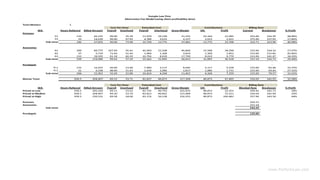
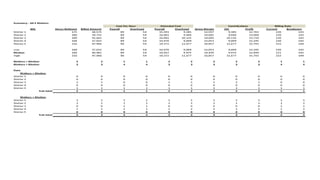
▸ The reporting result (samples to follow) :
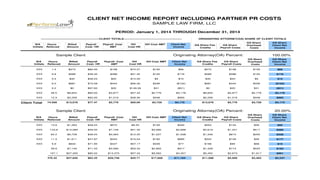
▸ Detail client net income report – Originator Sort
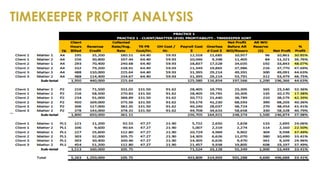
▸ Timekeeper profitability by client and Matter
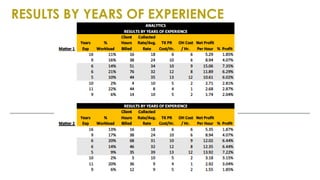
▸ Profitability by years of experience
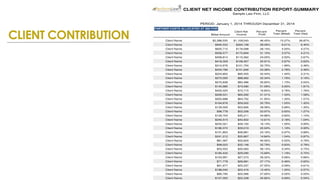
▸ Client Net Income Contribution Report – Summary
TIMEKEEPER PROFIT ANALYSIS
RESULTS BY YEARS OF EXPERIENCE
CLIENT CONTRIBUTION
www.PerformLaw.com
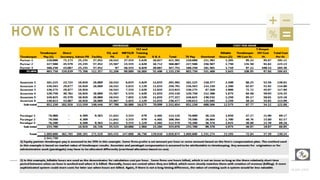
HOW IS IT CALCULATED?
▸ Data needed from time and billing system
▸ Fees billed by working attorney (WA) by client or matter*
▸ Hours billed by WA by client or matter
▸ Origination credit by client or matter
▸ AR write off by client or matter
▸ Fees billed and received by timekeeper
* If running at the matter level
www.PerformLaw.com
HOW IS IT CALCULATED?
▸ Other data needed
▸ Payroll and benefit history for the period
▸ Secretarial or direct support payroll
▸ Income statement - direct and indirect allocations
▸ Employee starts and terms during the period
▸ Allocation policy defining specific and general cost allocations
▸
www.PerformLaw.com
HOW IS IT CALCULATED?
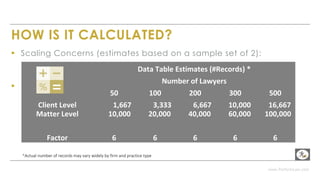
▸ Scaling Concerns (estimates based on a sample set of 2):
▸
Data	Table	Estimates	(#Records)	*
Number	of	Lawyers
50 100 200 300 500
Client	Level 1,667	 3,333	 6,667	 10,000	 16,667	
Matter	Level 10,000	 20,000	 40,000	 60,000	 100,000	
Factor	 6 6 6 6 6
*Actual	number	of	records	may	vary	widely	by	firm	and	practice	type
www.PerformLaw.com
HOW IS IT CALCULATED?
▸ Financial system profitability module
▸ Still perform many of the cost calculations and load
▸ May need enhanced reporting
▸ Should try first
▸ Other option is to use a 3rd party module
▸ Create an in house utility
www.PerformLaw.com
HOW IS IT CALCULATED?
▸ Direct costs
▸ Timekeeper salaries and benefits
▸ Billable hour versus standard hour divisor
▸ Easy to identify
www.PerformLaw.com
HOW IS IT CALCULATED?
▸ Specifically allocated overhead
▸ Sometimes also referred to as direct costs
▸ Secretarial and clerical support salaries and benefits
▸ Business development costs
▸ IT Costs*
* As per seat costing continues to become more prevalent, IT costs may be direct.
www.PerformLaw.com
HOW IS IT CALCULATED?
▸ Generally allocated overhead
▸ Facility costs;
▸ Equipment and practice aids
▸ Practice development*; and
▸ General and administrative costs.
* As mentioned previously, some of this is being specifically allocated.
www.PerformLaw.com
HOW IS IT CALCULATED?
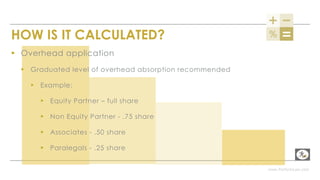
▸ Overhead application
▸ Graduated level of overhead absorption recommended
▸ Example:
▸ Equity Partner – full share
▸ Non Equity Partner - .75 share
▸ Associates - .50 share
▸ Paralegals - .25 share
‣WHY I RECOMMEND A
GRADUATED LEVEL OF
OVERHEAD ABSORPTION
www.PerformLaw.com
HOW IS IT CALCULATED?
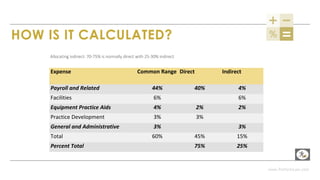
Expense	 Common	Range Direct Indirect
Payroll	and	Related 44% 40% 4%
Facilities 6% 6%
Equipment	Practice	Aids 4% 2% 2%
Practice	Development 3% 3%
General	and	Administrative 3% 3%
Total 60% 45% 15%
Percent	Total 75% 25%
Allocating	indirect:	70-75%	is	normally	direct	with	25-30%	indirect
www.PerformLaw.com
HOW IS IT CALCULATED?
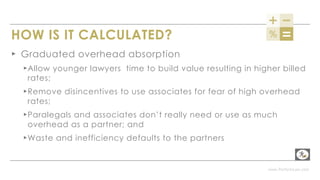
▸ Graduated overhead absorption
▸Allow younger lawyers time to build value resulting in higher billed
rates;
▸Remove disincentives to use associates for fear of high overhead
rates;
▸Paralegals and associates don’t really need or use as much
overhead as a partner; and
▸Waste and inefficiency defaults to the partners
www.PerformLaw.com
HOW IS IT CALCULATED?
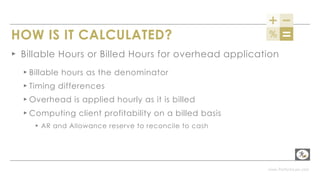
▸ Billable Hours or Billed Hours for overhead application
▸ Billable hours as the denominator
▸ Timing differences
▸ Overhead is applied hourly as it is billed
▸ Computing client profitability on a billed basis
▸ AR and Allowance reserve to reconcile to cash
www.PerformLaw.com
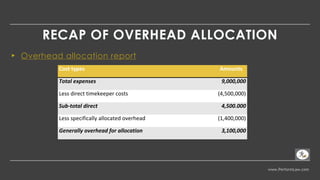
Cost	types Amounts
Total	expenses 9,000,000
Less	direct	timekeeper	costs (4,500,000)
Sub-total	direct 4,500.000
Less	specifically	allocated	overhead (1,400,000)
Generally	overhead	for	allocation 3,100,000
RECAP OF OVERHEAD ALLOCATION
▸ Overhead allocation report
21
www.PerformLaw.com
HOW IS IT CALCULATED?
www.PerformLaw.com
STRATEGIC CONSIDERATIONS
▸ Gross Margin
▸ Gross margin is the amount remaining after accounting for direct costs.
▸ Negative gross margins
▸ Partial contributions to overhead and no contribution to profit
www.PerformLaw.com
STRATEGIC CONSIDERATIONS
▸ Gross Margin Continued
▸ Examples of marginal cost thinking
▸ Start-up branch office, new practice area
▸ Attracting work from certain clients
▸ Firm growth
▸ Short term and long term
STRATEGIC
CONSIDERATIONS
All timekeepers ultimately need to
cover direct costs, absorb overhead
and contribute to profits, but there
are strategic components to a
timekeeper's contribution at a
given time.
www.PerformLaw.com
INTERPRETING RESULTS AND ACTION STEPS
▸ Net Profit
▸ Ability to cover all direct costs and overhead
▸ Acceptable profit margins
▸ Client ranking tools
▸ percent profit,
▸ actual profit dollars contributed,
▸ gross fees generated and
▸ overhead absorbed
www.PerformLaw.com
INTERPRETING RESULTS AND ACTION STEPS
▸ Net Profit Continued
▸ Analyzing a high-volume but underperforming account
▸ Efficiency of the staffing mix
▸ Competitiveness of the firm’s overhead structure
▸ Realization performance and indicated quality issues
▸ Billing rate increases
Utilize client profitability data,
rates, staffing mix, costs per hour
and overhead structure to
expand the options a firm has for
improving profits.
‣ Singular strategies are not
optimal.
‣ RECOMMENDATIONS
www.PerformLaw.com
USES OF CLIENT PROFITABILITY DATA
▸ Client pricing (Rates other pricing);
▸ http://performlaw.com/strategically-setting-billing-rates/
▸ Client staffing efficiency;
▸ Overhead efficiency;
▸ Compensation; and
▸ An Orderly transfer of equity(see performlawcom/blog 12-21post)
CLIENT PROFITABILITY
DATA AND PRICING
When pricing client work, firms should
consider the following :
• Existing position in the client’s buying
strategy?
• Existing and foreseeable market factors?
• Efficiency of client account staffing?
• Efficiency of overhead;
• Intangibles including fixed cost
absorption , training opportunities etc.;
and
• Opportunity costs
www.PerformLaw.com
CLIENT PROFITABILITY DATA AND PRICING
▸Alternative pricing approaches
▸ Blended rate
▸ Price at fixed point (median, low, high etc.)
▸ Data needed
▸ Analysis
www.PerformLaw.com
USES OF CLIENT PROFITABILITY DATA
www.PerformLaw.com
USES OF CLIENT PROFITABILITY DATA
www.PerformLaw.com
CLIENT
PRICING
‣ REMOVE THE GUESS WORK
‣ Measures
‣ Revenue and cost per hour
‣ Contribution margin %
‣ Profit $ and %
‣ Percent of firm profit
‣ Competitive concerns
‣ Subjective considerations (loss leader,
training, etc.)
-
www.PerformLaw.com
‣ WHAT SHOULD PARTNERS EXPECT?
‣ Pay partners a competitive market return
‣ Provide capital to build a practice
‣ Access to billable work while building a practice
‣ Better opportunities as result of association with other partners
DATA DRIVEN COMPENSATION
www.PerformLaw.com
CLIENT PROFITABILITY IN COMPENSATION
▸ A management tool
▸ Origination splitting policy
▸ Methodology for equating client net income to
compensation
▸ Mechanics can get contentious
▸ Powerful motivator
www.PerformLaw.com
HOW IS IT CALCULATED?
▸ Before we start, a note about originators and support
partners
▸ Origination polices
▸ Support partner originations
▸ Recommendations
▸ Origination credit if earned
▸ Production, Leveraging and Training Bonuses
www.PerformLaw.com
CLIENT PROFITABILITY & COMPENSATION
▸ How should we think about compensation?
▸ Market for compensating attorneys is mature
▸ Run compensation results / market payout
▸ Which system gives us the best chance at a right result?
▸ Objective with a subjective component
▸ Pure objective
▸ Pure subjective
www.PerformLaw.com
CLIENT PROFITABILITY & COMPENSATION
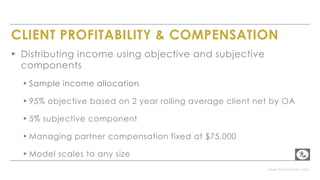
▸ Distributing income using objective and subjective
components
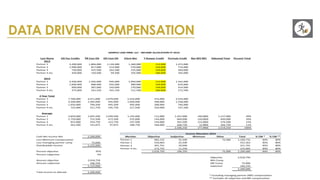
▸ Sample income allocation
▸ 95% objective based on 2 year rolling average client net by OA
▸ 5% subjective component
▸ Managing partner compensation fixed at $75,000
▸ Model scales to any size
DATA DRIVEN COMPENSATION
www.PerformLaw.com
CLIENT PROFITABILITY & COMPENSATION
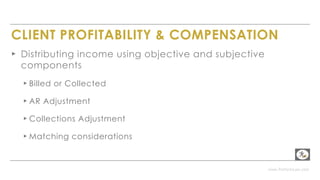
▸ Distributing income using objective and subjective
components
▸ Billed or Collected
▸ AR Adjustment
▸ Collections Adjustment
▸ Matching considerations
www.PerformLaw.com
• Fears & Resistance
• Truth in the numbers
• Compensation changes
• Moving from subjective to
objective
GETTING
STARTED
CLIENT PROFITABILITY
& COMPENSATION
www.PerformLaw.com
• Challenges
• Data and resources not always
available
• Financial systems not fully
implemented
• Analysis usually sought in hard
times
GETTING
STARTED
CLIENT PROFITABILITY
& COMPENSATION
www.PerformLaw.com
CLIENT PROFITABILITY
& COMPENSATION
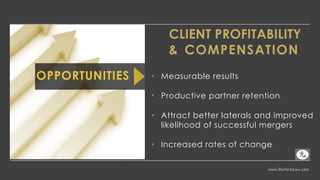
• Measurable results
• Productive partner retention
• Attract better laterals and improved
likelihood of successful mergers
• Increased rates of change
OPPORTUNITIES
www.PerformLaw.com
CLIENT PROFITABILITY
& COMPENSATION
• Large swings in compensation from
one year to the next
• Splitting origination credit
• Incentives for working with other
partners
• Adjusting points of ownership
CONCERNS
www.PerformLaw.com
CLIENT PROFITABILITY
& COMPENSATION
• Linking client profitability to
compensation can best be
described as a process that takes
time to mature.
• Partners will come to understand
that changes to their pricing,
staffing and management
approach may be necessary.
• Over time contribution to profit =
market pay
OPPORTUNITIES
& CONCERNS
www.PerformLaw.com
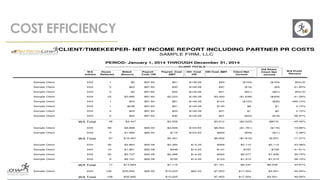
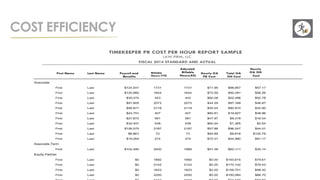
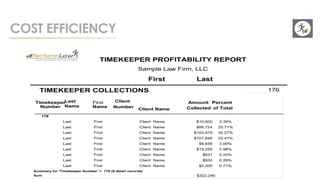
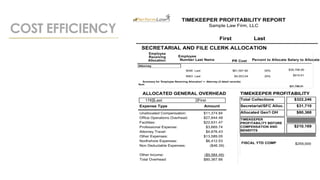
COST
EFFICIENCY
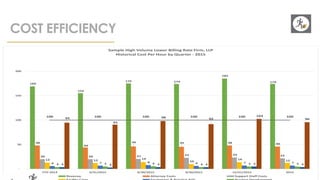
‣ COST SIDE
MEASUREMENTS AND
BENCHMARKS
‣ Approach and Tools
‣ It is about getting value for your
spend
‣ Cost solutions or Revenue solutions
-
COST EFFICIENCY
COST EFFICIENCY
COST EFFICIENCY
COST EFFICIENCY
COST EFFICIENCY
www.PerformLaw.com
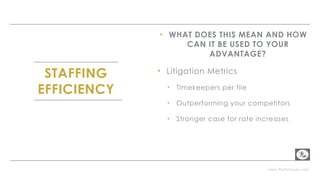
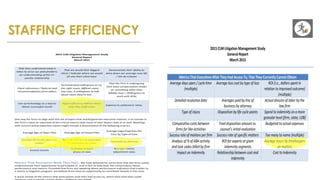
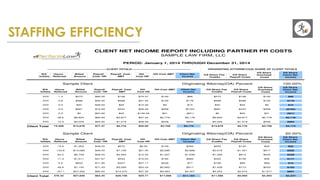
STAFFING
EFFICIENCY
‣ WHAT DOES THIS MEAN AND HOW
CAN IT BE USED TO YOUR
ADVANTAGE?
‣ Litigation Metrics
‣ Timekeepers per file
‣ Outperforming your competitors
‣ Stronger case for rate increases
STAFFING EFFICIENCY
STAFFING EFFICIENCY
www.PerformLaw.com
ASSOCIATE COMPENSATION
HOW SHOULD WE PAY ASSOCIATES?
? What should you do when market pay and associate
contributions are not aligned?
? Is compensation an incentive after a certain point?
? Should associate base salary contain more base pay or more
bonus?
www.PerformLaw.com
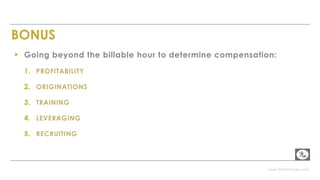
BONUS
▸ Going beyond the billable hour to determine compensation:
1. PROFITABILITY
2. ORIGINATIONS
3. TRAINING
4. LEVERAGING
5. RECRUITING
www.PerformLaw.com
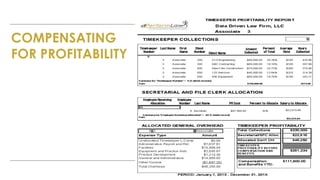
COMPENSATING
FOR PROFITABILITY
www.PerformLaw.com
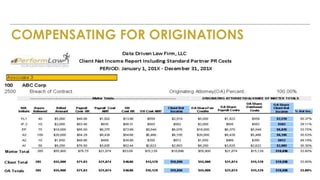
COMPENSATING FOR ORIGINATIONS
www.PerformLaw.com
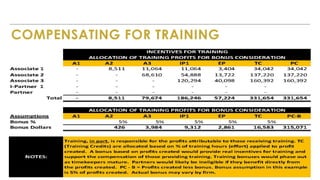
COMPENSATING FOR TRAINING
www.PerformLaw.com
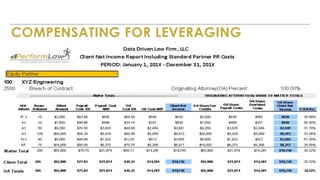
COMPENSATING FOR LEVERAGING
www.PerformLaw.com
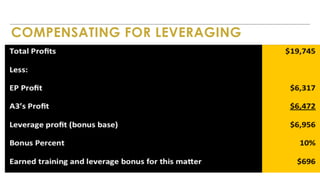
COMPENSATING FOR LEVERAGING
www.PerformLaw.com
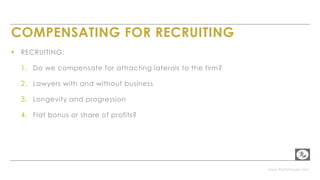
COMPENSATING FOR RECRUITING
▸ RECRUITING:
1. Do we compensate for attracting laterals to the firm?
2. Lawyers with and without business
3. Longevity and progression
4. Flat bonus or share of profits?
www.PerformLaw.com
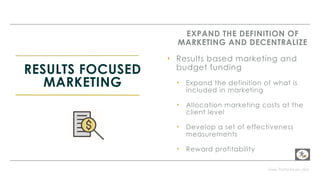
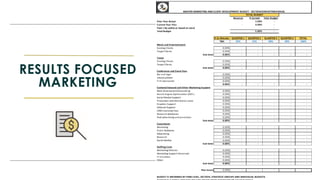
RESULTS FOCUSED
MARKETING
EXPAND THE DEFINITION OF
MARKETING AND DECENTRALIZE
‣ Results based marketing and
budget funding
‣ Expand the definition of what is
included in marketing
‣ Allocation marketing costs at the
client level
‣ Develop a set of effectiveness
measurements
‣ Reward profitability
www.PerformLaw.com
RESULTS FOCUSED
MARKETING
www.PerformLaw.com
‣ HELPFUL ARTICLES
‣ Metrics to Improve Law Firm
Marketing Effectiveness
‣ Law Firm Marketing: Get the Whole
Story
RESULTS FOCUSED
MARKETING
Thank You.
WWW.PERFORMLAW.COM

Client Profitability: Analysis to Action

  • 1.
    Performlaw.com CLIENT PROFITABILITY: ANALYSIS TOACTION Presented By: Brian Kennel
  • 2.
    www.PerformLaw.com SESSION TOPICS ▸ Reliablemethods for computing client profitability ▸ Client profitability data and client pricing, AFA’s workload distribution and overhead control ▸ Opportunities, pitfalls and first time considerations ▸ Client profitability data and compensation ▸ Advantages of using client profitability models in lateral and merger analysis – performlaw.com/blog – case study 2/9 and 3/8 post
  • 3.
    www.PerformLaw.com USES OF CLIENTPROFITABILITY DATA ▸ Client pricing (Rates other pricing); ▸ Article: Strategically Setting Billing Rates ▸ Client staffing efficiency; ▸ Overhead efficiency; ▸ Compensation; and ▸ Orderly transfer of equity.
  • 4.
    www.PerformLaw.com METHODOLOGY ▸ The reportingresult (samples to follow) : ▸ Detail client net income report – Originator Sort ▸ Timekeeper profitability by client and Matter ▸ Profitability by years of experience ▸ Client Net Income Contribution Report – Summary
  • 6.
  • 7.
    RESULTS BY YEARSOF EXPERIENCE
  • 8.
  • 9.
    www.PerformLaw.com HOW IS ITCALCULATED? ▸ Data needed from time and billing system ▸ Fees billed by working attorney (WA) by client or matter* ▸ Hours billed by WA by client or matter ▸ Origination credit by client or matter ▸ AR write off by client or matter ▸ Fees billed and received by timekeeper * If running at the matter level
  • 10.
    www.PerformLaw.com HOW IS ITCALCULATED? ▸ Other data needed ▸ Payroll and benefit history for the period ▸ Secretarial or direct support payroll ▸ Income statement - direct and indirect allocations ▸ Employee starts and terms during the period ▸ Allocation policy defining specific and general cost allocations ▸
  • 11.
    www.PerformLaw.com HOW IS ITCALCULATED? ▸ Scaling Concerns (estimates based on a sample set of 2): ▸ Data Table Estimates (#Records) * Number of Lawyers 50 100 200 300 500 Client Level 1,667 3,333 6,667 10,000 16,667 Matter Level 10,000 20,000 40,000 60,000 100,000 Factor 6 6 6 6 6 *Actual number of records may vary widely by firm and practice type
  • 12.
    www.PerformLaw.com HOW IS ITCALCULATED? ▸ Financial system profitability module ▸ Still perform many of the cost calculations and load ▸ May need enhanced reporting ▸ Should try first ▸ Other option is to use a 3rd party module ▸ Create an in house utility
  • 13.
    www.PerformLaw.com HOW IS ITCALCULATED? ▸ Direct costs ▸ Timekeeper salaries and benefits ▸ Billable hour versus standard hour divisor ▸ Easy to identify
  • 14.
    www.PerformLaw.com HOW IS ITCALCULATED? ▸ Specifically allocated overhead ▸ Sometimes also referred to as direct costs ▸ Secretarial and clerical support salaries and benefits ▸ Business development costs ▸ IT Costs* * As per seat costing continues to become more prevalent, IT costs may be direct.
  • 15.
    www.PerformLaw.com HOW IS ITCALCULATED? ▸ Generally allocated overhead ▸ Facility costs; ▸ Equipment and practice aids ▸ Practice development*; and ▸ General and administrative costs. * As mentioned previously, some of this is being specifically allocated.
  • 16.
    www.PerformLaw.com HOW IS ITCALCULATED? ▸ Overhead application ▸ Graduated level of overhead absorption recommended ▸ Example: ▸ Equity Partner – full share ▸ Non Equity Partner - .75 share ▸ Associates - .50 share ▸ Paralegals - .25 share
  • 17.
    ‣WHY I RECOMMENDA GRADUATED LEVEL OF OVERHEAD ABSORPTION
  • 18.
    www.PerformLaw.com HOW IS ITCALCULATED? Expense Common Range Direct Indirect Payroll and Related 44% 40% 4% Facilities 6% 6% Equipment Practice Aids 4% 2% 2% Practice Development 3% 3% General and Administrative 3% 3% Total 60% 45% 15% Percent Total 75% 25% Allocating indirect: 70-75% is normally direct with 25-30% indirect
  • 19.
    www.PerformLaw.com HOW IS ITCALCULATED? ▸ Graduated overhead absorption ▸Allow younger lawyers time to build value resulting in higher billed rates; ▸Remove disincentives to use associates for fear of high overhead rates; ▸Paralegals and associates don’t really need or use as much overhead as a partner; and ▸Waste and inefficiency defaults to the partners
  • 20.
    www.PerformLaw.com HOW IS ITCALCULATED? ▸ Billable Hours or Billed Hours for overhead application ▸ Billable hours as the denominator ▸ Timing differences ▸ Overhead is applied hourly as it is billed ▸ Computing client profitability on a billed basis ▸ AR and Allowance reserve to reconcile to cash
  • 21.
    www.PerformLaw.com Cost types Amounts Total expenses 9,000,000 Less direct timekeeper costs(4,500,000) Sub-total direct 4,500.000 Less specifically allocated overhead (1,400,000) Generally overhead for allocation 3,100,000 RECAP OF OVERHEAD ALLOCATION ▸ Overhead allocation report 21
  • 22.
  • 23.
    www.PerformLaw.com STRATEGIC CONSIDERATIONS ▸ GrossMargin ▸ Gross margin is the amount remaining after accounting for direct costs. ▸ Negative gross margins ▸ Partial contributions to overhead and no contribution to profit
  • 24.
    www.PerformLaw.com STRATEGIC CONSIDERATIONS ▸ GrossMargin Continued ▸ Examples of marginal cost thinking ▸ Start-up branch office, new practice area ▸ Attracting work from certain clients ▸ Firm growth ▸ Short term and long term
  • 25.
    STRATEGIC CONSIDERATIONS All timekeepers ultimatelyneed to cover direct costs, absorb overhead and contribute to profits, but there are strategic components to a timekeeper's contribution at a given time.
  • 26.
    www.PerformLaw.com INTERPRETING RESULTS ANDACTION STEPS ▸ Net Profit ▸ Ability to cover all direct costs and overhead ▸ Acceptable profit margins ▸ Client ranking tools ▸ percent profit, ▸ actual profit dollars contributed, ▸ gross fees generated and ▸ overhead absorbed
  • 27.
    www.PerformLaw.com INTERPRETING RESULTS ANDACTION STEPS ▸ Net Profit Continued ▸ Analyzing a high-volume but underperforming account ▸ Efficiency of the staffing mix ▸ Competitiveness of the firm’s overhead structure ▸ Realization performance and indicated quality issues ▸ Billing rate increases
  • 28.
    Utilize client profitabilitydata, rates, staffing mix, costs per hour and overhead structure to expand the options a firm has for improving profits. ‣ Singular strategies are not optimal. ‣ RECOMMENDATIONS
  • 29.
    www.PerformLaw.com USES OF CLIENTPROFITABILITY DATA ▸ Client pricing (Rates other pricing); ▸ http://performlaw.com/strategically-setting-billing-rates/ ▸ Client staffing efficiency; ▸ Overhead efficiency; ▸ Compensation; and ▸ An Orderly transfer of equity(see performlawcom/blog 12-21post)
  • 30.
    CLIENT PROFITABILITY DATA ANDPRICING When pricing client work, firms should consider the following : • Existing position in the client’s buying strategy? • Existing and foreseeable market factors? • Efficiency of client account staffing? • Efficiency of overhead; • Intangibles including fixed cost absorption , training opportunities etc.; and • Opportunity costs
  • 31.
    www.PerformLaw.com CLIENT PROFITABILITY DATAAND PRICING ▸Alternative pricing approaches ▸ Blended rate ▸ Price at fixed point (median, low, high etc.) ▸ Data needed ▸ Analysis
  • 32.
  • 33.
  • 34.
    www.PerformLaw.com CLIENT PRICING ‣ REMOVE THEGUESS WORK ‣ Measures ‣ Revenue and cost per hour ‣ Contribution margin % ‣ Profit $ and % ‣ Percent of firm profit ‣ Competitive concerns ‣ Subjective considerations (loss leader, training, etc.) -
  • 35.
    www.PerformLaw.com ‣ WHAT SHOULDPARTNERS EXPECT? ‣ Pay partners a competitive market return ‣ Provide capital to build a practice ‣ Access to billable work while building a practice ‣ Better opportunities as result of association with other partners DATA DRIVEN COMPENSATION
  • 36.
    www.PerformLaw.com CLIENT PROFITABILITY INCOMPENSATION ▸ A management tool ▸ Origination splitting policy ▸ Methodology for equating client net income to compensation ▸ Mechanics can get contentious ▸ Powerful motivator
  • 37.
    www.PerformLaw.com HOW IS ITCALCULATED? ▸ Before we start, a note about originators and support partners ▸ Origination polices ▸ Support partner originations ▸ Recommendations ▸ Origination credit if earned ▸ Production, Leveraging and Training Bonuses
  • 38.
    www.PerformLaw.com CLIENT PROFITABILITY &COMPENSATION ▸ How should we think about compensation? ▸ Market for compensating attorneys is mature ▸ Run compensation results / market payout ▸ Which system gives us the best chance at a right result? ▸ Objective with a subjective component ▸ Pure objective ▸ Pure subjective
  • 39.
    www.PerformLaw.com CLIENT PROFITABILITY &COMPENSATION ▸ Distributing income using objective and subjective components ▸ Sample income allocation ▸ 95% objective based on 2 year rolling average client net by OA ▸ 5% subjective component ▸ Managing partner compensation fixed at $75,000 ▸ Model scales to any size
  • 40.
  • 41.
    www.PerformLaw.com CLIENT PROFITABILITY &COMPENSATION ▸ Distributing income using objective and subjective components ▸ Billed or Collected ▸ AR Adjustment ▸ Collections Adjustment ▸ Matching considerations
  • 42.
    www.PerformLaw.com • Fears &Resistance • Truth in the numbers • Compensation changes • Moving from subjective to objective GETTING STARTED CLIENT PROFITABILITY & COMPENSATION
  • 43.
    www.PerformLaw.com • Challenges • Dataand resources not always available • Financial systems not fully implemented • Analysis usually sought in hard times GETTING STARTED CLIENT PROFITABILITY & COMPENSATION
  • 44.
    www.PerformLaw.com CLIENT PROFITABILITY & COMPENSATION •Measurable results • Productive partner retention • Attract better laterals and improved likelihood of successful mergers • Increased rates of change OPPORTUNITIES
  • 45.
    www.PerformLaw.com CLIENT PROFITABILITY & COMPENSATION •Large swings in compensation from one year to the next • Splitting origination credit • Incentives for working with other partners • Adjusting points of ownership CONCERNS
  • 46.
    www.PerformLaw.com CLIENT PROFITABILITY & COMPENSATION •Linking client profitability to compensation can best be described as a process that takes time to mature. • Partners will come to understand that changes to their pricing, staffing and management approach may be necessary. • Over time contribution to profit = market pay OPPORTUNITIES & CONCERNS
  • 47.
    www.PerformLaw.com COST EFFICIENCY ‣ COST SIDE MEASUREMENTSAND BENCHMARKS ‣ Approach and Tools ‣ It is about getting value for your spend ‣ Cost solutions or Revenue solutions -
  • 48.
  • 49.
  • 50.
  • 51.
  • 52.
  • 53.
    www.PerformLaw.com STAFFING EFFICIENCY ‣ WHAT DOESTHIS MEAN AND HOW CAN IT BE USED TO YOUR ADVANTAGE? ‣ Litigation Metrics ‣ Timekeepers per file ‣ Outperforming your competitors ‣ Stronger case for rate increases
  • 54.
  • 55.
  • 57.
    www.PerformLaw.com ASSOCIATE COMPENSATION HOW SHOULDWE PAY ASSOCIATES? ? What should you do when market pay and associate contributions are not aligned? ? Is compensation an incentive after a certain point? ? Should associate base salary contain more base pay or more bonus?
  • 58.
    www.PerformLaw.com BONUS ▸ Going beyondthe billable hour to determine compensation: 1. PROFITABILITY 2. ORIGINATIONS 3. TRAINING 4. LEVERAGING 5. RECRUITING
  • 59.
  • 60.
  • 61.
  • 62.
  • 63.
  • 64.
    www.PerformLaw.com COMPENSATING FOR RECRUITING ▸RECRUITING: 1. Do we compensate for attracting laterals to the firm? 2. Lawyers with and without business 3. Longevity and progression 4. Flat bonus or share of profits?
  • 65.
    www.PerformLaw.com RESULTS FOCUSED MARKETING EXPAND THEDEFINITION OF MARKETING AND DECENTRALIZE ‣ Results based marketing and budget funding ‣ Expand the definition of what is included in marketing ‣ Allocation marketing costs at the client level ‣ Develop a set of effectiveness measurements ‣ Reward profitability
  • 66.
  • 67.
    www.PerformLaw.com ‣ HELPFUL ARTICLES ‣Metrics to Improve Law Firm Marketing Effectiveness ‣ Law Firm Marketing: Get the Whole Story RESULTS FOCUSED MARKETING
  • 68.