Pricing in Professional Services: Fees, Billable Hours, and Firm StrategyAugust 5th 2009Lexis NexisRobert SawhneyManaging DirectorSRC Associates Ltd1www.srchk.com
What if?You worked less hours and earned moreYou and your people were more motivatedTime sheets were a thing of the pastYour value and knowledge counted more than your timeYou derived greater job satisfaction from your workYou learn and challenge yourself regularlywww.srchk.com2
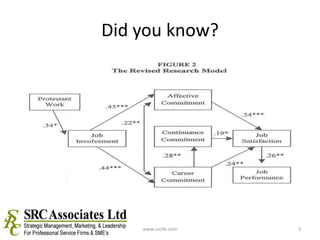
Did you know?www.srchk.com3
And that…Commission on Billable Hours Report: ABA 2001-2The NegativesAffects the culture of the firm and reduces the collegialityDiscourages pro bono workDoes not encourage case or project planningMay not reflect value to the clientFails to discourage layering and duplicationPenalizes the productive lawyerCreates itemized bills that do not reflect valueCreates conflict of interest between client and lawyerFails to promote risk/benefit analysis…and One of the major causes of associate dissatisfactionwww.srchk.com4
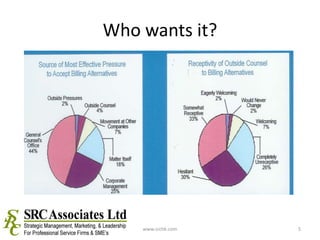
Who wants it?www.srchk.com5
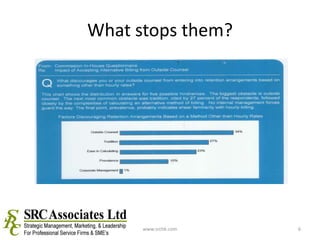
What stops them?www.srchk.com6
Pricing and Firm StrategyAccording to research conducted at the Centre for Management of Professional Services (Said Business School, Oxford University), a firm's ability to differentiate itself and create a sustainable strategy relies on four factors:·  Expertise - knowledge and experience ·  Relationships - clients and other stakeholders ·  Reputation - expertise, experience, and engagement ·  Service - processes, services, and engagement According to the authors, a sustainable strategy can be built around these four factors whereby they create a virtuous cycle of innovation, organisation learning and knowledge management, as well as access to new markets. The authors' research demonstrates clearly that for a firm to create differentiation that means something (ie value perceptions to client), a firm must spend time on factors aside from technical quality of work.www.srchk.com7
Cont’dStrategy is about choiceThat choice revolves around which markets you will serve and with what services, and how you structure the firm to achieve your objectives in those areasYou cannot be all things to all peoplePricing and strategy are related because being able to claim superiority relies on your firms ability to truly demonstrate a differentiated service to clients, if they perceive it as so they will pay for itwww.srchk.com8
The problem with hourly billingFocus on maximum utilisationValue and time considered the sameRemuneration based on narrow criteriaHence:Where is the incentive for people and the firm to engage in non billable time that will enhance the strategic processes of the firm?www.srchk.com9
Example Slaughter and MayFocus on key, high end practice areasLimited geographic exposure with “best friends” networkOnly firm to reach PEP of over 2 million poundsOnly magic circle firm not to downsizeCriticized for not having a banking practice, not now howeverBig 4 audit feesResearch shows a premium of up to 30%Global reach and international experienceReputation Client relationships and leveraging of knowledge management Competencies in institutionalizing a consistent servicewww.srchk.com10
Innovative capability Professionals are knowledge workers, a phrase coined by Peter Drucker many years ago, and as such require stimulation and growth from their work. Billable hours and realization rates only go to stifle this in many instancesAdditionally, why would a client let you raise fees? Are you offering more value than in the past? Have you innovated?Is innovation valued, encouraged, rewarded?www.srchk.com11
Compensation and Chicken & EggIf you believe that your compensation is tied to the existing paradigm of revenue management then what are the odds you will spend time on non billable activities?Yet it is these non billable hours that lay at the heart of future firm viability, innovation, and client satisfaction/retention Think about it like this, if the KCR wants you to ride their new route (such as the recently built West Rail), first they have to build the capacity and then await passengers. Yet in the PSF, this works in the opposite direction, new juniors and associates are not hired until expected utilization is upward of 70%, this maybe great for billable hours but it does nothing to add to the innovation capacity of the firm which is where true long term success lieswww.srchk.com12
Cutting Fees, Types of Work, and Firm PerformanceFee cutting without a quid pro quo is never a good idea. If you unilaterally reduce fees you lead your client to one conclusion: your services are commodities and have little value differentiation. According to Alan Weiss (author of How to Maximise Fees in Professional Services), if you must lower your fees then reduce some of the value you offer to the client or receive something in return (such as guaranteed future volume of work). If your firm does accept all types of work and habitually lowers fees to get it, one must understand the chain effect on the entire firm. Giving professionals repetitive work that lacks challenge and learning will negatively impact their motivation and job satisfaction. This has massive implications for firm performance and profitability. Firms rely on their human assets. Research by David Maister (author of Managing the Professional Service Firm and Practice What You Preach) in the professional services industry clearly demonstrates an empirical link between job satisfaction and firm performance. How satisfied do you think your people are likely to be when they are thought of as billable machines that live by their time sheet? www.srchk.com13
Pricing strategiesThese fall into two broad categories (Berry and Yadav, Sloan Management Review, 1996):Pricing strategies to reduce uncertainty-such as service guarantees, outcome based pricing and fixed price agreementsRelationship pricing-such as discounted rates and value added benefits for large volumes of work and longer term relationshipswww.srchk.com14
Value pricingIts not just about charging a premium price, its about offering a differentiated service that is perceived as valuable to clientsValue pricing success is contingent upon adopting a marketing culture into the very fabric of the firmIts about a change of mind setFor example, Barclays recent demands on its reduced law firms panel re alternative billing and diversity policieswww.srchk.com15
ExampleFrom Dave Bohrer of Confluence Law Partners on IP defense litigation:In the case of fighting trolls, hi-tech does not want to pay the $5 million-plus charged by hourly firms. The fixed-price discussion necessarily focuses on lowering the cost to levels where it is less expensive to fight than settle. One of the unanticipated advantages of this process, according to Neal Rubin [of Cisco], is that "counsel's willingness (or unwillingness) to share the risks and rewards of litigation can help  [Cisco] assess the strengths and weaknesses of its case. While firms are not equally risk positive or averse, a firm's willingness to accept risk provides a useful litmus test that can help instruct the client whether it has realistically assessed the strength of the case. The straight billable hour model provides no such feedback." www.srchk.com16
More Exampleshttp://www.valoremlaw.com/http://www.abajournal.com/index.php?/news/is_shift_from_billable_hour_motivated_by_greed/From my experience, less than 10% of a law firms billing in Asia is anything other than hourlywww.srchk.com17
Cont’dAs reported by Jim Schroeder in American Lawyer, the most profitable law firms excel in one or more areas and are known for itHarry Mills of the Mills Group suggests there are 4 levels of pricing practices:Basement pricing (cost plus)First floor (competitor driven)Second floor (exclusive benefits)Rooftop (brand pricing)He estimates only 20% of firms reside at the top 2 levelswww.srchk.com18
Alternative Billing Methods and their UseFixed price agreements (FPA) – the bundling together of services say over a time period or matter with unlimited access to service providerChange order – these are put in place when additional service needs arise that are not covered in the original FPA and services rendered here are charged separatelyService guarantees – perhaps worrying but some PSF are offering money back guarantees based on client satisfaction at the discretion of the clientwww.srchk.com19
Cont’dRisk based – sharing in the savings/revenue generated for clients or the size of a transactionDiscounted rates for guaranteed volume of workTask based – set fee for each task such as filing a motion, deposition etcDiscount rate plus kicker – agreed hourly rate plus performance based payAnnual retainerswww.srchk.com20
5 C’s of Value (Nagle and Holden, 2002)Comprehend – what drives value for your customers. Understand their needs, not just what services you/they think are requiredCreate – value for clients. Bundle your services in a way that meets those needs Communicate – the value you create. If people don’t understand, they won’t pay for itConvince – clients to pay for value received and if they only care about price, then???Capture – that value through appropriate pricingwww.srchk.com21
Best & Worst PracticeProductivity does not equal efficiency!!! It is a combination of effectiveness and efficiency. Just because you are efficient does not mean you are doing the right things!!!According to the ABA, any system that ties compensation rigidly to billable hours with no flexibility is ‘worst practice’.www.srchk.com22
Cont’dSome examples of best practice in associate and partner compensation to escape the mire of the billable hour:Weighted productivity – pay is linked to hours x quality rating of person Ceiling on hours – limits the number of billable hours that can be claimed, linked to other compensation:Pro Bono – credit and bonus for this workFocus on quality – create criteria and measurewww.srchk.com23
Thank YouFurther questions?Contact me at bob@srchk.comSee our blog: www.marketingasia.typepad.comSee articles section on our web site: www.srchk.comwww.srchk.com24

Pricing Seminar Ln Aug 5th 2009 Linked In Version

  • 1.
    Pricing in ProfessionalServices: Fees, Billable Hours, and Firm StrategyAugust 5th 2009Lexis NexisRobert SawhneyManaging DirectorSRC Associates Ltd1www.srchk.com
  • 2.
    What if?You workedless hours and earned moreYou and your people were more motivatedTime sheets were a thing of the pastYour value and knowledge counted more than your timeYou derived greater job satisfaction from your workYou learn and challenge yourself regularlywww.srchk.com2
  • 3.
  • 4.
    And that…Commission onBillable Hours Report: ABA 2001-2The NegativesAffects the culture of the firm and reduces the collegialityDiscourages pro bono workDoes not encourage case or project planningMay not reflect value to the clientFails to discourage layering and duplicationPenalizes the productive lawyerCreates itemized bills that do not reflect valueCreates conflict of interest between client and lawyerFails to promote risk/benefit analysis…and One of the major causes of associate dissatisfactionwww.srchk.com4
  • 5.
  • 6.
  • 7.
    Pricing and FirmStrategyAccording to research conducted at the Centre for Management of Professional Services (Said Business School, Oxford University), a firm's ability to differentiate itself and create a sustainable strategy relies on four factors:· Expertise - knowledge and experience · Relationships - clients and other stakeholders · Reputation - expertise, experience, and engagement · Service - processes, services, and engagement According to the authors, a sustainable strategy can be built around these four factors whereby they create a virtuous cycle of innovation, organisation learning and knowledge management, as well as access to new markets. The authors' research demonstrates clearly that for a firm to create differentiation that means something (ie value perceptions to client), a firm must spend time on factors aside from technical quality of work.www.srchk.com7
  • 8.
    Cont’dStrategy is aboutchoiceThat choice revolves around which markets you will serve and with what services, and how you structure the firm to achieve your objectives in those areasYou cannot be all things to all peoplePricing and strategy are related because being able to claim superiority relies on your firms ability to truly demonstrate a differentiated service to clients, if they perceive it as so they will pay for itwww.srchk.com8
  • 9.
    The problem withhourly billingFocus on maximum utilisationValue and time considered the sameRemuneration based on narrow criteriaHence:Where is the incentive for people and the firm to engage in non billable time that will enhance the strategic processes of the firm?www.srchk.com9
  • 10.
    Example Slaughter andMayFocus on key, high end practice areasLimited geographic exposure with “best friends” networkOnly firm to reach PEP of over 2 million poundsOnly magic circle firm not to downsizeCriticized for not having a banking practice, not now howeverBig 4 audit feesResearch shows a premium of up to 30%Global reach and international experienceReputation Client relationships and leveraging of knowledge management Competencies in institutionalizing a consistent servicewww.srchk.com10
  • 11.
    Innovative capability Professionalsare knowledge workers, a phrase coined by Peter Drucker many years ago, and as such require stimulation and growth from their work. Billable hours and realization rates only go to stifle this in many instancesAdditionally, why would a client let you raise fees? Are you offering more value than in the past? Have you innovated?Is innovation valued, encouraged, rewarded?www.srchk.com11
  • 12.
    Compensation and Chicken& EggIf you believe that your compensation is tied to the existing paradigm of revenue management then what are the odds you will spend time on non billable activities?Yet it is these non billable hours that lay at the heart of future firm viability, innovation, and client satisfaction/retention Think about it like this, if the KCR wants you to ride their new route (such as the recently built West Rail), first they have to build the capacity and then await passengers. Yet in the PSF, this works in the opposite direction, new juniors and associates are not hired until expected utilization is upward of 70%, this maybe great for billable hours but it does nothing to add to the innovation capacity of the firm which is where true long term success lieswww.srchk.com12
  • 13.
    Cutting Fees, Typesof Work, and Firm PerformanceFee cutting without a quid pro quo is never a good idea. If you unilaterally reduce fees you lead your client to one conclusion: your services are commodities and have little value differentiation. According to Alan Weiss (author of How to Maximise Fees in Professional Services), if you must lower your fees then reduce some of the value you offer to the client or receive something in return (such as guaranteed future volume of work). If your firm does accept all types of work and habitually lowers fees to get it, one must understand the chain effect on the entire firm. Giving professionals repetitive work that lacks challenge and learning will negatively impact their motivation and job satisfaction. This has massive implications for firm performance and profitability. Firms rely on their human assets. Research by David Maister (author of Managing the Professional Service Firm and Practice What You Preach) in the professional services industry clearly demonstrates an empirical link between job satisfaction and firm performance. How satisfied do you think your people are likely to be when they are thought of as billable machines that live by their time sheet? www.srchk.com13
  • 14.
    Pricing strategiesThese fallinto two broad categories (Berry and Yadav, Sloan Management Review, 1996):Pricing strategies to reduce uncertainty-such as service guarantees, outcome based pricing and fixed price agreementsRelationship pricing-such as discounted rates and value added benefits for large volumes of work and longer term relationshipswww.srchk.com14
  • 15.
    Value pricingIts notjust about charging a premium price, its about offering a differentiated service that is perceived as valuable to clientsValue pricing success is contingent upon adopting a marketing culture into the very fabric of the firmIts about a change of mind setFor example, Barclays recent demands on its reduced law firms panel re alternative billing and diversity policieswww.srchk.com15
  • 16.
    ExampleFrom Dave Bohrerof Confluence Law Partners on IP defense litigation:In the case of fighting trolls, hi-tech does not want to pay the $5 million-plus charged by hourly firms. The fixed-price discussion necessarily focuses on lowering the cost to levels where it is less expensive to fight than settle. One of the unanticipated advantages of this process, according to Neal Rubin [of Cisco], is that "counsel's willingness (or unwillingness) to share the risks and rewards of litigation can help  [Cisco] assess the strengths and weaknesses of its case. While firms are not equally risk positive or averse, a firm's willingness to accept risk provides a useful litmus test that can help instruct the client whether it has realistically assessed the strength of the case. The straight billable hour model provides no such feedback." www.srchk.com16
  • 17.
    More Exampleshttp://www.valoremlaw.com/http://www.abajournal.com/index.php?/news/is_shift_from_billable_hour_motivated_by_greed/From myexperience, less than 10% of a law firms billing in Asia is anything other than hourlywww.srchk.com17
  • 18.
    Cont’dAs reported byJim Schroeder in American Lawyer, the most profitable law firms excel in one or more areas and are known for itHarry Mills of the Mills Group suggests there are 4 levels of pricing practices:Basement pricing (cost plus)First floor (competitor driven)Second floor (exclusive benefits)Rooftop (brand pricing)He estimates only 20% of firms reside at the top 2 levelswww.srchk.com18
  • 19.
    Alternative Billing Methodsand their UseFixed price agreements (FPA) – the bundling together of services say over a time period or matter with unlimited access to service providerChange order – these are put in place when additional service needs arise that are not covered in the original FPA and services rendered here are charged separatelyService guarantees – perhaps worrying but some PSF are offering money back guarantees based on client satisfaction at the discretion of the clientwww.srchk.com19
  • 20.
    Cont’dRisk based –sharing in the savings/revenue generated for clients or the size of a transactionDiscounted rates for guaranteed volume of workTask based – set fee for each task such as filing a motion, deposition etcDiscount rate plus kicker – agreed hourly rate plus performance based payAnnual retainerswww.srchk.com20
  • 21.
    5 C’s ofValue (Nagle and Holden, 2002)Comprehend – what drives value for your customers. Understand their needs, not just what services you/they think are requiredCreate – value for clients. Bundle your services in a way that meets those needs Communicate – the value you create. If people don’t understand, they won’t pay for itConvince – clients to pay for value received and if they only care about price, then???Capture – that value through appropriate pricingwww.srchk.com21
  • 22.
    Best & WorstPracticeProductivity does not equal efficiency!!! It is a combination of effectiveness and efficiency. Just because you are efficient does not mean you are doing the right things!!!According to the ABA, any system that ties compensation rigidly to billable hours with no flexibility is ‘worst practice’.www.srchk.com22
  • 23.
    Cont’dSome examples ofbest practice in associate and partner compensation to escape the mire of the billable hour:Weighted productivity – pay is linked to hours x quality rating of person Ceiling on hours – limits the number of billable hours that can be claimed, linked to other compensation:Pro Bono – credit and bonus for this workFocus on quality – create criteria and measurewww.srchk.com23
  • 24.
    Thank YouFurther questions?Contactme at bob@srchk.comSee our blog: www.marketingasia.typepad.comSee articles section on our web site: www.srchk.comwww.srchk.com24