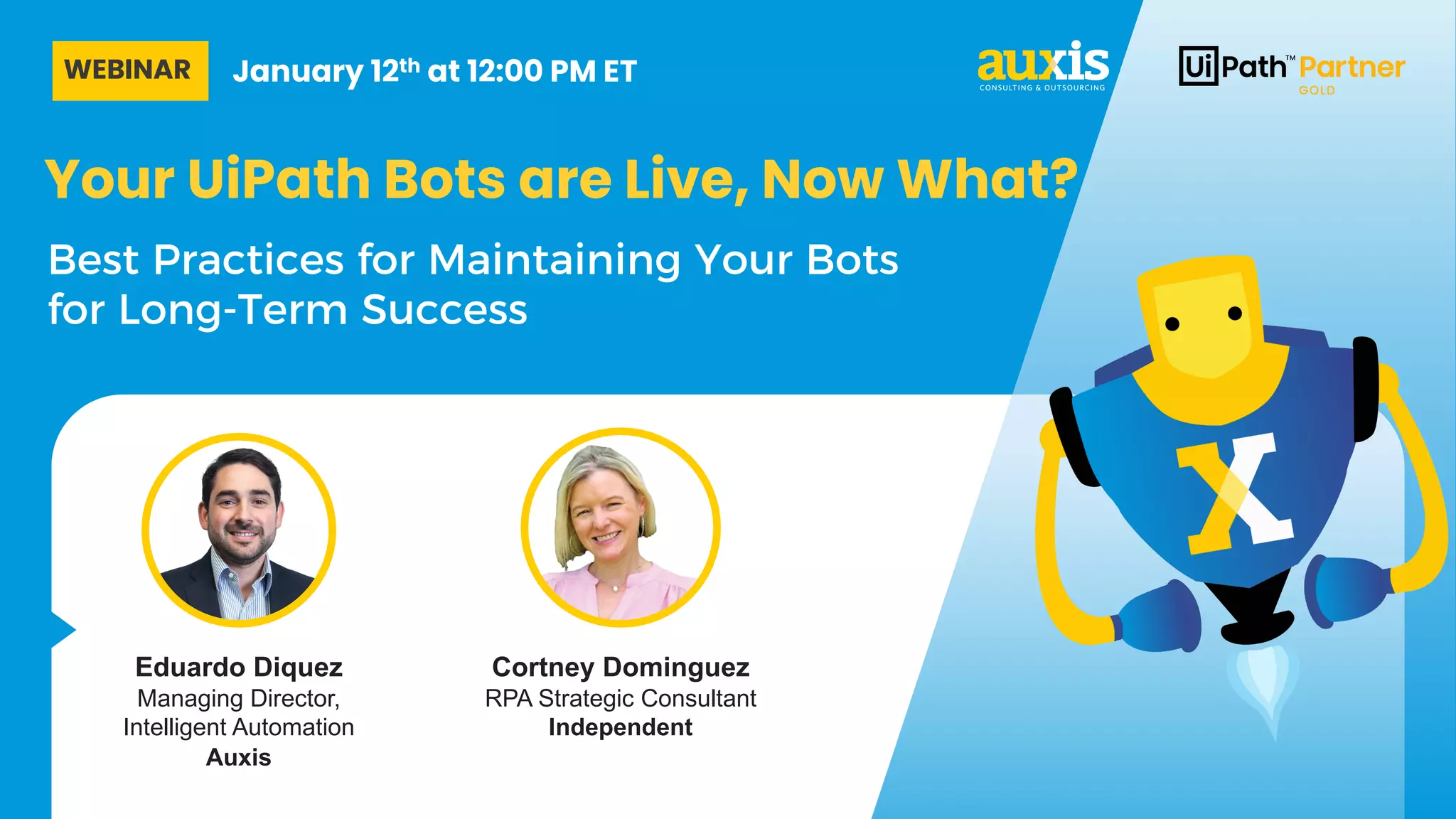
Your UiPath Bots are Live, Now What?
Best Practices for Maintaining Your Bots
for Long-Term Success
Cortney Dominguez
RPA Strategic Consultant
Independent
Eduardo Diquez
Managing Director,
Intelligent Automation
Auxis
WEBINAR January 12th at 12:00 PM ET
2
The Three Components to Maximize the
Value of Your Automation Program in 2022
• Qualified and cost-effective talent
• Training & Upskilling Program
• Close Collaboration requiring live
communication between the
COE, the business and IT
• Program Vision and Sponsorship
• Clear Definition of What Success Looks like
• Pipeline Management
• Enables idea creation
• Execution at Scale
• Low Code Self-Used
Automations
• AI & Machine Learning,
going beyond the RPA
core technology
• Performance Management
• Reliable Support
• Citizen Development
Automation Vision & Governance
Having the Right Technology
Talent Management
3
As organizations accelerate and expand their adoption
of RPA, having a strong support model has become
even more relevant
RPA continues to be the fastest-
growing software segment in
history and is expected to grow
at a CAGR of 25%+ between
2021 and 2028
Sources: Gartner; State of the RPA Developer Report 2021 by UiPath; Deloitte SSC 2021 Report; Auxis Webinar Registrants
77% of organizations
expect to hire more
RPA developers in the
next 12 months
80% of today's webinar
registrants are either already
a customer of UiPath (53%)
or in the process of
evaluation (27%)
Gartner predicts that 90% of
large organizations globally will
have adopted RPA in some
form by 2022
40% of RPA projects fail to deliver
expectations in terms of
implementation time and cost.
"Not taking maintenance needs
into account" is one of the most
common reasons that led to this gap.
Maintaining existing
automations and creating
documentation are the two
most hated tasks performed
by RPA developers
4
Introducing our Panelist!
Cortney Dominguez
RPA Strategic Consultant
Independent
Cortney Dominguez is a transformative business strategist
with a proven history of delivering lasting shareholder
value by strengthening corporate financial operations,
innovating enterprise solutions, and creating platforms for
growth. She is a champion for the creation and delivery of
robotic process automation, streamlining and generating
high-value efficiencies across Fortune 500 organizations.
She is passionate about smart automation technology and
enjoys discussing this with guests as a host on the Ivy
Podcast.
The Role of Support in Building a
Successful RPA Program
6
RPA Ongoing Maintenance is Often Overlooked and
Suffers from Underinvestment
Hyperautomation maturity
Highly Manual Organization Fully Automated Enterprise
Automation
Vision &
Executive
Sponsorship
Getting Started
& Proving the
Value
Mastering Post-
Implementation
Support
Refining Pipeline
Management
& ROI
Measurement
Democratizing
RPA with Citizen
Development
Continuous Employee Awareness & Communication Program
Prove Establish Expand Scale
7
38%
How many automations are you currently
supporting in production?
Poll Question # 1
We have not started our RPA Journey
More than 20 Automations 24%
1 – 10 Automations 14%
10 – 20 Automations 14%
We are currently in a Pilot Program 10%
How to Build the Right
Support Model
9
Building a Dedicated
Support Team
Segregation Between the Implementation and Support
Teams is Critical to Ensuring Long-Term Value
Challenges:
ü Achieving the scale to justify
the FTEs
ü Retaining Talent
Benefits:
ü Elimination of the
dependency from individual
employees
ü Standardized development
framework
ü Support team will act as
quality control before
automations go live
In-house
1.
Implement and
Operate Internally
Hire consultants
to build your COE
2.
• Implemented by 3rd
Party and operated
internally
• Implemented and
operated by a by 3rd
Party
Hybrid
(MS + In-House)
3.
• “Lowest” cost
• Highest risk
• Slower adoption
• Reduced risk
• “Highest” cost
• Accelerates adoption?
• Reduced risk
• Talent retention simplification
• Fastest time to benefit
• Scalable model with Partial
FTEs
+
10
53%
Poll Question # 2
Still figuring out the right model for our organization
100% In-House 35%
We leverage a partner for new developments 35%
We leverage a partner for support of existing robots 24%
We leverage a partner for strategy and business analysis 6%
How is your current RPA COE model
structured? Select all that apply
How to Structure and
Measure Your Support Team
12
Incident
Intake
• The priority of an incident is determined by the
impact on the business and the urgency with
which a resolution or workaround is needed.
The following table describes the overall criteria
used for determining priority.
Incident
Resolution
Request
Completion
Priority Response Time Assessment Time
1 < 0:30:00 <1:00:00
2 < 1:00:00 <2:00:00
3 < 2:00:00 <4:00:00
Proprietary & Confidential
IMPACT
URGENCY
HIGH MEDIUM LOW
HIGH
1 1 2
MEDIUM
1 2 3
LOW
2 3 3
ü RPA Self-reported Incident
ü Email
ü Phone Call
Incident Type Resolution Time
Infrastructure
and Access 2:00:00
New Exception
Handling 4:00:00
Application
Change
Will depend on the scope of
the change
Not All Automations Should be Treated Equally
When it Comes Down to Support
Having Standardized Support SLAs and an Incident Management
Tool is Critical to any Successful COE
ü Assess the implications of
automation failures
ü Setting clear expectations
with the business on potential
downtimes
ü Develop contingency plans
for large impact automations
Ensuring Business
Continuity
13
Most RPA COEs track COEs should also be tracking…
Number of Automations in
Production
Number of Incidents per Automation
What Should Organizations Be Tracking to Measure
Success?
Incident Types (Network,
Hardware, Credentials, Application
Change)
SLA Evaluation Resolution Times
Automation Downtime
Productivity Gains (Speed)
Robot Utilization
Hours/Cost Savings
Talent Management:
Does RPA Support Present
an Even Greater Challenge?
15
Creating Documentation & Maintaining Existing Bots Are the 2
Most Hated Activities by RPA Developers
Source: State of the RPA Developer Report 2021
Their least favorite activities
are creating
documentation, testing
RPA solutions and
maintaining existing
robots.
With Test Suite and Task
Capture some of these
tasks can be alleviated.
Consider outsourcing
support of existing robots as
a way to focus your
developers on what they
enjoy the most: building
new robots.
13%
5%
82%
29%
39%
32%
36%
30%
34%
44%
42%
14%
50%
26%
24%
52%
18%
30%
58%
26%
16%
62%
10%
28%
62%
27%
11%
65%
16%
19%
82%
9%
9%
Does and
enjoys
Does but does
not enjoy
Does not do
Build RPA solutions based on
requirements
Maintain, support, and debug
RPA solutions in production
Test RPA solutions
Create documentation
Perform code review
Work with business analysts to
define requirements for automation
Estimate automation duration
Work with a solution architect to
design the automation
Document implemented solutions
Evaluate the degree of difficulty in
the planning and design phase
Create dashboards to monitor
performance
16
20%
36%
44%
I'm not interested in a new job
I'm actively looking
Most developers are open to
a new opportunity.
Compared to last year, we see a slight reduction in
those who are actively looking for a new job, but we
see an increase in those who are open to
opportunities.
Even those looking for a new
opportunity plan to stay in RPA
Of those looking for a new job or open to new activities, 75%
want to remain in RPA development, up slightly from 70%
last year. This is yet another indication developers are happy
with their chosen careers.
I'm looking for a new job as an RPA developer
Unsure
I'm looking to change my career
75%
9%
16%
Source: State of the RPA Developer Report 2021
80% of RPA developers are actively looking for new
jobs (36%) or open to new opportunities (44%)
Key Enabling Technologies
for the Support Team
18
UiPath Suite Enables Support Teams move from
Reactive to Proactive Maintenance
Orchestrator
Assistant
Apps
Action
Center
Chatbots
Automation
Hub
Task
Capture
Process
Mining
Task
Mining
StudioX
Document
Understanding
Marketplace
&
Integrations
AI Fabric
MANAGE
ENGAGE
BUILD
DISCOVER
Robots
RUN
MEASURE
GOVERN
Studio
Pro
Test
Suite
Insights
Implementing Clear
Governance
üRight communication
mechanisms for issue
management
üHaving the right
technology enablers to
track open issues
üMeasuring & reporting
SLAs and automation
benefits to the business
KNOW BEFORE YOUR BUSINESS PARTNERS!
19
üPlatform for data modeling and analytics using a
combination of available business metrics and
operational insights
üIt enables you track performance indicators and
be alerted of errors
UiPath Insights – Performance Management of RPA Program
20
üUnderstand release status instantly and resolve
defects faster
üEnsure every requirement is fully tested before
deployment
Test Suite – Automatically Test
üOrganize your tests and execute continuously
or on-demand to proactively identify potential
incidents
21
50%
Poll Question # 3
UiPath Core Robots
UiPath Document Understanding 33%
UiPath Automation Hub/Task Capture 33%
UiPath Insights 33%
UiPath Test Suite 25%
Which of these UiPath technologies are you implementing
or planning to implement in 2022? Select all that apply
Q&A
23
Don’t Miss Our Upcoming Sessions:
UiPath Test Automation - Feb 16th @ 12:00 pm ET
What Is It and When Does It Make Sense to Leverage It?
Measuring the Performance of Your RPA COE - March 16th @ 12:00 pm ET
Best Practices & Lessons Learned
UiPath Citizen Development - May 25th @ 12:00 pm ET
A Real-World Perspective to Democratize Automation
Navigating the UiPath Hyperautomation Platform – June 22nd @ 12:00 pm ET
Are You Maximizing its Full Potential?
Thank you for joining us!
Cortney Dominguez
RPA Strategic
Consultant
Eduardo Diquez
Managing Director,
Intelligent Automation
Eduardo.diquez@auxis.com Cortney.dominguez@auxis.com

Your UiPath Bots are Live, Now What?

  • 1.
    Your UiPath Botsare Live, Now What? Best Practices for Maintaining Your Bots for Long-Term Success Cortney Dominguez RPA Strategic Consultant Independent Eduardo Diquez Managing Director, Intelligent Automation Auxis WEBINAR January 12th at 12:00 PM ET
  • 2.
    2 The Three Componentsto Maximize the Value of Your Automation Program in 2022 • Qualified and cost-effective talent • Training & Upskilling Program • Close Collaboration requiring live communication between the COE, the business and IT • Program Vision and Sponsorship • Clear Definition of What Success Looks like • Pipeline Management • Enables idea creation • Execution at Scale • Low Code Self-Used Automations • AI & Machine Learning, going beyond the RPA core technology • Performance Management • Reliable Support • Citizen Development Automation Vision & Governance Having the Right Technology Talent Management
  • 3.
    3 As organizations accelerateand expand their adoption of RPA, having a strong support model has become even more relevant RPA continues to be the fastest- growing software segment in history and is expected to grow at a CAGR of 25%+ between 2021 and 2028 Sources: Gartner; State of the RPA Developer Report 2021 by UiPath; Deloitte SSC 2021 Report; Auxis Webinar Registrants 77% of organizations expect to hire more RPA developers in the next 12 months 80% of today's webinar registrants are either already a customer of UiPath (53%) or in the process of evaluation (27%) Gartner predicts that 90% of large organizations globally will have adopted RPA in some form by 2022 40% of RPA projects fail to deliver expectations in terms of implementation time and cost. "Not taking maintenance needs into account" is one of the most common reasons that led to this gap. Maintaining existing automations and creating documentation are the two most hated tasks performed by RPA developers
  • 4.
    4 Introducing our Panelist! CortneyDominguez RPA Strategic Consultant Independent Cortney Dominguez is a transformative business strategist with a proven history of delivering lasting shareholder value by strengthening corporate financial operations, innovating enterprise solutions, and creating platforms for growth. She is a champion for the creation and delivery of robotic process automation, streamlining and generating high-value efficiencies across Fortune 500 organizations. She is passionate about smart automation technology and enjoys discussing this with guests as a host on the Ivy Podcast.
  • 5.
    The Role ofSupport in Building a Successful RPA Program
  • 6.
    6 RPA Ongoing Maintenanceis Often Overlooked and Suffers from Underinvestment Hyperautomation maturity Highly Manual Organization Fully Automated Enterprise Automation Vision & Executive Sponsorship Getting Started & Proving the Value Mastering Post- Implementation Support Refining Pipeline Management & ROI Measurement Democratizing RPA with Citizen Development Continuous Employee Awareness & Communication Program Prove Establish Expand Scale
  • 7.
    7 38% How many automationsare you currently supporting in production? Poll Question # 1 We have not started our RPA Journey More than 20 Automations 24% 1 – 10 Automations 14% 10 – 20 Automations 14% We are currently in a Pilot Program 10%
  • 8.
    How to Buildthe Right Support Model
  • 9.
    9 Building a Dedicated SupportTeam Segregation Between the Implementation and Support Teams is Critical to Ensuring Long-Term Value Challenges: ü Achieving the scale to justify the FTEs ü Retaining Talent Benefits: ü Elimination of the dependency from individual employees ü Standardized development framework ü Support team will act as quality control before automations go live In-house 1. Implement and Operate Internally Hire consultants to build your COE 2. • Implemented by 3rd Party and operated internally • Implemented and operated by a by 3rd Party Hybrid (MS + In-House) 3. • “Lowest” cost • Highest risk • Slower adoption • Reduced risk • “Highest” cost • Accelerates adoption? • Reduced risk • Talent retention simplification • Fastest time to benefit • Scalable model with Partial FTEs +
  • 10.
    10 53% Poll Question #2 Still figuring out the right model for our organization 100% In-House 35% We leverage a partner for new developments 35% We leverage a partner for support of existing robots 24% We leverage a partner for strategy and business analysis 6% How is your current RPA COE model structured? Select all that apply
  • 11.
    How to Structureand Measure Your Support Team
  • 12.
    12 Incident Intake • The priorityof an incident is determined by the impact on the business and the urgency with which a resolution or workaround is needed. The following table describes the overall criteria used for determining priority. Incident Resolution Request Completion Priority Response Time Assessment Time 1 < 0:30:00 <1:00:00 2 < 1:00:00 <2:00:00 3 < 2:00:00 <4:00:00 Proprietary & Confidential IMPACT URGENCY HIGH MEDIUM LOW HIGH 1 1 2 MEDIUM 1 2 3 LOW 2 3 3 ü RPA Self-reported Incident ü Email ü Phone Call Incident Type Resolution Time Infrastructure and Access 2:00:00 New Exception Handling 4:00:00 Application Change Will depend on the scope of the change Not All Automations Should be Treated Equally When it Comes Down to Support Having Standardized Support SLAs and an Incident Management Tool is Critical to any Successful COE ü Assess the implications of automation failures ü Setting clear expectations with the business on potential downtimes ü Develop contingency plans for large impact automations Ensuring Business Continuity
  • 13.
    13 Most RPA COEstrack COEs should also be tracking… Number of Automations in Production Number of Incidents per Automation What Should Organizations Be Tracking to Measure Success? Incident Types (Network, Hardware, Credentials, Application Change) SLA Evaluation Resolution Times Automation Downtime Productivity Gains (Speed) Robot Utilization Hours/Cost Savings
  • 14.
    Talent Management: Does RPASupport Present an Even Greater Challenge?
  • 15.
    15 Creating Documentation &Maintaining Existing Bots Are the 2 Most Hated Activities by RPA Developers Source: State of the RPA Developer Report 2021 Their least favorite activities are creating documentation, testing RPA solutions and maintaining existing robots. With Test Suite and Task Capture some of these tasks can be alleviated. Consider outsourcing support of existing robots as a way to focus your developers on what they enjoy the most: building new robots. 13% 5% 82% 29% 39% 32% 36% 30% 34% 44% 42% 14% 50% 26% 24% 52% 18% 30% 58% 26% 16% 62% 10% 28% 62% 27% 11% 65% 16% 19% 82% 9% 9% Does and enjoys Does but does not enjoy Does not do Build RPA solutions based on requirements Maintain, support, and debug RPA solutions in production Test RPA solutions Create documentation Perform code review Work with business analysts to define requirements for automation Estimate automation duration Work with a solution architect to design the automation Document implemented solutions Evaluate the degree of difficulty in the planning and design phase Create dashboards to monitor performance
  • 16.
    16 20% 36% 44% I'm not interestedin a new job I'm actively looking Most developers are open to a new opportunity. Compared to last year, we see a slight reduction in those who are actively looking for a new job, but we see an increase in those who are open to opportunities. Even those looking for a new opportunity plan to stay in RPA Of those looking for a new job or open to new activities, 75% want to remain in RPA development, up slightly from 70% last year. This is yet another indication developers are happy with their chosen careers. I'm looking for a new job as an RPA developer Unsure I'm looking to change my career 75% 9% 16% Source: State of the RPA Developer Report 2021 80% of RPA developers are actively looking for new jobs (36%) or open to new opportunities (44%)
  • 17.
  • 18.
    18 UiPath Suite EnablesSupport Teams move from Reactive to Proactive Maintenance Orchestrator Assistant Apps Action Center Chatbots Automation Hub Task Capture Process Mining Task Mining StudioX Document Understanding Marketplace & Integrations AI Fabric MANAGE ENGAGE BUILD DISCOVER Robots RUN MEASURE GOVERN Studio Pro Test Suite Insights Implementing Clear Governance üRight communication mechanisms for issue management üHaving the right technology enablers to track open issues üMeasuring & reporting SLAs and automation benefits to the business KNOW BEFORE YOUR BUSINESS PARTNERS!
  • 19.
    19 üPlatform for datamodeling and analytics using a combination of available business metrics and operational insights üIt enables you track performance indicators and be alerted of errors UiPath Insights – Performance Management of RPA Program
  • 20.
    20 üUnderstand release statusinstantly and resolve defects faster üEnsure every requirement is fully tested before deployment Test Suite – Automatically Test üOrganize your tests and execute continuously or on-demand to proactively identify potential incidents
  • 21.
    21 50% Poll Question #3 UiPath Core Robots UiPath Document Understanding 33% UiPath Automation Hub/Task Capture 33% UiPath Insights 33% UiPath Test Suite 25% Which of these UiPath technologies are you implementing or planning to implement in 2022? Select all that apply
  • 22.
  • 23.
    23 Don’t Miss OurUpcoming Sessions: UiPath Test Automation - Feb 16th @ 12:00 pm ET What Is It and When Does It Make Sense to Leverage It? Measuring the Performance of Your RPA COE - March 16th @ 12:00 pm ET Best Practices & Lessons Learned UiPath Citizen Development - May 25th @ 12:00 pm ET A Real-World Perspective to Democratize Automation Navigating the UiPath Hyperautomation Platform – June 22nd @ 12:00 pm ET Are You Maximizing its Full Potential?
  • 24.
    Thank you forjoining us! Cortney Dominguez RPA Strategic Consultant Eduardo Diquez Managing Director, Intelligent Automation Eduardo.diquez@auxis.com Cortney.dominguez@auxis.com