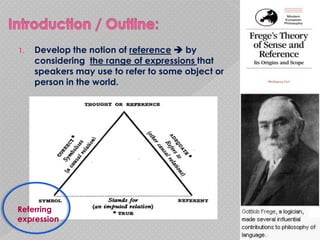
1.   Develop the notion of reference  by
     considering the range of expressions that
     speakers may use to refer to some object or
     person in the world.


Referring
expression
 Some expressions:
1. can only be used as referring expressions
2. can never be used as referring expressions
3. can be used to refer or not, depending on
   the kind of sentence they occur in.

4.   Introduce the notion (equative sentence)
     which is closely bound up with the idea of
     referring expressions.
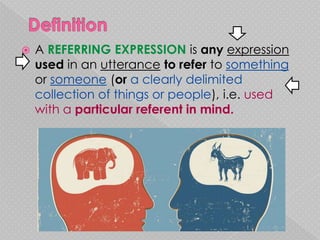
   A REFERRING EXPRESSION is any expression
    used in an utterance to refer to something
    or someone (or a clearly delimited
    collection of things or people), i.e. used
    with a particular referent in mind.
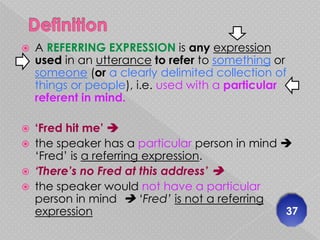
   A REFERRING EXPRESSION is any expression
    used in an utterance to refer to something or
    someone (or a clearly delimited collection of
    things or people), i.e. used with a particular
    referent in mind.

   ‘Fred hit me’ 
   the speaker has a particular person in mind 
    ‘Fred’ is a referring expression.
   ‘There’s no Fred at this address’ 
   the speaker would not have a particular
    person in mind  ‘Fred’ is not a referring
    expression                                  37
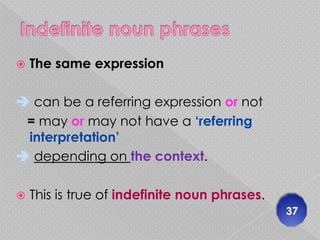
   The same expression

 can be a referring expression or not
 = may or may not have a ‘referring
 interpretation’
 depending on the context.

   This is true of indefinite noun phrases.
                                               37
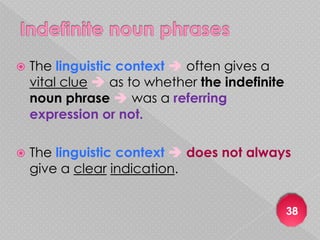
   The linguistic context  often gives a
    vital clue  as to whether the indefinite
    noun phrase  was a referring
    expression or not.

   The linguistic context  does not always
    give a clear indication.


                                                38
38

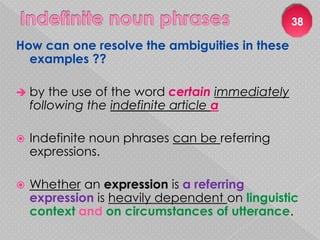
How can one resolve the ambiguities in these
  examples ??

 by    the use of the word certain immediately
    following the indefinite article a

   Indefinite noun phrases can be referring
    expressions.
   Whether an expression is a referring
    expression is heavily dependent on linguistic
    context and on circumstances of utterance.
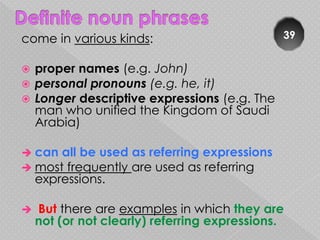
come in various kinds:                         39


 proper names (e.g. John)
 personal pronouns (e.g. he, it)
 Longer descriptive expressions (e.g. The
  man who unified the Kingdom of Saudi
  Arabia)

 can all be used   as referring expressions
 most frequently   are used as referring
    expressions.
   But there are examples in which they are
    not (or not clearly) referring expressions.
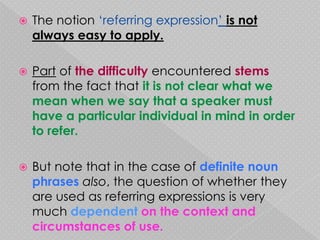
   The notion ‘referring expression’ is not
    always easy to apply.

   Part of the difficulty encountered stems
    from the fact that it is not clear what we
    mean when we say that a speaker must
    have a particular individual in mind in order
    to refer.

   But note that in the case of definite noun
    phrases also, the question of whether they
    are used as referring expressions is very
    much dependent on the context and
    circumstances of use.
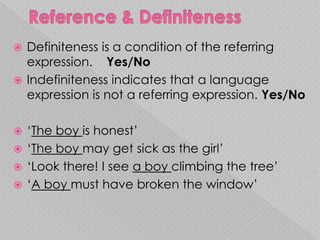
 Definiteness is a condition of the referring
  expression. Yes/No
 Indefiniteness indicates that a language
  expression is not a referring expression. Yes/No

 ‘The boy is honest’
 ‘The boy may get sick as the girl’
 ‘Look there! I see a boy climbing the tree’
 ‘A boy must have broken the window’
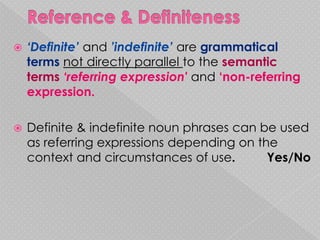
   ‘Definite’ and ’indefinite’ are grammatical
    terms not directly parallel to the semantic
    terms ‘referring expression' and ‘non-referring
    expression.

   Definite & indefinite noun phrases can be used
    as referring expressions depending on the
    context and circumstances of use.       Yes/No
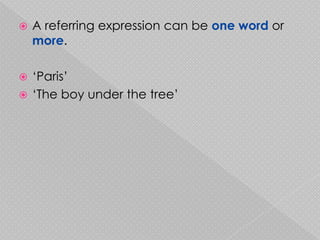
   A referring expression can be one word or
    more.

 ‘Paris’
 ‘The boy under the tree’
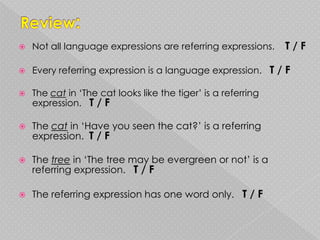
   Not all language expressions are referring expressions.    T/F
   Every referring expression is a language expression. T / F

   The cat in ‘The cat looks like the tiger’ is a referring
    expression. T / F

   The cat in ‘Have you seen the cat?’ is a referring
    expression. T / F

   The tree in ‘The tree may be evergreen or not’ is a
    referring expression. T / F

   The referring expression has one word only. T / F
A different topic:

   starting with consideration of definite noun
    phrases & eventually indefinite noun
    phrases.

   Introduce the notions (opaque context) &
    (equative sentence) which are closely
    bound up with the idea of referring
    expressions.
                                              39
   Normally, one expects that utterances which differ
    only in that they use different expressions referring to
    the same thing (or person) will have the same
    meaning.

 ‘John looks as if he’s about to faint’
 ‘The person in the corner looks as if he’s about to
  faint’

   But there is a class of exceptions to this
    generalization. This is the class of examples involving
    opaque contexts.
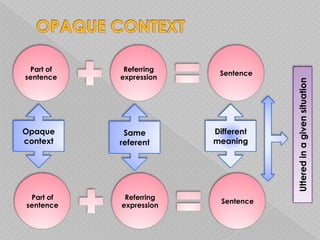
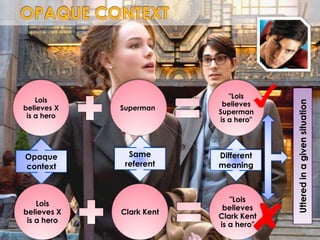
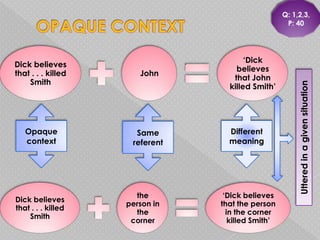
   An OPAQUE CONTEXT is a part of a sentence which
    could be made into a complete sentence by the
    addition of a referring expression, but where the
    addition of different referring expressions, even
    though they refer to the same thing or person, in a
    given situation, will yield sentences with DIFFERENT
    meanings when uttered in a given situation.

   OC is a linguistic context in which it is not always
    possible to substitute "co-referential" expressions
    (expressions referring to the same object) without
    altering the truth of sentences. So, substitution of co-
    referential expressions into an opaque context does
    not always preserve truth. (Wikipedia)
Part of    Referring
                         Sentence
sentence   expression


                                     Uttered in a given situation
Opaque      Same        Different
context    referent     meaning


 Part of    Referring
                          Sentence
sentence   expression
"Lois
    Lois


                                       Uttered in a given situation
                           believes
believes X   Superman
                          Superman
 is a hero
                          is a hero"


Opaque         Same       Different
context       referent    meaning


                             "Lois
    Lois
                           believes
believes X   Clark Kent
                          Clark Kent
 is a hero
                          is a hero"
Q: 1,2,3,
                                                    P: 40


                                       ‘Dick
Dick believes
                                    believes
that . . . killed      John
                                   that John
    Smith


                                                        Uttered in a given situation
                                  killed Smith’


   Opaque             Same        Different
   context           referent     meaning


                      the        ‘Dick believes
Dick believes
                    person in   that the person
that . . . killed
                      the         in the corner
    Smith
                     corner        killed Smith’
   ‘Opaque’ is especially appropriate because
    these contexts seem to ‘block our view’ through
    them to the referential interpretations (referents)
    of referring expressions.
   Opaque contexts typically involve a certain kind
    of verb, like want, believe, think, and wonder
    about.

   Note that it was often in the context of such
    opacity-creating verbs that indefinite noun
    phrases could be ambiguous between a referring
    and a non-referring interpretation, as in ‘Nancy
    wants to marry a Norwegian’.
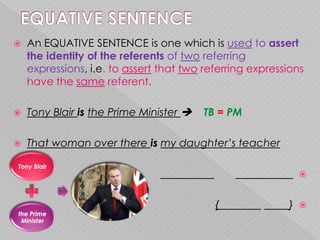
   An EQUATIVE SENTENCE is one which is used to assert
    the identity of the referents of two referring
    expressions, i.e. to assert that two referring expressions
    have the same referent.

   Tony Blair is the Prime Minister    TB = PM

   That woman over there is my daughter’s teacher

Tony Blair
                                                               


                                           {               }   
the Prime
 Minister
   A feature of many equative sentences is that the
    order of the two referring expressions can be
    reversed without loss of acceptability.

   The Prime Minister is Tony Blair.  equative 
    reversible + acceptable

   However, the ‘reversal test’/ ‘inversion test’ is not a
    perfect diagnostic for equative sentences.

   What I need is a pint of Guinness  reversible +
    not a referring expression  has no particular
    referent in mind  not equative

   That is the man who kidnapped my boss 
    equative + not reversible  unacceptable.
•   Semantics: A Coursebook by JAMES R. HURFORD ,
RENDAN HEASLEY, MICHAEL B. SMITH
•   Opaque context – Wikipedia
•Opaque    context, equative sentence and predicator

Unit 4 - Referring Expressions

  • 2.
    1. Develop the notion of reference  by considering the range of expressions that speakers may use to refer to some object or person in the world. Referring expression
  • 3.
     Some expressions: 1.can only be used as referring expressions 2. can never be used as referring expressions 3. can be used to refer or not, depending on the kind of sentence they occur in. 4. Introduce the notion (equative sentence) which is closely bound up with the idea of referring expressions.
  • 4.
    A REFERRING EXPRESSION is any expression used in an utterance to refer to something or someone (or a clearly delimited collection of things or people), i.e. used with a particular referent in mind.
  • 5.
    A REFERRING EXPRESSION is any expression used in an utterance to refer to something or someone (or a clearly delimited collection of things or people), i.e. used with a particular referent in mind.  ‘Fred hit me’   the speaker has a particular person in mind  ‘Fred’ is a referring expression.  ‘There’s no Fred at this address’   the speaker would not have a particular person in mind  ‘Fred’ is not a referring expression 37
  • 6.
    The same expression  can be a referring expression or not = may or may not have a ‘referring interpretation’  depending on the context.  This is true of indefinite noun phrases. 37
  • 7.
    The linguistic context  often gives a vital clue  as to whether the indefinite noun phrase  was a referring expression or not.  The linguistic context  does not always give a clear indication. 38
  • 8.
    38 How can oneresolve the ambiguities in these examples ??  by the use of the word certain immediately following the indefinite article a  Indefinite noun phrases can be referring expressions.  Whether an expression is a referring expression is heavily dependent on linguistic context and on circumstances of utterance.
  • 9.
    come in variouskinds: 39  proper names (e.g. John)  personal pronouns (e.g. he, it)  Longer descriptive expressions (e.g. The man who unified the Kingdom of Saudi Arabia)  can all be used as referring expressions  most frequently are used as referring expressions.  But there are examples in which they are not (or not clearly) referring expressions.
  • 10.
    The notion ‘referring expression’ is not always easy to apply.  Part of the difficulty encountered stems from the fact that it is not clear what we mean when we say that a speaker must have a particular individual in mind in order to refer.  But note that in the case of definite noun phrases also, the question of whether they are used as referring expressions is very much dependent on the context and circumstances of use.
  • 11.
     Definiteness isa condition of the referring expression. Yes/No  Indefiniteness indicates that a language expression is not a referring expression. Yes/No  ‘The boy is honest’  ‘The boy may get sick as the girl’  ‘Look there! I see a boy climbing the tree’  ‘A boy must have broken the window’
  • 12.
    ‘Definite’ and ’indefinite’ are grammatical terms not directly parallel to the semantic terms ‘referring expression' and ‘non-referring expression.  Definite & indefinite noun phrases can be used as referring expressions depending on the context and circumstances of use. Yes/No
  • 13.
    A referring expression can be one word or more.  ‘Paris’  ‘The boy under the tree’
  • 15.
    Not all language expressions are referring expressions. T/F  Every referring expression is a language expression. T / F  The cat in ‘The cat looks like the tiger’ is a referring expression. T / F  The cat in ‘Have you seen the cat?’ is a referring expression. T / F  The tree in ‘The tree may be evergreen or not’ is a referring expression. T / F  The referring expression has one word only. T / F
  • 16.
    A different topic:  starting with consideration of definite noun phrases & eventually indefinite noun phrases.  Introduce the notions (opaque context) & (equative sentence) which are closely bound up with the idea of referring expressions. 39
  • 17.
    Normally, one expects that utterances which differ only in that they use different expressions referring to the same thing (or person) will have the same meaning.  ‘John looks as if he’s about to faint’  ‘The person in the corner looks as if he’s about to faint’  But there is a class of exceptions to this generalization. This is the class of examples involving opaque contexts.
  • 18.
    An OPAQUE CONTEXT is a part of a sentence which could be made into a complete sentence by the addition of a referring expression, but where the addition of different referring expressions, even though they refer to the same thing or person, in a given situation, will yield sentences with DIFFERENT meanings when uttered in a given situation.  OC is a linguistic context in which it is not always possible to substitute "co-referential" expressions (expressions referring to the same object) without altering the truth of sentences. So, substitution of co- referential expressions into an opaque context does not always preserve truth. (Wikipedia)
  • 19.
    Part of Referring Sentence sentence expression Uttered in a given situation Opaque Same Different context referent meaning Part of Referring Sentence sentence expression
  • 20.
    "Lois Lois Uttered in a given situation believes believes X Superman Superman is a hero is a hero" Opaque Same Different context referent meaning "Lois Lois believes believes X Clark Kent Clark Kent is a hero is a hero"
  • 21.
    Q: 1,2,3, P: 40 ‘Dick Dick believes believes that . . . killed John that John Smith Uttered in a given situation killed Smith’ Opaque Same Different context referent meaning the ‘Dick believes Dick believes person in that the person that . . . killed the in the corner Smith corner killed Smith’
  • 22.
    ‘Opaque’ is especially appropriate because these contexts seem to ‘block our view’ through them to the referential interpretations (referents) of referring expressions.  Opaque contexts typically involve a certain kind of verb, like want, believe, think, and wonder about.  Note that it was often in the context of such opacity-creating verbs that indefinite noun phrases could be ambiguous between a referring and a non-referring interpretation, as in ‘Nancy wants to marry a Norwegian’.
  • 23.
    An EQUATIVE SENTENCE is one which is used to assert the identity of the referents of two referring expressions, i.e. to assert that two referring expressions have the same referent.  Tony Blair is the Prime Minister  TB = PM  That woman over there is my daughter’s teacher Tony Blair  { }  the Prime Minister
  • 24.
    A feature of many equative sentences is that the order of the two referring expressions can be reversed without loss of acceptability.  The Prime Minister is Tony Blair.  equative  reversible + acceptable  However, the ‘reversal test’/ ‘inversion test’ is not a perfect diagnostic for equative sentences.  What I need is a pint of Guinness  reversible + not a referring expression  has no particular referent in mind  not equative  That is the man who kidnapped my boss  equative + not reversible  unacceptable.
  • 25.
    Semantics: A Coursebook by JAMES R. HURFORD , RENDAN HEASLEY, MICHAEL B. SMITH • Opaque context – Wikipedia •Opaque context, equative sentence and predicator