X
Agriculture and forestry university
Rampur, Chitwan
Presentation on INTEGRATED DISEASE
MANAGEMENT
Submitted to:
Prof. Dr. Sundar Man Shrestha
Head of department
Department of plant pathology
AFU, Rampur
Prepared by:
Arjun Rayamajhi
Msc. Ag. 1st semester
Department of plant pathology
Exam Roll No: PLP-06M-2018
INTEGRATED DISEASE MANAGEMENT
• Background:
 Integrated disease management (IDM) is a concept derived from
the successful integrated pest management (IPM) systems
developed by entomologists for insect and mite control.
 Inclusion of the term ‘IPM’ in plant pathology was only after the
formal involvement of plant pathologists with entomologists,
nematologists and weed scientists in IPM programs under
huffaker project, in the USA.
 Plant pathologists embraced integrated disease management by
applying fundamental information on loss potential and pathogen
biology, ecology and epidemiology, and applying the basic
concepts of plant disease management.
INTRODUCTION TO THE INTEGRATED DISEASE
MANAGEMENT (IDM):
 The integrated disease management (IDM) involves the need based use of
pesticide only when the disease incidence reach economic threshold levels and
this will promote the build up of many bio-control agent in the crop ecosystems.
 Thus idm, a greener alternative to the conventional use of chemicals, is an
attempt to promote natural, economic and sociological farming methods
through the most effective combination of farming techniques and judicious and
limited use of fungicide.
 In other words, idm programme implies all the available disease management
approaches including cultural, biological and chemical control with the main
objective to keep the disease incidence below economic threshold level.
WHY IDM
Plant diseases management determines the effectiveness of other inputs (seed, fertilizer, water,
growth hormones) in crop production.
Exclusive reliance on fungicides, nematicides, bactericides or viricides resulted in pathogen
• Resistance,
• New pathotype development,
• Residues and
• Environmental pollution.
• This led to the development of integrated plant protection strategies, which are components of
sustainable agriculture with a sound ecological foundation.
Basic objectives:
Reduce the introduction of disease into the crop.
Avoid conditions that are suitable for disease establishment and their spread.
PRINCIPLES OF IDM
A good integrated disease management consists following six main principles:
• Exclusion:
This principle is defined as any measure that prevents the introduction of a disease-causing agent
(pathogen) into a region, farm, or planting.
 Major practices includes quarantine, inspection and certification, seed treatment and eradication
of insect vectors.
• Avoidance:
This principle includes tactics that prevent contact between the host and pathogen, presuming that
pathogen has crossed the barriers placed by exclusion or it is already present in the area and can
attack the host.
These tactics includes choice of geographic area, selection of field, choice of time of planting,
disease escaping varieties and section of seed and planting material.
PRINCIPLES CONTINUE…
• Eradication:
This principle aims at eliminating a pathogen after it is introduced into an area but before it has
become well established or widely spread.
Total eradication being not possible, the aim is to reduce the inoculum density to a level where it
cannot cause significant damage.
This is attempted through biological means, crop rotation, eradication of diseased plants or plant
organs, and physical and chemical treatments.
• Protection:
This principle depends on establishing a barrier between the pathogen and the host plant or the
susceptible part of the host plant.
It is usually thought of as a chemical barrier, e.g., A fungicide, bactericide or nematicide, but it
can also be a physical, spatial, or temporal barrier.
The specific strategies employed assume that pathogens are present and that infection will occur
without the intervention of protective measures.
PRINCIPLES CONTINUE…
• Resistance:
 This principle includes selecting plants that
possess ability to remain healthy even if the
plant is infected.
• Therapy:
 This principle includes disease control methods
that are applied after the plant is infected.
 Chemotherapy, heat or thermotherapy and tree
surgery can be done.
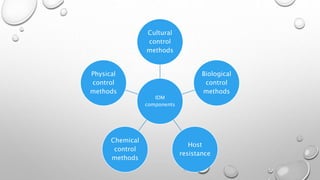
IDM
components
Cultural
control
methods
Biological
control
methods
Host
resistance
Chemical
control
methods
Physical
control
methods
COMPONENTS CONTINUE…
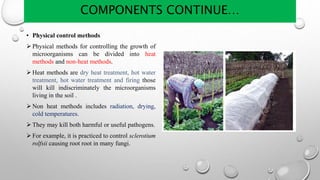
• Physical control methods
 Physical methods for controlling the growth of
microorganisms can be divided into heat
methods and non-heat methods.
 Heat methods are dry heat treatment, hot water
treatment, hot water treatment and firing those
will kill indiscriminately the microorganisms
living in the soil .
 Non heat methods includes radiation, drying,
cold temperatures.
 They may kill both harmful or useful pathogens.
 For example, it is practiced to control sclerotium
rolfsii causing root root in many fungi.
COMPONENTS CONTINUE…
 Cultural control methods:
• This involves deliberate manipulation of the cultural practices that
modify environment to make it less favorable to harmful organism
• e.g., By disrupting their reproduction cycles, eliminating their food
sources, or encouraging their natural enemies.
• Management of plant diseases through cultural practices involves the
principles of avoidance, exclusion and eradication.
• Successful use of cultural practices for disease management requires
complete knowledge of nature of pathogen and its behavior in
different conditions of the environment-climate, cropping systems, etc.
 Production and use of pathogen free planting material:
• Dry climate for seed production
• Isolation distance for seed plots
• Inspection of seed plots
• Drying and ageing of seed
• Cleaning of seed
• Thermal and chemical treatment of seed
• Site and treatment of nursery beds
• Adjustment of harvesting time of the crop
 Field and plant sanitation
• Management of crop debris
• Management of the diseased plant
• Management of irrigation water
• Crop-free period and crop-free zone
• Creating barriers by non-host of dead hosts
• Decoy crops, trap crops and antagonistic crops
• Management of weed, collateral and volunteer host plants
• Management of insect vectors
• Harvesting time and practices
 Adjustment of crop culture:
• Crop rotation, Fallowing, Monoculture, Mixed cropping, Adjustment of date of
sowing, Adjustment of depth of sowing, Plant spacing – rate of sowing and density
of stand, Management of irrigation, Management of host nutrition, Management of
soil acidity and alkalinity, Organic amendments of soil, Management of the soil,
Minimizing influx of inoculum from neighboring crops, Choice of crop variety
 Use of fertilizers
• Addition of organic manure, appropriate time and amount of the fertilizers
application is easy and cheap method of managing various diseases. High nitrogen
favors the rice blast disease while suppress the brown spot and vice versa.
COMPONENTS CONTINUE…
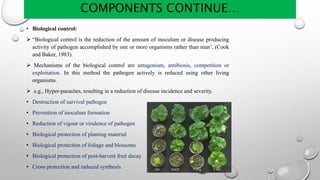
• Biological control:
 “Biological control is the reduction of the amount of inoculum or disease producing
activity of pathogen accomplished by one or more organisms rather than man’, (Cook
and Baker, 1983).
 Mechanisms of the biological control are antagonism, antibiosis, competition or
exploitation. In this method the pathogen actively is reduced using other living
organisms.
 e.g., Hyper-parasites, resulting in a reduction of disease incidence and severity.
• Destruction of survival pathogen
• Prevention of inoculum formation
• Reduction of vigour or virulence of pathogen
• Biological protection of planting material
• Biological protection of foliage and blossoms
• Biological protection of post-harvest fruit decay
• Cross protection and induced synthesis
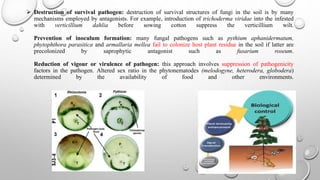
 Destruction of survival pathogen: destruction of survival structures of fungi in the soil is by many
mechanisms employed by antagonists. For example, introduction of trichoderma viridae into the infested
with verticillium dahlia before sowing cotton suppress the verticillium wilt.
Prevention of inoculum formation: many fungal pathogens such as pythium aphanidermatum,
phytophthora parasitica and armallaria mellea fail to colonize host plant residue in the soil if latter are
precolonized by saprophytic antagonist such as fusarium roseum.
Reduction of vigour or virulence of pathogen: this approach involves suppression of pathogenicity
factors in the pathogen. Altered sex ratio in the phytonematodes (melodogyne, heterodera, globodera)
determined by the availability of food and other environments.
COMPONENTS CONTINUE…
• Host resistance:
 Resistance is the characteristics of plant that suppress pathogen and disease
development.
 The use of resistant genotypes is a highly effective approach to suppress disease
to tolerable levels.
 In resistant genotypes, disease appears late, build up slowly and results in little
damage to the crop.
 Example: recombinant DNA technology using suitable gene vectors has helped
introduction of virus protein genes and pathogen avirulent gene into the plant to
make them resistance to specific diseases.
• Development of resistance varieties
 Selection
 Mutation
 Hybridization
• Breeding for resistance using biotechnology
• Induction of resistance by means of gene manipulation
COMPONENTS CONTINUE…
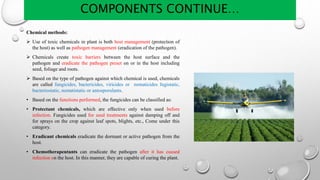
Chemical methods:
 Use of toxic chemicals in plant is both host management (protection of
the host) as well as pathogen management (eradication of the pathogen).
 Chemicals create toxic barriers between the host surface and the
pathogen and eradicate the pathogen preset on or in the host including
seed, foliage and roots.
 Based on the type of pathogen against which chemical is used, chemicals
are called fungicides, bactericides, viricides or nematicides fugistatic,
bacteriostatic, nematistatic or antosporulants.
• Based on the functions performed, the fungicides can be classified as:
• Protectant chemicals, which are effective only when used before
infection. Fungicides used for seed treatments against damping off and
for sprays on the crop against leaf spots, blights, etc., Come under this
category.
• Eradicant chemicals eradicate the dormant or active pathogen from the
host.
• Chemotherapeutants can eradicate the pathogen after it has caused
infection on the host. In this manner, they are capable of curing the plant.
REFERENCES
 Class notes on principles of plant pathology by Prof. Dr. Sundar Man Shrestha
 General concepts on integrated disease management by small farm research centre, Alabama
 Http://www.Biologydiscussion.Com/plants/plant-diseases/integrated-disease-management-idm-
meaning-and-components-plant-diseases/43067 [accessed apr 28 2018].
 Https://www.Apsnet.Org/edcenter/intropp/topics/documents/plantdiseasemanagement.Aspx [accessed
apr 28 2018]
 Https://www.Google.Com.Np/search?Q=integrated+disease+management&source=lnms&tbm=isch&s
a=x&ved=0ahukewipt7smhnzaahxeq48khyondw0q_auicigb&biw=1707&bih=736#imgrc=giolslmzhts
cwm [accessed apr 28 2018].
 Integrated disease management: concepts and practices. Available from:
https://www.Researchgate.Net/publication/226205980_integrated_disease_management_concepts_and
_practices [accessed apr 28 2018].
 Https://www.Cliffsnotes.Com/study-guides/biology/microbiology/control-of-microbial-
growth/physical-methods-of-control
 Singh, R.S. 2018. Introduction to principles of plant pathology. 5th ed. Medtech. India. Pp:310-365
integrated disease management

integrated disease management

  • 1.
    X Agriculture and forestryuniversity Rampur, Chitwan Presentation on INTEGRATED DISEASE MANAGEMENT Submitted to: Prof. Dr. Sundar Man Shrestha Head of department Department of plant pathology AFU, Rampur Prepared by: Arjun Rayamajhi Msc. Ag. 1st semester Department of plant pathology Exam Roll No: PLP-06M-2018
  • 2.
    INTEGRATED DISEASE MANAGEMENT •Background:  Integrated disease management (IDM) is a concept derived from the successful integrated pest management (IPM) systems developed by entomologists for insect and mite control.  Inclusion of the term ‘IPM’ in plant pathology was only after the formal involvement of plant pathologists with entomologists, nematologists and weed scientists in IPM programs under huffaker project, in the USA.  Plant pathologists embraced integrated disease management by applying fundamental information on loss potential and pathogen biology, ecology and epidemiology, and applying the basic concepts of plant disease management.
  • 3.
    INTRODUCTION TO THEINTEGRATED DISEASE MANAGEMENT (IDM):  The integrated disease management (IDM) involves the need based use of pesticide only when the disease incidence reach economic threshold levels and this will promote the build up of many bio-control agent in the crop ecosystems.  Thus idm, a greener alternative to the conventional use of chemicals, is an attempt to promote natural, economic and sociological farming methods through the most effective combination of farming techniques and judicious and limited use of fungicide.  In other words, idm programme implies all the available disease management approaches including cultural, biological and chemical control with the main objective to keep the disease incidence below economic threshold level.
  • 4.
    WHY IDM Plant diseasesmanagement determines the effectiveness of other inputs (seed, fertilizer, water, growth hormones) in crop production. Exclusive reliance on fungicides, nematicides, bactericides or viricides resulted in pathogen • Resistance, • New pathotype development, • Residues and • Environmental pollution. • This led to the development of integrated plant protection strategies, which are components of sustainable agriculture with a sound ecological foundation. Basic objectives: Reduce the introduction of disease into the crop. Avoid conditions that are suitable for disease establishment and their spread.
  • 5.
    PRINCIPLES OF IDM Agood integrated disease management consists following six main principles: • Exclusion: This principle is defined as any measure that prevents the introduction of a disease-causing agent (pathogen) into a region, farm, or planting.  Major practices includes quarantine, inspection and certification, seed treatment and eradication of insect vectors. • Avoidance: This principle includes tactics that prevent contact between the host and pathogen, presuming that pathogen has crossed the barriers placed by exclusion or it is already present in the area and can attack the host. These tactics includes choice of geographic area, selection of field, choice of time of planting, disease escaping varieties and section of seed and planting material.
  • 6.
    PRINCIPLES CONTINUE… • Eradication: Thisprinciple aims at eliminating a pathogen after it is introduced into an area but before it has become well established or widely spread. Total eradication being not possible, the aim is to reduce the inoculum density to a level where it cannot cause significant damage. This is attempted through biological means, crop rotation, eradication of diseased plants or plant organs, and physical and chemical treatments. • Protection: This principle depends on establishing a barrier between the pathogen and the host plant or the susceptible part of the host plant. It is usually thought of as a chemical barrier, e.g., A fungicide, bactericide or nematicide, but it can also be a physical, spatial, or temporal barrier. The specific strategies employed assume that pathogens are present and that infection will occur without the intervention of protective measures.
  • 7.
    PRINCIPLES CONTINUE… • Resistance: This principle includes selecting plants that possess ability to remain healthy even if the plant is infected. • Therapy:  This principle includes disease control methods that are applied after the plant is infected.  Chemotherapy, heat or thermotherapy and tree surgery can be done.
  • 8.
  • 9.
    COMPONENTS CONTINUE… • Physicalcontrol methods  Physical methods for controlling the growth of microorganisms can be divided into heat methods and non-heat methods.  Heat methods are dry heat treatment, hot water treatment, hot water treatment and firing those will kill indiscriminately the microorganisms living in the soil .  Non heat methods includes radiation, drying, cold temperatures.  They may kill both harmful or useful pathogens.  For example, it is practiced to control sclerotium rolfsii causing root root in many fungi.
  • 10.
    COMPONENTS CONTINUE…  Culturalcontrol methods: • This involves deliberate manipulation of the cultural practices that modify environment to make it less favorable to harmful organism • e.g., By disrupting their reproduction cycles, eliminating their food sources, or encouraging their natural enemies. • Management of plant diseases through cultural practices involves the principles of avoidance, exclusion and eradication. • Successful use of cultural practices for disease management requires complete knowledge of nature of pathogen and its behavior in different conditions of the environment-climate, cropping systems, etc.  Production and use of pathogen free planting material: • Dry climate for seed production • Isolation distance for seed plots • Inspection of seed plots • Drying and ageing of seed • Cleaning of seed • Thermal and chemical treatment of seed • Site and treatment of nursery beds • Adjustment of harvesting time of the crop  Field and plant sanitation • Management of crop debris • Management of the diseased plant • Management of irrigation water • Crop-free period and crop-free zone • Creating barriers by non-host of dead hosts • Decoy crops, trap crops and antagonistic crops • Management of weed, collateral and volunteer host plants • Management of insect vectors • Harvesting time and practices  Adjustment of crop culture: • Crop rotation, Fallowing, Monoculture, Mixed cropping, Adjustment of date of sowing, Adjustment of depth of sowing, Plant spacing – rate of sowing and density of stand, Management of irrigation, Management of host nutrition, Management of soil acidity and alkalinity, Organic amendments of soil, Management of the soil, Minimizing influx of inoculum from neighboring crops, Choice of crop variety  Use of fertilizers • Addition of organic manure, appropriate time and amount of the fertilizers application is easy and cheap method of managing various diseases. High nitrogen favors the rice blast disease while suppress the brown spot and vice versa.
  • 11.
    COMPONENTS CONTINUE… • Biologicalcontrol:  “Biological control is the reduction of the amount of inoculum or disease producing activity of pathogen accomplished by one or more organisms rather than man’, (Cook and Baker, 1983).  Mechanisms of the biological control are antagonism, antibiosis, competition or exploitation. In this method the pathogen actively is reduced using other living organisms.  e.g., Hyper-parasites, resulting in a reduction of disease incidence and severity. • Destruction of survival pathogen • Prevention of inoculum formation • Reduction of vigour or virulence of pathogen • Biological protection of planting material • Biological protection of foliage and blossoms • Biological protection of post-harvest fruit decay • Cross protection and induced synthesis
  • 12.
     Destruction ofsurvival pathogen: destruction of survival structures of fungi in the soil is by many mechanisms employed by antagonists. For example, introduction of trichoderma viridae into the infested with verticillium dahlia before sowing cotton suppress the verticillium wilt. Prevention of inoculum formation: many fungal pathogens such as pythium aphanidermatum, phytophthora parasitica and armallaria mellea fail to colonize host plant residue in the soil if latter are precolonized by saprophytic antagonist such as fusarium roseum. Reduction of vigour or virulence of pathogen: this approach involves suppression of pathogenicity factors in the pathogen. Altered sex ratio in the phytonematodes (melodogyne, heterodera, globodera) determined by the availability of food and other environments.
  • 13.
    COMPONENTS CONTINUE… • Hostresistance:  Resistance is the characteristics of plant that suppress pathogen and disease development.  The use of resistant genotypes is a highly effective approach to suppress disease to tolerable levels.  In resistant genotypes, disease appears late, build up slowly and results in little damage to the crop.  Example: recombinant DNA technology using suitable gene vectors has helped introduction of virus protein genes and pathogen avirulent gene into the plant to make them resistance to specific diseases. • Development of resistance varieties  Selection  Mutation  Hybridization • Breeding for resistance using biotechnology • Induction of resistance by means of gene manipulation
  • 14.
    COMPONENTS CONTINUE… Chemical methods: Use of toxic chemicals in plant is both host management (protection of the host) as well as pathogen management (eradication of the pathogen).  Chemicals create toxic barriers between the host surface and the pathogen and eradicate the pathogen preset on or in the host including seed, foliage and roots.  Based on the type of pathogen against which chemical is used, chemicals are called fungicides, bactericides, viricides or nematicides fugistatic, bacteriostatic, nematistatic or antosporulants. • Based on the functions performed, the fungicides can be classified as: • Protectant chemicals, which are effective only when used before infection. Fungicides used for seed treatments against damping off and for sprays on the crop against leaf spots, blights, etc., Come under this category. • Eradicant chemicals eradicate the dormant or active pathogen from the host. • Chemotherapeutants can eradicate the pathogen after it has caused infection on the host. In this manner, they are capable of curing the plant.
  • 15.
    REFERENCES  Class noteson principles of plant pathology by Prof. Dr. Sundar Man Shrestha  General concepts on integrated disease management by small farm research centre, Alabama  Http://www.Biologydiscussion.Com/plants/plant-diseases/integrated-disease-management-idm- meaning-and-components-plant-diseases/43067 [accessed apr 28 2018].  Https://www.Apsnet.Org/edcenter/intropp/topics/documents/plantdiseasemanagement.Aspx [accessed apr 28 2018]  Https://www.Google.Com.Np/search?Q=integrated+disease+management&source=lnms&tbm=isch&s a=x&ved=0ahukewipt7smhnzaahxeq48khyondw0q_auicigb&biw=1707&bih=736#imgrc=giolslmzhts cwm [accessed apr 28 2018].  Integrated disease management: concepts and practices. Available from: https://www.Researchgate.Net/publication/226205980_integrated_disease_management_concepts_and _practices [accessed apr 28 2018].  Https://www.Cliffsnotes.Com/study-guides/biology/microbiology/control-of-microbial- growth/physical-methods-of-control  Singh, R.S. 2018. Introduction to principles of plant pathology. 5th ed. Medtech. India. Pp:310-365