Generalized Transition Graphs
                           (GTG)
                         Definition
A generalized transition graph (GTG) is a collection of
three things:
   1. A finite set of states, of which at least one is a start
      state and some (maybe none) are final states.
   2. An alphabet ∑ of input letters.
   3. Directed edges connecting some pairs of states, each
      labeled with a regular expression.
                            Example
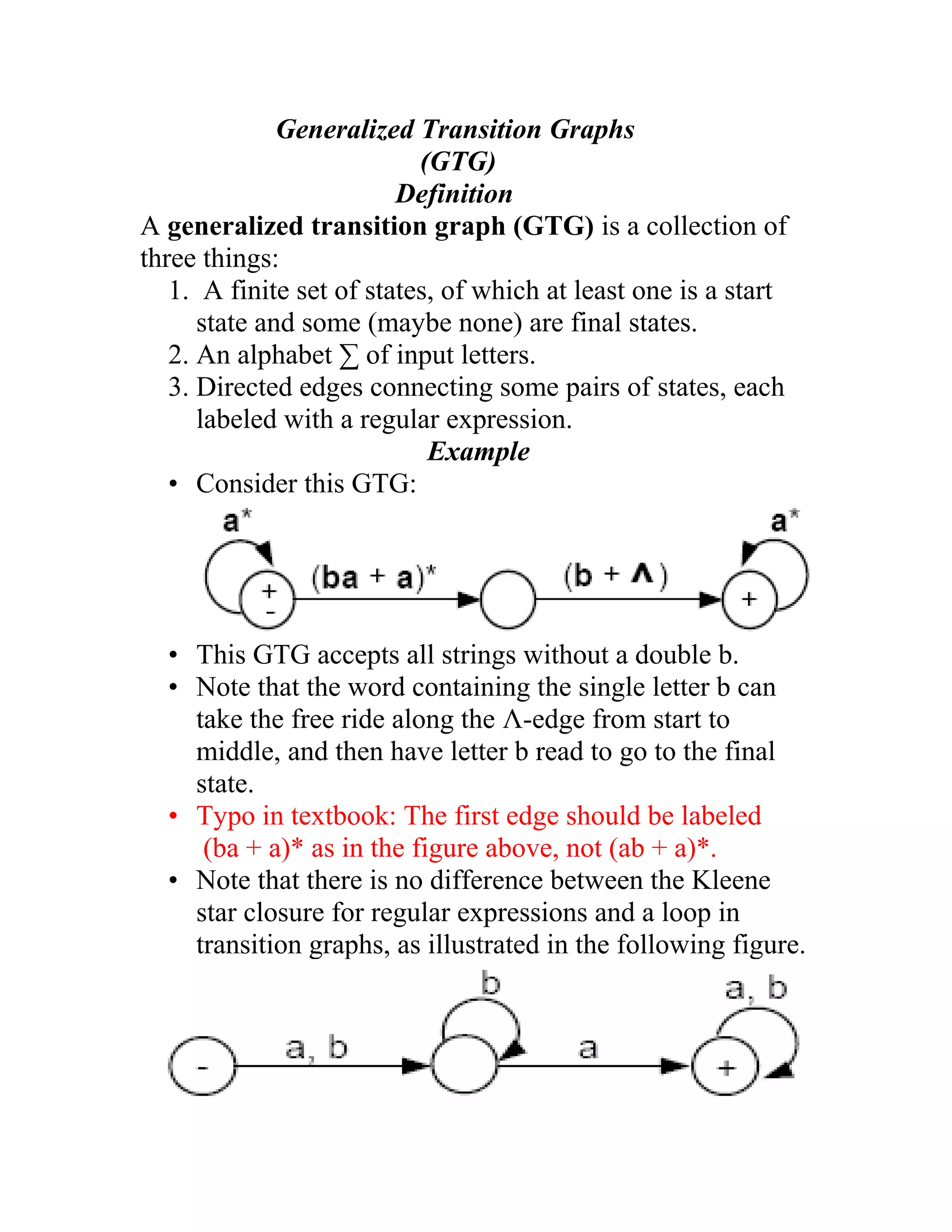
   • Consider this GTG:


  • This GTG accepts all strings without a double b.
  • Note that the word containing the single letter b can
    take the free ride along the Λ-edge from start to
    middle, and then have letter b read to go to the final
    state.
  • Typo in textbook: The first edge should be labeled
     (ba + a)* as in the figure above, not (ab + a)*.
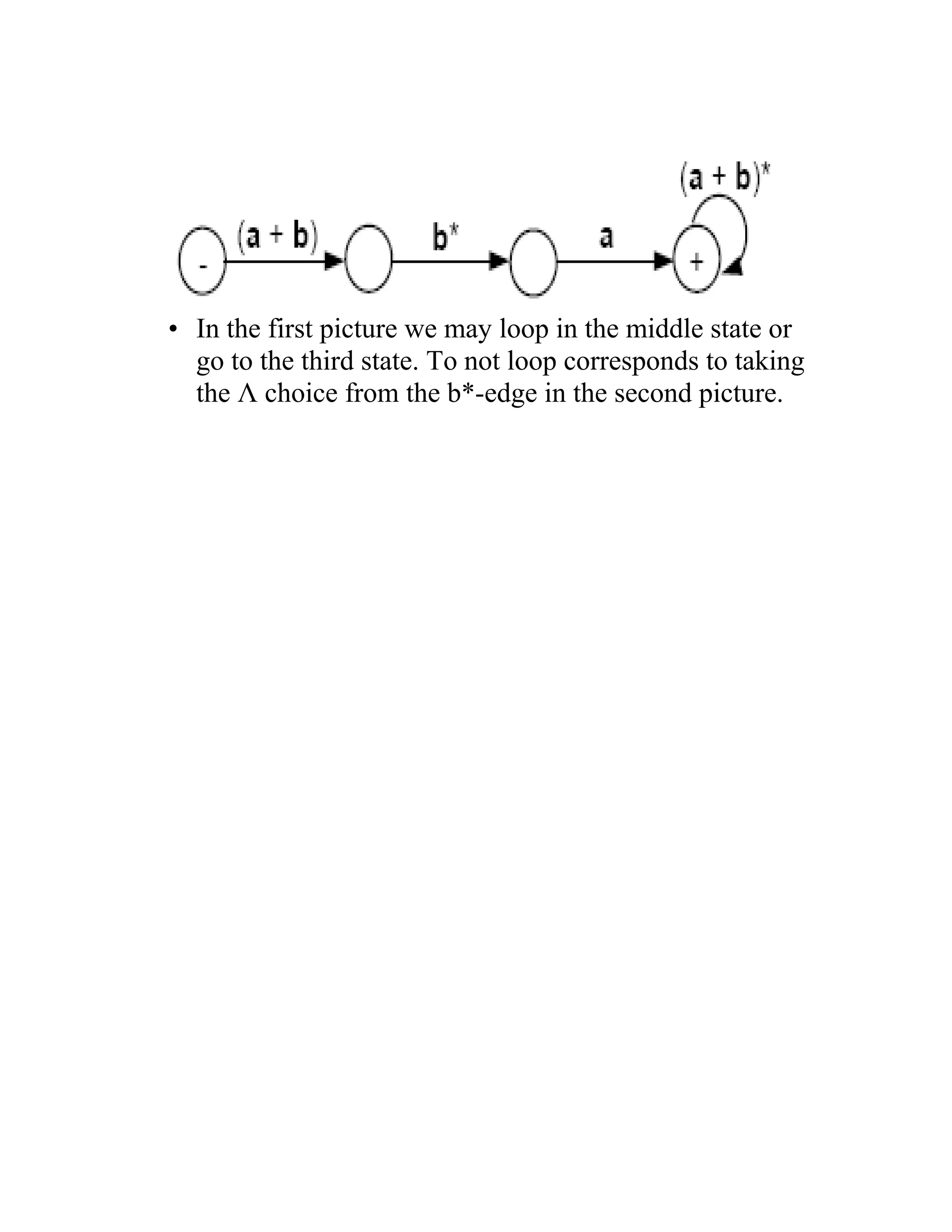
  • Note that there is no difference between the Kleene
    star closure for regular expressions and a loop in
    transition graphs, as illustrated in the following figure.
• In the first picture we may loop in the middle state or
  go to the third state. To not loop corresponds to taking
  the Λ choice from the b*-edge in the second picture.

Generalized transition graphs

  • 1.
    Generalized Transition Graphs (GTG) Definition A generalized transition graph (GTG) is a collection of three things: 1. A finite set of states, of which at least one is a start state and some (maybe none) are final states. 2. An alphabet ∑ of input letters. 3. Directed edges connecting some pairs of states, each labeled with a regular expression. Example • Consider this GTG: • This GTG accepts all strings without a double b. • Note that the word containing the single letter b can take the free ride along the Λ-edge from start to middle, and then have letter b read to go to the final state. • Typo in textbook: The first edge should be labeled (ba + a)* as in the figure above, not (ab + a)*. • Note that there is no difference between the Kleene star closure for regular expressions and a loop in transition graphs, as illustrated in the following figure.
  • 2.
    • In thefirst picture we may loop in the middle state or go to the third state. To not loop corresponds to taking the Λ choice from the b*-edge in the second picture.