Reverse Engineering a (M)MORPG
Antonin Beaujeant
AUTHOR
Name: Antonin Beaujeant (@beaujeant)
Job: Pentest - R&D
• Previous
• Now
Interest:
• Reverse engineering
• Hardware hacking
• CTF
2
AGENDA
• Introduction (12m)
• Game structure (8min)
• Define targets (8min)
• Find local saved data (10min)
• RE network protocol (45min)
• Building a Wireshark dissector (25min + 15min)
• Building an asynchronous proxy (python) (55min + 10min)
• RE binary (90min)
• Binary patching (30min)
• Library hooking (30min)
3
Introduction
INTRODUCTION
Game: Pwn Adventure 3
Genre: (M)MORPG - Team Adventure Quest
Developper: Vector35 (https://vector35.com)
Game Engine: Unity (cross-platform)
Event: Ghost In The Shellcode CTF 2015 (ShmooCon)
RE complexity: Medium (no obfuscation, no signature/encryption, all-in-one logic file)
5
INTRODUCTION
List of quests:
• Fire and Ice (RE binary)
• Pirates Treasure (crack me)
• Until the Cows Come Home (binary patching)
• Egg Hunter (RE network & RE binary)
• Unbearable Revenge (RE network)
• Blockys Revenge (logic gate)
• Overachiever (finish all achievements)
6
Town
Game Structure
Source: http://blog.dataart.com/game-development-engines-for-mobile-platforms-unity3d/
GAME STRUCTURE
8
Pwn Adventure 3 structure:
• Master game server - Login, team, characters, assign instance
• Game server - Game instances
• Client
GAME STRUCTURE
9
Application layer:
• Loading the game
• Receiving user inputs
• File/memory management
• Network communication
Game logic:
• Events (if player kill/pick up/… , then …)
• States and data (items, NPC, enemy, player, quests, etc)
• Physics (gravity, hit box, movement, collision with wall, etc)
Game view:
• Graphic engine
• Audio
GAME STRUCTURE
10
Offline game:
• All files and execution are done locally
• Full control over the game
• Obfuscation/anti-RE is the only obstacle
Online game:
• Client game logic
• Server game logic
• Bi-directional network communication
• Unknown logic on server side
• Uncontrolled logic on server side
Define Targets
Source: For Honor (Ubisoft)
DEFINE TARGET
12
Why reverse video game?
Fun 🎉
• Modding: New weapons, maps, missions, skins, etc
• Modding: New features
• Find cheat codes
Profit 🤑
• Make the game easier
• Advantage over other player
• Remove DRM
• Generate money (in game - real life)
DEFINE TARGET
13
Top down approach
Play the game to identify what is valuable:
• Items (coins, weapons, spells, etc)
• State (quest unlocked, being level 42, etc)
• Increase specs (damage x10, health +1000, etc)
• Enhance capabilities (run faster, see through wall, jump higher, etc)
Identify where it is used, then reverse and exploit.
Bottom-up approach
Reverse the binary/network to identify potential weakness
DEFINE TARGET
14
Targets for this workshop:
• Spawn wherever we want
• Pick up remote items
• Find secret to unlock quest
• Find vulnerability to kill boss
• Run faster
• Jump higher
• Teleport anywhere
DEFINE TARGET
15
Where to look?
• Network communication (if online)
• Local saved data
• Client game logic binary
• Server game logic binary (if online)
• Rendering engine
DEFINE TARGET
16
What to do?:
• RE network protocol
• Edit local saved data
• RE game logic
• Patch binary/Hook libraries
• Edit rendering engine
• Build bots (automate task to be faster and more accurate)
Find Local Saved Data
FIND LOCAL SAVED DATA
18
Saved data might contain items and states.
Could be encrypted and/or signed.
Should be most likely present in offline game.
Should be most likely not present in online game.
FIND LOCAL SAVED DATA
19
Lab 1: Find local saved data
Find new/deleted files:
• find / -type f -o -path /proc -prune > snapshot1
• find / -type f -o -path /proc -prune > snapshot2
• diff -crB snapshot1 snapshot2 > changes
Find edited/removed files:
• find / -path /proc -prune -o -path /sys -prune -o -path /usr -prune -o -type f -
print0 | xargs -0 md5sum | tee md5sum.txt
• md5sum -c md5sum.txt 2> /dev/null | grep -i 'FAIL' > failed.txt
RE Network Protocol
RE NETWORK PROTOCOL
21
Data expected:
• Encrypted
• Encoded
• Clear text
• Printable character
• Binary
RE NETWORK PROTOCOL
22
Format expected:
• Known format
• HTTP: username=john&password=letmein (POST /login/)
• JSON: {"login":{"username":"john","password":"letmein"}}
• XML: <login><username>john</username><password>letmein</password></login>
• More…
• Unknown format
• Identifier (when sequence order is not predictable)
• Delimiter (when size is not predicable)
RE NETWORK PROTOCOL
23
Methodology for binary protocol using unknown format:
• Understand your target
• Identify IP(s), port(s) and content (encrypted? Format?)
• Build use cases (e.g. don’t move, shoot, etc)
• Look at network behaviour (size, frequency, pattern, etc)
• Raise assumptions
• Identify the packet
• Isolate variables
• Locate the variable
RE NETWORK PROTOCOL
24
A lot of guessing and assumption, which
requires knowledge to fasten the process.
RE NETWORK PROTOCOL
25
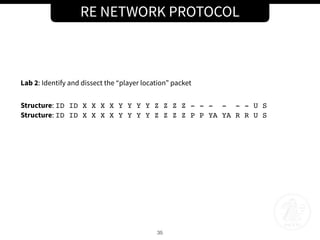
Lab 2: Identify and dissect the “player location” packet
RE NETWORK PROTOCOL
26
Lab 2: Identify and dissect the “player location” packet
No mouvement:
Structure: - - - - - - - - - - - - - - - - - - - - - -
RE NETWORK PROTOCOL
27
Lab 2: Identify and dissect the “player location” packet
Jump:
Structure: - - - - - - - - - - Z Z Z - - - - - - - - -
RE NETWORK PROTOCOL
28
Lab 2: Identify and dissect the “player location” packet
Move forward:
Structure: - - X X X - - - - - Z Z Z - - - - - - - ? -
RE NETWORK PROTOCOL
29
Lab 2: Identify and dissect the “player location” packet
Strafe right:
Structure: - - X X X - Y Y Y - Z Z Z - - - - - - ? ?
RE NETWORK PROTOCOL
30
Lab 2: Identify and dissect the “player location” packet
Structure: - - X X X - Y Y Y - Z Z Z Z - - - - - - ? ?
Structure: - - X X X X Y Y Y Y Z Z Z Z - - - - - - U S
Structure: ID ID X X X X Y Y Y Y Z Z Z Z - - - - - - U S
RE NETWORK PROTOCOL
31
Lab 2: Identify and dissect the “player location” packet
RE NETWORK PROTOCOL
32
Lab 2: Identify and dissect the “player location” packet
Look left:
Structure: ID ID X X X X Y Y Y Y Z Z Z Z - - YA YA - - U S
RE NETWORK PROTOCOL
33
Lab 2: Identify and dissect the “player location” packet
Look up:
Structure: ID ID X X X X Y Y Y Y Z Z Z Z P P YA YA - - U S
RE NETWORK PROTOCOL
34
Lab 2: Identify and dissect the “player location” packet
Look up:
Structure: ID ID X X X X Y Y Y Y Z Z Z Z P P YA YA R R U S
RE NETWORK PROTOCOL
35
Lab 2: Identify and dissect the “player location” packet
Structure: ID ID X X X X Y Y Y Y Z Z Z Z - - - - - - U S
Structure: ID ID X X X X Y Y Y Y Z Z Z Z P P YA YA R R U S
RE NETWORK PROTOCOL
36
Lab 3: Identify and dissect the “mana” and “chat” packets
Ressource:
• Wireshark filer: (tcp.port >= 3000 and tcp.port <=3010) and tcp.len > 0
RE NETWORK PROTOCOL
37
Packet format:
• Start with a 2-bytes identifier (e.g. mv = location, *i = fire, etc)
• Can be concatenated
• Strings is defined by length
• Number are represented in little-endian
RE NETWORK PROTOCOL
38
Endianness:
RE NETWORK PROTOCOL
39
Complete list of reversed packets:
https://github.com/Foxmole/PwnAdventure3/blob/master/protocol.md
Building a Wireshark Dissector
BUILDING DISSECTOR
41
What is Wireshark?
• Packet analyser
• Data ➡ human readable representation
• Hundreds of supported protocols and media
• Possibility to add custom parser (dissector)
BUILDING DISSECTOR
42
Two type of dissectors
Compiled dissector:
• Edit source code & compile
• Long term
• Parsing process faster
External plugin:
• Plugin in Lua
• Easy language
• Rapidly deployed
BUILDING DISSECTOR
43
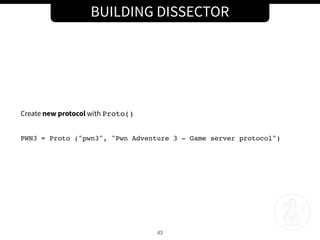
Create new protocol with Proto()
PWN3 = Proto ("pwn3", "Pwn Adventure 3 - Game server protocol")
BUILDING DISSECTOR
44
Define all elements (and type) of the protocol:
local f = PWN3.fields
local opcodes = {
[0x2a69] = “Fire",
[0x6d61] = "Update mana”,
[0x6d76] = "Update location”,
...
}
f.opcode = ProtoField.uint16 ("pwn3.opcode", "Action", base.HEX, opcodes)
f.posx = ProtoField.new ("X coordinate", "pwn3.posx", ftypes.FLOAT)
f.posy = ProtoField.new ("Y coordinate", "pwn3.posy", ftypes.FLOAT)
f.posz = ProtoField.new ("Z coordinate", "pwn3.posz", ftypes.FLOAT)
f.mana = ProtoField.uint32 ("pwn3.mana", "Mana", base.DEC)
...
BUILDING DISSECTOR
45
Start dissecting with PROTO.dissector():
function PWN3.dissector (buffer, pinfo, tree)
-- Dissection code
-- buffer is the data in the TCP packet
-- tree is the root element in the visual tree structure
end
BUILDING DISSECTOR
46
Wireshark visual tree structure:
BUILDING DISSECTOR
47
Adding new branch in the visual tree structure with tree:add:
-- Add node to the root (right below the TCP element)
local subtree = tree:add (PROTO, buffer())
-- Add a node to subtree (created above)
local branch = subtree:add (f.FMT, buffer(OFFSET, LENGTH))
• PROTO = PWN3
• BUFFER = buffer argument given in PROTO.dissector()
• f.FMT = format defined previously
• OFFSET / LENGTH = used to select a part of the buffer
BUILDING DISSECTOR
48
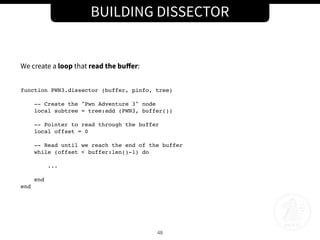
We create a loop that read the buffer:
function PWN3.dissector (buffer, pinfo, tree)
-- Create the "Pwn Adventure 3" node
local subtree = tree:add (PWN3, buffer())
-- Pointer to read through the buffer
local offset = 0
-- Read until we reach the end of the buffer
while (offset < buffer:len()-1) do
...
end
end
BUILDING DISSECTOR
49
Each time we find a known identifier, the section is parsed:
while (offset < buffer:len()-1) do
-- Reading two bytes
-- opcode is the packet identifier number
local opcode = buffer(offset, 2):uint()
offset = offset + 2
-- Update mana
if (opcode == 0x6d61) then
...
-- Fire
elseif (opcode == 0x2a69) then
...
end
end
BUILDING DISSECTOR
50
If mana:
-- Adding a node "Update mana" in subtree
-- Using the name related to the opcode
local branch = subtree:add (buffer(offset-2, 6), opcodes[opcode])
-- Appending a text to node "Update mana"
branch:append_text (", Mana: " .. buffer(offset, 4):le_uint())
-- Adding a node in the "Update mane" branch
-- Adding the opcode
branch:add (f.opcode, buffer(offset-2, 2))
-- Adding a node in the "Update mana" branch
-- Node mana level
branch:add_le (f.mana, buffer(offset, 4))
offset = offset + 4
BUILDING DISSECTOR
51
If fire:
-- Getting the size of the weapon name
-- This is to calculate the total length of the packet
local length = buffer(offset, 2):le_uint()
-- Adding a node "Fire" in subtree
-- Using the name related to the opcode
-- The size of the packet is:
-- 2 bytes for the opcode
-- 2 bytes for the length of the weapons name
-- n bytes for the weapons name (stored in var length)
-- 12 bytes for the direction of the projectile
-- Total = 16 + length
local branch = subtree:add (buffer(offset-2, 16+length), opcodes[opcode])
-- Adding a node in the "Update mane" branch
-- Adding the opcode
branch:add (f.opcode, buffer(offset-2, 2))
-- Skip the length byte
offset = offset + 2
-- Appending a text to node "Fire"
branch:append_text (", Weapon: " .. buffer(offset, length):string())
-- Adding a node in the "Fire" branch
-- Node weapons name
branch:add (f.str, buffer(offset, length))
offset = offset + length
-- Adding a node in the "Fire" branch
-- Node direction of the projectile
addVectors (buffer, offset, branch)
offset = offset + 12
BUILDING DISSECTOR
52
We create function to add direction/location/vectors in tree:
function addVectors (vectors, offset, tree)
local branch
branch = tree:add (vectors(offset, 12), "Vectors")
branch:add_le (f.vx, vectors(offset, 4))
branch:add_le (f.vy, vectors(offset + 4, 4))
branch:add_le (f.vz, vectors(offset + 8, 4))
end
BUILDING DISSECTOR
53
Finally, we register the protocol to the associated port(s) with DissectorTable:
tcp_table = DissectorTable.get ("tcp.port")
tcp_table:add (3000, PWN3)
tcp_table:add (3001, PWN3)
...
BUILDING DISSECTOR
54
Limitation with this design:
• If identifier not known, look for the next 2-bytes until one pair match, which might be
part of the data
BUILDING DISSECTOR
55
Install dissector:
• http://10.13.110.24/draft-dissector.lua
• Find plugin folder (in “About Wireshark”)
• macOS: “Wireshark” > “About Wireshark” > “Folders”
• Linux: “Help” > “About Wireshark” > “Folders”
• Windows: “Help” > “About Wireshark” > “Folders”
• Save dissector in folder
• Menu “Analyse” > “Reload Lua Plugins”
• Verify in menu “Analyse” > “Enabled Protocol…”
BUILDING DISSECTOR
56
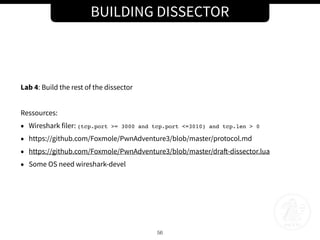
Lab 4: Build the rest of the dissector
Ressources:
• Wireshark filer: (tcp.port >= 3000 and tcp.port <=3010) and tcp.len > 0
• https://github.com/Foxmole/PwnAdventure3/blob/master/protocol.md
• https://github.com/Foxmole/PwnAdventure3/blob/master/draft-dissector.lua
• Some OS need wireshark-devel
BUILDING DISSECTOR
57
Complete dissector:
https://github.com/Foxmole/PwnAdventure3/blob/master/pwn3.lua
BUILDING DISSECTOR
58
Demo: Play game with dissector
Building an Asynchronous Proxy
BUILDING ASYNC PROXY
60
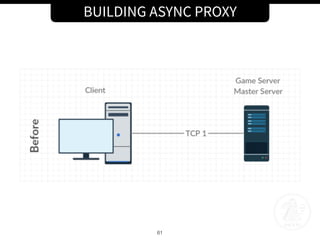
Proxy script:
• Python 2.7
• Native libs: asyncore, socket and struct
• Parse / edit on the fly in and out communication
BUILDING ASYNC PROXY
61
BUILDING ASYNC PROXY
62
BUILDING ASYNC PROXY
63
Re-routing the traffic:
• Editing /etc/hosts file:
127.0.0.1 pwn3.hackeduniverse.com
BUILDING ASYNC PROXY
64
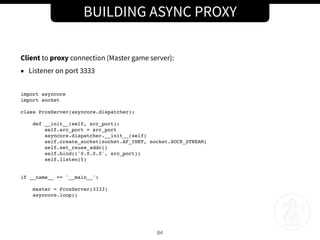
Client to proxy connection (Master game server):
• Listener on port 3333
import asyncore
import socket
class ProxServer(asyncore.dispatcher):
def __init__(self, src_port):
self.src_port = src_port
asyncore.dispatcher.__init__(self)
self.create_socket(socket.AF_INET, socket.SOCK_STREAM)
self.set_reuse_addr()
self.bind(('0.0.0.0', src_port))
self.listen(5)
if __name__ == '__main__':
master = ProxServer(3333)
asyncore.loop()
BUILDING ASYNC PROXY
65
Proxy to server connection (Master game server):
• Once client connected, create a new connection with server
class ProxServer(asyncore.dispatcher):
def __init__(self, src_port, dst_host, dst_port):
self.src_port = src_port
self.dst_host = dst_host
self.dst_port = dst_port
asyncore.dispatcher.__init__(self)
self.create_socket(socket.AF_INET, socket.SOCK_STREAM)
self.set_reuse_addr()
self.bind(('0.0.0.0', src_port))
self.listen(5)
def handle_accept(self):
pair = self.accept()
if not pair:
return
left, addr = pair
try:
right = socket.create_connection((self.dst_host, self.dst_port))
except socket.error, e:
if e.errno is not errno.ECONNREFUSED: raise
left.close()
def close(self):
asyncore.dispatcher.close(self)
if __name__ == '__main__':
# 10.0.1.3 = Master Server
master = ProxServer(3333, '10.0.1.3', 3333)
asyncore.loop()
BUILDING ASYNC PROXY
66
Forward connections:
• Forward input from client ➡ output to server
• Forward input from server ➡ output to client
def handle_accept(self):
pair = self.accept()
if not pair:
return
left, addr = pair
try:
right = socket.create_connection((self.dst_host, self.dst_port))
except socket.error, e:
if e.errno is not errno.ECONNREFUSED: raise
left.close()
client = Sock(left)
server = Sock(right)
client.other = server
server.other = client
BUILDING ASYNC PROXY
67
New class Sock:
• Buffer write_buffer for each TCP connection
• handle_read(): “Called when the asynchronous loop detects that a read() call
on the channel’s socket will succeed”
• When read() is called, the data is parsed() then copied in the buffer of the other
connection
class Sock(asyncore.dispatcher):
write_buffer = ''
def readable(self):
return not self.other.write_buffer
def handle_read(self):
self.other.write_buffer += self.recv(4096*4)
def handle_write(self):
if self.write_buffer:
pkt = parse(self.write_buffer)
sent = self.send(pkt)
self.write_buffer = self.write_buffer[sent:]
def handle_close(self):
self.close()
if self.other.other:
self.other.close()
self.other = None
BUILDING ASYNC PROXY
68
• Proxy for Master server ✅
• Proxy for Game server:
if __name__ == '__main__':
master = ProxServer(3333, '10.0.1.3', 3333)
game = ProxServer(3000, '10.0.1.3', 3000)
print "Proxy ready..."
asyncore.loop()
BUILDING ASYNC PROXY
69
Now we just need to create the parse()
function to manipulate the data
BUILDING ASYNC PROXY
70
What to do?
• Change spawning location
• Pick up any item
• Generate any item (weapons, ammunitions, etc)
SET SPAWNING LOCATION
71
Spawn location packet:
[II II] [?? ??] [XX XX XX XX] [YY YY YY YY] [ZZ ZZ ZZ ZZ] [RR RR] [YY YY] [PP PP]
I = Identifier can be multiple values
? = Always seen set as 0x00 0x00
X, Y and Z = Location where to spawn
R, Y and P = Set to zero (spawn always looking at the same direction)
Packet has always been seen alone.
SET SPAWNING LOCATION
72
Identify generic spawn packet:
• 22 bytes long (always alone)
• 3rd and 4th = 0x00 (?? ??)
• Last 6 bytes = 0x00 (RR YY PP)
def parse(p_out):
if len(p_out) == 22 and p_out[2:4] == "x00x00" and p_out[16:] == "x00x00x00x00x00x00":
# DO SOMETHING
return p_out
SET SPAWNING LOCATION
73
What to do once we have identifying the spawn packet?
• Find the coordinate where we want to spawn
• E.g. -39602.8, -18288.0, 2400.28 + 10000 (In town, high in the sky)
• Replace the coordinates with the new location
• Re-use the identifier
• Add x00x00
• Add the new coordinate [XX XX XX XX] [YY YY YY YY] [ZZ ZZ ZZ ZZ]
• Add x00x00x00x00x00x00 (direction)
SET SPAWNING LOCATION
74
Parsing script to replace the spawn packet:
def parse(p_out):
if len(p_out) == 22 and p_out[2:4] == "x00x00" and p_out[16:] == "x00x00x00x00x00x00":
packet_id = p_out[:2] # We re-use the packet ID
x = -39602.8
y = -18288.0
z = 2400.28 + 10000
p_out = packet_id
p_out += struct.pack("=HfffHHH", 0, x, y, z, 0, 0, 0)
return p_out
SET SPAWNING LOCATION
75
Demo: Spawn in the sky
PICK UP ANY ITEM
76
Pick up element packet: [65 65] [NN NN NN NN]
65 65 = Identifier (e e)
N = Element identifier
def getme(elem_id):
return "ee" + struct.pack("I", elem_id)
PICK UP ANY ITEM
77
What element number?
• Great balls of fire = 00 00 00 01
• Packet to sent: [65 65] [01 00 00 00] (little endian)
PICK UP ANY ITEM
78
When to send?
• Decide when to trigger
• Easy to trigger
PICK UP ANY ITEM
79
Chat packet: [23 2A] [LL LL] [WW WW …]
23 2A = Identifier (# *)
L = Size of the message
W = The message
def chat(msg):
return "#*" + struct.pack("H", len(msg)) + msg
PICK UP ANY ITEM
80
Script to get the Great Balls of Fire (v1):
def parse(p_out):
def chat(msg):
return "#*" + struct.pack("H", len(msg)) + msg
def getme(elem_id):
return "ee" + struct.pack("I", elem_id)
if chat("GreatBallsOfFire") in p_out:
p_out += getme(1)
return p_out
PICK UP ANY ITEM
81
Demo: Get the Great Balls of Fire
PICK UP ANY ITEM
82
It doesn’t work… Why?
PICK UP ANY ITEM
83
Location packet: [6D 76] [XX XX XX XX] [YY YY YY YY] [ZZ ZZ ZZ ZZ] [RR RR] [YY YY] [PP PP] [FF] [SS]
6D 76= Identifier (m v)
X, Y and Z = Position on the X, Y and Z axis of the map
R, Y and P = Direction where to look (roll, yaw, pitch)
F = Direction where I move
S = Direction where I strafe
def loc(x, y, z):
return "mv" + struct.pack("IIIfffBB", x, y, z, 0, 0, 0, 0, 0)
PICK UP ANY ITEM
84
What location to fake?
PICK UP ANY ITEM
85
Script to get the Great Balls of Fire (v2):
def parse(p_out):
def chat(msg):
return "#*" + struct.pack("H", len(msg)) + msg
def getme(elem_id):
return "ee" + struct.pack("I", elem_id)
def loc(x, y, z):
return "mv" + struct.pack("IIIfffBB", x, y, z, 0, 0, 0, 0, 0)
if chat("GreatBallsOfFire") in p_out:
p_out += loc(-43655.0, -55820.0, 322.0)
p_out += getme(1)
return p_out
PICK UP ANY ITEM
86
Demo: Let’s try again to get those Great Balls of Fire
CREATE ELEMENTS
87
Let’s generate new element!
CREATE ELEMENTS
88
Communication flow:
Get any element:
| CLIENT | - - - [chat] - - - > | PROXY | - - - [chat] [location] [getelement] - - - > | GAME SERVER |
| CLIENT | < - - [...] - - - - | PROXY | < - - - - - - - - [...] - - - - - - - - - - | GAME SERVER |
Create an element:
| CLIENT | - - - - [chat] - - - - - - - - > | PROXY | - - - [chat] - - - > | GAME SERVER |
| CLIENT | < - - - [...] [addelement] - - - | PROXY | < - - - [...] - - - | GAME SERVER |
CREATE ELEMENTS
89
Update proxy script:
def parse(p_out):
# DO SOMETHING
return (p_in, p_out)
...
class Sock(FixedDispatcher):
...
def handle_write(self):
if self.write_buffer:
(p_in, p_out) = parse(self.write_buffer)
self.other.write_buffer += p_in
sent = self.send(p_out)
self.write_buffer = self.write_buffer[sent:]
CREATE ELEMENTS
90
Create element packet:
[6D 6B] [NN NN NN NN] [?? ?? ?? ?? ??] [LL LL] [WW WW ...]
[XX XX XX XX] [YY YY YY YY] [ZZ ZZ ZZ ZZ] [RR RR] [YY YY] [PP
PP] [?? ?? ?? ??] [00 00]
6D 6B = Identifier (m k)
N = Element identifier
? = Always seen as 0x00
L = Length of the name
W = name of the object
X, Y and Z = Position on the X, Y and Z axis of the map
R, Y and P = Direction where to element is pointing to (roll, yaw, pitch)
? = Always seen as 0x00
00 00 = Always seen as 0x00 0x00
CREATE ELEMENTS
91
Create element packet:
def createel(elid, item, x, y, z):
packet = 'mk'
packet += struct.pack("I", elid)
packet += "x00x00x00x00x00"
packet += struct.pack("H", len(item)) + item
packet += struct.pack("fffHHHBBBB", x, y, z, 0, 0, 0, 0, 0, 0, 0)
return packet
CREATE ELEMENTS
92
What to create and where to put it?
CREATE ELEMENTS
93
Script to create a new bear chest:
def parse(p_out):
p_in = ""
def createel(elid, item, x, y, z):
packet = 'mk'
packet += struct.pack("I", elid)
packet += "x00x00x00x00x00"
packet += struct.pack("H", len(item)) + item
packet += struct.pack("fffHHHBBBB", x, y, z, 0, 0, 0, 100, 0, 0, 0)
return packet
def chat(msg):
return "#*" + struct.pack("H", len(msg)) + msg
def newspawn(opcode, x, y, z):
return opcode + struct.pack("=HfffHHH", 0, x, y, z, 0, 0, 0)
# Coordinate Town
x = -39602.8
y = -18288.0
z = 2400.28
if len(p_out) == 22 and p_out[2:4] == "x00x00" and p_out[16:] == "x00x00x00x00x00x00":
p_out = newspawn(p_out[:2], x, y, z)
if chat("CreateChest") in p_out:
p_in += createel(1337, "BearChest", x + 500, y, z)
return (p_in, p_out)
CREATE ELEMENTS
94
Demo: Create bear chest
BUILDING ASYNC PROXY
95
Lab 5: Write banner on screen
Banner packet: [65 76] [LL LL] [WW WW ...] [LL LL] [WW WW ...]
65 76 = Identifier (e v)
L = Length of first message
W = First message
L = Length of second message
W = Second message
LOOT AND MONEY
96
Time to get rich!
LOOT AND MONEY
97
New item in inventory packet:
[63 70] [LL LL] [WW WW ...] [QQ QQ QQ QQ]
63 70 = Identifier (c p)
L = Length of the name
W = Name of the element
Q = Quantity
def more(item, qt):
return "cp" + struct.pack("H", len(item)) + item + struct.pack("I", qt)
LOOT AND MONEY
98
Script to loot bear skins:
def parse(p_out):
p_in = ""
def more(item, qt):
return "cp" + struct.pack("H", len(item)) + item + struct.pack("I", qt)
def chat(msg):
return "#*" + struct.pack("H", len(msg)) + msg
if chat("GetSkin") in p_out:
p_in += more("BearSkin", 100)
return (p_in, p_out)
LOOT AND MONEY
99
It works! But can we trade the item?
Why?
LOOT AND MONEY
100
• Inventory is stored on the server side
• Before any transaction/usage, the server verify if you actually have the item in your
updated inventory stored on the server side
• Inventory is updated only with items looted/purchased legitimately
BUILDING ASYNC PROXY
101
Resource:
• https://github.com/Foxmole/PwnAdventure3/blob/master/pwn3proxy.py
UNBEARABLE REVENGE
List of quests:
• Fire and Ice (RE binary)
• Pirates Treasure (crack me)
• Until the Cows Come Home (binary patching)
• Egg Hunter (RE network & RE binary)
• Unbearable Revenge (RE network)
• Blockys Revenge (logic gate)
• Overachiever (finish all achievements)
102
Town
UNBEARABLE REVENGE
103
Where to start?
def parse(p_out):
p_in = ""
def newspawn(opcode, x, y, z):
return opcode + struct.pack("=HfffHHH", 0, x, y, z, 0, 0, 0)
if len(p_out) == 22 and p_out[2:4] == "x00x00" and p_out[16:] == "x00x00x00x00x00x00":
x = -7894.0
y = 64482.0 + 500
z = 2663.0
p_out = newspawn(p_out[:2], x, y, z)
return (p_in, p_out)
UNBEARABLE REVENGE
104
Demo: Start Unbearable Revenge quest
UNBEARABLE REVENGE
105
What to do?
• Unlock the chest (5 minutes)
• Stay in near the chest (around 10 meters diameter)
• Survive the different waves of bears
• Bears
• Angry bears
UNBEARABLE REVENGE
106
How to protect you? Climb in the tree? How to get there?
• Spawn on top
• Activate chest remotely
def parse(p_out):
p_in = ""
def newspawn(opcode, x, y, z):
return opcode + struct.pack("=HfffHHH", 0, x, y, z, 0, 0, 0)
def loc(x, y, z):
return "mv" + struct.pack("fffHHHBB", x, y, z, 0, 0, 0, 0, 0)
def getme(item):
return "ee" + struct.pack("I", item)
# Bear Chest coordinates
x = -7894.0
y = 64482.0
z = 2663.0
if len(p_out) == 22 and p_out[2:4] == "x00x00" and p_out[16:] == "x00x00x00x00x00x00":
p_out = newspawn(p_out[:2], x, y, z + 3000)
if chat("UnlockChest") in p_out:
p_out += loc(x, y, z)
p_out += getme(3) # 3 = BearChest element ID
return (p_in, p_out)
UNBEARABLE REVENGE
107
Demo: Spawn in the tree
UNBEARABLE REVENGE
108
Angry bear?
what are you doing?
Angry bear?
Stahp!
What to do now?
UNBEARABLE REVENGE
109
Spawn under the chest:
• Since under the chest is the void, we create an element underneath to “fly”
• Found a special location where our head is stuck and we can’t fall
def parse(p_out):
p_in = ""
def newspawn(opcode, x, y, z):
return opcode + struct.pack("=HfffHHH", 0, x, y, z, 0, 0, 0)
if len(p_out) == 22 and p_out[2:4] == "x00x00" and p_out[16:] == "x00x00x00x00x00x00":
# Bear Chest coordinates
x = -7894.0
y = 64482.0
z = 2663.0
p_out = newspawn(p_out[:2], x, y, z - 244)
return (p_in, p_out)
UNBEARABLE REVENGE
110
Demo: Spawn under the chest
UNBEARABLE REVENGE
111
Gotcha! Flag: “They couldnt bear the sight of you”
FIRE AND ICE
List of quests:
• Fire and Ice (RE binary)
• Pirates Treasure (crack me)
• Until the Cows Come Home (binary patching)
• Egg Hunter (RE network & RE binary)
• Unbearable Revenge (RE network)
• Blockys Revenge (logic gate)
• Overachiever (finish all achievements)
112
Town
EGG HUNTER
113
Where to start?
def parse(p_out):
p_in = ""
def newspawn(opcode, x, y, z):
return opcode + struct.pack("=HfffHHH", 0, x, y, z, 0, 0, 0)
if len(p_out) == 22 and p_out[2:4] == "x00x00" and p_out[16:] == "x00x00x00x00x00x00":
# First egg location
x = 24770.0
y = 69466.0
z = 2727.0
p_out = newspawn(p_out[:2], x, y, z)
return (p_in, p_out)
EGG HUNTER
114
Demo: Start Egg Finder quest
EGG HUNTER
115
What to do?
• Collect all the eggs on the map
• Eggs are listed in the init packet
EGG HUNTER
116
Script to collect them all:
def parse(p_out):
p_in = ""
def getme(item):
return "ee" + struct.pack("I", item)
def loc(x, y, z):
return "mv" + struct.pack("fffHHHBB", x, y, z, 0, 0, 0, 0, 0)
def chat(msg):
return "#*" + struct.pack("H", len(msg)) + msg
if chat("egg1") in p_out:
p_out += loc(-25045.0, 18085.0, 260.0)
p_out += getme(11)
if chat("egg2") in p_out:
p_out += loc(-51570.0, -61215.0, 5020.0)
p_out += getme(12)
if chat("egg3") in p_out:
p_out += loc(24512.0, 69682.0, 2659.0)
p_out += getme(13)
...
if chat("egg9") in p_out:
p_out += loc(65225.0, -5740.0, 4928.0)
p_out += getme(19)
if chat("BallmerPeakEgg") in p_out:
p_out += loc(-2778.0, -11035.0, 10504.0)
p_out += getme(20)
return (p_in, p_out)
EGG HUNTER
117
Once in a while, you will have the game server that crash. This might be due to the
sudden jump between locations.
Eventually, you will be able to collect all eggs but the “Ballmer Peak Egg”.
Let’s have a closer look in… the binary!
Reverse Engineering Binary
RE BINARY
119
What binary to reverse?
• Game logic
• Linux: PwnAdventure3/client/PwnAdventure3_Data/PwnAdventure3/
PwnAdventure3/Binaries/Linux/libGameLogic.so
• macOS: /Applications/Pwn Adventure 3.app/Contents/PwnAdventure3/
PwnAdventure3.app/Contents/MacOS/GameLogic.dylib
:~$ file libGameLogic.so
libGameLogic.so: ELF 64-bit LSB shared object, x86-64, version 1 (SYSV),
dynamically linked, not stripped
RE BINARY
120
What tools to use?
• Disassembler
• Hopper (free for x64)
• Binary Ninja
• IDA Pro
• Debugger
• gdb
• OllyDbg
RE BINARY
121
Assembly:
• Low-level programming language
• Close to machine code instruction
RE BINARY
122
Limited set of instructions:
• mov
• call
• test
• cmp
• jmp, jnz, jb, …
• …
RE BINARY
123
Variables are stored in different areas:
• Registries
• RAX
• RBX
• RCX
• RDX
• Stack
• Heap
• RSI
• RDI
• RBP
• RSP
• R8
• R9
• R…
• R15
• XMM8
• XMM9
• XMM…
• XMM15
• RIP
• EFLAGS
EGG FINDER
124
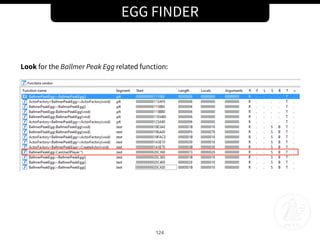
Look for the Ballmer Peak Egg related function:
EGG FINDER
125
BallmerPeakEgg:CanUse(BallmerPeakEgg *this, IPlayer *player) {
int ret;
int canuse;
ret = ItemPickup::CanUse(this, player);
if (ret)
{
ret = Player::????(“BallmerPeakSecret”);
if (ret)
{
canuse = true;
}
else
{
canuse = false;
}
}
else
{
canuse = false;
}
return canuse; // We want to return true
}
EGG FINDER
126
How to find which function is called?
• gdb
• Breakpoint at call qword ptr [rcx+0D0h]
$ ps a
PID TTY STAT TIME COMMAND
2334 pts/18 Sl+ 0:00 ./MasterServer
2410 pts/17 Sl+ 11:08 ./PwnAdventure3Server
2414 pts/17 Sl+ 10:56 ./PwnAdventure3Server
2416 pts/17 Sl+ 12:35 ./PwnAdventure3Server
3232 pts/1 Ss 0:00 bash
3603 pts/1 R+ 0:00 ps a
$ sudo su
# gdb -p 2410
(gdb) break BallmerPeakEgg::CanUse
(gdb) continue
EGG FINDER
127
Let’s trigger the function BallmerPeakEgg:CanUse:
• Type BallmerPeakEgg in the chat box
def parse(p_out):
p_in = ""
def getme(item):
return "ee" + struct.pack("I", item)
def loc(x, y, z):
return "mv" + struct.pack("fffHHHBB", x, y, z, 0, 0, 0, 0, 0)
def chat(msg):
return "#*" + struct.pack("H", len(msg)) + msg
if chat("BallmerPeakEgg") in p_out:
p_out += loc(-2778.0, -11035.0, 10504.0)
p_out += getme(20)
return (p_in, p_out)
EGG FINDER
128
The process break at BallmerPeakEgg::CanUse.
Now we can set a breakpoint at call QWORD PTR [rcx+0xd0]:
(gdb) set disassembly-flavor intel
(gdb) x/20i $rip
=> 0x7f3c6ff26374: mov rdi,QWORD PTR [rbp-0x18]
0x7f3c6ff26378: mov QWORD PTR [rbp-0x20],rdi
...
0x7f3c6ff263a7: mov rdi,rax
0x7f3c6ff263aa: call QWORD PTR [rcx+0xd0]
0x7f3c6ff263b0: test al,0x1
...
0x7f3c6ff263c5: mov al,BYTE PTR [rbp-0x1]
(gdb) break *0x7f3c6ff263aa
EGG FINDER
129
Finally, we can see the function called:
(gdb) continue
(gdb) step
Player::HasPickedUp (this=0x72ed9e0, name=0x7f3c6ff473e9 "BallmerPeakSecret") at
Player.cpp:864
EGG FINDER
130
Final pseudo-code translation for BallmerPeakEgg:CanUser:
BallmerPeakEgg:CanUse(BallmerPeakEgg *this, IPlayer *player) {
int ret;
int canuse;
ret = ItemPickup::CanUse(this, player); // Seems to be always true
if (ret)
{
ret = Player::HasPickedUp(this, “BallmerPeakSecret”);
if (ret)
{
canuse = true;
}
else
{
canuse = false;
}
}
else
{
canuse = false;
}
return canuse; // We want to return true
}
EGG FINDER
131
It seems that at some point, we need to pick up a “BallmerPeakSecret” in order to use
(pick up) the BallmerPeakEgg.
Where is the “BallmerPeakSecret” string also used?
EGG FINDER
132
This is an overview of BallmerPeakPoster::Damage:
1
2
3
4
5
6
7 BallmerPeakSecret used
8
EGG FINDER
133
Set a breakpoint at BallmerPeakPoster::Damage:
(gdb) break BallmerPeakPoster::Damage
(gdb) continue
EGG FINDER
134
Go to BallmerPeakPoster and start fire Great Balls of Fire at it
def parse(p_out):
p_in = ""
def newspawn(opcode, x, y, z):
return opcode + struct.pack("=HfffHHH", 0, x, y, z, 0, 0, 0)
if len(p_out) == 22 and p_out[2:4] == "x00x00" and p_out[16:] == "x00x00x00x00x00x00":
# Ballmer Peak location
x = -6791.0
y = -11655.0
z = 10528.0
p_out = newspawn(p_out[:2], x, y, z)
return (p_in, p_out)
EGG FINDER
135
1. Entry point (disassembler)
Assign arguments
to local variables
Make sure the argument
instigator != 0
rdi rsi rdx ecx r8d
1. Entry point (debugger)
(gdb) x/x $rsi
0x5e0fcb0: 0x230c2980
EGG FINDER
136
This is an overview of BallmerPeakPoster::Damage:
2
BallmerPeakSecret used
EGG FINDER
137
2. Block (disassembler)
What function is called?
2. Block (debugger)
(gdb) set disassembly-flavor intel
(gdb) x/30i $rip
[...]
0x7f8622dcd655: mov rdi,rax
0x7f8622dcd658: call QWORD PTR [rcx+0x20]
0x7f8622dcd65b: test al,0x1
0x7f8622dcd65d: jne 0x7f8622dcd668
[...]
(gdb) break *0x7f8622dcd658
(gdb) break *0x7f8622dcd668
(gdb) continue
(gdb) step
Player::IsPlayer (this=0x5e0fcb0)
(gdb) finish
Value returned is $1 = true
EGG FINDER
138
This is an overview of BallmerPeakPoster::Damage:
3
BallmerPeakSecret used
EGG FINDER
139
3. Block (disassembler)
3. Block (debugger)
(gdb) x/xg $rbp-0x18
0x7fffd46c5988: 0x0000000005bc8290
Convert symbol
in HEX
EGG FINDER
140
This is an overview of BallmerPeakPoster::Damage:
4
5
6
BallmerPeakSecret used
EGG FINDER
141
4, 5and 6. Block (disassembler) 4, 5and 6. Block (debugger)
• In order to move to the blue box, AL
should be different than 1 (True) 1
• AL = var_59 2
• var_59 is the return value from 3
• Once un-mangled, the function is:
std::operator!=( lhs, rhs )
(gdb) x/30i $rip
[...]
0x7f8622dcd6b5: lea rdi,[rbp-0x28]
0x7f8622dcd6b9: lea rsi,[rip+0x6a6b6] # 0x7f8622e37d76
0x7f8622dcd6c0: call 0x7f8622d1afb0
0x7f8622dcd6c5: mov BYTE PTR [rbp-0x59],al
0x7f8622dcd6c8: jmp 0x7f8622dcd6cd
[...]
(gdb) break *0x7f8622dcd6c0
(gdb) continue
(gdb) x/s $rsi
0x7f8622e37d76: "CowboyCoder"
(gdb) x/xg $rdi
0x7fffd46c5978: 0x0000000005db9d38
(gdb) x/s 0x0000000005db9d38
0x5db9d38: "GreatBallsOfFire"
3
1
2
EGG FINDER
142
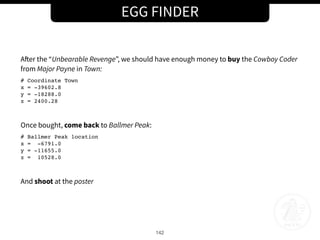
After the “Unbearable Revenge”, we should have enough money to buy the Cowboy Coder
from Major Payne in Town:
# Coordinate Town
x = -39602.8
y = -18288.0
z = 2400.28
Once bought, come back to Ballmer Peak:
# Ballmer Peak location
x = -6791.0
y = -11655.0
z = 10528.0
And shoot at the poster
EGG FINDER
143
This is an overview of BallmerPeakPoster::Damage:
7 BallmerPeakSecret used
EGG FINDER
144
7. Block (disassembler)
7. Block (debugger)
(gdb) x/30i $rip
[...]
0x7f8622dcd722: lea rsi,[rip+0x6dcc0] # 0x7f8622e3b3e9
0x7f8622dcd729: mov rax,QWORD PTR [rbp-0x10]
0x7f8622dcd72d: mov QWORD PTR [rbp-0x48],rax
0x7f8622dcd731: mov rax,QWORD PTR [rbp-0x48]
0x7f8622dcd735: mov rcx,QWORD PTR [rax]
0x7f8622dcd738: mov rdi,rax
0x7f8622dcd73b: call QWORD PTR [rcx+0x250]
0x7f8622dcd741: add rsp,0x60
0x7f8622dcd745: pop rbp
0x7f8622dcd746: ret
[...]
(gdb) break *0x7f8622dcd73b
(gdb) continue
(gdb) step
Player::MarkAsPickedUp (this=0x619e010, name=0x7f8622e3b3e9 "BallmerPeakSecret")
What function is called?
EGG FINDER
145
Player::MarkAsPickedUp("BallmerPeakSecret") is exactly what we needed!
Summary:
• If we shoot at the Ballmer Peak Poster with a Cowboy Coder, the function
Player::MarkAsPickedUp("BallmerPeakSecret") will be called
• From now on, the function Player::HasPickedUp("BallmerPeakSecret") will return True
• Which means BallmerPeakEgg:CanUse(...) will also return True
EGG FINDER
146
Demo: Get that Ballmer Peak Egg
FIRE AND ICE
List of quests:
• Fire and Ice (RE binary)
• Pirates Treasure (crack me)
• Until the Cows Come Home (binary patching)
• Egg Hunter (RE network & RE binary)
• Unbearable Revenge (RE network)
• Blockys Revenge (logic gate)
• Overachiever (finish all achievements)
147
Town
FIRE AND ICE
148
Where to start?
def parse(p_out):
p_in = ""
def newspawn(opcode, x, y, z):
return opcode + struct.pack("=HfffHHH", 0, x, y, z, 0, 0, 0)
if len(p_out) == 22 and p_out[2:4] == "x00x00" and p_out[16:] == "x00x00x00x00x00x00":
# Lava Cave location
x = 50876.0
y = -5243.0
z = 1645.0
p_out = newspawn(p_out[:2], x, y, z)
return (p_in, p_out)
FIRE AND ICE
149
What to do?
• “Kill Magmarok”
FIRE AND ICE
150
Demo: Try to kill Magmarok
FIRE AND ICE
151
What we noticed:
• Ice seem to give more damage
• Weapon and static links barely give any damage
• Fire seem to heal Magmarok
• When Magmarok reach half life, it start a spell to regenerate its entire life bar
FIRE AND ICE
152
List all functions in Magmarok object:
FIRE AND ICE
153
Magmarok::Damage pseudo-code:
Magmarok::Damage(weaponDmg, weaponType) {
FIRE = 1
ICE = 2
if (weaponType == FIRE) # 0x13AF4F
{
healthFactor = magmarok.currentHealth / 10000 # 0x13AF87
healthMultiplier = pow(healthFactor, 3) # 0x13AFA2
intendedHealing = healthMultiplier * weaponDmg # 0x13AFC0
intendedHealing = intendedHealing * 4 # 0x13AFC4
maximumHealing = 10000 - magmarok.currentHealth # 0x13AFD3
if (intendedHealing > maximumHealing) # 0x13AFDC
{
intendedHealing = maximumHealing # 0x13AFE8
}
weaponDmg = 0 - intendedHealing # 0x13AFF3
}
else
{
if (weaponType != ICE) # 0x13AFFB
{
# If not ice nor fire
weaponDmg = weaponDmg / 2 # 0x13B019
}
}
. . .
. . .
if (magmarok.something == 1) # 0x13B027
{
if (weaponDmg <= 0) # 0x13B034
{
if (magmarok.something == 1) # 0x13B060
{
if (weaponType != ICE) # 0x13B06D
{
weaponDmg = weaponDmg * 4 # 0x13B07D
}
}
}
else
{
weaponDmg = weaponDmg / 2 # 0x13B052
}
}
damage(magmarok, weaponDmg, weaponType) # 0x13B09E
}
FIRE AND ICE
154
Damage summary:
• Fire spell will give negative damage (healing) proportionally to Magmarok’s health
• Ice spell will give normal damage
• All other weapon/spell will give half damage
FIRE AND ICE
155
Potential integer overflow?
Healing is an interesting feature. If we heal enough Magmarok, we might trigger an
integer overflow and kill the beast.
FIRE AND ICE
156
What is an integer overflow?
“If the variable has a signed integer type, a program may make the assumption
that a variable always contains a positive value. An integer overflow can cause
the value to wrap and become negative, which violates the program’s assumption
and may lead to unexpected behavior.”
1111111111111111111111111111111111111111111111111111111111111111 = 18446744073709551615
1111111111111111111111111111111111111111111111111111111111111110 = 18446744073709551614
. . .
0000000000000000000000000000000000000000000000000000000000000010 = 2
0000000000000000000000000000000000000000000000000000000000000001 = 1
0000000000000000000000000000000000000000000000000000000000000000 = 0
1111111111111111111111111111111111111111111111111111111111111111 = -1
1111111111111111111111111111111111111111111111111111111111111110 = -2
FIRE AND ICE
157
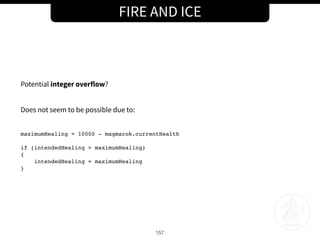
Potential integer overflow?
Does not seem to be possible due to:
maximumHealing = 10000 - magmarok.currentHealth
if (intendedHealing > maximumHealing)
{
intendedHealing = maximumHealing
}
FIRE AND ICE
158
Magmarok::Damage pseudo-code:
Magmarok::Damage(weaponDmg, weaponType) {
FIRE = 1
ICE = 2
if (weaponType == FIRE) # 0x13AF4F
{
healthFactor = magmarok.currentHealth / 10000 # 0x13AF87
healthMultiplier = pow(healthFactor, 3) # 0x13AFA2
intendedHealing = healthMultiplier * weaponDmg # 0x13AFC0
intendedHealing = intendedHealing * 4 # 0x13AFC4
maximumHealing = 10000 - magmarok.currentHealth # 0x13AFD3
if (intendedHealing > maximumHealing) # 0x13AFDC
{
intendedHealing = maximumHealing # 0x13AFE8
}
weaponDmg = 0 - intendedHealing # 0x13AFF3
}
else
{
if (weaponType != ICE) # 0x13AFFB
{
# If not ice nor fire
weaponDmg = weaponDmg / 2 # 0x13B019
}
}
. . .
. . .
if (magmarok.something == 1) # 0x13B027
{
if (weaponDmg <= 0) # 0x13B034
{
if (magmarok.something == 1) # 0x13B060
{
if (weaponType != ICE) # 0x13B06D
{
weaponDmg = weaponDmg * 4 # 0x13B07D
}
}
}
else
{
weaponDmg = weaponDmg / 2 # 0x13B052
}
}
damage(magmarok, weaponDmg, weaponType) # 0x13B09E
}
FIRE AND ICE
159
Where is the Magmarok regeneration code?
Filter for Magmarok:: functions

• Magmarok::Damage
• Magmarok::Tick
• Magmarok::GetMaxHealth
Let’s search for “heal”:
FIRE AND ICE
160
What is Magmarok::Tick function?
A “real time” function that is triggered regularly in order to update the state and action of
Magmarok.
[...]
if (magmarok.healing == False) # 0x13B122
{
if (magmarok.health > 0) # 0x13B32F
{
if (magmarok.health < 5000) # 0x13B343
{
magmarok.healing = True # 0x13B357
updateState(magmarok, "Healing") # 0x13B3CD
}
}
}
else
{
if (magmarok.health > 0) # 0x13B166
{
newHealth = magmarok.health + 4975 # 0x13B182
sendHealthUpdate(magmarok, newHealth) # 0x13B1B5
triggerEvent(magmarok, "Heal") # 0x13B227
triggerEvent(magmarok, "Healing") # 0x13B2A9
}
}
[...]
FIRE AND ICE
161
Tick summary:
• When health < 5000 HP, switch to healing mode
• When in healing mode, next tick grants 4975 HP
• It takes around 4 seconds for healing
FIRE AND ICE
162
What’s better than an integer overflow?
Double integer overflow!
FIRE AND ICE
163
Let’s go back to the initial issue that prevent the first integer overflow:
maximumHealing = 10000 - magmarok.currentHealth # 0x13AFD3
if (intendedHealing > maximumHealing) # 0x13AFDC
{
intendedHealing = maximumHealing # 0x13AFE8
}
rax = Magmarok object

verify with debugging
FIRE AND ICE
164
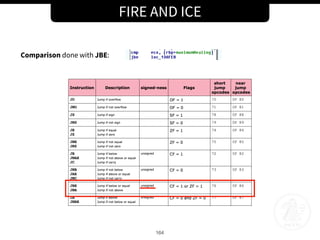
Comparison done with JBE:
FIRE AND ICE
165
What if magmarok.currentHealth is higher than 10000?
maximumHealing = 10000 - magmarok.currentHealth
if (intendedHealing > maximumHealing)
{
intendedHealing = maximumHealing
}
maximumHealing will be negative:
0000000000000000000000000000000000000000000000000000000000000010 = 2
0000000000000000000000000000000000000000000000000000000000000001 = 1
0000000000000000000000000000000000000000000000000000000000000000 = 0
1111111111111111111111111111111111111111111111111111111111111111 = -1
1111111111111111111111111111111111111111111111111111111111111110 = -2
E.g. if maximumHealing = -1, the if() condition intendedHealing > maximumHealing will not
be true
FIRE AND ICE
166
This means as soon as Magmarok health is higher than 10000, we will be able to
increase its health infinitely.
How to get magmarok.health > 10000?
if (magmarok.health < 5000):
Heal for 4 seconds
magmarok.health += 4975
So we just need to drop health right below 5000HP, then we will have 4 seconds to
increase the health to 5026HP (or more) so that when it regenerate its health by
4975HP, the final health will be 10001HP (or more).
FIRE AND ICE
167
We don’t have much time (4 seconds) to get the health > 5000HP. This means we need to
be accurate and be right below 5000HP.
We will use the proxy to indicate Magmarok’s health:
def parse(p_out):
p_in = ""
if "++" in p_out:
posi = p_out.index("++")
actor,health = struct.unpack("ii", p_out[posi+2 : posi+10])
print "HEALTH: " + str(actor) + " - " + str(health) + "hp"
return (p_out, p_in)
FIRE AND ICE
168
Demo: Let’s kill Magmarok
Binary Patching
BINARY PATCHING
170
When you run an application, you execute instructions that has been writing by the
developers for a specific purpose.
Sometimes, the instructions restrict you:
• An evaluation version of an application that exit after 30 minutes
• Your player in your MMORPG that cannot jump high enough to access hidden high
location
BINARY PATCHING
171
The executed instructions are located on your computer, which you control:
• Read binary: Disassembling
• Execute binary: Debugging
• Edit binary: Patching
You can therefore change those instructions to bypass restrictions (e.g. cracking) but
also to improve or add new functionalities.
BINARY PATCHING
172
Let’s run faster!
BINARY PATCHING
173
Functions related to movements:
BINARY PATCHING
174
Player::GetSprintMultiplier(void) function:
Non-scalar types (including floats and doubles) are returned in the XMM0 register
BINARY PATCHING
175
Tool list:
• Python
• Capstone
• Keystone
BINARY PATCHING
176
Find the offset:
BINARY PATCHING
177
Verify new instruction won’t overwrite the next legitimate instruction (cvtsi2ss xmm0,
rax). For this, we need to calculate the size in memory of the instruction to replace:
from capstone import *
offset = 0x15ea64
with open( 'libGameLogic.so', 'rb' ) as f:
binary = f.read()
cpt = 0
size = 0
md = Cs( CS_ARCH_X86, CS_MODE_64 )
for i in md.disasm( binary[ offset : offset+64 ], offset ):
if not cpt:
size = len(i.bytes)
cpt += 1
BINARY PATCHING
178
Then we assemble the new instruction and compare the size: If It equals or smaller, we
can overwrite the instruction with padding:
from keystone import *
ks = Ks(KS_ARCH_X86, KS_MODE_64)
encoding, count = ks.asm(b'mov rax, 0x1e')
if len( encoding ) <= size:
# padding with NOPs if shorter
encoding = encoding + [0x90]*( size - len(encoding) )
binary = binary[ : offset ] + ''.join(chr(c) for c in binary) +
BIN[ offset+size : ]
BINARY PATCHING
179
Finally, we just need to save the new file:
with open('libGameLogic.so', 'wb') as f:
f.write(binary)
BINARY PATCHING
180
Complete patcher script:
https://github.com/Foxmole/PwnAdventure3/blob/master/binpatcher.py
$ python binpatcher.py -f libGameLogic.so -o 0x15ea64 -m 64 -i "movabs rax, 0x1e"
FIRE AND ICE
181
Demo: Let’s run supa fast!
Library Hooking
LIBRARY HOOKING
183
Binary patching:
• Edit binary to modify the binary in our advantage
• Small changes: Overwrite one instruction
• If we want to add more complex logic:
• Code cave
• Hooking
CODE CAVE
184
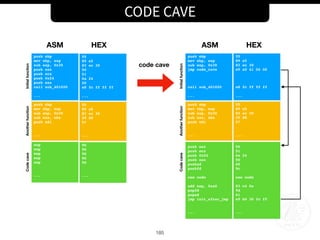
Code cave technique:
• Find an area in the binary that is not used (cave)
• Jump to that cave (overwrite instruction)
• Add overwritten instruction(s) at the beginning of the cave
• Save the registers
• Add new code (assembly instruction) in it
• Re-align stack and reset the registers at the end of the code cave
• Once reset, add a jump to come back in the initial function (right after the new jump)
CODE CAVE
185
push ebp
mov ebp, esp
sub esp, 0x30
push eax
push ecx
push 0x24
push eax
call sub_401020
...
push ebp
mov ebp, esp
sub esp, 0x30
sub eax, ebx
push edi
...
nop
nop
nop
nop
nop
...
InitialfunctionAnotherfunctionCodecave
push ebp
mov ebp, esp
sub esp, 0x30
jmp code_cave
call sub_401020
...
push ebp
mov ebp, esp
sub esp, 0x30
sub eax, ebx
push edi
...
push eax
push ecx
push 0x24
push eax
pushad
pushfd
new code
add esp, 0xa0
popfd
popad
jmp init_after_jmp
...
InitialfunctionAnotherfunctionCodecave
55
89 e5
83 ec 30
50
51
6a 24
50
e8 fc ff ff ff
...
55
89 e5
83 ec 30
29 d8
57
...
90
90
90
90
90
...
55
89 e5
83 ec 30
e9 a0 41 06 00
e8 fc ff ff ff
...
55
89 e5
83 ec 30
29 d8
57
...
50
51
6a 24
50
60
9c
new code
83 c4 0a
9d
61
e9 b0 30 fc ff
...
ASM HEX ASM HEX
code cave
CODE CAVE
186
Code cave usage:
• Often used by malware developers to hide malicious code into benign applications
• Easy to break the application
• Requires to do the changes in assembly
LIBRARY HOOKING
187
Library hooking:
• Hijack the execution flow
• Code written with higher language (C/C++)
• Use LD_PRELOAD (in Linux)
• Preloading a library
• Its functions will be used before others of the same name in later libraries
LIBRARY HOOKING
188
How to trigger the hack?
• Chat function
• Can be sent anytime
• Can contain custom text
LIBRARY HOOKING
189
What is Player::Chat structure?
// #define _GNU_SOURCE
#include <dlfcn.h>
#include <stdio.h>
#include <iostream>
class Player {
public:
void Chat(const char *text);
};
typedef void (*orig_chat_f_type)(Player *, const char *);
void Player::Chat(const char *text)
{
std::string str(text);
std::cout << "Chat: " << str << "n";
// Call original Player::Chat() function
orig_chat_f_type orig;
orig = (orig_chat_f_type) dlsym(RTLD_NEXT,
“_ZN6Player4ChatEPKc");
orig(this, text);
}
LIBRARY HOOKING
190
Compile:
g++ -shared -fPIC -o hook.so hook.cc
Run and load the shared object:
LD_PRELOAD=`pwd`/hook.so ./PwnAdventure3-Linux-Shipping
Note: PwnAdventure is just a wrapper that actually call: PwnAdventure3_data/PwnAdventure3/PwnAdventure3/
Binaries/Linux/PwnAdventure3-Linux-Shipping
LIBRARY HOOKING
191
How to teleport:
• Create a function that changes X, Y, Z locally and update the server
• Use existing functions
• Look for functions related to teleportation
• Found Player::PerformTeleport
LIBRARY HOOKING
192
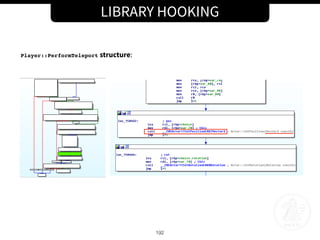
Player::PerformTeleport structure:
LIBRARY HOOKING
193
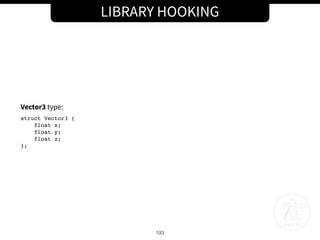
Vector3 type:
struct Vector3 {
float x;
float y;
float z;
};
LIBRARY HOOKING
194
Use dlsym to find Actor::SetPosition address:
typedef void (*orig_pos_f_type)(Player *, const Vector3 *);
orig_pos_f_type orig;
orig = (orig_pos_f_type) dlsym(RTLD_NEXT, "_ZN5Actor11SetPositionERK7Vector3");
LIBRARY HOOKING
195
Teleport to Michael Angelo when typing Michael:
void Player::Chat(const char *text)
{
std::string str(text);
if (str.compare("Michael") == 0)
{
Vector3 pos;
pos.x = 260255.0;
pos.y = -249336.0;
pos.z = 1476.0;
const Vector3 p = pos;
orig(this, &p);
}
// Call orignal Player::Chat() function
orig_chat_f_type orig;
orig = (orig_chat_f_type) dlsym(RTLD_NEXT, "_ZN6Player4ChatEPKc");
orig(this, text);
}
LIBRARY HOOKING
196
How to move faster and jump higher?
• Changing sprint multiplier (binary patching)
• Changing default walking speed
• Changing default jump speed
LIBRARY HOOKING
197
Function related to speed:
LIBRARY HOOKING
198
Function related to speed:
LIBRARY HOOKING
199
Where is the speed value stored?
• Player::GetWalkingSpeed() and Player::GetJumpSpeed() return local variables
• Typical Setter/Getter
LIBRARY HOOKING
200
How to modify those values?
• Player *this is just a pointer
• Player structure is not define in our hook
• We cannot simply use the name
• Find the offset from the pointer
• Player->WalkSpeed: offset 0x2e0 (736)
• Player->JumpSpeed: offset 0x2e4 (740)
• What variables between beginning of object and WalkSpeed?
• Don’t care, padding
LIBRARY HOOKING
201
New hook function:
class Player {
public:
char padding[736];
float speed;
float jumpspeed;
void Chat(const char *text);
};
void Player::Chat(const char *text)
{
std::string str(text);
if (str.compare("walk") == 0)
{
this->speed = this->speed * 4;
}
if (str.compare("jump") == 0)
{
this->jumpspeed = this->jumpspeed * 1.5;
}
// Call orignal Player::Chat() function
orig_chat_f_type orig;
orig = (orig_chat_f_type) dlsym(RTLD_NEXT, "_ZN6Player4ChatEPKc");
orig(this, text);
}
LIBRARY HOOKING
202
Demo: You’re now Superman, go kill each other!
https://github.com/Foxmole/PwnAdventure3/blob/master/hook.cc
FUTURE WORK
203
Homework:
• Reverse 3333 (SSL/TLS)
• Wall hack
Want more?
• Vector35 trainings
• https://www.reddit.com/r/REGames/
Questions?
@beaujeant

Reverse Engineering a (M)MORPG

  • 1.
    Reverse Engineering a(M)MORPG Antonin Beaujeant
  • 2.
    AUTHOR Name: Antonin Beaujeant(@beaujeant) Job: Pentest - R&D • Previous • Now Interest: • Reverse engineering • Hardware hacking • CTF 2
  • 3.
    AGENDA • Introduction (12m) •Game structure (8min) • Define targets (8min) • Find local saved data (10min) • RE network protocol (45min) • Building a Wireshark dissector (25min + 15min) • Building an asynchronous proxy (python) (55min + 10min) • RE binary (90min) • Binary patching (30min) • Library hooking (30min) 3
  • 4.
  • 5.
    INTRODUCTION Game: Pwn Adventure3 Genre: (M)MORPG - Team Adventure Quest Developper: Vector35 (https://vector35.com) Game Engine: Unity (cross-platform) Event: Ghost In The Shellcode CTF 2015 (ShmooCon) RE complexity: Medium (no obfuscation, no signature/encryption, all-in-one logic file) 5
  • 6.
    INTRODUCTION List of quests: •Fire and Ice (RE binary) • Pirates Treasure (crack me) • Until the Cows Come Home (binary patching) • Egg Hunter (RE network & RE binary) • Unbearable Revenge (RE network) • Blockys Revenge (logic gate) • Overachiever (finish all achievements) 6 Town
  • 7.
  • 8.
    GAME STRUCTURE 8 Pwn Adventure3 structure: • Master game server - Login, team, characters, assign instance • Game server - Game instances • Client
  • 9.
    GAME STRUCTURE 9 Application layer: •Loading the game • Receiving user inputs • File/memory management • Network communication Game logic: • Events (if player kill/pick up/… , then …) • States and data (items, NPC, enemy, player, quests, etc) • Physics (gravity, hit box, movement, collision with wall, etc) Game view: • Graphic engine • Audio
  • 10.
    GAME STRUCTURE 10 Offline game: •All files and execution are done locally • Full control over the game • Obfuscation/anti-RE is the only obstacle Online game: • Client game logic • Server game logic • Bi-directional network communication • Unknown logic on server side • Uncontrolled logic on server side
  • 11.
  • 12.
    DEFINE TARGET 12 Why reversevideo game? Fun 🎉 • Modding: New weapons, maps, missions, skins, etc • Modding: New features • Find cheat codes Profit 🤑 • Make the game easier • Advantage over other player • Remove DRM • Generate money (in game - real life)
  • 13.
    DEFINE TARGET 13 Top downapproach Play the game to identify what is valuable: • Items (coins, weapons, spells, etc) • State (quest unlocked, being level 42, etc) • Increase specs (damage x10, health +1000, etc) • Enhance capabilities (run faster, see through wall, jump higher, etc) Identify where it is used, then reverse and exploit. Bottom-up approach Reverse the binary/network to identify potential weakness
  • 14.
    DEFINE TARGET 14 Targets forthis workshop: • Spawn wherever we want • Pick up remote items • Find secret to unlock quest • Find vulnerability to kill boss • Run faster • Jump higher • Teleport anywhere
  • 15.
    DEFINE TARGET 15 Where tolook? • Network communication (if online) • Local saved data • Client game logic binary • Server game logic binary (if online) • Rendering engine
  • 16.
    DEFINE TARGET 16 What todo?: • RE network protocol • Edit local saved data • RE game logic • Patch binary/Hook libraries • Edit rendering engine • Build bots (automate task to be faster and more accurate)
  • 17.
  • 18.
    FIND LOCAL SAVEDDATA 18 Saved data might contain items and states. Could be encrypted and/or signed. Should be most likely present in offline game. Should be most likely not present in online game.
  • 19.
    FIND LOCAL SAVEDDATA 19 Lab 1: Find local saved data Find new/deleted files: • find / -type f -o -path /proc -prune > snapshot1 • find / -type f -o -path /proc -prune > snapshot2 • diff -crB snapshot1 snapshot2 > changes Find edited/removed files: • find / -path /proc -prune -o -path /sys -prune -o -path /usr -prune -o -type f - print0 | xargs -0 md5sum | tee md5sum.txt • md5sum -c md5sum.txt 2> /dev/null | grep -i 'FAIL' > failed.txt
  • 20.
  • 21.
    RE NETWORK PROTOCOL 21 Dataexpected: • Encrypted • Encoded • Clear text • Printable character • Binary
  • 22.
    RE NETWORK PROTOCOL 22 Formatexpected: • Known format • HTTP: username=john&password=letmein (POST /login/) • JSON: {"login":{"username":"john","password":"letmein"}} • XML: <login><username>john</username><password>letmein</password></login> • More… • Unknown format • Identifier (when sequence order is not predictable) • Delimiter (when size is not predicable)
  • 23.
    RE NETWORK PROTOCOL 23 Methodologyfor binary protocol using unknown format: • Understand your target • Identify IP(s), port(s) and content (encrypted? Format?) • Build use cases (e.g. don’t move, shoot, etc) • Look at network behaviour (size, frequency, pattern, etc) • Raise assumptions • Identify the packet • Isolate variables • Locate the variable
  • 24.
    RE NETWORK PROTOCOL 24 Alot of guessing and assumption, which requires knowledge to fasten the process.
  • 25.
    RE NETWORK PROTOCOL 25 Lab2: Identify and dissect the “player location” packet
  • 26.
    RE NETWORK PROTOCOL 26 Lab2: Identify and dissect the “player location” packet No mouvement: Structure: - - - - - - - - - - - - - - - - - - - - - -
  • 27.
    RE NETWORK PROTOCOL 27 Lab2: Identify and dissect the “player location” packet Jump: Structure: - - - - - - - - - - Z Z Z - - - - - - - - -
  • 28.
    RE NETWORK PROTOCOL 28 Lab2: Identify and dissect the “player location” packet Move forward: Structure: - - X X X - - - - - Z Z Z - - - - - - - ? -
  • 29.
    RE NETWORK PROTOCOL 29 Lab2: Identify and dissect the “player location” packet Strafe right: Structure: - - X X X - Y Y Y - Z Z Z - - - - - - ? ?
  • 30.
    RE NETWORK PROTOCOL 30 Lab2: Identify and dissect the “player location” packet Structure: - - X X X - Y Y Y - Z Z Z Z - - - - - - ? ? Structure: - - X X X X Y Y Y Y Z Z Z Z - - - - - - U S Structure: ID ID X X X X Y Y Y Y Z Z Z Z - - - - - - U S
  • 31.
    RE NETWORK PROTOCOL 31 Lab2: Identify and dissect the “player location” packet
  • 32.
    RE NETWORK PROTOCOL 32 Lab2: Identify and dissect the “player location” packet Look left: Structure: ID ID X X X X Y Y Y Y Z Z Z Z - - YA YA - - U S
  • 33.
    RE NETWORK PROTOCOL 33 Lab2: Identify and dissect the “player location” packet Look up: Structure: ID ID X X X X Y Y Y Y Z Z Z Z P P YA YA - - U S
  • 34.
    RE NETWORK PROTOCOL 34 Lab2: Identify and dissect the “player location” packet Look up: Structure: ID ID X X X X Y Y Y Y Z Z Z Z P P YA YA R R U S
  • 35.
    RE NETWORK PROTOCOL 35 Lab2: Identify and dissect the “player location” packet Structure: ID ID X X X X Y Y Y Y Z Z Z Z - - - - - - U S Structure: ID ID X X X X Y Y Y Y Z Z Z Z P P YA YA R R U S
  • 36.
    RE NETWORK PROTOCOL 36 Lab3: Identify and dissect the “mana” and “chat” packets Ressource: • Wireshark filer: (tcp.port >= 3000 and tcp.port <=3010) and tcp.len > 0
  • 37.
    RE NETWORK PROTOCOL 37 Packetformat: • Start with a 2-bytes identifier (e.g. mv = location, *i = fire, etc) • Can be concatenated • Strings is defined by length • Number are represented in little-endian
  • 38.
  • 39.
    RE NETWORK PROTOCOL 39 Completelist of reversed packets: https://github.com/Foxmole/PwnAdventure3/blob/master/protocol.md
  • 40.
  • 41.
    BUILDING DISSECTOR 41 What isWireshark? • Packet analyser • Data ➡ human readable representation • Hundreds of supported protocols and media • Possibility to add custom parser (dissector)
  • 42.
    BUILDING DISSECTOR 42 Two typeof dissectors Compiled dissector: • Edit source code & compile • Long term • Parsing process faster External plugin: • Plugin in Lua • Easy language • Rapidly deployed
  • 43.
    BUILDING DISSECTOR 43 Create newprotocol with Proto() PWN3 = Proto ("pwn3", "Pwn Adventure 3 - Game server protocol")
  • 44.
    BUILDING DISSECTOR 44 Define allelements (and type) of the protocol: local f = PWN3.fields local opcodes = { [0x2a69] = “Fire", [0x6d61] = "Update mana”, [0x6d76] = "Update location”, ... } f.opcode = ProtoField.uint16 ("pwn3.opcode", "Action", base.HEX, opcodes) f.posx = ProtoField.new ("X coordinate", "pwn3.posx", ftypes.FLOAT) f.posy = ProtoField.new ("Y coordinate", "pwn3.posy", ftypes.FLOAT) f.posz = ProtoField.new ("Z coordinate", "pwn3.posz", ftypes.FLOAT) f.mana = ProtoField.uint32 ("pwn3.mana", "Mana", base.DEC) ...
  • 45.
    BUILDING DISSECTOR 45 Start dissectingwith PROTO.dissector(): function PWN3.dissector (buffer, pinfo, tree) -- Dissection code -- buffer is the data in the TCP packet -- tree is the root element in the visual tree structure end
  • 46.
  • 47.
    BUILDING DISSECTOR 47 Adding newbranch in the visual tree structure with tree:add: -- Add node to the root (right below the TCP element) local subtree = tree:add (PROTO, buffer()) -- Add a node to subtree (created above) local branch = subtree:add (f.FMT, buffer(OFFSET, LENGTH)) • PROTO = PWN3 • BUFFER = buffer argument given in PROTO.dissector() • f.FMT = format defined previously • OFFSET / LENGTH = used to select a part of the buffer
  • 48.
    BUILDING DISSECTOR 48 We createa loop that read the buffer: function PWN3.dissector (buffer, pinfo, tree) -- Create the "Pwn Adventure 3" node local subtree = tree:add (PWN3, buffer()) -- Pointer to read through the buffer local offset = 0 -- Read until we reach the end of the buffer while (offset < buffer:len()-1) do ... end end
  • 49.
    BUILDING DISSECTOR 49 Each timewe find a known identifier, the section is parsed: while (offset < buffer:len()-1) do -- Reading two bytes -- opcode is the packet identifier number local opcode = buffer(offset, 2):uint() offset = offset + 2 -- Update mana if (opcode == 0x6d61) then ... -- Fire elseif (opcode == 0x2a69) then ... end end
  • 50.
    BUILDING DISSECTOR 50 If mana: --Adding a node "Update mana" in subtree -- Using the name related to the opcode local branch = subtree:add (buffer(offset-2, 6), opcodes[opcode]) -- Appending a text to node "Update mana" branch:append_text (", Mana: " .. buffer(offset, 4):le_uint()) -- Adding a node in the "Update mane" branch -- Adding the opcode branch:add (f.opcode, buffer(offset-2, 2)) -- Adding a node in the "Update mana" branch -- Node mana level branch:add_le (f.mana, buffer(offset, 4)) offset = offset + 4
  • 51.
    BUILDING DISSECTOR 51 If fire: --Getting the size of the weapon name -- This is to calculate the total length of the packet local length = buffer(offset, 2):le_uint() -- Adding a node "Fire" in subtree -- Using the name related to the opcode -- The size of the packet is: -- 2 bytes for the opcode -- 2 bytes for the length of the weapons name -- n bytes for the weapons name (stored in var length) -- 12 bytes for the direction of the projectile -- Total = 16 + length local branch = subtree:add (buffer(offset-2, 16+length), opcodes[opcode]) -- Adding a node in the "Update mane" branch -- Adding the opcode branch:add (f.opcode, buffer(offset-2, 2)) -- Skip the length byte offset = offset + 2 -- Appending a text to node "Fire" branch:append_text (", Weapon: " .. buffer(offset, length):string()) -- Adding a node in the "Fire" branch -- Node weapons name branch:add (f.str, buffer(offset, length)) offset = offset + length -- Adding a node in the "Fire" branch -- Node direction of the projectile addVectors (buffer, offset, branch) offset = offset + 12
  • 52.
    BUILDING DISSECTOR 52 We createfunction to add direction/location/vectors in tree: function addVectors (vectors, offset, tree) local branch branch = tree:add (vectors(offset, 12), "Vectors") branch:add_le (f.vx, vectors(offset, 4)) branch:add_le (f.vy, vectors(offset + 4, 4)) branch:add_le (f.vz, vectors(offset + 8, 4)) end
  • 53.
    BUILDING DISSECTOR 53 Finally, weregister the protocol to the associated port(s) with DissectorTable: tcp_table = DissectorTable.get ("tcp.port") tcp_table:add (3000, PWN3) tcp_table:add (3001, PWN3) ...
  • 54.
    BUILDING DISSECTOR 54 Limitation withthis design: • If identifier not known, look for the next 2-bytes until one pair match, which might be part of the data
  • 55.
    BUILDING DISSECTOR 55 Install dissector: •http://10.13.110.24/draft-dissector.lua • Find plugin folder (in “About Wireshark”) • macOS: “Wireshark” > “About Wireshark” > “Folders” • Linux: “Help” > “About Wireshark” > “Folders” • Windows: “Help” > “About Wireshark” > “Folders” • Save dissector in folder • Menu “Analyse” > “Reload Lua Plugins” • Verify in menu “Analyse” > “Enabled Protocol…”
  • 56.
    BUILDING DISSECTOR 56 Lab 4:Build the rest of the dissector Ressources: • Wireshark filer: (tcp.port >= 3000 and tcp.port <=3010) and tcp.len > 0 • https://github.com/Foxmole/PwnAdventure3/blob/master/protocol.md • https://github.com/Foxmole/PwnAdventure3/blob/master/draft-dissector.lua • Some OS need wireshark-devel
  • 57.
  • 58.
  • 59.
  • 60.
    BUILDING ASYNC PROXY 60 Proxyscript: • Python 2.7 • Native libs: asyncore, socket and struct • Parse / edit on the fly in and out communication
  • 61.
  • 62.
  • 63.
    BUILDING ASYNC PROXY 63 Re-routingthe traffic: • Editing /etc/hosts file: 127.0.0.1 pwn3.hackeduniverse.com
  • 64.
    BUILDING ASYNC PROXY 64 Clientto proxy connection (Master game server): • Listener on port 3333 import asyncore import socket class ProxServer(asyncore.dispatcher): def __init__(self, src_port): self.src_port = src_port asyncore.dispatcher.__init__(self) self.create_socket(socket.AF_INET, socket.SOCK_STREAM) self.set_reuse_addr() self.bind(('0.0.0.0', src_port)) self.listen(5) if __name__ == '__main__': master = ProxServer(3333) asyncore.loop()
  • 65.
    BUILDING ASYNC PROXY 65 Proxyto server connection (Master game server): • Once client connected, create a new connection with server class ProxServer(asyncore.dispatcher): def __init__(self, src_port, dst_host, dst_port): self.src_port = src_port self.dst_host = dst_host self.dst_port = dst_port asyncore.dispatcher.__init__(self) self.create_socket(socket.AF_INET, socket.SOCK_STREAM) self.set_reuse_addr() self.bind(('0.0.0.0', src_port)) self.listen(5) def handle_accept(self): pair = self.accept() if not pair: return left, addr = pair try: right = socket.create_connection((self.dst_host, self.dst_port)) except socket.error, e: if e.errno is not errno.ECONNREFUSED: raise left.close() def close(self): asyncore.dispatcher.close(self) if __name__ == '__main__': # 10.0.1.3 = Master Server master = ProxServer(3333, '10.0.1.3', 3333) asyncore.loop()
  • 66.
    BUILDING ASYNC PROXY 66 Forwardconnections: • Forward input from client ➡ output to server • Forward input from server ➡ output to client def handle_accept(self): pair = self.accept() if not pair: return left, addr = pair try: right = socket.create_connection((self.dst_host, self.dst_port)) except socket.error, e: if e.errno is not errno.ECONNREFUSED: raise left.close() client = Sock(left) server = Sock(right) client.other = server server.other = client
  • 67.
    BUILDING ASYNC PROXY 67 Newclass Sock: • Buffer write_buffer for each TCP connection • handle_read(): “Called when the asynchronous loop detects that a read() call on the channel’s socket will succeed” • When read() is called, the data is parsed() then copied in the buffer of the other connection class Sock(asyncore.dispatcher): write_buffer = '' def readable(self): return not self.other.write_buffer def handle_read(self): self.other.write_buffer += self.recv(4096*4) def handle_write(self): if self.write_buffer: pkt = parse(self.write_buffer) sent = self.send(pkt) self.write_buffer = self.write_buffer[sent:] def handle_close(self): self.close() if self.other.other: self.other.close() self.other = None
  • 68.
    BUILDING ASYNC PROXY 68 •Proxy for Master server ✅ • Proxy for Game server: if __name__ == '__main__': master = ProxServer(3333, '10.0.1.3', 3333) game = ProxServer(3000, '10.0.1.3', 3000) print "Proxy ready..." asyncore.loop()
  • 69.
    BUILDING ASYNC PROXY 69 Nowwe just need to create the parse() function to manipulate the data
  • 70.
    BUILDING ASYNC PROXY 70 Whatto do? • Change spawning location • Pick up any item • Generate any item (weapons, ammunitions, etc)
  • 71.
    SET SPAWNING LOCATION 71 Spawnlocation packet: [II II] [?? ??] [XX XX XX XX] [YY YY YY YY] [ZZ ZZ ZZ ZZ] [RR RR] [YY YY] [PP PP] I = Identifier can be multiple values ? = Always seen set as 0x00 0x00 X, Y and Z = Location where to spawn R, Y and P = Set to zero (spawn always looking at the same direction) Packet has always been seen alone.
  • 72.
    SET SPAWNING LOCATION 72 Identifygeneric spawn packet: • 22 bytes long (always alone) • 3rd and 4th = 0x00 (?? ??) • Last 6 bytes = 0x00 (RR YY PP) def parse(p_out): if len(p_out) == 22 and p_out[2:4] == "x00x00" and p_out[16:] == "x00x00x00x00x00x00": # DO SOMETHING return p_out
  • 73.
    SET SPAWNING LOCATION 73 Whatto do once we have identifying the spawn packet? • Find the coordinate where we want to spawn • E.g. -39602.8, -18288.0, 2400.28 + 10000 (In town, high in the sky) • Replace the coordinates with the new location • Re-use the identifier • Add x00x00 • Add the new coordinate [XX XX XX XX] [YY YY YY YY] [ZZ ZZ ZZ ZZ] • Add x00x00x00x00x00x00 (direction)
  • 74.
    SET SPAWNING LOCATION 74 Parsingscript to replace the spawn packet: def parse(p_out): if len(p_out) == 22 and p_out[2:4] == "x00x00" and p_out[16:] == "x00x00x00x00x00x00": packet_id = p_out[:2] # We re-use the packet ID x = -39602.8 y = -18288.0 z = 2400.28 + 10000 p_out = packet_id p_out += struct.pack("=HfffHHH", 0, x, y, z, 0, 0, 0) return p_out
  • 75.
  • 76.
    PICK UP ANYITEM 76 Pick up element packet: [65 65] [NN NN NN NN] 65 65 = Identifier (e e) N = Element identifier def getme(elem_id): return "ee" + struct.pack("I", elem_id)
  • 77.
    PICK UP ANYITEM 77 What element number? • Great balls of fire = 00 00 00 01 • Packet to sent: [65 65] [01 00 00 00] (little endian)
  • 78.
    PICK UP ANYITEM 78 When to send? • Decide when to trigger • Easy to trigger
  • 79.
    PICK UP ANYITEM 79 Chat packet: [23 2A] [LL LL] [WW WW …] 23 2A = Identifier (# *) L = Size of the message W = The message def chat(msg): return "#*" + struct.pack("H", len(msg)) + msg
  • 80.
    PICK UP ANYITEM 80 Script to get the Great Balls of Fire (v1): def parse(p_out): def chat(msg): return "#*" + struct.pack("H", len(msg)) + msg def getme(elem_id): return "ee" + struct.pack("I", elem_id) if chat("GreatBallsOfFire") in p_out: p_out += getme(1) return p_out
  • 81.
    PICK UP ANYITEM 81 Demo: Get the Great Balls of Fire
  • 82.
    PICK UP ANYITEM 82 It doesn’t work… Why?
  • 83.
    PICK UP ANYITEM 83 Location packet: [6D 76] [XX XX XX XX] [YY YY YY YY] [ZZ ZZ ZZ ZZ] [RR RR] [YY YY] [PP PP] [FF] [SS] 6D 76= Identifier (m v) X, Y and Z = Position on the X, Y and Z axis of the map R, Y and P = Direction where to look (roll, yaw, pitch) F = Direction where I move S = Direction where I strafe def loc(x, y, z): return "mv" + struct.pack("IIIfffBB", x, y, z, 0, 0, 0, 0, 0)
  • 84.
    PICK UP ANYITEM 84 What location to fake?
  • 85.
    PICK UP ANYITEM 85 Script to get the Great Balls of Fire (v2): def parse(p_out): def chat(msg): return "#*" + struct.pack("H", len(msg)) + msg def getme(elem_id): return "ee" + struct.pack("I", elem_id) def loc(x, y, z): return "mv" + struct.pack("IIIfffBB", x, y, z, 0, 0, 0, 0, 0) if chat("GreatBallsOfFire") in p_out: p_out += loc(-43655.0, -55820.0, 322.0) p_out += getme(1) return p_out
  • 86.
    PICK UP ANYITEM 86 Demo: Let’s try again to get those Great Balls of Fire
  • 87.
  • 88.
    CREATE ELEMENTS 88 Communication flow: Getany element: | CLIENT | - - - [chat] - - - > | PROXY | - - - [chat] [location] [getelement] - - - > | GAME SERVER | | CLIENT | < - - [...] - - - - | PROXY | < - - - - - - - - [...] - - - - - - - - - - | GAME SERVER | Create an element: | CLIENT | - - - - [chat] - - - - - - - - > | PROXY | - - - [chat] - - - > | GAME SERVER | | CLIENT | < - - - [...] [addelement] - - - | PROXY | < - - - [...] - - - | GAME SERVER |
  • 89.
    CREATE ELEMENTS 89 Update proxyscript: def parse(p_out): # DO SOMETHING return (p_in, p_out) ... class Sock(FixedDispatcher): ... def handle_write(self): if self.write_buffer: (p_in, p_out) = parse(self.write_buffer) self.other.write_buffer += p_in sent = self.send(p_out) self.write_buffer = self.write_buffer[sent:]
  • 90.
    CREATE ELEMENTS 90 Create elementpacket: [6D 6B] [NN NN NN NN] [?? ?? ?? ?? ??] [LL LL] [WW WW ...] [XX XX XX XX] [YY YY YY YY] [ZZ ZZ ZZ ZZ] [RR RR] [YY YY] [PP PP] [?? ?? ?? ??] [00 00] 6D 6B = Identifier (m k) N = Element identifier ? = Always seen as 0x00 L = Length of the name W = name of the object X, Y and Z = Position on the X, Y and Z axis of the map R, Y and P = Direction where to element is pointing to (roll, yaw, pitch) ? = Always seen as 0x00 00 00 = Always seen as 0x00 0x00
  • 91.
    CREATE ELEMENTS 91 Create elementpacket: def createel(elid, item, x, y, z): packet = 'mk' packet += struct.pack("I", elid) packet += "x00x00x00x00x00" packet += struct.pack("H", len(item)) + item packet += struct.pack("fffHHHBBBB", x, y, z, 0, 0, 0, 0, 0, 0, 0) return packet
  • 92.
    CREATE ELEMENTS 92 What tocreate and where to put it?
  • 93.
    CREATE ELEMENTS 93 Script tocreate a new bear chest: def parse(p_out): p_in = "" def createel(elid, item, x, y, z): packet = 'mk' packet += struct.pack("I", elid) packet += "x00x00x00x00x00" packet += struct.pack("H", len(item)) + item packet += struct.pack("fffHHHBBBB", x, y, z, 0, 0, 0, 100, 0, 0, 0) return packet def chat(msg): return "#*" + struct.pack("H", len(msg)) + msg def newspawn(opcode, x, y, z): return opcode + struct.pack("=HfffHHH", 0, x, y, z, 0, 0, 0) # Coordinate Town x = -39602.8 y = -18288.0 z = 2400.28 if len(p_out) == 22 and p_out[2:4] == "x00x00" and p_out[16:] == "x00x00x00x00x00x00": p_out = newspawn(p_out[:2], x, y, z) if chat("CreateChest") in p_out: p_in += createel(1337, "BearChest", x + 500, y, z) return (p_in, p_out)
  • 94.
  • 95.
    BUILDING ASYNC PROXY 95 Lab5: Write banner on screen Banner packet: [65 76] [LL LL] [WW WW ...] [LL LL] [WW WW ...] 65 76 = Identifier (e v) L = Length of first message W = First message L = Length of second message W = Second message
  • 96.
  • 97.
    LOOT AND MONEY 97 Newitem in inventory packet: [63 70] [LL LL] [WW WW ...] [QQ QQ QQ QQ] 63 70 = Identifier (c p) L = Length of the name W = Name of the element Q = Quantity def more(item, qt): return "cp" + struct.pack("H", len(item)) + item + struct.pack("I", qt)
  • 98.
    LOOT AND MONEY 98 Scriptto loot bear skins: def parse(p_out): p_in = "" def more(item, qt): return "cp" + struct.pack("H", len(item)) + item + struct.pack("I", qt) def chat(msg): return "#*" + struct.pack("H", len(msg)) + msg if chat("GetSkin") in p_out: p_in += more("BearSkin", 100) return (p_in, p_out)
  • 99.
    LOOT AND MONEY 99 Itworks! But can we trade the item? Why?
  • 100.
    LOOT AND MONEY 100 •Inventory is stored on the server side • Before any transaction/usage, the server verify if you actually have the item in your updated inventory stored on the server side • Inventory is updated only with items looted/purchased legitimately
  • 101.
    BUILDING ASYNC PROXY 101 Resource: •https://github.com/Foxmole/PwnAdventure3/blob/master/pwn3proxy.py
  • 102.
    UNBEARABLE REVENGE List ofquests: • Fire and Ice (RE binary) • Pirates Treasure (crack me) • Until the Cows Come Home (binary patching) • Egg Hunter (RE network & RE binary) • Unbearable Revenge (RE network) • Blockys Revenge (logic gate) • Overachiever (finish all achievements) 102 Town
  • 103.
    UNBEARABLE REVENGE 103 Where tostart? def parse(p_out): p_in = "" def newspawn(opcode, x, y, z): return opcode + struct.pack("=HfffHHH", 0, x, y, z, 0, 0, 0) if len(p_out) == 22 and p_out[2:4] == "x00x00" and p_out[16:] == "x00x00x00x00x00x00": x = -7894.0 y = 64482.0 + 500 z = 2663.0 p_out = newspawn(p_out[:2], x, y, z) return (p_in, p_out)
  • 104.
    UNBEARABLE REVENGE 104 Demo: StartUnbearable Revenge quest
  • 105.
    UNBEARABLE REVENGE 105 What todo? • Unlock the chest (5 minutes) • Stay in near the chest (around 10 meters diameter) • Survive the different waves of bears • Bears • Angry bears
  • 106.
    UNBEARABLE REVENGE 106 How toprotect you? Climb in the tree? How to get there? • Spawn on top • Activate chest remotely def parse(p_out): p_in = "" def newspawn(opcode, x, y, z): return opcode + struct.pack("=HfffHHH", 0, x, y, z, 0, 0, 0) def loc(x, y, z): return "mv" + struct.pack("fffHHHBB", x, y, z, 0, 0, 0, 0, 0) def getme(item): return "ee" + struct.pack("I", item) # Bear Chest coordinates x = -7894.0 y = 64482.0 z = 2663.0 if len(p_out) == 22 and p_out[2:4] == "x00x00" and p_out[16:] == "x00x00x00x00x00x00": p_out = newspawn(p_out[:2], x, y, z + 3000) if chat("UnlockChest") in p_out: p_out += loc(x, y, z) p_out += getme(3) # 3 = BearChest element ID return (p_in, p_out)
  • 107.
  • 108.
    UNBEARABLE REVENGE 108 Angry bear? whatare you doing? Angry bear? Stahp! What to do now?
  • 109.
    UNBEARABLE REVENGE 109 Spawn underthe chest: • Since under the chest is the void, we create an element underneath to “fly” • Found a special location where our head is stuck and we can’t fall def parse(p_out): p_in = "" def newspawn(opcode, x, y, z): return opcode + struct.pack("=HfffHHH", 0, x, y, z, 0, 0, 0) if len(p_out) == 22 and p_out[2:4] == "x00x00" and p_out[16:] == "x00x00x00x00x00x00": # Bear Chest coordinates x = -7894.0 y = 64482.0 z = 2663.0 p_out = newspawn(p_out[:2], x, y, z - 244) return (p_in, p_out)
  • 110.
  • 111.
    UNBEARABLE REVENGE 111 Gotcha! Flag:“They couldnt bear the sight of you”
  • 112.
    FIRE AND ICE Listof quests: • Fire and Ice (RE binary) • Pirates Treasure (crack me) • Until the Cows Come Home (binary patching) • Egg Hunter (RE network & RE binary) • Unbearable Revenge (RE network) • Blockys Revenge (logic gate) • Overachiever (finish all achievements) 112 Town
  • 113.
    EGG HUNTER 113 Where tostart? def parse(p_out): p_in = "" def newspawn(opcode, x, y, z): return opcode + struct.pack("=HfffHHH", 0, x, y, z, 0, 0, 0) if len(p_out) == 22 and p_out[2:4] == "x00x00" and p_out[16:] == "x00x00x00x00x00x00": # First egg location x = 24770.0 y = 69466.0 z = 2727.0 p_out = newspawn(p_out[:2], x, y, z) return (p_in, p_out)
  • 114.
  • 115.
    EGG HUNTER 115 What todo? • Collect all the eggs on the map • Eggs are listed in the init packet
  • 116.
    EGG HUNTER 116 Script tocollect them all: def parse(p_out): p_in = "" def getme(item): return "ee" + struct.pack("I", item) def loc(x, y, z): return "mv" + struct.pack("fffHHHBB", x, y, z, 0, 0, 0, 0, 0) def chat(msg): return "#*" + struct.pack("H", len(msg)) + msg if chat("egg1") in p_out: p_out += loc(-25045.0, 18085.0, 260.0) p_out += getme(11) if chat("egg2") in p_out: p_out += loc(-51570.0, -61215.0, 5020.0) p_out += getme(12) if chat("egg3") in p_out: p_out += loc(24512.0, 69682.0, 2659.0) p_out += getme(13) ... if chat("egg9") in p_out: p_out += loc(65225.0, -5740.0, 4928.0) p_out += getme(19) if chat("BallmerPeakEgg") in p_out: p_out += loc(-2778.0, -11035.0, 10504.0) p_out += getme(20) return (p_in, p_out)
  • 117.
    EGG HUNTER 117 Once ina while, you will have the game server that crash. This might be due to the sudden jump between locations. Eventually, you will be able to collect all eggs but the “Ballmer Peak Egg”. Let’s have a closer look in… the binary!
  • 118.
  • 119.
    RE BINARY 119 What binaryto reverse? • Game logic • Linux: PwnAdventure3/client/PwnAdventure3_Data/PwnAdventure3/ PwnAdventure3/Binaries/Linux/libGameLogic.so • macOS: /Applications/Pwn Adventure 3.app/Contents/PwnAdventure3/ PwnAdventure3.app/Contents/MacOS/GameLogic.dylib :~$ file libGameLogic.so libGameLogic.so: ELF 64-bit LSB shared object, x86-64, version 1 (SYSV), dynamically linked, not stripped
  • 120.
    RE BINARY 120 What toolsto use? • Disassembler • Hopper (free for x64) • Binary Ninja • IDA Pro • Debugger • gdb • OllyDbg
  • 121.
    RE BINARY 121 Assembly: • Low-levelprogramming language • Close to machine code instruction
  • 122.
    RE BINARY 122 Limited setof instructions: • mov • call • test • cmp • jmp, jnz, jb, … • …
  • 123.
    RE BINARY 123 Variables arestored in different areas: • Registries • RAX • RBX • RCX • RDX • Stack • Heap • RSI • RDI • RBP • RSP • R8 • R9 • R… • R15 • XMM8 • XMM9 • XMM… • XMM15 • RIP • EFLAGS
  • 124.
    EGG FINDER 124 Look forthe Ballmer Peak Egg related function:
  • 125.
    EGG FINDER 125 BallmerPeakEgg:CanUse(BallmerPeakEgg *this,IPlayer *player) { int ret; int canuse; ret = ItemPickup::CanUse(this, player); if (ret) { ret = Player::????(“BallmerPeakSecret”); if (ret) { canuse = true; } else { canuse = false; } } else { canuse = false; } return canuse; // We want to return true }
  • 126.
    EGG FINDER 126 How tofind which function is called? • gdb • Breakpoint at call qword ptr [rcx+0D0h] $ ps a PID TTY STAT TIME COMMAND 2334 pts/18 Sl+ 0:00 ./MasterServer 2410 pts/17 Sl+ 11:08 ./PwnAdventure3Server 2414 pts/17 Sl+ 10:56 ./PwnAdventure3Server 2416 pts/17 Sl+ 12:35 ./PwnAdventure3Server 3232 pts/1 Ss 0:00 bash 3603 pts/1 R+ 0:00 ps a $ sudo su # gdb -p 2410 (gdb) break BallmerPeakEgg::CanUse (gdb) continue
  • 127.
    EGG FINDER 127 Let’s triggerthe function BallmerPeakEgg:CanUse: • Type BallmerPeakEgg in the chat box def parse(p_out): p_in = "" def getme(item): return "ee" + struct.pack("I", item) def loc(x, y, z): return "mv" + struct.pack("fffHHHBB", x, y, z, 0, 0, 0, 0, 0) def chat(msg): return "#*" + struct.pack("H", len(msg)) + msg if chat("BallmerPeakEgg") in p_out: p_out += loc(-2778.0, -11035.0, 10504.0) p_out += getme(20) return (p_in, p_out)
  • 128.
    EGG FINDER 128 The processbreak at BallmerPeakEgg::CanUse. Now we can set a breakpoint at call QWORD PTR [rcx+0xd0]: (gdb) set disassembly-flavor intel (gdb) x/20i $rip => 0x7f3c6ff26374: mov rdi,QWORD PTR [rbp-0x18] 0x7f3c6ff26378: mov QWORD PTR [rbp-0x20],rdi ... 0x7f3c6ff263a7: mov rdi,rax 0x7f3c6ff263aa: call QWORD PTR [rcx+0xd0] 0x7f3c6ff263b0: test al,0x1 ... 0x7f3c6ff263c5: mov al,BYTE PTR [rbp-0x1] (gdb) break *0x7f3c6ff263aa
  • 129.
    EGG FINDER 129 Finally, wecan see the function called: (gdb) continue (gdb) step Player::HasPickedUp (this=0x72ed9e0, name=0x7f3c6ff473e9 "BallmerPeakSecret") at Player.cpp:864
  • 130.
    EGG FINDER 130 Final pseudo-codetranslation for BallmerPeakEgg:CanUser: BallmerPeakEgg:CanUse(BallmerPeakEgg *this, IPlayer *player) { int ret; int canuse; ret = ItemPickup::CanUse(this, player); // Seems to be always true if (ret) { ret = Player::HasPickedUp(this, “BallmerPeakSecret”); if (ret) { canuse = true; } else { canuse = false; } } else { canuse = false; } return canuse; // We want to return true }
  • 131.
    EGG FINDER 131 It seemsthat at some point, we need to pick up a “BallmerPeakSecret” in order to use (pick up) the BallmerPeakEgg. Where is the “BallmerPeakSecret” string also used?
  • 132.
    EGG FINDER 132 This isan overview of BallmerPeakPoster::Damage: 1 2 3 4 5 6 7 BallmerPeakSecret used 8
  • 133.
    EGG FINDER 133 Set abreakpoint at BallmerPeakPoster::Damage: (gdb) break BallmerPeakPoster::Damage (gdb) continue
  • 134.
    EGG FINDER 134 Go toBallmerPeakPoster and start fire Great Balls of Fire at it def parse(p_out): p_in = "" def newspawn(opcode, x, y, z): return opcode + struct.pack("=HfffHHH", 0, x, y, z, 0, 0, 0) if len(p_out) == 22 and p_out[2:4] == "x00x00" and p_out[16:] == "x00x00x00x00x00x00": # Ballmer Peak location x = -6791.0 y = -11655.0 z = 10528.0 p_out = newspawn(p_out[:2], x, y, z) return (p_in, p_out)
  • 135.
    EGG FINDER 135 1. Entrypoint (disassembler) Assign arguments to local variables Make sure the argument instigator != 0 rdi rsi rdx ecx r8d 1. Entry point (debugger) (gdb) x/x $rsi 0x5e0fcb0: 0x230c2980
  • 136.
    EGG FINDER 136 This isan overview of BallmerPeakPoster::Damage: 2 BallmerPeakSecret used
  • 137.
    EGG FINDER 137 2. Block(disassembler) What function is called? 2. Block (debugger) (gdb) set disassembly-flavor intel (gdb) x/30i $rip [...] 0x7f8622dcd655: mov rdi,rax 0x7f8622dcd658: call QWORD PTR [rcx+0x20] 0x7f8622dcd65b: test al,0x1 0x7f8622dcd65d: jne 0x7f8622dcd668 [...] (gdb) break *0x7f8622dcd658 (gdb) break *0x7f8622dcd668 (gdb) continue (gdb) step Player::IsPlayer (this=0x5e0fcb0) (gdb) finish Value returned is $1 = true
  • 138.
    EGG FINDER 138 This isan overview of BallmerPeakPoster::Damage: 3 BallmerPeakSecret used
  • 139.
    EGG FINDER 139 3. Block(disassembler) 3. Block (debugger) (gdb) x/xg $rbp-0x18 0x7fffd46c5988: 0x0000000005bc8290 Convert symbol in HEX
  • 140.
    EGG FINDER 140 This isan overview of BallmerPeakPoster::Damage: 4 5 6 BallmerPeakSecret used
  • 141.
    EGG FINDER 141 4, 5and6. Block (disassembler) 4, 5and 6. Block (debugger) • In order to move to the blue box, AL should be different than 1 (True) 1 • AL = var_59 2 • var_59 is the return value from 3 • Once un-mangled, the function is: std::operator!=( lhs, rhs ) (gdb) x/30i $rip [...] 0x7f8622dcd6b5: lea rdi,[rbp-0x28] 0x7f8622dcd6b9: lea rsi,[rip+0x6a6b6] # 0x7f8622e37d76 0x7f8622dcd6c0: call 0x7f8622d1afb0 0x7f8622dcd6c5: mov BYTE PTR [rbp-0x59],al 0x7f8622dcd6c8: jmp 0x7f8622dcd6cd [...] (gdb) break *0x7f8622dcd6c0 (gdb) continue (gdb) x/s $rsi 0x7f8622e37d76: "CowboyCoder" (gdb) x/xg $rdi 0x7fffd46c5978: 0x0000000005db9d38 (gdb) x/s 0x0000000005db9d38 0x5db9d38: "GreatBallsOfFire" 3 1 2
  • 142.
    EGG FINDER 142 After the“Unbearable Revenge”, we should have enough money to buy the Cowboy Coder from Major Payne in Town: # Coordinate Town x = -39602.8 y = -18288.0 z = 2400.28 Once bought, come back to Ballmer Peak: # Ballmer Peak location x = -6791.0 y = -11655.0 z = 10528.0 And shoot at the poster
  • 143.
    EGG FINDER 143 This isan overview of BallmerPeakPoster::Damage: 7 BallmerPeakSecret used
  • 144.
    EGG FINDER 144 7. Block(disassembler) 7. Block (debugger) (gdb) x/30i $rip [...] 0x7f8622dcd722: lea rsi,[rip+0x6dcc0] # 0x7f8622e3b3e9 0x7f8622dcd729: mov rax,QWORD PTR [rbp-0x10] 0x7f8622dcd72d: mov QWORD PTR [rbp-0x48],rax 0x7f8622dcd731: mov rax,QWORD PTR [rbp-0x48] 0x7f8622dcd735: mov rcx,QWORD PTR [rax] 0x7f8622dcd738: mov rdi,rax 0x7f8622dcd73b: call QWORD PTR [rcx+0x250] 0x7f8622dcd741: add rsp,0x60 0x7f8622dcd745: pop rbp 0x7f8622dcd746: ret [...] (gdb) break *0x7f8622dcd73b (gdb) continue (gdb) step Player::MarkAsPickedUp (this=0x619e010, name=0x7f8622e3b3e9 "BallmerPeakSecret") What function is called?
  • 145.
    EGG FINDER 145 Player::MarkAsPickedUp("BallmerPeakSecret") isexactly what we needed! Summary: • If we shoot at the Ballmer Peak Poster with a Cowboy Coder, the function Player::MarkAsPickedUp("BallmerPeakSecret") will be called • From now on, the function Player::HasPickedUp("BallmerPeakSecret") will return True • Which means BallmerPeakEgg:CanUse(...) will also return True
  • 146.
    EGG FINDER 146 Demo: Getthat Ballmer Peak Egg
  • 147.
    FIRE AND ICE Listof quests: • Fire and Ice (RE binary) • Pirates Treasure (crack me) • Until the Cows Come Home (binary patching) • Egg Hunter (RE network & RE binary) • Unbearable Revenge (RE network) • Blockys Revenge (logic gate) • Overachiever (finish all achievements) 147 Town
  • 148.
    FIRE AND ICE 148 Whereto start? def parse(p_out): p_in = "" def newspawn(opcode, x, y, z): return opcode + struct.pack("=HfffHHH", 0, x, y, z, 0, 0, 0) if len(p_out) == 22 and p_out[2:4] == "x00x00" and p_out[16:] == "x00x00x00x00x00x00": # Lava Cave location x = 50876.0 y = -5243.0 z = 1645.0 p_out = newspawn(p_out[:2], x, y, z) return (p_in, p_out)
  • 149.
    FIRE AND ICE 149 Whatto do? • “Kill Magmarok”
  • 150.
    FIRE AND ICE 150 Demo:Try to kill Magmarok
  • 151.
    FIRE AND ICE 151 Whatwe noticed: • Ice seem to give more damage • Weapon and static links barely give any damage • Fire seem to heal Magmarok • When Magmarok reach half life, it start a spell to regenerate its entire life bar
  • 152.
    FIRE AND ICE 152 Listall functions in Magmarok object:
  • 153.
    FIRE AND ICE 153 Magmarok::Damagepseudo-code: Magmarok::Damage(weaponDmg, weaponType) { FIRE = 1 ICE = 2 if (weaponType == FIRE) # 0x13AF4F { healthFactor = magmarok.currentHealth / 10000 # 0x13AF87 healthMultiplier = pow(healthFactor, 3) # 0x13AFA2 intendedHealing = healthMultiplier * weaponDmg # 0x13AFC0 intendedHealing = intendedHealing * 4 # 0x13AFC4 maximumHealing = 10000 - magmarok.currentHealth # 0x13AFD3 if (intendedHealing > maximumHealing) # 0x13AFDC { intendedHealing = maximumHealing # 0x13AFE8 } weaponDmg = 0 - intendedHealing # 0x13AFF3 } else { if (weaponType != ICE) # 0x13AFFB { # If not ice nor fire weaponDmg = weaponDmg / 2 # 0x13B019 } } . . . . . . if (magmarok.something == 1) # 0x13B027 { if (weaponDmg <= 0) # 0x13B034 { if (magmarok.something == 1) # 0x13B060 { if (weaponType != ICE) # 0x13B06D { weaponDmg = weaponDmg * 4 # 0x13B07D } } } else { weaponDmg = weaponDmg / 2 # 0x13B052 } } damage(magmarok, weaponDmg, weaponType) # 0x13B09E }
  • 154.
    FIRE AND ICE 154 Damagesummary: • Fire spell will give negative damage (healing) proportionally to Magmarok’s health • Ice spell will give normal damage • All other weapon/spell will give half damage
  • 155.
    FIRE AND ICE 155 Potentialinteger overflow? Healing is an interesting feature. If we heal enough Magmarok, we might trigger an integer overflow and kill the beast.
  • 156.
    FIRE AND ICE 156 Whatis an integer overflow? “If the variable has a signed integer type, a program may make the assumption that a variable always contains a positive value. An integer overflow can cause the value to wrap and become negative, which violates the program’s assumption and may lead to unexpected behavior.” 1111111111111111111111111111111111111111111111111111111111111111 = 18446744073709551615 1111111111111111111111111111111111111111111111111111111111111110 = 18446744073709551614 . . . 0000000000000000000000000000000000000000000000000000000000000010 = 2 0000000000000000000000000000000000000000000000000000000000000001 = 1 0000000000000000000000000000000000000000000000000000000000000000 = 0 1111111111111111111111111111111111111111111111111111111111111111 = -1 1111111111111111111111111111111111111111111111111111111111111110 = -2
  • 157.
    FIRE AND ICE 157 Potentialinteger overflow? Does not seem to be possible due to: maximumHealing = 10000 - magmarok.currentHealth if (intendedHealing > maximumHealing) { intendedHealing = maximumHealing }
  • 158.
    FIRE AND ICE 158 Magmarok::Damagepseudo-code: Magmarok::Damage(weaponDmg, weaponType) { FIRE = 1 ICE = 2 if (weaponType == FIRE) # 0x13AF4F { healthFactor = magmarok.currentHealth / 10000 # 0x13AF87 healthMultiplier = pow(healthFactor, 3) # 0x13AFA2 intendedHealing = healthMultiplier * weaponDmg # 0x13AFC0 intendedHealing = intendedHealing * 4 # 0x13AFC4 maximumHealing = 10000 - magmarok.currentHealth # 0x13AFD3 if (intendedHealing > maximumHealing) # 0x13AFDC { intendedHealing = maximumHealing # 0x13AFE8 } weaponDmg = 0 - intendedHealing # 0x13AFF3 } else { if (weaponType != ICE) # 0x13AFFB { # If not ice nor fire weaponDmg = weaponDmg / 2 # 0x13B019 } } . . . . . . if (magmarok.something == 1) # 0x13B027 { if (weaponDmg <= 0) # 0x13B034 { if (magmarok.something == 1) # 0x13B060 { if (weaponType != ICE) # 0x13B06D { weaponDmg = weaponDmg * 4 # 0x13B07D } } } else { weaponDmg = weaponDmg / 2 # 0x13B052 } } damage(magmarok, weaponDmg, weaponType) # 0x13B09E }
  • 159.
    FIRE AND ICE 159 Whereis the Magmarok regeneration code? Filter for Magmarok:: functions • Magmarok::Damage • Magmarok::Tick • Magmarok::GetMaxHealth Let’s search for “heal”:
  • 160.
    FIRE AND ICE 160 Whatis Magmarok::Tick function? A “real time” function that is triggered regularly in order to update the state and action of Magmarok. [...] if (magmarok.healing == False) # 0x13B122 { if (magmarok.health > 0) # 0x13B32F { if (magmarok.health < 5000) # 0x13B343 { magmarok.healing = True # 0x13B357 updateState(magmarok, "Healing") # 0x13B3CD } } } else { if (magmarok.health > 0) # 0x13B166 { newHealth = magmarok.health + 4975 # 0x13B182 sendHealthUpdate(magmarok, newHealth) # 0x13B1B5 triggerEvent(magmarok, "Heal") # 0x13B227 triggerEvent(magmarok, "Healing") # 0x13B2A9 } } [...]
  • 161.
    FIRE AND ICE 161 Ticksummary: • When health < 5000 HP, switch to healing mode • When in healing mode, next tick grants 4975 HP • It takes around 4 seconds for healing
  • 162.
    FIRE AND ICE 162 What’sbetter than an integer overflow? Double integer overflow!
  • 163.
    FIRE AND ICE 163 Let’sgo back to the initial issue that prevent the first integer overflow: maximumHealing = 10000 - magmarok.currentHealth # 0x13AFD3 if (intendedHealing > maximumHealing) # 0x13AFDC { intendedHealing = maximumHealing # 0x13AFE8 } rax = Magmarok object verify with debugging
  • 164.
  • 165.
    FIRE AND ICE 165 Whatif magmarok.currentHealth is higher than 10000? maximumHealing = 10000 - magmarok.currentHealth if (intendedHealing > maximumHealing) { intendedHealing = maximumHealing } maximumHealing will be negative: 0000000000000000000000000000000000000000000000000000000000000010 = 2 0000000000000000000000000000000000000000000000000000000000000001 = 1 0000000000000000000000000000000000000000000000000000000000000000 = 0 1111111111111111111111111111111111111111111111111111111111111111 = -1 1111111111111111111111111111111111111111111111111111111111111110 = -2 E.g. if maximumHealing = -1, the if() condition intendedHealing > maximumHealing will not be true
  • 166.
    FIRE AND ICE 166 Thismeans as soon as Magmarok health is higher than 10000, we will be able to increase its health infinitely. How to get magmarok.health > 10000? if (magmarok.health < 5000): Heal for 4 seconds magmarok.health += 4975 So we just need to drop health right below 5000HP, then we will have 4 seconds to increase the health to 5026HP (or more) so that when it regenerate its health by 4975HP, the final health will be 10001HP (or more).
  • 167.
    FIRE AND ICE 167 Wedon’t have much time (4 seconds) to get the health > 5000HP. This means we need to be accurate and be right below 5000HP. We will use the proxy to indicate Magmarok’s health: def parse(p_out): p_in = "" if "++" in p_out: posi = p_out.index("++") actor,health = struct.unpack("ii", p_out[posi+2 : posi+10]) print "HEALTH: " + str(actor) + " - " + str(health) + "hp" return (p_out, p_in)
  • 168.
    FIRE AND ICE 168 Demo:Let’s kill Magmarok
  • 169.
  • 170.
    BINARY PATCHING 170 When yourun an application, you execute instructions that has been writing by the developers for a specific purpose. Sometimes, the instructions restrict you: • An evaluation version of an application that exit after 30 minutes • Your player in your MMORPG that cannot jump high enough to access hidden high location
  • 171.
    BINARY PATCHING 171 The executedinstructions are located on your computer, which you control: • Read binary: Disassembling • Execute binary: Debugging • Edit binary: Patching You can therefore change those instructions to bypass restrictions (e.g. cracking) but also to improve or add new functionalities.
  • 172.
  • 173.
  • 174.
    BINARY PATCHING 174 Player::GetSprintMultiplier(void) function: Non-scalartypes (including floats and doubles) are returned in the XMM0 register
  • 175.
    BINARY PATCHING 175 Tool list: •Python • Capstone • Keystone
  • 176.
  • 177.
    BINARY PATCHING 177 Verify newinstruction won’t overwrite the next legitimate instruction (cvtsi2ss xmm0, rax). For this, we need to calculate the size in memory of the instruction to replace: from capstone import * offset = 0x15ea64 with open( 'libGameLogic.so', 'rb' ) as f: binary = f.read() cpt = 0 size = 0 md = Cs( CS_ARCH_X86, CS_MODE_64 ) for i in md.disasm( binary[ offset : offset+64 ], offset ): if not cpt: size = len(i.bytes) cpt += 1
  • 178.
    BINARY PATCHING 178 Then weassemble the new instruction and compare the size: If It equals or smaller, we can overwrite the instruction with padding: from keystone import * ks = Ks(KS_ARCH_X86, KS_MODE_64) encoding, count = ks.asm(b'mov rax, 0x1e') if len( encoding ) <= size: # padding with NOPs if shorter encoding = encoding + [0x90]*( size - len(encoding) ) binary = binary[ : offset ] + ''.join(chr(c) for c in binary) + BIN[ offset+size : ]
  • 179.
    BINARY PATCHING 179 Finally, wejust need to save the new file: with open('libGameLogic.so', 'wb') as f: f.write(binary)
  • 180.
    BINARY PATCHING 180 Complete patcherscript: https://github.com/Foxmole/PwnAdventure3/blob/master/binpatcher.py $ python binpatcher.py -f libGameLogic.so -o 0x15ea64 -m 64 -i "movabs rax, 0x1e"
  • 181.
    FIRE AND ICE 181 Demo:Let’s run supa fast!
  • 182.
  • 183.
    LIBRARY HOOKING 183 Binary patching: •Edit binary to modify the binary in our advantage • Small changes: Overwrite one instruction • If we want to add more complex logic: • Code cave • Hooking
  • 184.
    CODE CAVE 184 Code cavetechnique: • Find an area in the binary that is not used (cave) • Jump to that cave (overwrite instruction) • Add overwritten instruction(s) at the beginning of the cave • Save the registers • Add new code (assembly instruction) in it • Re-align stack and reset the registers at the end of the code cave • Once reset, add a jump to come back in the initial function (right after the new jump)
  • 185.
    CODE CAVE 185 push ebp movebp, esp sub esp, 0x30 push eax push ecx push 0x24 push eax call sub_401020 ... push ebp mov ebp, esp sub esp, 0x30 sub eax, ebx push edi ... nop nop nop nop nop ... InitialfunctionAnotherfunctionCodecave push ebp mov ebp, esp sub esp, 0x30 jmp code_cave call sub_401020 ... push ebp mov ebp, esp sub esp, 0x30 sub eax, ebx push edi ... push eax push ecx push 0x24 push eax pushad pushfd new code add esp, 0xa0 popfd popad jmp init_after_jmp ... InitialfunctionAnotherfunctionCodecave 55 89 e5 83 ec 30 50 51 6a 24 50 e8 fc ff ff ff ... 55 89 e5 83 ec 30 29 d8 57 ... 90 90 90 90 90 ... 55 89 e5 83 ec 30 e9 a0 41 06 00 e8 fc ff ff ff ... 55 89 e5 83 ec 30 29 d8 57 ... 50 51 6a 24 50 60 9c new code 83 c4 0a 9d 61 e9 b0 30 fc ff ... ASM HEX ASM HEX code cave
  • 186.
    CODE CAVE 186 Code caveusage: • Often used by malware developers to hide malicious code into benign applications • Easy to break the application • Requires to do the changes in assembly
  • 187.
    LIBRARY HOOKING 187 Library hooking: •Hijack the execution flow • Code written with higher language (C/C++) • Use LD_PRELOAD (in Linux) • Preloading a library • Its functions will be used before others of the same name in later libraries
  • 188.
    LIBRARY HOOKING 188 How totrigger the hack? • Chat function • Can be sent anytime • Can contain custom text
  • 189.
    LIBRARY HOOKING 189 What isPlayer::Chat structure? // #define _GNU_SOURCE #include <dlfcn.h> #include <stdio.h> #include <iostream> class Player { public: void Chat(const char *text); }; typedef void (*orig_chat_f_type)(Player *, const char *); void Player::Chat(const char *text) { std::string str(text); std::cout << "Chat: " << str << "n"; // Call original Player::Chat() function orig_chat_f_type orig; orig = (orig_chat_f_type) dlsym(RTLD_NEXT, “_ZN6Player4ChatEPKc"); orig(this, text); }
  • 190.
    LIBRARY HOOKING 190 Compile: g++ -shared-fPIC -o hook.so hook.cc Run and load the shared object: LD_PRELOAD=`pwd`/hook.so ./PwnAdventure3-Linux-Shipping Note: PwnAdventure is just a wrapper that actually call: PwnAdventure3_data/PwnAdventure3/PwnAdventure3/ Binaries/Linux/PwnAdventure3-Linux-Shipping
  • 191.
    LIBRARY HOOKING 191 How toteleport: • Create a function that changes X, Y, Z locally and update the server • Use existing functions • Look for functions related to teleportation • Found Player::PerformTeleport
  • 192.
  • 193.
    LIBRARY HOOKING 193 Vector3 type: structVector3 { float x; float y; float z; };
  • 194.
    LIBRARY HOOKING 194 Use dlsymto find Actor::SetPosition address: typedef void (*orig_pos_f_type)(Player *, const Vector3 *); orig_pos_f_type orig; orig = (orig_pos_f_type) dlsym(RTLD_NEXT, "_ZN5Actor11SetPositionERK7Vector3");
  • 195.
    LIBRARY HOOKING 195 Teleport toMichael Angelo when typing Michael: void Player::Chat(const char *text) { std::string str(text); if (str.compare("Michael") == 0) { Vector3 pos; pos.x = 260255.0; pos.y = -249336.0; pos.z = 1476.0; const Vector3 p = pos; orig(this, &p); } // Call orignal Player::Chat() function orig_chat_f_type orig; orig = (orig_chat_f_type) dlsym(RTLD_NEXT, "_ZN6Player4ChatEPKc"); orig(this, text); }
  • 196.
    LIBRARY HOOKING 196 How tomove faster and jump higher? • Changing sprint multiplier (binary patching) • Changing default walking speed • Changing default jump speed
  • 197.
  • 198.
  • 199.
    LIBRARY HOOKING 199 Where isthe speed value stored? • Player::GetWalkingSpeed() and Player::GetJumpSpeed() return local variables • Typical Setter/Getter
  • 200.
    LIBRARY HOOKING 200 How tomodify those values? • Player *this is just a pointer • Player structure is not define in our hook • We cannot simply use the name • Find the offset from the pointer • Player->WalkSpeed: offset 0x2e0 (736) • Player->JumpSpeed: offset 0x2e4 (740) • What variables between beginning of object and WalkSpeed? • Don’t care, padding
  • 201.
    LIBRARY HOOKING 201 New hookfunction: class Player { public: char padding[736]; float speed; float jumpspeed; void Chat(const char *text); }; void Player::Chat(const char *text) { std::string str(text); if (str.compare("walk") == 0) { this->speed = this->speed * 4; } if (str.compare("jump") == 0) { this->jumpspeed = this->jumpspeed * 1.5; } // Call orignal Player::Chat() function orig_chat_f_type orig; orig = (orig_chat_f_type) dlsym(RTLD_NEXT, "_ZN6Player4ChatEPKc"); orig(this, text); }
  • 202.
    LIBRARY HOOKING 202 Demo: You’renow Superman, go kill each other! https://github.com/Foxmole/PwnAdventure3/blob/master/hook.cc
  • 203.
    FUTURE WORK 203 Homework: • Reverse3333 (SSL/TLS) • Wall hack Want more? • Vector35 trainings • https://www.reddit.com/r/REGames/
  • 204.