25th April 2018
Kolkata
HOW TO BUILD SELF-AWARENESS & FOCUS
An SME Council Initiative
Our mind is a muscle...
We must keep exercising it
Emotional intelligence is central for leaders of the future
● Achievement drive & standards
● Influence
● Conceptual thinking
● Analytical ability
● Initiative
● Self-confidence
*Daniel Goleman, Lecture “Social Intelligence:
The New Science of Human Relationship”
EQ
4/6
IQ
2/6
Bain and Company
“Inspirational Leadership”
Likelihood to inspire others
What are qualities?
◉ Traits or behavioral habits
◉ Skills or physical and mental abilities
◉ Values or what is important to you
◉ 3 of these should represent your core strengths today, and areas you want to
really focus on
◉ 1 of these can represent an area that is not currently a strength, but is something
that you want to work on
◉ Why are these qualities important for you?
◉ What impact would they make?
◉ How do they make you feel?
◉ What type of person would you become?
◉ Who and what will stop you from making it happen?
◉ External constraints - things out of your control
◉ Internal constraints - your skills, time, habits
◉ Limiting beliefs - your narratives, fears, insecurities
◉ Who and what will help you make it happen?
◉ Your mentors
◉ Your practices and habits **pick one practice from today**
◉ Your mindsets and beliefs
◉ Think of 5-10 people (the more the merrier) could ask for feedback on your qualities
◉ Pick a variety of people inside and outside work to help you develop a broader and
richer understanding of your qualities
◉ For each quality - write down what you will do to work on this area next week
◉ Any change starts with small and imperfect steps
◉ For each quality - write down how you will continue to build this ares over the coming
months
◉ Only practice (and more practice) makes permanent
◉ What is your accountability commitment?
◉ When will you check-in to review progress (add this to your calendar now)?
◉ Who can be your accountability partner(s)?
◉ Make it public, pin-up and share your leadership canvas?
Priming
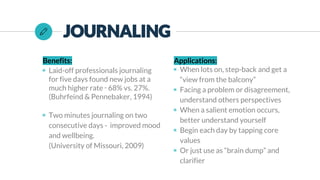
Journalling
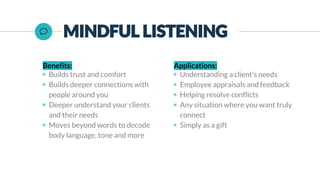
Mindful Listening
Centering
Benefits:
◉ Laid-off professionals journaling
for five days found new jobs at a
much higher rate ‑ 68% vs. 27%.
(Buhrfeind & Pennebaker, 1994)
◉ Two minutes journaling on two
consecutive days - improved mood
and wellbeing.
(University of Missouri, 2009)
Applications:
◉ When lots on, step-back and get a
“view from the balcony”
◉ Facing a problem or disagreement,
understand others perspectives
◉ When a salient emotion occurs,
better understand yourself
◉ Begin each day by tapping core
values
◉ Or just use as “brain dump” and
clarifier
Benefits:
◉ Builds trust and comfort
◉ Builds deeper connections with
people around you
◉ Deeper understand your clients
and their needs
◉ Moves beyond words to decode
body language, tone and more
Applications:
◉ Understanding a client’s needs
◉ Employee appraisals and feedback
◉ Helping resolve conflicts
◉ Any situation where you want truly
connect
◉ Simply as a gift
◉ Provides the space in which we choose how to respond,
rather than automatically reacting to a situation
◉ In this space we find the time and awareness to bring
our inspirational leadership skills to bear
Strong positive
correlation
between a leader’s
mindfulness and
employee
well-being
Higher performance
ratings, fewer instances
of negative behaviors,
lower emotional
exhaustion and higher
satisfaction with
work-life balance
“Centeredness is the key
to replacing automatic
reactions with
thoughtful, strategic and
authentic responses”
Bain and Company Lee Kong Chian School of Business and
NUS Business School
London Imperial College
9833980951
benjamin@shortlist.net
9820409188
anshul@greattoawesome.com
9821147670
realmsofdance@gmail.com

Developing Authentic Leadership - Kolkata

  • 1.
    25th April 2018 Kolkata HOWTO BUILD SELF-AWARENESS & FOCUS An SME Council Initiative
  • 5.
    Our mind isa muscle... We must keep exercising it
  • 6.
    Emotional intelligence iscentral for leaders of the future
  • 7.
    ● Achievement drive& standards ● Influence ● Conceptual thinking ● Analytical ability ● Initiative ● Self-confidence *Daniel Goleman, Lecture “Social Intelligence: The New Science of Human Relationship” EQ 4/6 IQ 2/6
  • 8.
    Bain and Company “InspirationalLeadership” Likelihood to inspire others
  • 11.
    What are qualities? ◉Traits or behavioral habits ◉ Skills or physical and mental abilities ◉ Values or what is important to you ◉ 3 of these should represent your core strengths today, and areas you want to really focus on ◉ 1 of these can represent an area that is not currently a strength, but is something that you want to work on
  • 12.
    ◉ Why arethese qualities important for you? ◉ What impact would they make? ◉ How do they make you feel? ◉ What type of person would you become?
  • 13.
    ◉ Who andwhat will stop you from making it happen? ◉ External constraints - things out of your control ◉ Internal constraints - your skills, time, habits ◉ Limiting beliefs - your narratives, fears, insecurities
  • 14.
    ◉ Who andwhat will help you make it happen? ◉ Your mentors ◉ Your practices and habits **pick one practice from today** ◉ Your mindsets and beliefs
  • 15.
    ◉ Think of5-10 people (the more the merrier) could ask for feedback on your qualities ◉ Pick a variety of people inside and outside work to help you develop a broader and richer understanding of your qualities
  • 16.
    ◉ For eachquality - write down what you will do to work on this area next week ◉ Any change starts with small and imperfect steps ◉ For each quality - write down how you will continue to build this ares over the coming months ◉ Only practice (and more practice) makes permanent
  • 17.
    ◉ What isyour accountability commitment? ◉ When will you check-in to review progress (add this to your calendar now)? ◉ Who can be your accountability partner(s)? ◉ Make it public, pin-up and share your leadership canvas?
  • 19.
  • 20.
    Benefits: ◉ Laid-off professionalsjournaling for five days found new jobs at a much higher rate ‑ 68% vs. 27%. (Buhrfeind & Pennebaker, 1994) ◉ Two minutes journaling on two consecutive days - improved mood and wellbeing. (University of Missouri, 2009) Applications: ◉ When lots on, step-back and get a “view from the balcony” ◉ Facing a problem or disagreement, understand others perspectives ◉ When a salient emotion occurs, better understand yourself ◉ Begin each day by tapping core values ◉ Or just use as “brain dump” and clarifier
  • 21.
    Benefits: ◉ Builds trustand comfort ◉ Builds deeper connections with people around you ◉ Deeper understand your clients and their needs ◉ Moves beyond words to decode body language, tone and more Applications: ◉ Understanding a client’s needs ◉ Employee appraisals and feedback ◉ Helping resolve conflicts ◉ Any situation where you want truly connect ◉ Simply as a gift
  • 22.
    ◉ Provides thespace in which we choose how to respond, rather than automatically reacting to a situation ◉ In this space we find the time and awareness to bring our inspirational leadership skills to bear
  • 24.
    Strong positive correlation between aleader’s mindfulness and employee well-being Higher performance ratings, fewer instances of negative behaviors, lower emotional exhaustion and higher satisfaction with work-life balance “Centeredness is the key to replacing automatic reactions with thoughtful, strategic and authentic responses” Bain and Company Lee Kong Chian School of Business and NUS Business School London Imperial College
  • 27.