By : Anmol Khare
Class : 12th
Subject : Economics
Meaning
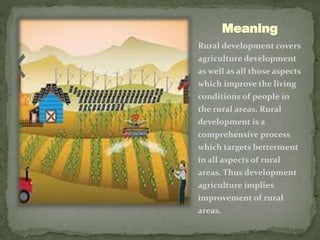
Rural development covers
agriculture development
as well as all those aspects
which improve the living
conditions of people in
the rural areas. Rural
development is a
comprehensive process
which targets betterment
in all aspects of rural
areas. Thus development
agriculture implies
improvement of rural
areas.
 Development of human resources
 Land reforms
 Development of infrastructure
 Alleviation of poverty
 Development of the productive
resources of each locality
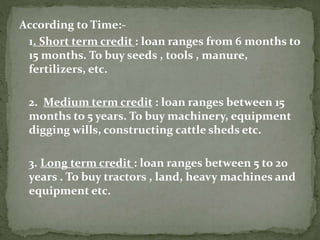
According to Time:-
1. Short term credit : loan ranges from 6 months to
15 months. To buy seeds , tools , manure,
fertilizers, etc.
2. Medium term credit : loan ranges between 15
months to 5 years. To buy machinery, equipment
digging wills, constructing cattle sheds etc.
3. Long term credit : loan ranges between 5 to 20
years . To buy tractors , land, heavy machines and
equipment etc.
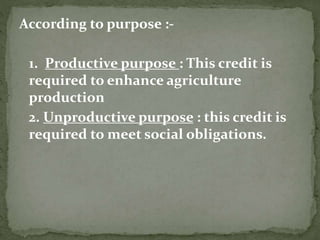
According to purpose :-
1. Productive purpose : This credit is
required to enhance agriculture
production
2. Unproductive purpose : this credit is
required to meet social obligations.
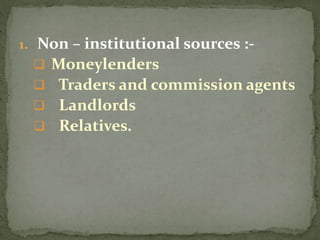
1. Non – institutional sources :-
 Moneylenders
 Traders and commission agents
 Landlords
 Relatives.
2. Institutional sources :-
Cooperative credit societies.
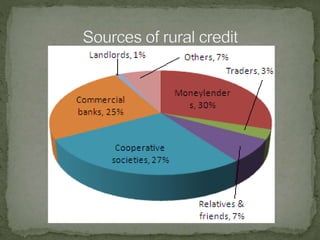
 These contributes nearly 30% of
the rural credit.
 Land development banks
The credit is granted against the
mortgage
Long term credit
3. Commercial bank credit
Regional rural bank
To open the branches in those
areas where there no banking
facilities available
To provide credit facilities to
small and marginal farmers.
 National bank for agricultural and rural
development (NABARD) Apex agency To
promote the strength of credit
institutions in credit delivery system To
provide assistance in the non-farm
sectors also To control and evaluate the
projects financed by it It coordinates the
functioning of different financial
institution involved in advancing rural
credit.
Agriculture marketing is a process
that involves the assembling,
storage processing, transportation,
packaging, grading and distribution
of different agriculture
commodities across the country .
Regulation of markets
 Provision of physical infrastructure
Cooperative marketing
 Minimum support price
 Grading and quality control
 Dissemination of information.
 Government intervention should increase
 More of rural periodic markets should be
developed
 There should be increased provision of more
infrastructural facilities
 Abolition of intermediaries
 Provision of standardizing and grading
 Dissemination of market related information
through electronic media
 New cooperative marketing societies
 Easy credit to the farmers
Aspect of diversification
Diversification of crop production (
change in cropping pattern)
Diversification of productive activities
( shift of workforce from agriculture to
other allied activities and non-
agricultural sector like live stock,
poultry, fisheries etc.,)
Animal husbandry
 It provides stability in income, food security ,
transportation, fuel ad nutrition for the family
 70 million small and marginal farmers provides
alternate livelihood
 Poultry account for the largest share with 58% followed
by others
 Dairy sector over last 3 decades has been quite
impressive
 Operation flood – milk produced according to different
grading
Fisheries
 Fish production from inland sources contributes
about 64 % to the total fish production and the
balance 36% comes from the marine sector
 Today total fish production accounts for 0.8% of total
GDP.
Horticulture
 It contribute nearly one third of the value of
agriculture output and 6% of GDP of India.
 2014-15 production of fruits and vegetables was
around 87 million tons and 170 million tons
respectively
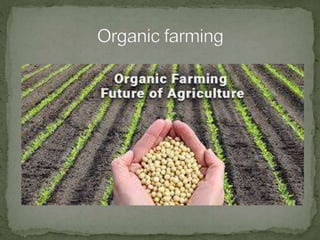
 Needed
 It is an economic farming technology. It can be picked
up by small and marginal farmers
 There is urgent requirement to optimally utile our
scarce resources so that they can be preserved for future
generations too to promote sustainable development.
 Conventional farming methods use chemical based
fertilitsers and topic pesticides which deplete the soil
and devastate natural eco system, so there is urgent
need of an eco-friendly technology like organic farming.
 Economical
 Generation of income
 Healthy food
 Environment friendly
 Generates employment
 Maintains natural eco-system
 Needs popularization
 Inadequate infrastructure and marketing
 Less output
 Shorter shelf life
 Limited choice in production
Thank You

Rural development class 12 Economics

  • 1.
    By : AnmolKhare Class : 12th Subject : Economics
  • 2.
    Meaning Rural development covers agriculturedevelopment as well as all those aspects which improve the living conditions of people in the rural areas. Rural development is a comprehensive process which targets betterment in all aspects of rural areas. Thus development agriculture implies improvement of rural areas.
  • 3.
     Development ofhuman resources  Land reforms  Development of infrastructure  Alleviation of poverty  Development of the productive resources of each locality
  • 5.
    According to Time:- 1.Short term credit : loan ranges from 6 months to 15 months. To buy seeds , tools , manure, fertilizers, etc. 2. Medium term credit : loan ranges between 15 months to 5 years. To buy machinery, equipment digging wills, constructing cattle sheds etc. 3. Long term credit : loan ranges between 5 to 20 years . To buy tractors , land, heavy machines and equipment etc.
  • 6.
    According to purpose:- 1. Productive purpose : This credit is required to enhance agriculture production 2. Unproductive purpose : this credit is required to meet social obligations.
  • 8.
    1. Non –institutional sources :-  Moneylenders  Traders and commission agents  Landlords  Relatives.
  • 9.
    2. Institutional sources:- Cooperative credit societies.  These contributes nearly 30% of the rural credit.  Land development banks The credit is granted against the mortgage Long term credit
  • 10.
    3. Commercial bankcredit Regional rural bank To open the branches in those areas where there no banking facilities available To provide credit facilities to small and marginal farmers.
  • 12.
     National bankfor agricultural and rural development (NABARD) Apex agency To promote the strength of credit institutions in credit delivery system To provide assistance in the non-farm sectors also To control and evaluate the projects financed by it It coordinates the functioning of different financial institution involved in advancing rural credit.
  • 13.
    Agriculture marketing isa process that involves the assembling, storage processing, transportation, packaging, grading and distribution of different agriculture commodities across the country .
  • 14.
    Regulation of markets Provision of physical infrastructure Cooperative marketing  Minimum support price  Grading and quality control  Dissemination of information.
  • 15.
     Government interventionshould increase  More of rural periodic markets should be developed  There should be increased provision of more infrastructural facilities  Abolition of intermediaries  Provision of standardizing and grading  Dissemination of market related information through electronic media  New cooperative marketing societies  Easy credit to the farmers
  • 16.
    Aspect of diversification Diversificationof crop production ( change in cropping pattern) Diversification of productive activities ( shift of workforce from agriculture to other allied activities and non- agricultural sector like live stock, poultry, fisheries etc.,)
  • 17.
    Animal husbandry  Itprovides stability in income, food security , transportation, fuel ad nutrition for the family  70 million small and marginal farmers provides alternate livelihood  Poultry account for the largest share with 58% followed by others  Dairy sector over last 3 decades has been quite impressive  Operation flood – milk produced according to different grading
  • 18.
    Fisheries  Fish productionfrom inland sources contributes about 64 % to the total fish production and the balance 36% comes from the marine sector  Today total fish production accounts for 0.8% of total GDP.
  • 19.
    Horticulture  It contributenearly one third of the value of agriculture output and 6% of GDP of India.  2014-15 production of fruits and vegetables was around 87 million tons and 170 million tons respectively
  • 21.
     Needed  Itis an economic farming technology. It can be picked up by small and marginal farmers  There is urgent requirement to optimally utile our scarce resources so that they can be preserved for future generations too to promote sustainable development.  Conventional farming methods use chemical based fertilitsers and topic pesticides which deplete the soil and devastate natural eco system, so there is urgent need of an eco-friendly technology like organic farming.
  • 22.
     Economical  Generationof income  Healthy food  Environment friendly  Generates employment  Maintains natural eco-system
  • 23.
     Needs popularization Inadequate infrastructure and marketing  Less output  Shorter shelf life  Limited choice in production
  • 24.