RADIO CARBON DATING
GOKUL UK
NO:25 MS6
CONTENTS
• Introduction.
• History
• Carbon 14
• Basic concept of radio carbon dating
• Dating sample
• Carbon dating methods
• Applications
• Impact
• Limitations
• Conclusion
INTRODUCTION
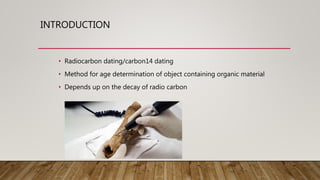
• Radiocarbon dating/carbon14 dating
• Method for age determination of object containing organic material
• Depends up on the decay of radio carbon
HISTORY
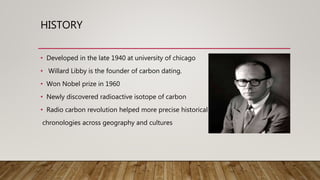
• Developed in the late 1940 at university of chicago
• Willard Libby is the founder of carbon dating.
• Won Nobel prize in 1960
• Newly discovered radioactive isotope of carbon
• Radio carbon revolution helped more precise historical
chronologies across geography and cultures
WILLARD LIBBY'S CONCEPT OF CARBON DATING
• Radio carbon dating in 1945
• Inspired by phisicist Serge korff
• C14 in the atmosphere find its way to living matter
• If one could detect the amount of carbon 14 in an object
that objects age can be established
• Object age can be established using rate of decay.
CARBON 14
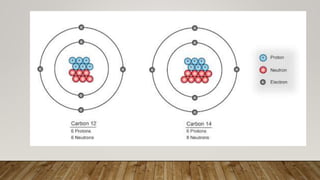
• Radioactive isotope of carbon
• Contains 6 protons and 8 neutrons
• Discovered by Martin kamen and Samu Ruben
• Naturally occuring isotope
• Natural source of carbo 14 on earth
Is cosmic ray action on nitrogen in atmosphere
• Has a half life of 5730+_30 years
BASIC PRINCIPLE OF CARBON DATING
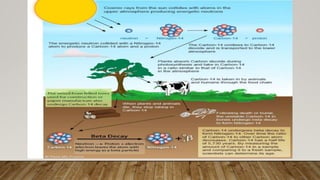
• Carbon 14 continually formed in the upper atmosphere
• Effect of cosmic ray neutron on nitrogen 14 atoms produce C14
• Rapidly oxidized in air to form carbondioxide enters global carbon cycle
• Plants and animals accumulate C14 throughout their life times
• Stop exchanging carbon with biosphere when they die
• C14. Content decreased by the law of radio active decay
• Measuring the amount of carbon 14 the age can be estimated
• Ratio between C12 and C14 approx same in living time
• When it dies C14 decays to Nitrogen14
• By measuring ratio of C12 to C14 after death can be used to estimate the age.
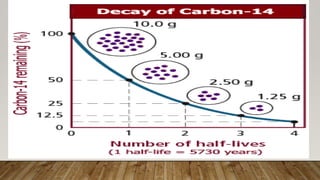
HALF LIFE OF RADIOACTIVE ISOTOPE
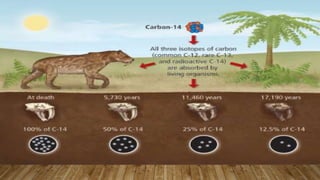
• Amount of time takes to half the number of isotope in a sample to decay
• Half life for carbon 14 is 5730 years
• Relatively small span
• More than 60000 years is not possible
• Every 5730 years C14 content is halfed
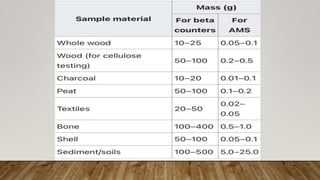
DATING SAMPLE
• Samples containing organic matter
• Handled carefully to avoid contamination
• Should converted to suitable form
• Contaminants removed by pre treatment
• Sample sizes based on testing technologies
CARBON DATING METHODS
• Gas proportional counting
• Liquid scintillation counting
• Accelerator mass spectrometry
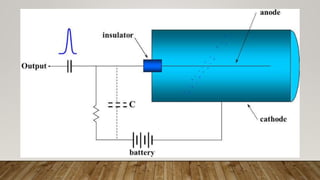
GAS PROPORTIONAL COUNTING
• Conventional radiometric dating technique
• Counts beta particles emitted by sample
• Beta particles are product of radiocarbon decay
• Carbon sample is converted to carbondioxide gas for counting
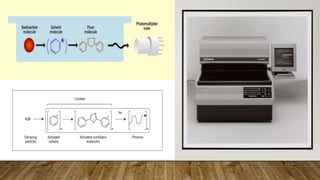
LIQUID SCINTILLATION COUNTING
• Popular technique in the 1960’s
• Sample is in liquid form
• Scintillator is added
• Scintillator produces flash light while interacting with beta particle
• Photomultiplier tubes transfer this light signal
• Used for alpha and beta particle detection
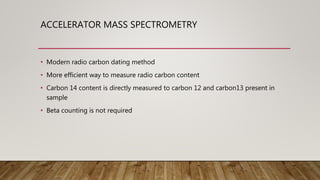
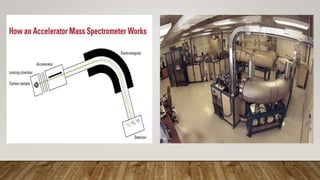
ACCELERATOR MASS SPECTROMETRY
• Modern radio carbon dating method
• More efficient way to measure radio carbon content
• Carbon 14 content is directly measured to carbon 12 and carbon13 present in
sample
• Beta counting is not required
APPLICATIONS
• Archeology
• Geology
• Hydrology
• Geophysics
• Atmospheric science
• Oceanography
• Bio medicine
IMPACT
• Modern man made it one of the most significant discoveries of the 20th century
• Revolutionizes man’s understandings on events that allready happened
thousands of years ago
• Prove and disprove theories
LIMITATIONS
• Dating is not possible for samples older than 60,000 years.
• Dating is possible only for objects containing organic material.
• Objects that are parts of living things only could be dated.
• Emission from fossil fuels limit carbon dating.
CONCLUSION
• Carbon dating technology is effective technology to find out age of objects upto
60,000 years old.
• Most of every field of science utilises carbon dating
• Carbon dating is in danger due to excess burning of fossil fuel.
Radiocarbon Dating Endangered by Air Pollution
THANK YOU

Radiocarbon dating

  • 1.
  • 2.
    CONTENTS • Introduction. • History •Carbon 14 • Basic concept of radio carbon dating • Dating sample • Carbon dating methods • Applications • Impact • Limitations • Conclusion
  • 3.
    INTRODUCTION • Radiocarbon dating/carbon14dating • Method for age determination of object containing organic material • Depends up on the decay of radio carbon
  • 4.
    HISTORY • Developed inthe late 1940 at university of chicago • Willard Libby is the founder of carbon dating. • Won Nobel prize in 1960 • Newly discovered radioactive isotope of carbon • Radio carbon revolution helped more precise historical chronologies across geography and cultures
  • 5.
    WILLARD LIBBY'S CONCEPTOF CARBON DATING • Radio carbon dating in 1945 • Inspired by phisicist Serge korff • C14 in the atmosphere find its way to living matter • If one could detect the amount of carbon 14 in an object that objects age can be established • Object age can be established using rate of decay.
  • 6.
    CARBON 14 • Radioactiveisotope of carbon • Contains 6 protons and 8 neutrons • Discovered by Martin kamen and Samu Ruben • Naturally occuring isotope • Natural source of carbo 14 on earth Is cosmic ray action on nitrogen in atmosphere • Has a half life of 5730+_30 years
  • 8.
    BASIC PRINCIPLE OFCARBON DATING • Carbon 14 continually formed in the upper atmosphere • Effect of cosmic ray neutron on nitrogen 14 atoms produce C14 • Rapidly oxidized in air to form carbondioxide enters global carbon cycle • Plants and animals accumulate C14 throughout their life times • Stop exchanging carbon with biosphere when they die • C14. Content decreased by the law of radio active decay
  • 9.
    • Measuring theamount of carbon 14 the age can be estimated • Ratio between C12 and C14 approx same in living time • When it dies C14 decays to Nitrogen14 • By measuring ratio of C12 to C14 after death can be used to estimate the age.
  • 11.
    HALF LIFE OFRADIOACTIVE ISOTOPE • Amount of time takes to half the number of isotope in a sample to decay • Half life for carbon 14 is 5730 years • Relatively small span • More than 60000 years is not possible • Every 5730 years C14 content is halfed
  • 14.
    DATING SAMPLE • Samplescontaining organic matter • Handled carefully to avoid contamination • Should converted to suitable form • Contaminants removed by pre treatment • Sample sizes based on testing technologies
  • 16.
    CARBON DATING METHODS •Gas proportional counting • Liquid scintillation counting • Accelerator mass spectrometry
  • 17.
    GAS PROPORTIONAL COUNTING •Conventional radiometric dating technique • Counts beta particles emitted by sample • Beta particles are product of radiocarbon decay • Carbon sample is converted to carbondioxide gas for counting
  • 19.
    LIQUID SCINTILLATION COUNTING •Popular technique in the 1960’s • Sample is in liquid form • Scintillator is added • Scintillator produces flash light while interacting with beta particle • Photomultiplier tubes transfer this light signal • Used for alpha and beta particle detection
  • 21.
    ACCELERATOR MASS SPECTROMETRY •Modern radio carbon dating method • More efficient way to measure radio carbon content • Carbon 14 content is directly measured to carbon 12 and carbon13 present in sample • Beta counting is not required
  • 23.
    APPLICATIONS • Archeology • Geology •Hydrology • Geophysics • Atmospheric science • Oceanography • Bio medicine
  • 24.
    IMPACT • Modern manmade it one of the most significant discoveries of the 20th century • Revolutionizes man’s understandings on events that allready happened thousands of years ago • Prove and disprove theories
  • 25.
    LIMITATIONS • Dating isnot possible for samples older than 60,000 years. • Dating is possible only for objects containing organic material. • Objects that are parts of living things only could be dated. • Emission from fossil fuels limit carbon dating.
  • 26.
    CONCLUSION • Carbon datingtechnology is effective technology to find out age of objects upto 60,000 years old. • Most of every field of science utilises carbon dating • Carbon dating is in danger due to excess burning of fossil fuel.

  • 27.
  • 28.