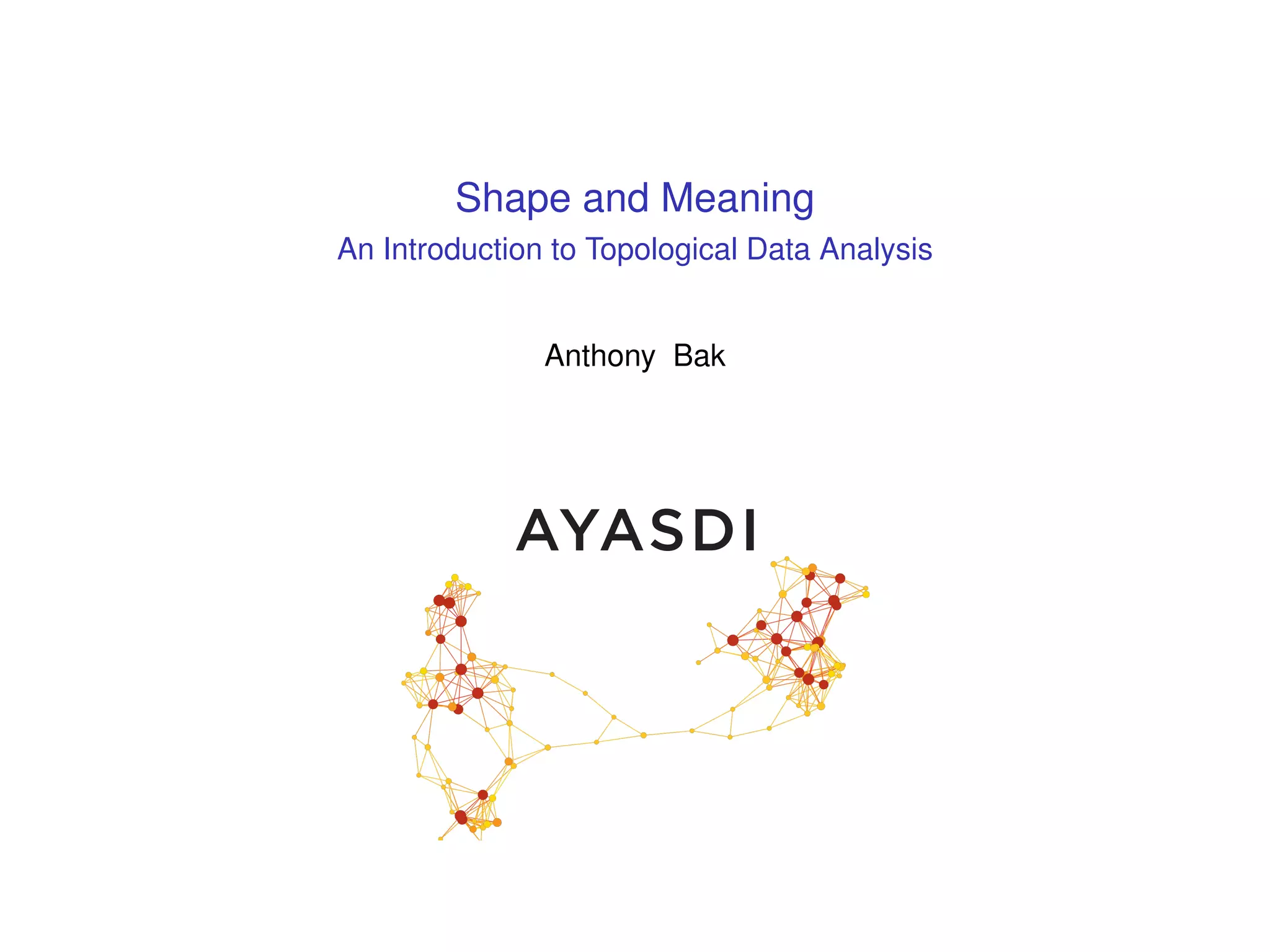
Shape and Meaning
An Introduction to Topological Data Analysis
Anthony Bak
Goals
For this talk I want to:
Goals
For this talk I want to:
Show you how TDA provides a framework for many machine learning/data
analysis techniques
Goals
For this talk I want to:
Show you how TDA provides a framework for many machine learning/data
analysis techniques
Demonstrate how Ayasdi provides insights into the data.
Goals
For this talk I want to:
Show you how TDA provides a framework for many machine learning/data
analysis techniques
Demonstrate how Ayasdi provides insights into the data.
Caveats: I am only talking about the strain of TDA done by Ayasdi
The Data Problem
How do we extract meaning from Complex Data?
The Data Problem
How do we extract meaning from Complex Data?
Data is complex because it’s "Big Data"
The Data Problem
How do we extract meaning from Complex Data?
Data is complex because it’s "Big Data"
Or has very rich features (eg. Genetic Data >500,000 features, complicated
interdependencies)
The Data Problem
How do we extract meaning from Complex Data?
Data is complex because it’s "Big Data"
Or has very rich features (eg. Genetic Data >500,000 features, complicated
interdependencies)
Or both!
The Data Problem
How do we extract meaning from Complex Data?
Data is complex because it’s "Big Data"
Or has very rich features (eg. Genetic Data >500,000 features, complicated
interdependencies)
Or both!
The Problem in both cases is that there isn’t a single story happening in your data.
The Data Problem
How do we extract meaning from Complex Data?
Data is complex because it’s "Big Data"
Or has very rich features (eg. Genetic Data >500,000 features, complicated
interdependencies)
Or both!
The Problem in both cases is that there isn’t a single story happening in your data.
TDA will be the tool that summarizes out the irrelevant stories to get at something
interesting.
Data Has Shape
And Shape Has Meaning
Data Has Shape
And Shape Has Meaning
⇒ In this talk I will focus on how we extract meaning.
But first... What is shape?
Shape is the global realization of local constraints.
But first... What is shape?
Shape is the global realization of local constraints.
For a given problem determined by a choice of
Features, columns or properties to measure.
A metric on the columns.
But first... What is shape?
Shape is the global realization of local constraints.
For a given problem determined by a choice of
Features, columns or properties to measure.
A metric on the columns.
But not necessarily so. There are more relaxed definitions of shape and we
can use those too.
But first... What is shape?
Shape is the global realization of local constraints.
For a given problem determined by a choice of
Features, columns or properties to measure.
A metric on the columns.
But not necessarily so. There are more relaxed definitions of shape and we
can use those too.
The goal of TDA is to understand (for us, summarize) the shape with no
preconceived model of what it should be.
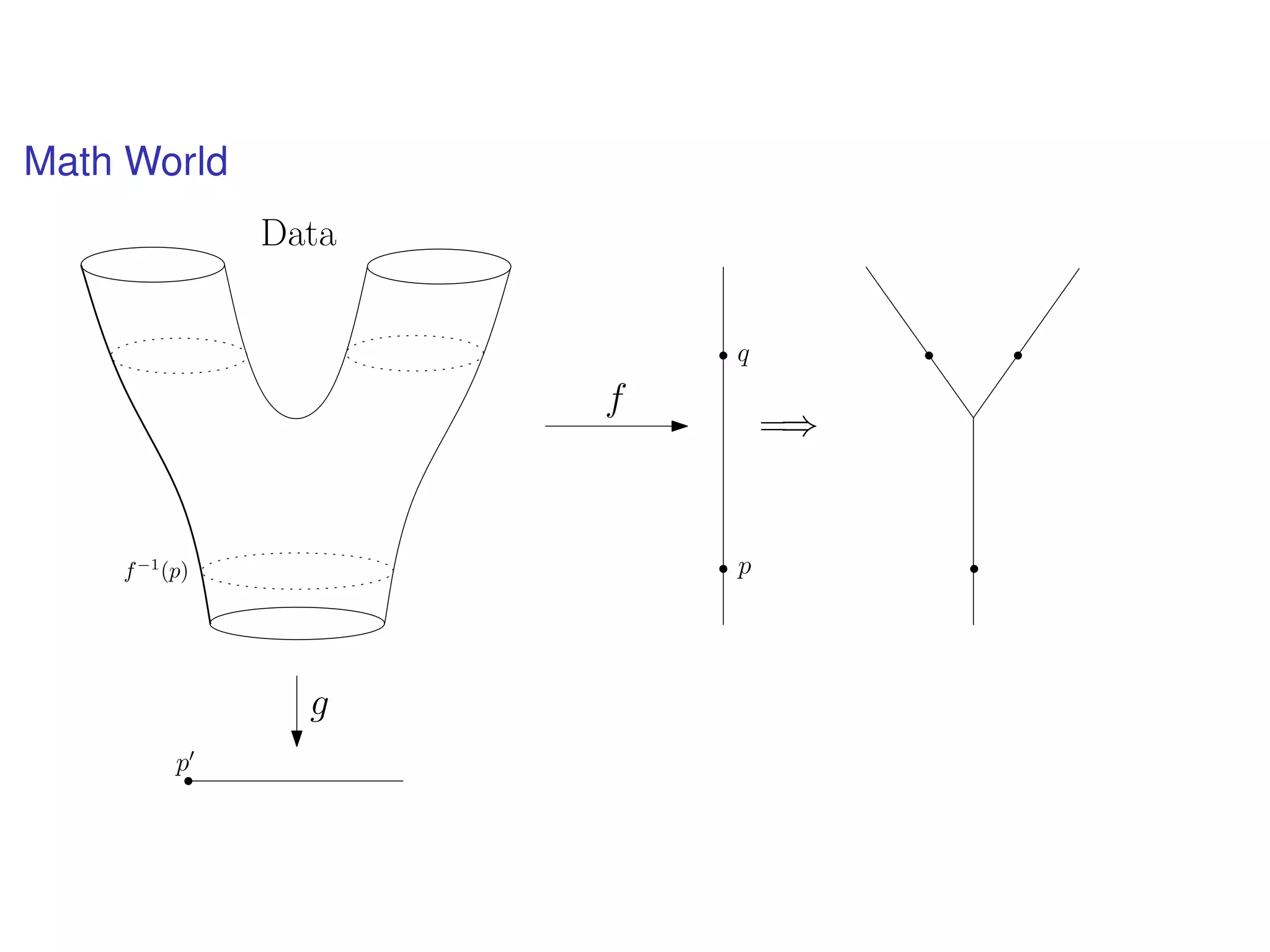
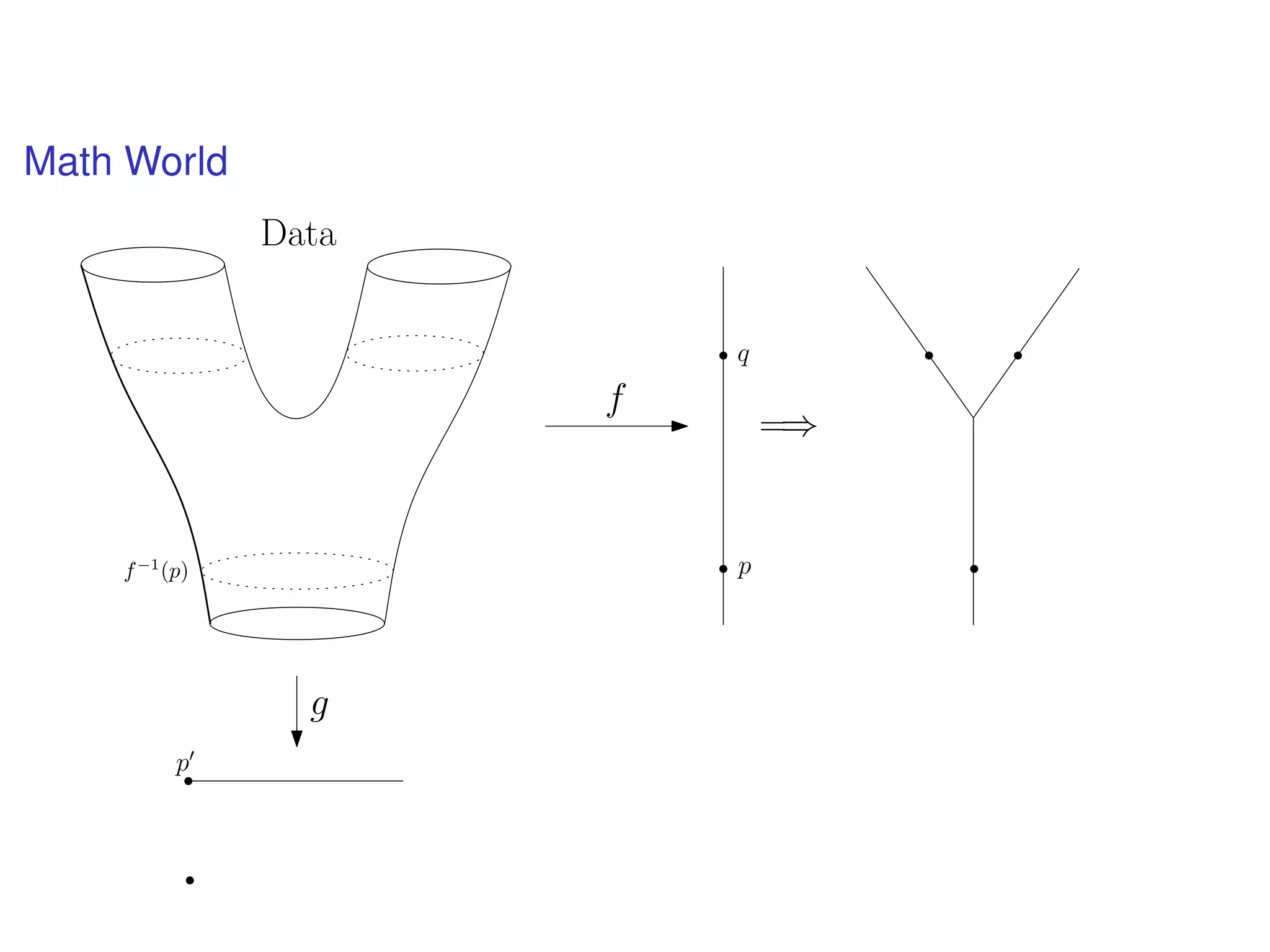
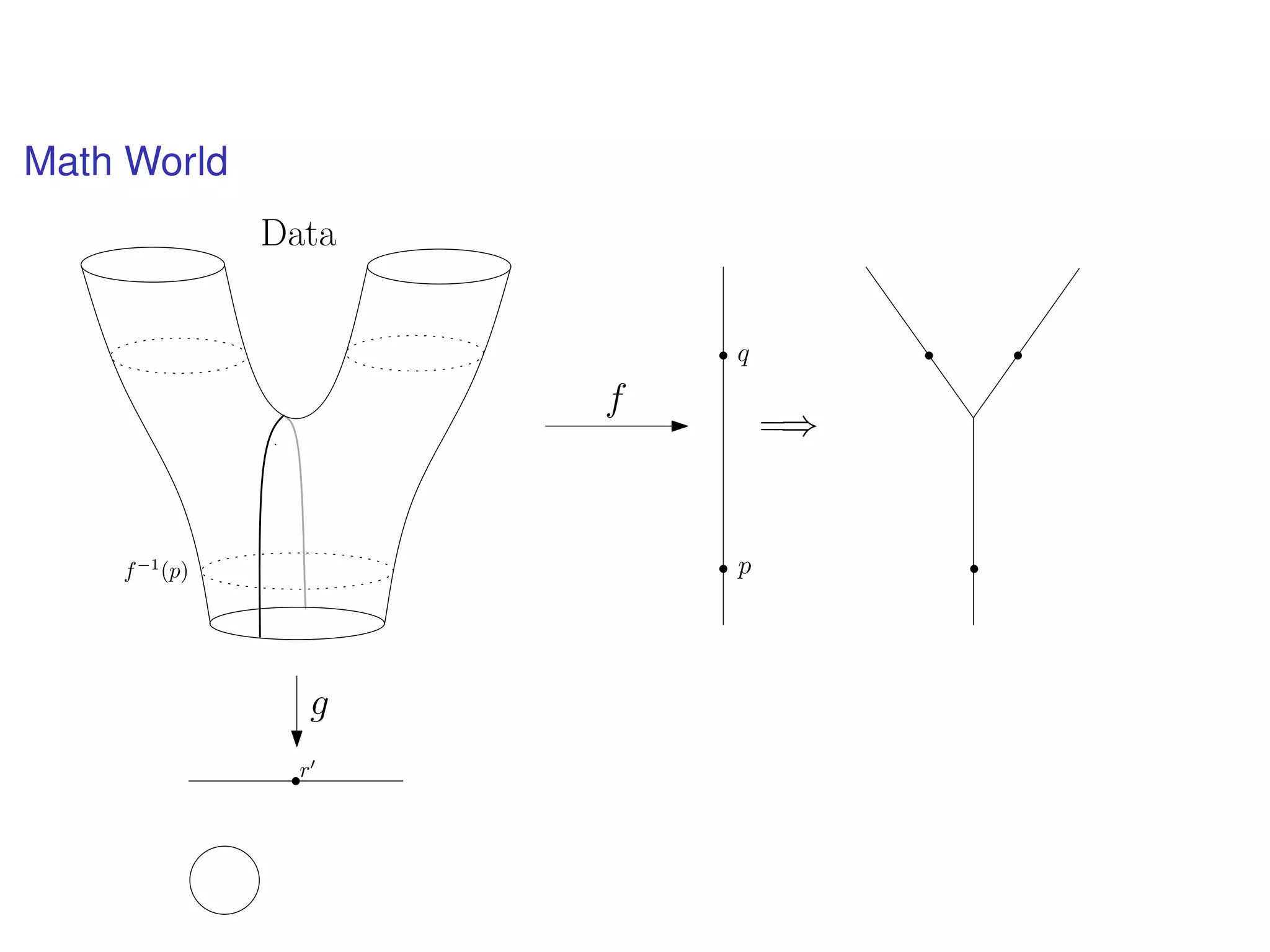
Math World
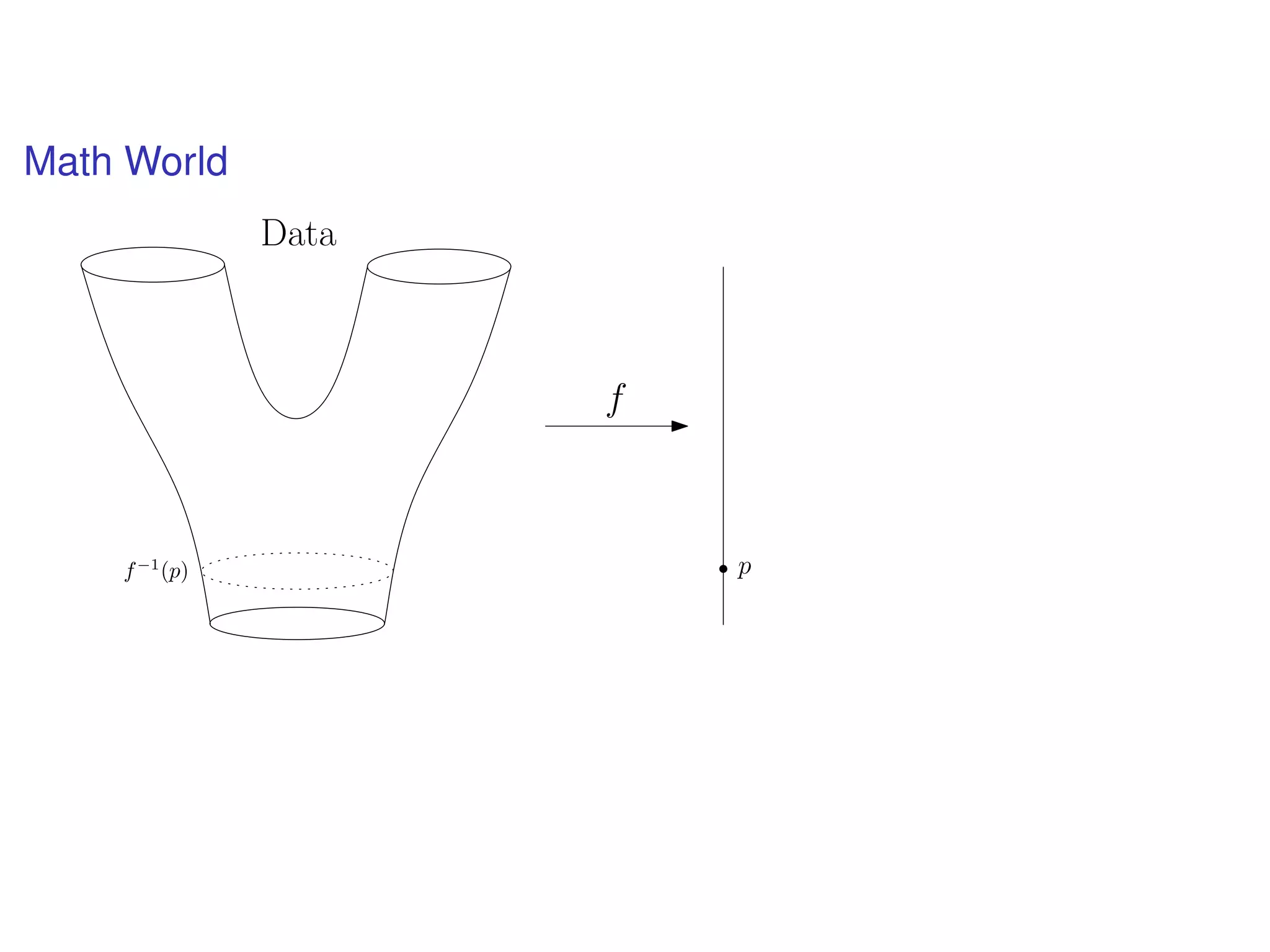
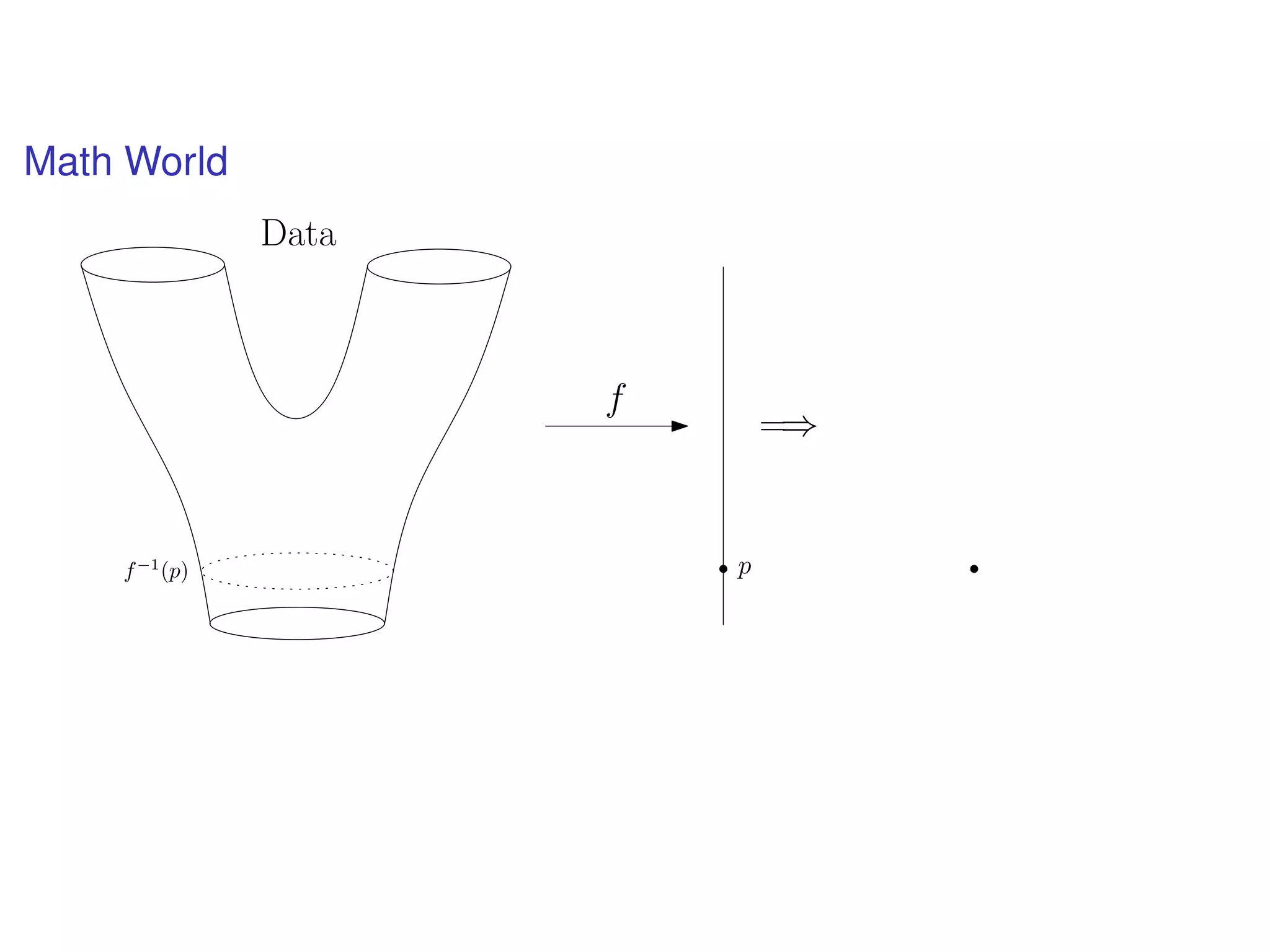
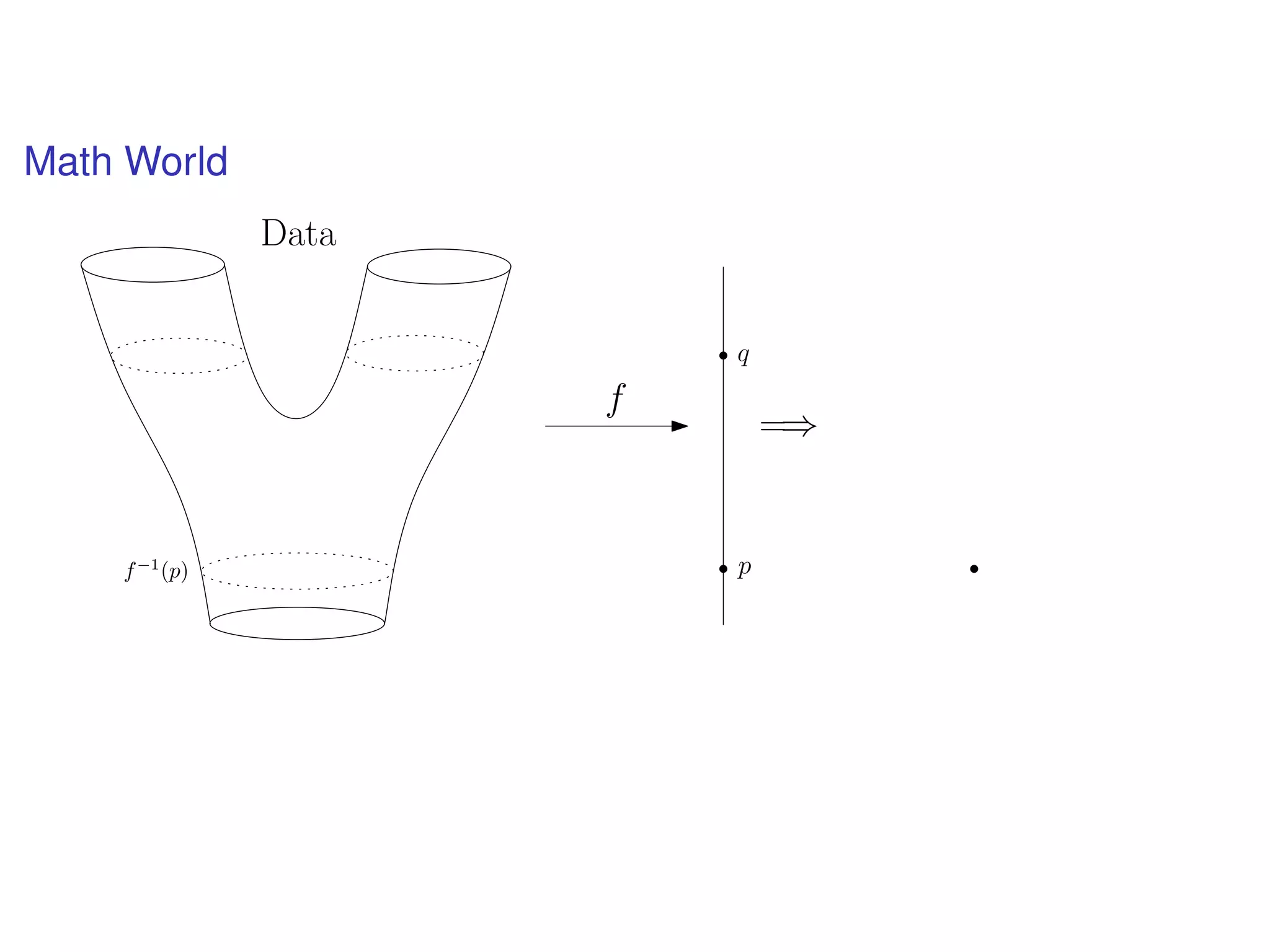
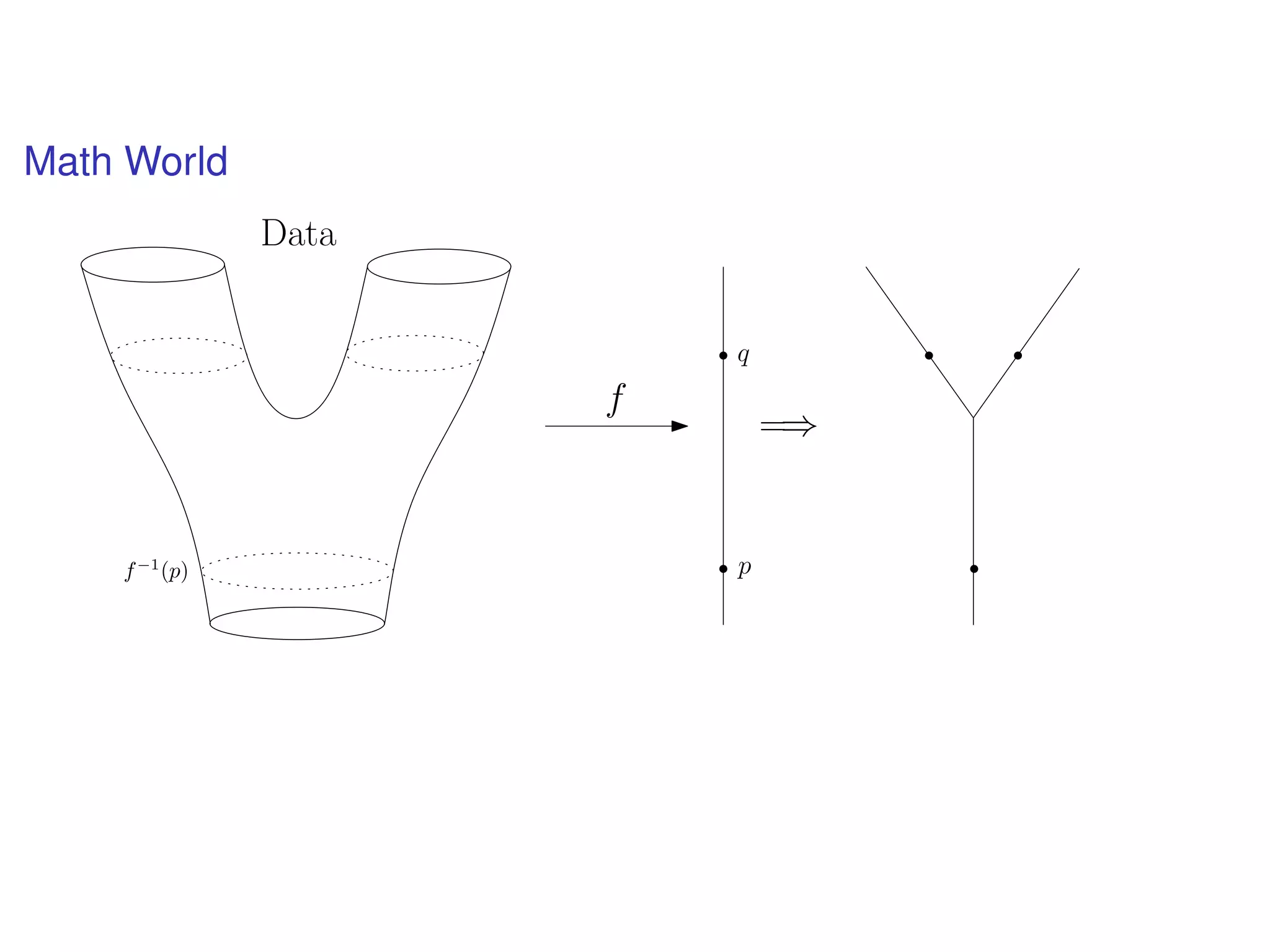
To show you how we extract insight from shape we start in "Math World"
Math World
To show you how we extract insight from shape we start in "Math World"
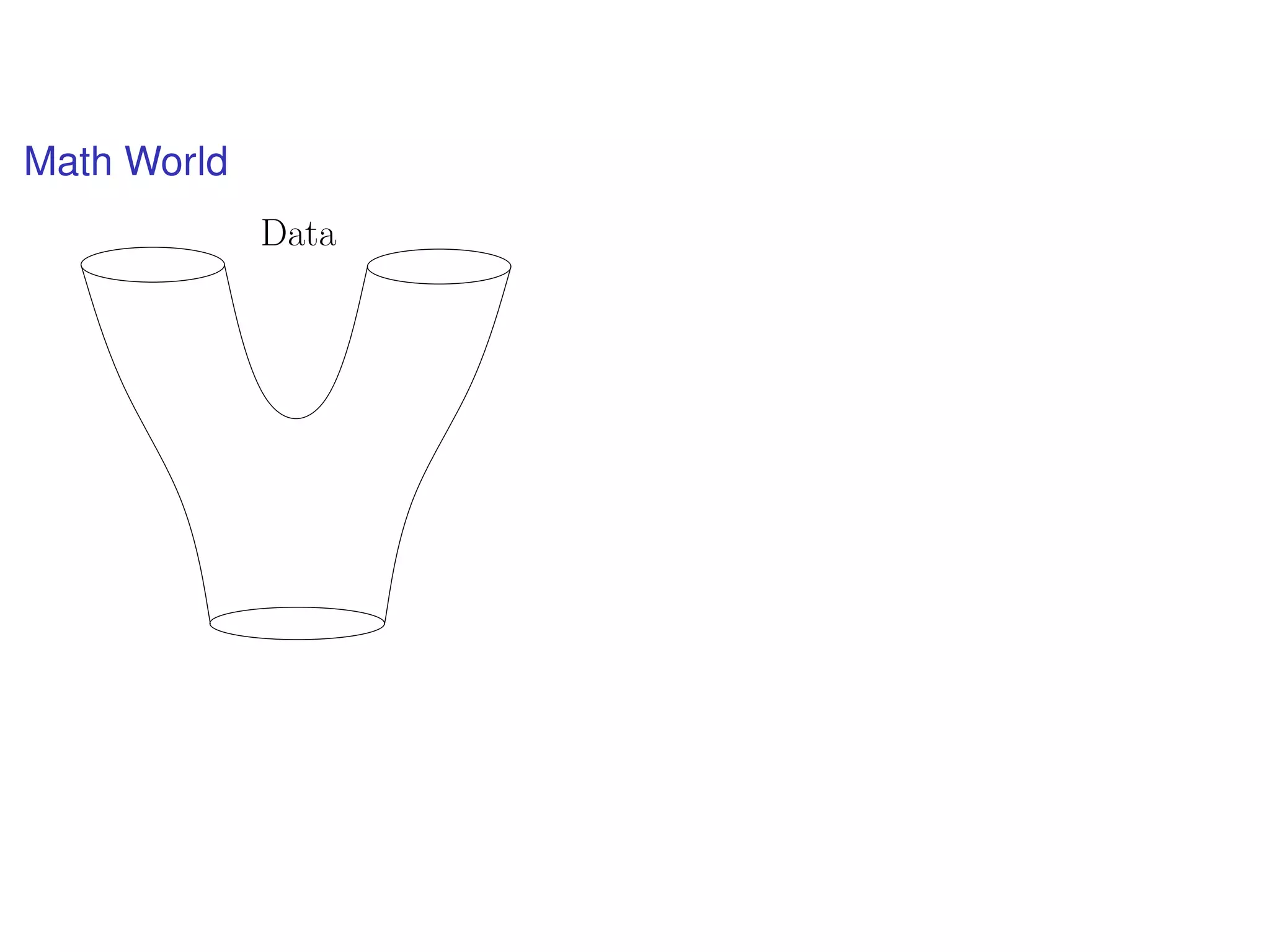
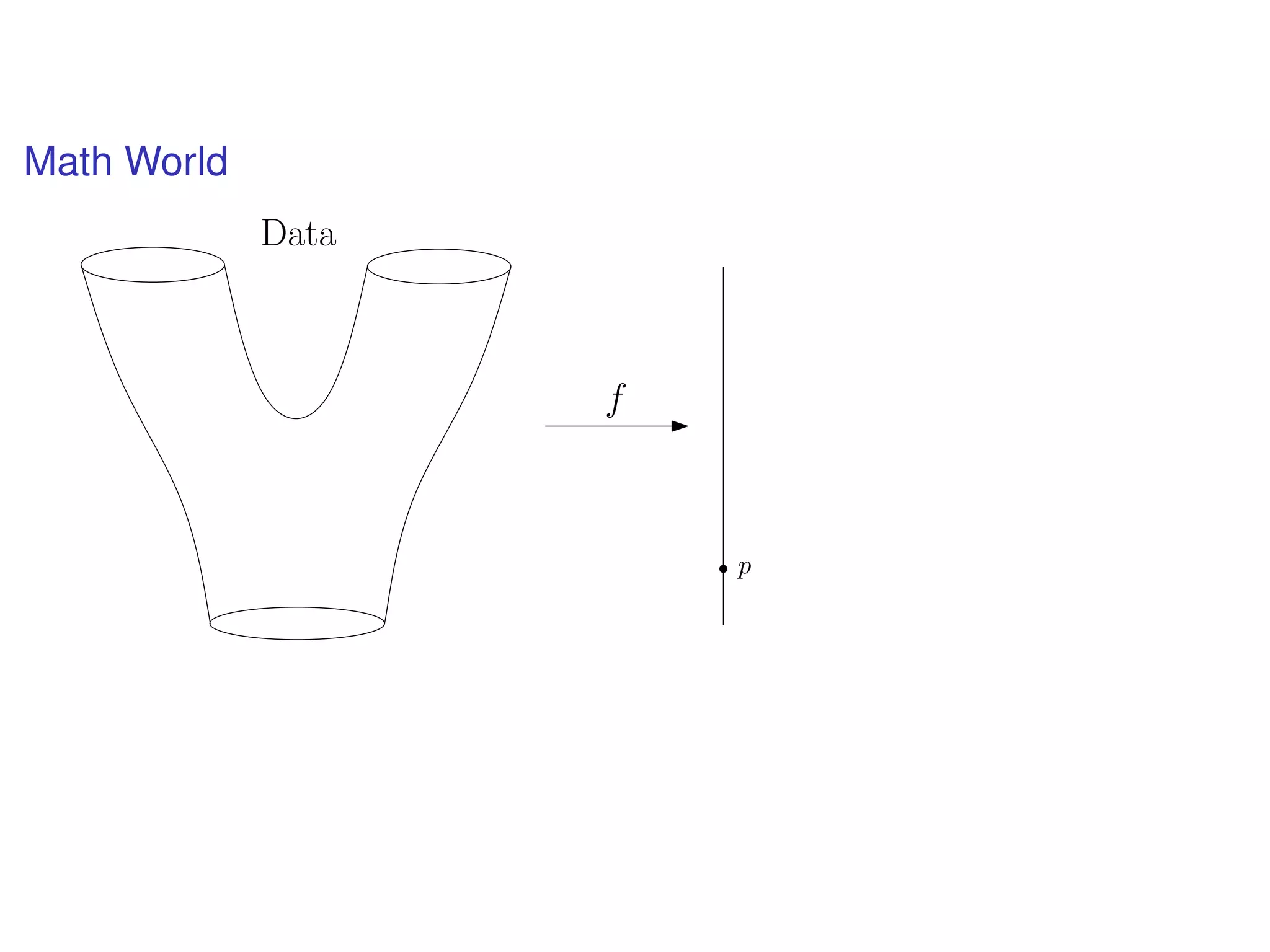
We’ll draw the data as a smooth manifold.
Math World
To show you how we extract insight from shape we start in "Math World"
We’ll draw the data as a smooth manifold.
Functions that appear are smooth or continuous.
Math World
To show you how we extract insight from shape we start in "Math World"
We’ll draw the data as a smooth manifold.
Functions that appear are smooth or continuous.
⇒ We will not need either of these assumptions once we’re in "Data World".
Math World
To show you how we extract insight from shape we start in "Math World"
We’ll draw the data as a smooth manifold.
Functions that appear are smooth or continuous.
⇒ We will not need either of these assumptions once we’re in "Data World".
⇒ Even more importantly, data in the real world is never like this
Math World
Data
Math World
f
p
Data
Math World
f
pf−1
(p)
Data
Math World
f
pf−1
(p)
=⇒
Data
Math World
f
pf−1
(p)
=⇒
q
Data
Math World
f
pf−1
(p)
=⇒
q
Data
Math World
f
pf−1
(p)
=⇒
q
Data
Math World
f
pf−1
(p)
=⇒
q
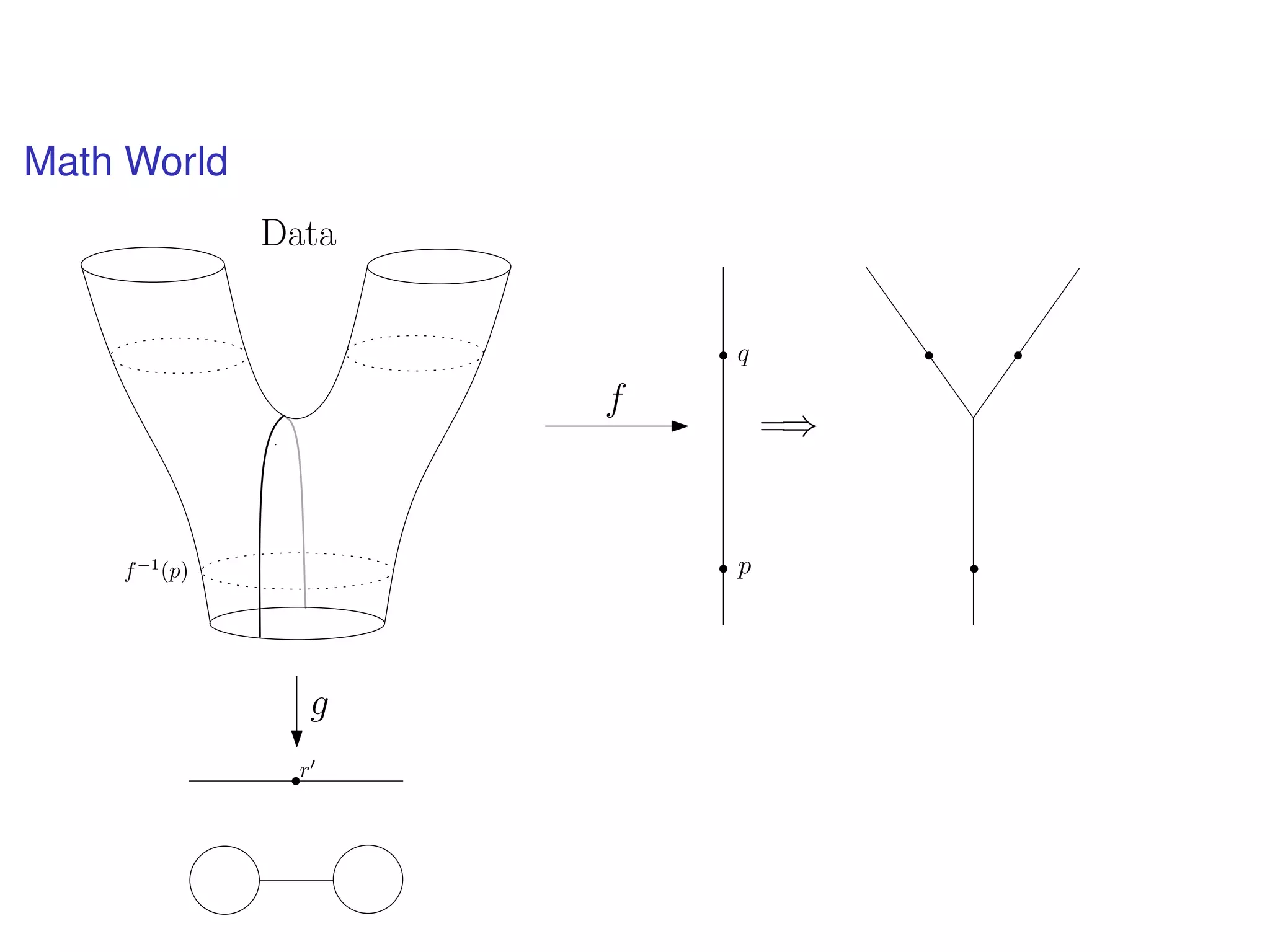
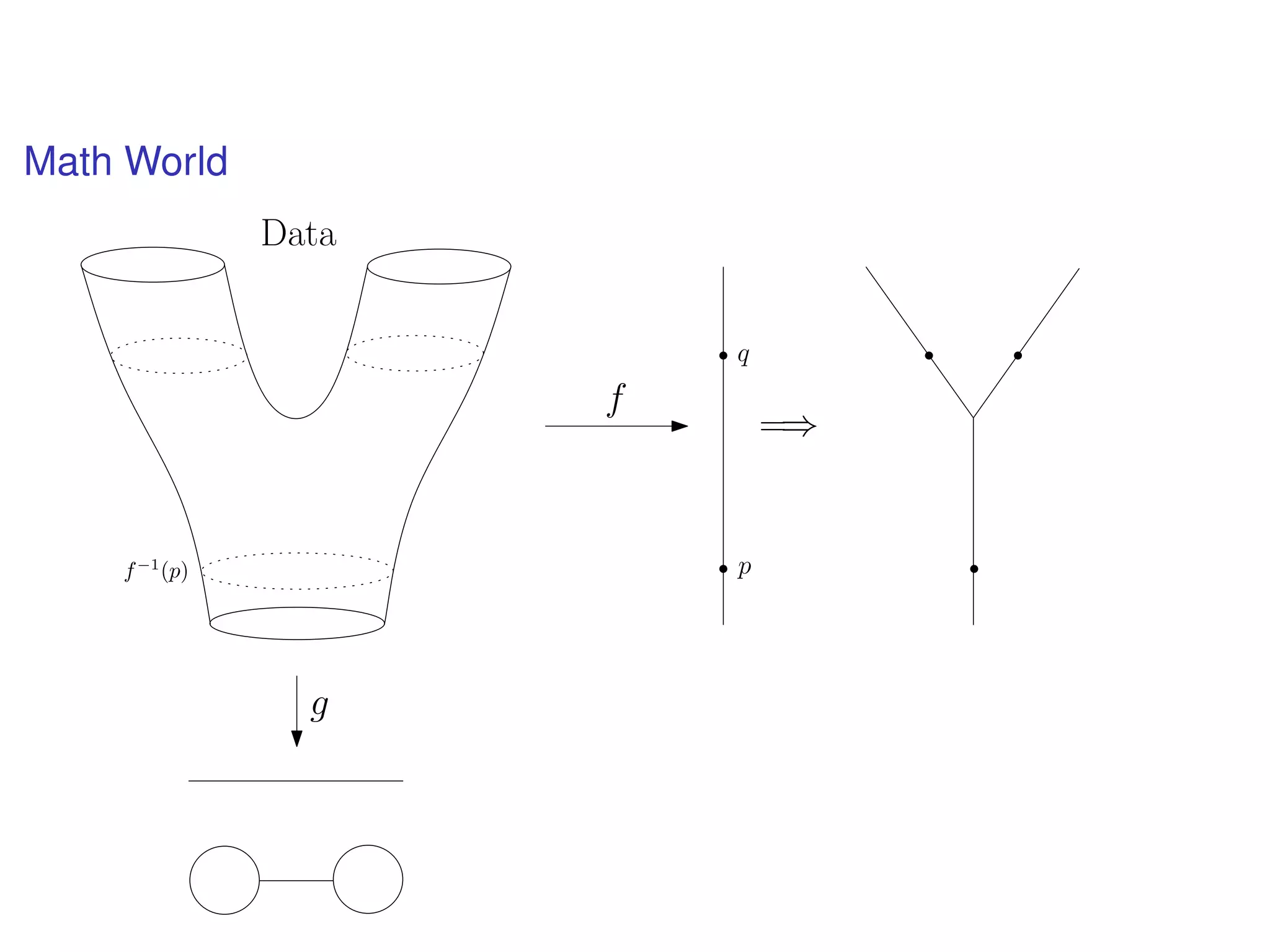
g
Data
Math World
f
pf−1
(p)
=⇒
q
g
Data
p
Math World
f
pf−1
(p)
=⇒
q
g
Data
p
Math World
f
pf−1
(p)
=⇒
q
g
Data
p q
Math World
f
pf−1
(p)
=⇒
q
g
Data
p q
Math World
f
pf−1
(p)
=⇒
q
g
Data
r
Math World
f
pf−1
(p)
=⇒
q
g
Data
r
Math World
f
pf−1
(p)
=⇒
q
g
Data
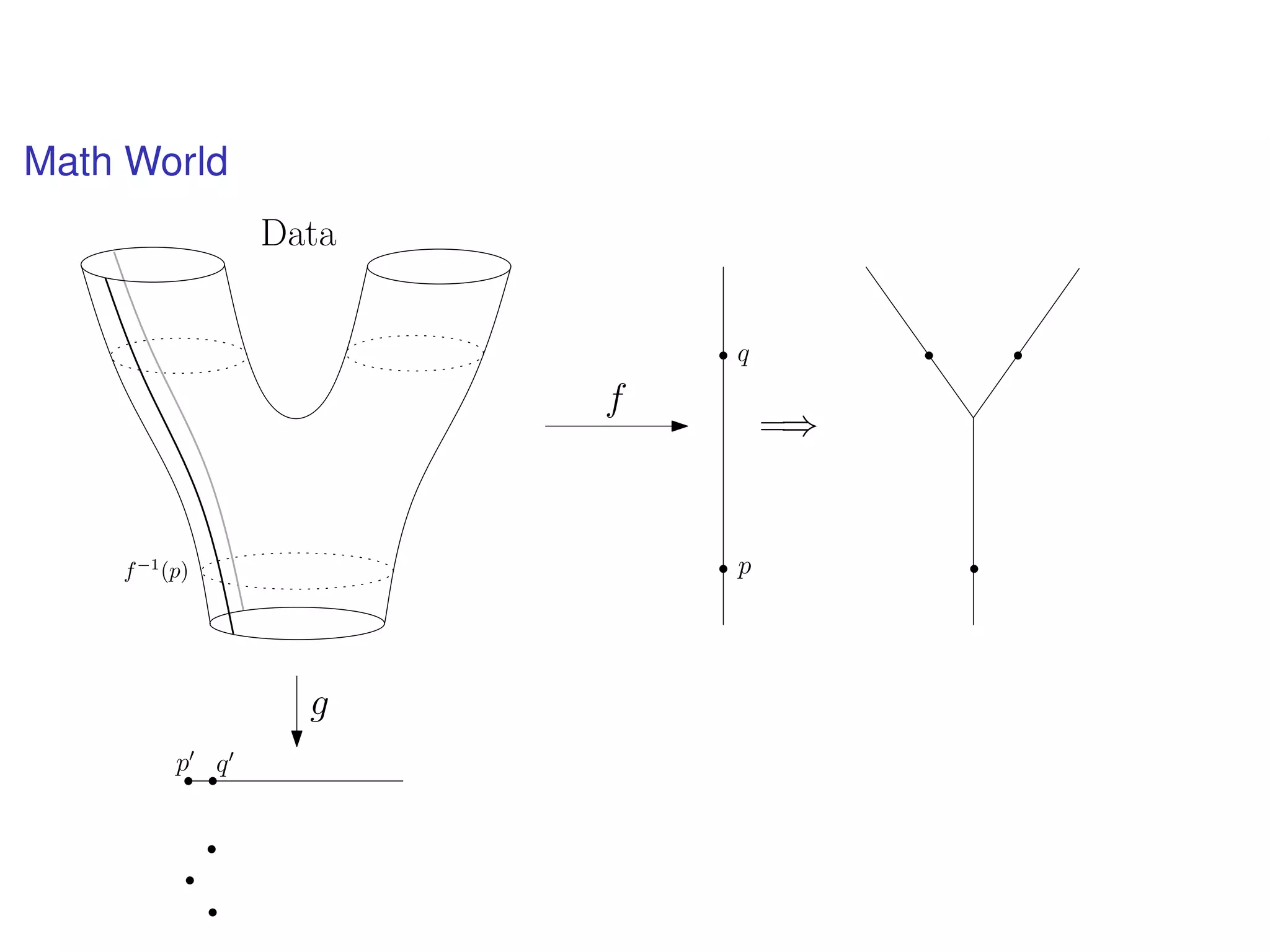
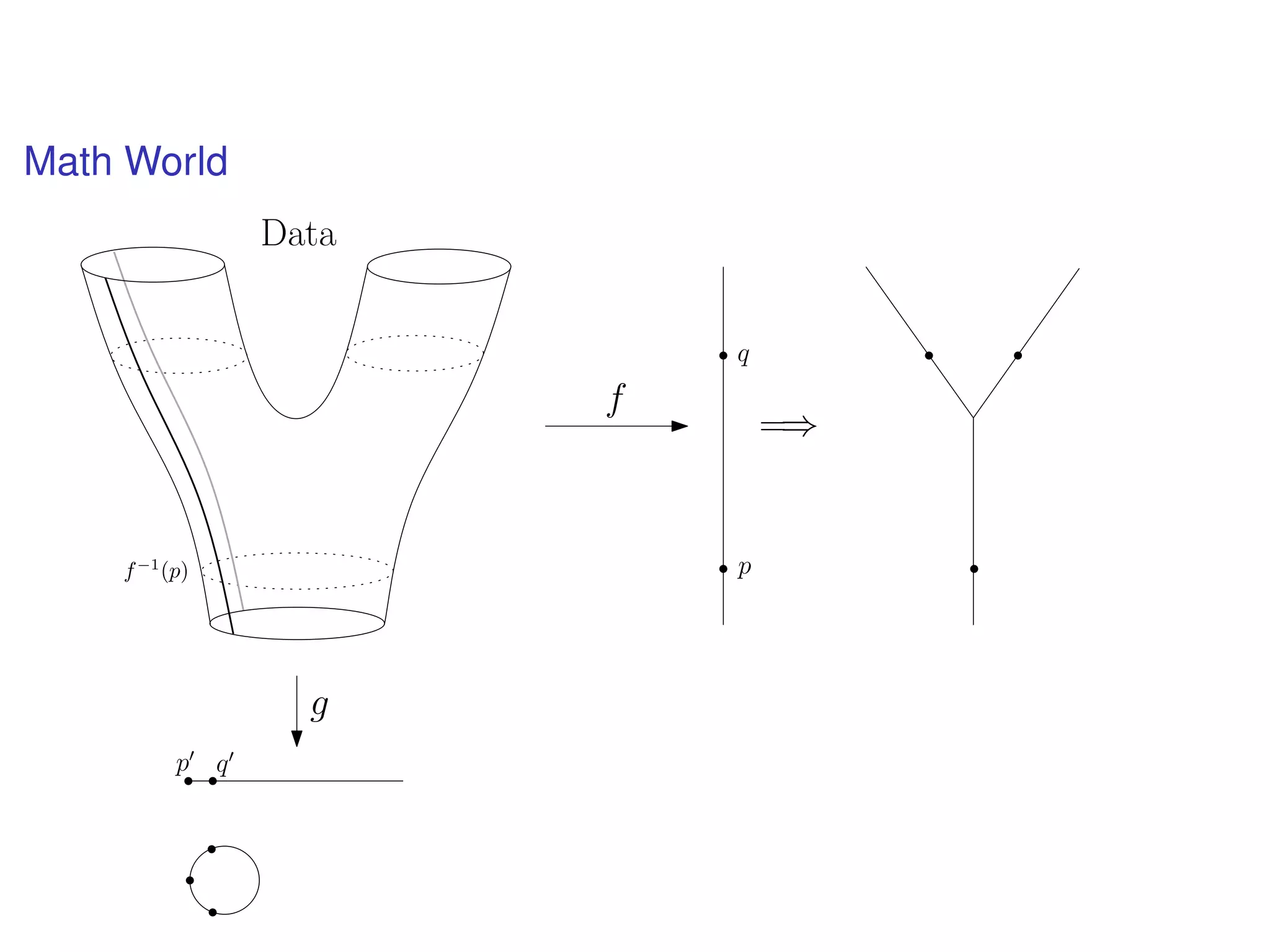
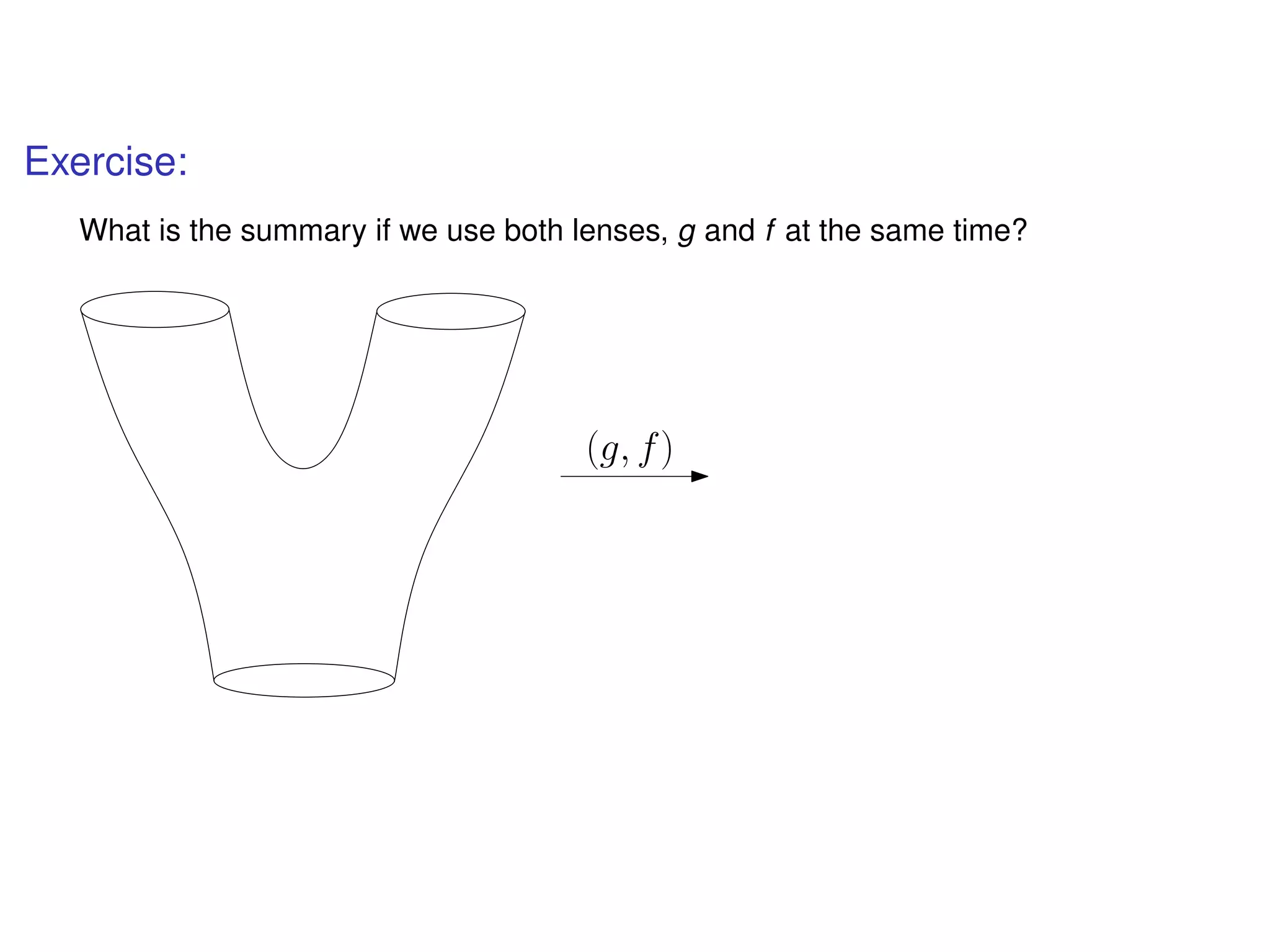
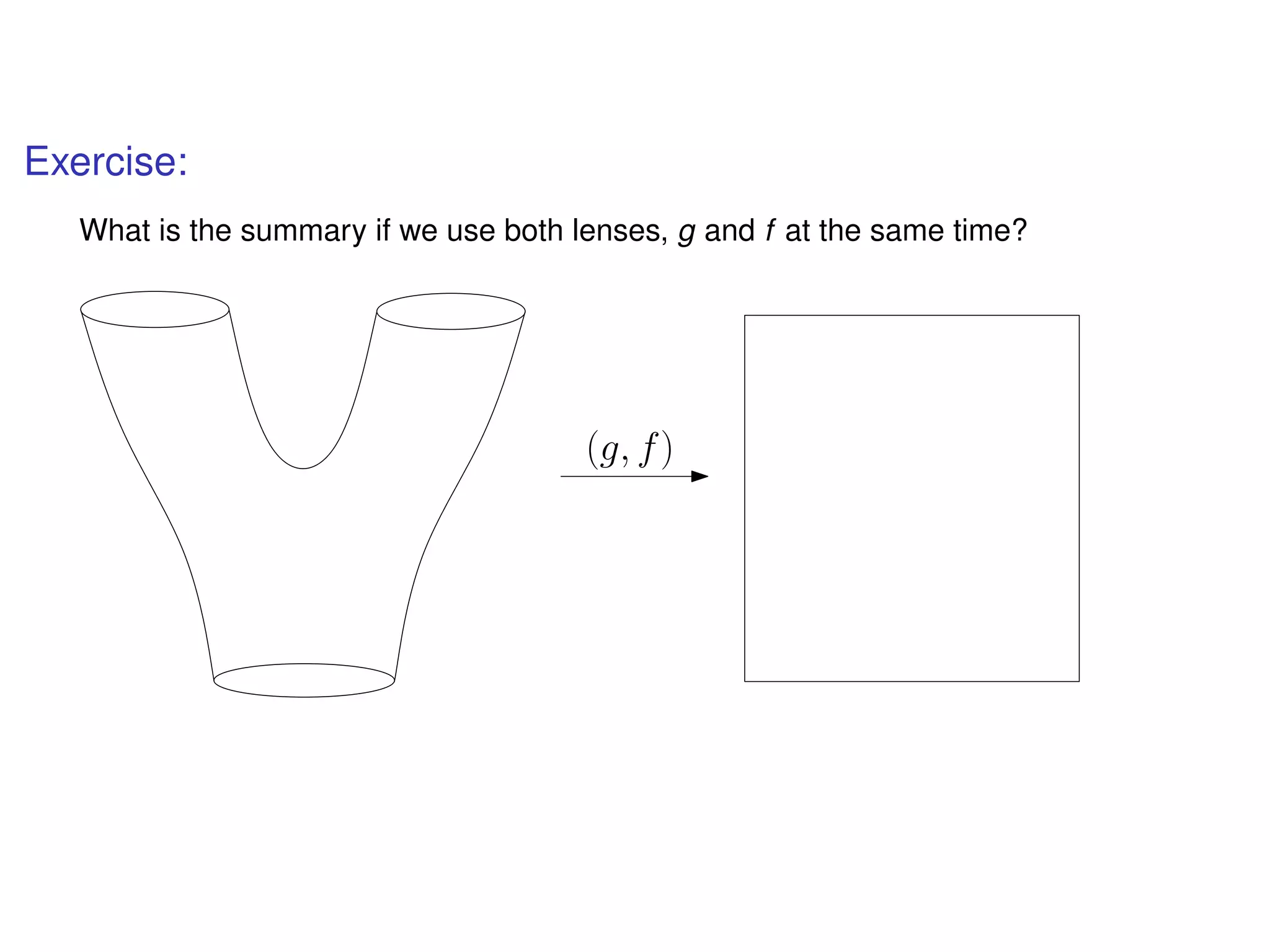
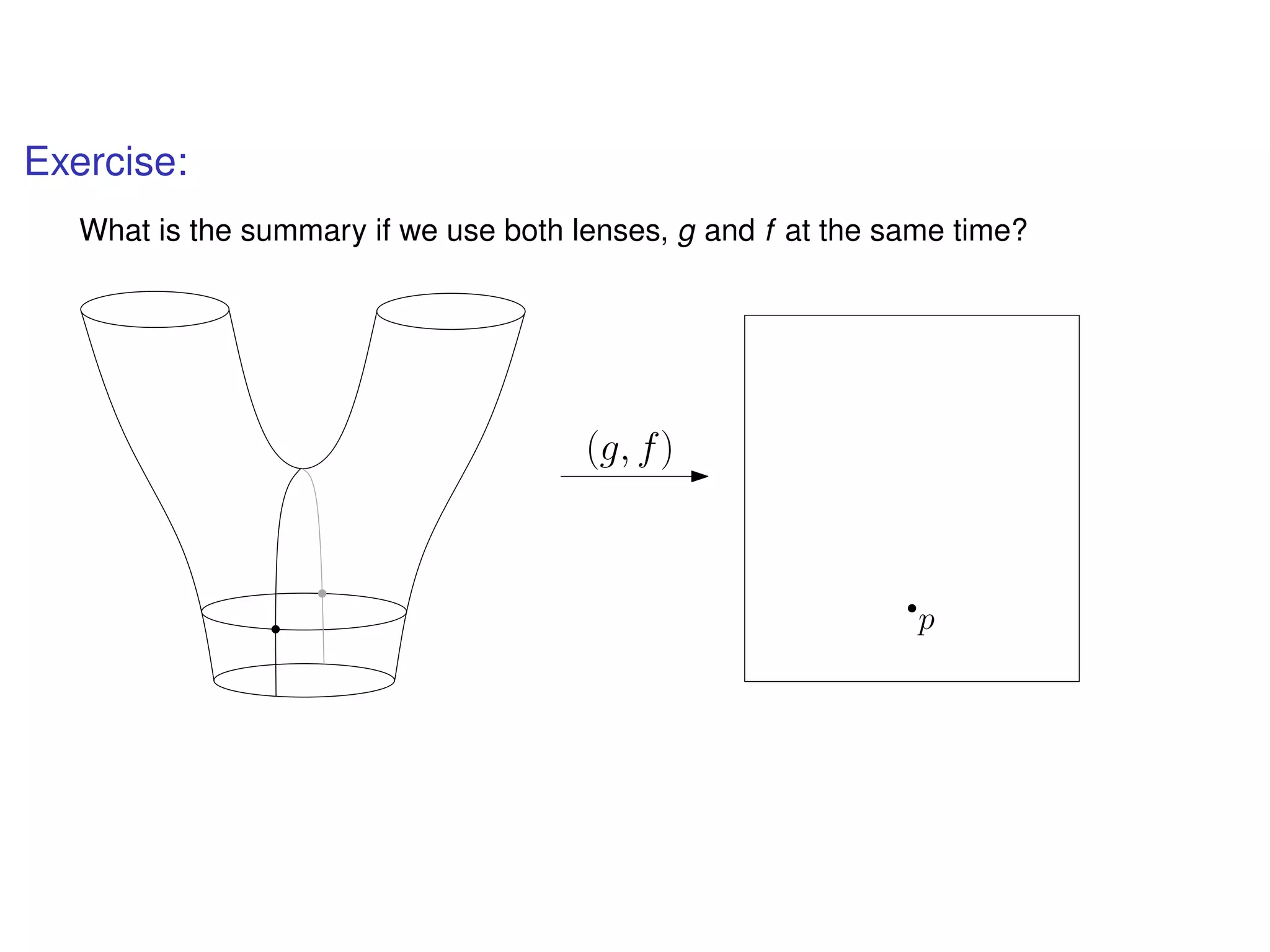
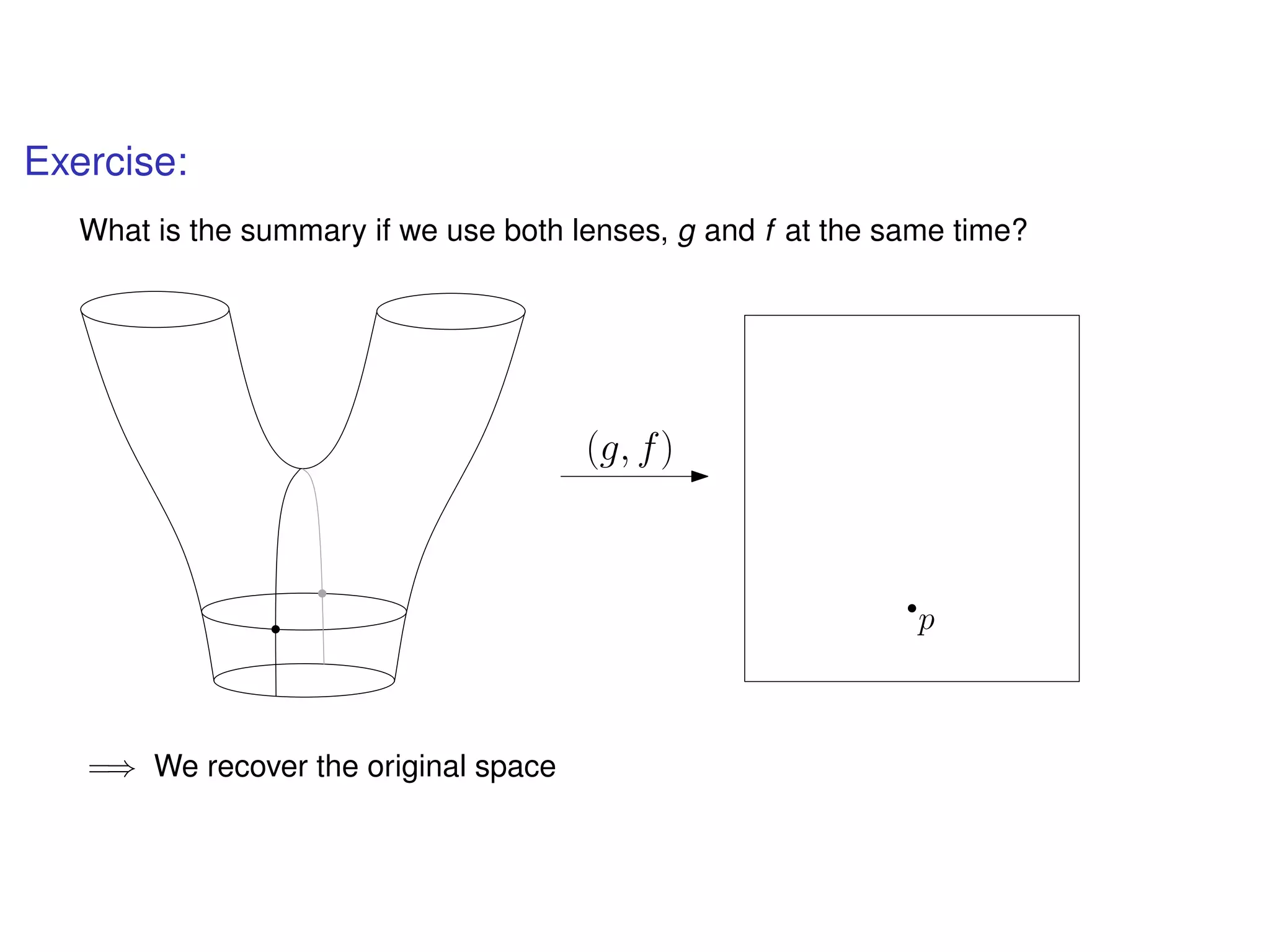
Exercise:
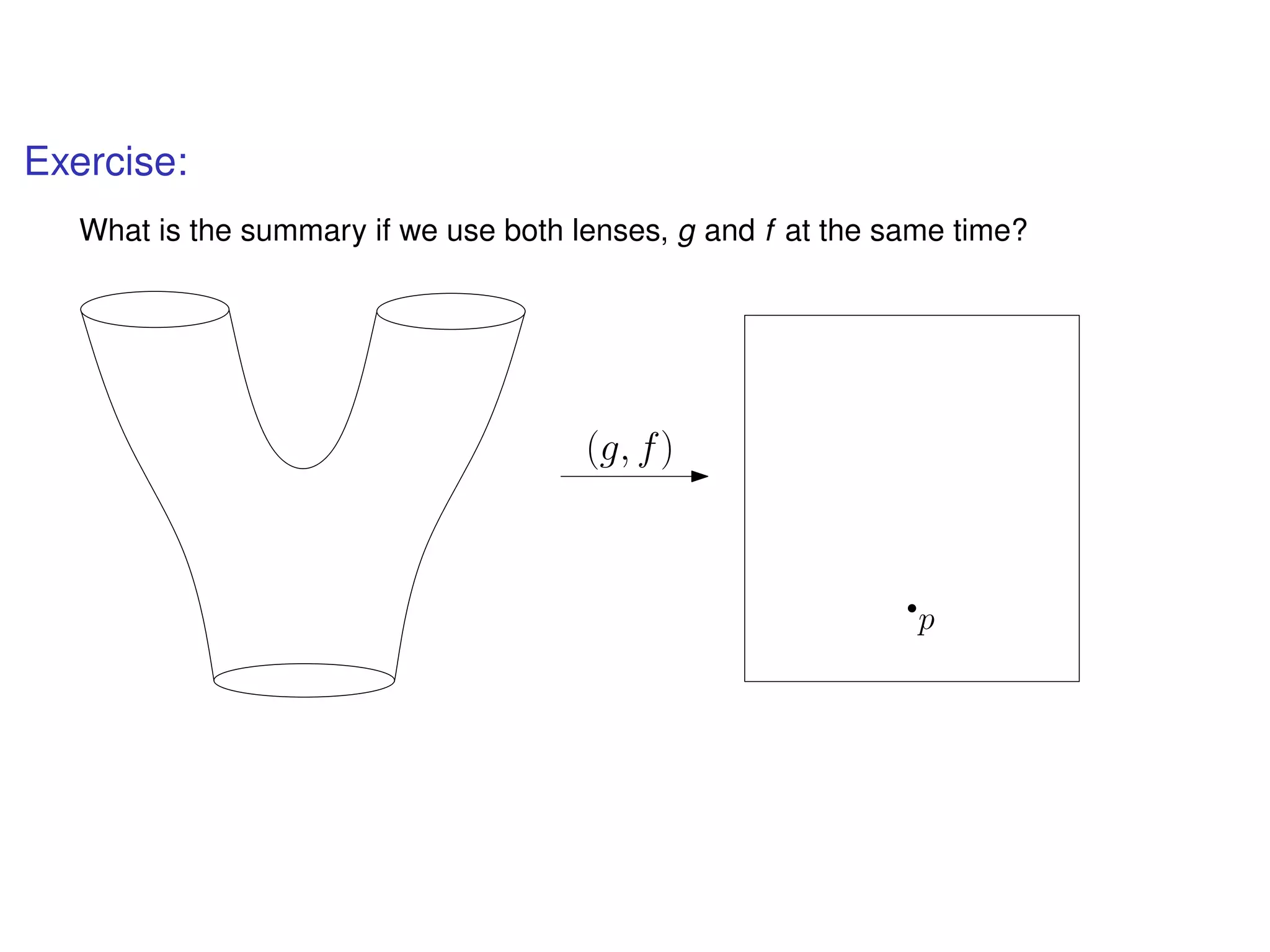
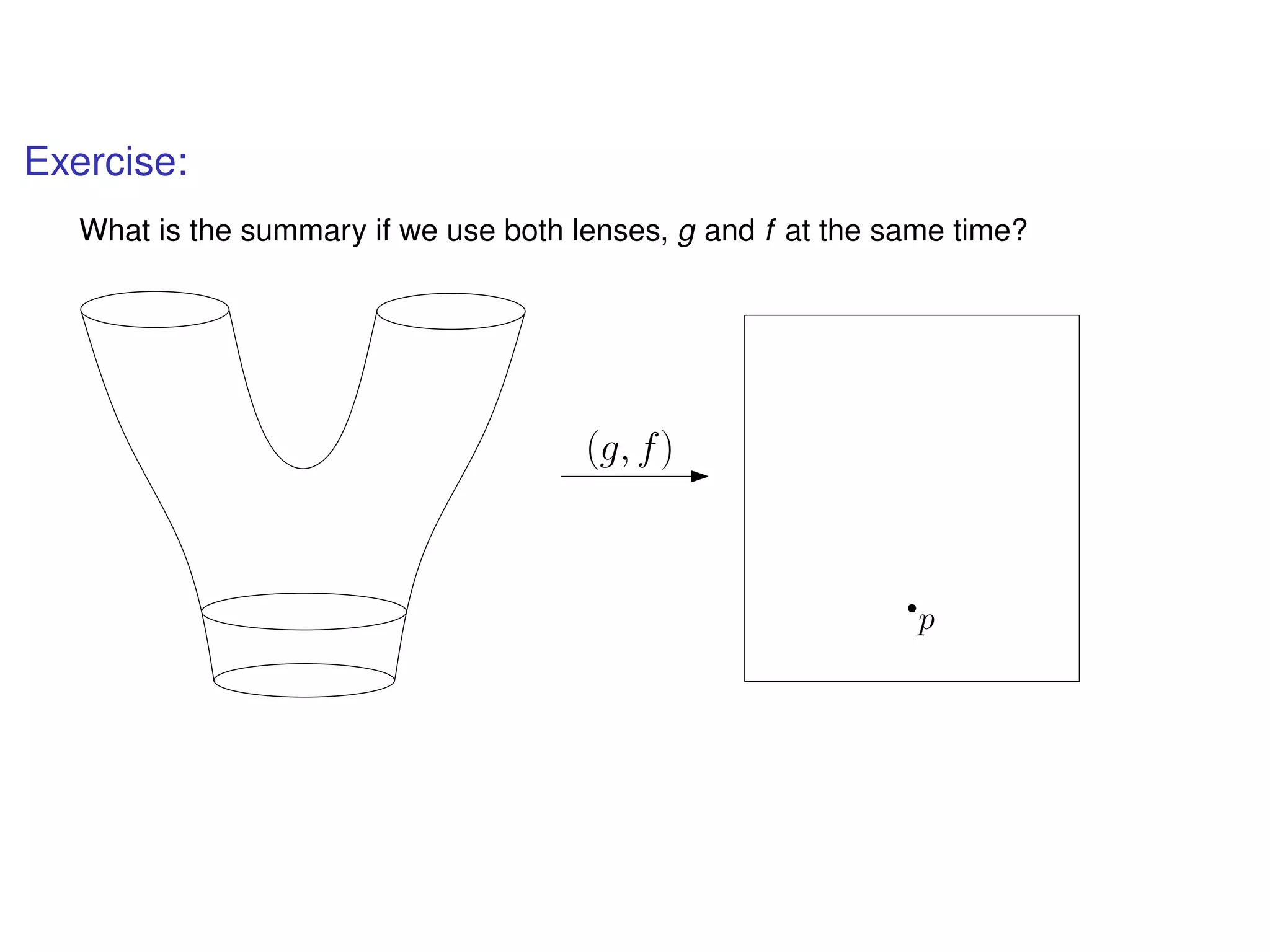
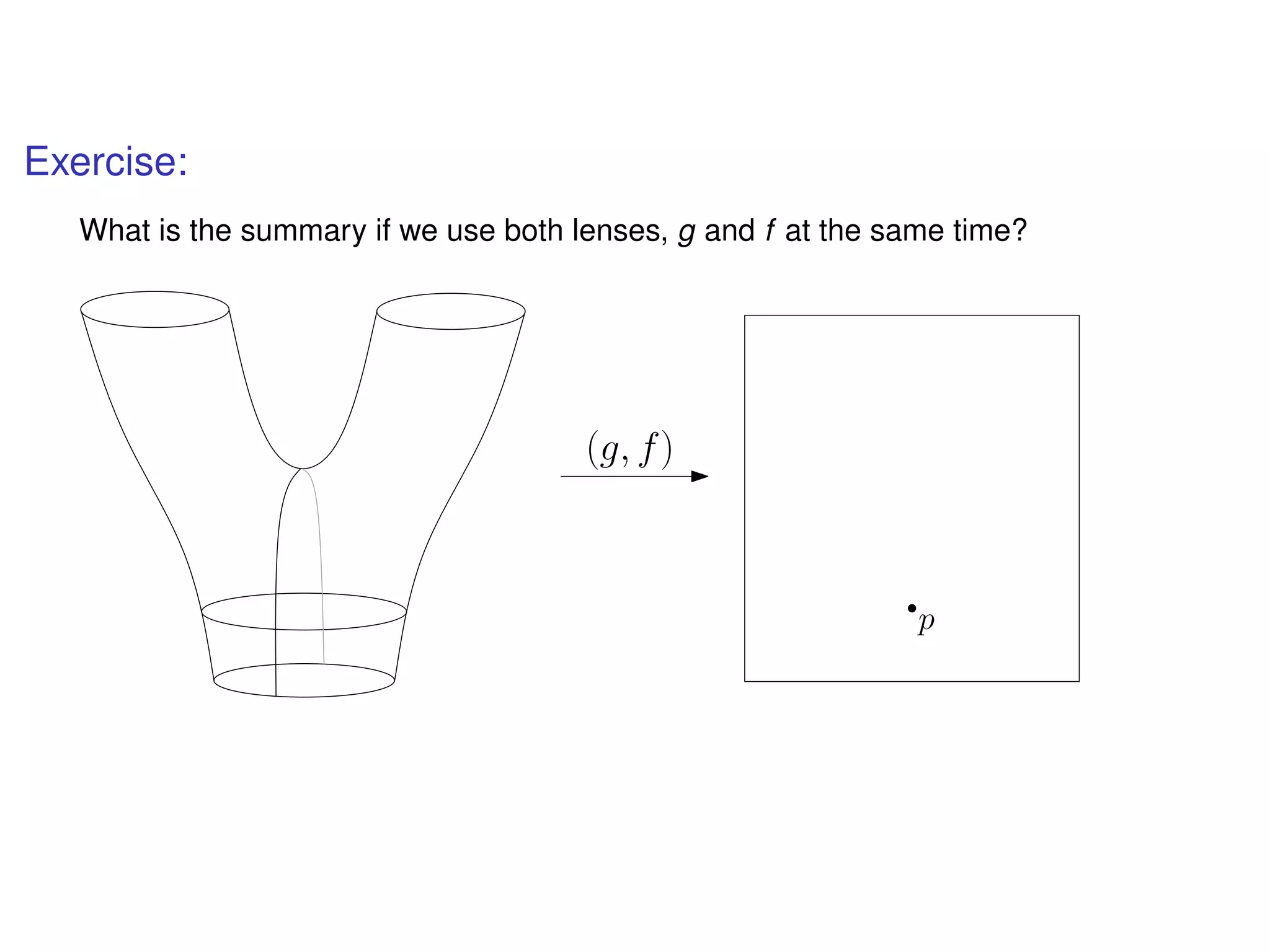
What is the summary if we use both lenses, g and f at the same time?
(g, f)
Exercise:
What is the summary if we use both lenses, g and f at the same time?
(g, f)
Exercise:
What is the summary if we use both lenses, g and f at the same time?
(g, f)
p
Exercise:
What is the summary if we use both lenses, g and f at the same time?
(g, f)
p
Exercise:
What is the summary if we use both lenses, g and f at the same time?
(g, f)
p
Exercise:
What is the summary if we use both lenses, g and f at the same time?
(g, f)
p
Exercise:
What is the summary if we use both lenses, g and f at the same time?
(g, f)
p
=⇒ We recover the original space
What did the exercise tell us?
With a rich enough set of functions (lenses) we can recover the original space
What did the exercise tell us?
With a rich enough set of functions (lenses) we can recover the original space
Of course this leaves us no better off then where we started.
What did the exercise tell us?
With a rich enough set of functions (lenses) we can recover the original space
Of course this leaves us no better off then where we started.
⇒ Instead we select a set of functions to tune in to the signal we want.
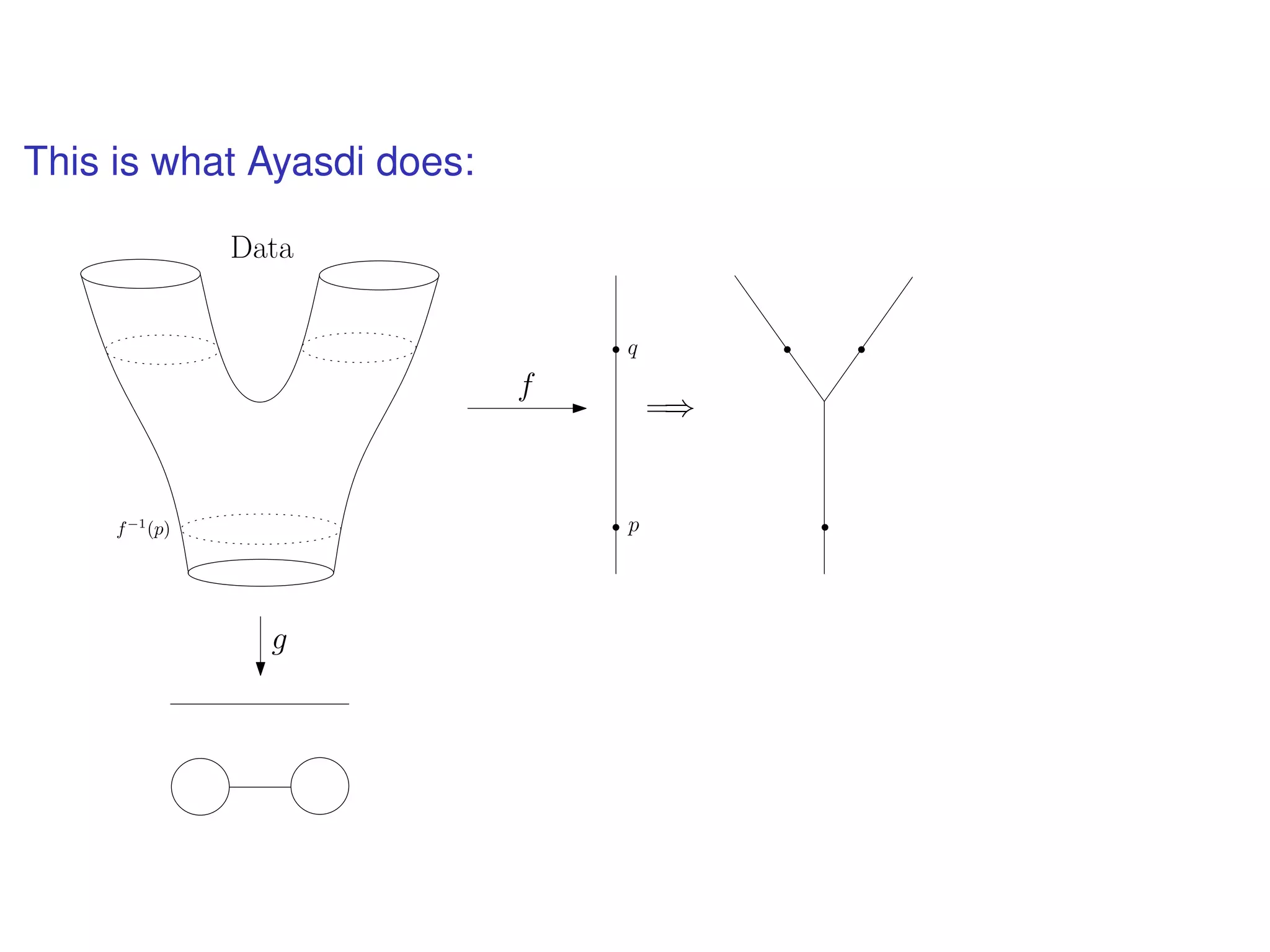
This is what Ayasdi does:
f
pf−1
(p)
=⇒
q
g
Data
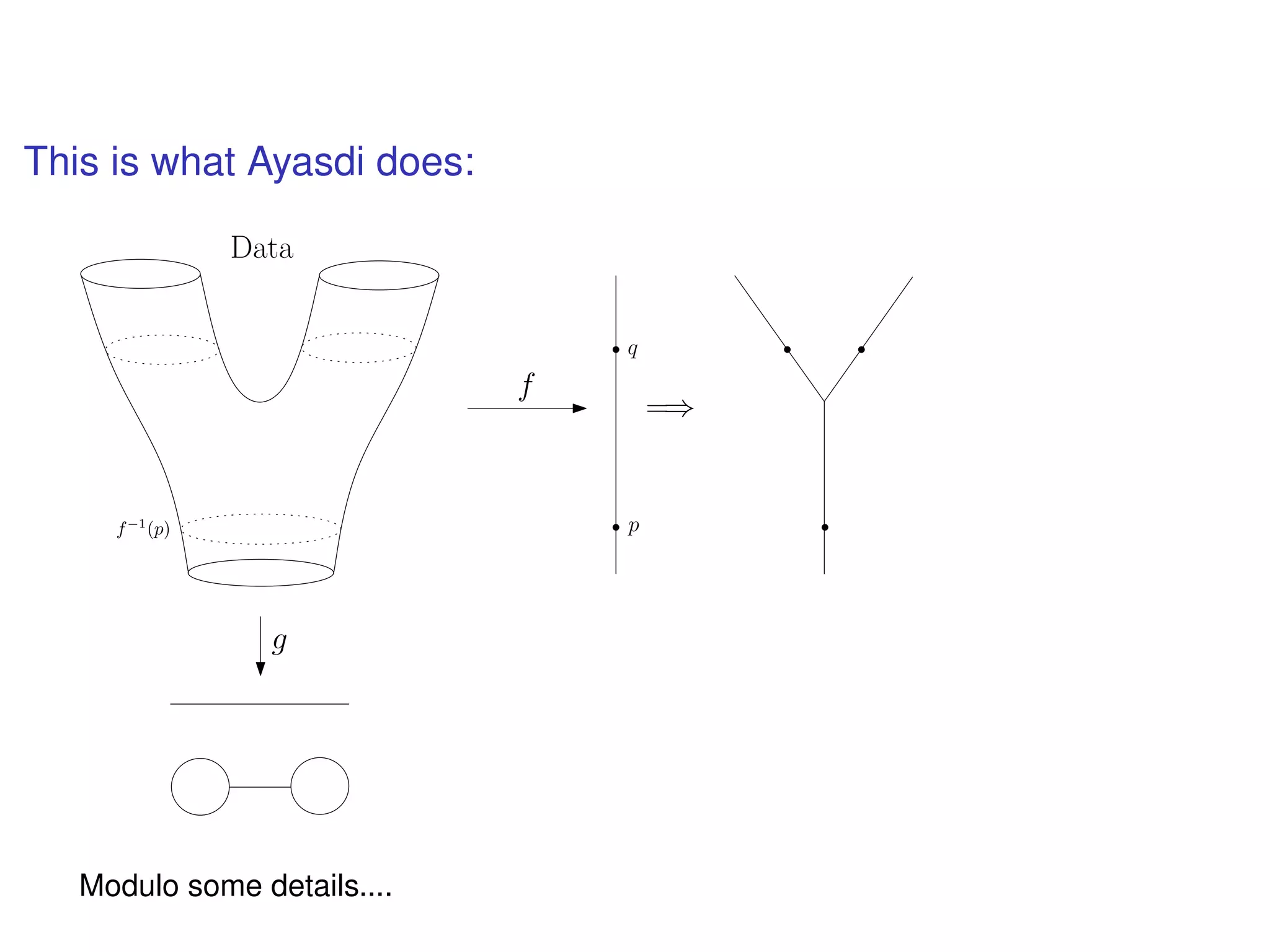
This is what Ayasdi does:
f
pf−1
(p)
=⇒
q
g
Data
Modulo some details....
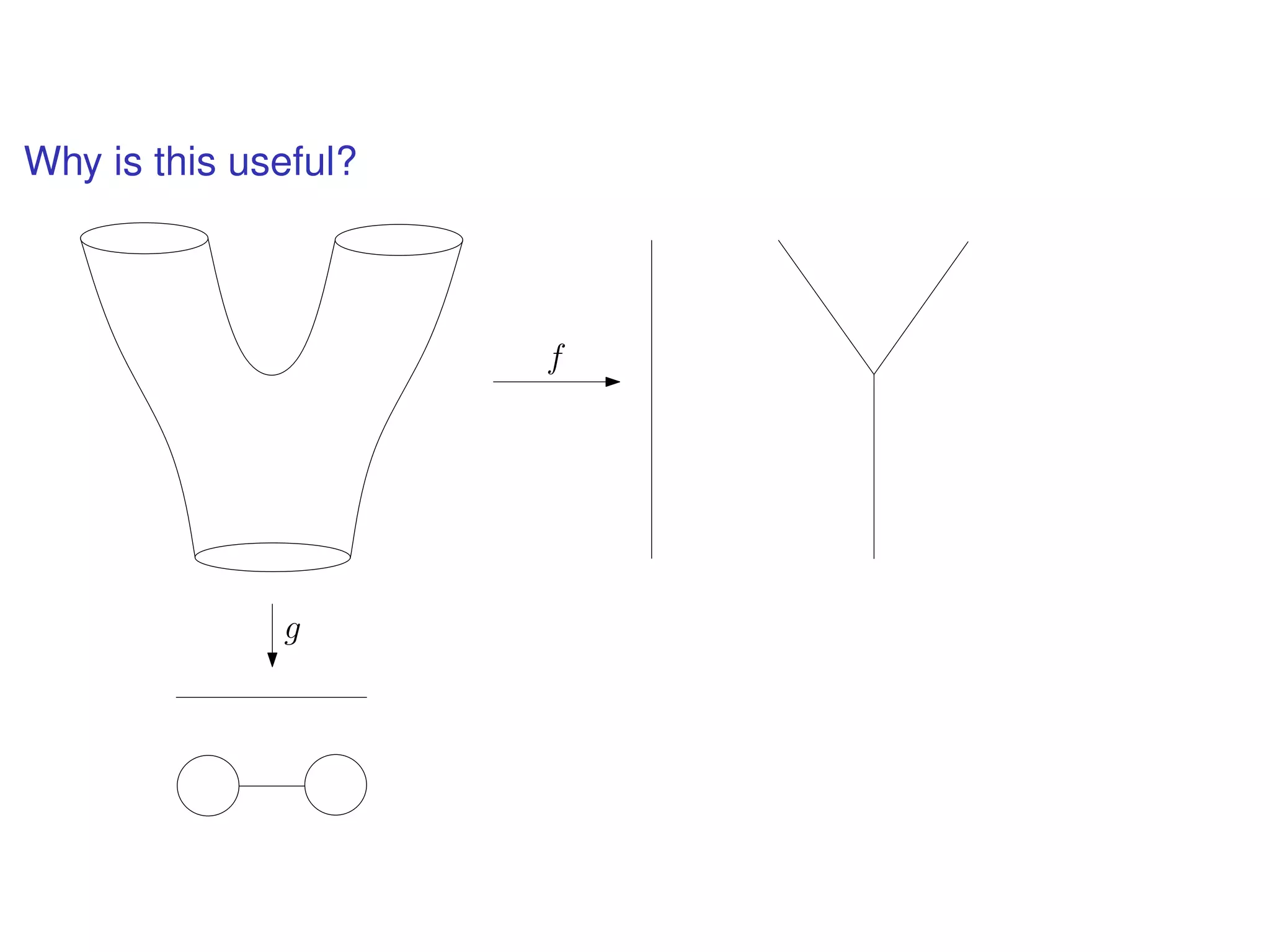
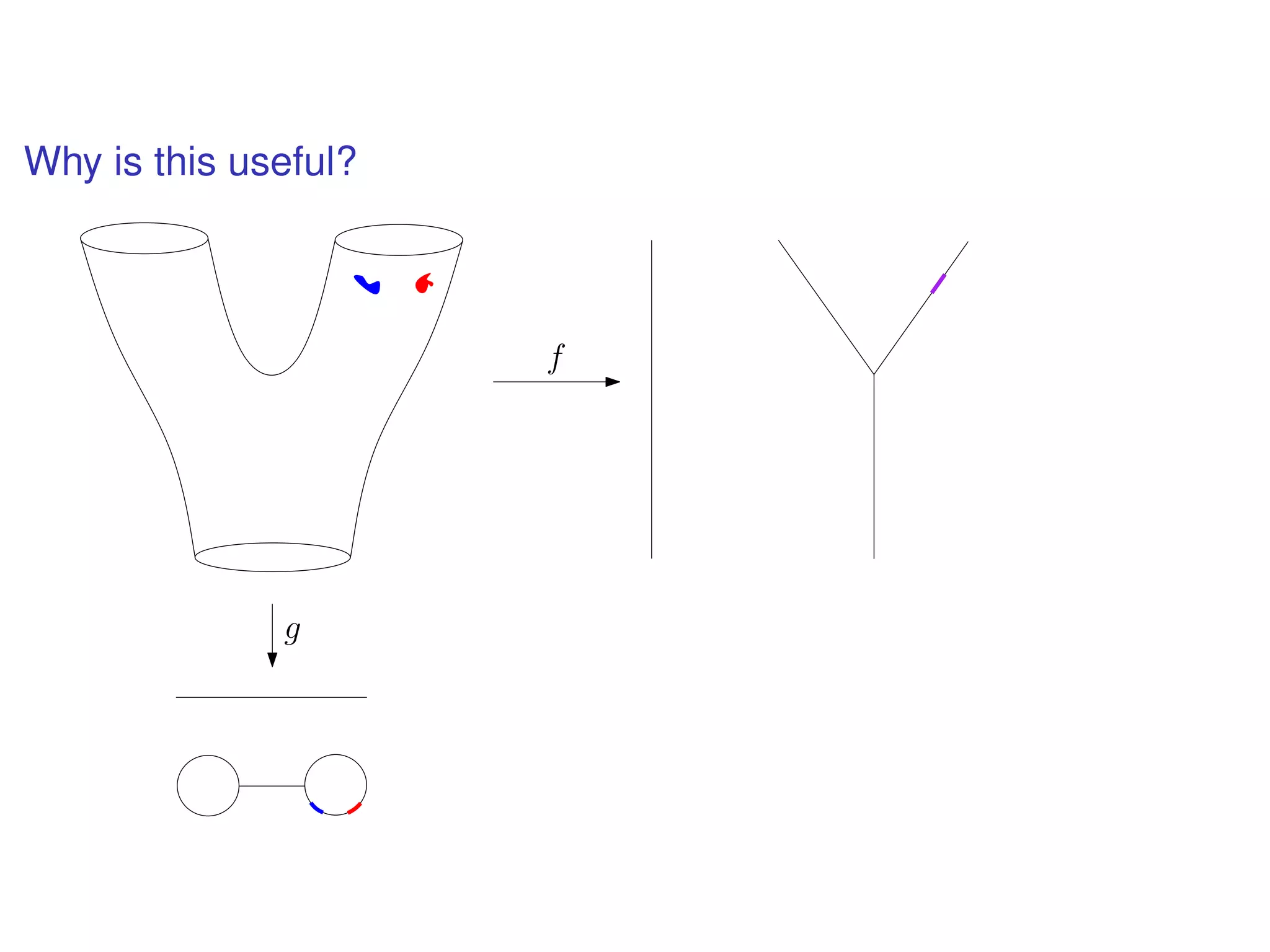
Why is this useful?
Why is this useful?
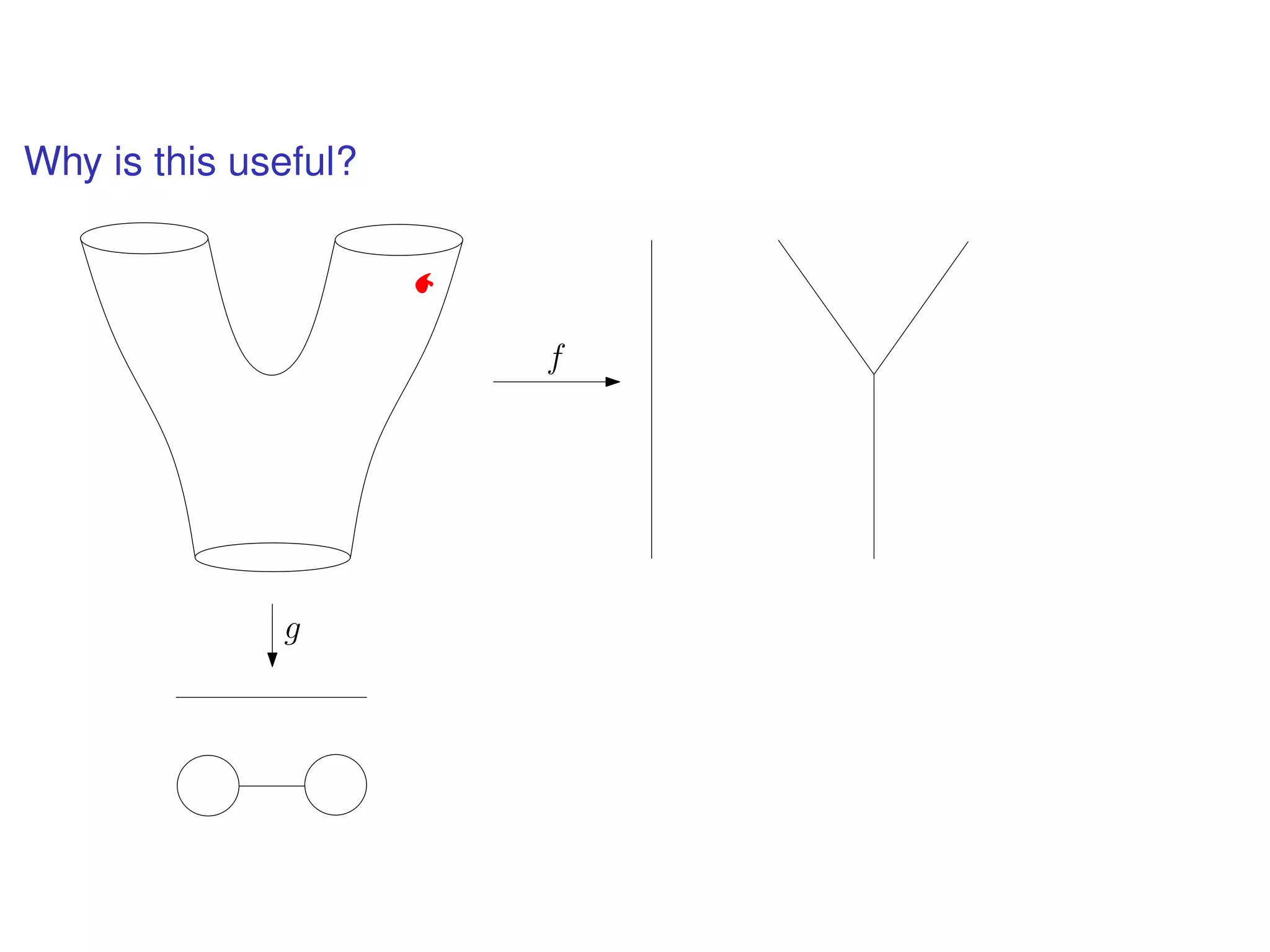
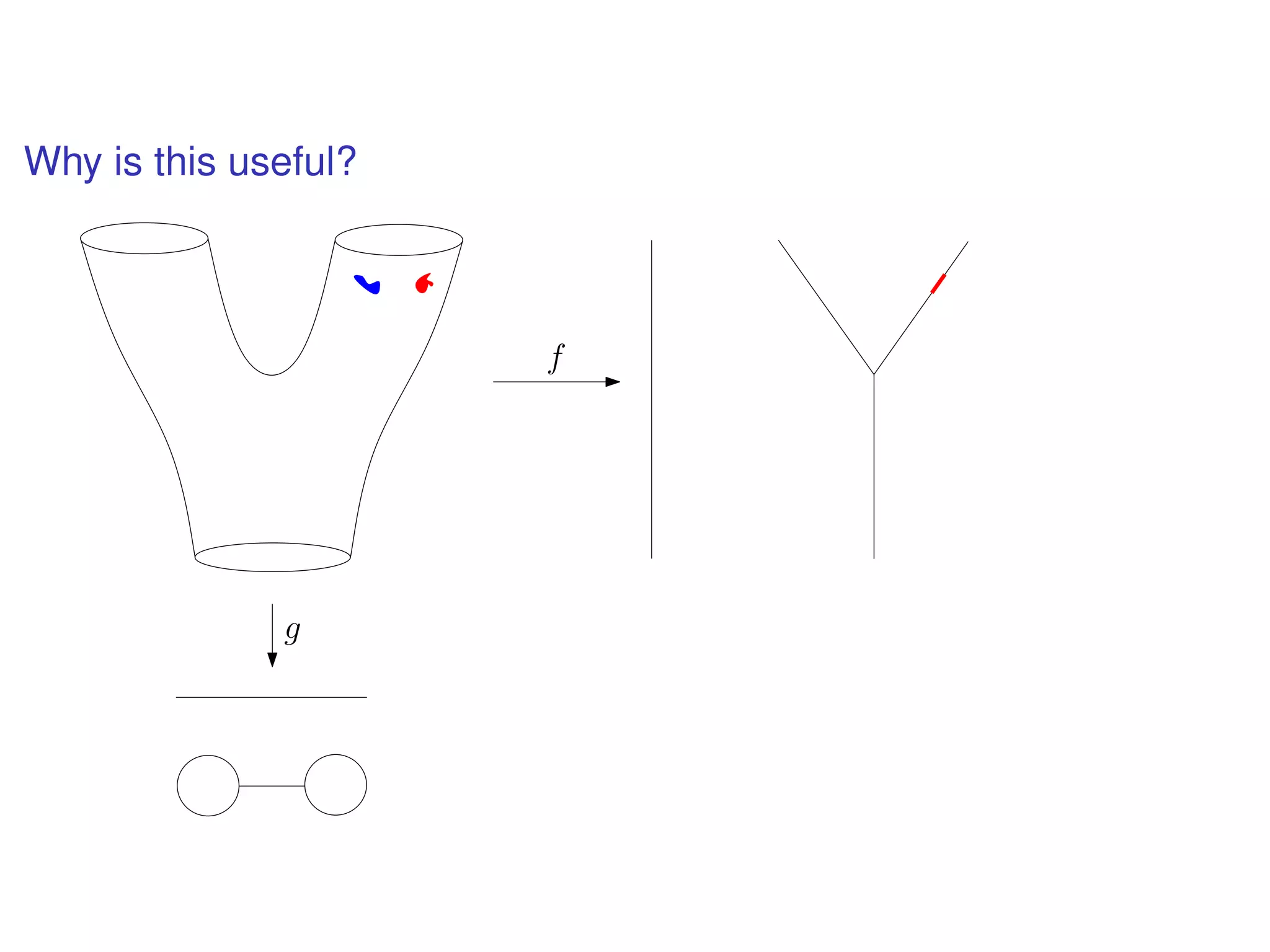
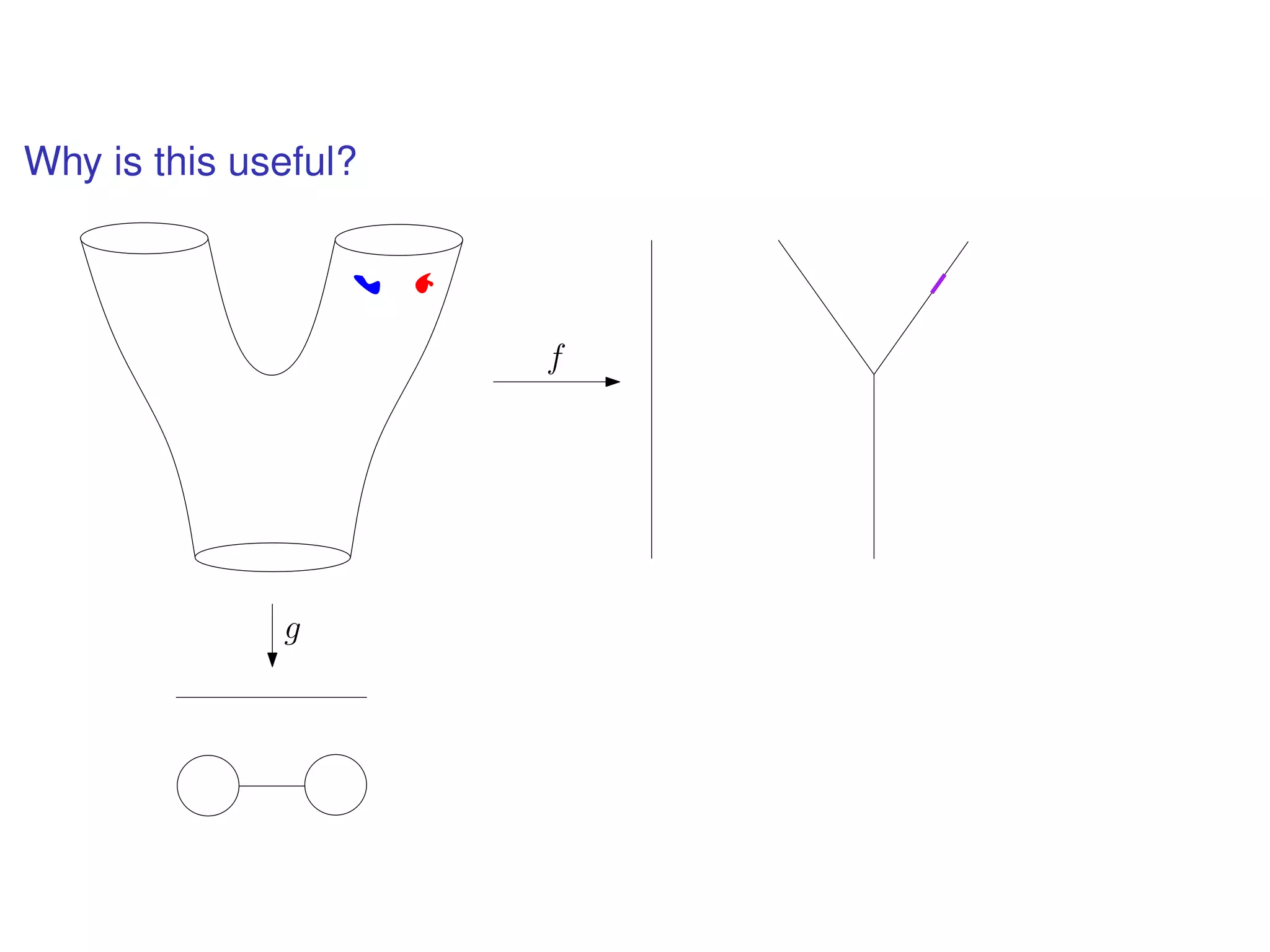
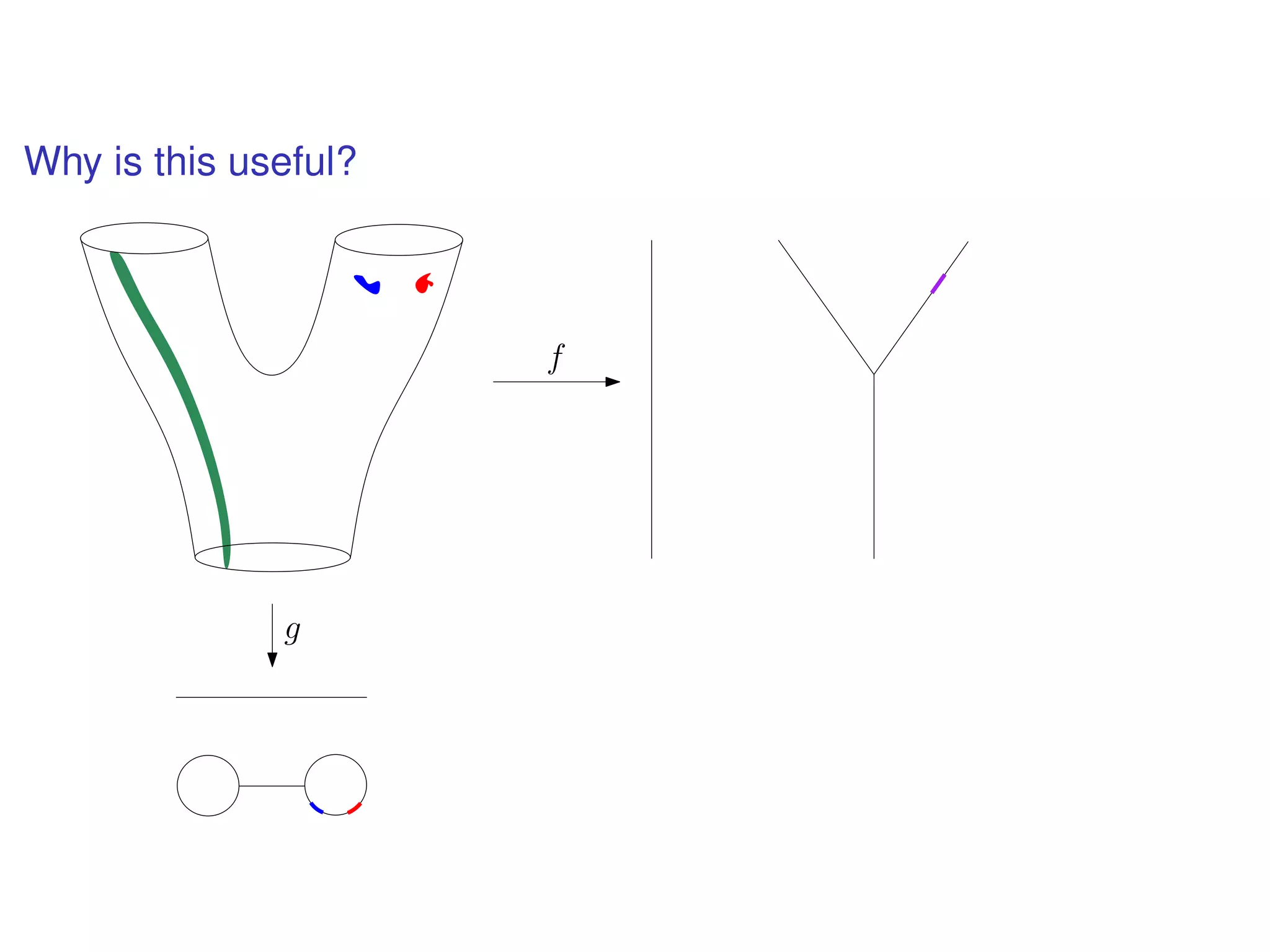
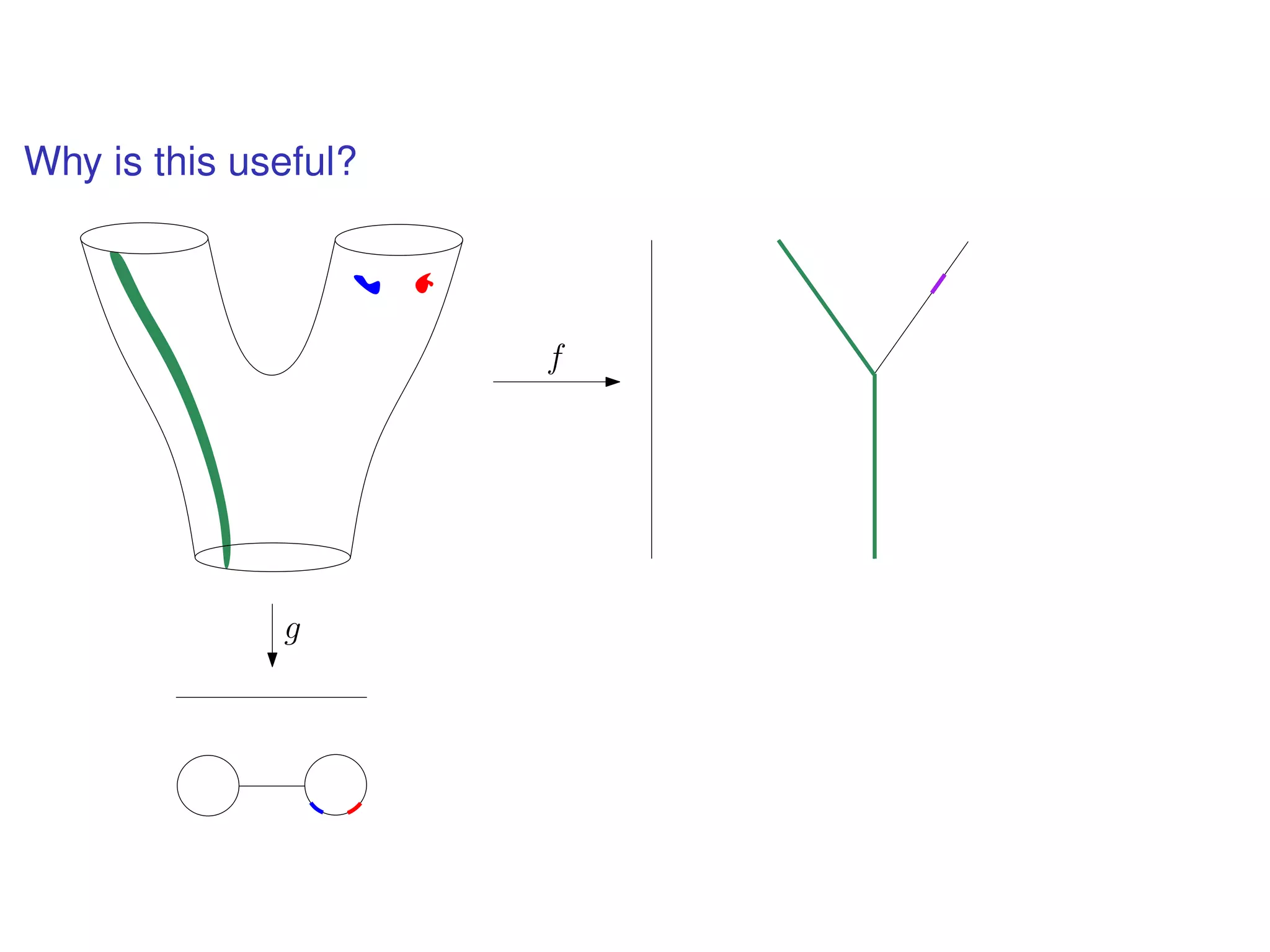
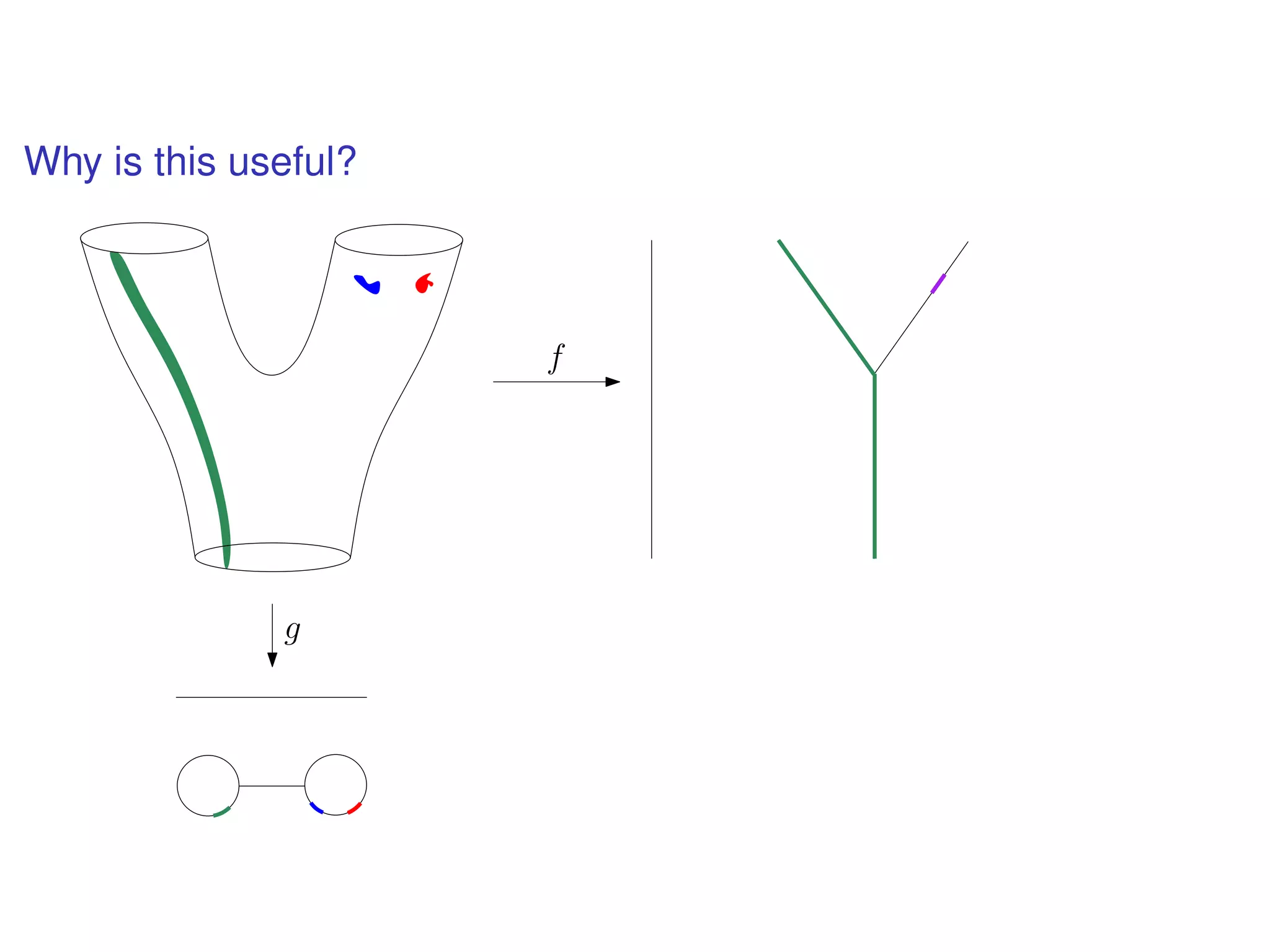
⇒ We get "easy" understanding of the localizations of quantities of interest.
Why is this useful?
f
g
Why is this useful?
f
g
Why is this useful?
f
g
Why is this useful?
f
g
Why is this useful?
f
g
Why is this useful?
f
g
Why is this useful?
f
g
Why is this useful?
f
g
Why is this useful?
f
g
Why is this useful?
Why is this useful?
Lenses inform us where in the space to look for phenomena.
Why is this useful?
Lenses inform us where in the space to look for phenomena.
For easy localizations many different lenses will be informative.
Why is this useful?
Lenses inform us where in the space to look for phenomena.
For easy localizations many different lenses will be informative.
For hard ( = geometrically distributed) localizations we have to be more
careful.
Why is this useful?
Lenses inform us where in the space to look for phenomena.
For easy localizations many different lenses will be informative.
For hard ( = geometrically distributed) localizations we have to be more
careful. But even then, we frequently get incremental knowledge even from a
poorly chosen lens.
Modulo Details....
We want to move from this mathematical model to a data driven setup.
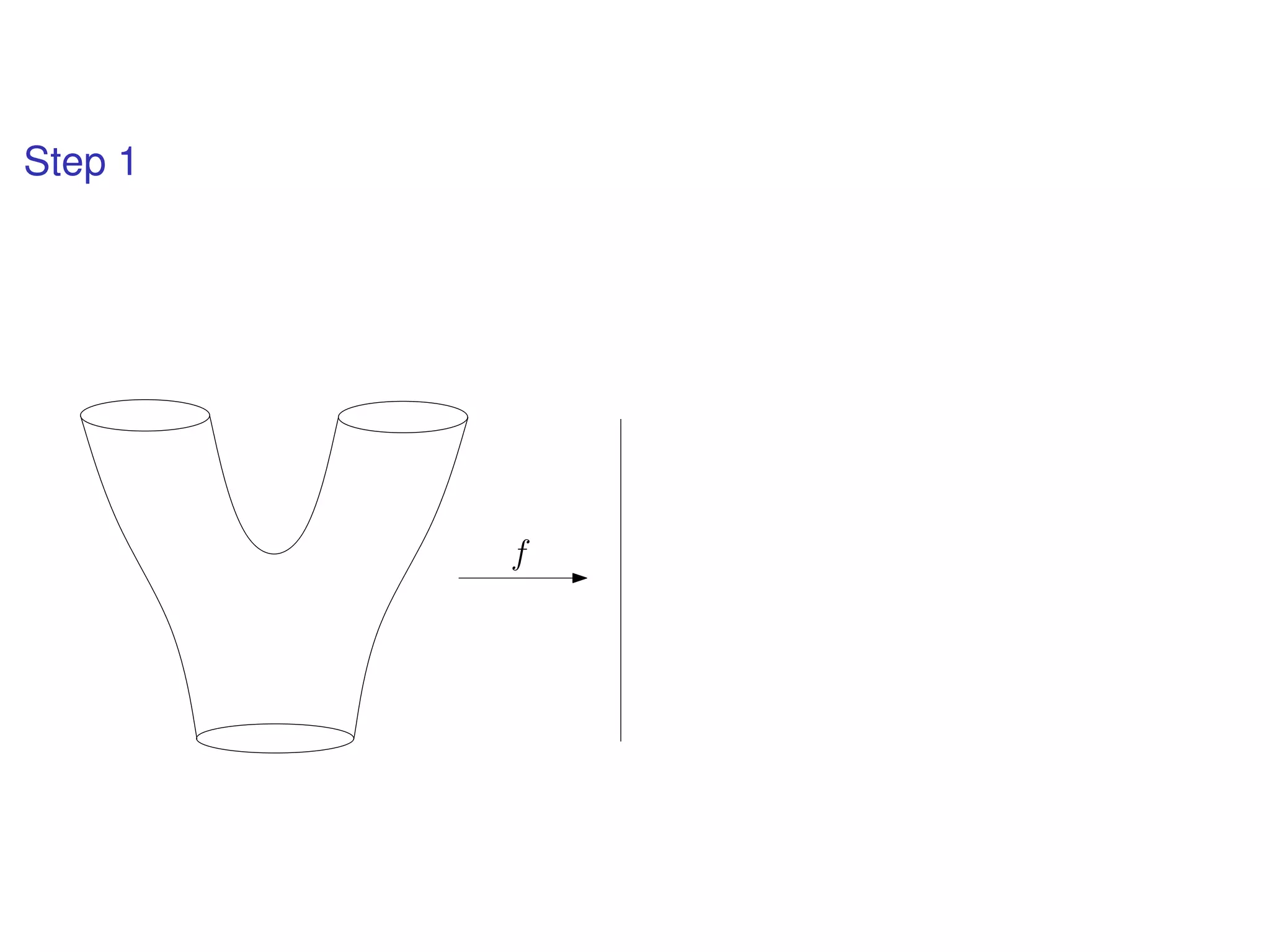
Step 1
f
Step 1
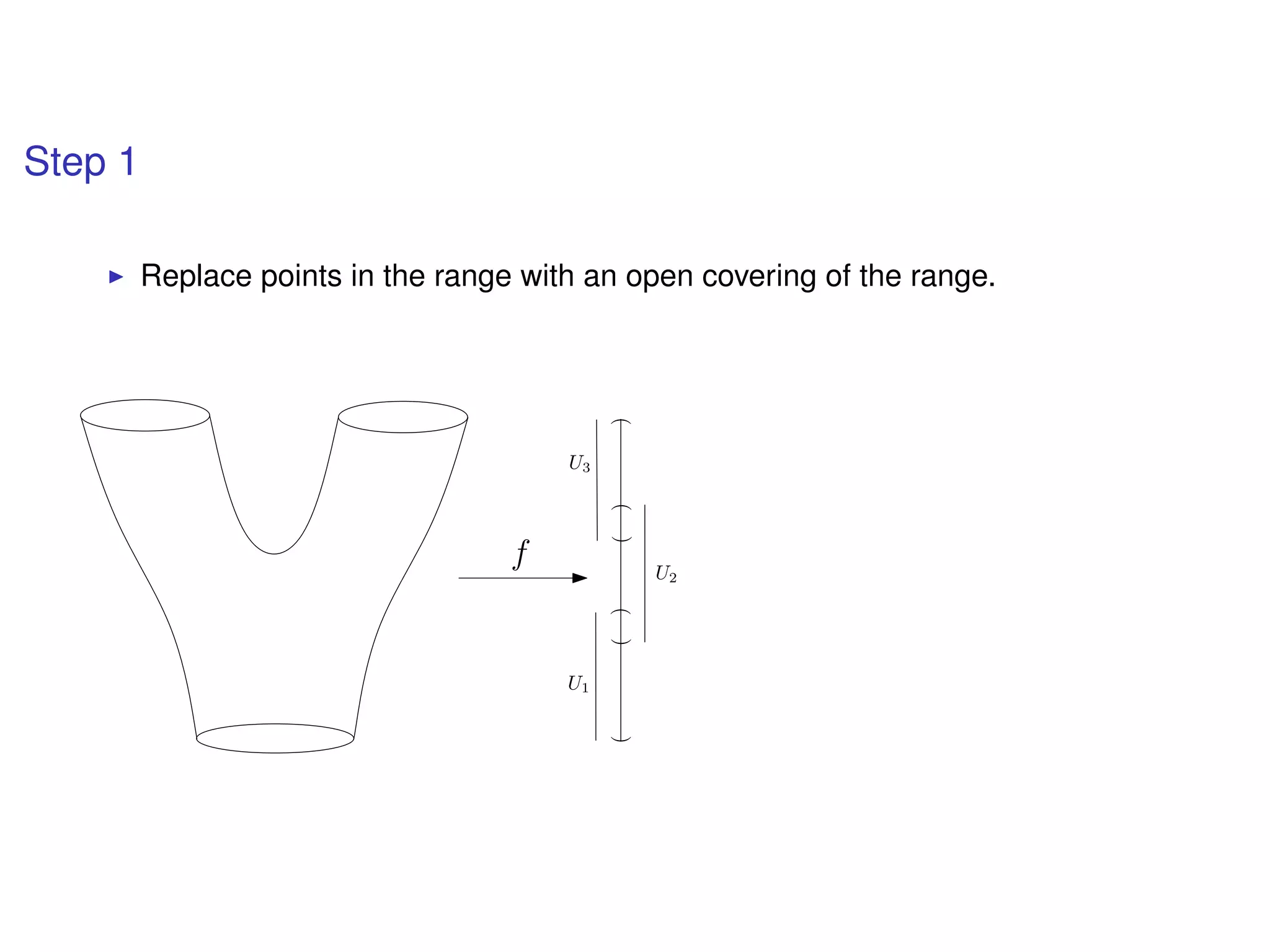
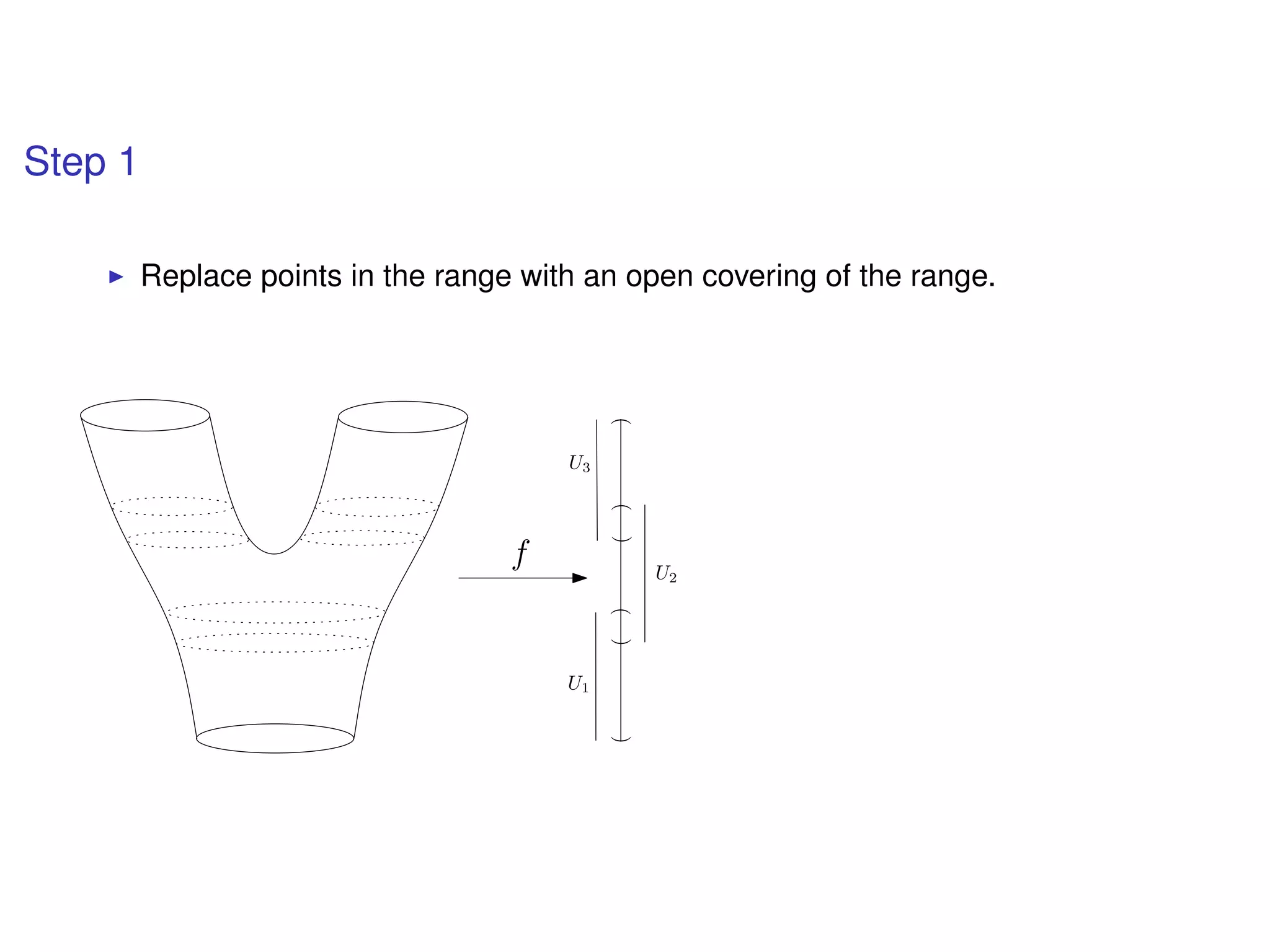
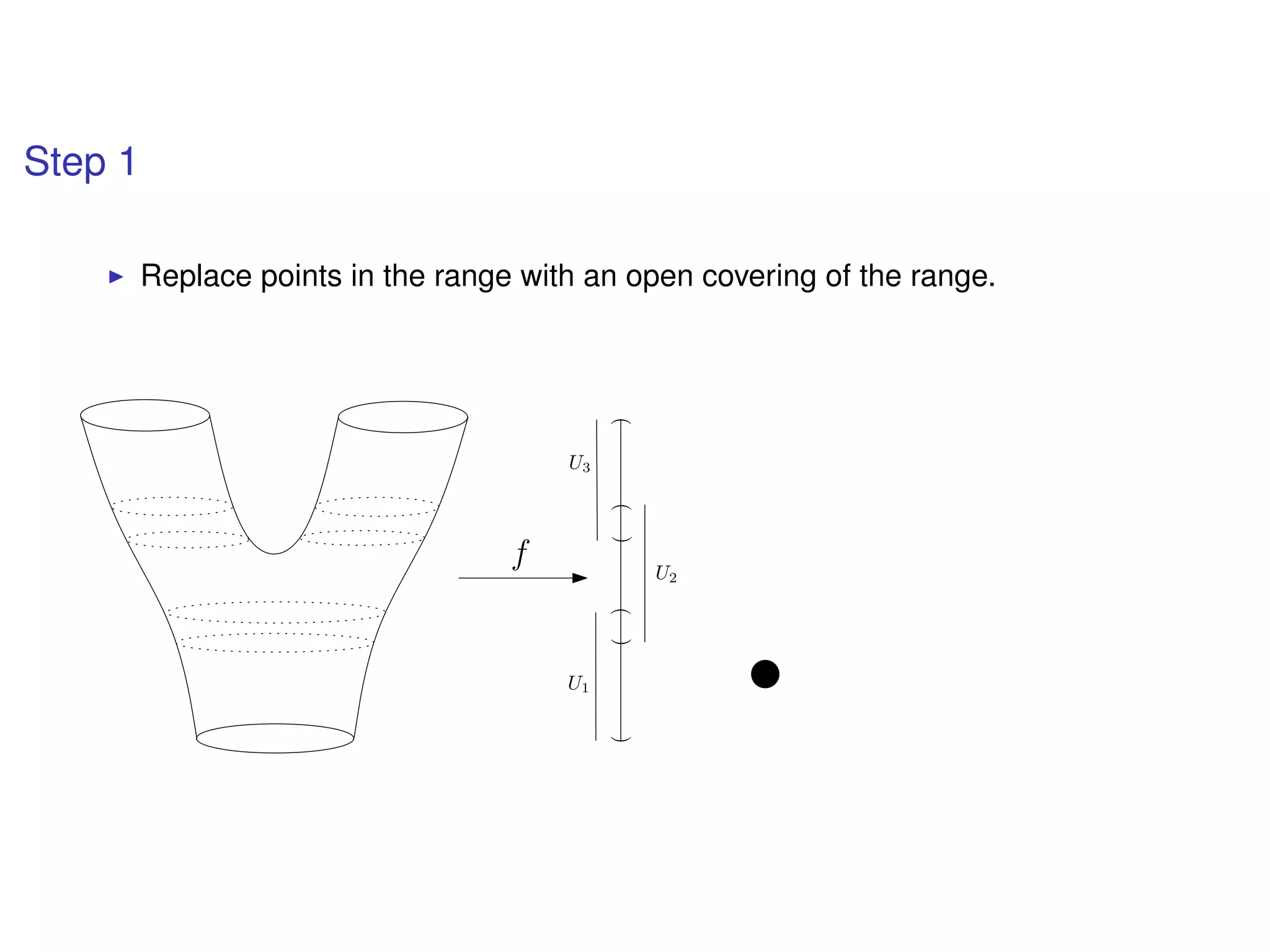
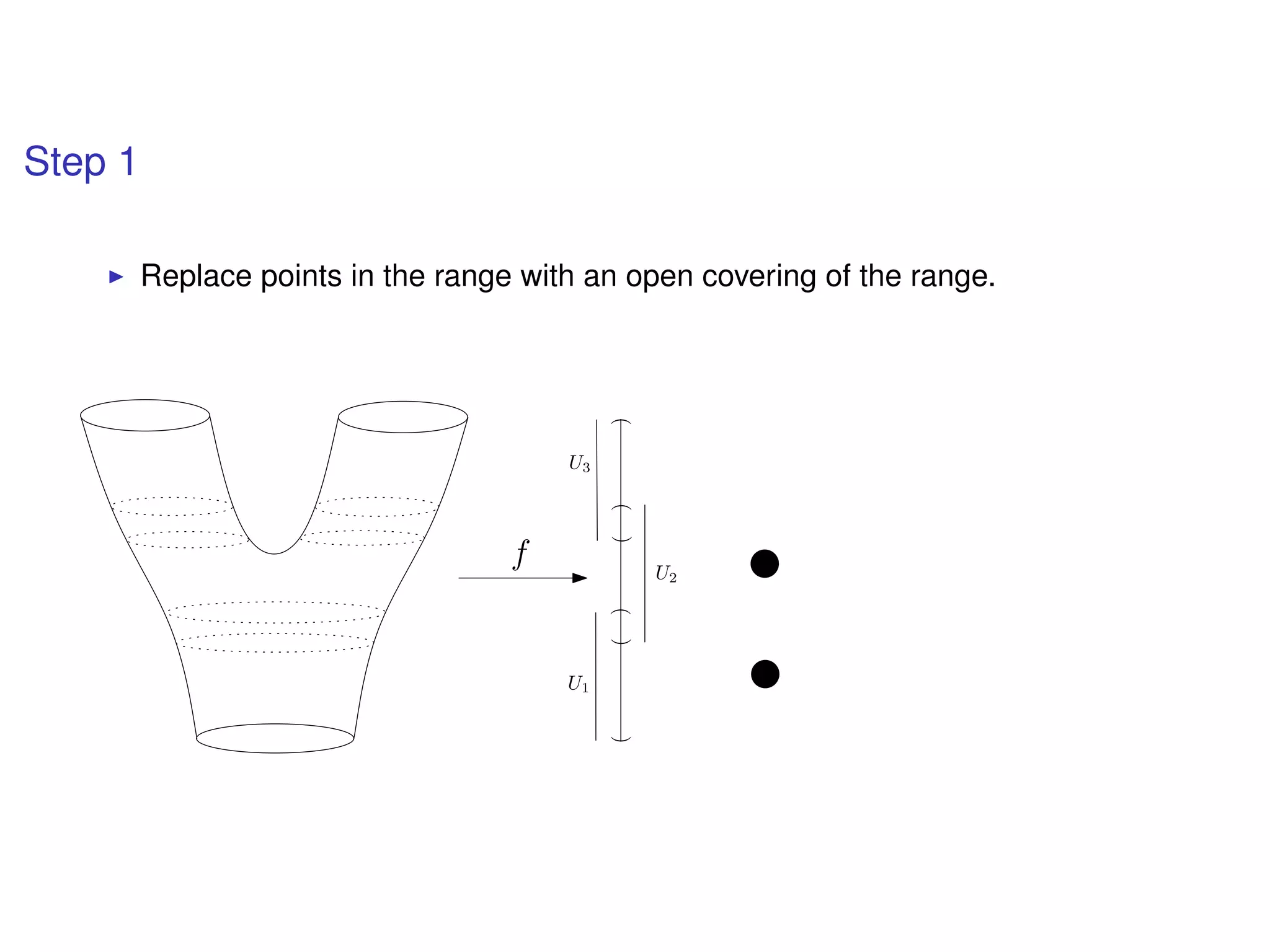
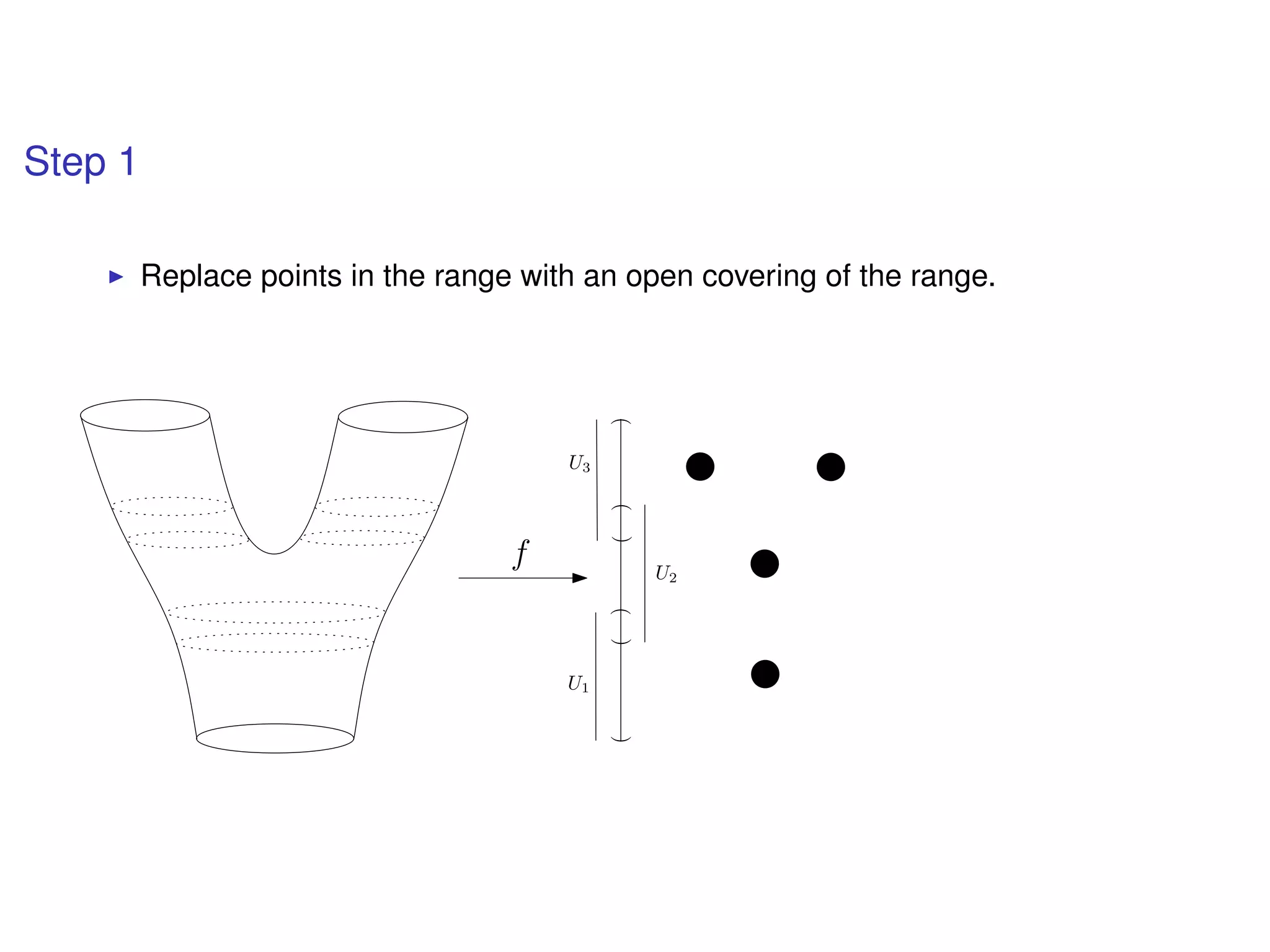
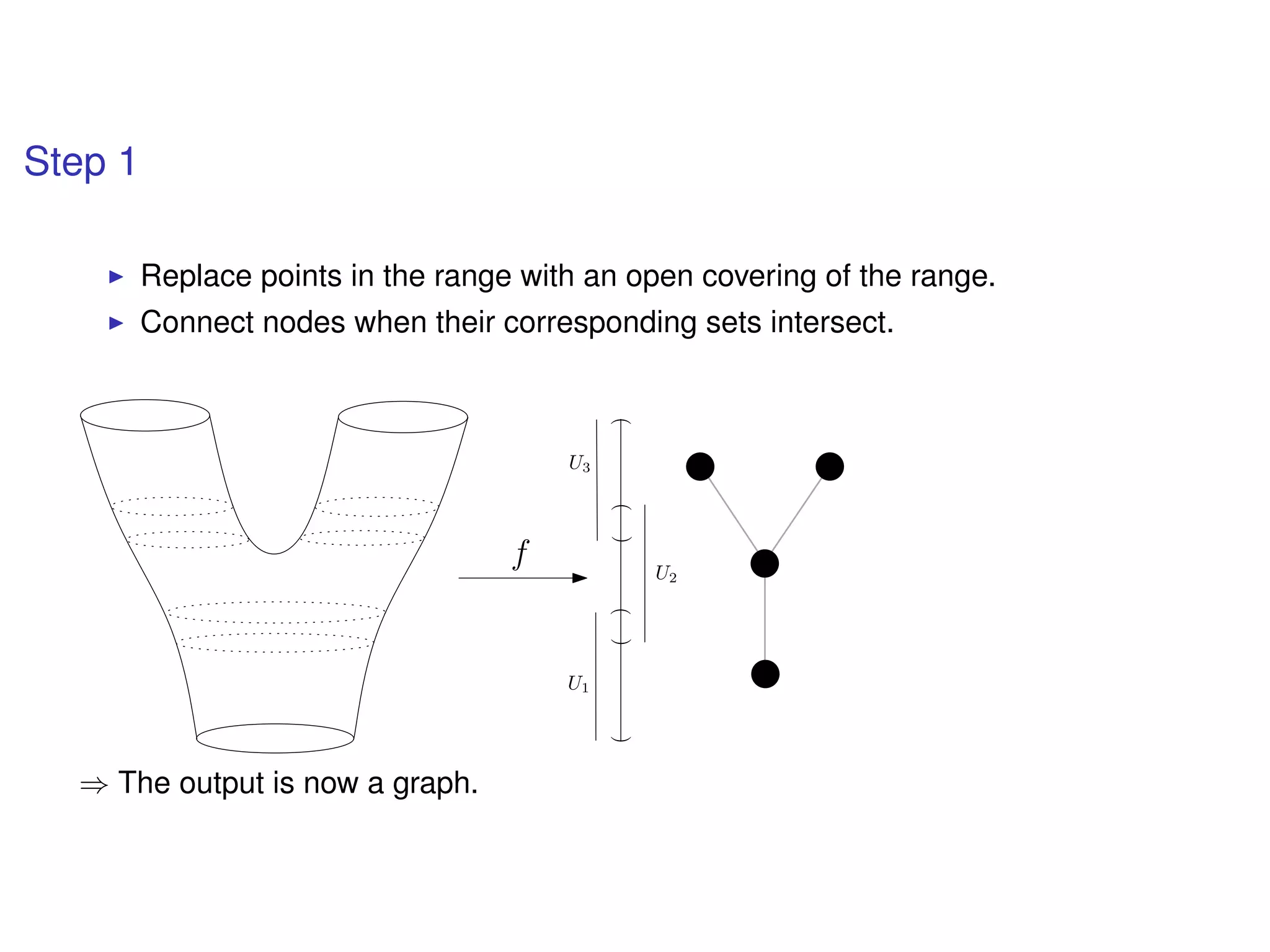
Replace points in the range with an open covering of the range.
f
((()))
U1
U2
U3
Step 1
Replace points in the range with an open covering of the range.
f
((()))
U1
U2
U3
Step 1
Replace points in the range with an open covering of the range.
f
((()))
U1
U2
U3
Step 1
Replace points in the range with an open covering of the range.
f
((()))
U1
U2
U3
Step 1
Replace points in the range with an open covering of the range.
f
((()))
U1
U2
U3
Step 1
Replace points in the range with an open covering of the range.
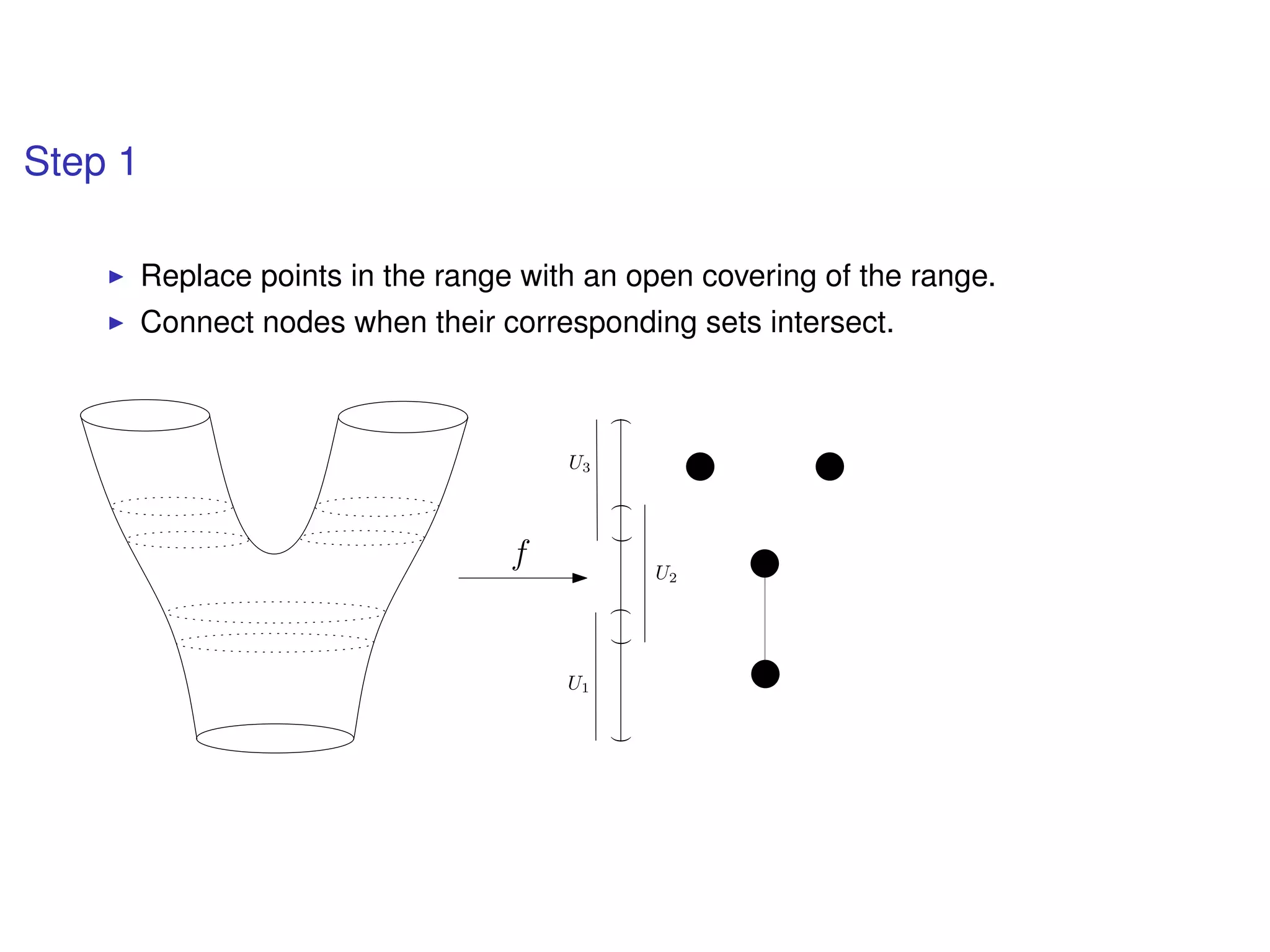
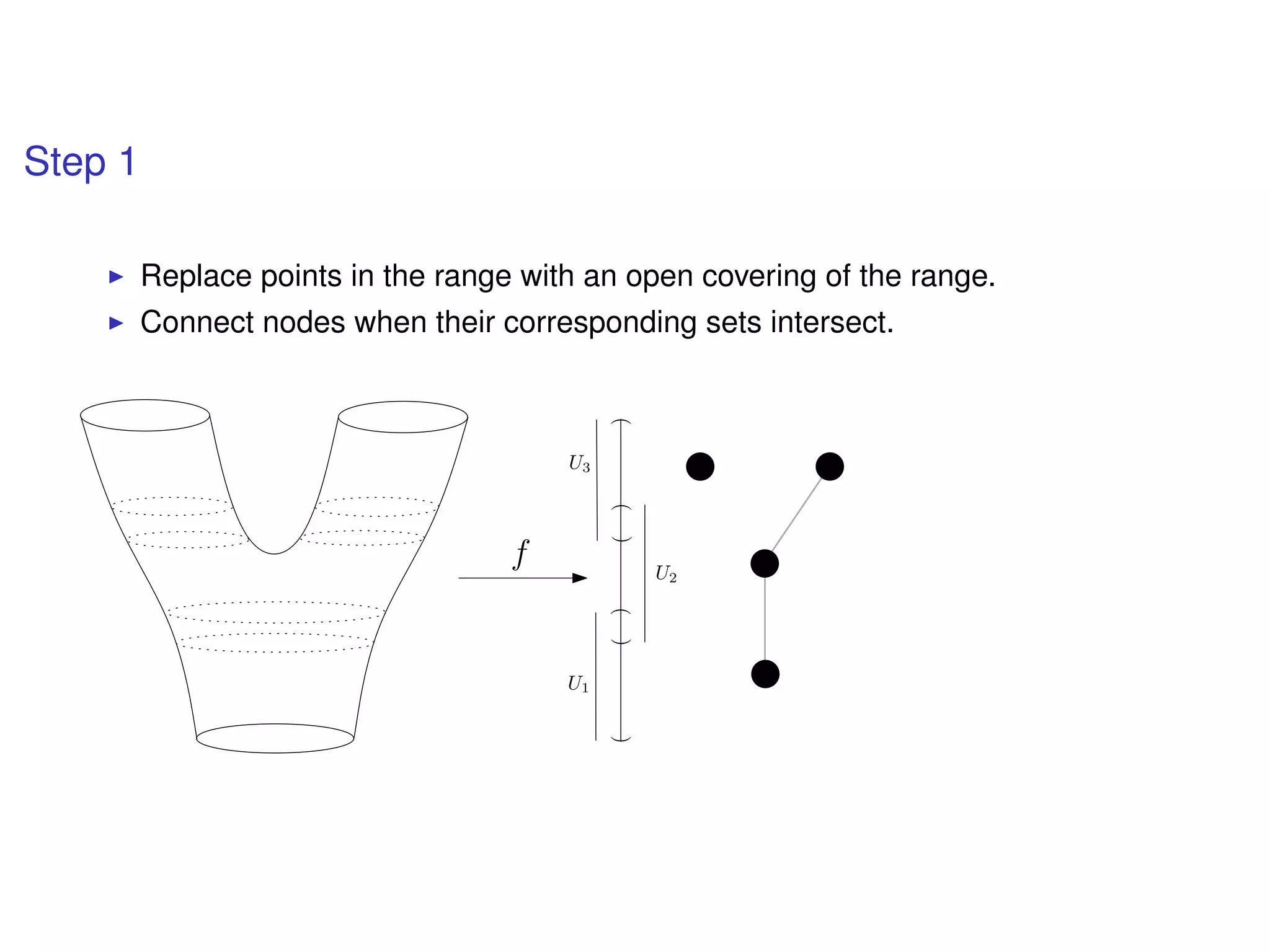
Connect nodes when their corresponding sets intersect.
f
((()))
U1
U2
U3
Step 1
Replace points in the range with an open covering of the range.
Connect nodes when their corresponding sets intersect.
f
((()))
U1
U2
U3
Step 1
Replace points in the range with an open covering of the range.
Connect nodes when their corresponding sets intersect.
f
((()))
U1
U2
U3
⇒ The output is now a graph.
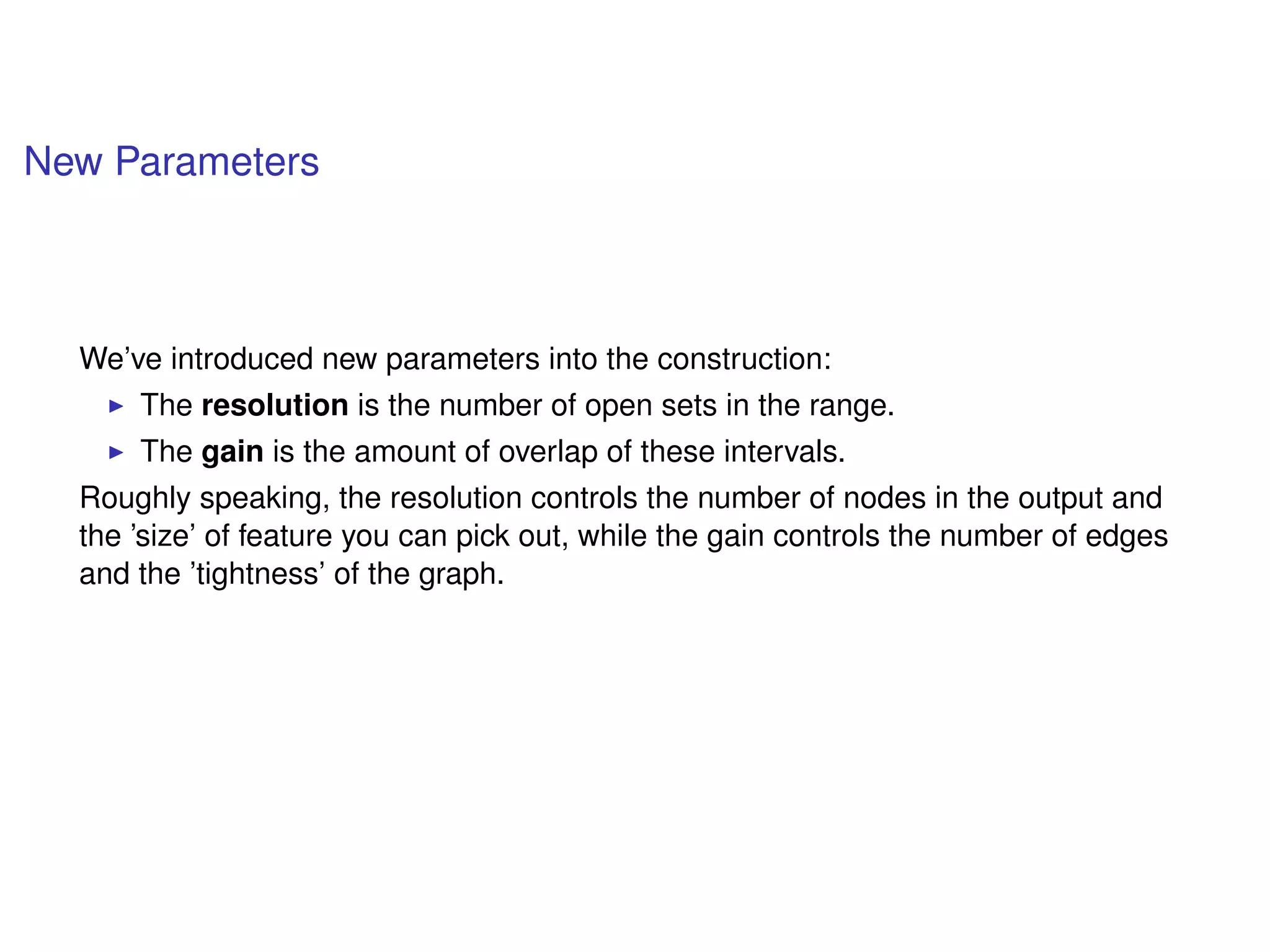
New Parameters
We’ve introduced new parameters into the construction:
New Parameters
We’ve introduced new parameters into the construction:
The resolution is the number of open sets in the range.
New Parameters
We’ve introduced new parameters into the construction:
The resolution is the number of open sets in the range.
The gain is the amount of overlap of these intervals.
New Parameters
We’ve introduced new parameters into the construction:
The resolution is the number of open sets in the range.
The gain is the amount of overlap of these intervals.
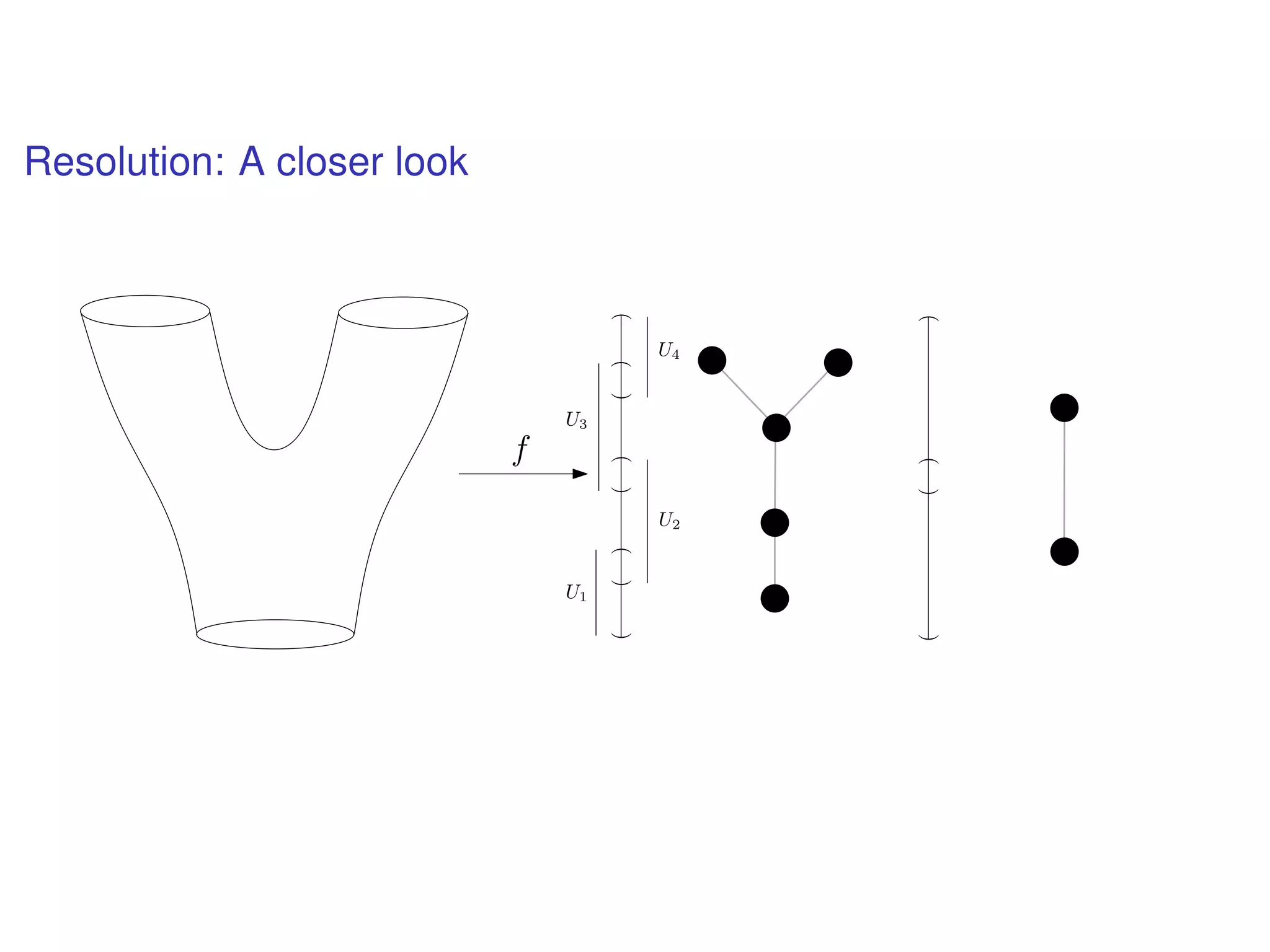
Roughly speaking, the resolution controls the number of nodes in the output and
the ’size’ of feature you can pick out, while the gain controls the number of edges
and the ’tightness’ of the graph.
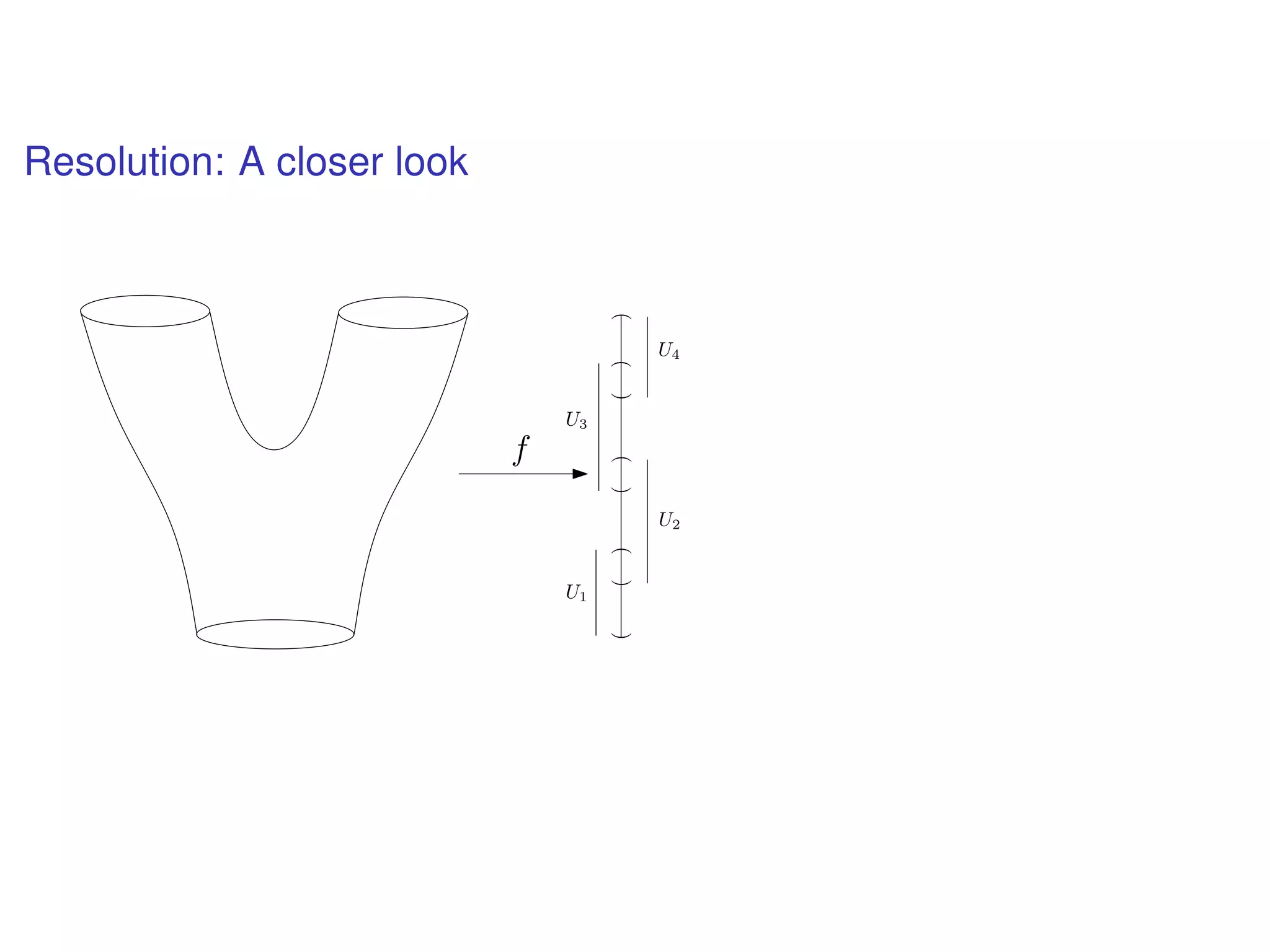
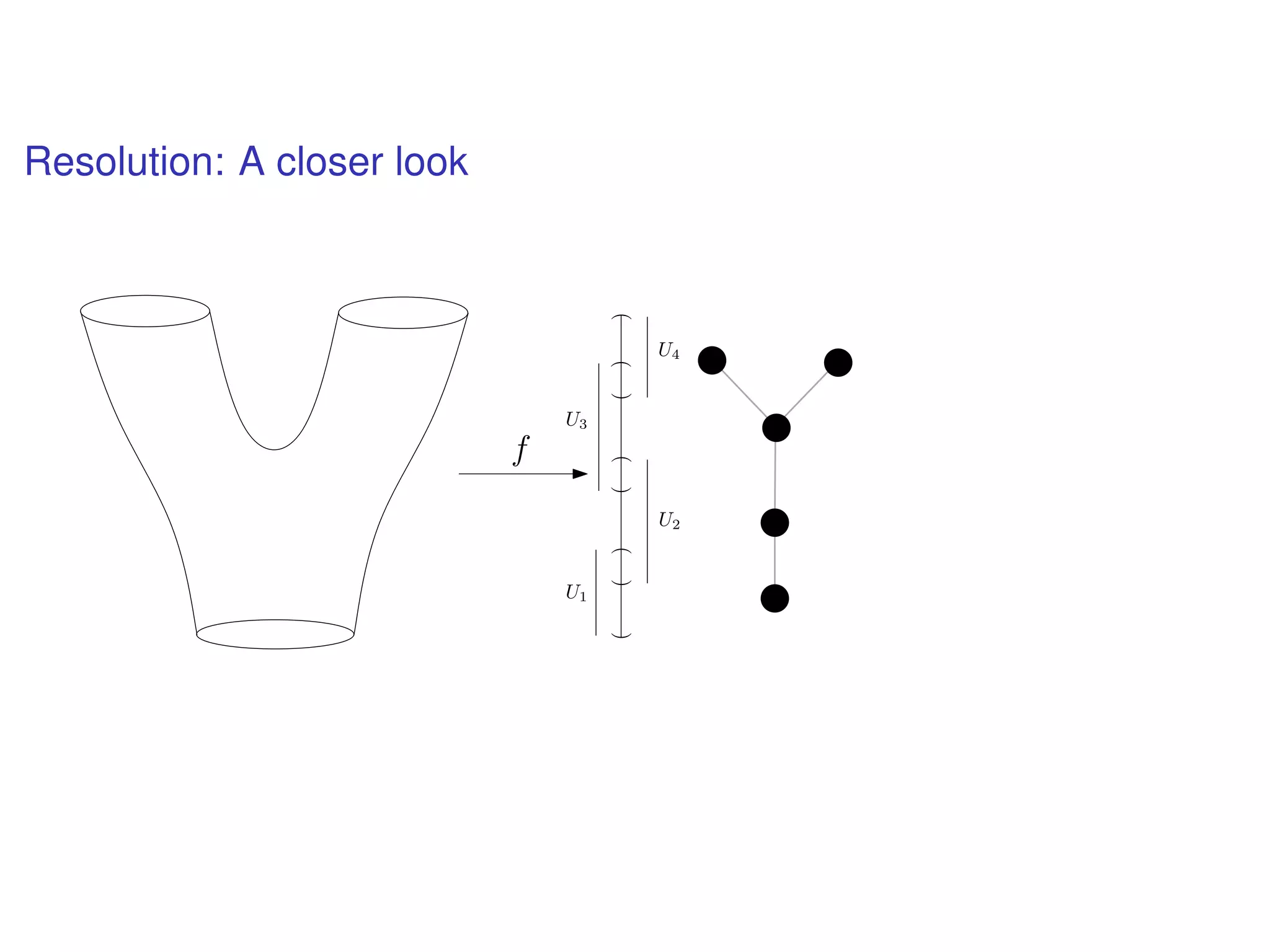
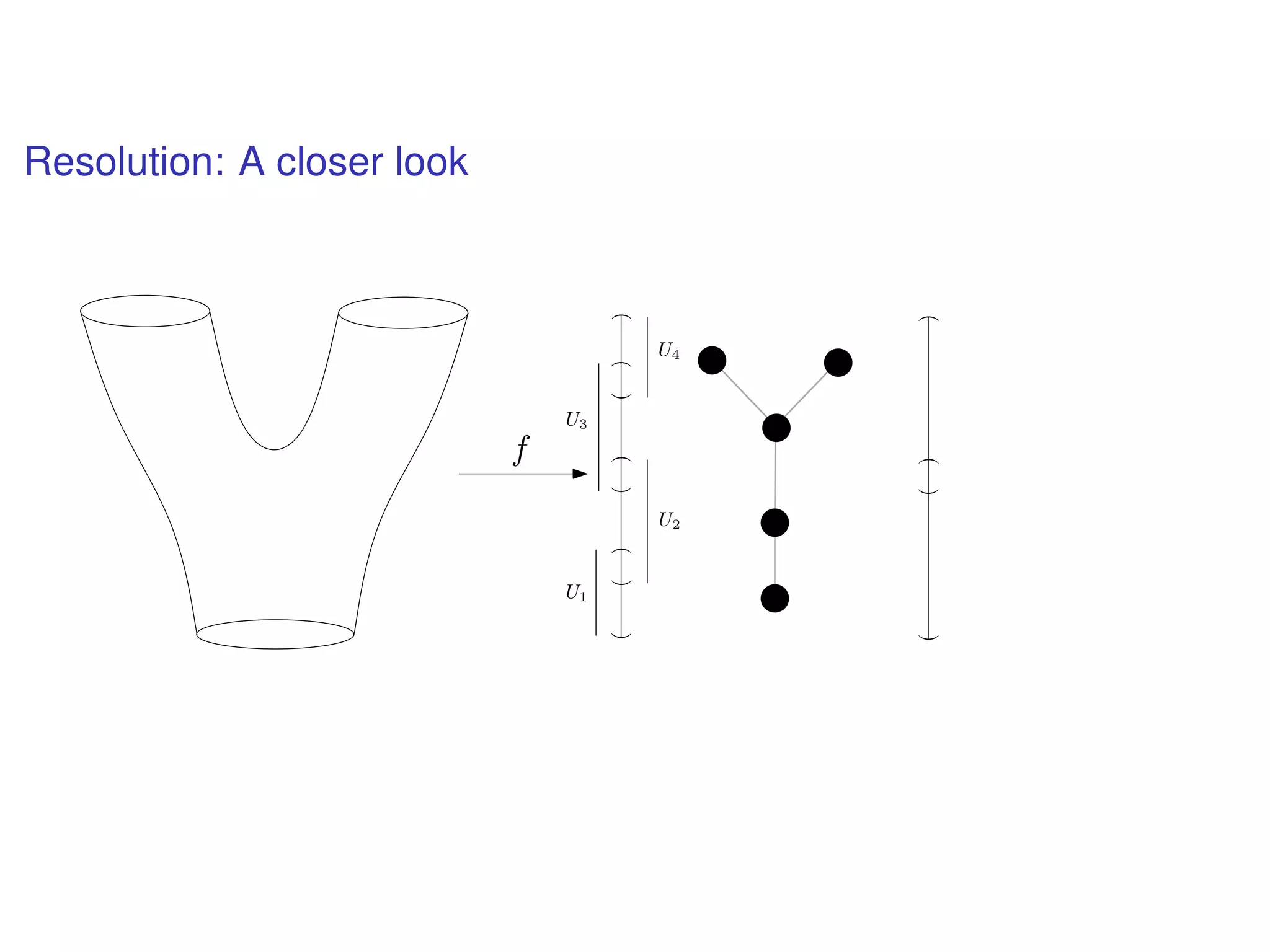
Resolution: A closer look
f
()()()()
U1
U2
U3
U4
Resolution: A closer look
f
()()()()
U1
U2
U3
U4
Resolution: A closer look
f
()()()()
U1
U2
U3
U4
()()
Resolution: A closer look
f
()()()()
U1
U2
U3
U4
()()
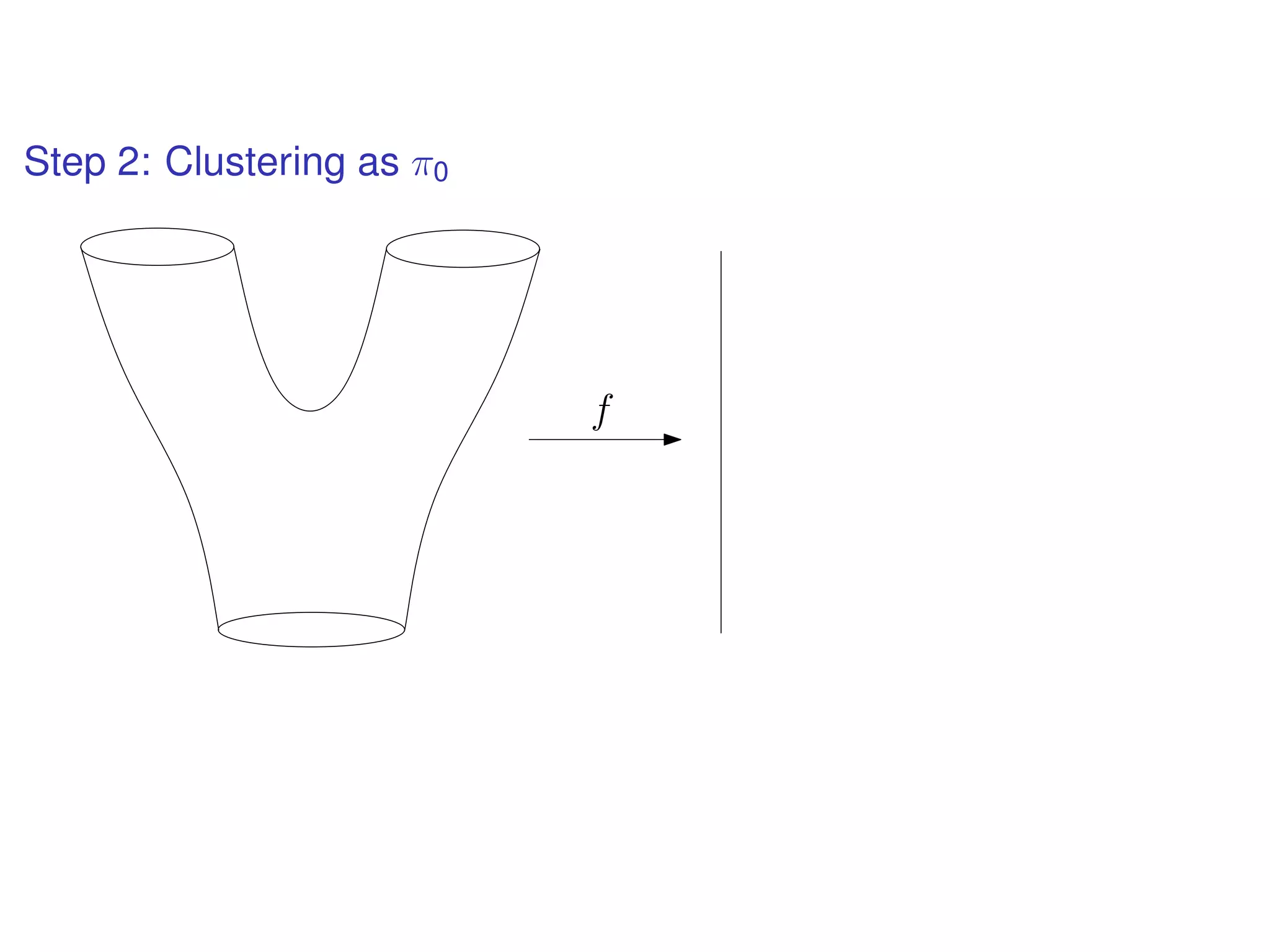
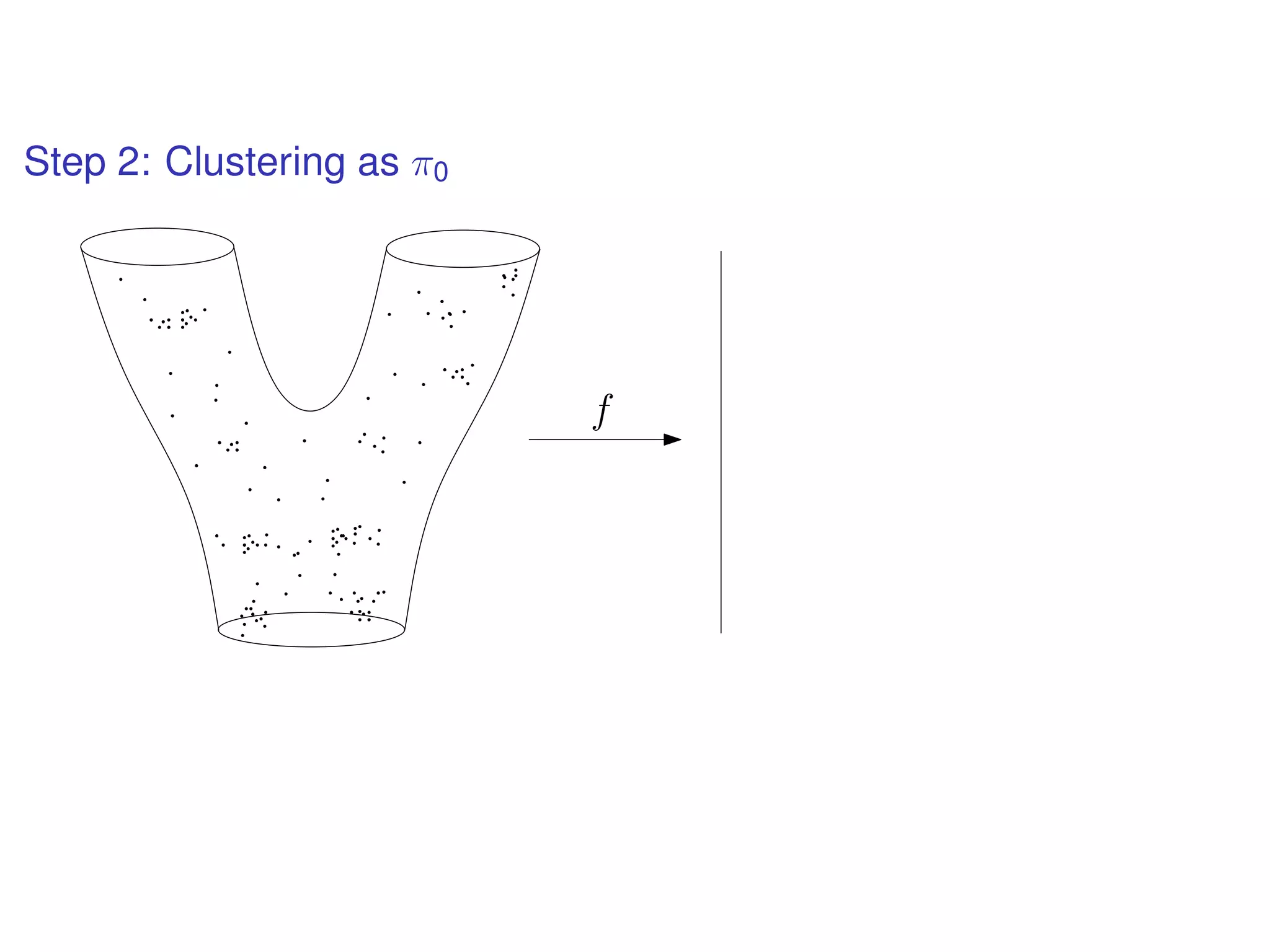
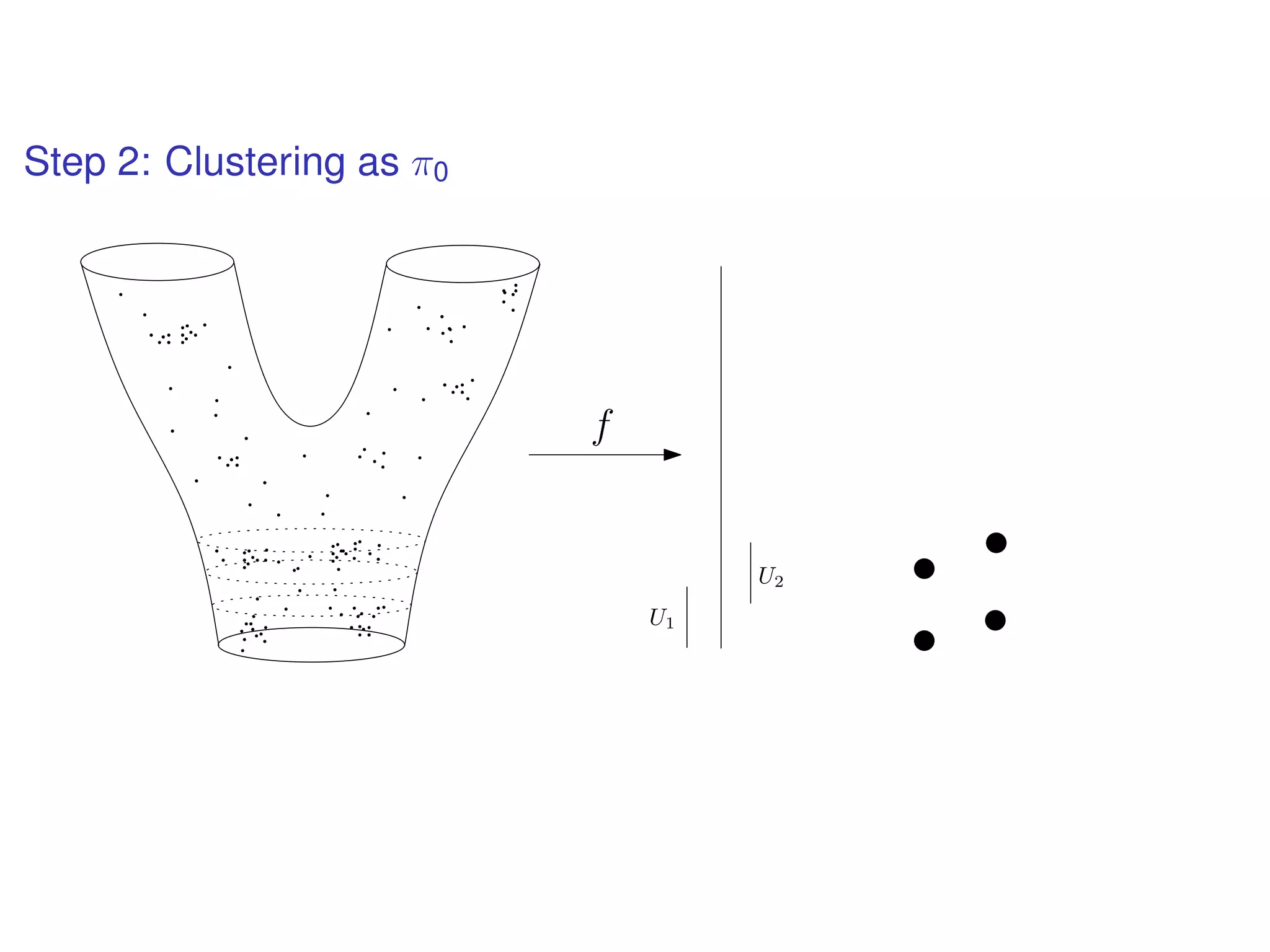
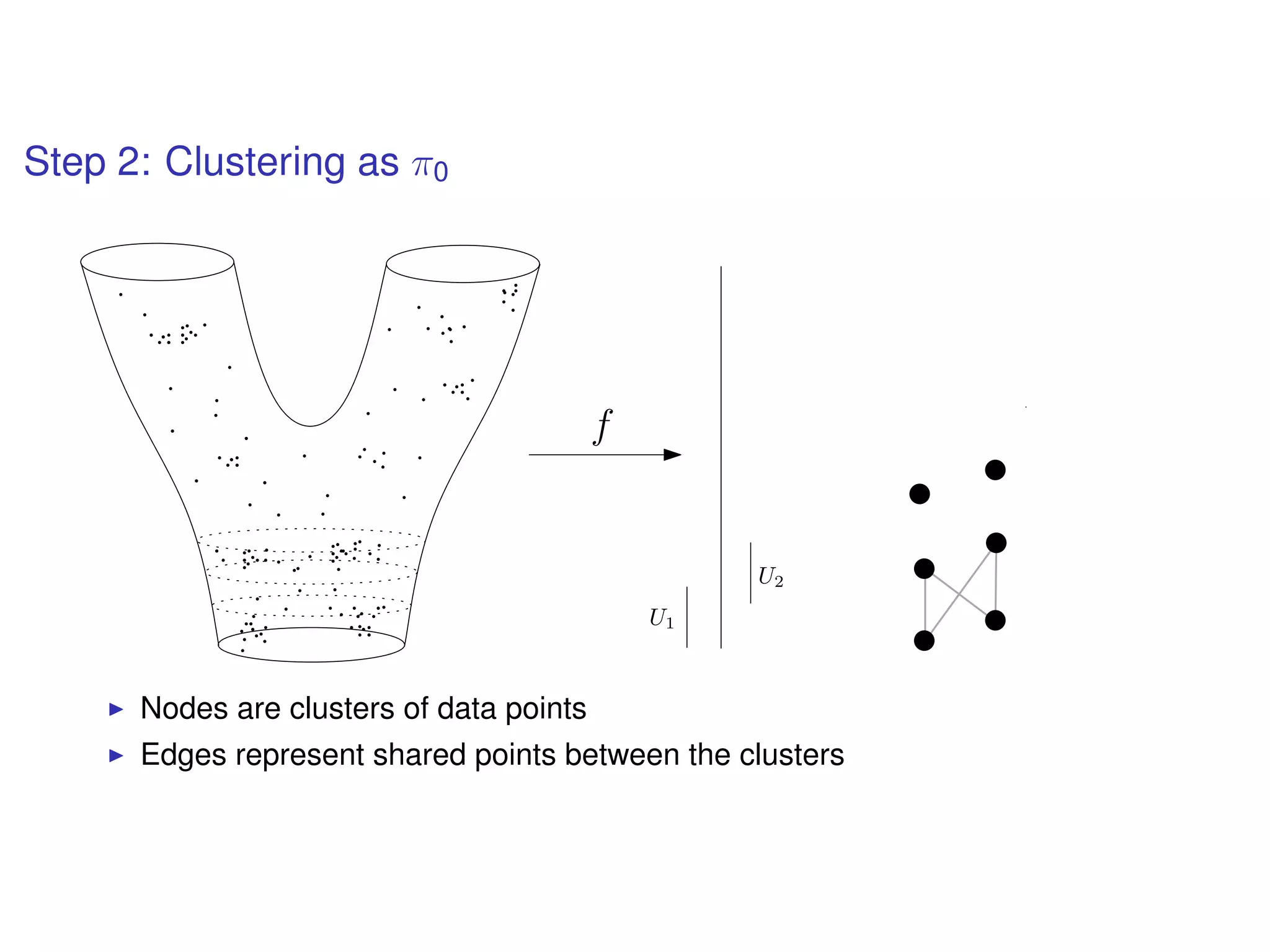
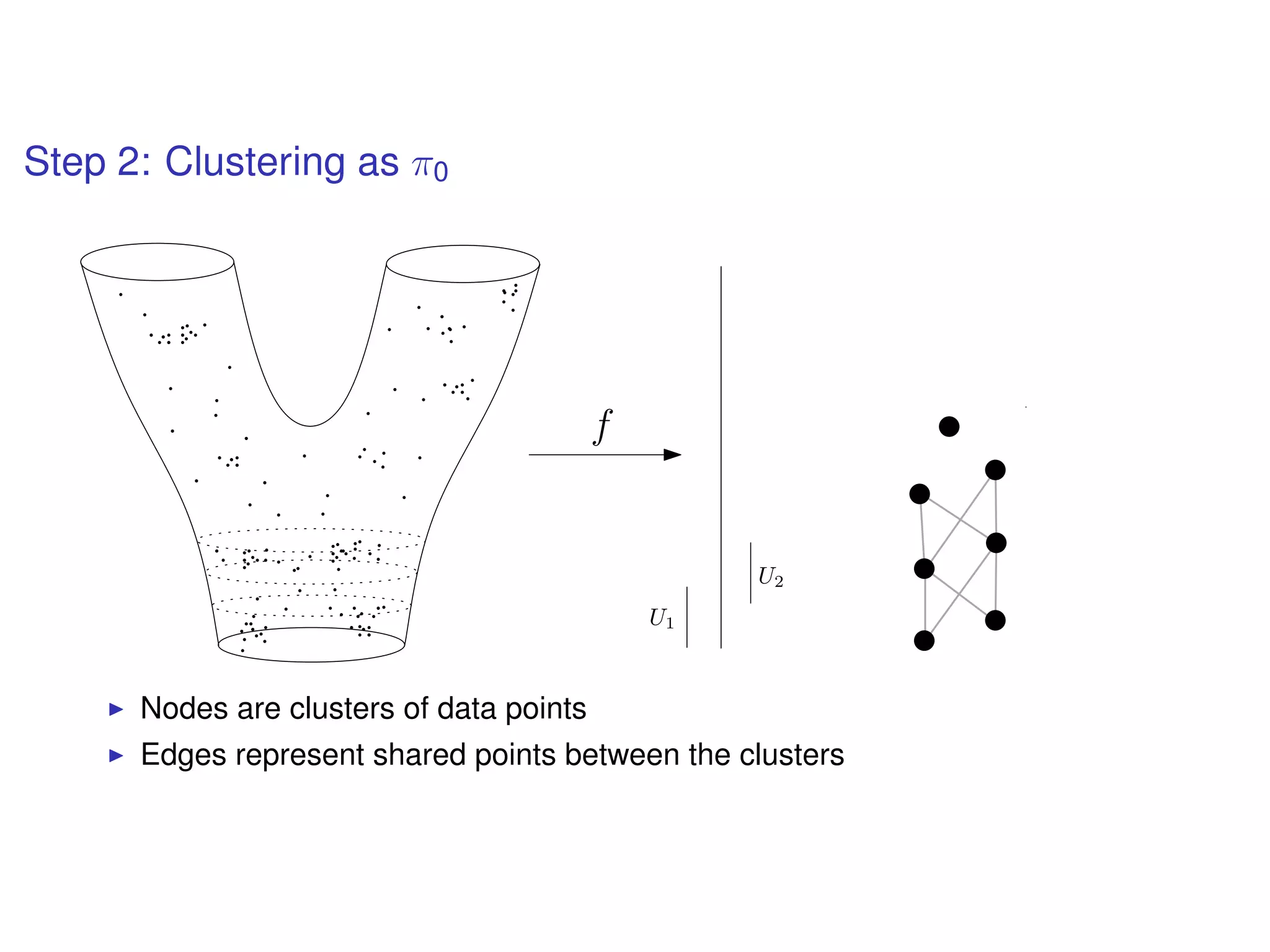
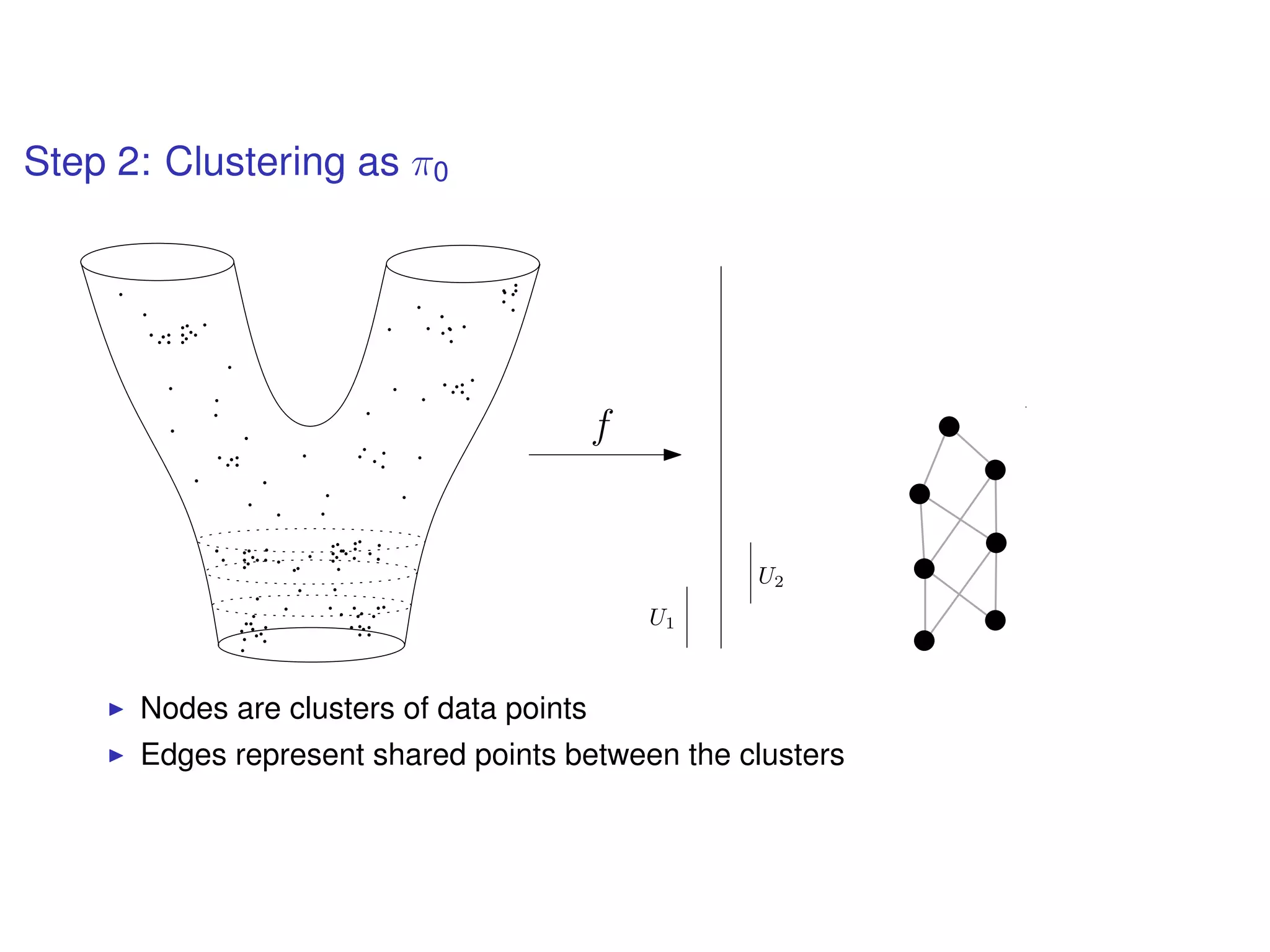
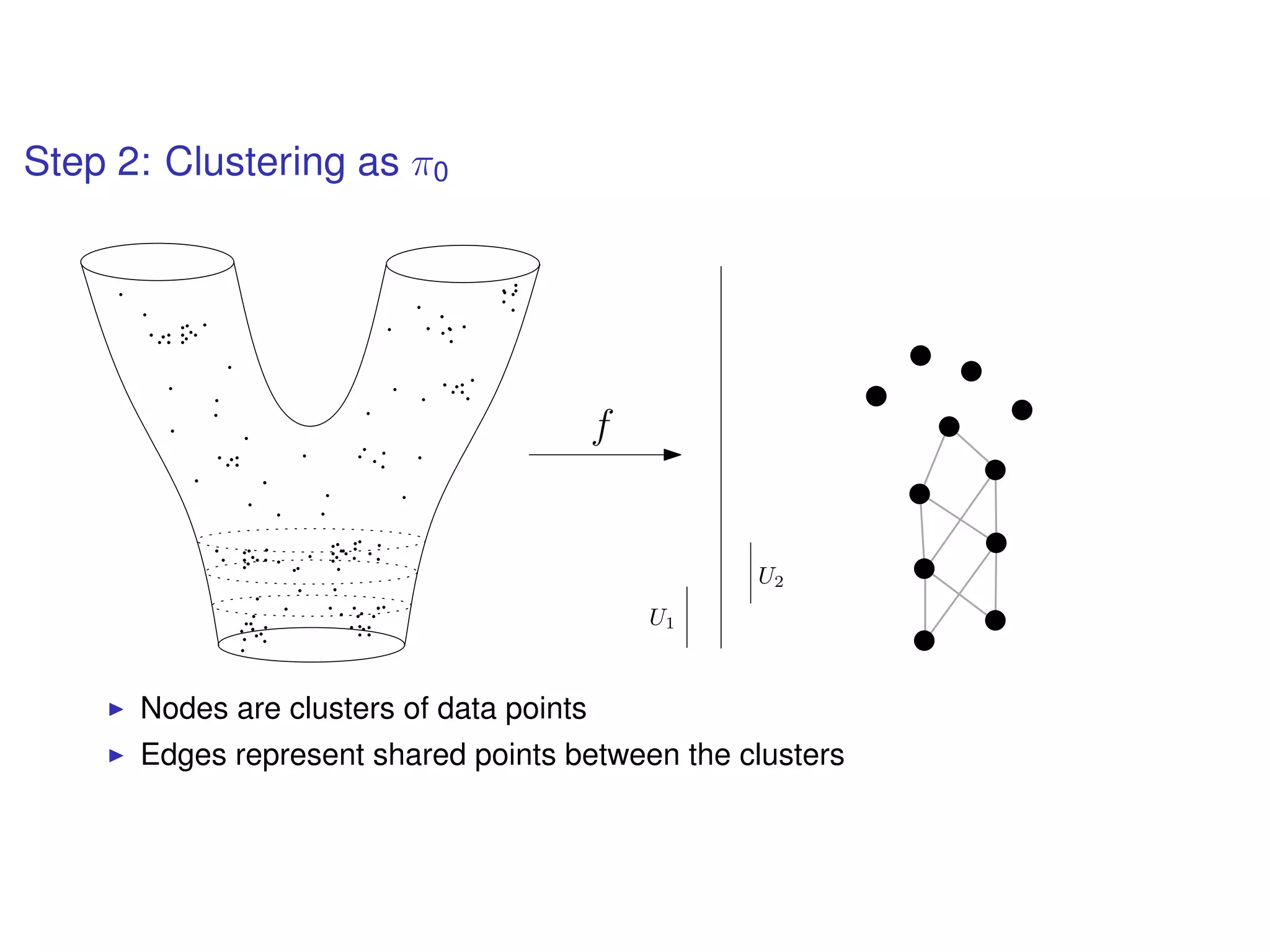
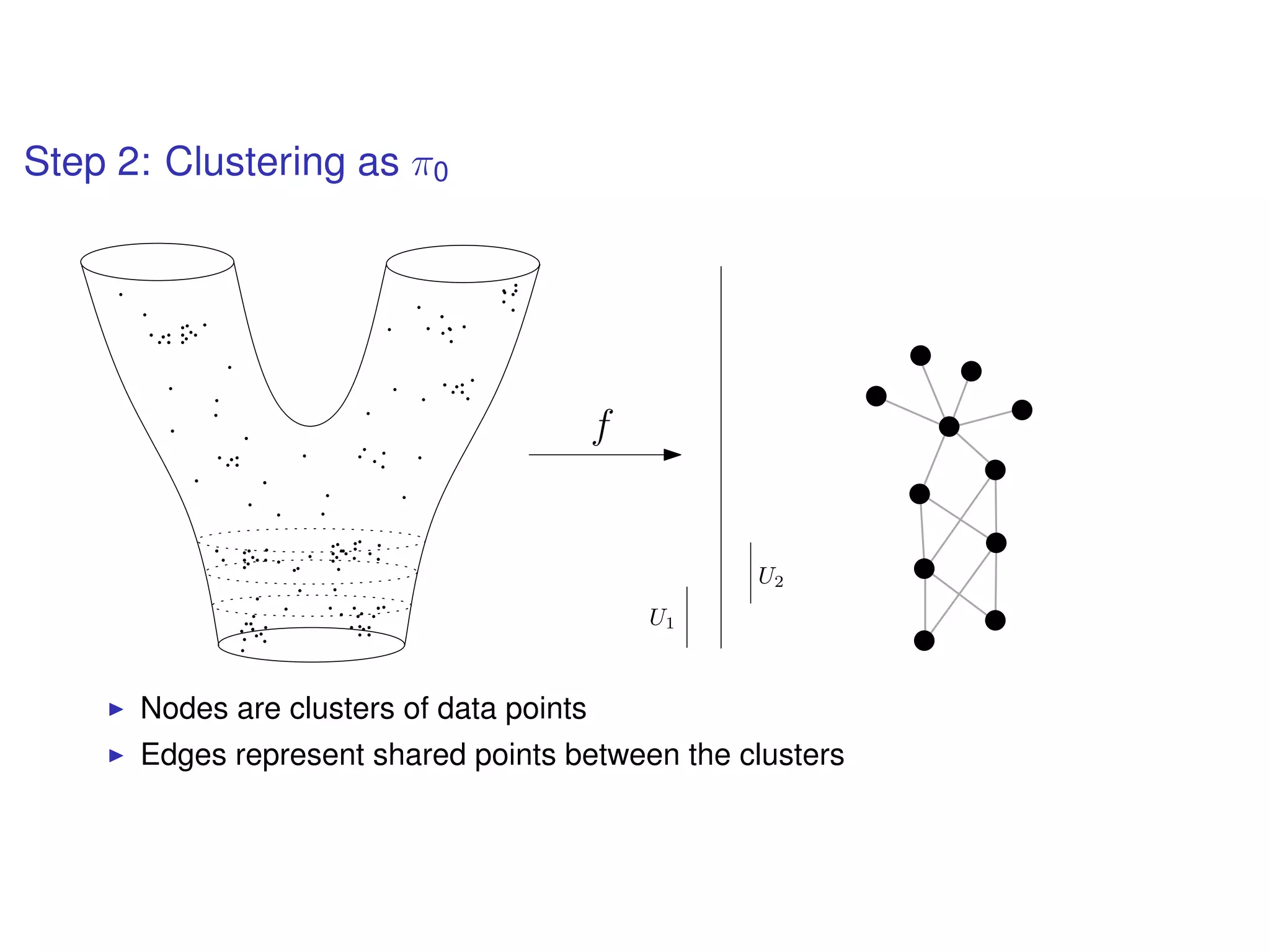
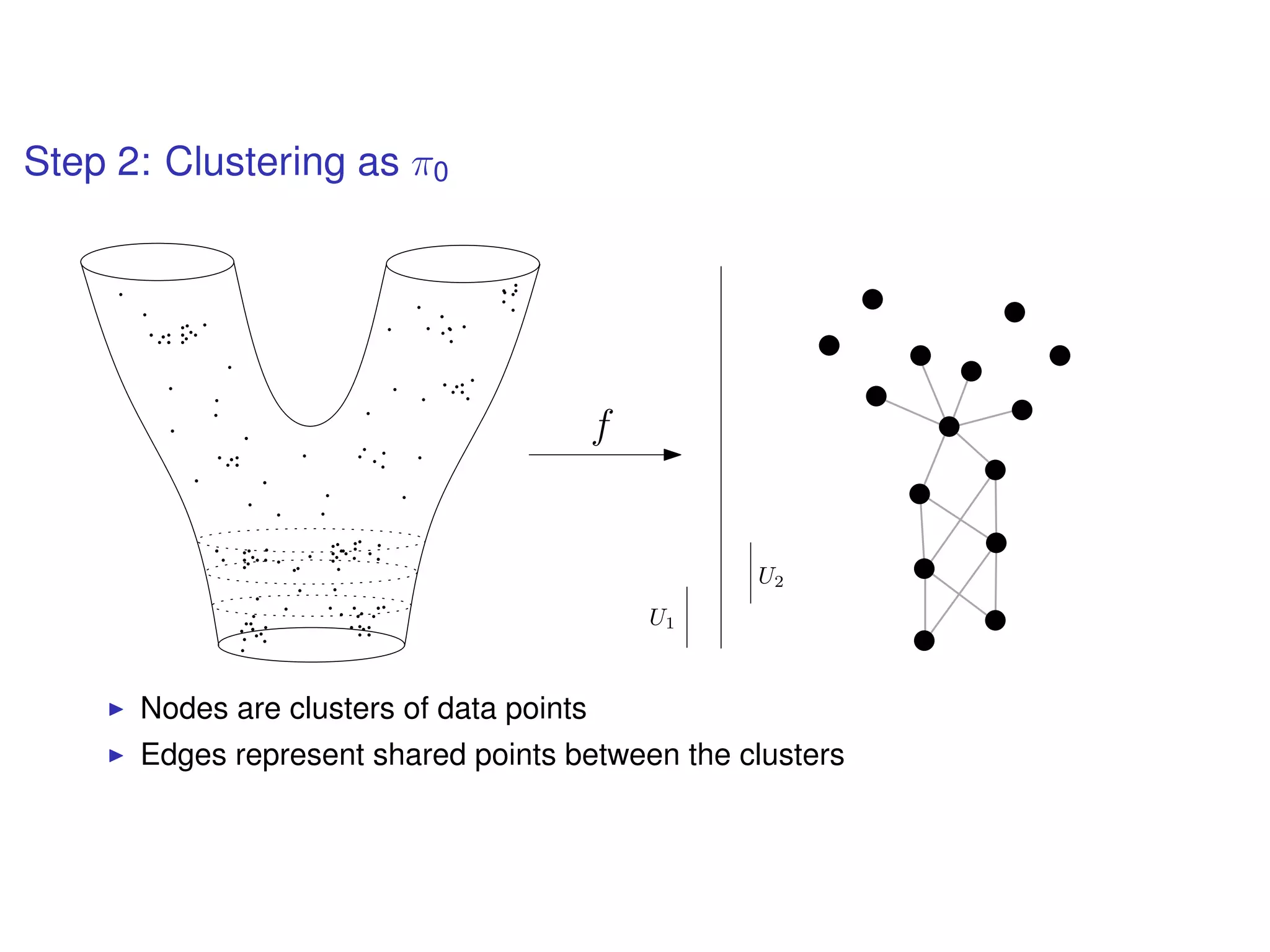
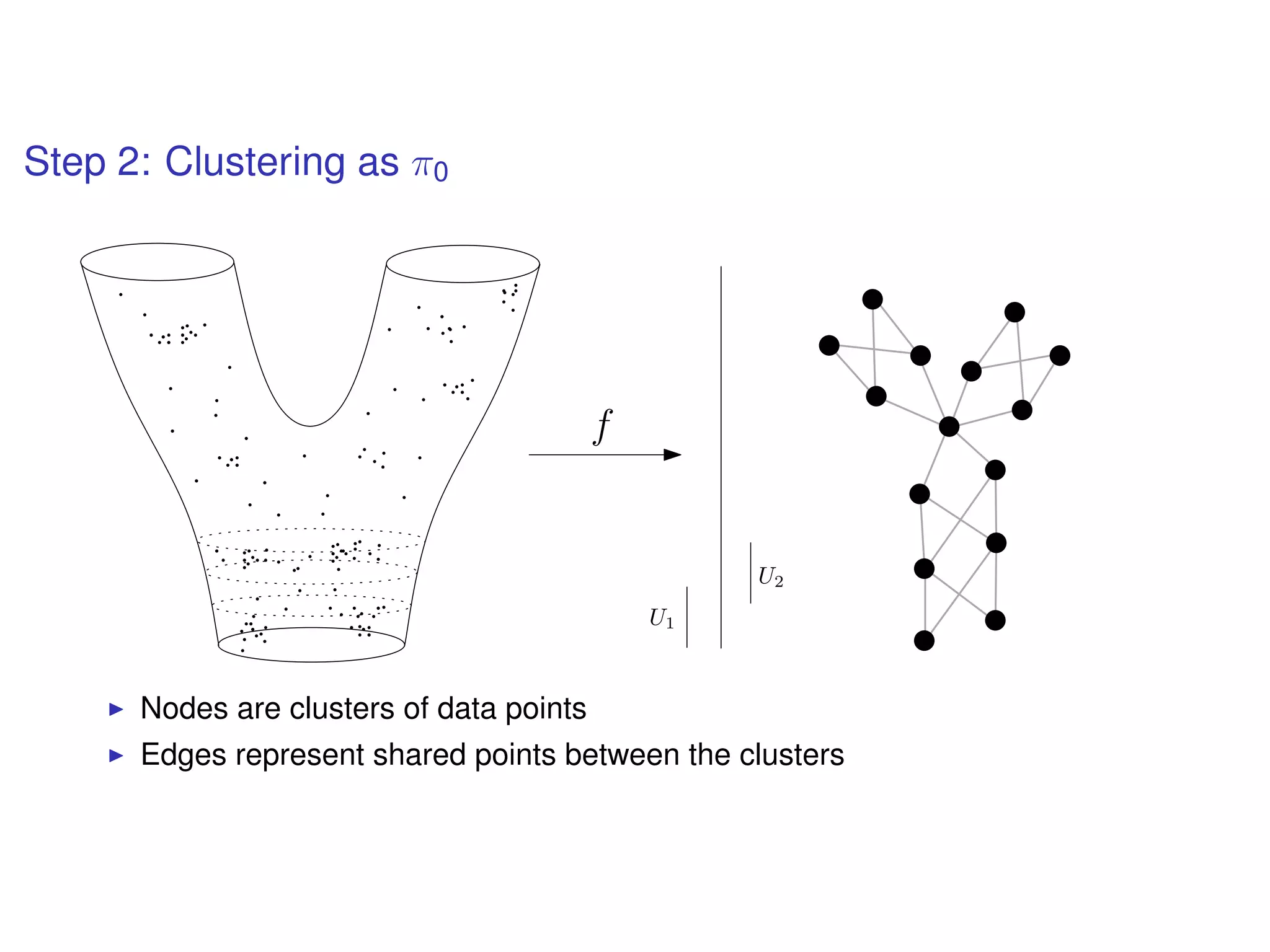
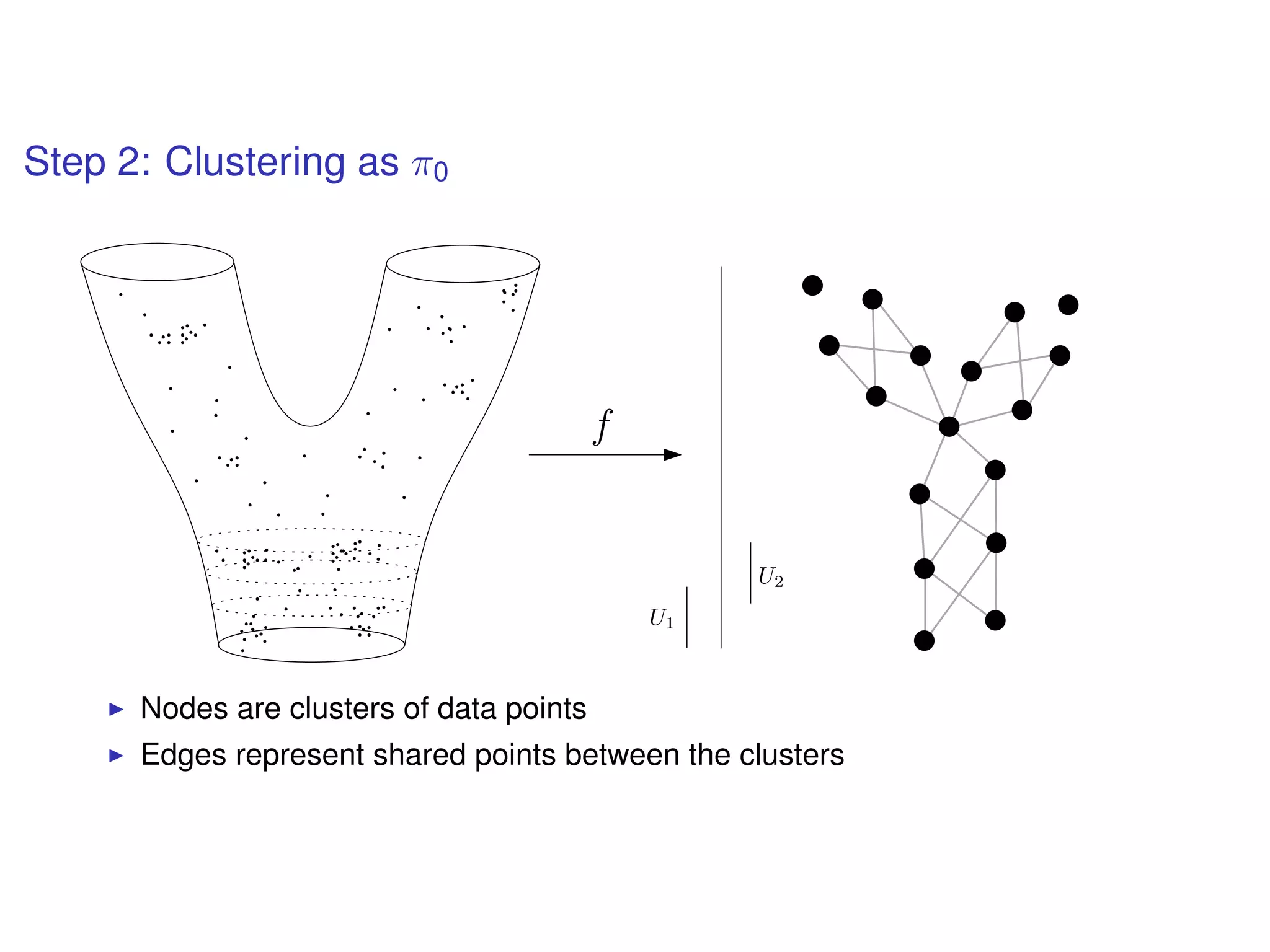
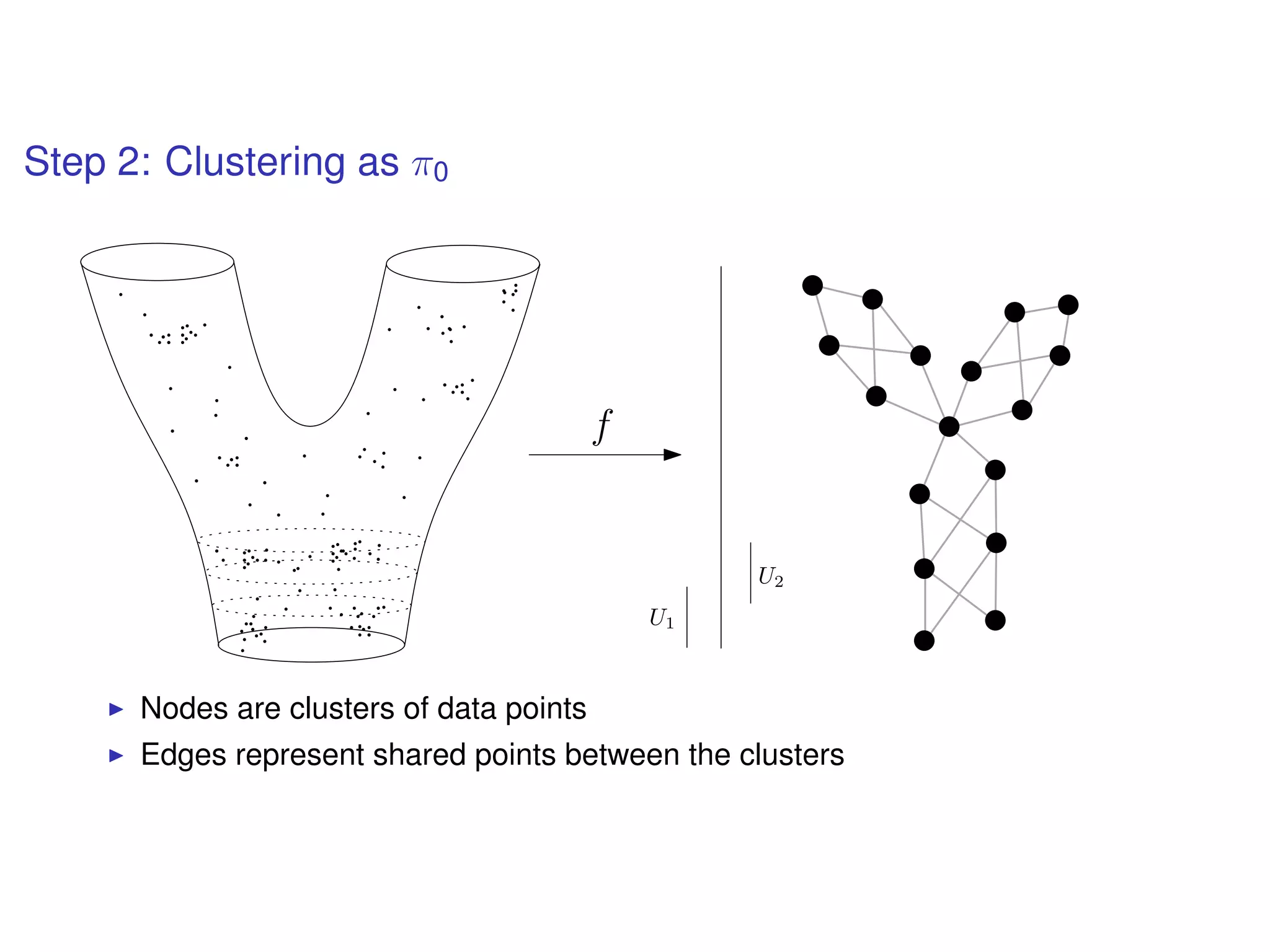
Step 2: Clustering as π0
We need to make a final adjustment to the algorithm to bring it into data world.
Step 2: Clustering as π0
We need to make a final adjustment to the algorithm to bring it into data world.
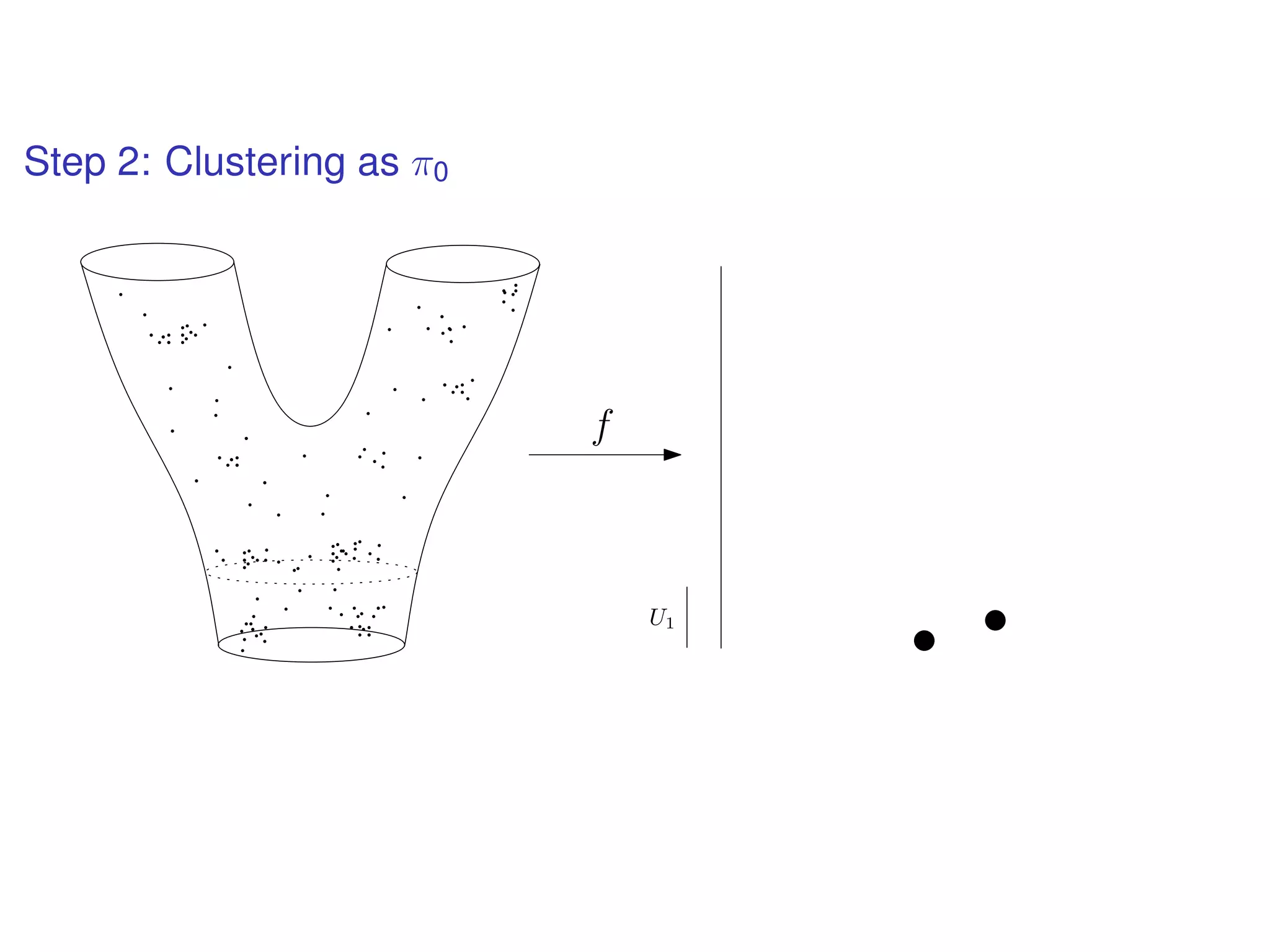
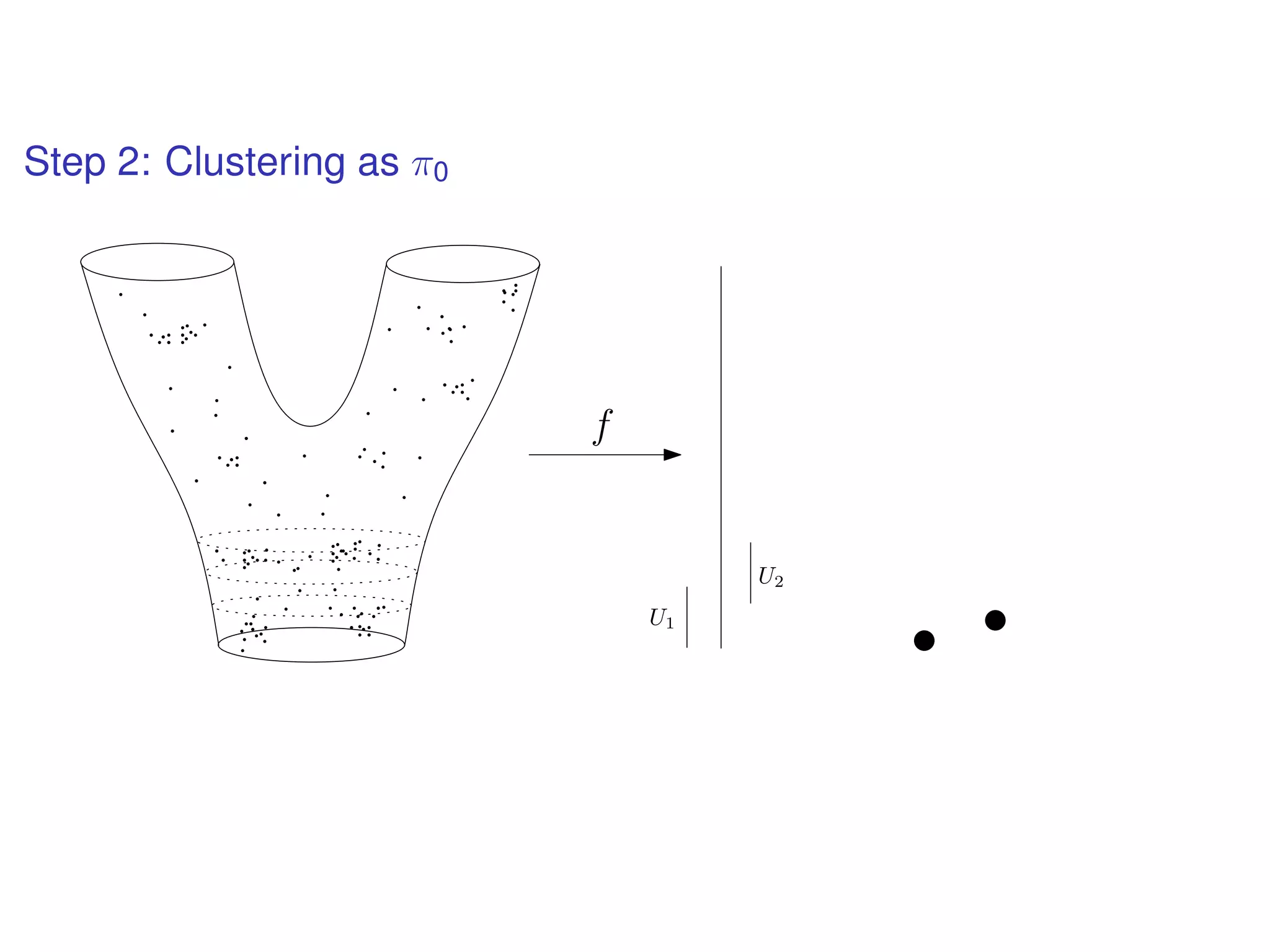
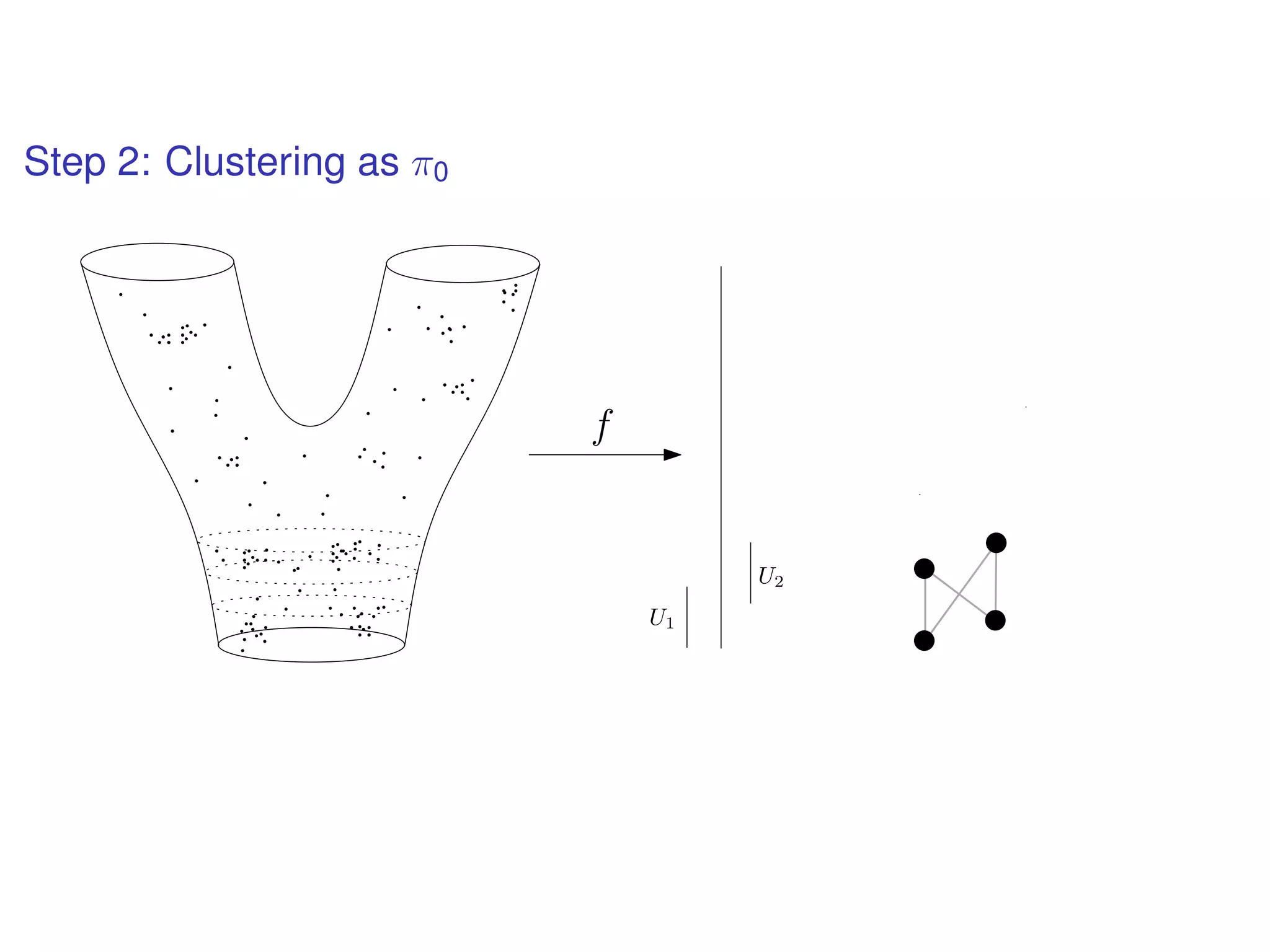
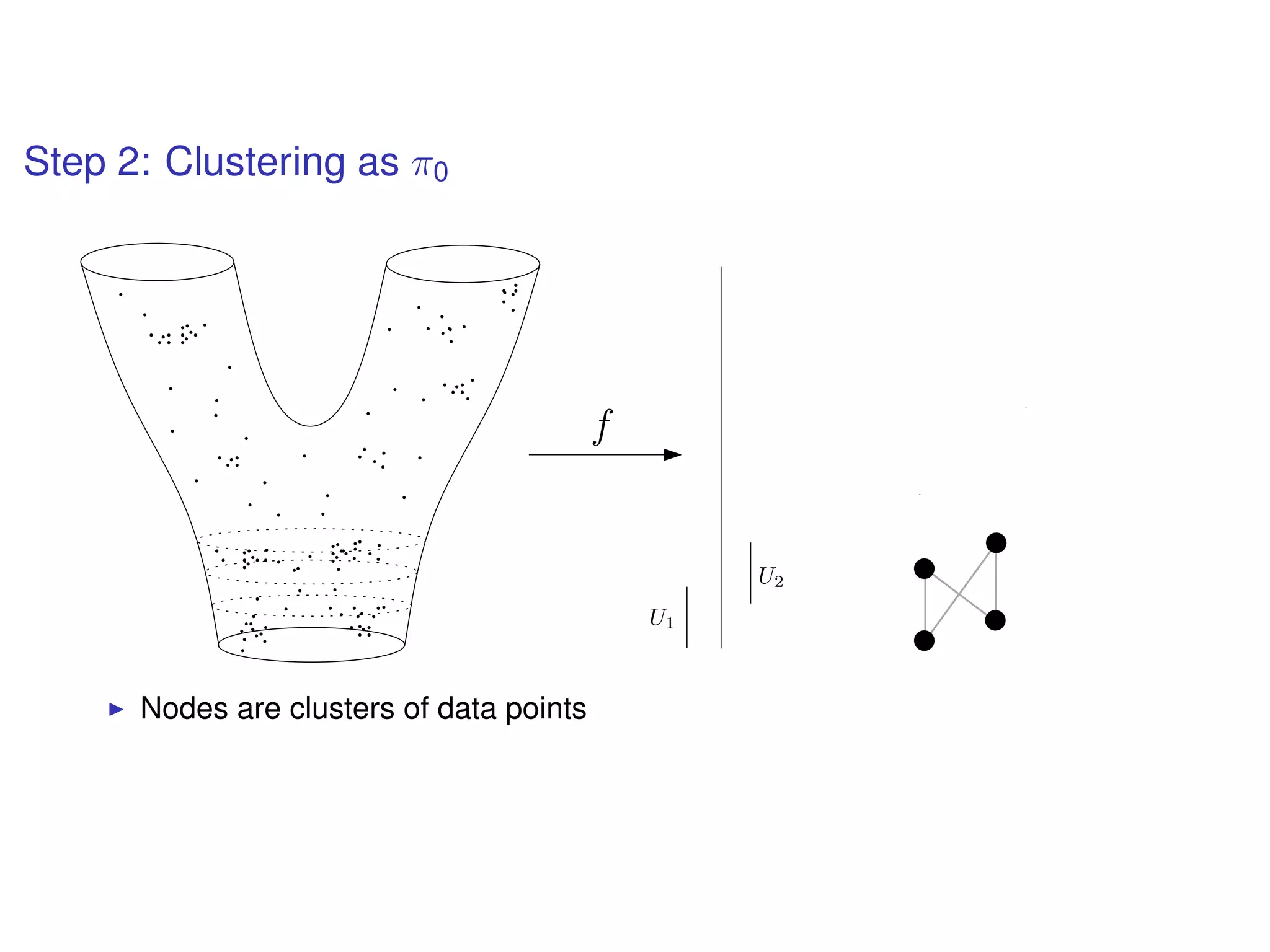
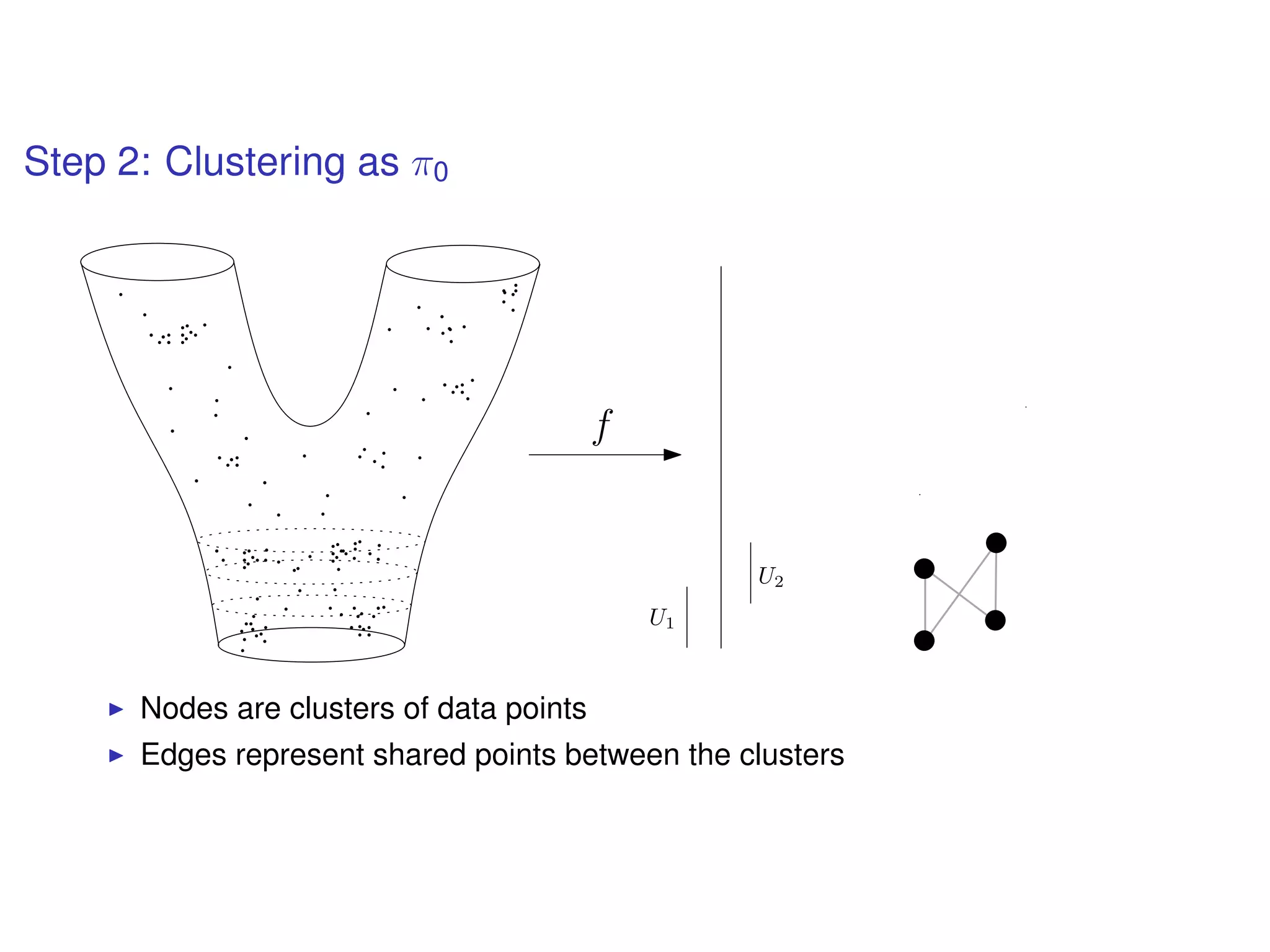
We replace "connected component of the inverse image" is with "clusters in
the inverse image".
Step 2: Clustering as π0
We need to make a final adjustment to the algorithm to bring it into data world.
We replace "connected component of the inverse image" is with "clusters in
the inverse image".
We connect clusters (nodes) with an edge if they share points in common.
Step 2: Clustering as π0
f
Step 2: Clustering as π0
f
Step 2: Clustering as π0
f
U1
Step 2: Clustering as π0
f
U1
U2
Step 2: Clustering as π0
f
U1
U2
Step 2: Clustering as π0
f
U1
U2
Step 2: Clustering as π0
f
U1
U2
Nodes are clusters of data points
Step 2: Clustering as π0
f
U1
U2
Nodes are clusters of data points
Edges represent shared points between the clusters
Step 2: Clustering as π0
f
U1
U2
Nodes are clusters of data points
Edges represent shared points between the clusters
Step 2: Clustering as π0
f
U1
U2
Nodes are clusters of data points
Edges represent shared points between the clusters
Step 2: Clustering as π0
f
U1
U2
Nodes are clusters of data points
Edges represent shared points between the clusters
Step 2: Clustering as π0
f
U1
U2
Nodes are clusters of data points
Edges represent shared points between the clusters
Step 2: Clustering as π0
f
U1
U2
Nodes are clusters of data points
Edges represent shared points between the clusters
Step 2: Clustering as π0
f
U1
U2
Nodes are clusters of data points
Edges represent shared points between the clusters
Step 2: Clustering as π0
f
U1
U2
Nodes are clusters of data points
Edges represent shared points between the clusters
Step 2: Clustering as π0
f
U1
U2
Nodes are clusters of data points
Edges represent shared points between the clusters
Step 2: Clustering as π0
f
U1
U2
Nodes are clusters of data points
Edges represent shared points between the clusters
Step 2: Clustering as π0
f
U1
U2
Nodes are clusters of data points
Edges represent shared points between the clusters
That’s It
That’s It
Ok not quite...
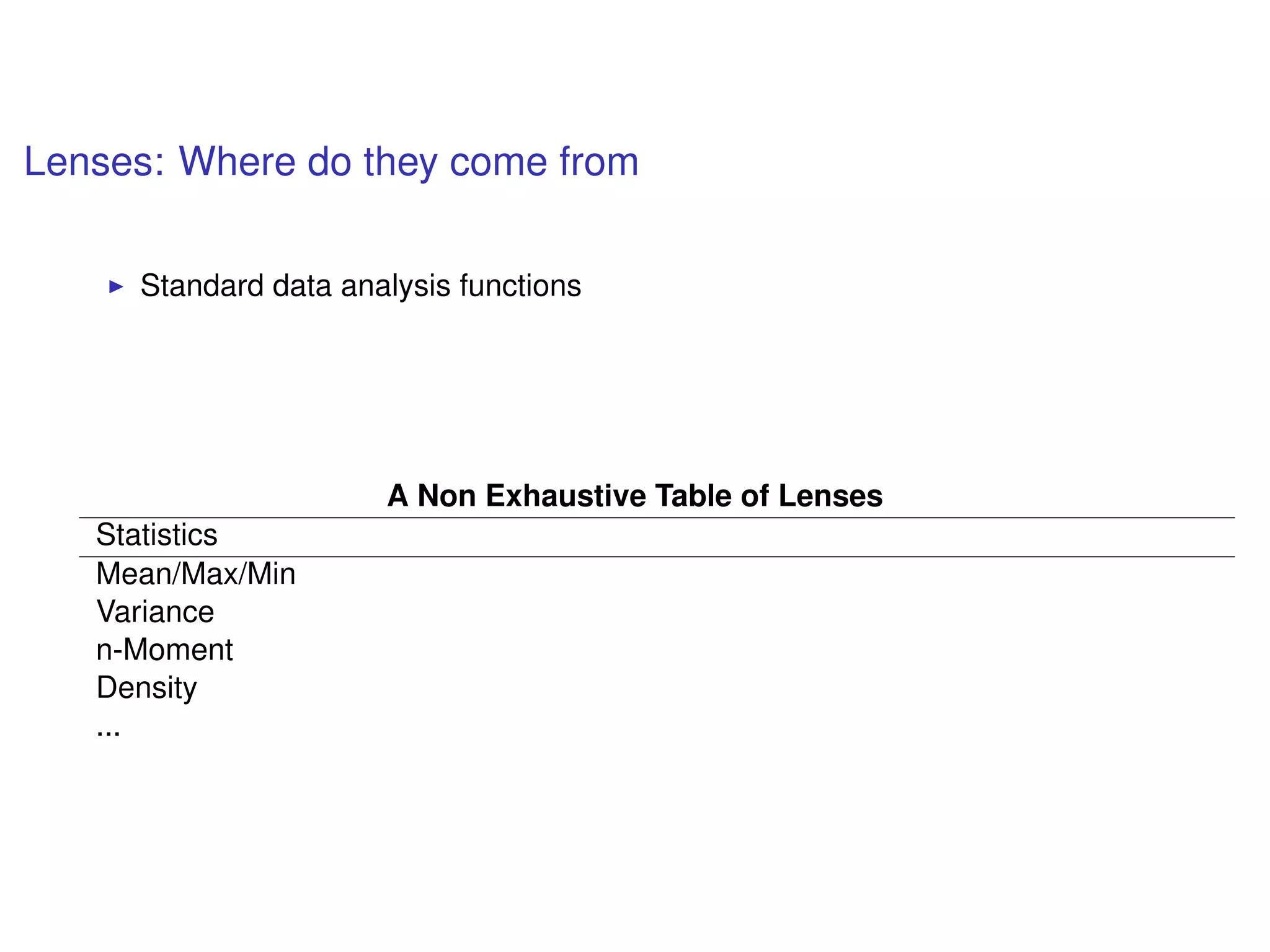
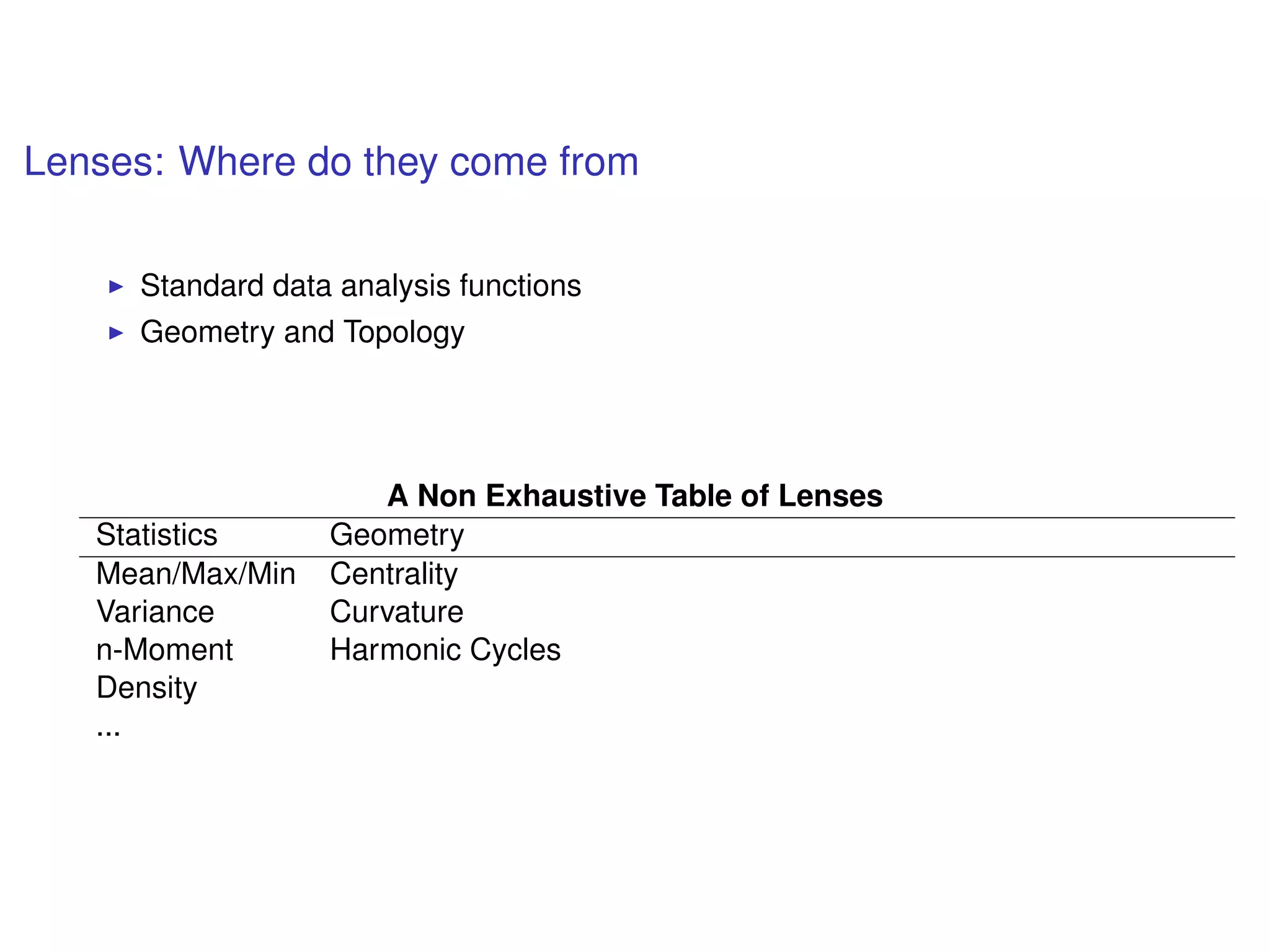
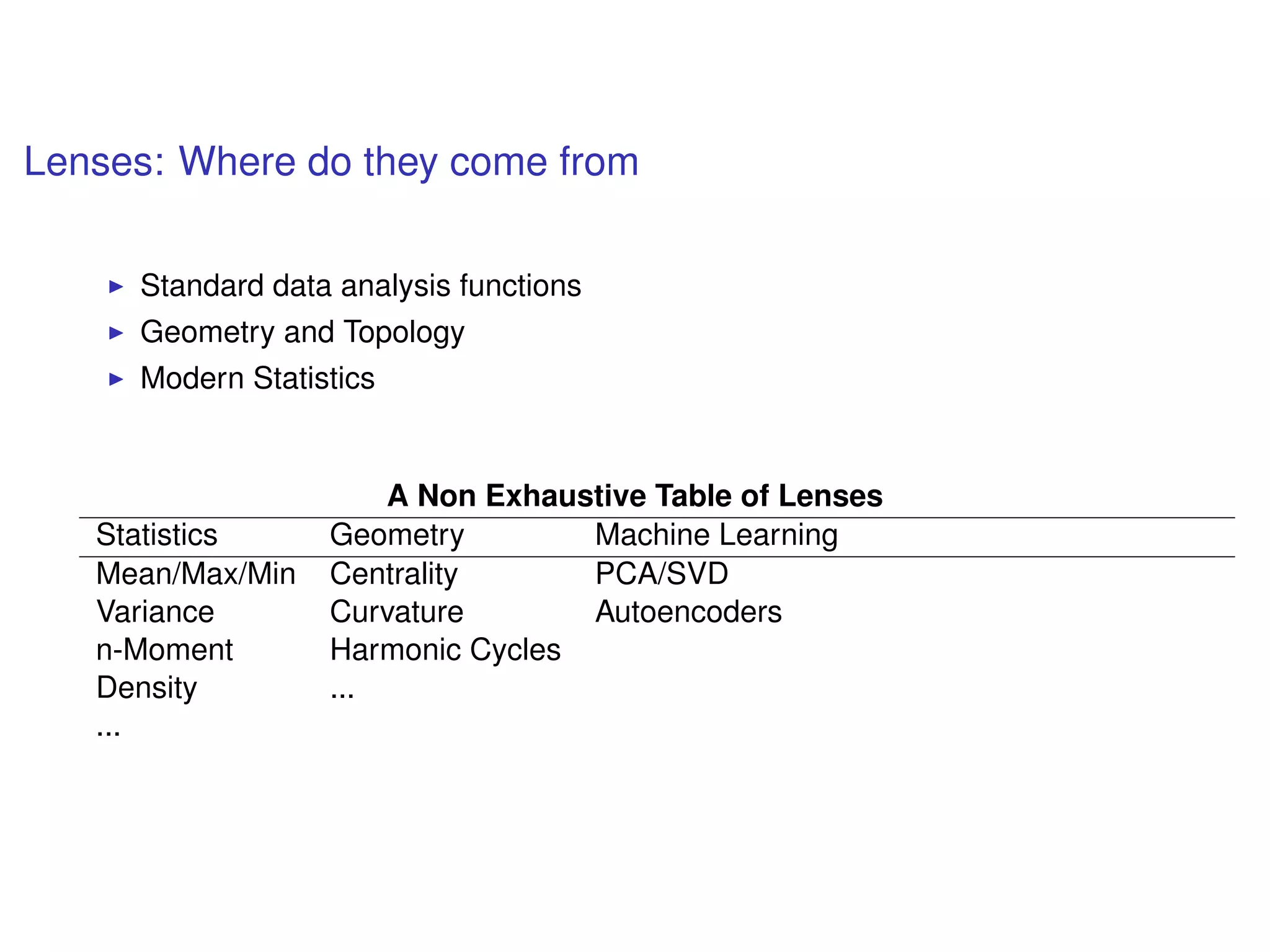
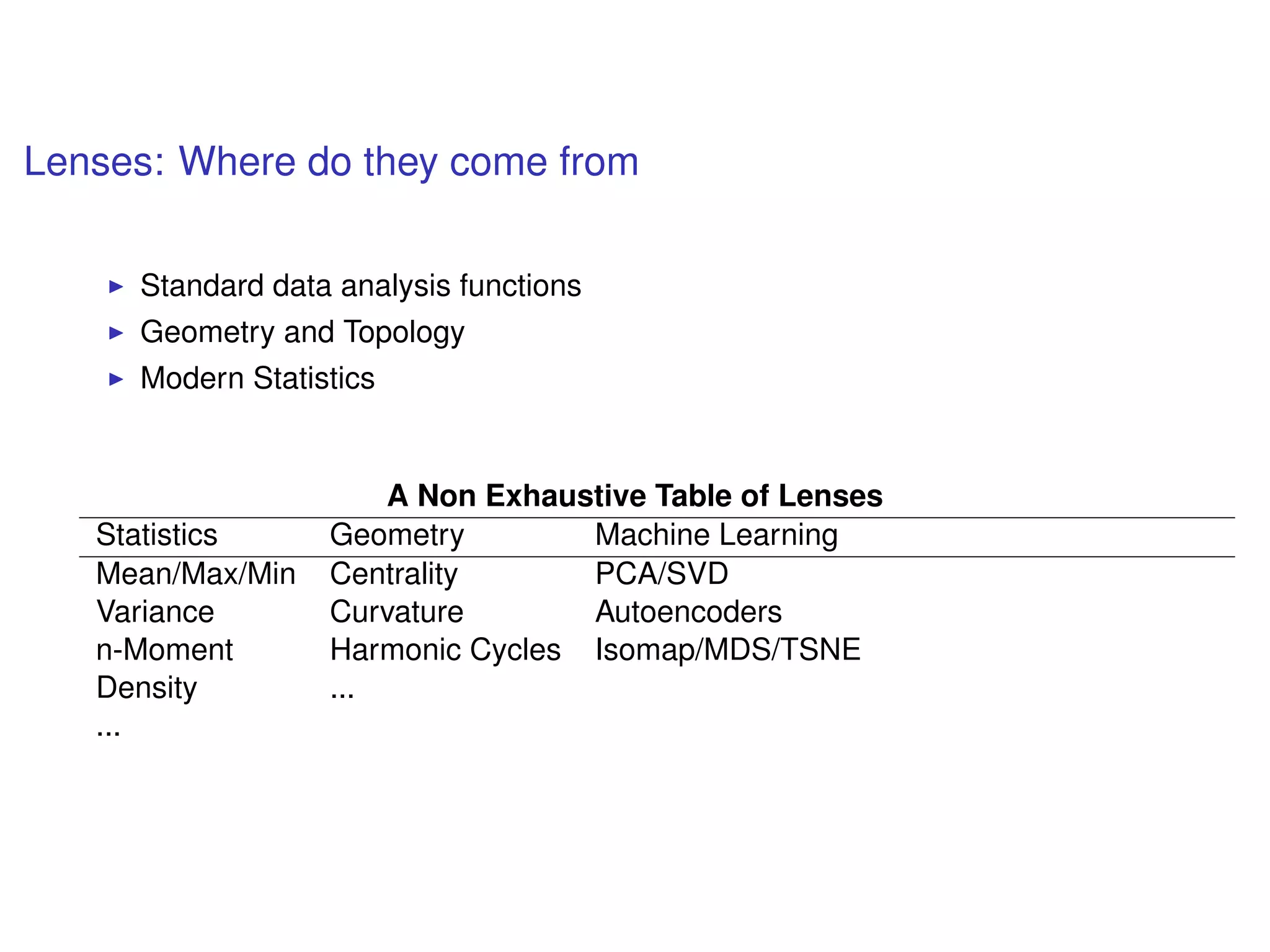
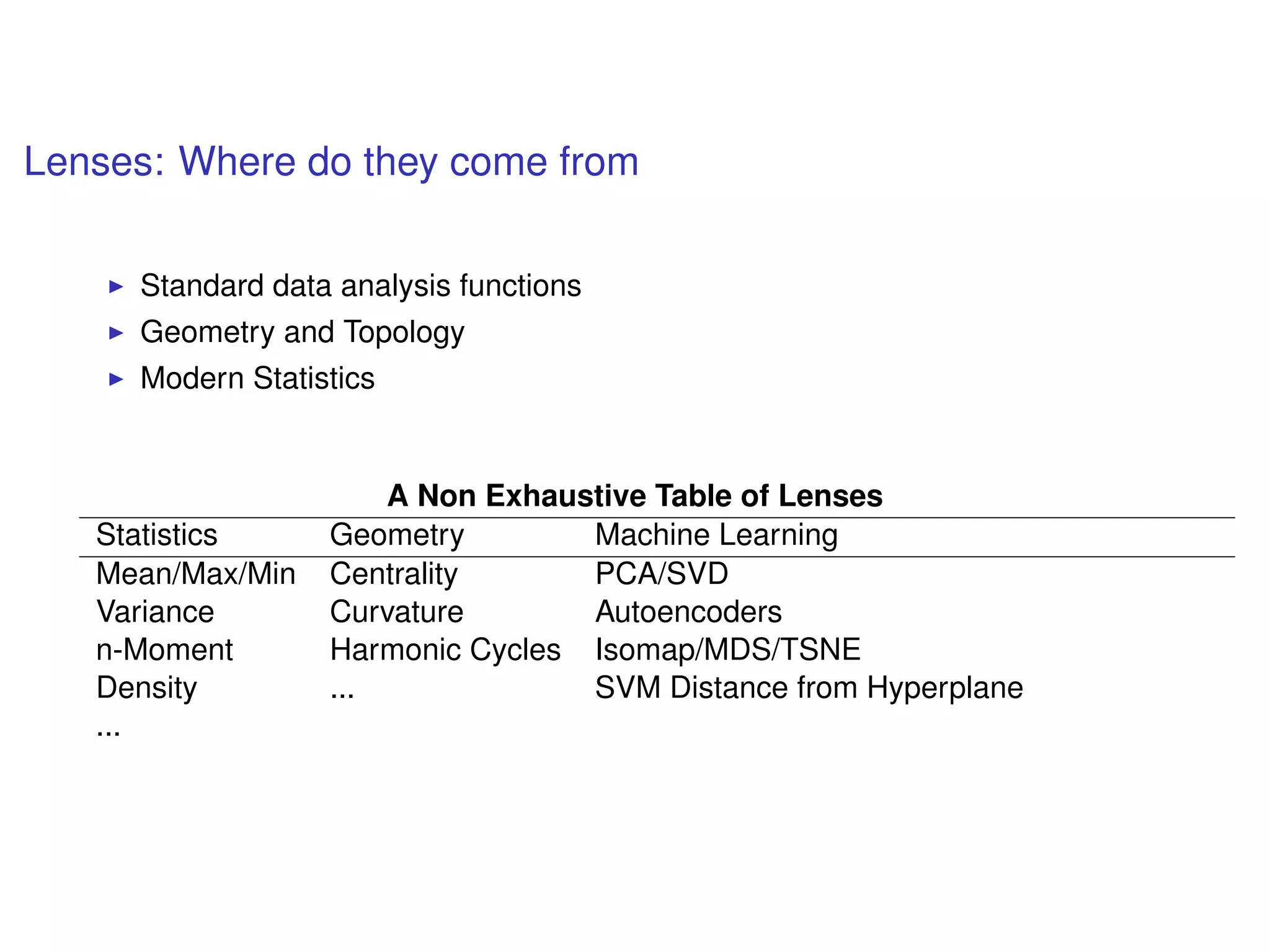
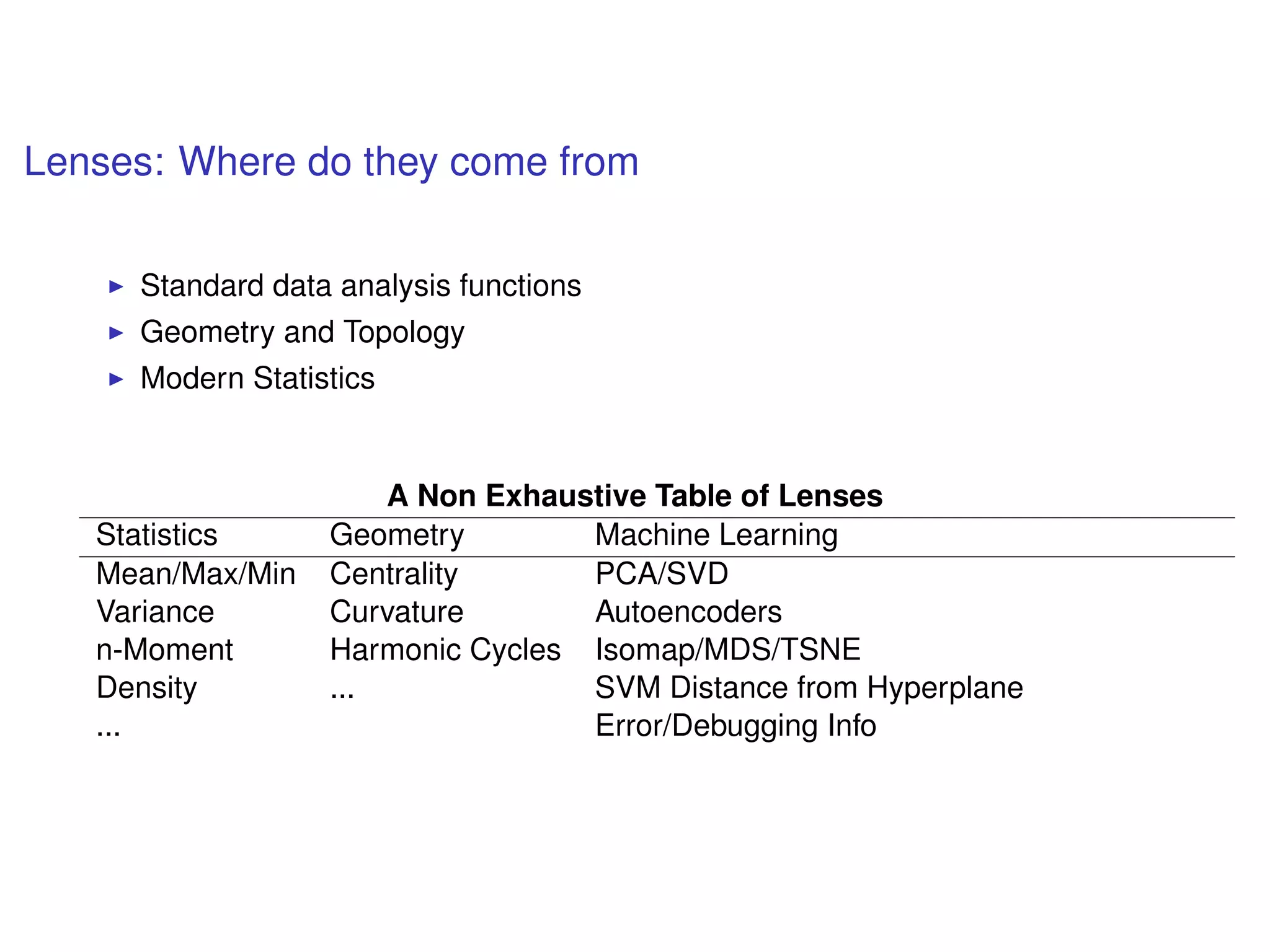
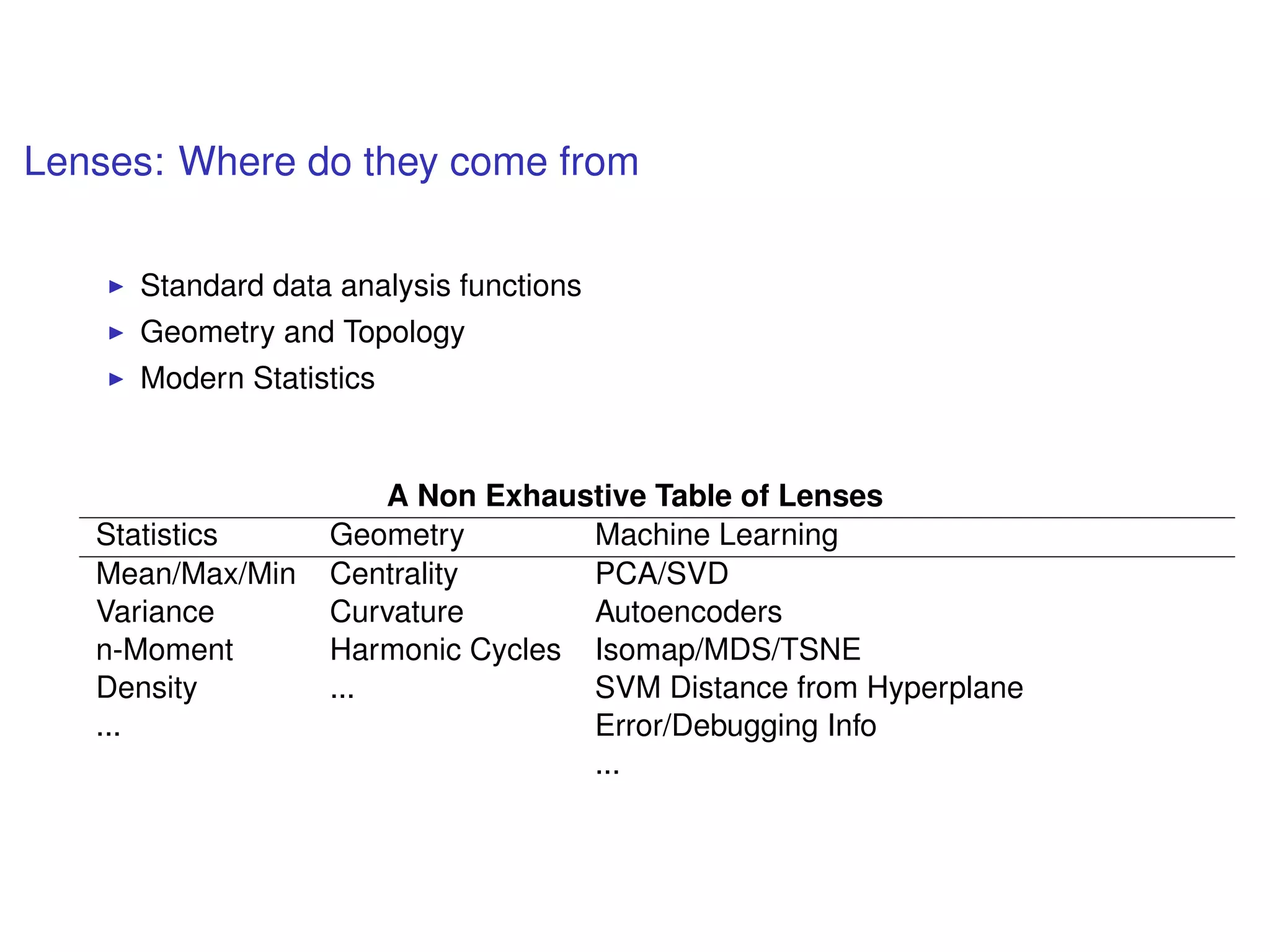
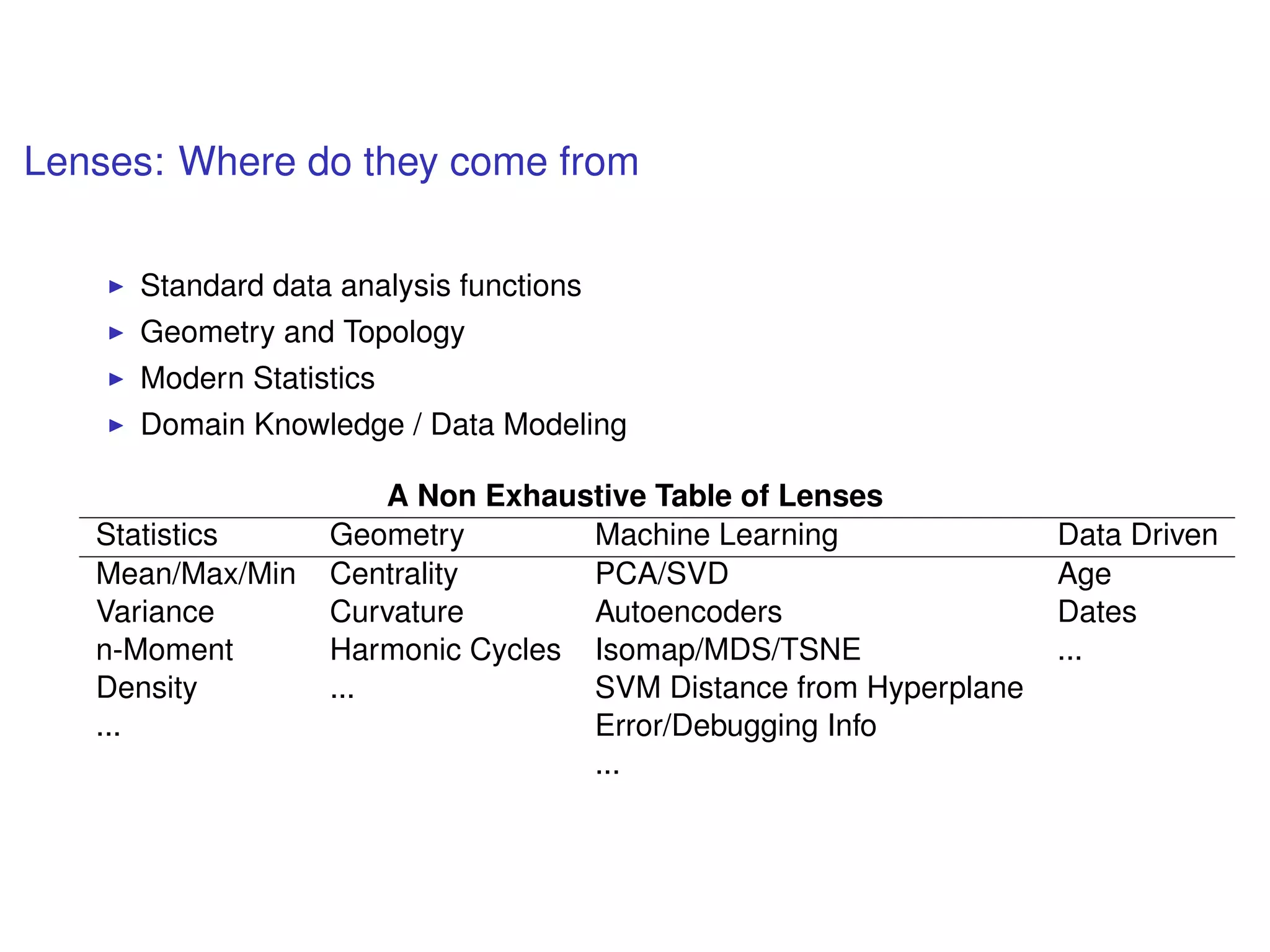
Lenses: Where do they come from
The technique rests on finding good lenses.
Lenses: Where do they come from
The technique rests on finding good lenses.
⇒ Luckily lots of people have worked on this problem
Lenses: Where do they come from
A Non Exhaustive Table of Lenses
Lenses: Where do they come from
Standard data analysis functions
A Non Exhaustive Table of Lenses
Statistics
Lenses: Where do they come from
Standard data analysis functions
A Non Exhaustive Table of Lenses
Statistics
Mean/Max/Min
Lenses: Where do they come from
Standard data analysis functions
A Non Exhaustive Table of Lenses
Statistics
Mean/Max/Min
Variance
Lenses: Where do they come from
Standard data analysis functions
A Non Exhaustive Table of Lenses
Statistics
Mean/Max/Min
Variance
n-Moment
Lenses: Where do they come from
Standard data analysis functions
A Non Exhaustive Table of Lenses
Statistics
Mean/Max/Min
Variance
n-Moment
Density
Lenses: Where do they come from
Standard data analysis functions
A Non Exhaustive Table of Lenses
Statistics
Mean/Max/Min
Variance
n-Moment
Density
...
Lenses: Where do they come from
Standard data analysis functions
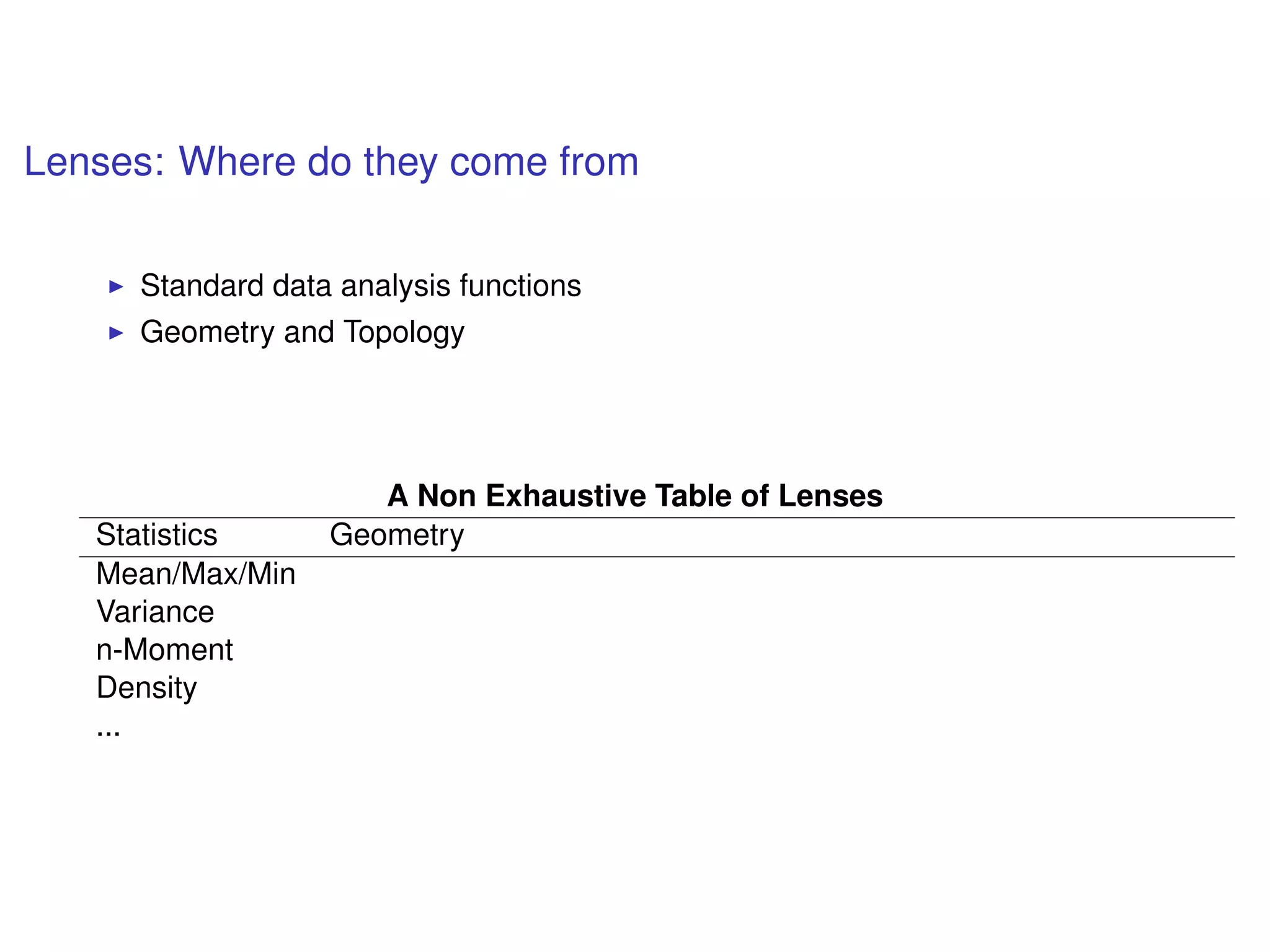
Geometry and Topology
A Non Exhaustive Table of Lenses
Statistics Geometry
Mean/Max/Min
Variance
n-Moment
Density
...
Lenses: Where do they come from
Standard data analysis functions
Geometry and Topology
A Non Exhaustive Table of Lenses
Statistics Geometry
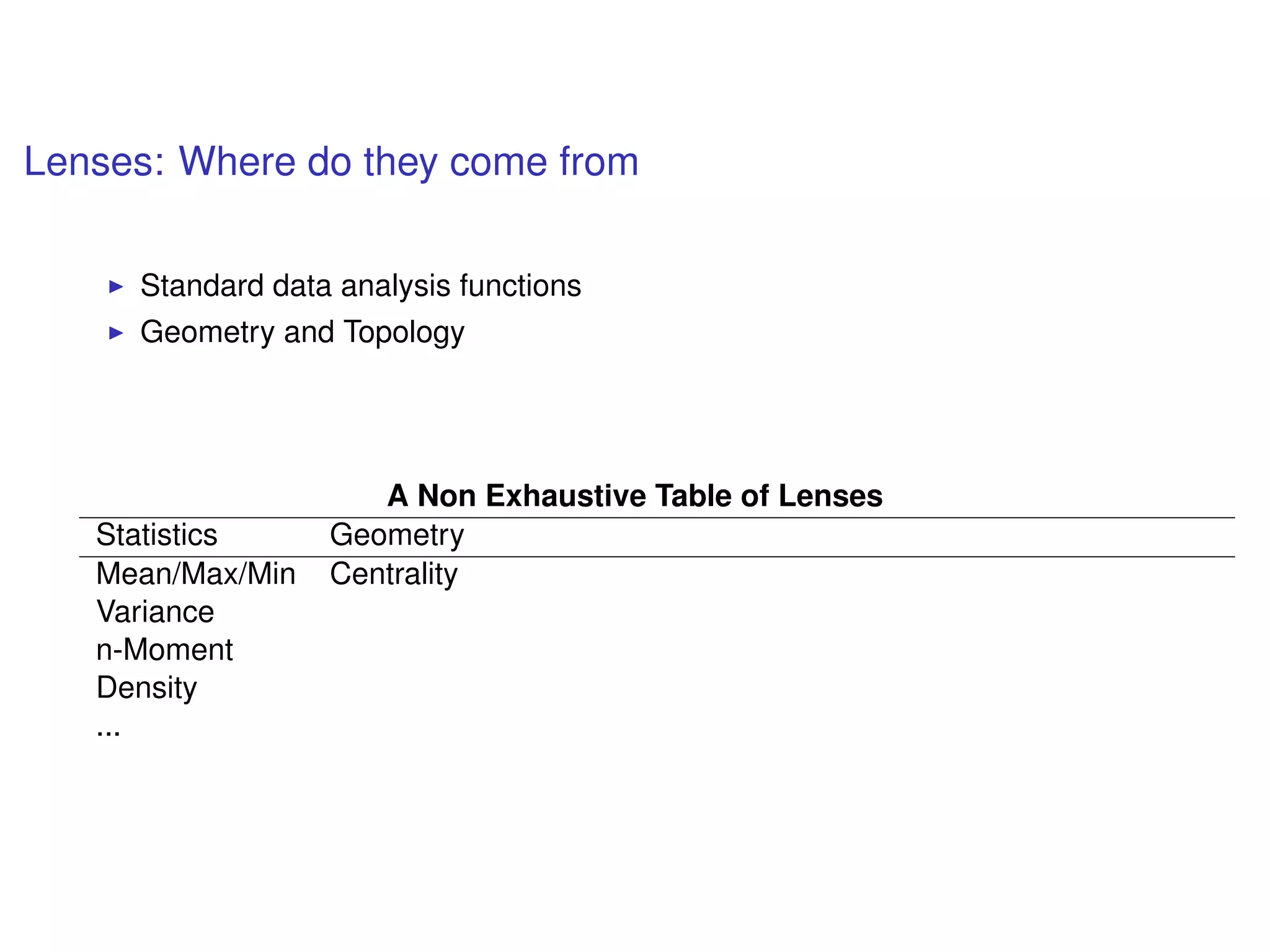
Mean/Max/Min Centrality
Variance
n-Moment
Density
...
Lenses: Where do they come from
Standard data analysis functions
Geometry and Topology
A Non Exhaustive Table of Lenses
Statistics Geometry
Mean/Max/Min Centrality
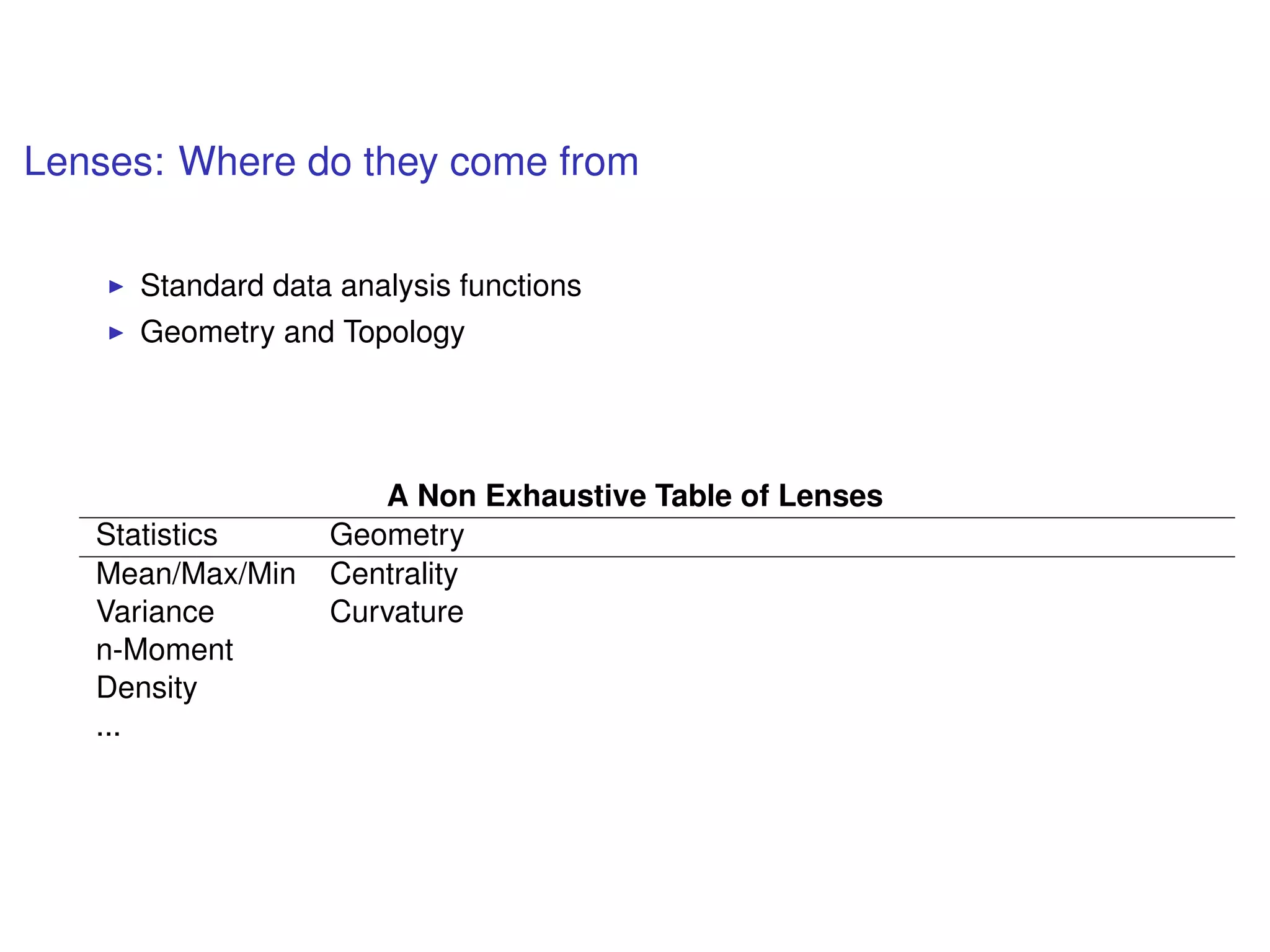
Variance Curvature
n-Moment
Density
...
Lenses: Where do they come from
Standard data analysis functions
Geometry and Topology
A Non Exhaustive Table of Lenses
Statistics Geometry
Mean/Max/Min Centrality
Variance Curvature
n-Moment Harmonic Cycles
Density
...
Lenses: Where do they come from
Standard data analysis functions
Geometry and Topology
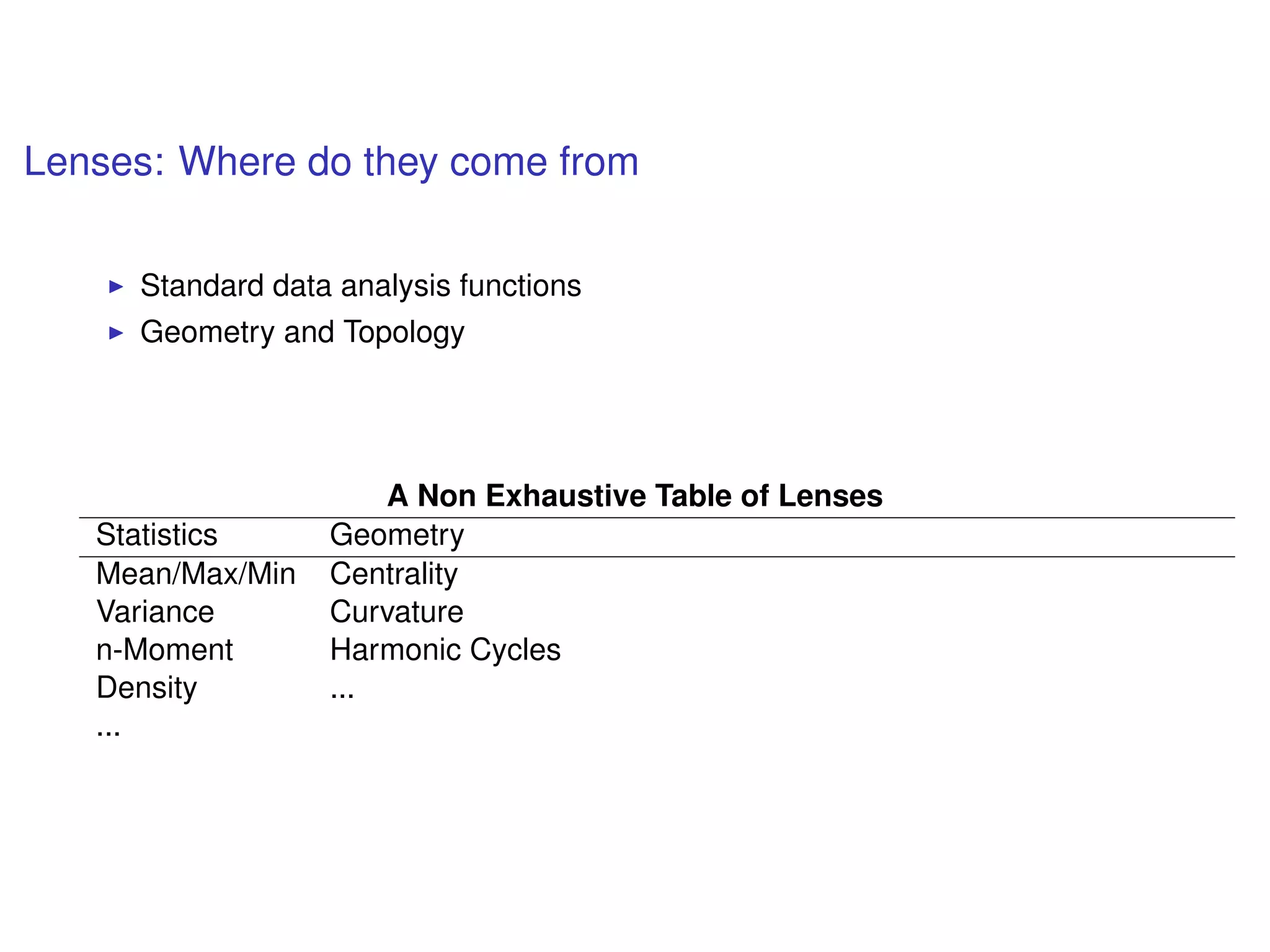
A Non Exhaustive Table of Lenses
Statistics Geometry
Mean/Max/Min Centrality
Variance Curvature
n-Moment Harmonic Cycles
Density ...
...
Lenses: Where do they come from
Standard data analysis functions
Geometry and Topology
Modern Statistics
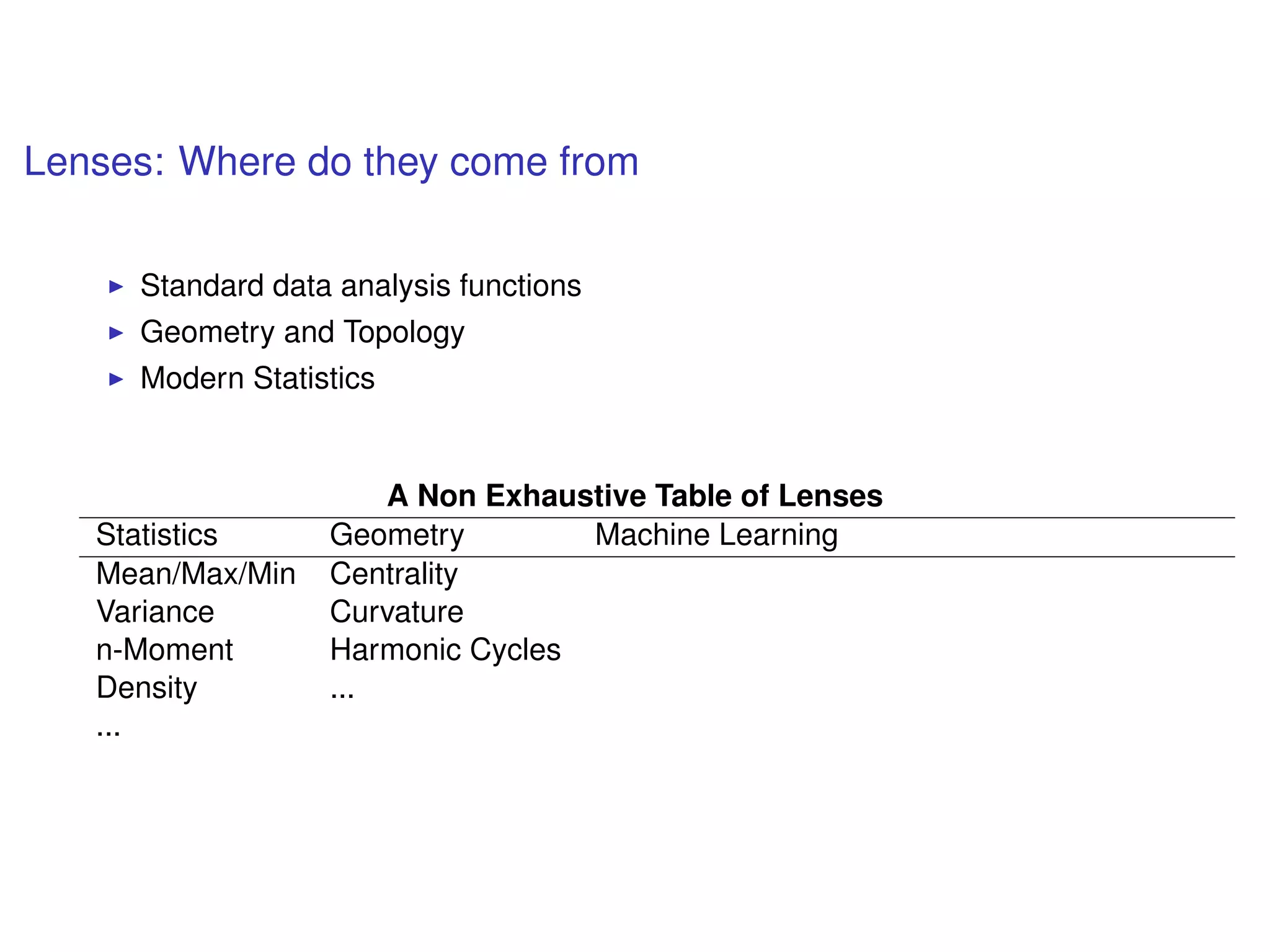
A Non Exhaustive Table of Lenses
Statistics Geometry Machine Learning
Mean/Max/Min Centrality
Variance Curvature
n-Moment Harmonic Cycles
Density ...
...
Lenses: Where do they come from
Standard data analysis functions
Geometry and Topology
Modern Statistics
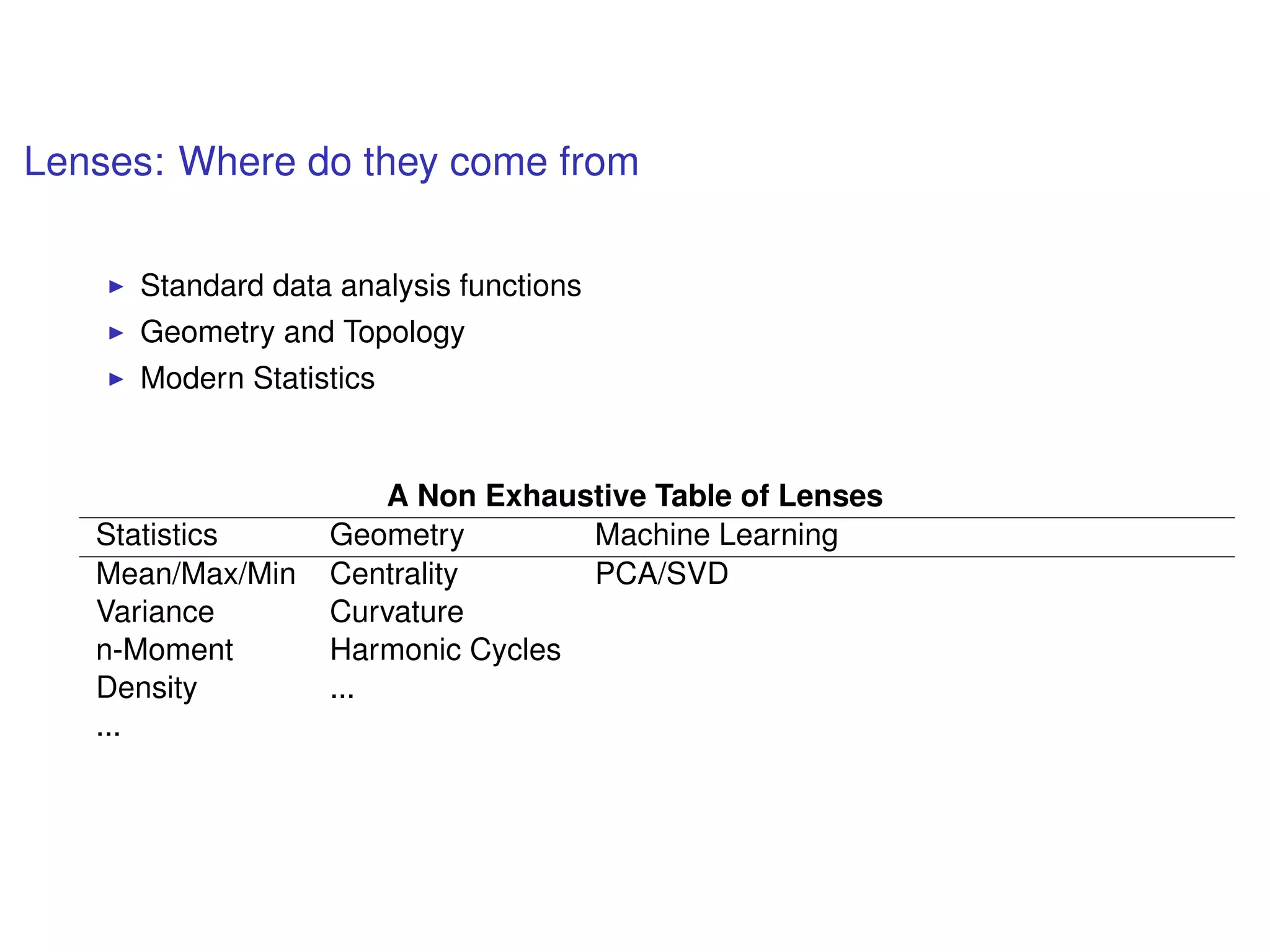
A Non Exhaustive Table of Lenses
Statistics Geometry Machine Learning
Mean/Max/Min Centrality PCA/SVD
Variance Curvature
n-Moment Harmonic Cycles
Density ...
...
Lenses: Where do they come from
Standard data analysis functions
Geometry and Topology
Modern Statistics
A Non Exhaustive Table of Lenses
Statistics Geometry Machine Learning
Mean/Max/Min Centrality PCA/SVD
Variance Curvature Autoencoders
n-Moment Harmonic Cycles
Density ...
...
Lenses: Where do they come from
Standard data analysis functions
Geometry and Topology
Modern Statistics
A Non Exhaustive Table of Lenses
Statistics Geometry Machine Learning
Mean/Max/Min Centrality PCA/SVD
Variance Curvature Autoencoders
n-Moment Harmonic Cycles Isomap/MDS/TSNE
Density ...
...
Lenses: Where do they come from
Standard data analysis functions
Geometry and Topology
Modern Statistics
A Non Exhaustive Table of Lenses
Statistics Geometry Machine Learning
Mean/Max/Min Centrality PCA/SVD
Variance Curvature Autoencoders
n-Moment Harmonic Cycles Isomap/MDS/TSNE
Density ... SVM Distance from Hyperplane
...
Lenses: Where do they come from
Standard data analysis functions
Geometry and Topology
Modern Statistics
A Non Exhaustive Table of Lenses
Statistics Geometry Machine Learning
Mean/Max/Min Centrality PCA/SVD
Variance Curvature Autoencoders
n-Moment Harmonic Cycles Isomap/MDS/TSNE
Density ... SVM Distance from Hyperplane
... Error/Debugging Info
Lenses: Where do they come from
Standard data analysis functions
Geometry and Topology
Modern Statistics
A Non Exhaustive Table of Lenses
Statistics Geometry Machine Learning
Mean/Max/Min Centrality PCA/SVD
Variance Curvature Autoencoders
n-Moment Harmonic Cycles Isomap/MDS/TSNE
Density ... SVM Distance from Hyperplane
... Error/Debugging Info
...
Lenses: Where do they come from
Standard data analysis functions
Geometry and Topology
Modern Statistics
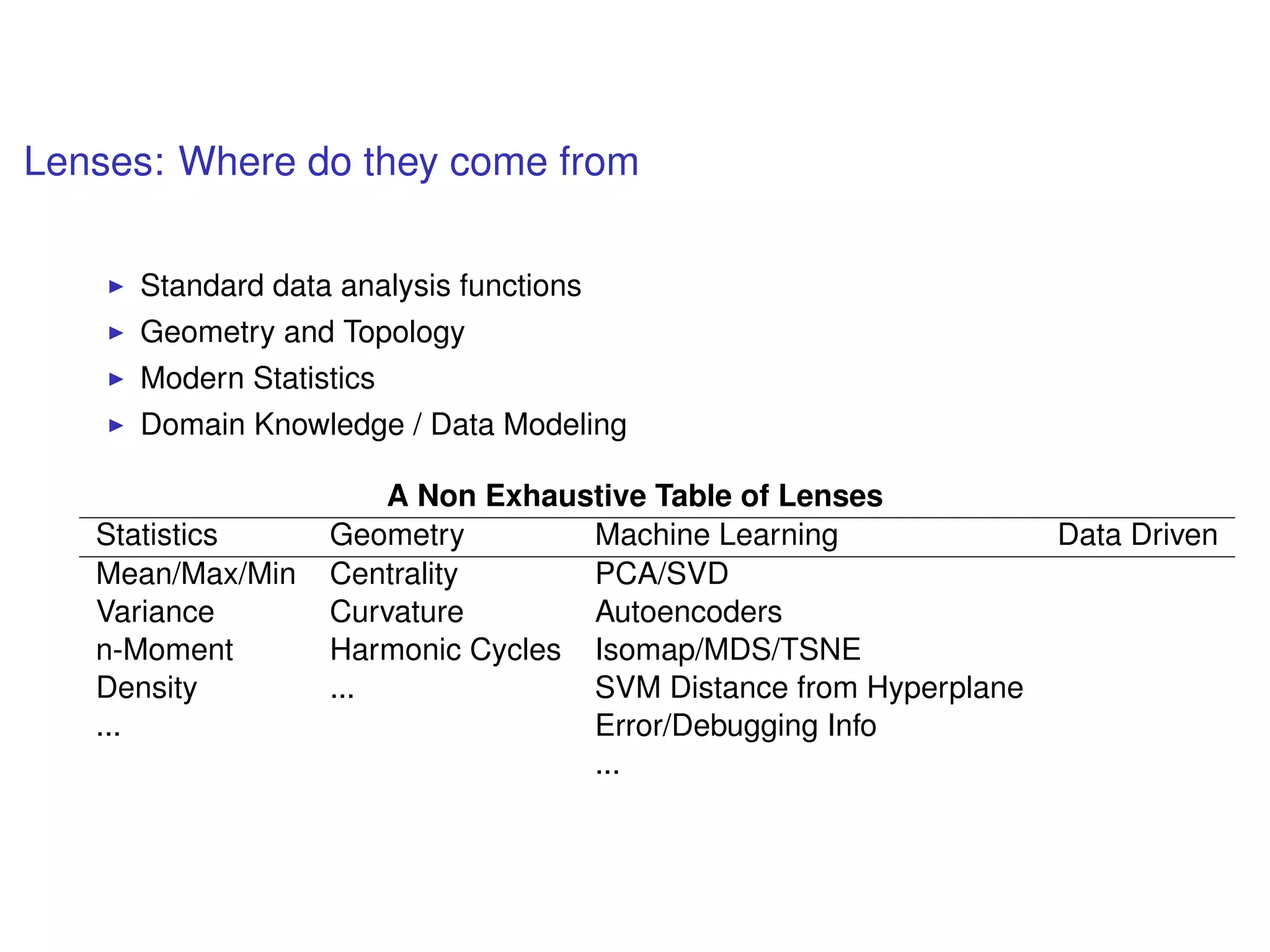
Domain Knowledge / Data Modeling
A Non Exhaustive Table of Lenses
Statistics Geometry Machine Learning Data Driven
Mean/Max/Min Centrality PCA/SVD
Variance Curvature Autoencoders
n-Moment Harmonic Cycles Isomap/MDS/TSNE
Density ... SVM Distance from Hyperplane
... Error/Debugging Info
...
Lenses: Where do they come from
Standard data analysis functions
Geometry and Topology
Modern Statistics
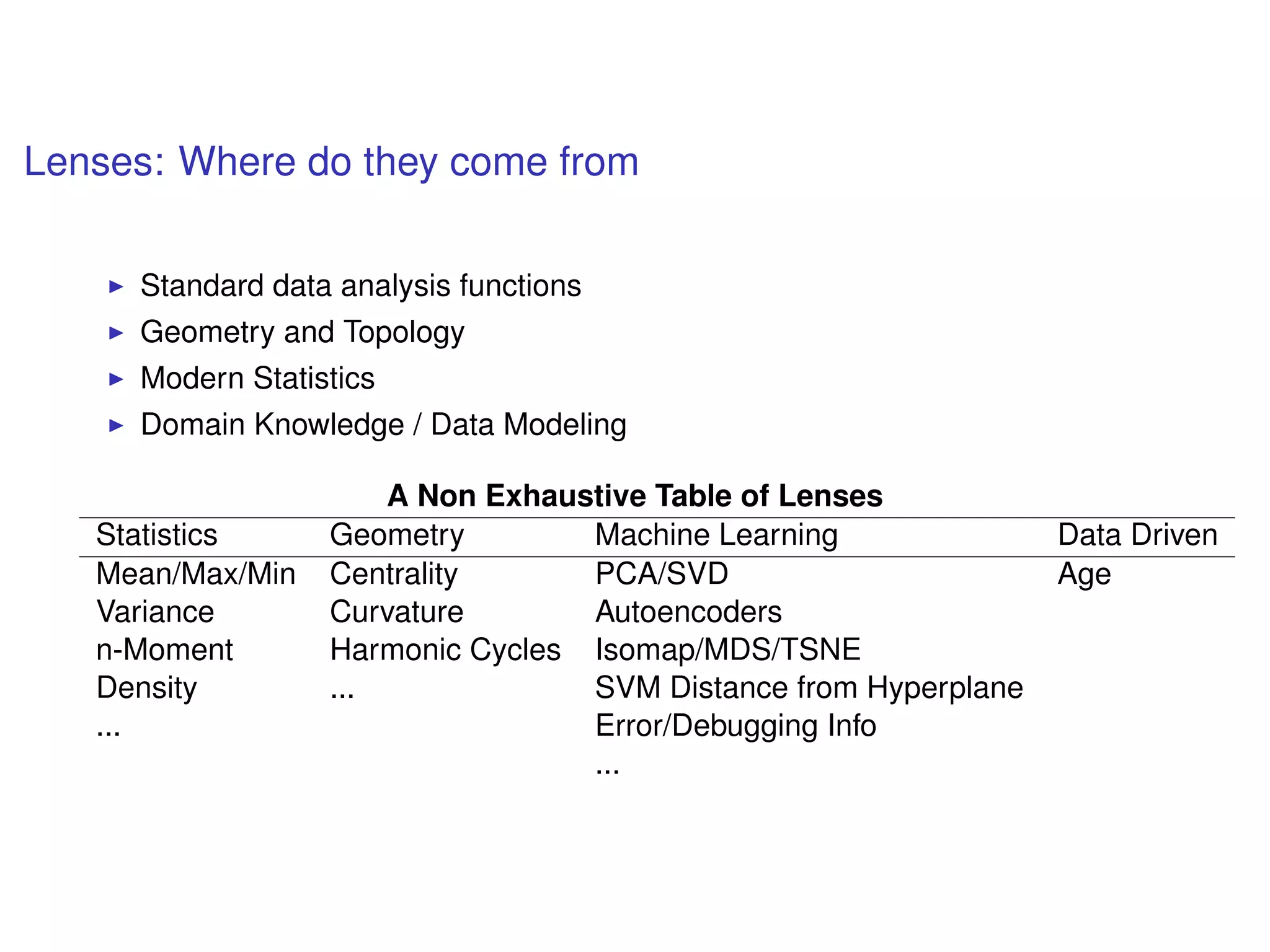
Domain Knowledge / Data Modeling
A Non Exhaustive Table of Lenses
Statistics Geometry Machine Learning Data Driven
Mean/Max/Min Centrality PCA/SVD Age
Variance Curvature Autoencoders
n-Moment Harmonic Cycles Isomap/MDS/TSNE
Density ... SVM Distance from Hyperplane
... Error/Debugging Info
...
Lenses: Where do they come from
Standard data analysis functions
Geometry and Topology
Modern Statistics
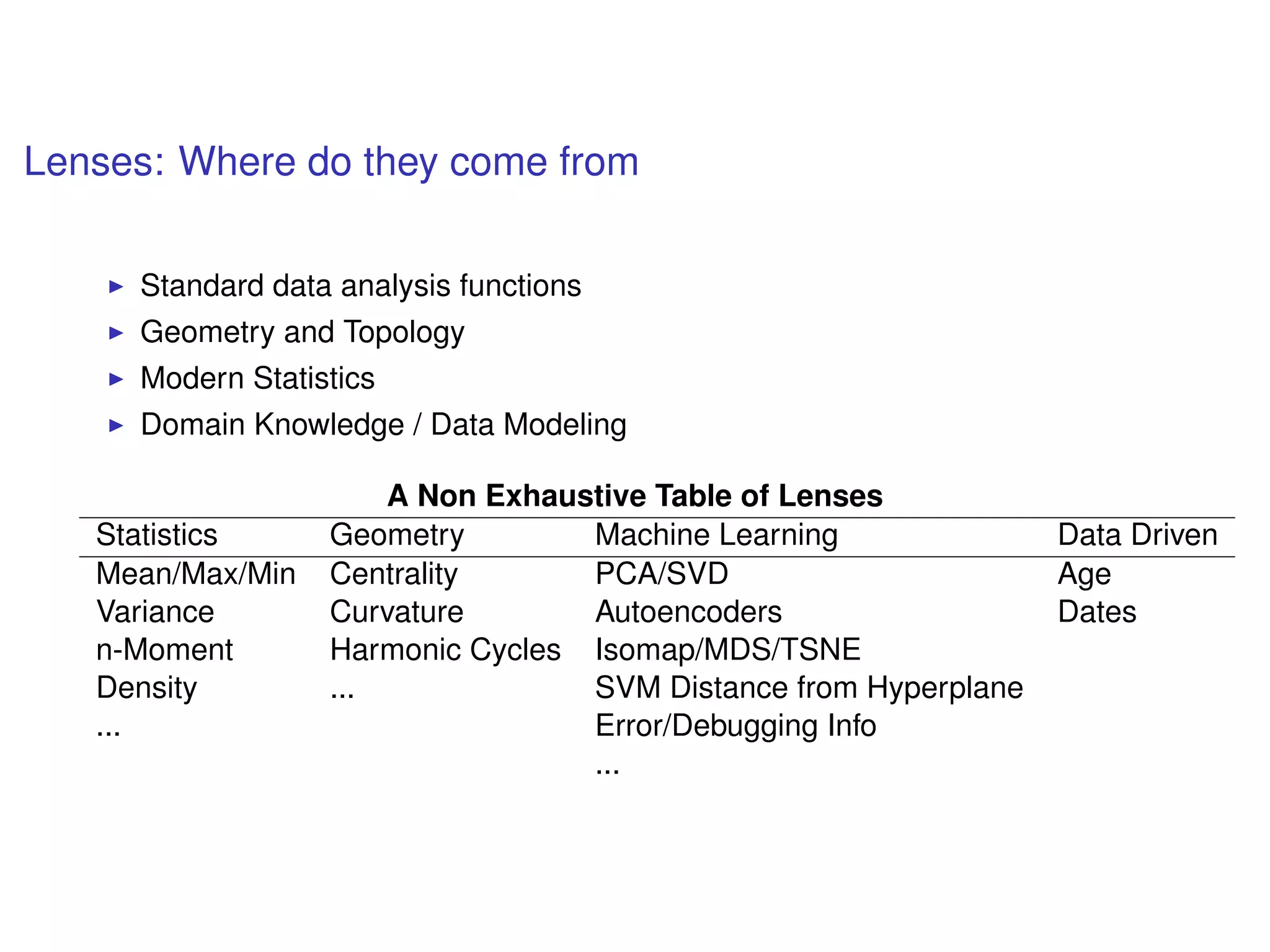
Domain Knowledge / Data Modeling
A Non Exhaustive Table of Lenses
Statistics Geometry Machine Learning Data Driven
Mean/Max/Min Centrality PCA/SVD Age
Variance Curvature Autoencoders Dates
n-Moment Harmonic Cycles Isomap/MDS/TSNE
Density ... SVM Distance from Hyperplane
... Error/Debugging Info
...
Lenses: Where do they come from
Standard data analysis functions
Geometry and Topology
Modern Statistics
Domain Knowledge / Data Modeling
A Non Exhaustive Table of Lenses
Statistics Geometry Machine Learning Data Driven
Mean/Max/Min Centrality PCA/SVD Age
Variance Curvature Autoencoders Dates
n-Moment Harmonic Cycles Isomap/MDS/TSNE ...
Density ... SVM Distance from Hyperplane
... Error/Debugging Info
...
Interperability and Meaning
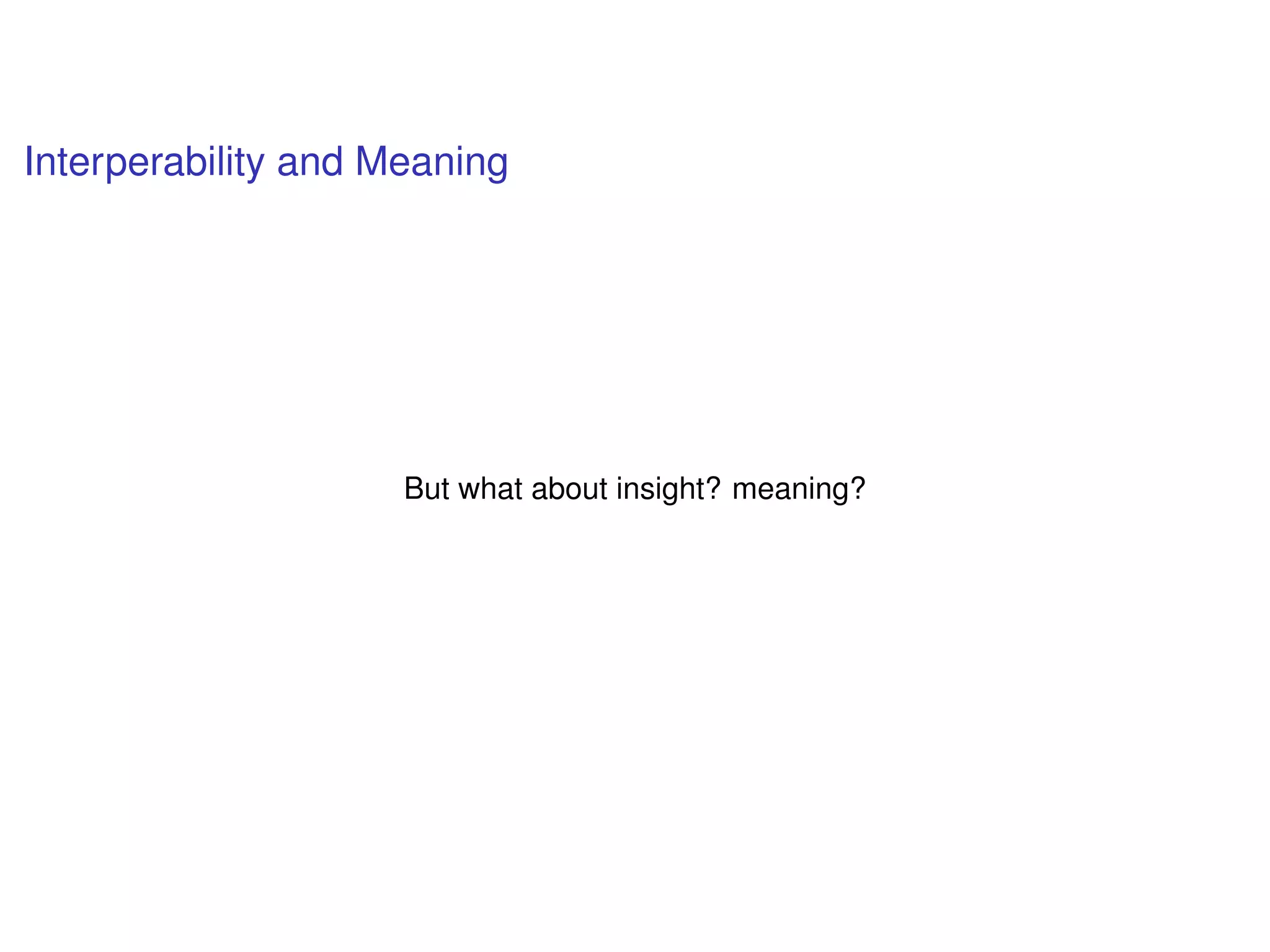
But what about insight? meaning?
Interperability and Meaning
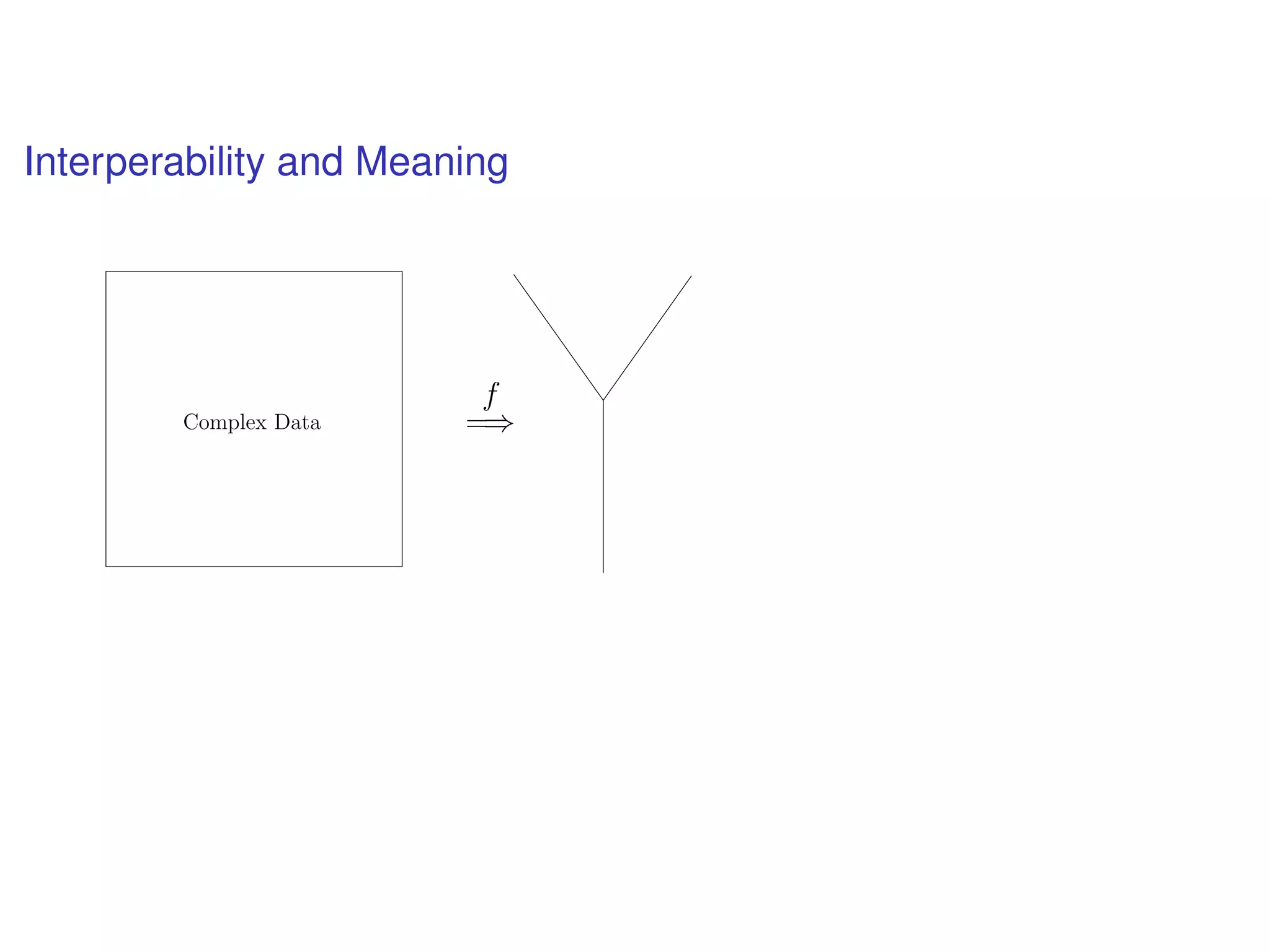
f
=⇒Complex Data
Interperability and Meaning
f
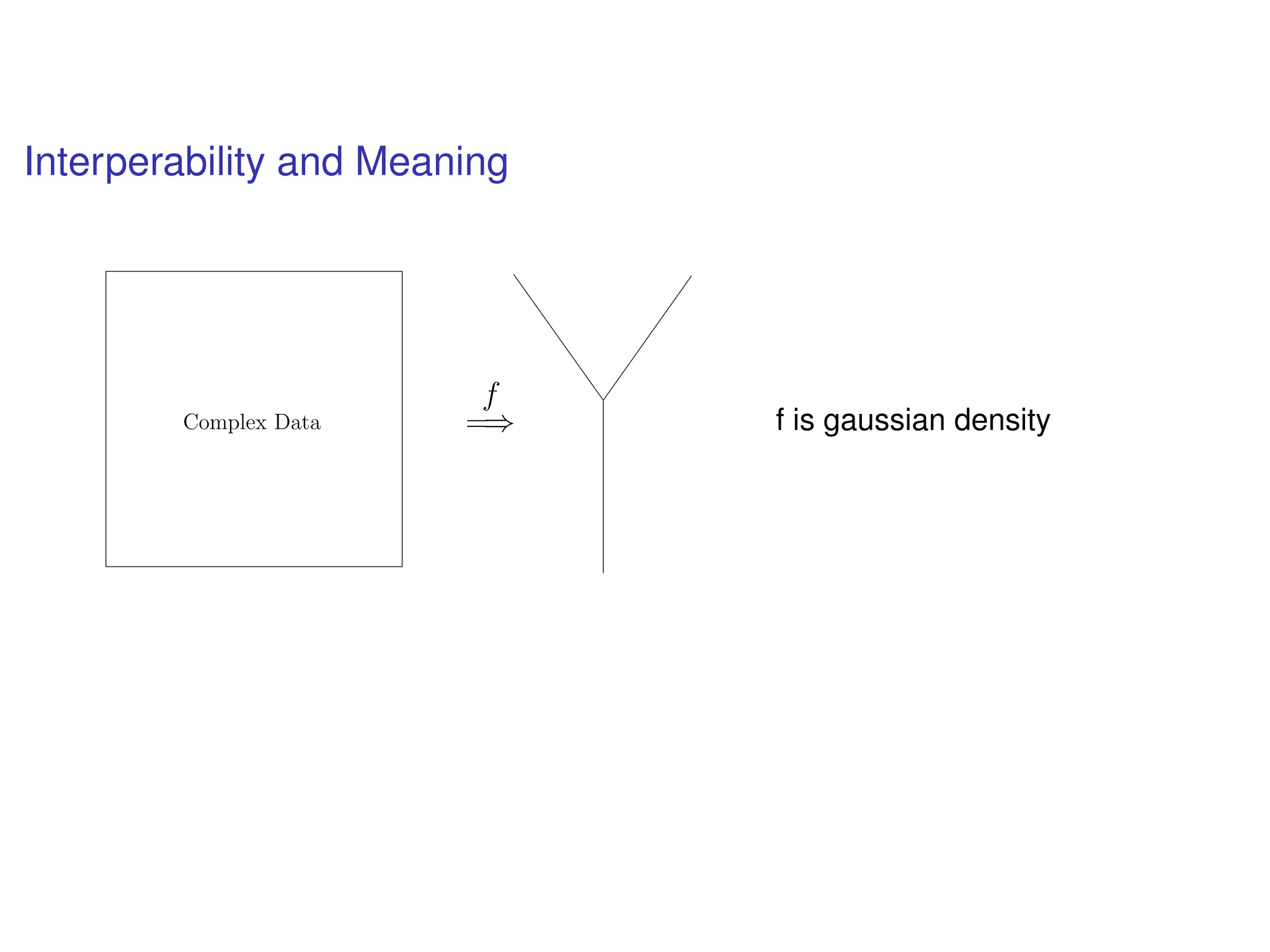
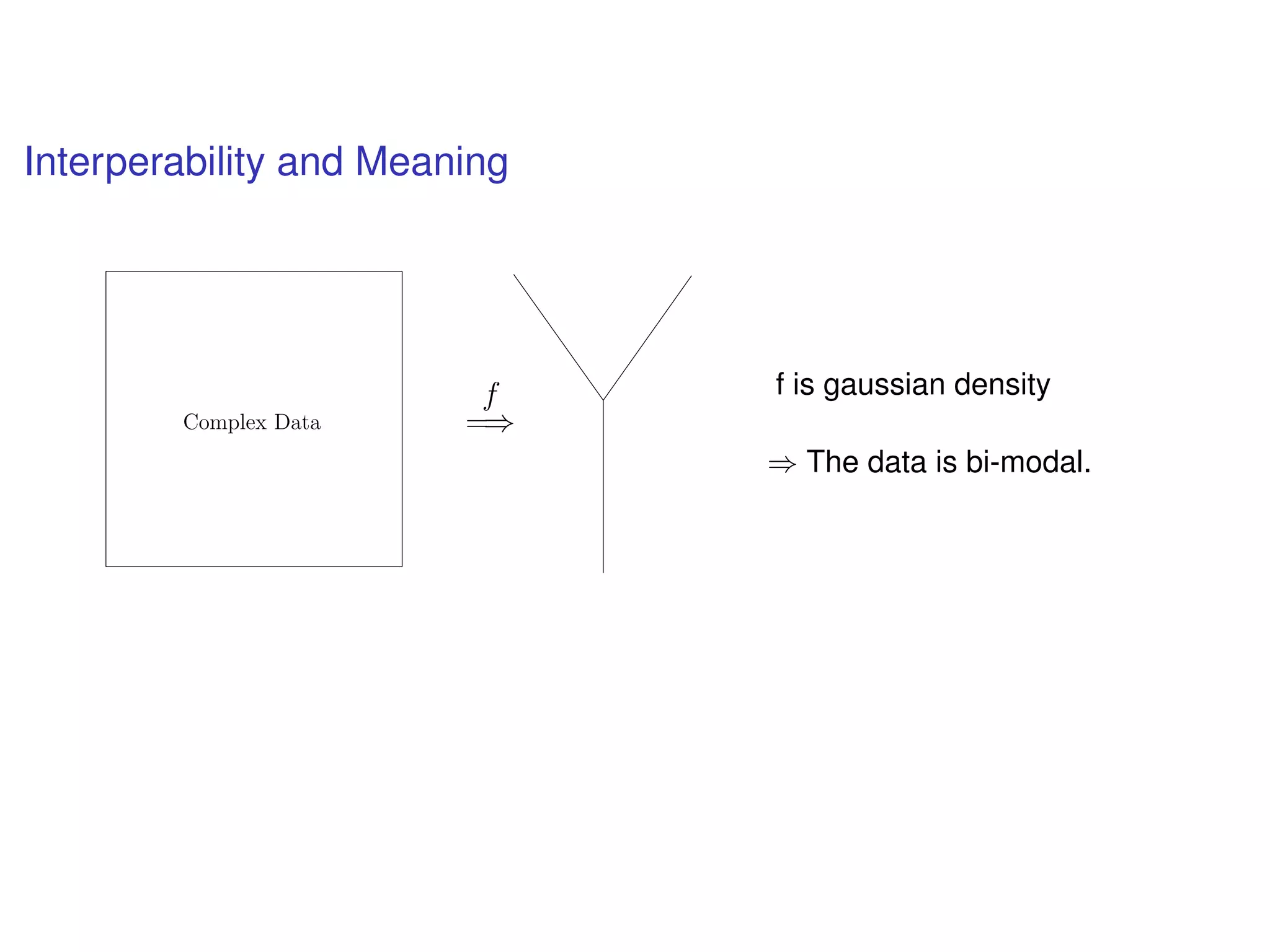
=⇒Complex Data f is gaussian density
Interperability and Meaning
f
=⇒Complex Data
f is gaussian density
⇒ The data is bi-modal.
Interperability and Meaning
f
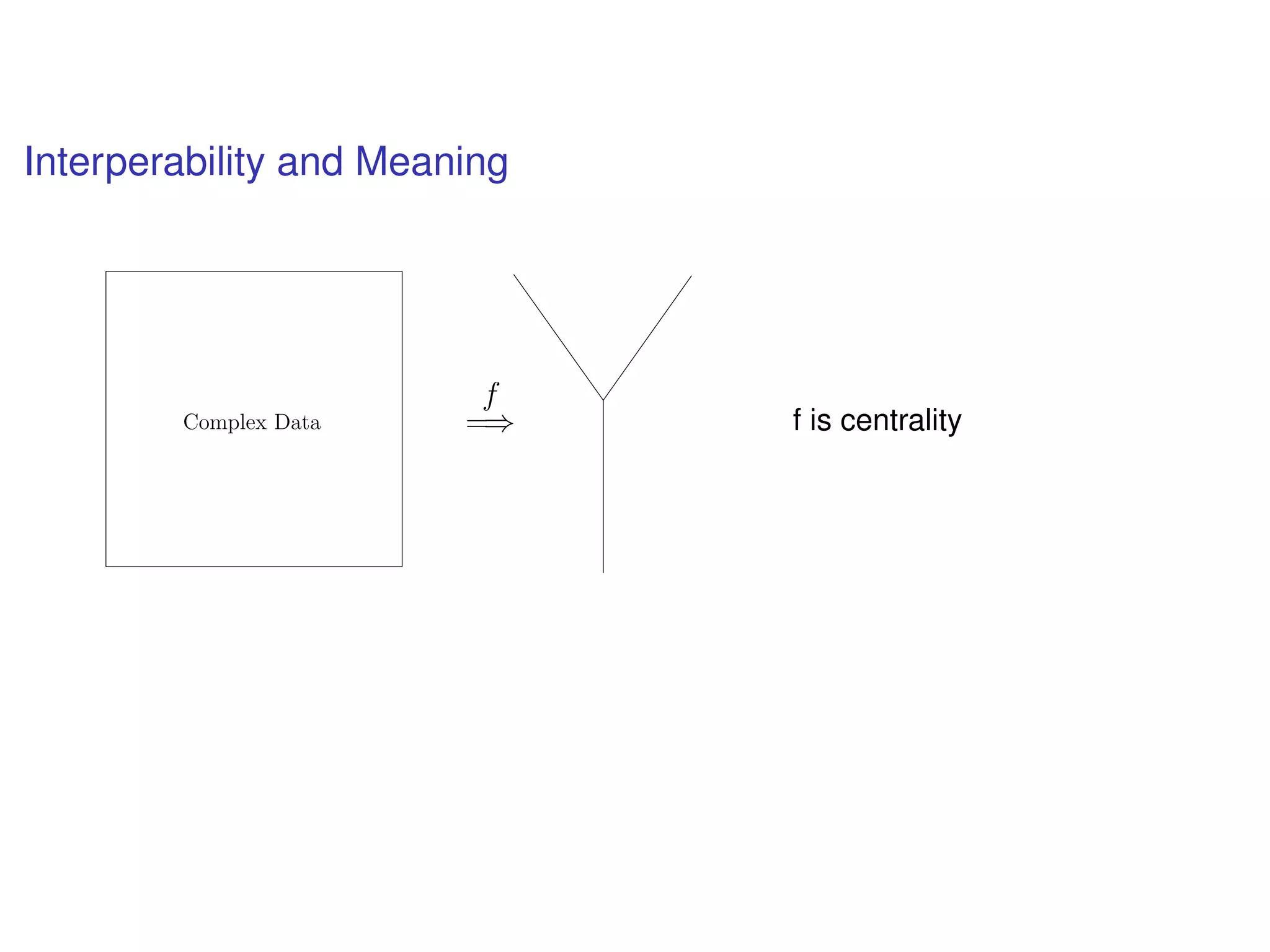
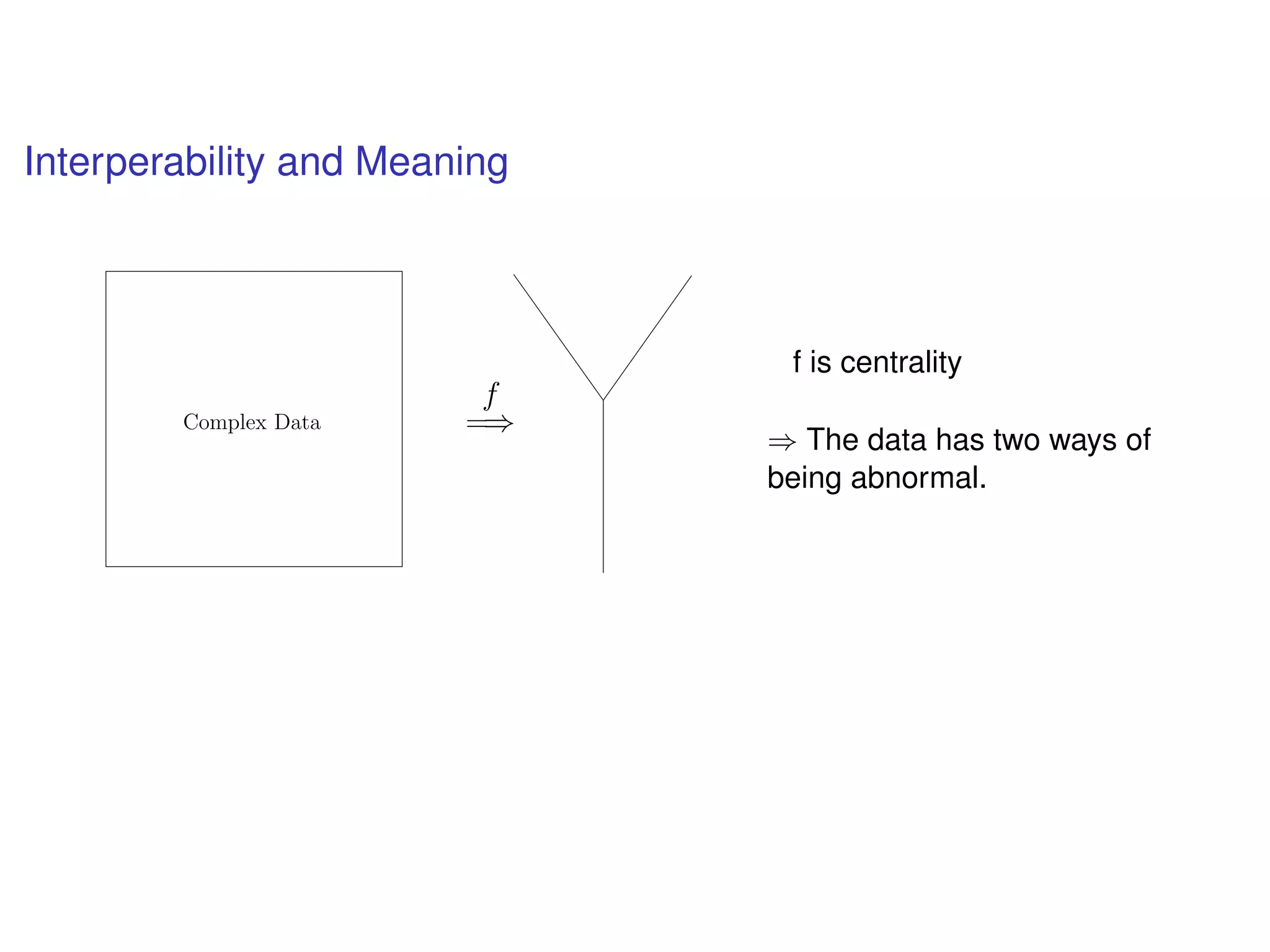
=⇒Complex Data f is centrality
Interperability and Meaning
f
=⇒Complex Data
f is centrality
⇒ The data has two ways of
being abnormal.
Interperability and Meaning
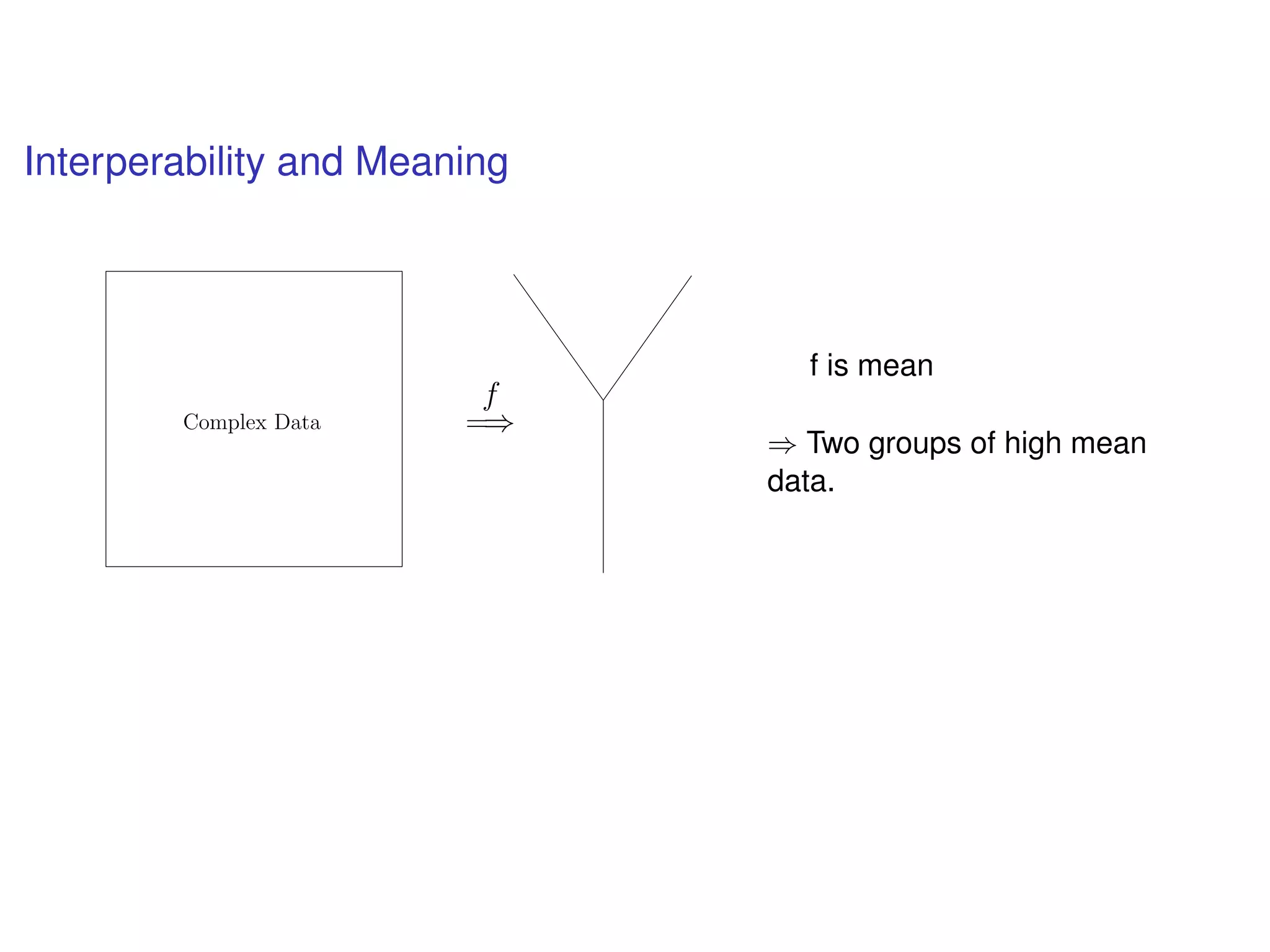
f
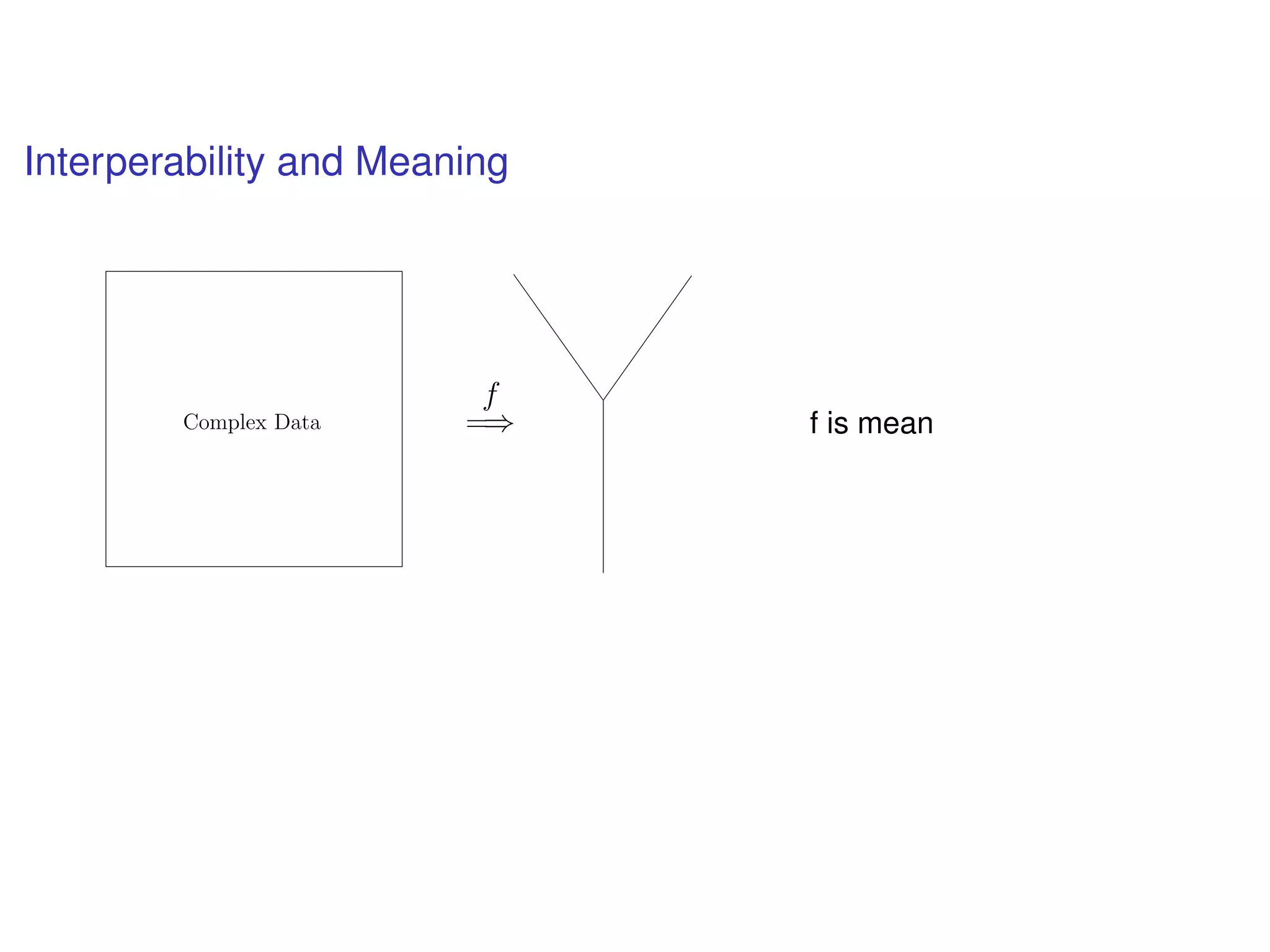
=⇒Complex Data f is mean
Interperability and Meaning
f
=⇒Complex Data
f is mean
⇒ Two groups of high mean
data.
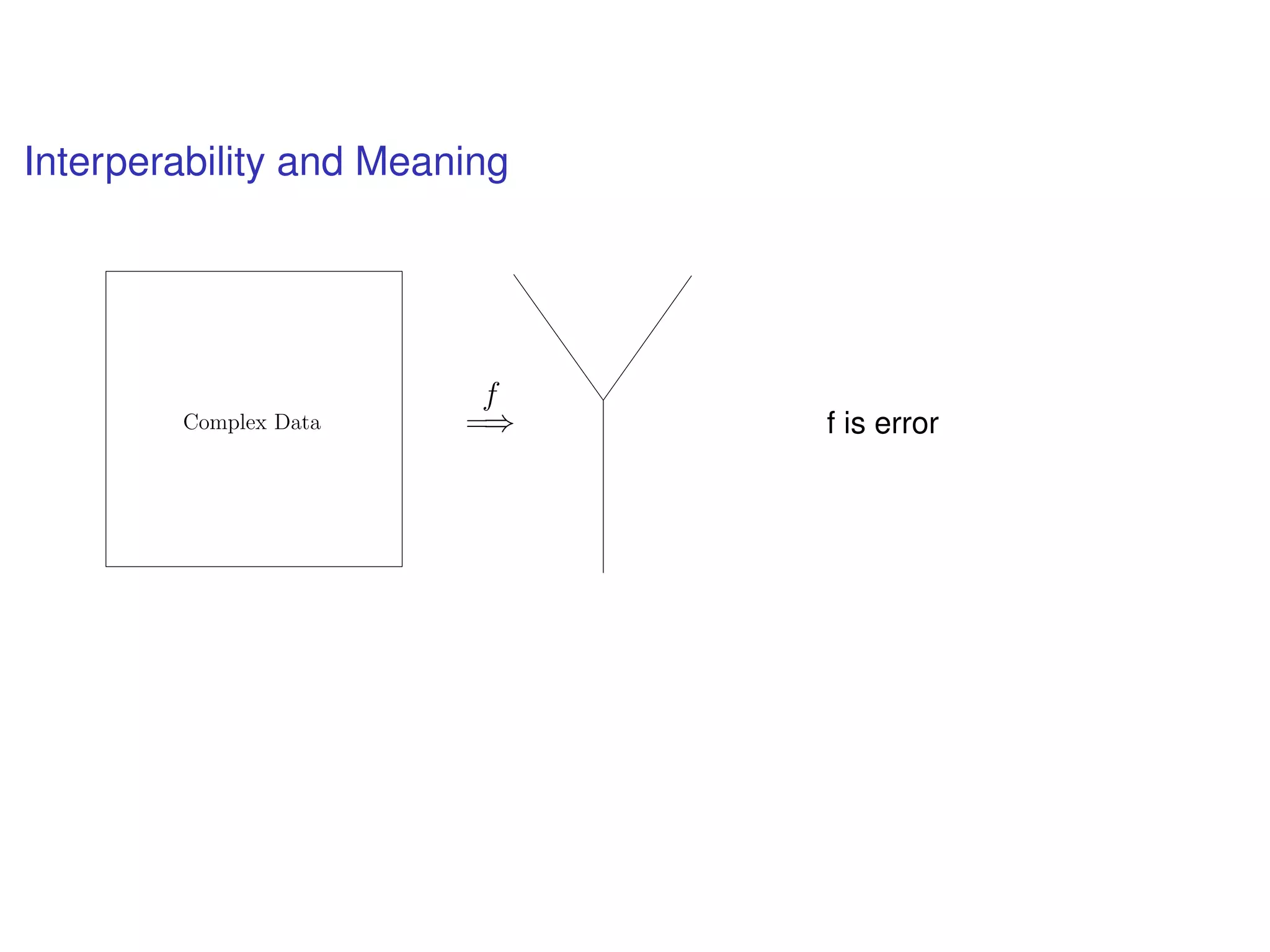
Interperability and Meaning
f
=⇒Complex Data f is error
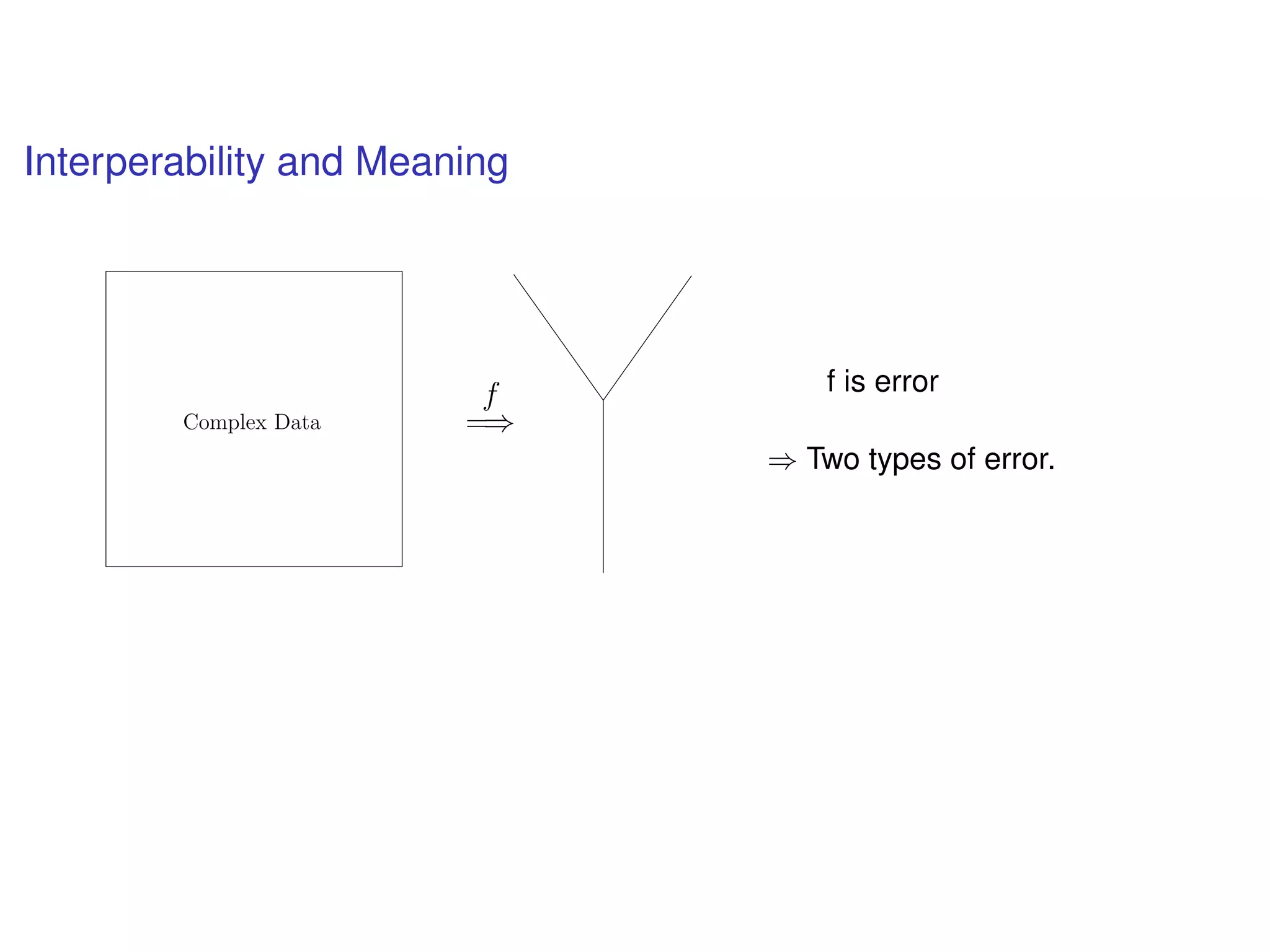
Interperability and Meaning
f
=⇒Complex Data
f is error
⇒ Two types of error.
Interperability and Meaning
f
=⇒Complex Data
f is error
⇒ Two types of error.
The units on the lens give interperability/meaning to the topological summary.
Interperability and Meaning
Another way to think about lenses is as a kind of ’geometric query’.
Examples
Interperability and Meaning
Another way to think about lenses is as a kind of ’geometric query’.
Examples
1. Heart disease study
Interperability and Meaning
Another way to think about lenses is as a kind of ’geometric query’.
Examples
1. Heart disease study
Stratification by age without making arbitrary cutoffs.
Interperability and Meaning
Another way to think about lenses is as a kind of ’geometric query’.
Examples
1. Heart disease study
Stratification by age without making arbitrary cutoffs.
2. Heavy machinery
Interperability and Meaning
Another way to think about lenses is as a kind of ’geometric query’.
Examples
1. Heart disease study
Stratification by age without making arbitrary cutoffs.
2. Heavy machinery
Use mean a variance as a lens to find what operating regimes lead to failure of
mechanical components.
Some generalizations and extensions
Metrics
Some generalizations and extensions
Metrics
We don’t need a metric, just a notion of similarity - or perhaps a clustering
mechanism.
Some generalizations and extensions
Metrics
We don’t need a metric, just a notion of similarity - or perhaps a clustering
mechanism.
Lenses
Some generalizations and extensions
Metrics
We don’t need a metric, just a notion of similarity - or perhaps a clustering
mechanism.
Lenses
Lenses don’t need to be continuous - just "sensible".
Some generalizations and extensions
Metrics
We don’t need a metric, just a notion of similarity - or perhaps a clustering
mechanism.
Lenses
Lenses don’t need to be continuous - just "sensible".
We can use multiple lenses at the same time.
Some generalizations and extensions
Metrics
We don’t need a metric, just a notion of similarity - or perhaps a clustering
mechanism.
Lenses
Lenses don’t need to be continuous - just "sensible".
We can use multiple lenses at the same time.
Lenses can map to space other then R.
Some generalizations and extensions
Metrics
We don’t need a metric, just a notion of similarity - or perhaps a clustering
mechanism.
Lenses
Lenses don’t need to be continuous - just "sensible".
We can use multiple lenses at the same time.
Lenses can map to space other then R.
In fact, can work with "open covers" of the space (Here taken to mean
overlapping partitions). Don’t need a lens at all.
Some generalizations and extensions
Metrics
We don’t need a metric, just a notion of similarity - or perhaps a clustering
mechanism.
Lenses
Lenses don’t need to be continuous - just "sensible".
We can use multiple lenses at the same time.
Lenses can map to space other then R.
In fact, can work with "open covers" of the space (Here taken to mean
overlapping partitions). Don’t need a lens at all.
Data
Some generalizations and extensions
Metrics
We don’t need a metric, just a notion of similarity - or perhaps a clustering
mechanism.
Lenses
Lenses don’t need to be continuous - just "sensible".
We can use multiple lenses at the same time.
Lenses can map to space other then R.
In fact, can work with "open covers" of the space (Here taken to mean
overlapping partitions). Don’t need a lens at all.
Data
Input space can be anything with a topology. Typically we work with
row/column numeric/categorical data but, for example, graphs are ok.
Some generalizations and extensions
Metrics
We don’t need a metric, just a notion of similarity - or perhaps a clustering
mechanism.
Lenses
Lenses don’t need to be continuous - just "sensible".
We can use multiple lenses at the same time.
Lenses can map to space other then R.
In fact, can work with "open covers" of the space (Here taken to mean
overlapping partitions). Don’t need a lens at all.
Data
Input space can be anything with a topology. Typically we work with
row/column numeric/categorical data but, for example, graphs are ok.
Output
Some generalizations and extensions
Metrics
We don’t need a metric, just a notion of similarity - or perhaps a clustering
mechanism.
Lenses
Lenses don’t need to be continuous - just "sensible".
We can use multiple lenses at the same time.
Lenses can map to space other then R.
In fact, can work with "open covers" of the space (Here taken to mean
overlapping partitions). Don’t need a lens at all.
Data
Input space can be anything with a topology. Typically we work with
row/column numeric/categorical data but, for example, graphs are ok.
Output
The output of the algorithm isn’t just a graph but is an abstract simplicial
complex (swept under the rug in this presentation).
Demo
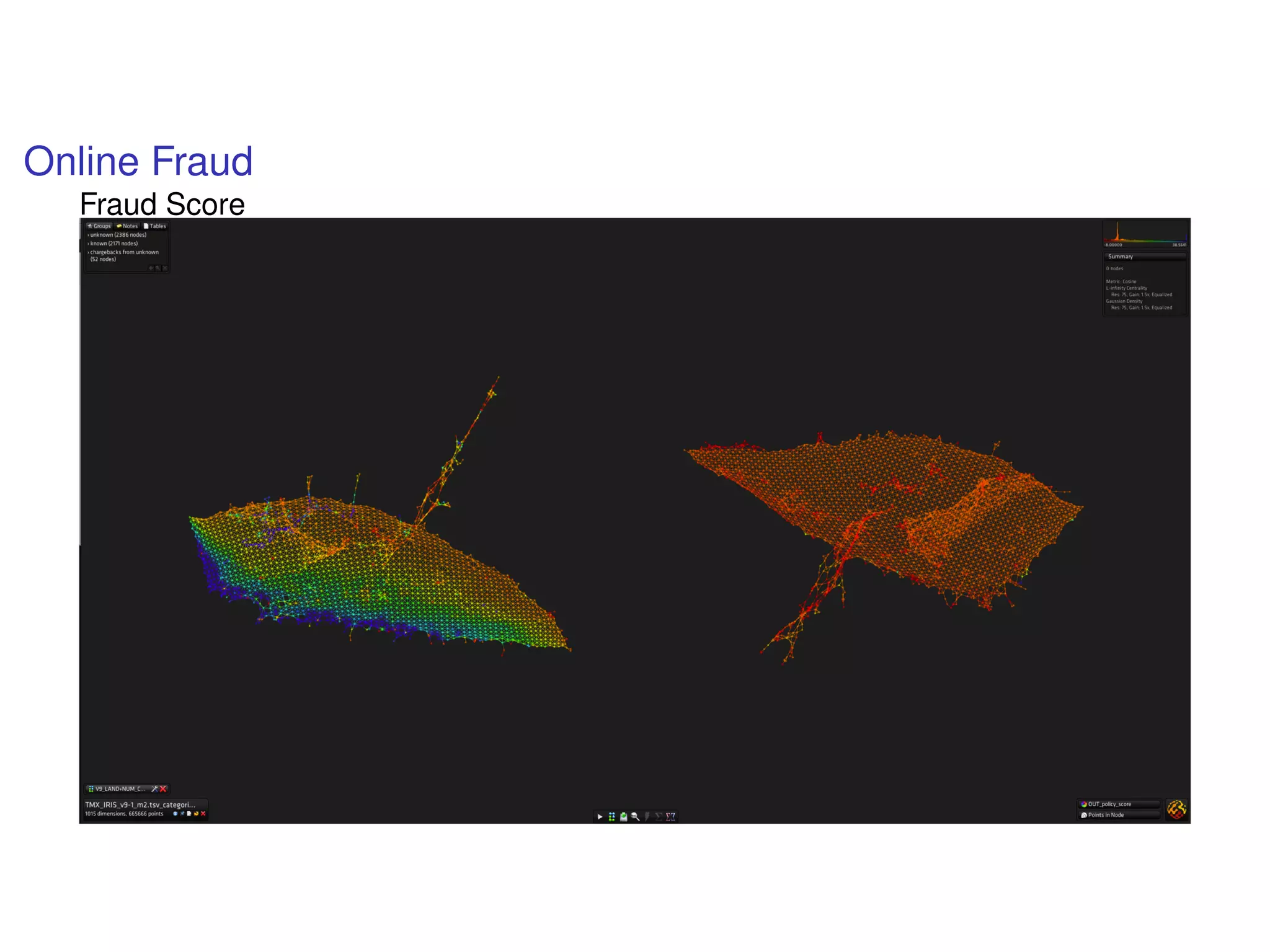
Online Fraud
Fraud Score
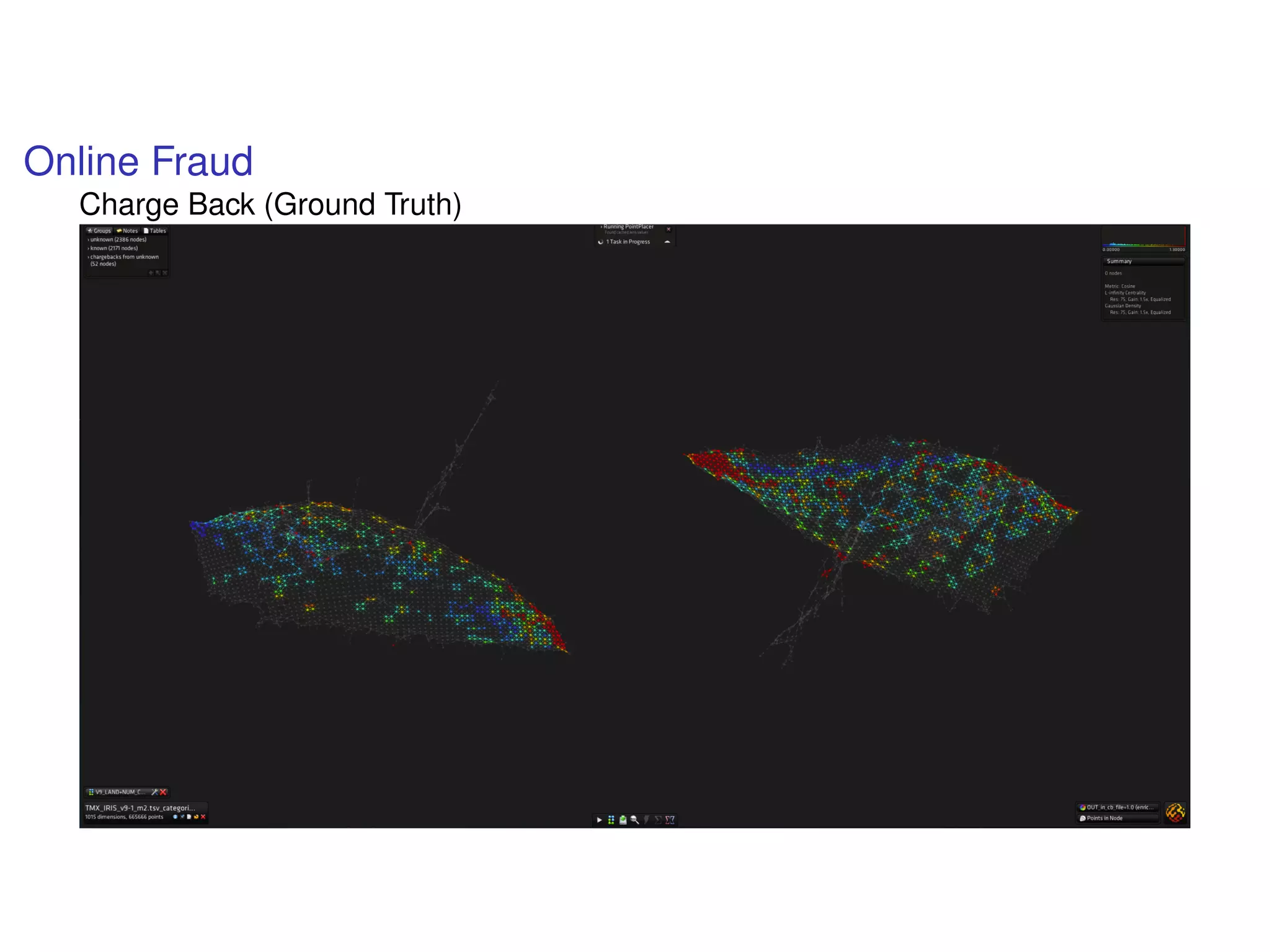
Online Fraud
Charge Back (Ground Truth)
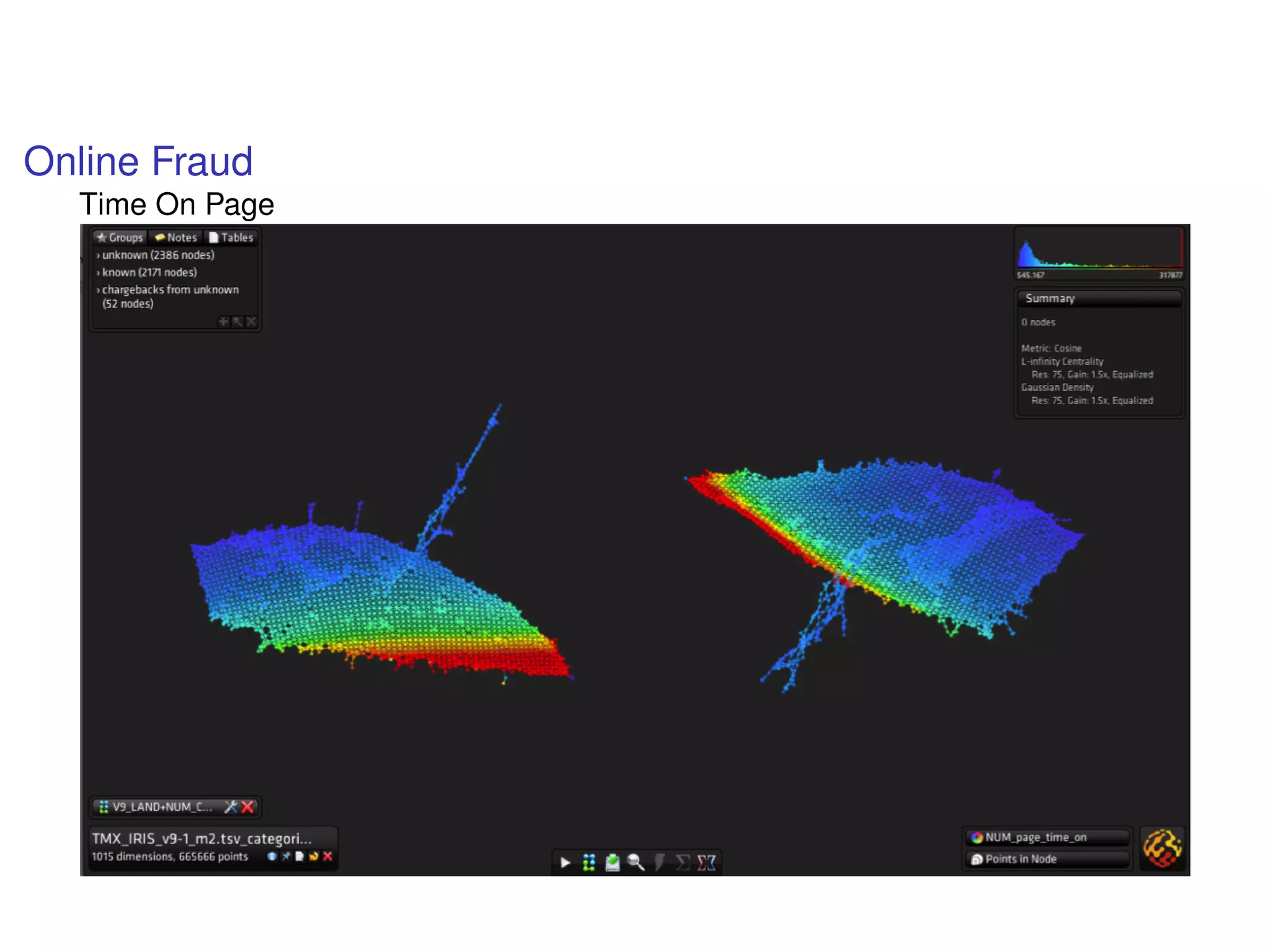
Online Fraud
Time On Page
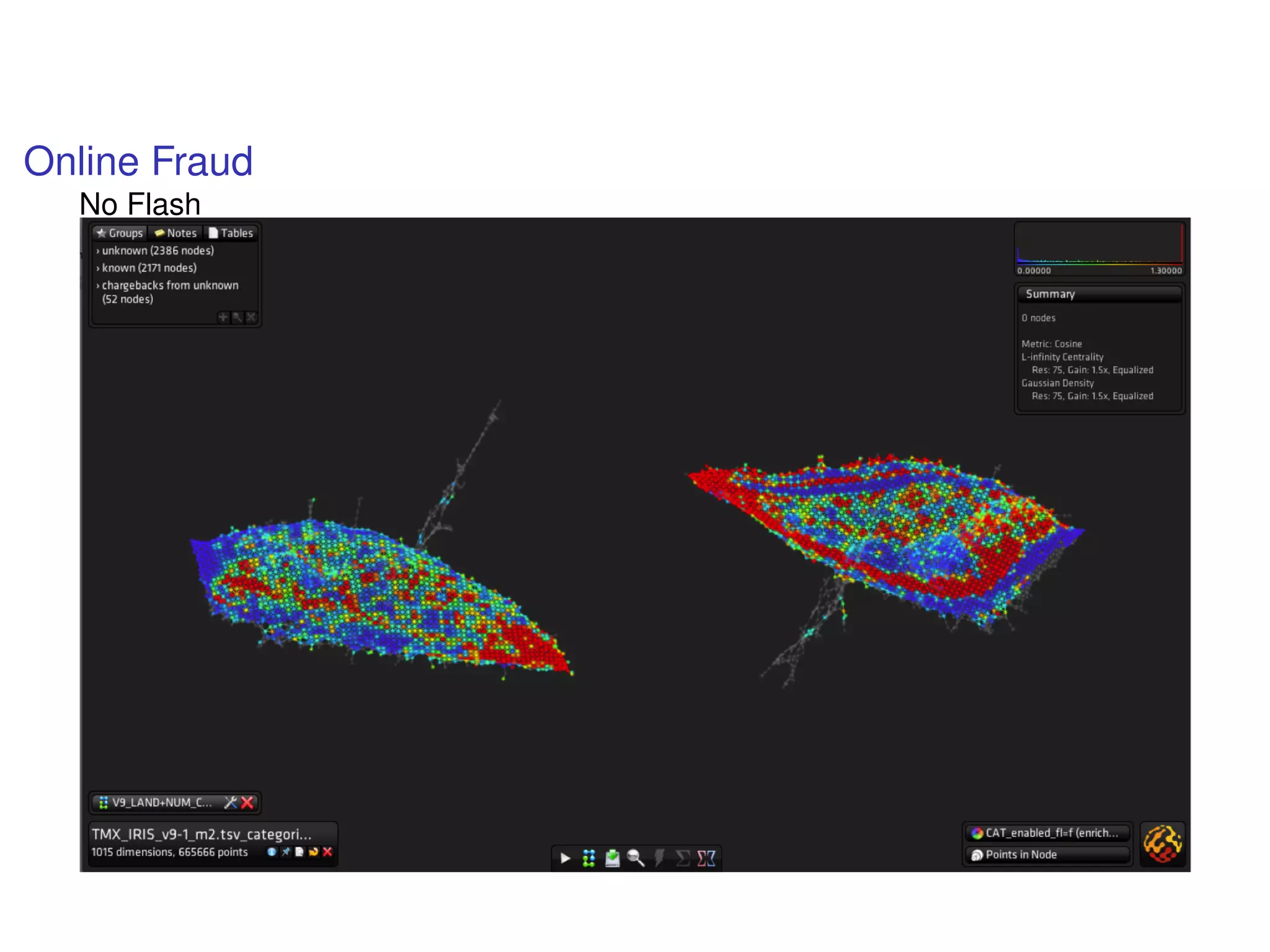
Online Fraud
No Flash
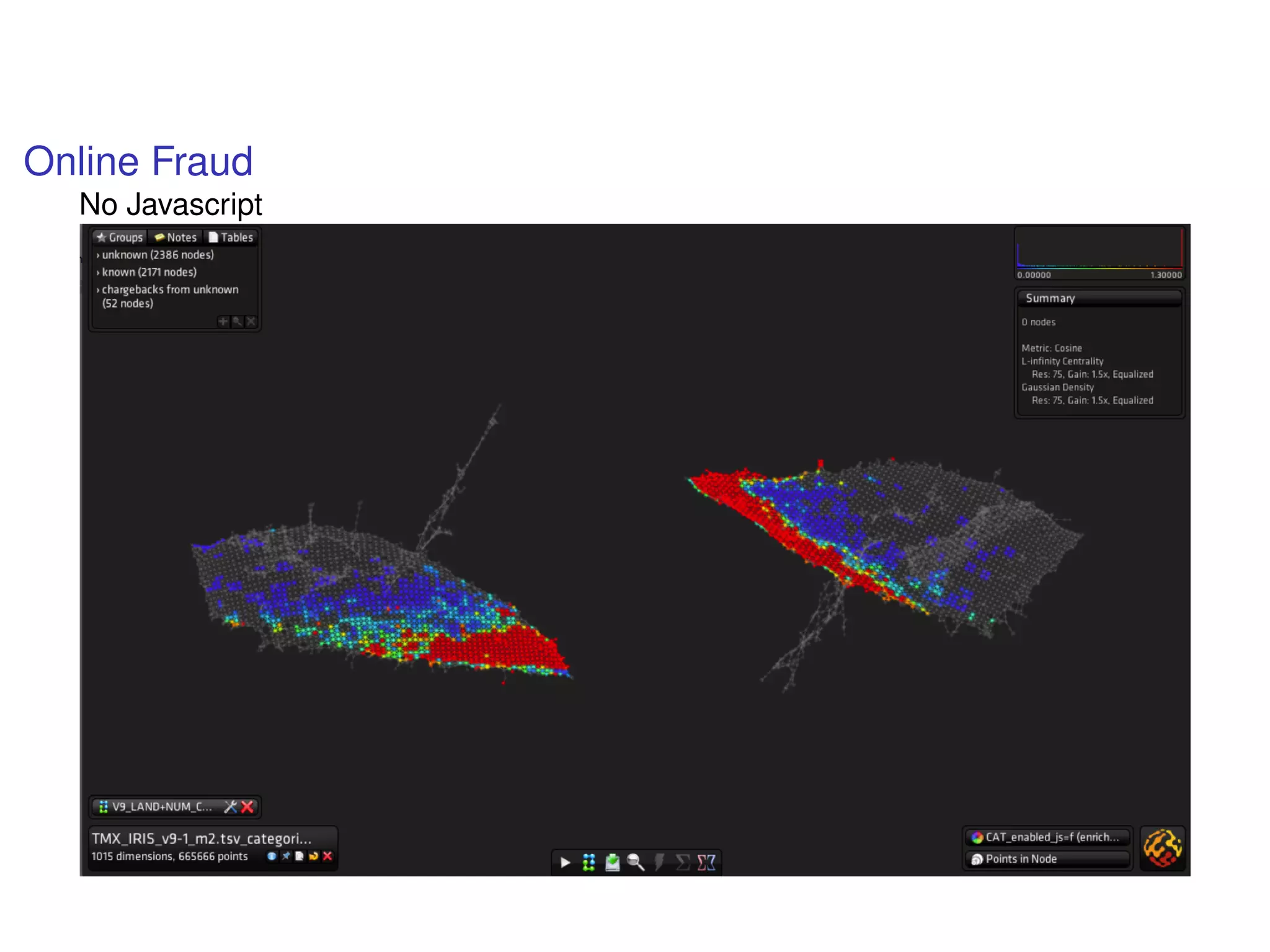
Online Fraud
No Javascript
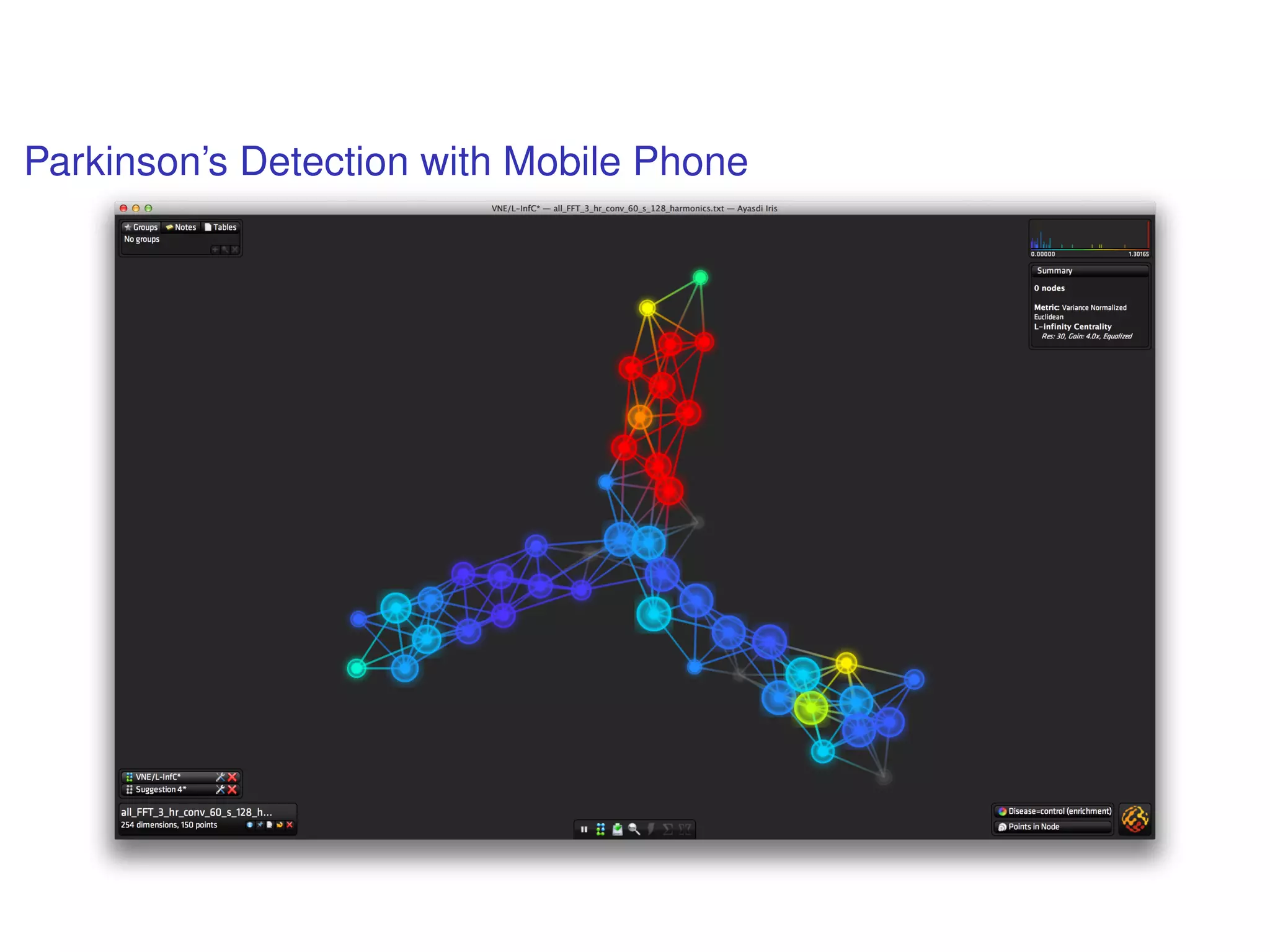
Parkinson’s Detection with Mobile Phone

Using Topological Data Analysis on your BigData

  • 1.
    Shape and Meaning AnIntroduction to Topological Data Analysis Anthony Bak
  • 2.
  • 3.
    Goals For this talkI want to: Show you how TDA provides a framework for many machine learning/data analysis techniques
  • 4.
    Goals For this talkI want to: Show you how TDA provides a framework for many machine learning/data analysis techniques Demonstrate how Ayasdi provides insights into the data.
  • 5.
    Goals For this talkI want to: Show you how TDA provides a framework for many machine learning/data analysis techniques Demonstrate how Ayasdi provides insights into the data. Caveats: I am only talking about the strain of TDA done by Ayasdi
  • 6.
    The Data Problem Howdo we extract meaning from Complex Data?
  • 7.
    The Data Problem Howdo we extract meaning from Complex Data? Data is complex because it’s "Big Data"
  • 8.
    The Data Problem Howdo we extract meaning from Complex Data? Data is complex because it’s "Big Data" Or has very rich features (eg. Genetic Data >500,000 features, complicated interdependencies)
  • 9.
    The Data Problem Howdo we extract meaning from Complex Data? Data is complex because it’s "Big Data" Or has very rich features (eg. Genetic Data >500,000 features, complicated interdependencies) Or both!
  • 10.
    The Data Problem Howdo we extract meaning from Complex Data? Data is complex because it’s "Big Data" Or has very rich features (eg. Genetic Data >500,000 features, complicated interdependencies) Or both! The Problem in both cases is that there isn’t a single story happening in your data.
  • 11.
    The Data Problem Howdo we extract meaning from Complex Data? Data is complex because it’s "Big Data" Or has very rich features (eg. Genetic Data >500,000 features, complicated interdependencies) Or both! The Problem in both cases is that there isn’t a single story happening in your data. TDA will be the tool that summarizes out the irrelevant stories to get at something interesting.
  • 12.
    Data Has Shape AndShape Has Meaning
  • 13.
    Data Has Shape AndShape Has Meaning ⇒ In this talk I will focus on how we extract meaning.
  • 14.
  • 15.
    But first... Whatis shape? Shape is the global realization of local constraints.
  • 16.
    But first... Whatis shape? Shape is the global realization of local constraints. For a given problem determined by a choice of Features, columns or properties to measure. A metric on the columns.
  • 17.
    But first... Whatis shape? Shape is the global realization of local constraints. For a given problem determined by a choice of Features, columns or properties to measure. A metric on the columns. But not necessarily so. There are more relaxed definitions of shape and we can use those too.
  • 18.
    But first... Whatis shape? Shape is the global realization of local constraints. For a given problem determined by a choice of Features, columns or properties to measure. A metric on the columns. But not necessarily so. There are more relaxed definitions of shape and we can use those too. The goal of TDA is to understand (for us, summarize) the shape with no preconceived model of what it should be.
  • 19.
    Math World To showyou how we extract insight from shape we start in "Math World"
  • 20.
    Math World To showyou how we extract insight from shape we start in "Math World" We’ll draw the data as a smooth manifold.
  • 21.
    Math World To showyou how we extract insight from shape we start in "Math World" We’ll draw the data as a smooth manifold. Functions that appear are smooth or continuous.
  • 22.
    Math World To showyou how we extract insight from shape we start in "Math World" We’ll draw the data as a smooth manifold. Functions that appear are smooth or continuous. ⇒ We will not need either of these assumptions once we’re in "Data World".
  • 23.
    Math World To showyou how we extract insight from shape we start in "Math World" We’ll draw the data as a smooth manifold. Functions that appear are smooth or continuous. ⇒ We will not need either of these assumptions once we’re in "Data World". ⇒ Even more importantly, data in the real world is never like this
  • 24.
  • 25.
  • 26.
  • 27.
  • 28.
  • 29.
  • 30.
  • 31.
  • 32.
  • 33.
  • 34.
  • 35.
  • 36.
  • 37.
  • 38.
  • 39.
    Exercise: What is thesummary if we use both lenses, g and f at the same time? (g, f)
  • 40.
    Exercise: What is thesummary if we use both lenses, g and f at the same time? (g, f)
  • 41.
    Exercise: What is thesummary if we use both lenses, g and f at the same time? (g, f) p
  • 42.
    Exercise: What is thesummary if we use both lenses, g and f at the same time? (g, f) p
  • 43.
    Exercise: What is thesummary if we use both lenses, g and f at the same time? (g, f) p
  • 44.
    Exercise: What is thesummary if we use both lenses, g and f at the same time? (g, f) p
  • 45.
    Exercise: What is thesummary if we use both lenses, g and f at the same time? (g, f) p =⇒ We recover the original space
  • 46.
    What did theexercise tell us?
  • 47.
    What did theexercise tell us? With a rich enough set of functions (lenses) we can recover the original space
  • 48.
    What did theexercise tell us? With a rich enough set of functions (lenses) we can recover the original space Of course this leaves us no better off then where we started.
  • 49.
    What did theexercise tell us? With a rich enough set of functions (lenses) we can recover the original space Of course this leaves us no better off then where we started. ⇒ Instead we select a set of functions to tune in to the signal we want.
  • 50.
    This is whatAyasdi does: f pf−1 (p) =⇒ q g Data
  • 51.
    This is whatAyasdi does: f pf−1 (p) =⇒ q g Data Modulo some details....
  • 52.
    Why is thisuseful?
  • 53.
    Why is thisuseful? ⇒ We get "easy" understanding of the localizations of quantities of interest.
  • 54.
    Why is thisuseful? f g
  • 55.
    Why is thisuseful? f g
  • 56.
    Why is thisuseful? f g
  • 57.
    Why is thisuseful? f g
  • 58.
    Why is thisuseful? f g
  • 59.
    Why is thisuseful? f g
  • 60.
    Why is thisuseful? f g
  • 61.
    Why is thisuseful? f g
  • 62.
    Why is thisuseful? f g
  • 63.
    Why is thisuseful?
  • 64.
    Why is thisuseful? Lenses inform us where in the space to look for phenomena.
  • 65.
    Why is thisuseful? Lenses inform us where in the space to look for phenomena. For easy localizations many different lenses will be informative.
  • 66.
    Why is thisuseful? Lenses inform us where in the space to look for phenomena. For easy localizations many different lenses will be informative. For hard ( = geometrically distributed) localizations we have to be more careful.
  • 67.
    Why is thisuseful? Lenses inform us where in the space to look for phenomena. For easy localizations many different lenses will be informative. For hard ( = geometrically distributed) localizations we have to be more careful. But even then, we frequently get incremental knowledge even from a poorly chosen lens.
  • 68.
    Modulo Details.... We wantto move from this mathematical model to a data driven setup.
  • 69.
  • 70.
    Step 1 Replace pointsin the range with an open covering of the range. f ((())) U1 U2 U3
  • 71.
    Step 1 Replace pointsin the range with an open covering of the range. f ((())) U1 U2 U3
  • 72.
    Step 1 Replace pointsin the range with an open covering of the range. f ((())) U1 U2 U3
  • 73.
    Step 1 Replace pointsin the range with an open covering of the range. f ((())) U1 U2 U3
  • 74.
    Step 1 Replace pointsin the range with an open covering of the range. f ((())) U1 U2 U3
  • 75.
    Step 1 Replace pointsin the range with an open covering of the range. Connect nodes when their corresponding sets intersect. f ((())) U1 U2 U3
  • 76.
    Step 1 Replace pointsin the range with an open covering of the range. Connect nodes when their corresponding sets intersect. f ((())) U1 U2 U3
  • 77.
    Step 1 Replace pointsin the range with an open covering of the range. Connect nodes when their corresponding sets intersect. f ((())) U1 U2 U3 ⇒ The output is now a graph.
  • 78.
    New Parameters We’ve introducednew parameters into the construction:
  • 79.
    New Parameters We’ve introducednew parameters into the construction: The resolution is the number of open sets in the range.
  • 80.
    New Parameters We’ve introducednew parameters into the construction: The resolution is the number of open sets in the range. The gain is the amount of overlap of these intervals.
  • 81.
    New Parameters We’ve introducednew parameters into the construction: The resolution is the number of open sets in the range. The gain is the amount of overlap of these intervals. Roughly speaking, the resolution controls the number of nodes in the output and the ’size’ of feature you can pick out, while the gain controls the number of edges and the ’tightness’ of the graph.
  • 82.
    Resolution: A closerlook f ()()()() U1 U2 U3 U4
  • 83.
    Resolution: A closerlook f ()()()() U1 U2 U3 U4
  • 84.
    Resolution: A closerlook f ()()()() U1 U2 U3 U4 ()()
  • 85.
    Resolution: A closerlook f ()()()() U1 U2 U3 U4 ()()
  • 86.
    Step 2: Clusteringas π0 We need to make a final adjustment to the algorithm to bring it into data world.
  • 87.
    Step 2: Clusteringas π0 We need to make a final adjustment to the algorithm to bring it into data world. We replace "connected component of the inverse image" is with "clusters in the inverse image".
  • 88.
    Step 2: Clusteringas π0 We need to make a final adjustment to the algorithm to bring it into data world. We replace "connected component of the inverse image" is with "clusters in the inverse image". We connect clusters (nodes) with an edge if they share points in common.
  • 89.
  • 90.
  • 91.
    Step 2: Clusteringas π0 f U1
  • 92.
    Step 2: Clusteringas π0 f U1 U2
  • 93.
    Step 2: Clusteringas π0 f U1 U2
  • 94.
    Step 2: Clusteringas π0 f U1 U2
  • 95.
    Step 2: Clusteringas π0 f U1 U2 Nodes are clusters of data points
  • 96.
    Step 2: Clusteringas π0 f U1 U2 Nodes are clusters of data points Edges represent shared points between the clusters
  • 97.
    Step 2: Clusteringas π0 f U1 U2 Nodes are clusters of data points Edges represent shared points between the clusters
  • 98.
    Step 2: Clusteringas π0 f U1 U2 Nodes are clusters of data points Edges represent shared points between the clusters
  • 99.
    Step 2: Clusteringas π0 f U1 U2 Nodes are clusters of data points Edges represent shared points between the clusters
  • 100.
    Step 2: Clusteringas π0 f U1 U2 Nodes are clusters of data points Edges represent shared points between the clusters
  • 101.
    Step 2: Clusteringas π0 f U1 U2 Nodes are clusters of data points Edges represent shared points between the clusters
  • 102.
    Step 2: Clusteringas π0 f U1 U2 Nodes are clusters of data points Edges represent shared points between the clusters
  • 103.
    Step 2: Clusteringas π0 f U1 U2 Nodes are clusters of data points Edges represent shared points between the clusters
  • 104.
    Step 2: Clusteringas π0 f U1 U2 Nodes are clusters of data points Edges represent shared points between the clusters
  • 105.
    Step 2: Clusteringas π0 f U1 U2 Nodes are clusters of data points Edges represent shared points between the clusters
  • 106.
    Step 2: Clusteringas π0 f U1 U2 Nodes are clusters of data points Edges represent shared points between the clusters
  • 107.
  • 108.
  • 109.
    Lenses: Where dothey come from The technique rests on finding good lenses.
  • 110.
    Lenses: Where dothey come from The technique rests on finding good lenses. ⇒ Luckily lots of people have worked on this problem
  • 111.
    Lenses: Where dothey come from A Non Exhaustive Table of Lenses
  • 112.
    Lenses: Where dothey come from Standard data analysis functions A Non Exhaustive Table of Lenses Statistics
  • 113.
    Lenses: Where dothey come from Standard data analysis functions A Non Exhaustive Table of Lenses Statistics Mean/Max/Min
  • 114.
    Lenses: Where dothey come from Standard data analysis functions A Non Exhaustive Table of Lenses Statistics Mean/Max/Min Variance
  • 115.
    Lenses: Where dothey come from Standard data analysis functions A Non Exhaustive Table of Lenses Statistics Mean/Max/Min Variance n-Moment
  • 116.
    Lenses: Where dothey come from Standard data analysis functions A Non Exhaustive Table of Lenses Statistics Mean/Max/Min Variance n-Moment Density
  • 117.
    Lenses: Where dothey come from Standard data analysis functions A Non Exhaustive Table of Lenses Statistics Mean/Max/Min Variance n-Moment Density ...
  • 118.
    Lenses: Where dothey come from Standard data analysis functions Geometry and Topology A Non Exhaustive Table of Lenses Statistics Geometry Mean/Max/Min Variance n-Moment Density ...
  • 119.
    Lenses: Where dothey come from Standard data analysis functions Geometry and Topology A Non Exhaustive Table of Lenses Statistics Geometry Mean/Max/Min Centrality Variance n-Moment Density ...
  • 120.
    Lenses: Where dothey come from Standard data analysis functions Geometry and Topology A Non Exhaustive Table of Lenses Statistics Geometry Mean/Max/Min Centrality Variance Curvature n-Moment Density ...
  • 121.
    Lenses: Where dothey come from Standard data analysis functions Geometry and Topology A Non Exhaustive Table of Lenses Statistics Geometry Mean/Max/Min Centrality Variance Curvature n-Moment Harmonic Cycles Density ...
  • 122.
    Lenses: Where dothey come from Standard data analysis functions Geometry and Topology A Non Exhaustive Table of Lenses Statistics Geometry Mean/Max/Min Centrality Variance Curvature n-Moment Harmonic Cycles Density ... ...
  • 123.
    Lenses: Where dothey come from Standard data analysis functions Geometry and Topology Modern Statistics A Non Exhaustive Table of Lenses Statistics Geometry Machine Learning Mean/Max/Min Centrality Variance Curvature n-Moment Harmonic Cycles Density ... ...
  • 124.
    Lenses: Where dothey come from Standard data analysis functions Geometry and Topology Modern Statistics A Non Exhaustive Table of Lenses Statistics Geometry Machine Learning Mean/Max/Min Centrality PCA/SVD Variance Curvature n-Moment Harmonic Cycles Density ... ...
  • 125.
    Lenses: Where dothey come from Standard data analysis functions Geometry and Topology Modern Statistics A Non Exhaustive Table of Lenses Statistics Geometry Machine Learning Mean/Max/Min Centrality PCA/SVD Variance Curvature Autoencoders n-Moment Harmonic Cycles Density ... ...
  • 126.
    Lenses: Where dothey come from Standard data analysis functions Geometry and Topology Modern Statistics A Non Exhaustive Table of Lenses Statistics Geometry Machine Learning Mean/Max/Min Centrality PCA/SVD Variance Curvature Autoencoders n-Moment Harmonic Cycles Isomap/MDS/TSNE Density ... ...
  • 127.
    Lenses: Where dothey come from Standard data analysis functions Geometry and Topology Modern Statistics A Non Exhaustive Table of Lenses Statistics Geometry Machine Learning Mean/Max/Min Centrality PCA/SVD Variance Curvature Autoencoders n-Moment Harmonic Cycles Isomap/MDS/TSNE Density ... SVM Distance from Hyperplane ...
  • 128.
    Lenses: Where dothey come from Standard data analysis functions Geometry and Topology Modern Statistics A Non Exhaustive Table of Lenses Statistics Geometry Machine Learning Mean/Max/Min Centrality PCA/SVD Variance Curvature Autoencoders n-Moment Harmonic Cycles Isomap/MDS/TSNE Density ... SVM Distance from Hyperplane ... Error/Debugging Info
  • 129.
    Lenses: Where dothey come from Standard data analysis functions Geometry and Topology Modern Statistics A Non Exhaustive Table of Lenses Statistics Geometry Machine Learning Mean/Max/Min Centrality PCA/SVD Variance Curvature Autoencoders n-Moment Harmonic Cycles Isomap/MDS/TSNE Density ... SVM Distance from Hyperplane ... Error/Debugging Info ...
  • 130.
    Lenses: Where dothey come from Standard data analysis functions Geometry and Topology Modern Statistics Domain Knowledge / Data Modeling A Non Exhaustive Table of Lenses Statistics Geometry Machine Learning Data Driven Mean/Max/Min Centrality PCA/SVD Variance Curvature Autoencoders n-Moment Harmonic Cycles Isomap/MDS/TSNE Density ... SVM Distance from Hyperplane ... Error/Debugging Info ...
  • 131.
    Lenses: Where dothey come from Standard data analysis functions Geometry and Topology Modern Statistics Domain Knowledge / Data Modeling A Non Exhaustive Table of Lenses Statistics Geometry Machine Learning Data Driven Mean/Max/Min Centrality PCA/SVD Age Variance Curvature Autoencoders n-Moment Harmonic Cycles Isomap/MDS/TSNE Density ... SVM Distance from Hyperplane ... Error/Debugging Info ...
  • 132.
    Lenses: Where dothey come from Standard data analysis functions Geometry and Topology Modern Statistics Domain Knowledge / Data Modeling A Non Exhaustive Table of Lenses Statistics Geometry Machine Learning Data Driven Mean/Max/Min Centrality PCA/SVD Age Variance Curvature Autoencoders Dates n-Moment Harmonic Cycles Isomap/MDS/TSNE Density ... SVM Distance from Hyperplane ... Error/Debugging Info ...
  • 133.
    Lenses: Where dothey come from Standard data analysis functions Geometry and Topology Modern Statistics Domain Knowledge / Data Modeling A Non Exhaustive Table of Lenses Statistics Geometry Machine Learning Data Driven Mean/Max/Min Centrality PCA/SVD Age Variance Curvature Autoencoders Dates n-Moment Harmonic Cycles Isomap/MDS/TSNE ... Density ... SVM Distance from Hyperplane ... Error/Debugging Info ...
  • 134.
    Interperability and Meaning Butwhat about insight? meaning?
  • 135.
  • 136.
  • 137.
    Interperability and Meaning f =⇒ComplexData f is gaussian density ⇒ The data is bi-modal.
  • 138.
  • 139.
    Interperability and Meaning f =⇒ComplexData f is centrality ⇒ The data has two ways of being abnormal.
  • 140.
  • 141.
    Interperability and Meaning f =⇒ComplexData f is mean ⇒ Two groups of high mean data.
  • 142.
  • 143.
    Interperability and Meaning f =⇒ComplexData f is error ⇒ Two types of error.
  • 144.
    Interperability and Meaning f =⇒ComplexData f is error ⇒ Two types of error. The units on the lens give interperability/meaning to the topological summary.
  • 145.
    Interperability and Meaning Anotherway to think about lenses is as a kind of ’geometric query’. Examples
  • 146.
    Interperability and Meaning Anotherway to think about lenses is as a kind of ’geometric query’. Examples 1. Heart disease study
  • 147.
    Interperability and Meaning Anotherway to think about lenses is as a kind of ’geometric query’. Examples 1. Heart disease study Stratification by age without making arbitrary cutoffs.
  • 148.
    Interperability and Meaning Anotherway to think about lenses is as a kind of ’geometric query’. Examples 1. Heart disease study Stratification by age without making arbitrary cutoffs. 2. Heavy machinery
  • 149.
    Interperability and Meaning Anotherway to think about lenses is as a kind of ’geometric query’. Examples 1. Heart disease study Stratification by age without making arbitrary cutoffs. 2. Heavy machinery Use mean a variance as a lens to find what operating regimes lead to failure of mechanical components.
  • 150.
  • 151.
    Some generalizations andextensions Metrics
  • 152.
    Some generalizations andextensions Metrics We don’t need a metric, just a notion of similarity - or perhaps a clustering mechanism.
  • 153.
    Some generalizations andextensions Metrics We don’t need a metric, just a notion of similarity - or perhaps a clustering mechanism. Lenses
  • 154.
    Some generalizations andextensions Metrics We don’t need a metric, just a notion of similarity - or perhaps a clustering mechanism. Lenses Lenses don’t need to be continuous - just "sensible".
  • 155.
    Some generalizations andextensions Metrics We don’t need a metric, just a notion of similarity - or perhaps a clustering mechanism. Lenses Lenses don’t need to be continuous - just "sensible". We can use multiple lenses at the same time.
  • 156.
    Some generalizations andextensions Metrics We don’t need a metric, just a notion of similarity - or perhaps a clustering mechanism. Lenses Lenses don’t need to be continuous - just "sensible". We can use multiple lenses at the same time. Lenses can map to space other then R.
  • 157.
    Some generalizations andextensions Metrics We don’t need a metric, just a notion of similarity - or perhaps a clustering mechanism. Lenses Lenses don’t need to be continuous - just "sensible". We can use multiple lenses at the same time. Lenses can map to space other then R. In fact, can work with "open covers" of the space (Here taken to mean overlapping partitions). Don’t need a lens at all.
  • 158.
    Some generalizations andextensions Metrics We don’t need a metric, just a notion of similarity - or perhaps a clustering mechanism. Lenses Lenses don’t need to be continuous - just "sensible". We can use multiple lenses at the same time. Lenses can map to space other then R. In fact, can work with "open covers" of the space (Here taken to mean overlapping partitions). Don’t need a lens at all. Data
  • 159.
    Some generalizations andextensions Metrics We don’t need a metric, just a notion of similarity - or perhaps a clustering mechanism. Lenses Lenses don’t need to be continuous - just "sensible". We can use multiple lenses at the same time. Lenses can map to space other then R. In fact, can work with "open covers" of the space (Here taken to mean overlapping partitions). Don’t need a lens at all. Data Input space can be anything with a topology. Typically we work with row/column numeric/categorical data but, for example, graphs are ok.
  • 160.
    Some generalizations andextensions Metrics We don’t need a metric, just a notion of similarity - or perhaps a clustering mechanism. Lenses Lenses don’t need to be continuous - just "sensible". We can use multiple lenses at the same time. Lenses can map to space other then R. In fact, can work with "open covers" of the space (Here taken to mean overlapping partitions). Don’t need a lens at all. Data Input space can be anything with a topology. Typically we work with row/column numeric/categorical data but, for example, graphs are ok. Output
  • 161.
    Some generalizations andextensions Metrics We don’t need a metric, just a notion of similarity - or perhaps a clustering mechanism. Lenses Lenses don’t need to be continuous - just "sensible". We can use multiple lenses at the same time. Lenses can map to space other then R. In fact, can work with "open covers" of the space (Here taken to mean overlapping partitions). Don’t need a lens at all. Data Input space can be anything with a topology. Typically we work with row/column numeric/categorical data but, for example, graphs are ok. Output The output of the algorithm isn’t just a graph but is an abstract simplicial complex (swept under the rug in this presentation).
  • 162.
  • 163.
  • 164.
  • 165.
  • 166.
  • 167.
  • 168.