INGOLD	
Leading Process Analytics
For chemical, pharmaceutical, biotechnology and all
other process industries, maintaining high product
quality while improving process safety and controlling
operating costs is a constant challenge. Increased
maintenance requirements for sensors and unplanned
production downtimes resulting from the failure of
measurement technology are substantial cost factors.
Cutting-edge analytical measurement systems help
ensure product quality and yield, enhance process reli-
ability and reduce sensor life cycle costs.
Intelligent Sensor Management
The Power of ISM
WhitePaper
Improving manufacturing plant efficiency is vital to successful
business operations. Part of that endeavor is ensuring production
equipment is operating correctly and is well maintained. This is
as true for analytical measurement systems as it is for any other
plant asset. Failure to properly maintain measurement systems
can have a significant impact on efficiency and production costs.
Reduced product quality, batch failure or unplanned downtimes
can easily result from poorly calibrated, dirty or failed sensors.
However, supporting an effective maintenance regime is a time
consuming burden on skilled staff. The answer is intelligent
process analytic systems that can not only monitor themselves
for wear and advise operators when maintenance is required, but
that also improve process safety.
Intelligent Sensor Management (ISM) is an innovative technol-
ogy for all major process parameters that combines many fea-
tures into a unique solution. One that is tailorable and adaptable
to specific industry and production plant needs. ISM improves
maintenance management and diagnostics, which translates
into increased process safety and reduced operating costs.
Digital technology
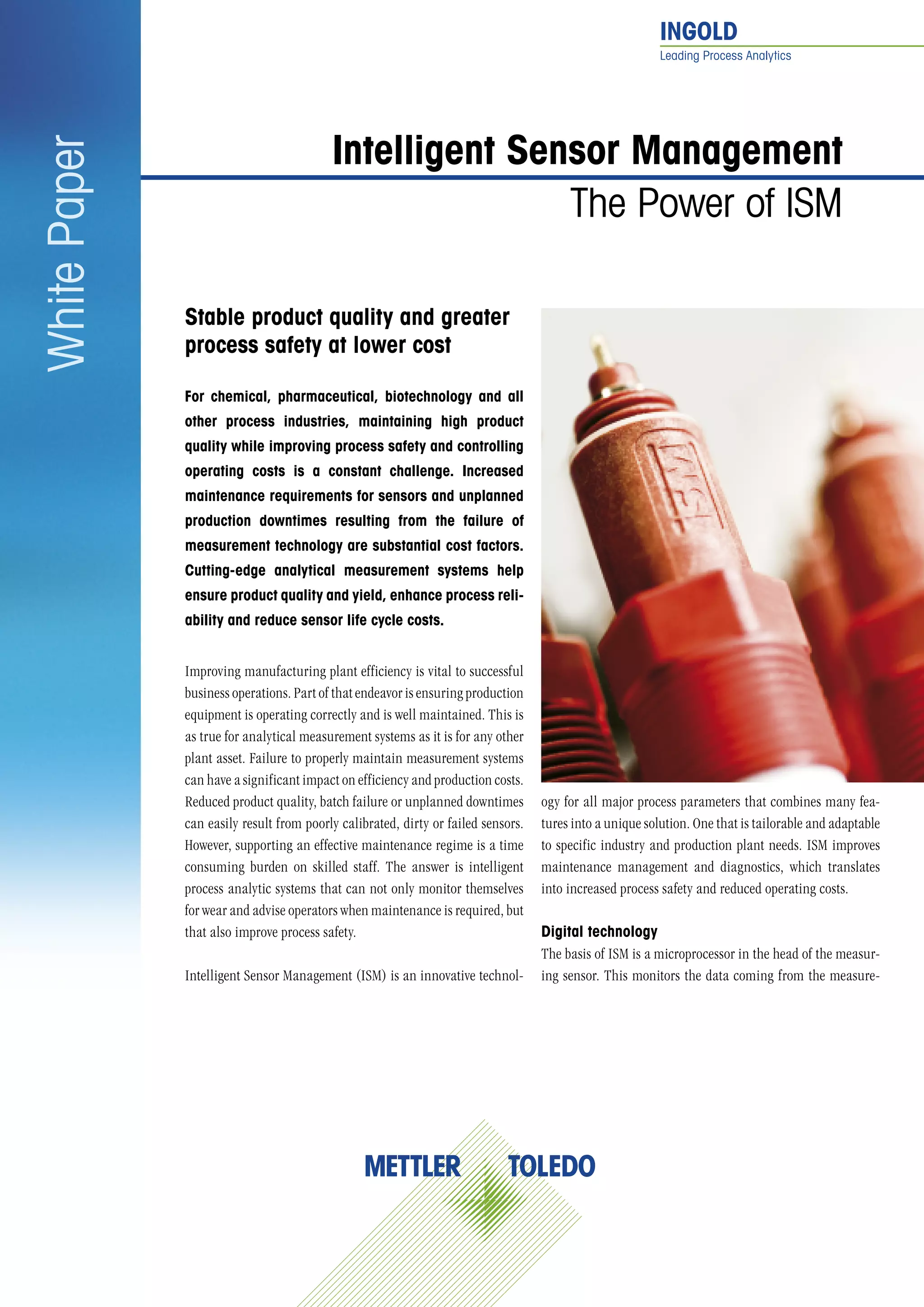
The basis of ISM is a microprocessor in the head of the measur-
ing sensor. This monitors the data coming from the measure-
Stable product quality and greater
process safety at lower cost
2 METTLER TOLEDO
IntelligentSensorManagement
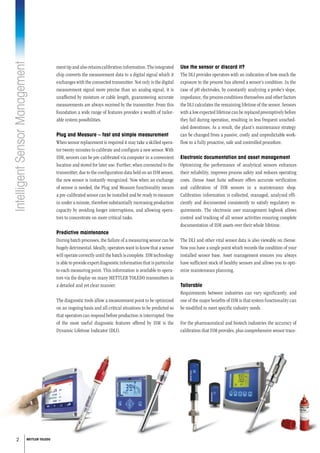
menttipandalsoretainscalibrationinformation.Theintegrated
chip converts the measurement data to a digital signal which it
exchanges with the connected transmitter. Not only is the digital
measurement signal more precise than an analog signal, it is
unaffected by moisture or cable length, guaranteeing accurate
measurements are always received by the transmitter. From this
foundation a wide range of features provides a wealth of tailor-
able system possibilities.
Plug and Measure – fast and simple measurement
When sensor replacement is required it may take a skilled opera-
tor twenty minutes to calibrate and configure a new sensor. With
ISM, sensors can be pre-calibrated via computer in a convenient
location and stored for later use. Further, when connected to the
transmitter, due to the configuration data held on an ISM sensor,
the new sensor is instantly recognized. Now when an exchange
of sensor is needed, the Plug and Measure functionality means
a pre-calibrated sensor can be installed and be ready to measure
in under a minute, therefore substantially increasing production
capacity by avoiding longer interruptions, and allowing opera-
tors to concentrate on more critical tasks.
Predictive maintenance
During batch processes, the failure of a measuring sensor can be
hugely detrimental. Ideally, operators want to know that a sensor
will operate correctly until the batch is complete. ISM technology
is able to provide expert diagnostic information that is particular
to each measuring point. This information is available to opera-
tors via the display on many METTLER TOLEDO transmitters in
a detailed and yet clear manner.
The diagnostic tools allow a measurement point to be optimized
on an ongoing basis and all critical situations to be predicted so
that operators can respond before production is interrupted. One
of the most useful diagnostic features offered by ISM is the
Dynamic Lifetime Indicator (DLI).
Use the sensor or discard it?
The DLI provides operators with an indication of how much the
exposure to the process has altered a sensor’s condition. In the
case of pH electrodes, by constantly analyzing a probe's slope,
impedance, the process conditions themselves and other factors
the DLI calculates the remaining lifetime of the sensor. Sensors
with a low expected lifetime can be replaced preemptively before
they fail during operation, resulting in less frequent unsched-
uled downtimes. As a result, the plant’s maintenance strategy
can be changed from a passive, costly and unpredictable work-
flow to a fully proactive, safe and controlled procedure.
Electronic documentation and asset management
Optimizing the performance of analytical sensors enhances
their reliability, improves process safety and reduces operating
costs. iSense Asset Suite software offers accurate verification
and calibration of ISM sensors in a maintenance shop.
Calibration information is collected, managed, analyzed effi-
ciently and documented consistently to satisfy regulatory re-
quirements. The electronic user management logbook allows
control and tracking of all sensor activities ensuring complete
documentation of ISM assets over their whole lifetime.
The DLI and other vital sensor data is also viewable on iSense.
Now you have a single point which records the condition of your
installed sensor base. Asset management ensures you always
have sufficient stock of healthy sensors and allows you to opti-
mize maintenance planning.
Tailorable
Requirements between industries can vary significantly, and
one of the major benefits of ISM is that system functionality can
be modified to meet specific industry needs.
For the pharmaceutical and biotech industries the accuracy of
calibration that ISM provides, plus comprehensive sensor trace-
3METTLER TOLEDO
abilityviaelectronicdocumentation,areofimportance.Whereas
in the chemical and petrochemical industries it is the ability to
pre-calibrate in a maintenance shop and optimized mainte-
nance management for improved process reliability and reduced
maintenance costs that are of greater value. Further, as men-
tioned above, diagnostic tools can be modified for each measur-
ing point to accommodate the conditions of individual
processes.
Whether you operate in biopharma, chemical, refining, or food
and beverage, ISM offers a solution to meet your needs.
Adaptive
A further significant benefit of ISM is its adaptability to indi-
vidual plant control system requirements. Fieldbus integration
via transmitters, direct integration using digital to analog con-
verters and a variety of wireless solutions are all available. This
means ISM solutions are compatible with legacy installations as
well as the latest Ethernet-based technologies.
A range of advanced multi-parameter, dual-channel and mixed-
mode (accepts digital or analog sensors) transmitters further
ensure the adaptability of ISM solutions to your requirements.
The invaluable diagnostic data that ISM provides does not stop
at the transmitter. Seamless integration into control systems
IntelligentSensorManagement
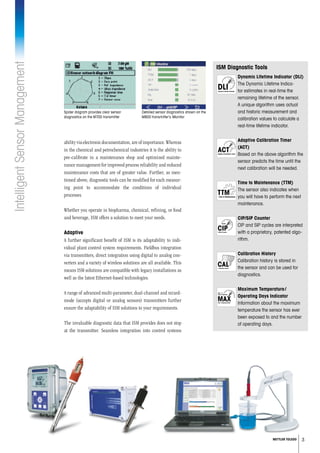
Spider diagram provides clear sensor
diagnostics on the M700 transmitter
Dynamic Lifetime Indicator (DLI)
The Dynamic Lifetime Indica-
tor estimates in real-time the
remaining lifetime of the sensor.
A unique algorithm uses actual
and historic measurement and
calibration values to calculate a
real-time lifetime indicator.
Adaptive Calibration Timer
(ACT)	
Based on the above algorithm the
sensor predicts the time until the
next calibration will be needed.
Time to Maintenance (TTM)
The sensor also indicates when
you will have to perform the next
maintenance.
CIP/SIP Counter
CIP and SIP cycles are interpreted
with a proprietary, patented algo-
rithm.
Calibration History
Calibration history is stored in
the sensor and can be used for
diagnostics.
Maximum Temperature / 	
Operating Days Indicator
Information about the maximum
temperature the sensor has ever
been exposed to and the number
of operating days.
TTMTime to Maintenance
DLIDynamic Lifetime Indicator
ACTAdaptive Calibration Timer
TTMTime to Maintenance
DLIDynamic Lifetime Indicator
ACTAdaptive Calibration Timer
TTMTime to Maintenance
DLIDynamic Lifetime Indicator
ACTAdaptive Calibration Timer
CIPCIP/SIP Counter
00/NN
Max. °C
Days of operation
MAXMax. Temperature/ODI
Calibration History
CAL
CIPCIP/SIP Counter
00/NN
Max. °C
Days of operation
MAXMax. Temperature/ODI
Calibration History
CAL
CIPCIP/SIP Counter
00/NN
Max. °C
Days of operation
MAXMax. Temperature/ODI
Calibration History
CAL
Detailed sensor diagnostics shown on the
M800 transmitter's iMonitor
ISM Diagnostic Tools
Visit for more information
Mettler-Toledo AG
Process Analytics
Im Hackacker 15
CH-8902 Urdorf
Switzerland – 08 / 10
www.mt.com/pro
www.mt.com/ISM
allows real-time monitoring of sensor performance from the
convenience of a control room. This means that if production
staff are away from the process and a measuring point needs
attention, it will be noticed instantly.
Conclusion
Continuous improvement in process equipment efficiency is an
important business driver. Process analytic measurement solu-
tions that enhance product quality and yield, while simultane-
ously reducing operating costs, are going to be of increasing
value.
ISM’s numerous features and benefits mean that increased mea-
surement accuracy, reliability of signal transmission, fast error-
freesensorcommissioningandreal-timediagnosticinformation
combine to create a powerful tool for improving process control
and maximizing process equipment availability.
IntelligentSensorManagement
Feature overview for ISM sensors:
•	 More precise measurement signal compared
with analog sensors
•	 Advanced sensor diagnostics
•	 Predictive maintenance functions
•	 Plug and Measure functionality
•	 Digital IP 68 connector
•	 ATEX, FM compatible
•	 CIP / SIP counter
The flexibility offered by a wide range of solutions and further
planned developments guarantees ISM will remain at the fore-
front of process analytic measurement technologies.
Further information on ISM can be found on our website:

Intelligent Sensor Management From Ingold

  • 1.
    INGOLD Leading Process Analytics Forchemical, pharmaceutical, biotechnology and all other process industries, maintaining high product quality while improving process safety and controlling operating costs is a constant challenge. Increased maintenance requirements for sensors and unplanned production downtimes resulting from the failure of measurement technology are substantial cost factors. Cutting-edge analytical measurement systems help ensure product quality and yield, enhance process reli- ability and reduce sensor life cycle costs. Intelligent Sensor Management The Power of ISM WhitePaper Improving manufacturing plant efficiency is vital to successful business operations. Part of that endeavor is ensuring production equipment is operating correctly and is well maintained. This is as true for analytical measurement systems as it is for any other plant asset. Failure to properly maintain measurement systems can have a significant impact on efficiency and production costs. Reduced product quality, batch failure or unplanned downtimes can easily result from poorly calibrated, dirty or failed sensors. However, supporting an effective maintenance regime is a time consuming burden on skilled staff. The answer is intelligent process analytic systems that can not only monitor themselves for wear and advise operators when maintenance is required, but that also improve process safety. Intelligent Sensor Management (ISM) is an innovative technol- ogy for all major process parameters that combines many fea- tures into a unique solution. One that is tailorable and adaptable to specific industry and production plant needs. ISM improves maintenance management and diagnostics, which translates into increased process safety and reduced operating costs. Digital technology The basis of ISM is a microprocessor in the head of the measur- ing sensor. This monitors the data coming from the measure- Stable product quality and greater process safety at lower cost
  • 2.
    2 METTLER TOLEDO IntelligentSensorManagement menttipandalsoretainscalibrationinformation.Theintegrated chip convertsthe measurement data to a digital signal which it exchanges with the connected transmitter. Not only is the digital measurement signal more precise than an analog signal, it is unaffected by moisture or cable length, guaranteeing accurate measurements are always received by the transmitter. From this foundation a wide range of features provides a wealth of tailor- able system possibilities. Plug and Measure – fast and simple measurement When sensor replacement is required it may take a skilled opera- tor twenty minutes to calibrate and configure a new sensor. With ISM, sensors can be pre-calibrated via computer in a convenient location and stored for later use. Further, when connected to the transmitter, due to the configuration data held on an ISM sensor, the new sensor is instantly recognized. Now when an exchange of sensor is needed, the Plug and Measure functionality means a pre-calibrated sensor can be installed and be ready to measure in under a minute, therefore substantially increasing production capacity by avoiding longer interruptions, and allowing opera- tors to concentrate on more critical tasks. Predictive maintenance During batch processes, the failure of a measuring sensor can be hugely detrimental. Ideally, operators want to know that a sensor will operate correctly until the batch is complete. ISM technology is able to provide expert diagnostic information that is particular to each measuring point. This information is available to opera- tors via the display on many METTLER TOLEDO transmitters in a detailed and yet clear manner. The diagnostic tools allow a measurement point to be optimized on an ongoing basis and all critical situations to be predicted so that operators can respond before production is interrupted. One of the most useful diagnostic features offered by ISM is the Dynamic Lifetime Indicator (DLI). Use the sensor or discard it? The DLI provides operators with an indication of how much the exposure to the process has altered a sensor’s condition. In the case of pH electrodes, by constantly analyzing a probe's slope, impedance, the process conditions themselves and other factors the DLI calculates the remaining lifetime of the sensor. Sensors with a low expected lifetime can be replaced preemptively before they fail during operation, resulting in less frequent unsched- uled downtimes. As a result, the plant’s maintenance strategy can be changed from a passive, costly and unpredictable work- flow to a fully proactive, safe and controlled procedure. Electronic documentation and asset management Optimizing the performance of analytical sensors enhances their reliability, improves process safety and reduces operating costs. iSense Asset Suite software offers accurate verification and calibration of ISM sensors in a maintenance shop. Calibration information is collected, managed, analyzed effi- ciently and documented consistently to satisfy regulatory re- quirements. The electronic user management logbook allows control and tracking of all sensor activities ensuring complete documentation of ISM assets over their whole lifetime. The DLI and other vital sensor data is also viewable on iSense. Now you have a single point which records the condition of your installed sensor base. Asset management ensures you always have sufficient stock of healthy sensors and allows you to opti- mize maintenance planning. Tailorable Requirements between industries can vary significantly, and one of the major benefits of ISM is that system functionality can be modified to meet specific industry needs. For the pharmaceutical and biotech industries the accuracy of calibration that ISM provides, plus comprehensive sensor trace-
  • 3.
    3METTLER TOLEDO abilityviaelectronicdocumentation,areofimportance.Whereas in the chemicaland petrochemical industries it is the ability to pre-calibrate in a maintenance shop and optimized mainte- nance management for improved process reliability and reduced maintenance costs that are of greater value. Further, as men- tioned above, diagnostic tools can be modified for each measur- ing point to accommodate the conditions of individual processes. Whether you operate in biopharma, chemical, refining, or food and beverage, ISM offers a solution to meet your needs. Adaptive A further significant benefit of ISM is its adaptability to indi- vidual plant control system requirements. Fieldbus integration via transmitters, direct integration using digital to analog con- verters and a variety of wireless solutions are all available. This means ISM solutions are compatible with legacy installations as well as the latest Ethernet-based technologies. A range of advanced multi-parameter, dual-channel and mixed- mode (accepts digital or analog sensors) transmitters further ensure the adaptability of ISM solutions to your requirements. The invaluable diagnostic data that ISM provides does not stop at the transmitter. Seamless integration into control systems IntelligentSensorManagement Spider diagram provides clear sensor diagnostics on the M700 transmitter Dynamic Lifetime Indicator (DLI) The Dynamic Lifetime Indica- tor estimates in real-time the remaining lifetime of the sensor. A unique algorithm uses actual and historic measurement and calibration values to calculate a real-time lifetime indicator. Adaptive Calibration Timer (ACT) Based on the above algorithm the sensor predicts the time until the next calibration will be needed. Time to Maintenance (TTM) The sensor also indicates when you will have to perform the next maintenance. CIP/SIP Counter CIP and SIP cycles are interpreted with a proprietary, patented algo- rithm. Calibration History Calibration history is stored in the sensor and can be used for diagnostics. Maximum Temperature /  Operating Days Indicator Information about the maximum temperature the sensor has ever been exposed to and the number of operating days. TTMTime to Maintenance DLIDynamic Lifetime Indicator ACTAdaptive Calibration Timer TTMTime to Maintenance DLIDynamic Lifetime Indicator ACTAdaptive Calibration Timer TTMTime to Maintenance DLIDynamic Lifetime Indicator ACTAdaptive Calibration Timer CIPCIP/SIP Counter 00/NN Max. °C Days of operation MAXMax. Temperature/ODI Calibration History CAL CIPCIP/SIP Counter 00/NN Max. °C Days of operation MAXMax. Temperature/ODI Calibration History CAL CIPCIP/SIP Counter 00/NN Max. °C Days of operation MAXMax. Temperature/ODI Calibration History CAL Detailed sensor diagnostics shown on the M800 transmitter's iMonitor ISM Diagnostic Tools
  • 4.
    Visit for moreinformation Mettler-Toledo AG Process Analytics Im Hackacker 15 CH-8902 Urdorf Switzerland – 08 / 10 www.mt.com/pro www.mt.com/ISM allows real-time monitoring of sensor performance from the convenience of a control room. This means that if production staff are away from the process and a measuring point needs attention, it will be noticed instantly. Conclusion Continuous improvement in process equipment efficiency is an important business driver. Process analytic measurement solu- tions that enhance product quality and yield, while simultane- ously reducing operating costs, are going to be of increasing value. ISM’s numerous features and benefits mean that increased mea- surement accuracy, reliability of signal transmission, fast error- freesensorcommissioningandreal-timediagnosticinformation combine to create a powerful tool for improving process control and maximizing process equipment availability. IntelligentSensorManagement Feature overview for ISM sensors: • More precise measurement signal compared with analog sensors • Advanced sensor diagnostics • Predictive maintenance functions • Plug and Measure functionality • Digital IP 68 connector • ATEX, FM compatible • CIP / SIP counter The flexibility offered by a wide range of solutions and further planned developments guarantees ISM will remain at the fore- front of process analytic measurement technologies. Further information on ISM can be found on our website: