Is an allergy to a drug, most commonly
a medication, Medical attention
should be sought immediately if an
allergic reaction is suspected. An allergic
reaction will not occur on the first
exposure to a substance. The first exposure allows the body to create antibodies and memory
lymphocyte cells for the antigen. However, drugs often contain many different substances,
including dyes, which could cause allergic reactions. This can cause an allergic reaction on the
first administration of a drug. For example, a person who developed an allergy to a red dye will be
allergic to any new drug which contains that red dye.
A drug allergy is different from intolerance. A drug intolerance, which is often a milder, non-
immune-mediated reaction, does not depend on prior exposure. Most people who believe they are
allergic to aspirin are actually suffering from drug intolerance
Drug Allergy Causes& Mechanism
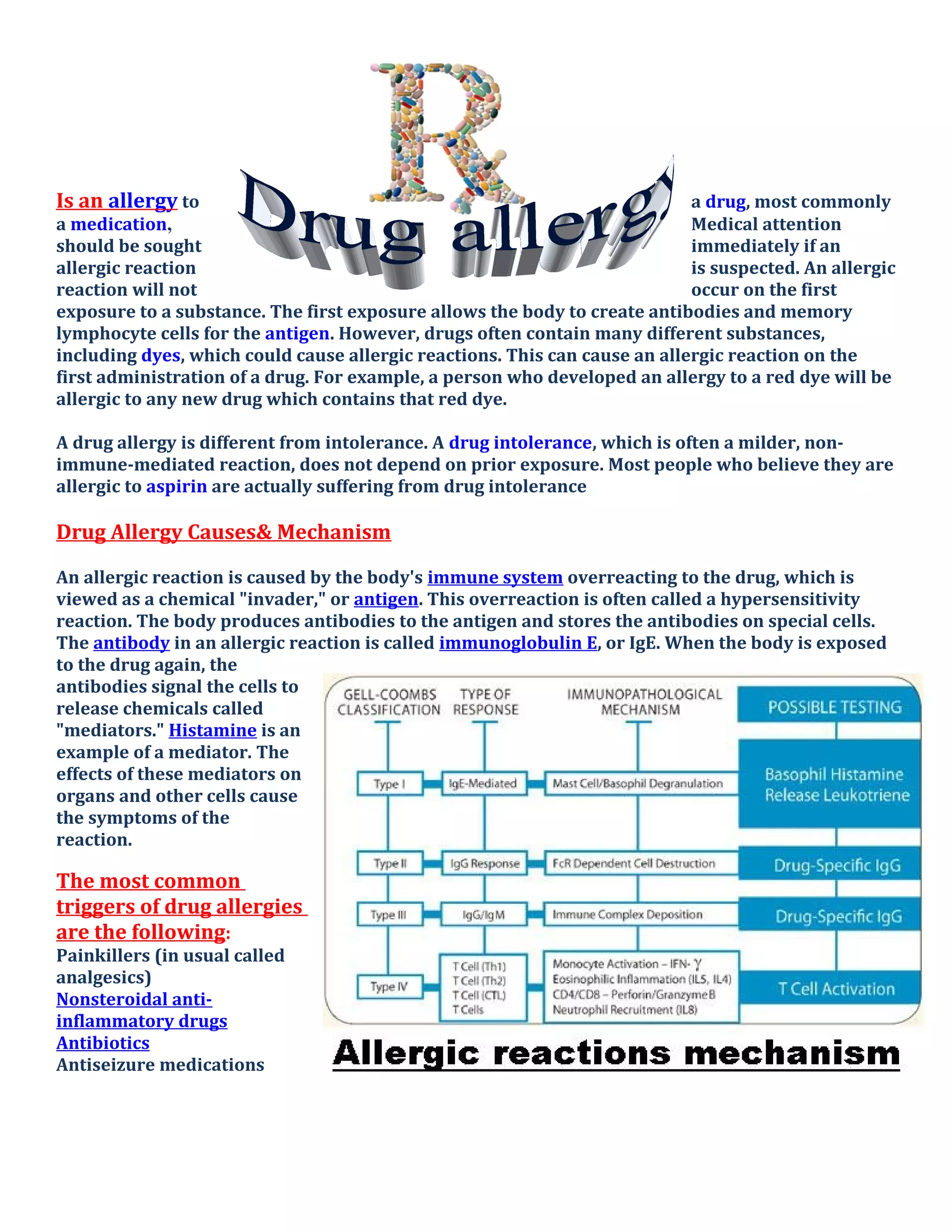
An allergic reaction is caused by the body's immune system overreacting to the drug, which is
viewed as a chemical "invader," or antigen. This overreaction is often called a hypersensitivity
reaction. The body produces antibodies to the antigen and stores the antibodies on special cells.
The antibody in an allergic reaction is called immunoglobulin E, or IgE. When the body is exposed
to the drug again, the
antibodies signal the cells to
release chemicals called
"mediators." Histamine is an
example of a mediator. The
effects of these mediators on
organs and other cells cause
the symptoms of the
reaction.
The most common
triggers of drug allergies
are the following:
Painkillers (in usual called
analgesics)
Nonsteroidal anti-
inflammatory drugs
Antibiotics
Antiseizure medications
Risk factors for drug allergies include the following:
**Frequent exposure to the drug & Large doses of the drug
**Drug given by injection rather than pill
**Family tendency to develop allergies and asthma
**Certain food allergies such as to eggs, soybeans, or shellfish
Drug Allergy Symptoms
1. Skin reactions:
**A measles-like rash, Fever
**Hives-Slightly red, itchy, and raised swellings on the skin, which have an irregular shape
**Photoallergy-Sensitivity to sunlight, an itchy and scaly rash that occurs following sun exposure
**Erythema multiform-Red, raised and itchy patches on the skin that sometimes look like bull's-
eye targets and which may occur together with swelling of the face or tongue, images examples:
2. Muscle and joint aches
3. Lymph nodes swelling
4. Inflammation of the kidney
unlike most allergic reactions, which occur fairly quickly after exposure to the allergen, allergic
reactions to drugs tend to occur days or weeks after the first dose of
the drug.
Anaphylaxis or anaphylactic reaction
This is a serious allergic reaction that can be life threatening which must be treated in a hospital
emergency department. Characteristics of anaphylaxis (sometimes referred to as anaphylactic
shock) include:
((Skin reaction-Hives, redness/flushing, sense of warmth, itching
Difficulty breathing-Chest tightness, wheezing, throat tightness
Fainting-Light-headedness or loss of consciousness due to drastic decrease
in blood pressure
Rapid or irregular heart beat
Swelling of face, tongue, lips, throat, joints, hands, or feet))
____________________________________________________
Allergy to Beta-Lactam Antibiotics
What is a Penicillin Allergy?
Penicillin and cephalosporin are the most common causes of drug allergy. Overall rate of allergy
to cephalosporin in people with penicillin allergy is approximately 5 to 10%, although rates may
be higher for certain people.
Penicillin allergy most commonly
occurs in young adults, reactions
can occur at any age. Women
appear to be at higher risk than
men.
Symptoms of an allergic reaction
to penicillin may include
anaphylaxis, hives, below-the-
skin swelling, asthma symptoms,
as well as non-allergic symptoms
Other than the immediate
treatment of drug allergy
symptoms, the main
treatment for penicillin
allergy is avoidance of
future use of penicillin and related antibiotics.
____________________________________________________
Sulfa Drug Allergy
What is sulfa allergy?
"Sulfa allergy" is a term used to describe adverse drug reactions to sulfonamides, a group of drugs
that includes those with and without antibiotic characteristics, although today are used much less
frequently given their common side effects. Common
sulfa antibiotics include (Septra®, Bactrim® and
Pediazole®). The antibiotic sulfonamides and
appear to be much more likely to result in allergic
reactions Compared with non- antibiotic
sulfonamides, The overall incidence of adverse drug
reactions to sulfa antibiotics is approximately 3%,
similar to other antibiotics such as penicillin.
Symptoms are common in sulfa allergy
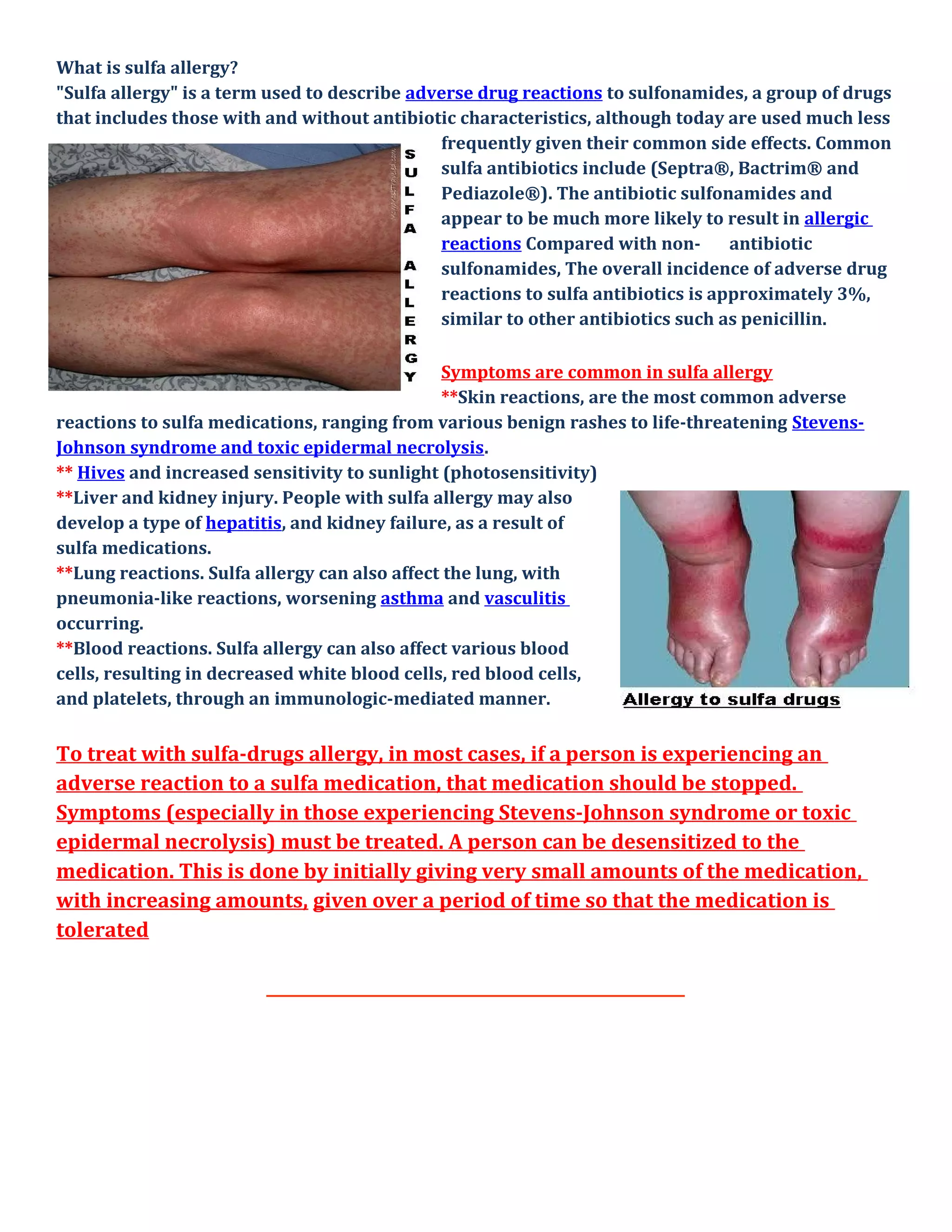
**Skin reactions, are the most common adverse
reactions to sulfa medications, ranging from various benign rashes to life-threatening Stevens-
Johnson syndrome and toxic epidermal necrolysis.
** Hives and increased sensitivity to sunlight (photosensitivity)
**Liver and kidney injury. People with sulfa allergy may also
develop a type of hepatitis, and kidney failure, as a result of
sulfa medications.
**Lung reactions. Sulfa allergy can also affect the lung, with
pneumonia-like reactions, worsening asthma and vasculitis
occurring.
**Blood reactions. Sulfa allergy can also affect various blood
cells, resulting in decreased white blood cells, red blood cells,
and platelets, through an immunologic-mediated manner.
To treat with sulfa-drugs allergy, in most cases, if a person is experiencing an
adverse reaction to a sulfa medication, that medication should be stopped.
Symptoms (especially in those experiencing Stevens-Johnson syndrome or toxic
epidermal necrolysis) must be treated. A person can be desensitized to the
medication. This is done by initially giving very small amounts of the medication,
with increasing amounts, given over a period of time so that the medication is
tolerated
____________________________________________________
FURTHER IMAGES’ EXAMPLES FOR ALLERGY TO DRUGS
‫ةةةةةةة‬ ‫ةةةةةةة‬ ‫ةةةةةةة‬ ‫ةةة‬
FURTHER IMAGES’ EXAMPLES FOR ALLERGY TO DRUGS
‫ةةةةةةة‬ ‫ةةةةةةة‬ ‫ةةةةةةة‬ ‫ةةة‬

Drug allergy

  • 1.
    Is an allergyto a drug, most commonly a medication, Medical attention should be sought immediately if an allergic reaction is suspected. An allergic reaction will not occur on the first exposure to a substance. The first exposure allows the body to create antibodies and memory lymphocyte cells for the antigen. However, drugs often contain many different substances, including dyes, which could cause allergic reactions. This can cause an allergic reaction on the first administration of a drug. For example, a person who developed an allergy to a red dye will be allergic to any new drug which contains that red dye. A drug allergy is different from intolerance. A drug intolerance, which is often a milder, non- immune-mediated reaction, does not depend on prior exposure. Most people who believe they are allergic to aspirin are actually suffering from drug intolerance Drug Allergy Causes& Mechanism An allergic reaction is caused by the body's immune system overreacting to the drug, which is viewed as a chemical "invader," or antigen. This overreaction is often called a hypersensitivity reaction. The body produces antibodies to the antigen and stores the antibodies on special cells. The antibody in an allergic reaction is called immunoglobulin E, or IgE. When the body is exposed to the drug again, the antibodies signal the cells to release chemicals called "mediators." Histamine is an example of a mediator. The effects of these mediators on organs and other cells cause the symptoms of the reaction. The most common triggers of drug allergies are the following: Painkillers (in usual called analgesics) Nonsteroidal anti- inflammatory drugs Antibiotics Antiseizure medications
  • 2.
    Risk factors fordrug allergies include the following: **Frequent exposure to the drug & Large doses of the drug **Drug given by injection rather than pill **Family tendency to develop allergies and asthma **Certain food allergies such as to eggs, soybeans, or shellfish Drug Allergy Symptoms 1. Skin reactions: **A measles-like rash, Fever **Hives-Slightly red, itchy, and raised swellings on the skin, which have an irregular shape **Photoallergy-Sensitivity to sunlight, an itchy and scaly rash that occurs following sun exposure **Erythema multiform-Red, raised and itchy patches on the skin that sometimes look like bull's- eye targets and which may occur together with swelling of the face or tongue, images examples: 2. Muscle and joint aches 3. Lymph nodes swelling 4. Inflammation of the kidney unlike most allergic reactions, which occur fairly quickly after exposure to the allergen, allergic reactions to drugs tend to occur days or weeks after the first dose of the drug. Anaphylaxis or anaphylactic reaction This is a serious allergic reaction that can be life threatening which must be treated in a hospital emergency department. Characteristics of anaphylaxis (sometimes referred to as anaphylactic shock) include: ((Skin reaction-Hives, redness/flushing, sense of warmth, itching Difficulty breathing-Chest tightness, wheezing, throat tightness Fainting-Light-headedness or loss of consciousness due to drastic decrease in blood pressure Rapid or irregular heart beat Swelling of face, tongue, lips, throat, joints, hands, or feet)) ____________________________________________________
  • 3.
    Allergy to Beta-LactamAntibiotics What is a Penicillin Allergy? Penicillin and cephalosporin are the most common causes of drug allergy. Overall rate of allergy to cephalosporin in people with penicillin allergy is approximately 5 to 10%, although rates may be higher for certain people. Penicillin allergy most commonly occurs in young adults, reactions can occur at any age. Women appear to be at higher risk than men. Symptoms of an allergic reaction to penicillin may include anaphylaxis, hives, below-the- skin swelling, asthma symptoms, as well as non-allergic symptoms Other than the immediate treatment of drug allergy symptoms, the main treatment for penicillin allergy is avoidance of future use of penicillin and related antibiotics. ____________________________________________________ Sulfa Drug Allergy
  • 4.
    What is sulfaallergy? "Sulfa allergy" is a term used to describe adverse drug reactions to sulfonamides, a group of drugs that includes those with and without antibiotic characteristics, although today are used much less frequently given their common side effects. Common sulfa antibiotics include (Septra®, Bactrim® and Pediazole®). The antibiotic sulfonamides and appear to be much more likely to result in allergic reactions Compared with non- antibiotic sulfonamides, The overall incidence of adverse drug reactions to sulfa antibiotics is approximately 3%, similar to other antibiotics such as penicillin. Symptoms are common in sulfa allergy **Skin reactions, are the most common adverse reactions to sulfa medications, ranging from various benign rashes to life-threatening Stevens- Johnson syndrome and toxic epidermal necrolysis. ** Hives and increased sensitivity to sunlight (photosensitivity) **Liver and kidney injury. People with sulfa allergy may also develop a type of hepatitis, and kidney failure, as a result of sulfa medications. **Lung reactions. Sulfa allergy can also affect the lung, with pneumonia-like reactions, worsening asthma and vasculitis occurring. **Blood reactions. Sulfa allergy can also affect various blood cells, resulting in decreased white blood cells, red blood cells, and platelets, through an immunologic-mediated manner. To treat with sulfa-drugs allergy, in most cases, if a person is experiencing an adverse reaction to a sulfa medication, that medication should be stopped. Symptoms (especially in those experiencing Stevens-Johnson syndrome or toxic epidermal necrolysis) must be treated. A person can be desensitized to the medication. This is done by initially giving very small amounts of the medication, with increasing amounts, given over a period of time so that the medication is tolerated ____________________________________________________
  • 5.
    FURTHER IMAGES’ EXAMPLESFOR ALLERGY TO DRUGS ‫ةةةةةةة‬ ‫ةةةةةةة‬ ‫ةةةةةةة‬ ‫ةةة‬
  • 6.
    FURTHER IMAGES’ EXAMPLESFOR ALLERGY TO DRUGS ‫ةةةةةةة‬ ‫ةةةةةةة‬ ‫ةةةةةةة‬ ‫ةةة‬