K e l l y W i l l i a m s o n , P h a r m D , B C I D P
I n f e c t i o u s D i s e a s e s C l i n i c a l S p e c i a l i s t
Au g u s t 2 8 , 2 0 1 9
What’s New in C. diff?
Objectives
 Define risk factors for developing Clostridium difficle
 Review the Akron Children’s guideline for
Clostridium difficle
 Outline clinical pearls in the management of
Clostridium difficle
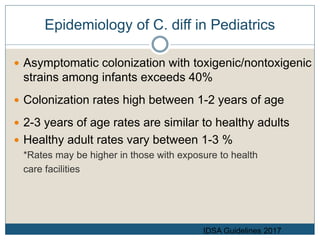
Epidemiology of C. diff in Pediatrics
 Asymptomatic colonization with toxigenic/nontoxigenic
strains among infants exceeds 40%
 Colonization rates high between 1-2 years of age
 2-3 years of age rates are similar to healthy adults
 Healthy adult rates vary between 1-3 %
*Rates may be higher in those with exposure to health
care facilities
IDSA Guidelines 2017
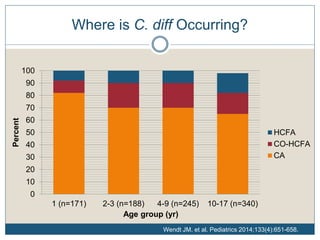
Where is C. diff Occurring?
0
10
20
30
40
50
60
70
80
90
100
1 (n=171) 2-3 (n=188) 4-9 (n=245) 10-17 (n=340)
Percent
Age group (yr)
HCFA
CO-HCFA
CA
Wendt JM, et al. Pediatrics 2014;133(4):651-658.
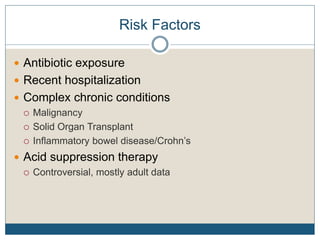
Risk Factors
 Antibiotic exposure
 Recent hospitalization
 Complex chronic conditions
 Malignancy
 Solid Organ Transplant
 Inflammatory bowel disease/Crohn’s
 Acid suppression therapy
 Controversial, mostly adult data
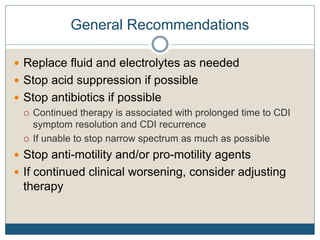
General Recommendations
 Replace fluid and electrolytes as needed
 Stop acid suppression if possible
 Stop antibiotics if possible
 Continued therapy is associated with prolonged time to CDI
symptom resolution and CDI recurrence
 If unable to stop narrow spectrum as much as possible
 Stop anti-motility and/or pro-motility agents
 If continued clinical worsening, consider adjusting
therapy
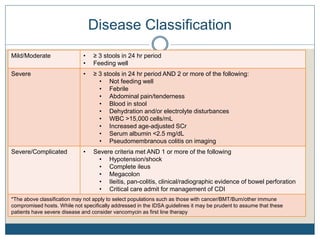
Disease Classification
Mild/Moderate • ≥ 3 stools in 24 hr period
• Feeding well
Severe • ≥ 3 stools in 24 hr period AND 2 or more of the following:
• Not feeding well
• Febrile
• Abdominal pain/tenderness
• Blood in stool
• Dehydration and/or electrolyte disturbances
• WBC >15,000 cells/mL
• Increased age-adjusted SCr
• Serum albumin <2.5 mg/dL
• Pseudomembranous colitis on imaging
Severe/Complicated • Severe criteria met AND 1 or more of the following
• Hypotension/shock
• Complete ileus
• Megacolon
• Ileitis, pan-colitis, clinical/radiographic evidence of bowel perforation
• Critical care admit for management of CDI
*The above classification may not apply to select populations such as those with cancer/BMT/Burn/other immune
compromised hosts. While not specifically addressed in the IDSA guidelines it may be prudent to assume that these
patients have severe disease and consider vancomycin as first line therapy
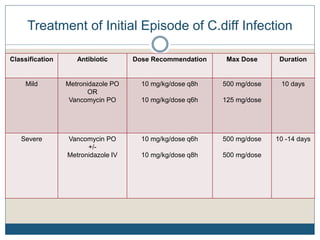
Treatment of Initial Episode of C.diff Infection
Classification Antibiotic Dose Recommendation Max Dose Duration
Mild Metronidazole PO
OR
Vancomycin PO
10 mg/kg/dose q8h
10 mg/kg/dose q6h
500 mg/dose
125 mg/dose
10 days
Severe Vancomycin PO
+/-
Metronidazole IV
10 mg/kg/dose q6h
10 mg/kg/dose q8h
500 mg/dose
500 mg/dose
10 -14 days
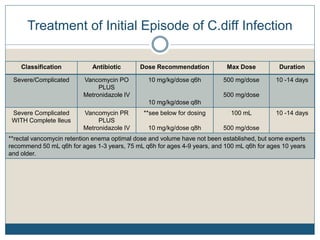
Treatment of Initial Episode of C.diff Infection
Classification Antibiotic Dose Recommendation Max Dose Duration
Severe/Complicated Vancomycin PO
PLUS
Metronidazole IV
10 mg/kg/dose q6h
10 mg/kg/dose q8h
500 mg/dose
500 mg/dose
10 -14 days
Severe Complicated
WITH Complete Ileus
Vancomycin PR
PLUS
Metronidazole IV
**see below for dosing
10 mg/kg/dose q8h
100 mL
500 mg/dose
10 -14 days
**rectal vancomycin retention enema optimal dose and volume have not been established, but some experts
recommend 50 mL q6h for ages 1-3 years, 75 mL q6h for ages 4-9 years, and 100 mL q6h for ages 10 years
and older.
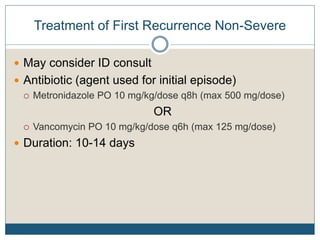
Treatment of First Recurrence Non-Severe
 May consider ID consult
 Antibiotic (agent used for initial episode)
 Metronidazole PO 10 mg/kg/dose q8h (max 500 mg/dose)
OR
 Vancomycin PO 10 mg/kg/dose q6h (max 125 mg/dose)
 Duration: 10-14 days
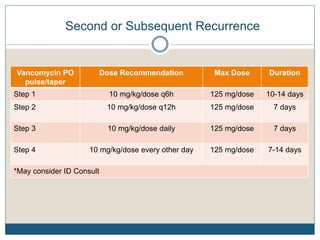
Second or Subsequent Recurrence
Vancomycin PO
pulse/taper
Dose Recommendation Max Dose Duration
Step 1 10 mg/kg/dose q6h 125 mg/dose 10-14 days
Step 2 10 mg/kg/dose q12h 125 mg/dose 7 days
Step 3 10 mg/kg/dose daily 125 mg/dose 7 days
Step 4 10 mg/kg/dose every other day 125 mg/dose 7-14 days
*May consider ID Consult
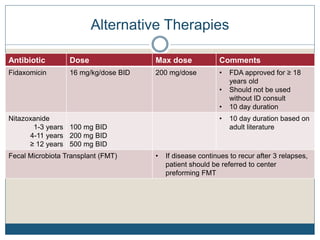
Alternative Therapies
Antibiotic Dose Max dose Comments
Fidaxomicin 16 mg/kg/dose BID 200 mg/dose • FDA approved for ≥ 18
years old
• Should not be used
without ID consult
• 10 day duration
Nitazoxanide
1-3 years
4-11 years
≥ 12 years
100 mg BID
200 mg BID
500 mg BID
• 10 day duration based on
adult literature
Fecal Microbiota Transplant (FMT) • If disease continues to recur after 3 relapses,
patient should be referred to center
preforming FMT
Clinical Treatment Controversies
 FMT
 Probiotics
 Not recommended in AAP statement on C.diff treatment
 IDSA guidelines do not recommend probiotic use
 Studies showing benefit had higher incidence rates of CDI than most
institutions have
 Limitations of probiotic studies
 Differences in probiotic formulation
 Duration of probiotic administration
 Inclusion of patients not typically considered at high risk for CDI
 Continued literature regarding potential for probiotics to cause infection
in hospitalized patients
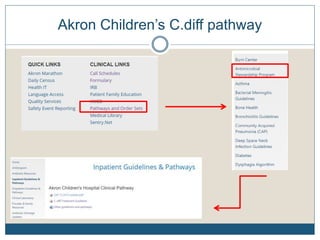
Akron Children’s C.diff pathway
Clinical Pearls For Treatment - Metronidazole
 Bioavailability >90%
 Distributes widely throughout the body
 Metabolized into multiple metabolites (1 active)
 Active metabolite has a longer half-life than parent compound
 Half-life of parent compound + metabolite = 6-10 hrs
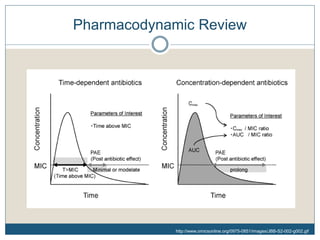
 Concentration-dependent antibiotic
 Post antibiotic effect around 3 hrs
Lamp KC, et al. Clin Pharmacokinet 1999;36(5):353-373.
Metronidazole [prescribing information] Sellersville, PA: Teva; 2011.
Pharmacodynamic Review
http://www.omicsonline.org/0975-0851/images/JBB-S2-002-g002.gif
Clinical Pearls For Treatment - Metronidazole
 Commercially available liquid product
 Grape flavored
 Important counseling points
 Recommended to take with food to minimize GI effects
 Disulfuram-like reaction with alcohol
 Cumulative neurotoxicity with repeated exposures
Lamp KC, et al. Clin Pharmacokinet 1999;36(5):353-373.
Metronidazole [prescribing information] Sellersville, PA: Teva; 2011.
Clinical Pearls For Treatment – PO Vancomycin
 Bioavailability extremely poor
 Drug concentration remains localized to the gut
 At standard doses no detectable serum levels
 When max dose of 500 mg q6h utilized serum concentrations of 1-
5 mcg/mL have been detected in adult patients
 Recommended using standard dose of 125 mg q6h
 Can increase dose if patient not responding after 3-4 days of
standard dosing
D’Ostroph AR, et al. Infect Drug Resist. 2017;10:365-375.
Bhansali SG, et al. Antimicrob Agents Chemother. 2015;59(3):1441-1445.
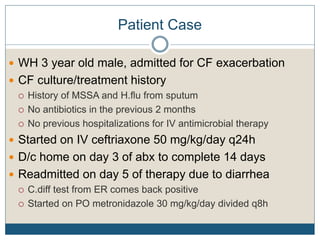
Patient Case
 WH 3 year old male, admitted for CF exacerbation
 CF culture/treatment history
 History of MSSA and H.flu from sputum
 No antibiotics in the previous 2 months
 No previous hospitalizations for IV antimicrobial therapy
 Started on IV ceftriaxone 50 mg/kg/day q24h
 D/c home on day 3 of abx to complete 14 days
 Readmitted on day 5 of therapy due to diarrhea
 C.diff test from ER comes back positive
 Started on PO metronidazole 30 mg/kg/day divided q8h
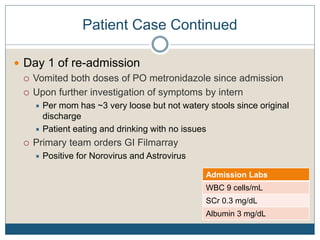
Patient Case Continued
 Day 1 of re-admission
 Vomited both doses of PO metronidazole since admission
 Upon further investigation of symptoms by intern
 Per mom has ~3 very loose but not watery stools since original
discharge
 Patient eating and drinking with no issues
 Primary team orders GI Filmarray
 Positive for Norovirus and Astrovirus
Admission Labs
WBC 9 cells/mL
SCr 0.3 mg/dL
Albumin 3 mg/dL
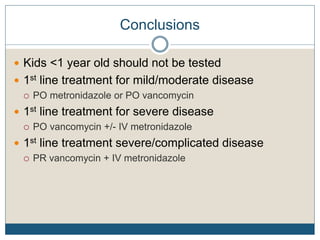
Conclusions
 Kids <1 year old should not be tested
 1st line treatment for mild/moderate disease
 PO metronidazole or PO vancomycin
 1st line treatment for severe disease
 PO vancomycin +/- IV metronidazole
 1st line treatment severe/complicated disease
 PR vancomycin + IV metronidazole

What's new in c. diff

  • 1.
    K e ll y W i l l i a m s o n , P h a r m D , B C I D P I n f e c t i o u s D i s e a s e s C l i n i c a l S p e c i a l i s t Au g u s t 2 8 , 2 0 1 9 What’s New in C. diff?
  • 2.
    Objectives  Define riskfactors for developing Clostridium difficle  Review the Akron Children’s guideline for Clostridium difficle  Outline clinical pearls in the management of Clostridium difficle
  • 3.
    Epidemiology of C.diff in Pediatrics  Asymptomatic colonization with toxigenic/nontoxigenic strains among infants exceeds 40%  Colonization rates high between 1-2 years of age  2-3 years of age rates are similar to healthy adults  Healthy adult rates vary between 1-3 % *Rates may be higher in those with exposure to health care facilities IDSA Guidelines 2017
  • 4.
    Where is C.diff Occurring? 0 10 20 30 40 50 60 70 80 90 100 1 (n=171) 2-3 (n=188) 4-9 (n=245) 10-17 (n=340) Percent Age group (yr) HCFA CO-HCFA CA Wendt JM, et al. Pediatrics 2014;133(4):651-658.
  • 5.
    Risk Factors  Antibioticexposure  Recent hospitalization  Complex chronic conditions  Malignancy  Solid Organ Transplant  Inflammatory bowel disease/Crohn’s  Acid suppression therapy  Controversial, mostly adult data
  • 6.
    General Recommendations  Replacefluid and electrolytes as needed  Stop acid suppression if possible  Stop antibiotics if possible  Continued therapy is associated with prolonged time to CDI symptom resolution and CDI recurrence  If unable to stop narrow spectrum as much as possible  Stop anti-motility and/or pro-motility agents  If continued clinical worsening, consider adjusting therapy
  • 7.
    Disease Classification Mild/Moderate •≥ 3 stools in 24 hr period • Feeding well Severe • ≥ 3 stools in 24 hr period AND 2 or more of the following: • Not feeding well • Febrile • Abdominal pain/tenderness • Blood in stool • Dehydration and/or electrolyte disturbances • WBC >15,000 cells/mL • Increased age-adjusted SCr • Serum albumin <2.5 mg/dL • Pseudomembranous colitis on imaging Severe/Complicated • Severe criteria met AND 1 or more of the following • Hypotension/shock • Complete ileus • Megacolon • Ileitis, pan-colitis, clinical/radiographic evidence of bowel perforation • Critical care admit for management of CDI *The above classification may not apply to select populations such as those with cancer/BMT/Burn/other immune compromised hosts. While not specifically addressed in the IDSA guidelines it may be prudent to assume that these patients have severe disease and consider vancomycin as first line therapy
  • 8.
    Treatment of InitialEpisode of C.diff Infection Classification Antibiotic Dose Recommendation Max Dose Duration Mild Metronidazole PO OR Vancomycin PO 10 mg/kg/dose q8h 10 mg/kg/dose q6h 500 mg/dose 125 mg/dose 10 days Severe Vancomycin PO +/- Metronidazole IV 10 mg/kg/dose q6h 10 mg/kg/dose q8h 500 mg/dose 500 mg/dose 10 -14 days
  • 9.
    Treatment of InitialEpisode of C.diff Infection Classification Antibiotic Dose Recommendation Max Dose Duration Severe/Complicated Vancomycin PO PLUS Metronidazole IV 10 mg/kg/dose q6h 10 mg/kg/dose q8h 500 mg/dose 500 mg/dose 10 -14 days Severe Complicated WITH Complete Ileus Vancomycin PR PLUS Metronidazole IV **see below for dosing 10 mg/kg/dose q8h 100 mL 500 mg/dose 10 -14 days **rectal vancomycin retention enema optimal dose and volume have not been established, but some experts recommend 50 mL q6h for ages 1-3 years, 75 mL q6h for ages 4-9 years, and 100 mL q6h for ages 10 years and older.
  • 10.
    Treatment of FirstRecurrence Non-Severe  May consider ID consult  Antibiotic (agent used for initial episode)  Metronidazole PO 10 mg/kg/dose q8h (max 500 mg/dose) OR  Vancomycin PO 10 mg/kg/dose q6h (max 125 mg/dose)  Duration: 10-14 days
  • 11.
    Second or SubsequentRecurrence Vancomycin PO pulse/taper Dose Recommendation Max Dose Duration Step 1 10 mg/kg/dose q6h 125 mg/dose 10-14 days Step 2 10 mg/kg/dose q12h 125 mg/dose 7 days Step 3 10 mg/kg/dose daily 125 mg/dose 7 days Step 4 10 mg/kg/dose every other day 125 mg/dose 7-14 days *May consider ID Consult
  • 12.
    Alternative Therapies Antibiotic DoseMax dose Comments Fidaxomicin 16 mg/kg/dose BID 200 mg/dose • FDA approved for ≥ 18 years old • Should not be used without ID consult • 10 day duration Nitazoxanide 1-3 years 4-11 years ≥ 12 years 100 mg BID 200 mg BID 500 mg BID • 10 day duration based on adult literature Fecal Microbiota Transplant (FMT) • If disease continues to recur after 3 relapses, patient should be referred to center preforming FMT
  • 13.
    Clinical Treatment Controversies FMT  Probiotics  Not recommended in AAP statement on C.diff treatment  IDSA guidelines do not recommend probiotic use  Studies showing benefit had higher incidence rates of CDI than most institutions have  Limitations of probiotic studies  Differences in probiotic formulation  Duration of probiotic administration  Inclusion of patients not typically considered at high risk for CDI  Continued literature regarding potential for probiotics to cause infection in hospitalized patients
  • 14.
  • 15.
    Clinical Pearls ForTreatment - Metronidazole  Bioavailability >90%  Distributes widely throughout the body  Metabolized into multiple metabolites (1 active)  Active metabolite has a longer half-life than parent compound  Half-life of parent compound + metabolite = 6-10 hrs  Concentration-dependent antibiotic  Post antibiotic effect around 3 hrs Lamp KC, et al. Clin Pharmacokinet 1999;36(5):353-373. Metronidazole [prescribing information] Sellersville, PA: Teva; 2011.
  • 16.
  • 17.
    Clinical Pearls ForTreatment - Metronidazole  Commercially available liquid product  Grape flavored  Important counseling points  Recommended to take with food to minimize GI effects  Disulfuram-like reaction with alcohol  Cumulative neurotoxicity with repeated exposures Lamp KC, et al. Clin Pharmacokinet 1999;36(5):353-373. Metronidazole [prescribing information] Sellersville, PA: Teva; 2011.
  • 18.
    Clinical Pearls ForTreatment – PO Vancomycin  Bioavailability extremely poor  Drug concentration remains localized to the gut  At standard doses no detectable serum levels  When max dose of 500 mg q6h utilized serum concentrations of 1- 5 mcg/mL have been detected in adult patients  Recommended using standard dose of 125 mg q6h  Can increase dose if patient not responding after 3-4 days of standard dosing D’Ostroph AR, et al. Infect Drug Resist. 2017;10:365-375. Bhansali SG, et al. Antimicrob Agents Chemother. 2015;59(3):1441-1445.
  • 19.
    Patient Case  WH3 year old male, admitted for CF exacerbation  CF culture/treatment history  History of MSSA and H.flu from sputum  No antibiotics in the previous 2 months  No previous hospitalizations for IV antimicrobial therapy  Started on IV ceftriaxone 50 mg/kg/day q24h  D/c home on day 3 of abx to complete 14 days  Readmitted on day 5 of therapy due to diarrhea  C.diff test from ER comes back positive  Started on PO metronidazole 30 mg/kg/day divided q8h
  • 20.
    Patient Case Continued Day 1 of re-admission  Vomited both doses of PO metronidazole since admission  Upon further investigation of symptoms by intern  Per mom has ~3 very loose but not watery stools since original discharge  Patient eating and drinking with no issues  Primary team orders GI Filmarray  Positive for Norovirus and Astrovirus Admission Labs WBC 9 cells/mL SCr 0.3 mg/dL Albumin 3 mg/dL
  • 21.
    Conclusions  Kids <1year old should not be tested  1st line treatment for mild/moderate disease  PO metronidazole or PO vancomycin  1st line treatment for severe disease  PO vancomycin +/- IV metronidazole  1st line treatment severe/complicated disease  PR vancomycin + IV metronidazole

Editor's Notes

  • #5 Patients 0-2 yrs of age have the highest outpatient antibiotic prescribing rate, even when compared with patients >65 yrs
  • #9 - Add note about improvement
  • #16 * Small quantities reach the colon. Poor blood flow from the systemic circulation to the colonic mucosa is a hypothesized reason by metronidazole can be less effective
  • #20 Mention going home on OPAT