 GROUP V MEMBERS

12/GS/3711
12/GS/3921
12/GS/3864
12/GS/3929
12/GS/3705
12/GS/3702
12/GS/3708

Vitamin B6
VITAMIN B6
INTRODUCTION
Vitamin B6 also called pyridoxine is a watersoluble vitamin that is naturally present in
many foods, added to others, and available
as a dietary supplement.
Your body needs it for regular nervous
system function, production of normal red
blood cells and protein metabolism
FOOD SOURCES
Vitamin B6 is found in:
Avocado
Banana
Legumes (dried beans)
Meat
Nuts
Poultry
Whole grains
Fortified breads and cereals may also contain
vitamin B6. Fortified means that a vitamin or
mineral has been added to the food.
FUNCTIONS
Vitamin B6 helps the body to:
Make antibodies. Antibodies are needed to
fight many diseases.
Maintain normal nerve function
Make hemoglobin. Hemoglobin carries
oxygen in the red blood cells to the tissues. A
vitamin B6 deficiency can cause a form of
anemia.
Break down proteins. The more protein you
eat, the more vitamin B6 you need.
Keep blood sugar (glucose) in normal ranges.
RECOMMENDATIONS
The Recommended Dietary Allowance
(RDA) for vitamins reflects how much of
each vitamin people should receive on a
daily basis. The RDA for vitamins may be
used to help create goals for each person.
How much of each vitamin is needed
depends on a person's age and gender.
Other factors, such as pregnancy and
illnesses, are also important. Ask your
health care provider which amount is best
for you.
RECOMMENDATIONS
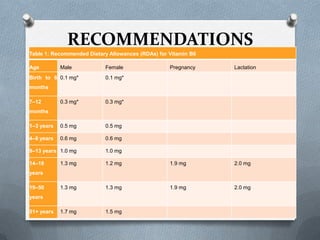
Table 1: Recommended Dietary Allowances (RDAs) for Vitamin B6
Age

Male

Birth to 6 0.1 mg*

Female

Pregnancy

Lactation

0.1 mg*

months
7–12

0.3 mg*

0.3 mg*

1–3 years

0.5 mg

0.5 mg

4–8 years

0.6 mg

0.6 mg

9–13 years 1.0 mg

1.0 mg

14–18

1.3 mg

1.2 mg

1.9 mg

2.0 mg

1.3 mg

1.3 mg

1.9 mg

2.0 mg

1.7 mg

1.5 mg

months

years
19–50
years
51+ years
DEFICIENCY AND RELATED
DISORDERS
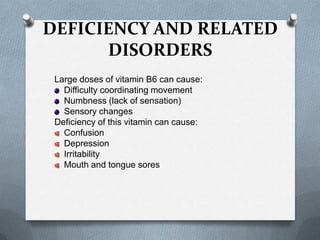
Large doses of vitamin B6 can cause:
Difficulty coordinating movement
Numbness (lack of sensation)
Sensory changes
Deficiency of this vitamin can cause:
Confusion
Depression
Irritability
Mouth and tongue sores
CURRENT RESEARCHES
VITAMIN B6 INTAKES AND STATUS

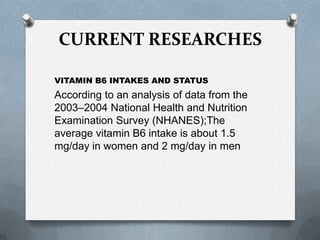
According to an analysis of data from the
2003–2004 National Health and Nutrition
Examination Survey (NHANES);The
average vitamin B6 intake is about 1.5
mg/day in women and 2 mg/day in men
CURRENT RESEARCHES
VITAMIN B6 DEFICIENCY

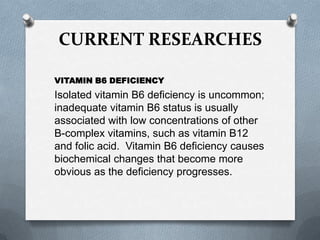
Isolated vitamin B6 deficiency is uncommon;
inadequate vitamin B6 status is usually
associated with low concentrations of other
B-complex vitamins, such as vitamin B12
and folic acid. Vitamin B6 deficiency causes
biochemical changes that become more
obvious as the deficiency progresses.
CURRENT RESEARCHES
Vitamin B6 deficiency is associated with
microcytic anemia, electroencephalographic
abnormalities, dermatitis with cheilosis
(scaling on the lips and cracks at the
corners of the mouth) and glossitis (swollen
tongue), depression and confusion, and
weakened immune function.
CURRENT RESEARCHES
In infants, vitamin B6 deficiency causes
irritability, abnormally acute hearing, and
convulsive seizures.
End-stage renal diseases, chronic renal
insufficiency, and other kidney diseases can
cause vitamin B6 deficiency.
CURRENT RESEARCHES
In addition, vitamin B6 deficiency can result
from malabsorption syndromes, such as
celiac disease, Crohn’s disease, and
ulcerative colitis. Certain genetic diseases,
such as homocystinuria, can also cause
vitamin B6 deficiency. Some medications,
such as antiepileptic drugs, can lead to
deficiency over time.
CURRENT RESEARCHES
GROUPS AT RISK OF VITAMIN B6 INADEQUACY
The following groups are among those most likely to have inadequate
intakes of vitamin B6.
INDIVIDUALS WITH IMPAIRED RENAL FUNCTION

People with poor renal function, including those with end-stage renal
disease and chronic renal insufficiency, often have low vitamin B6
concentrations.
Plasma PLP concentrations are also low in patients receiving
maintenance kidney dialysis or intermittent peritoneal dialysis, as well
as those who have undergone a kidney transplant, perhaps due to
increased metabolic clearance of PLP. Patients with kidney disease
often show clinical symptoms similar to those of people with vitamin B6
deficiency.
O
CURRENT RESEARCHES
INDIVIDUALS WITH AUTOIMMUNE DISORDERS

People with rheumatoid arthritis often have low
vitamin B6 concentrations, and vitamin B6
concentrations tend to decrease with increased
disease severity. These low vitamin B6 levels are due
to the inflammation caused by the disease and, in
turn, increase the inflammation associated with the
disease. Although vitamin B6 supplements can
normalize vitamin B6 concentrations in patients with
rheumatoid arthritis, they do not suppress the
production of inflammatory cytokines or decrease
levels of inflammatory markers.
CURRENT RESEARCHES
PEOPLE WITH ALCOHOL DEPENDENCE

Plasma PLP concentrations tend to be very
low in people with alcohol dependence.
Alcohol produces acetaldehyde, which
decreases net PLP formation by cells and
competes with PLP in protein binding. As a
result, the PLP in cells might be more
susceptible to hydrolysis by membranebound phosphatase. People with alcohol
dependence might benefit from pyridoxine
supplementation.
REFERENCES
1.

Institute of Medicine. Food and Nutrition Board. Dietary
Reference Intakes: Thiamin, Riboflavin, Niacin, Vitamin B6,
Folate, Vitamin B12, Pantothenic Acid, Biotin, and Choline .
Washington, DC: National Academy Press; 1998.

2.

Mackey A, Davis S, Gregory J. Vitamin B6. In: Shils M, Shike
M, Ross A, Caballero B, Cousins R, eds. Modern Nutrition in
Health and Disease. 10th ed. Baltimore, MD: Lippincott
Williams & Wilkins; 2005.

3.

McCormick D. Vitamin B6. In: Bowman B, Russell R, eds.
Present Knowledge in Nutrition. 9th ed. Washington, DC:
International Life Sciences Institute; 2006.
To be
continued
Nothing Is Impossible, Nothing is Unreachable when you are willing
!!!

Vitamin b6

  • 1.
     GROUP VMEMBERS 12/GS/3711 12/GS/3921 12/GS/3864 12/GS/3929 12/GS/3705 12/GS/3702 12/GS/3708 Vitamin B6
  • 2.
    VITAMIN B6 INTRODUCTION Vitamin B6also called pyridoxine is a watersoluble vitamin that is naturally present in many foods, added to others, and available as a dietary supplement. Your body needs it for regular nervous system function, production of normal red blood cells and protein metabolism
  • 3.
    FOOD SOURCES Vitamin B6is found in: Avocado Banana Legumes (dried beans) Meat Nuts Poultry Whole grains Fortified breads and cereals may also contain vitamin B6. Fortified means that a vitamin or mineral has been added to the food.
  • 4.
    FUNCTIONS Vitamin B6 helpsthe body to: Make antibodies. Antibodies are needed to fight many diseases. Maintain normal nerve function Make hemoglobin. Hemoglobin carries oxygen in the red blood cells to the tissues. A vitamin B6 deficiency can cause a form of anemia. Break down proteins. The more protein you eat, the more vitamin B6 you need. Keep blood sugar (glucose) in normal ranges.
  • 5.
    RECOMMENDATIONS The Recommended DietaryAllowance (RDA) for vitamins reflects how much of each vitamin people should receive on a daily basis. The RDA for vitamins may be used to help create goals for each person. How much of each vitamin is needed depends on a person's age and gender. Other factors, such as pregnancy and illnesses, are also important. Ask your health care provider which amount is best for you.
  • 6.
    RECOMMENDATIONS Table 1: RecommendedDietary Allowances (RDAs) for Vitamin B6 Age Male Birth to 6 0.1 mg* Female Pregnancy Lactation 0.1 mg* months 7–12 0.3 mg* 0.3 mg* 1–3 years 0.5 mg 0.5 mg 4–8 years 0.6 mg 0.6 mg 9–13 years 1.0 mg 1.0 mg 14–18 1.3 mg 1.2 mg 1.9 mg 2.0 mg 1.3 mg 1.3 mg 1.9 mg 2.0 mg 1.7 mg 1.5 mg months years 19–50 years 51+ years
  • 7.
    DEFICIENCY AND RELATED DISORDERS Largedoses of vitamin B6 can cause: Difficulty coordinating movement Numbness (lack of sensation) Sensory changes Deficiency of this vitamin can cause: Confusion Depression Irritability Mouth and tongue sores
  • 8.
    CURRENT RESEARCHES VITAMIN B6INTAKES AND STATUS According to an analysis of data from the 2003–2004 National Health and Nutrition Examination Survey (NHANES);The average vitamin B6 intake is about 1.5 mg/day in women and 2 mg/day in men
  • 9.
    CURRENT RESEARCHES VITAMIN B6DEFICIENCY Isolated vitamin B6 deficiency is uncommon; inadequate vitamin B6 status is usually associated with low concentrations of other B-complex vitamins, such as vitamin B12 and folic acid. Vitamin B6 deficiency causes biochemical changes that become more obvious as the deficiency progresses.
  • 10.
    CURRENT RESEARCHES Vitamin B6deficiency is associated with microcytic anemia, electroencephalographic abnormalities, dermatitis with cheilosis (scaling on the lips and cracks at the corners of the mouth) and glossitis (swollen tongue), depression and confusion, and weakened immune function.
  • 11.
    CURRENT RESEARCHES In infants,vitamin B6 deficiency causes irritability, abnormally acute hearing, and convulsive seizures. End-stage renal diseases, chronic renal insufficiency, and other kidney diseases can cause vitamin B6 deficiency.
  • 12.
    CURRENT RESEARCHES In addition,vitamin B6 deficiency can result from malabsorption syndromes, such as celiac disease, Crohn’s disease, and ulcerative colitis. Certain genetic diseases, such as homocystinuria, can also cause vitamin B6 deficiency. Some medications, such as antiepileptic drugs, can lead to deficiency over time.
  • 13.
    CURRENT RESEARCHES GROUPS ATRISK OF VITAMIN B6 INADEQUACY The following groups are among those most likely to have inadequate intakes of vitamin B6. INDIVIDUALS WITH IMPAIRED RENAL FUNCTION People with poor renal function, including those with end-stage renal disease and chronic renal insufficiency, often have low vitamin B6 concentrations. Plasma PLP concentrations are also low in patients receiving maintenance kidney dialysis or intermittent peritoneal dialysis, as well as those who have undergone a kidney transplant, perhaps due to increased metabolic clearance of PLP. Patients with kidney disease often show clinical symptoms similar to those of people with vitamin B6 deficiency. O
  • 14.
    CURRENT RESEARCHES INDIVIDUALS WITHAUTOIMMUNE DISORDERS People with rheumatoid arthritis often have low vitamin B6 concentrations, and vitamin B6 concentrations tend to decrease with increased disease severity. These low vitamin B6 levels are due to the inflammation caused by the disease and, in turn, increase the inflammation associated with the disease. Although vitamin B6 supplements can normalize vitamin B6 concentrations in patients with rheumatoid arthritis, they do not suppress the production of inflammatory cytokines or decrease levels of inflammatory markers.
  • 15.
    CURRENT RESEARCHES PEOPLE WITHALCOHOL DEPENDENCE Plasma PLP concentrations tend to be very low in people with alcohol dependence. Alcohol produces acetaldehyde, which decreases net PLP formation by cells and competes with PLP in protein binding. As a result, the PLP in cells might be more susceptible to hydrolysis by membranebound phosphatase. People with alcohol dependence might benefit from pyridoxine supplementation.
  • 16.
    REFERENCES 1. Institute of Medicine.Food and Nutrition Board. Dietary Reference Intakes: Thiamin, Riboflavin, Niacin, Vitamin B6, Folate, Vitamin B12, Pantothenic Acid, Biotin, and Choline . Washington, DC: National Academy Press; 1998. 2. Mackey A, Davis S, Gregory J. Vitamin B6. In: Shils M, Shike M, Ross A, Caballero B, Cousins R, eds. Modern Nutrition in Health and Disease. 10th ed. Baltimore, MD: Lippincott Williams & Wilkins; 2005. 3. McCormick D. Vitamin B6. In: Bowman B, Russell R, eds. Present Knowledge in Nutrition. 9th ed. Washington, DC: International Life Sciences Institute; 2006.
  • 17.
    To be continued Nothing IsImpossible, Nothing is Unreachable when you are willing !!!