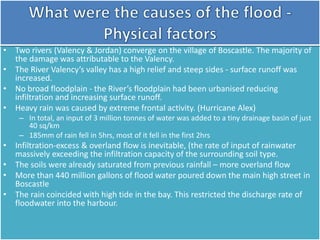
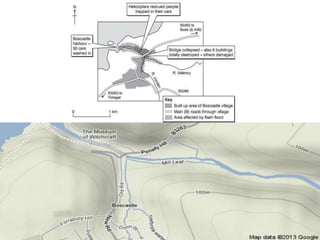
• Two rivers (Valency & Jordan) converge on the village of Boscastle. The majority of
the damage was attributable to the Valency.
• The River Valency’s valley has a high relief and steep sides - surface runoff was
increased.
• No broad floodplain - the River’s floodplain had been urbanised reducing
infiltration and increasing surface runoff.
• Heavy rain was caused by extreme frontal activity. (Hurricane Alex)
– In total, an input of 3 million tonnes of water was added to a tiny drainage basin of just
40 sq/km
– 185mm of rain fell in 5hrs, most of it fell in the first 2hrs
• Infiltration-excess & overland flow is inevitable, (the rate of input of rainwater
massively exceeding the infiltration capacity of the surrounding soil type.
• The soils were already saturated from previous rainfall – more overland flow
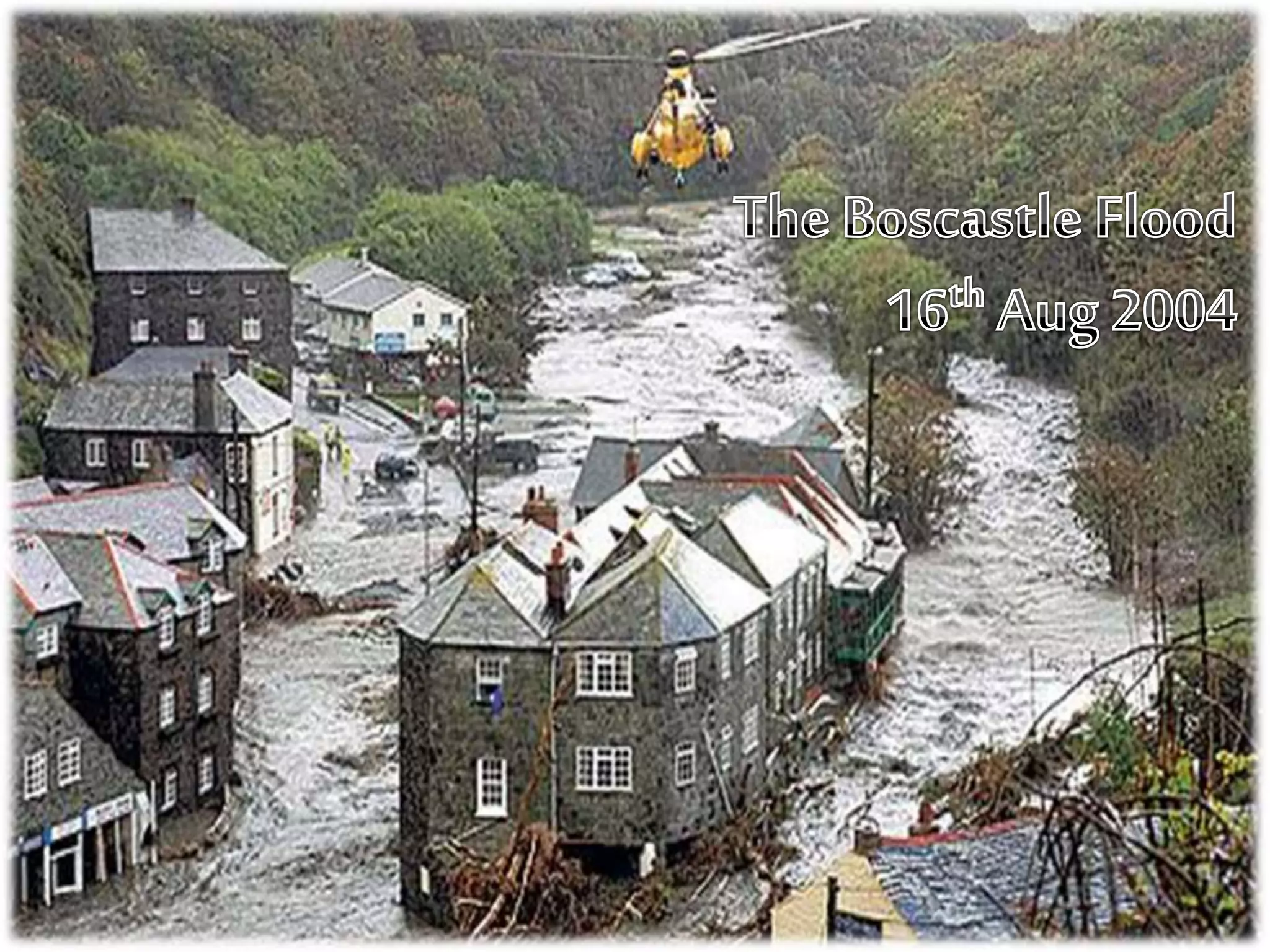
• More than 440 million gallons of flood water poured down the main high street in
Boscastle
• The rain coincided with high tide in the bay. This restricted the discharge rate of
floodwater into the harbour.
• The settlement of Boscastle has been allowed to
develop on a narrow flood plain on the west coast of
England, where rainfall is often high.
• Early settlers would have been attracted by ‘site’ factors
such as the fresh water supply and access to a natural
harbour.
• There are now around 1,000 permanent residents,
most of who rely upon the situation of the settlement
to provide tourist revenues (it is close to the South
West Coast Path).
• The rainfall hit at the worst time of year when the
settlement population doubles to 2,000 as tourists
arrive, many of who are following the South West Coast
Path.
• At 3.46pm river levels had risen by 7 feet (2.15 m) in one hour
• Heavy property damage
– Six properties were completely destroyed. Most others will require between £15,000 and £30,000
for repairs
– Shared amenities such as the village green are now covered with silt and up-ended cars.
– These are serious costs for a small community with a seasonal employment problem, due to its
over-reliance on summer tourism.
– Some home and car owners will not receive compensation if (a) they lack insurance cover or (b)
they find that they are not entitled to payment because insurers regard this unusual event as an
‘Act of God’
• Infrastructure disruption
– Both bridges in the village were destroyed and sections of road have been swept away.
– Telephone, water, electricity and gas supplies were all cut-off
• Irreplaceable loss of historical artefacts
– The ‘Witch Museum’ – 50 years old and receives 50,000 visitors a year
– Some of its unique contents were damaged
• No deaths - But at least one resident suffered a heart attack
• Due to the nature of the tourist population, and the time of year the flood struck, it
took a long time to clearly establish that there had been no fatalities
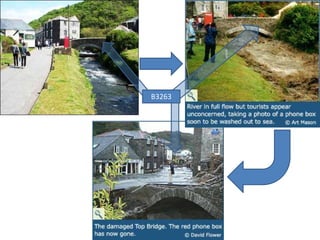
B3263
• Economic losses
– Much of rural Cornwall is classified as a deprived region. It is one of the UK’s poorest rural
counties. A victim of early deindustrialisation, the region’s mining industries are now long-
gone leaving it over-dependent on tourism.
– Most shops stayed shut for the rest of the season and the reduction in tourist numbers during
future years, may result in a negative multiplier effect for the entire local community. “We've
actually lost 79% of our turnover this winter”
• In addition, shops were carrying greater levels of stock than at other times of the year.
– House prices fell – People found the value of their homes permanently reduced, now that
Boscastle is associated with a serious flood risk. It has been suggested that values have halved
• Wider regional impact
– In addition, the effect may spread beyond Boscastle if other river-line settlements are
perceived to be at risk by tourists.
– Boscastle businesses can claim compensation from their insurance companies (claims for
‘disruption to trading’ in Boscastle could amount to £15m). However, others businesses
elsewhere in Cornwall cannot, even though they too may suffer reduced trade next year.
– This is a cause for concern, with tourism accounting for 30% of Cornwall’s GDP. The
population doubles during July and August each year, with tourists spending up to £1 billion
throughout the county.
Continued...
• Mental trauma
– Many residents will suffer stress and anxiety during the year ahead, with
insurance loss adjusters advising that it may be six months before properties
are sufficiently repaired for homeowners to permanently return.
– Environment Agency post-event surveys have repeatedly shown that this is one
of the worst problems that flood victims face: they cannot physically return to
their homes even when the floodwaters have receded.
– North Cornwall District Council banned Boscastle residents from returning to
even look at their homes for the first ten days, while structural engineers
inspected properties.
– Health and Safety legislation also required that 76 up-ended cars, masses of
uprooted trees and sewage-contaminated silts needed to be moved from the
village streets before they could be re-opened to the public.
– Only now can actual interior repairs such as re-plastering begin, and this will
take many more months. In some cases, the historic character of the houses in
Boscastle is likely to cause extra problems. Many are Grade II Listed buildings,
which means that repairs will take even longer, as restoration will require
specialist attention.
• Sediment accretion
– Much of the village’s open land, including gardens and the
village green, were covered with fresh beds of alluvial silt.
– As the floodwaters receded and the three rivers lost energy,
they deposited a large amount of sediment (most houses
contained a two-foot deep deposit of mud).
• River channel changes
– The bed of the River Jordan is 10ft higher than before the
flood, as a result of sediment transport and deposition.
– It has also changed its course.
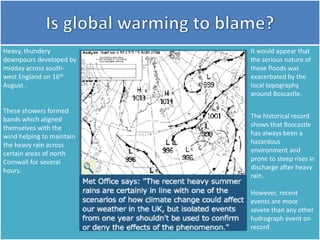
Heavy, thundery
downpours developed by
midday across south-
west England on 16th
August .
These showers formed
bands which aligned
themselves with the
wind helping to maintain
the heavy rain across
certain areas of north
Cornwall for several
hours.
It would appear that
the serious nature of
these floods was
exacerbated by the
local topography
around Boscastle.
The historical record
shows that Boscastle
has always been a
hazardous
environment and
prone to steep rises in
discharge after heavy
rain.
However, recent
events are more
severe than any other
hydrograph event on
record.
• A flood warning was issued for parts of Cornwall at 3:30pm
– Boscastle wasn’t specifically warned.
• A search and rescue operation was setup
– Lasted until 2:30am the next day
– RAF helicopters worked between 6 and 9pm to rescue over 150
stranded citizens & tourists
– Overall, excellent emergency services and Environment Agency
response meant no lives lost
• 11 Days after the flood people were allowed to return to their
homes to salvage their belongings.
• Prince Charles visited the town 2 days after the flood and
donated a large sum of money to the town.
• A few days after the flood, geologists flew over the area to
assess the risk of landslides triggered by the heavy rain.
• Flood defence system (New flood defences were set to be built in October, work
had not yet started then)
– Deepened the River Valency by 2 metres – increase capacity & reduce risk of flooding
– The remains of the “lower bridge” that triggered a 3m wave was demolished and
replaced with a larger bridge that would be more difficult to block with debris.
– In 2007, these defences were put to the test and a much smaller, more controlled flood
occurred.
• Businesses were offered compensation for lost revenue & to cover costs to repair
shops etc.
• Main car park raised by 1 metre
– Left as an area that can flood in order to cope with excess water
• Afforestation on the upper catchment slopes
• The effects of the flood caused people in Boscastle to take their environmental
footprint far more seriously
– They were led to believe that climate change exacerbated by human activity was
responsible for the “freak weather” that caused the river to flood.
– When buildings were reconstructed, they were done so in an environmentally friendly
manner with insulation, double glazing etc.
– The town won 5 awards for its eco-friendliness.
No arch
allows for
more water
to pass
underneath
the bridge
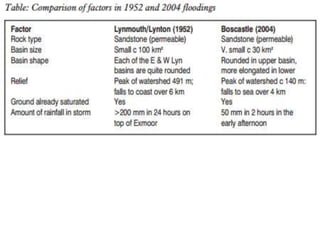
• Levels of property damage in Lynmouth (1952) and Boscastle (2004) are very similar, notably the
number of properties damaged.
• Loss of life is very different. No lives were lost in 2004, partly reflecting improvements in flood warning
techniques, levels of public education and emergency service preparation for such extreme hazard
events.
• Seven Navy and coastguard helicopters as well as 17 fire engines were quickly scrambled to help
stranded residents escape from the roofs of their houses.
• The Environment Agency web site now provides 24hr flood warning information, which may have
alerted people of the impending danger.
• The same physical factor - extreme frontal rainfall - was the primary cause of the hazard in both cases.
185mm in 5hrs in Boscastle, compared with 230mm over 14hrs in Lynmouth.
• Both events also occurred in the same part of the world under
near-identical conditions of geology and relief.
• However, the hazard impact was greater at Lynmouth, claiming
34 lives, due to one key additional factor: the blocking of the
river Lyn’s narrow-arched road-bridge.
The boscastle flood (August 2004) - case study

The boscastle flood (August 2004) - case study

  • 4.
    • Two rivers(Valency & Jordan) converge on the village of Boscastle. The majority of the damage was attributable to the Valency. • The River Valency’s valley has a high relief and steep sides - surface runoff was increased. • No broad floodplain - the River’s floodplain had been urbanised reducing infiltration and increasing surface runoff. • Heavy rain was caused by extreme frontal activity. (Hurricane Alex) – In total, an input of 3 million tonnes of water was added to a tiny drainage basin of just 40 sq/km – 185mm of rain fell in 5hrs, most of it fell in the first 2hrs • Infiltration-excess & overland flow is inevitable, (the rate of input of rainwater massively exceeding the infiltration capacity of the surrounding soil type. • The soils were already saturated from previous rainfall – more overland flow • More than 440 million gallons of flood water poured down the main high street in Boscastle • The rain coincided with high tide in the bay. This restricted the discharge rate of floodwater into the harbour.
  • 6.
    • The settlementof Boscastle has been allowed to develop on a narrow flood plain on the west coast of England, where rainfall is often high. • Early settlers would have been attracted by ‘site’ factors such as the fresh water supply and access to a natural harbour. • There are now around 1,000 permanent residents, most of who rely upon the situation of the settlement to provide tourist revenues (it is close to the South West Coast Path). • The rainfall hit at the worst time of year when the settlement population doubles to 2,000 as tourists arrive, many of who are following the South West Coast Path.
  • 7.
    • At 3.46pmriver levels had risen by 7 feet (2.15 m) in one hour • Heavy property damage – Six properties were completely destroyed. Most others will require between £15,000 and £30,000 for repairs – Shared amenities such as the village green are now covered with silt and up-ended cars. – These are serious costs for a small community with a seasonal employment problem, due to its over-reliance on summer tourism. – Some home and car owners will not receive compensation if (a) they lack insurance cover or (b) they find that they are not entitled to payment because insurers regard this unusual event as an ‘Act of God’ • Infrastructure disruption – Both bridges in the village were destroyed and sections of road have been swept away. – Telephone, water, electricity and gas supplies were all cut-off • Irreplaceable loss of historical artefacts – The ‘Witch Museum’ – 50 years old and receives 50,000 visitors a year – Some of its unique contents were damaged • No deaths - But at least one resident suffered a heart attack • Due to the nature of the tourist population, and the time of year the flood struck, it took a long time to clearly establish that there had been no fatalities
  • 8.
  • 9.
    • Economic losses –Much of rural Cornwall is classified as a deprived region. It is one of the UK’s poorest rural counties. A victim of early deindustrialisation, the region’s mining industries are now long- gone leaving it over-dependent on tourism. – Most shops stayed shut for the rest of the season and the reduction in tourist numbers during future years, may result in a negative multiplier effect for the entire local community. “We've actually lost 79% of our turnover this winter” • In addition, shops were carrying greater levels of stock than at other times of the year. – House prices fell – People found the value of their homes permanently reduced, now that Boscastle is associated with a serious flood risk. It has been suggested that values have halved • Wider regional impact – In addition, the effect may spread beyond Boscastle if other river-line settlements are perceived to be at risk by tourists. – Boscastle businesses can claim compensation from their insurance companies (claims for ‘disruption to trading’ in Boscastle could amount to £15m). However, others businesses elsewhere in Cornwall cannot, even though they too may suffer reduced trade next year. – This is a cause for concern, with tourism accounting for 30% of Cornwall’s GDP. The population doubles during July and August each year, with tourists spending up to £1 billion throughout the county.
  • 10.
    Continued... • Mental trauma –Many residents will suffer stress and anxiety during the year ahead, with insurance loss adjusters advising that it may be six months before properties are sufficiently repaired for homeowners to permanently return. – Environment Agency post-event surveys have repeatedly shown that this is one of the worst problems that flood victims face: they cannot physically return to their homes even when the floodwaters have receded. – North Cornwall District Council banned Boscastle residents from returning to even look at their homes for the first ten days, while structural engineers inspected properties. – Health and Safety legislation also required that 76 up-ended cars, masses of uprooted trees and sewage-contaminated silts needed to be moved from the village streets before they could be re-opened to the public. – Only now can actual interior repairs such as re-plastering begin, and this will take many more months. In some cases, the historic character of the houses in Boscastle is likely to cause extra problems. Many are Grade II Listed buildings, which means that repairs will take even longer, as restoration will require specialist attention.
  • 11.
    • Sediment accretion –Much of the village’s open land, including gardens and the village green, were covered with fresh beds of alluvial silt. – As the floodwaters receded and the three rivers lost energy, they deposited a large amount of sediment (most houses contained a two-foot deep deposit of mud). • River channel changes – The bed of the River Jordan is 10ft higher than before the flood, as a result of sediment transport and deposition. – It has also changed its course.
  • 12.
    Heavy, thundery downpours developedby midday across south- west England on 16th August . These showers formed bands which aligned themselves with the wind helping to maintain the heavy rain across certain areas of north Cornwall for several hours. It would appear that the serious nature of these floods was exacerbated by the local topography around Boscastle. The historical record shows that Boscastle has always been a hazardous environment and prone to steep rises in discharge after heavy rain. However, recent events are more severe than any other hydrograph event on record.
  • 13.
    • A floodwarning was issued for parts of Cornwall at 3:30pm – Boscastle wasn’t specifically warned. • A search and rescue operation was setup – Lasted until 2:30am the next day – RAF helicopters worked between 6 and 9pm to rescue over 150 stranded citizens & tourists – Overall, excellent emergency services and Environment Agency response meant no lives lost • 11 Days after the flood people were allowed to return to their homes to salvage their belongings. • Prince Charles visited the town 2 days after the flood and donated a large sum of money to the town. • A few days after the flood, geologists flew over the area to assess the risk of landslides triggered by the heavy rain.
  • 14.
    • Flood defencesystem (New flood defences were set to be built in October, work had not yet started then) – Deepened the River Valency by 2 metres – increase capacity & reduce risk of flooding – The remains of the “lower bridge” that triggered a 3m wave was demolished and replaced with a larger bridge that would be more difficult to block with debris. – In 2007, these defences were put to the test and a much smaller, more controlled flood occurred. • Businesses were offered compensation for lost revenue & to cover costs to repair shops etc. • Main car park raised by 1 metre – Left as an area that can flood in order to cope with excess water • Afforestation on the upper catchment slopes • The effects of the flood caused people in Boscastle to take their environmental footprint far more seriously – They were led to believe that climate change exacerbated by human activity was responsible for the “freak weather” that caused the river to flood. – When buildings were reconstructed, they were done so in an environmentally friendly manner with insulation, double glazing etc. – The town won 5 awards for its eco-friendliness.
  • 15.
    No arch allows for morewater to pass underneath the bridge
  • 16.
    • Levels ofproperty damage in Lynmouth (1952) and Boscastle (2004) are very similar, notably the number of properties damaged. • Loss of life is very different. No lives were lost in 2004, partly reflecting improvements in flood warning techniques, levels of public education and emergency service preparation for such extreme hazard events. • Seven Navy and coastguard helicopters as well as 17 fire engines were quickly scrambled to help stranded residents escape from the roofs of their houses. • The Environment Agency web site now provides 24hr flood warning information, which may have alerted people of the impending danger. • The same physical factor - extreme frontal rainfall - was the primary cause of the hazard in both cases. 185mm in 5hrs in Boscastle, compared with 230mm over 14hrs in Lynmouth. • Both events also occurred in the same part of the world under near-identical conditions of geology and relief. • However, the hazard impact was greater at Lynmouth, claiming 34 lives, due to one key additional factor: the blocking of the river Lyn’s narrow-arched road-bridge.