DEPARTMENT OF
ORTHODONTICS
Prepared By: Under the Guidance of:
Priyanka Vadhera Dr. Rahul Paul
Batch-2012 Dr. Vineet Golcha
Roll No. 6083059 Dr. Deepti
Dr. Siddhant Taneja
Dr. Ankita Jhalani
CONTENTS
 Introduction
 Definition
 Features Of Class III Malocclusion
 Skeletal Features Of Class III
Malocclusion
 Etiology
 Diagnosis
 Treatment
I. Interception During Growth
II. Treatment Using Fixed Appliance
III. Treatment of Anterior Crossbite
IV. Treatment Of Posterior Crossbite
V. Role Of Extractions
VI. Treatment Of Severe Class III After
Growth
VII. Treatment Of Pseudo Class III
INTRODUCTION
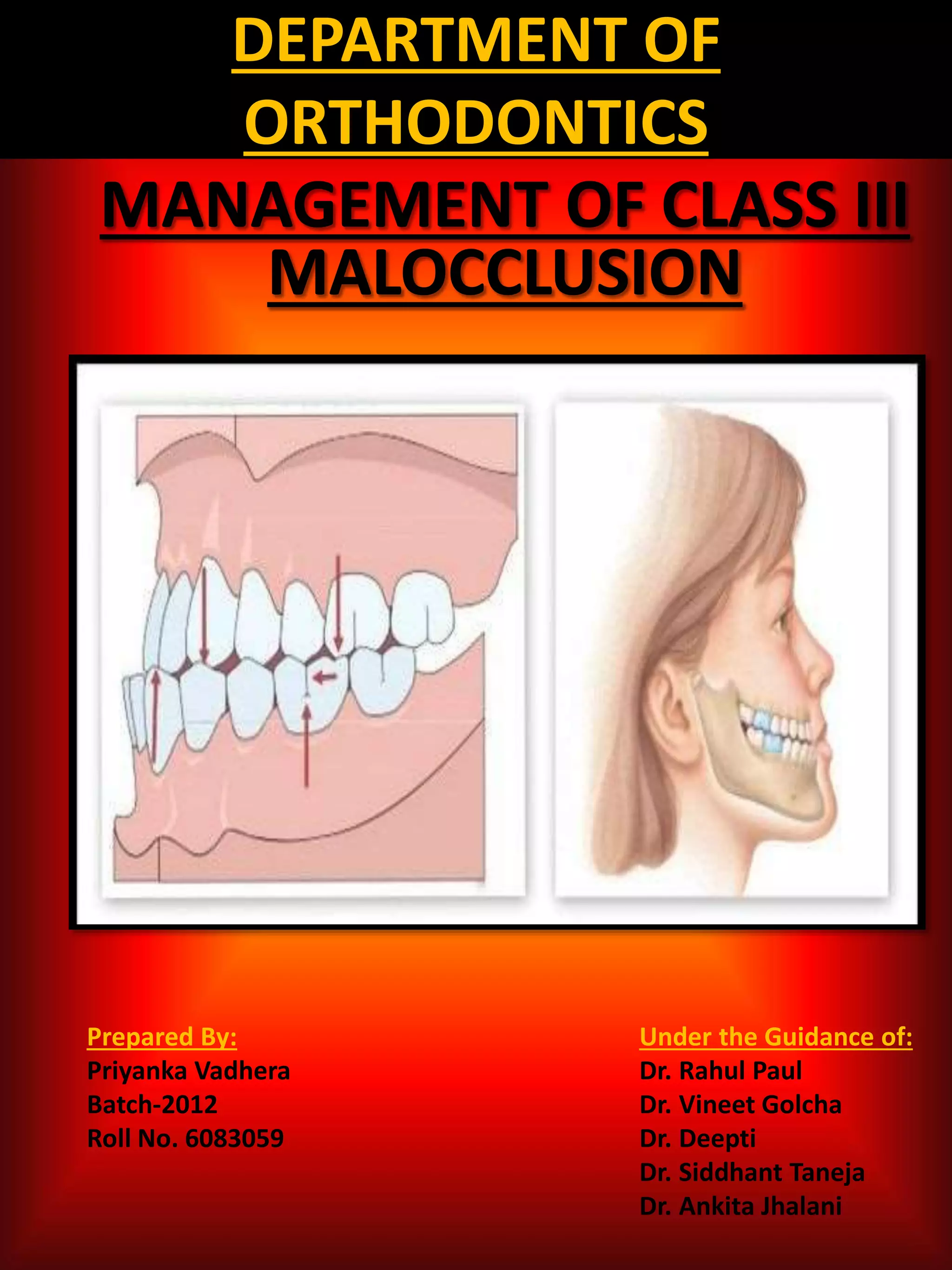
Class III malocclusion is very easy to identify but
difficult to treat.
It represents a pre-normalcy where the mandible
is in a mesial relation to the upper arch.
This kind of malocclusion finds highest incidence
in Japan & Korea.
DEFINITION
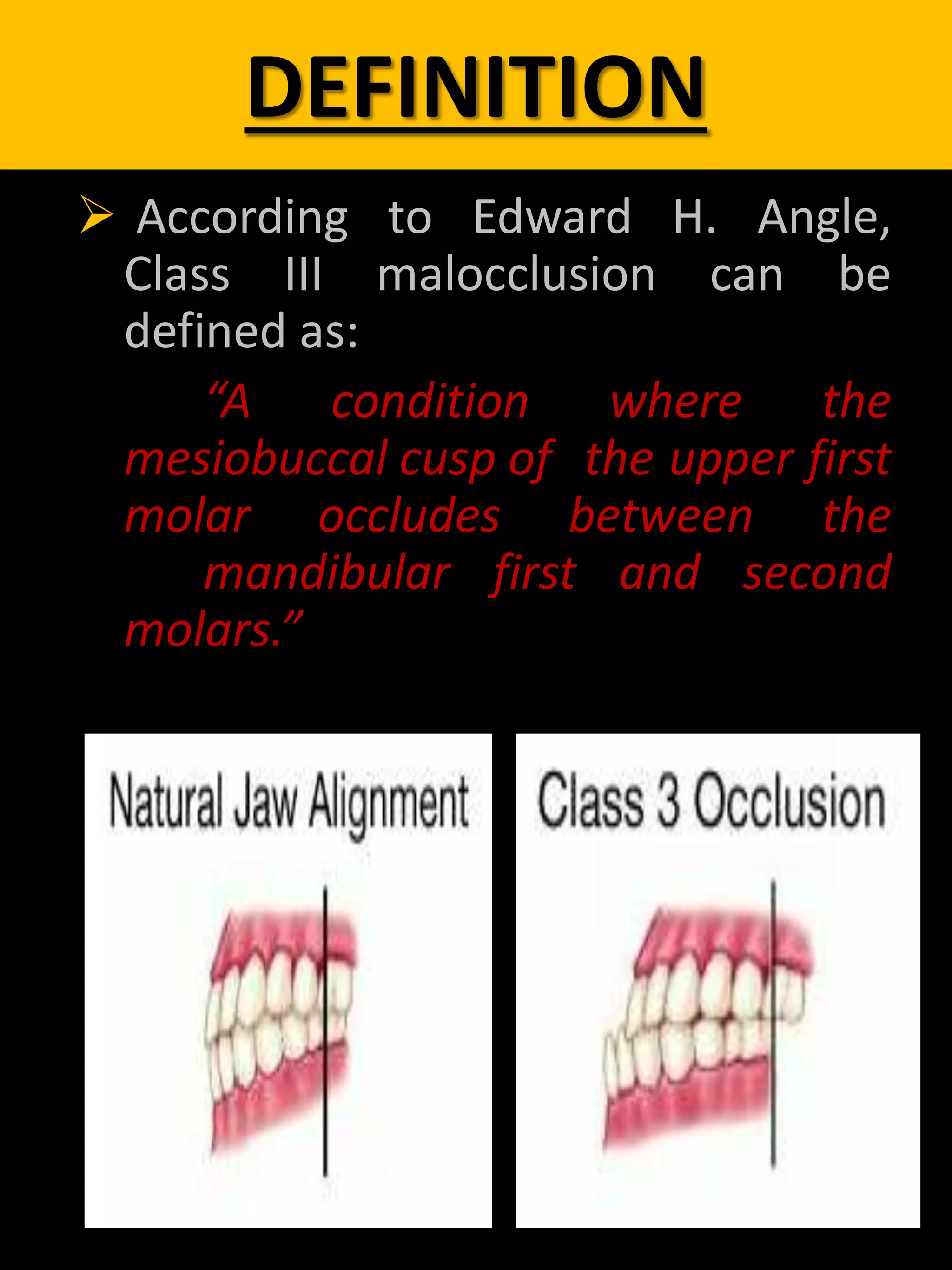
 According to Edward H. Angle,
Class III malocclusion can be
defined as:
“A condition where the
mesiobuccal cusp of the upper first
molar occludes between the
mandibular first and second
molars.”
FEATURES OF CLASS III
MALOCCLUSION
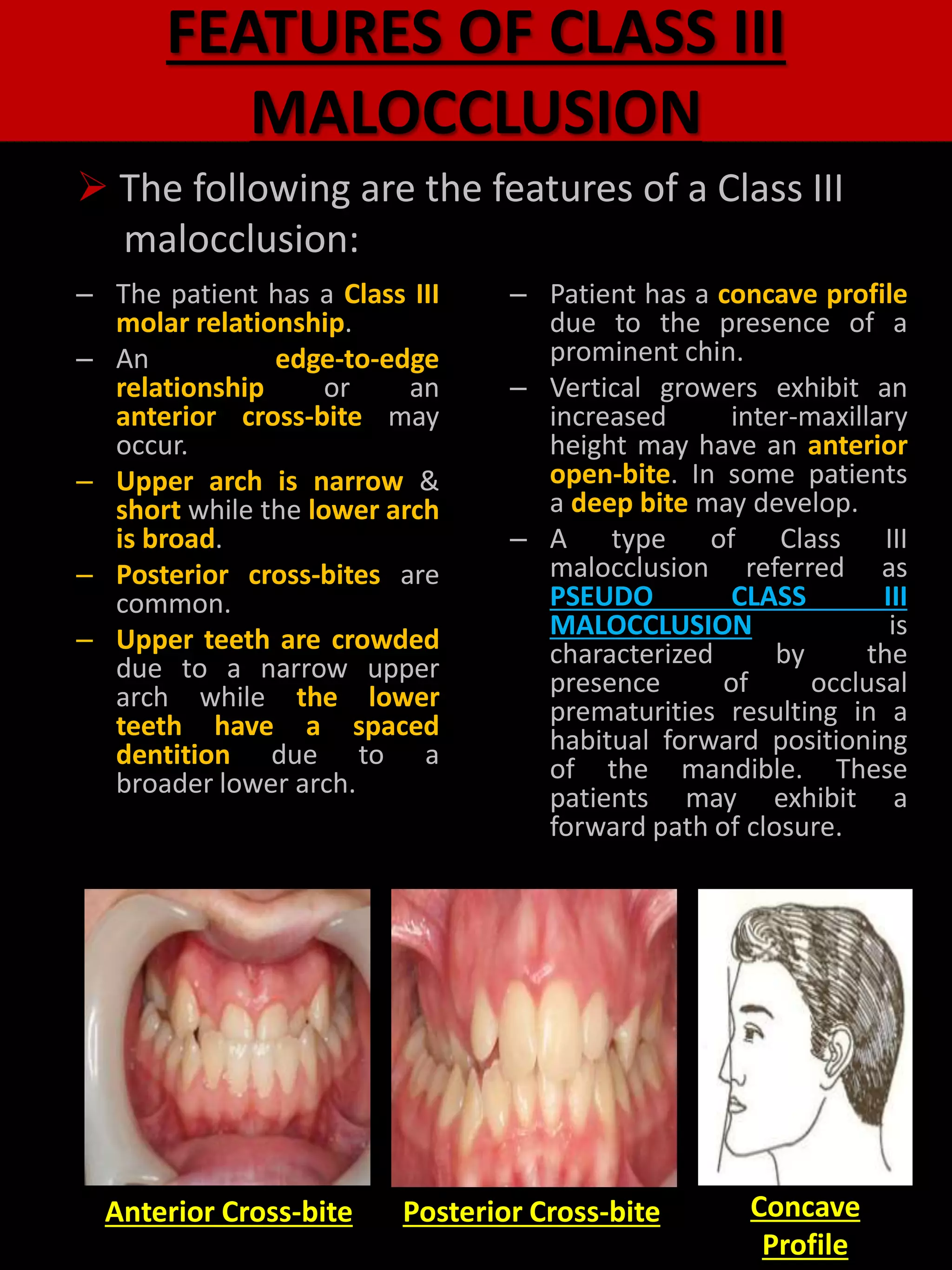
– The patient has a Class III
molar relationship.
– An edge-to-edge
relationship or an
anterior cross-bite may
occur.
– Upper arch is narrow &
short while the lower arch
is broad.
– Posterior cross-bites are
common.
– Upper teeth are crowded
due to a narrow upper
arch while the lower
teeth have a spaced
dentition due to a
broader lower arch.
– Patient has a concave profile
due to the presence of a
prominent chin.
– Vertical growers exhibit an
increased inter-maxillary
height may have an anterior
open-bite. In some patients
a deep bite may develop.
– A type of Class III
malocclusion referred as
PSEUDO CLASS III
MALOCCLUSION is
characterized by the
presence of occlusal
prematurities resulting in a
habitual forward positioning
of the mandible. These
patients may exhibit a
forward path of closure.
 The following are the features of a Class III
malocclusion:
Anterior Cross-bite Posterior Cross-bite Concave
Profile
SKELETAL FEATURES OF CLASS III
MALOCCLUSION
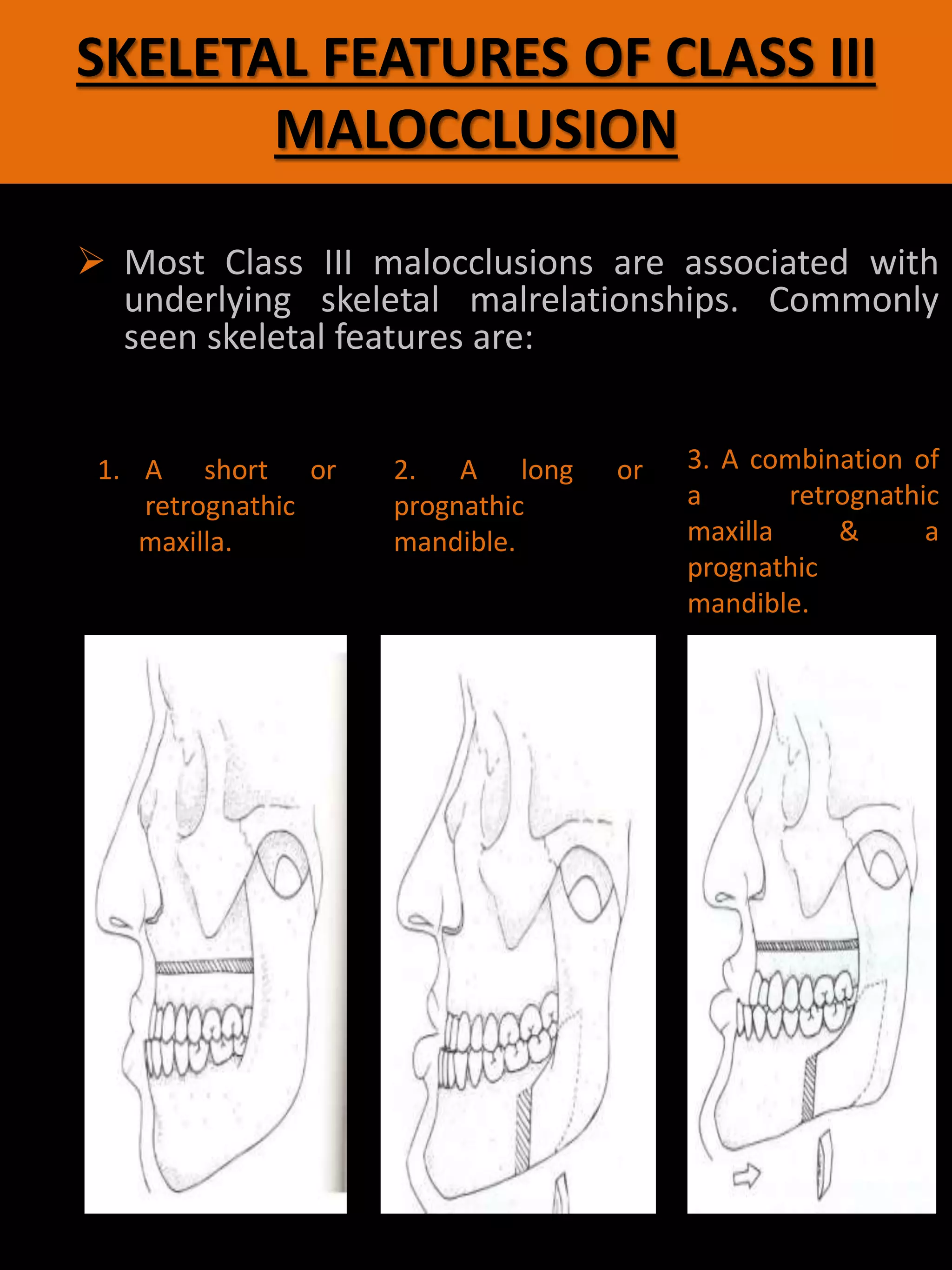
 Most Class III malocclusions are associated with
underlying skeletal malrelationships. Commonly
seen skeletal features are:
1. A short or
retrognathic
maxilla.
2. A long or
prognathic
mandible.
3. A combination of
a retrognathic
maxilla & a
prognathic
mandible.
ETIOLOGY
True Class III malocclusion that exhibits
underlying skeletal imbalance is usually
inherited.
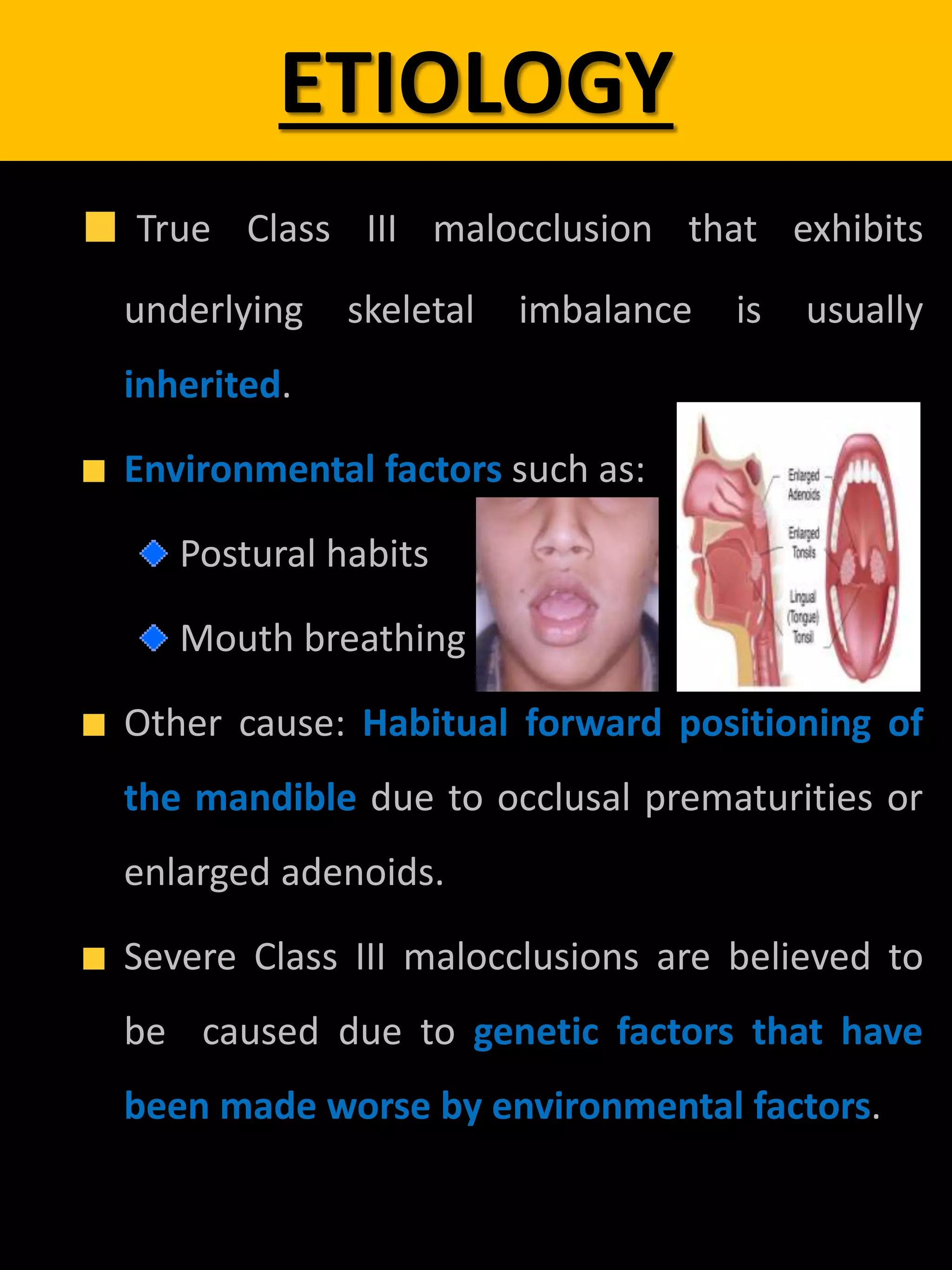
Environmental factors such as:
Postural habits
Mouth breathing
Other cause: Habitual forward positioning of
the mandible due to occlusal prematurities or
enlarged adenoids.
Severe Class III malocclusions are believed to
be caused due to genetic factors that have
been made worse by environmental factors.
DIAGNOSIS
 The diagnostic procedure should help in the
determination the type of Class III malocclusion
i.e, dental or skeletal, true or pseudo.
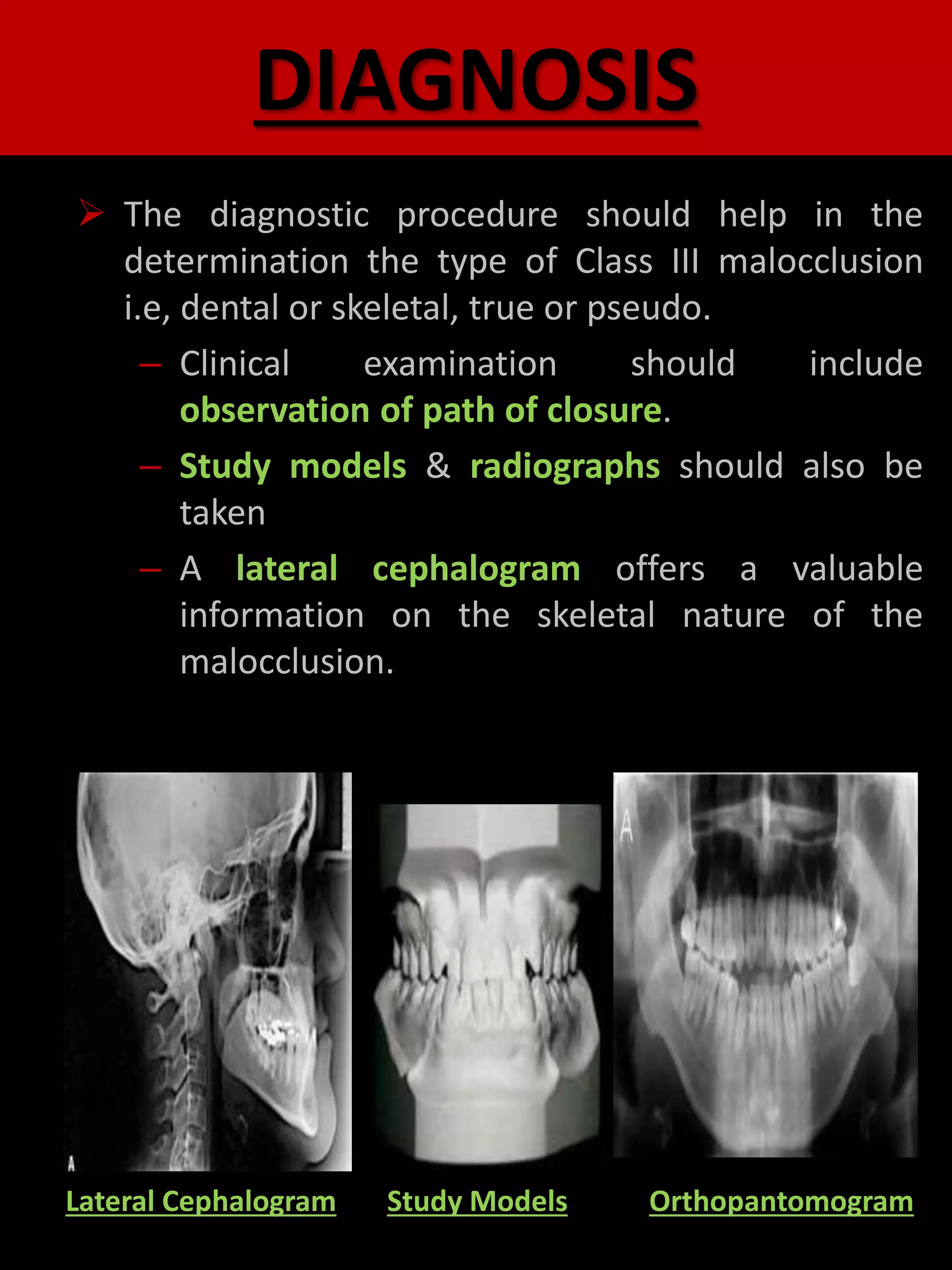
– Clinical examination should include
observation of path of closure.
– Study models & radiographs should also be
taken
– A lateral cephalogram offers a valuable
information on the skeletal nature of the
malocclusion.
Lateral Cephalogram Study Models Orthopantomogram
DIAGNOSIS
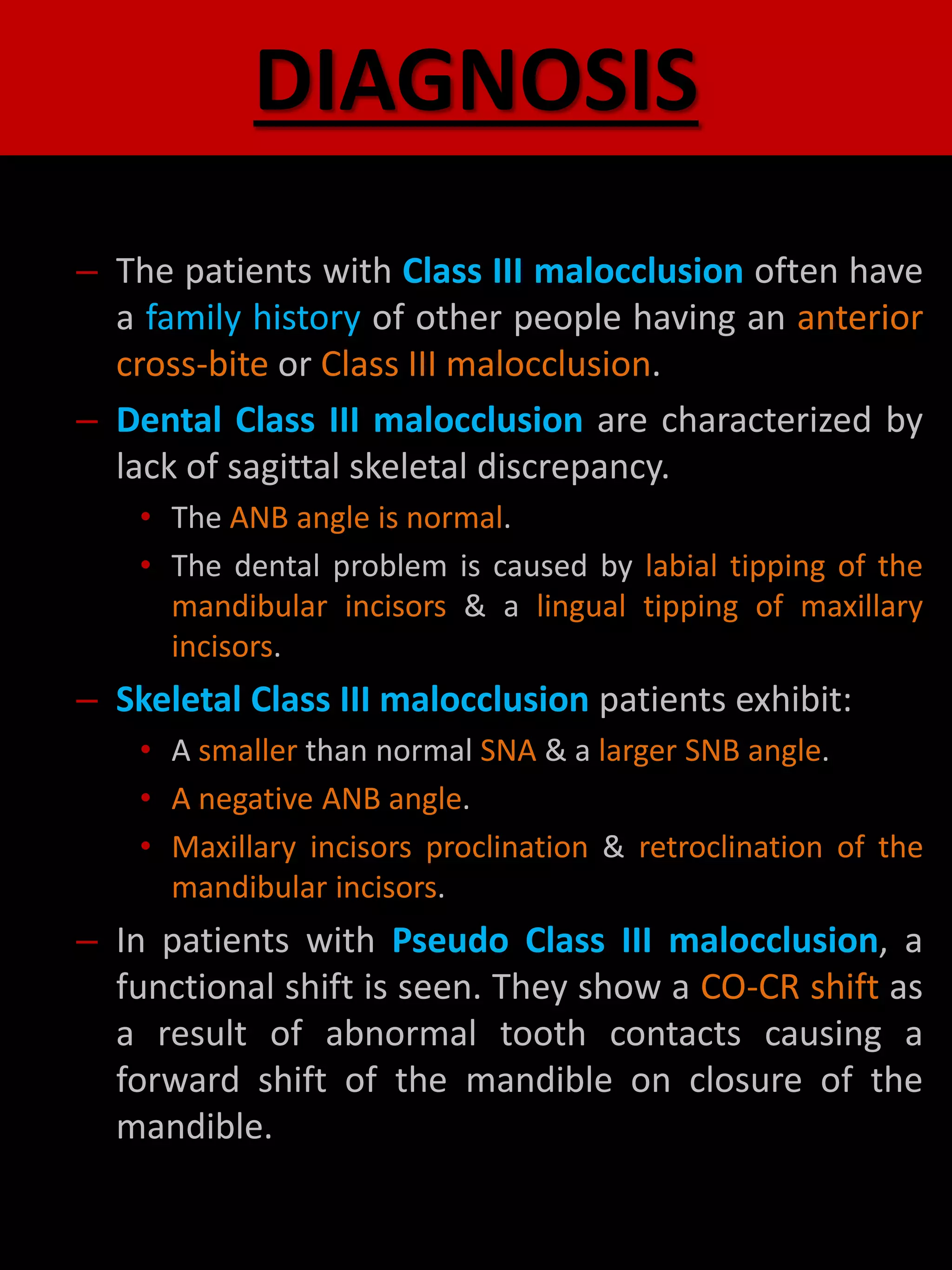
– The patients with Class III malocclusion often have
a family history of other people having an anterior
cross-bite or Class III malocclusion.
– Dental Class III malocclusion are characterized by
lack of sagittal skeletal discrepancy.
• The ANB angle is normal.
• The dental problem is caused by labial tipping of the
mandibular incisors & a lingual tipping of maxillary
incisors.
– Skeletal Class III malocclusion patients exhibit:
• A smaller than normal SNA & a larger SNB angle.
• A negative ANB angle.
• Maxillary incisors proclination & retroclination of the
mandibular incisors.
– In patients with Pseudo Class III malocclusion, a
functional shift is seen. They show a CO-CR shift as
a result of abnormal tooth contacts causing a
forward shift of the mandible on closure of the
mandible.
TREATMENT
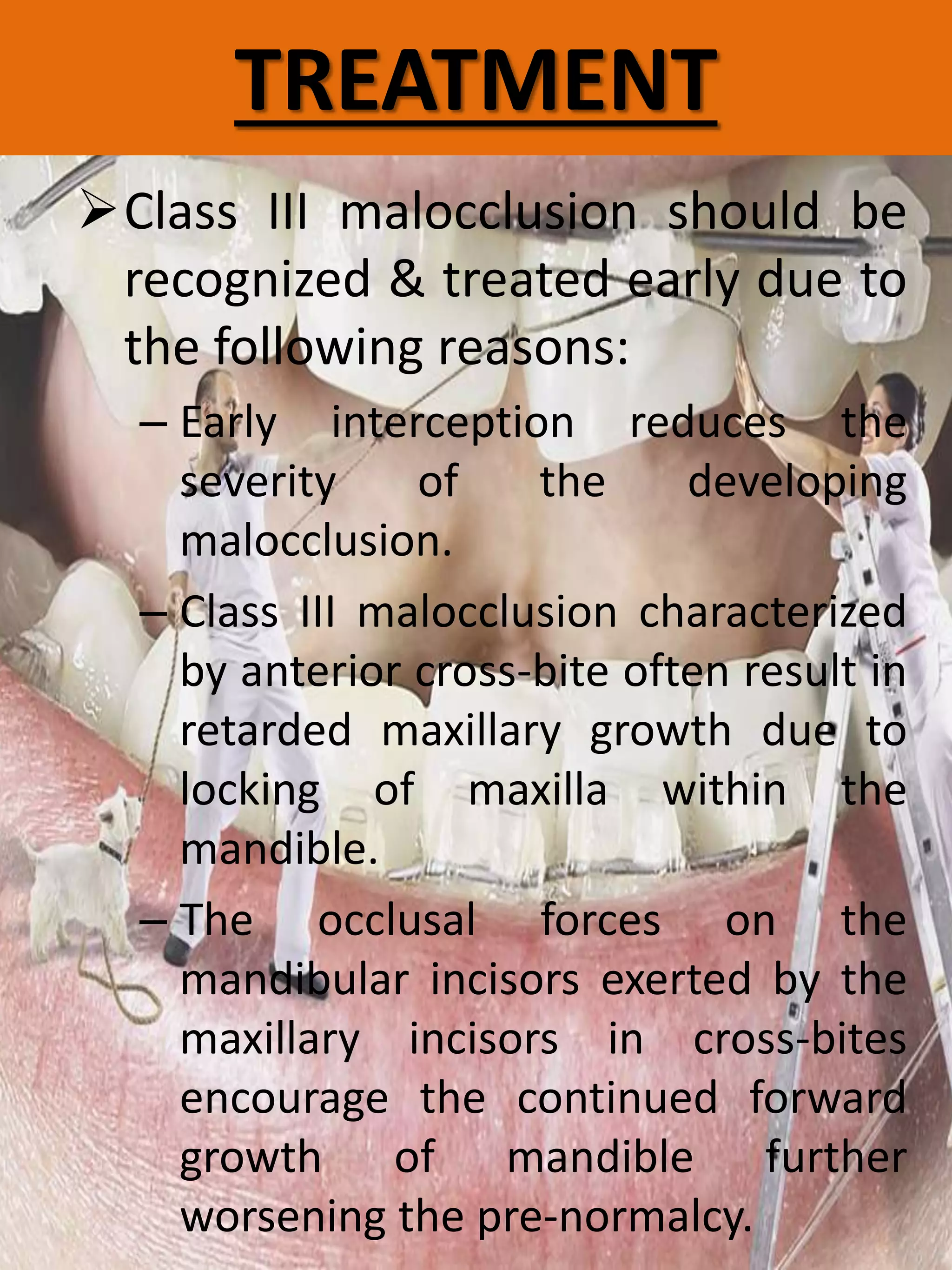
Class III malocclusion should be
recognized & treated early due to
the following reasons:
– Early interception reduces the
severity of the developing
malocclusion.
– Class III malocclusion characterized
by anterior cross-bite often result in
retarded maxillary growth due to
locking of maxilla within the
mandible.
– The occlusal forces on the
mandibular incisors exerted by the
maxillary incisors in cross-bites
encourage the continued forward
growth of mandible further
worsening the pre-normalcy.
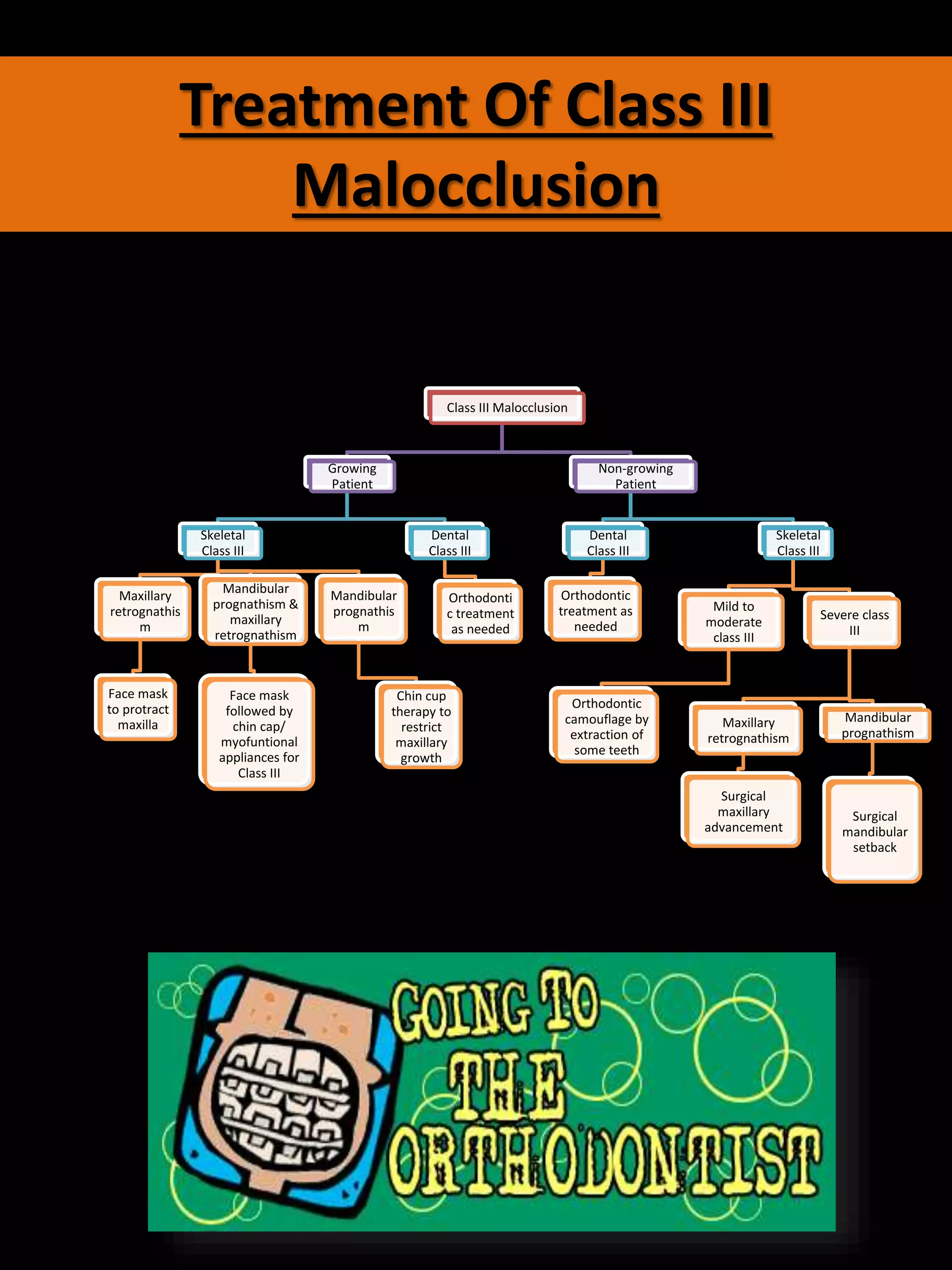
Class III Malocclusion
Growing
Patient
Skeletal
Class III
Maxillary
retrognathis
m
Face mask
to protract
maxilla
Mandibular
prognathism &
maxillary
retrognathism
Face mask
followed by
chin cap/
myofuntional
appliances for
Class III
Mandibular
prognathis
m
Chin cup
therapy to
restrict
maxillary
growth
Dental
Class III
Orthodonti
c treatment
as needed
Non-growing
Patient
Dental
Class III
Orthodontic
treatment as
needed
Skeletal
Class III
Mild to
moderate
class III
Orthodontic
camouflage by
extraction of
some teeth
Severe class
III
Maxillary
retrognathism
Surgical
maxillary
advancement
Mandibular
prognathism
Surgical
mandibular
setback
Treatment Of Class III
Malocclusion
I. Interception During Growth
Class III malocclusion with an underlying skeletal
malrelationship require early interception to
prevent skeletal malocclussion.
AIM: To improve the skeletal discrepancy thereby
providing a more favourable environment for future
growth.
It also helps to eliminate or reduce the chances
of orthognathic surgeries in future.
INDICATIONS:
Good facial esthetics
Presence of antero-
posterior functional
shift
Mild skeletal problem
Absence of familial
prognathism
Convergent facial type
Symmetric condylar
growth
Patients with growth
still present
Patient cooperation is
essential
CONTRAINDICATIONS:
Poor facial esthetics
Absence of antero-
posterior functional
shift
Severe skeletal
problems
Familial prognathism
Divergent facial type
Assymetric condylar
growth
Patients with no
growth potential
Patient not willing to
cooperate
Interception during growth can be done by using
one of the following techniques:
1. MYOFUNCTIONAL APPLIANCES
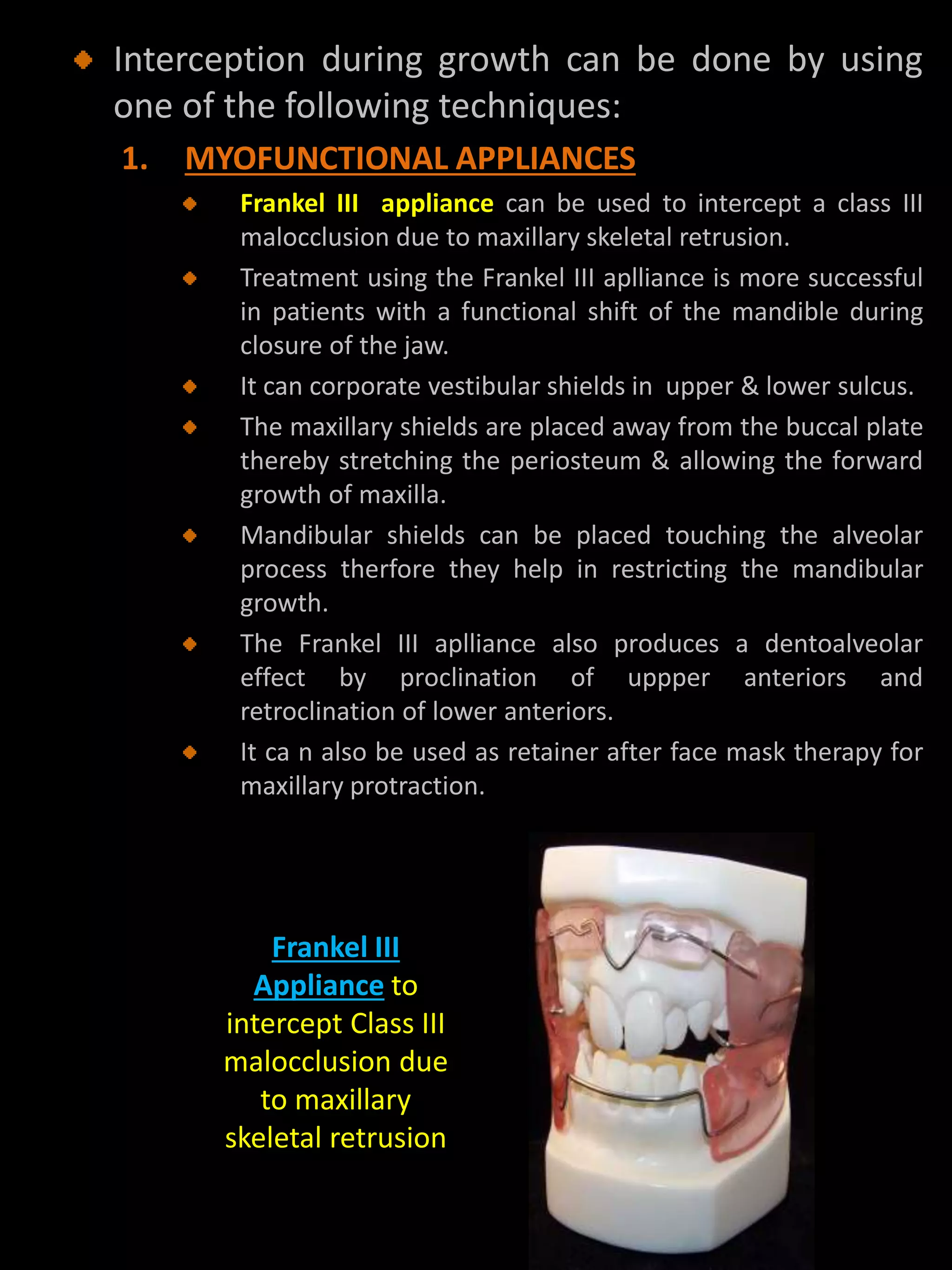
Frankel III appliance can be used to intercept a class III
malocclusion due to maxillary skeletal retrusion.
Treatment using the Frankel III aplliance is more successful
in patients with a functional shift of the mandible during
closure of the jaw.
It can corporate vestibular shields in upper & lower sulcus.
The maxillary shields are placed away from the buccal plate
thereby stretching the periosteum & allowing the forward
growth of maxilla.
Mandibular shields can be placed touching the alveolar
process therfore they help in restricting the mandibular
growth.
The Frankel III aplliance also produces a dentoalveolar
effect by proclination of uppper anteriors and
retroclination of lower anteriors.
It ca n also be used as retainer after face mask therapy for
maxillary protraction.
Frankel III
Appliance to
intercept Class III
malocclusion due
to maxillary
skeletal retrusion
2. CHIN CUP THERAPY
Used in the treatment of Class III malocclusion
with protrusive mandible & normal maxilla.
Two types:
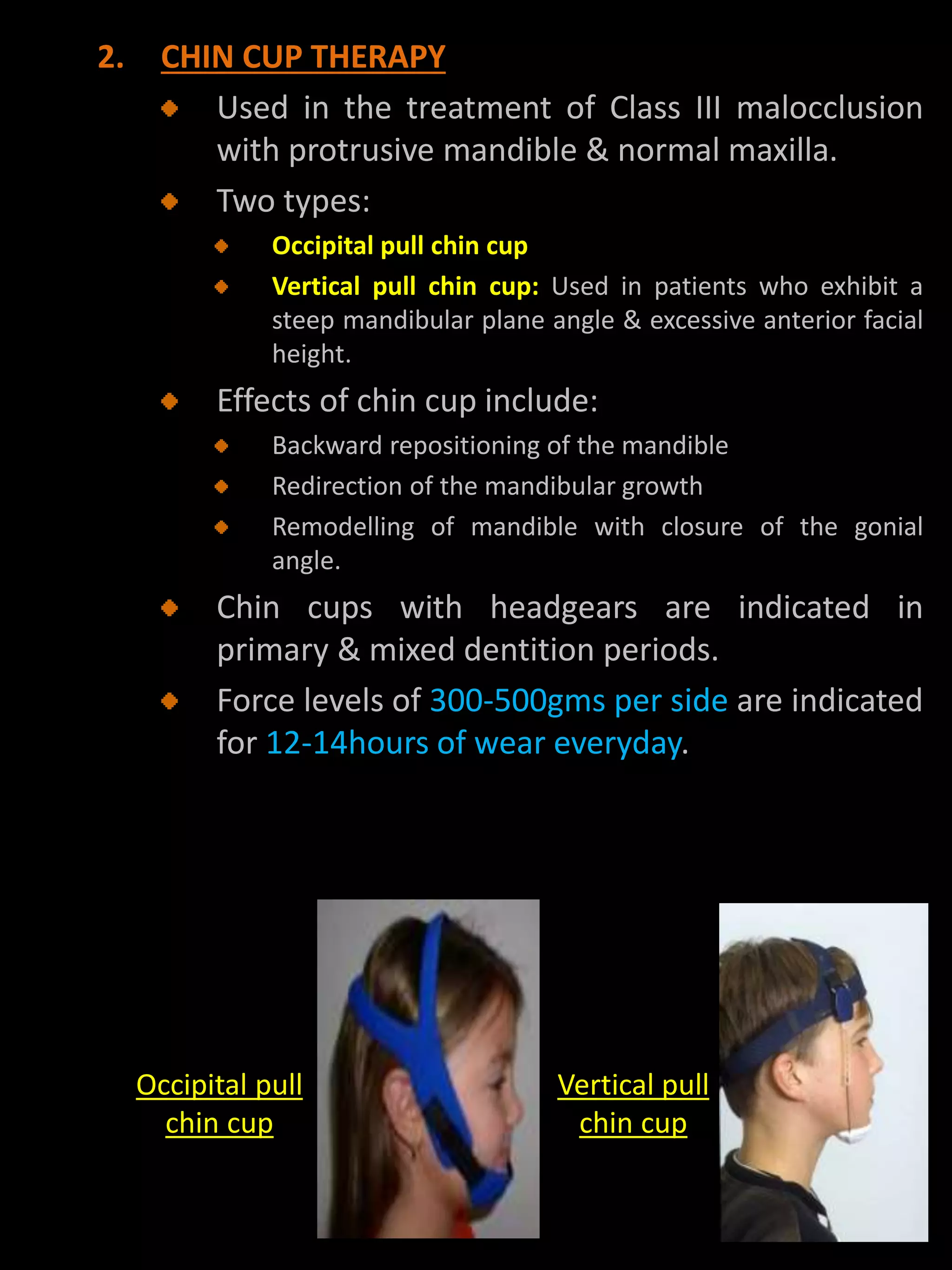
Occipital pull chin cup
Vertical pull chin cup: Used in patients who exhibit a
steep mandibular plane angle & excessive anterior facial
height.
Effects of chin cup include:
Backward repositioning of the mandible
Redirection of the mandibular growth
Remodelling of mandible with closure of the gonial
angle.
Chin cups with headgears are indicated in
primary & mixed dentition periods.
Force levels of 300-500gms per side are indicated
for 12-14hours of wear everyday.
Occipital pull
chin cup
Vertical pull
chin cup
3. FACE MASK THERAPY
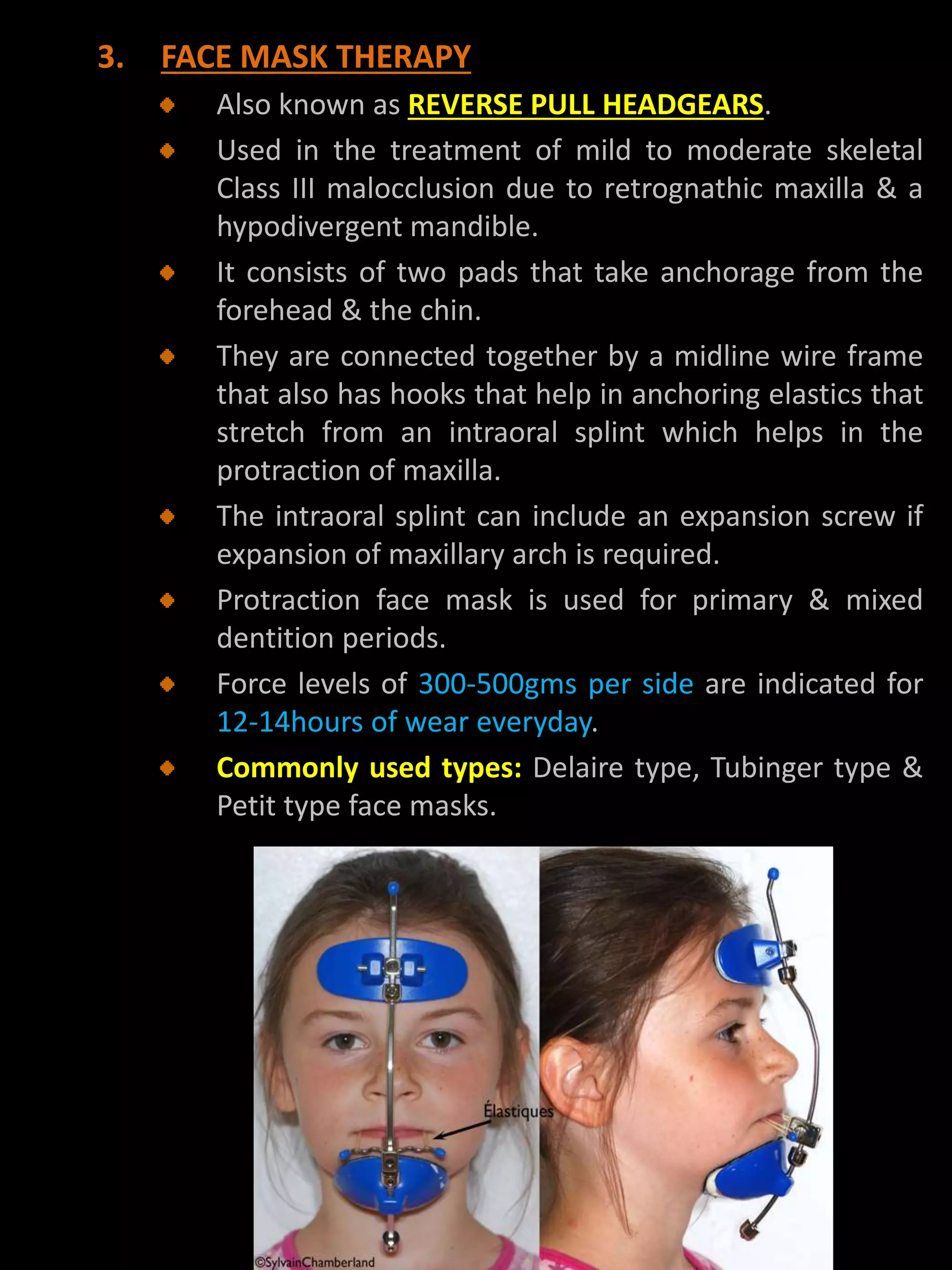
Also known as REVERSE PULL HEADGEARS.
Used in the treatment of mild to moderate skeletal
Class III malocclusion due to retrognathic maxilla & a
hypodivergent mandible.
It consists of two pads that take anchorage from the
forehead & the chin.
They are connected together by a midline wire frame
that also has hooks that help in anchoring elastics that
stretch from an intraoral splint which helps in the
protraction of maxilla.
The intraoral splint can include an expansion screw if
expansion of maxillary arch is required.
Protraction face mask is used for primary & mixed
dentition periods.
Force levels of 300-500gms per side are indicated for
12-14hours of wear everyday.
Commonly used types: Delaire type, Tubinger type &
Petit type face masks.
II. Treatment Using Fixed
Appliances
Best done in mixed dentition, before the
eruption of permanent canines.
In patients with mild to moderate class III
skeletal pattern, a combination of
retroclination of lower incisors & proclination
of upper incisors maybe required.
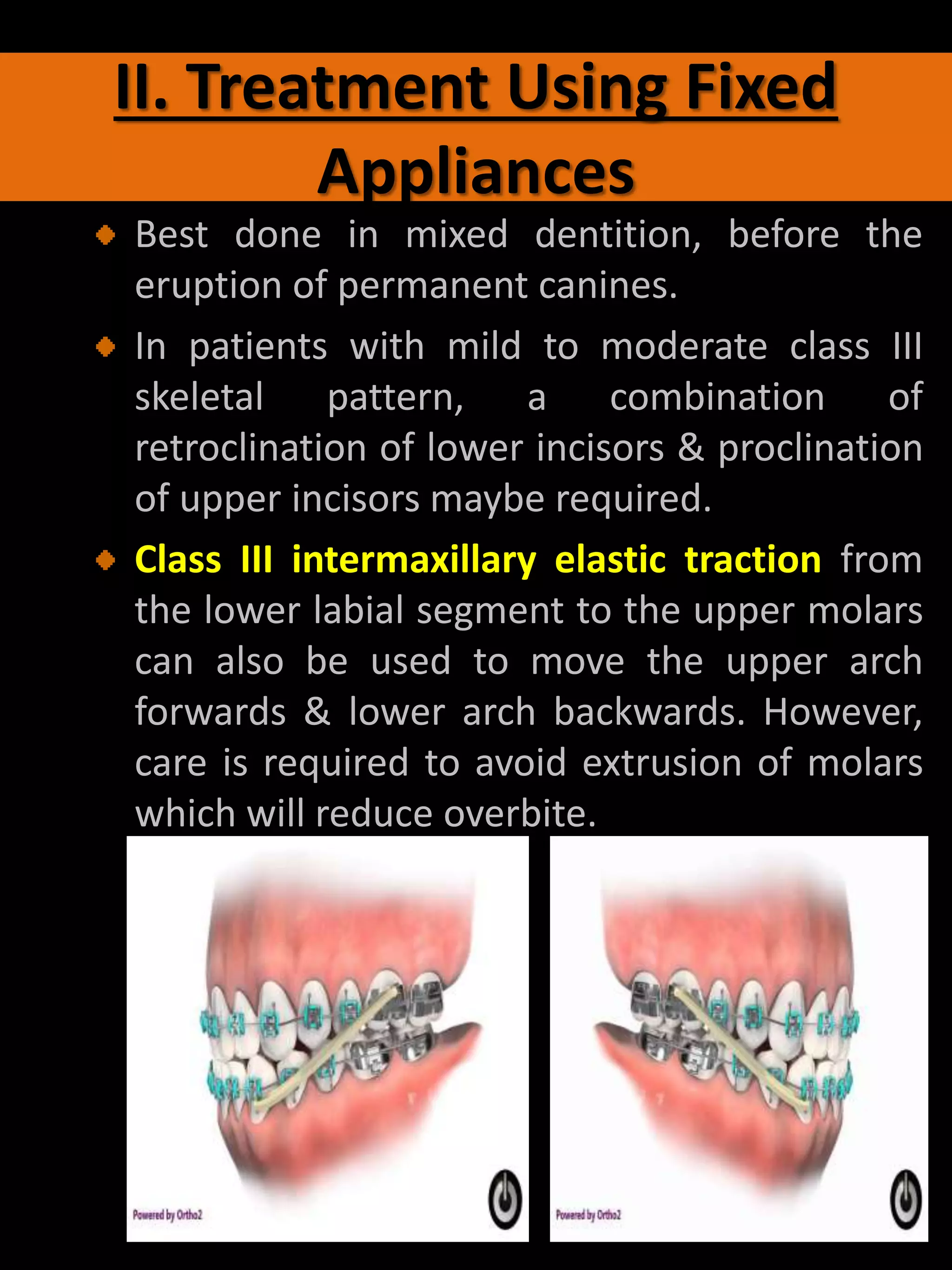
Class III intermaxillary elastic traction from
the lower labial segment to the upper molars
can also be used to move the upper arch
forwards & lower arch backwards. However,
care is required to avoid extrusion of molars
which will reduce overbite.
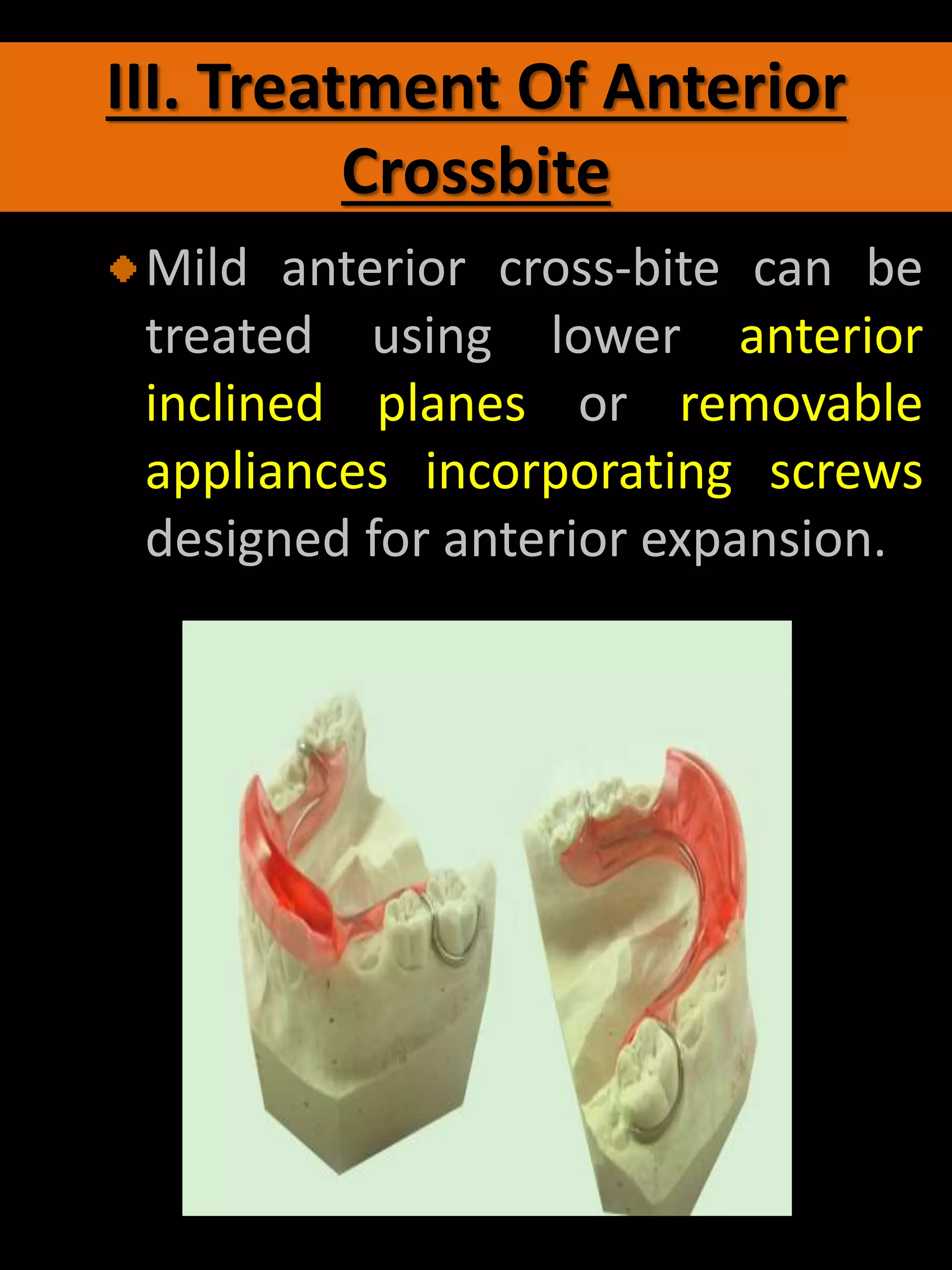
III. Treatment Of Anterior
Crossbite
Mild anterior cross-bite can be
treated using lower anterior
inclined planes or removable
appliances incorporating screws
designed for anterior expansion.
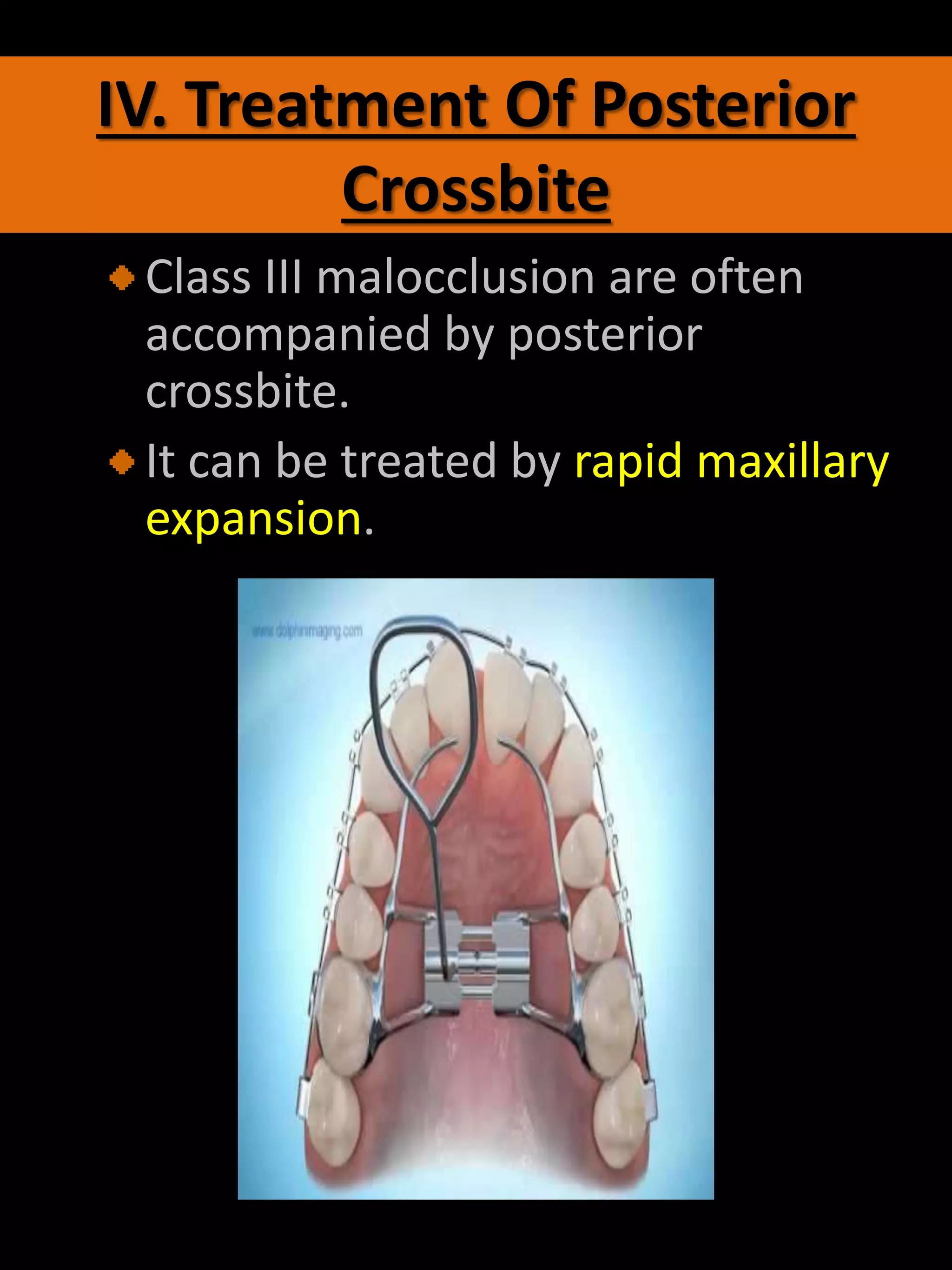
IV. Treatment Of Posterior
Crossbite
Class III malocclusion are often
accompanied by posterior
crossbite.
It can be treated by rapid maxillary
expansion.
V. Role Of Extractions
Class III malocclusion
characterized by mild
mandibular prognathism &
lower arch crowding can be
treated by extracting the
lower first premolars
followed by fixed
mechanotherapy.
This is an orthodontic
camouflage of the underlying
skeletal malocclusion.
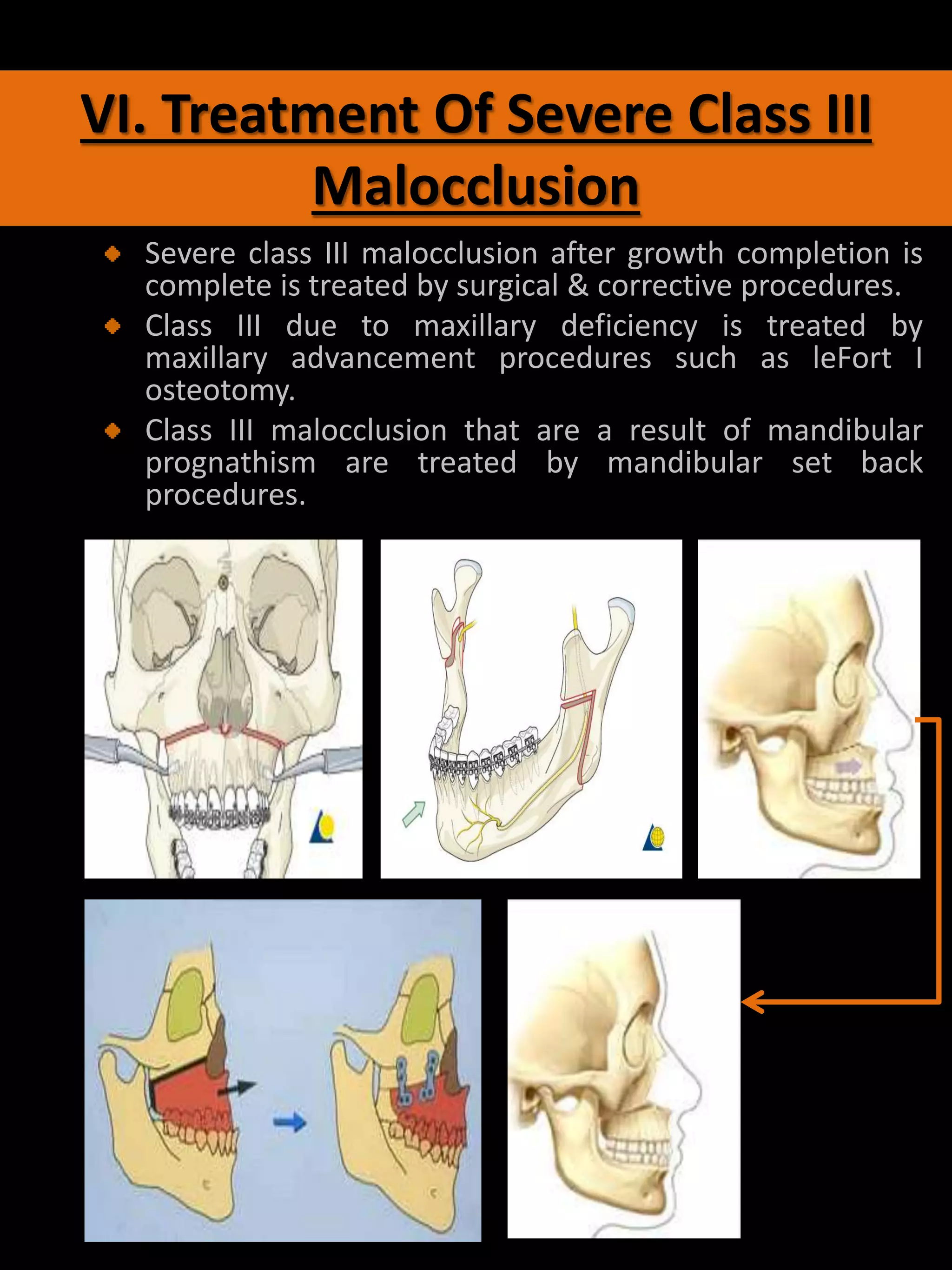
VI. Treatment Of Severe Class III
Malocclusion
Severe class III malocclusion after growth completion is
complete is treated by surgical & corrective procedures.
Class III due to maxillary deficiency is treated by
maxillary advancement procedures such as leFort I
osteotomy.
Class III malocclusion that are a result of mandibular
prognathism are treated by mandibular set back
procedures.
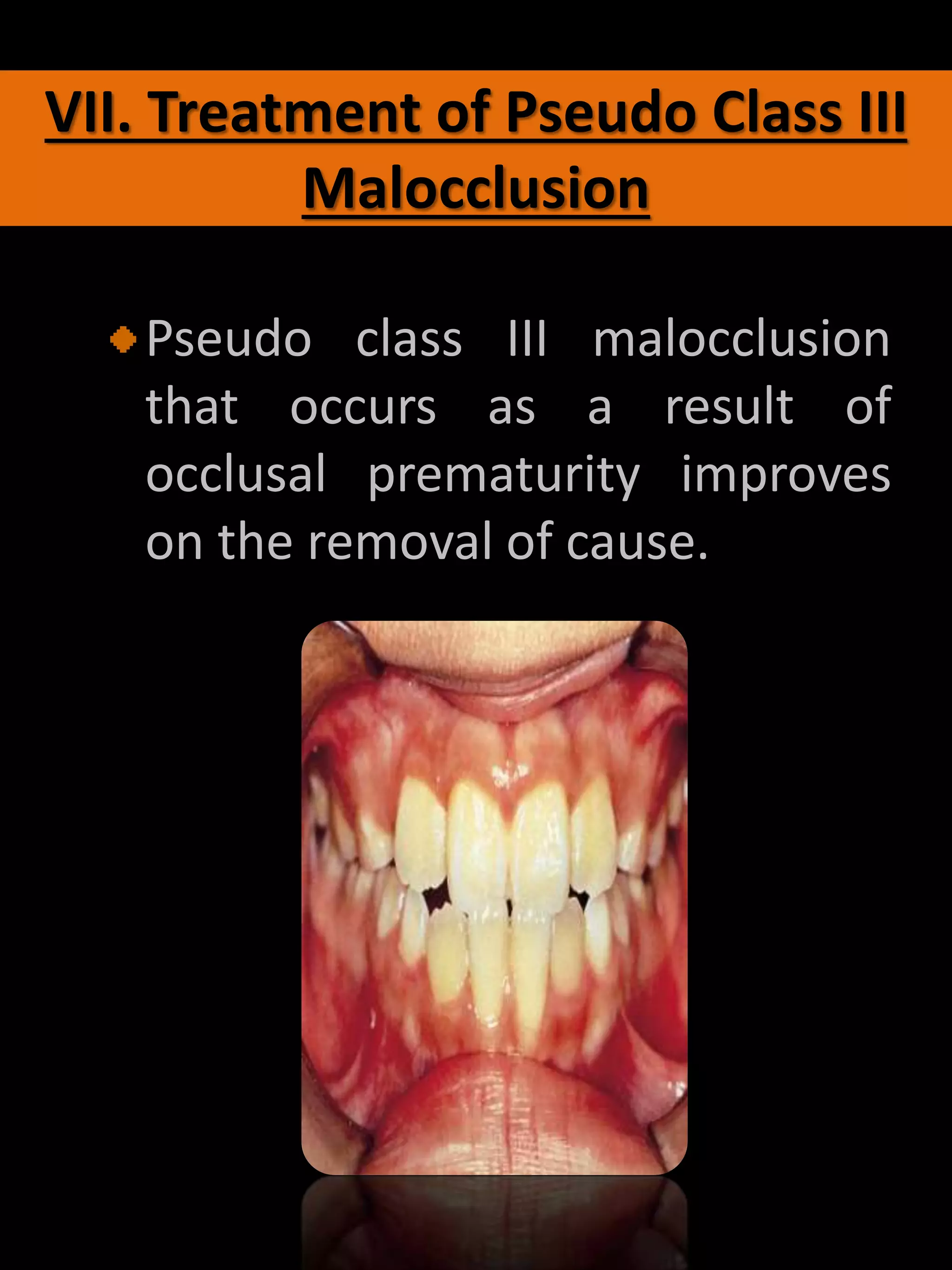
VII. Treatment of Pseudo Class III
Malocclusion
Pseudo class III malocclusion
that occurs as a result of
occlusal prematurity improves
on the removal of cause.
Thank
You..!

Class III Malocclusion

  • 1.
    DEPARTMENT OF ORTHODONTICS Prepared By:Under the Guidance of: Priyanka Vadhera Dr. Rahul Paul Batch-2012 Dr. Vineet Golcha Roll No. 6083059 Dr. Deepti Dr. Siddhant Taneja Dr. Ankita Jhalani
  • 2.
    CONTENTS  Introduction  Definition Features Of Class III Malocclusion  Skeletal Features Of Class III Malocclusion  Etiology  Diagnosis  Treatment I. Interception During Growth II. Treatment Using Fixed Appliance III. Treatment of Anterior Crossbite IV. Treatment Of Posterior Crossbite V. Role Of Extractions VI. Treatment Of Severe Class III After Growth VII. Treatment Of Pseudo Class III
  • 3.
    INTRODUCTION Class III malocclusionis very easy to identify but difficult to treat. It represents a pre-normalcy where the mandible is in a mesial relation to the upper arch. This kind of malocclusion finds highest incidence in Japan & Korea.
  • 4.
    DEFINITION  According toEdward H. Angle, Class III malocclusion can be defined as: “A condition where the mesiobuccal cusp of the upper first molar occludes between the mandibular first and second molars.”
  • 5.
    FEATURES OF CLASSIII MALOCCLUSION – The patient has a Class III molar relationship. – An edge-to-edge relationship or an anterior cross-bite may occur. – Upper arch is narrow & short while the lower arch is broad. – Posterior cross-bites are common. – Upper teeth are crowded due to a narrow upper arch while the lower teeth have a spaced dentition due to a broader lower arch. – Patient has a concave profile due to the presence of a prominent chin. – Vertical growers exhibit an increased inter-maxillary height may have an anterior open-bite. In some patients a deep bite may develop. – A type of Class III malocclusion referred as PSEUDO CLASS III MALOCCLUSION is characterized by the presence of occlusal prematurities resulting in a habitual forward positioning of the mandible. These patients may exhibit a forward path of closure.  The following are the features of a Class III malocclusion: Anterior Cross-bite Posterior Cross-bite Concave Profile
  • 6.
    SKELETAL FEATURES OFCLASS III MALOCCLUSION  Most Class III malocclusions are associated with underlying skeletal malrelationships. Commonly seen skeletal features are: 1. A short or retrognathic maxilla. 2. A long or prognathic mandible. 3. A combination of a retrognathic maxilla & a prognathic mandible.
  • 7.
    ETIOLOGY True Class IIImalocclusion that exhibits underlying skeletal imbalance is usually inherited. Environmental factors such as: Postural habits Mouth breathing Other cause: Habitual forward positioning of the mandible due to occlusal prematurities or enlarged adenoids. Severe Class III malocclusions are believed to be caused due to genetic factors that have been made worse by environmental factors.
  • 8.
    DIAGNOSIS  The diagnosticprocedure should help in the determination the type of Class III malocclusion i.e, dental or skeletal, true or pseudo. – Clinical examination should include observation of path of closure. – Study models & radiographs should also be taken – A lateral cephalogram offers a valuable information on the skeletal nature of the malocclusion. Lateral Cephalogram Study Models Orthopantomogram
  • 9.
    DIAGNOSIS – The patientswith Class III malocclusion often have a family history of other people having an anterior cross-bite or Class III malocclusion. – Dental Class III malocclusion are characterized by lack of sagittal skeletal discrepancy. • The ANB angle is normal. • The dental problem is caused by labial tipping of the mandibular incisors & a lingual tipping of maxillary incisors. – Skeletal Class III malocclusion patients exhibit: • A smaller than normal SNA & a larger SNB angle. • A negative ANB angle. • Maxillary incisors proclination & retroclination of the mandibular incisors. – In patients with Pseudo Class III malocclusion, a functional shift is seen. They show a CO-CR shift as a result of abnormal tooth contacts causing a forward shift of the mandible on closure of the mandible.
  • 10.
    TREATMENT Class III malocclusionshould be recognized & treated early due to the following reasons: – Early interception reduces the severity of the developing malocclusion. – Class III malocclusion characterized by anterior cross-bite often result in retarded maxillary growth due to locking of maxilla within the mandible. – The occlusal forces on the mandibular incisors exerted by the maxillary incisors in cross-bites encourage the continued forward growth of mandible further worsening the pre-normalcy.
  • 11.
    Class III Malocclusion Growing Patient Skeletal ClassIII Maxillary retrognathis m Face mask to protract maxilla Mandibular prognathism & maxillary retrognathism Face mask followed by chin cap/ myofuntional appliances for Class III Mandibular prognathis m Chin cup therapy to restrict maxillary growth Dental Class III Orthodonti c treatment as needed Non-growing Patient Dental Class III Orthodontic treatment as needed Skeletal Class III Mild to moderate class III Orthodontic camouflage by extraction of some teeth Severe class III Maxillary retrognathism Surgical maxillary advancement Mandibular prognathism Surgical mandibular setback Treatment Of Class III Malocclusion
  • 12.
    I. Interception DuringGrowth Class III malocclusion with an underlying skeletal malrelationship require early interception to prevent skeletal malocclussion. AIM: To improve the skeletal discrepancy thereby providing a more favourable environment for future growth. It also helps to eliminate or reduce the chances of orthognathic surgeries in future. INDICATIONS: Good facial esthetics Presence of antero- posterior functional shift Mild skeletal problem Absence of familial prognathism Convergent facial type Symmetric condylar growth Patients with growth still present Patient cooperation is essential CONTRAINDICATIONS: Poor facial esthetics Absence of antero- posterior functional shift Severe skeletal problems Familial prognathism Divergent facial type Assymetric condylar growth Patients with no growth potential Patient not willing to cooperate
  • 13.
    Interception during growthcan be done by using one of the following techniques: 1. MYOFUNCTIONAL APPLIANCES Frankel III appliance can be used to intercept a class III malocclusion due to maxillary skeletal retrusion. Treatment using the Frankel III aplliance is more successful in patients with a functional shift of the mandible during closure of the jaw. It can corporate vestibular shields in upper & lower sulcus. The maxillary shields are placed away from the buccal plate thereby stretching the periosteum & allowing the forward growth of maxilla. Mandibular shields can be placed touching the alveolar process therfore they help in restricting the mandibular growth. The Frankel III aplliance also produces a dentoalveolar effect by proclination of uppper anteriors and retroclination of lower anteriors. It ca n also be used as retainer after face mask therapy for maxillary protraction. Frankel III Appliance to intercept Class III malocclusion due to maxillary skeletal retrusion
  • 14.
    2. CHIN CUPTHERAPY Used in the treatment of Class III malocclusion with protrusive mandible & normal maxilla. Two types: Occipital pull chin cup Vertical pull chin cup: Used in patients who exhibit a steep mandibular plane angle & excessive anterior facial height. Effects of chin cup include: Backward repositioning of the mandible Redirection of the mandibular growth Remodelling of mandible with closure of the gonial angle. Chin cups with headgears are indicated in primary & mixed dentition periods. Force levels of 300-500gms per side are indicated for 12-14hours of wear everyday. Occipital pull chin cup Vertical pull chin cup
  • 15.
    3. FACE MASKTHERAPY Also known as REVERSE PULL HEADGEARS. Used in the treatment of mild to moderate skeletal Class III malocclusion due to retrognathic maxilla & a hypodivergent mandible. It consists of two pads that take anchorage from the forehead & the chin. They are connected together by a midline wire frame that also has hooks that help in anchoring elastics that stretch from an intraoral splint which helps in the protraction of maxilla. The intraoral splint can include an expansion screw if expansion of maxillary arch is required. Protraction face mask is used for primary & mixed dentition periods. Force levels of 300-500gms per side are indicated for 12-14hours of wear everyday. Commonly used types: Delaire type, Tubinger type & Petit type face masks.
  • 16.
    II. Treatment UsingFixed Appliances Best done in mixed dentition, before the eruption of permanent canines. In patients with mild to moderate class III skeletal pattern, a combination of retroclination of lower incisors & proclination of upper incisors maybe required. Class III intermaxillary elastic traction from the lower labial segment to the upper molars can also be used to move the upper arch forwards & lower arch backwards. However, care is required to avoid extrusion of molars which will reduce overbite.
  • 17.
    III. Treatment OfAnterior Crossbite Mild anterior cross-bite can be treated using lower anterior inclined planes or removable appliances incorporating screws designed for anterior expansion.
  • 18.
    IV. Treatment OfPosterior Crossbite Class III malocclusion are often accompanied by posterior crossbite. It can be treated by rapid maxillary expansion.
  • 19.
    V. Role OfExtractions Class III malocclusion characterized by mild mandibular prognathism & lower arch crowding can be treated by extracting the lower first premolars followed by fixed mechanotherapy. This is an orthodontic camouflage of the underlying skeletal malocclusion.
  • 20.
    VI. Treatment OfSevere Class III Malocclusion Severe class III malocclusion after growth completion is complete is treated by surgical & corrective procedures. Class III due to maxillary deficiency is treated by maxillary advancement procedures such as leFort I osteotomy. Class III malocclusion that are a result of mandibular prognathism are treated by mandibular set back procedures.
  • 21.
    VII. Treatment ofPseudo Class III Malocclusion Pseudo class III malocclusion that occurs as a result of occlusal prematurity improves on the removal of cause.
  • 22.