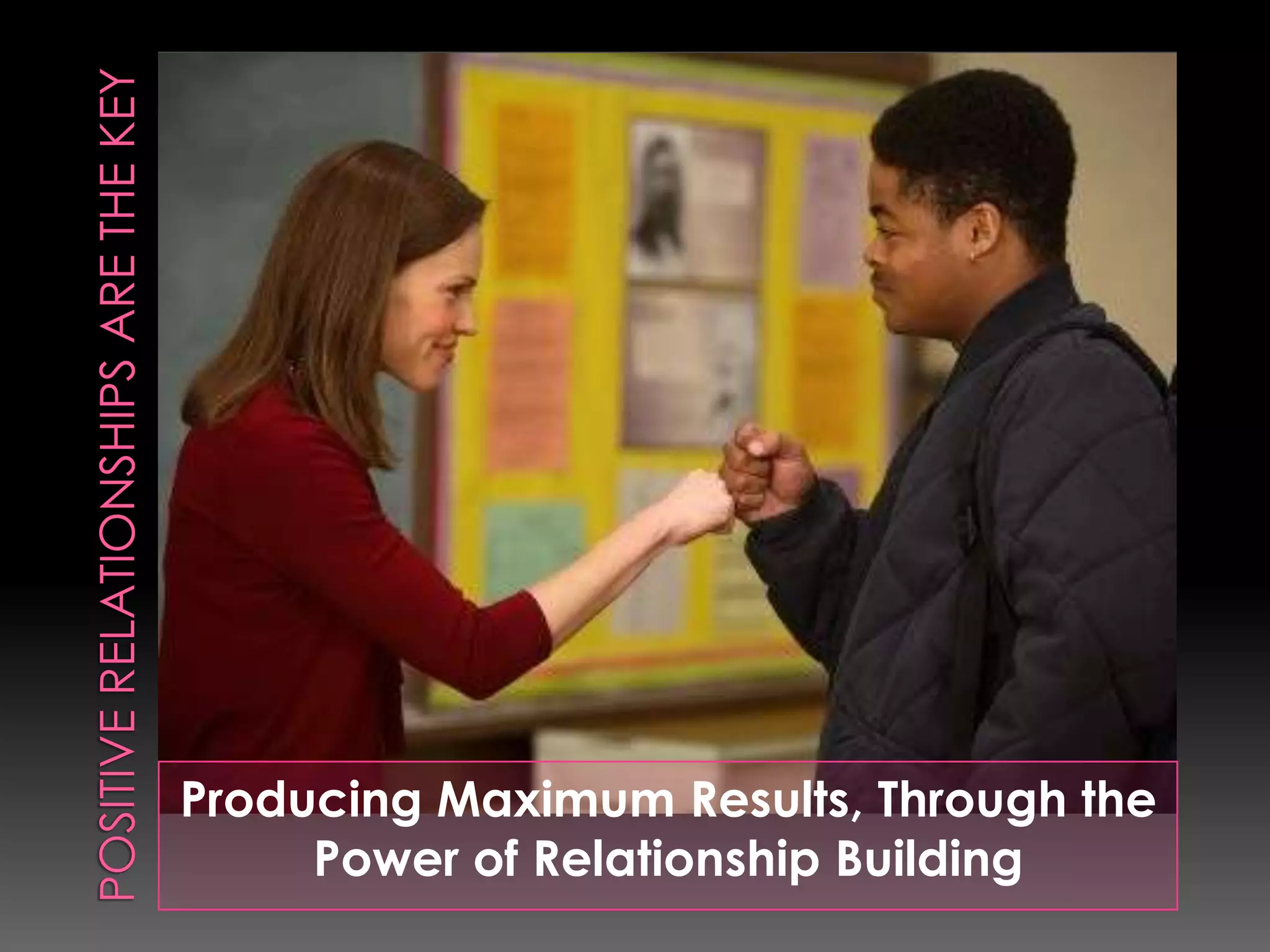
Producing Maximum Results, Through the
     Power of Relationship Building
 Isrelationship
  building a natural
  process
 What is HOPE
 How do you give
  HOPE to a student
  who feels hopeless
The longitudinal results of the study
indicated that children who experienced
warm student-teacher
relationships performed better on
thinking, language ability, and math
skills when compared to children who
did not experience such a warm
relationship .
                  Peisner-Feinberg et al., 1999
   “A fundamental question for a student is,
    “Does my teacher like me?’ Given a
    rigorous, aligned curriculum, the answer
    to that simple question is our best
    predictor of student achievement.”
          Alice Terry, More Life Through Management
The quality of teacher-student
relationships is the keystone for all other
aspects of classroom management.
   Marzano and Marzano, Dimensions of Learning
   80% of students entering schools feel
    good about themselves. By the end of 5th
    grade only 20% do. Only one in five high
    school students has a positive self-
    esteem.
         National Assessment of Educational Progress,
                 National Parent Teacher Association
Birch and Ladd, further concluded that
conflict in Kindergarten children’s
teacher-child relationships was
associated with a decline in children’s
pro-social behavior over time
Additionally, a child’s demonstration of
less pro-social behavior may negatively
affect a child’s ability to develop and
maintain positive relationships with
others, including peers, thus
perpetuating a cycle of behavioral and
relational difficulties.
The #1 stimuli that
determines the outcome
of your interaction with a
student labeled “at risk”
            is?
YOU
Control your energy
  – Control your
     outcome
 Don’t try to be cooler than you really are
 Project an atmosphere of “Accessible
  Control”
 Always be aware that the student knows
  where they are (in school) at all times
 Do not sacrifice your integrity to try to fit
  in with your students. Allow your students
  to experience a responsible adult, who
  can also relate to their lifestyle.
 Allow student’s to experience your light
  side, but always maintain a respectable
  authority.
 Remind students in subtle terms where
  they are and the responsibilities
  associated with that environment.
Every student is an individual
with different circumstances,
motivations and needs.
 Look for elements of familiarity
 Are there any identifiable cultural icons
 Find a way to create common ground
  (for instance, “The Freedom Writers”)
  Take time to learn about another culture
 Go the extra yard, walk in your student’s
  shoes for a day (Steve Martin, CEO, Blue
  Cross/Blue Shield)
Every classroom
disruption is not a
  blatant act of
    disrespect
 Ascertain the intent of the disruption.
 Is the disruption a personal attack on
  you?
 Is the disruption a act to get attention?
 Is the disruption a cry for help?
 Is the disruption outside of the norm for
  that particular student’s character
When you discover the intent
of the disruption (utilizing the
relationship) you can now
effectively offer a solution to
the problem.
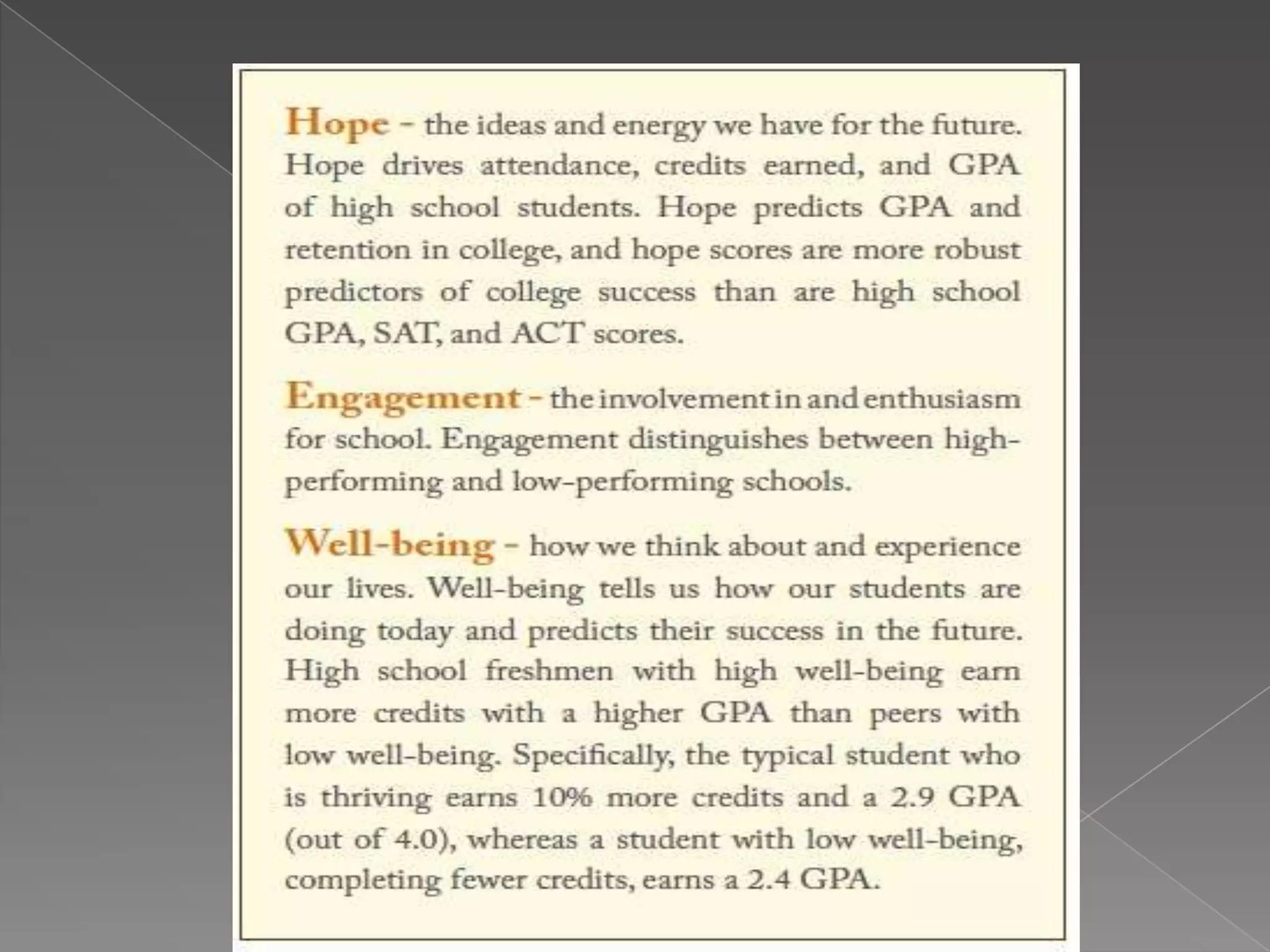
Gallup research has already
proven that “Hope” is a
more powerful indicator of
 academic success and
graduation than GPA and
      ACT scores.
 Show me your HUNGER
 Show me your Hope
 Show me your Focus
 Show me your Commitment
 Show me your Actions


And     I’ll show you
    your RESULTS
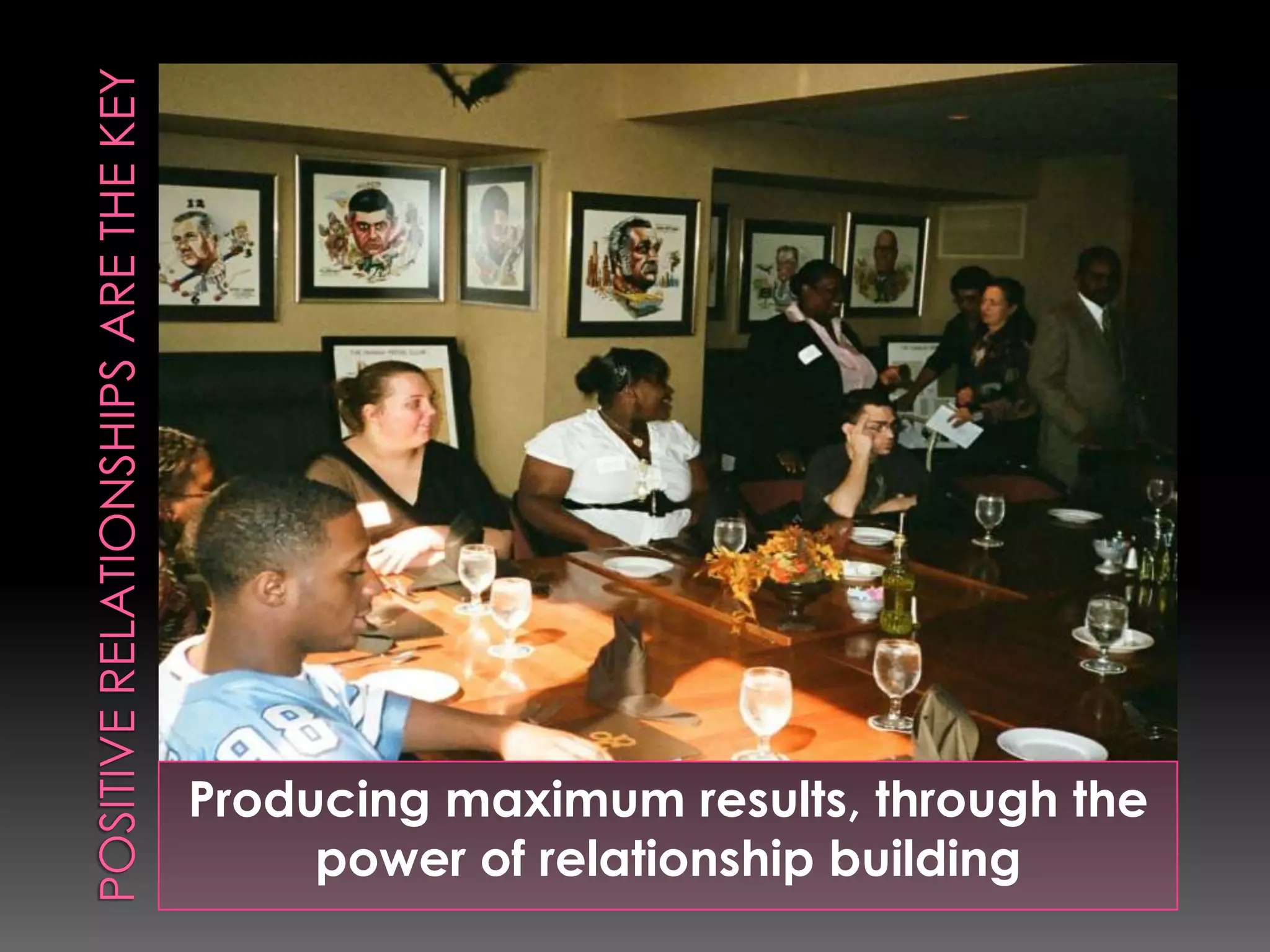
Producing maximum results, through the
     power of relationship building

Relationship building and_hope

  • 1.
    Producing Maximum Results,Through the Power of Relationship Building
  • 2.
     Isrelationship building a natural process  What is HOPE  How do you give HOPE to a student who feels hopeless
  • 5.
    The longitudinal resultsof the study indicated that children who experienced warm student-teacher relationships performed better on thinking, language ability, and math skills when compared to children who did not experience such a warm relationship . Peisner-Feinberg et al., 1999
  • 6.
    “A fundamental question for a student is, “Does my teacher like me?’ Given a rigorous, aligned curriculum, the answer to that simple question is our best predictor of student achievement.” Alice Terry, More Life Through Management
  • 7.
    The quality ofteacher-student relationships is the keystone for all other aspects of classroom management. Marzano and Marzano, Dimensions of Learning
  • 8.
    80% of students entering schools feel good about themselves. By the end of 5th grade only 20% do. Only one in five high school students has a positive self- esteem. National Assessment of Educational Progress, National Parent Teacher Association
  • 9.
    Birch and Ladd,further concluded that conflict in Kindergarten children’s teacher-child relationships was associated with a decline in children’s pro-social behavior over time
  • 10.
    Additionally, a child’sdemonstration of less pro-social behavior may negatively affect a child’s ability to develop and maintain positive relationships with others, including peers, thus perpetuating a cycle of behavioral and relational difficulties.
  • 12.
    The #1 stimulithat determines the outcome of your interaction with a student labeled “at risk” is?
  • 13.
  • 14.
    Control your energy – Control your outcome
  • 16.
     Don’t tryto be cooler than you really are  Project an atmosphere of “Accessible Control”  Always be aware that the student knows where they are (in school) at all times
  • 17.
     Do notsacrifice your integrity to try to fit in with your students. Allow your students to experience a responsible adult, who can also relate to their lifestyle.  Allow student’s to experience your light side, but always maintain a respectable authority.  Remind students in subtle terms where they are and the responsibilities associated with that environment.
  • 20.
    Every student isan individual with different circumstances, motivations and needs.
  • 21.
     Look forelements of familiarity  Are there any identifiable cultural icons  Find a way to create common ground (for instance, “The Freedom Writers”) Take time to learn about another culture  Go the extra yard, walk in your student’s shoes for a day (Steve Martin, CEO, Blue Cross/Blue Shield)
  • 22.
    Every classroom disruption isnot a blatant act of disrespect
  • 23.
     Ascertain theintent of the disruption.  Is the disruption a personal attack on you?  Is the disruption a act to get attention?  Is the disruption a cry for help?  Is the disruption outside of the norm for that particular student’s character
  • 24.
    When you discoverthe intent of the disruption (utilizing the relationship) you can now effectively offer a solution to the problem.
  • 25.
    Gallup research hasalready proven that “Hope” is a more powerful indicator of academic success and graduation than GPA and ACT scores.
  • 31.
     Show meyour HUNGER  Show me your Hope  Show me your Focus  Show me your Commitment  Show me your Actions And I’ll show you your RESULTS
  • 32.
    Producing maximum results,through the power of relationship building