NON INVASIVE VENTILATION
Noninvasive ventilation is the delivery of alveolar
ventilation without the need for an invasive artificial
airway.
Types of NIV
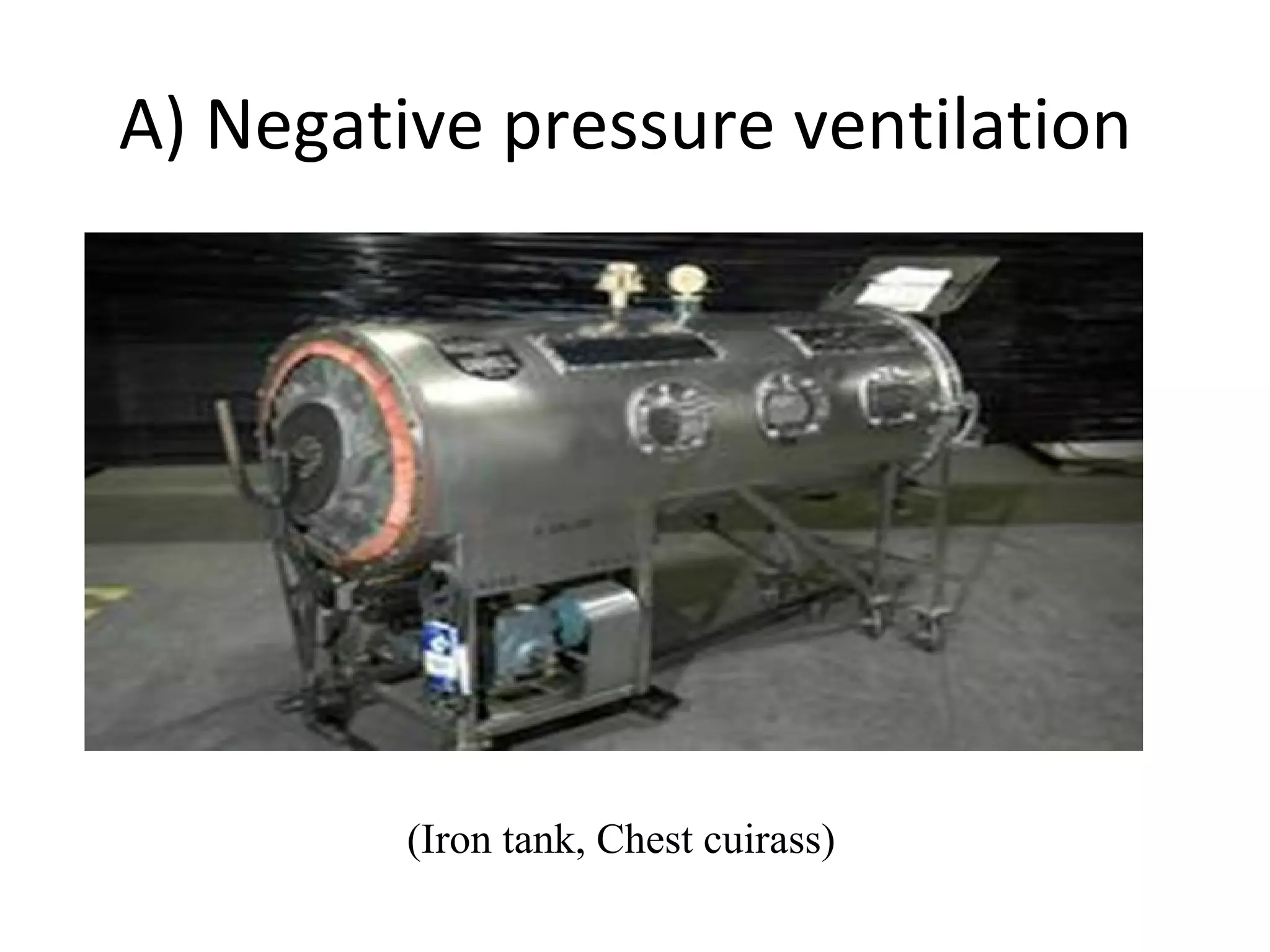
•Negative pressure ventilation(Iron tank, Chest cuirass)
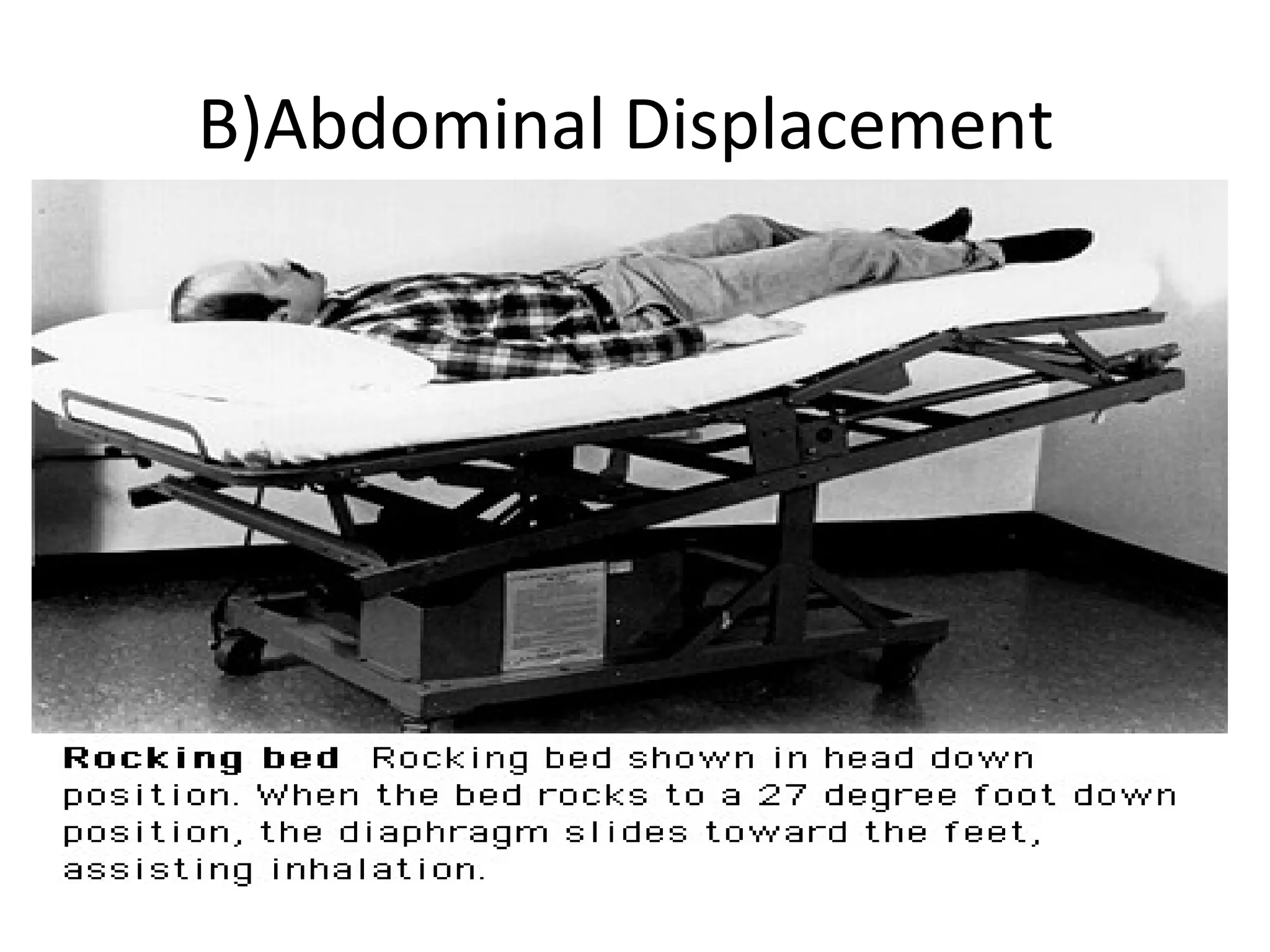
•Abdominal Displacement (Pneumobelt-Rocking bed)
•Positive pressure ventilation (BIPAP, CPAP, NIPPV)
A) Negative pressure ventilation
(Iron tank, Chest cuirass)
B)Abdominal Displacement
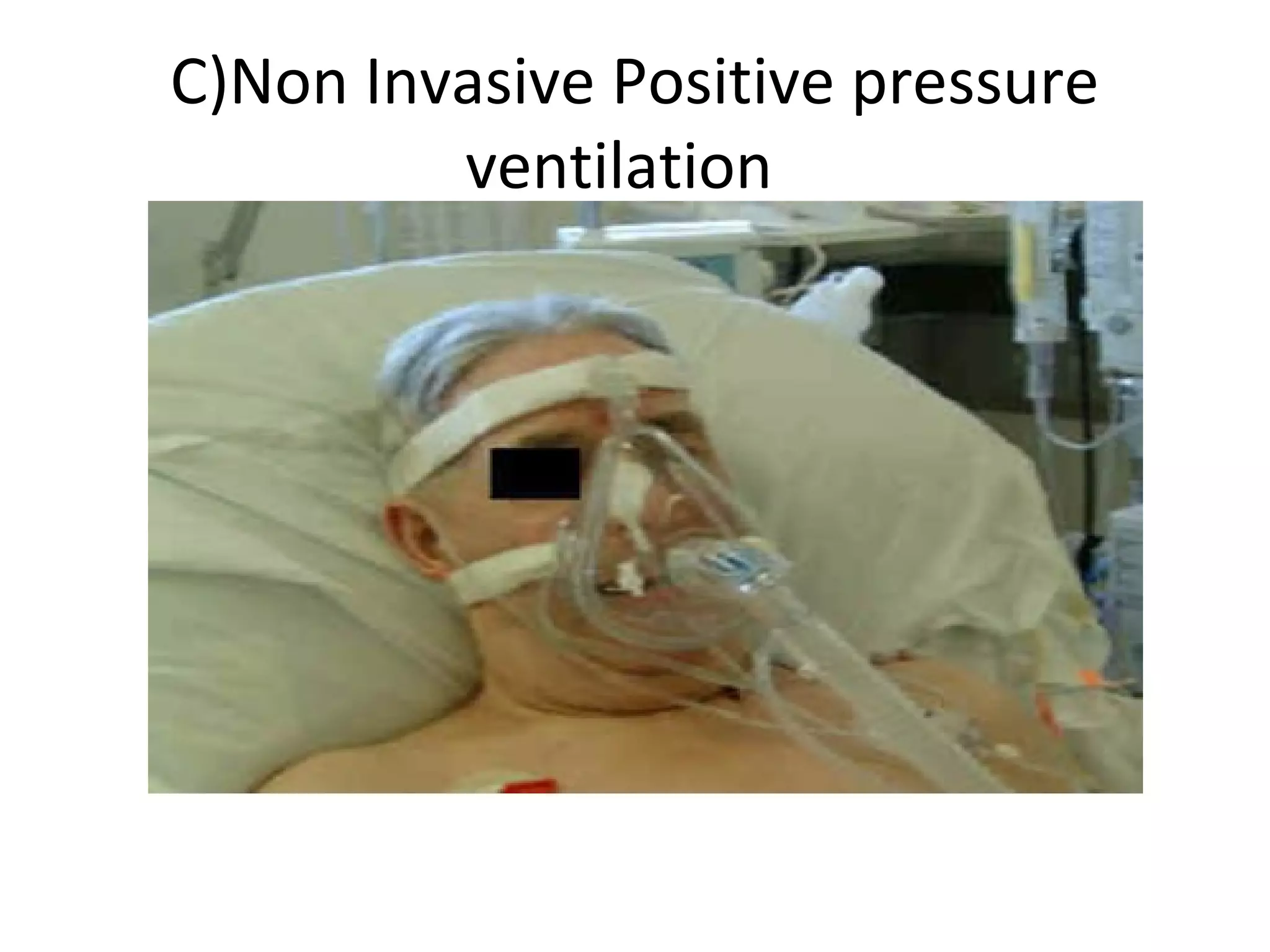
C)Non Invasive Positive pressure
ventilation
Advantages of NIV/ NIPPV
1) Noninvasiveness
Avoids the complications of endotracheal intubation
- Early (local trauma, aspiration)
- Late (injury to the the hypopharynx, larynx, and
trachea, nosocomial infections)
2 ) Ease of application
(compared with endotracheal intubation)
- Easy to implement
- Easy to remove
3) Allows intermittent application
4) Can be used in non ICU settings
5) Improves patient comfort
6) Reduces the need for sedation
7) Oral patency (preserves speech, swallowing,
and cough)
8) Avoid the resistive work imposed by the
endotracheal tube
Disadvantages of NIV
1.System
– Slower correction of gas exchange abnormalities
– Increased initial time commitment, may need intubation
– Gastric distension (occurs in <2% patients)
– Time consuming, manpower consuming
2.Mask
-Air leakage
- Transient hypoxemia from accidental removal
-Eye irritation
- Facial skin necrosis –most common complication.
3.Lack of airway access and protection
- Suctioning of secretions
Location of NIV
NIV can be administered in the
-Emergency department
-ICU
-HDU
-General ward
-Home
Who can administer NIV?
- Physicians
-Nurses
-Respiratory care therapists
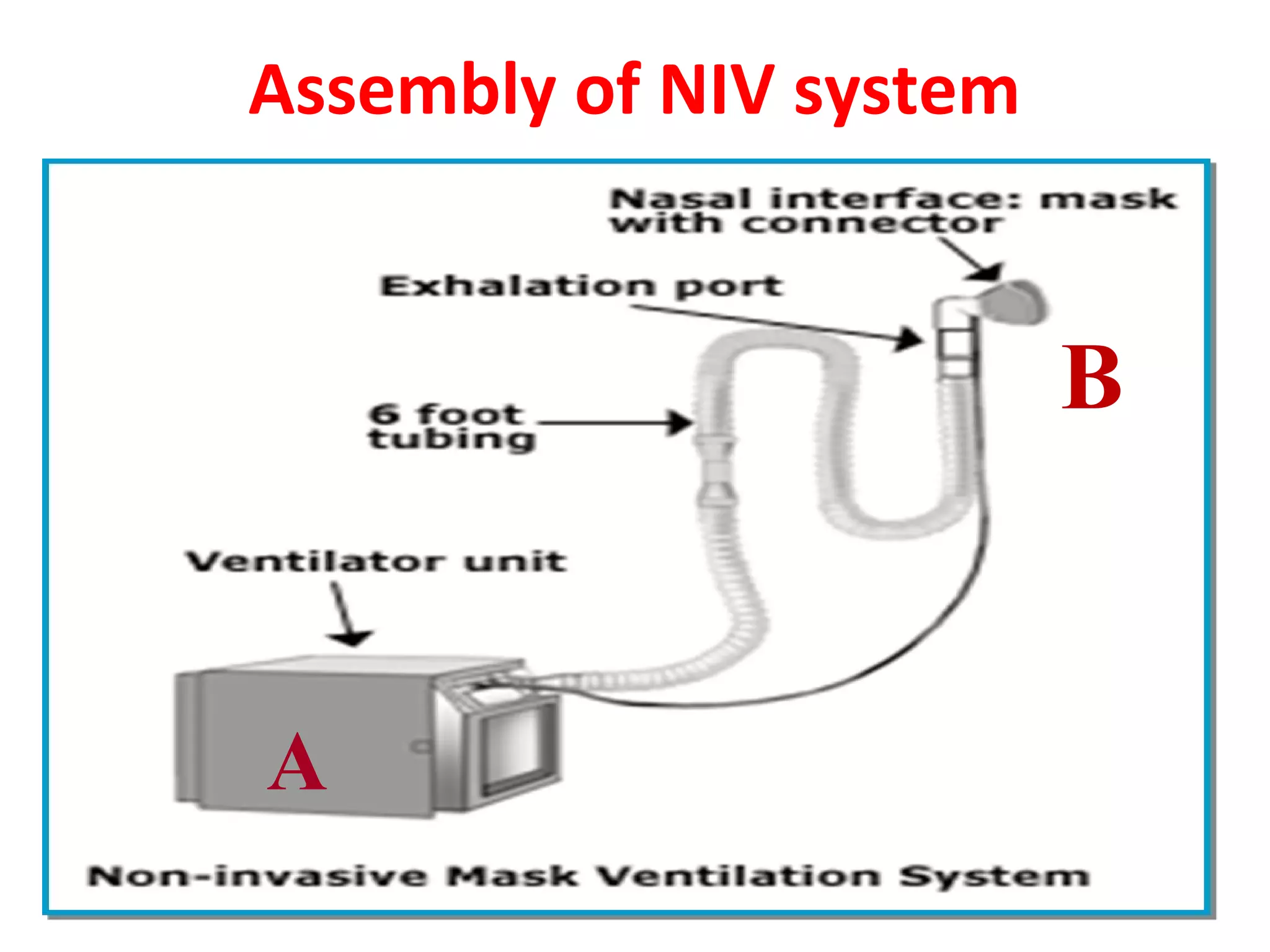
Assembly of NIV system
A
B
a) Ventilator unit
1) CPAP 3) Bilevel NIV
2) BIPAP 4) Conventional ICU ventilator
Modes of NIPPV
Pressure preset mode- (most commonly used)
The delivered volume is variable depending on lung compliance .
- Compensates better in case of air leak
- Limitation of peak airway pressure possible
(ie reduction in TV / Insp. flow rate) , hence better in pts. with
previous emphysematous bullae/ pneumothoraces.
- Comfortable and better tolerated
Volume preset mode-
The set volume is delivered with variable peak airway pressures
Pressure preset mode
• CPAP(Continous Positive Airway Pressure)
Only one level of positive pressure set above
atmospheric pressure during entire spontaenous
breath, does not include any mech. breath
If IPPV settings are set as IPAP= EPAP, then it acts
like CPAP
• IPPV(Intermittent Positive Pressure Ventilation)
Two level of pressure is set –
a)IPAP (Inspiratory positive airway pressure)
b)EPAP (Expiratory positive airway pressure)
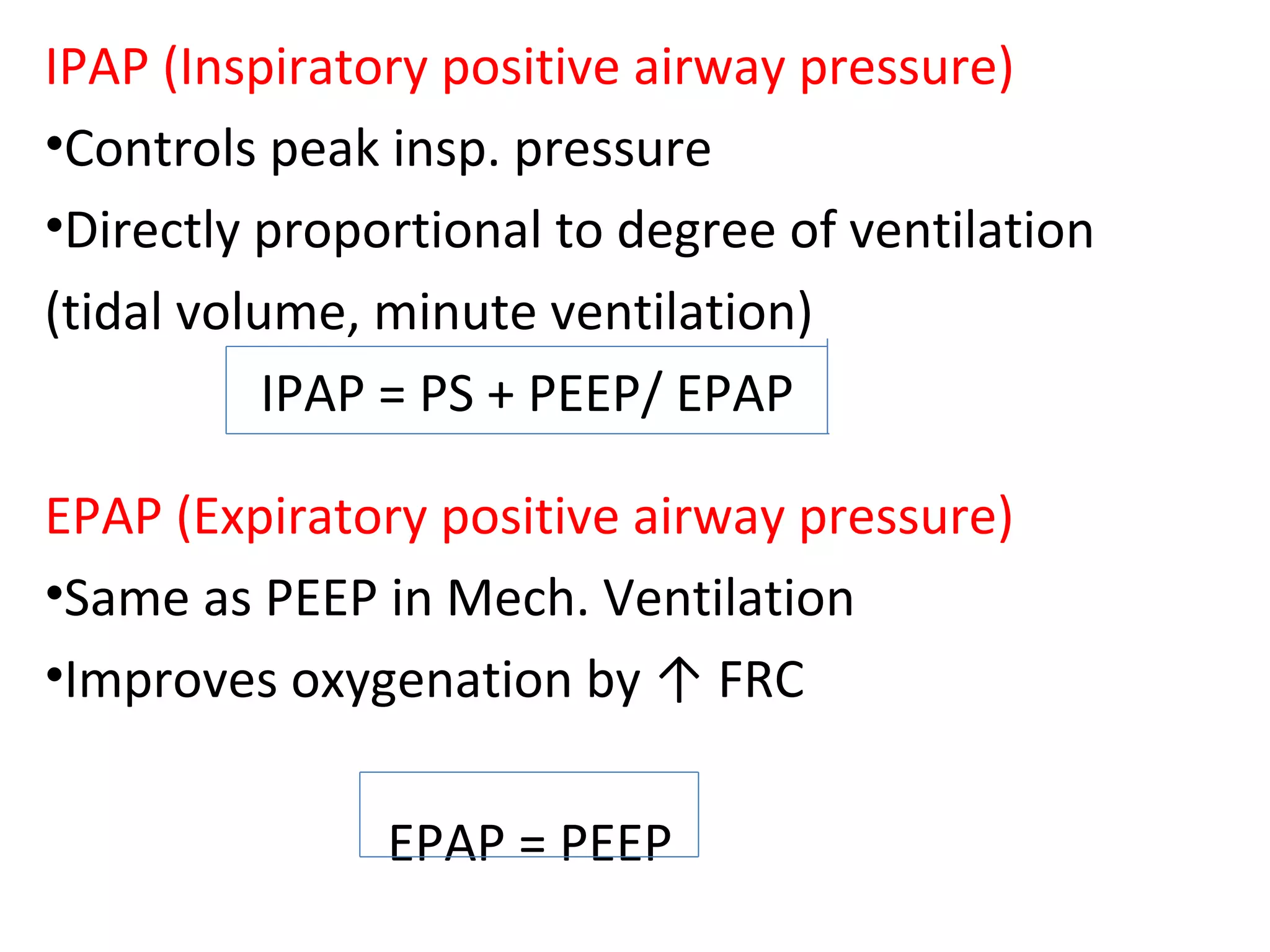
IPAP (Inspiratory positive airway pressure)
•Controls peak insp. pressure
•Directly proportional to degree of ventilation
(tidal volume, minute ventilation)
IPAP = PS + PEEP/ EPAP
EPAP (Expiratory positive airway pressure)
•Same as PEEP in Mech. Ventilation
•Improves oxygenation by ↑ FRC
EPAP = PEEP
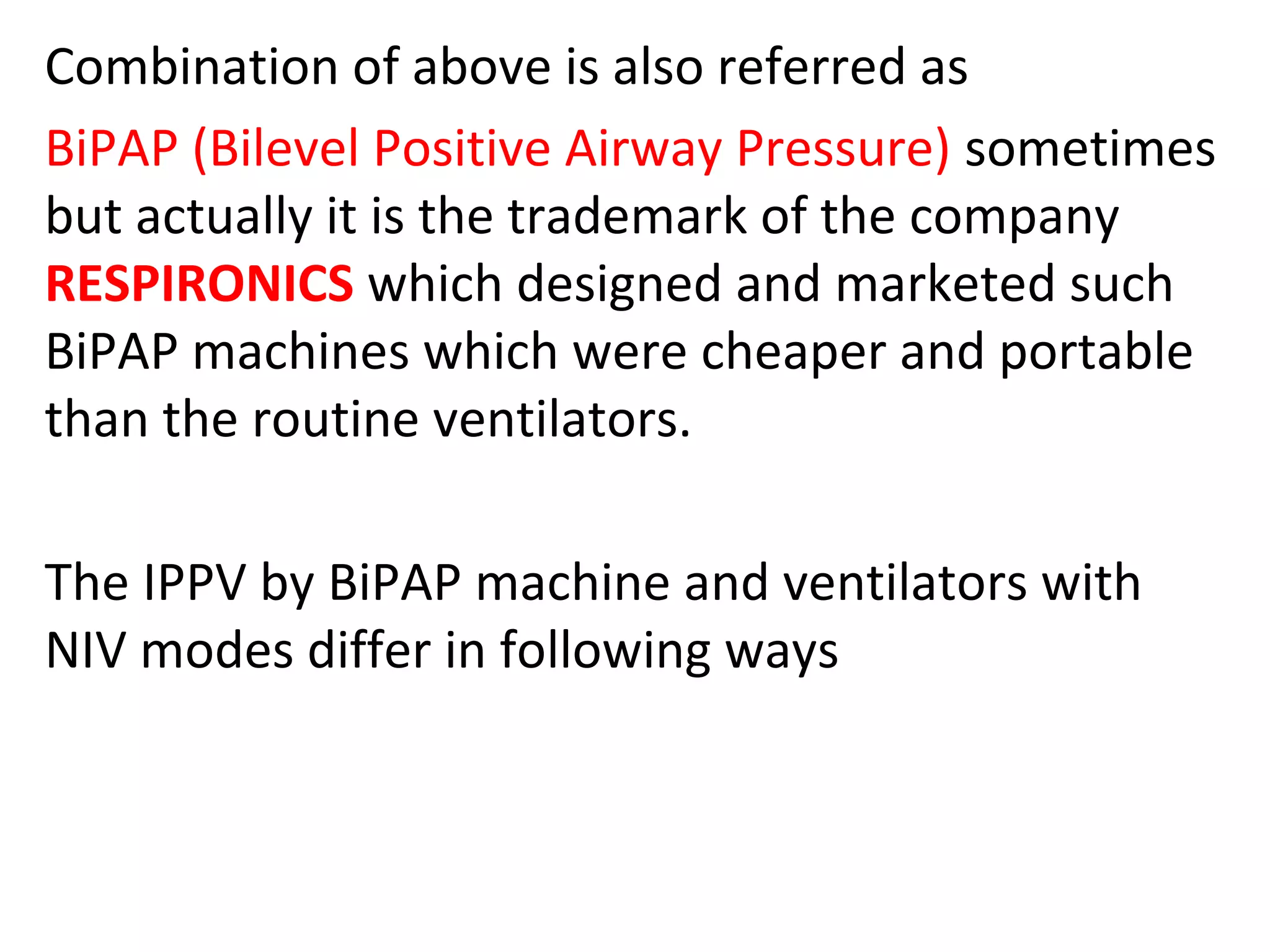
Combination of above is also referred as
BiPAP (Bilevel Positive Airway Pressure) sometimes
but actually it is the trademark of the company
RESPIRONICS which designed and marketed such
BiPAP machines which were cheaper and portable
than the routine ventilators.
The IPPV by BiPAP machine and ventilators with
NIV modes differ in following ways
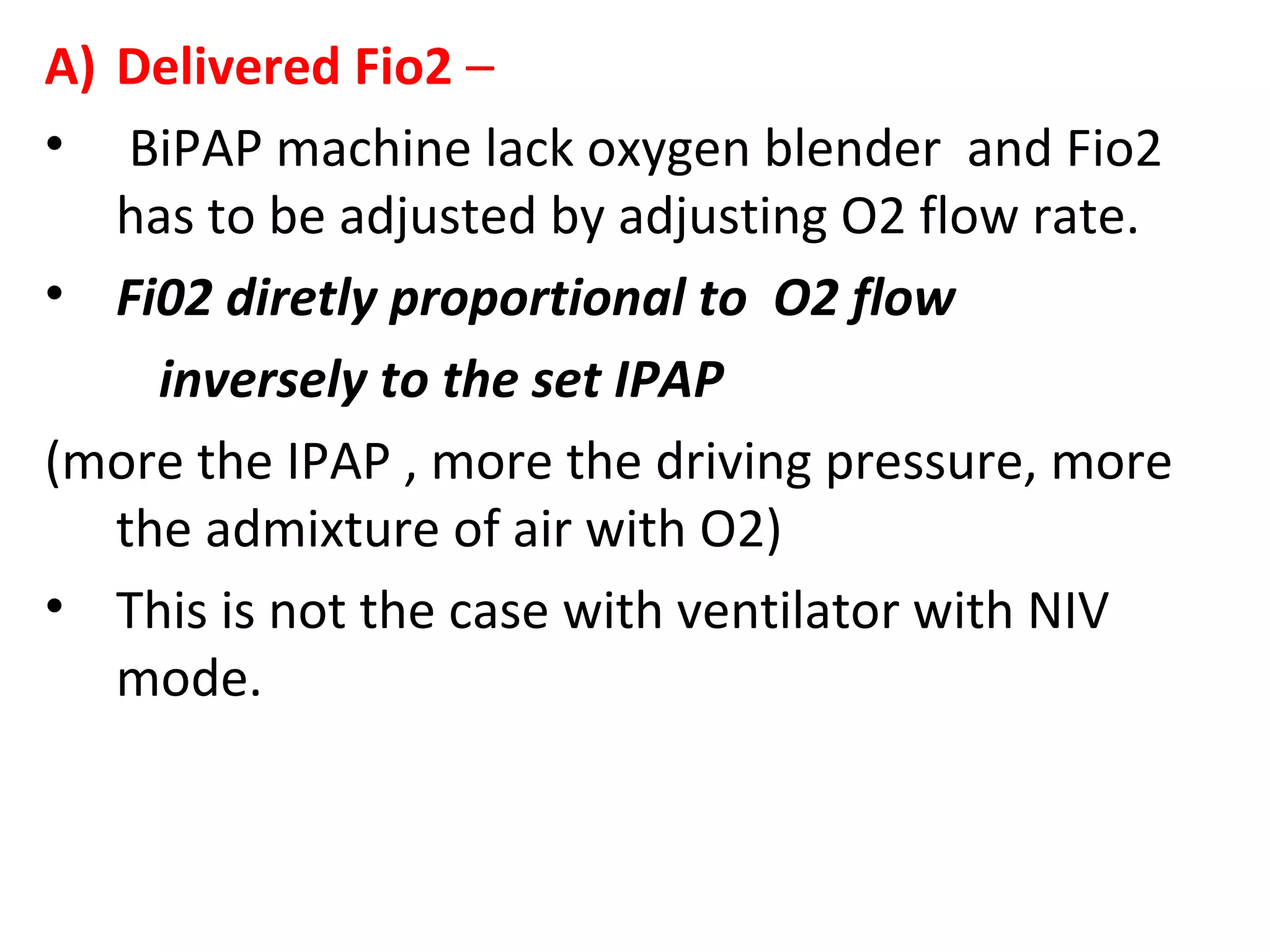
A) Delivered Fio2 –
• BiPAP machine lack oxygen blender and Fio2
has to be adjusted by adjusting O2 flow rate.
• Fi02 diretly proportional to O2 flow
inversely to the set IPAP
(more the IPAP , more the driving pressure, more
the admixture of air with O2)
• This is not the case with ventilator with NIV
mode.
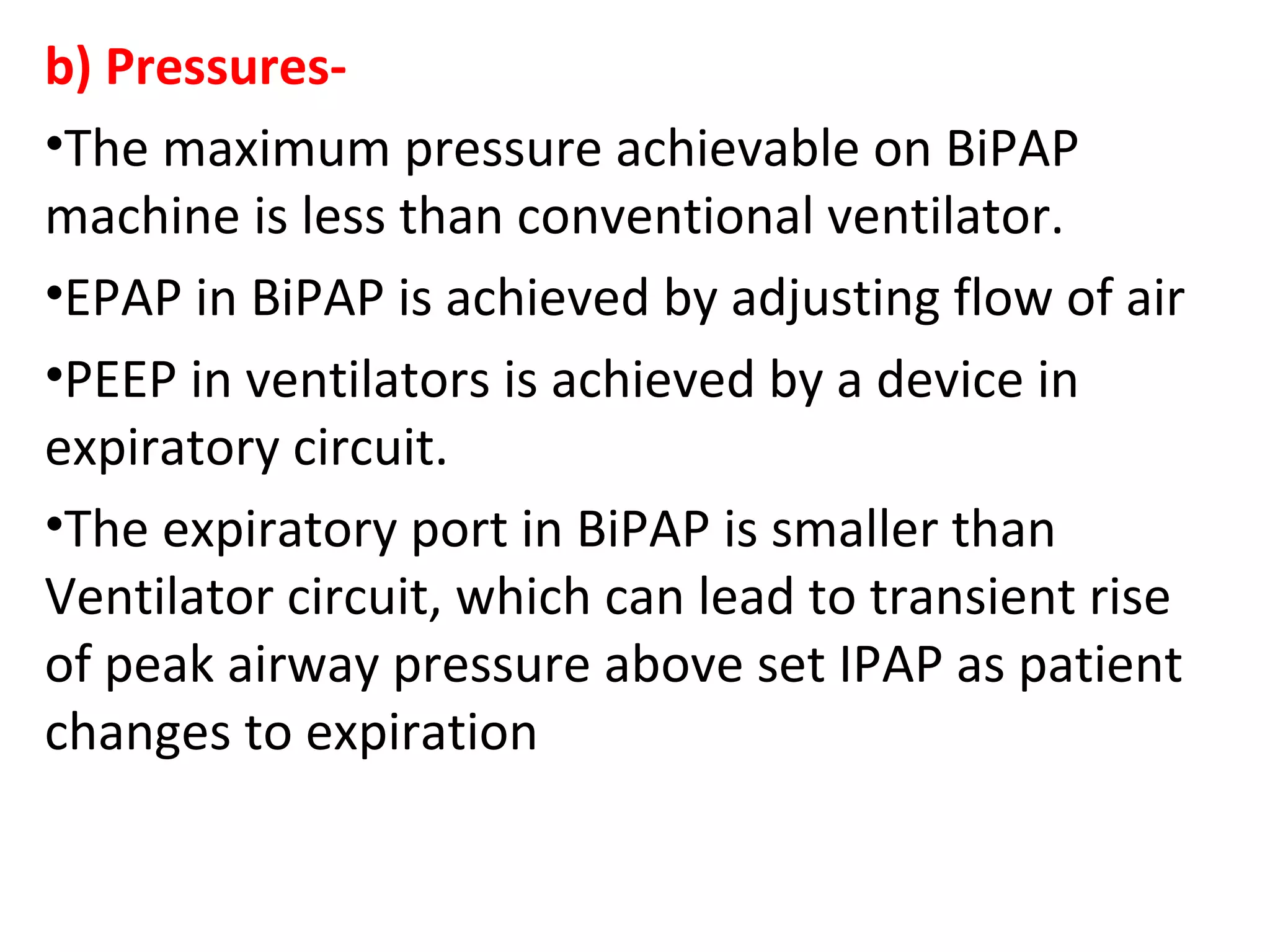
b) Pressures-
•The maximum pressure achievable on BiPAP
machine is less than conventional ventilator.
•EPAP in BiPAP is achieved by adjusting flow of air
•PEEP in ventilators is achieved by a device in
expiratory circuit.
•The expiratory port in BiPAP is smaller than
Ventilator circuit, which can lead to transient rise
of peak airway pressure above set IPAP as patient
changes to expiration
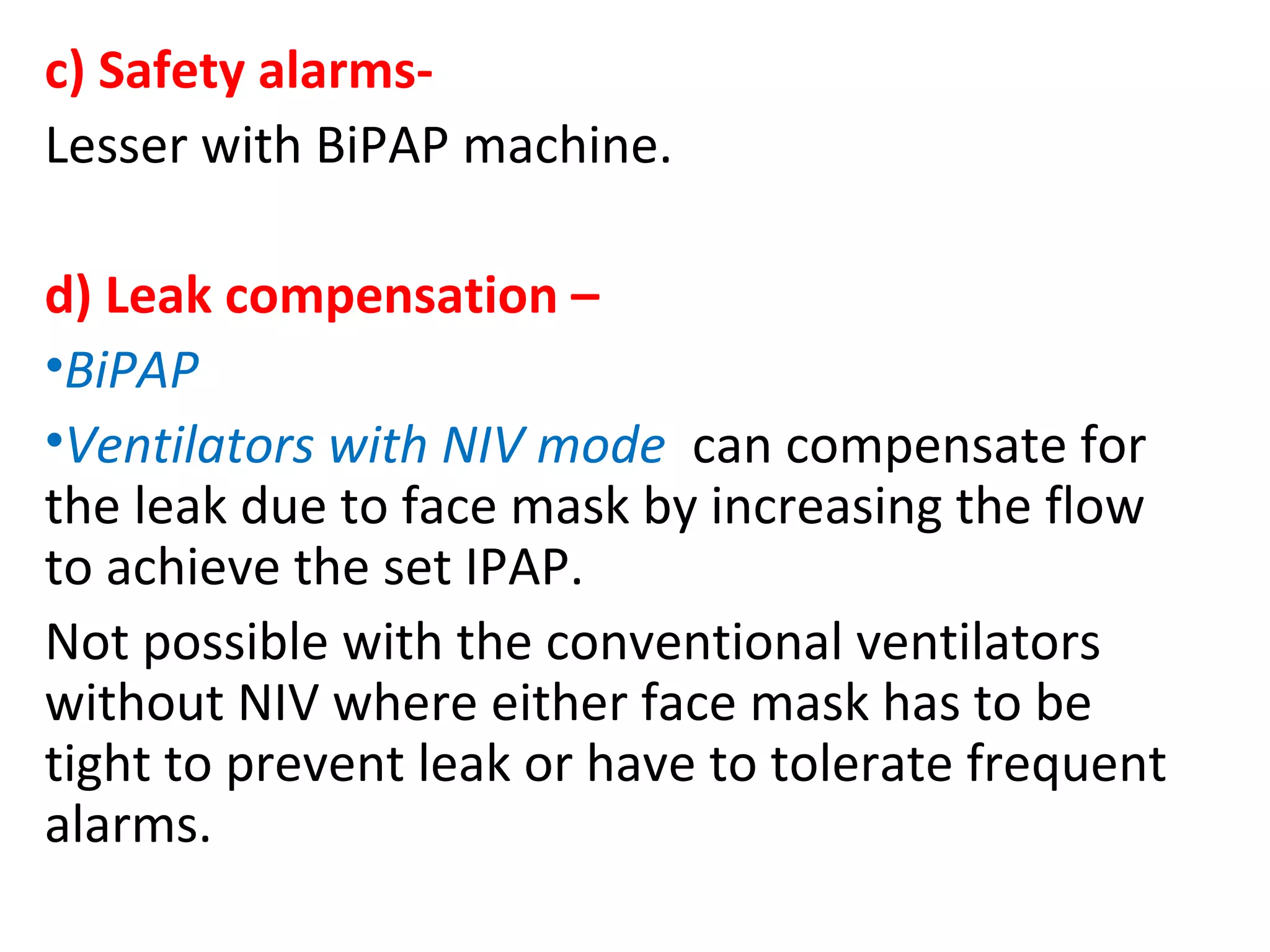
c) Safety alarms-
Lesser with BiPAP machine.
d) Leak compensation –
•BiPAP
•Ventilators with NIV mode can compensate for
the leak due to face mask by increasing the flow
to achieve the set IPAP.
Not possible with the conventional ventilators
without NIV where either face mask has to be
tight to prevent leak or have to tolerate frequent
alarms.
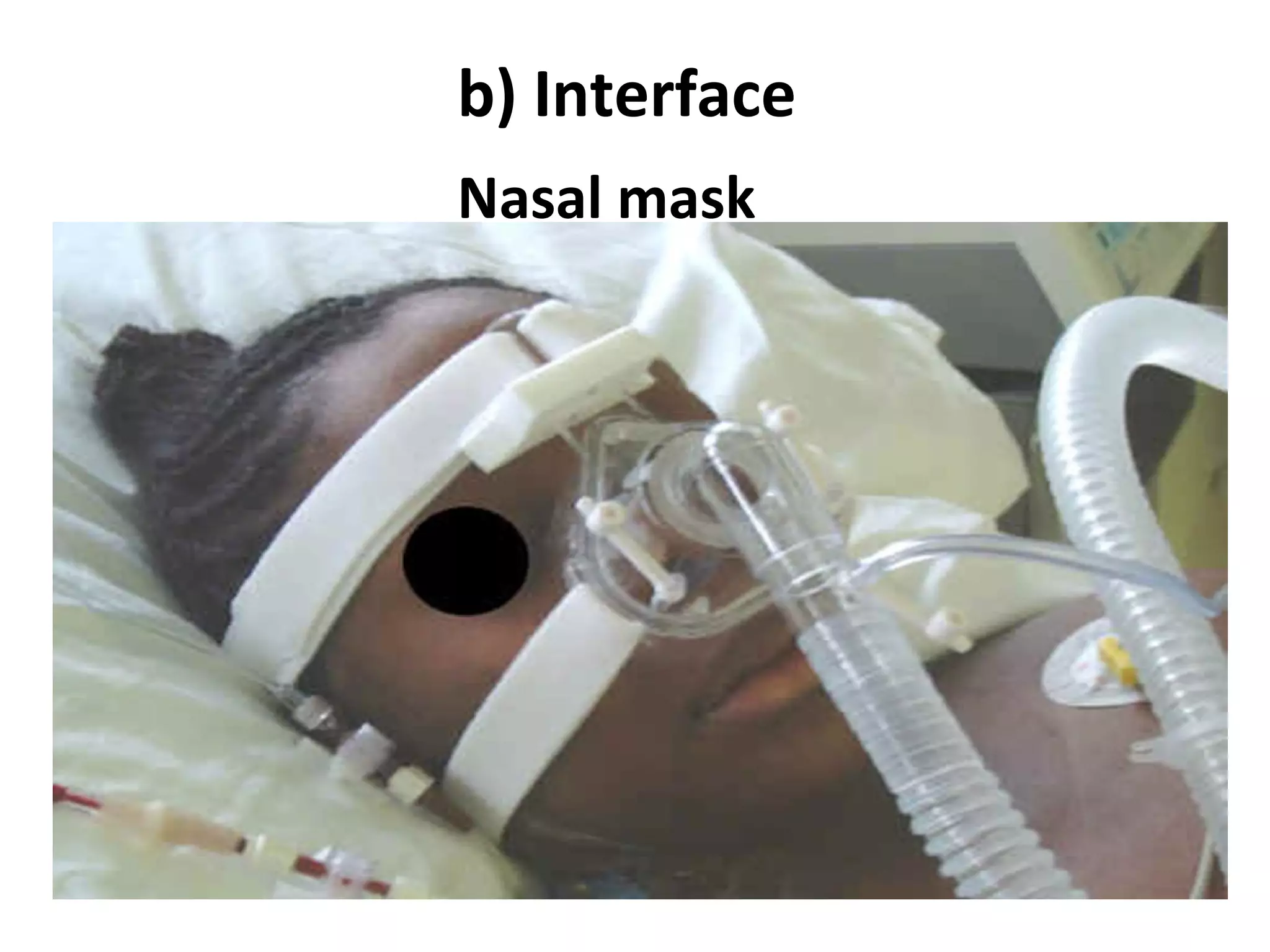
b) Interface
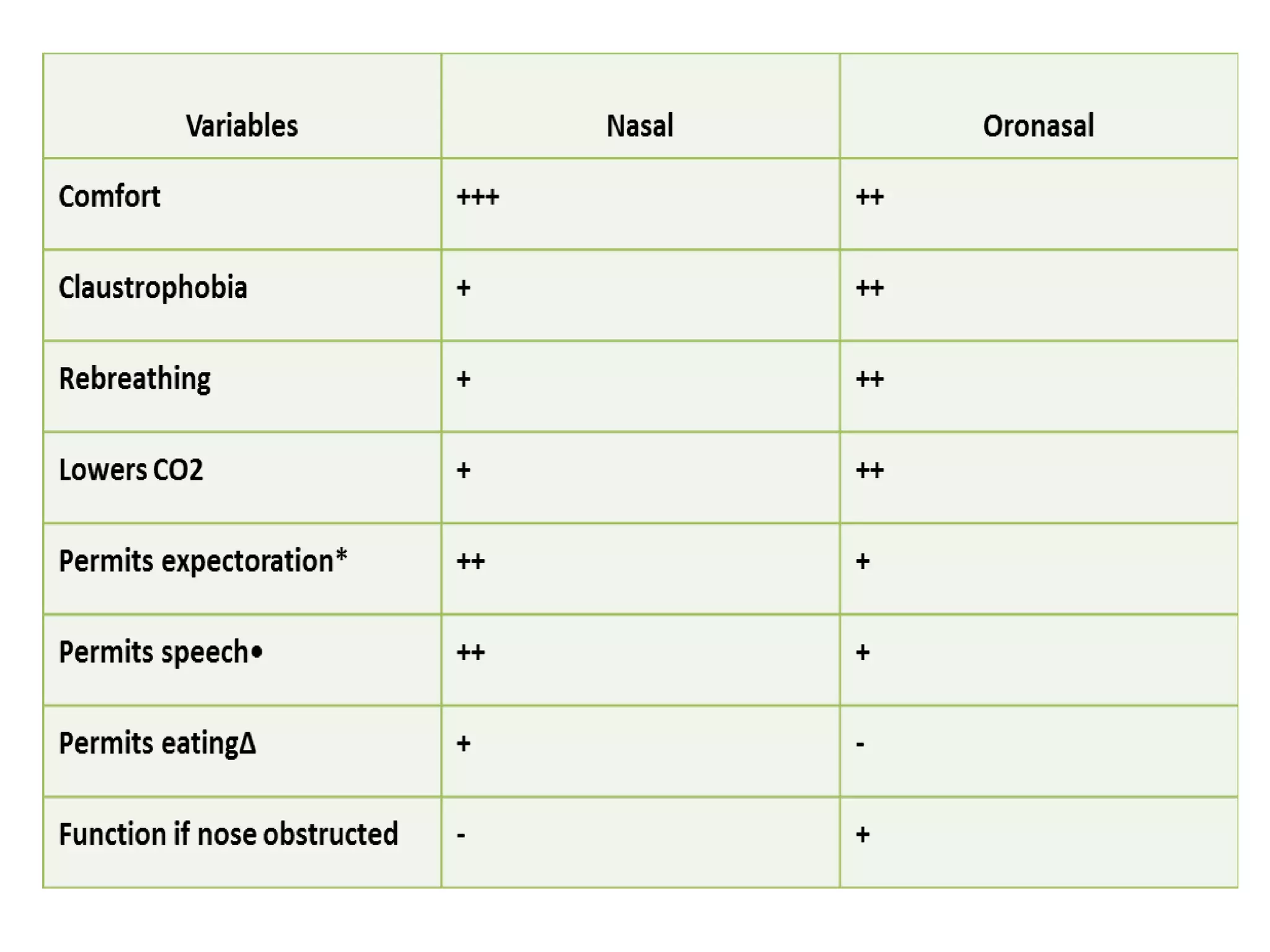
Nasal mask
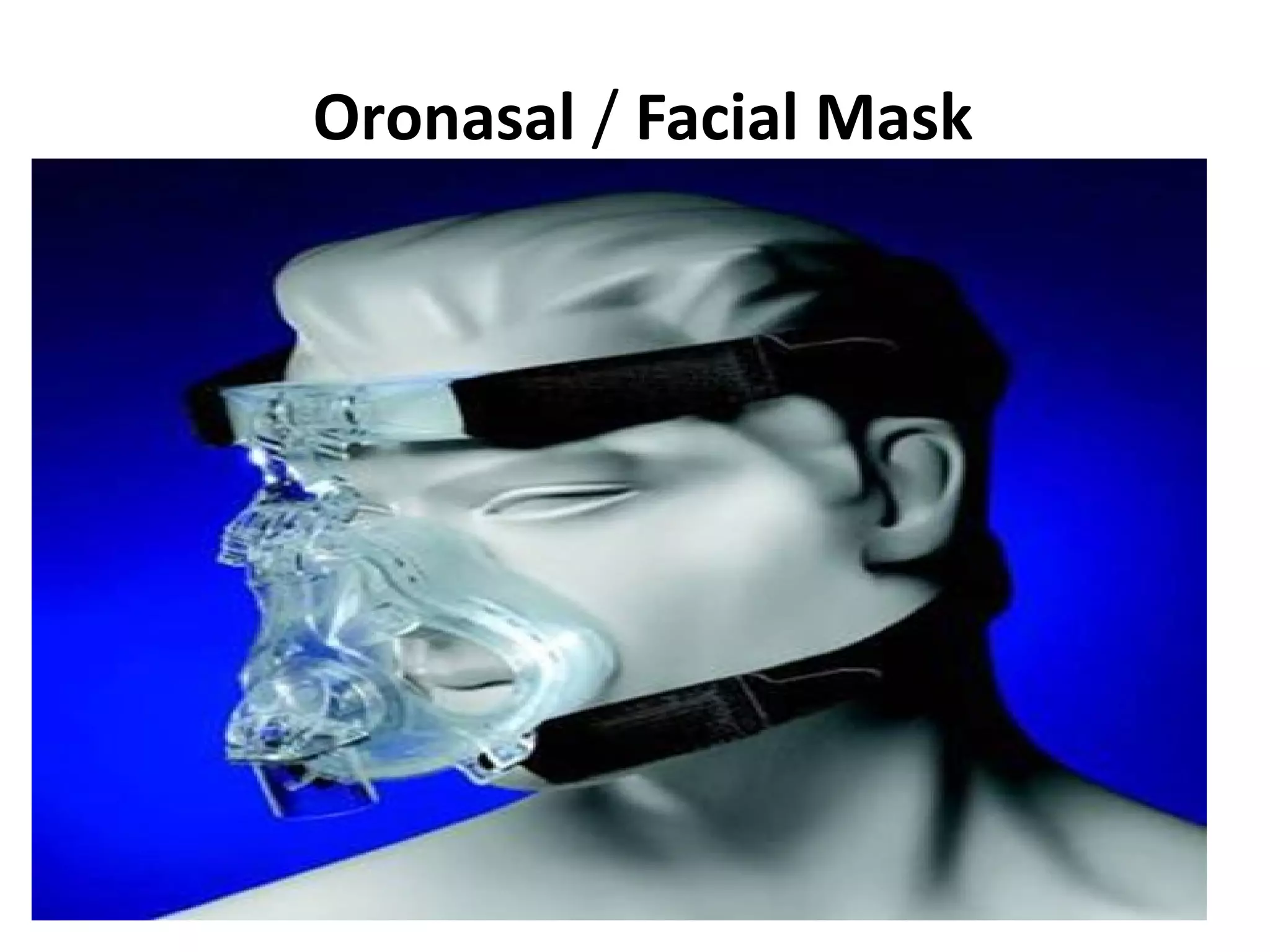
Oronasal / Facial Mask
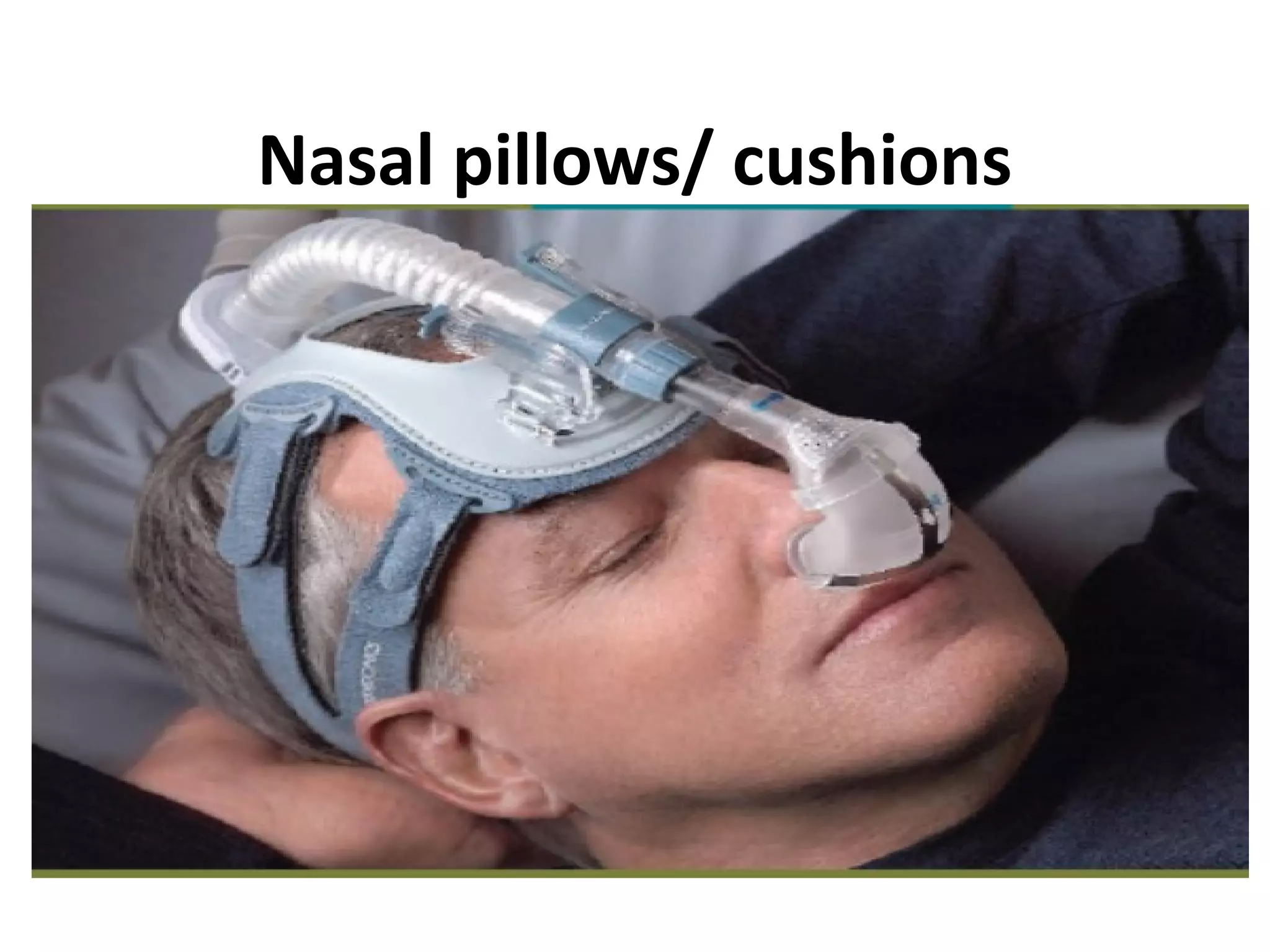
Nasal pillows/ cushions
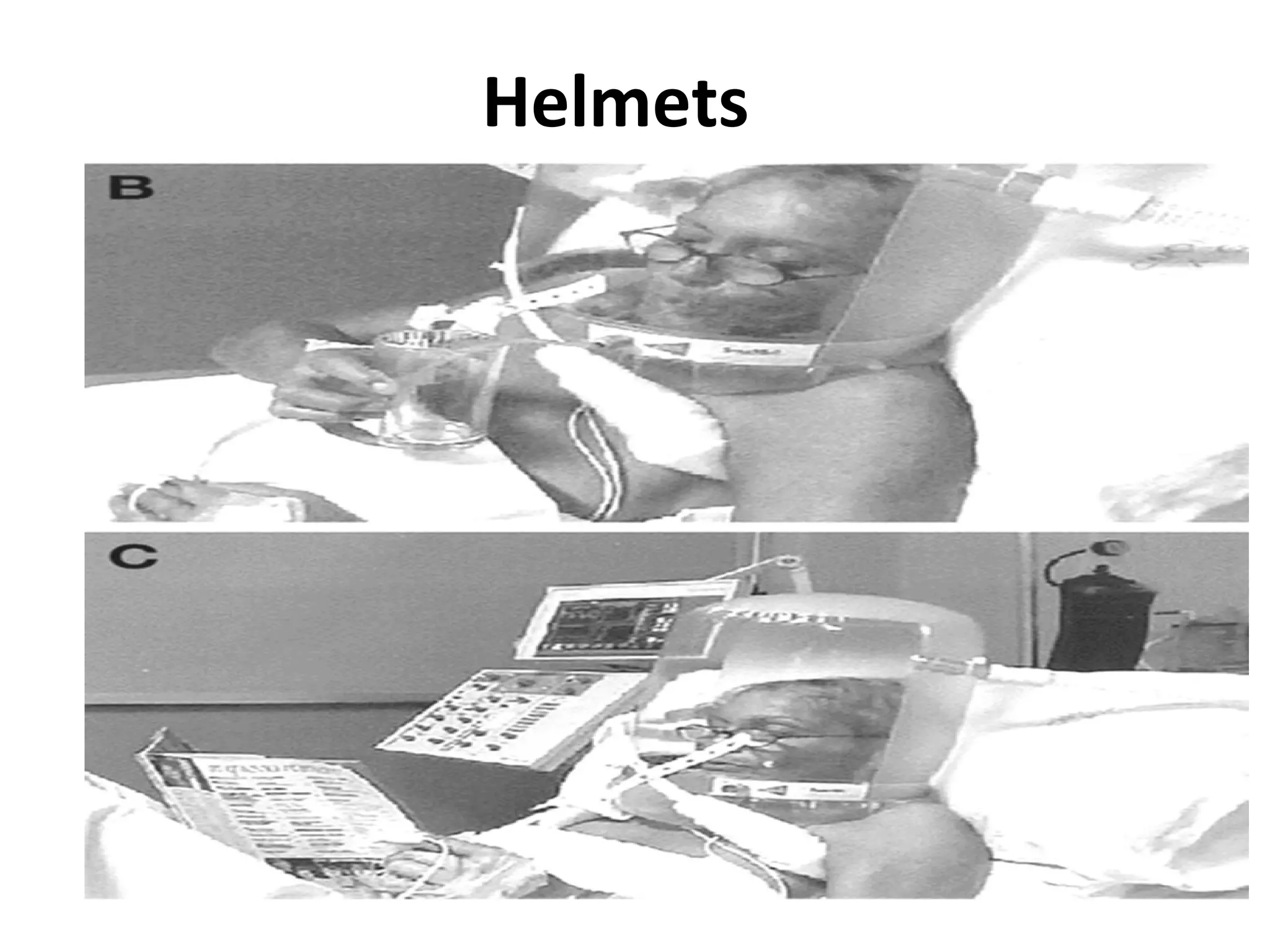
Helmets
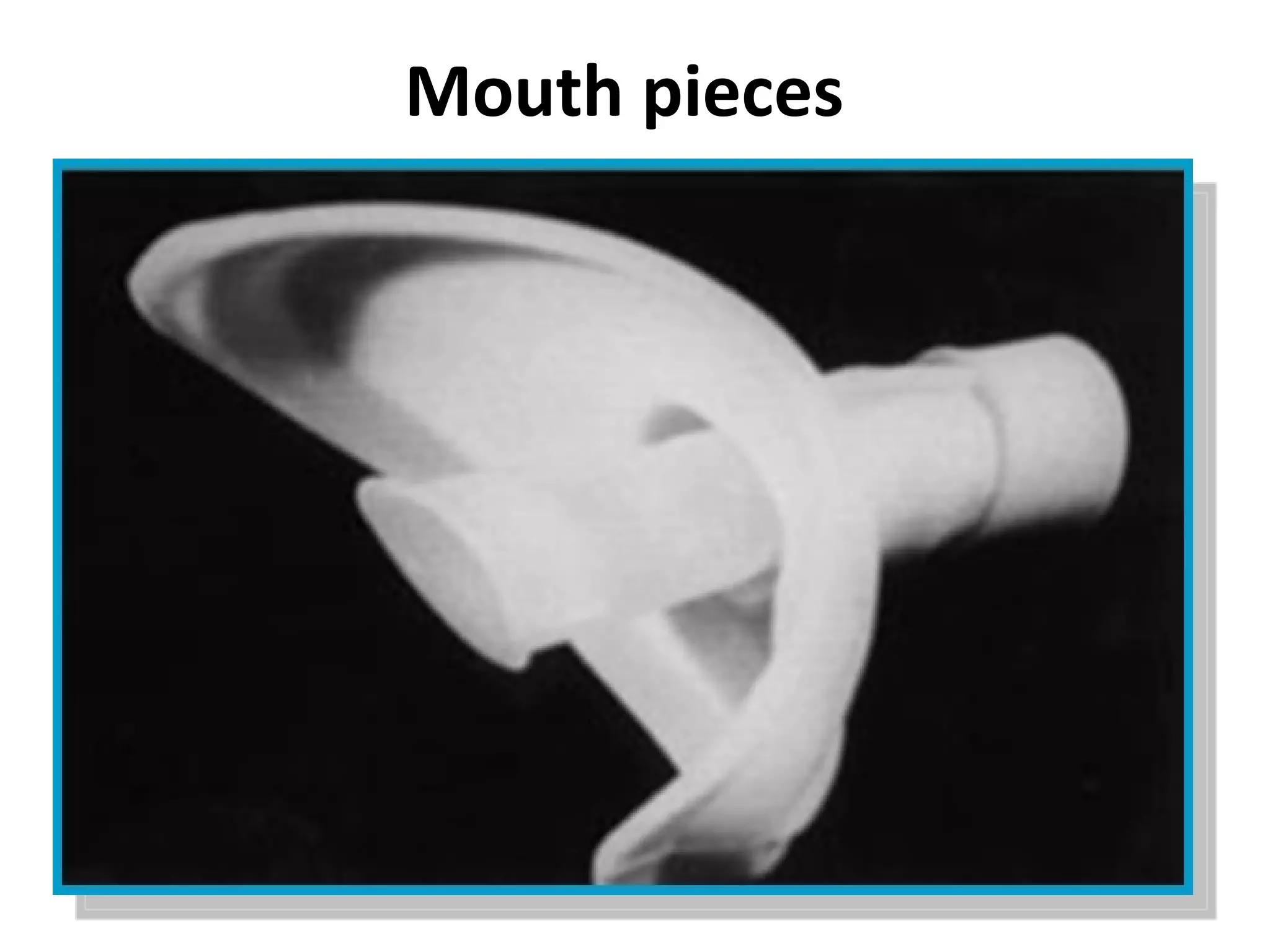
Mouth pieces
Scenarios in which NIV can be used
CAT I- life support without preset limits
CAT II – life support with preset limits (DNI )
CAT III – comfort care
Indications
I) Acute respiratory failure
a) Hypercapnic acute respiratory failure
•Acute exacerbation of COPD
•Post extubation NIV
•Post surgical respiratory failure
•Thoracic wall deformities /Neuromuscular diseases
•Status asthmaticus
•Acute respiratory failure in OSAHS
b) Hypoxemic acute respiratory failure
•Cardiogenic pulmonary edema
•Community acquired pneumonia
•Post traumatic respiratory failure
•ARDS
II) Chronic Respiratory Failure
III) Immunocompromised Patients
IV) Weaning difficulties
IV) Do Not Intubate Patients
Scenarios where strong evidence exists on use of
NIV
•COPD
1)To avoid intubation
2)To extubate to NIV (i.e facilitate extubation)
•OSAHS (esp CPAP)
•Acute cardiogenic pulmonary edema
•Immunocompromised/ Hematologic patients
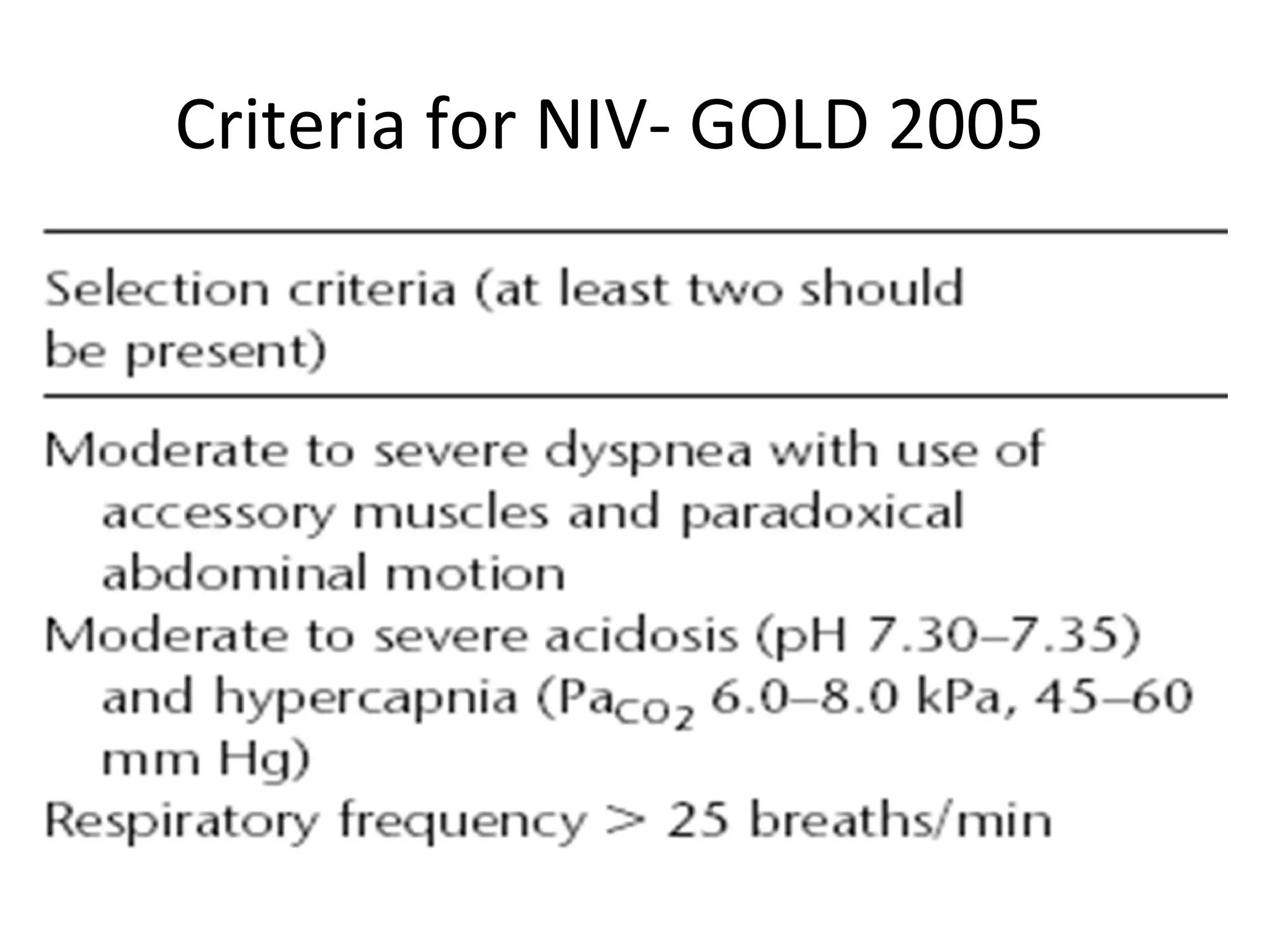
Criteria for NIV- GOLD 2005
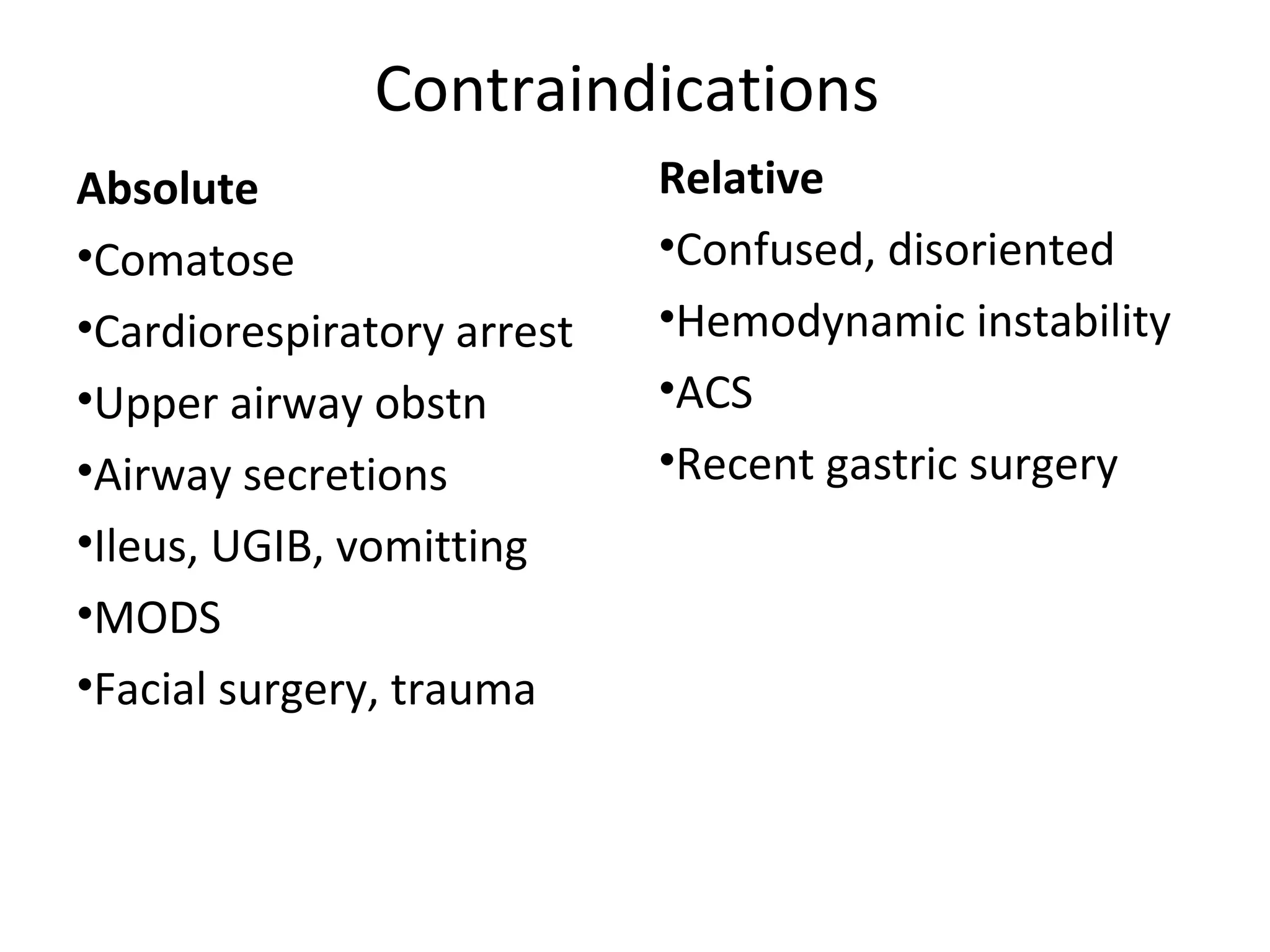
Contraindications
Absolute
•Comatose
•Cardiorespiratory arrest
•Upper airway obstn
•Airway secretions
•Ileus, UGIB, vomitting
•MODS
•Facial surgery, trauma
Relative
•Confused, disoriented
•Hemodynamic instability
•ACS
•Recent gastric surgery
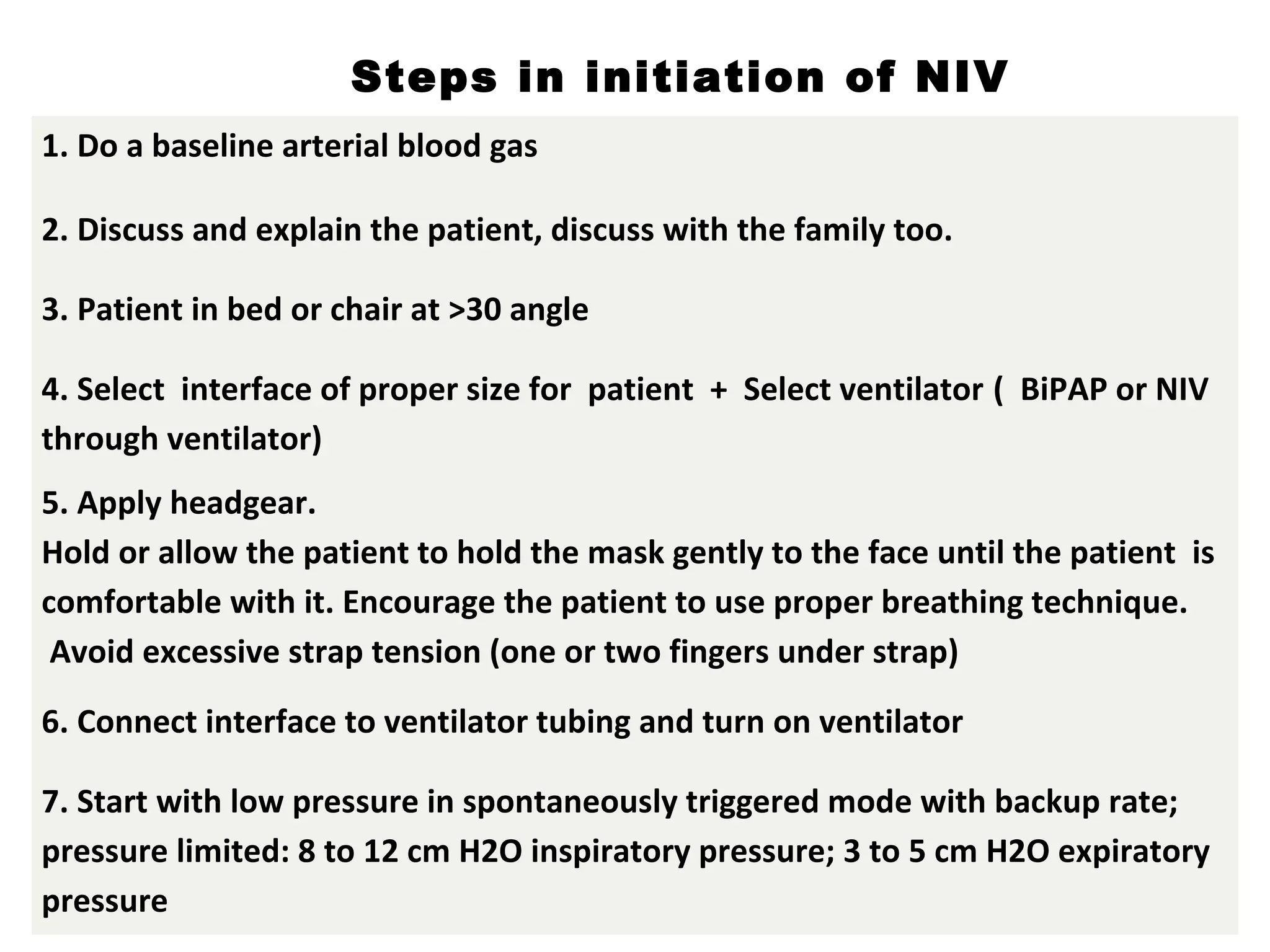
1. Do a baseline arterial blood gas
2. Discuss and explain the patient, discuss with the family too.
3. Patient in bed or chair at >30 angle
4. Select interface of proper size for patient + Select ventilator ( BiPAP or NIV
through ventilator)
5. Apply headgear.
Hold or allow the patient to hold the mask gently to the face until the patient is
comfortable with it. Encourage the patient to use proper breathing technique.
Avoid excessive strap tension (one or two fingers under strap)
6. Connect interface to ventilator tubing and turn on ventilator
7. Start with low pressure in spontaneously triggered mode with backup rate;
pressure limited: 8 to 12 cm H2O inspiratory pressure; 3 to 5 cm H2O expiratory
pressure
Steps in initiation of NIV
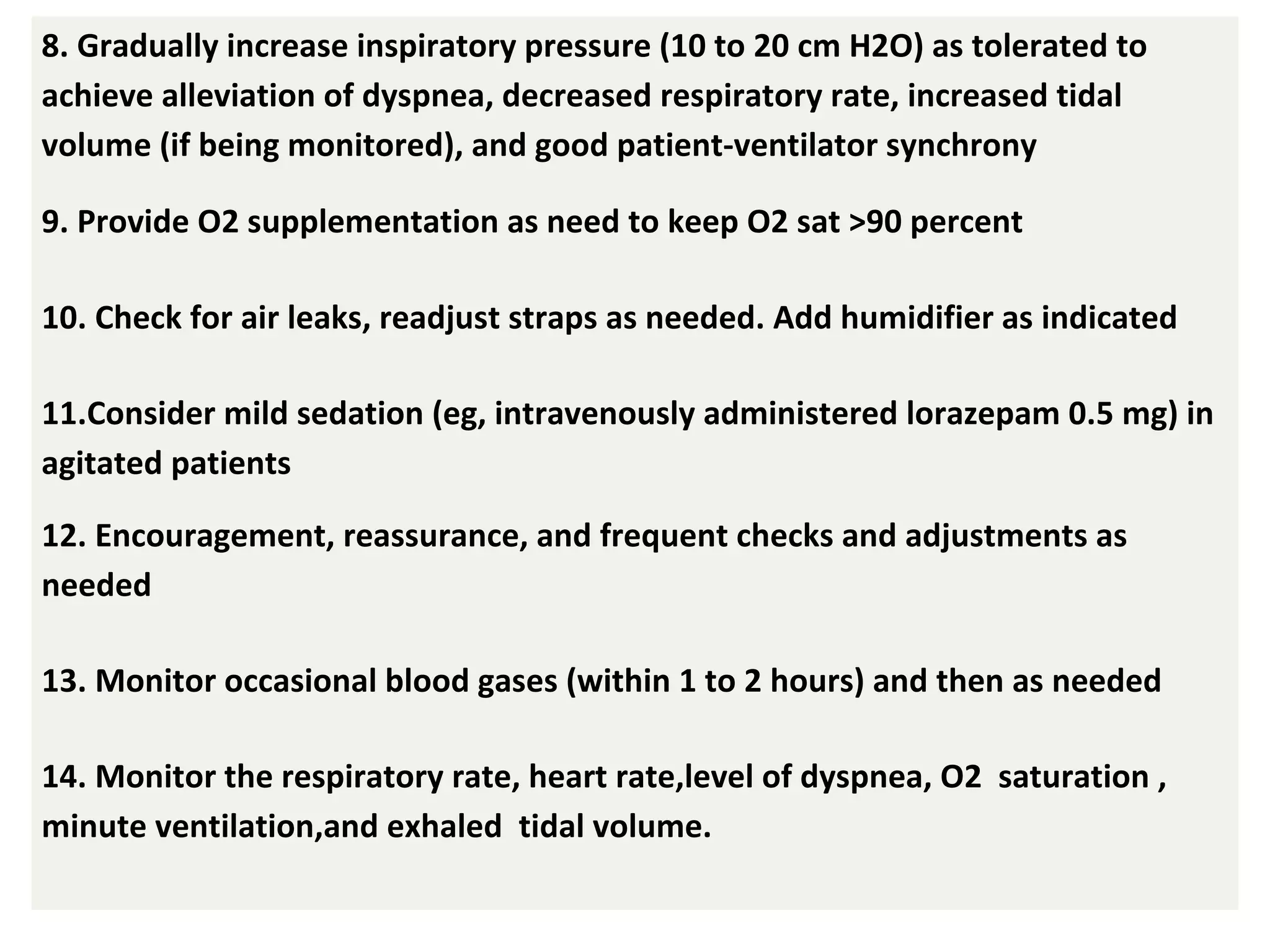
8. Gradually increase inspiratory pressure (10 to 20 cm H2O) as tolerated to
achieve alleviation of dyspnea, decreased respiratory rate, increased tidal
volume (if being monitored), and good patient-ventilator synchrony
9. Provide O2 supplementation as need to keep O2 sat >90 percent
10. Check for air leaks, readjust straps as needed. Add humidifier as indicated
11.Consider mild sedation (eg, intravenously administered lorazepam 0.5 mg) in
agitated patients
12. Encouragement, reassurance, and frequent checks and adjustments as
needed
13. Monitor occasional blood gases (within 1 to 2 hours) and then as needed
14. Monitor the respiratory rate, heart rate,level of dyspnea, O2 saturation ,
minute ventilation,and exhaled tidal volume.
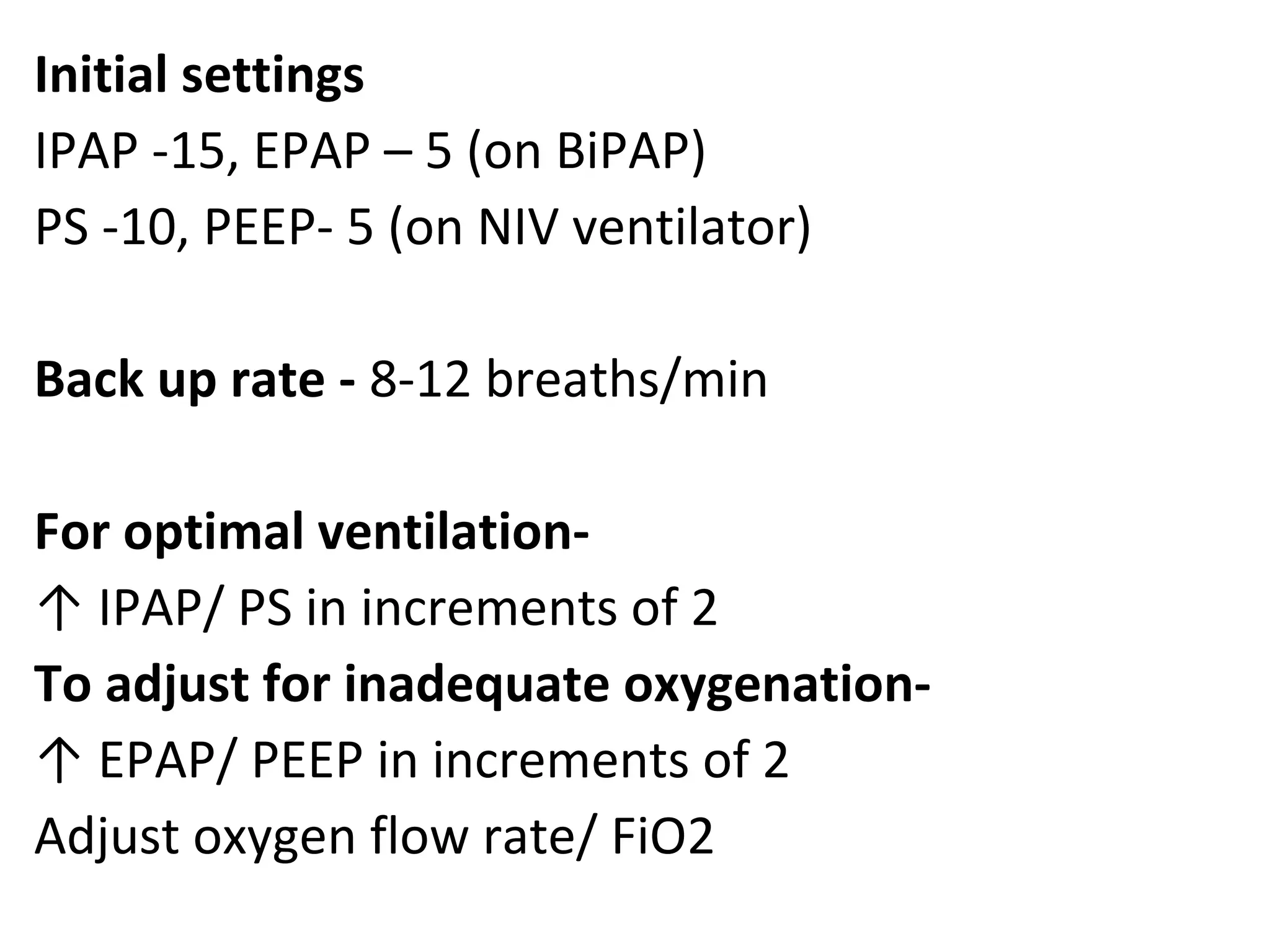
Initial settings
IPAP -15, EPAP – 5 (on BiPAP)
PS -10, PEEP- 5 (on NIV ventilator)
Back up rate - 8-12 breaths/min
For optimal ventilation-
↑ IPAP/ PS in increments of 2
To adjust for inadequate oxygenation-
↑ EPAP/ PEEP in increments of 2
Adjust oxygen flow rate/ FiO2
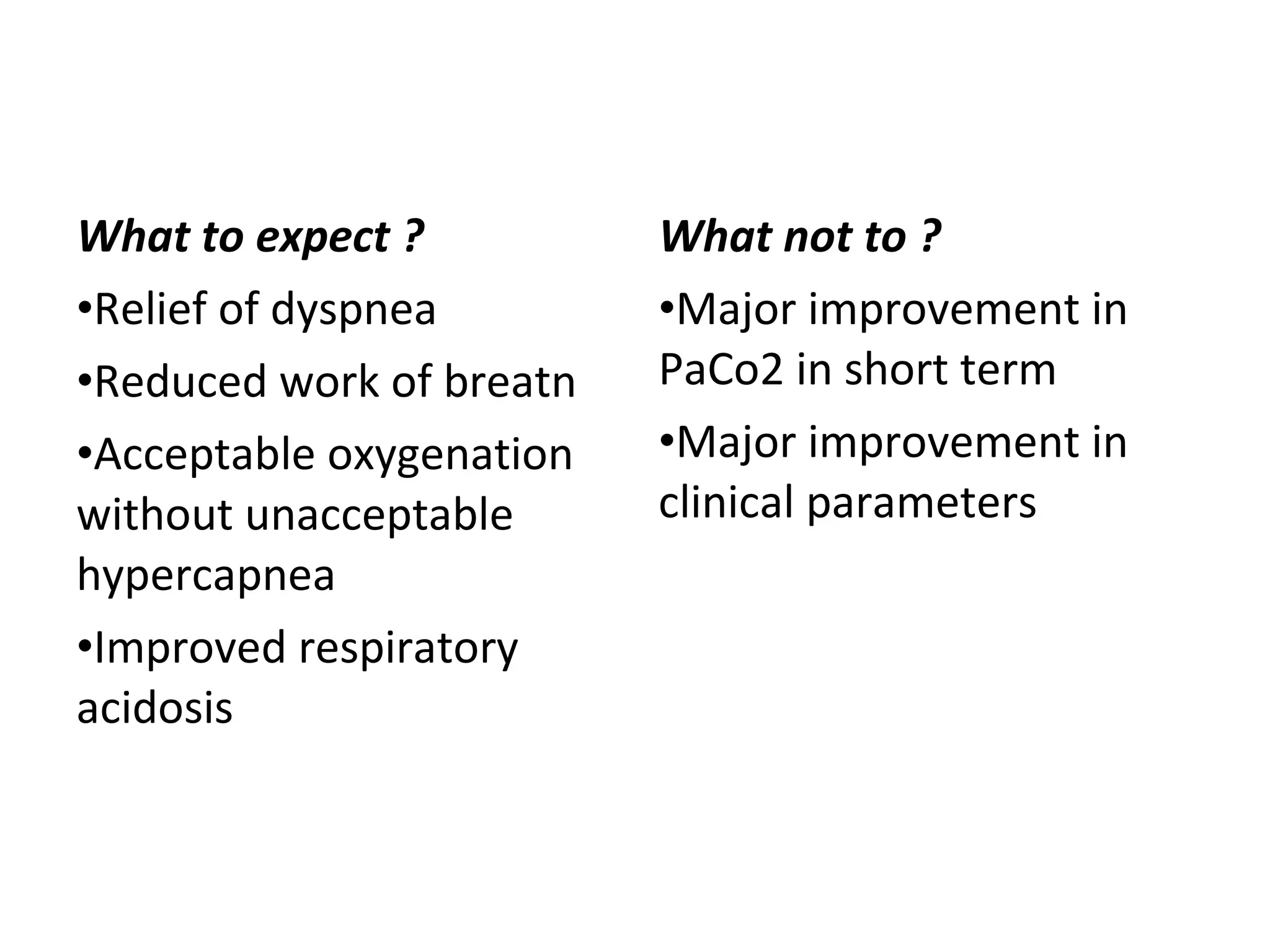
What to expect ?
•Relief of dyspnea
•Reduced work of breatn
•Acceptable oxygenation
without unacceptable
hypercapnea
•Improved respiratory
acidosis
What not to ?
•Major improvement in
PaCo2 in short term
•Major improvement in
clinical parameters
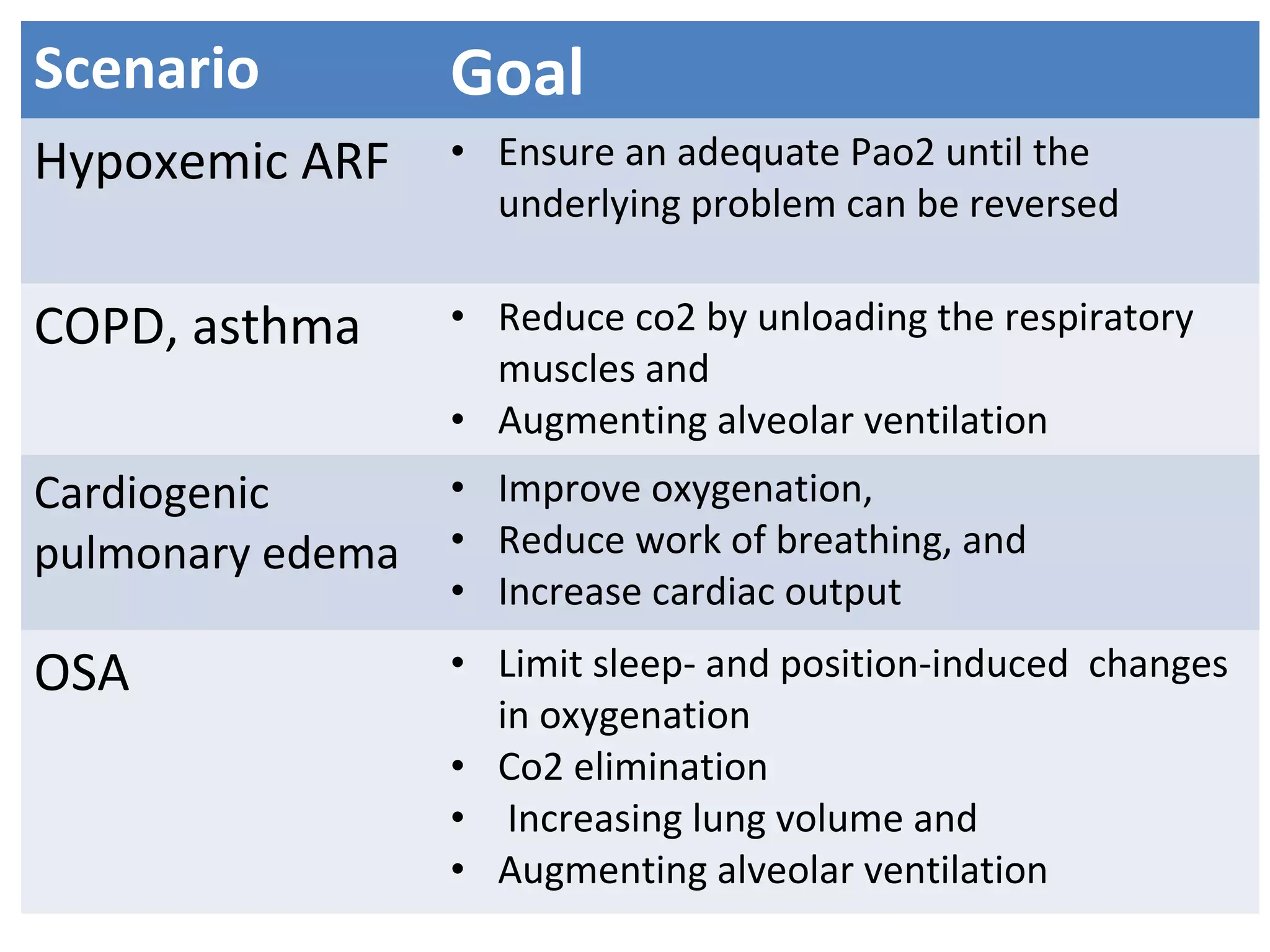
Scenario Goal
Hypoxemic ARF • Ensure an adequate Pao2 until the
underlying problem can be reversed
COPD, asthma • Reduce co2 by unloading the respiratory
muscles and
• Augmenting alveolar ventilation
Cardiogenic
pulmonary edema
• Improve oxygenation,
• Reduce work of breathing, and
• Increase cardiac output
OSA • Limit sleep- and position-induced changes
in oxygenation
• Co2 elimination
• Increasing lung volume and
• Augmenting alveolar ventilation
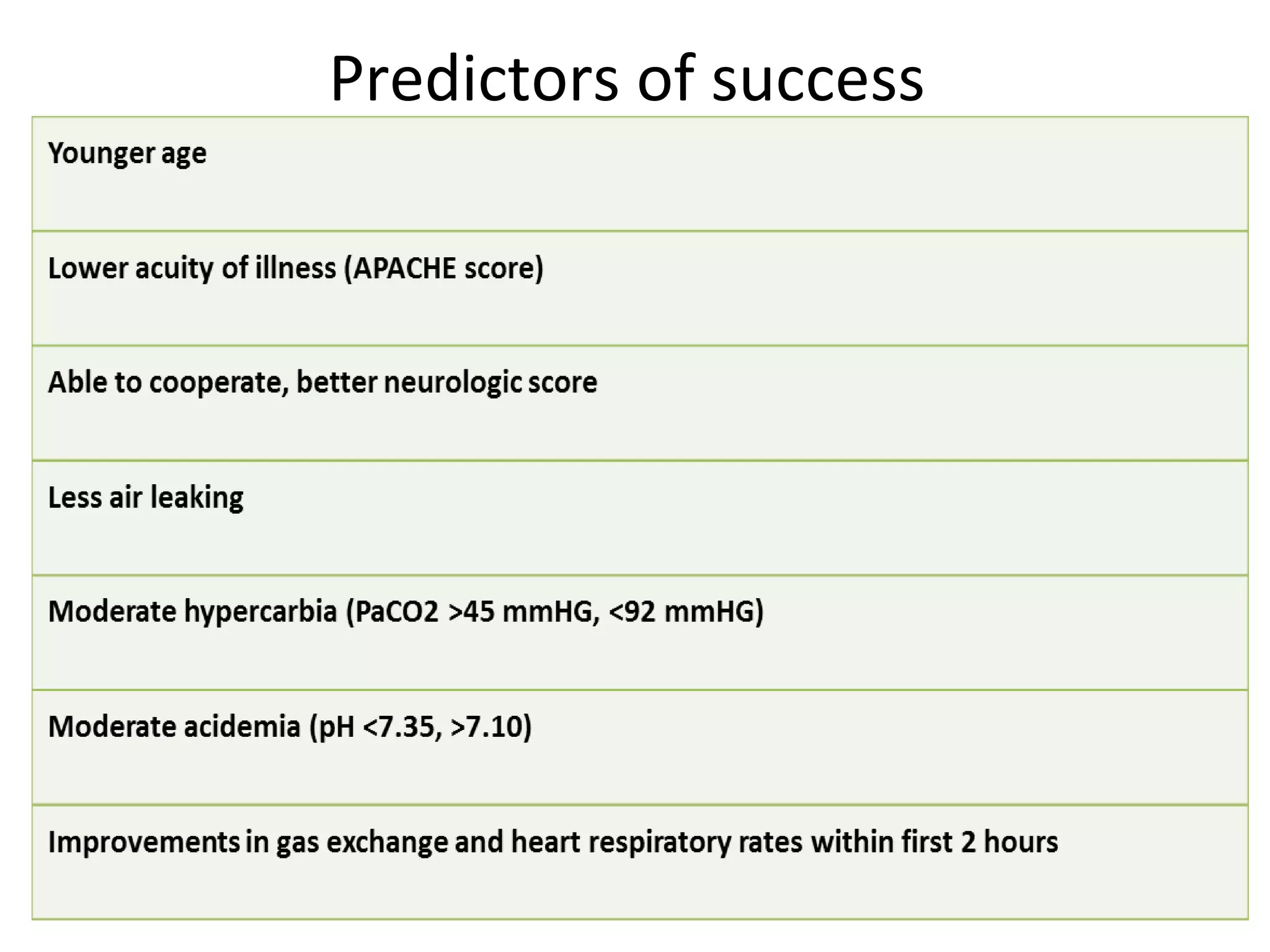
Predictors of success
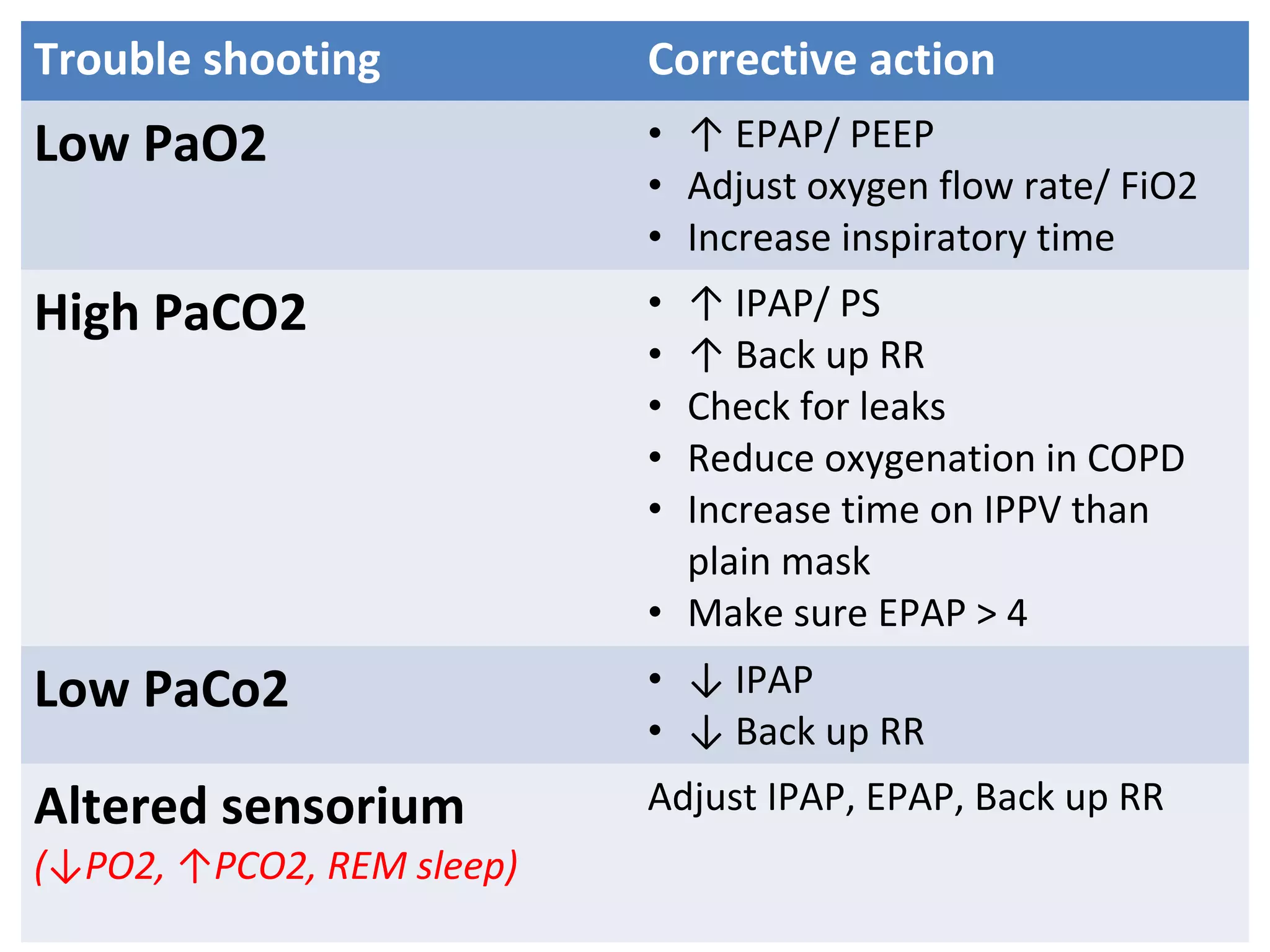
Trouble shooting Corrective action
Low PaO2 • ↑ EPAP/ PEEP
• Adjust oxygen flow rate/ FiO2
• Increase inspiratory time
High PaCO2 • ↑ IPAP/ PS
• ↑ Back up RR
• Check for leaks
• Reduce oxygenation in COPD
• Increase time on IPPV than
plain mask
• Make sure EPAP > 4
Low PaCo2 • ↓ IPAP
• ↓ Back up RR
Altered sensorium
(↓PO2, ↑PCO2, REM sleep)
Adjust IPAP, EPAP, Back up RR
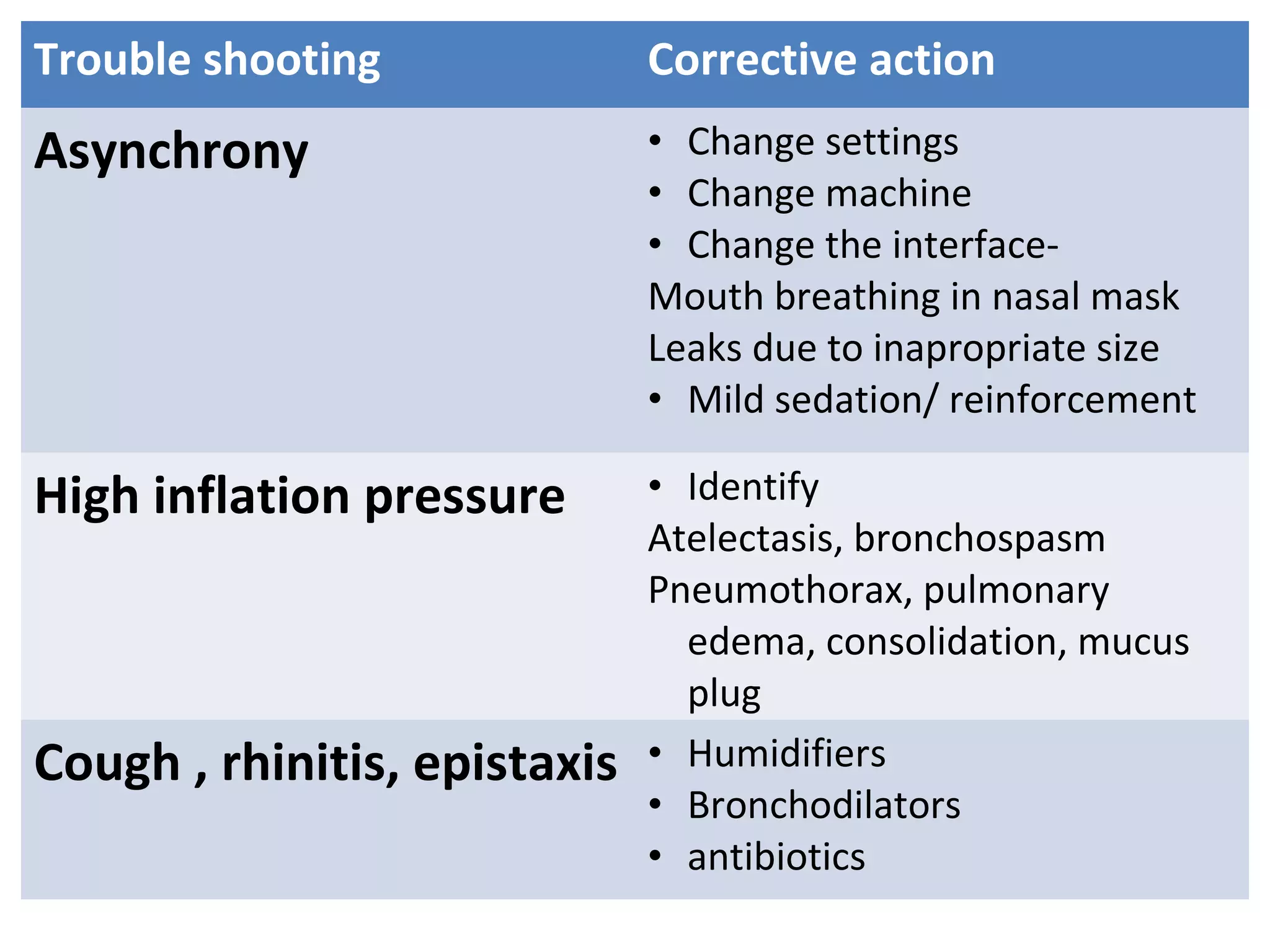
Trouble shooting Corrective action
Asynchrony • Change settings
• Change machine
• Change the interface-
Mouth breathing in nasal mask
Leaks due to inapropriate size
• Mild sedation/ reinforcement
High inflation pressure • Identify
Atelectasis, bronchospasm
Pneumothorax, pulmonary
edema, consolidation, mucus
plug
Cough , rhinitis, epistaxis • Humidifiers
• Bronchodilators
• antibiotics
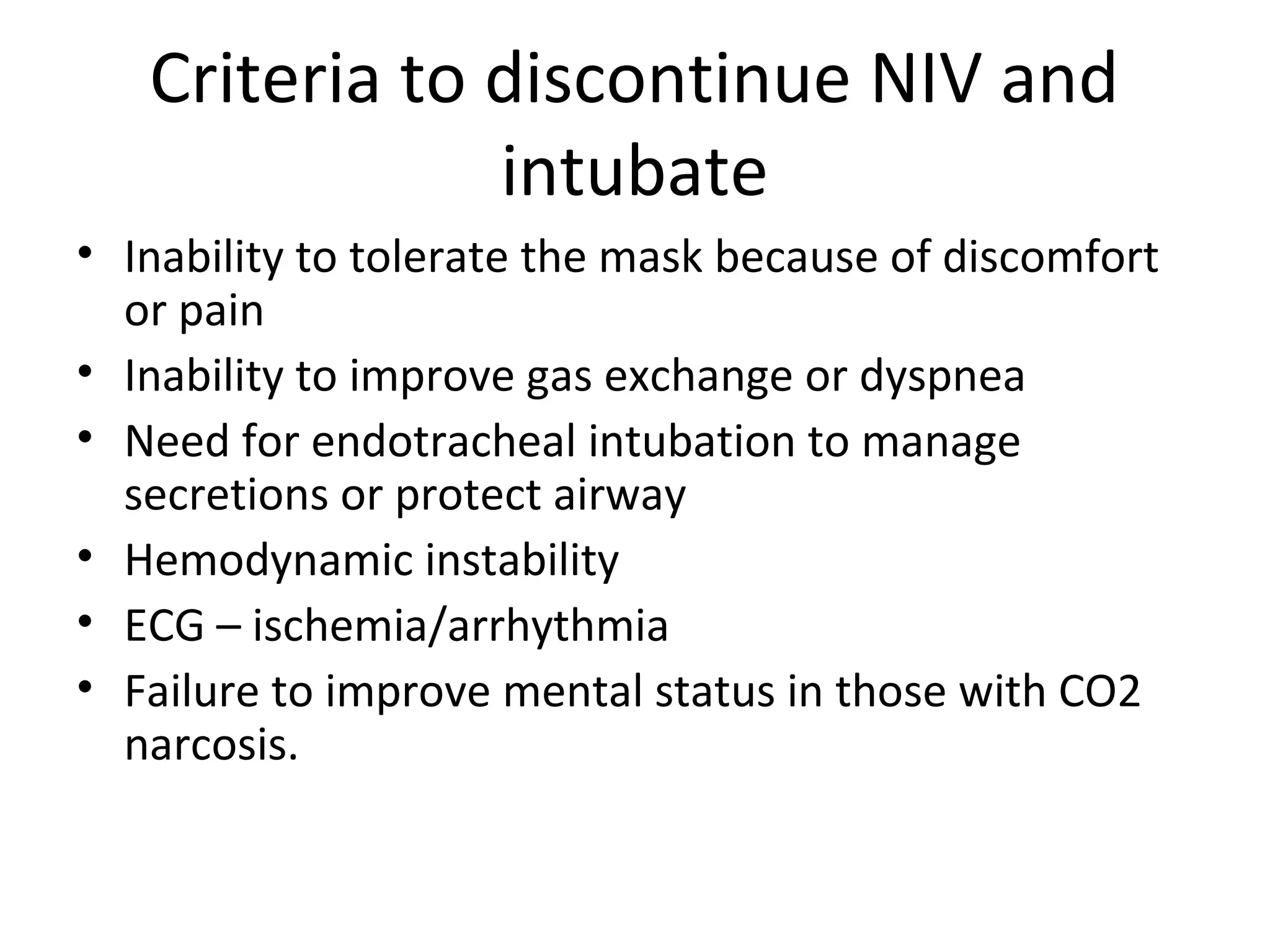
Criteria to discontinue NIV and
intubate
• Inability to tolerate the mask because of discomfort
or pain
• Inability to improve gas exchange or dyspnea
• Need for endotracheal intubation to manage
secretions or protect airway
• Hemodynamic instability
• ECG – ischemia/arrhythmia
• Failure to improve mental status in those with CO2
narcosis.
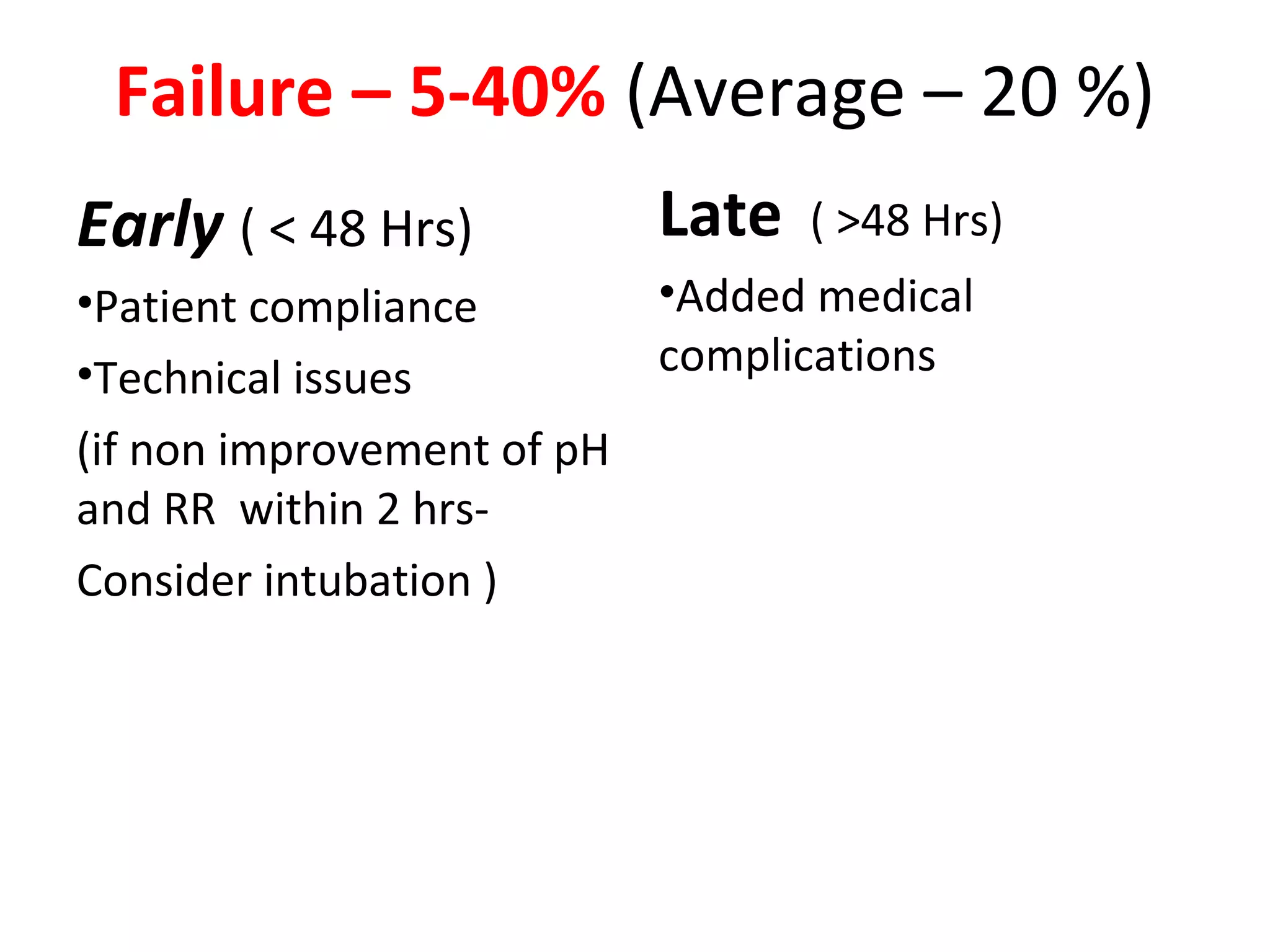
Failure – 5-40% (Average – 20 %)
Early ( < 48 Hrs)
•Patient compliance
•Technical issues
(if non improvement of pH
and RR within 2 hrs-
Consider intubation )
Late ( >48 Hrs)
•Added medical
complications
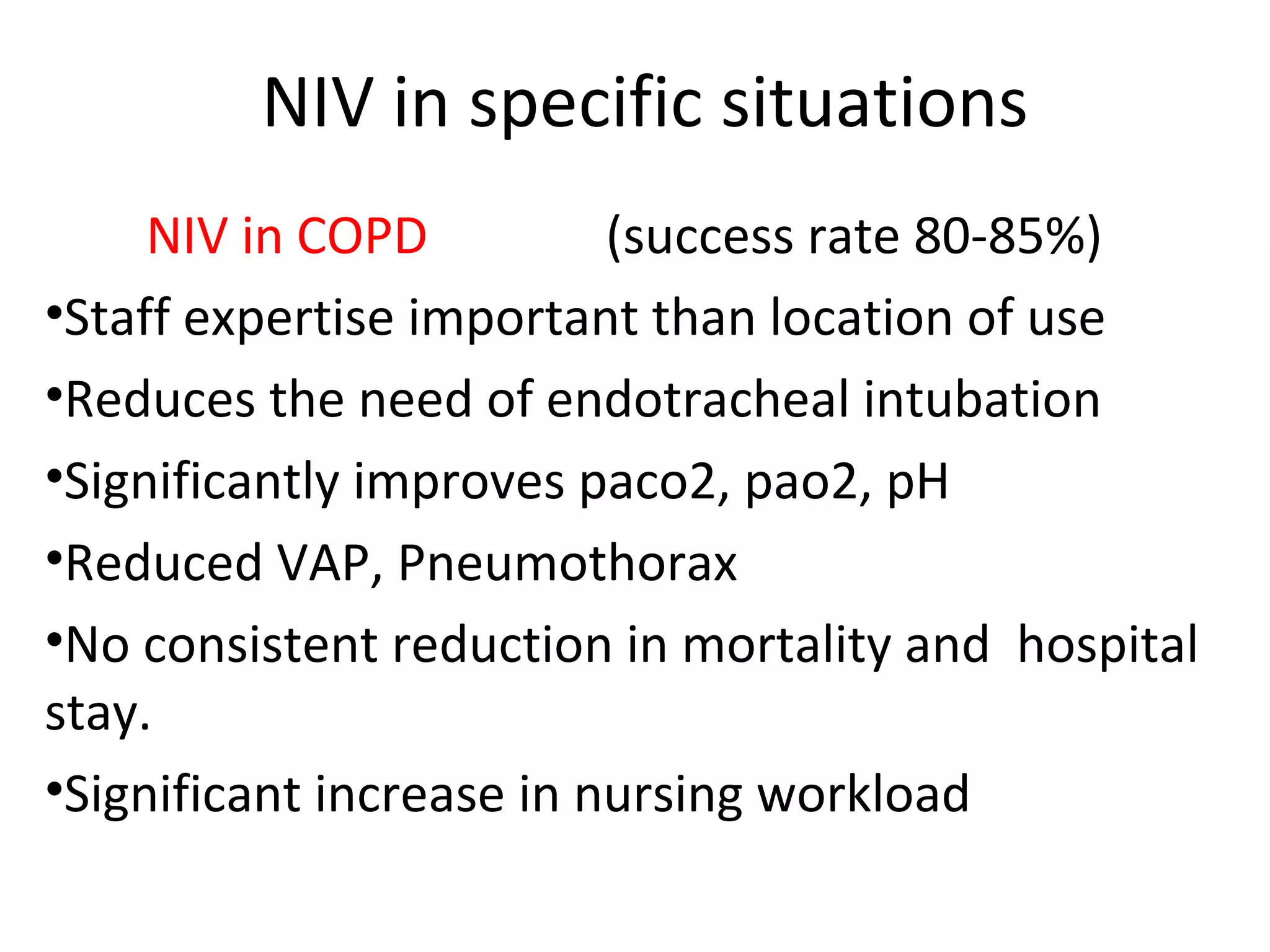
NIV in specific situations
NIV in COPD (success rate 80-85%)
•Staff expertise important than location of use
•Reduces the need of endotracheal intubation
•Significantly improves paco2, pao2, pH
•Reduced VAP, Pneumothorax
•No consistent reduction in mortality and hospital
stay.
•Significant increase in nursing workload
• No difference in outcome of pressure vs
volume preset modes
• But pressure preset mode better tolerated
• BiPAP is first mode of choice
• CPAP to be used if BiPAP not available, as
the degree of unloading of respiratory work
with former is better.
NIV in Cardiogenic pulmonary edema
• CPAP reduces venous return and can lower left
ventricular preload .
• Even with very poor left ventricular function &
active ischemia, the stroke volume and
ejection fraction can improve with CPAP,
leading to a rapid decrease in heart rate
without undue hypotension.
• Sufficently high level evidence to favor the use
of CPAP
• There is insufficient evidence to recommend the
use of BiPAP/ NIPPV probably the exception being
patients with hypercapnic CPE.
• Some have even reported evidence of ongoing
myocardial ischemia with BiPAP
• No effect in short term mortality
• Reduction in rate of intubation, metabolic
disturbances, long term mortality (45%)
• CPAP should be mode of choice
• BiPAP/ Bilevel pressure NIMV -
if hypercapnic CPE or if CPAP results in inadequate
relief of symptoms.
NIV in OSAHS
Home CPAP at night time is the first line therapy
•Reduced apnea, hypoapneas
•Better nocturnal oxygenation
•Better quality of life, mood, cognition and
vigilance
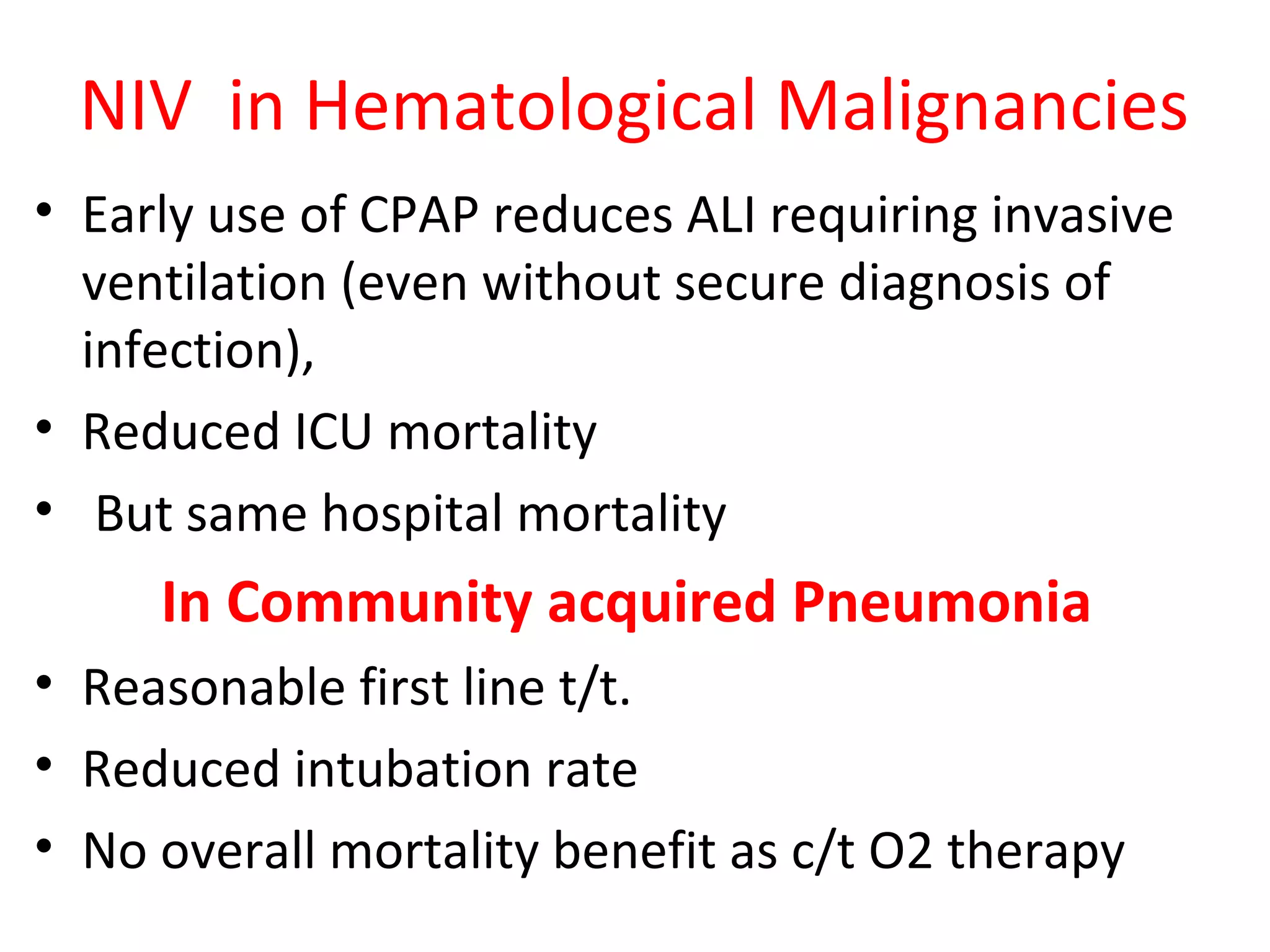
NIV in Hematological Malignancies
• Early use of CPAP reduces ALI requiring invasive
ventilation (even without secure diagnosis of
infection),
• Reduced ICU mortality
• But same hospital mortality
In Community acquired Pneumonia
• Reasonable first line t/t.
• Reduced intubation rate
• No overall mortality benefit as c/t O2 therapy
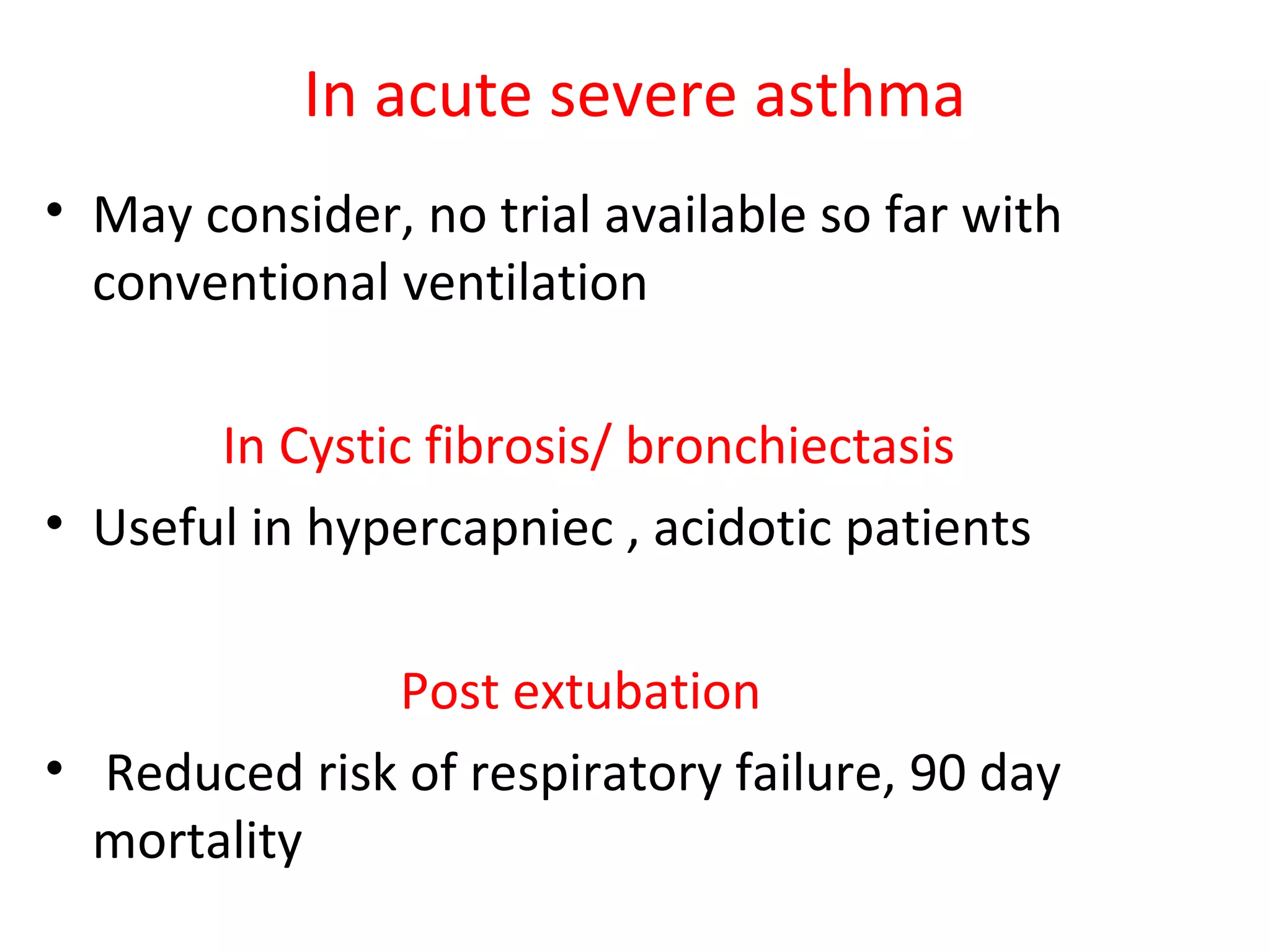
In acute severe asthma
• May consider, no trial available so far with
conventional ventilation
In Cystic fibrosis/ bronchiectasis
• Useful in hypercapniec , acidotic patients
Post extubation
• Reduced risk of respiratory failure, 90 day
mortality
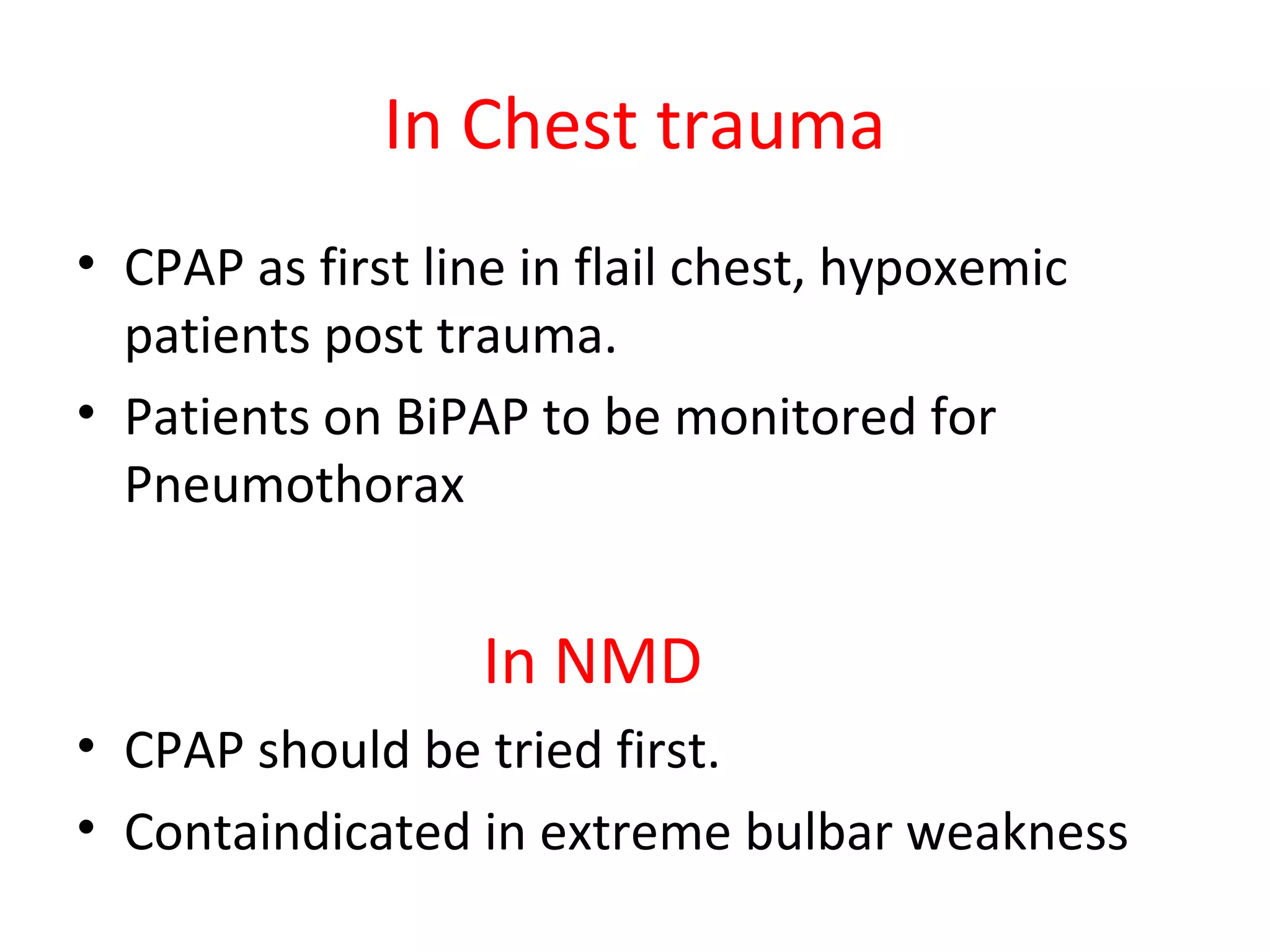
In Chest trauma
• CPAP as first line in flail chest, hypoxemic
patients post trauma.
• Patients on BiPAP to be monitored for
Pneumothorax
In NMD
• CPAP should be tried first.
• Containdicated in extreme bulbar weakness
Non Invasive Ventilator

Non Invasive Ventilator

  • 1.
  • 2.
    Noninvasive ventilation isthe delivery of alveolar ventilation without the need for an invasive artificial airway. Types of NIV •Negative pressure ventilation(Iron tank, Chest cuirass) •Abdominal Displacement (Pneumobelt-Rocking bed) •Positive pressure ventilation (BIPAP, CPAP, NIPPV)
  • 3.
    A) Negative pressureventilation (Iron tank, Chest cuirass)
  • 4.
  • 5.
    C)Non Invasive Positivepressure ventilation
  • 6.
    Advantages of NIV/NIPPV 1) Noninvasiveness Avoids the complications of endotracheal intubation - Early (local trauma, aspiration) - Late (injury to the the hypopharynx, larynx, and trachea, nosocomial infections) 2 ) Ease of application (compared with endotracheal intubation) - Easy to implement - Easy to remove
  • 7.
    3) Allows intermittentapplication 4) Can be used in non ICU settings 5) Improves patient comfort 6) Reduces the need for sedation 7) Oral patency (preserves speech, swallowing, and cough) 8) Avoid the resistive work imposed by the endotracheal tube
  • 8.
    Disadvantages of NIV 1.System –Slower correction of gas exchange abnormalities – Increased initial time commitment, may need intubation – Gastric distension (occurs in <2% patients) – Time consuming, manpower consuming 2.Mask -Air leakage - Transient hypoxemia from accidental removal -Eye irritation - Facial skin necrosis –most common complication. 3.Lack of airway access and protection - Suctioning of secretions
  • 9.
    Location of NIV NIVcan be administered in the -Emergency department -ICU -HDU -General ward -Home Who can administer NIV? - Physicians -Nurses -Respiratory care therapists
  • 10.
    Assembly of NIVsystem A B
  • 11.
    a) Ventilator unit 1)CPAP 3) Bilevel NIV 2) BIPAP 4) Conventional ICU ventilator Modes of NIPPV Pressure preset mode- (most commonly used) The delivered volume is variable depending on lung compliance . - Compensates better in case of air leak - Limitation of peak airway pressure possible (ie reduction in TV / Insp. flow rate) , hence better in pts. with previous emphysematous bullae/ pneumothoraces. - Comfortable and better tolerated Volume preset mode- The set volume is delivered with variable peak airway pressures
  • 12.
    Pressure preset mode •CPAP(Continous Positive Airway Pressure) Only one level of positive pressure set above atmospheric pressure during entire spontaenous breath, does not include any mech. breath If IPPV settings are set as IPAP= EPAP, then it acts like CPAP • IPPV(Intermittent Positive Pressure Ventilation) Two level of pressure is set – a)IPAP (Inspiratory positive airway pressure) b)EPAP (Expiratory positive airway pressure)
  • 13.
    IPAP (Inspiratory positiveairway pressure) •Controls peak insp. pressure •Directly proportional to degree of ventilation (tidal volume, minute ventilation) IPAP = PS + PEEP/ EPAP EPAP (Expiratory positive airway pressure) •Same as PEEP in Mech. Ventilation •Improves oxygenation by ↑ FRC EPAP = PEEP
  • 14.
    Combination of aboveis also referred as BiPAP (Bilevel Positive Airway Pressure) sometimes but actually it is the trademark of the company RESPIRONICS which designed and marketed such BiPAP machines which were cheaper and portable than the routine ventilators. The IPPV by BiPAP machine and ventilators with NIV modes differ in following ways
  • 15.
    A) Delivered Fio2– • BiPAP machine lack oxygen blender and Fio2 has to be adjusted by adjusting O2 flow rate. • Fi02 diretly proportional to O2 flow inversely to the set IPAP (more the IPAP , more the driving pressure, more the admixture of air with O2) • This is not the case with ventilator with NIV mode.
  • 16.
    b) Pressures- •The maximumpressure achievable on BiPAP machine is less than conventional ventilator. •EPAP in BiPAP is achieved by adjusting flow of air •PEEP in ventilators is achieved by a device in expiratory circuit. •The expiratory port in BiPAP is smaller than Ventilator circuit, which can lead to transient rise of peak airway pressure above set IPAP as patient changes to expiration
  • 17.
    c) Safety alarms- Lesserwith BiPAP machine. d) Leak compensation – •BiPAP •Ventilators with NIV mode can compensate for the leak due to face mask by increasing the flow to achieve the set IPAP. Not possible with the conventional ventilators without NIV where either face mask has to be tight to prevent leak or have to tolerate frequent alarms.
  • 18.
  • 19.
  • 20.
  • 21.
  • 22.
  • 24.
    Scenarios in whichNIV can be used CAT I- life support without preset limits CAT II – life support with preset limits (DNI ) CAT III – comfort care
  • 25.
    Indications I) Acute respiratoryfailure a) Hypercapnic acute respiratory failure •Acute exacerbation of COPD •Post extubation NIV •Post surgical respiratory failure •Thoracic wall deformities /Neuromuscular diseases •Status asthmaticus •Acute respiratory failure in OSAHS
  • 26.
    b) Hypoxemic acuterespiratory failure •Cardiogenic pulmonary edema •Community acquired pneumonia •Post traumatic respiratory failure •ARDS II) Chronic Respiratory Failure III) Immunocompromised Patients IV) Weaning difficulties IV) Do Not Intubate Patients
  • 27.
    Scenarios where strongevidence exists on use of NIV •COPD 1)To avoid intubation 2)To extubate to NIV (i.e facilitate extubation) •OSAHS (esp CPAP) •Acute cardiogenic pulmonary edema •Immunocompromised/ Hematologic patients
  • 28.
  • 29.
    Contraindications Absolute •Comatose •Cardiorespiratory arrest •Upper airwayobstn •Airway secretions •Ileus, UGIB, vomitting •MODS •Facial surgery, trauma Relative •Confused, disoriented •Hemodynamic instability •ACS •Recent gastric surgery
  • 30.
    1. Do abaseline arterial blood gas 2. Discuss and explain the patient, discuss with the family too. 3. Patient in bed or chair at >30 angle 4. Select interface of proper size for patient + Select ventilator ( BiPAP or NIV through ventilator) 5. Apply headgear. Hold or allow the patient to hold the mask gently to the face until the patient is comfortable with it. Encourage the patient to use proper breathing technique. Avoid excessive strap tension (one or two fingers under strap) 6. Connect interface to ventilator tubing and turn on ventilator 7. Start with low pressure in spontaneously triggered mode with backup rate; pressure limited: 8 to 12 cm H2O inspiratory pressure; 3 to 5 cm H2O expiratory pressure Steps in initiation of NIV
  • 31.
    8. Gradually increaseinspiratory pressure (10 to 20 cm H2O) as tolerated to achieve alleviation of dyspnea, decreased respiratory rate, increased tidal volume (if being monitored), and good patient-ventilator synchrony 9. Provide O2 supplementation as need to keep O2 sat >90 percent 10. Check for air leaks, readjust straps as needed. Add humidifier as indicated 11.Consider mild sedation (eg, intravenously administered lorazepam 0.5 mg) in agitated patients 12. Encouragement, reassurance, and frequent checks and adjustments as needed 13. Monitor occasional blood gases (within 1 to 2 hours) and then as needed 14. Monitor the respiratory rate, heart rate,level of dyspnea, O2 saturation , minute ventilation,and exhaled tidal volume.
  • 32.
    Initial settings IPAP -15,EPAP – 5 (on BiPAP) PS -10, PEEP- 5 (on NIV ventilator) Back up rate - 8-12 breaths/min For optimal ventilation- ↑ IPAP/ PS in increments of 2 To adjust for inadequate oxygenation- ↑ EPAP/ PEEP in increments of 2 Adjust oxygen flow rate/ FiO2
  • 33.
    What to expect? •Relief of dyspnea •Reduced work of breatn •Acceptable oxygenation without unacceptable hypercapnea •Improved respiratory acidosis What not to ? •Major improvement in PaCo2 in short term •Major improvement in clinical parameters
  • 34.
    Scenario Goal Hypoxemic ARF• Ensure an adequate Pao2 until the underlying problem can be reversed COPD, asthma • Reduce co2 by unloading the respiratory muscles and • Augmenting alveolar ventilation Cardiogenic pulmonary edema • Improve oxygenation, • Reduce work of breathing, and • Increase cardiac output OSA • Limit sleep- and position-induced changes in oxygenation • Co2 elimination • Increasing lung volume and • Augmenting alveolar ventilation
  • 35.
  • 36.
    Trouble shooting Correctiveaction Low PaO2 • ↑ EPAP/ PEEP • Adjust oxygen flow rate/ FiO2 • Increase inspiratory time High PaCO2 • ↑ IPAP/ PS • ↑ Back up RR • Check for leaks • Reduce oxygenation in COPD • Increase time on IPPV than plain mask • Make sure EPAP > 4 Low PaCo2 • ↓ IPAP • ↓ Back up RR Altered sensorium (↓PO2, ↑PCO2, REM sleep) Adjust IPAP, EPAP, Back up RR
  • 37.
    Trouble shooting Correctiveaction Asynchrony • Change settings • Change machine • Change the interface- Mouth breathing in nasal mask Leaks due to inapropriate size • Mild sedation/ reinforcement High inflation pressure • Identify Atelectasis, bronchospasm Pneumothorax, pulmonary edema, consolidation, mucus plug Cough , rhinitis, epistaxis • Humidifiers • Bronchodilators • antibiotics
  • 38.
    Criteria to discontinueNIV and intubate • Inability to tolerate the mask because of discomfort or pain • Inability to improve gas exchange or dyspnea • Need for endotracheal intubation to manage secretions or protect airway • Hemodynamic instability • ECG – ischemia/arrhythmia • Failure to improve mental status in those with CO2 narcosis.
  • 39.
    Failure – 5-40%(Average – 20 %) Early ( < 48 Hrs) •Patient compliance •Technical issues (if non improvement of pH and RR within 2 hrs- Consider intubation ) Late ( >48 Hrs) •Added medical complications
  • 40.
    NIV in specificsituations NIV in COPD (success rate 80-85%) •Staff expertise important than location of use •Reduces the need of endotracheal intubation •Significantly improves paco2, pao2, pH •Reduced VAP, Pneumothorax •No consistent reduction in mortality and hospital stay. •Significant increase in nursing workload
  • 41.
    • No differencein outcome of pressure vs volume preset modes • But pressure preset mode better tolerated • BiPAP is first mode of choice • CPAP to be used if BiPAP not available, as the degree of unloading of respiratory work with former is better.
  • 42.
    NIV in Cardiogenicpulmonary edema • CPAP reduces venous return and can lower left ventricular preload . • Even with very poor left ventricular function & active ischemia, the stroke volume and ejection fraction can improve with CPAP, leading to a rapid decrease in heart rate without undue hypotension. • Sufficently high level evidence to favor the use of CPAP
  • 43.
    • There isinsufficient evidence to recommend the use of BiPAP/ NIPPV probably the exception being patients with hypercapnic CPE. • Some have even reported evidence of ongoing myocardial ischemia with BiPAP • No effect in short term mortality • Reduction in rate of intubation, metabolic disturbances, long term mortality (45%) • CPAP should be mode of choice • BiPAP/ Bilevel pressure NIMV - if hypercapnic CPE or if CPAP results in inadequate relief of symptoms.
  • 44.
    NIV in OSAHS HomeCPAP at night time is the first line therapy •Reduced apnea, hypoapneas •Better nocturnal oxygenation •Better quality of life, mood, cognition and vigilance
  • 45.
    NIV in HematologicalMalignancies • Early use of CPAP reduces ALI requiring invasive ventilation (even without secure diagnosis of infection), • Reduced ICU mortality • But same hospital mortality In Community acquired Pneumonia • Reasonable first line t/t. • Reduced intubation rate • No overall mortality benefit as c/t O2 therapy
  • 46.
    In acute severeasthma • May consider, no trial available so far with conventional ventilation In Cystic fibrosis/ bronchiectasis • Useful in hypercapniec , acidotic patients Post extubation • Reduced risk of respiratory failure, 90 day mortality
  • 47.
    In Chest trauma •CPAP as first line in flail chest, hypoxemic patients post trauma. • Patients on BiPAP to be monitored for Pneumothorax In NMD • CPAP should be tried first. • Containdicated in extreme bulbar weakness

Editor's Notes

  • #3 The use of NIV in acute hospital settings and at home has been steadily increasing