The document discusses various number systems, including decimal, binary, hexadecimal, and octal, detailing their bases and digit compositions. It explains how to convert binary numbers to decimal using positional values and demonstrates binary arithmetic operations such as addition, subtraction, multiplication, and division with examples for each. Additionally, it provides step-by-step examples for computing binary arithmetic, illustrating the processes involved.
Introduction to common types of number systems: Decimal (Base-10), Binary (Base-2), Hexadecimal (Base-16), and Octal (Base-8). Examples provided for each.
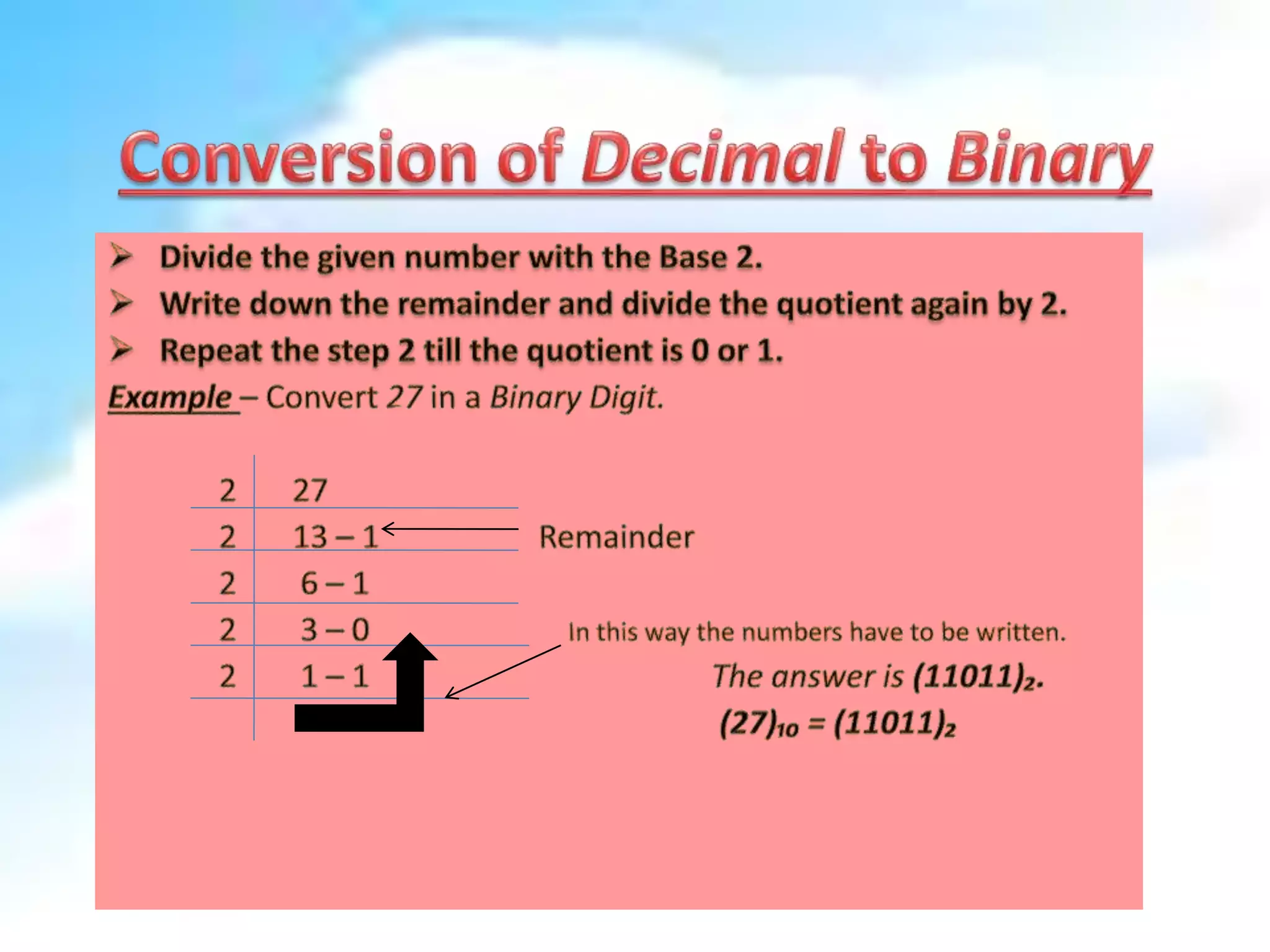
Method to convert binary numbers to decimal using positional values and powers of 2. Example conversion of (1001)₂ to decimal.
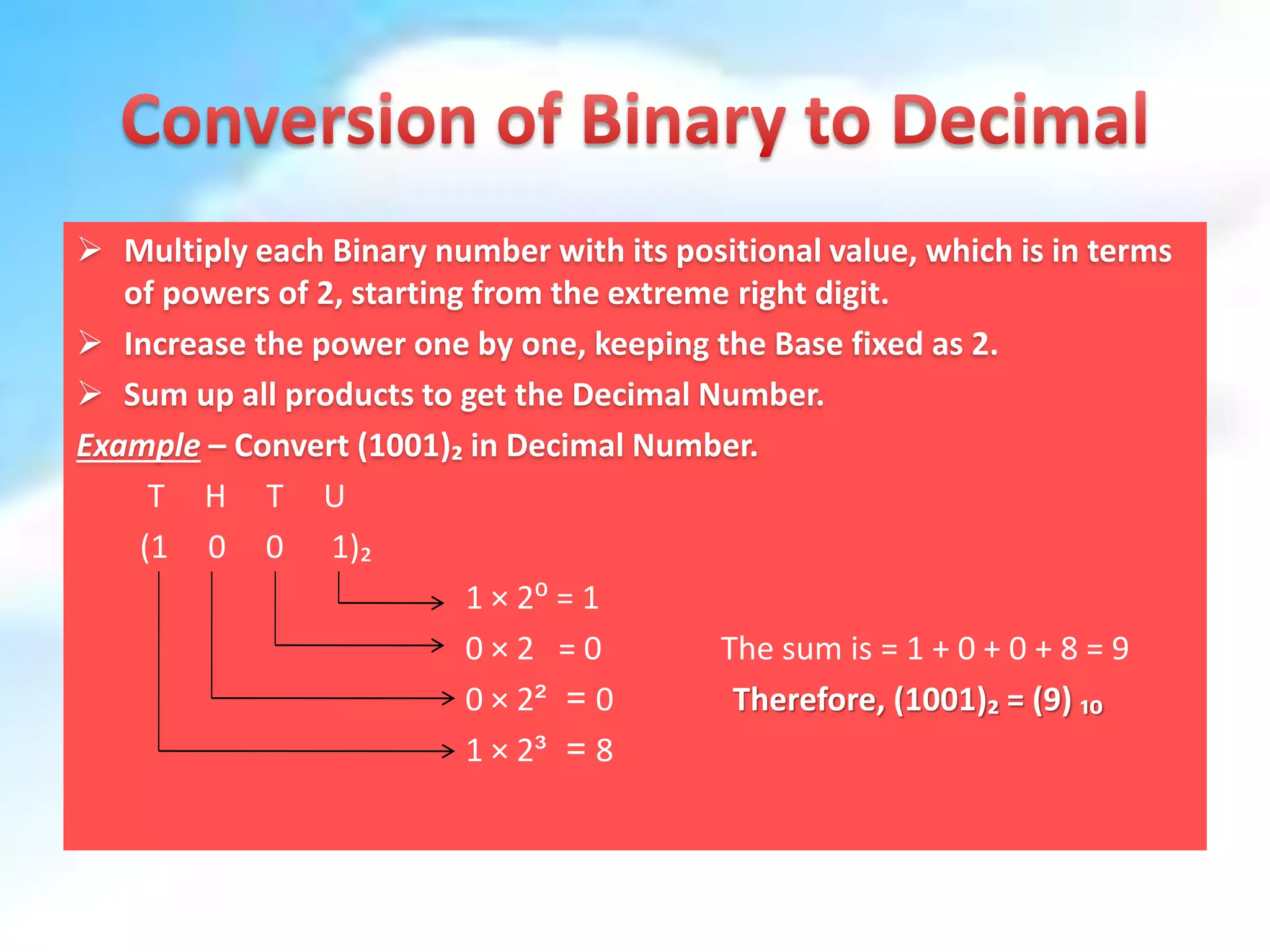
Binary addition rules and example of binary addition with carry. Example: (11111)₂ + (1011)₂ resulting in (101010)₂.
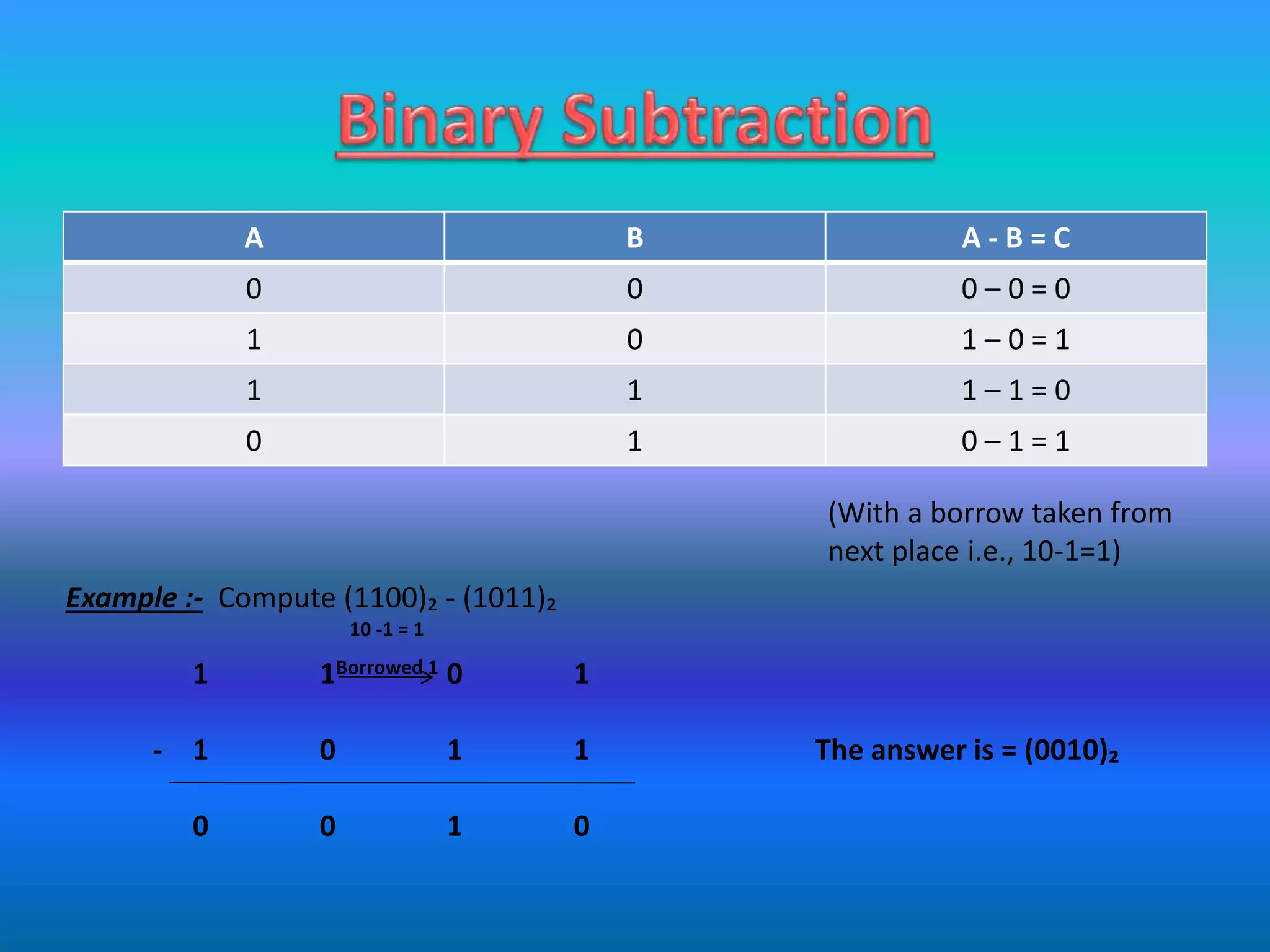
Binary subtraction rules with borrowing and example. Example: (1100)₂ - (1011)₂ resulting in (0010)₂.
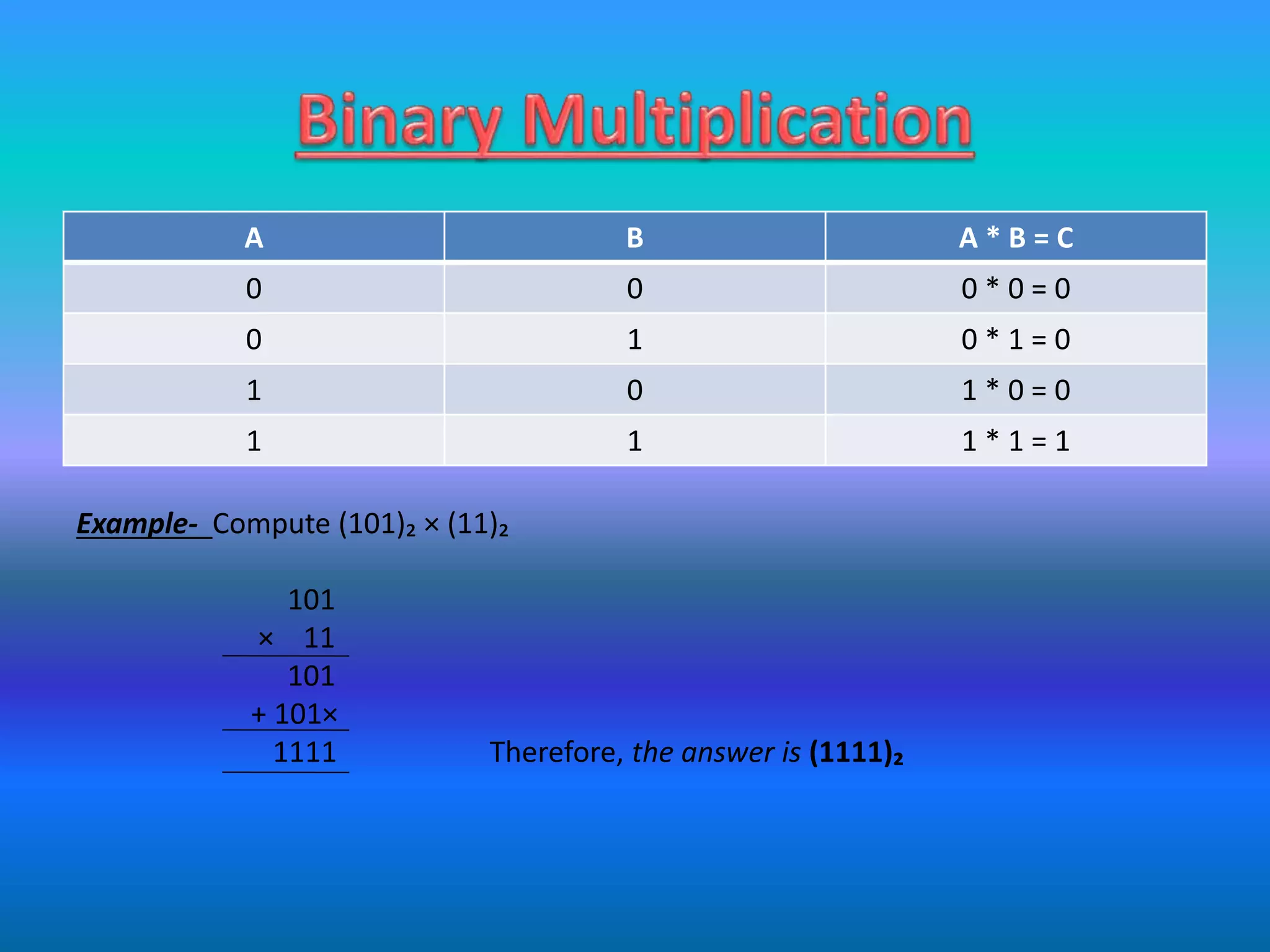
Binary multiplication rules and example. Example: Computation of (101)₂ × (11)₂ resulting in (1111)₂.
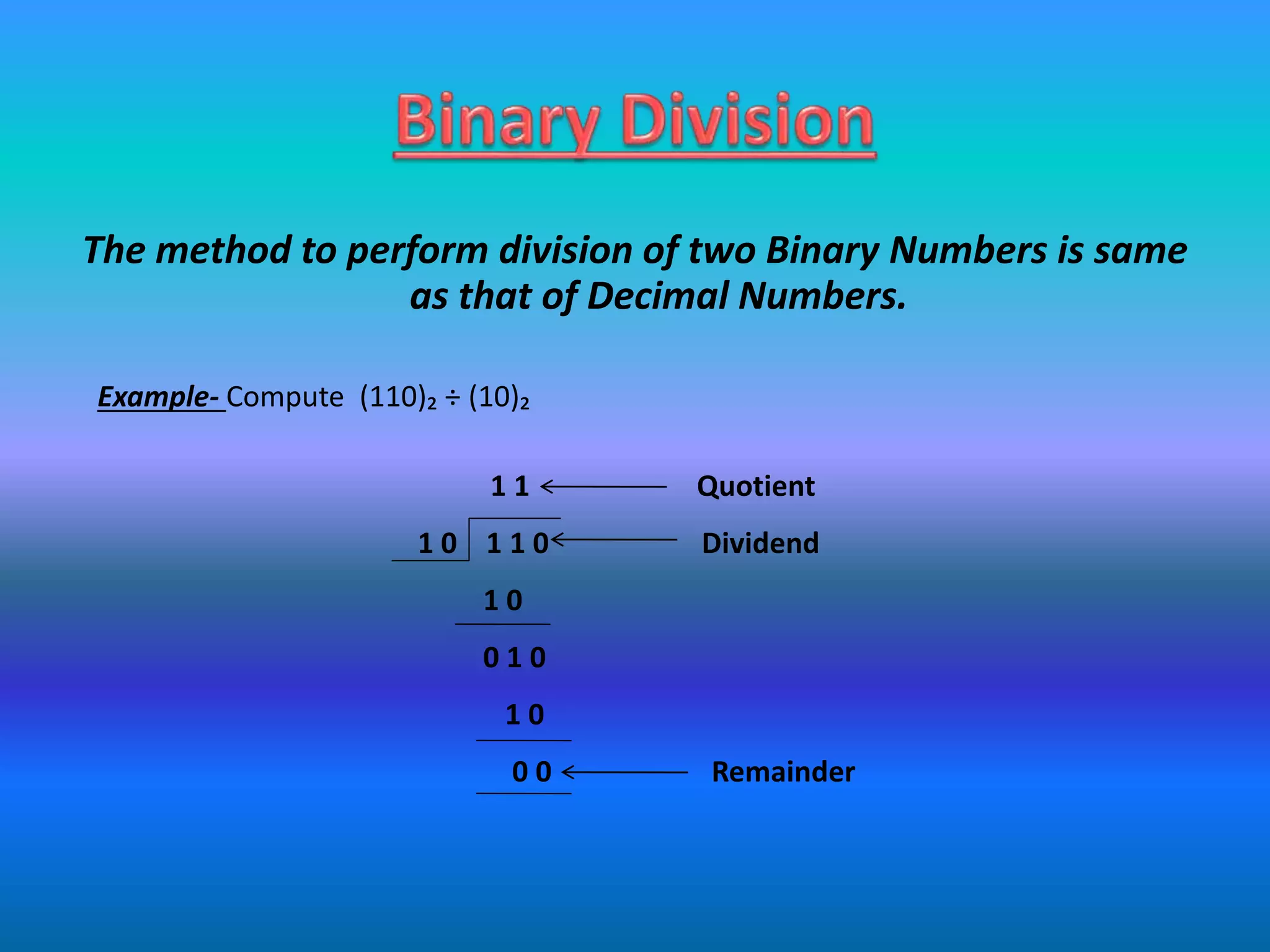
Method to divide binary numbers similar to decimal division. Example: (110)₂ ÷ (10)₂ with quotient and remainder.
Types Of NumberSystems
• Commonly used number system.
• Consists of 10 digits (0-9). Base-10
• Example:-107, 78, 98, 2786
Decimal
Number System
• Used in digital computers.
• Consists of 2 digits (0 and 1). Base-2
• Example:-100101,001010
Binary Number
System
• Consists of 16 digits [ (0-9) and (A-F) ]
• Base – 16
• Example:- D1CE, 2E6
Hexadecimal
Number System
• Consists of 8 digits ( 0-7 )
• Base – 8
• Example:-6675,453,655
Octal Number
System
4.
Multiply eachBinary number with its positional value, which is in terms
of powers of 2, starting from the extreme right digit.
Increase the power one by one, keeping the Base fixed as 2.
Sum up all products to get the Decimal Number.
Example – Convert (1001)₂ in Decimal Number.
T H T U
(1 0 0 1)₂
1 × 2⁰ = 1
0 × 2 = 0 The sum is = 1 + 0 + 0 + 8 = 9
0 × 2² = 0 Therefore, (1001)₂ = (9) ₁₀
1 × 2³ = 8
A B A- B = C
0 0 0 – 0 = 0
1 0 1 – 0 = 1
1 1 1 – 1 = 0
0 1 0 – 1 = 1
(With a borrow taken from
next place i.e., 10-1=1)
Example :- Compute (1100)₂ - (1011)₂
10 -1 = 1
1 1Borrowed 1 0 1
- 1 0 1 1 The answer is = (0010)₂
0 0 1 0
7.
A B A* B = C
0 0 0 * 0 = 0
0 1 0 * 1 = 0
1 0 1 * 0 = 0
1 1 1 * 1 = 1
Example- Compute (101)₂ × (11)₂
101
× 11
101
+ 101×
1111 Therefore, the answer is (1111)₂
8.
The method toperform division of two Binary Numbers is same
as that of Decimal Numbers.
Example- Compute (110)₂ ÷ (10)₂
1 1 Quotient
1 0 1 1 0 Dividend
1 0
0 1 0
1 0
0 0 Remainder
![Types Of Number Systems
• Commonly used number system.
• Consists of 10 digits (0-9). Base-10
• Example:-107, 78, 98, 2786
Decimal
Number System
• Used in digital computers.
• Consists of 2 digits (0 and 1). Base-2
• Example:-100101,001010
Binary Number
System
• Consists of 16 digits [ (0-9) and (A-F) ]
• Base – 16
• Example:- D1CE, 2E6
Hexadecimal
Number System
• Consists of 8 digits ( 0-7 )
• Base – 8
• Example:-6675,453,655
Octal Number
System](https://image.slidesharecdn.com/numbersystem-150925014449-lva1-app6891/75/ALL-ABOUT-NUMBER-SYSTEMS-2-2048.jpg)



![[DSC Europe 25] Dusan Jovicic - AI Story: From on-prem to cloud and back agai...](https://cdn.slidesharecdn.com/ss_thumbnails/8kp49m6uq22ifnbwhfnk-2-251205085715-964d11a6-thumbnail.jpg?width=640&height=640&fit=bounds)


![[DSC Europe 25] Max Talanov - Non digital NNs.pptx](https://cdn.slidesharecdn.com/ss_thumbnails/wif8tr3gtua74qvtopke-non-digital-nns-251205090438-26b0eea6-thumbnail.jpg?width=640&height=640&fit=bounds)


![[DSC Europe 25] Vid Stimac - Policy Parsimony: Between Oversimplifying and Ov...](https://cdn.slidesharecdn.com/ss_thumbnails/eqlepagzqp2rhg3gbluh-dsc-stimac-251120-251205090438-059e7f54-thumbnail.jpg?width=640&height=640&fit=bounds)


![[DSC Europe 25] Goran Obradovic - The Rise of Sovereign AI: Building the Regi...](https://cdn.slidesharecdn.com/ss_thumbnails/7nw2xxixrxqdxvrb5wca-6-251205085714-ab09a2ac-thumbnail.jpg?width=640&height=640&fit=bounds)
