Web 2.0 in Health: a Practical Overview

Loading...

Flash Player 9 (or above) is needed to view presentations.
We have detected that you do not have it on your computer. To install it, go here.

1 comments

Comments 1 - 1 of 1 previous next Post a comment

  • + guestbcd73c guestbcd73c 2 years ago
    a very useful information everyone should know and start implimenting to lead a smooth healthy life
Post a comment
Embed Video
Edit your comment Cancel

15 Favorites & 1 Group

Web 2.0 in Health: a Practical Overview - Presentation Transcript

  1. Web 2.0 in health: a practical overview Presented for BC Ministry of Health and Ministry of Children and Family Development Eugene Barsky Librarian, I.K. Barber Learning Centre, UBC October 31, 2007 eugene.barsky@ubc.ca http://weblogs.elearning.ubc.ca/physio/
  2. Goals of this session Introduce social software to health sciences researchers, analysts and clinicians Provide and share personal experiences 2
  3. Social software - definition “social-software refers to web-based software tools that support or foster group interaction” Social software is mostly about interaction Web 2.0 creates conversations 3
  4. Social tools to be covered today: Blogs RSS feeds Podcasting Wikis Instant messaging Social networking Anything else? 4
  5. What is blog? A frequent, chronological, and personalized publication of web content Pros of blogs: No need to know html coding No need to find server space Usually free Allow interactivity and sharing Cons of blogs: Too many – hard to select It takes time to read 5
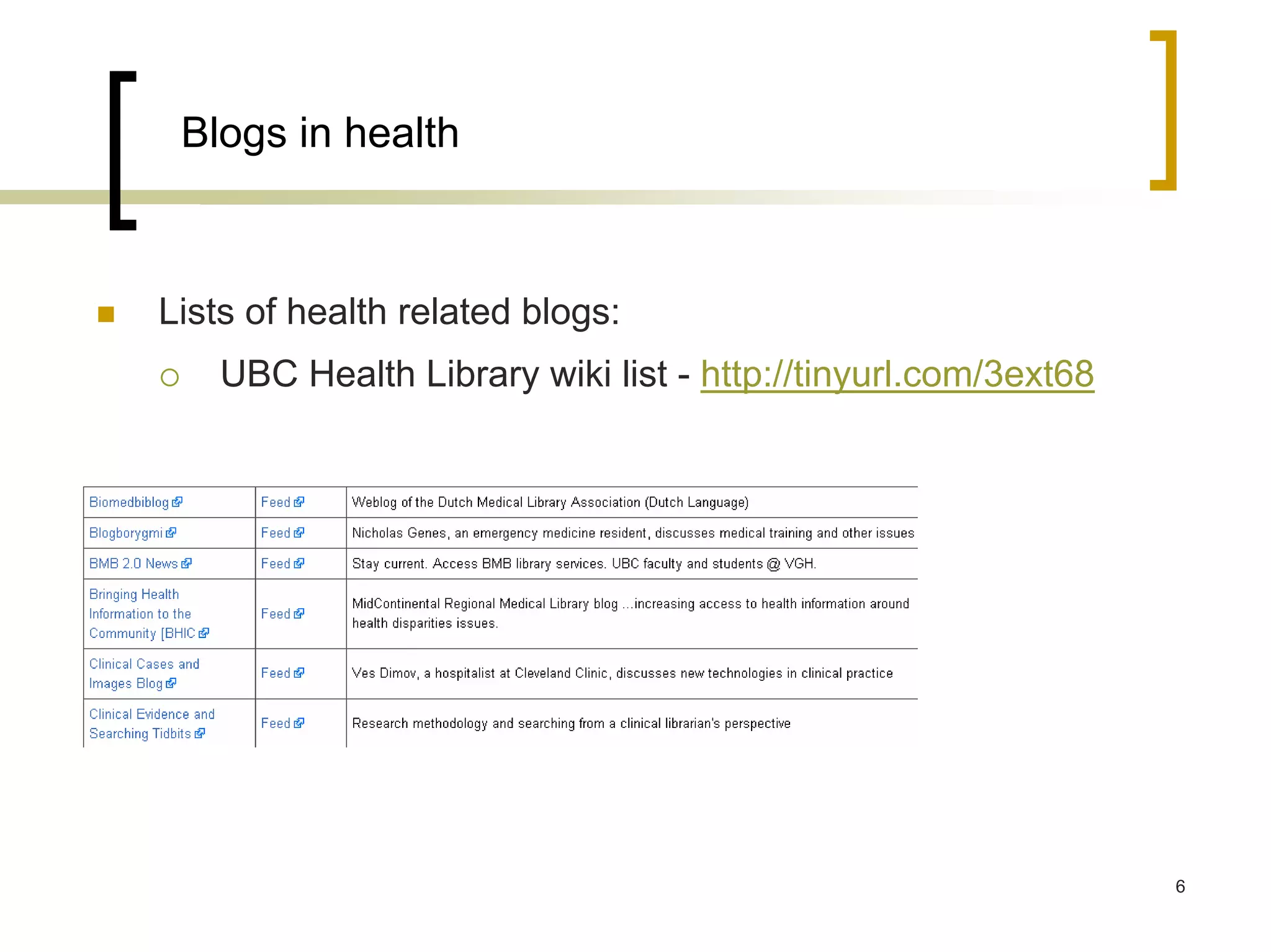
  6. Blogs in health Lists of health related blogs: UBC Health Library wiki list - http://tinyurl.com/3ext68 6
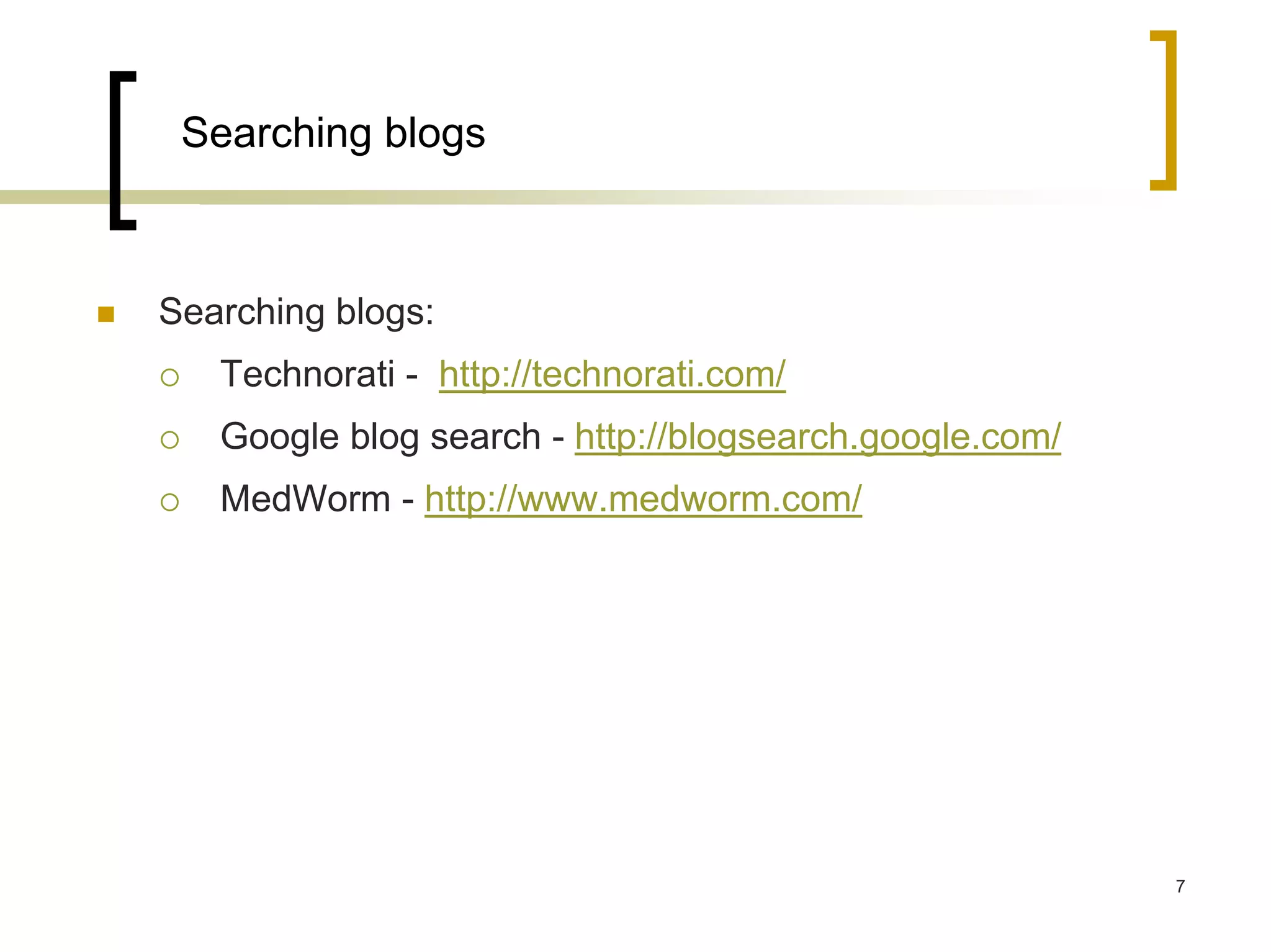
  7. Searching blogs Searching blogs: Technorati - http://technorati.com/ Google blog search - http://blogsearch.google.com/ MedWorm - http://www.medworm.com/ 7
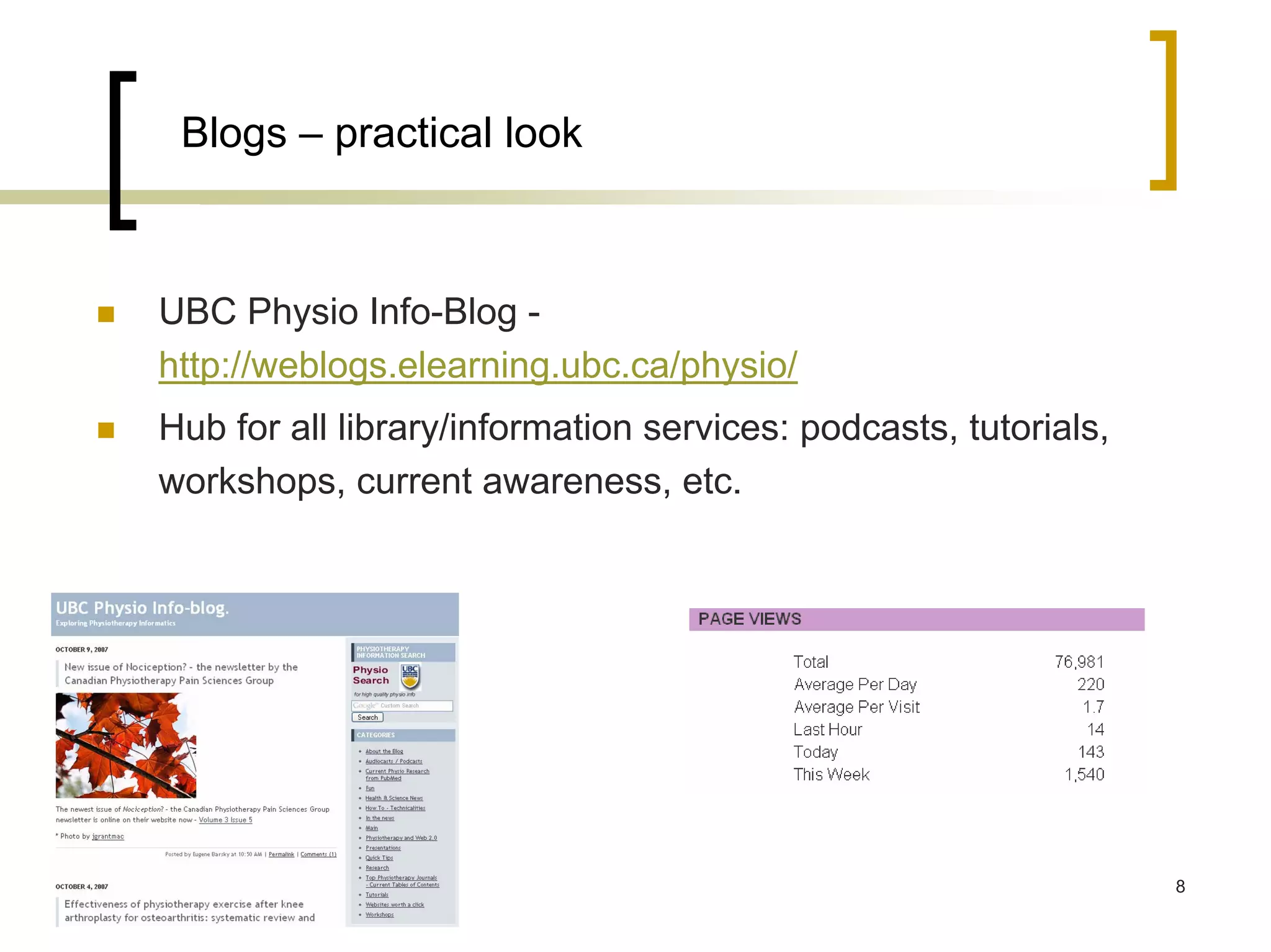
  8. Blogs – practical look UBC Physio Info-Blog - http://weblogs.elearning.ubc.ca/physio/ Hub for all library/information services: podcasts, tutorials, workshops, current awareness, etc. 8
  9. What is RSS? Pushed vs. pulled content from blogs and websites Instead of you going to check for new info – the info comes to you Video - http://www.blip.tv/file/205570/ 9
  10. Why using RSS? Blogs - RSS feeds let readers know when a blog has been updated. Newspapers and journals - new articles and research are published, and users are alerted via the feed. Press releases and announcements - RSS is a useful tool for formal announcements, such as those from your organization (http://www.news.gov.bc.ca/rss/). Current awareness -- News and articles updates - Google News and PubMed provide search results and updates in RSS formats, for example. 10
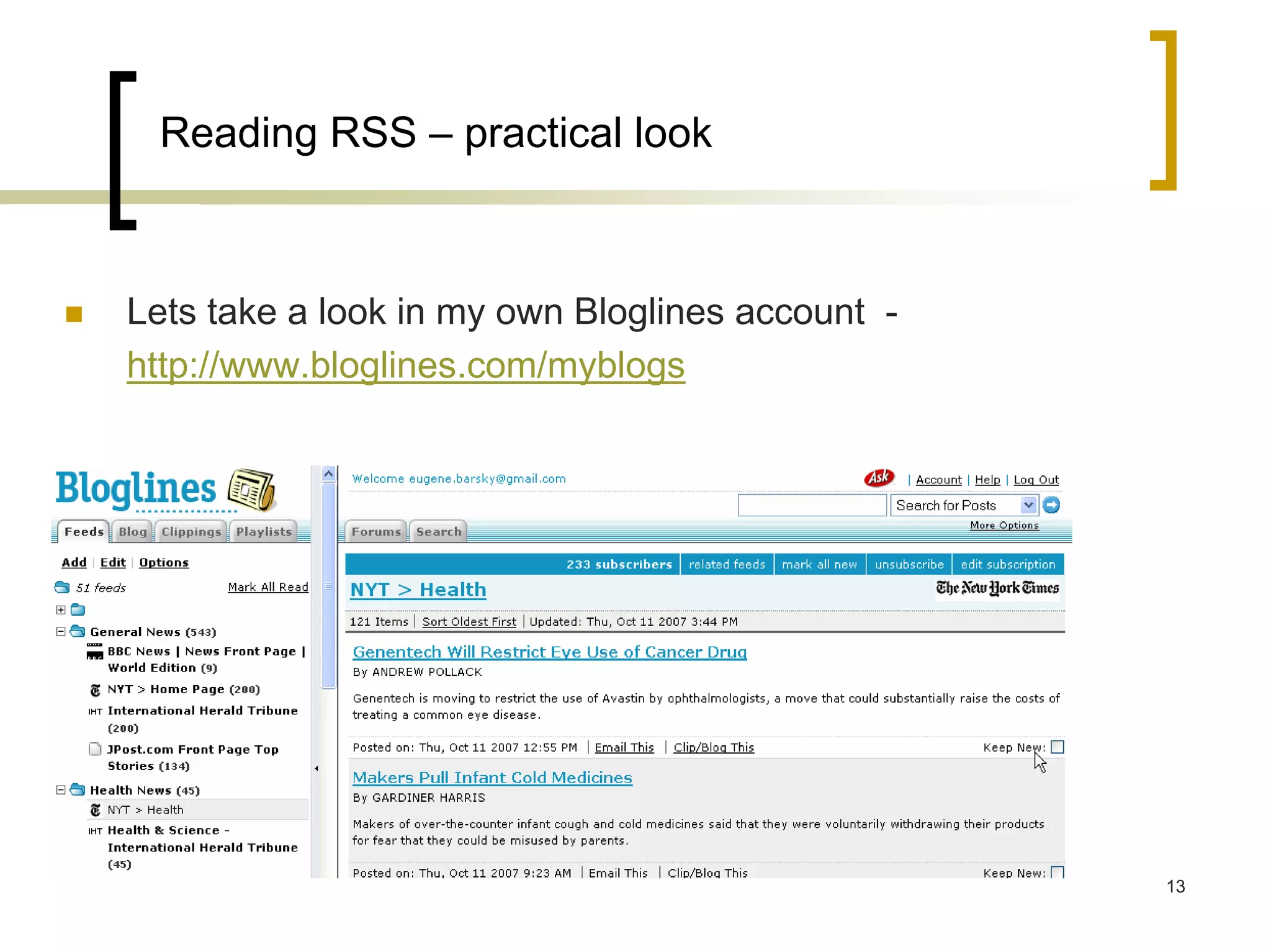
  11. Reading RSS You need a free reader: Web-based – Bloglines (http://www.bloglines.com/) or Google Reader (http://www.google.com/reader) Standalone clients - SharpReader (http://www.sharpreader.net/) Plugins – are integrated into software packages like Microsoft Outlook, and downloaded to your desktop 11
  12. Finding health–related RSS feeds UBC Health Library Wiki – list of health RSS feeds - http://hlwiki.slais.ubc.ca/index.php?title=RSS MedWorm - http://www.medworm.com/ 12
  13. Reading RSS – practical look Lets take a look in my own Bloglines account - http://www.bloglines.com/myblogs 13
  14. What is podcasting? Audio files, thrown on RSS feed Download themselves to the subscribers’ machines Don’t need iPod 14
  15. Why using podcasts? Current awareness alternative for busy health professionals Portable, cheap to produce, Easy to find and use (listen on the go and in your convenience) Perfect for auditory learners (some 30% of learners) 15
  16. Health related podcasts: Brief directory of health related podcasts (from the UBC Health Library Wiki) - http://hlwiki.slais.ubc.ca/index.php?title=Podcasts_and_Videocasts #Medical_podcasts My favorites: BBC Naked Scientists podcasts - http://www.thenakedscientists.com/HTML/podcasts/listen/ Johns Hopkins podcasts - http://www.hopkinsmedicine.org/mediaII/Podcasts.html 16
  17. Searching podcasts: Directories: Podcast.net - http://www.podcast.net Apple iTunes - http://www.apple.com/find/searchtips.html Search tools: Podscope - http://podscope.com/ 17
  18. Recording podcasts: Easy to do with free (or almost free) tools We use Audacity to record - http://audacity.sourceforge.net/ 1 min. of recording is roughly 1MB All files live on UBC Institutional Repository - https://circle.ubc.ca/dspace/ Very popular with our users, particularly in remote communities! 18
  19. What is wiki? An online resource which allows users to add and edit content collectively Video - http://blip.tv/file/246821 Why to use a wiki? Wikis are participative and allow many people to work together Software is usually free and easy-to-learn and use 19
  20. Where to use a wiki? A conference planning committee needs a Web-based tool to keep track of their activities and who is doing what (Canadian Health Library Association, 2005-08) An executive committee is looking for an easy way to create and maintain its documents (Saskatchewan Health Information Resources Partnership 2005-07) 20
  21. Where to use a wiki? A company would like any authorized staff member to be able to update content on its intranet as necessary, without needing to use specialist software (British Columbia Securities Commission, 2006-07) 21
  22. Examples of wikis Wikipedia - http://en.wikipedia.org Wikis in Health Medicine - http://davidrothman.net/list-of-medical-wikis/ (by David Rothman) AskDrWiki - http://askdrwiki.com, GANFYD - http://www.ganfyd.org - expert moderated version of wikis 22
  23. Software for wikis Examples of free wiki software: PBwiki – http://pbwiki.com/ - free on the Web MediaWiki – http://www.mediawiki.org - package used by Wikipedia and our own UBC Health Library Wiki 23
  24. Problems with wikis Wikis are sometimes prone to vandalism Quality issues – since everybody can edit Spam (wiki-spam) Can be time consuming projects 24
  25. What is Instant Messaging (IM)? A system which allows instant text communication between two or more people through a network Very popular with NextGens, Generations Y and X (young health professionals) 25
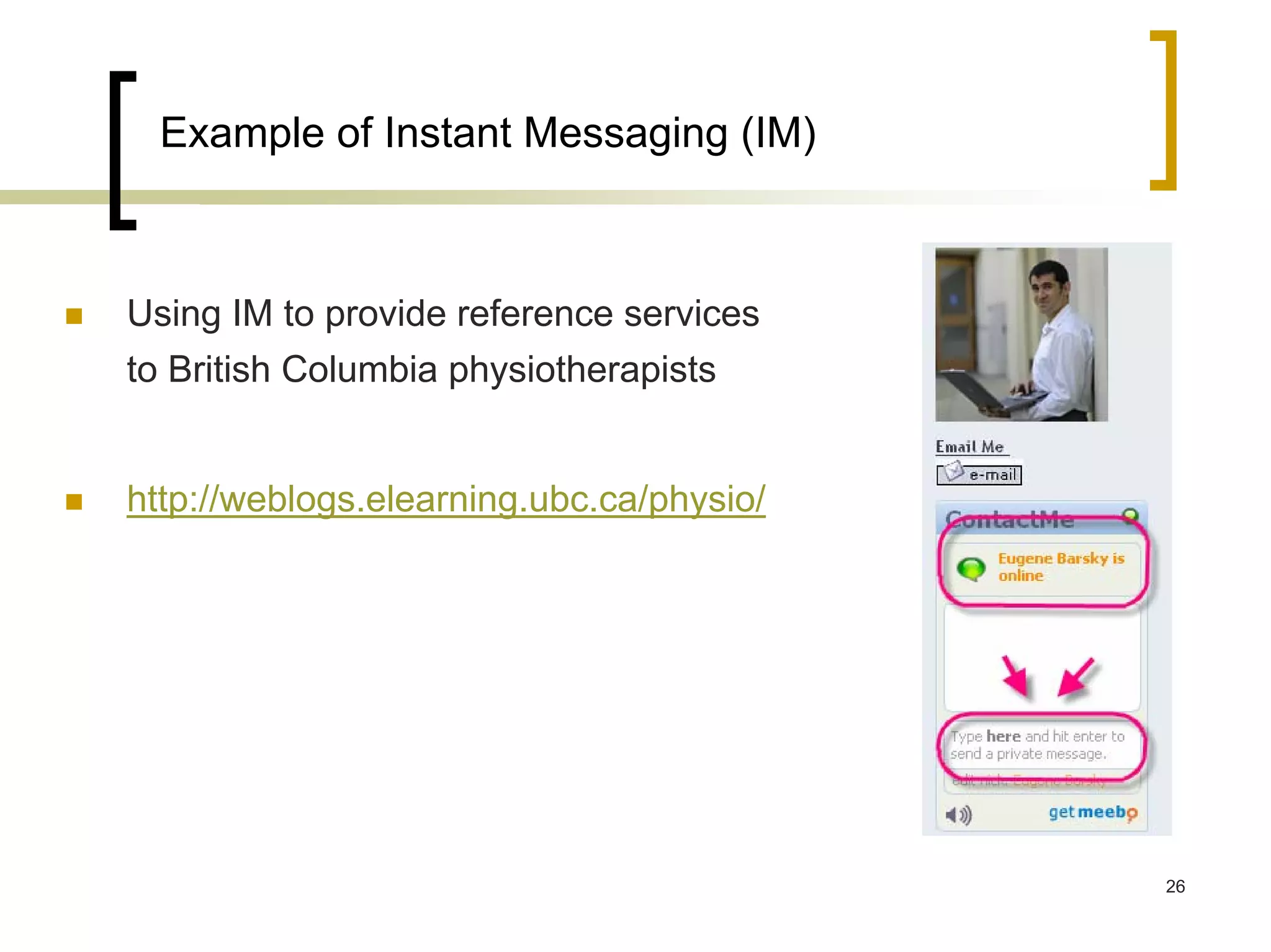
  26. Example of Instant Messaging (IM) Using IM to provide reference services to British Columbia physiotherapists http://weblogs.elearning.ubc.ca/physio/ 26
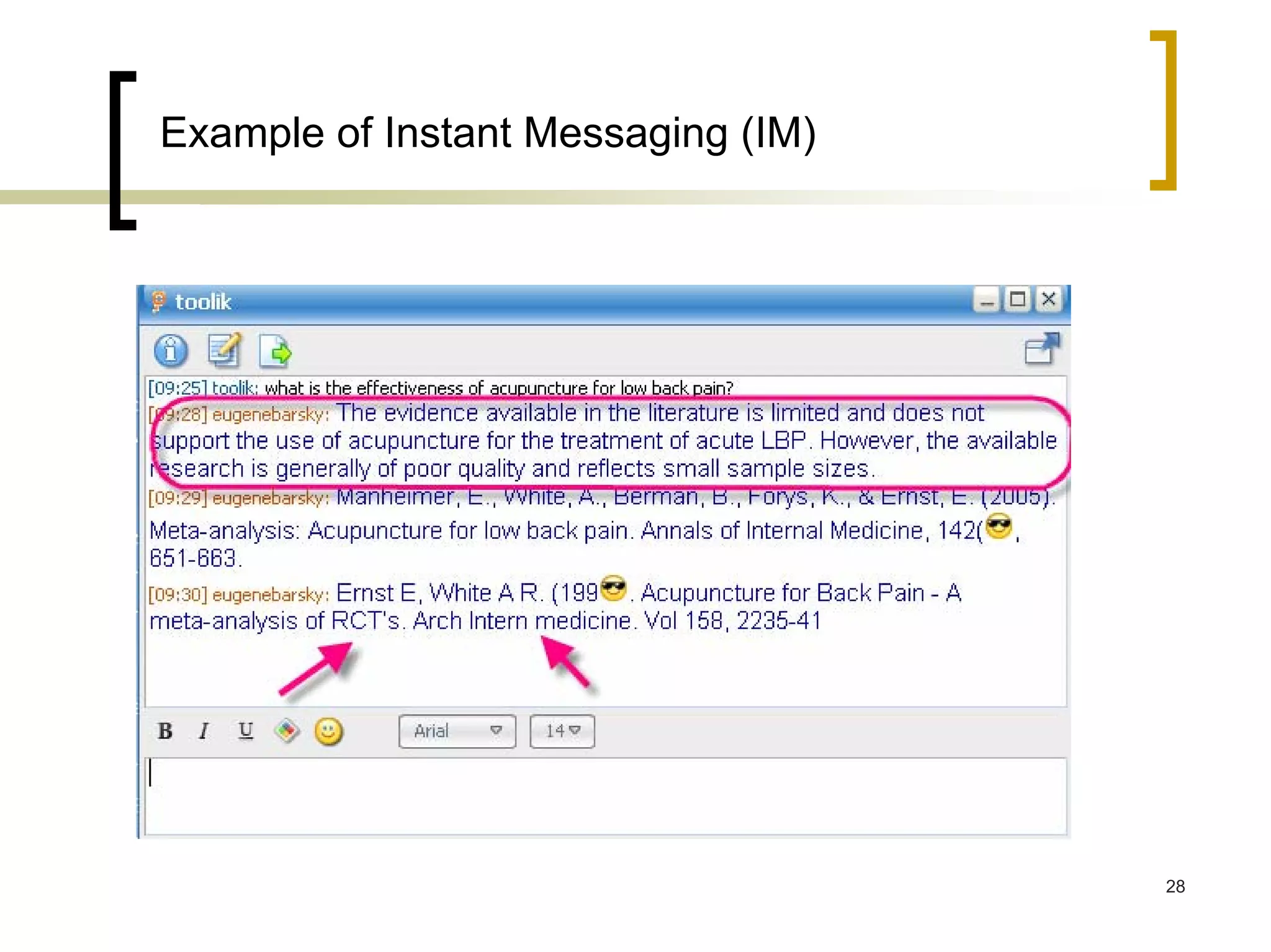
  27. Example of Instant Messaging (IM) Question from a physio in Northern BC – “what is the effectiveness of acupuncture for acute low back pain?” Answer – “The evidence available in the literature is limited and does not support the use of acupuncture for the treatment of acute LBP. However, the available research is generally of poor quality and reflects small sample sizes.” 27
  28. Example of Instant Messaging (IM) 28
  29. What are social networks? Definition: “Virtual communities that are structured to delineate and build on relationships that members have with each other by virtue of their being part of that community.” Video - http://blip.tv/file/282928 29
  30. Example of general social networks MySpace – http://www.myspace.com - world's sixth most popular English-language site. Facebook - http://facebook.com - Users join one or more participating networks, such as a high school, place of employment, or geographic region. Linked-In - http://www.linkedin.com/ - LinkedIn is a business-oriented social networking site, mainly used for and by professionals. 30
  31. Example of social networks in health Sermo - http://www.sermo.com - American Medical Association (AMA) social network. Nurse LinkUp - http://nurselinkup.com - online nursing community for nursing professionals. Tiromed - http://www.tiromed.com - professional knowledge network exclusively for students of medicine and physicians. 31
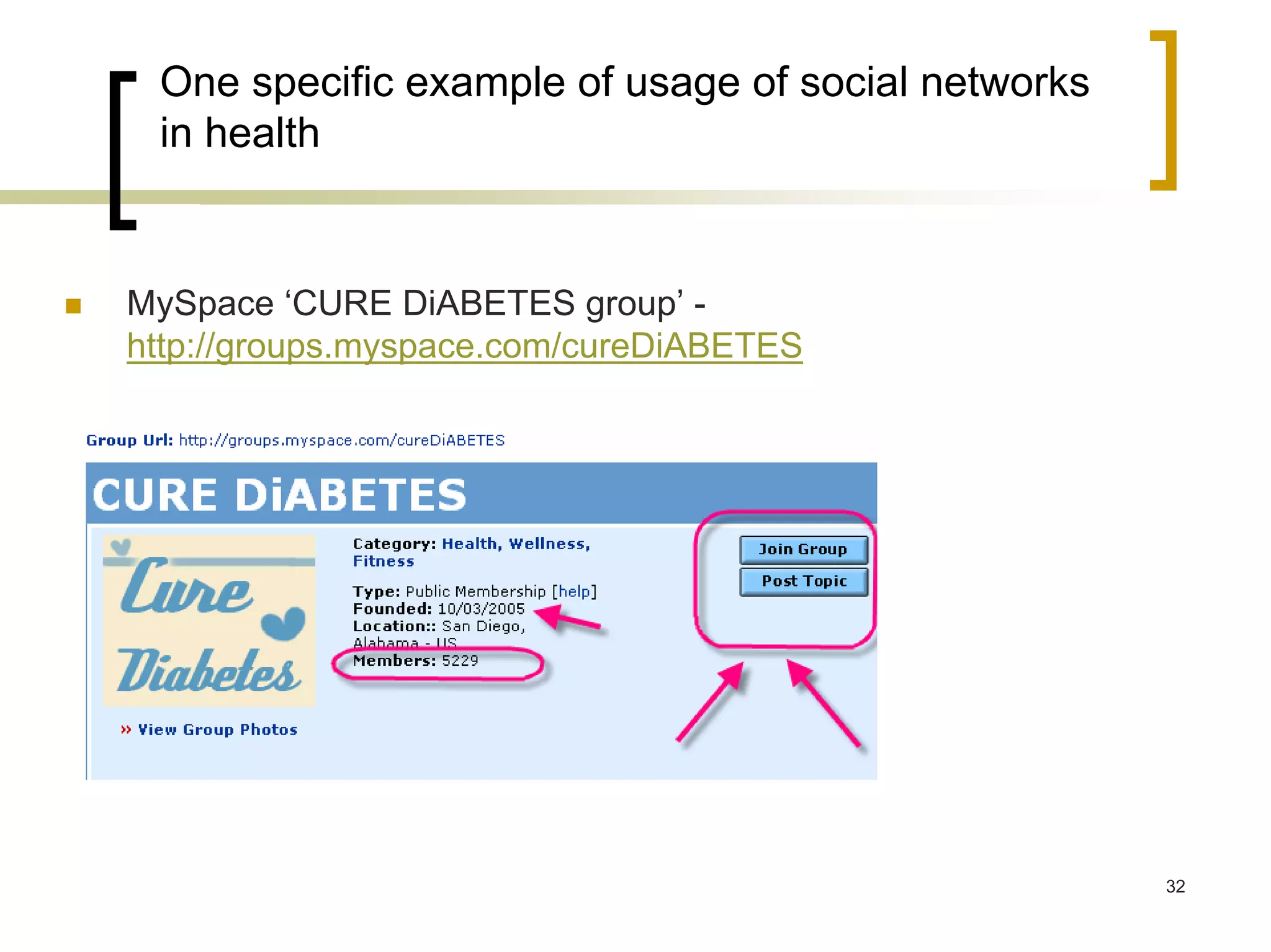
  32. One specific example of usage of social networks in health MySpace ‘CURE DiABETES group’ - http://groups.myspace.com/cureDiABETES 32
  33. Summary and brainstorm: Socialization is the dominant feature of Web 2.0 Web should remain an open and optimal learning space More productive? Careful thinking is needed! Your ideas? 33
  34. References: Barsky E, Giustini D. Introducing web 2.0: Wikis for health librarians. J Can Health Libr Assoc. (in print). Barsky E, Cho A. Introducing web 2.0: Social search for health librarians. J Can Health Libr Assoc. 2007;28:58-61. Barsky E. Introducing web 2.0: RSS trends for health librarians. J CAN HEALTH LIBR ASSOC. 2006;27:7- 8. Barsky E. Introducing web 2.0: Weblogs and podcasting for health librarians. J CAN HEALTH LIBR ASSOC. 2006;27:33-34. Barsky E, Purdon M. Introducing web 2.0: Social networking and social bookmarking for health librarians. J CAN HEALTH LIBR ASSOC. 2006;27:65-67. Boulos MN, Maramba I, Wheeler S. Wikis, blogs and podcasts: A new generation of web-based tools for virtual collaborative clinical practice and education. BMC Med Educ. 2006;6:41. Boulos MN, Wheeler S. The emerging web 2.0 social software: An enabling suite of sociable technologies in health and health care education. HEALTH INF LIBR J. 2007;24:2-23. Giustini D. How web 2.0 is changing medicine. BMJ. 2006;333:1283-1284. Liesegang TJ. Web 2.0, library 2.0, physician learning 2.0. Ophthalmology. 2007;114:1801-1803. McLean R, Richards BH, Wardman JI. The effect of web 2.0 on the future of medical practice and education: Darwikinian evolution or folksonomic revolution? Med J Aust. 2007;187:174-177. 34
  35. Contact info Eugene Barsky, MLIS Physiotherapy Outreach Librarian Irving K. Barber Learning Centre University of British Columbia Phone: (604) 827-4088 Fax: (604) 822-9122 Email: eugene.barsky@ubc.ca MSN/Meebo: eugene.barsky@ubc.ca Blog: http://weblogs.elearning.ubc.ca/physio/ Web: http://www.ikebarberlearningcentre.ubc.ca/ 35

+ ubcphysioblogubcphysioblog, 3 years ago

custom

5151 views, 15 favs, 11 embeds more stats

This is a presentation for the British Columbia Min more

More info about this document

© All Rights Reserved

Go to text version

  • Total Views 5151
    • 4812 on SlideShare
    • 339 from embeds
  • Comments 1
  • Favorites 15
  • Downloads 239
Most viewed embeds
  • 242 views on http://weblogs.elearning.ubc.ca
  • 39 views on http://davidrothman.net
  • 39 views on http://digital-medicine.blogspot.com
  • 11 views on http://scienceroll.com
  • 2 views on http://neeleshbhandari.blogspot.com

more

All embeds
  • 242 views on http://weblogs.elearning.ubc.ca
  • 39 views on http://davidrothman.net
  • 39 views on http://digital-medicine.blogspot.com
  • 11 views on http://scienceroll.com
  • 2 views on http://neeleshbhandari.blogspot.com
  • 1 views on http://72.14.203.104
  • 1 views on http://networks.feedburner.com
  • 1 views on file://
  • 1 views on http://www.davidrothman.net
  • 1 views on http://www.netvibes.com
  • 1 views on http://www.workcolab.com

less

Flagged as inappropriate Flag as inappropriate
Flag as inappropriate

Select your reason for flagging this presentation as inappropriate. If needed, use the feedback form to let us know more details.

Cancel
File a copyright complaint
Having problems? Go to our helpdesk?

Categories

Groups / Events