
Hurricane Facts (Updated May 2011)
•Download as PPTX, PDF•
5 likes•3,371 views

This is a presentation about hurricanes and what to do to prepare for them. This version contains the latest information.
![Table of Contents ,[object Object]](data:image/gif;base64,R0lGODlhAQABAIAAAAAAAP///yH5BAEAAAAALAAAAAABAAEAAAIBRAA7)
Recommended
More Related Content
What's hot
What's hot (20)
Viewers also liked
Similar to Hurricane Facts (Updated May 2011)
Similar to Hurricane Facts (Updated May 2011) (20)
More from Dominique Turner
Recently uploaded
Recently uploaded (20)
Hurricane Facts (Updated May 2011)
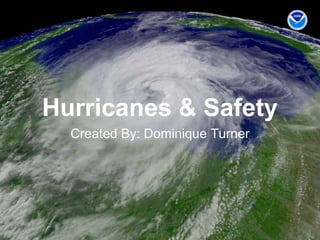
- 1. Hurricanes & Safety Created By: Dominique Turner
- 4. Where do hurricanes form?
- 5. How are hurricanes named?
- 6. Parts of a hurricane
- 7. Hurricane watch vs. Hurricane warning
- 10. Saffir-Simpson Scale Measures the intensity of a hurricane Contains 5 categories Category 1 = minor damage Category 5 = major damage
- 11. Saffir-Simpson Scale Pressure is 980 millibars (MB). Light Damage Pressure is 965-979 MB. Moderate Damage Pressure is 945-964 MB. Extensive Damage Pressure is 920-944 MB. Extreme Damage Pressure is <920 MB. Catastrophic Damage Lower Pressure = Stronger Hurricane
- 12. Where Do Hurricanes Form? All hurricanes form near the equator. Atlantic, Pacific, and the Indian Ocean. They are not always called hurricanes: Atlantic and Eastern Pacific-Hurricanes Western Pacific-Typhoons Indian Ocean-Cyclones
- 13. Map of Formation Hurricanes Typhoons Hurricanes Cyclones
- 14. How Are Hurricanes Named? Began in 1953. There are 21 names on the list. It’s numbered when it’s a T.D. (<39 MPH). It’s a named when it’s a T.S. (39-73 MPH). Hurricane winds are >73 MPH. The Greek alphabet (Link) is used when names run out. Occurred once in 2005.
- 15. How Are Hurricanes Named? On the list of names (Link), male and female names alternate. Male and female names were used starting in 1979. The same name is used every six years. When a storm does major damage, that name is never used again.
- 17. Hurricane Watch vs. Warning Hurricane Watch Hurricane conditions are possible within 48 hrs. Take immediate action if a hurricane warning is issued. Hurricane Warning Hurricane conditions areexpected within 36 hrs. You must evacuate when asked. The same goes for tropical storm watches and warnings
- 20. You Must Evacuate when asked
- 21. Move farther inland to a shelter or hotel.
- 22. If evacuating, leave early.
- 23. Take your pet or leave it with plenty of food and water.
- 25. For A Complete List: http://www.nhc.noaa.gov/HAW2/english/prepare/supply_kit.shtml
- 26. REMEMBER THIS YOU MUST EVACUATE WHEN ASKED TO. IF YOU DON’T, THINGS COULD GET DANGEROUS, EVEN DEADLY. HAVE A FAMILY DISASTER PLAN READY. NEVER UNDERESTIMATE THE POWER OF A HURRICANE!
- 27. Bibliography http://ww2010.atmos.uiuc.edu/(Gh)/guides/mtr/hurr/home.rxml http://www.cotf.edu/ete/modules/sevweath/swwhatare.html http://www.fema.gov/business/guide/section3d.shtm Changes to the 2010 Hurricane Season