© Copyright 2010 Digital Enterprise Research Institute. All rights reserved.
Digital Enterprise Research Institute www.deri.ie
Curbing Resource Consumption
Using Team-Based Feedback
Souleiman Hasan1
, Richard Medland2
, Marcus Foth2
, Edward Curry1
1
Digital Enterprise Research Institute, National University of Ireland, Galway, Ireland
2
Urban Informatics Research Lab, Queensland University of Technology & NICTA, Australia
Stefan.Decker@deri.org
http://www.StefanDecker.org/
In proceedings of The 8th International Conference on Persuasive Technology
(2013), Sydney, Australia.
Digital Enterprise Research Institute www.deri.ie
Outline
 Motivation and Background
 Paper consumption
 Previous work and research question
 Individual vs. team-based feedback
 Experiment Setting
 Environment
 Print monitoring
 Persuasive strategies
 Procedure
 Results and Discussion
 Conclusions
2 / 20
Digital Enterprise Research Institute www.deri.ie
Motivation
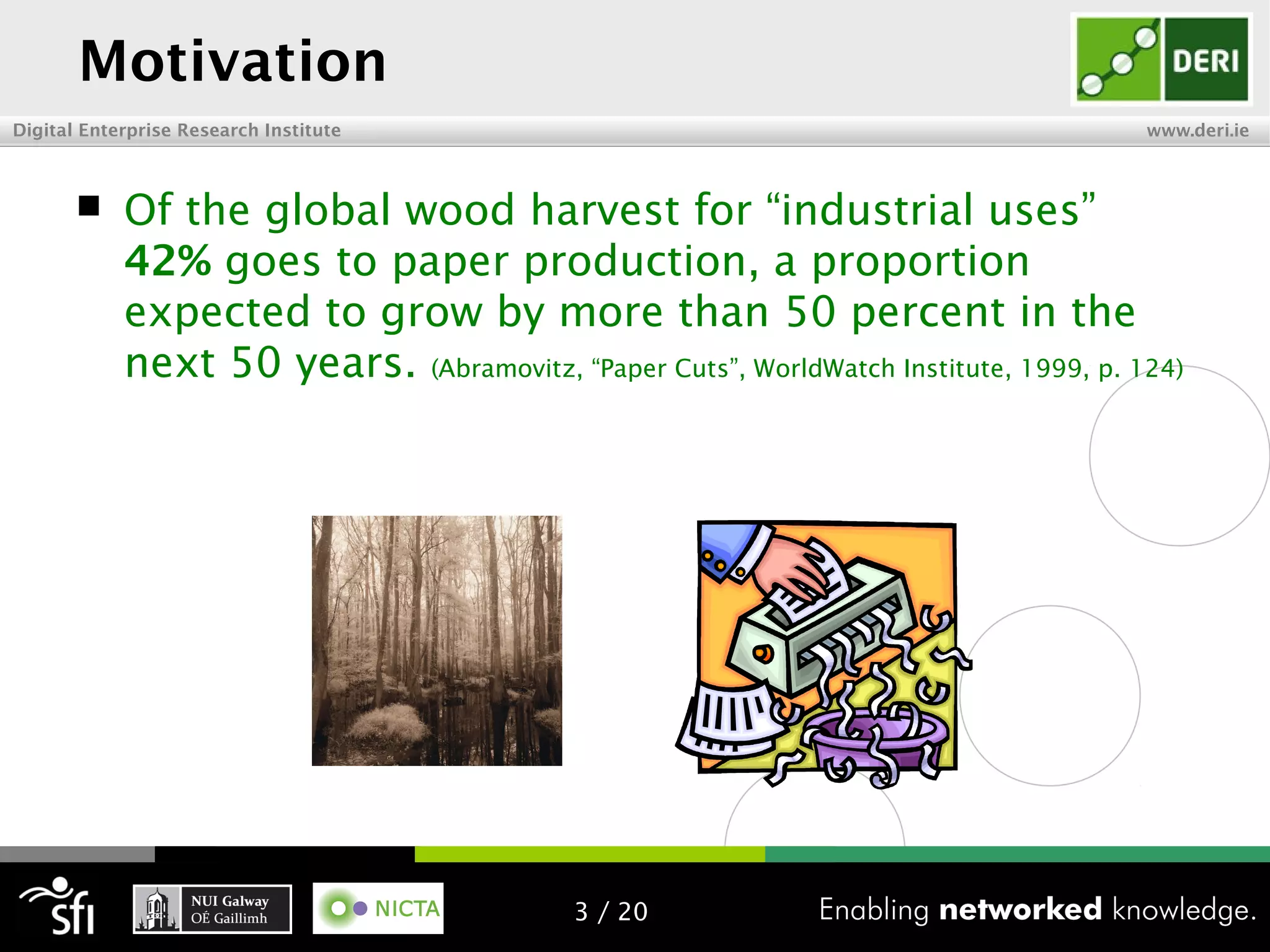
 Of the global wood harvest for “industrial uses”
42% goes to paper production, a proportion
expected to grow by more than 50 percent in the
next 50 years. (Abramovitz, “Paper Cuts”, WorldWatch Institute, 1999, p. 124)
3 / 20
Digital Enterprise Research Institute www.deri.ie
Previous Work & Question
 Using flavoured feedback to curb paper printing
(Medland et al., 2010)
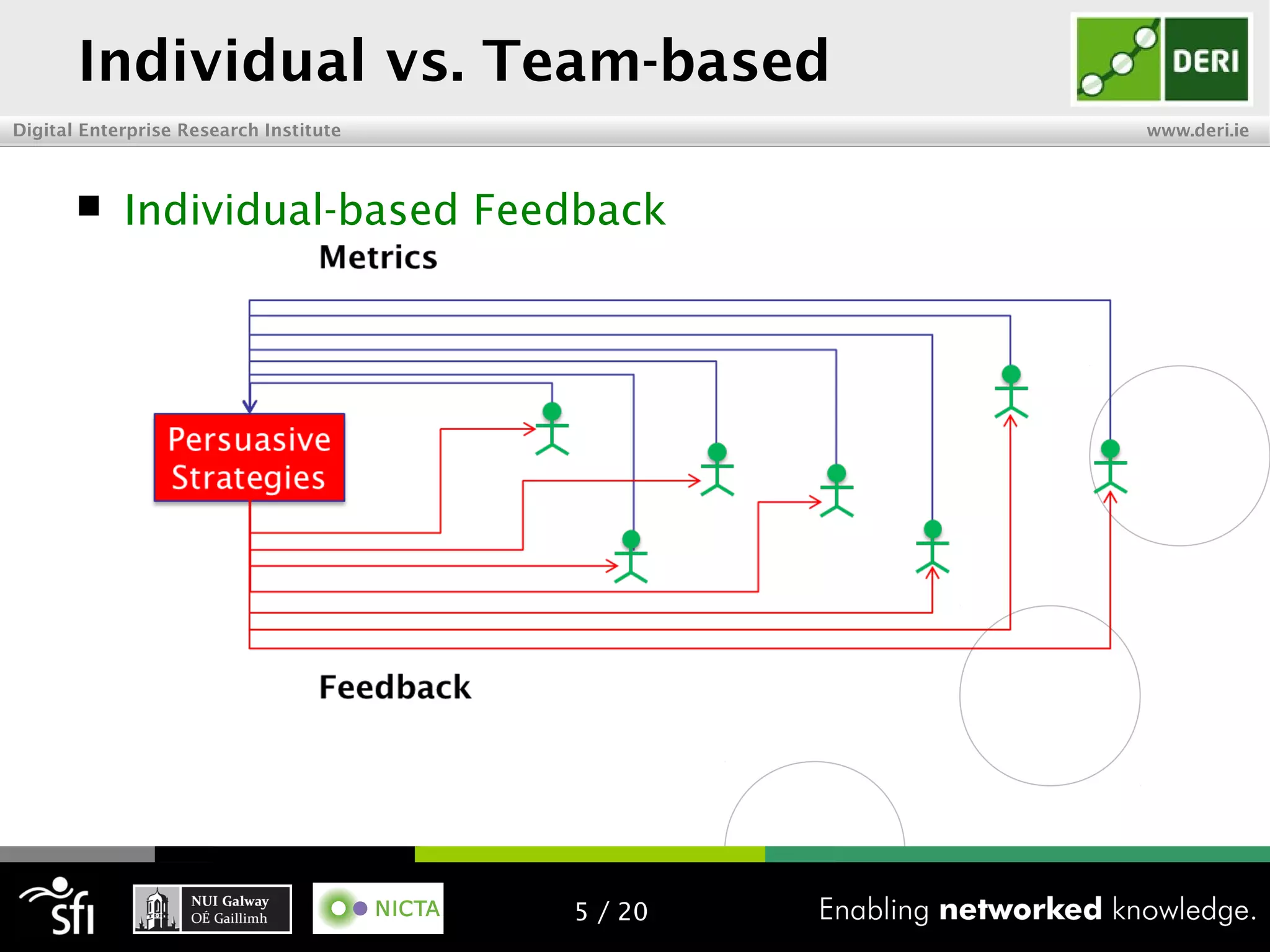
 Focused on individualistic feedback
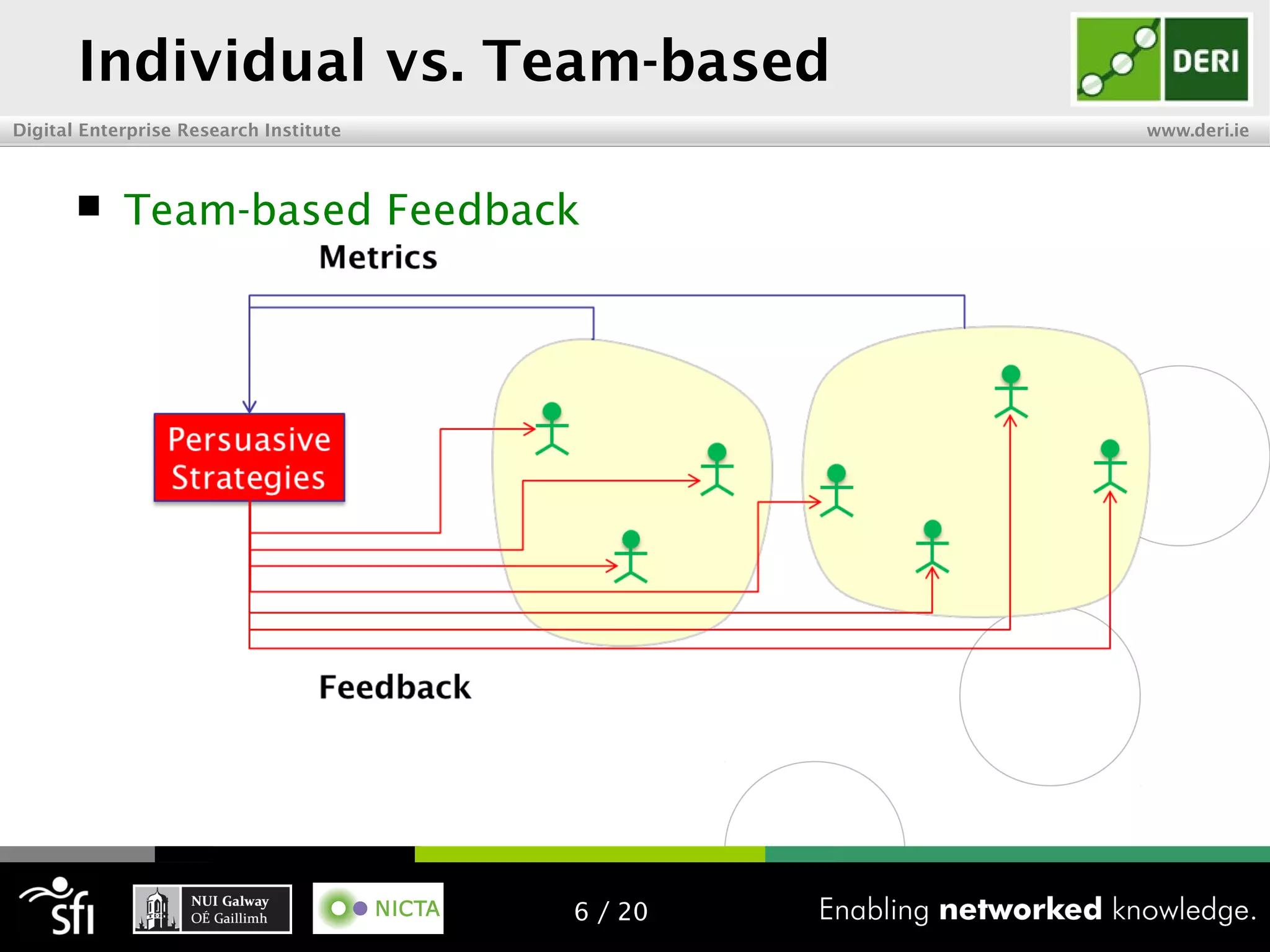
 Question: “Can membership in a group be
leveraged to persuade individuals to change their
behaviour, and hence the group overall behaviour?”
4 / 20
Digital Enterprise Research Institute www.deri.ie
 Individual-based Feedback
Individual vs. Team-based
5 / 20
Digital Enterprise Research Institute www.deri.ie
 Team-based Feedback
Individual vs. Team-based
6 / 20
Digital Enterprise Research Institute www.deri.ie
Outline
 Motivation and Background
 Paper consumption
 Previous work and research question
 Individual vs. team-based feedback
 Experiment Setting
 Environment
 Print monitoring
 Persuasive strategies
 Procedure
 Results and Discussion
 Conclusions
7 / 20
Digital Enterprise Research Institute www.deri.ie
Case Study Environment
 DERI
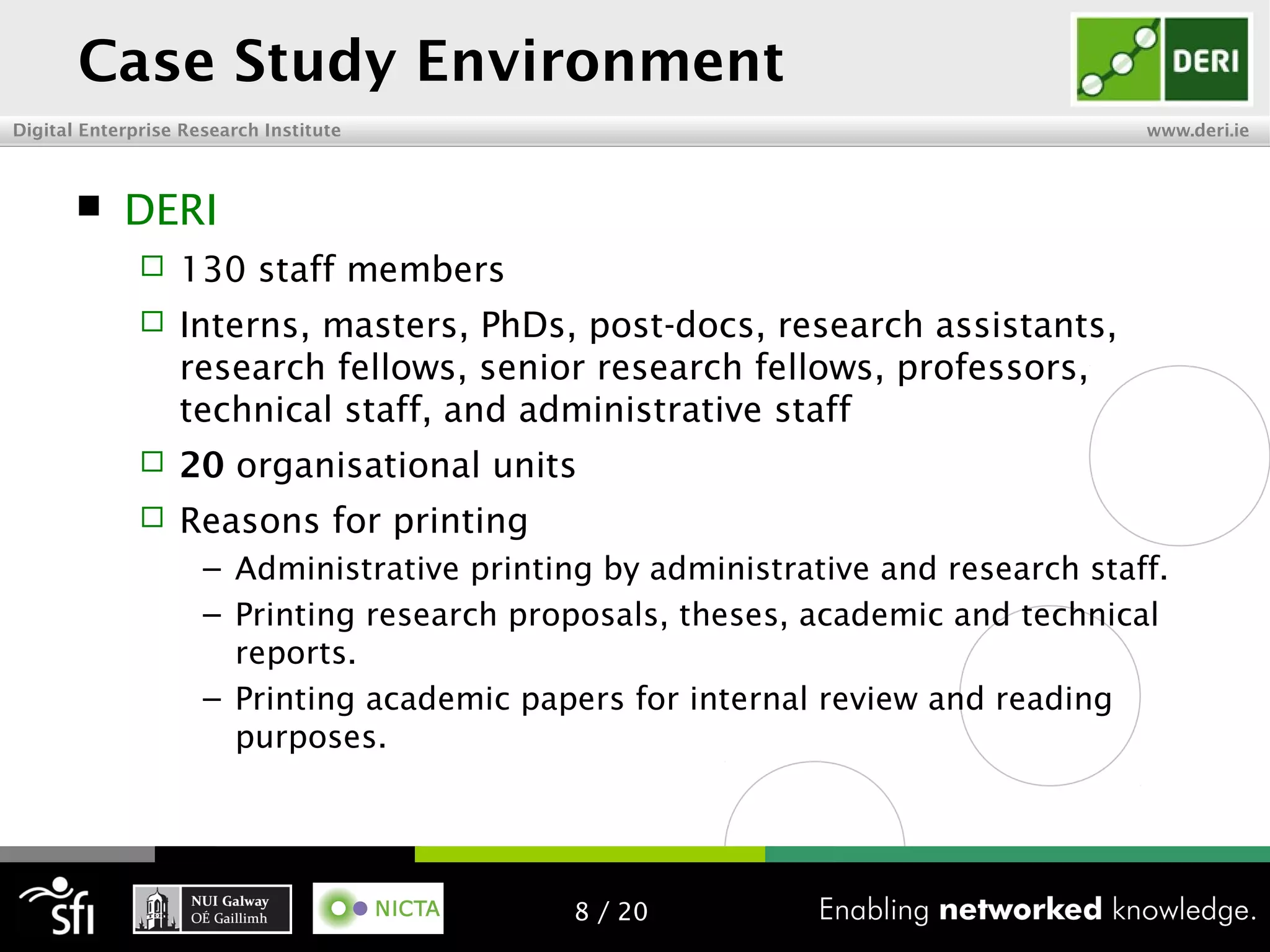
 130 staff members
 Interns, masters, PhDs, post-docs, research assistants,
research fellows, senior research fellows, professors,
technical staff, and administrative staff
 20 organisational units
 Reasons for printing
– Administrative printing by administrative and research staff.
– Printing research proposals, theses, academic and technical
reports.
– Printing academic papers for internal review and reading
purposes.
8 / 20
Digital Enterprise Research Institute www.deri.ie
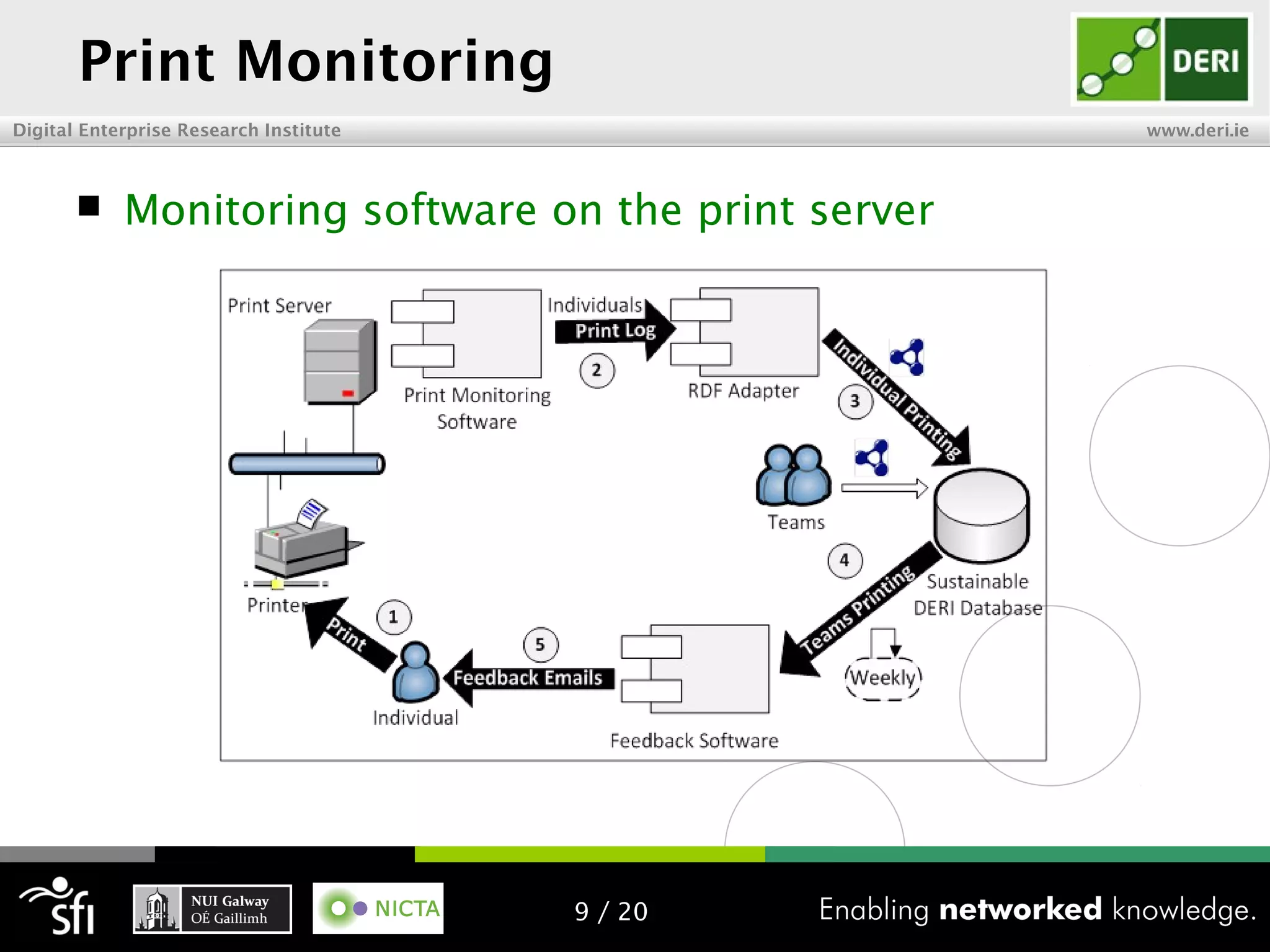
Print Monitoring
 Monitoring software on the print server
9 / 20
Digital Enterprise Research Institute www.deri.ie
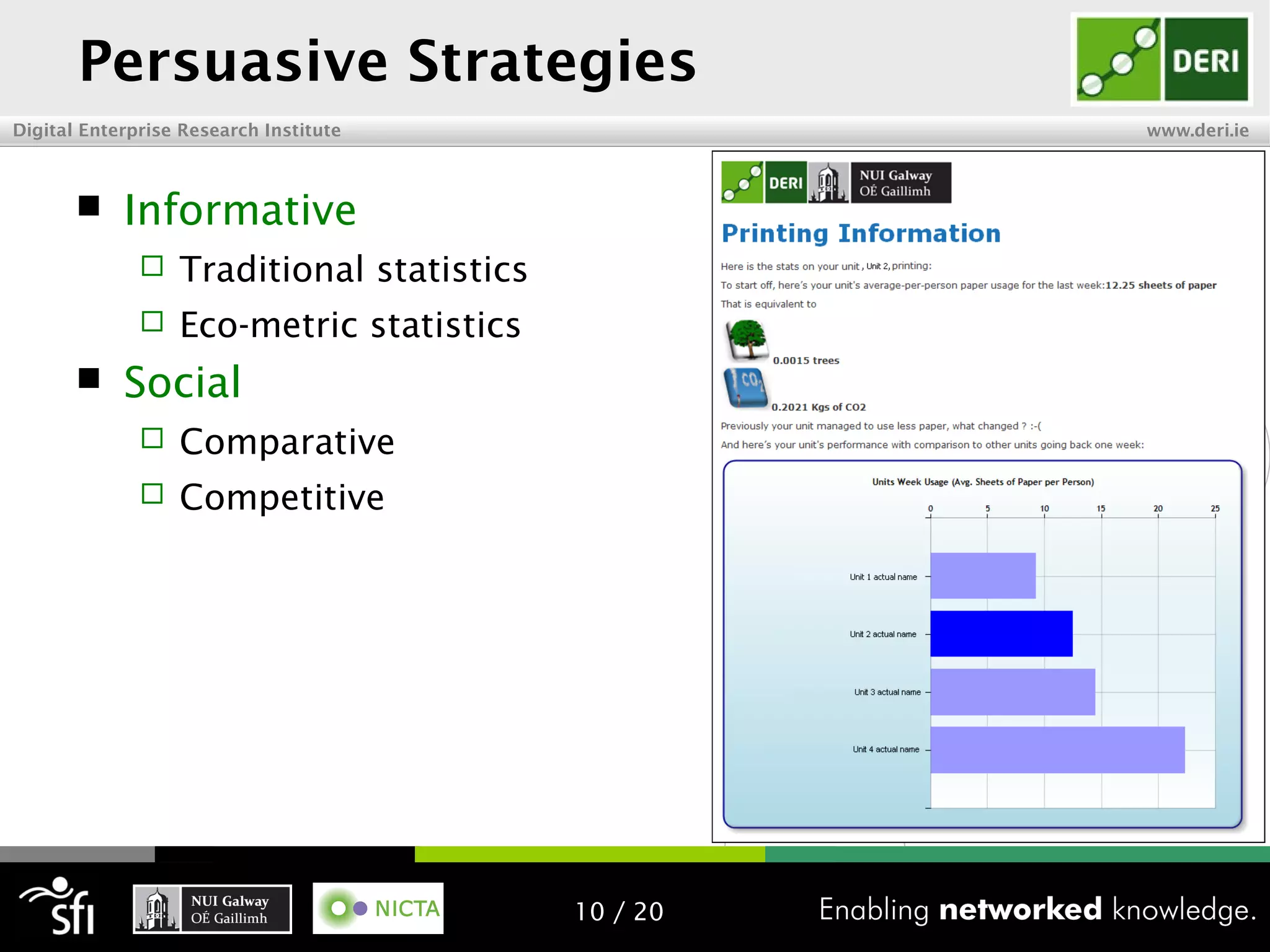
Persuasive Strategies
 Informative
 Traditional statistics
 Eco-metric statistics
 Social
 Comparative
 Competitive
10 / 20
Digital Enterprise Research Institute www.deri.ie
Experimental Procedure
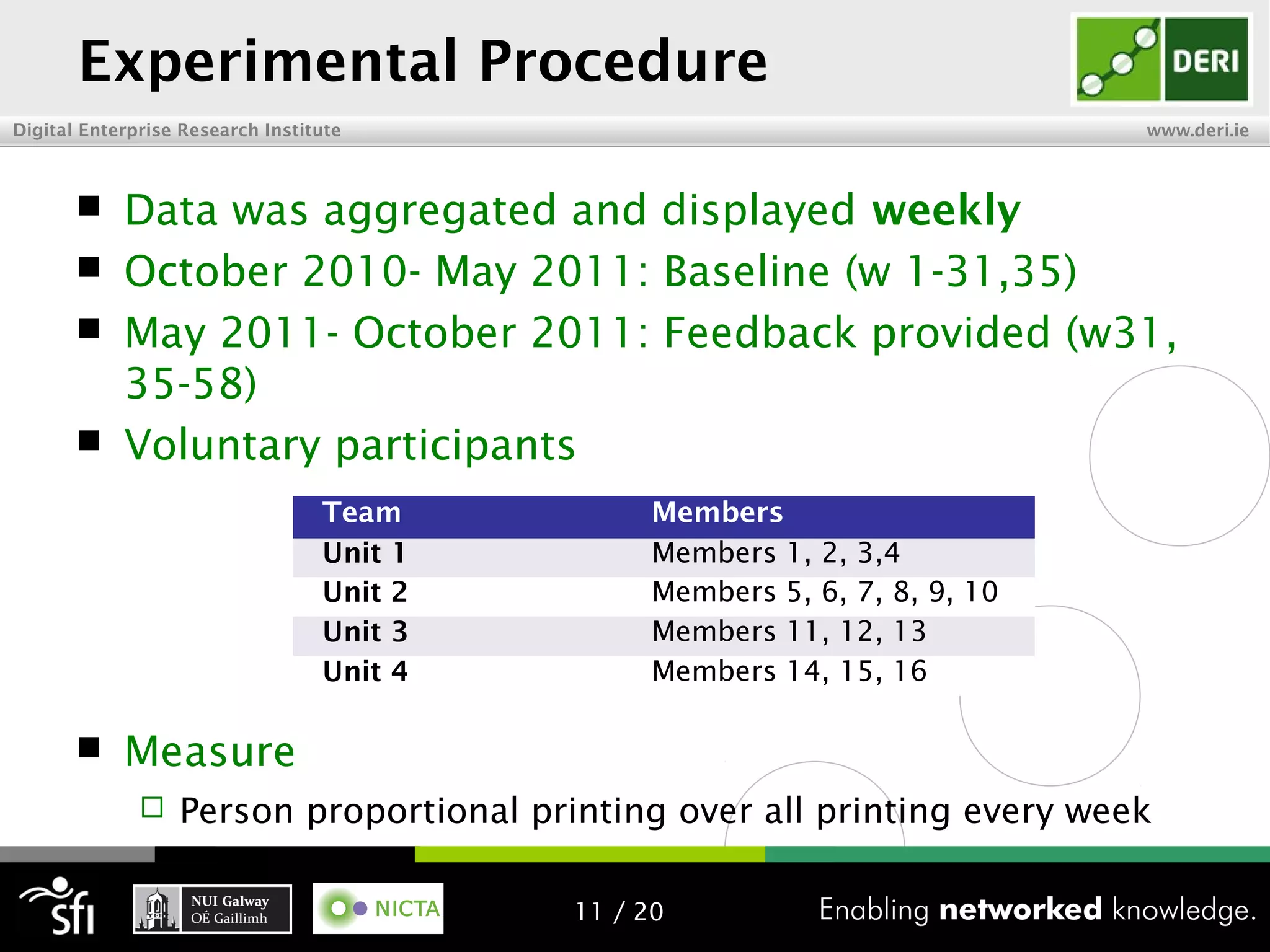
 Data was aggregated and displayed weekly
 October 2010- May 2011: Baseline (w 1-31,35)
 May 2011- October 2011: Feedback provided (w31,
35-58)
 Voluntary participants
 Measure
 Person proportional printing over all printing every week
Team Members
Unit 1 Members 1, 2, 3,4
Unit 2 Members 5, 6, 7, 8, 9, 10
Unit 3 Members 11, 12, 13
Unit 4 Members 14, 15, 16
11 / 20
Digital Enterprise Research Institute www.deri.ie
Outline
 Motivation and Background
 Paper consumption
 Previous work and research question
 Individual vs. team-based feedback
 Experiment Setting
 Environment
 Print monitoring
 Persuasive strategies
 Procedure
 Results and Discussion
 Conclusions
12 / 20
Digital Enterprise Research Institute www.deri.ie
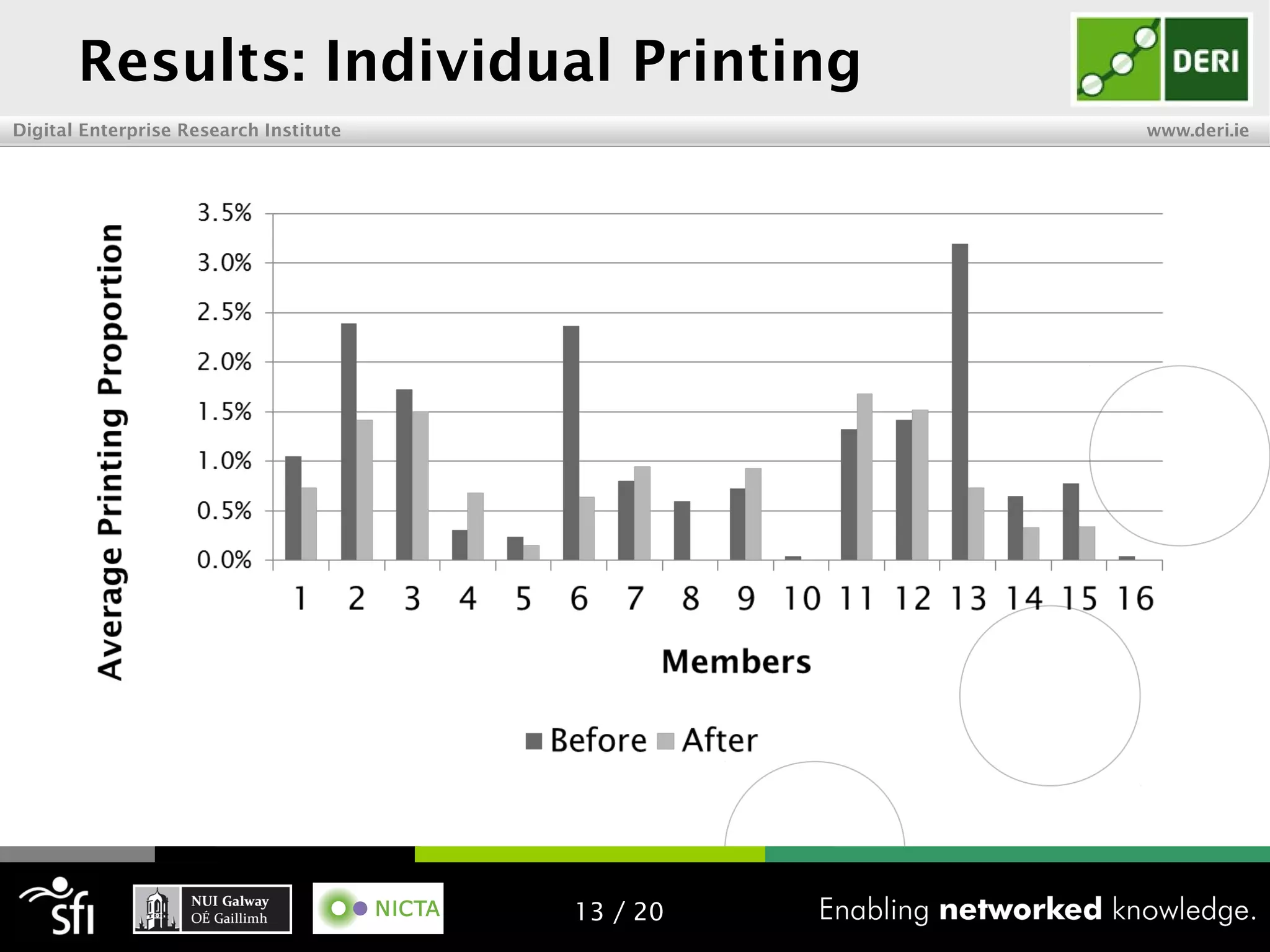
Results: Individual Printing
13 / 20
Digital Enterprise Research Institute www.deri.ie
Results: Statistical Significance
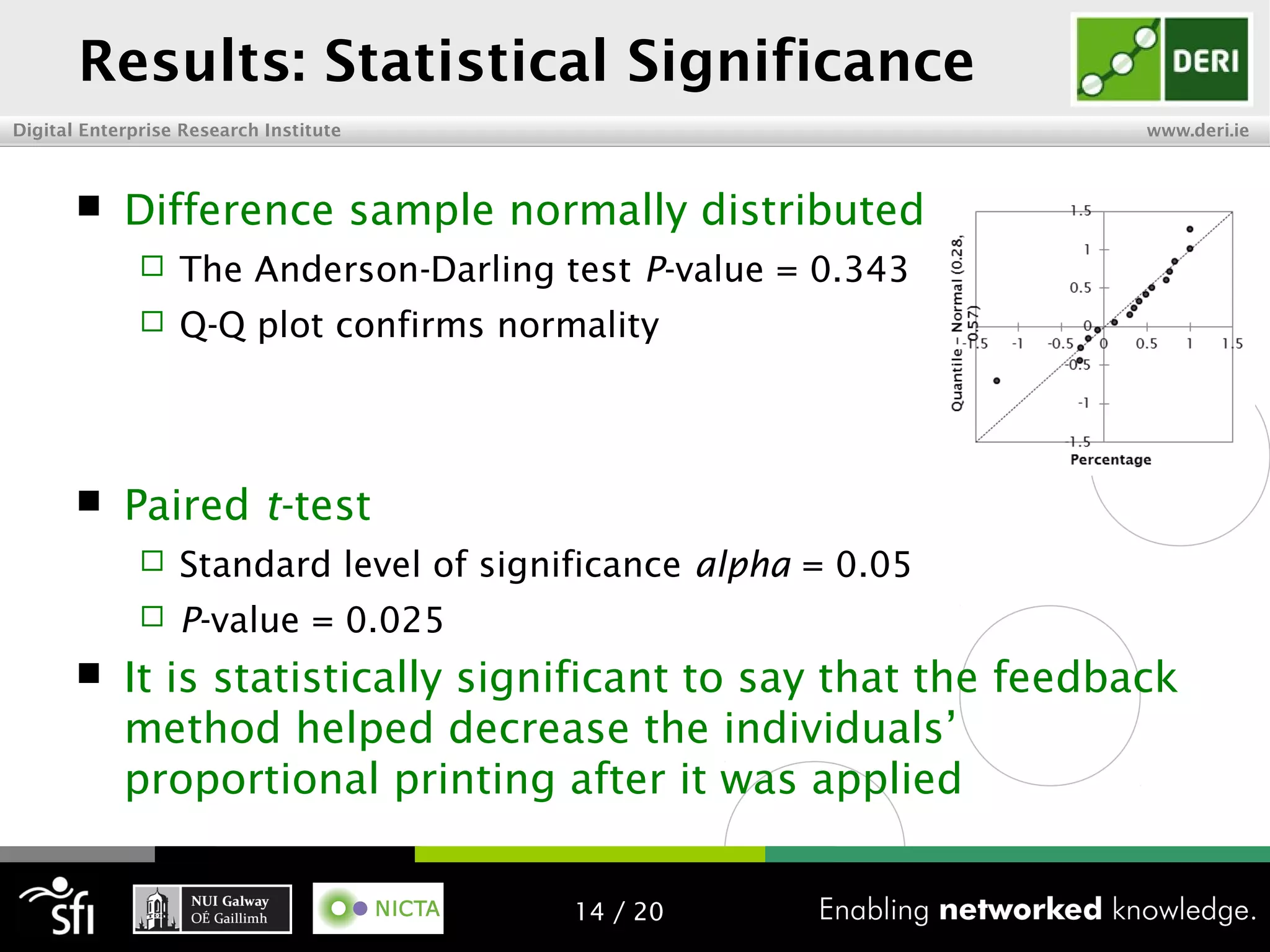
 Difference sample normally distributed
 The Anderson-Darling test P-value = 0.343
 Q-Q plot confirms normality
 Paired t-test
 Standard level of significance alpha = 0.05
 P-value = 0.025
 It is statistically significant to say that the feedback
method helped decrease the individuals’
proportional printing after it was applied
14 / 20
Digital Enterprise Research Institute www.deri.ie
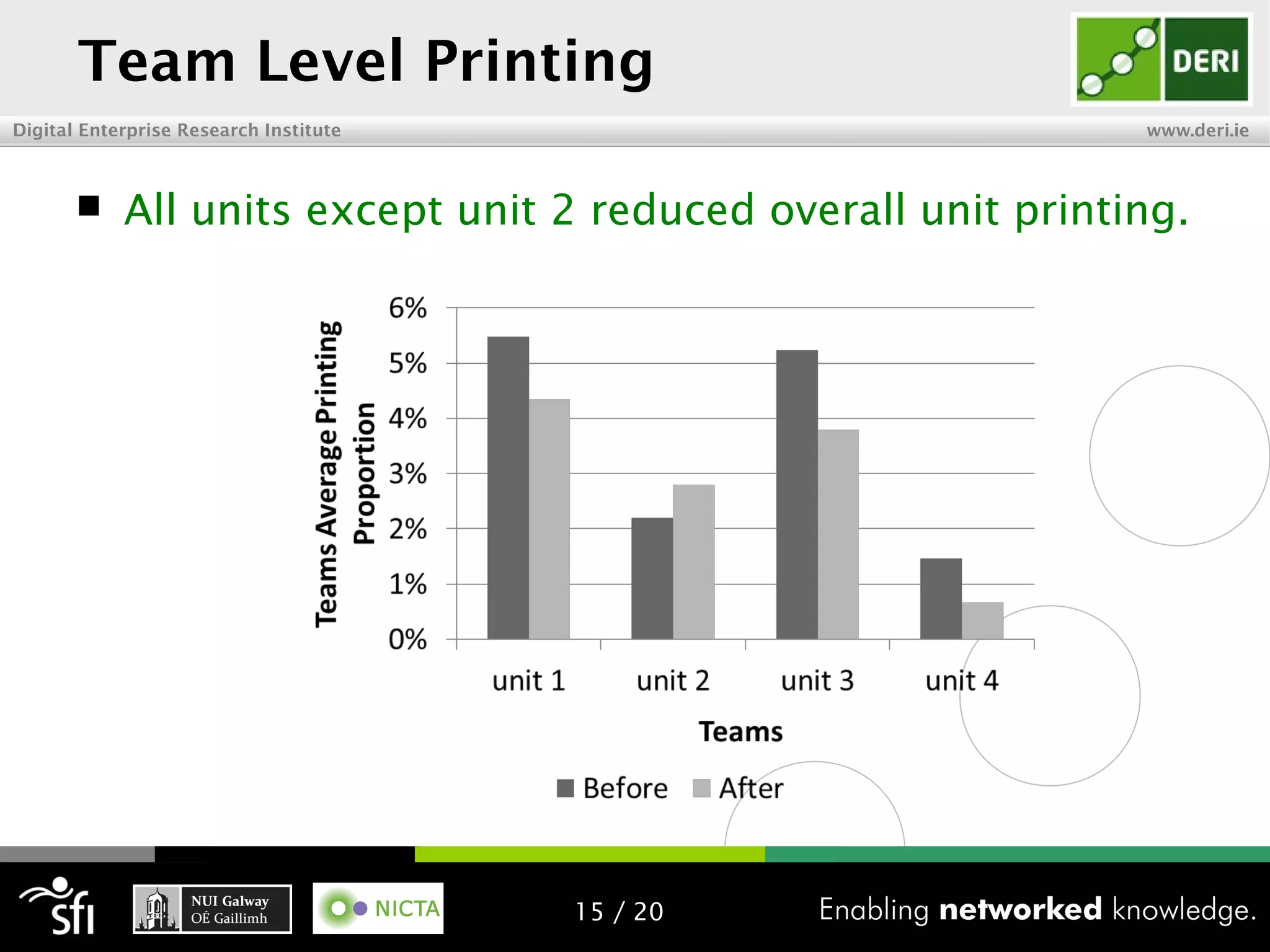
Team Level Printing
 All units except unit 2 reduced overall unit printing.
15 / 20
Digital Enterprise Research Institute www.deri.ie
Discussion
 Previous survey revealed three themes
 Theme 1
 Any printing conducted by staff was viewed as necessary,
excepting accidents.
 Theme 2
 Staff viewed different metrics as relevant or alternatively,
as unnecessary for feedback on printing behaviour.
 Theme 3
 Staff viewed co-workers championing reduced paper use
as a helpful reminder to be conscious of how much they
were printing.
16 / 20
Digital Enterprise Research Institute www.deri.ie
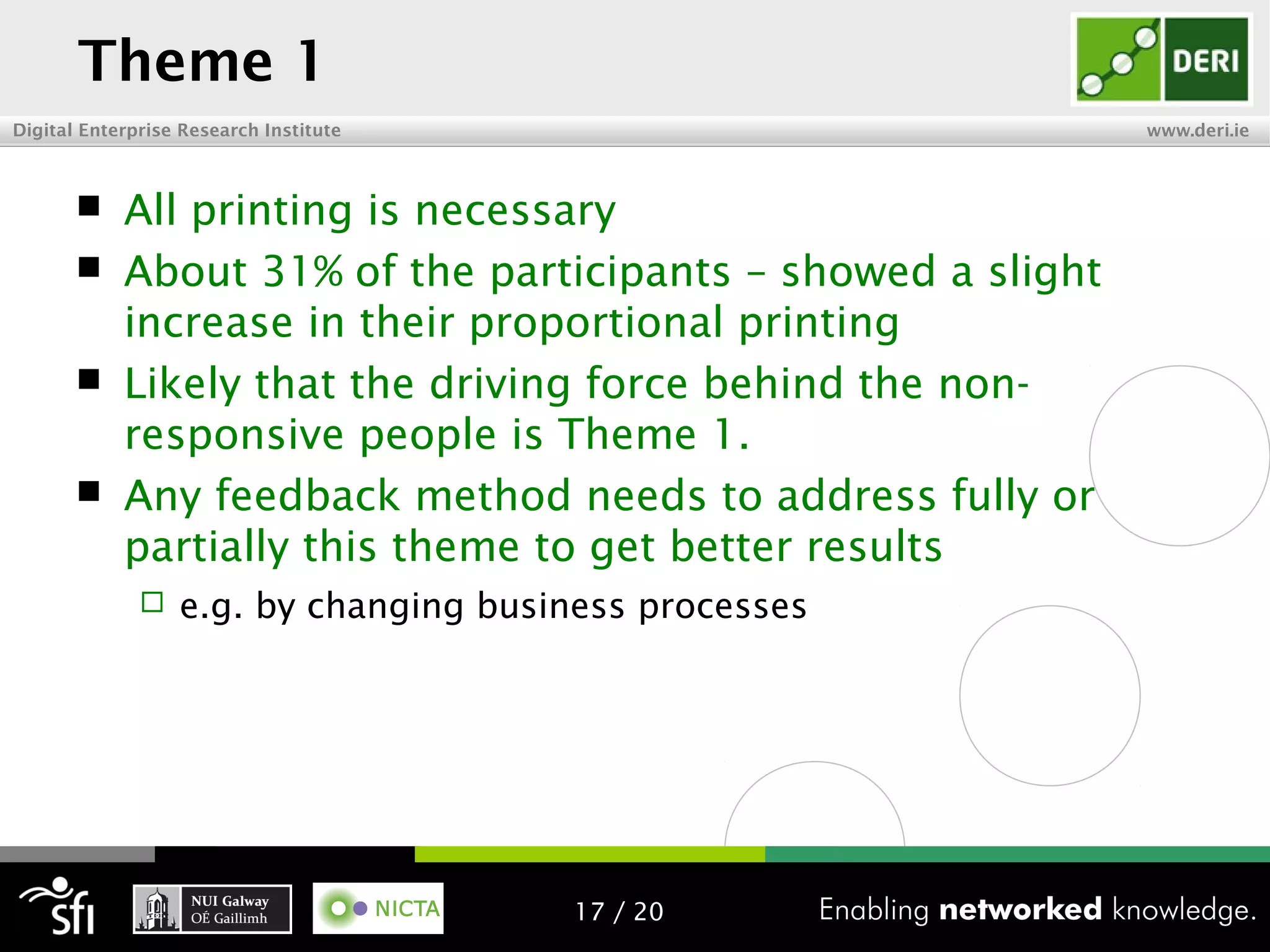
Theme 1
 All printing is necessary
 About 31% of the participants – showed a slight
increase in their proportional printing
 Likely that the driving force behind the non-
responsive people is Theme 1.
 Any feedback method needs to address fully or
partially this theme to get better results
 e.g. by changing business processes
17 / 20
Digital Enterprise Research Institute www.deri.ie
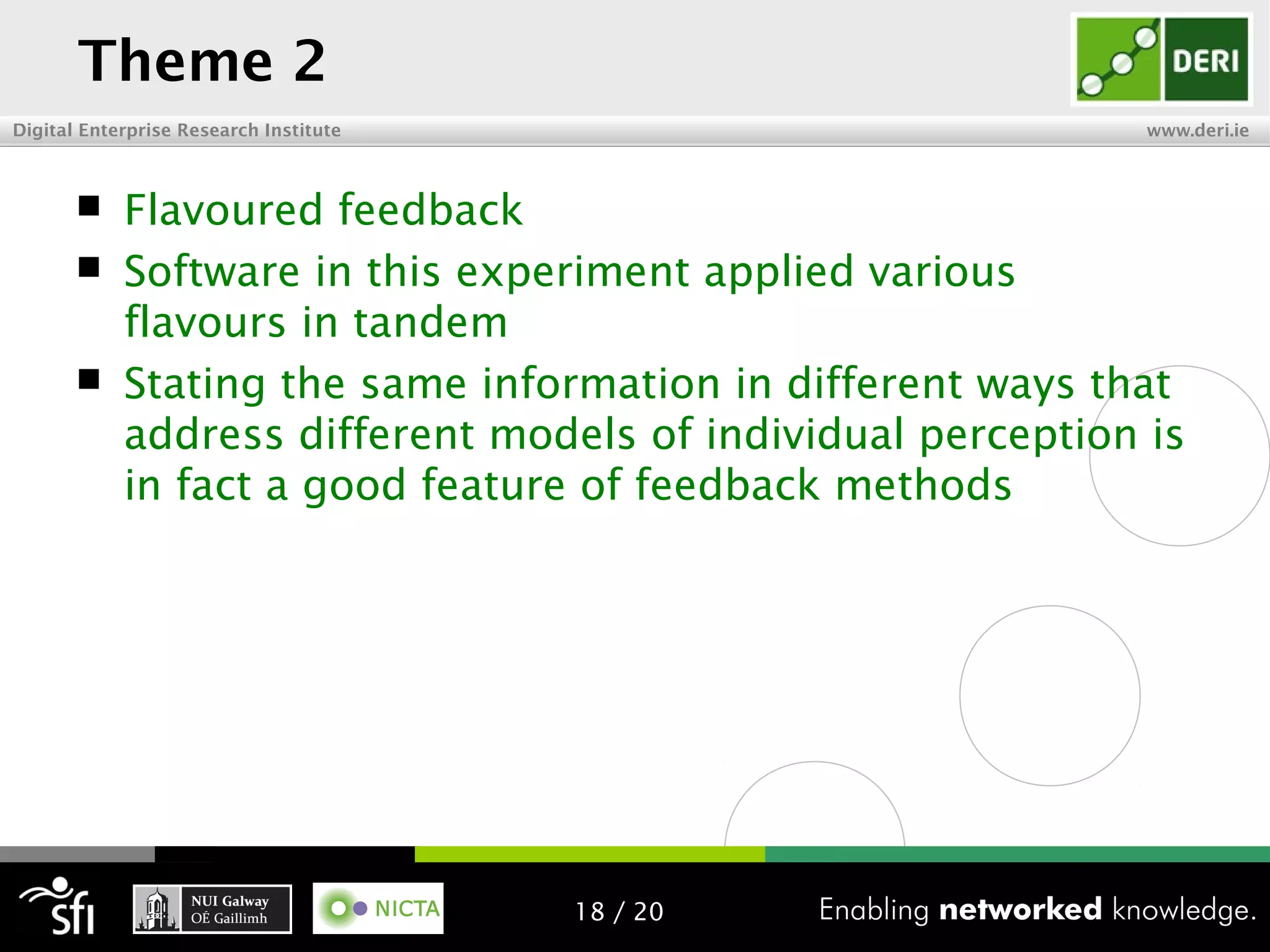
Theme 2
 Flavoured feedback
 Software in this experiment applied various
flavours in tandem
 Stating the same information in different ways that
address different models of individual perception is
in fact a good feature of feedback methods
18 / 20
Digital Enterprise Research Institute www.deri.ie
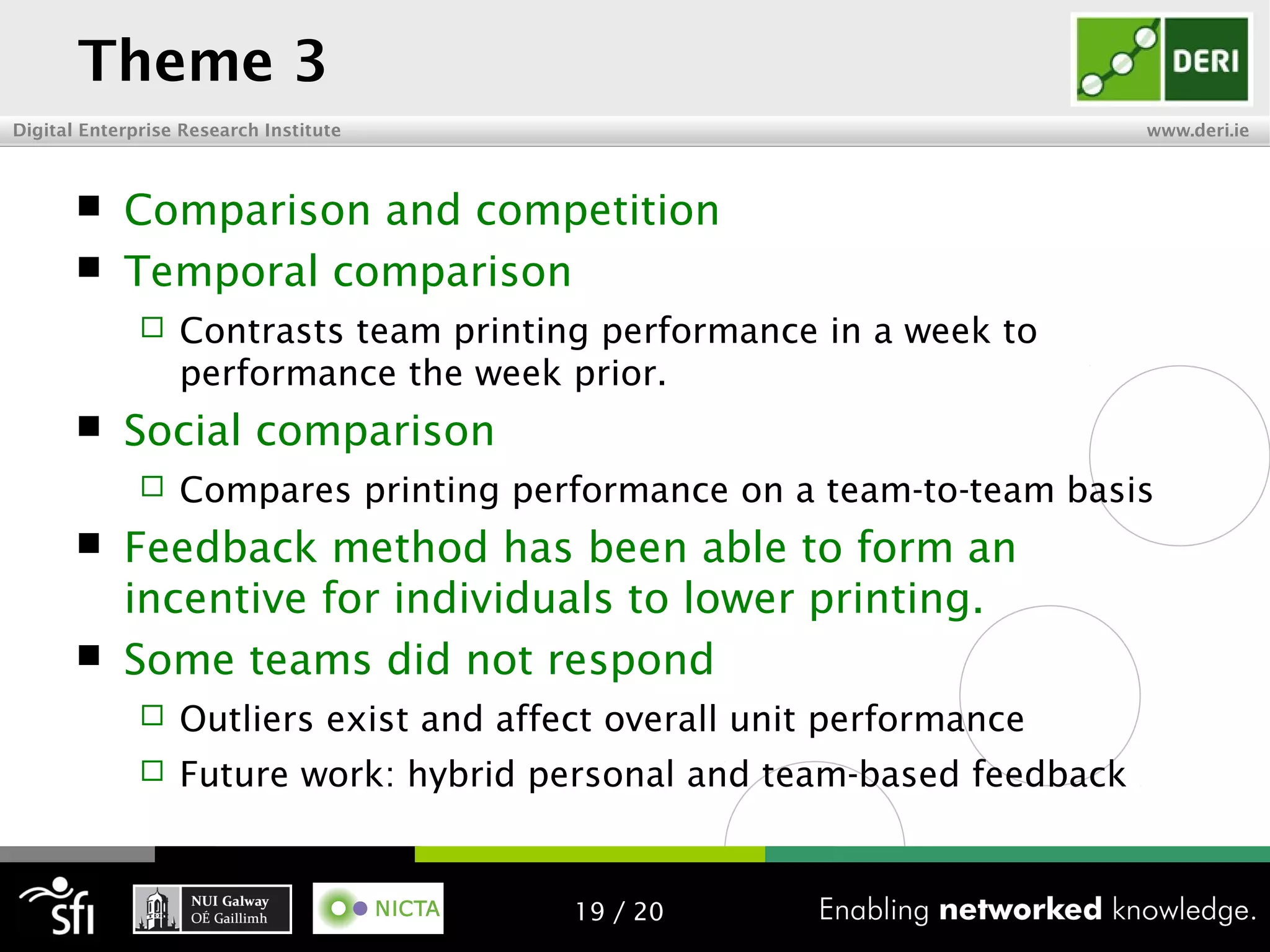
Theme 3
 Comparison and competition
 Temporal comparison
 Contrasts team printing performance in a week to
performance the week prior.
 Social comparison
 Compares printing performance on a team-to-team basis
 Feedback method has been able to form an
incentive for individuals to lower printing.
 Some teams did not respond
 Outliers exist and affect overall unit performance
 Future work: hybrid personal and team-based feedback
19 / 20
Digital Enterprise Research Institute www.deri.ie
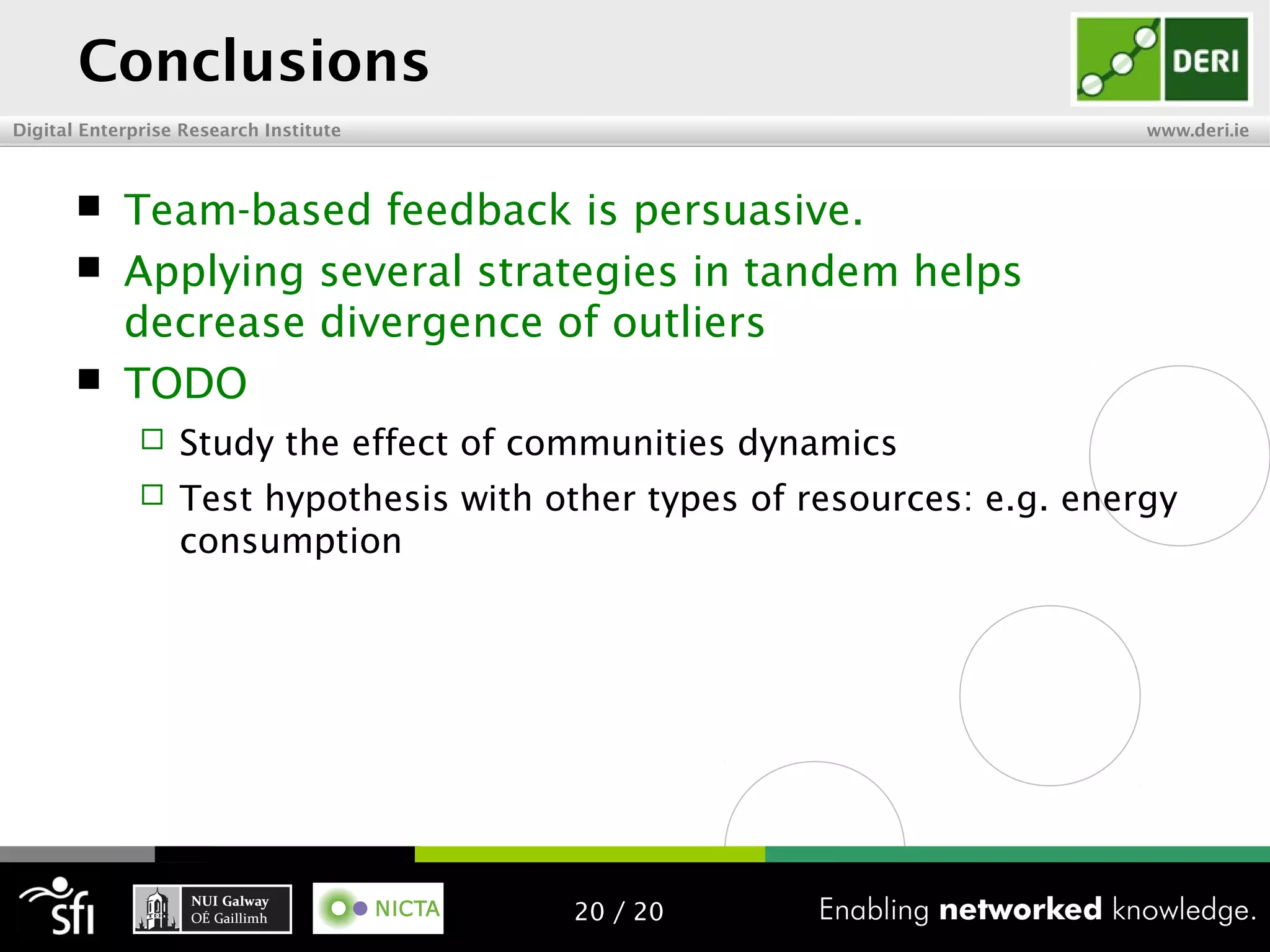
Conclusions
 Team-based feedback is persuasive.
 Applying several strategies in tandem helps
decrease divergence of outliers
 TODO
 Study the effect of communities dynamics
 Test hypothesis with other types of resources: e.g. energy
consumption
20 / 20

Curbing Resource Consumption Using Team Based Feedback

  • 1.
    © Copyright 2010Digital Enterprise Research Institute. All rights reserved. Digital Enterprise Research Institute www.deri.ie Curbing Resource Consumption Using Team-Based Feedback Souleiman Hasan1 , Richard Medland2 , Marcus Foth2 , Edward Curry1 1 Digital Enterprise Research Institute, National University of Ireland, Galway, Ireland 2 Urban Informatics Research Lab, Queensland University of Technology & NICTA, Australia Stefan.Decker@deri.org http://www.StefanDecker.org/ In proceedings of The 8th International Conference on Persuasive Technology (2013), Sydney, Australia.
  • 2.
    Digital Enterprise ResearchInstitute www.deri.ie Outline  Motivation and Background  Paper consumption  Previous work and research question  Individual vs. team-based feedback  Experiment Setting  Environment  Print monitoring  Persuasive strategies  Procedure  Results and Discussion  Conclusions 2 / 20
  • 3.
    Digital Enterprise ResearchInstitute www.deri.ie Motivation  Of the global wood harvest for “industrial uses” 42% goes to paper production, a proportion expected to grow by more than 50 percent in the next 50 years. (Abramovitz, “Paper Cuts”, WorldWatch Institute, 1999, p. 124) 3 / 20
  • 4.
    Digital Enterprise ResearchInstitute www.deri.ie Previous Work & Question  Using flavoured feedback to curb paper printing (Medland et al., 2010)  Focused on individualistic feedback  Question: “Can membership in a group be leveraged to persuade individuals to change their behaviour, and hence the group overall behaviour?” 4 / 20
  • 5.
    Digital Enterprise ResearchInstitute www.deri.ie  Individual-based Feedback Individual vs. Team-based 5 / 20
  • 6.
    Digital Enterprise ResearchInstitute www.deri.ie  Team-based Feedback Individual vs. Team-based 6 / 20
  • 7.
    Digital Enterprise ResearchInstitute www.deri.ie Outline  Motivation and Background  Paper consumption  Previous work and research question  Individual vs. team-based feedback  Experiment Setting  Environment  Print monitoring  Persuasive strategies  Procedure  Results and Discussion  Conclusions 7 / 20
  • 8.
    Digital Enterprise ResearchInstitute www.deri.ie Case Study Environment  DERI  130 staff members  Interns, masters, PhDs, post-docs, research assistants, research fellows, senior research fellows, professors, technical staff, and administrative staff  20 organisational units  Reasons for printing – Administrative printing by administrative and research staff. – Printing research proposals, theses, academic and technical reports. – Printing academic papers for internal review and reading purposes. 8 / 20
  • 9.
    Digital Enterprise ResearchInstitute www.deri.ie Print Monitoring  Monitoring software on the print server 9 / 20
  • 10.
    Digital Enterprise ResearchInstitute www.deri.ie Persuasive Strategies  Informative  Traditional statistics  Eco-metric statistics  Social  Comparative  Competitive 10 / 20
  • 11.
    Digital Enterprise ResearchInstitute www.deri.ie Experimental Procedure  Data was aggregated and displayed weekly  October 2010- May 2011: Baseline (w 1-31,35)  May 2011- October 2011: Feedback provided (w31, 35-58)  Voluntary participants  Measure  Person proportional printing over all printing every week Team Members Unit 1 Members 1, 2, 3,4 Unit 2 Members 5, 6, 7, 8, 9, 10 Unit 3 Members 11, 12, 13 Unit 4 Members 14, 15, 16 11 / 20
  • 12.
    Digital Enterprise ResearchInstitute www.deri.ie Outline  Motivation and Background  Paper consumption  Previous work and research question  Individual vs. team-based feedback  Experiment Setting  Environment  Print monitoring  Persuasive strategies  Procedure  Results and Discussion  Conclusions 12 / 20
  • 13.
    Digital Enterprise ResearchInstitute www.deri.ie Results: Individual Printing 13 / 20
  • 14.
    Digital Enterprise ResearchInstitute www.deri.ie Results: Statistical Significance  Difference sample normally distributed  The Anderson-Darling test P-value = 0.343  Q-Q plot confirms normality  Paired t-test  Standard level of significance alpha = 0.05  P-value = 0.025  It is statistically significant to say that the feedback method helped decrease the individuals’ proportional printing after it was applied 14 / 20
  • 15.
    Digital Enterprise ResearchInstitute www.deri.ie Team Level Printing  All units except unit 2 reduced overall unit printing. 15 / 20
  • 16.
    Digital Enterprise ResearchInstitute www.deri.ie Discussion  Previous survey revealed three themes  Theme 1  Any printing conducted by staff was viewed as necessary, excepting accidents.  Theme 2  Staff viewed different metrics as relevant or alternatively, as unnecessary for feedback on printing behaviour.  Theme 3  Staff viewed co-workers championing reduced paper use as a helpful reminder to be conscious of how much they were printing. 16 / 20
  • 17.
    Digital Enterprise ResearchInstitute www.deri.ie Theme 1  All printing is necessary  About 31% of the participants – showed a slight increase in their proportional printing  Likely that the driving force behind the non- responsive people is Theme 1.  Any feedback method needs to address fully or partially this theme to get better results  e.g. by changing business processes 17 / 20
  • 18.
    Digital Enterprise ResearchInstitute www.deri.ie Theme 2  Flavoured feedback  Software in this experiment applied various flavours in tandem  Stating the same information in different ways that address different models of individual perception is in fact a good feature of feedback methods 18 / 20
  • 19.
    Digital Enterprise ResearchInstitute www.deri.ie Theme 3  Comparison and competition  Temporal comparison  Contrasts team printing performance in a week to performance the week prior.  Social comparison  Compares printing performance on a team-to-team basis  Feedback method has been able to form an incentive for individuals to lower printing.  Some teams did not respond  Outliers exist and affect overall unit performance  Future work: hybrid personal and team-based feedback 19 / 20
  • 20.
    Digital Enterprise ResearchInstitute www.deri.ie Conclusions  Team-based feedback is persuasive.  Applying several strategies in tandem helps decrease divergence of outliers  TODO  Study the effect of communities dynamics  Test hypothesis with other types of resources: e.g. energy consumption 20 / 20