
User Assistance Systems
Prof. Dr. Alexander Mädche, University of Mannheim
SAP Series, Rethinking Business and IT
Walldorf, June 19th 2015
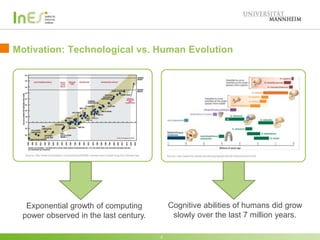
Motivation: Technological vs. Human Evolution
2
Cognitive abilities of humans did grow
slowly over the last 7 million years.
Exponential growth of computing
power observed in the last century.
Source: http://www.bio.utexas.edu/faculty/sjasper/Bio301M/humanevol.htmlSource: http://www.extremetech.com/extreme/203490-moores-law-is-dead-long-live-moores-law
Motivation: Software-intensive Systems in Enterprises
3
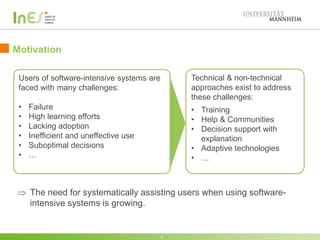
Technical & non-technical
approaches exist to address
these challenges:
• Training
• Help & Communities
• Decision support with
explanation
• Adaptive technologies
• …
Users of software-intensive systems are
faced with many challenges:
• Failure
• High learning efforts
• Lacking adoption
• Inefficient and uneffective use
• Suboptimal decisions
• …
 The need for systematically assisting users when using software-
intensive systems in enterprises is growing.
Agenda
4
Agenda
1 Motivation
2 What are User Assistance Systems?
3 Selected Research Examples
4 Outlook & Summary
4
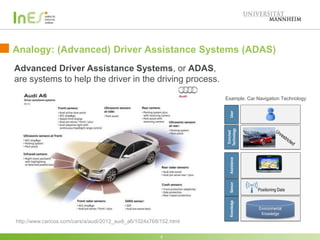
Analogy: (Advanced) Driver Assistance Systems (ADAS)
5
http://www.caricos.com/cars/a/audi/2012_audi_a6/1024x768/152.html
Advanced Driver Assistance Systems, or ADAS,
are systems to help the driver in the driving process.
AssistanceSensorKnowledge
Environmental
Knowledge
Positioning Data
Enriched
Technology
User
Example: Car Navigation Technology
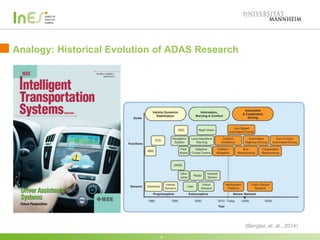
Analogy: Historical Evolution of ADAS Research
6
(Bengler, et. al., 2014)
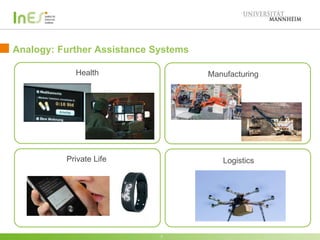
Analogy: Further Assistance Systems
7
Health
Private Life
Manufacturing
Logistics
Definition: (Advanced) User Assistance Systems
8
(Advanced) user assistance systems provide
intelligence and automation capabilities for users
of software-intensive systems leveraging different
types of data sources and user interaction.
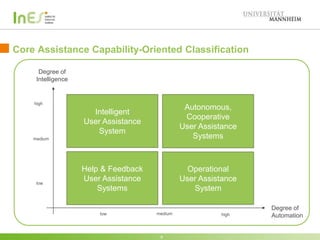
Core Assistance Capability-Oriented Classification
9
Degree of
Intelligence
Degree of
Automation
low
high
medium
low medium high
Intelligent
User Assistance
System
Autonomous,
Cooperative
User Assistance
Systems
Help & Feedback
User Assistance
Systems
Operational
User Assistance
System
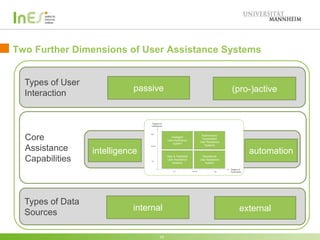
Two Further Dimensions of User Assistance Systems
10
Types of Data
Sources
internal external
Types of User
Interaction
passive (pro-)active
Core
Assistance
Capabilities
intelligence automation
Degree of
Intelligence
Degree of
Automation
low
high
medium
low medium high
Intelligent
User Assistance
System
Autonomous,
Cooperative
User Assistance
Systems
Help & Feedback
User Assistance
Systems
Operational
User Assistance
System
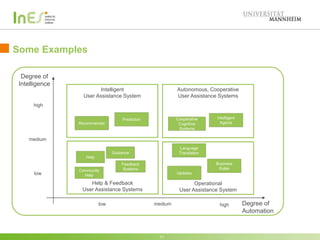
Some Examples
11
Degree of
Intelligence
Degree of
Automation
low
high
medium
low medium high
Intelligent
User Assistance System
Autonomous, Cooperative
User Assistance Systems
Help & Feedback
User Assistance Systems
Operational
User Assistance System
Help
Community
Help
Guidance
Recommender
Prediction Intelligent
Agents
Business
Rules
Updates
Feedback
Systems
Cooperative
Cognitive
Systems
Language
Translation
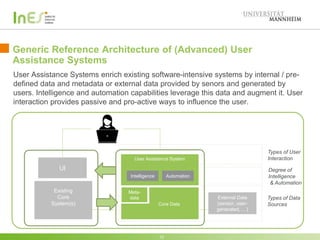
Generic Reference Architecture of (Advanced) User
Assistance Systems
12
Existing
Core
System(s)
External Data
(sensor, user-
generated, …)
UI
User Assistance System
Intelligence
Meta-
data
Core Data
Automation
Types of Data
Sources
Types of User
Interaction
Degree of
Intelligence
& Automation
User Assistance Systems enrich existing software-intensive systems by internal / pre-
defined data and metadata or external data provided by sensors and generated by
users. Intelligence and automation capabilities leverage this data and augment it. User
interaction provides passive and pro-active ways to influence the user.
Agenda
13
Agenda
1 Motivation
2 What are User Assistance Systems?
3 Selected Research Examples
4 Outlook & Summary
13
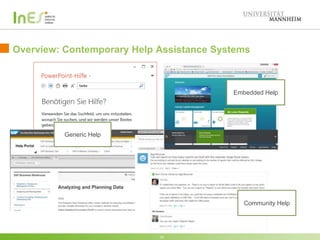
Overview: Contemporary Help Assistance Systems
14
Embedded Help
Generic Help
Community Help
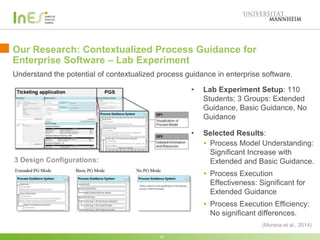
Our Research: Contextualized Process Guidance for
Enterprise Software – Lab Experiment
15
(Morana et al., 2014)
• Lab Experiment Setup: 110
Students; 3 Groups: Extended
Guidance, Basic Guidance, No
Guidance
• Selected Results:
• Process Model Understanding:
Significant Increase with
Extended and Basic Guidance.
• Process Execution
Effectiveness: Significant for
Extended Guidance
• Process Execution Efficiency:
No significant differences.
3 Design Configurations:
Understand the potential of contextualized process guidance in enterprise software.
Our Research: Contextualized Process Guidance for
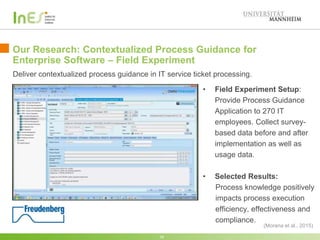
Enterprise Software – Field Experiment
16
(Morana et al., 2015)
• Field Experiment Setup:
Provide Process Guidance
Application to 270 IT
employees. Collect survey-
based data before and after
implementation as well as
usage data.
• Selected Results:
Process knowledge positively
impacts process execution
efficiency, effectiveness and
compliance.
Deliver contextualized process guidance in IT service ticket processing.
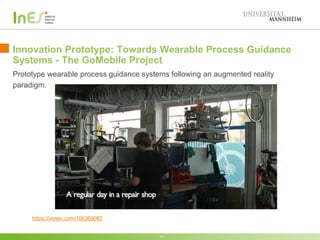
Innovation Prototype: Towards Wearable Process Guidance
Systems - The GoMobile Project
17
https://vimeo.com/106369083
Prototype wearable process guidance systems following an augmented reality
paradigm.
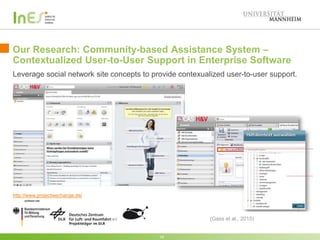
Our Research: Community-based Assistance System –
Contextualized User-to-User Support in Enterprise Software
18
(Gass et al., 2015)
http://www.projectwechange.de/
Leverage social network site concepts to provide contexualized user-to-user support.
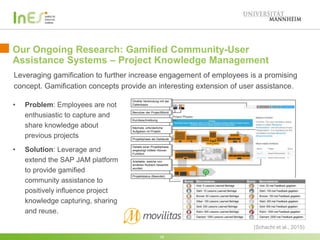
Our Ongoing Research: Gamified Community-User
Assistance Systems – Project Knowledge Management
19
Benutzer der ProjectWorld
Projektphase als Gebäude
Kurzbeschreibung
Projektstatus (Beendet)
Direkte Verbindung mit der
Datenbasis
Nächste, erforderliche
Aufgaben im Projekt
Artefakte, welche von
anderen Nutzern bewertet
wurden
Details einer Projektphase
angezeigt mittels Hoover
Funktion
Leveraging gamification to further increase engagement of employees is a promising
concept. Gamification concepts provide an interesting extension of user assistance.
• Problem: Employees are not
enthusiastic to capture and
share knowledge about
previous projects
• Solution: Leverage and
extend the SAP JAM platform
to provide gamified
community assistance to
positively influence project
knowledge capturing, sharing
and reuse.
(Schacht et al., 2015)
Our Ongoing Research: Intelligent Feedback User
Assistance Systems - Energy consumption behavior change
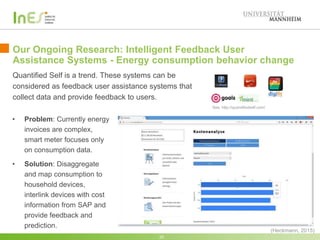
Quantified Self is a trend. These systems can be
considered as feedback user assistance systems that
collect data and provide feedback to users.
20
See: http://quantifiedself.com/
• Problem: Currently energy
invoices are complex,
smart meter focuses only
on consumption data.
• Solution: Disaggregate
and map consumption to
household devices,
interlink devices with cost
information from SAP and
provide feedback and
prediction.
(Heckmann, 2015)
Our Ongoing Research: Intelligent User Assistance Systems
- Report Recommendation in Business Intelligence
21
(Kretzer et al. 2015)
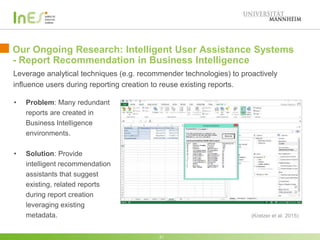
• Problem: Many redundant
reports are created in
Business Intelligence
environments.
• Solution: Provide
intelligent recommendation
assistants that suggest
existing, related reports
during report creation
leveraging existing
metadata.
Leverage analytical techniques (e.g. recommender technologies) to proactively
influence users during reporting creation to reuse existing reports.
Agenda
22
Agenda
1 Motivation
2 What are User Assistance Systems?
3 Selected Research Examples
4 Outlook & Summary
22
Outlook: Countdown to Singularity?
23
Source: http://www.singularity.com/images/charts/ExponentialGrowthofComputing.jpg
Scenario 1:
Technology takes
over.
Scenario 2:
Evolution of an
advanced human –
technology
cooperation
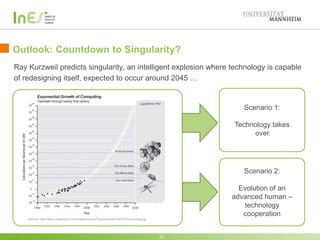
Ray Kurzweil predicts singularity, an intelligent explosion where technology is capable
of redesigning itself, expected to occur around 2045 …
Summary
24
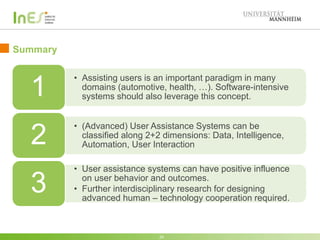
• Assisting users is an important paradigm in many
domains (automotive, health, …). Software-intensive
systems should also leverage this concept.1
• (Advanced) User Assistance Systems can be
classified along four dimensions: Data, Intelligence,
Automation, User Interaction2
• User assistance systems can have positive influence
on user behavior and outcomes.
• Further interdisciplinary research for designing
advanced human – technology cooperation required.
3
Thank you for your attention!
25
Prof. Dr. Alexander Mädche
University of Mannheim | Business School
Institute for Enterprise Systems (InES)
L 15, 1-6 | 4th floor | 68131 Mannheim | Germany
Phone +49 621 181-3606 | Fax +49 621 181-3627
maedche@es.uni-mannheim.de
http://eris.bwl.uni-mannheim.de
http://ines.uni-mannheim.de
References
Bengler, K., Dietmeyer, K., Färber, B., Maurer, M., Stiller, C., & Winner, H. (2014). Three Decades of Driver Assistance
Systems: Review and Future Perspectives. IEEE Intelligent Transportation Systems, October 2014,
doi:10.1109/MITS.2014.2336271
Gass, O., Öztürk, G., Schacht, S. and Maedche, A. (2015). “Designing an Enterprise Social Questions and Answers Site
to Enable Scalable User-to-User Support.” in: DESRIST 2015 Proceedings.
Kretzer, M., Kleinedler, M., Theilemann, C. and Maedche, A. (2015). Designing a Report Recommendation Assistant: A
First Design Cycle. To appear in: DESRIST 2015 Proceedings.
Morana, S., Schacht, S., Scherp, A., and Maedche, A. (2014). "Designing a Process Guidance System to Support User’s
Business Process Compliance," in ICIS 2014 Proceedings.
Morana,S., Gerards, T., and Maedche, A. (2015). “ITSM ProcessGuide – A Longitudinal and Multi-Method Field Study
for Real-World DSR Artifact Evaluation.” in: DESRIST 2015 Proceedings.
Heckmann, Carl. (2015). “SMARTICITY – A Feedback System for Energy Consumption and Costs”, in: Energy, Science,
Technology Conference, Karlsruhe.
Schacht, S., Reindl, A., Morana, S., and Maedche, A. (2015). „Projekterfahrungen spielend einfach mit der Pro-
jectWorld! – Ein gamifiziertes Projektwissensmanagementsystem“. Arbeitspapier, Institut für Enterprise Systems,
Universität Mannheim.
26
Attribution
The Noun Project (http://thenounproject.com/)
 User from Wilson Joseph
27

User Assistance Systems

  • 1.
    User Assistance Systems Prof.Dr. Alexander Mädche, University of Mannheim SAP Series, Rethinking Business and IT Walldorf, June 19th 2015
  • 2.
    Motivation: Technological vs.Human Evolution 2 Cognitive abilities of humans did grow slowly over the last 7 million years. Exponential growth of computing power observed in the last century. Source: http://www.bio.utexas.edu/faculty/sjasper/Bio301M/humanevol.htmlSource: http://www.extremetech.com/extreme/203490-moores-law-is-dead-long-live-moores-law
  • 3.
    Motivation: Software-intensive Systemsin Enterprises 3 Technical & non-technical approaches exist to address these challenges: • Training • Help & Communities • Decision support with explanation • Adaptive technologies • … Users of software-intensive systems are faced with many challenges: • Failure • High learning efforts • Lacking adoption • Inefficient and uneffective use • Suboptimal decisions • …  The need for systematically assisting users when using software- intensive systems in enterprises is growing.
  • 4.
    Agenda 4 Agenda 1 Motivation 2 Whatare User Assistance Systems? 3 Selected Research Examples 4 Outlook & Summary 4
  • 5.
    Analogy: (Advanced) DriverAssistance Systems (ADAS) 5 http://www.caricos.com/cars/a/audi/2012_audi_a6/1024x768/152.html Advanced Driver Assistance Systems, or ADAS, are systems to help the driver in the driving process. AssistanceSensorKnowledge Environmental Knowledge Positioning Data Enriched Technology User Example: Car Navigation Technology
  • 6.
    Analogy: Historical Evolutionof ADAS Research 6 (Bengler, et. al., 2014)
  • 7.
    Analogy: Further AssistanceSystems 7 Health Private Life Manufacturing Logistics
  • 8.
    Definition: (Advanced) UserAssistance Systems 8 (Advanced) user assistance systems provide intelligence and automation capabilities for users of software-intensive systems leveraging different types of data sources and user interaction.
  • 9.
    Core Assistance Capability-OrientedClassification 9 Degree of Intelligence Degree of Automation low high medium low medium high Intelligent User Assistance System Autonomous, Cooperative User Assistance Systems Help & Feedback User Assistance Systems Operational User Assistance System
  • 10.
    Two Further Dimensionsof User Assistance Systems 10 Types of Data Sources internal external Types of User Interaction passive (pro-)active Core Assistance Capabilities intelligence automation Degree of Intelligence Degree of Automation low high medium low medium high Intelligent User Assistance System Autonomous, Cooperative User Assistance Systems Help & Feedback User Assistance Systems Operational User Assistance System
  • 11.
    Some Examples 11 Degree of Intelligence Degreeof Automation low high medium low medium high Intelligent User Assistance System Autonomous, Cooperative User Assistance Systems Help & Feedback User Assistance Systems Operational User Assistance System Help Community Help Guidance Recommender Prediction Intelligent Agents Business Rules Updates Feedback Systems Cooperative Cognitive Systems Language Translation
  • 12.
    Generic Reference Architectureof (Advanced) User Assistance Systems 12 Existing Core System(s) External Data (sensor, user- generated, …) UI User Assistance System Intelligence Meta- data Core Data Automation Types of Data Sources Types of User Interaction Degree of Intelligence & Automation User Assistance Systems enrich existing software-intensive systems by internal / pre- defined data and metadata or external data provided by sensors and generated by users. Intelligence and automation capabilities leverage this data and augment it. User interaction provides passive and pro-active ways to influence the user.
  • 13.
    Agenda 13 Agenda 1 Motivation 2 Whatare User Assistance Systems? 3 Selected Research Examples 4 Outlook & Summary 13
  • 14.
    Overview: Contemporary HelpAssistance Systems 14 Embedded Help Generic Help Community Help
  • 15.
    Our Research: ContextualizedProcess Guidance for Enterprise Software – Lab Experiment 15 (Morana et al., 2014) • Lab Experiment Setup: 110 Students; 3 Groups: Extended Guidance, Basic Guidance, No Guidance • Selected Results: • Process Model Understanding: Significant Increase with Extended and Basic Guidance. • Process Execution Effectiveness: Significant for Extended Guidance • Process Execution Efficiency: No significant differences. 3 Design Configurations: Understand the potential of contextualized process guidance in enterprise software.
  • 16.
    Our Research: ContextualizedProcess Guidance for Enterprise Software – Field Experiment 16 (Morana et al., 2015) • Field Experiment Setup: Provide Process Guidance Application to 270 IT employees. Collect survey- based data before and after implementation as well as usage data. • Selected Results: Process knowledge positively impacts process execution efficiency, effectiveness and compliance. Deliver contextualized process guidance in IT service ticket processing.
  • 17.
    Innovation Prototype: TowardsWearable Process Guidance Systems - The GoMobile Project 17 https://vimeo.com/106369083 Prototype wearable process guidance systems following an augmented reality paradigm.
  • 18.
    Our Research: Community-basedAssistance System – Contextualized User-to-User Support in Enterprise Software 18 (Gass et al., 2015) http://www.projectwechange.de/ Leverage social network site concepts to provide contexualized user-to-user support.
  • 19.
    Our Ongoing Research:Gamified Community-User Assistance Systems – Project Knowledge Management 19 Benutzer der ProjectWorld Projektphase als Gebäude Kurzbeschreibung Projektstatus (Beendet) Direkte Verbindung mit der Datenbasis Nächste, erforderliche Aufgaben im Projekt Artefakte, welche von anderen Nutzern bewertet wurden Details einer Projektphase angezeigt mittels Hoover Funktion Leveraging gamification to further increase engagement of employees is a promising concept. Gamification concepts provide an interesting extension of user assistance. • Problem: Employees are not enthusiastic to capture and share knowledge about previous projects • Solution: Leverage and extend the SAP JAM platform to provide gamified community assistance to positively influence project knowledge capturing, sharing and reuse. (Schacht et al., 2015)
  • 20.
    Our Ongoing Research:Intelligent Feedback User Assistance Systems - Energy consumption behavior change Quantified Self is a trend. These systems can be considered as feedback user assistance systems that collect data and provide feedback to users. 20 See: http://quantifiedself.com/ • Problem: Currently energy invoices are complex, smart meter focuses only on consumption data. • Solution: Disaggregate and map consumption to household devices, interlink devices with cost information from SAP and provide feedback and prediction. (Heckmann, 2015)
  • 21.
    Our Ongoing Research:Intelligent User Assistance Systems - Report Recommendation in Business Intelligence 21 (Kretzer et al. 2015) • Problem: Many redundant reports are created in Business Intelligence environments. • Solution: Provide intelligent recommendation assistants that suggest existing, related reports during report creation leveraging existing metadata. Leverage analytical techniques (e.g. recommender technologies) to proactively influence users during reporting creation to reuse existing reports.
  • 22.
    Agenda 22 Agenda 1 Motivation 2 Whatare User Assistance Systems? 3 Selected Research Examples 4 Outlook & Summary 22
  • 23.
    Outlook: Countdown toSingularity? 23 Source: http://www.singularity.com/images/charts/ExponentialGrowthofComputing.jpg Scenario 1: Technology takes over. Scenario 2: Evolution of an advanced human – technology cooperation Ray Kurzweil predicts singularity, an intelligent explosion where technology is capable of redesigning itself, expected to occur around 2045 …
  • 24.
    Summary 24 • Assisting usersis an important paradigm in many domains (automotive, health, …). Software-intensive systems should also leverage this concept.1 • (Advanced) User Assistance Systems can be classified along four dimensions: Data, Intelligence, Automation, User Interaction2 • User assistance systems can have positive influence on user behavior and outcomes. • Further interdisciplinary research for designing advanced human – technology cooperation required. 3
  • 25.
    Thank you foryour attention! 25 Prof. Dr. Alexander Mädche University of Mannheim | Business School Institute for Enterprise Systems (InES) L 15, 1-6 | 4th floor | 68131 Mannheim | Germany Phone +49 621 181-3606 | Fax +49 621 181-3627 maedche@es.uni-mannheim.de http://eris.bwl.uni-mannheim.de http://ines.uni-mannheim.de
  • 26.
    References Bengler, K., Dietmeyer,K., Färber, B., Maurer, M., Stiller, C., & Winner, H. (2014). Three Decades of Driver Assistance Systems: Review and Future Perspectives. IEEE Intelligent Transportation Systems, October 2014, doi:10.1109/MITS.2014.2336271 Gass, O., Öztürk, G., Schacht, S. and Maedche, A. (2015). “Designing an Enterprise Social Questions and Answers Site to Enable Scalable User-to-User Support.” in: DESRIST 2015 Proceedings. Kretzer, M., Kleinedler, M., Theilemann, C. and Maedche, A. (2015). Designing a Report Recommendation Assistant: A First Design Cycle. To appear in: DESRIST 2015 Proceedings. Morana, S., Schacht, S., Scherp, A., and Maedche, A. (2014). "Designing a Process Guidance System to Support User’s Business Process Compliance," in ICIS 2014 Proceedings. Morana,S., Gerards, T., and Maedche, A. (2015). “ITSM ProcessGuide – A Longitudinal and Multi-Method Field Study for Real-World DSR Artifact Evaluation.” in: DESRIST 2015 Proceedings. Heckmann, Carl. (2015). “SMARTICITY – A Feedback System for Energy Consumption and Costs”, in: Energy, Science, Technology Conference, Karlsruhe. Schacht, S., Reindl, A., Morana, S., and Maedche, A. (2015). „Projekterfahrungen spielend einfach mit der Pro- jectWorld! – Ein gamifiziertes Projektwissensmanagementsystem“. Arbeitspapier, Institut für Enterprise Systems, Universität Mannheim. 26
  • 27.
    Attribution The Noun Project(http://thenounproject.com/)  User from Wilson Joseph 27

Editor's Notes

  • #10 AI: ability of a system to act appropriately in an uncertain environment, Intelligent System: An application of AI to a particular problem domain. Perform useful functions driven by desired goals and current knowledge • Emulate biological and cognitive processes • Process information to achieve objectives • Learn by example or from experience • Adapt functions to a changing environment Autonomy: The ability of an intelligent system to independently compose and select among different courses of action to accomplish goals based on its knowledge and understanding of the world, itself, and the situation. Automation: Automation emphasizes efficiency, productivity, quality, and reliability, focusing on systems that operate without direct control, often in structured environments over extended periods, and on the explicit structuring of such environments.
  • #12 AI: ability of a system to act appropriately in an uncertain environment, Intelligent System: An application of AI to a particular problem domain. Perform useful functions driven by desired goals and current knowledge • Emulate biological and cognitive processes • Process information to achieve objectives • Learn by example or from experience • Adapt functions to a changing environment Autonomy: The ability of an intelligent system to independently compose and select among different courses of action to accomplish goals based on its knowledge and understanding of the world, itself, and the situation. Automation: Automation emphasizes efficiency, productivity, quality, and reliability, focusing on systems that operate without direct control, often in structured environments over extended periods, and on the explicit structuring of such environments.