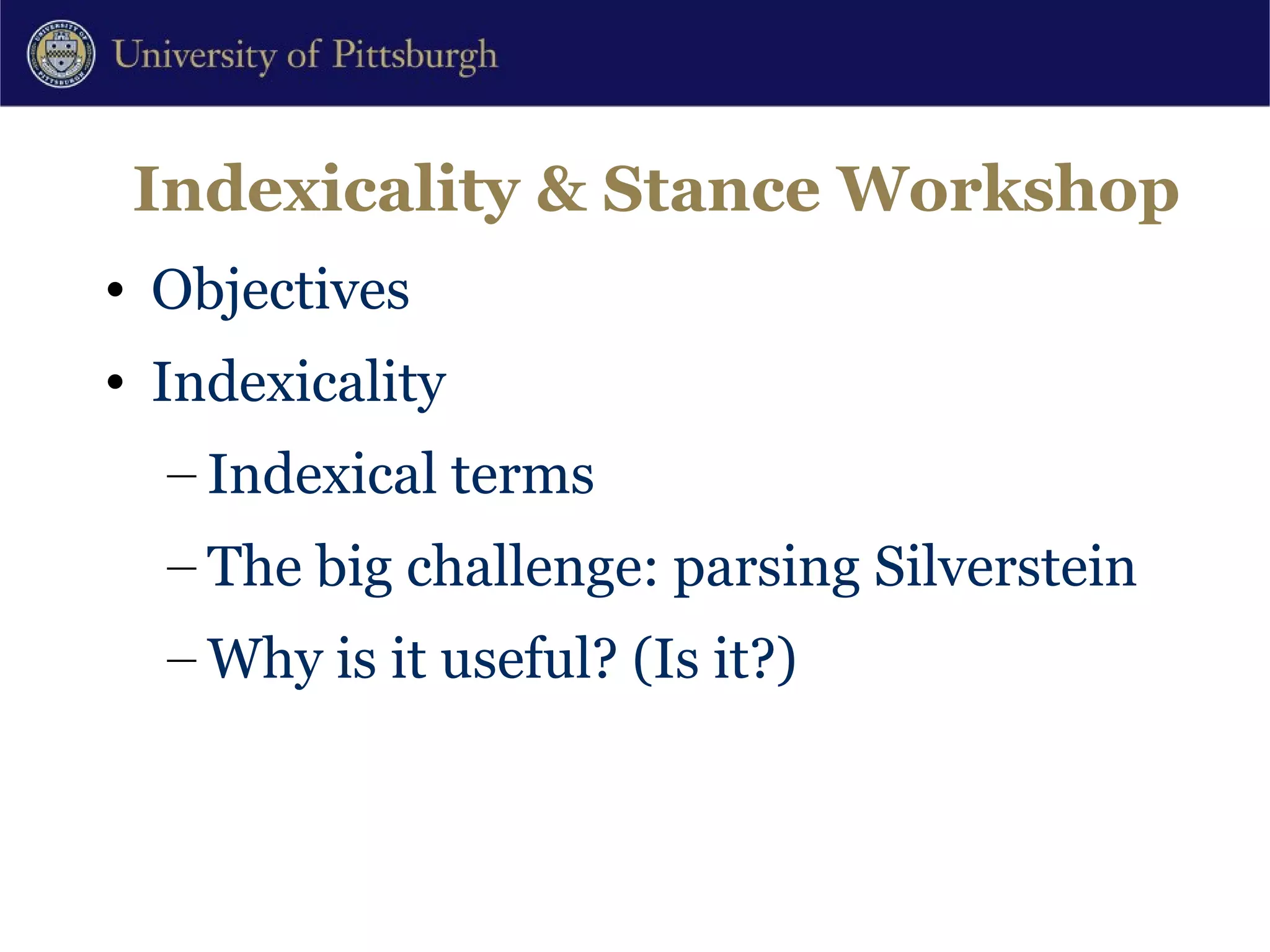
Indexicality & Stance Workshop Objectives Indexicality Indexical terms The big challenge: parsing Silverstein Why is it useful? (Is it?)
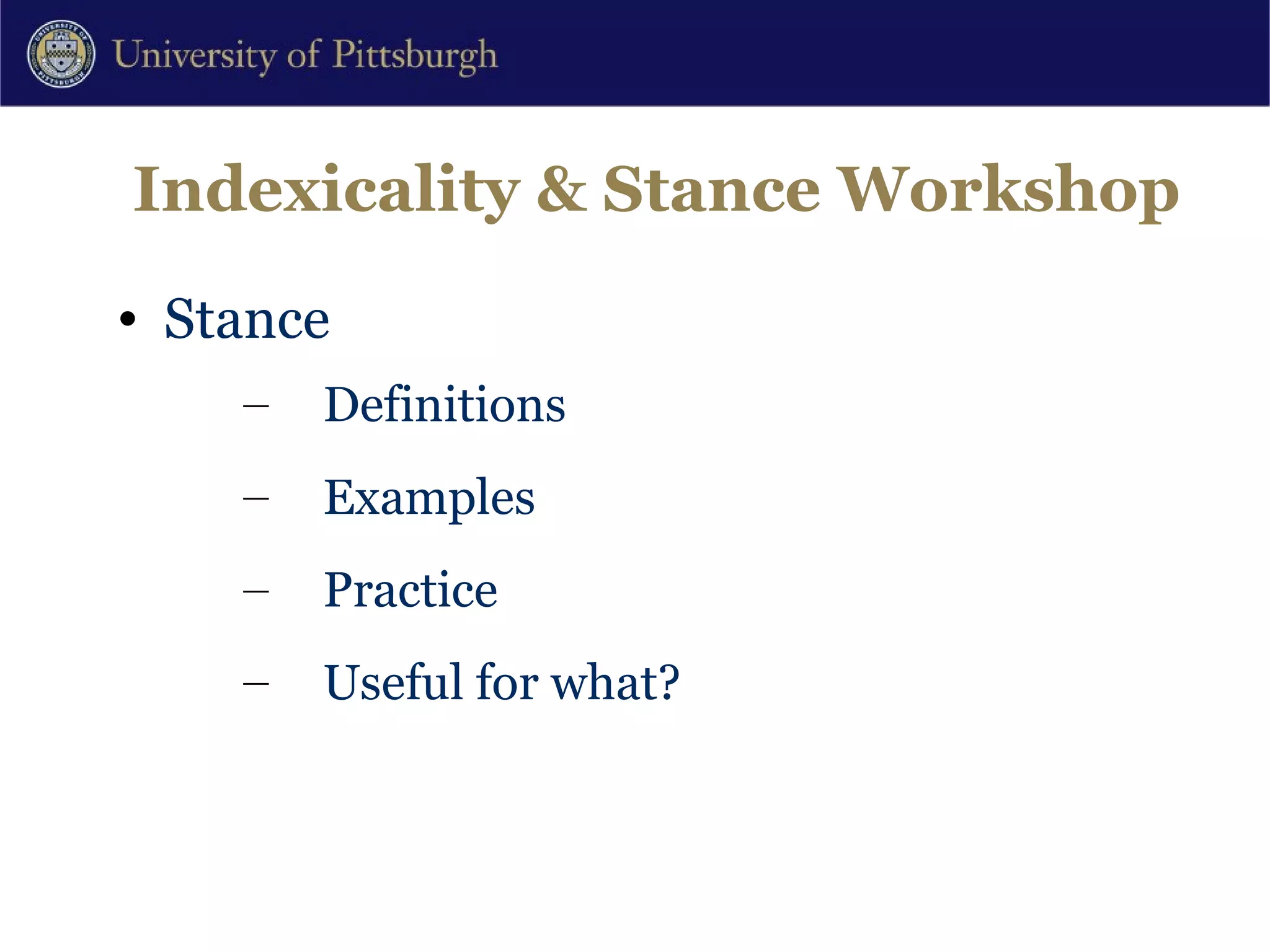
Indexicality & Stance Workshop Stance Definitions Examples Practice Useful for what?
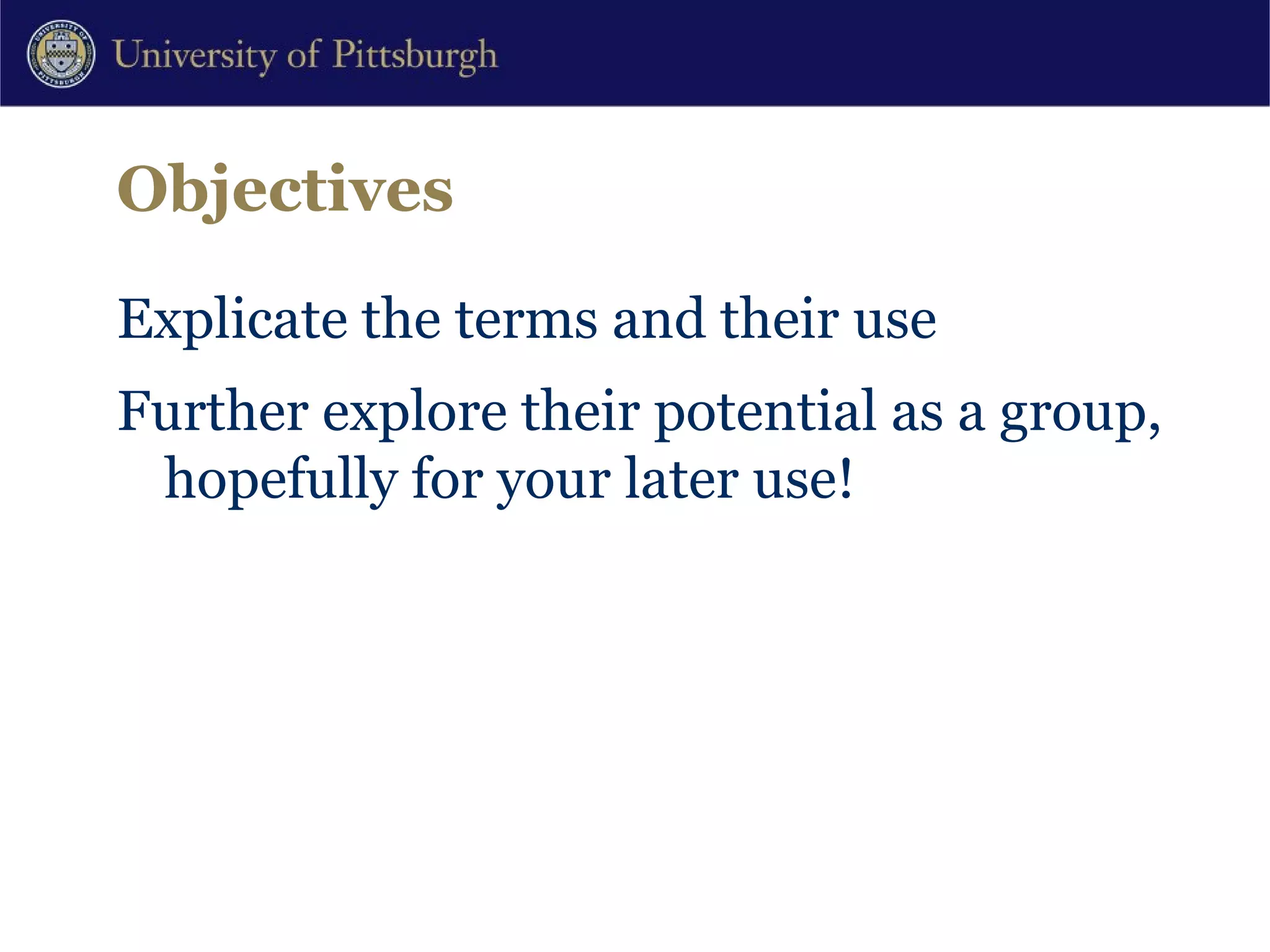
Objectives Explicate the terms and their use Further explore their potential as a group, hopefully for your later use!
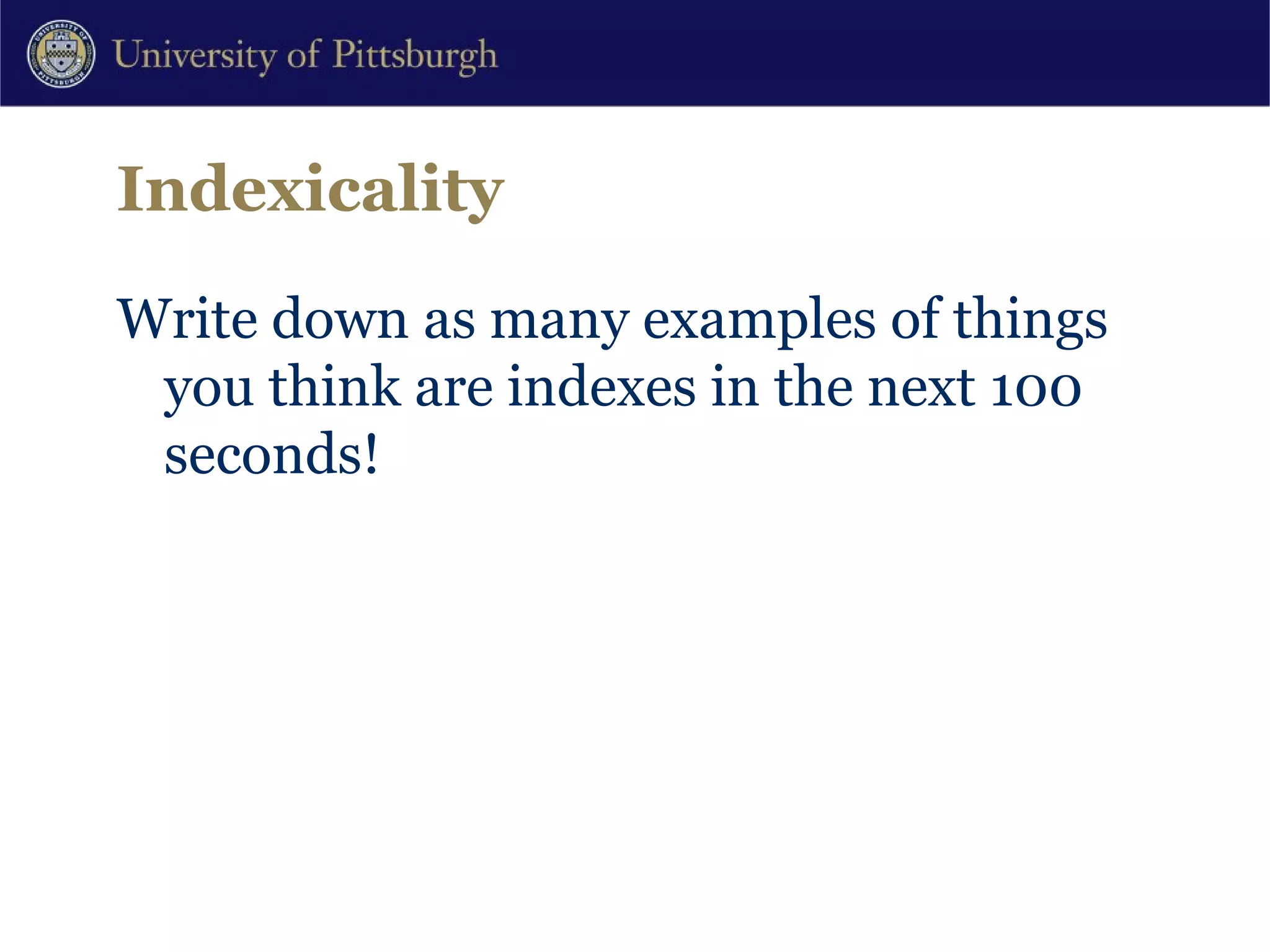
Indexicality Write down as many examples of things you think are indexes in the next 100 seconds!
Indexicality What questions do you have about indexicality?
Terms in Peircean meaning Icon : a sign vehicle that resembles that which it signifies. buzz, or rising intonation in some cases Symbol : meaning depends entirely on an abstract arbitrary connection Index : “‘pure’ indexes are features of speech which, independent of any referential speech events that may be occurring, signal some particular value of one or more contextual variables.” Silverstein (1995[1976]:201) Shifters : referential indexes which have rules of use that gain reference only in context (tense, place deixis)
Terms in Peircean meaning 76 Definitions of The Sign by C. S. Peirce collected and analyzed by Robert Marty Department of Mathematics University of Perpignan Perpignan, France With an Appendix of 12 Further Definitions or Equivalents proposed by Alfred Lang Dept of Psychology University of Bern Bern, Switzerland http://www.cspeirce.com/menu/library/rsources/76defs/76defs.htm
Big Questions How and why  are indexical meanings  realised?
Presupposing and creative presupposing : assumes (follows) rules of use (e.g., this chair and that chair) creative or performative -- entailment : make explicit and overt the parameters of the ongoing event (English pronouns, esp. 2p) Examples??
Indexical orders Similar to Labovian ‘awareness’ although discussed in terms of metapragmatic discourse and less reliant on widely shared norms in the speech community.  A process of conventionalization. As you go up indexical orders, they have more creative effects.
To the text! Silverstein, Michael. 2003. Indexical order and the dialectics of sociolinguistic life.  Language & Communication , 23: 193-229.
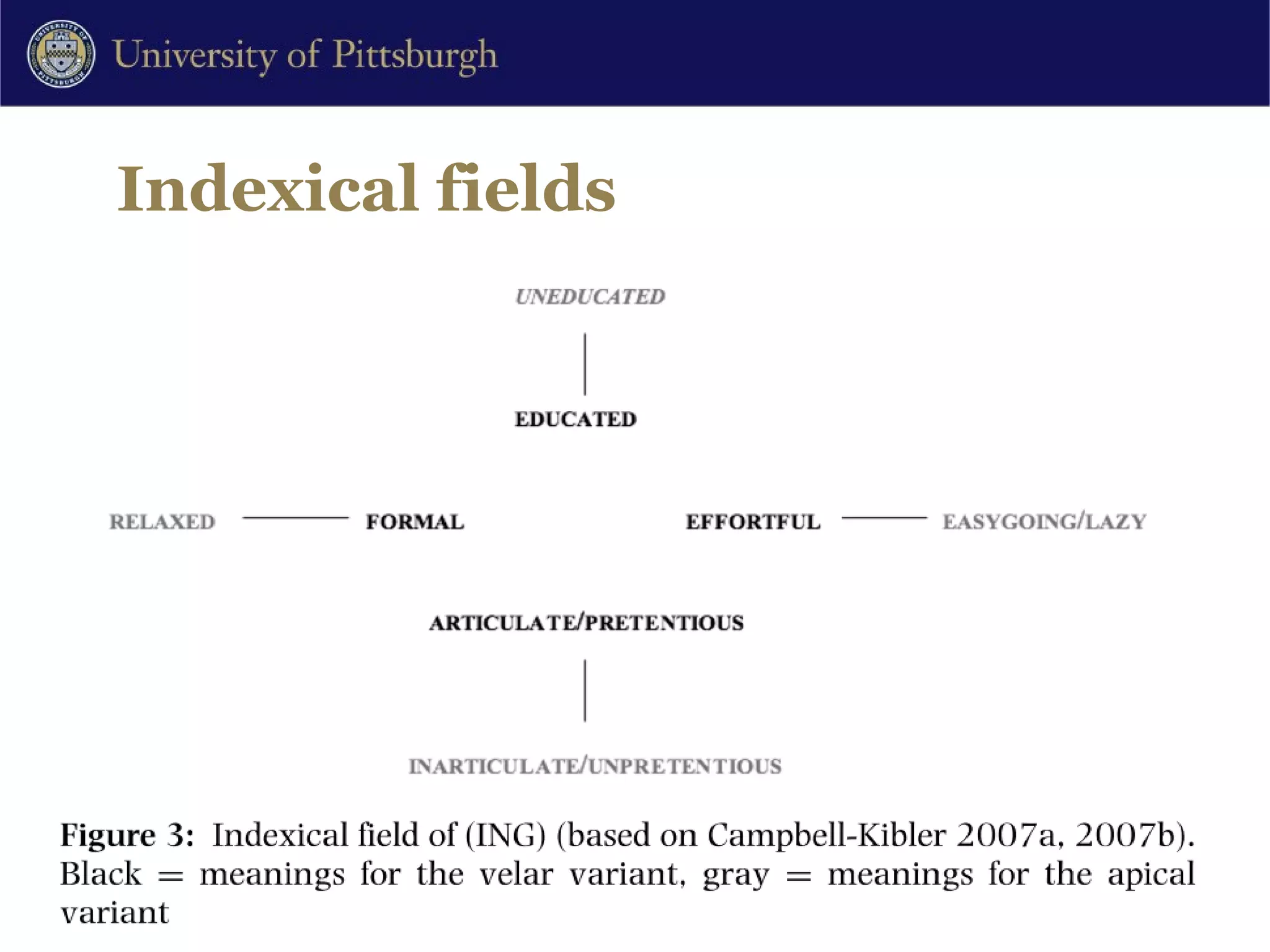
Indexical fields (webs?) indexical field : constellation of ideologically related meanings any one of which can be activated in the situated use of the variable
Indexical fields
Questions about your examples  or just questions? Shy? Write questions down and leave them up here during the break.
How are these terminological distinctions useful in different areas of sociolinguistics?
Stance What is it? Write down what YOU think it is.
Big Questions Methodologically, how do we find it?  How does stance get created?  How do linguistic ‘things’ work together to create a stance?
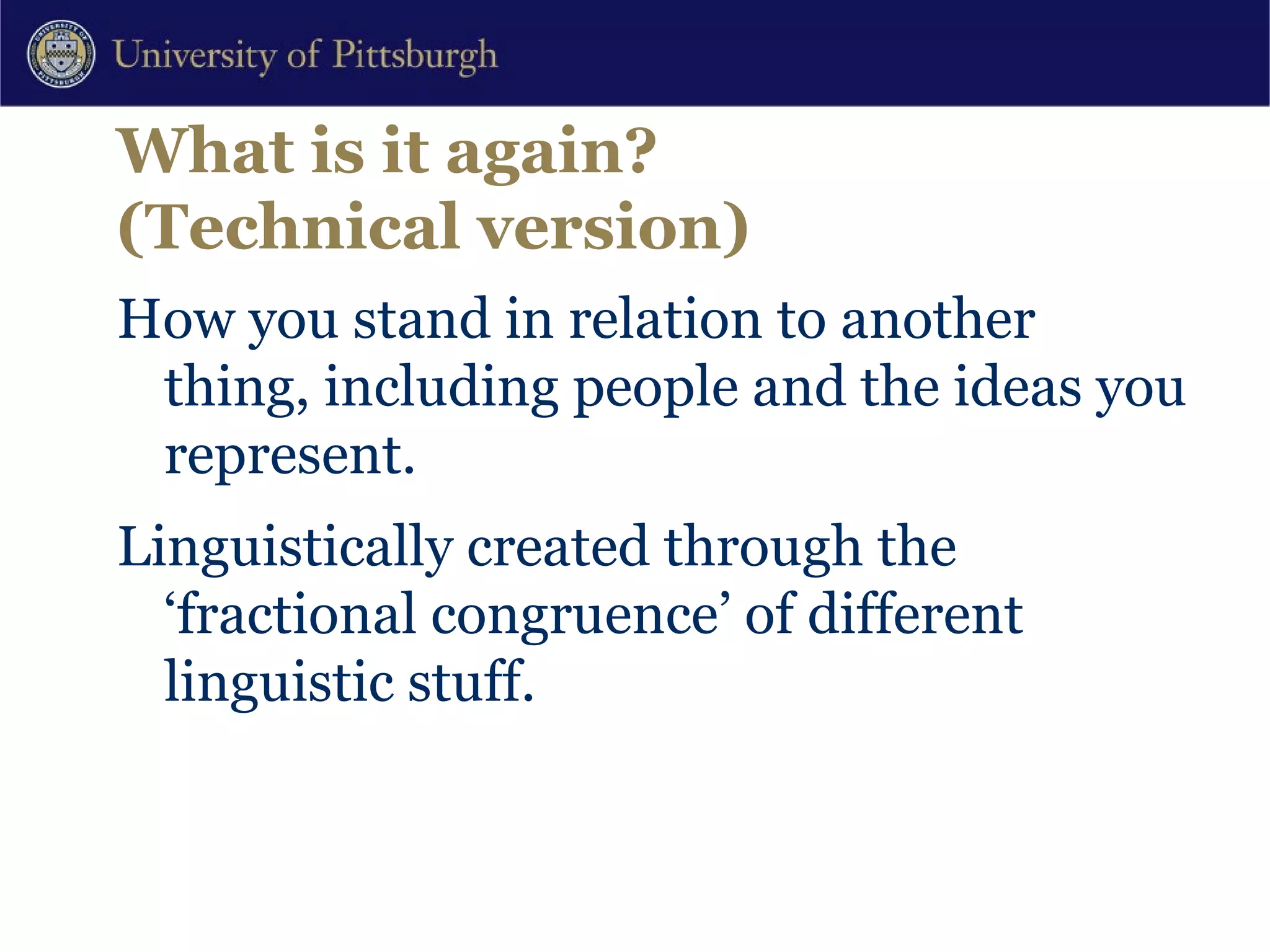
What is it again?  (Technical version) How you stand in relation to another thing, including people and the ideas you represent. Linguistically created through the ‘fractional congruence’ of different linguistic stuff.
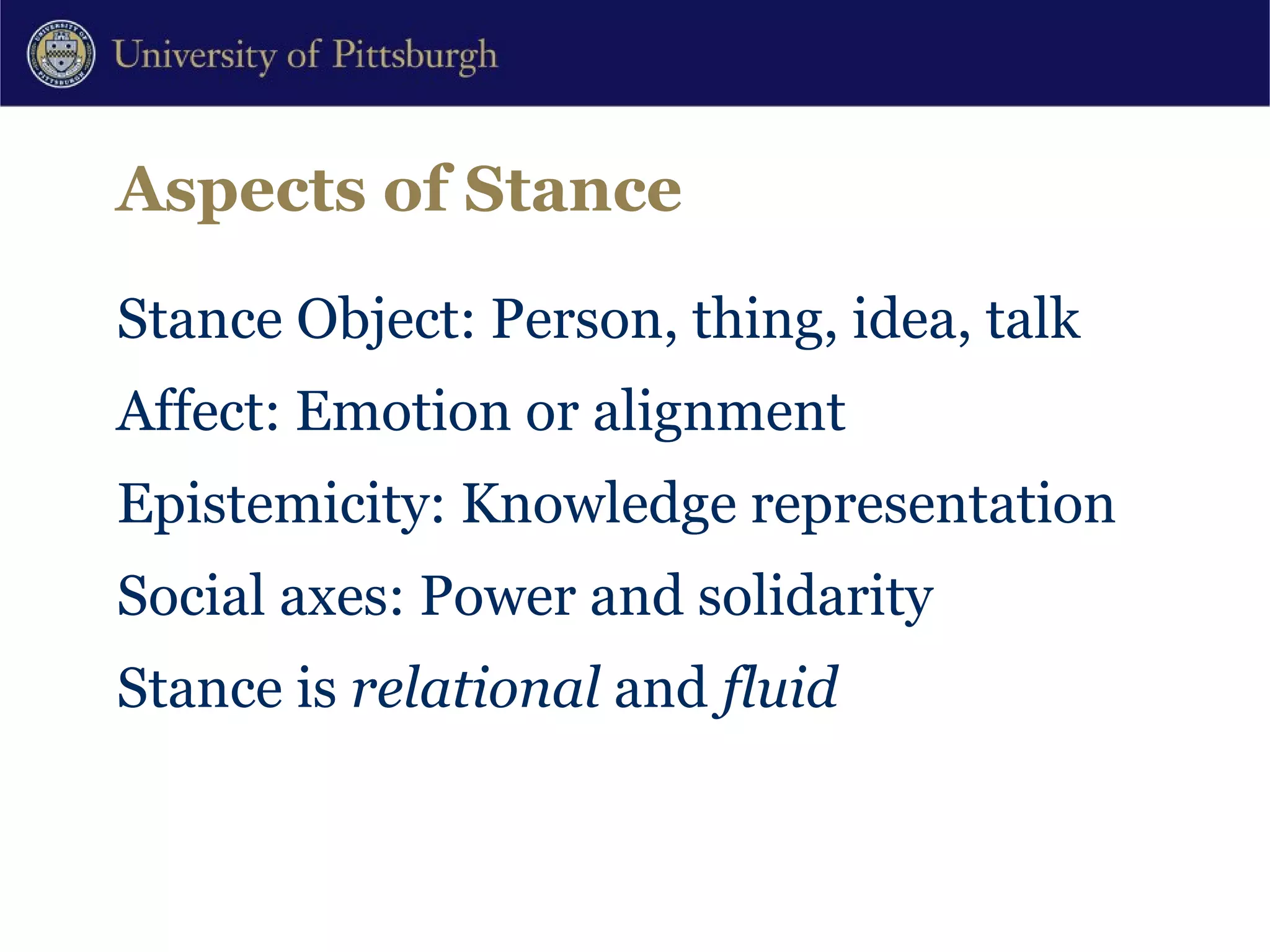
Aspects of Stance Stance Object: Person, thing, idea, talk Affect: Emotion or alignment Epistemicity: Knowledge representation Social axes: Power and solidarity Stance is  relational  and  fluid
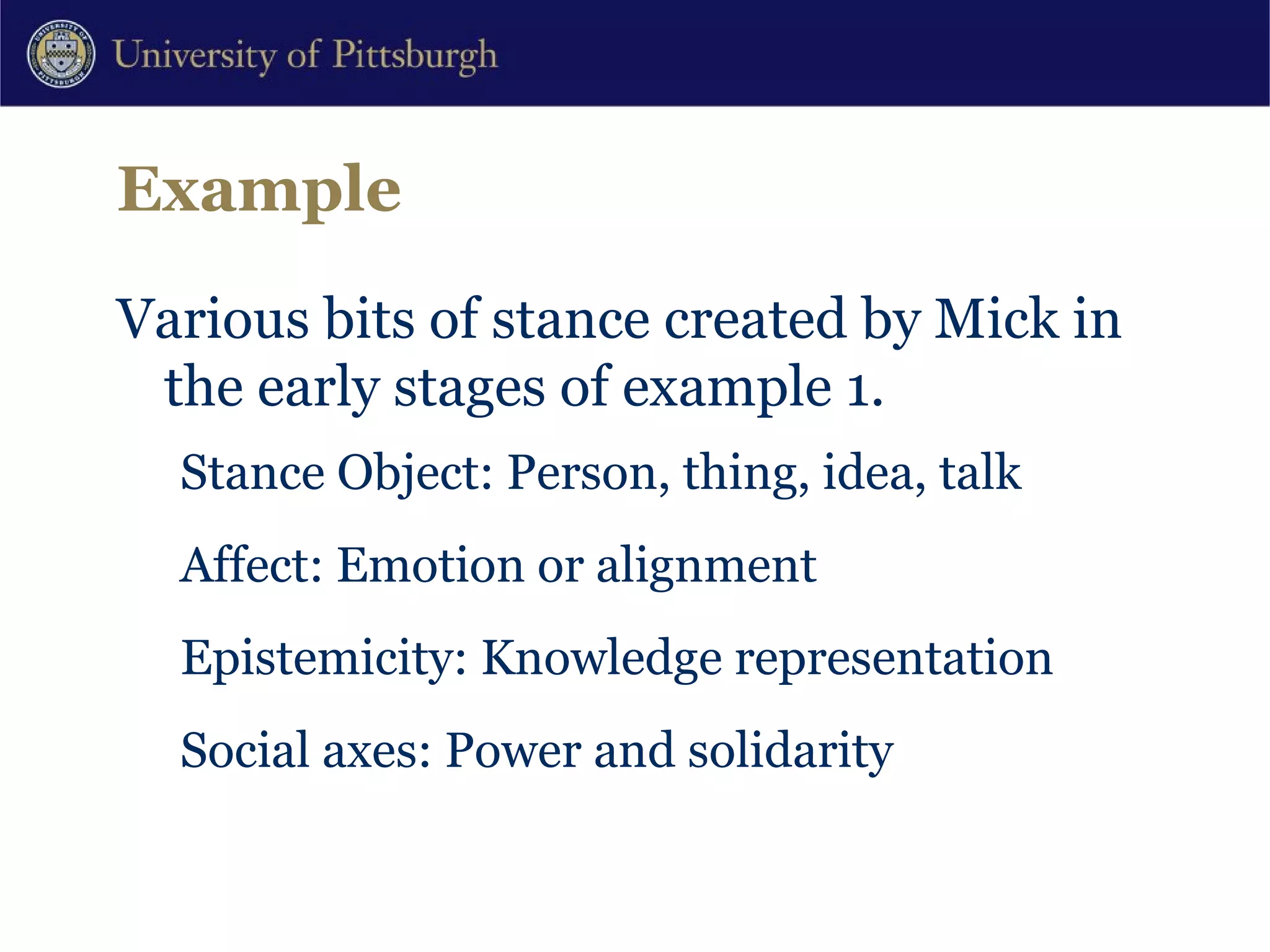
Example Various bits of stance created by Mick in the early stages of example 1. Stance Object: Person, thing, idea, talk Affect: Emotion or alignment Epistemicity: Knowledge representation Social axes: Power and solidarity

Stance indexicalityworkshop

  • 1.
    Indexicality & StanceWorkshop Objectives Indexicality Indexical terms The big challenge: parsing Silverstein Why is it useful? (Is it?)
  • 2.
    Indexicality & StanceWorkshop Stance Definitions Examples Practice Useful for what?
  • 3.
    Objectives Explicate theterms and their use Further explore their potential as a group, hopefully for your later use!
  • 4.
    Indexicality Write downas many examples of things you think are indexes in the next 100 seconds!
  • 5.
    Indexicality What questionsdo you have about indexicality?
  • 6.
    Terms in Peirceanmeaning Icon : a sign vehicle that resembles that which it signifies. buzz, or rising intonation in some cases Symbol : meaning depends entirely on an abstract arbitrary connection Index : “‘pure’ indexes are features of speech which, independent of any referential speech events that may be occurring, signal some particular value of one or more contextual variables.” Silverstein (1995[1976]:201) Shifters : referential indexes which have rules of use that gain reference only in context (tense, place deixis)
  • 7.
    Terms in Peirceanmeaning 76 Definitions of The Sign by C. S. Peirce collected and analyzed by Robert Marty Department of Mathematics University of Perpignan Perpignan, France With an Appendix of 12 Further Definitions or Equivalents proposed by Alfred Lang Dept of Psychology University of Bern Bern, Switzerland http://www.cspeirce.com/menu/library/rsources/76defs/76defs.htm
  • 8.
    Big Questions Howand why are indexical meanings realised?
  • 9.
    Presupposing and creativepresupposing : assumes (follows) rules of use (e.g., this chair and that chair) creative or performative -- entailment : make explicit and overt the parameters of the ongoing event (English pronouns, esp. 2p) Examples??
  • 10.
    Indexical orders Similarto Labovian ‘awareness’ although discussed in terms of metapragmatic discourse and less reliant on widely shared norms in the speech community. A process of conventionalization. As you go up indexical orders, they have more creative effects.
  • 11.
    To the text!Silverstein, Michael. 2003. Indexical order and the dialectics of sociolinguistic life. Language & Communication , 23: 193-229.
  • 12.
    Indexical fields (webs?)indexical field : constellation of ideologically related meanings any one of which can be activated in the situated use of the variable
  • 13.
  • 14.
    Questions about yourexamples or just questions? Shy? Write questions down and leave them up here during the break.
  • 15.
    How are theseterminological distinctions useful in different areas of sociolinguistics?
  • 16.
    Stance What isit? Write down what YOU think it is.
  • 17.
    Big Questions Methodologically,how do we find it? How does stance get created? How do linguistic ‘things’ work together to create a stance?
  • 18.
    What is itagain? (Technical version) How you stand in relation to another thing, including people and the ideas you represent. Linguistically created through the ‘fractional congruence’ of different linguistic stuff.
  • 19.
    Aspects of StanceStance Object: Person, thing, idea, talk Affect: Emotion or alignment Epistemicity: Knowledge representation Social axes: Power and solidarity Stance is relational and fluid
  • 20.
    Example Various bitsof stance created by Mick in the early stages of example 1. Stance Object: Person, thing, idea, talk Affect: Emotion or alignment Epistemicity: Knowledge representation Social axes: Power and solidarity