Ruel A. Punzalan
Reporter/Tagaytay City
MAS 106 – Current Issues
and Problem in Education
What is ALS?
 is a free education
program implemented by
the DepEd
 the 3rd bureau of Deped
 benefits those who cannot
afford formal schooling
specially the OSY
ALS brief history
Executive Order No. 356
 Renaming the Bureau of
Non-Formal Education
(BNE) to Bureau of
Alternative Learning
System (ALS)
ALS Goals & Objectives
 to protect and promote the
right of all citizens to
quality basic education and
such education accessible
to all
ALS Goals & Objectives
 To provide viable
alternative to the existing
formal education
instruction, encompassing
both non-formal and
informal sources of
knowledge and skills
ALS Goals & Objectives
 To improve the socio-
economic status of the OSY
and the poor by enhancing
their basic education
capability through functional
education and literacy
Target Learners
 Elementary and secondary
drop-outs
 Unemployed / underemployed
OYSs and adults
 Industry based workers,
housewives, maids, factory
workers, drivers
Target Learners
 Members of cultural minorities
/ indigenous peoples (IPs)
 Persons with disabilities
(PWDs) / physically challenged
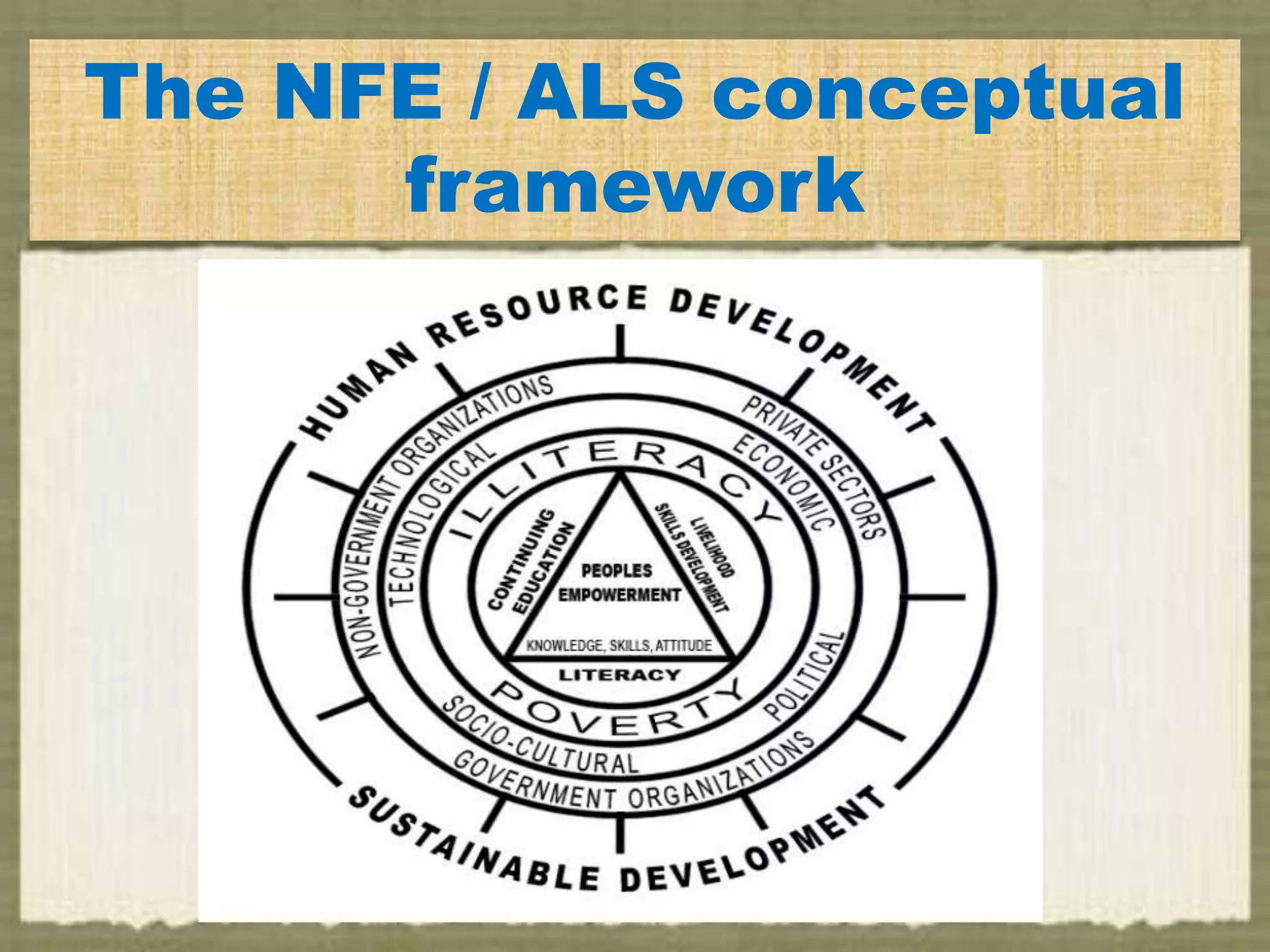
The NFE / ALS conceptual
framework
Programs & Projects
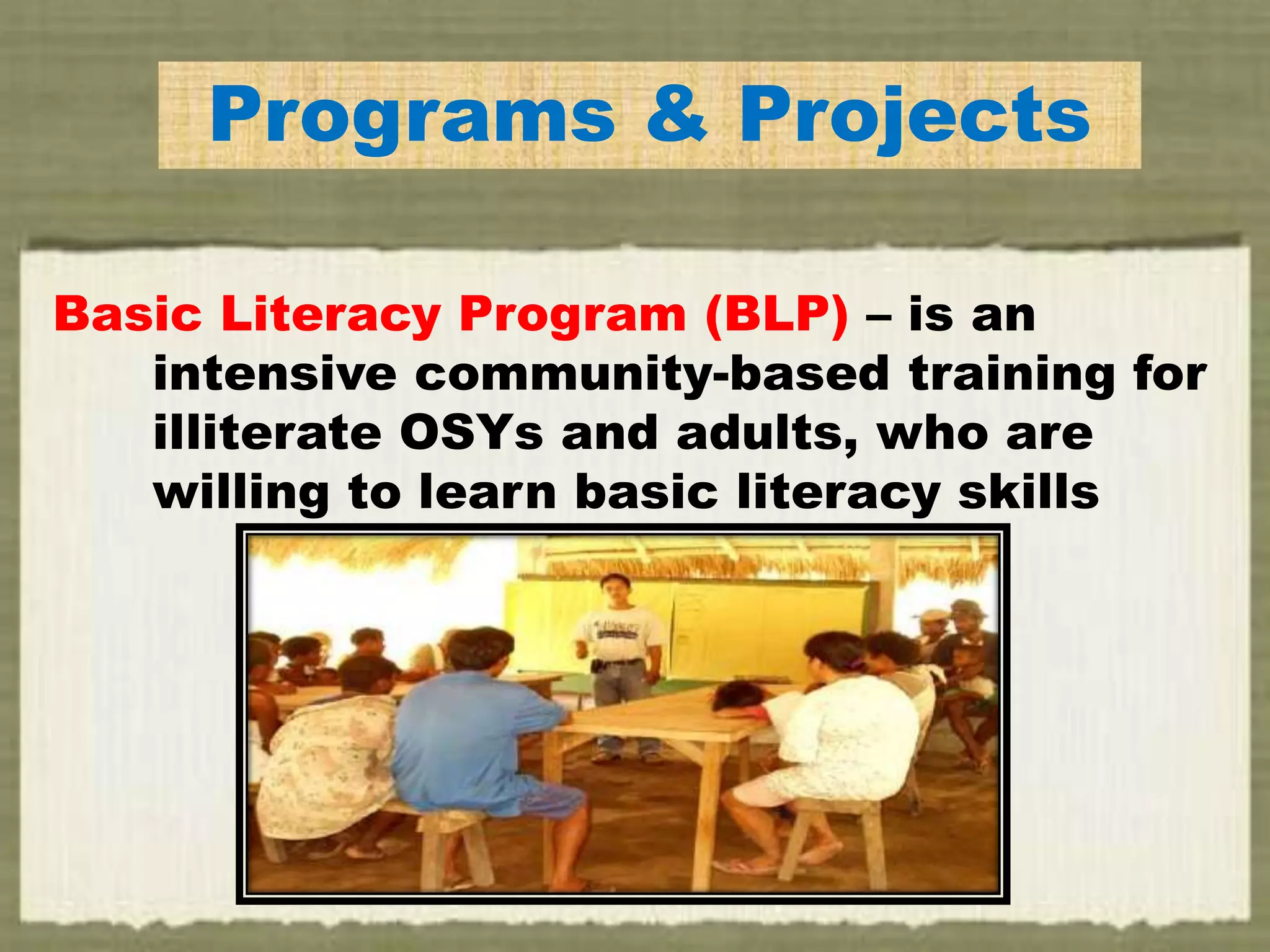
Basic Literacy Program (BLP) – is an
intensive community-based training for
illiterate OSYs and adults, who are
willing to learn basic literacy skills
Programs & Projects
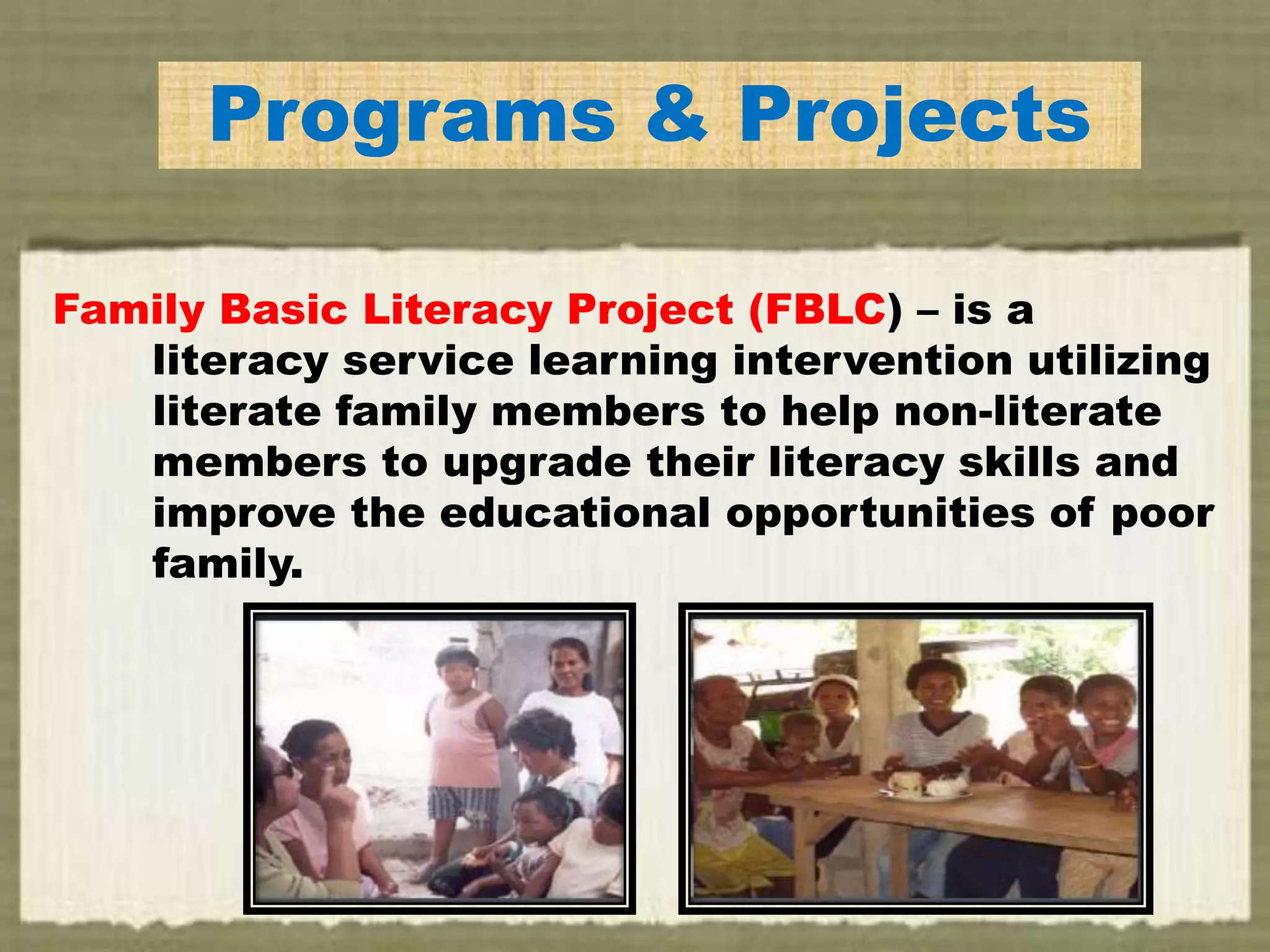
Family Basic Literacy Project (FBLC) – is a
literacy service learning intervention utilizing
literate family members to help non-literate
members to upgrade their literacy skills and
improve the educational opportunities of poor
family.
Programs & Projects
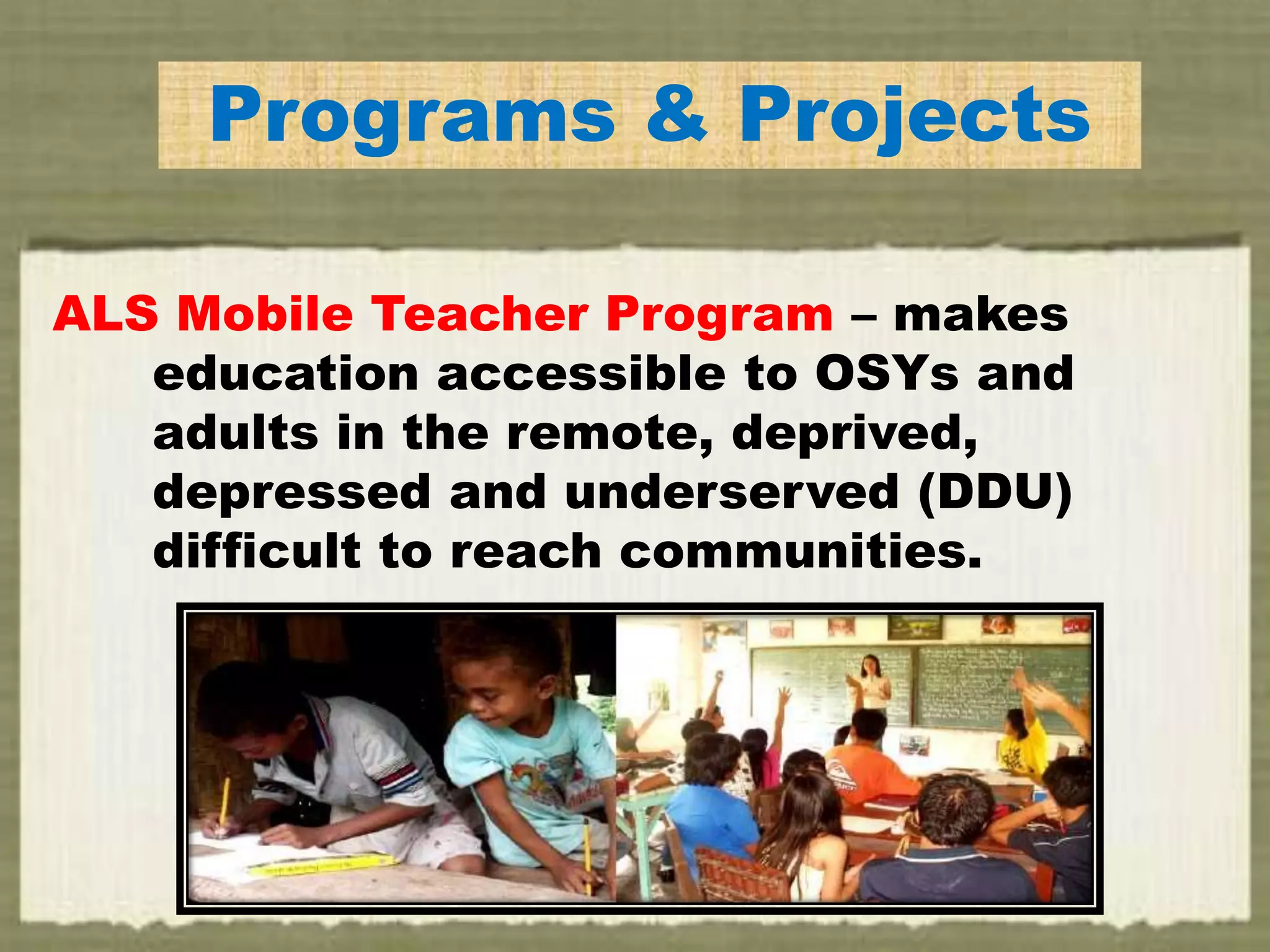
ALS Mobile Teacher Program – makes
education accessible to OSYs and
adults in the remote, deprived,
depressed and underserved (DDU)
difficult to reach communities.
Programs & Projects
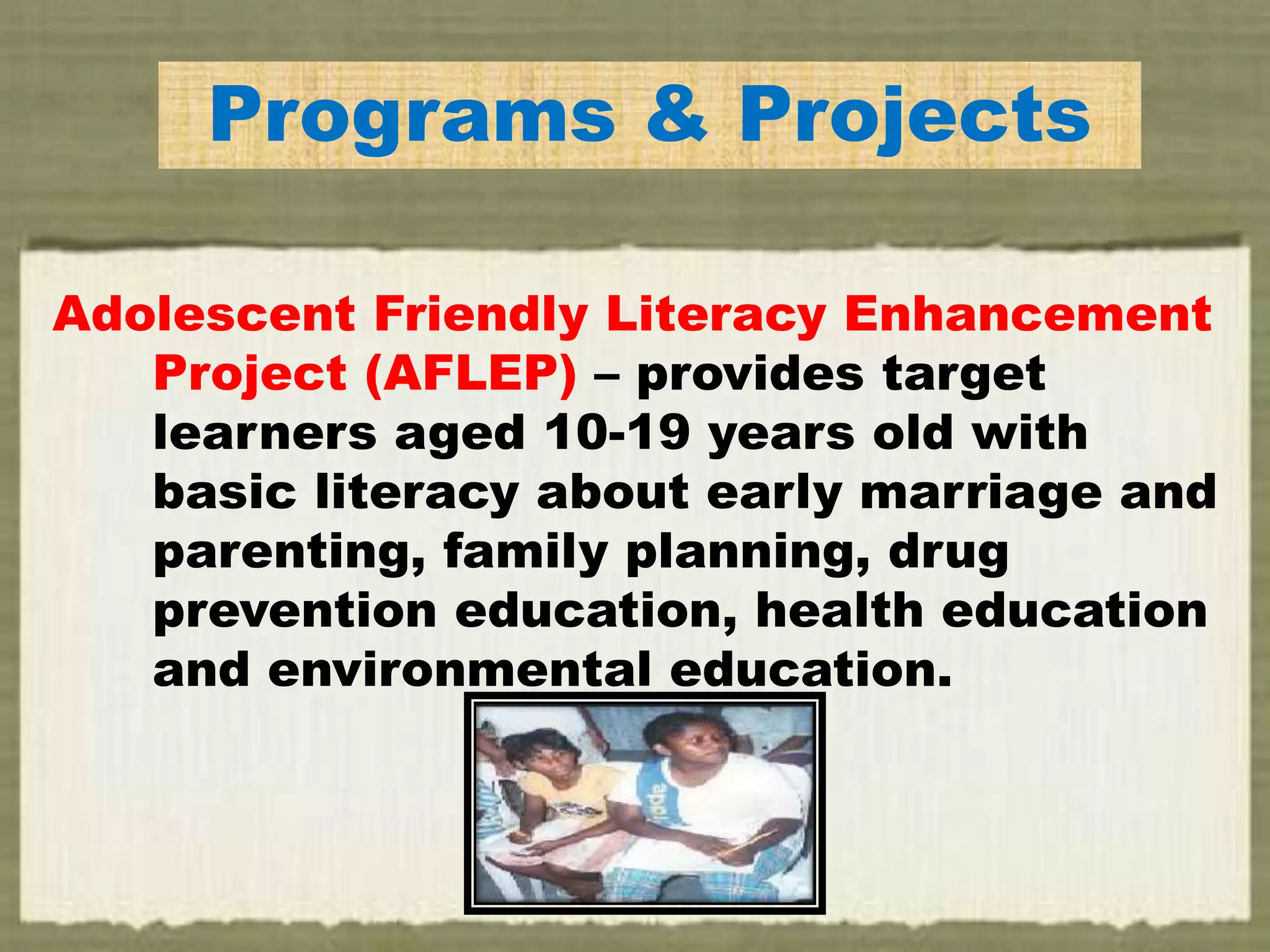
Adolescent Friendly Literacy Enhancement
Project (AFLEP) – provides target
learners aged 10-19 years old with
basic literacy about early marriage and
parenting, family planning, drug
prevention education, health education
and environmental education.
Programs & Projects
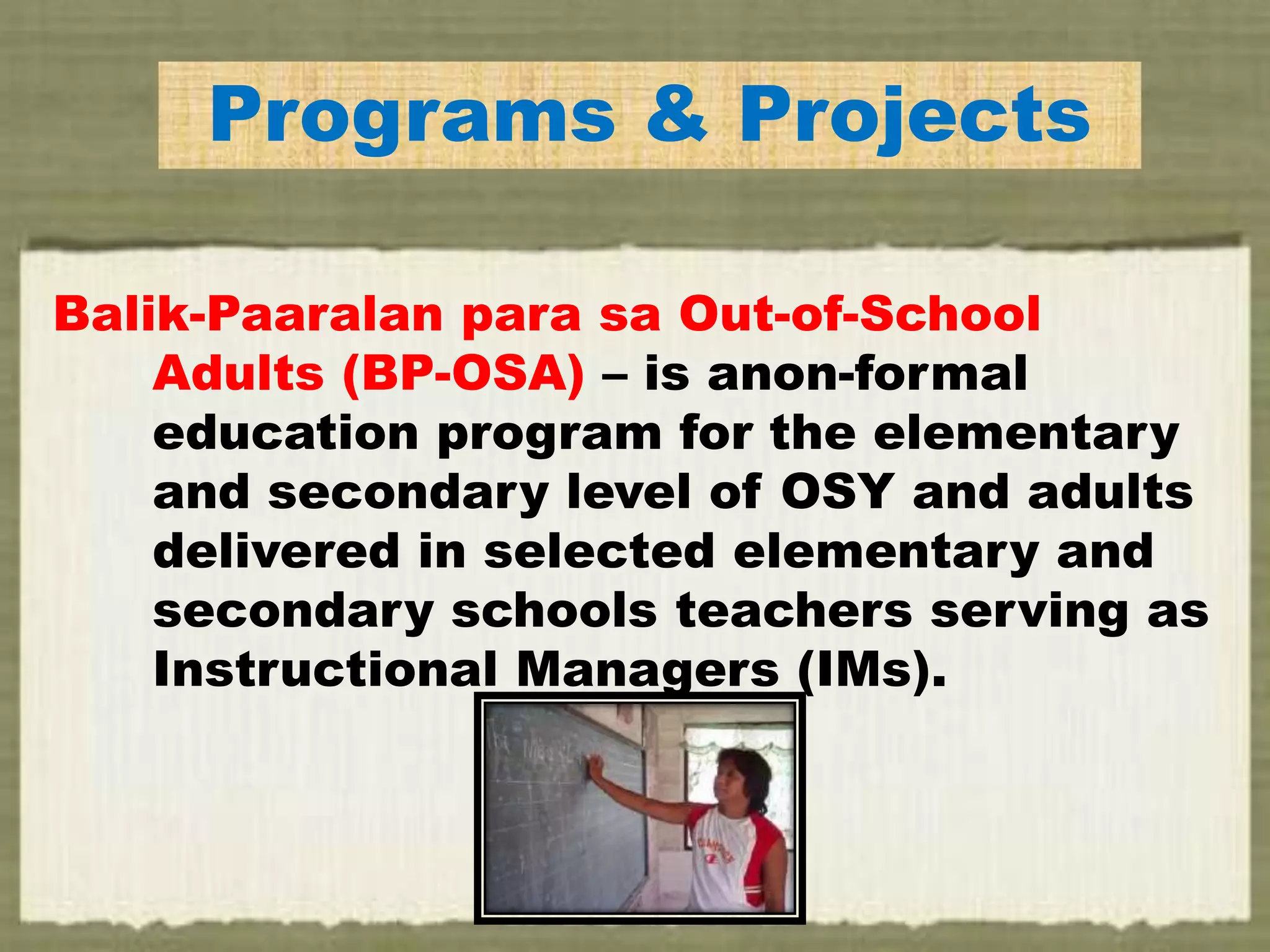
Balik-Paaralan para sa Out-of-School
Adults (BP-OSA) – is anon-formal
education program for the elementary
and secondary level of OSY and adults
delivered in selected elementary and
secondary schools teachers serving as
Instructional Managers (IMs).
Programs & Projects
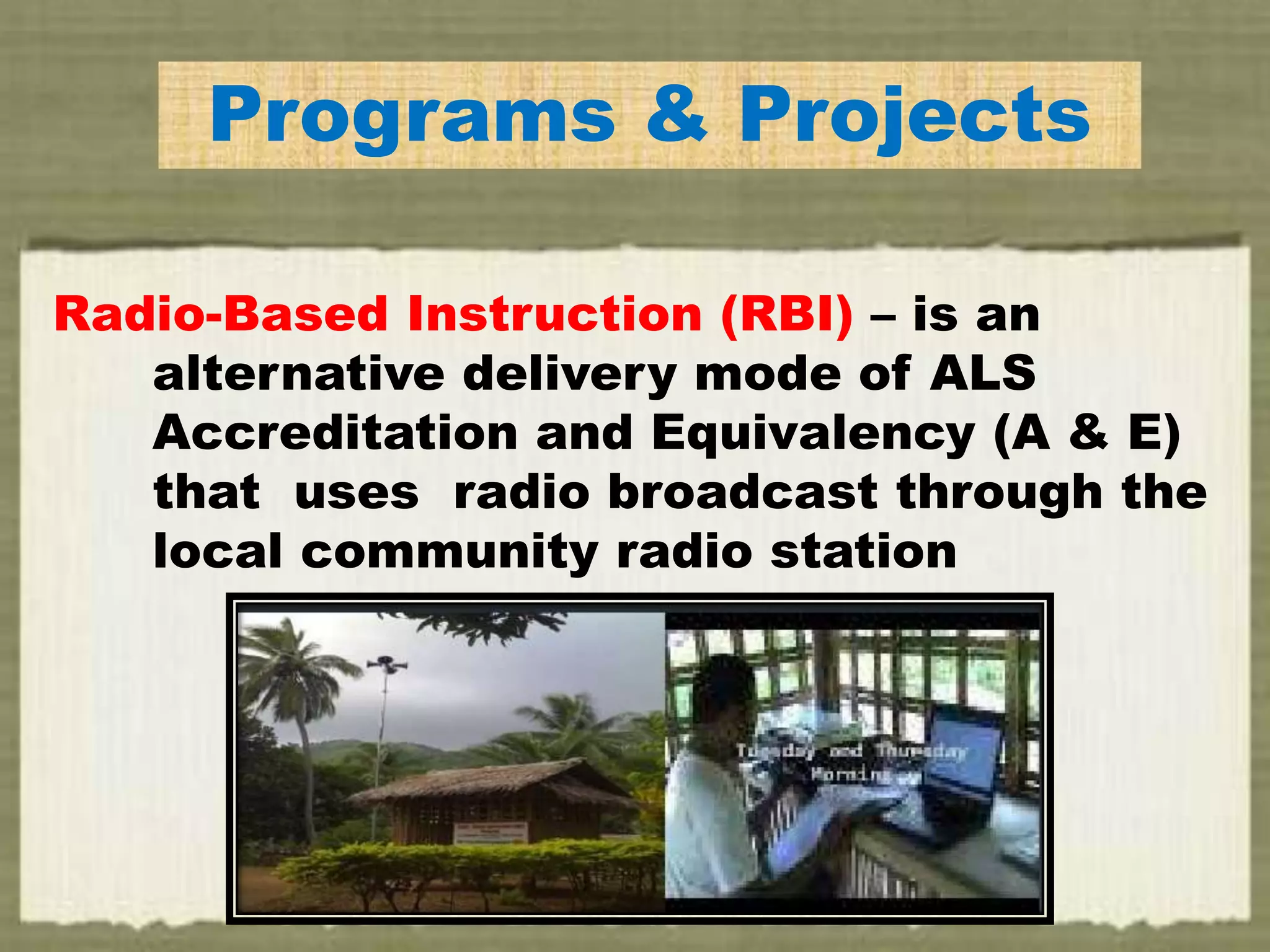
Radio-Based Instruction (RBI) – is an
alternative delivery mode of ALS
Accreditation and Equivalency (A & E)
that uses radio broadcast through the
local community radio station
Programs & Projects
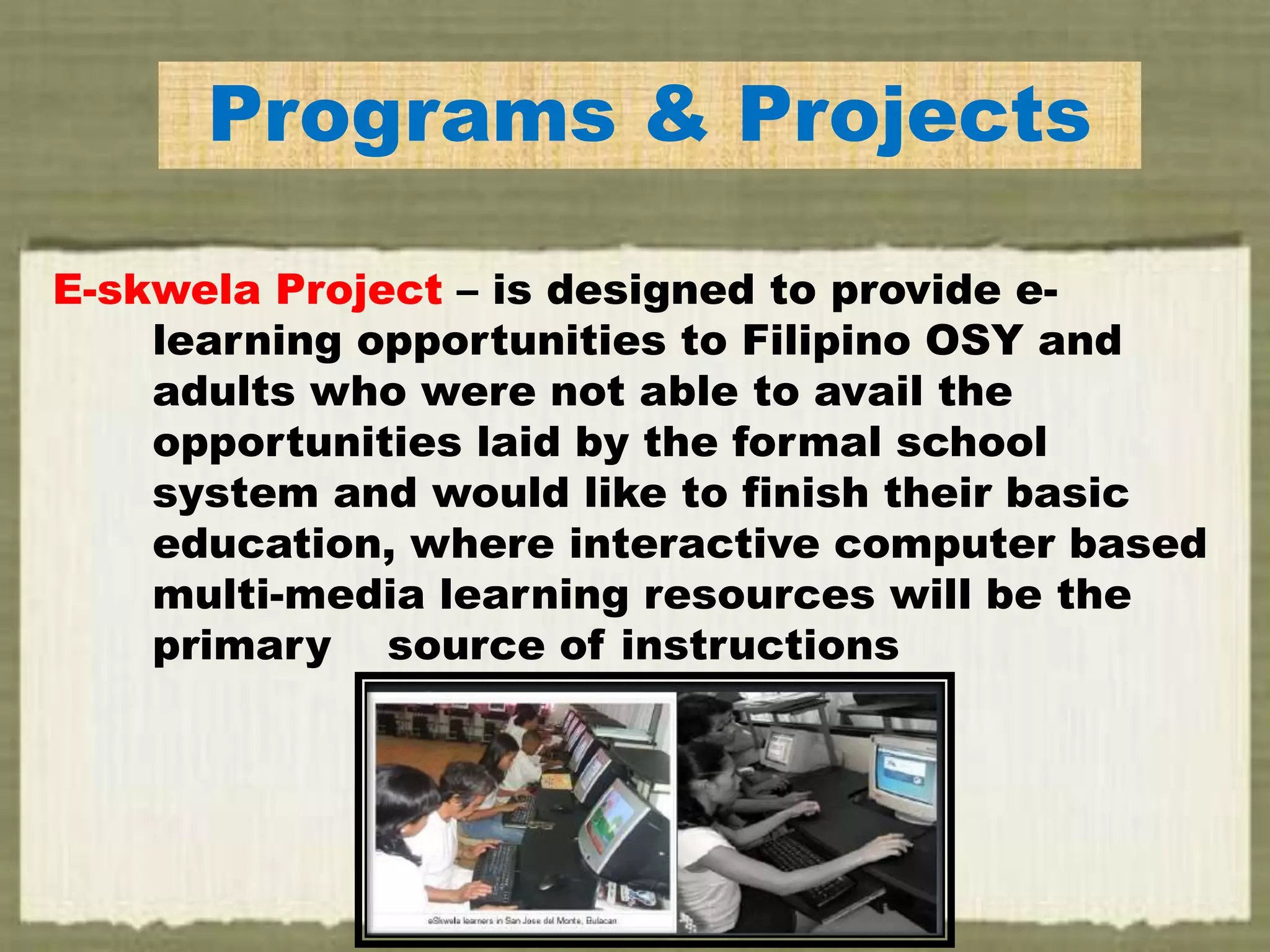
E-skwela Project – is designed to provide e-
learning opportunities to Filipino OSY and
adults who were not able to avail the
opportunities laid by the formal school
system and would like to finish their basic
education, where interactive computer based
multi-media learning resources will be the
primary source of instructions
NousPrograms & Projects
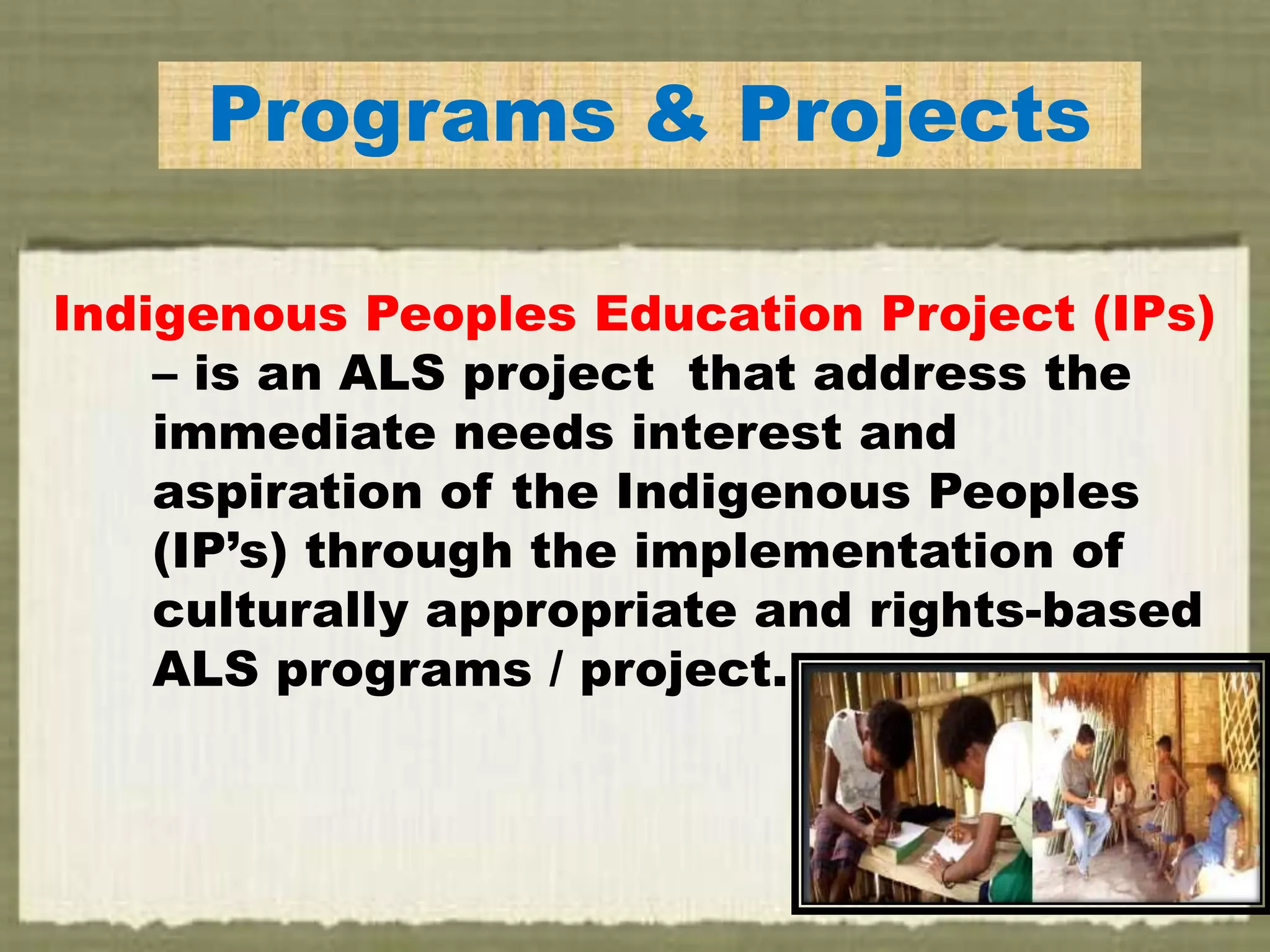
Indigenous Peoples Education Project (IPs)
– is an ALS project that address the
immediate needs interest and
aspiration of the Indigenous Peoples
(IP’s) through the implementation of
culturally appropriate and rights-based
ALS programs / project.
Programs & Projects
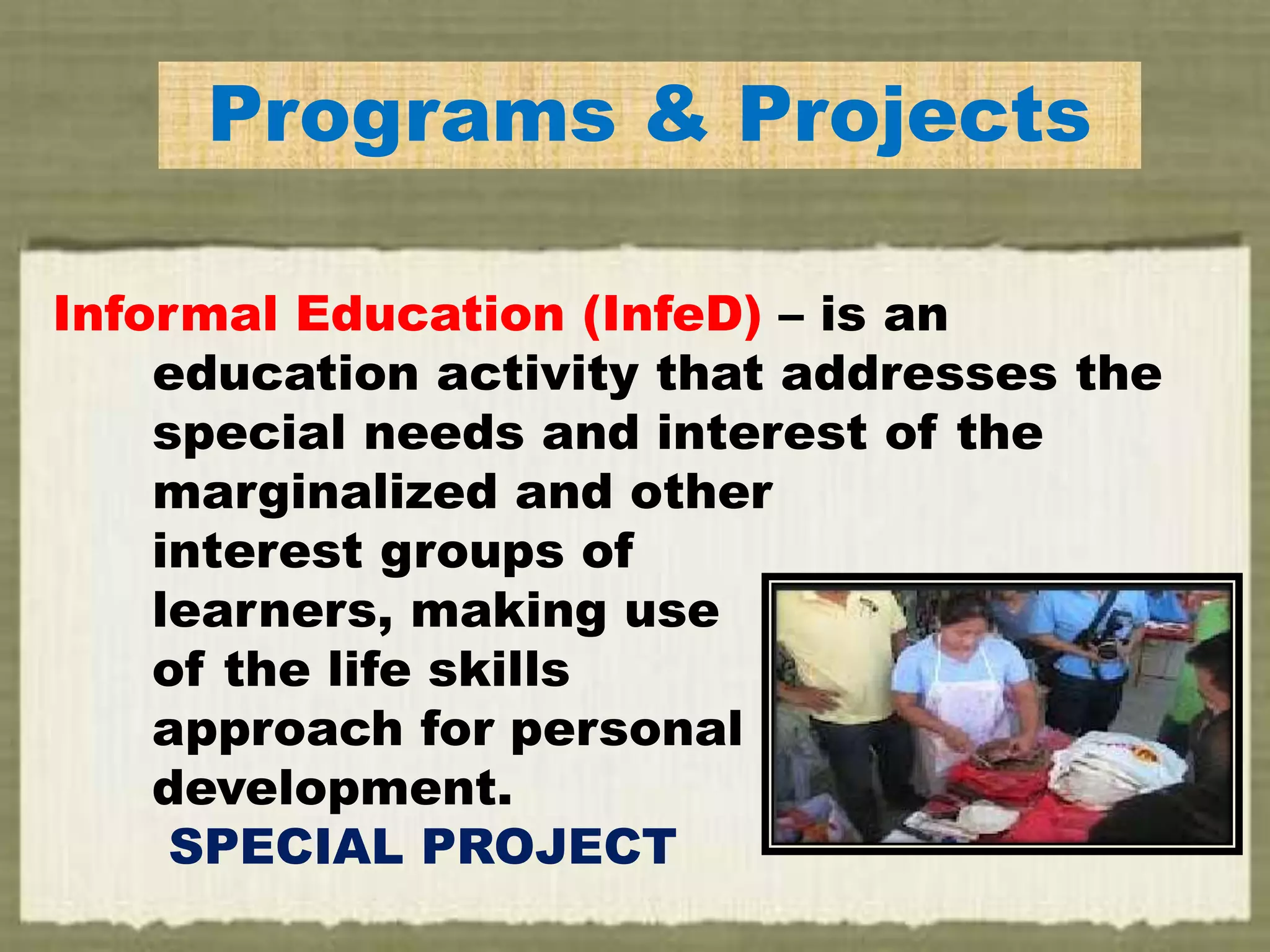
Informal Education (InfeD) – is an
education activity that addresses the
special needs and interest of the
marginalized and other
interest groups of
learners, making use
of the life skills
approach for personal
development.
SPECIAL PROJECT
Programs & Projects
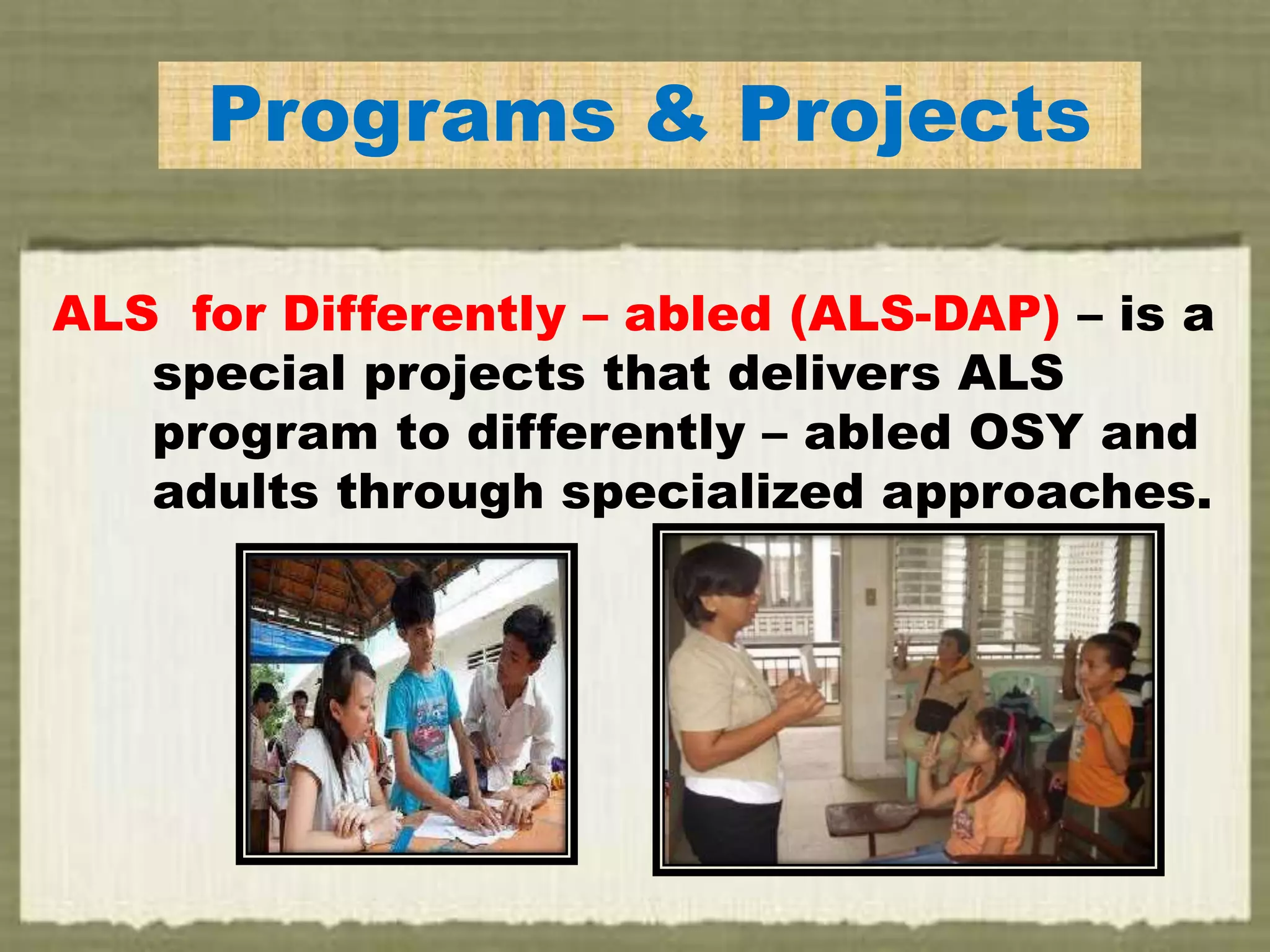
ALS for Differently – abled (ALS-DAP) – is a
special projects that delivers ALS
program to differently – abled OSY and
adults through specialized approaches.
Programs & Projects
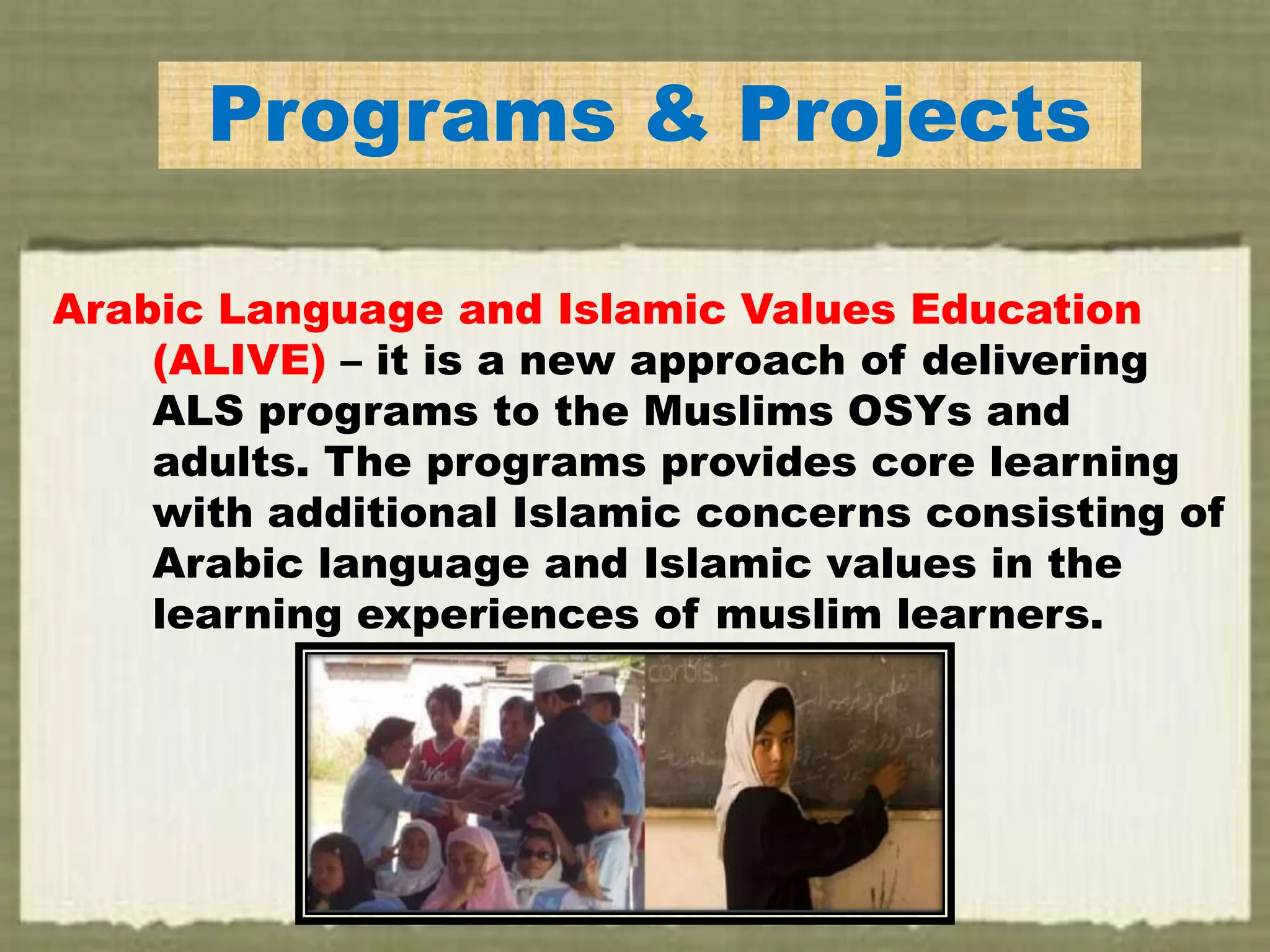
Arabic Language and Islamic Values Education
(ALIVE) – it is a new approach of delivering
ALS programs to the Muslims OSYs and
adults. The programs provides core learning
with additional Islamic concerns consisting of
Arabic language and Islamic values in the
learning experiences of muslim learners.
EPrograms & Projects
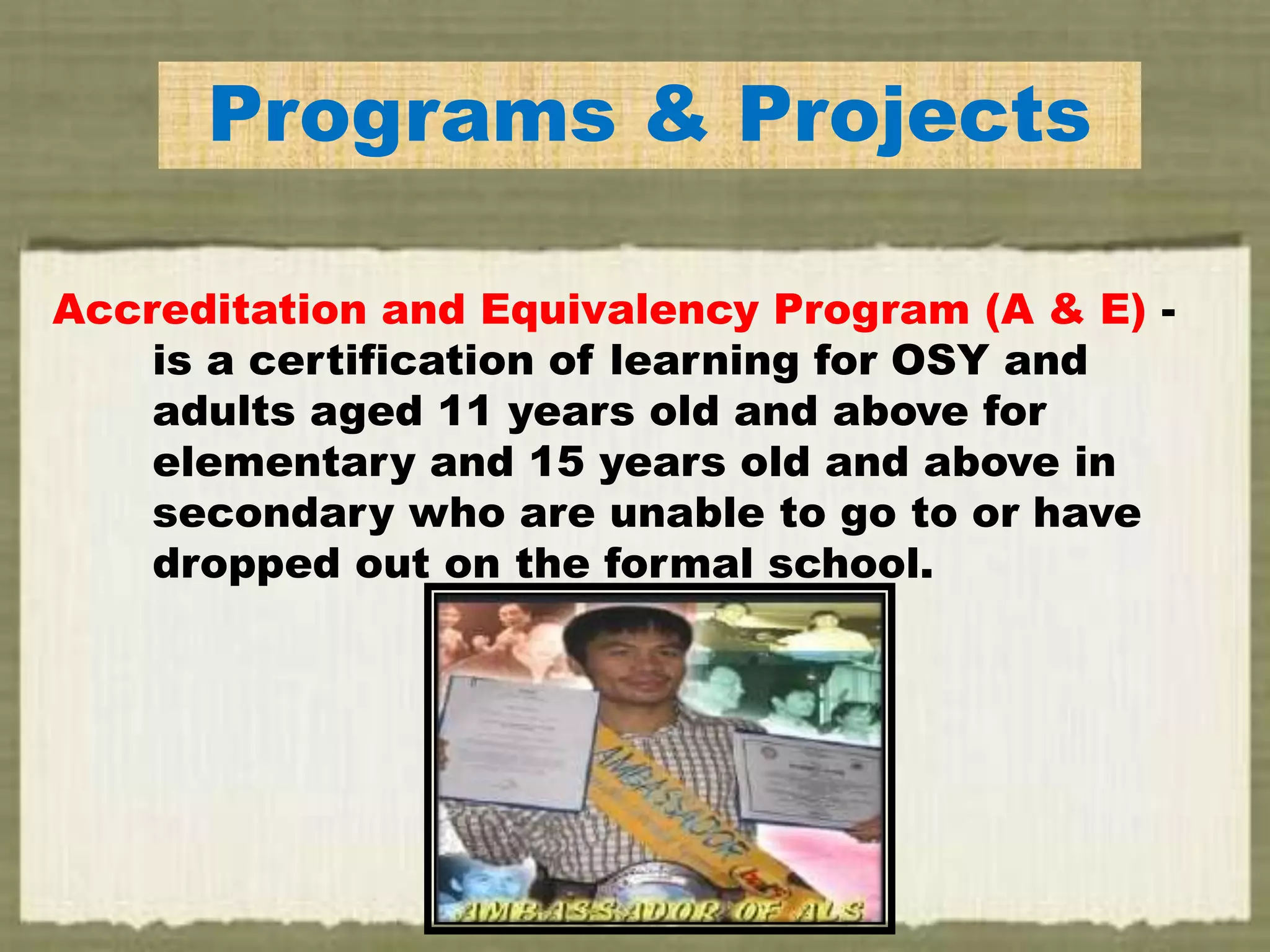
Accreditation and Equivalency Program (A & E) -
is a certification of learning for OSY and
adults aged 11 years old and above for
elementary and 15 years old and above in
secondary who are unable to go to or have
dropped out on the formal school.
E
Options/Opportunities for the
ALS A&E Test Passers
 Enter college/university
 Enter other non formal training
programs
 Enter formal training programs
 Enter/re-enter the world of work
 Enter/re-enter elementary or secondary
formal school system
 Learn essential life skills to participate
more fully and actively in the political,
social, and economic lives in the
community
EMemorandum of Agreement
 With other educational institutions
and organizations that secondary
level passers can enrol in post
secondary schools and vocational
training programs, college /
university courses subject to the
usual screening procedures
E
Civil Service Commission
(CSC) Resolution No. 000499
 Recognizing the ALS & AE
elementary and secondary
certificates as valid documents
for permanent appointment to
government positions provided
that other requirements are met.
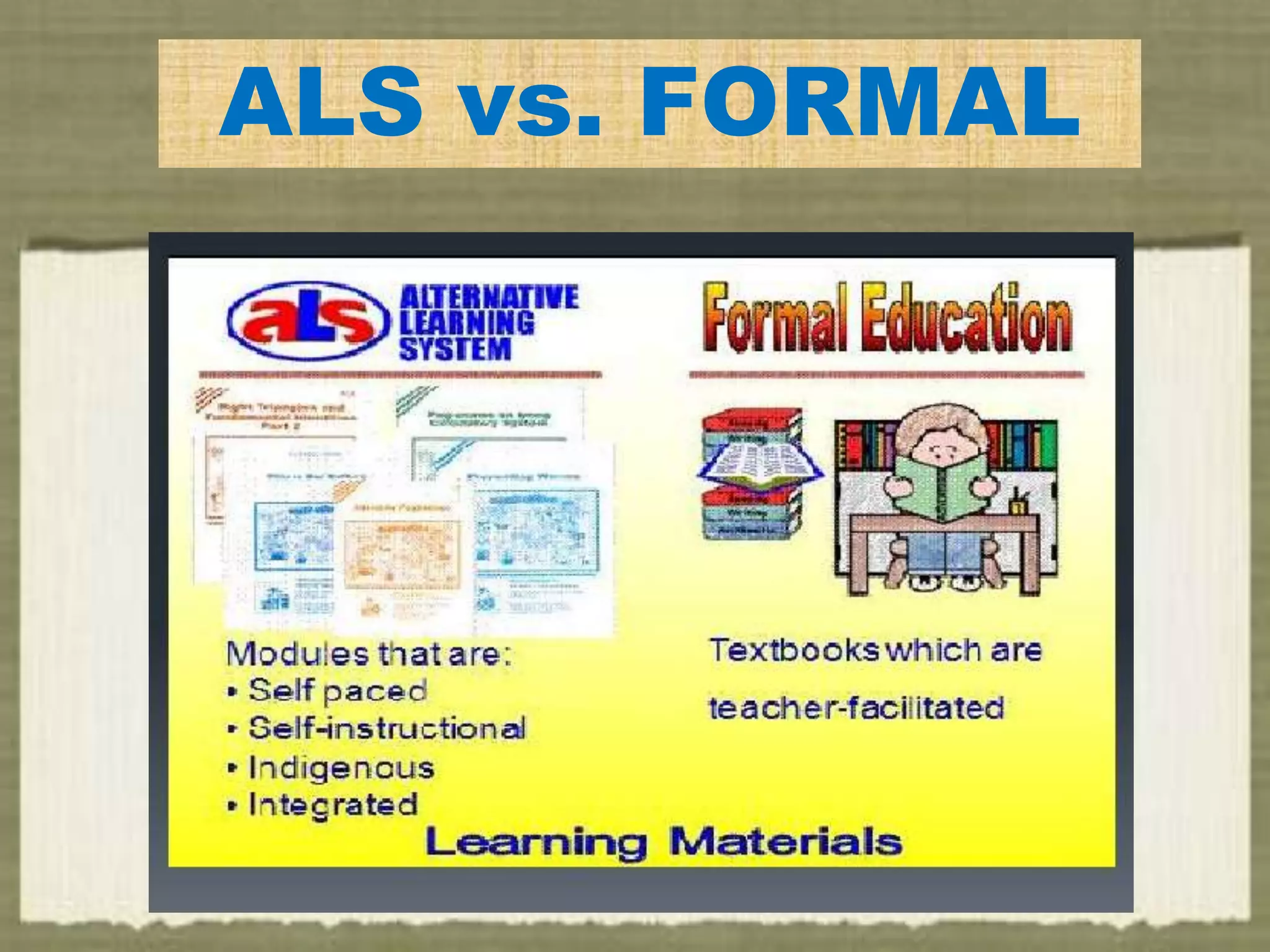
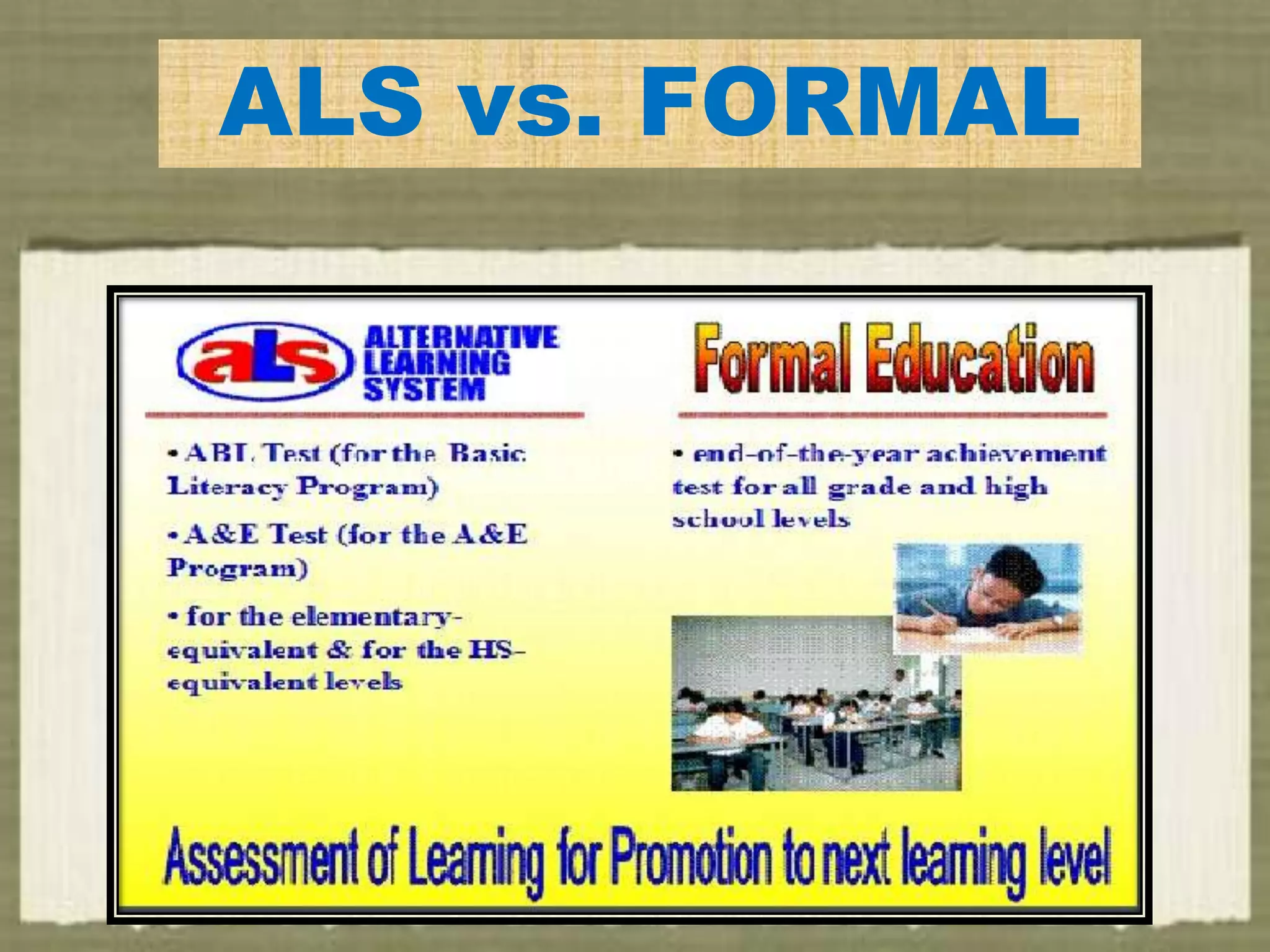
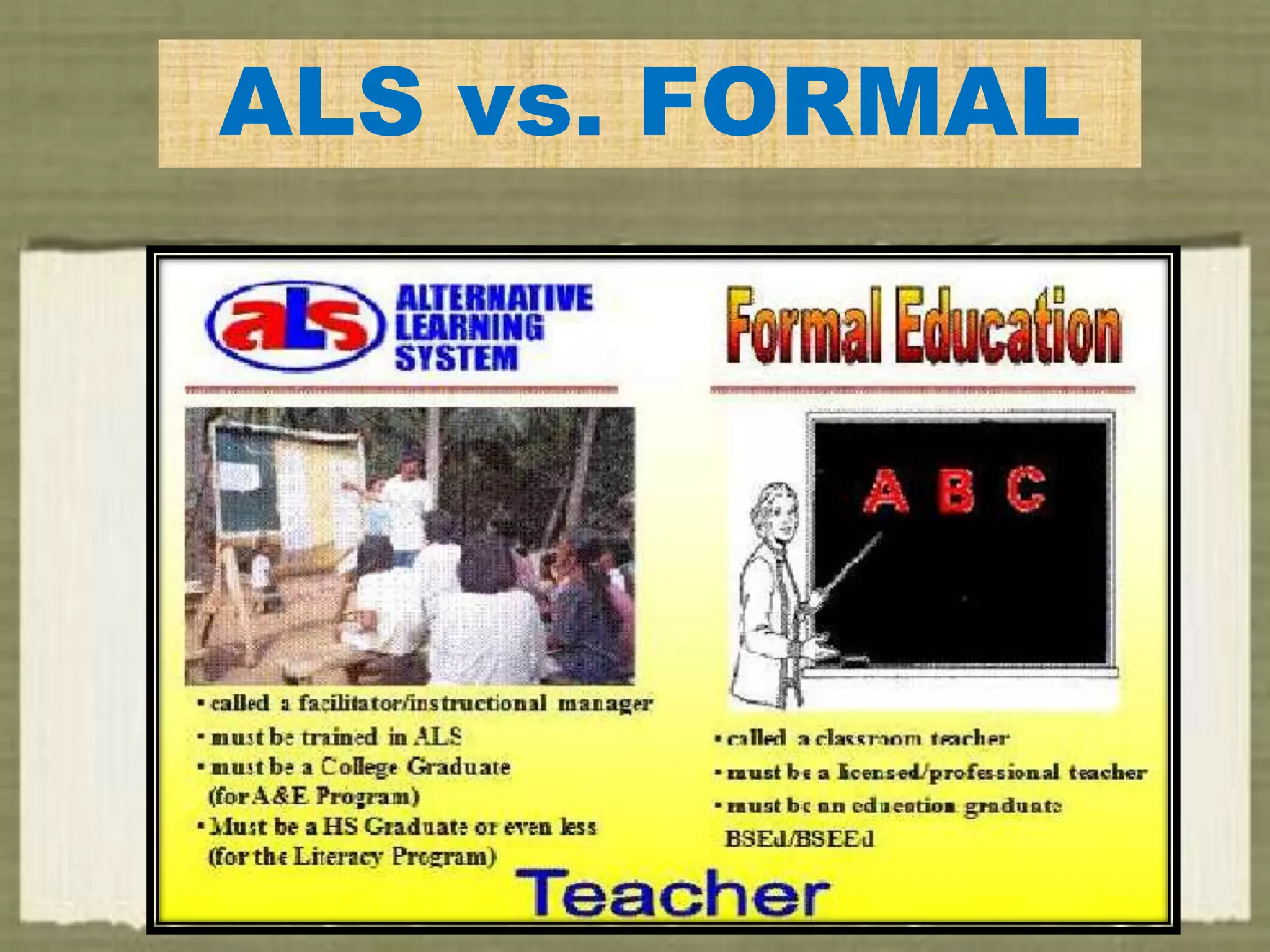
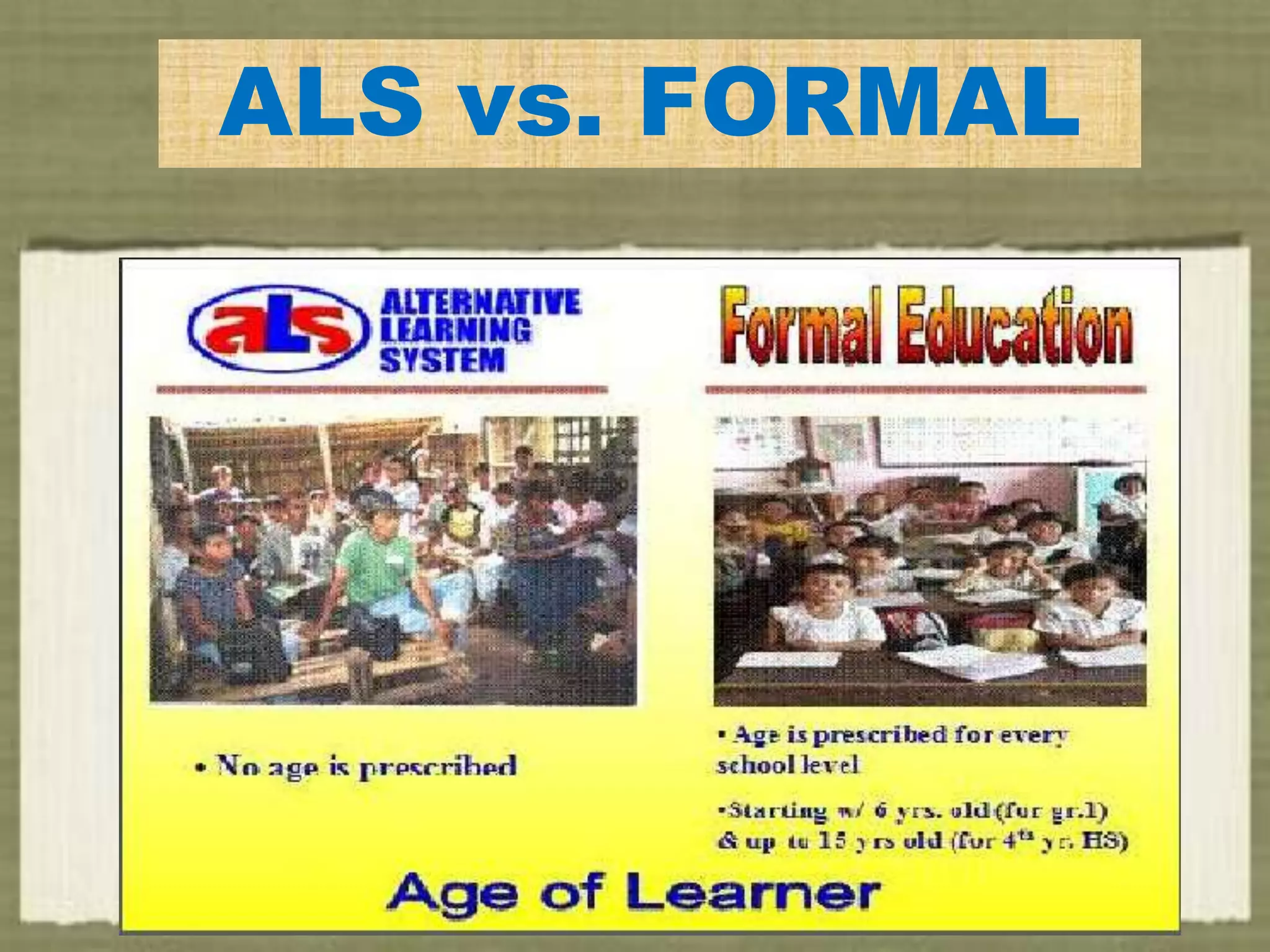
ALS vs. FORMAL
ALS vs. FORMAL
ALS vs. FORMAL
ALS vs. FORMAL
ALS vs. FORMAL
ALS vs. FORMAL
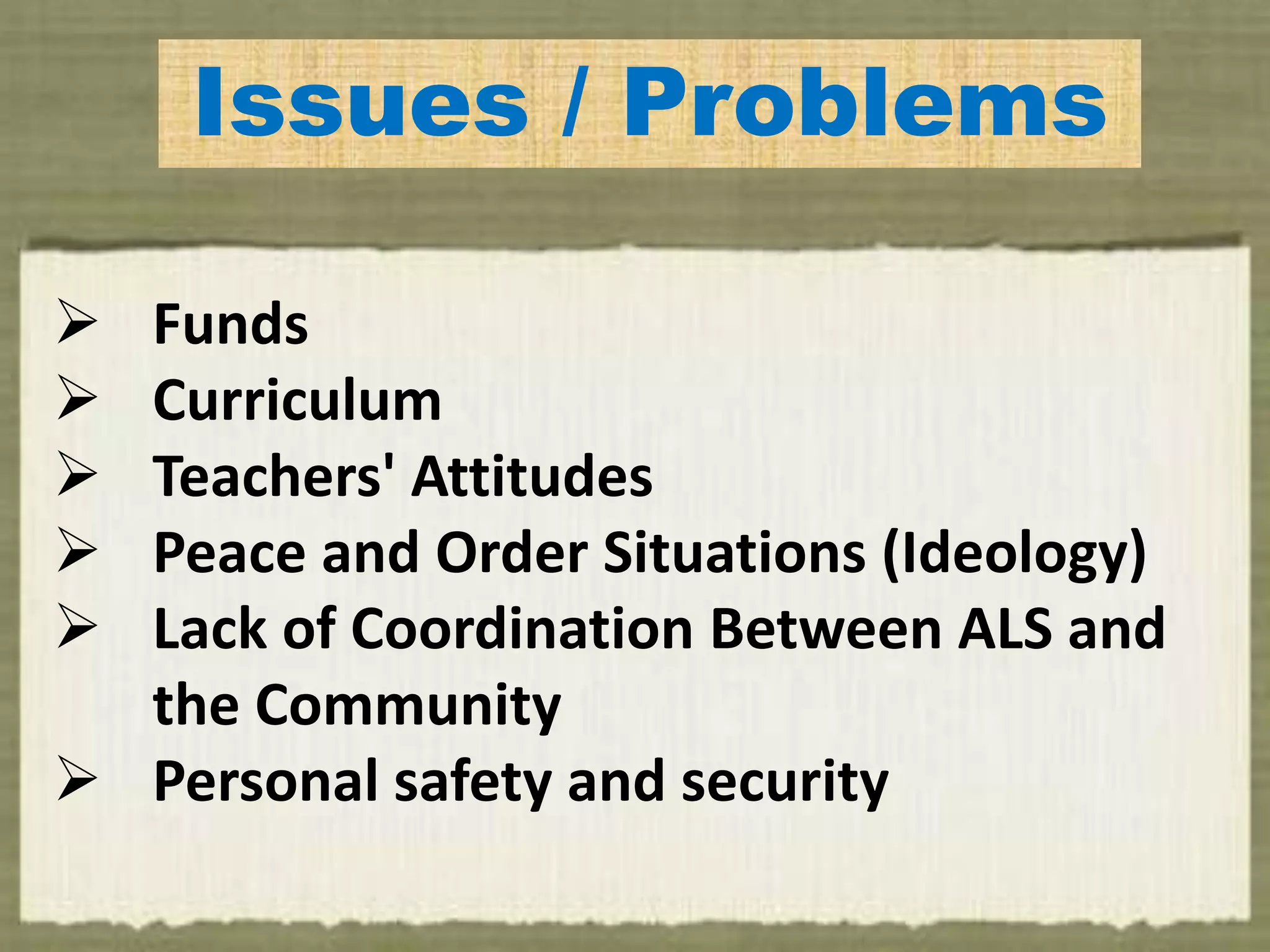
Issues / Problems
 Funds
 Curriculum
 Teachers' Attitudes
 Peace and Order Situations (Ideology)
 Lack of Coordination Between ALS and
the Community
 Personal safety and security
ALS vs. FORMAL

alternative learning system (als)

  • 1.
    Ruel A. Punzalan Reporter/TagaytayCity MAS 106 – Current Issues and Problem in Education
  • 2.
    What is ALS? is a free education program implemented by the DepEd  the 3rd bureau of Deped  benefits those who cannot afford formal schooling specially the OSY
  • 3.
    ALS brief history ExecutiveOrder No. 356  Renaming the Bureau of Non-Formal Education (BNE) to Bureau of Alternative Learning System (ALS)
  • 4.
    ALS Goals &Objectives  to protect and promote the right of all citizens to quality basic education and such education accessible to all
  • 5.
    ALS Goals &Objectives  To provide viable alternative to the existing formal education instruction, encompassing both non-formal and informal sources of knowledge and skills
  • 6.
    ALS Goals &Objectives  To improve the socio- economic status of the OSY and the poor by enhancing their basic education capability through functional education and literacy
  • 7.
    Target Learners  Elementaryand secondary drop-outs  Unemployed / underemployed OYSs and adults  Industry based workers, housewives, maids, factory workers, drivers
  • 8.
    Target Learners  Membersof cultural minorities / indigenous peoples (IPs)  Persons with disabilities (PWDs) / physically challenged
  • 9.
    The NFE /ALS conceptual framework
  • 10.
    Programs & Projects BasicLiteracy Program (BLP) – is an intensive community-based training for illiterate OSYs and adults, who are willing to learn basic literacy skills
  • 11.
    Programs & Projects FamilyBasic Literacy Project (FBLC) – is a literacy service learning intervention utilizing literate family members to help non-literate members to upgrade their literacy skills and improve the educational opportunities of poor family.
  • 12.
    Programs & Projects ALSMobile Teacher Program – makes education accessible to OSYs and adults in the remote, deprived, depressed and underserved (DDU) difficult to reach communities.
  • 13.
    Programs & Projects AdolescentFriendly Literacy Enhancement Project (AFLEP) – provides target learners aged 10-19 years old with basic literacy about early marriage and parenting, family planning, drug prevention education, health education and environmental education.
  • 14.
    Programs & Projects Balik-Paaralanpara sa Out-of-School Adults (BP-OSA) – is anon-formal education program for the elementary and secondary level of OSY and adults delivered in selected elementary and secondary schools teachers serving as Instructional Managers (IMs).
  • 15.
    Programs & Projects Radio-BasedInstruction (RBI) – is an alternative delivery mode of ALS Accreditation and Equivalency (A & E) that uses radio broadcast through the local community radio station
  • 16.
    Programs & Projects E-skwelaProject – is designed to provide e- learning opportunities to Filipino OSY and adults who were not able to avail the opportunities laid by the formal school system and would like to finish their basic education, where interactive computer based multi-media learning resources will be the primary source of instructions
  • 17.
    NousPrograms & Projects IndigenousPeoples Education Project (IPs) – is an ALS project that address the immediate needs interest and aspiration of the Indigenous Peoples (IP’s) through the implementation of culturally appropriate and rights-based ALS programs / project.
  • 18.
    Programs & Projects InformalEducation (InfeD) – is an education activity that addresses the special needs and interest of the marginalized and other interest groups of learners, making use of the life skills approach for personal development. SPECIAL PROJECT
  • 19.
    Programs & Projects ALSfor Differently – abled (ALS-DAP) – is a special projects that delivers ALS program to differently – abled OSY and adults through specialized approaches.
  • 20.
    Programs & Projects ArabicLanguage and Islamic Values Education (ALIVE) – it is a new approach of delivering ALS programs to the Muslims OSYs and adults. The programs provides core learning with additional Islamic concerns consisting of Arabic language and Islamic values in the learning experiences of muslim learners.
  • 21.
    EPrograms & Projects Accreditationand Equivalency Program (A & E) - is a certification of learning for OSY and adults aged 11 years old and above for elementary and 15 years old and above in secondary who are unable to go to or have dropped out on the formal school.
  • 22.
    E Options/Opportunities for the ALSA&E Test Passers  Enter college/university  Enter other non formal training programs  Enter formal training programs  Enter/re-enter the world of work  Enter/re-enter elementary or secondary formal school system  Learn essential life skills to participate more fully and actively in the political, social, and economic lives in the community
  • 23.
    EMemorandum of Agreement With other educational institutions and organizations that secondary level passers can enrol in post secondary schools and vocational training programs, college / university courses subject to the usual screening procedures
  • 24.
    E Civil Service Commission (CSC)Resolution No. 000499  Recognizing the ALS & AE elementary and secondary certificates as valid documents for permanent appointment to government positions provided that other requirements are met.
  • 25.
  • 26.
  • 27.
  • 28.
  • 29.
  • 30.
  • 31.
    Issues / Problems Funds  Curriculum  Teachers' Attitudes  Peace and Order Situations (Ideology)  Lack of Coordination Between ALS and the Community  Personal safety and security
  • 32.