


Rob Nelson
Systems Administrator
@rnelson0
http://rnelson0.com
https://github.com/puppetinabox
Puppetizing your Organization
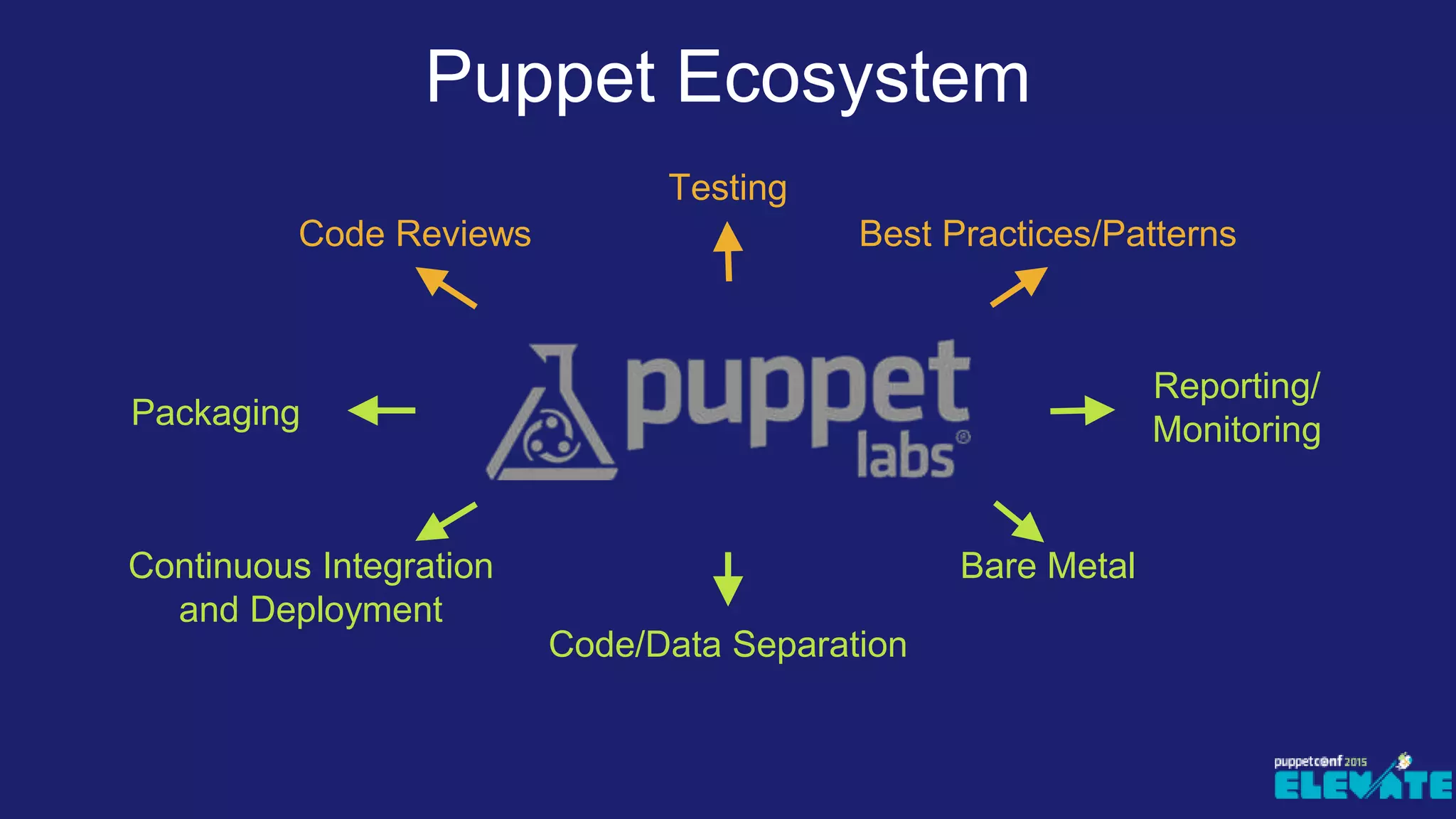
Code Reviews
Testing
Best Practices/Patterns
Continuous Integration
and Deployment
Reporting/
Monitoring
Code/Data Separation
Bare Metal
Packaging
Puppet Ecosystem
Culture
Be a change agent
• Rome wasn’t built in a day
• Lots of learning and failure
• Communication is key
• Pace yourself, avoid culture shock
Culture
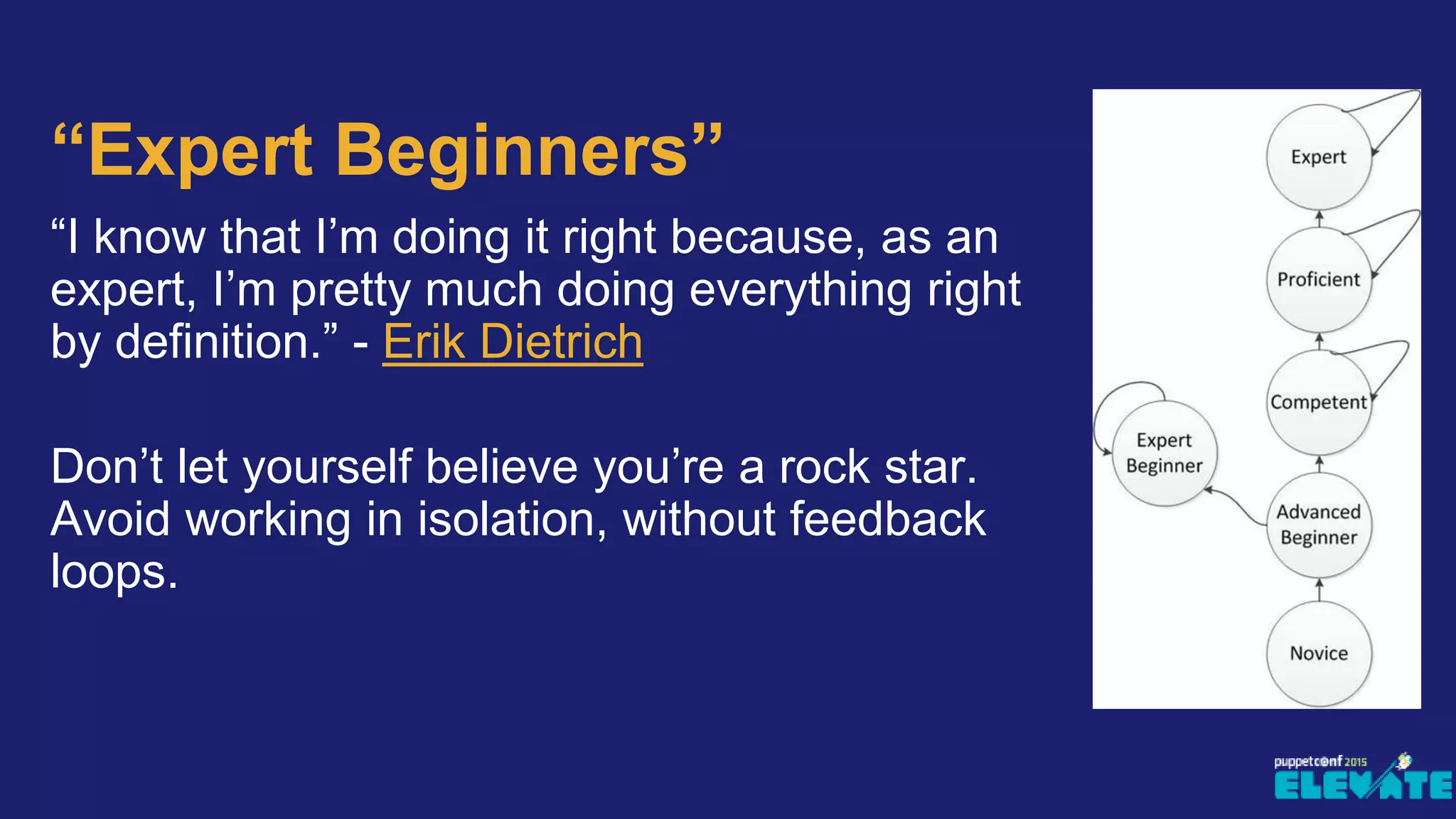
“Expert Beginners”
“I know that I’m doing it right because, as an
expert, I’m pretty much doing everything right
by definition.” - Erik Dietrich
Don’t let yourself believe you’re a rock star.
Avoid working in isolation, without feedback
loops.
Sharing is Caring
Find feedback loops
• Puppet User Group (or LUG/VMUG/etc)
• Meetup.com (DevOps, Puppet, Conf. Management)
• Puppet Labs Test Pilots
• Websites: ask.puppetlabs.com, stackoverflow
• IRC: #puppet, #puppet-community
• Podcasts, Slideshares, Blog Posts, Video Tutorials
• Industry Peers (Friends, Co-Workers, Social Media)
• Jumpstart Engagement (PL Professional Services)
Get buy-in from your family and your employer. Get permission for the time and
don’t share proprietary data!
It’s a cultural issue, not a technological issue
• Git - Distributed VCS
• Mandatory code reviews via Pull Requests (PRs)
• Small, discrete, self-contained changes
• Enable approvals
• ESPECIALLY in emergencies!
• Git hooks save time and embarrassment
• Be positive!
Code Review
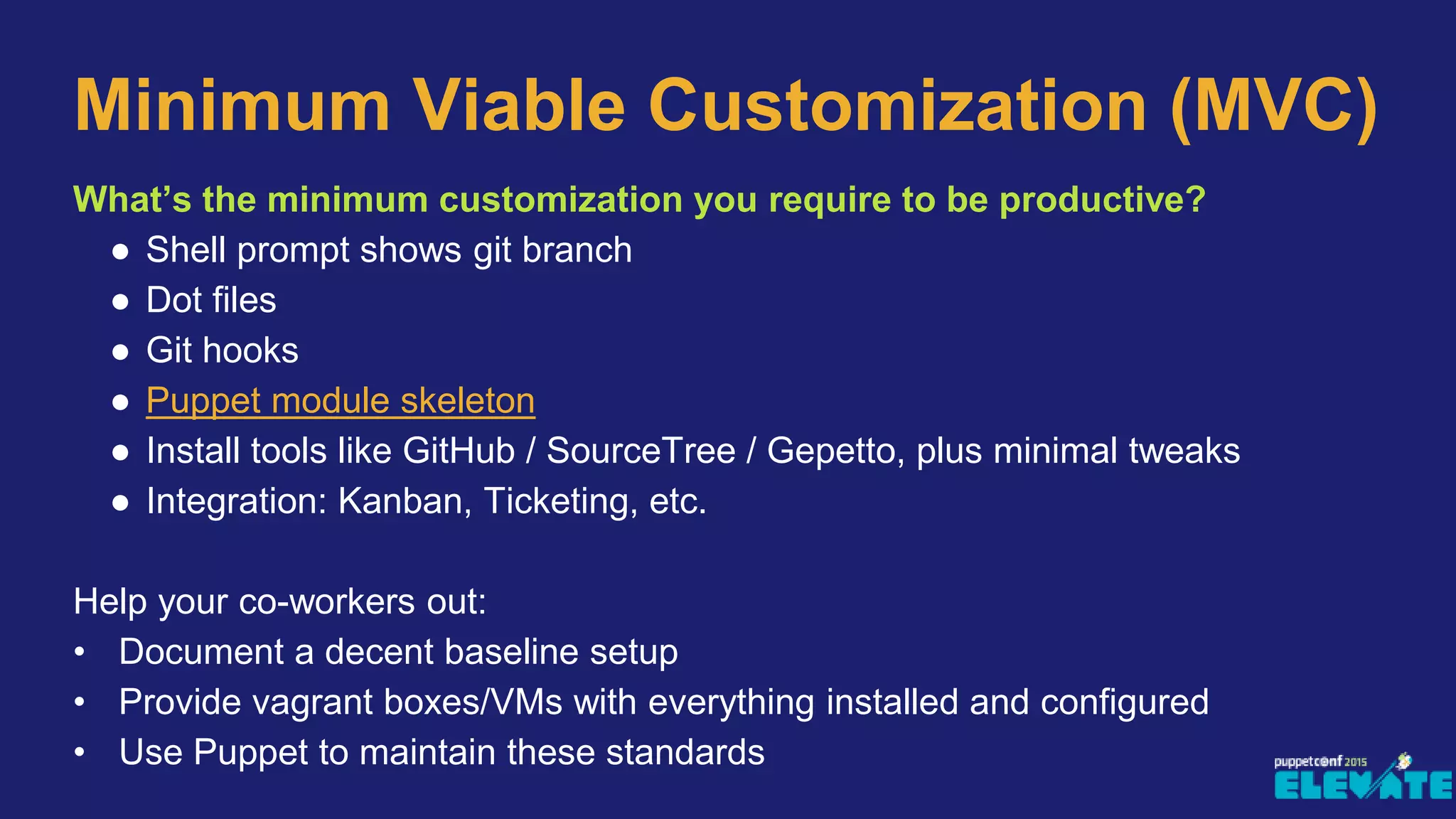
What’s the minimum customization you require to be productive?
● Shell prompt shows git branch
● Dot files
● Git hooks
● Puppet module skeleton
● Install tools like GitHub / SourceTree / Gepetto, plus minimal tweaks
● Integration: Kanban, Ticketing, etc.
Help your co-workers out:
• Document a decent baseline setup
• Provide vagrant boxes/VMs with everything installed and configured
• Use Puppet to maintain these standards
Minimum Viable Customization (MVC)
Create a culture that works for your team
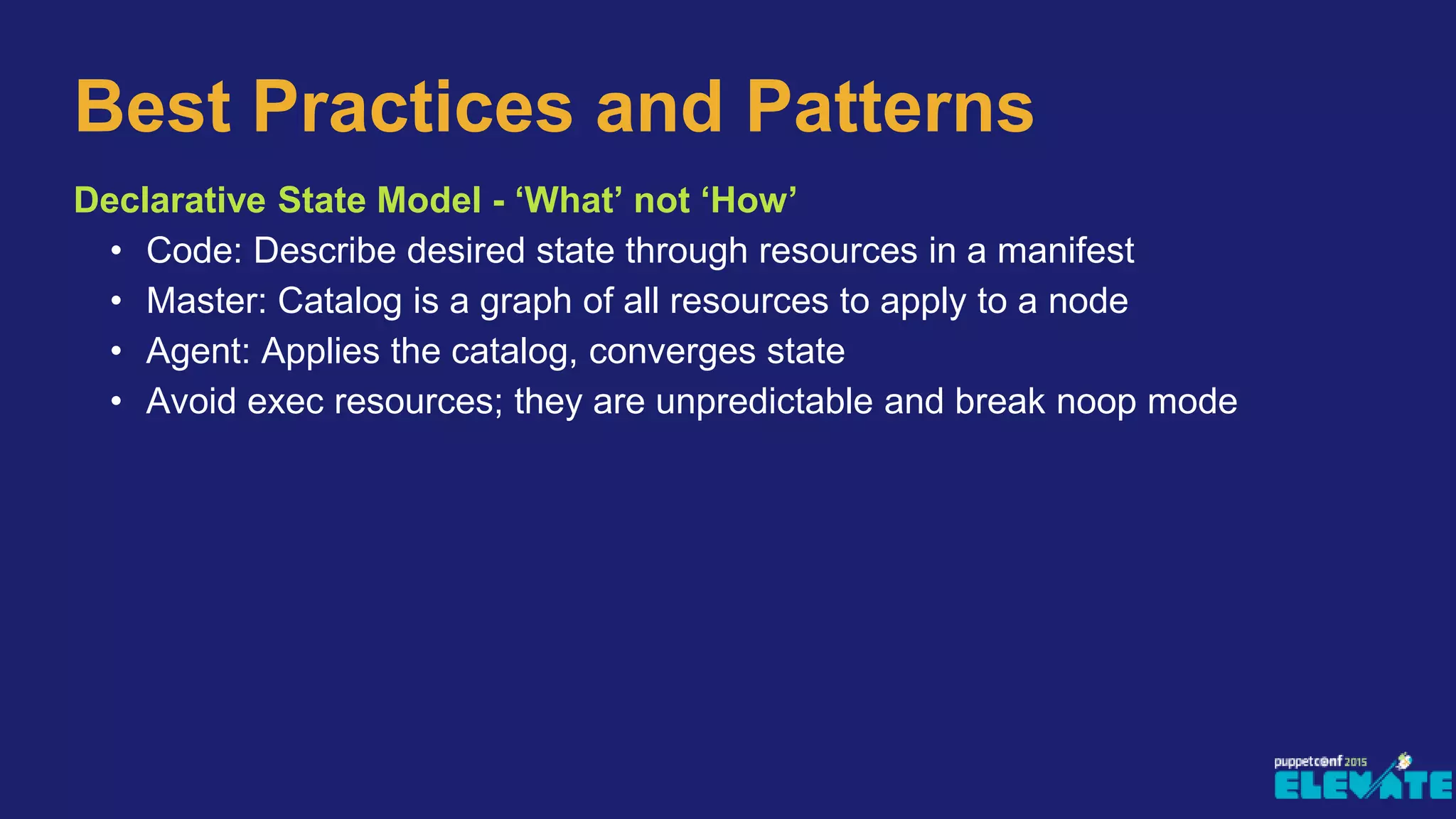
Best Practices and Patterns
Declarative State Model - ‘What’ not ‘How’
• Code: Describe desired state through resources in a manifest
• Master: Catalog is a graph of all resources to apply to a node
• Agent: Applies the catalog, converges state
• Avoid exec resources; they are unpredictable and break noop mode
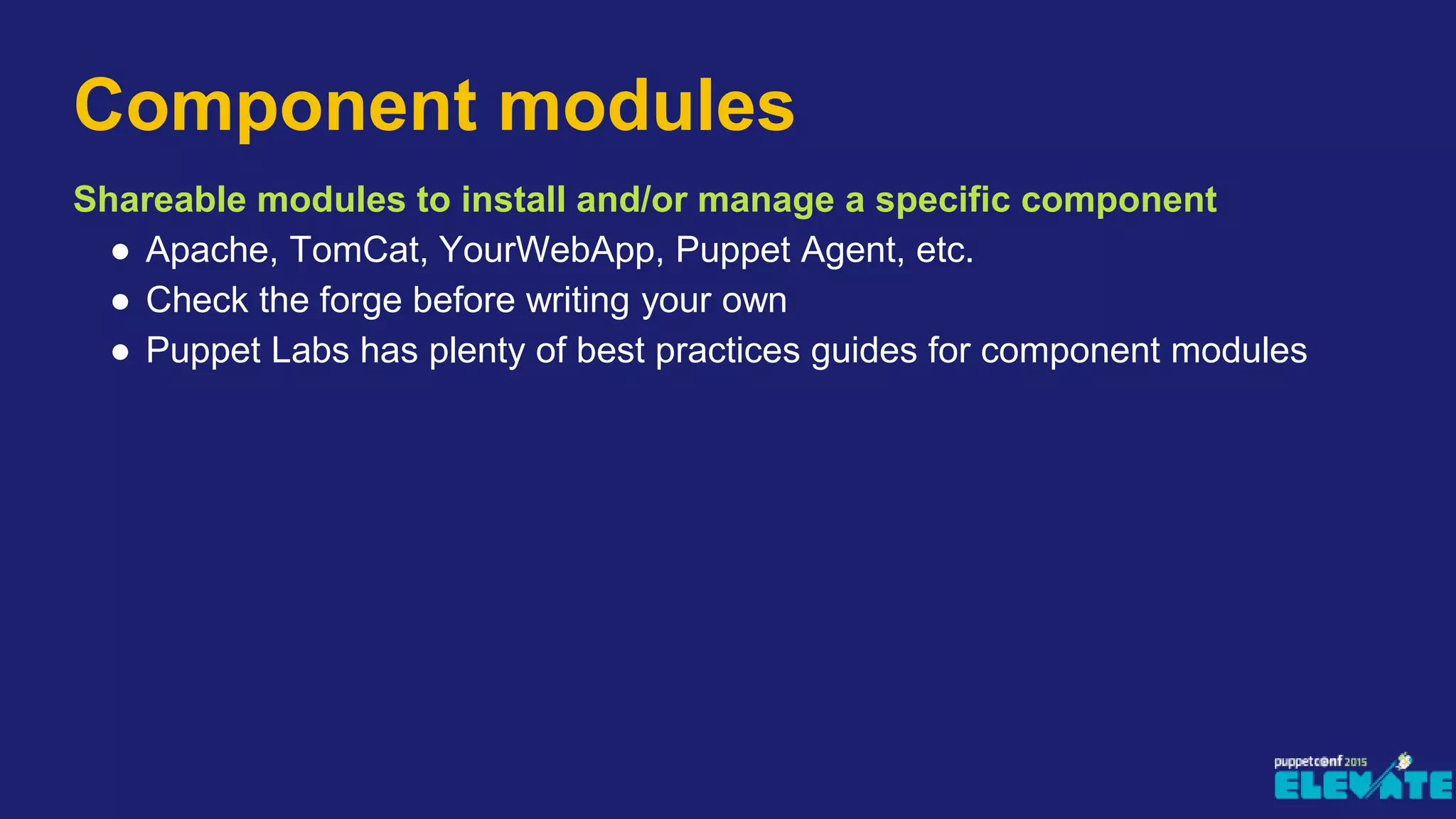
Shareable modules to install and/or manage a specific component
● Apache, TomCat, YourWebApp, Puppet Agent, etc.
● Check the forge before writing your own
● Puppet Labs has plenty of best practices guides for component modules
Component modules
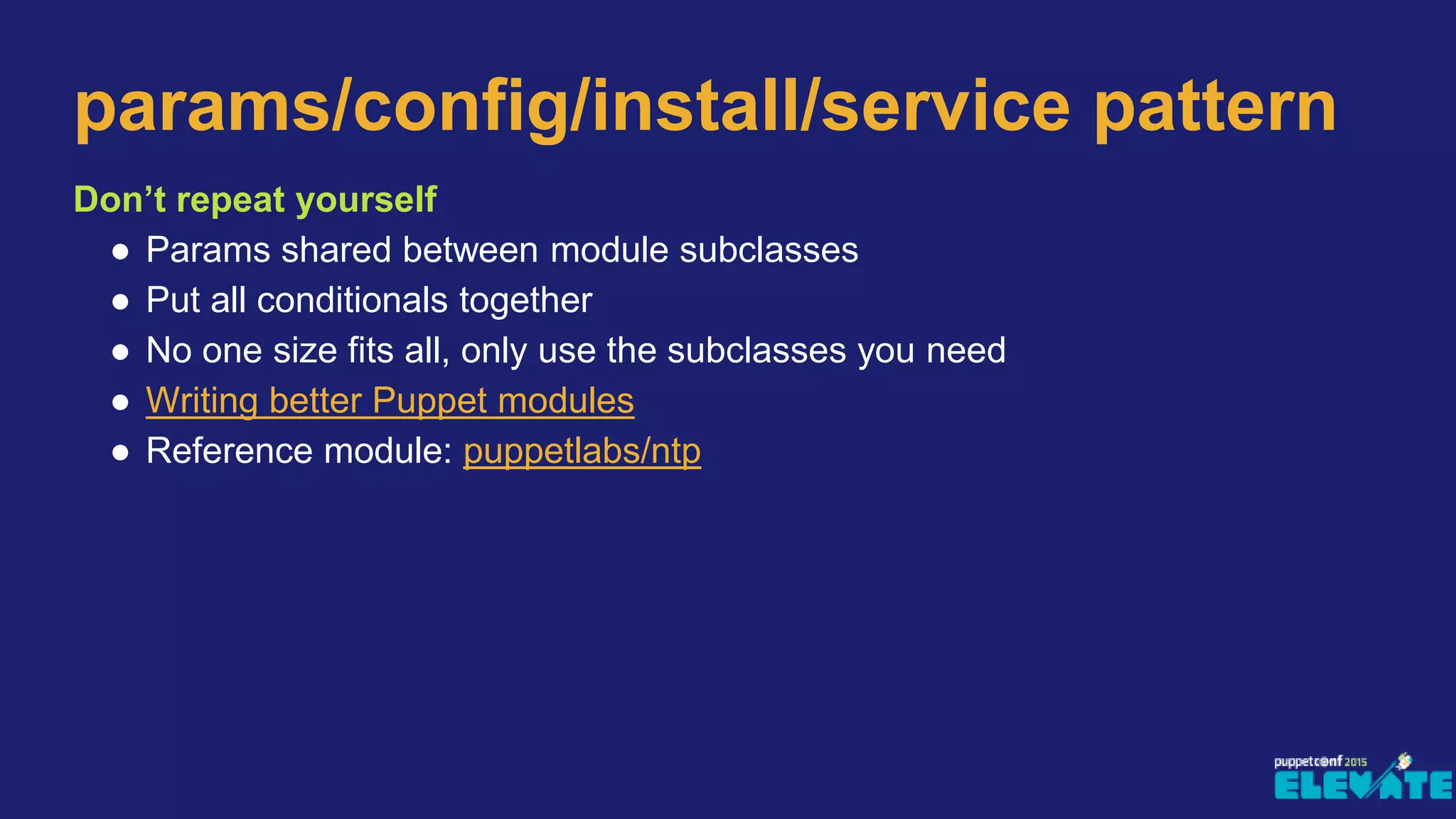
Don’t repeat yourself
● Params shared between module subclasses
● Put all conditionals together
● No one size fits all, only use the subclasses you need
● Writing better Puppet modules
● Reference module: puppetlabs/ntp
params/config/install/service pattern
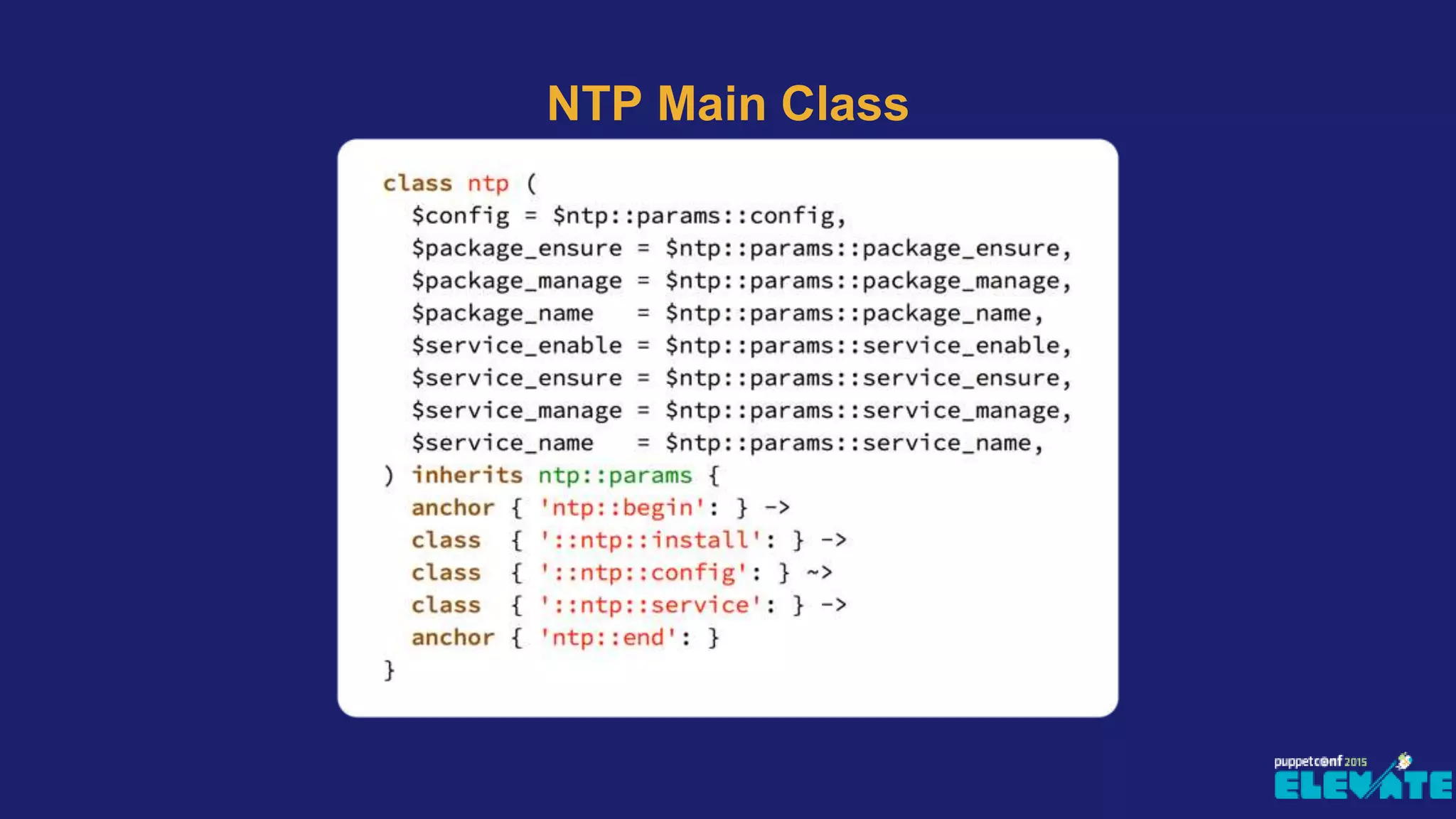
NTP Main Class
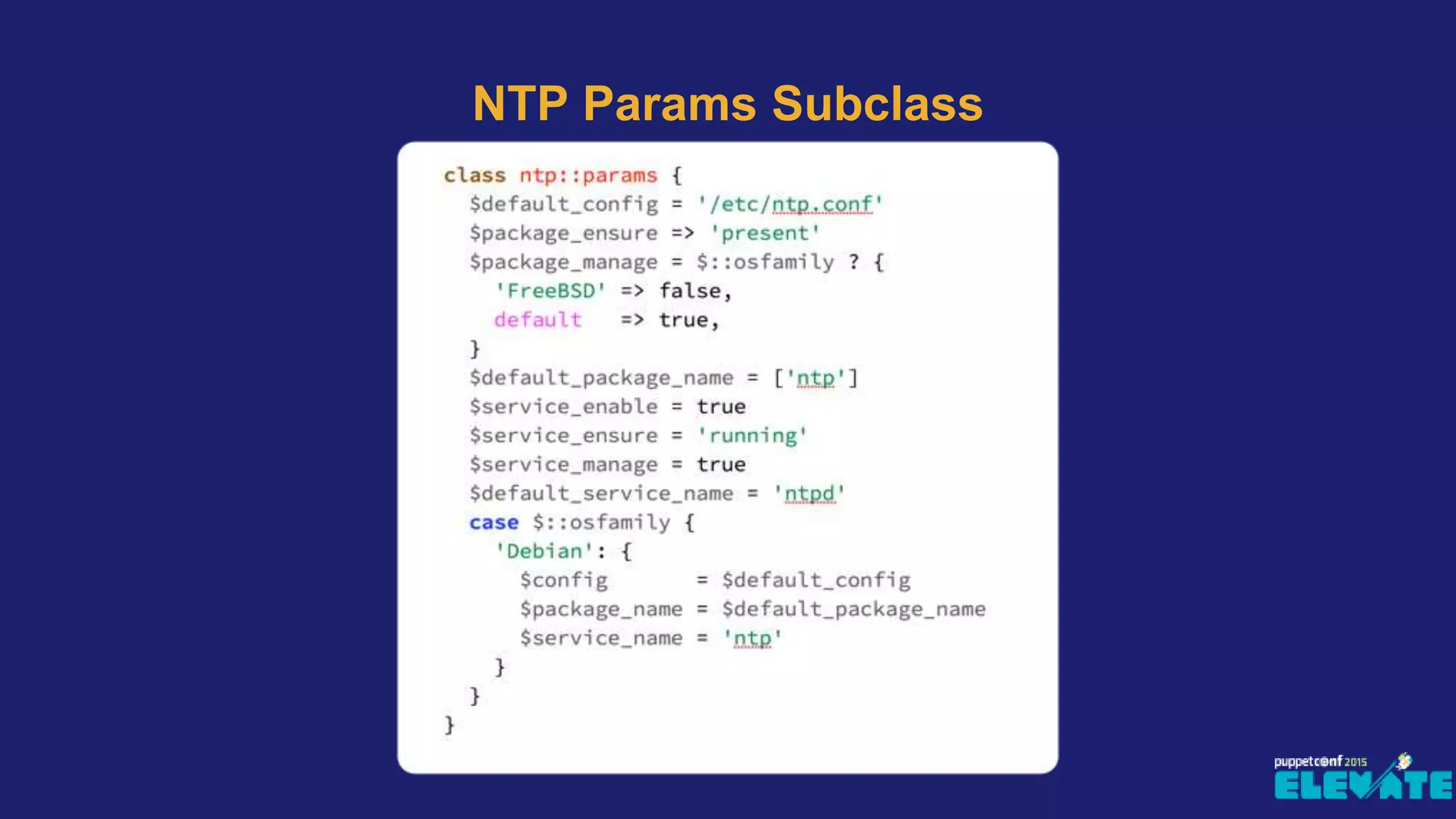
NTP Params Subclass
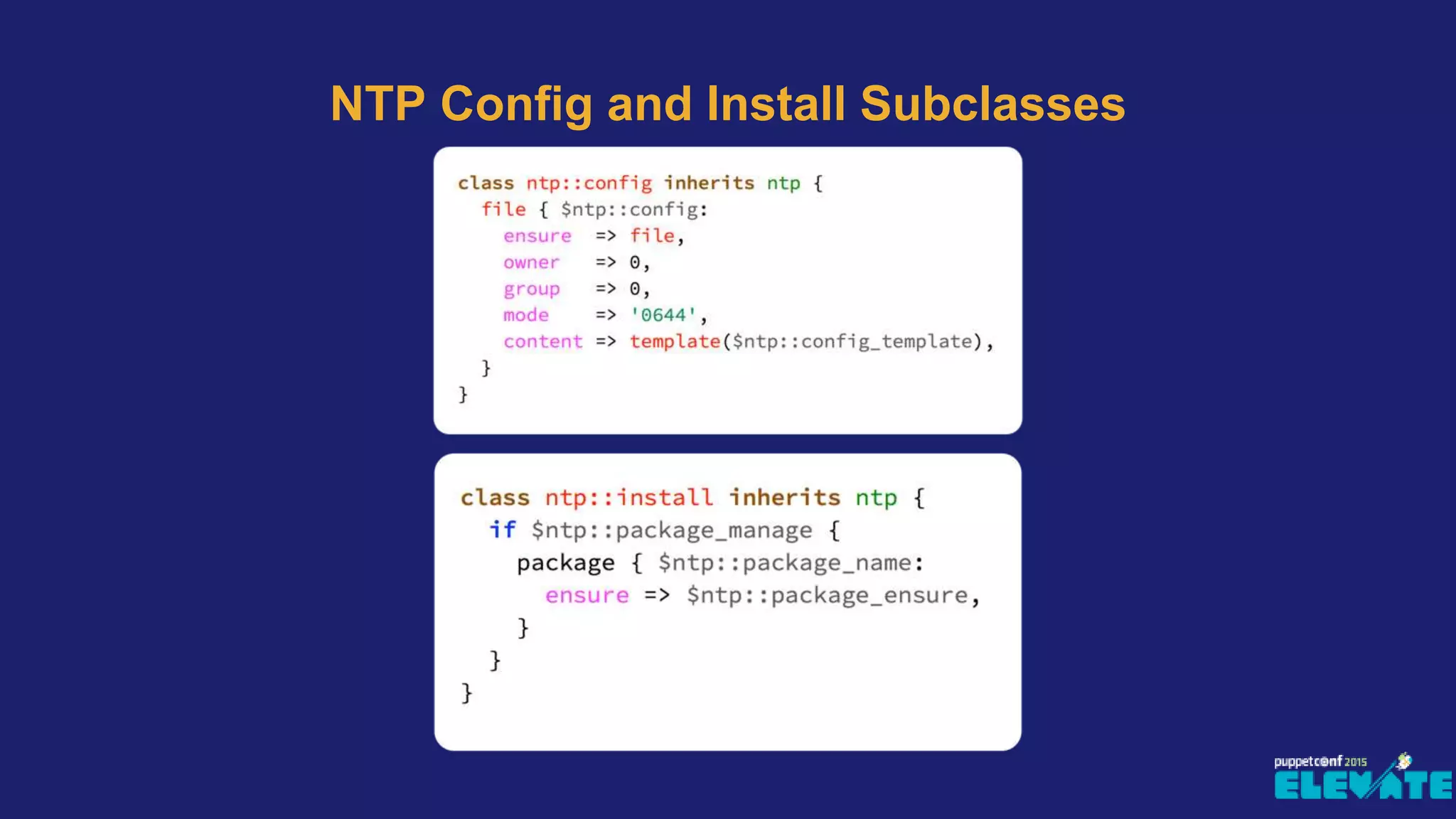
NTP Config and Install Subclasses
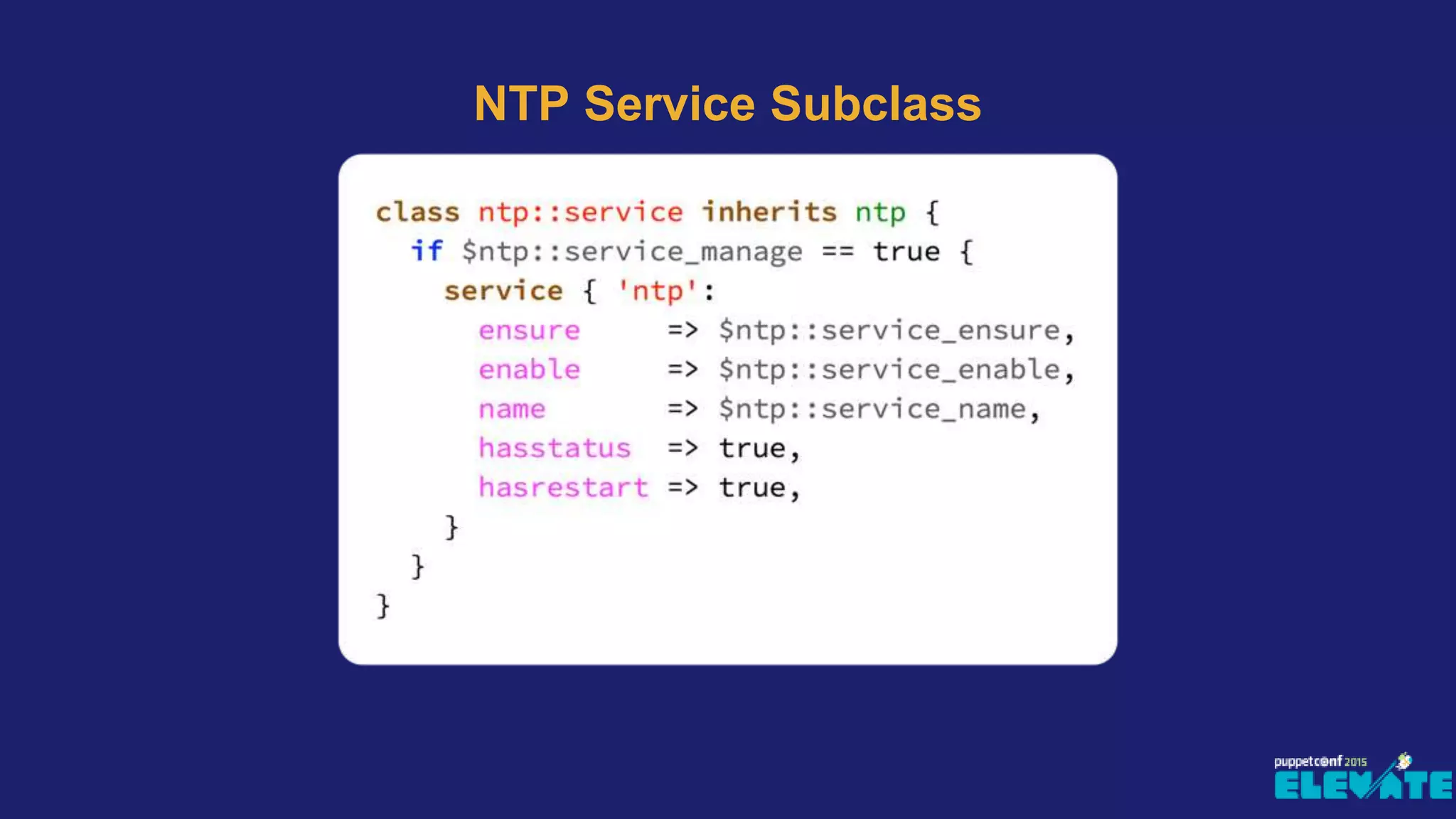
NTP Service Subclass
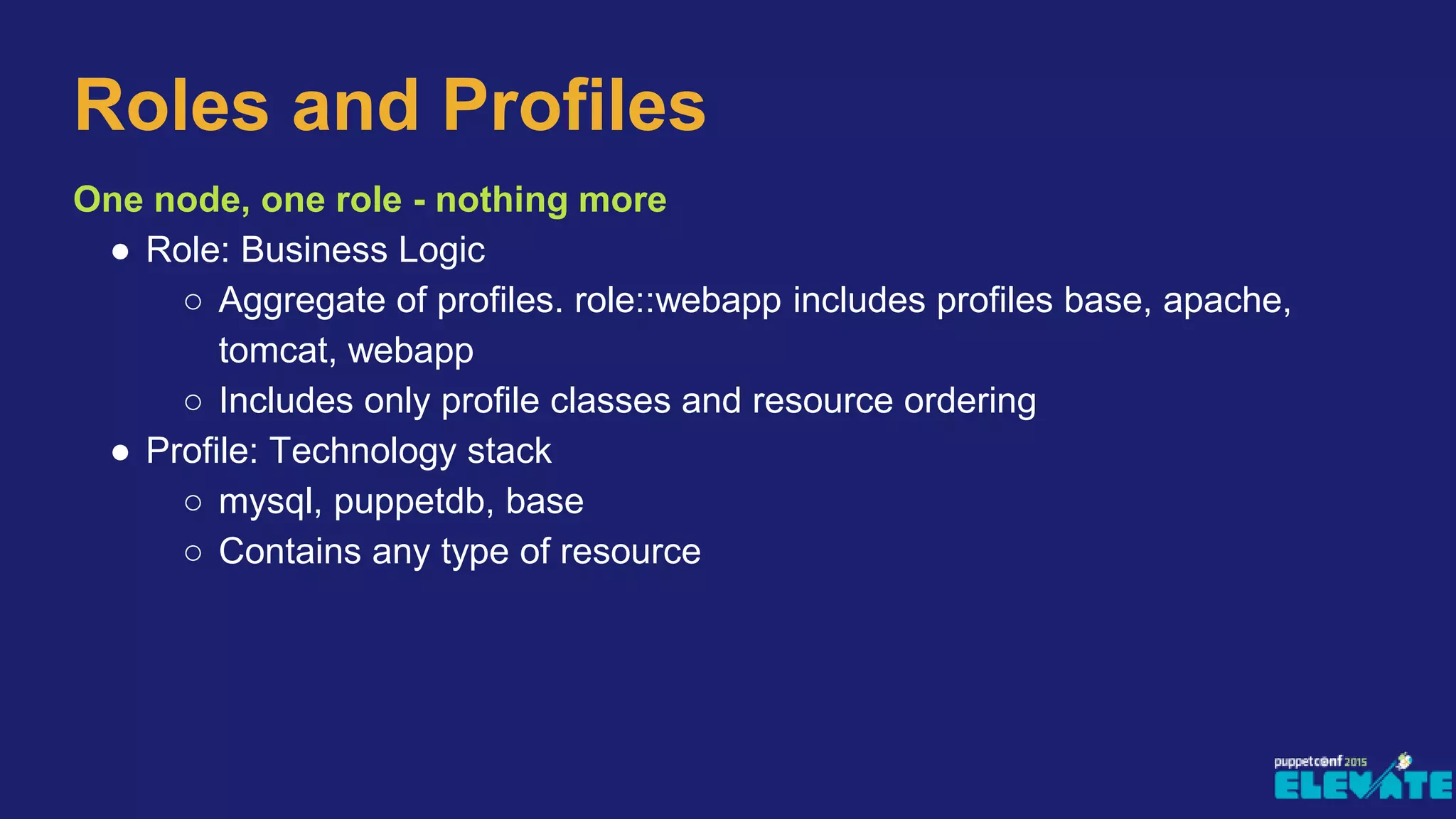
One node, one role - nothing more
● Role: Business Logic
○ Aggregate of profiles. role::webapp includes profiles base, apache,
tomcat, webapp
○ Includes only profile classes and resource ordering
● Profile: Technology stack
○ mysql, puppetdb, base
○ Contains any type of resource
Roles and Profiles
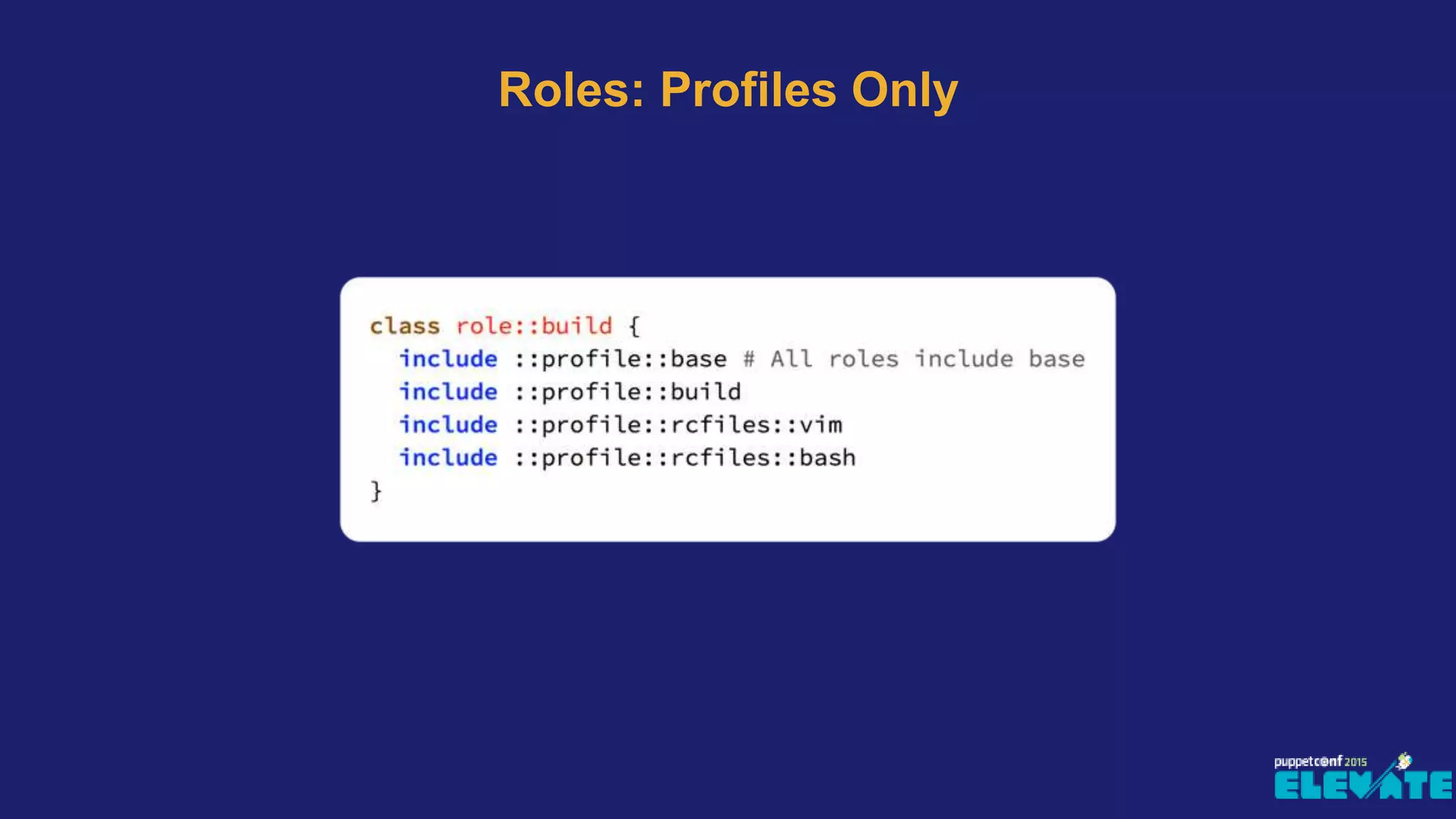
Roles: Profiles Only
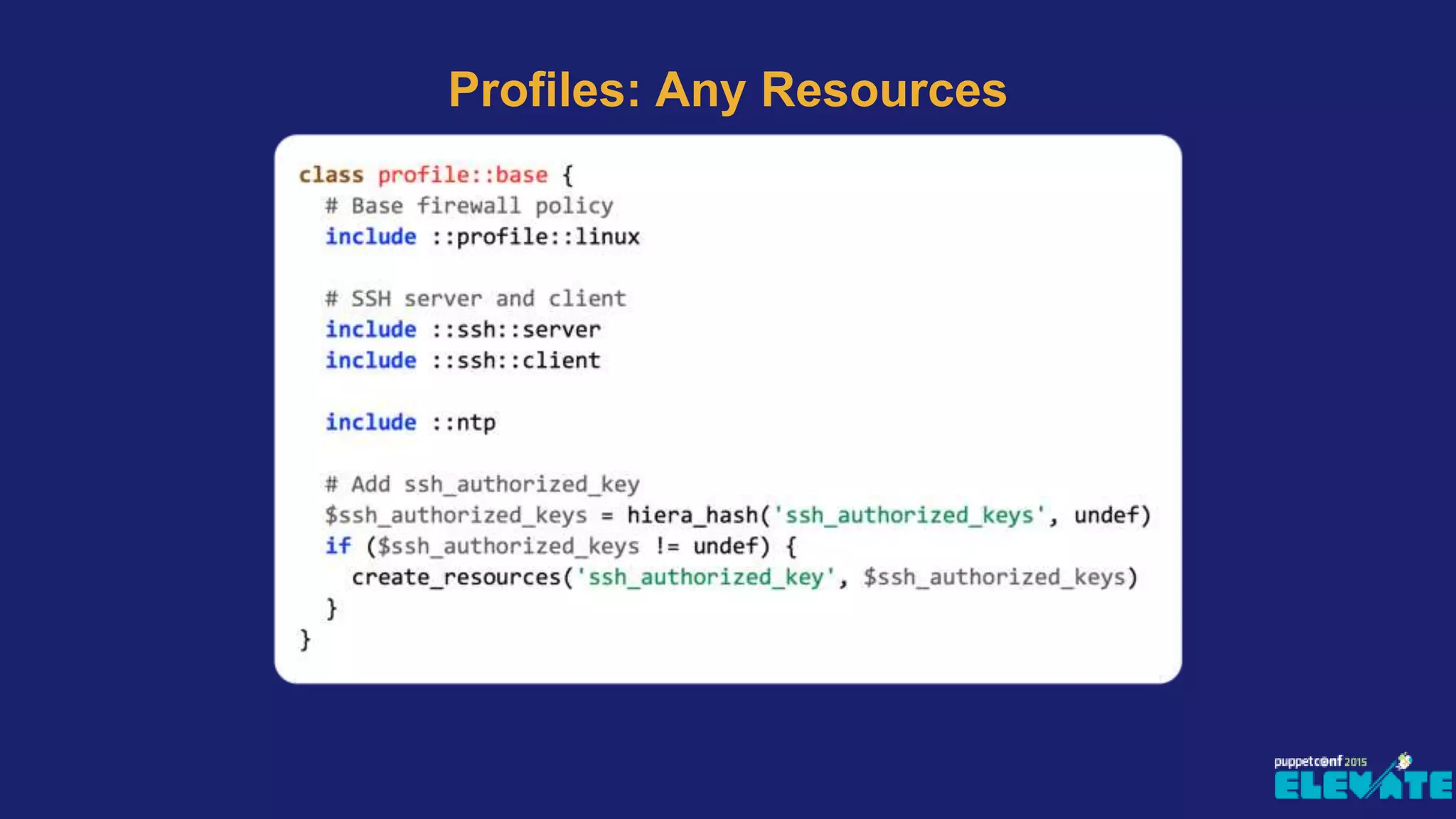
Profiles: Any Resources
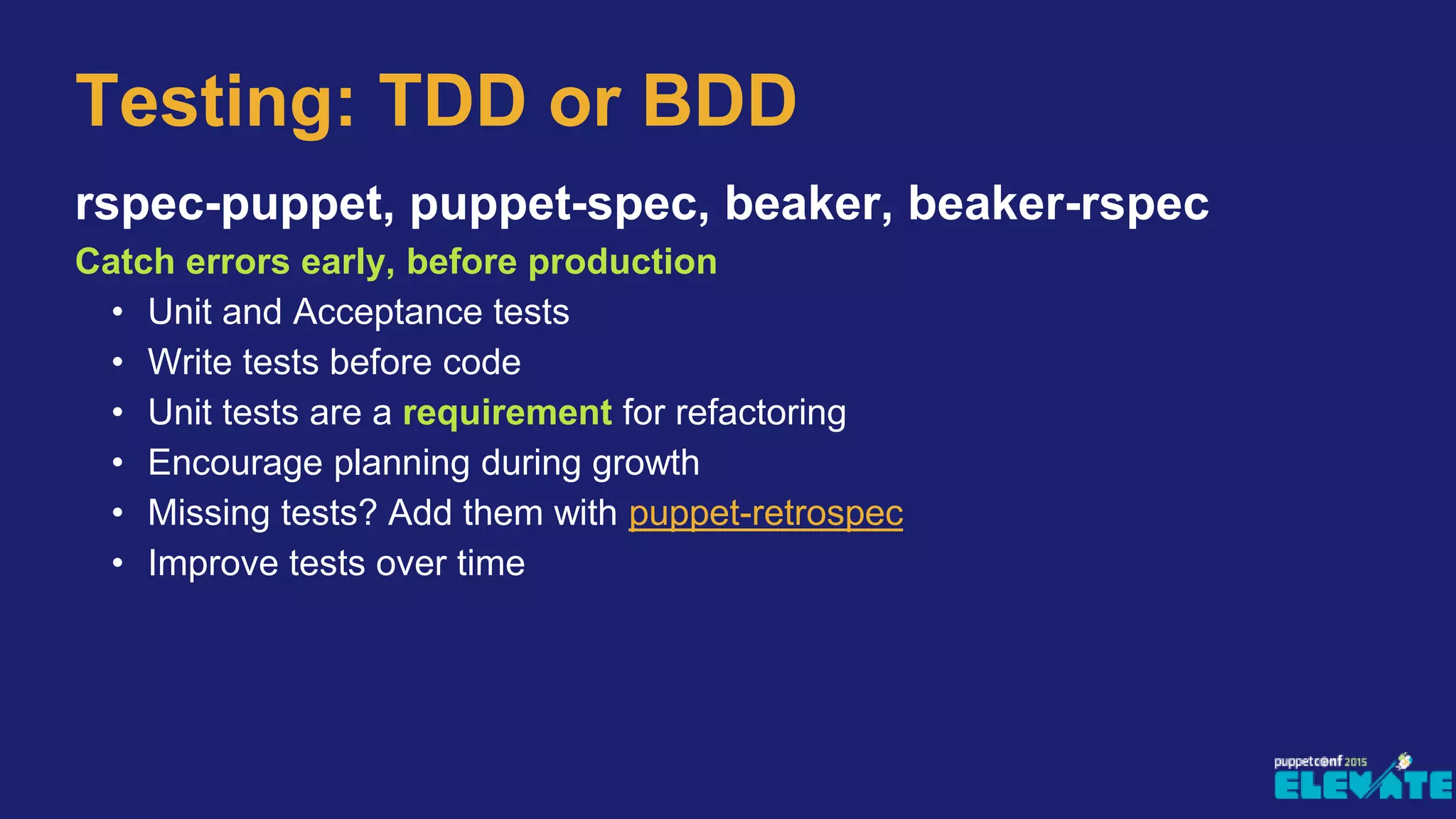
Testing: TDD or BDD
rspec-puppet, puppet-spec, beaker, beaker-rspec
Catch errors early, before production
• Unit and Acceptance tests
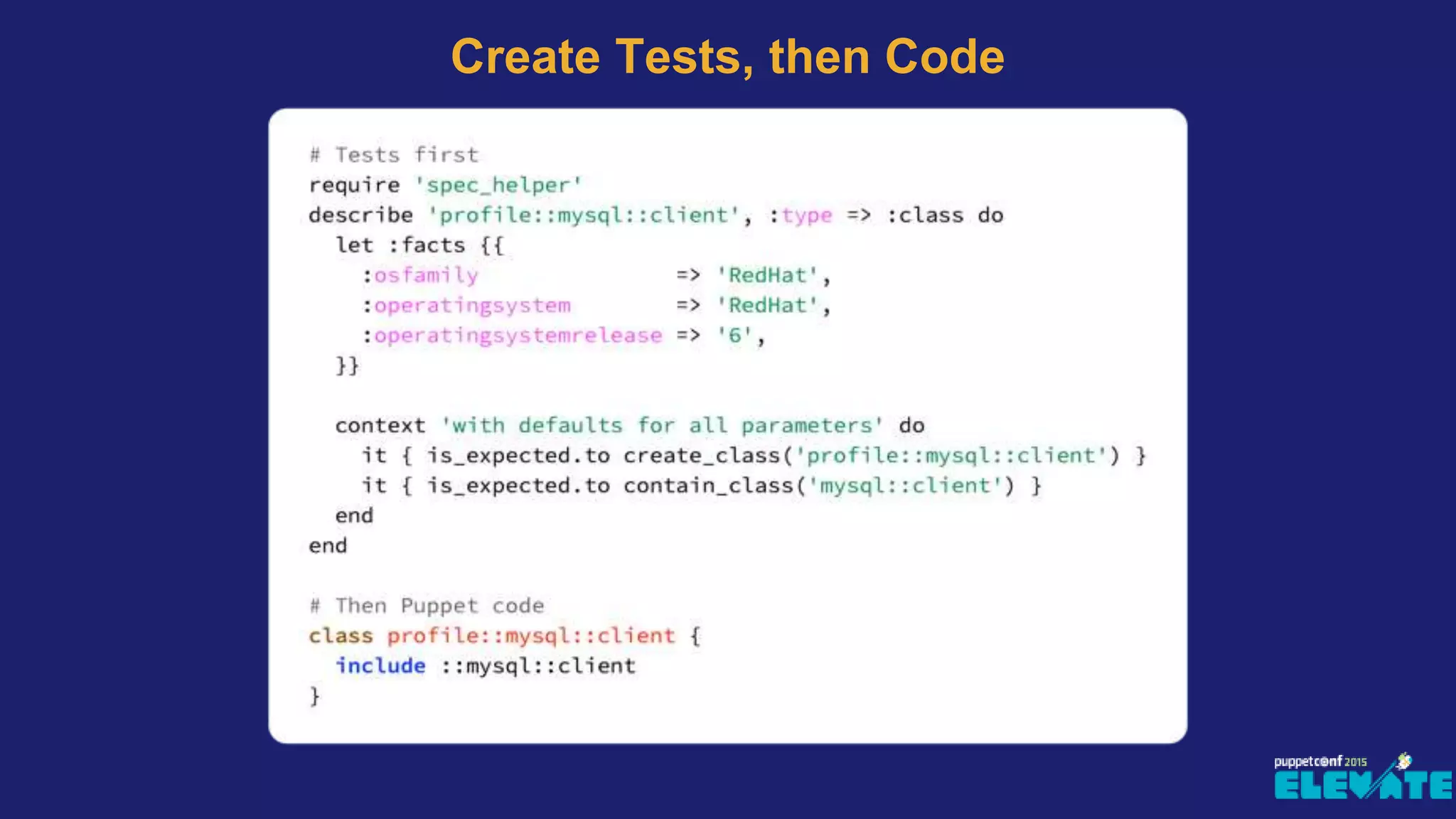
• Write tests before code
• Unit tests are a requirement for refactoring
• Encourage planning during growth
• Missing tests? Add them with puppet-retrospec
• Improve tests over time
Create Tests, then Code
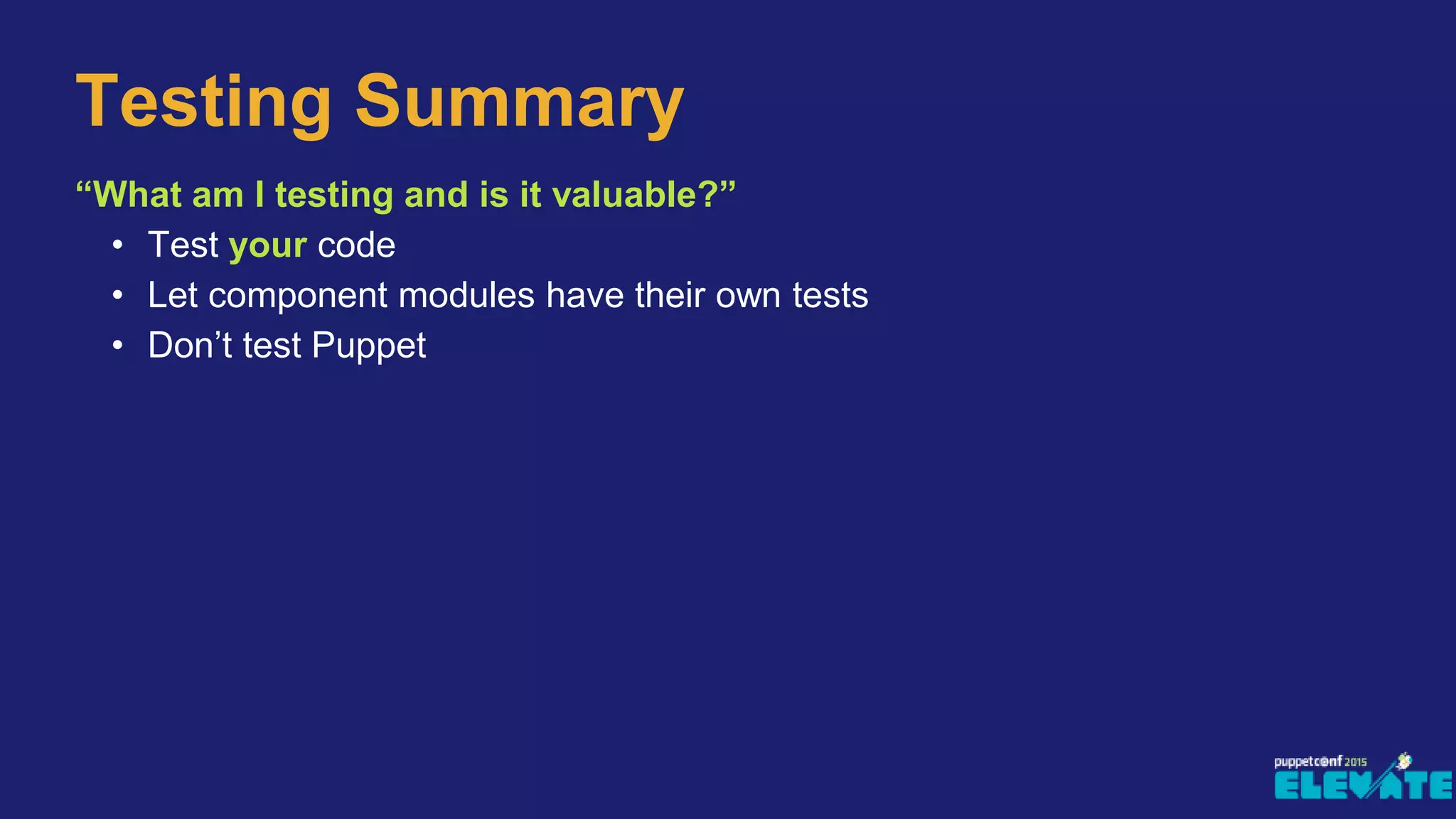
Testing Summary
“What am I testing and is it valuable?”
• Test your code
• Let component modules have their own tests
• Don’t test Puppet
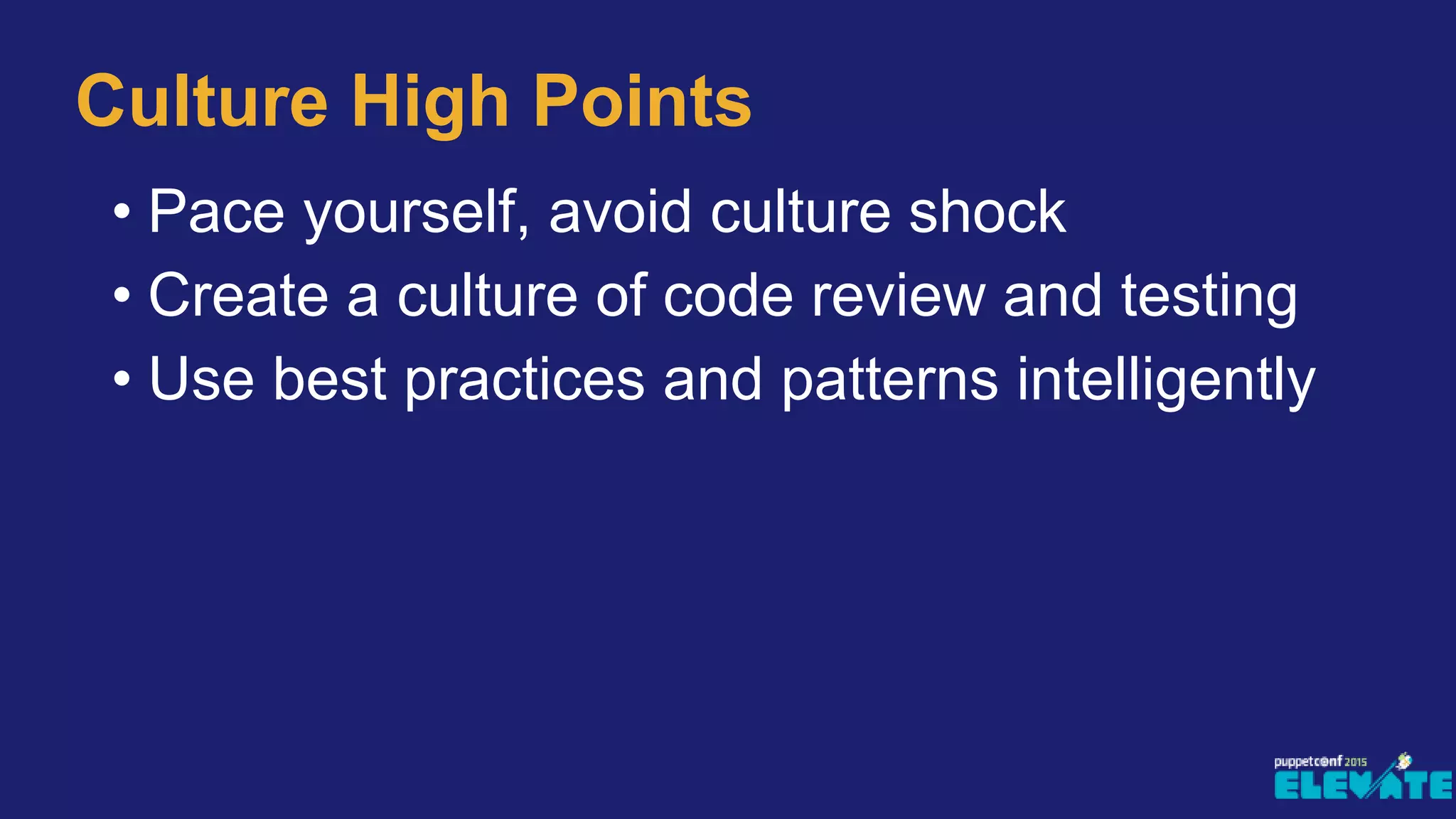
Culture High Points
• Pace yourself, avoid culture shock
• Create a culture of code review and testing
• Use best practices and patterns intelligently
Tooling
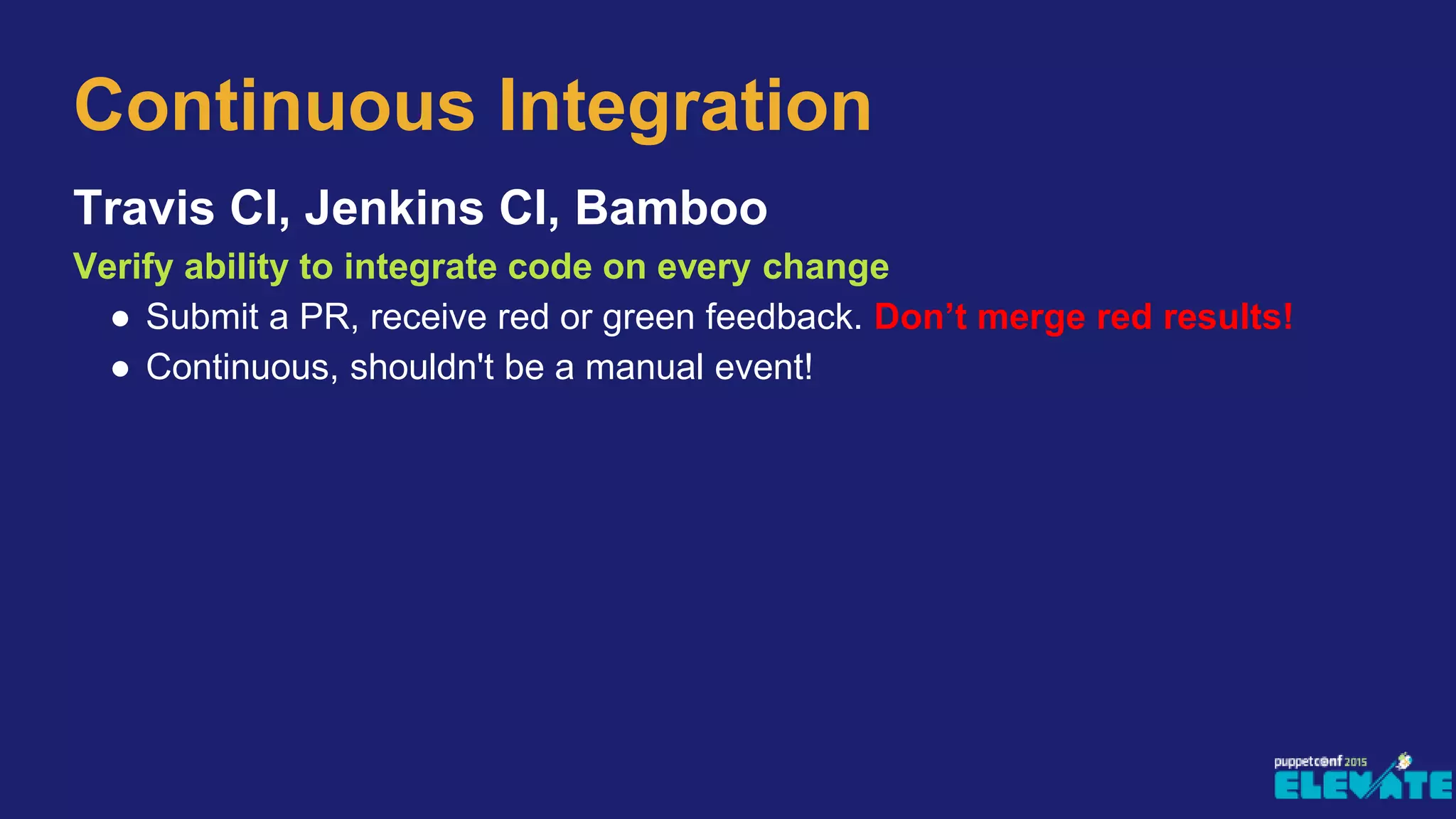
Travis CI, Jenkins CI, Bamboo
Verify ability to integrate code on every change
● Submit a PR, receive red or green feedback. Don’t merge red results!
● Continuous, shouldn't be a manual event!
Continuous Integration
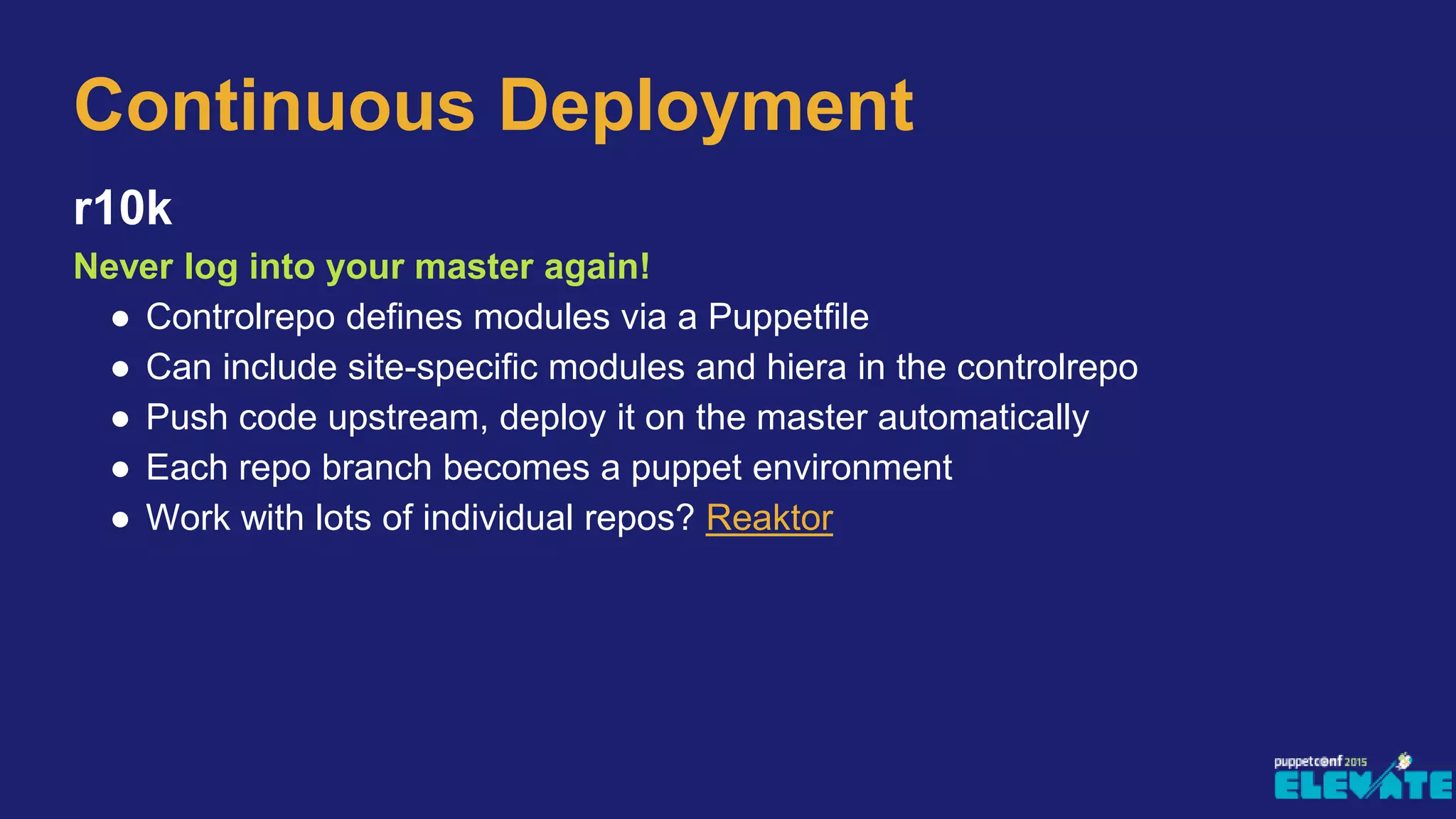
r10k
Never log into your master again!
● Controlrepo defines modules via a Puppetfile
● Can include site-specific modules and hiera in the controlrepo
● Push code upstream, deploy it on the master automatically
● Each repo branch becomes a puppet environment
● Work with lots of individual repos? Reaktor
Continuous Deployment
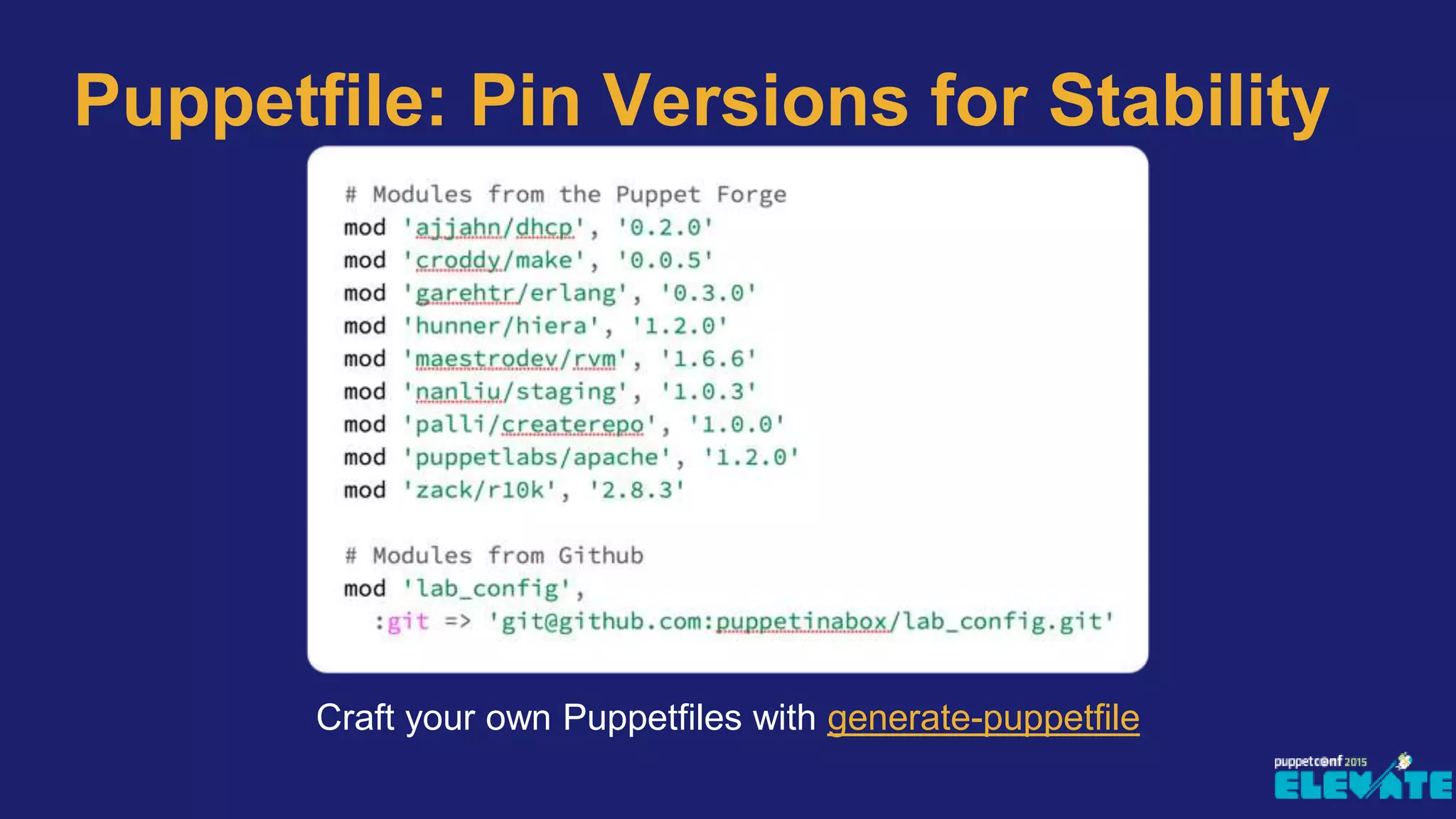
Puppetfile: Pin Versions for Stability
Craft your own Puppetfiles with generate-puppetfile
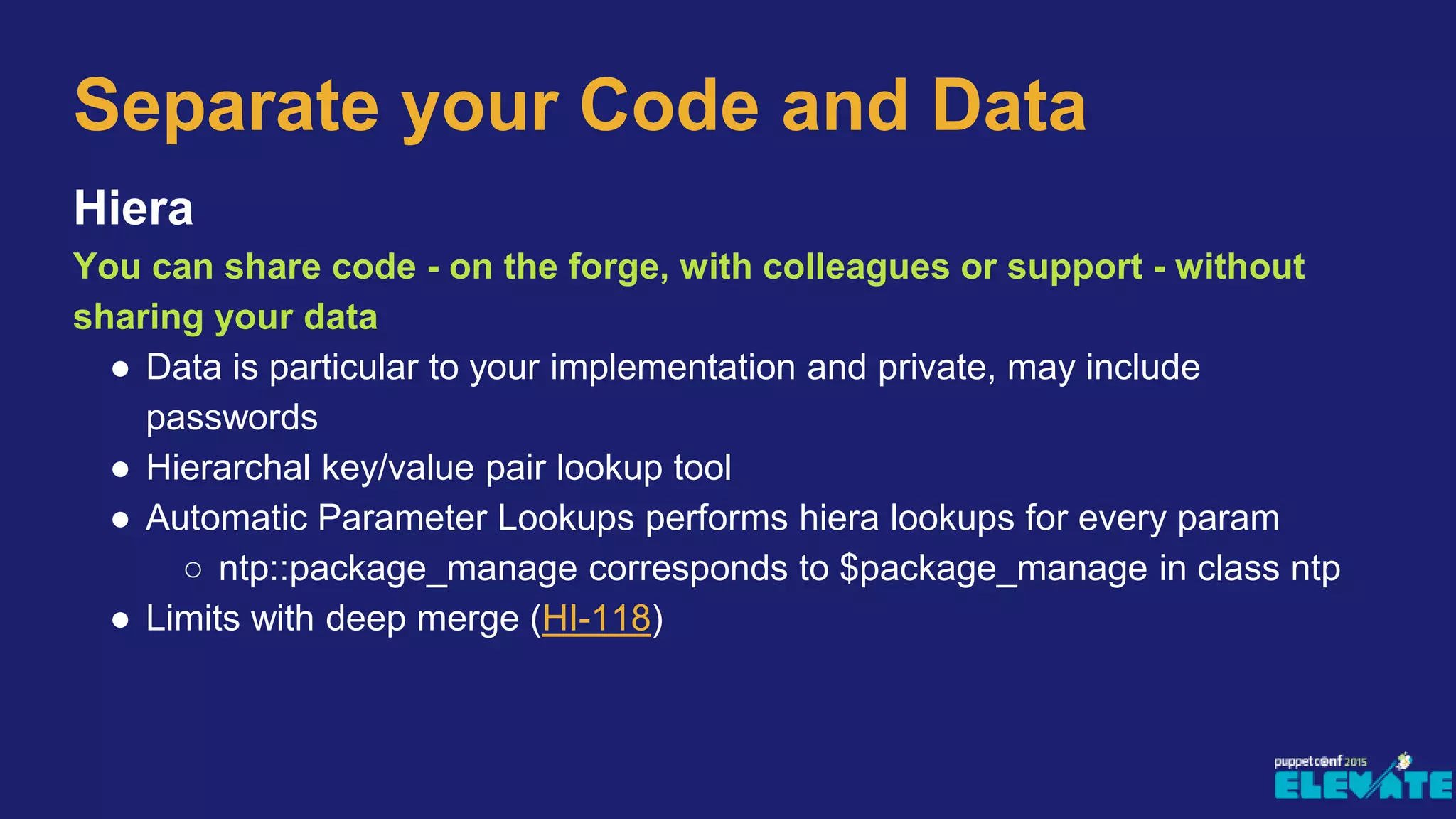
Hiera
You can share code - on the forge, with colleagues or support - without
sharing your data
● Data is particular to your implementation and private, may include
passwords
● Hierarchal key/value pair lookup tool
● Automatic Parameter Lookups performs hiera lookups for every param
○ ntp::package_manage corresponds to $package_manage in class ntp
● Limits with deep merge (HI-118)
Separate your Code and Data
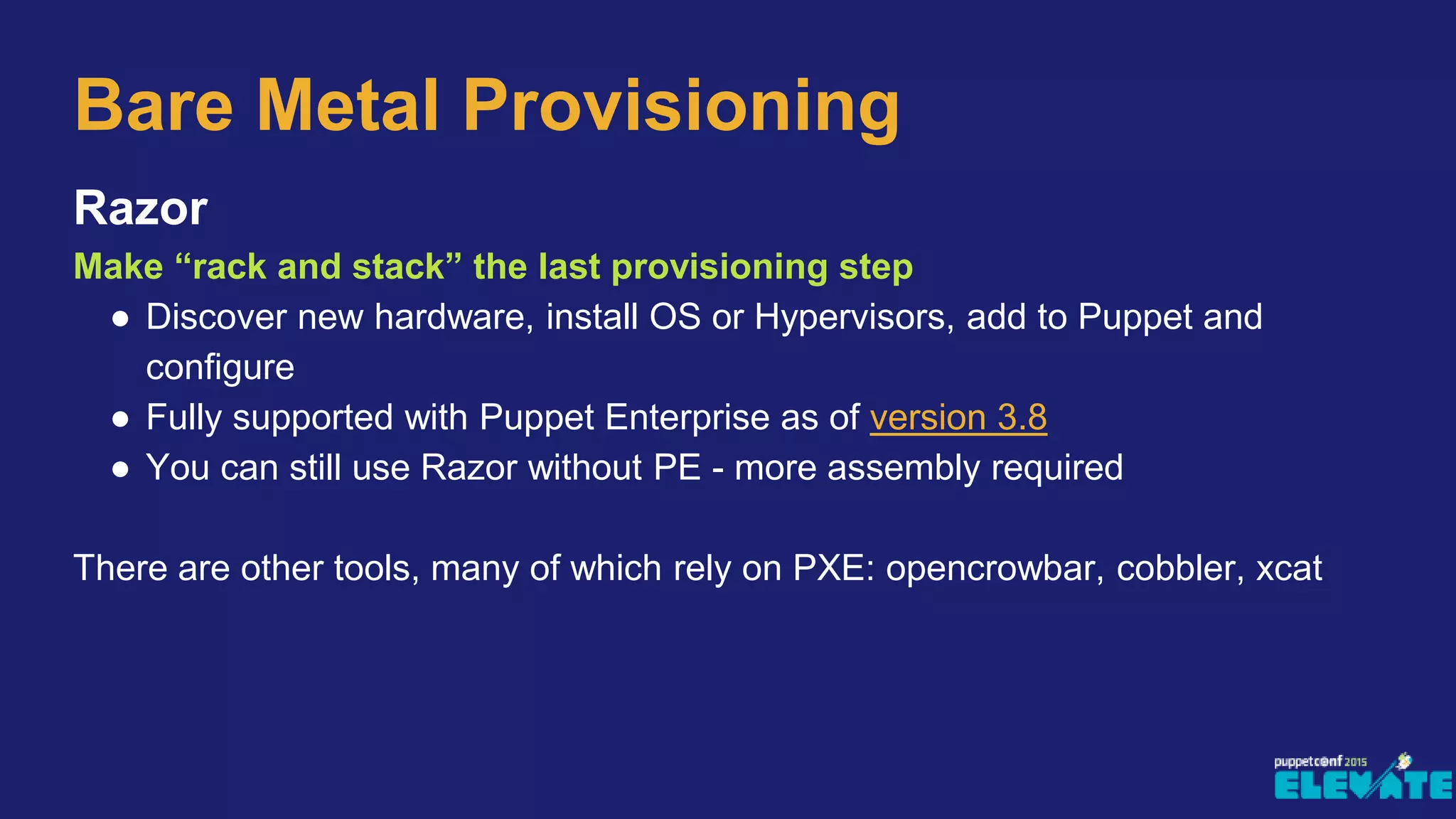
Razor
Make “rack and stack” the last provisioning step
● Discover new hardware, install OS or Hypervisors, add to Puppet and
configure
● Fully supported with Puppet Enterprise as of version 3.8
● You can still use Razor without PE - more assembly required
There are other tools, many of which rely on PXE: opencrowbar, cobbler, xcat
Bare Metal Provisioning
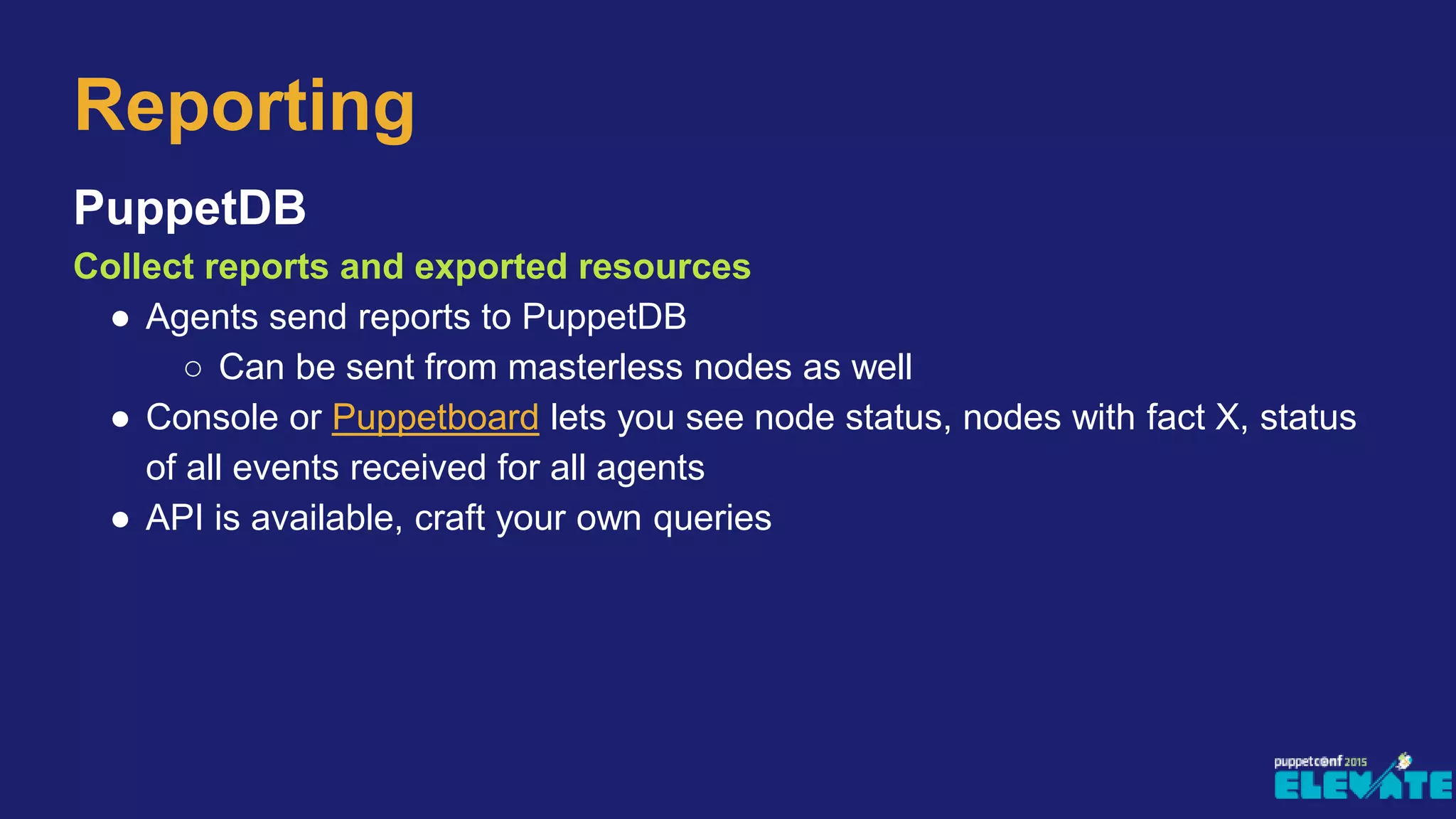
PuppetDB
Collect reports and exported resources
● Agents send reports to PuppetDB
○ Can be sent from masterless nodes as well
● Console or Puppetboard lets you see node status, nodes with fact X, status
of all events received for all agents
● API is available, craft your own queries
Reporting
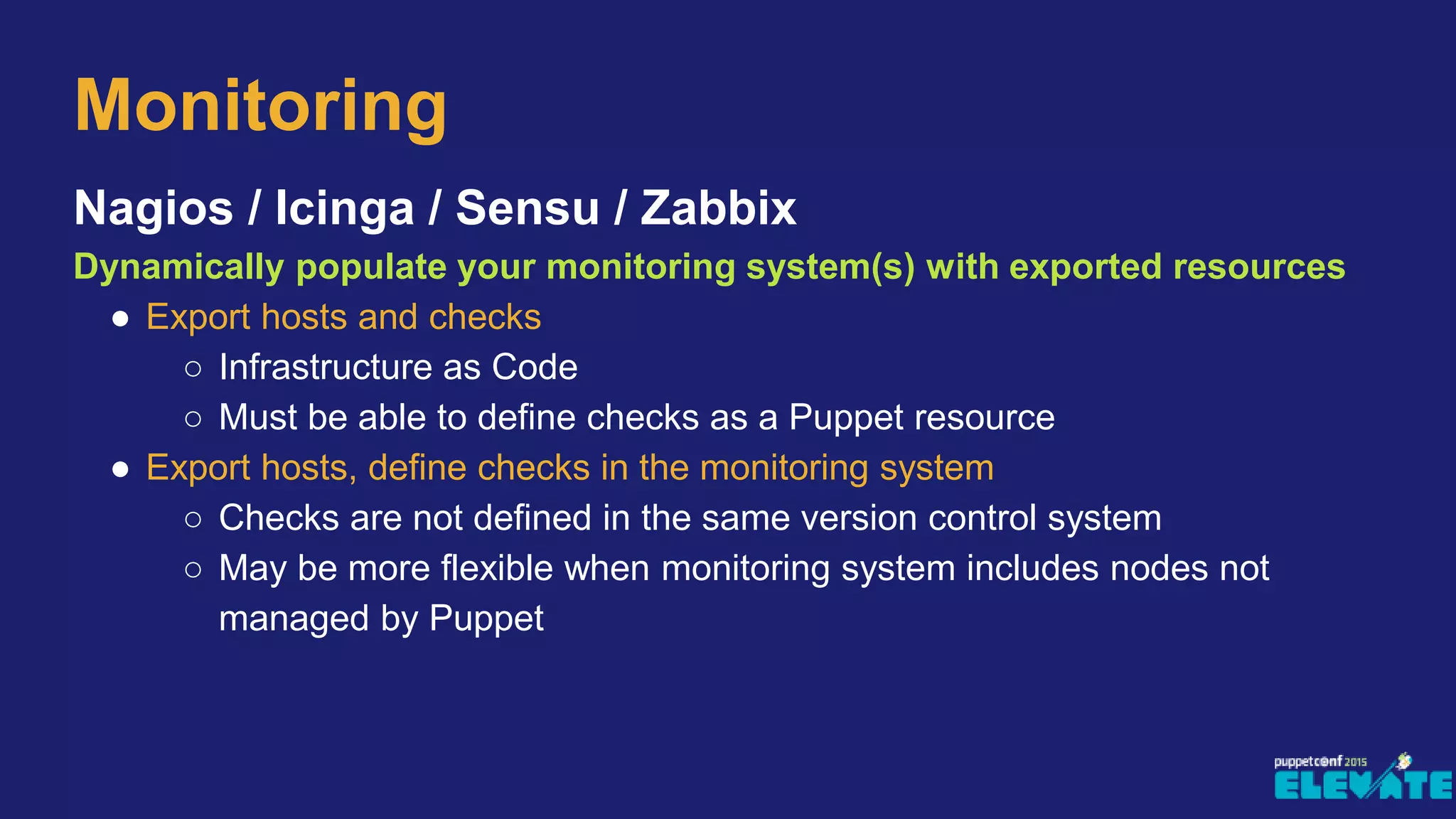
Nagios / Icinga / Sensu / Zabbix
Dynamically populate your monitoring system(s) with exported resources
● Export hosts and checks
○ Infrastructure as Code
○ Must be able to define checks as a Puppet resource
● Export hosts, define checks in the monitoring system
○ Checks are not defined in the same version control system
○ May be more flexible when monitoring system includes nodes not
managed by Puppet
Monitoring
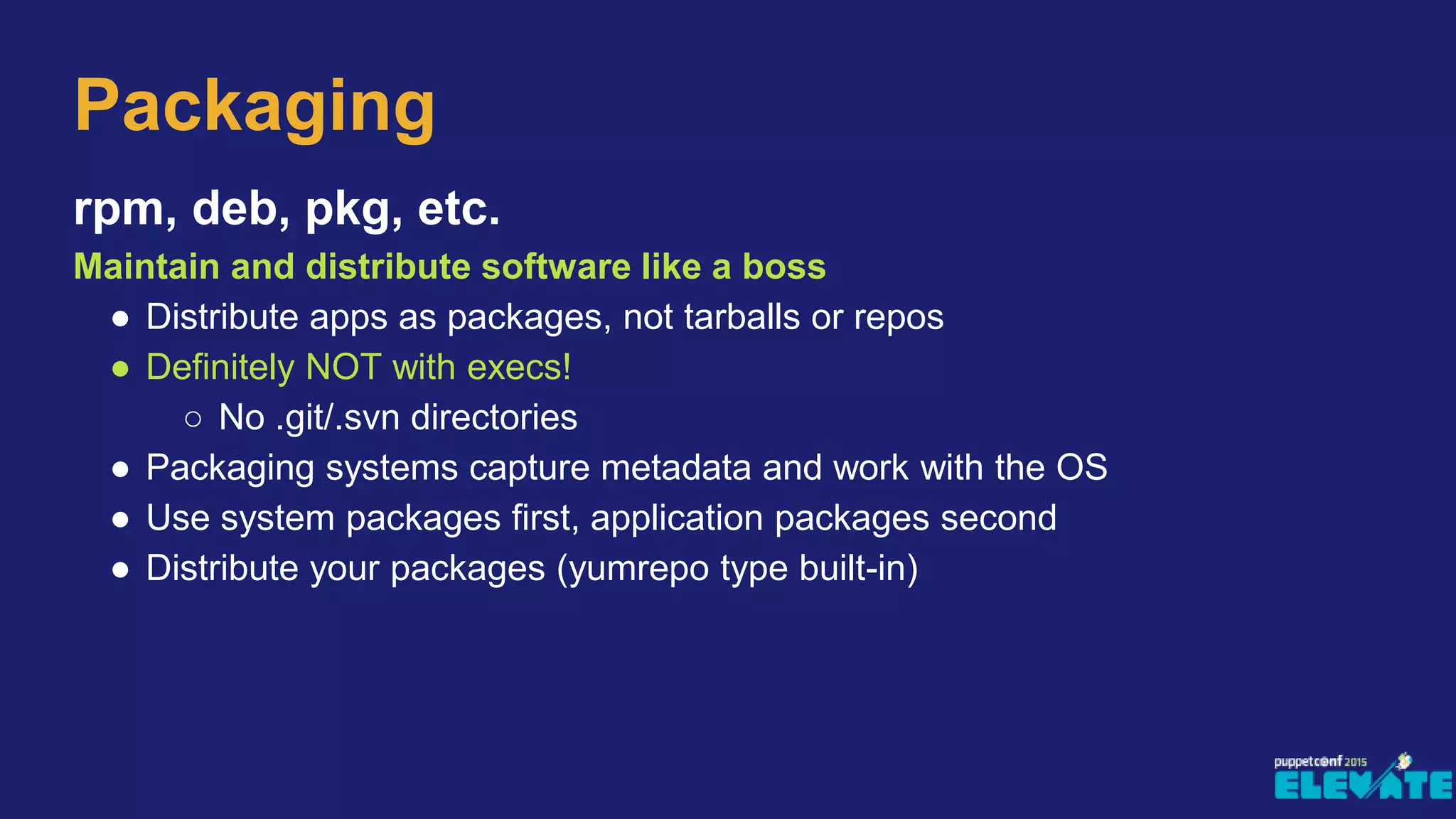
rpm, deb, pkg, etc.
Maintain and distribute software like a boss
● Distribute apps as packages, not tarballs or repos
● Definitely NOT with execs!
○ No .git/.svn directories
● Packaging systems capture metadata and work with the OS
● Use system packages first, application packages second
● Distribute your packages (yumrepo type built-in)
Packaging
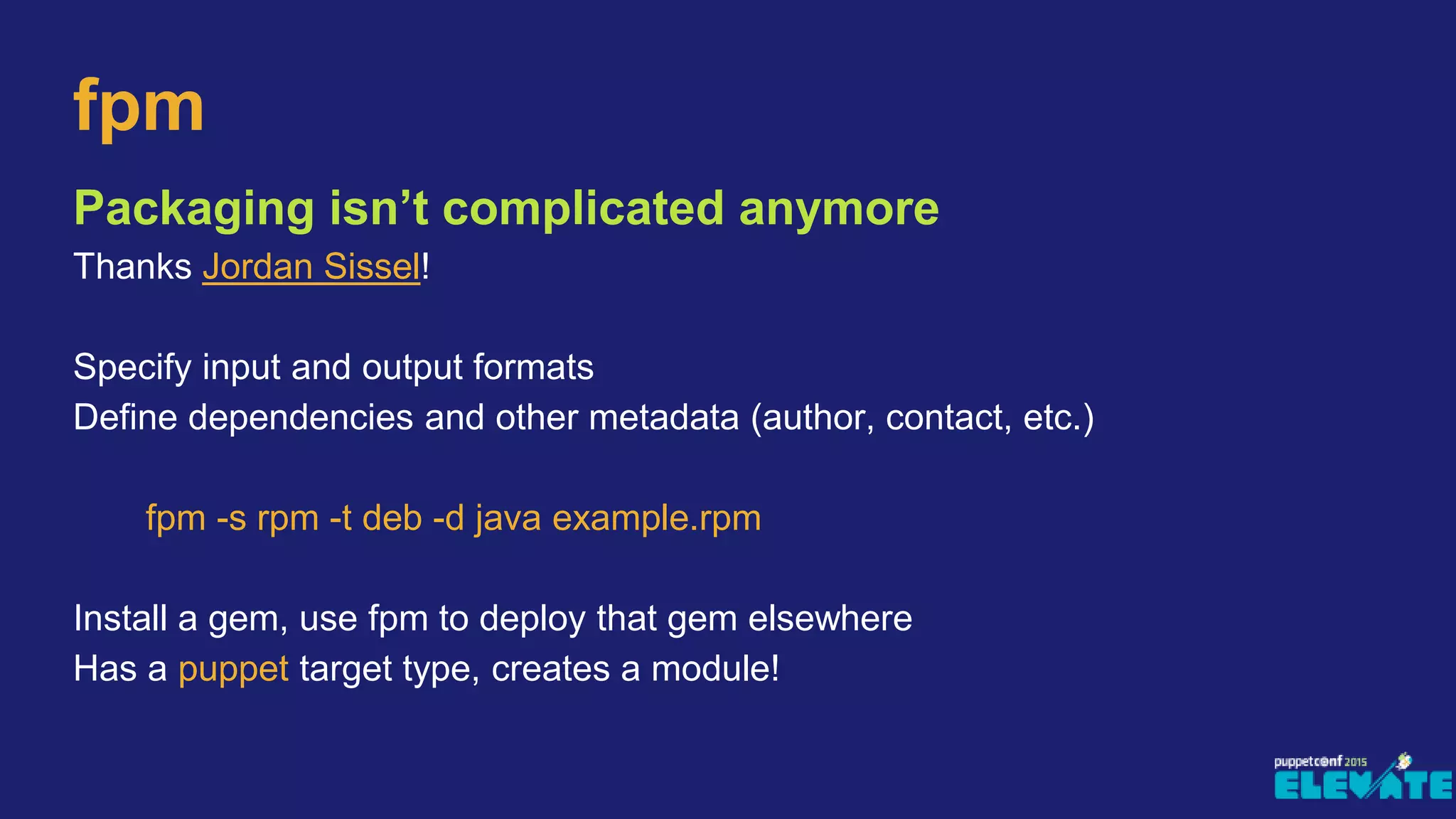
Packaging isn’t complicated anymore
Thanks Jordan Sissel!
Specify input and output formats
Define dependencies and other metadata (author, contact, etc.)
fpm -s rpm -t deb -d java example.rpm
Install a gem, use fpm to deploy that gem elsewhere
Has a puppet target type, creates a module!
fpm
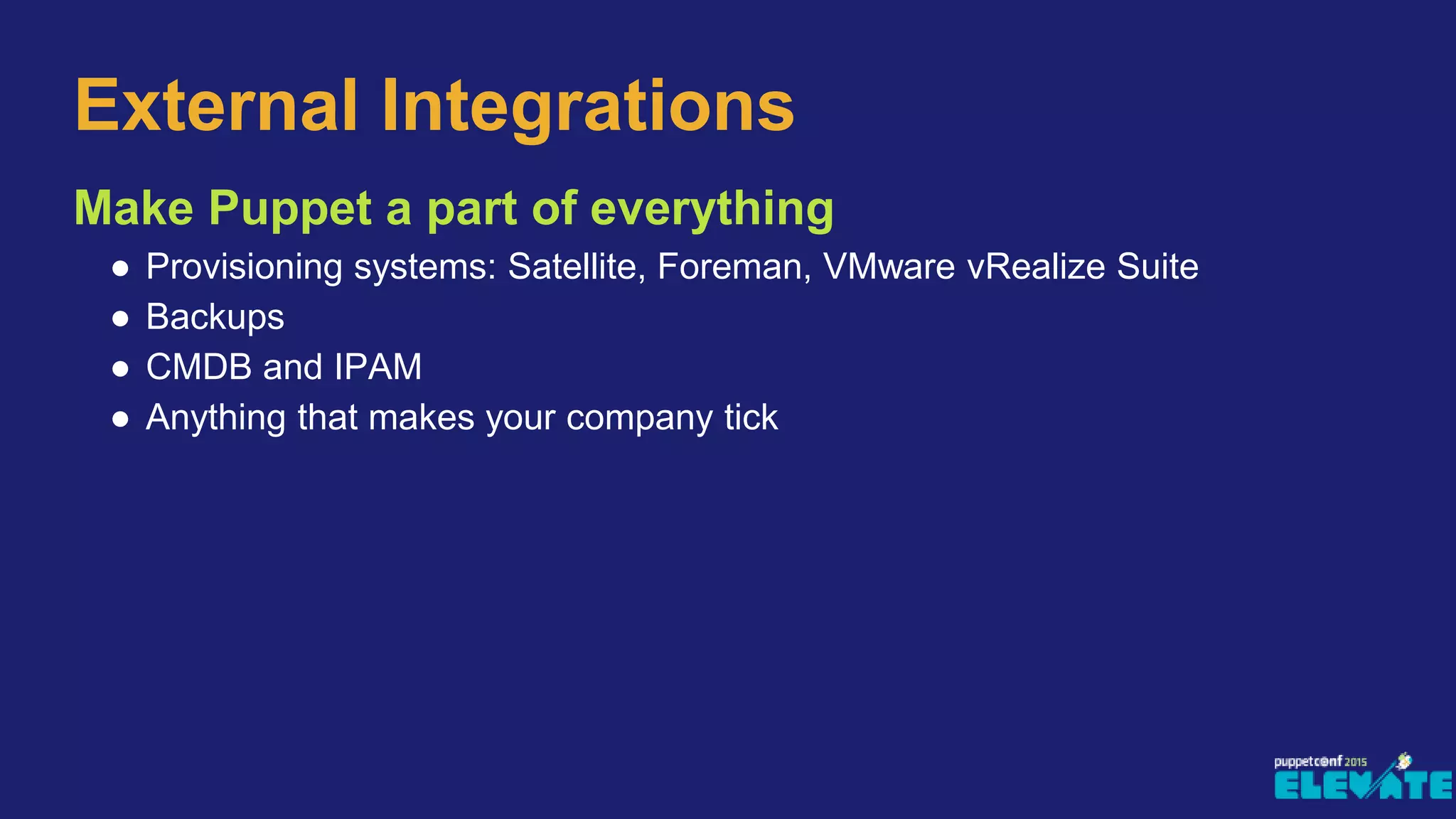
Make Puppet a part of everything
● Provisioning systems: Satellite, Foreman, VMware vRealize Suite
● Backups
● CMDB and IPAM
● Anything that makes your company tick
External Integrations
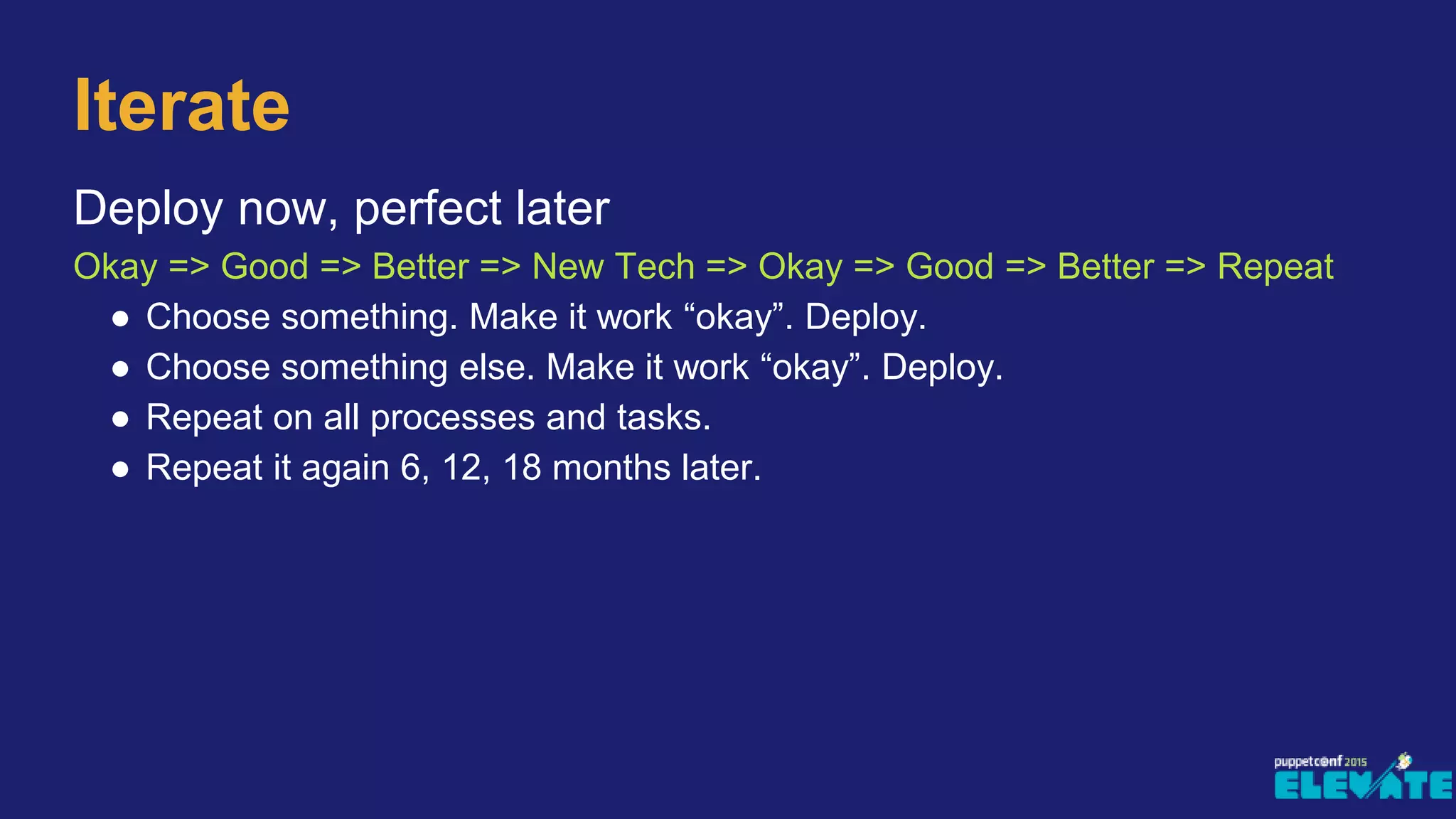
Deploy now, perfect later
Okay => Good => Better => New Tech => Okay => Good => Better => Repeat
● Choose something. Make it work “okay”. Deploy.
● Choose something else. Make it work “okay”. Deploy.
● Repeat on all processes and tasks.
● Repeat it again 6, 12, 18 months later.
Iterate
Recap
• Culture of change and feedback
• Many tools available in the ecosystem
• Iterate to success
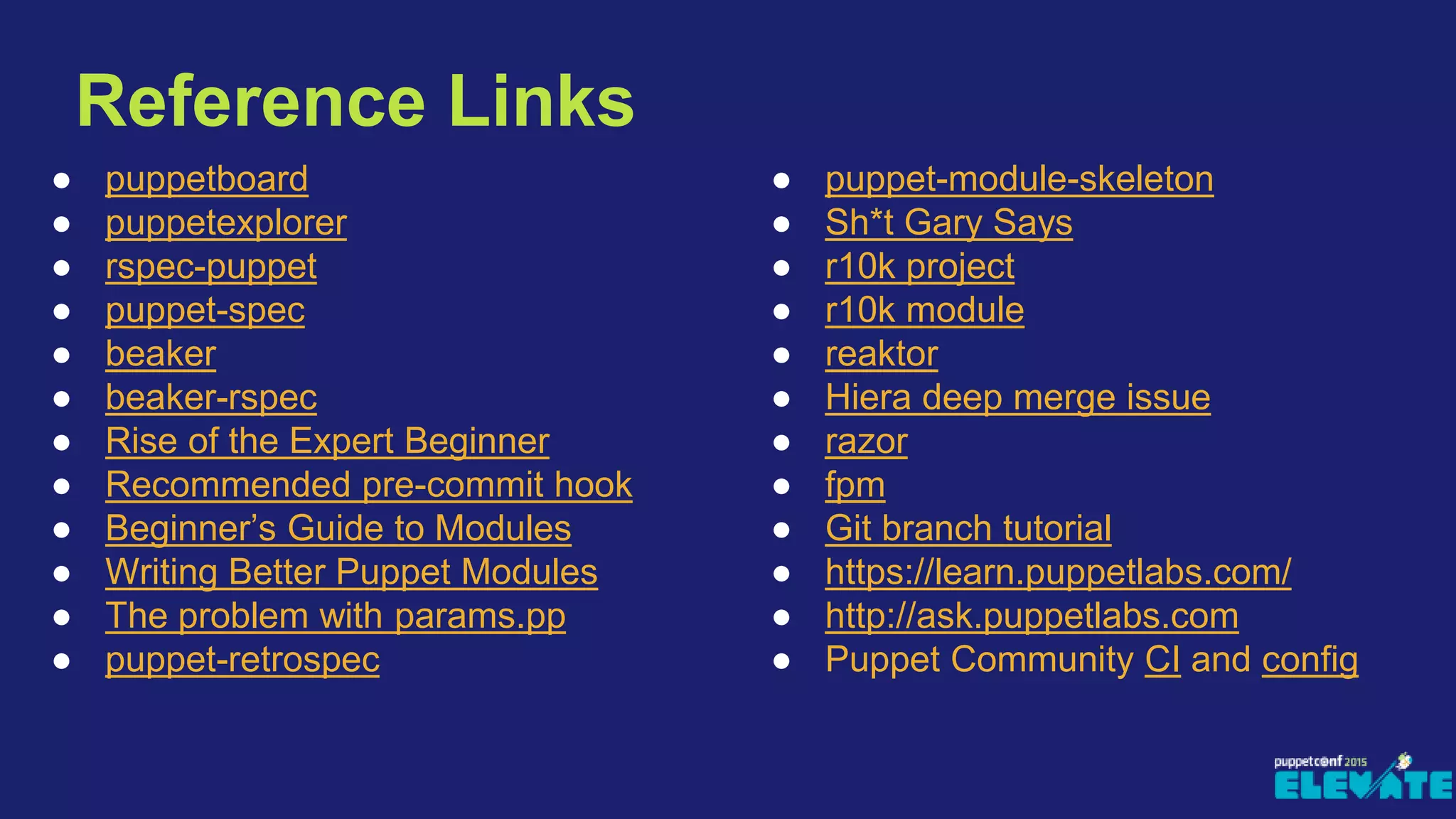
Reference Links
● puppetboard
● puppetexplorer
● rspec-puppet
● puppet-spec
● beaker
● beaker-rspec
● Rise of the Expert Beginner
● Recommended pre-commit hook
● Beginner’s Guide to Modules
● Writing Better Puppet Modules
● The problem with params.pp
● puppet-retrospec
● puppet-module-skeleton
● Sh*t Gary Says
● r10k project
● r10k module
● reaktor
● Hiera deep merge issue
● razor
● fpm
● Git branch tutorial
● https://learn.puppetlabs.com/
● http://ask.puppetlabs.com
● Puppet Community CI and config
• My awesome wife, Michelle!
• Puppet Labs
• Puppet Community
• Reviewers
• Jason Breitwieser
• Ryan McKern (@the_mckern)
• Richard Pijnenburg (electrical / @richardp82)
• Walid Shaari
• Tim Meusel (bastelfreak)
Thank You!
Q&A

Puppetizing Your Organization

  • 2.
  • 3.
    Code Reviews Testing Best Practices/Patterns ContinuousIntegration and Deployment Reporting/ Monitoring Code/Data Separation Bare Metal Packaging Puppet Ecosystem
  • 5.
  • 6.
    Be a changeagent • Rome wasn’t built in a day • Lots of learning and failure • Communication is key • Pace yourself, avoid culture shock Culture
  • 7.
    “Expert Beginners” “I knowthat I’m doing it right because, as an expert, I’m pretty much doing everything right by definition.” - Erik Dietrich Don’t let yourself believe you’re a rock star. Avoid working in isolation, without feedback loops.
  • 8.
    Sharing is Caring Findfeedback loops • Puppet User Group (or LUG/VMUG/etc) • Meetup.com (DevOps, Puppet, Conf. Management) • Puppet Labs Test Pilots • Websites: ask.puppetlabs.com, stackoverflow • IRC: #puppet, #puppet-community • Podcasts, Slideshares, Blog Posts, Video Tutorials • Industry Peers (Friends, Co-Workers, Social Media) • Jumpstart Engagement (PL Professional Services) Get buy-in from your family and your employer. Get permission for the time and don’t share proprietary data!
  • 9.
    It’s a culturalissue, not a technological issue • Git - Distributed VCS • Mandatory code reviews via Pull Requests (PRs) • Small, discrete, self-contained changes • Enable approvals • ESPECIALLY in emergencies! • Git hooks save time and embarrassment • Be positive! Code Review
  • 10.
    What’s the minimumcustomization you require to be productive? ● Shell prompt shows git branch ● Dot files ● Git hooks ● Puppet module skeleton ● Install tools like GitHub / SourceTree / Gepetto, plus minimal tweaks ● Integration: Kanban, Ticketing, etc. Help your co-workers out: • Document a decent baseline setup • Provide vagrant boxes/VMs with everything installed and configured • Use Puppet to maintain these standards Minimum Viable Customization (MVC)
  • 11.
    Create a culturethat works for your team
  • 12.
    Best Practices andPatterns Declarative State Model - ‘What’ not ‘How’ • Code: Describe desired state through resources in a manifest • Master: Catalog is a graph of all resources to apply to a node • Agent: Applies the catalog, converges state • Avoid exec resources; they are unpredictable and break noop mode
  • 13.
    Shareable modules toinstall and/or manage a specific component ● Apache, TomCat, YourWebApp, Puppet Agent, etc. ● Check the forge before writing your own ● Puppet Labs has plenty of best practices guides for component modules Component modules
  • 14.
    Don’t repeat yourself ●Params shared between module subclasses ● Put all conditionals together ● No one size fits all, only use the subclasses you need ● Writing better Puppet modules ● Reference module: puppetlabs/ntp params/config/install/service pattern
  • 15.
  • 16.
  • 17.
    NTP Config andInstall Subclasses
  • 18.
  • 19.
    One node, onerole - nothing more ● Role: Business Logic ○ Aggregate of profiles. role::webapp includes profiles base, apache, tomcat, webapp ○ Includes only profile classes and resource ordering ● Profile: Technology stack ○ mysql, puppetdb, base ○ Contains any type of resource Roles and Profiles
  • 20.
  • 21.
  • 22.
    Testing: TDD orBDD rspec-puppet, puppet-spec, beaker, beaker-rspec Catch errors early, before production • Unit and Acceptance tests • Write tests before code • Unit tests are a requirement for refactoring • Encourage planning during growth • Missing tests? Add them with puppet-retrospec • Improve tests over time
  • 23.
  • 24.
    Testing Summary “What amI testing and is it valuable?” • Test your code • Let component modules have their own tests • Don’t test Puppet
  • 25.
    Culture High Points •Pace yourself, avoid culture shock • Create a culture of code review and testing • Use best practices and patterns intelligently
  • 26.
  • 27.
    Travis CI, JenkinsCI, Bamboo Verify ability to integrate code on every change ● Submit a PR, receive red or green feedback. Don’t merge red results! ● Continuous, shouldn't be a manual event! Continuous Integration
  • 28.
    r10k Never log intoyour master again! ● Controlrepo defines modules via a Puppetfile ● Can include site-specific modules and hiera in the controlrepo ● Push code upstream, deploy it on the master automatically ● Each repo branch becomes a puppet environment ● Work with lots of individual repos? Reaktor Continuous Deployment
  • 29.
    Puppetfile: Pin Versionsfor Stability Craft your own Puppetfiles with generate-puppetfile
  • 30.
    Hiera You can sharecode - on the forge, with colleagues or support - without sharing your data ● Data is particular to your implementation and private, may include passwords ● Hierarchal key/value pair lookup tool ● Automatic Parameter Lookups performs hiera lookups for every param ○ ntp::package_manage corresponds to $package_manage in class ntp ● Limits with deep merge (HI-118) Separate your Code and Data
  • 31.
    Razor Make “rack andstack” the last provisioning step ● Discover new hardware, install OS or Hypervisors, add to Puppet and configure ● Fully supported with Puppet Enterprise as of version 3.8 ● You can still use Razor without PE - more assembly required There are other tools, many of which rely on PXE: opencrowbar, cobbler, xcat Bare Metal Provisioning
  • 32.
    PuppetDB Collect reports andexported resources ● Agents send reports to PuppetDB ○ Can be sent from masterless nodes as well ● Console or Puppetboard lets you see node status, nodes with fact X, status of all events received for all agents ● API is available, craft your own queries Reporting
  • 33.
    Nagios / Icinga/ Sensu / Zabbix Dynamically populate your monitoring system(s) with exported resources ● Export hosts and checks ○ Infrastructure as Code ○ Must be able to define checks as a Puppet resource ● Export hosts, define checks in the monitoring system ○ Checks are not defined in the same version control system ○ May be more flexible when monitoring system includes nodes not managed by Puppet Monitoring
  • 34.
    rpm, deb, pkg,etc. Maintain and distribute software like a boss ● Distribute apps as packages, not tarballs or repos ● Definitely NOT with execs! ○ No .git/.svn directories ● Packaging systems capture metadata and work with the OS ● Use system packages first, application packages second ● Distribute your packages (yumrepo type built-in) Packaging
  • 35.
    Packaging isn’t complicatedanymore Thanks Jordan Sissel! Specify input and output formats Define dependencies and other metadata (author, contact, etc.) fpm -s rpm -t deb -d java example.rpm Install a gem, use fpm to deploy that gem elsewhere Has a puppet target type, creates a module! fpm
  • 36.
    Make Puppet apart of everything ● Provisioning systems: Satellite, Foreman, VMware vRealize Suite ● Backups ● CMDB and IPAM ● Anything that makes your company tick External Integrations
  • 37.
    Deploy now, perfectlater Okay => Good => Better => New Tech => Okay => Good => Better => Repeat ● Choose something. Make it work “okay”. Deploy. ● Choose something else. Make it work “okay”. Deploy. ● Repeat on all processes and tasks. ● Repeat it again 6, 12, 18 months later. Iterate
  • 38.
    Recap • Culture ofchange and feedback • Many tools available in the ecosystem • Iterate to success
  • 40.
    Reference Links ● puppetboard ●puppetexplorer ● rspec-puppet ● puppet-spec ● beaker ● beaker-rspec ● Rise of the Expert Beginner ● Recommended pre-commit hook ● Beginner’s Guide to Modules ● Writing Better Puppet Modules ● The problem with params.pp ● puppet-retrospec ● puppet-module-skeleton ● Sh*t Gary Says ● r10k project ● r10k module ● reaktor ● Hiera deep merge issue ● razor ● fpm ● Git branch tutorial ● https://learn.puppetlabs.com/ ● http://ask.puppetlabs.com ● Puppet Community CI and config
  • 41.
    • My awesomewife, Michelle! • Puppet Labs • Puppet Community • Reviewers • Jason Breitwieser • Ryan McKern (@the_mckern) • Richard Pijnenburg (electrical / @richardp82) • Walid Shaari • Tim Meusel (bastelfreak) Thank You!
  • 42.