Story of Puppet @eBay Classifieds Group
or how we came to the setup we use
Some bio or “Who is Vladimir”
!    Sysadmin for eighteen years
!    Currently in Solutions team of eCG’s marktplaats.nl
!    All-round nerd
!    Hobbyist programmer
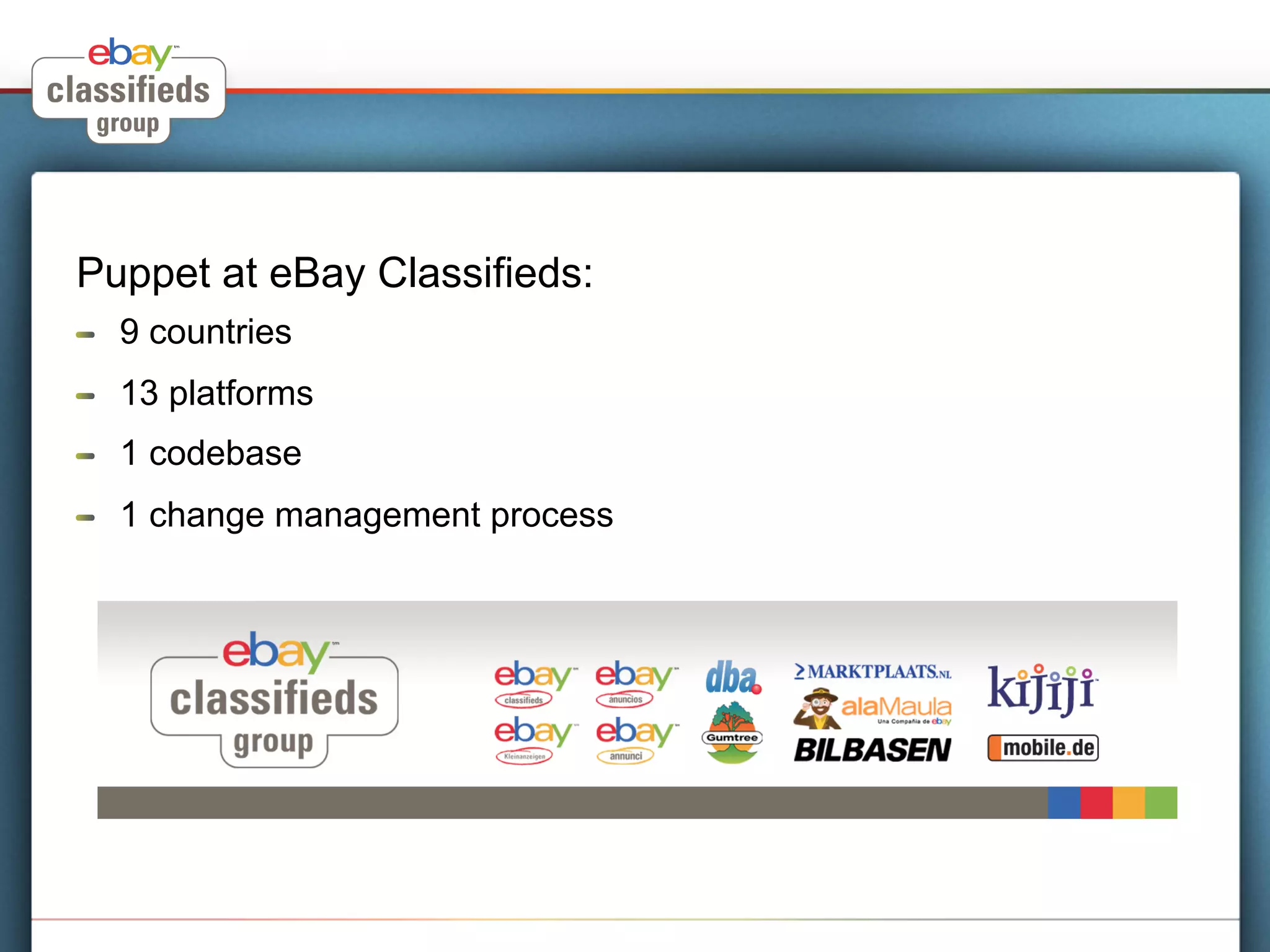
Puppet at eBay Classifieds:
!    9 countries
!    13 platforms
!    1 codebase
!    1 change management process
Puppet at eBay Classifieds:
!    We started adopting puppet in 2008
!    Since then we had about 4 different iterations of “this is bloated and
     doesn’t work, let’s think more and re-do”
!    Currently we believe we achieved a workable scenario where we:
     !    Enable teams to share and re-use puppet code
     !    Enforce the same code style and standards
     !    Allow for peer-reviews of the code, also enforce them


               “If it’s not in Puppet – it does not exist.”
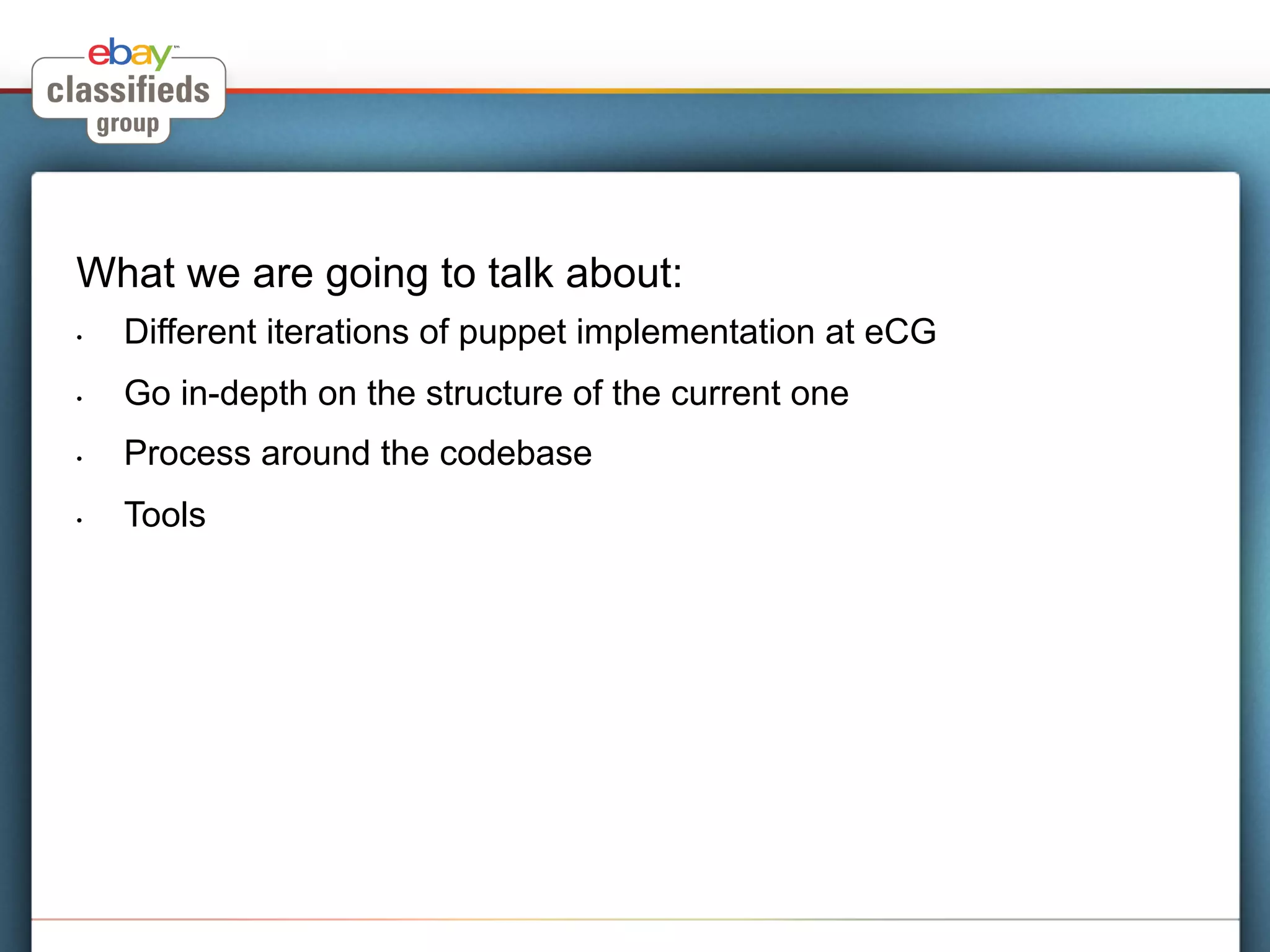
What we are going to talk about:
•    Different iterations of puppet implementation at eCG
•    Go in-depth on the structure of the current one
•    Process around the codebase
•    Tools
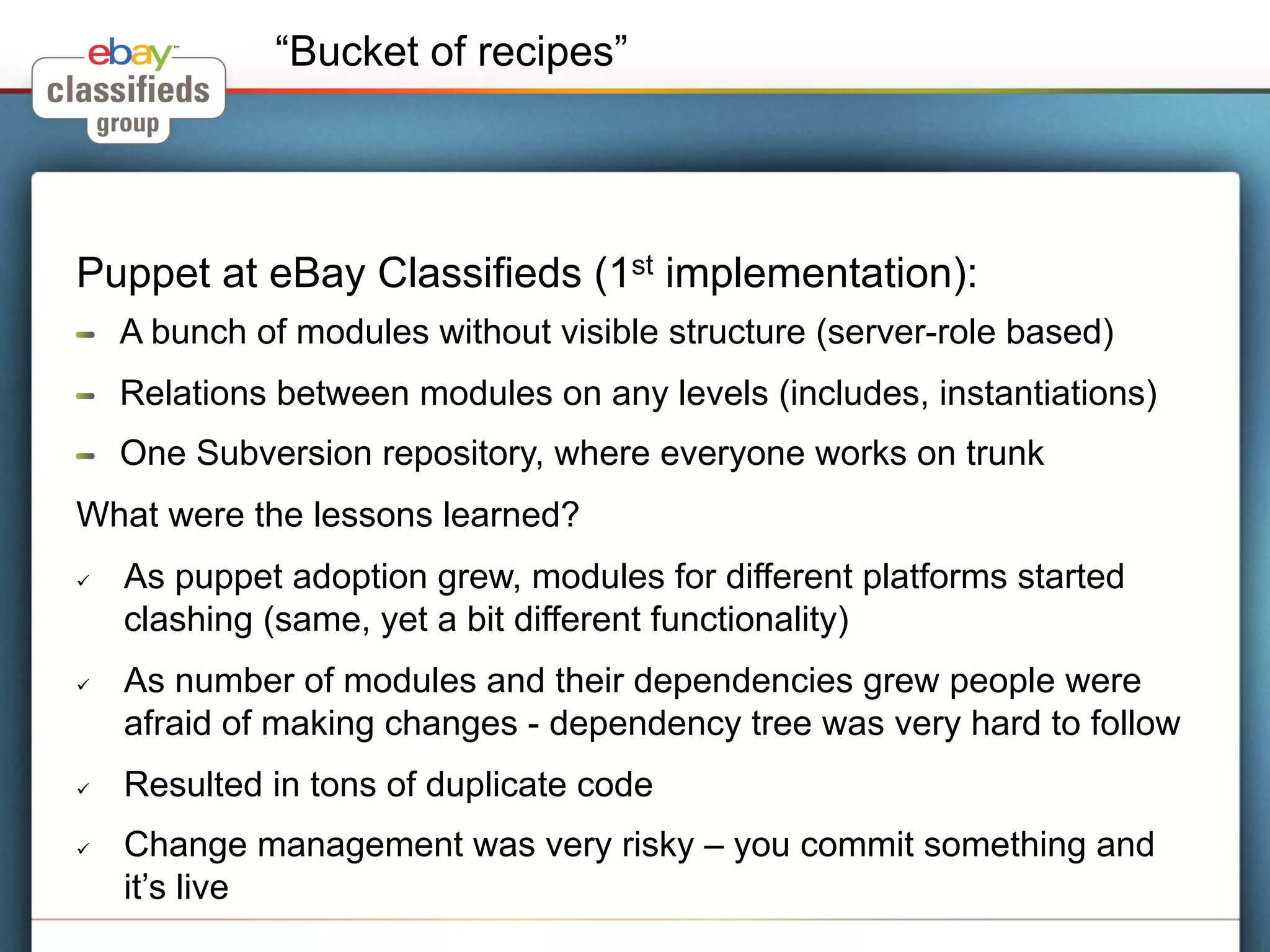
“Bucket of recipes”


Puppet at eBay Classifieds (1st implementation):
!     A bunch of modules without visible structure (server-role based)
!     Relations between modules on any levels (includes, instantiations)
!     One Subversion repository, where everyone works on trunk
What were the lessons learned?
ü    As puppet adoption grew, modules for different platforms started
      clashing (same, yet a bit different functionality)
ü    As number of modules and their dependencies grew people were
      afraid of making changes - dependency tree was very hard to follow
ü    Resulted in tons of duplicate code
ü    Change management was very risky – you commit something and
      it’s live
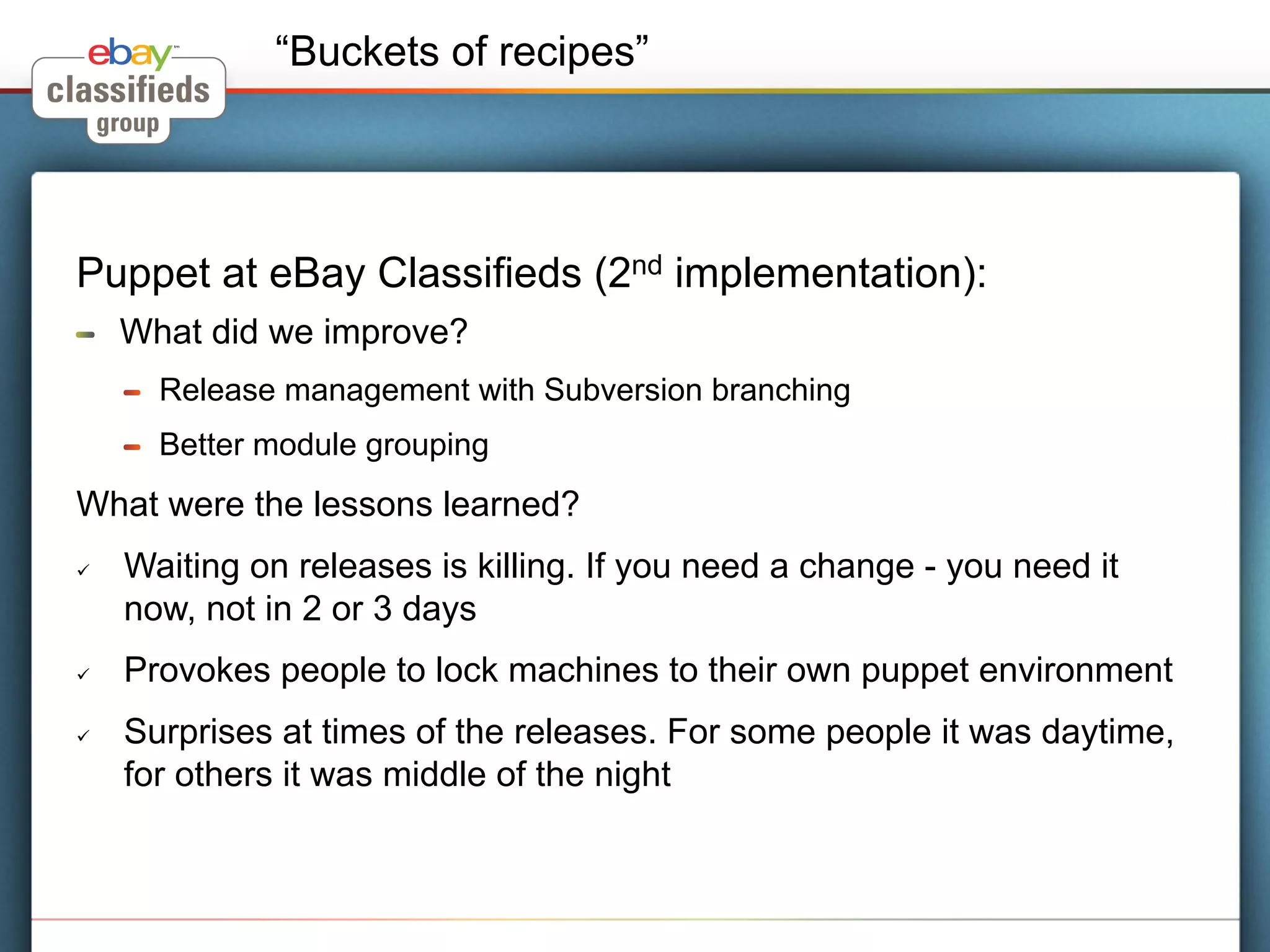
“Buckets of recipes”


Puppet at eBay Classifieds (2nd implementation):
!     What did we improve?
      !    Release management with Subversion branching
      !    Better module grouping
What were the lessons learned?
ü    Waiting on releases is killing. If you need a change - you need it
      now, not in 2 or 3 days
ü    Provokes people to lock machines to their own puppet environment
ü    Surprises at times of the releases. For some people it was daytime,
      for others it was middle of the night
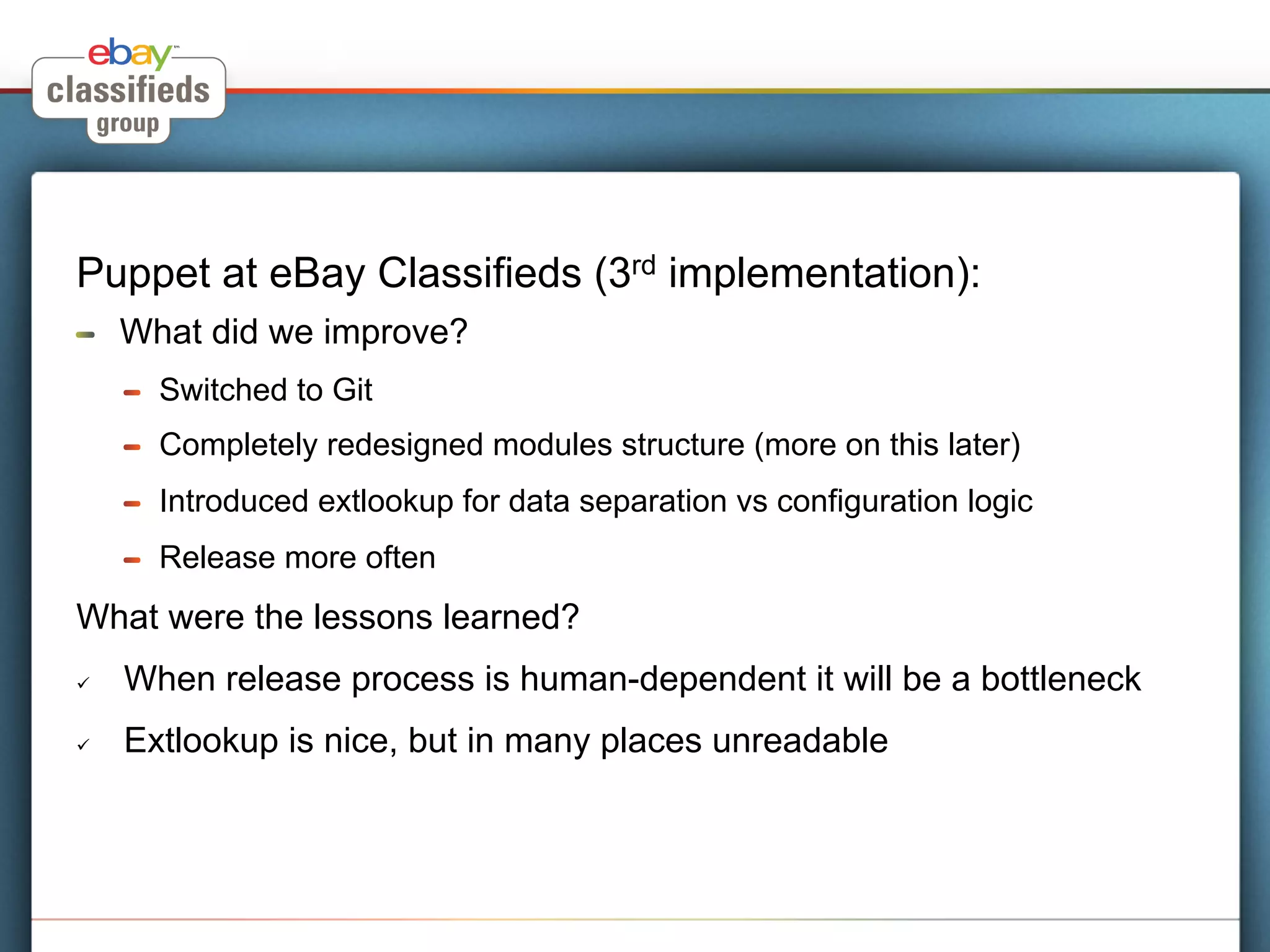
Puppet at eBay Classifieds (3rd implementation):
!     What did we improve?
      !    Switched to Git
      !    Completely redesigned modules structure (more on this later)
      !    Introduced extlookup for data separation vs configuration logic
      !    Release more often
What were the lessons learned?
ü    When release process is human-dependent it will be a bottleneck
ü    Extlookup is nice, but in many places unreadable
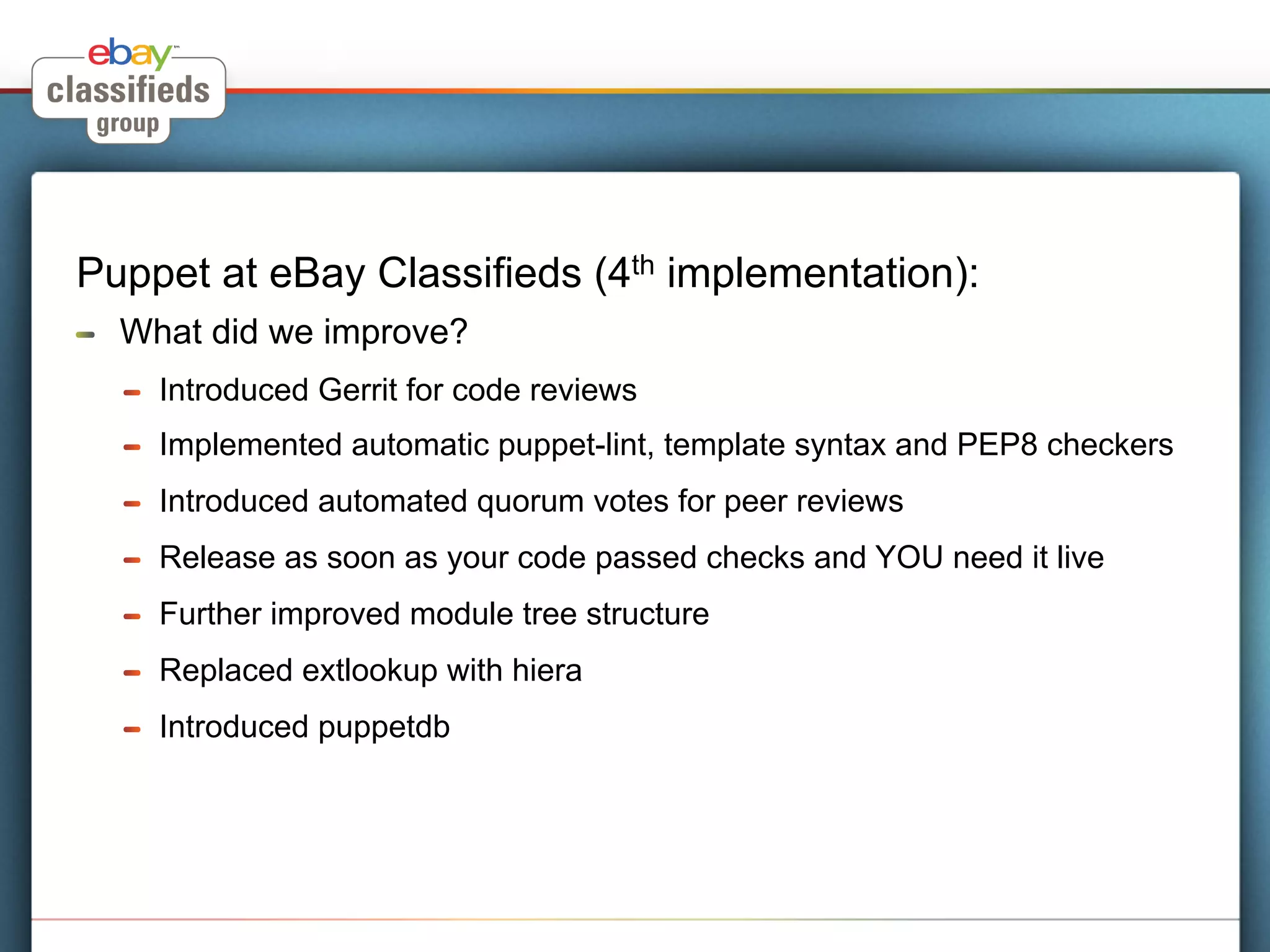
Puppet at eBay Classifieds (4th implementation):
!    What did we improve?
     !    Introduced Gerrit for code reviews
     !    Implemented automatic puppet-lint, template syntax and PEP8 checkers
     !    Introduced automated quorum votes for peer reviews
     !    Release as soon as your code passed checks and YOU need it live
     !    Further improved module tree structure
     !    Replaced extlookup with hiera
     !    Introduced puppetdb
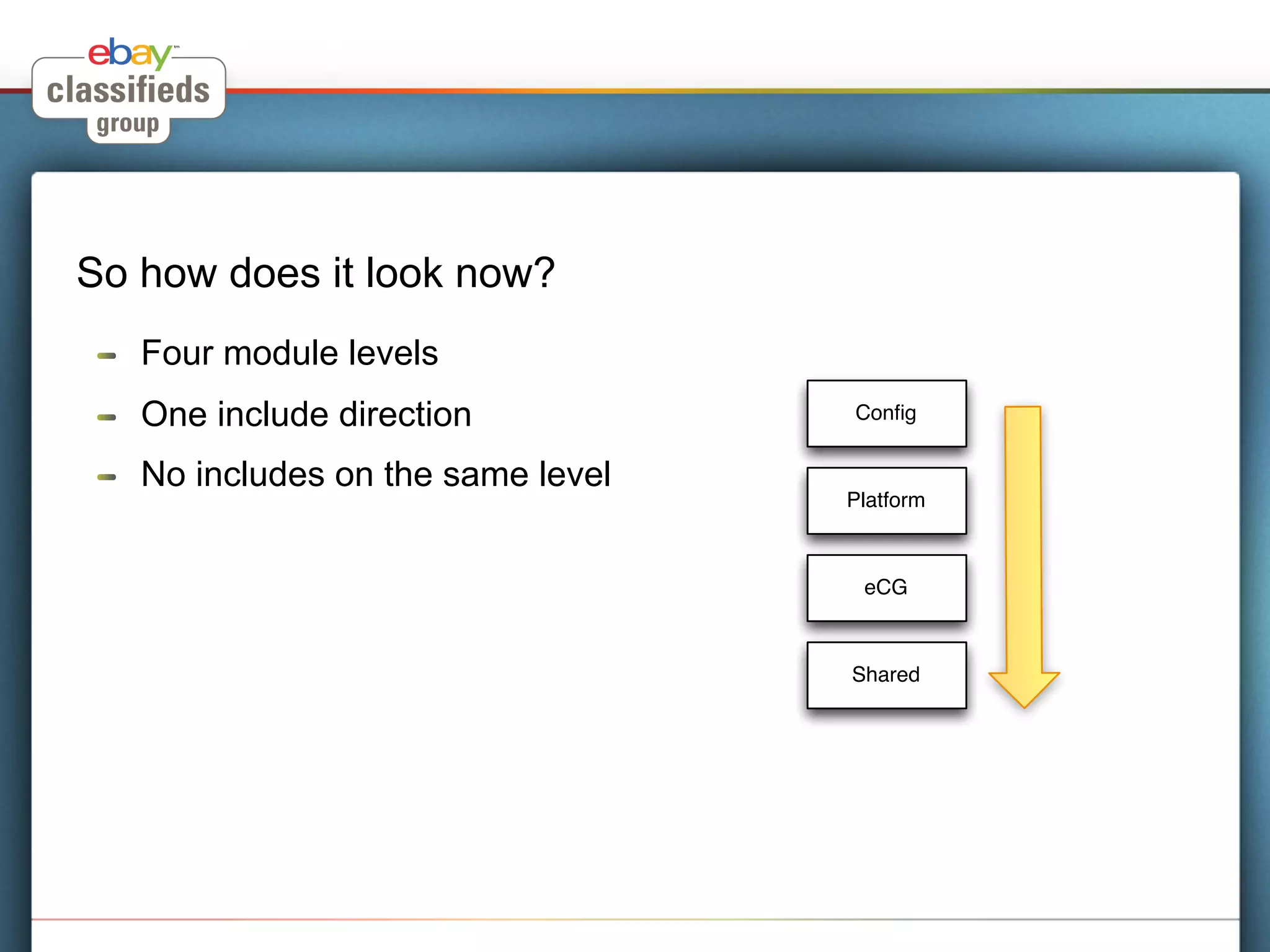
So how does it look now?
 !    Four module levels
 !    One include direction           Config


 !    No includes on the same level
                                      Platform


                                       eCG


                                      Shared
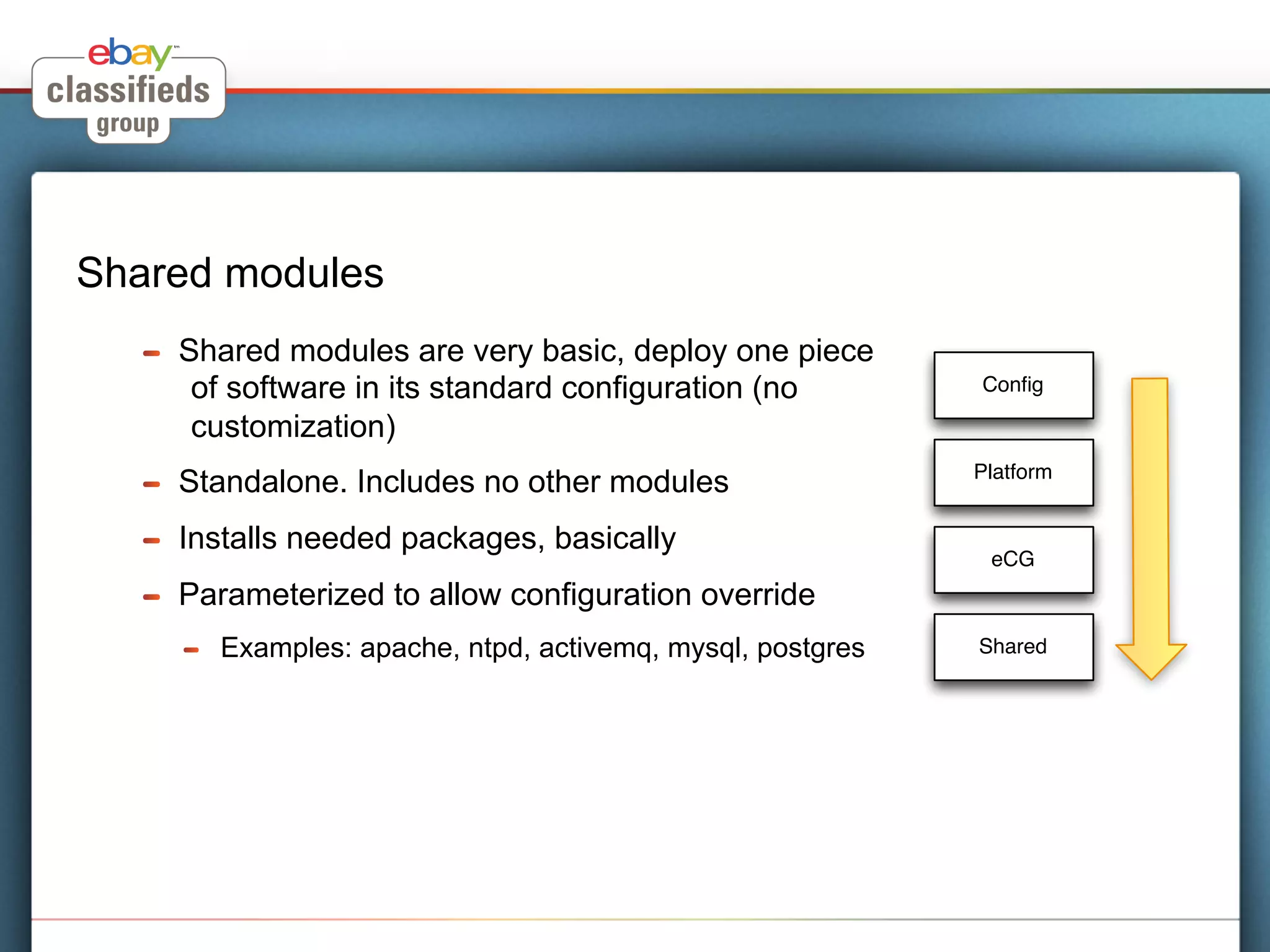
Shared modules
   !    Shared modules are very basic, deploy one piece
         of software in its standard configuration (no           Config

         customization)
                                                                 Platform
   !    Standalone. Includes no other modules
   !    Installs needed packages, basically
                                                                  eCG
   !    Parameterized to allow configuration override
        !    Examples: apache, ntpd, activemq, mysql, postgres   Shared
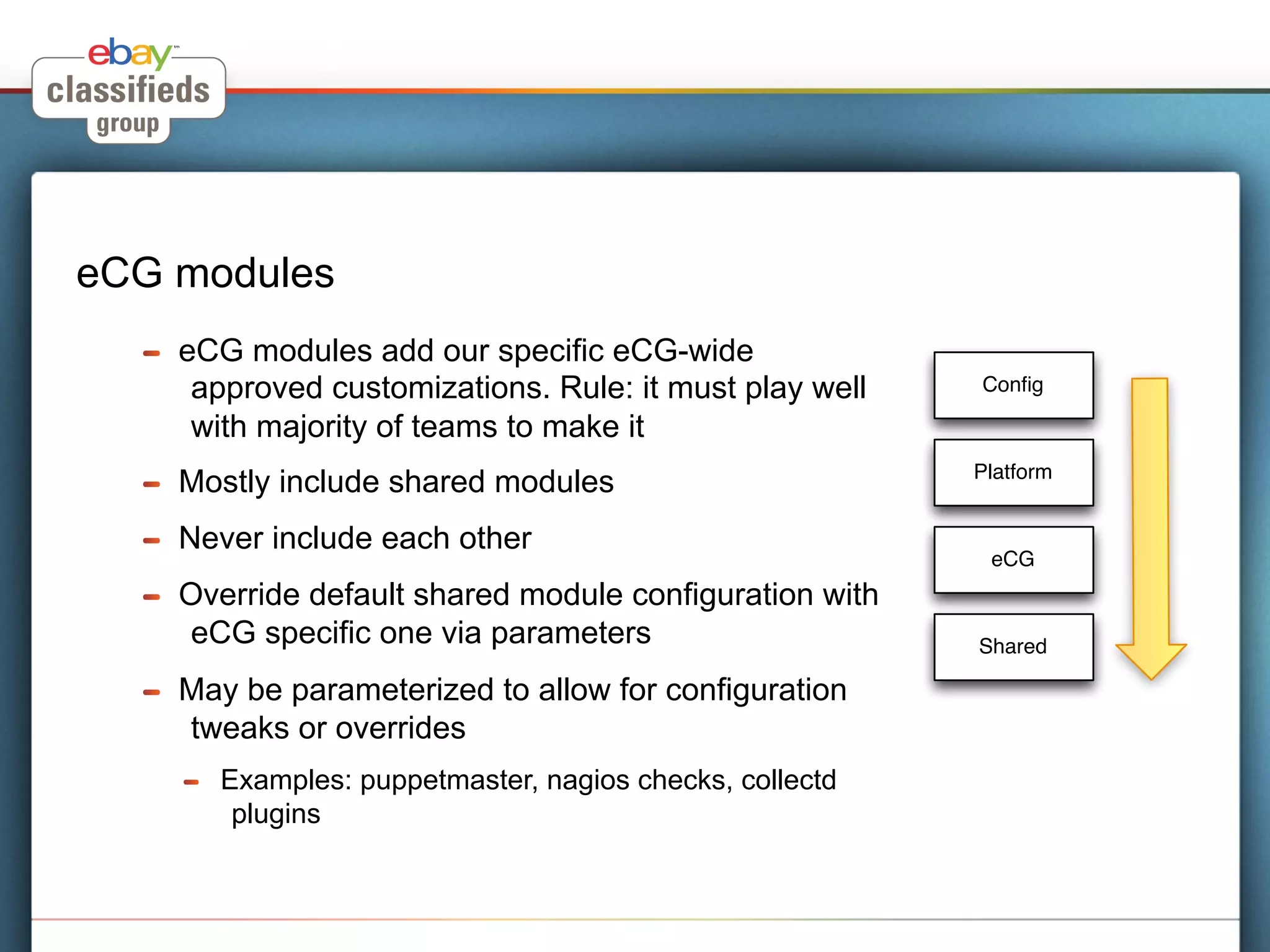
eCG modules
  !    eCG modules add our specific eCG-wide
        approved customizations. Rule: it must play well      Config

        with majority of teams to make it
                                                              Platform
  !    Mostly include shared modules
  !    Never include each other
                                                               eCG
  !    Override default shared module configuration with
       eCG specific one via parameters                        Shared

  !    May be parameterized to allow for configuration
       tweaks or overrides
       !    Examples: puppetmaster, nagios checks, collectd
             plugins
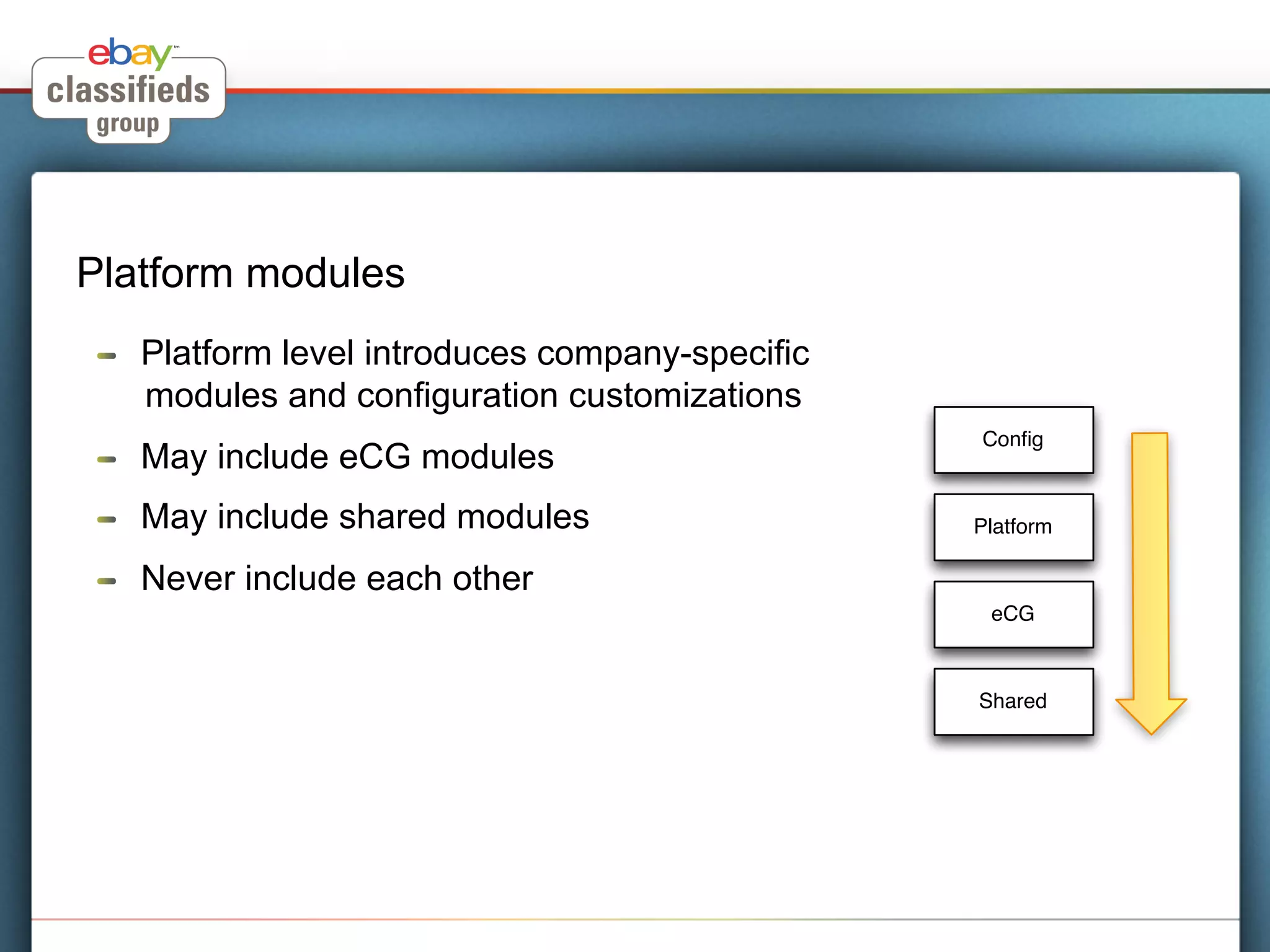
Platform modules
 !    Platform level introduces company-specific
      modules and configuration customizations
                                                   Config
 !    May include eCG modules
 !    May include shared modules                   Platform

 !    Never include each other
                                                    eCG


                                                   Shared
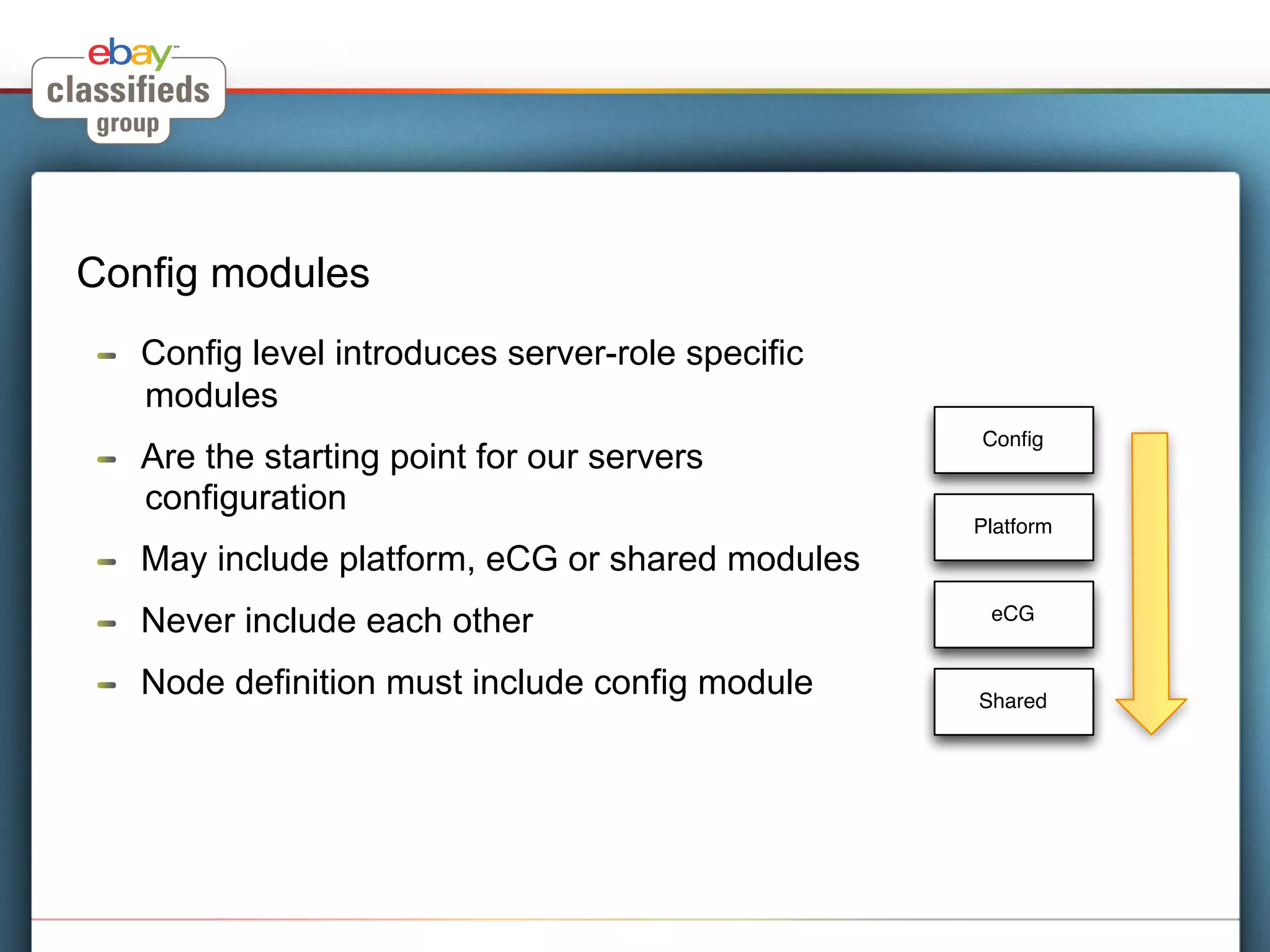
Config modules
 !    Config level introduces server-role specific
      modules
                                                     Config
 !    Are the starting point for our servers
      configuration
                                                     Platform
 !    May include platform, eCG or shared modules
 !    Never include each other                        eCG


 !    Node definition must include config module     Shared
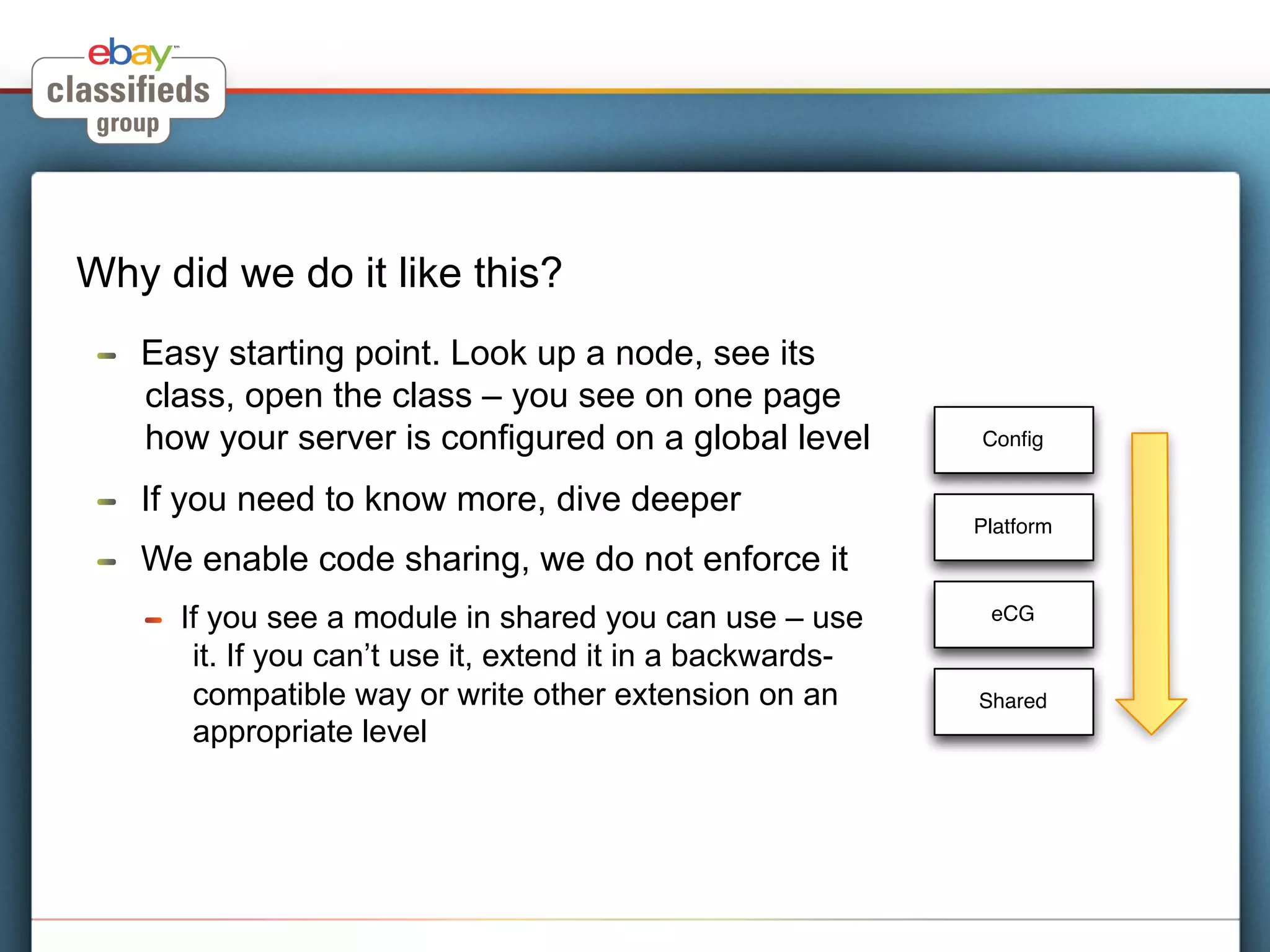
Why did we do it like this?
 !    Easy starting point. Look up a node, see its
      class, open the class – you see on one page
      how your server is configured on a global level            Config


 !    If you need to know more, dive deeper
                                                                 Platform
 !    We enable code sharing, we do not enforce it
      !    If you see a module in shared you can use – use        eCG

            it. If you can’t use it, extend it in a backwards-
            compatible way or write other extension on an        Shared
            appropriate level
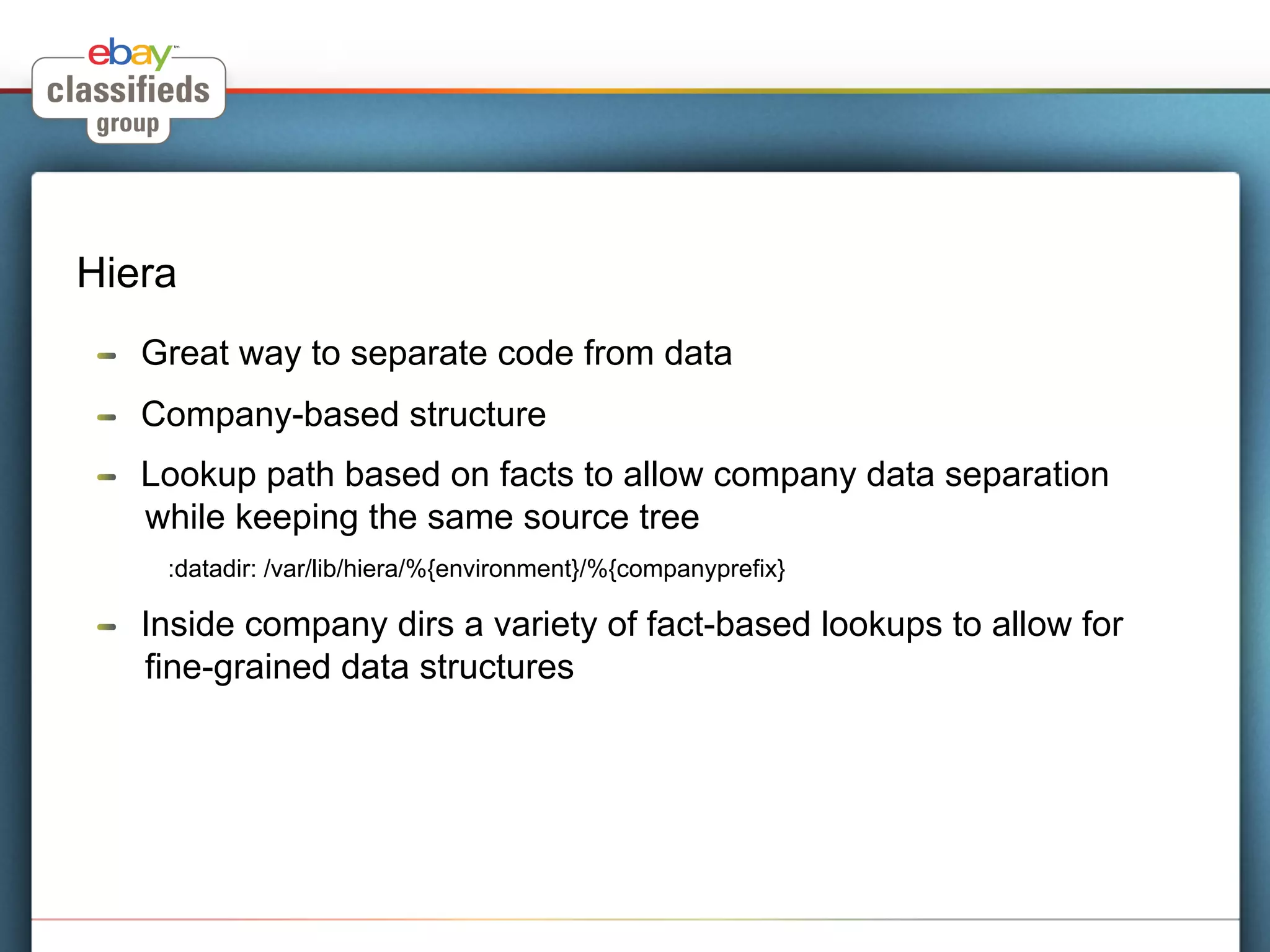
Hiera
 !    Great way to separate code from data
 !    Company-based structure
 !    Lookup path based on facts to allow company data separation
      while keeping the same source tree
       :datadir: /var/lib/hiera/%{environment}/%{companyprefix}

 !    Inside company dirs a variety of fact-based lookups to allow for
      fine-grained data structures
PuppetDB
!    Much faster catalog compilations for huge catalogs (nagios server
     with 200k resources)
!    REST API to talk to for inventory and searches
!    Many brilliant ways to (ab)use it
     !    Stores all facts (can be used to feed CMDBs)
     !    Stores most recent catalog (can be used for inspections)
     !    POC we are running - internal Puppet naginator module is very slow,
           collection of exported resources takes about 15 minutes. We use
           PuppetDB to generate the same nagios configs in just under 8
           seconds
     !    “If there is data, it can be used”. PuppetDB is a central data store.
           Love.
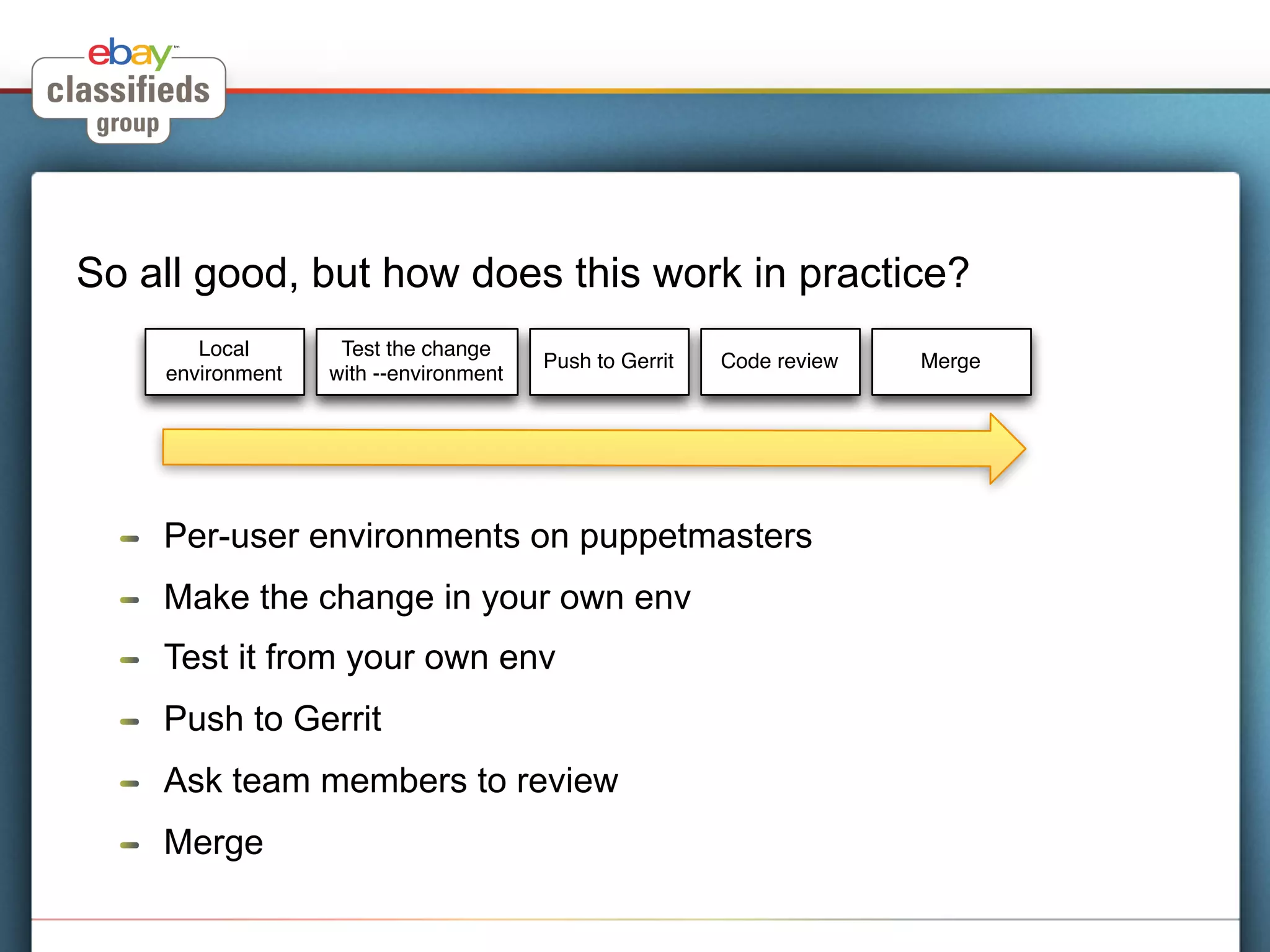
So all good, but how does this work in practice?
          Local       Test the change
                                          Push to Gerrit   Code review   Merge
       environment   with --environment


  !    Per-user environments on puppetmasters
  !    Make the change in your own env
  !    Test it from your own env
  !    Push to Gerrit
  !    Ask team members to review
  !    Merge
Gerrit
  !    Great code review tool (https://code.google.com/p/gerrit/)
  !    Acts as a Git server with fine-grained access control
  !    Each commit is a separate change, that requires votes for
       approvals
  !    Votes can be +1 for Code Review, +2 for change approval
  !    No +2 – no merge
  !    We use voting system with auto +2
       !    Depending on platform size or number of platforms affected by the
             change more votes are needed to get a change through
       !    Each change can be “pushed through” in case of an emergency
More Gerrit goodies
  !    Allows for post-push hooks
       !    Puppet-lint
       !    Ruby templates parsing
       !    PEP8 (we love Python)
  !    Each change is separately checked out by hooks and tested for
       syntax or other obvious errors
  !    Concept of one commit – one change forces people to create
       atomic changes that are easy to revert in case of errors
  !    Keeping it all in the same system, even if you decide to split Git
       repositories still makes work done by colleagues VISIBLE
Gerrit and puppetmasters
  !    Master is automatically pulled by crons on puppetmasters
  !    Gerrit disallows pushing directly to master
  !    Even if you force-merge a change, it makes your change
       VISIBLE and easily REVERTIBLE
  !    Takes about half a minute extra time
  !    Ensures you didn’t slack out on syntax checkers
To sum it all up
  !    There is no single structure that fits every company
  !    Puppet code is like any other code
       !    Write
       !    Use
       !    Refactor if needed
  !    Layered modules structure can work well in many cases
  !    Complementary tooling around Puppet is a life- (and time-)
       saver
       !    Lint(s), Gerrit, PuppetDB
Work to be done in our house
  !    Approval process improvements
       !    Better quorum schemas
       !    Easier ways of code style and syntax checking
       !    See that people don’t leave changes “hanging”
  !    Integrate Gerrit with corporate GitHub
  !    Work more with community
       !    Open source some generic shared modules
       !    Offer changes to PuppetForge modules
  !    POC with Vagrant for puppet code testing
Questions?
Thank you!
 Special thanks to:

 •  PuppetLabs and eCG for the opportunity to speak here
 •  Teams of eCG for bearing with me all these years
 •  You all for attending and listening

 You can reach me by:
 •  Mailing to favoretti@gmail.com
 •  Following me on GitHub (
    https://github.com/favoretti)

We are hiring!
Visit http://ebayclassifiedsgroup.com/careers
for more info.

Story of Puppet @eBay Global Classifieds Group (eCG)

  • 1.
    Story of Puppet@eBay Classifieds Group or how we came to the setup we use
  • 2.
    Some bio or“Who is Vladimir” ! Sysadmin for eighteen years !  Currently in Solutions team of eCG’s marktplaats.nl !  All-round nerd !  Hobbyist programmer
  • 3.
    Puppet at eBayClassifieds: !  9 countries !  13 platforms !  1 codebase !  1 change management process
  • 4.
    Puppet at eBayClassifieds: !  We started adopting puppet in 2008 !  Since then we had about 4 different iterations of “this is bloated and doesn’t work, let’s think more and re-do” !  Currently we believe we achieved a workable scenario where we: !  Enable teams to share and re-use puppet code !  Enforce the same code style and standards !  Allow for peer-reviews of the code, also enforce them “If it’s not in Puppet – it does not exist.”
  • 5.
    What we aregoing to talk about: •  Different iterations of puppet implementation at eCG •  Go in-depth on the structure of the current one •  Process around the codebase •  Tools
  • 6.
    “Bucket of recipes” Puppetat eBay Classifieds (1st implementation): !  A bunch of modules without visible structure (server-role based) !  Relations between modules on any levels (includes, instantiations) !  One Subversion repository, where everyone works on trunk What were the lessons learned? ü  As puppet adoption grew, modules for different platforms started clashing (same, yet a bit different functionality) ü  As number of modules and their dependencies grew people were afraid of making changes - dependency tree was very hard to follow ü  Resulted in tons of duplicate code ü  Change management was very risky – you commit something and it’s live
  • 7.
    “Buckets of recipes” Puppetat eBay Classifieds (2nd implementation): !  What did we improve? !  Release management with Subversion branching !  Better module grouping What were the lessons learned? ü  Waiting on releases is killing. If you need a change - you need it now, not in 2 or 3 days ü  Provokes people to lock machines to their own puppet environment ü  Surprises at times of the releases. For some people it was daytime, for others it was middle of the night
  • 8.
    Puppet at eBayClassifieds (3rd implementation): !  What did we improve? !  Switched to Git !  Completely redesigned modules structure (more on this later) !  Introduced extlookup for data separation vs configuration logic !  Release more often What were the lessons learned? ü  When release process is human-dependent it will be a bottleneck ü  Extlookup is nice, but in many places unreadable
  • 9.
    Puppet at eBayClassifieds (4th implementation): !  What did we improve? !  Introduced Gerrit for code reviews !  Implemented automatic puppet-lint, template syntax and PEP8 checkers !  Introduced automated quorum votes for peer reviews !  Release as soon as your code passed checks and YOU need it live !  Further improved module tree structure !  Replaced extlookup with hiera !  Introduced puppetdb
  • 10.
    So how doesit look now? !  Four module levels !  One include direction Config !  No includes on the same level Platform eCG Shared
  • 11.
    Shared modules !  Shared modules are very basic, deploy one piece of software in its standard configuration (no Config customization) Platform !  Standalone. Includes no other modules !  Installs needed packages, basically eCG !  Parameterized to allow configuration override !  Examples: apache, ntpd, activemq, mysql, postgres Shared
  • 12.
    eCG modules ! eCG modules add our specific eCG-wide approved customizations. Rule: it must play well Config with majority of teams to make it Platform !  Mostly include shared modules !  Never include each other eCG !  Override default shared module configuration with eCG specific one via parameters Shared !  May be parameterized to allow for configuration tweaks or overrides !  Examples: puppetmaster, nagios checks, collectd plugins
  • 13.
    Platform modules !  Platform level introduces company-specific modules and configuration customizations Config !  May include eCG modules !  May include shared modules Platform !  Never include each other eCG Shared
  • 14.
    Config modules ! Config level introduces server-role specific modules Config !  Are the starting point for our servers configuration Platform !  May include platform, eCG or shared modules !  Never include each other eCG !  Node definition must include config module Shared
  • 15.
    Why did wedo it like this? !  Easy starting point. Look up a node, see its class, open the class – you see on one page how your server is configured on a global level Config !  If you need to know more, dive deeper Platform !  We enable code sharing, we do not enforce it !  If you see a module in shared you can use – use eCG it. If you can’t use it, extend it in a backwards- compatible way or write other extension on an Shared appropriate level
  • 16.
    Hiera !  Great way to separate code from data !  Company-based structure !  Lookup path based on facts to allow company data separation while keeping the same source tree :datadir: /var/lib/hiera/%{environment}/%{companyprefix} !  Inside company dirs a variety of fact-based lookups to allow for fine-grained data structures
  • 17.
    PuppetDB !  Much faster catalog compilations for huge catalogs (nagios server with 200k resources) !  REST API to talk to for inventory and searches !  Many brilliant ways to (ab)use it !  Stores all facts (can be used to feed CMDBs) !  Stores most recent catalog (can be used for inspections) !  POC we are running - internal Puppet naginator module is very slow, collection of exported resources takes about 15 minutes. We use PuppetDB to generate the same nagios configs in just under 8 seconds !  “If there is data, it can be used”. PuppetDB is a central data store. Love.
  • 18.
    So all good,but how does this work in practice? Local Test the change Push to Gerrit Code review Merge environment with --environment !  Per-user environments on puppetmasters !  Make the change in your own env !  Test it from your own env !  Push to Gerrit !  Ask team members to review !  Merge
  • 19.
    Gerrit !  Great code review tool (https://code.google.com/p/gerrit/) !  Acts as a Git server with fine-grained access control !  Each commit is a separate change, that requires votes for approvals !  Votes can be +1 for Code Review, +2 for change approval !  No +2 – no merge !  We use voting system with auto +2 !  Depending on platform size or number of platforms affected by the change more votes are needed to get a change through !  Each change can be “pushed through” in case of an emergency
  • 20.
    More Gerrit goodies !  Allows for post-push hooks !  Puppet-lint !  Ruby templates parsing !  PEP8 (we love Python) !  Each change is separately checked out by hooks and tested for syntax or other obvious errors !  Concept of one commit – one change forces people to create atomic changes that are easy to revert in case of errors !  Keeping it all in the same system, even if you decide to split Git repositories still makes work done by colleagues VISIBLE
  • 21.
    Gerrit and puppetmasters !  Master is automatically pulled by crons on puppetmasters ! Gerrit disallows pushing directly to master !  Even if you force-merge a change, it makes your change VISIBLE and easily REVERTIBLE !  Takes about half a minute extra time !  Ensures you didn’t slack out on syntax checkers
  • 22.
    To sum itall up !  There is no single structure that fits every company !  Puppet code is like any other code !  Write !  Use !  Refactor if needed !  Layered modules structure can work well in many cases !  Complementary tooling around Puppet is a life- (and time-) saver !  Lint(s), Gerrit, PuppetDB
  • 23.
    Work to bedone in our house !  Approval process improvements !  Better quorum schemas !  Easier ways of code style and syntax checking !  See that people don’t leave changes “hanging” !  Integrate Gerrit with corporate GitHub !  Work more with community !  Open source some generic shared modules !  Offer changes to PuppetForge modules !  POC with Vagrant for puppet code testing
  • 24.
  • 25.
    Thank you! Specialthanks to: •  PuppetLabs and eCG for the opportunity to speak here •  Teams of eCG for bearing with me all these years •  You all for attending and listening You can reach me by: •  Mailing to favoretti@gmail.com •  Following me on GitHub ( https://github.com/favoretti) We are hiring! Visit http://ebayclassifiedsgroup.com/careers for more info.