salfaeThis is an excellent presentation in so many ways it seems an understatement to say 'wow'! We have been studying Latin America Market as part of our 'Americas' approach for our new start-up. Razorfish always does a good presentation, but this one took a long standing perception and turned it on its head. Thank you!2 years ago
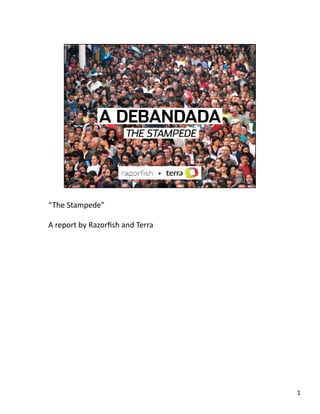
Hello. My name is Joseph Crump, and I am Senior Vice President
of Strategy and Planning at Razorfish. I consider myself one of the
luckiest people on earth because I live in two of the greatest
ciJes in the world: ManhaLan, and Rio de Janeiro.
I am really thrilled to share some ideas with you that resulted
from about five months of quanJtaJve and qualitaJve research
that Razorfish, in partnership with Terra Networks, did in the
three major markets in LaJn America: Brazil, Mexico, and
ArgenJna.
2
As you can see from this chart, Brazil will, over the next decades,
become one of the world’s leading economies. As such, it’s the
focus of many of the world’s biggest brands and companies.
Everyone, it seems, is interested in doing business in Brazil – and
in LaJn America generally.
Because of this, Razorfish – in conjuncJon with Terra Networks,
the largest digital media company in LaJn America, undertook a
5‐month study into the largest segment of the populaJon: The
group known throughout the region at Classe C.
The following presentaJon will illustrate why Classe C is, in our
esJmaJon, both the most powerful and the most misunderstood
group in the region.
3
This document doesn’t talk very much about markeJng. This is
maybe ironic, considering that Razorfish is one of the largest
digital markeJng firms in the world.
4
And I’m not going to talk very much about the Internet. Again,
this may come as a surprise, since Razorfish was one of the
world’s first pure‐play Internet agencies.
5
Mostly, I’m going to talk about looking. About observaJon. And
about people. This is preLy much my favorite topic, because I was
trained as an anthropologist and a journalist. My favorite thing to
do is to study human beings and how they behave, and to try to
develop insights and tell stories that will help drive user‐centered
innovaJon.
6
So just to get you warmed up and paying aLenJon, here’s a liLle
test...
7
What do you see in this photograph? (And no, it has not been
Photoshopped.) This photograph was taken in the Morumbi
neighborhood of Sao Paulo. This is a place, like so much of LaJn
America, where the physical distance between the very rich and
the very poor can be measured in feet.
So now for the test...
If you were going to guess, which community is more “digital”?
Which community spends more Jme online? Which community
represents the biggest economic force?
You don’t need to ever have visited Sao Paulo before. Just go with
your gut. Try to be very honest and open about your assumpJons
and beliefs.
8
Razorfish has been operaJng in LaJn America now for about
three years, and many of us have been living in the region for far
longer than that. But never have we seen such a rapid change in
the digital evoluJon of a region like we’re seeing unfold in LaJn
America now.
We see a digital revoluJon happening right before our eyes. Let’s
look at some numbers.
9
The revoluJon is happening fastest and most extensively in Brazil,
which is the economic powerhouse of LaJn America – and on
track to becoming the world’s fourth largest economy within 10
years.
LaJn America has a very extensive socioeconomic classificaJon
system, which ranks households from Class A (rich) to Class E
(homeless).
And one thing we found very surprising, is that in Brazil, Classe C
– those are the people who lived in the slums or “favelas” in that
photo from Morumbi – have already overtaken the members of
the Classes A and B in their access to computers.
10
Look at how things have changed in 5 years. Today, half of the
Brazilian internet users belong to the emerging classes (Classe C,
D and E).
11
And this phenomenon is not unique to Brazil. It’s happening in
Mexico, too.
12
And also, in ArgenJna – the digital difference between the upper
and lower classes is becoming very hard to find.
13
Here are some fascinaJng facts across the region.
14
There are certainly massive problems to be resolved in LaJn
America. We see them in the headlines every day. But there is a
criJcally important counter‐story playing out, as well. The fact is
that many of our assumpJons about LaJn America are flat‐out
wrong. And near the top of the list: The most digital people in the
region are not who you think they are.
15
Aher months of qualitaJve and quanJtaJve study, Razorfish
believes that it’s Jme for anyone interested in LaJn America –
whether marketers, manufacturers, retailers, poliJcians,
academics – to rethink their fundamental assumpJons. It’s Jme
to reboot your beliefs and stereotypes and segmentaJon models
and media plans. Because I can promise you that they are very,
very wrong.
16
For anyone who has been living and working in LaJn America, or
helping global brands operate there, this is the stereotypical
image of the members of Classe C. They are the people on the
bus. In the kitchen. They are the people who clean the office.
They are the people who live in the favelas. And only in a very
glancing way, do their paths cross with the “upper classes.”
17
But guess what: That stereotype is terribly wrong. Classe C is the
majority of the populaJon – and the fastest growing. They
understand that the educaJonal system in their country is awful –
and so they are working extremely hard to educate themselves.
More than any other class, they are adding skills and moving up
the economic ladder the fastest. And the main driving force of all
of this is the Internet and digital media.
18
All of us marketers and branders are focused on the bulls‐eye.
People who live in nice houses and drive nice cars and aLend nice
schools. We would like to suggest that in LaJn America, the bulls‐
eye looks really, really different.
We would like to suggest that the people known as Classe C are
about to rule the world, and shockingly we don’t understand
them at all right now.
We need to fundamentally re‐think – and in fact, re‐label ‐‐ these
folks. And instead of “Classe C” – a label which we have become
so comfortable with ‐‐ we think we should call them the New
Digital Middle Class. Because that’s exactly what they are.
19
Our first step in the process of rebooJng our assumpJons was to
re‐set the demographic boundaries and definiJons within the
three major markets: Brazil, Mexico, and ArgenJna. This new
group represents the majority of the populaJon in all three
countries, is between the ages of 12 and 35, and has a household
income of between US $,542 and $,2892 annually, depending on
the country.
20
Our belief, however, is that the numerical data about the New
Digital Middle Class only tells a parJally complete story. One of
the most powerful and unique aspects of our study has been the
ethnographic work that we did throughout LaJn America. We
spent Jme at home with them in the favela of Rocinha, in Rio de
Janeiro ‐ the largest favela in LaJn America.
21
And in the favela of Paraisopolis, in Sao Paulo.
22
And in the Classe C neighborhoods surrounding Buenos Aires...
23
And in the Classe C neighborhoods outside Mexico City.
24
We looked for the rhythms and rouJnes of their lives at work and
home and play, and supplemented it with vast amounts of
quanJtaJve data. Seven key themes began to emerge. We think
of these seven insights as touchstones, as points of inspiraJon for
brands or companies who are looking to create products or
services or campaigns that beLer serve this emerging majority in
the region.
25
The first insight is that the New Digital Middle Classe (NDMC) has
some very unique behaviors in their use of digital devices and
channels.
26
As it turns out, the longitudinal data for Brazil is more extensive
than it is for any other LaJn American country. So we took a look
at the digital behavior of the NDMC over Jme, beginning in 2006.
The next few pages of charts illustrate changes in the usage of
various digital devices…
27
28
29
30
So here is the summary chart:
1) Aher minimal year‐over‐year changes, the purchase of desktop
computers shot up 15% in the last year, largely because local
Brazilian manufacturers are now producing extremely
inexpensive laptops well within the budgets of the NDMC.
2) The number of landline phones has dropped 17.2%, driven
primarily by the inverse increase by 10.6% in the number of
mobile phones.
3) And interesJngly, despite the penetraJon of mobile phones,
the use of those phones to access the web has increased only
2.4%. This is a direct side‐effect of the price of mobile data
plans, which are prohibiJvely expensive for the NDMC.
31
This next sequence of charts examines the physical access
locaJons where Brazilian members of the NDMC access the
Web, and how this has changed between 2006 and 2009…
32
33
34
35
1) Over the last four years an increasing number of people are
accessing the Internet from home or another person’s home.
This is likely the result of the recent rise in computer sales.
2) As a result of the increasing number of computer sales, the
number of people who access the internet from work is
dropping.
3) The use of LAN Houses, or public internet cafes, conJnues to
be a huge force in Brazil. There are more than 90,000 LAN
Houses in Brazil – compared to, for example, 4,000 movie
theatres.
4) Mobile is sJll not a viable way for the vast majority of the
NDMC to access the Internet.
36
And this final series of charts illustrates the specific digital
acJviJes that NDMC Brazilians are engaging in, and their
evoluJon…
37
38
39
40
1. Brazil conJnues to be a global leader in the use of almost all
forms of social media.
2. Downloads of all forms – from music to movies and games –
conJnues to rise.
3. And in one of the most important trends, Brazilians –
parJcularly youth – are using the Web to supplement poor
public educaJon systems. (More on that later in the report.)
41
As we examined the behaviors of the NDMC, we began to see
some common behaviors among subsets of the group. Eventually,
we idenJfied six key behavioral segments, and we then used
quanJtaJve surveys to establish some preliminary segment sizes
for each of the six groups.
42
The first segment is the “Digi‐naJves.” RepresenJng approximately 19% of the NDMC
populaJon, this generaJon was born in the 2000 decade, typically in a very crowded
urban community. However, their life expectaJons are very different from their parents.
Economic growth and social advancement will help them reach a new level of life.
For them, all technology is familiar and taken for granted. Their families have purchased
all the technology we can imagine: PCs, flat screen TVs, broadband Internet access,
high‐end cell phones. Entertainment is on the Internet, PlaystaJon or Wii… always
playing the latest and coolest games. Only a small part of the entertainment is out‐of‐
home or on the TV set.
If we consider that the literacy level of “Digi‐naJves” will be beLer than ever before,
and that their life achievement expectaJons are more ambiJous, products in the future
will need to be more sophisJcated and communicaJons more elaborate.
Nowadays, even the poorest families are giving cell phones to their kids. While for
parents this is a maLer of safety and communicaJon, for kids it’s a symbolic tool: the
cell phone means freedom and inclusion. They use mobile technology for music and
games, enjoying only the ones they can exchange via Bluetooth. This group is already
digital, and they will be digital extroverts in the near future, always‐on, updaJng their
profile, daJng online, communicaJng and entertaining themselves online as part of
their daily rouJne.
This boy is 10 years old. He lives in Paraisópolis – a favela in Sao
Paulo ‐‐ with mom, dad and 3 older brothers in a 30 square
meters house. His mother is the first Paulistana (born in the city
of SP) in the family. They arrived 10 years ago, aher a flood in
their hometown in the northeast of Brazil. His house has all sort
of technologies, including games, cell phones, PC and laptop. He
has his own Orkut & MSN account.
In the other photo, there is a Lan House in one of the poorest and
most violent areas of Buenos Aires. It is beauJful Sunday
ahernoon, and the boys are playing a soccer game online, instead
of doing it outside.
The second segment of the NDMC is the “E‐nthusiasts.” This group represents about 20% of the NDMC,
and they are technology enthusiasts. The Internet is a door to a world of opportuniJes: from educaJon
to easy communicaJon with friends and families.
This group is mobile centric, but the PC sJll plays a part in their connecJon, especially when we are
talking about educaJon.
Due to low literacy levels, this group is regarded as proficient on the web, but actually they basically use
only MSN and Orkut. They read and understand around 3,000‐5,000 words.
Women in this group are shy when playing internet games (they must be at a low level of challenge), and
men are more proficient gamers. They work hard during the day and go to college at night, so they have
liLle Jme to enjoy staying online.
Since they are the first generaJon of naJve urbans or being in the urban slums since very young, they
don’t want the same desJny as their parents: a lifeJme of underpaid, low‐status jobs. They want to take
control of their lives. For women, the idea of taking the path to IT‐related jobs is sJll a distant dream, but
to young men it seems to be the way. Since NGOs and schools recognize the need for an IT‐related
educaJon, many of them offer digital literacy courses as a starter, and undergrad schools offer
cerJficaJons and programming courses. These low level courses open the door for beLer jobs, which will
help them to pay undergrad and post‐grad courses in the future.
Elkyres (in the picture above) comes from a rural area. She is 24 and lives in São Paulo. Her parents
decided to move to the city in order to improve their chances of a beLer life. Elkyres had the chance to
go to a public school. At the age of 16 she started to work as a maid, but never dropped out of school.
Part of the money she earned was to pay an IT course. Nowadays she works as admin staff in a small
firm.
As you can see, she loves cell phones! She just bought this one, and it comes with TV, Orkut and MSN.
However, she ohen does not have enough credits to use all of this. Elkyres uses Orkut and MSN in a daily
basis, and plays the app “Colheita Feliz” with friends that live in her neighborhood.
SebasJán is 19 years old, and lives in Mataderos, a slum area with
2.5 million people near Buenos Aires. He has had a cell phone
since he was 5 years old. His mom gave it to him in order to
know where he was during the day. When he turned 10, his
sister gave him a computer. He never goes out to play ball, he
prefers computer games. He has recently finished a computer
programming course at @ Programar. He is making 2.500 pesos a
month, and is planning to go on to an undergrad IT course.
46
The “Climbers” are our third behavioral segment, and make up about 14% of the NDMC. Most
of this group are parents, with several kids at home. Both men and women work. However, the
challenge of raising kids in an expensive city arises, and leads either men or women to become
entrepreneurs – ohen managing this separate career in addiJon to their “day” jobs.
Technology is central to the entrepreneurial streak in the Climbers. Men ohen start their own
Lan Houses using their savings to buy the first couple of computers. Some pay for the
broadband access, others don’t. Women behave differently, usually asking for help from family
and friends. They can also go to ask for microcredit in banks.
However, making the Lan House business succeed is hard. The internet access business is
constantly challenged by governments and market iniJaJves for digital inclusion and the
increasingly easy access to less expensive PC brands. Because of this, this group of
entrepreneurs has to improve their digital literacy in order to offer other services, instead of
selling only internet access.
Women in this group have discovered how to use their recently acquired skills with technology.
They use MSN and Orkut as e‐commerce tools and sell cosmeJcs, lingerie and clothes to people
from their community who don’t have Jme to go to the bricks and mortar stores. Natura and O
BoJcario are the brands of choice for female digital entrepreneurs.
For this group, credit is a challenge, but they are financially creaJve. They know the value of
money, and do not trust loan insJtuJons. They organize their financial lives around their credit
card limits and personal savings.
This family is originally from Bolivia. They have lived in Bue, a
slum outside Buenos Aires, since 1980.
Monica – on the right ‐‐ is a single mom and she owns a
CiberCafe.
48
Her mother works at the CiberCafe, and spends most of her day
online.
49
The fourth segment, the “E‐Advantagers,” is at the highest financial rung of the NDMC. They make up
approximately 21% of the NDMC populaJon.
Aher a long journey, these men (predominantly) found a way to get a beLer paycheck. They don’t aim
toward social climbing like the “E‐nthusiasts.” They want a beLer life for themselves and their significant
others. From almost dead‐end jobs to administraJve staff, they used educaJon to reach beLer posiJons.
Many found their way by learning IT‐related skills , and now pursue undergrad and post‐grad courses to
reach their goals. They have the highest income (as individuals) , and work all day in tech related jobs
and/or with tech tools.
They are not heavy users of MSN or Orkut or Facebook. Their main online interests are research and
informaJon. They use email as their main communicaJon tool.
They sJll watch a lot of TV, but are digital literates and have the best reading‐comprehension skills of all
the groups. They also enjoy beLer benefits from their employers, such as health insurance.
These are the big spenders of the NDMC. CosmeJcs and clothing are luxuries they afford, and provide for
their significant others.
Carlos (in the picture above) is 27 years old and married. He works as admin staff at the mobile carrier
TIM, in São Paulo. He completed his two‐year undergrad program in July 2010, and wants to conJnue his
studies by doing his post‐grad in IT. Carlos is aware his salary will double if he does that. Both Carlos and
his wife use the internet for study, search, entertainment (including on the cell phone) and e‐commerce.
They buy expensive brands, and use two or more credit cards to do so. Their debt includes a house, a car
and expensive items for the newborn baby.
Ernesto is 26, and an ArgenJnian. He was orphaned at the age of
5, and lived on the street working hard just to survive. 3 years ago
he discovered the PH15 program in Buenos Aires, which trains
youth on various forms of digital media. He learned how to take
digital pictures. Today he is a photography professor, and he has
won important internaJonal awards in photography. His
exhibiJon in Germany was a success. He has fans all over the
world, and sells his art photography from his Facebook page.
51
The “Hard Workers” are our fihh segment, at almost 17% of the
NDMC. Today they live in the urban slums, but life was not always
like this. Coming from rural (always poor) parts of the country,
they arrived in the big ciJes hoping for a beLer life. From the
warm and less violent rural towns to the cold and violent urban
landscape, they perform the low‐status jobs that the city depends
on: Maids, doormen, handymen, bricklayers and the like. Within
the highly hierarchical LaJn American culture, they are regarded
as “second class ciJzens”. But the last 10 years of economic
stability and growth have helped them to improve the path for
their children, the “E‐nthusiasts.” They are more poliJcally
conservaJve and religious. They watch a lot of TV, and use the
cell phone as only a communicaJon tool. They do not use PCs
without assistance, but they know the computer’s value because
they see the difference it has made in the lives of their children
and grandchildren.
Aher generaJons below the poverty line, our final segment – the “Strugglers” –
have found a way to reach a beLer future: a regular job that helps to pay tuiJon
for an inexpensive undergrad school. At about 8% of the NDMC, for them
technology is a crucially important part of social and professional advancement –
but the cost must be factored into the expenses of daily survival. They struggle
just to pay the electricity bills, for example, and ohen unplug their refrigerators
at night to reduce consumpJon. But the internet is never disconnected: For their
children, the Internet is the Jcket to the future.
Kids prefer online games, and cartoons on the TV and online. For them, listening
to music on their cell phones is a big pasJme.
The parents from the “Strugglers” use the internet to do research and
homework, even though their reading‐comprehension skills are limited. They
prefer to watch less TV and enjoy having informaJon and entertainment through
the web.
The” Strugglers” see a beLer future through the combinaJon of educaJon (in IT,
because it offers more opportuniJes) and hard work.
Claudia Cantero, 26, works as a Programmer and in Technical Support. She
is a mother of two, and at the age of 16 had her first child, Aymara, the girl.
She lives in La Matanza, a slum in the suburbs of Buenos Aires. Her family
comes from the province of Chaco, one of the poorest and less developed
areas in ArgenJna.
She moved from Chaco to Buenos Aires when she was 10 years old. The
first computer she saw was in the public school years later, when she was
15. She spent her days taking care of her family at home, and had already
postponed the idea of studying. But things changed a year ago when she
saw a pamphlet for Proyecto Programar inviJng those with secondary
school but no university studies to train themselves in programming and
technical support. Claudia wrote down the number on her mobile phone,
and a few weeks later she was facing a PC and trying to understand how a
mouse works. Aher a lot of effort, she graduated at the top of her class,
and was hired by Pragma Consultores. Now, the whole family is proud of
her. Before this profound change in Claudia’s life, her household income
was only $700 pesos. Today, it is $2,700 pesos – and she can’t wait to start
her undergrad IT program.
54
You might think the New Digital Middle Class is poor, and you
might think the poor aren’t your customers. You would be wrong
on both counts.
55
There are 37 million Middle Class families in Brazil, with a
monthly income between 3 and 10 Jmes the naJonal minimum wage.
These Middle Class families are responsible for US$ 242,869 billion of all
Brazilian income. And if we add the Classes D and E to this sum, we will
have another US$ 228,347 billion. That means more than 2/3 of the total
of R$ 1,38 trillion in 2010 comes from these 3 classes. (SOURCE: 2010
Trends of the Majority Study by Data Popular InsJtute)
The Middle Class produces US$ 233,560 billion of the Mexican economy. In
Mexico it represents 26.7% of Classe Media, including C, D and E. (SOURCE:
hLp://www.inegi.org.mx/inegi/contenidos/espanol/prensa/comunicados/
enigh2008.asp )
In ArgenJna, if you also include the Classe Media Baja (whose average
incomes actually fell just out of our NDMC range) these numbers jump to
61.1% of the naJonal income. (SOURCE: INDEC)
56
The NDMC is especially surprising – and creaJve – in the way
they spend their disposable income.
For example, the combinaJon of the dollar at a low currency rate
and the availability of “mini‐cruises” (which are shorter packages
of duraJon around 3 to 4 days) made the cruise industry see a
boom in the NDMC market during 2009‐2010. The demand was
so high that for the first Jme the cruise ships were staying along
the Brazilian coast unJl May, extending the cruising season in
Brazil to eight months, which had never happened before.
“The New Middle Class discovered the mini‐cruises, which are
ideal for this demographic, since these vacaJon packages are
more accessible than the trips of six or seven nights.” said Adrian
Ursilli, markeJng and comercial director of MSC Cruises.
57
A 2009 study by Avenida Brasil Comunicações revealed that the
populaJon with incomes under R$ 1,700 represented 69% of the
credit card market. And Classes C, D and E were responsible for R
$ 111.8 billion in transacJons. According to ABECS (Brazilian
AssociaJon of Credit Card Companies), Classe C already
represents 38% of the 140 million credit cards in Brazil, while
Classes D and E owns another 20%.
Between 2000 and 2007, the total Mexican credit grew from 6.5%
to 13%. In Classe C (or middle class) the growth in the number of
users went from 63% to 74% and in Classe D+ (or low middle
class) the change was from 41% to 61%.
SOURCE: hLp://eleconomista.com.mx/notas‐online/finanzas/
2009/06/09/avanza‐bancarizacion‐mexico‐visa
58
A study by Data Popular InsJtute affirms that it doesn’t make
sense for the NDMC to deposit their money into savings as a form
of investment, because the purchases they would be making
instead (i.e. new clothes for a job interview, a PC to help with
their children’s educaJon) are seen as more valuable ways of
invesJng their money.
59
Brazilian banks never gave as many loans as they currently do to the NDMC. According
to new rules established by the Banco Central (Brazilian Central Bank), banks must
direct 2% of all the deposits to microcredit or keep this money as frozen assets. In April
of this year, R$ 1,6 billion (or US$ 800 million) were offered to microcredit. This means
Brazilian financial insJtuJons lend 62% from the R$ 2,7 billion (US$ 1,8 billion) available
for this kind of operaJon. In April 2009, they offered 56% of the budget.
A total of 100 thousand contracts are done monthly and the average amount is R$
1,300.00 (US$ 750.00). Microcredit is used in majority for small business
entrepreneurs. These entrepreneurs don’t want to have a boss any longer, and don’t
want to depend on regular employment pracJces. They understand that the NDMC
is growing and needs new services, and that the best people to serve them come from
the same class. (SOURCE: hLp://economia.estadao.com.br/noJcias/not_22646.htm )
Brazilian women take out the majority of microcredit loans, holding 53% of all
contracts. NDMC women contribute an average of 41% to all family monthly income,
while the richer women from the Classe A contribute only 25%. (SOURCE:
hLp://noJcias.r7.com/economia/noJcias/mulheres‐dominam‐microcredito‐no‐
brasil‐20100328.html )
60
Pictured above: Elektra stores in San Mar}n Texmelucan in Mexico, and
Recife in Brazil (SOURCE: photo by Fabiano Accorsi, Época Negócios
Magazine, July 2008).
In Mexico, microcredits are growing by 20%. The recent financial crisis
made 533 thousand Mexicans cancel their saving accounts during the first
three months of this year, because they feared losing their money with
“trusted” banks.
Banco Azteca makes credit more accessible and easy to get for nearly 10
million people, and this credit can be obtained with as liLle as $50 pesos.
They even ensure that the condiJons of the loans are the best available for
that market segment and that there is no risk to the consumer: they don’t
raise the rates; they don’t ask for advanced payment deadlines; and the
consumer takes on a fixed weekly payment. It’s that simple.
Grupo Salinas – also the owner of Elektra Stores – sells low‐cost household
products and gives opportuniJes to the boLom of the pyramid to get
access to basic goods and services through installment plans.
61
The NDMC is both realisJc and pracJcal. They understand that
the public school systems are not very good – and if their children
are going to get a good educaJon, it’s because they used special
weapons and tacJcs – like the Internet.
62
Aluno Integrado is a project from the Department of EducaJon of
the Brazilian government started in 2010. The program , which
targets high school students from public schools, intends to teach
ICTs so these kids can use their knowledge to create digital
projects that can help their schools and communiJes.
Each student must take 180 hours of classes during 5 months; the
first class is in‐ person and the other ones are virtualized.
63
Anyone who thinks technology is not the career of choice in LATAM is mistaken, even if
in 2008 Computer Science was only the 10th career of choice in Brazilian universiJes
and colleges – with 112,857 enrollments – the number of new technological schools
that opened in the last few years in the country was huge.
These technological schools teach a bunch of professional courses, which are usually
fast and short when compared to undergrad courses, which are about two years. This
helps fulfill the needs of the NDMC, who are worried about finding a job ASAP to help
with their family income.
Both government and private companies are jumping on the tech schools bandwagon.
The Brazilian government plans on invesJng R$ 1,1 billion through the end of 2011.
Currently there are 219,000 enrolled students in the federal technological schools, this
number is 93% higher than those registered in 2003, when there were only 113,000
students. Also in 2002 there were 140 federal schools of this kind, today they are 214.
The private educaJonal companies are also interested in this trend, and these private
school franchises grew 34% in 2010, according to a research by the consultancy Rizzo
Franchise. For this year, 354 new schools are expected to open. In 2009, when the
country had only 1,044 insJtuJons of this kind, the growth rate was 26%. According to
Marcus Rizzo, of the consultancy Rizzo Franchise, the biggest demand is for informaJcs
courses, because nowadays even the simplest jobs require computer knowledge.
64
In Brazil, more than 3,7 million NDMC children and teenagers are going to
private high schools. They represent more than half of the 5,5 million Brazilian
kids aLending these insJtuJons.
The number of NDMC undergrad students almost doubled since 2002, when
they represented only 16,2%.
The projecJons for organic growth for the next five years (2015) are that the
number of NDMC college students will double again, making the NDMC the
majority of higher educaJon students.
(SOURCES: Educação Magazine, #156, 2010 ‐ hLp://revistaeducacao.uol.com.br/
textos.asp?codigo=12881
Ensino Superior Magazine, #134, Nov 2009 ‐ hLp://edumeduem.blogspot.com/
2010/01/classe‐c‐chega‐universidade.html
Estado de São Paulo Newspaper, Nov 2009 ‐ hLp://www.conjur.com.br/2010‐
fev‐07/segunda‐leitura‐chegada‐classe‐ensino‐superior)
65
Despite the perpetual crises in the ArgenJne economy, the
ArgenJne government announced an ambiJous plan in April to
buy and distribute 3 million laptops for all students in public high
schools (~4,800 public high schools). The plan will be completed
in 2012. Other aspects of the plan include the improvement of
Internet access around the schools (the installaJon of ~1200
servers in schools) and the digital training of teachers. Teachers
will receive special face‐to‐face training that will be organized by
each province and funded by the Technical EducaJon Act.
66
NGOs are fighJng high school drop‐out rates and fulfilling the
desperate need for IT professionals by offering 3‐4 month IT
courses to 16‐25 year olds from high risk areas. Many students go
to these programs without even knowing what programming (as
a word) means! They get into these programs and become
fascinated. The drop‐out rate is among the lowest for any group,
in any subject area.
67
In September 2007, the Secretaria de Educacion Pública of
Mexico (Department of Public EducaJon) introduced an Open
EducaJon Pla„orm, with more than 131 educaJonal
establishments in the country.
More than 131 public insJtuJons now have the capacity to
educate 40 thousand students ‐‐ thanks to the use of new
technologies. These new virtual classrooms allow students to go
to class from anywhere at anyJme, the only barrier is the need
for a computer with Internet access.
68
The study revealed an interesJng paLern in the way the NDMC
adopts digital media. It seems to occur in three disJnct phases.
69
The first phase is Discovery – when the NDMC understand that,
for the first Jme in their lives, the Web puts the enJre world at
their fingerJps. The absolute core acJvity during this phase is
social media.
70
The highly social nature of LaJn American culture plays an
important part in the rise of social networks in the region. Along
with e‐mail and IM, social networks offer an important way for
users in the region to stay in touch with friends and family, both
in their home country and abroad. The heavy penetraJon of
social networking in this region is also playing an important role
in facilitaJng the disseminaJon of other types of Web 2.0
content.
71
Orkut reaches 72% of all Brazilian internet users. In April 2010
Orkut reached 30 million daily unique visitors, with 70% of its
users younger than 34 years old. In June 2010, Orkut had 60.7%
of all the visits to social networks in Brazil.
72
LaJn America loves TwiLer, with Brazil leading the world in the
adopJon of the pla„orm.
73
Facebook is tremendously popular in Mexico.
74
Aher the “Discovery” phase, the New Digital Middle Class begins
to understand that social media and digital technology could also
be the primary catalysts for entrepreneurship and financial
advancement. A huge percentage of NDMC start businesses such
as Lan Houses, repair stores for cell phones, IT courses, and
reselling of consumer goods through social networks and instant
messengers.
75
Consider Elizelma, in Sao Paulo. Four years ago she barely knew
how to use the Internet. Today she uses Orkut and MSN as a re‐
seller of Natura products, the Brazilian leading manufacturer and
marketer of skin care, cosmeJcs, perfume and hair care products.
Natura has an "army" of more than 1,500 women selling goods all
over Brazil. They educated these women in the use of the web,
and as a result they increased producJvity and diminished all sort
of errors in the purchase system. Besides doing door‐to‐door
sales, Elizelma sells goods through MSN (showing clothes in the
webcam) and uses Orkut to display for the cosmeJcs and
perfumes she sells.
76
Unsurprisingly, the mobile phone is not only the lifeline for the NDMC, it is
increasingly their key business tool, as well. And when the cell phone
breaks – unlike our behavior in the U.S. – they don’t simply replace it. They
take it in to get it repaired. The favelas and poor commercial areas
throughout LaJn America are filled with Jny repair shops like this one in
Mexico City. And this, in turn, has spawned a secondary industry in the
training of people to perform cell phone repairs. This Jny “school” offers
basic, intermediate, and advanced training.
The Basic module takes 20 hours, costs US$ 200.
The Intermediate is a 12 hours course, and costs US$ 450.
The Advanced take 8 hours, and costs another US$ 400.
At the end, the person can start his/her own repair shop. It is a huge
investment for the average NDMC person, but the advanced module
assures graduates that their cell phone repair business will have at least a
30‐40% margin (greater than drug dealing).
77
The third phase of digital parJcipaJon for the NDMC is called
“TransformaJon,” and it’s when they begin to use digital media
and tacJcs to influence their culture, their communiJes, and
their poliJcal landscape. Digital becomes a force for change.
78
On of the best examples of this occurred in Chile. A second grade student named
Maria used Facebook and SMS to organize a protest against the educaJonal
policies of Chile’s president, Michelle Bachelet and the educaJon minister. Maria
encouraged all the students in Chile to “Skip School” on May 30. 600,000
students protested, making it the largest student strike in Chilean history.
AuthoriJes were stunned by the organizaJon of the protest, now widely known
as "the march of the penguins" ‐ in reference to the protesters' school uniforms.
Using the internet and cell phones, the students have rewriLen the rules of
dissent with their ability instantly to organize marches and make collecJve
decisions. The organizers are typically very young, with an average age of 16, and
their support goes all the way down to 11‐year‐olds, who organized forums and
debate the right to a free educaJon, turning their school breaks into a civics
lesson.
Hundreds of colleges were occupied and classes were cancelled for up to 10
days. Alliances between poor students at state schools and pupils in the private
educaJon system erased the usual class lines that mark Chilean social protests.
79
Mexico has also used digital media to stage major poliJcal
protests. Just this year, the Mexican government wanted to
charge a 3% tax on Internet services. This sparked a huge social
movement – ciJzens used social networks to communicate with
each other and directly with the Senate, asking why the
government would charge more for a service that’s “essenJal” to
all ciJzens.
The protest occurred almost enJrely in TwiLer, with the
#internetnecesario tag. “If you want your opinion to be heard use
#internetnecesario. You are the Internet.”
80
In 2007, 12 Brazilian motorcycle couriers used their mobile
phones with cameras to take pictures and make videos of bike
and car accidents, bad road condiJons, poliJcian´s promises
that never come true, etc. Everything was published in real Jme
on the website www.megafone.net/SAOPAULO with tags chosen
by these city chroniclers of São Paulo. The project was later
transformed in a documentary.
81
The Ficha Limpa (Clean Record) Law was delivered in 2010 to the Brazilian
NaJonal Congress by a popular iniJaJve, requesJng that poliJcal
candidates found guilty of commiˆng serious crimes such as money
laundering, drug dealing, corrupJon, use of public funds and electoral
infringements be forbidden from running for public office.
More than 3 million Brazilians signed an online peJJon for approval of the
law. When some poliJcians in the Brazilian Congress – not interested in
passing the law – started to suggest the postponement of the vote on the
law, more than 41,000 e‐mails were sent to each one of the Brazilian
Congressmen. The campaign for the peJJon was done through e‐mail,
TwiLer, Facebook and Orkut. In fact, Ficha Limpa became a top TwiLer
trending topic for a week in Brazil.
Thanks to the effort done by digital campaigners, the law passed through
the Brazilian Congress in record Jme and went into effect in October of this
year.
82
Mobile is a key trend for almost any social class in almost any
region of the world. But Razorfish believes that there are some
unique dynamics playing out in mobile among the NDMC in LaJn
America.
Mobile penetraJon in LaJn America and the Caribbean was
approximately 80% in early 2009, well above the world average
which was about 58%. Several countries, including ArgenJna,
Jamaica, Uruguay, and Venezuela have passed the 100%
penetraJon threshold.
With 458 million people owning a mobile phone in early 2009,
LaJn America and the Caribbean together hold approximately
12% of the world’s 3.97 billion mobile subscribers.
83
The NDMC don’t necessarily want smartphones – they want
phones that are smart.
The cheap and awful doesn’t interest them. They want the best
devices that fit their lifestyle. iPhones and BlackBerries have too
many irrelevant features and funcJons, and they would probably
just get stolen.
So, instead of purchasing low‐end feature phones (like simple flip
phones) or the top smartphones in the market, the New Digital
Middle Class looks for a specific kind of product that meets their
funcJonal needs and also gives a lot of status (another big
concern for them): the Net‐phones.
These mobile devices look like the best smartphones: they are
touch‐screen, access the web, have an aLracJve design, a camera
with lots of megapixels, radio, mp3 player… and all that for an
affordable price. Many of them also have built‐in televisions.
Some great examples are the Motorola CUBO, the Samsung Star
and LG Scarlet and the Chinese knock‐off “iPhones”.
84
85
LaJn Americans are accessing a lot of social media and
entertainment content through the mobile web, and their
potenJal for being heavy users of mobile internet, like they
already are for tradiJonal web, is huge, but there are two major
barriers:
1. Safety – Many of the NDMC live in neighborhoods that are not
enJrely secure. They are nervous about pulling out an
expensive phone on the street or on the bus.
2. Cost – Data charges for the mobile web are prohibiJvely
expensive for most members of the NDMC.
86
A significant percentage of the NDMC uses phones with web
access capability, but only a fracJon of these people are actually
taking advantage of this capability. The data plans are extremely
prohibiJve, pushing the Middle Class away of the mobile web.
SOURCES:
May 2009 Report About Habits of the Mexican Internet Users by
AMIPCI;
and 2009 Survey on the Use of the ICTs in Brazil by NIC.br.
87
Again and again we have seen how the NDMC is really creaJve in
solving their financial dilemmas. The mobile web is another
example. The NDMC are heavy users of Bluetooth technology to
circumvent carrier charges and share content with each other.
Movies, games, MP3s, videos – if it can be shared, the NDMC will
be sharing it by Bluetooth. This occurs from phone to phone, and
also from phone to PC. Bluetooth is the pla„orm of choice for the
NDMC.
88
This photo is from one of the dozens of booths outside the main
train staJon in Mexico City. But it could just as easily have been
from any of the commercial districts in any of the poor
commercial areas in the favelas. These booths sell any Hollywood
movie or PlaystaJon Game you can imagine for 5‐10 pesos – all
transferred on the street, via Bluetooth.
89
Transfercel is a debit card Jed to a cell phone applicaJon. The
company’s target are Middle Class Mexicans who can’t have a
bank account, and Mexicans living in the US who want to transfer
money to their families back in their home country. The users can
transfer money through the applicaJon at US$ 5.00, instead of
paying the usual $35 for the bank. The Transfercel card is not Jed
to any bank, and it requires users to press only 2 keys on their cell
phones.
90
Women are the CTO, CFO, and generally early adopters of New
Digital Middle Class household.
NDMC women are hard workers who usually have more than one
job and are also responsible for the finances at home. Because of
that, they are the ones who make the purchasing decisions,
including the tech products for their homes. They understand the
power of digital to improve their quality of life through access to
informaJon and educaJon, to change their children's future for
the beLer, and to be a tool for entrepreneurism and generaJons
of new income.
91
All across LaJn America, women have achieved parity with men
in their access to digital.
(SOURCES: Amipci ‐ Internet Users 2006, Amipci ‐ Internet Users
2009, Ibope Net/RaJngs September 2006, Ibope Net/RaJngs
April 2010, D’Alessio ArgenJna IROL Internet en la ArgenJna)
92
Retailers – both online and offline – understand that women, not
men, are the main drivers of purchasing decisions. This flies in the
face of many paternalisJc stereotypes of LaJn America.
93
Even more interesJngly, in Brazil women are substanJally more
entrepreneurial than men. Again, this data runs completely
contrary to convenJonal wisdom about the role of women in the
culture.
94
The Internet plays a huge role in the lives and self‐percepJon of
women. They view the Web as not only as a beLer source of
entertainment than “old media,” but also the primary means of
tangibly improving their lives and the lives of their families.
95
So one of the larger messages of this study
is the central role of women in the digital
evoluJon of the NDMC. The beaJng heart
of the New Digital Middle Class is female.
Women are breaking down the generaJon
gap and bringing down the digital divide by
acJvely using the Web and being the
primary economic engine of the emerging
classes.
96
At last, we return to the test from the beginning of the report. If
you are like most people, and if you were truthful to your
insJncts, you probably assumed that the “most digital” group was
the people on the right side of this photo. It would be a
reasonable assumpJon. But Razorfish hopes that now you might
be willing to adjust your beliefs.
97
Should you have quesJons or comments, please feel free to drop
me a line.
Joe Crump
Senior Vice President of Strategy and Planning, Razorfish
joe.crump@razorfish.com
98
This study could not have been possible without the support of
our good friends at Terra, the largest digital communicaJons
company in LaJn America. We are grateful for their conJnued
friendship.
99
1–1 of 1 previous next