Appropriately Addressing your
Audience and Purpose
Patricia MillerPatricia Miller
Enc 1102 Spring 2009Enc 1102 Spring 2009
Prof. Kyle StedmanProf. Kyle Stedman
University of South FloridaUniversity of South Florida
Audience?
 When writing academic
papers, it is vital to consider
your audience.
 Who will be reading this
paper?
 What do they already know
about the topic?
 What do they need to know
to understand the topic?
 Is your topic something new
and interesting? Most people
don't want to hear an
argument they've heard
before.
Who is your Target Audience?
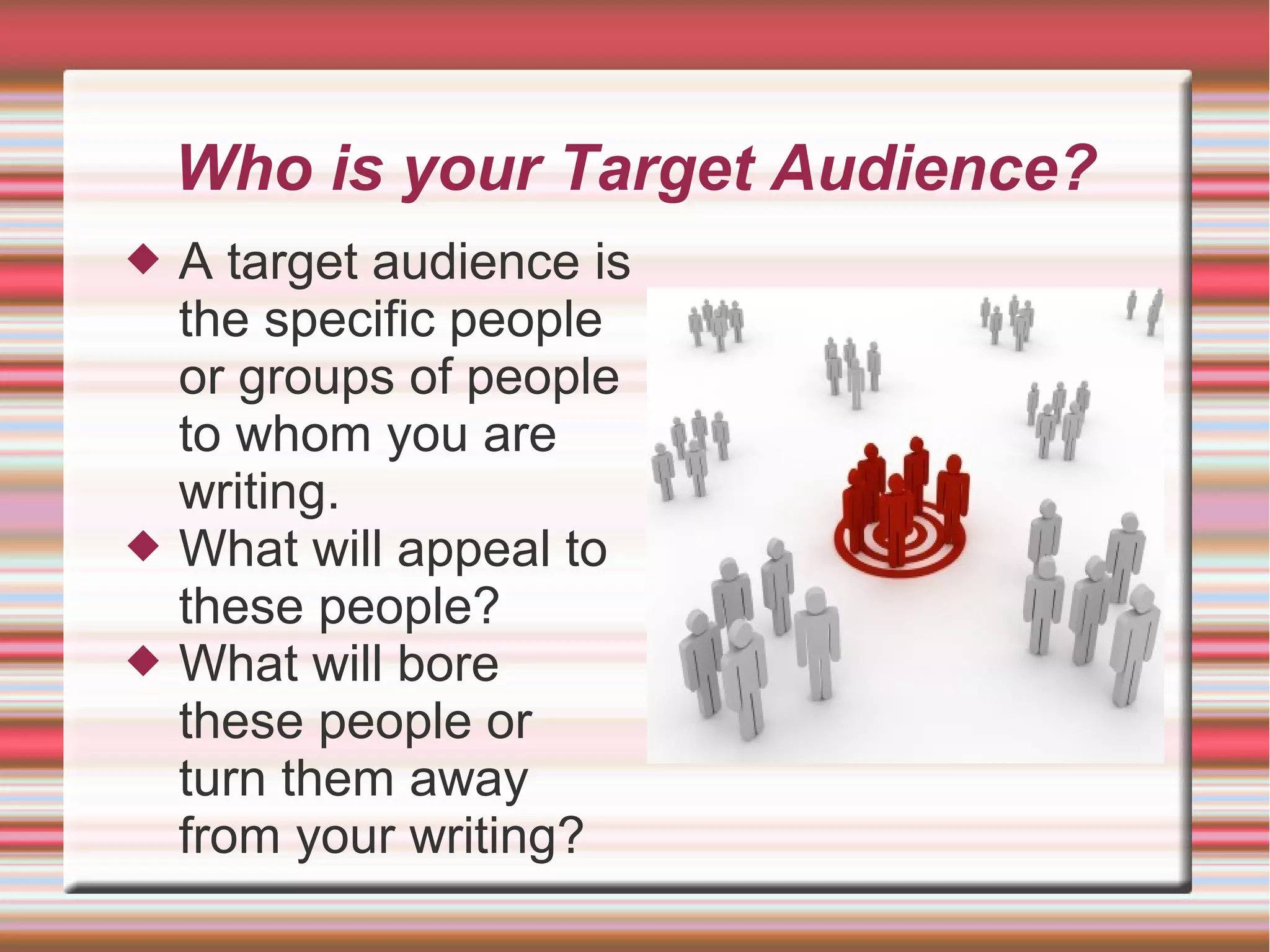
 A target audience is
the specific people
or groups of people
to whom you are
writing.
 What will appeal to
these people?
 What will bore
these people or
turn them away
from your writing?
Clever Questions to Ask Yourself
 Who is your Audience?
 How many audiences do
you have? List them.
 What does your
audience need or want?
 What is most important
to them?
 What are they least likely
to care about?
 What do you have to say
or are you doing in your
research that might
surprise your audience?
 What do you want your
audience to think, learn,
or assume about you?
 How might you organize
your essay in a way that
will be best for your
audience?
Adapted from “Audience”
Know your Assignment
 Review assignment
instructions!
 Usually your instructor
will discuss the intended
audience in the
assignment description.
 If you fail to follow
assignment guidelines,
you may be failing to
meet the expectations of
your projected audience.
Keep your Audience Riveted!
 Write with a purpose!
 Your audience is the
reason you write.
 Consider age,
education level, and
interests of readers.
 What is your primary
goal in writing this
paper? To inform,
entertain, motivate, or
just to express
yourself?
Adapted from “Writing with a Purpose”
Consider your Tone
 Tone, or the manner or
style in which you write, is
directly tied to audience
appeal.
 One must decide if the
audience would respond
better to casual
colloquialisms or formal
terminology.
 Generally, when appealing
to a wide audience, a tone
of semi-formality is best.
 Frequent use of contractions
(ie: we've, they've, it's)
convey a casual tone.
 If you want to sound more
formal, use fewer
contractions (ie: we have,
they have, it is).
 Word choice is key to
keeping your audience
interested. Are you being too
verbose? Are you using terms
your audience will understand
and relate to?
Adapted from “Tone: A Matter of Attitude”
Organize your Thoughts so your
Audience will Follow
 Organization plays an important part in keeping your
readers entertained.
 A skilled writer will guide readers along an easy-to-
follow path. By using transitional phrases and moving
clearly from one supporting fact to the next, the writer
is assured his or her audience can follow his or her
reasoning.
 Use “telling facts” or facts that illustrate your point
instead of simply stating them. Be sure the relationship
between your topic and your fact is apparent to your
reader.
Adapted from “Telling Facts”
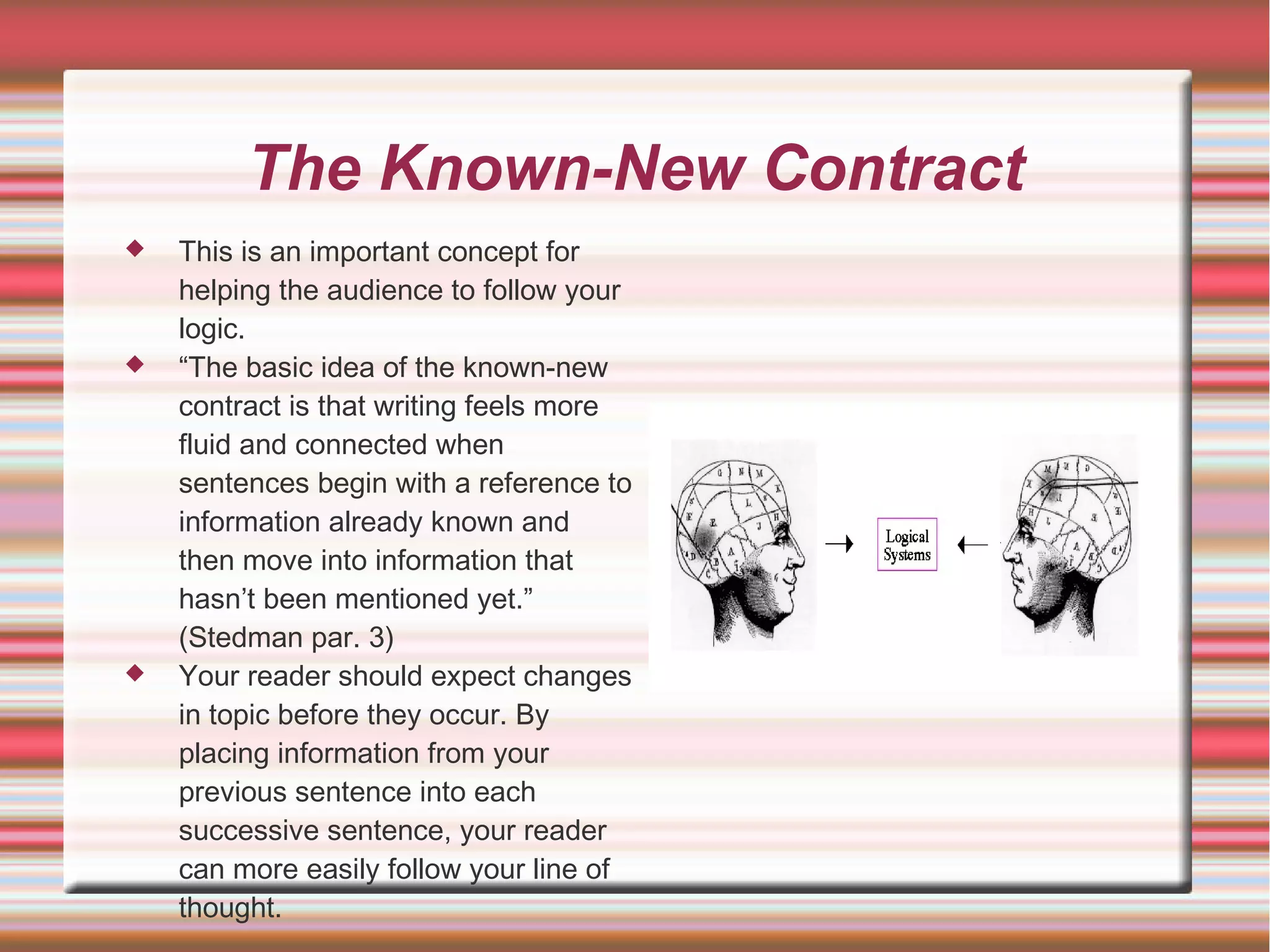
The Known-New Contract
 This is an important concept for
helping the audience to follow your
logic.
 “The basic idea of the known-new
contract is that writing feels more
fluid and connected when
sentences begin with a reference to
information already known and
then move into information that
hasn’t been mentioned yet.”
(Stedman par. 3)
 Your reader should expect changes
in topic before they occur. By
placing information from your
previous sentence into each
successive sentence, your reader
can more easily follow your line of
thought.
The More You Know...
 The more you understand about your
audience, the better you are able to appeal
to their taste.
 In other words, know your audience, please
your audience!
Works Cited
"Audience." The Writing Center, University of North Carolina at Chapel
Hill. 28 April 2009. <
http://www.unc.edu/depts/wcweb/handouts/audience.html>.
Macrorie, Ken. Telling Writing. 3rd
Ed. Rochelle Park, NJ: Hayden, 1980.
Course Handout. Enc 1102, Spring 2009.
Stedman, Kyle. “Known-New Contract.” Adapted from Martha Kolln,
Rhetorical Grammar: Grammatical Choices, Rhetorical Effects.
Course Handout. Enc 1102, Spring 2009.
"Tone: A Matter of Attitude." 4/29/2009 <
http://grammar.ccc.commnet.edu/grammar/composition/tone.htm>.
"Writing with a Sense of Purpose." Capital Community College
Foundation. 29 April 2009. <
http://grammar.ccc.commnet.edu/grammar/composition/purpose.htm
>.

Addressing Your Audience

  • 1.
    Appropriately Addressing your Audienceand Purpose Patricia MillerPatricia Miller Enc 1102 Spring 2009Enc 1102 Spring 2009 Prof. Kyle StedmanProf. Kyle Stedman University of South FloridaUniversity of South Florida
  • 2.
    Audience?  When writingacademic papers, it is vital to consider your audience.  Who will be reading this paper?  What do they already know about the topic?  What do they need to know to understand the topic?  Is your topic something new and interesting? Most people don't want to hear an argument they've heard before.
  • 3.
    Who is yourTarget Audience?  A target audience is the specific people or groups of people to whom you are writing.  What will appeal to these people?  What will bore these people or turn them away from your writing?
  • 4.
    Clever Questions toAsk Yourself  Who is your Audience?  How many audiences do you have? List them.  What does your audience need or want?  What is most important to them?  What are they least likely to care about?  What do you have to say or are you doing in your research that might surprise your audience?  What do you want your audience to think, learn, or assume about you?  How might you organize your essay in a way that will be best for your audience? Adapted from “Audience”
  • 5.
    Know your Assignment Review assignment instructions!  Usually your instructor will discuss the intended audience in the assignment description.  If you fail to follow assignment guidelines, you may be failing to meet the expectations of your projected audience.
  • 6.
    Keep your AudienceRiveted!  Write with a purpose!  Your audience is the reason you write.  Consider age, education level, and interests of readers.  What is your primary goal in writing this paper? To inform, entertain, motivate, or just to express yourself? Adapted from “Writing with a Purpose”
  • 7.
    Consider your Tone Tone, or the manner or style in which you write, is directly tied to audience appeal.  One must decide if the audience would respond better to casual colloquialisms or formal terminology.  Generally, when appealing to a wide audience, a tone of semi-formality is best.  Frequent use of contractions (ie: we've, they've, it's) convey a casual tone.  If you want to sound more formal, use fewer contractions (ie: we have, they have, it is).  Word choice is key to keeping your audience interested. Are you being too verbose? Are you using terms your audience will understand and relate to? Adapted from “Tone: A Matter of Attitude”
  • 8.
    Organize your Thoughtsso your Audience will Follow  Organization plays an important part in keeping your readers entertained.  A skilled writer will guide readers along an easy-to- follow path. By using transitional phrases and moving clearly from one supporting fact to the next, the writer is assured his or her audience can follow his or her reasoning.  Use “telling facts” or facts that illustrate your point instead of simply stating them. Be sure the relationship between your topic and your fact is apparent to your reader. Adapted from “Telling Facts”
  • 9.
    The Known-New Contract This is an important concept for helping the audience to follow your logic.  “The basic idea of the known-new contract is that writing feels more fluid and connected when sentences begin with a reference to information already known and then move into information that hasn’t been mentioned yet.” (Stedman par. 3)  Your reader should expect changes in topic before they occur. By placing information from your previous sentence into each successive sentence, your reader can more easily follow your line of thought.
  • 10.
    The More YouKnow...  The more you understand about your audience, the better you are able to appeal to their taste.  In other words, know your audience, please your audience!
  • 11.
    Works Cited "Audience." TheWriting Center, University of North Carolina at Chapel Hill. 28 April 2009. < http://www.unc.edu/depts/wcweb/handouts/audience.html>. Macrorie, Ken. Telling Writing. 3rd Ed. Rochelle Park, NJ: Hayden, 1980. Course Handout. Enc 1102, Spring 2009. Stedman, Kyle. “Known-New Contract.” Adapted from Martha Kolln, Rhetorical Grammar: Grammatical Choices, Rhetorical Effects. Course Handout. Enc 1102, Spring 2009. "Tone: A Matter of Attitude." 4/29/2009 < http://grammar.ccc.commnet.edu/grammar/composition/tone.htm>. "Writing with a Sense of Purpose." Capital Community College Foundation. 29 April 2009. < http://grammar.ccc.commnet.edu/grammar/composition/purpose.htm >.