E-Commerce Basics Chapter One:  Understanding the New Internet Economy
Topics covered in this chapter.. Electronic Commerce Basics The Internet and World Wide Web Brief History of the Internet and WWW Who’s online now?  Business in the New Economy E-Business Adv. and Disadv. E-Business Models
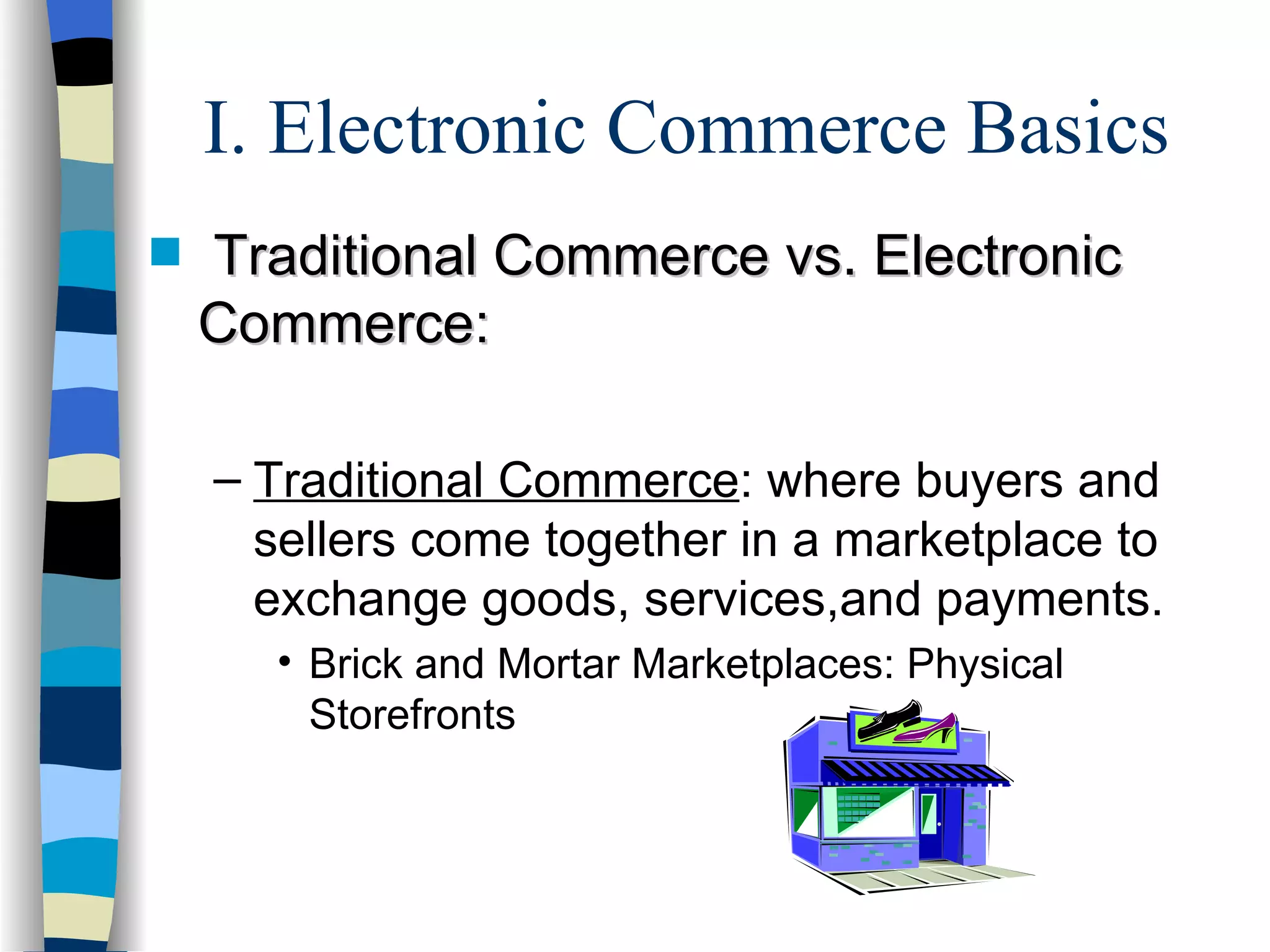
I. Electronic Commerce Basics Traditional Commerce vs. Electronic Commerce: Traditional Commerce : where buyers and sellers come together in a marketplace to exchange goods, services,and payments. Brick and Mortar Marketplaces: Physical Storefronts
I. Electronic Commerce Basics Traditional Commerce vs. Electronic Commerce: Electronic Commerce : Buying and selling products and services over a telecommunications network. Electronic marketplace or marketspace
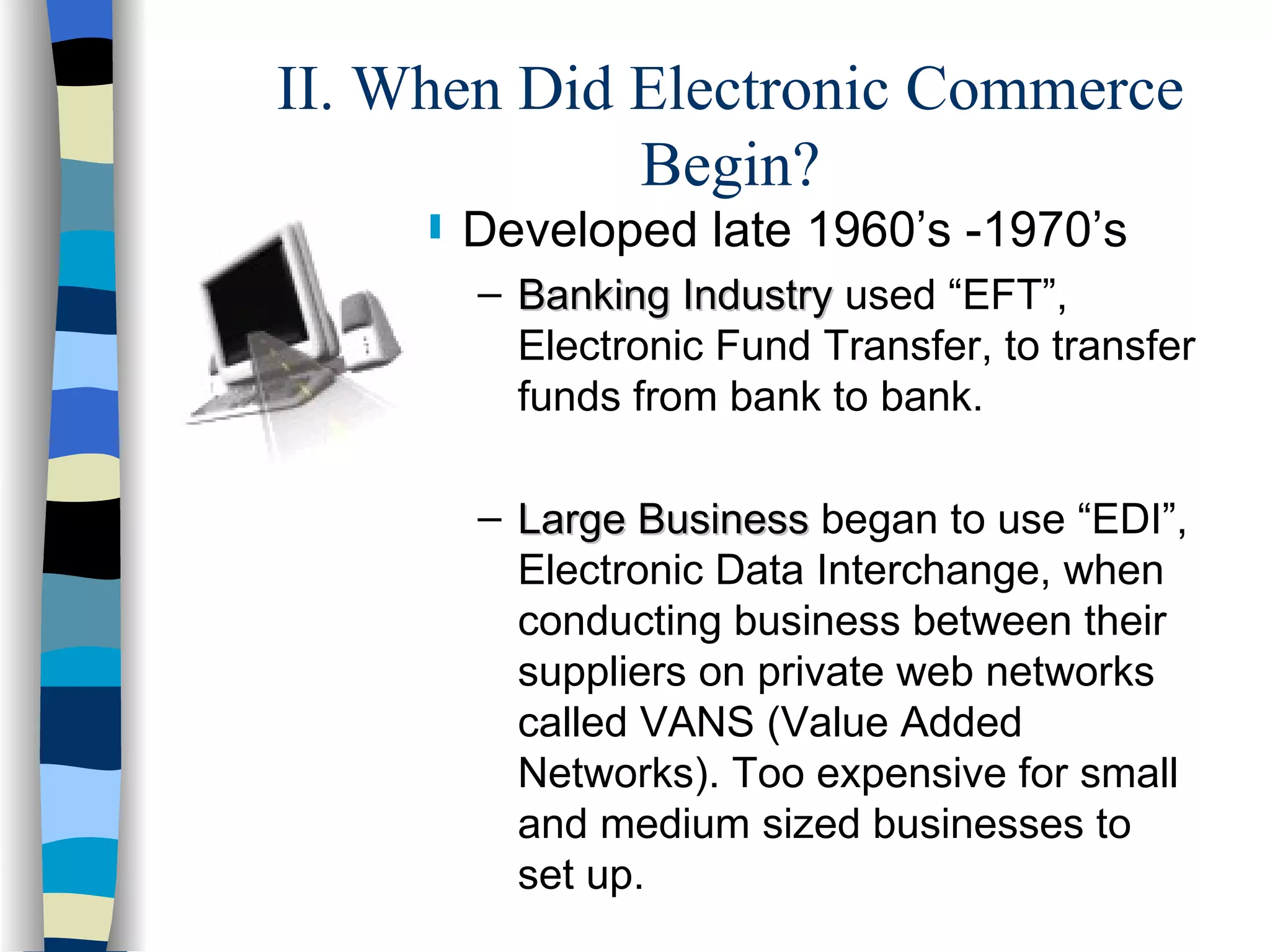
II. When Did Electronic Commerce Begin? Developed late 1960’s -1970’s Banking Industry  used “EFT”, Electronic Fund Transfer, to transfer funds from bank to bank. Large Business  began to use “EDI”, Electronic Data Interchange, when conducting business between their suppliers on private web networks called VANS (Value Added Networks). Too expensive for small and medium sized businesses to set up.
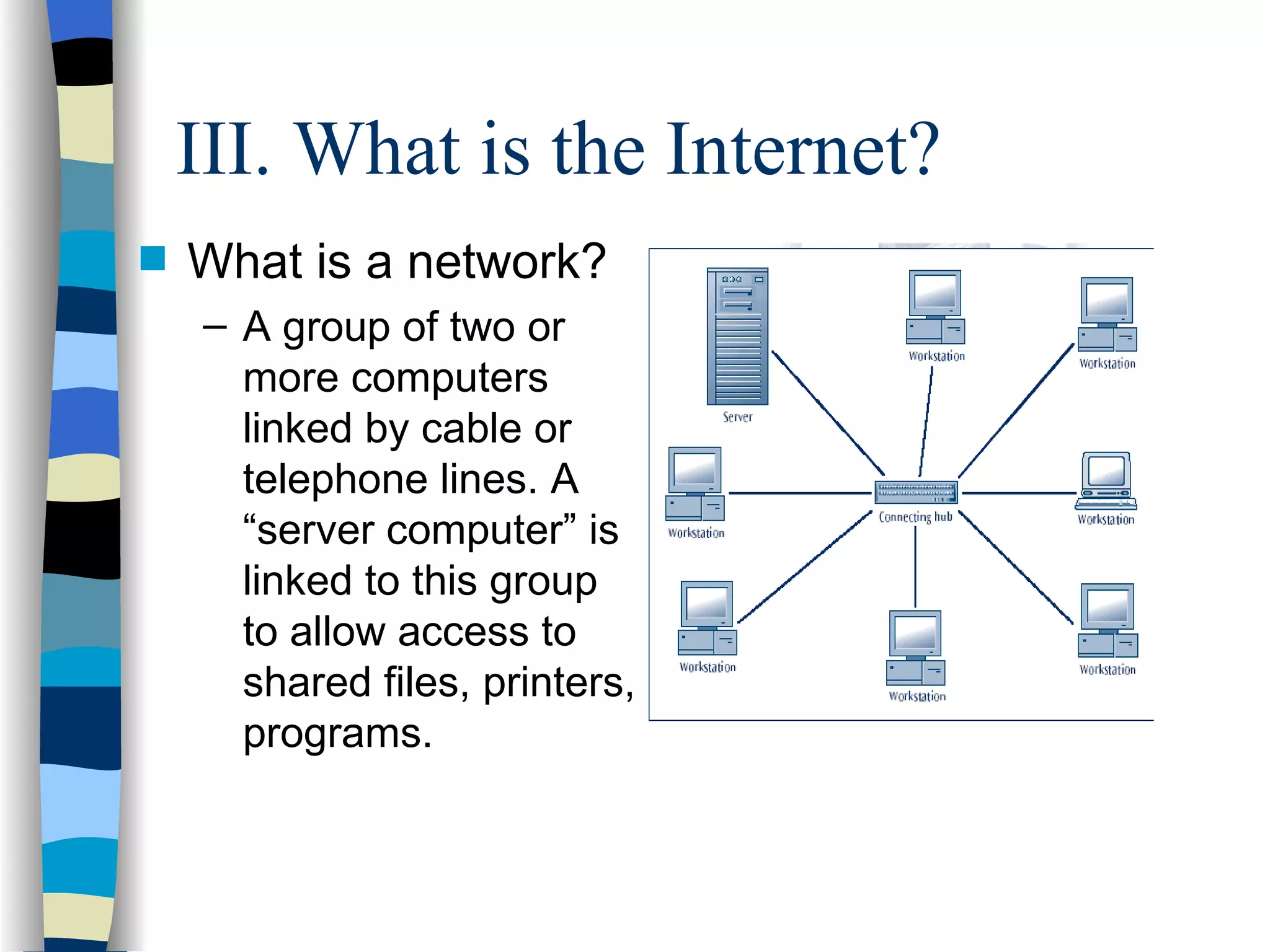
III. What is the Internet? What is a network?  A group of two or more computers linked by cable or telephone lines. A “server computer” is linked to this group to allow access to shared files, printers, programs.
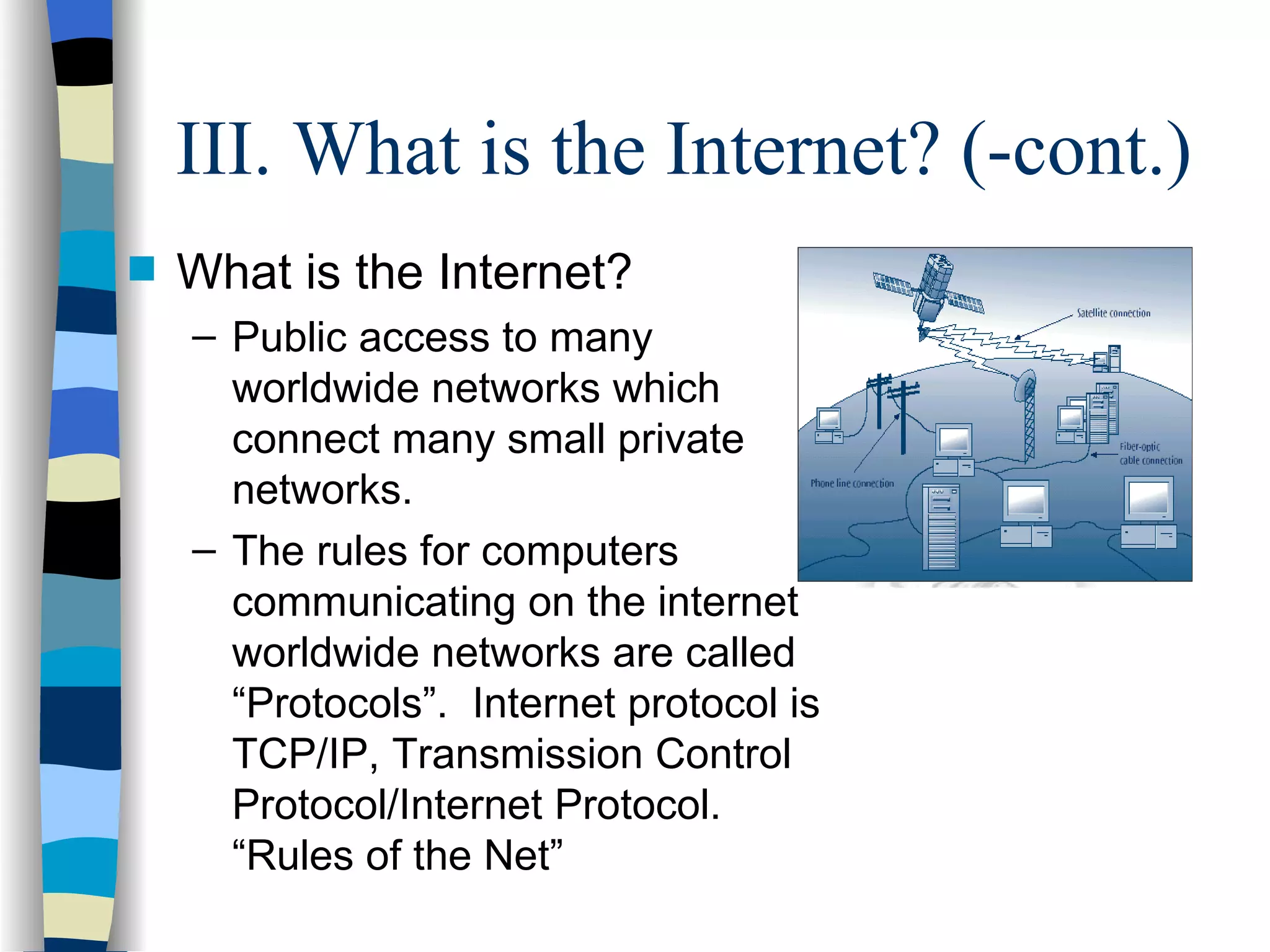
III. What is the Internet? (-cont.) What is the Internet? Public access to many worldwide networks which connect many small private networks. The rules for computers communicating on the internet worldwide networks are called “Protocols”.  Internet protocol is TCP/IP, Transmission Control Protocol/Internet Protocol. “Rules of the Net”
IV. History of the Internet Internet started late 1960’s US Department of Defense -Military Networks called ARPNET Researchers at Colleges used this network to share research amongst universities By mid to late 1980’s Military created their own separate internet network called MILNET. National Science Foundation used military internet and created their own-NSFnet.
IV. History of the Internet By 1989 The internet was called the “Networks of Networks” In order for businesses to connect to this internet network, cables or phone modems were needed.  Since this was expensive, at the time, small and medium sized companies connected through a HOST or Internet Service Provider, ISP
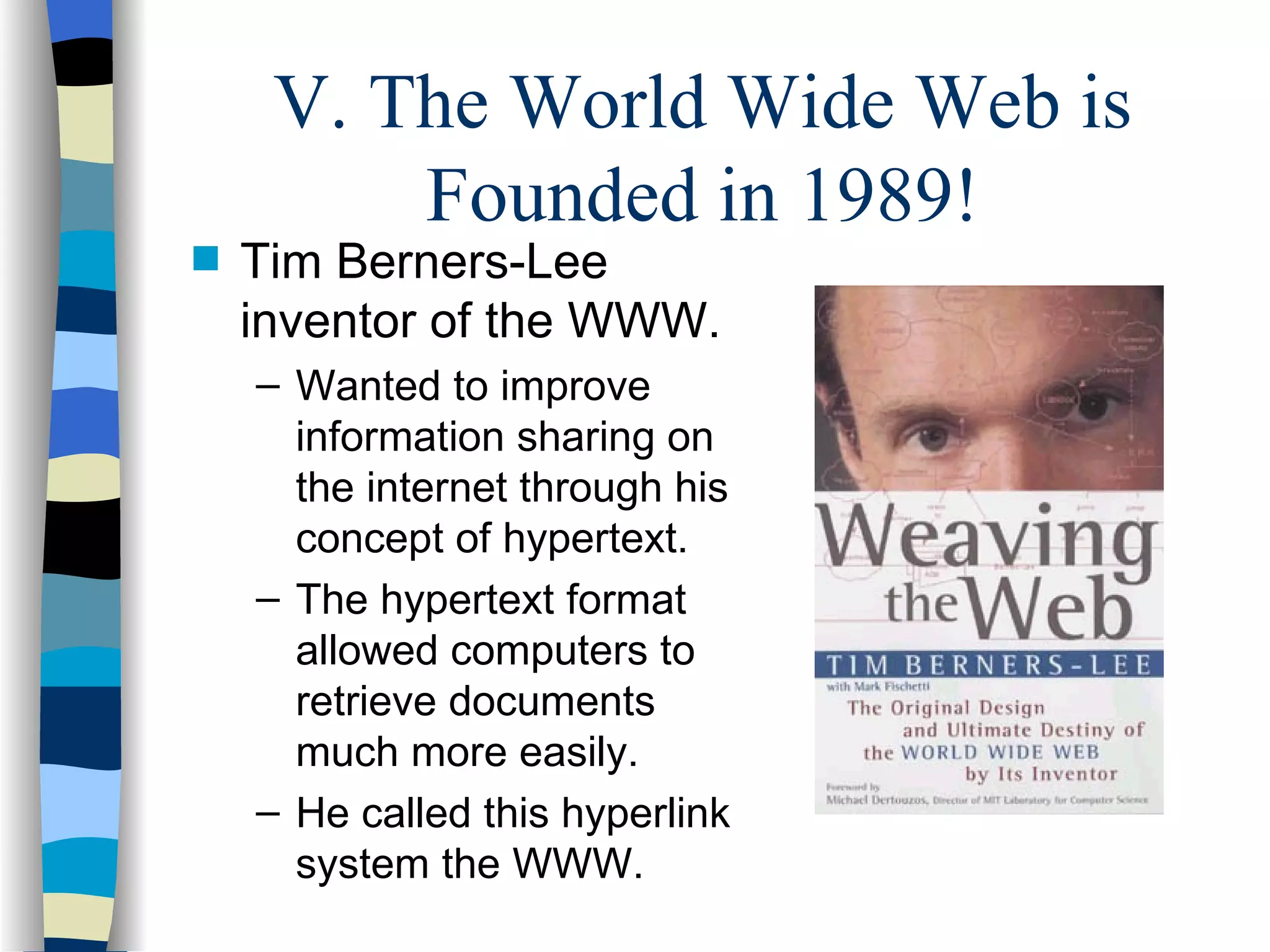
V. The World Wide Web is Founded in 1989! Tim Berners-Lee inventor of the WWW. Wanted to improve information sharing on the internet through his concept of hypertext. The hypertext format allowed computers to retrieve documents much more easily. He called this hyperlink system the WWW.
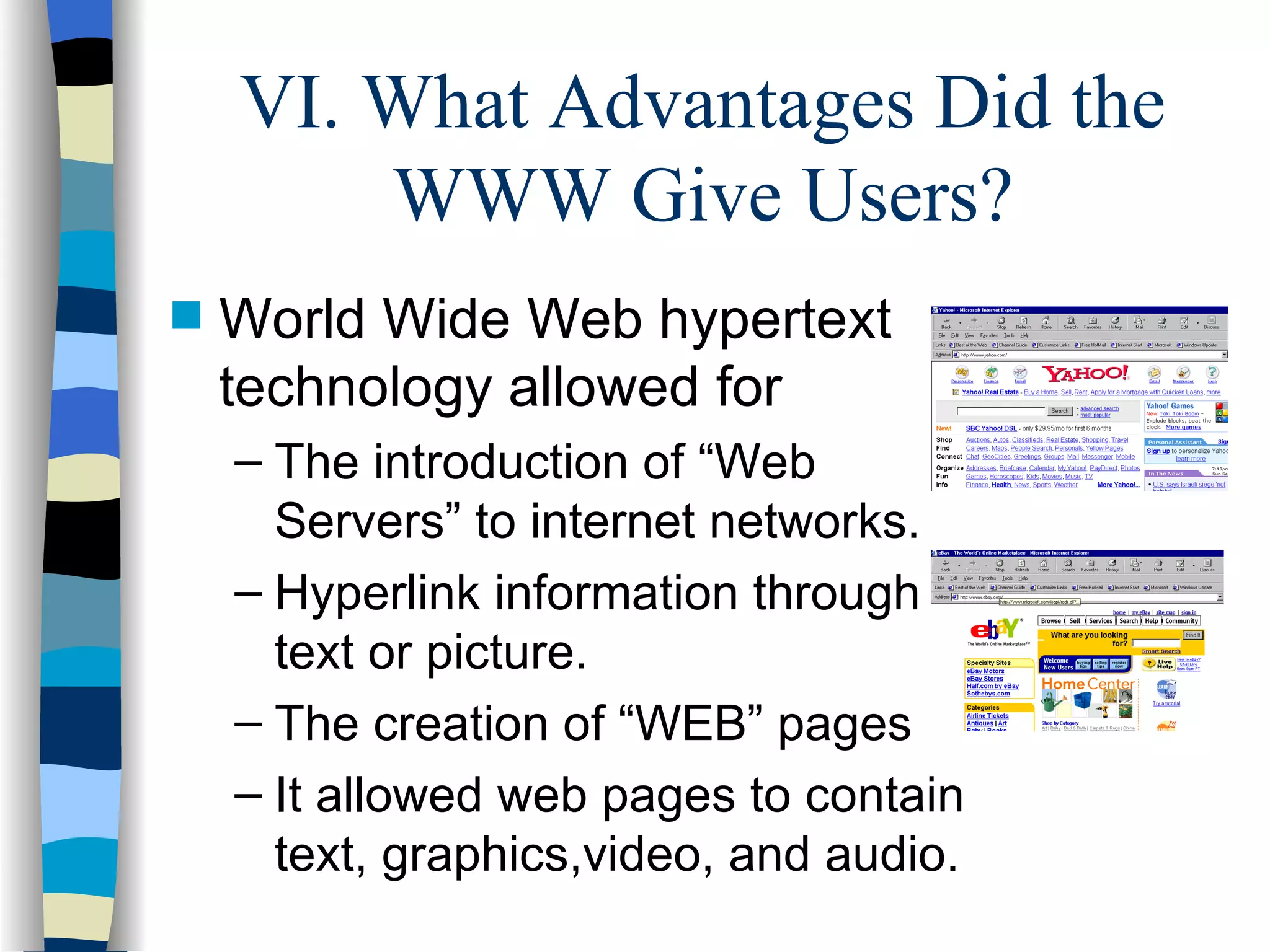
VI. What Advantages Did the WWW Give Users? World Wide Web hypertext technology allowed for The introduction of “Web Servers” to internet networks. Hyperlink information through text or picture. The creation of “WEB” pages  It allowed web pages to contain text, graphics,video, and audio.
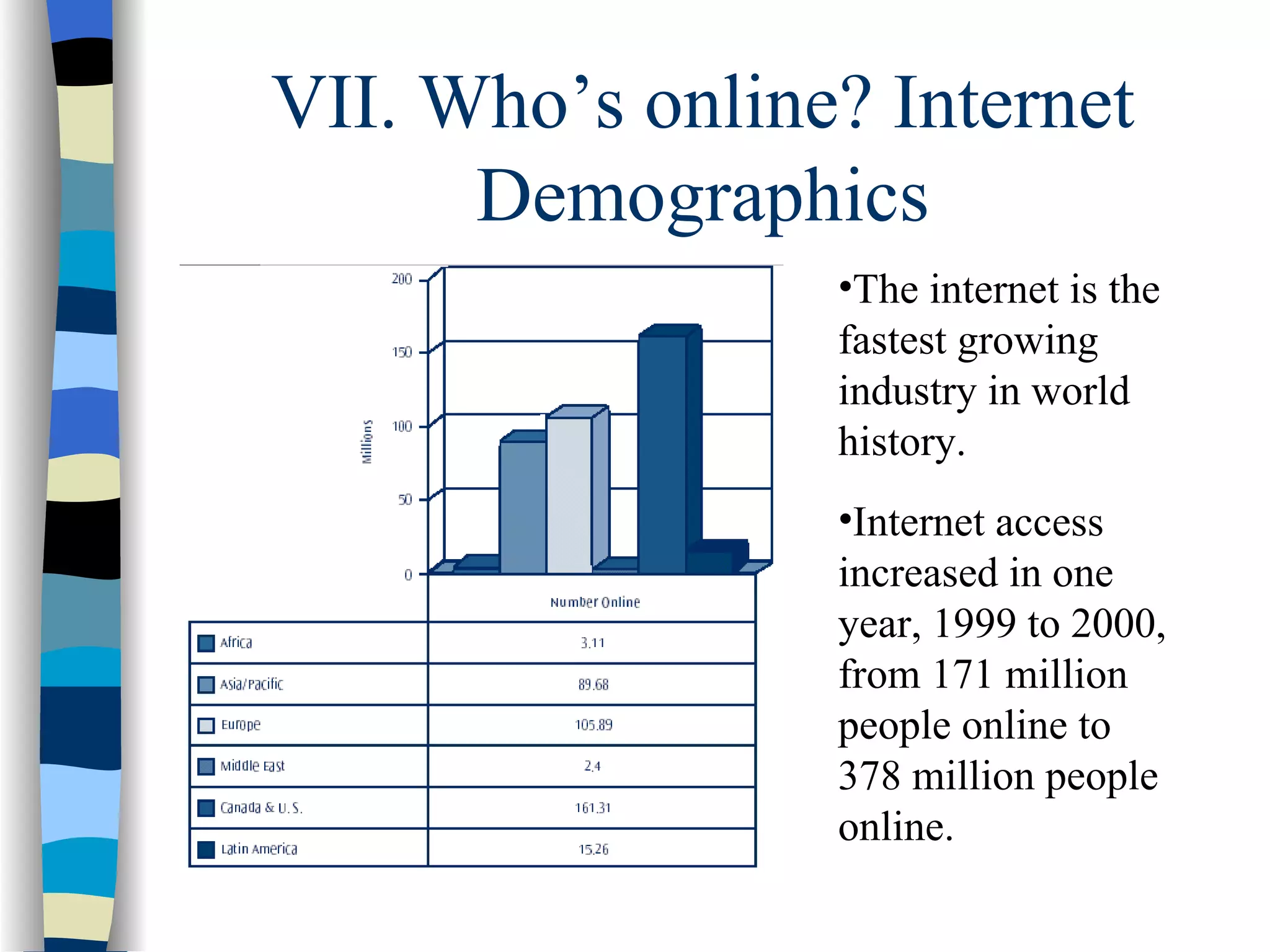
VII. Who’s online? Internet Demographics Internet access increased in one year, 1999 to 2000, from 171 million people online to 378 million people online. The internet is the fastest growing industry in world history.
VIII.  E-Business and the New Economy New Internet Economy has created a new economic environment for business. Reduced limitations for medium and small businesses to operate online Limitations of space and time are disappearing Businesses are open 24 hours/7days a week Geographic limitations are disappearing Mass customization vs Mass production
IX. Advantages of E-Business Sellers Increased sales Decreased transaction costs Open 24hr/7days  Ability to reseach target customers worldwide Global Markets Increased speed and accuracy of transactions Buyers Wider product availability Personalized buying options Shop 24/7days Easy comparison shopping Quick delivery Participate in auctions
X. Disadvantages of E-Business Sellers Rapid changes in technology Insufficient bandwidth Software integration difficulties for e-business Global market issues:language, currency, legal issues Shortage of skilled technical workers Buyers Security concerns regarding payment Lack of trust in an e-business that is unfamiliar Lack of “touch and feel” of product. WWW. FORSALE.COM
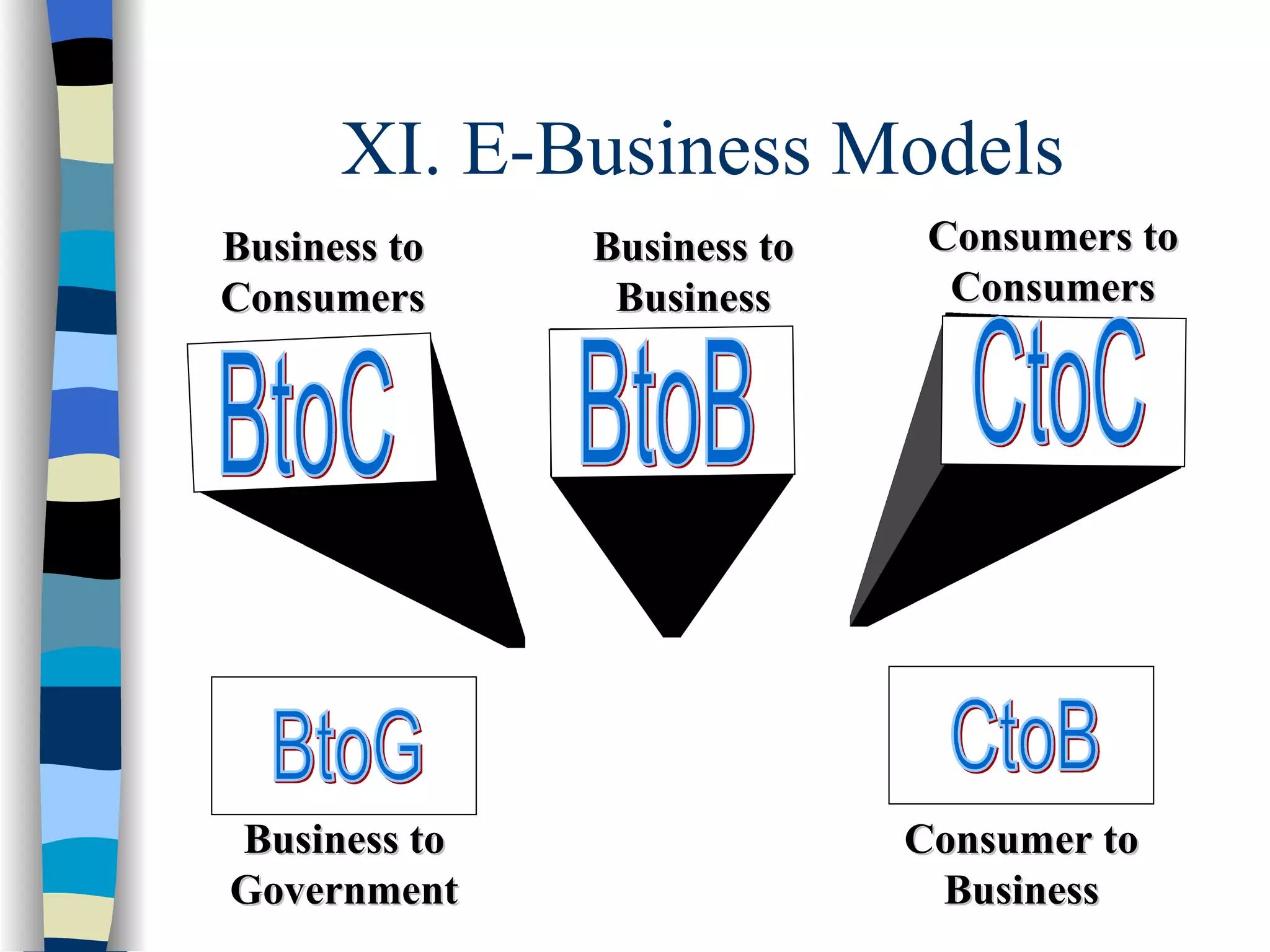
XI. E-Business Models Business to Consumers Business to Business Consumers to Consumers CtoB Business to Government Consumer to Business BtoC BtoB CtoC BtoG

E Business Pp Chapter1

  • 1.
    E-Commerce Basics ChapterOne: Understanding the New Internet Economy
  • 2.
    Topics covered inthis chapter.. Electronic Commerce Basics The Internet and World Wide Web Brief History of the Internet and WWW Who’s online now? Business in the New Economy E-Business Adv. and Disadv. E-Business Models
  • 3.
    I. Electronic CommerceBasics Traditional Commerce vs. Electronic Commerce: Traditional Commerce : where buyers and sellers come together in a marketplace to exchange goods, services,and payments. Brick and Mortar Marketplaces: Physical Storefronts
  • 4.
    I. Electronic CommerceBasics Traditional Commerce vs. Electronic Commerce: Electronic Commerce : Buying and selling products and services over a telecommunications network. Electronic marketplace or marketspace
  • 5.
    II. When DidElectronic Commerce Begin? Developed late 1960’s -1970’s Banking Industry used “EFT”, Electronic Fund Transfer, to transfer funds from bank to bank. Large Business began to use “EDI”, Electronic Data Interchange, when conducting business between their suppliers on private web networks called VANS (Value Added Networks). Too expensive for small and medium sized businesses to set up.
  • 6.
    III. What isthe Internet? What is a network? A group of two or more computers linked by cable or telephone lines. A “server computer” is linked to this group to allow access to shared files, printers, programs.
  • 7.
    III. What isthe Internet? (-cont.) What is the Internet? Public access to many worldwide networks which connect many small private networks. The rules for computers communicating on the internet worldwide networks are called “Protocols”. Internet protocol is TCP/IP, Transmission Control Protocol/Internet Protocol. “Rules of the Net”
  • 8.
    IV. History ofthe Internet Internet started late 1960’s US Department of Defense -Military Networks called ARPNET Researchers at Colleges used this network to share research amongst universities By mid to late 1980’s Military created their own separate internet network called MILNET. National Science Foundation used military internet and created their own-NSFnet.
  • 9.
    IV. History ofthe Internet By 1989 The internet was called the “Networks of Networks” In order for businesses to connect to this internet network, cables or phone modems were needed. Since this was expensive, at the time, small and medium sized companies connected through a HOST or Internet Service Provider, ISP
  • 10.
    V. The WorldWide Web is Founded in 1989! Tim Berners-Lee inventor of the WWW. Wanted to improve information sharing on the internet through his concept of hypertext. The hypertext format allowed computers to retrieve documents much more easily. He called this hyperlink system the WWW.
  • 11.
    VI. What AdvantagesDid the WWW Give Users? World Wide Web hypertext technology allowed for The introduction of “Web Servers” to internet networks. Hyperlink information through text or picture. The creation of “WEB” pages It allowed web pages to contain text, graphics,video, and audio.
  • 12.
    VII. Who’s online?Internet Demographics Internet access increased in one year, 1999 to 2000, from 171 million people online to 378 million people online. The internet is the fastest growing industry in world history.
  • 13.
    VIII. E-Businessand the New Economy New Internet Economy has created a new economic environment for business. Reduced limitations for medium and small businesses to operate online Limitations of space and time are disappearing Businesses are open 24 hours/7days a week Geographic limitations are disappearing Mass customization vs Mass production
  • 14.
    IX. Advantages ofE-Business Sellers Increased sales Decreased transaction costs Open 24hr/7days Ability to reseach target customers worldwide Global Markets Increased speed and accuracy of transactions Buyers Wider product availability Personalized buying options Shop 24/7days Easy comparison shopping Quick delivery Participate in auctions
  • 15.
    X. Disadvantages ofE-Business Sellers Rapid changes in technology Insufficient bandwidth Software integration difficulties for e-business Global market issues:language, currency, legal issues Shortage of skilled technical workers Buyers Security concerns regarding payment Lack of trust in an e-business that is unfamiliar Lack of “touch and feel” of product. WWW. FORSALE.COM
  • 16.
    XI. E-Business ModelsBusiness to Consumers Business to Business Consumers to Consumers CtoB Business to Government Consumer to Business BtoC BtoB CtoC BtoG