ReST Vs SOA(P) ... Yawn

Loading...

Flash Player 9 (or above) is needed to view presentations.
We have detected that you do not have it on your computer. To install it, go here.

0 comments

Post a comment

    Post a comment
    Embed Video
    Edit your comment Cancel

    18 Favorites & 1 Group

    ReST Vs SOA(P) ... Yawn - Presentation Transcript

    1. ReST vs SOA(P) yawn ... Instead ... Facts and confused metaphors for Understanding ReST
    2. Early Web • Human edited Files / Document Oriented programatic output • A patchy server opening up access to static files • Massive Upgrade to Human Knowlege, Communication, and Transparency
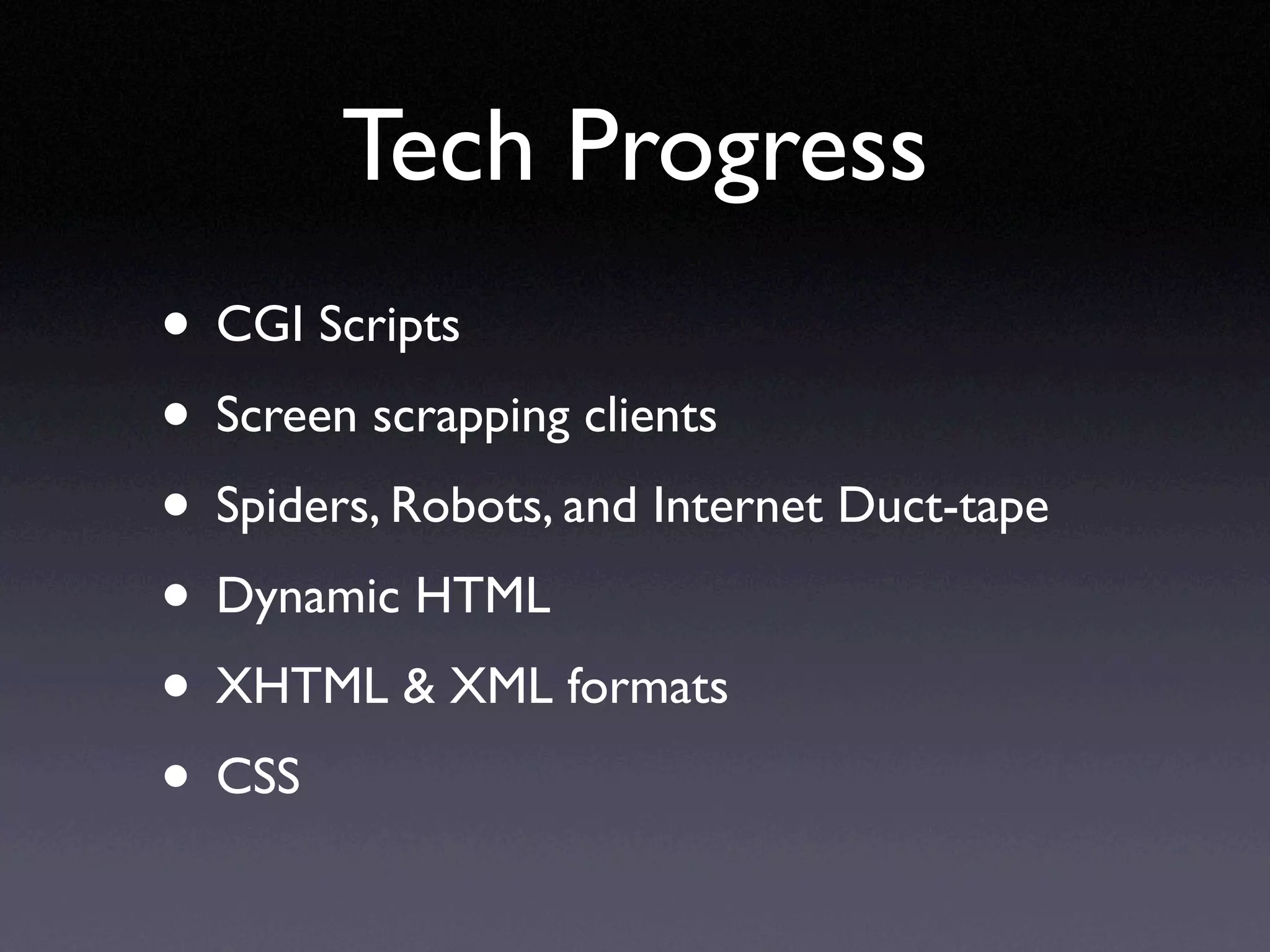
    3. Tech Progress • CGI Scripts • Screen scrapping clients • Spiders, Robots, and Internet Duct-tape • Dynamic HTML • XHTML & XML formats • CSS
    4. Roy T. Fielding Architectural Styles and the Design of Network-based Software Architectures http://www.ics.uci.edu/~fielding/pubs/dissertation/top.htm by Paul Downey
    5. ReST is not • A technology • A set of standards • COTS software • A tooth paste http://www.lostwackys.com/Wacky-Packages/die-cuts/Crust.htm
    6. ReST is • A series of constraints that defines a specific flavor of system architecture • Layered • Client / Server Representational e • Code on Demand State • Client Cache Transfer • Stateless Server
    7. ReST is Weak Poor network latency Difficult to identify authoritative response Uniform Interfaces degrade performance Lacks “mandatory extensions” - must understand Optimized for course grained transmissions Hard to customize
    8. but also ReST is Dope because of Low technical barrier to play General Interfaces Resource Extensibility Massively Scalable Independent Deployment
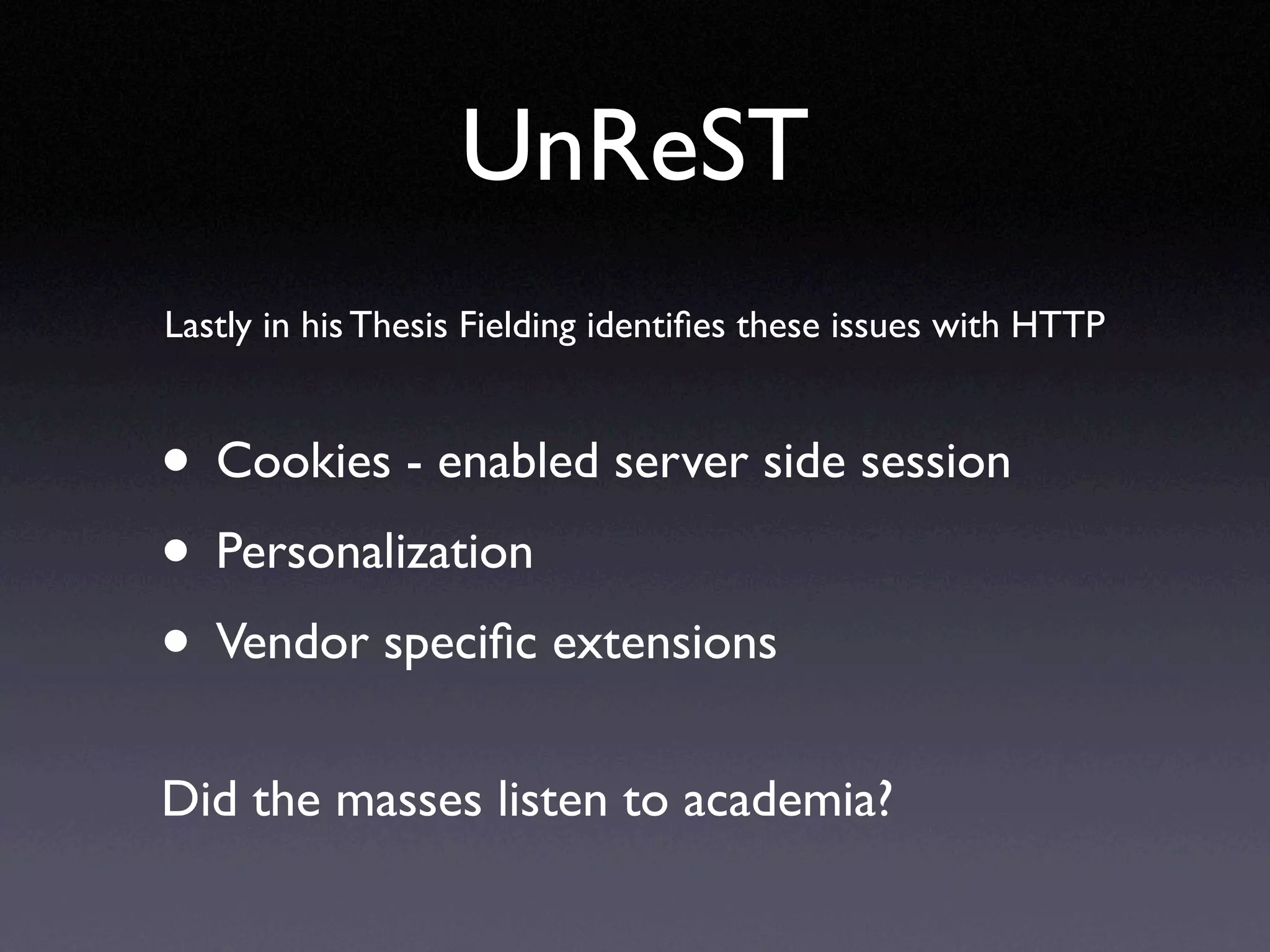
    9. UnReST Lastly in his Thesis Fielding identifies these issues with HTTP • Cookies - enabled server side session • Personalization • Vendor specific extensions Did the masses listen to academia?
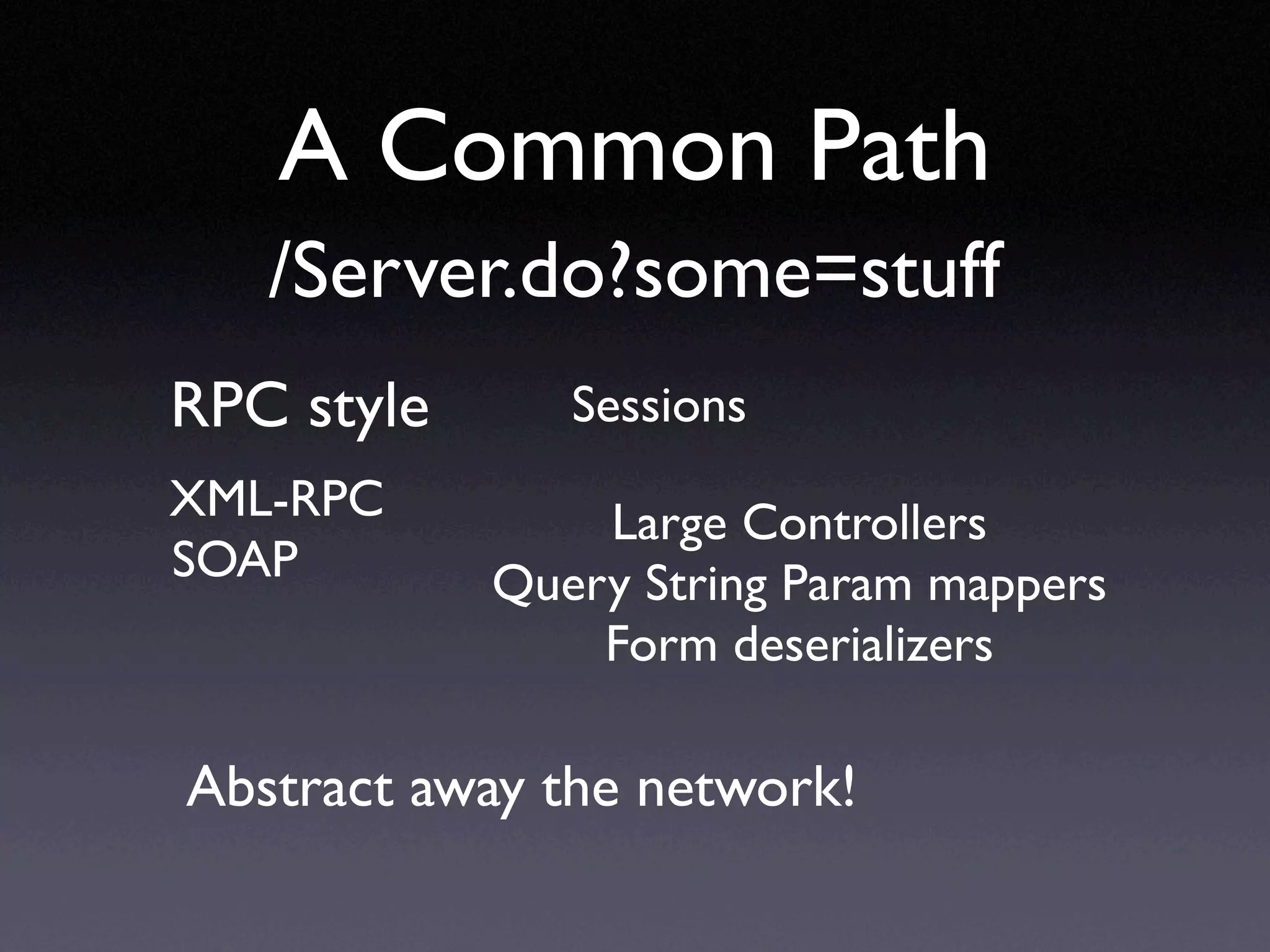
    10. A Common Path /Server.do?some=stuff RPC style Sessions XML-RPC Large Controllers SOAP Query String Param mappers Form deserializers Abstract away the network!
    11. A Common Path? • Focus on APIs, distributed transactions, etc • Procedural code • Distributed OOP 1992 called, it wants it’s CORBA back ...
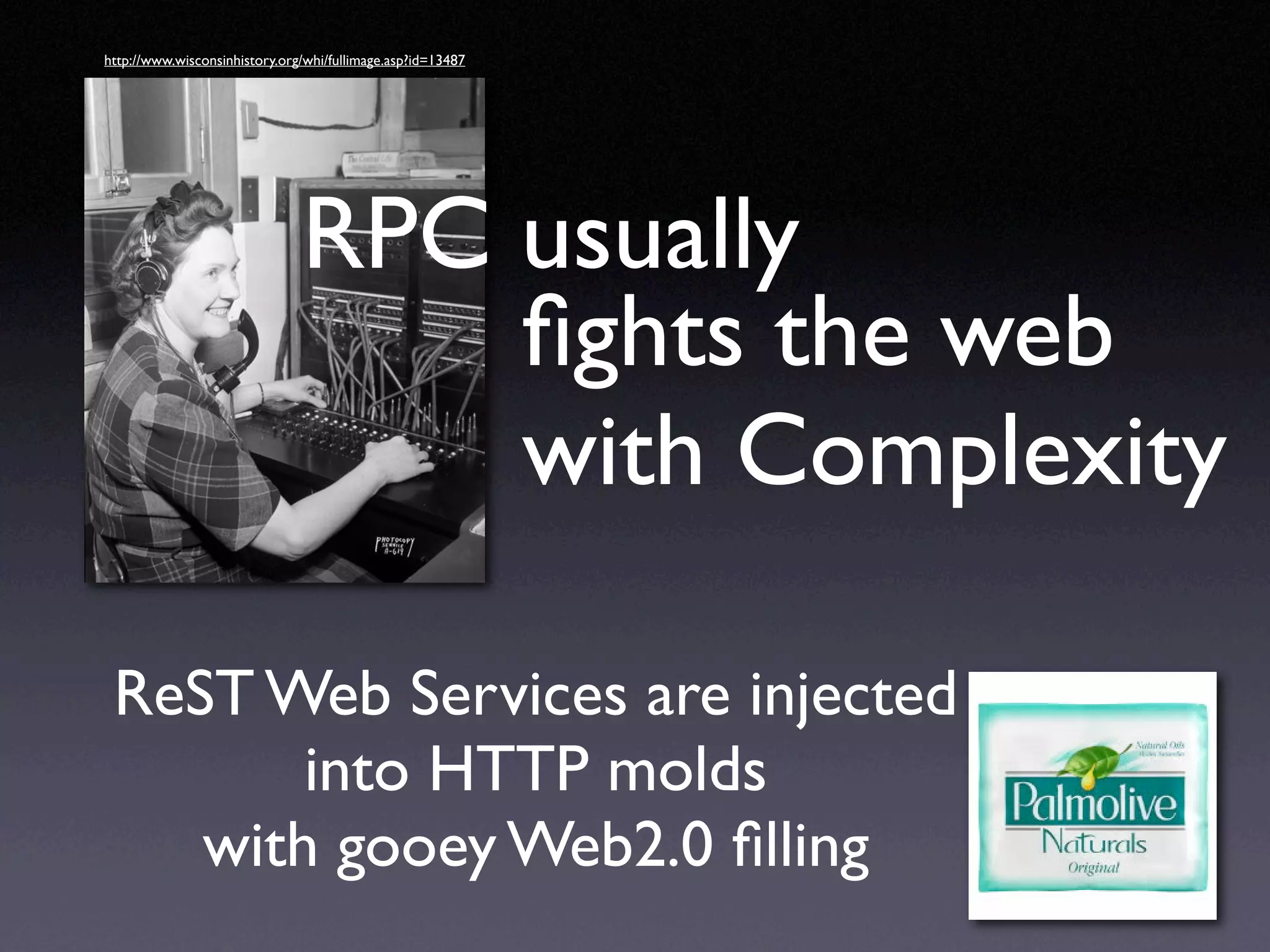
    12. http://www.wisconsinhistory.org/whi/fullimage.asp?id=13487 RPC usually fights the web with Complexity ReST Web Services are injected into HTTP molds with gooey Web2.0 filling
    13. ReSTful Web Services? Madge! You’re suggesting there’s issues with transporting all my SOAP traffic over POST through one URI? Relax, SOAP document literal over HTTP is the most popular. But won’t I lose transport independence? Yes, but if you add using GET, more endpoints, etc you can have caching for free! via Shannon C. on Flickr
    14. ReST in 90 seconds • URIs • Resources • Representations • State Transitions • User agents, intermediaries, and servers • Uniform Interfaces
    15. Core Concepts http://flickr.com/photos/68661927@N00/350737025/in/photostream/
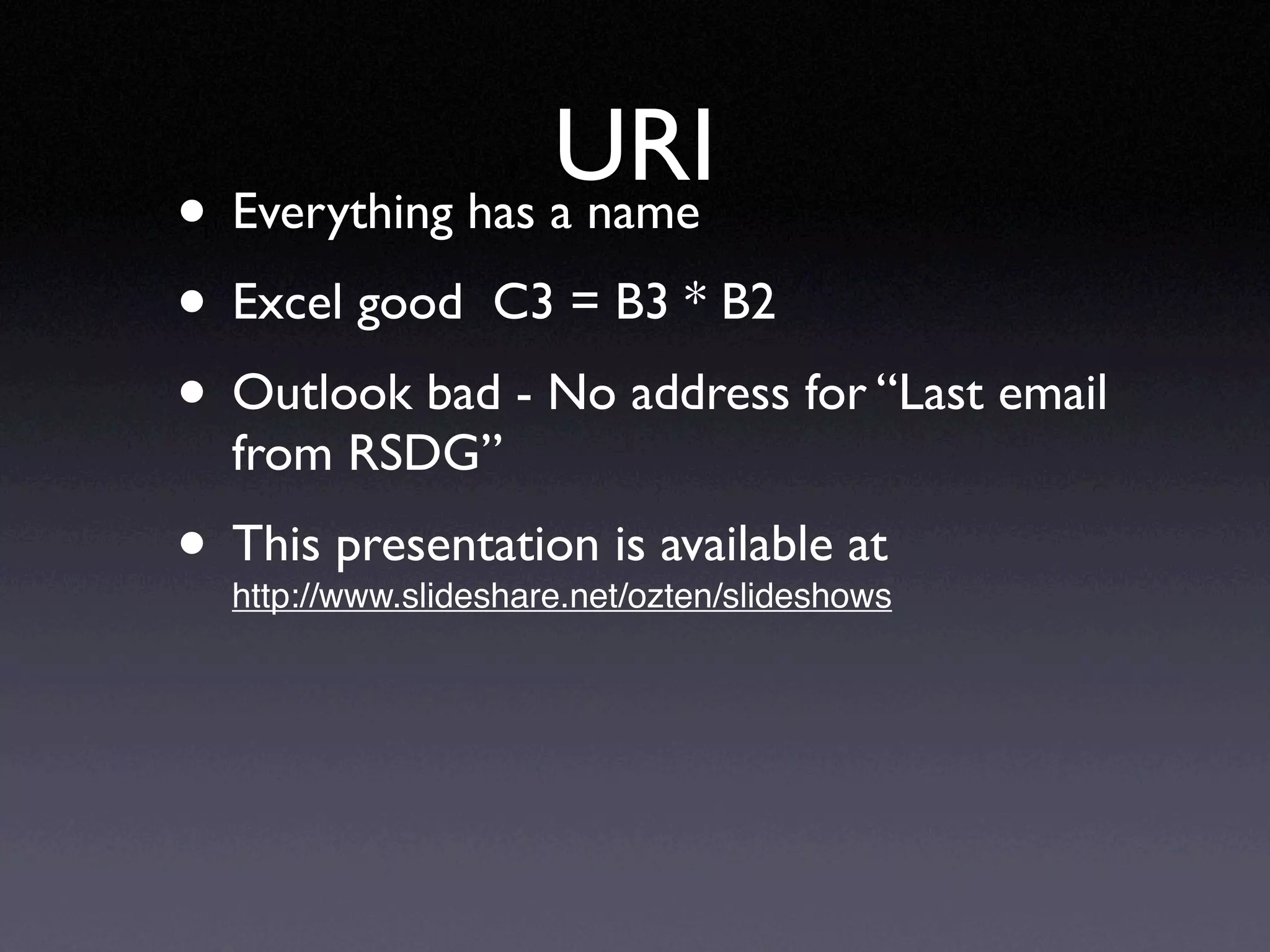
    16. URI • Everything has a name • Excel good C3 = B3 * B2 • Outlook bad - No address for “Last email from RSDG” • This presentation is available at http://www.slideshare.net/ozten/slideshows
    17. Resources • Any “Thing” - concept, event, person • Anything you would want to point too • Request or Respose = data + metadata in an envelope with control data • Explicit request / response - no hidden state • Easier to load balance • Easier to troubleshoot
    18. Representations • A serializable description of a Resource • Modify resources through representations • XHTML Microformats • Industry standard binary formats ( jpg, mpg, etc ) • JSON • XML ( Atom or custom ) • The resource itself for static files
    19. State Transitions Hypermedia as the engine of • Links application state • link, img, and a tags • Forms Links and forms are the hypermedia elements of XHTML. They create the network effect of the web. Every resource represents a state in your application. State transition aren’t hidden behind an API, but are instead transmitted back in forth in a hypermedia protocol. Client’s can follow these links and be less fragile to future changes. RPC usually lacks links and encourages assumptions about formatting URI or server states.
    20. Client / Server • User Agents • Web browsers • HTTP libraries - libwww, libcurl, etc • Proxies • Gateways • Servers
    21. Uniform Interfaces HTTP Method Guarantee # Of Effects 0 GET, HEAD Safe 1 PUT, DELETE Idempotent POST None ??? Möbius strip via wikipediajpg
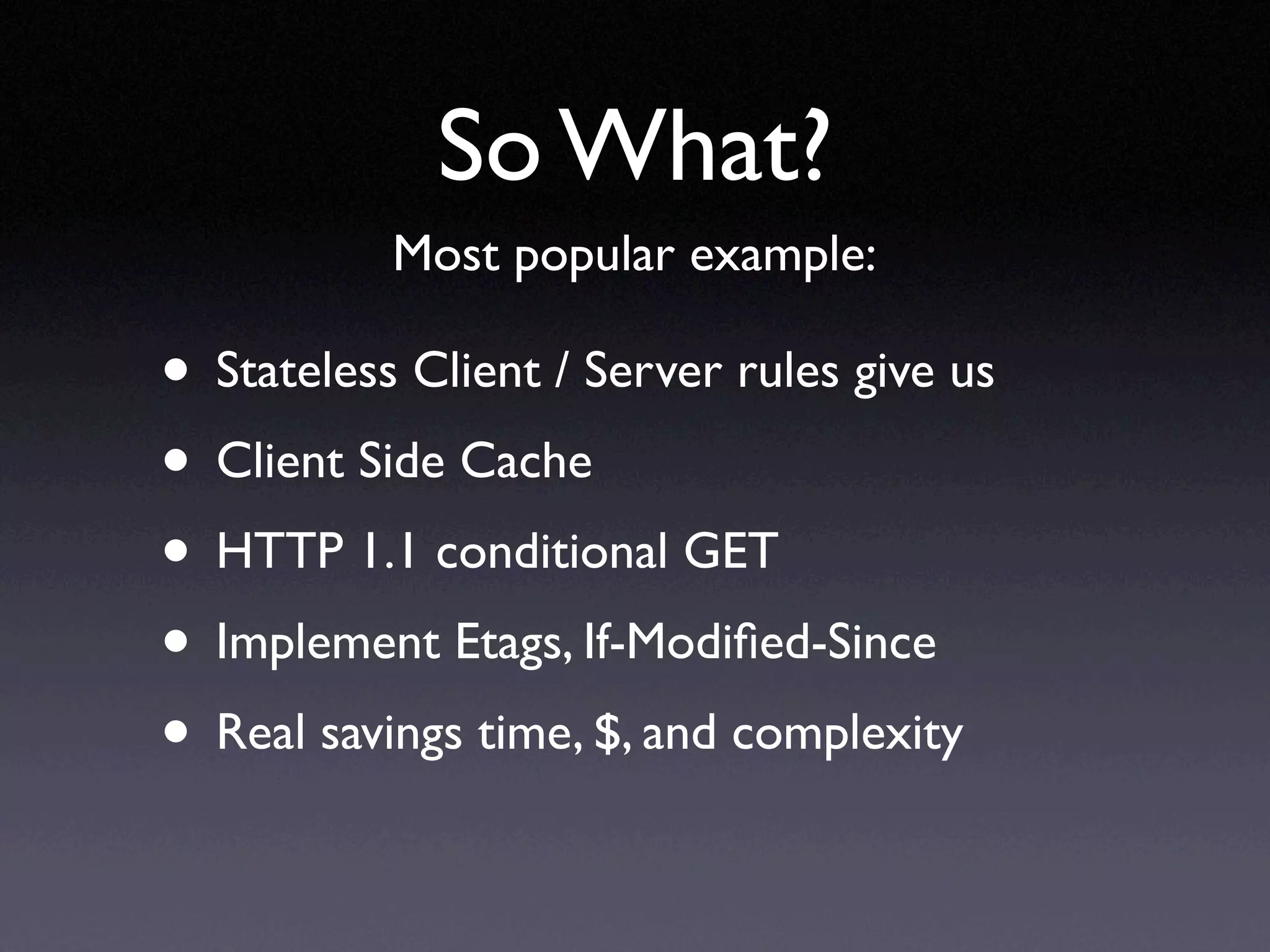
    22. So What? Most popular example: • Stateless Client / Server rules give us • Client Side Cache • HTTP 1.1 conditional GET • Implement Etags, If-Modified-Since • Real savings time, $, and complexity
    23. Common Misconceptions
    24. But, Browsers only do GET and POST • Yep, their horrible ReST clients • Web Developers use XMLHttpRequest for PUT, DELETE, etc • Outside of browser, use HttpClient, libwww, or libcurl • ReST uniform interface means you can tunnel PUT, DELETE over POST or write one off Proxy via cleansweepsupply.com
    25. ReST is just CRUD • Sure you can expose HTTP SQL CRUD POST INSERT Create DB on web GET SELECT Read • Too cute and simple PUT UPDATE Update right? DELETE DELETE Delete It’s about favoring protocols Refactor design to use and resources over APIs. new resources if you run out of HTTP methods
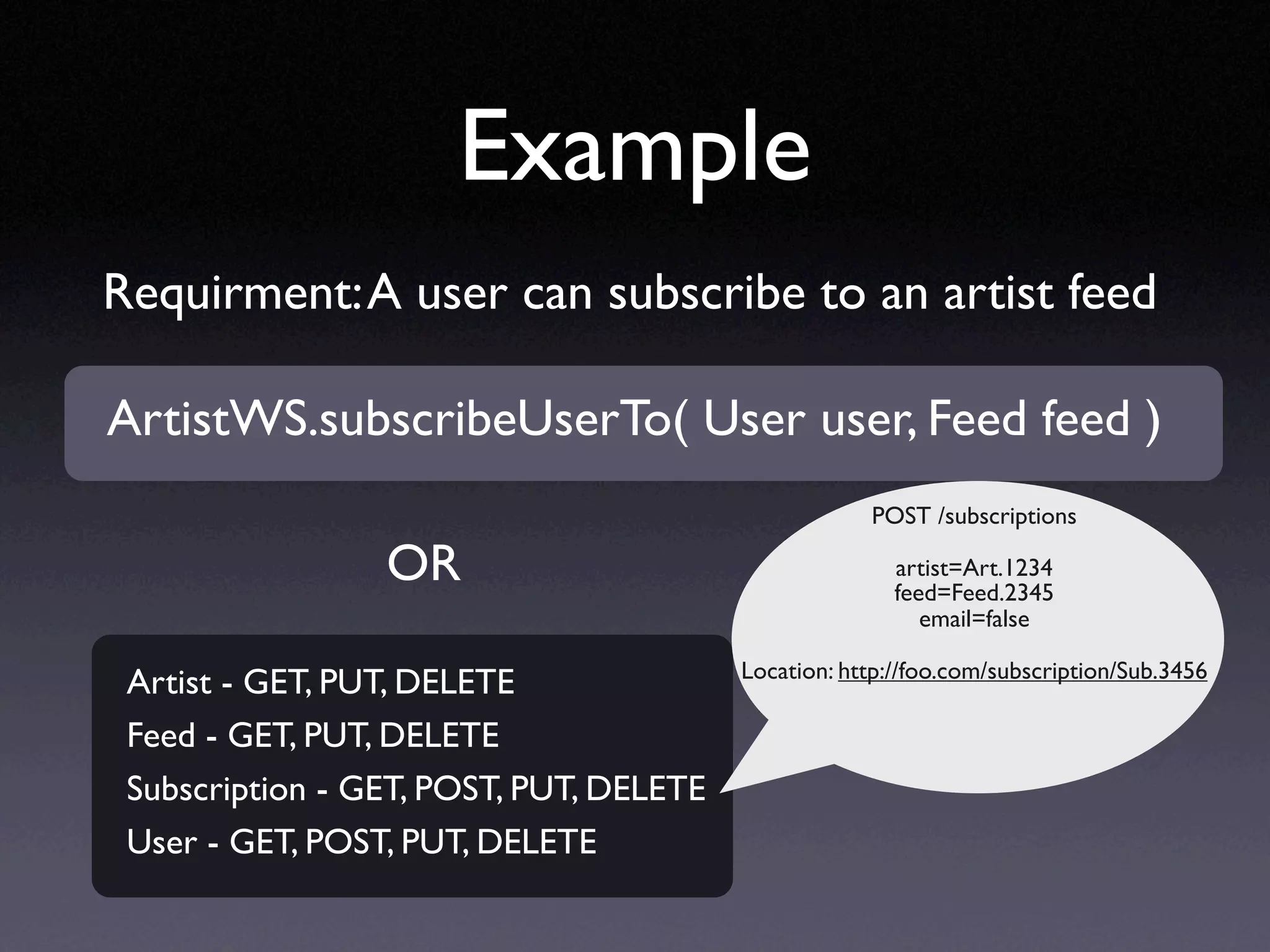
    26. Example Requirment: A user can subscribe to an artist feed ArtistWS.subscribeUserTo( User user, Feed feed ) POST /subscriptions OR artist=Art.1234 feed=Feed.2345 email=false Location: http://foo.com/subscription/Sub.3456 Artist - GET, PUT, DELETE Feed - GET, PUT, DELETE Subscription - GET, POST, PUT, DELETE User - GET, POST, PUT, DELETE
    27. We need WSDL for ReST • Yes, programmers need documentation and a way to discover functionality • ReST gets for free • Uniform Interface • Transparent data and HTTP tools • Explicit state transitions • Power of XML - XSD, extensibility, etc
    28. • WSDL tries to hide network, parsing and formating messages, loose typing • Often WSDL is an afterthought, a verbose format itself, used to generate incredibly verbose SOAP payloads - Yeah tools! • Doesn’t actually solve the really hard problems, still need other WS-* specs focused on such as transitions or security
    29. • ReST still requires you to document your resources, representations, and other highly application specific details • URI, Microformats, XSD, hypermedia, etc let ReST clients do this in a lightweight manner • URITemplates, XHTML 5, etc coming • besides, WSDL2Foo is bad
    30. WADL • Don’t agree that WSDL2Foo is bad? • OKAY, Use WADL • WSDL like tool
    31. Rare Conceptions • ReST is nothing more than the web circa 2003 • Human and programatic web both thrive under ReST constraints • It’s the Data, not the Source, not the API, not the platform • Mashups and ??? (future emergent techniques) are easier with ReST
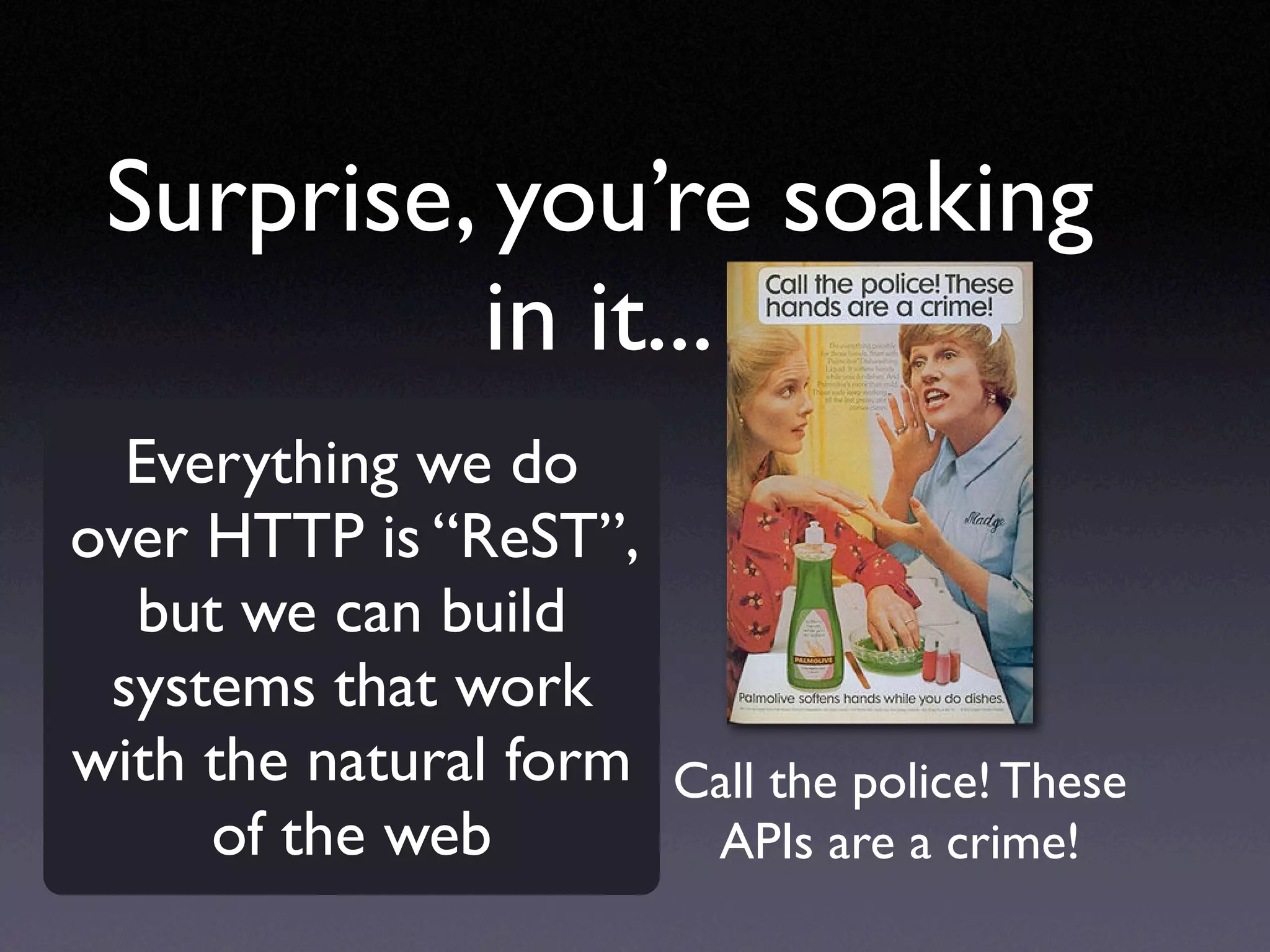
    32. Surprise, you’re soaking in it... Everything we do over HTTP is “ReST”, but we can build systems that work with the natural form Call the police! These of the web APIs are a crime!
    33. ReST isn’t your solution • If your doing sophisticated mission critical distributed programming with transactions across multiple partners in synergistic fashion • Use CORBA, EDI, Stateful protocol, etc • Client and server written in Java? Use RMI, Jini, etc • Invent a new architecture by applying constraints to derive a solution that works with your problem space ala Chapter 5 of Fielding
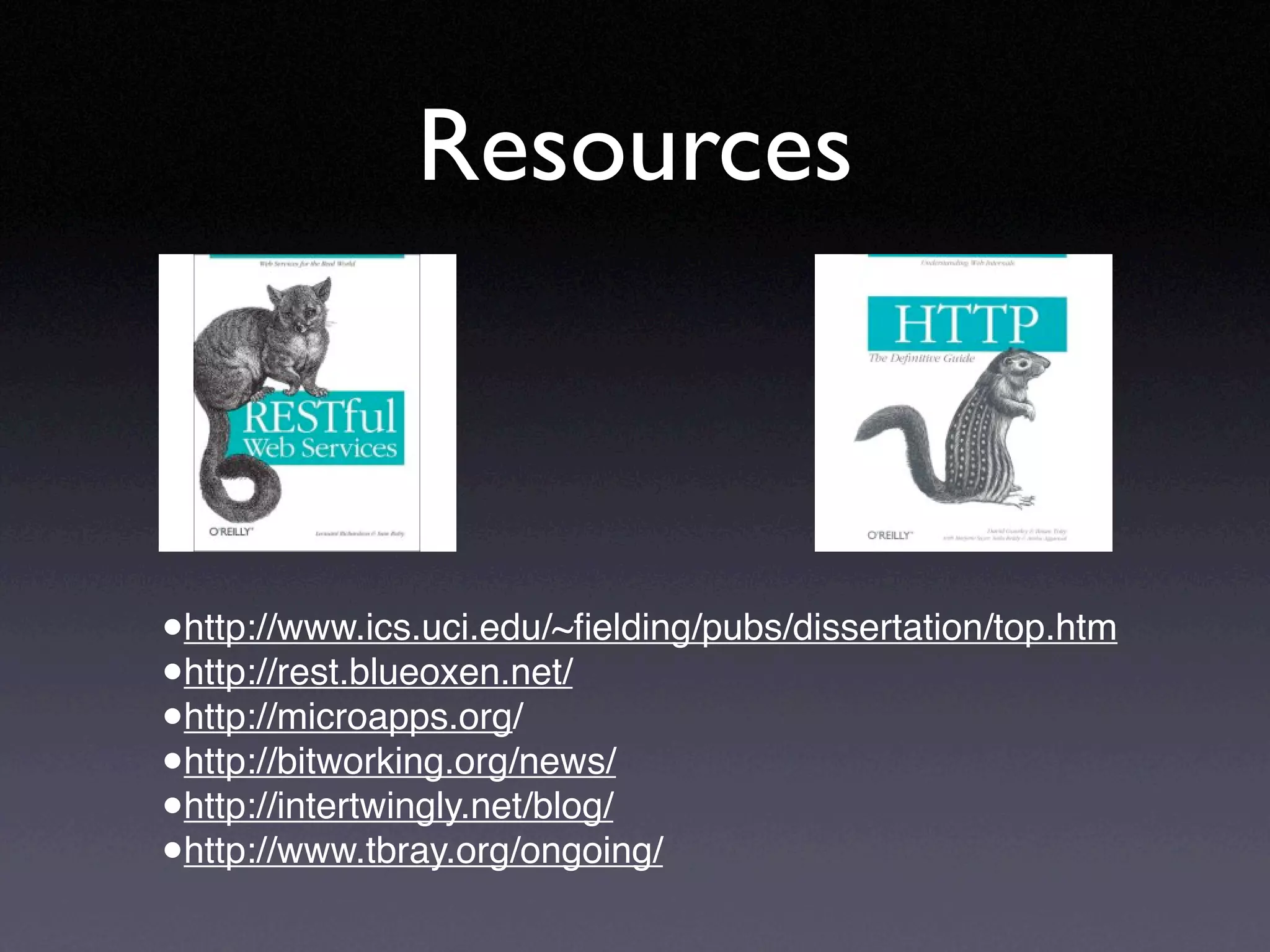
    34. Resources •http://www.ics.uci.edu/~fielding/pubs/dissertation/top.htm •http://rest.blueoxen.net/ •http://microapps.org/ •http://bitworking.org/news/ •http://intertwingly.net/blog/ •http://www.tbray.org/ongoing/

    + oztenozten, 3 years ago

    custom

    8085 views, 18 favs, 7 embeds more stats

    Overview of ReST Web Services is explained by confu more

    More info about this document

    © All Rights Reserved

    Go to text version

    • Total Views 8085
      • 7622 on SlideShare
      • 463 from embeds
    • Comments 0
    • Favorites 18
    • Downloads 483
    Most viewed embeds
    • 211 views on http://mauriziostorani.wordpress.com
    • 191 views on http://abrdev.com
    • 32 views on http://blog.dawouds.com
    • 18 views on http://www.ozten.com
    • 9 views on http://jeffmcneill.com

    more

    All embeds
    • 211 views on http://mauriziostorani.wordpress.com
    • 191 views on http://abrdev.com
    • 32 views on http://blog.dawouds.com
    • 18 views on http://www.ozten.com
    • 9 views on http://jeffmcneill.com
    • 1 views on http://64.233.189.100
    • 1 views on http://localhost

    less

    Flagged as inappropriate Flag as inappropriate
    Flag as inappropriate

    Select your reason for flagging this presentation as inappropriate. If needed, use the feedback form to let us know more details.

    Cancel
    File a copyright complaint
    Having problems? Go to our helpdesk?

    Categories

    Groups / Events