
Introduction to Intellectual Property
Jane Lambert
Thursday, 26 June 2013
16:00 – 18:00
Contents
• What is Intellectual Property?
• Why do we have it?
• The WTO Agreement and TRIPS
• The Treaties
• European Patent Convention
• EU Directives and Regulations
• Statutes and Case Law
• Sources of IP Law
What is Intellectual Property?
Intellectual property (“IP”) is the collective
term for the bundle of laws that protect
investment in intellectual assets (“IA”).
What are Intellectual Assets?
IA are the brands, designs, technology or the
works of art and literature which give one
business a competitive advantage over all
others.
What are Brands?
For the purpose of this discussion, a brand
means the sign that identifies a supplier or his
goods or services in the market place.
What are Designs?
In everyday language “design” can mean the
appearance of an article as in “designer
handbag” or in a technical arrangement as in
an “engine design”.
What are Designs?
The former are called “decorative” or
“ornamental designs” and the latter
“functional designs”. The law protects both in
the UK and most other countries.
What is Technology?
Essentially new products and processes.
English law is not very good at protecting new
services or such as new methods of business
or software.
Works of Art and Literature
Essentially these fall into two categories:
• Permanent works like
books, CDs, film, music or drawings;
• Performances of actors, dancers, musicians
or singers
How does the Law protect Brands?
• Registered Trade Marks
• Passing off
• Geographical Indications
• Registered Designs
How does the Law protect
Designs?
• Functional designs by unregistered design
right
• Decorative designs by registered
designs, registered Community
designs, unregistered Community designs and
artistic copyright
How does the Law protect
Technology?
• Patents
• Trade Secrets
• Unregistered design rights
• Plant breeders’ rights for new plant varieties
• Literary copyright for computer programs and
databases
How does the Law protect Works
of Art and Literature?
• Copyright protects original
artistic, dramatic, literary and musical
works, broadcasts, films, sound recordings and
typographical arrangements of published
editions.
• Artists, dancers, musicians and other
performers (and those with exclusive
contracts to film or tape them) have the right
to object to unauthorized filming or taping
known as “rights in performances”.
Competition and Freedom of
Trade
Monopolies and other exclusive rights
conferred by IP laws restrict competition and
freedom of trade just like any other monopoly
or restraint of trade.
Competition and Freedom of
Trade
To mitigate the effect of such restrictions the
statutes and common law subject the
subsistence and exercise of IP rights to
conditions.
Function of IP Law
To strike a balance between conflicting public
interests:
• Incentivizing creativity and innovation; while
• Safeguarding competition and freedom to
trade.
Tension between conflicting public
interests
Illustrated by:
• Statute of Monopolies 1623 which
established patents; and
• Statute of Anne 1710 which established
copyright.
Statute of Monopolies 1623
Essentially a competition statute as it
abolished monopolies but allowed an
exception for inventions to incentivize
innovation.
Statute of Anne 1710
Licensing system required to incentivize
writers and publishers in a completely
unregulated market.
Tension between conflicting public
interests
The tension between those conflicting public
imperatives resurfaces at international
conferences, in national legislatures and the
courts and its appreciation is fundamental to
understanding IP.
The WTO and TRIPs
An instance where this tension arose was in
the Uruguay round of negotiations to
liberalize world trade in goods and services
between 1986 and 1994.
The WTO and TRIPs
The Agreement establishing the World Trade
Organization (“WTO”) in 1994 annexed an
Agreement on Trade Related Aspects of
Intellectual Property Rights (“TRIPS”).
The WTO and TRIPs
TRIPS requires WTO member states to protect
the IA of its own citizens and residents and
those of other member states
The WTO and TRIPs
Since 1994 providing minimum IP protection
has been a condition of favourable access to
the markets of the world’s leading industrial
countries.
The Treaties
TRIPS refers to four core treaties:
• Paris Convention 1883: patents, trade marks
and industrial designs;
• Berne Convention1886: copyrights;
• Rome Convention 1961: rights in
performances; and
• Washington Convention 1989:
semiconductor topographies.
The Treaties
Treaties can be divided into four groups:
• Protection Treaties: Paris, Berne, Rome etc.;
• Prosecution Facilitation: PCT, Madrid
Protocol and Hague;
• Classification: Nice and Locarno; and
• Regional: European Patent Convention
(“EPC”).
European Patent Convention
• Establishes a European Patent office in
Munich;
• Grants European patents for new inventions
on behalf of national governments which rank
alongside national patents; and
• Harmonizes the substantive laws of the
contracting states.
EU Directives and Regulations
• From earliest days of the European project
national IP rights were a barrier to trade
between member states.
• ECJ (now CJEU) developed doctrines that
limited the exercise of those rights insofar as
they restricted free movement of goods.
• Solution was to harmonize national member
states’ IP laws and create Community IP rights.
EU Directives and Regulations
• Extensive harmonization of
copyright, registered design and trade mark
law by a series of directives.
• Community trade marks and design
registration.
• Less success with patents owing to disputes
over language and enforcement.
• But agreement has been reached on a
unitary patent.
Statutes
• Registered Designs Act 1949
• Patents Act 1977
• Copyright, Designs and Patents Act 1988
• Trade Marks Act 1994
The IPO has compiled useful unofficial
consolidations of those statutes which can be
downloaded from its website.
Rules
• Patents Rules 2007
• Trade Marks 2008
• Registered Designs Rules 2006
Law of Confidence
“In my judgment, three elements are normally required
if, apart from contract, a case of breach of confidence is to
succeed. First, the information itself, in the words of Lord
Greene, MR in the Saltman case on page 215, must ‘have the
necessary quality of confidence about it.’ Secondly, the
information must have been imparted in circumstances
importing an obligation of confidence. Thirdly, there must be
an unauthorized use of that information to the detriment of
the party communicating it.”
Megarry J in Coco v A N Clarke (Engineers) Ltd [1967] RPC 41, 47
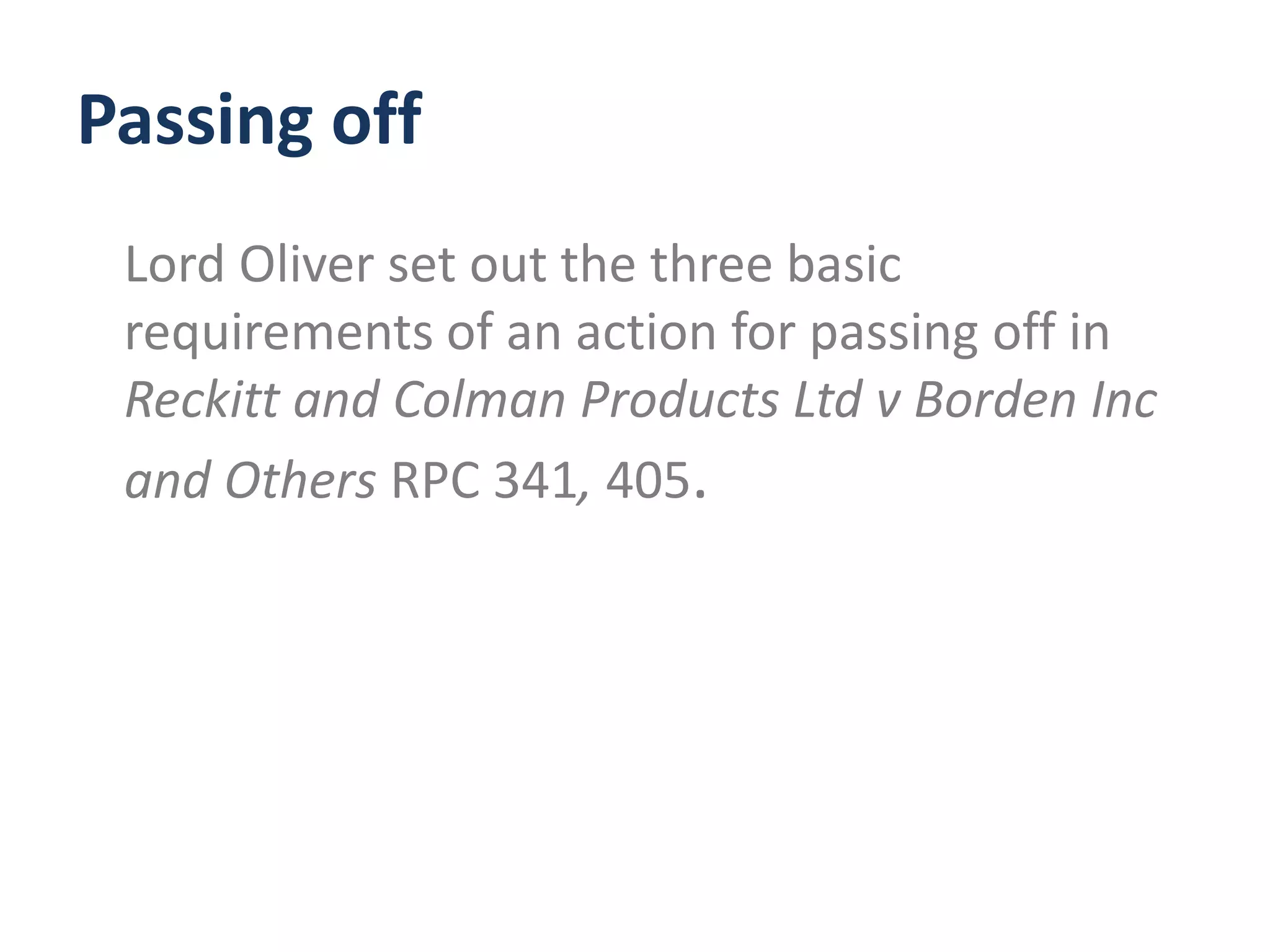
Passing off
Lord Oliver set out the three basic
requirements of an action for passing off in
Reckitt and Colman Products Ltd v Borden Inc
and Others RPC 341, 405.
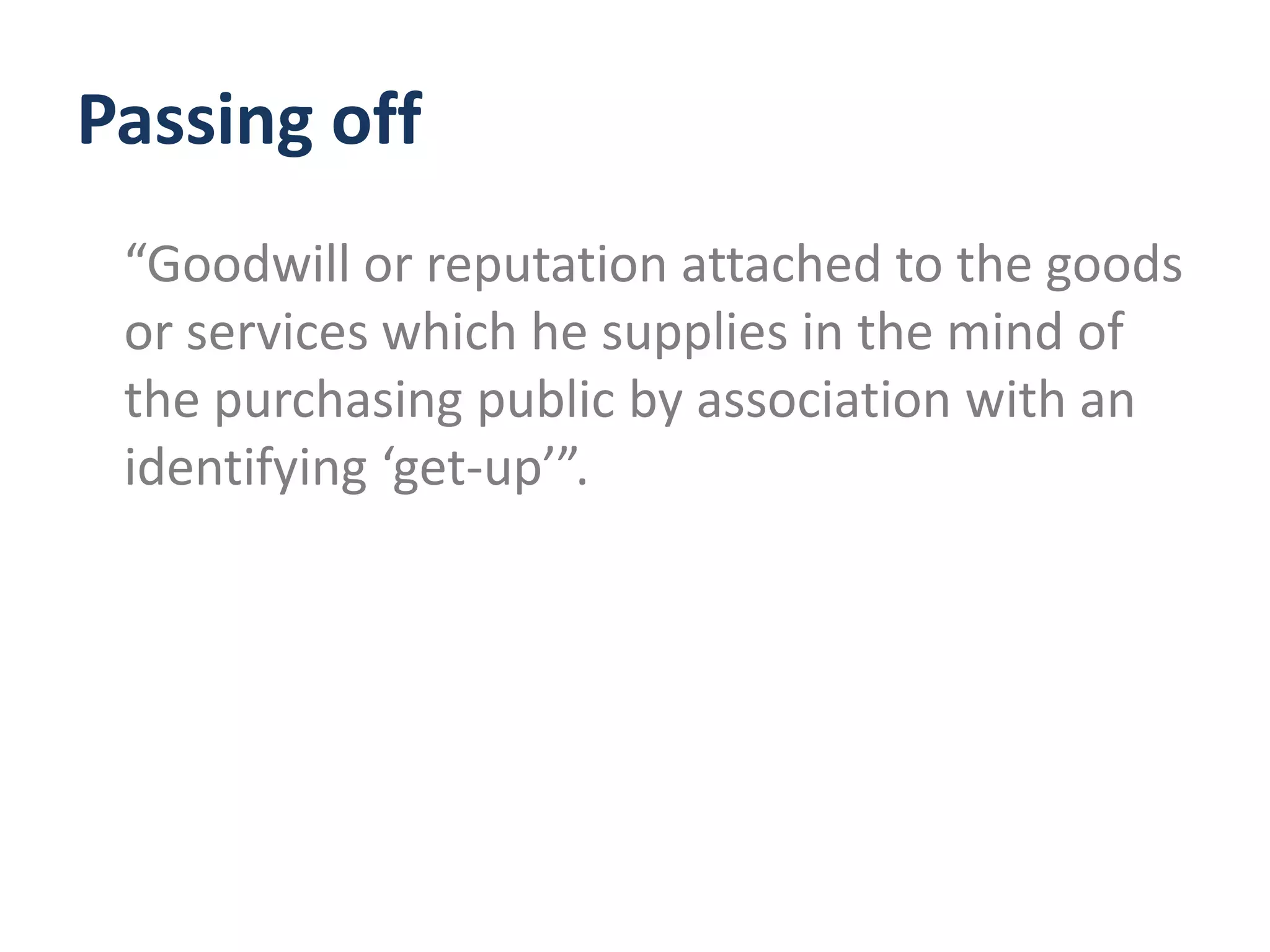
Passing off
“Goodwill or reputation attached to the goods
or services which he supplies in the mind of
the purchasing public by association with an
identifying ‘get-up’”.
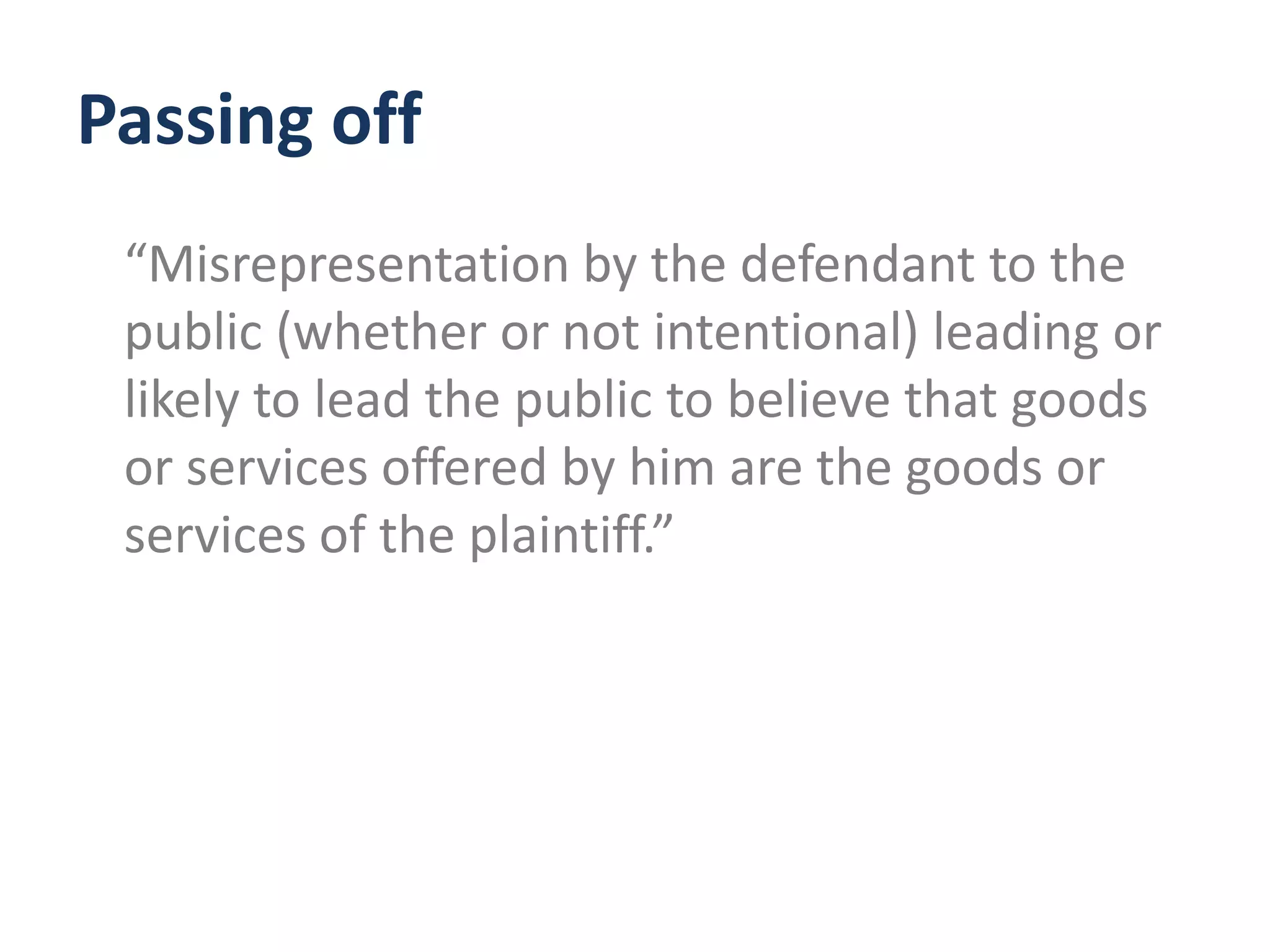
Passing off
“Misrepresentation by the defendant to the
public (whether or not intentional) leading or
likely to lead the public to believe that goods
or services offered by him are the goods or
services of the plaintiff.”
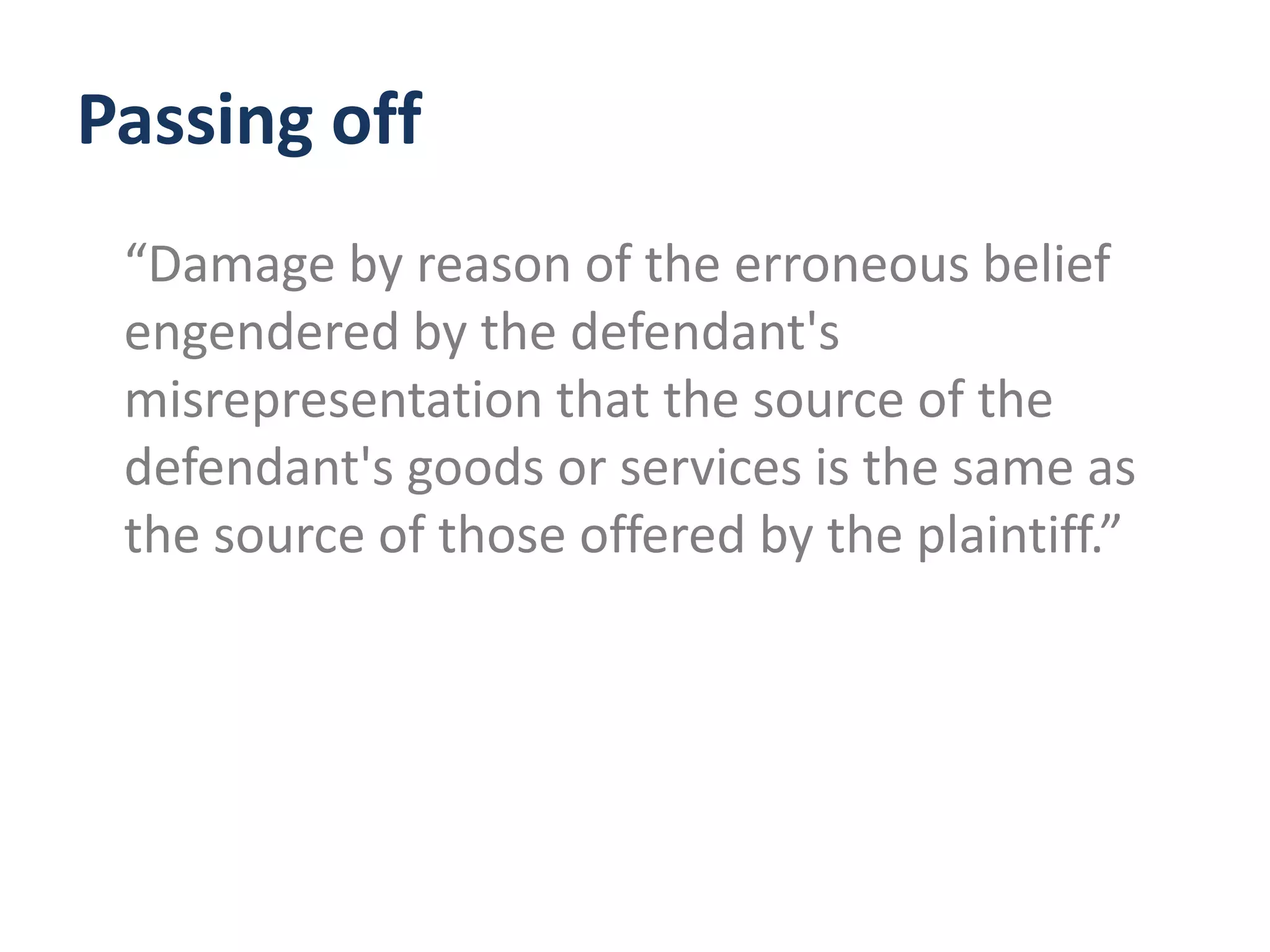
Passing off
“Damage by reason of the erroneous belief
engendered by the defendant's
misrepresentation that the source of the
defendant's goods or services is the same as
the source of those offered by the plaintiff.”
IP Litigation
All IP cases are allocated to the Chancery
Division, the Patents County Court or a County
Court attached to a Chancery District Registry
(Birmingham, Bristol, Caernarfon, Cardiff, Leed
s, Liverpool, Manchester, Mold, Newcastle, Pr
eston)
IP Litigation
Patents, registered designs and registered
Community designs, semiconductor
topography and plant varieties cases are
assigned to a special court within the
Chancery Division known as the “Patents
Court” or to the Patents County Court.
IP Litigation
Patents County Court has a small claims track
for IP cases other than patents, registered and
registered Community designs, semiconductor
topography and plant breeders rights.
IP Litigation
Practice is to be found in:
• CPR Part 63 and PD Part 63
• Chancery Guide
• Patents Court Guide
• Patents County Court Guide
• Small Claims Guide
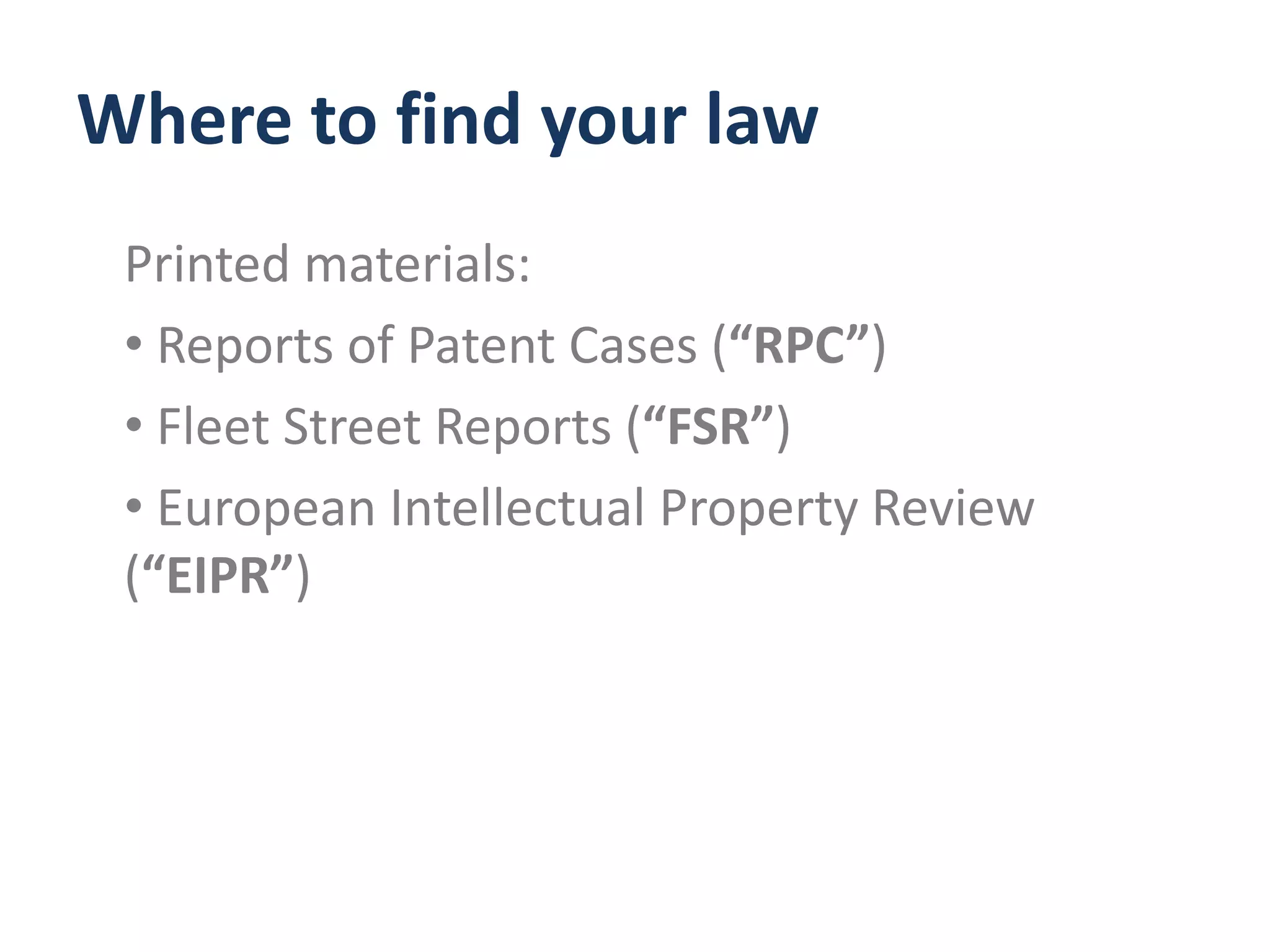
Where to find your law
Printed materials:
• Reports of Patent Cases (“RPC”)
• Fleet Street Reports (“FSR”)
• European Intellectual Property Review
(“EIPR”)
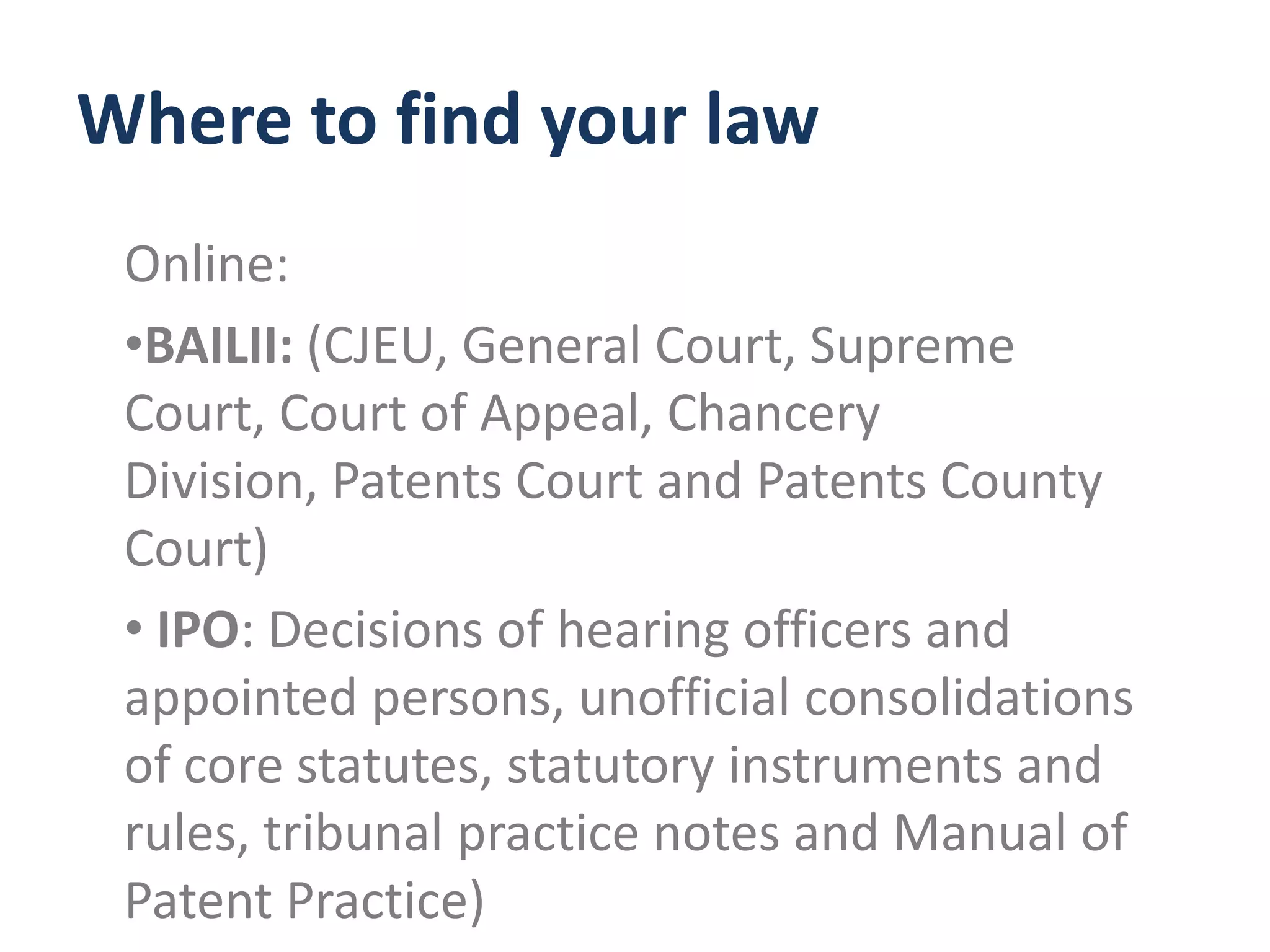
Where to find your law
Online:
•BAILII: (CJEU, General Court, Supreme
Court, Court of Appeal, Chancery
Division, Patents Court and Patents County
Court)
• IPO: Decisions of hearing officers and
appointed persons, unofficial consolidations
of core statutes, statutory instruments and
rules, tribunal practice notes and Manual of
Patent Practice)
Where to find your law
Online:
• EPO: EPC, Official Journal and decisions of
boards of appeal
•OHIM: Community trade mark and design
regulations, trade mark and design directives
and decisions of boards of appeal
• WIPO: Treaties and conventions
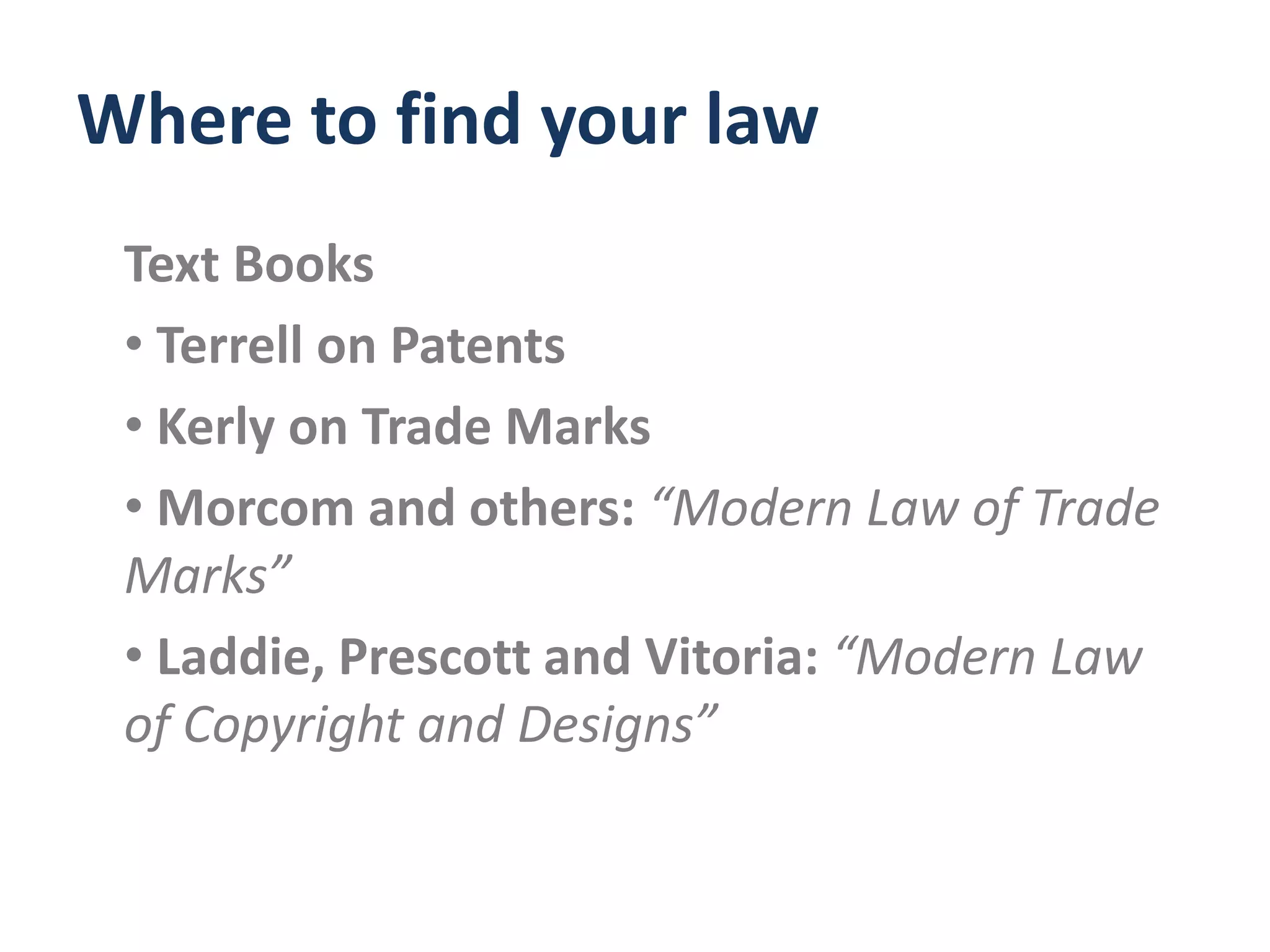
Where to find your law
Text Books
• Terrell on Patents
• Kerly on Trade Marks
• Morcom and others: “Modern Law of Trade
Marks”
• Laddie, Prescott and Vitoria: “Modern Law
of Copyright and Designs”
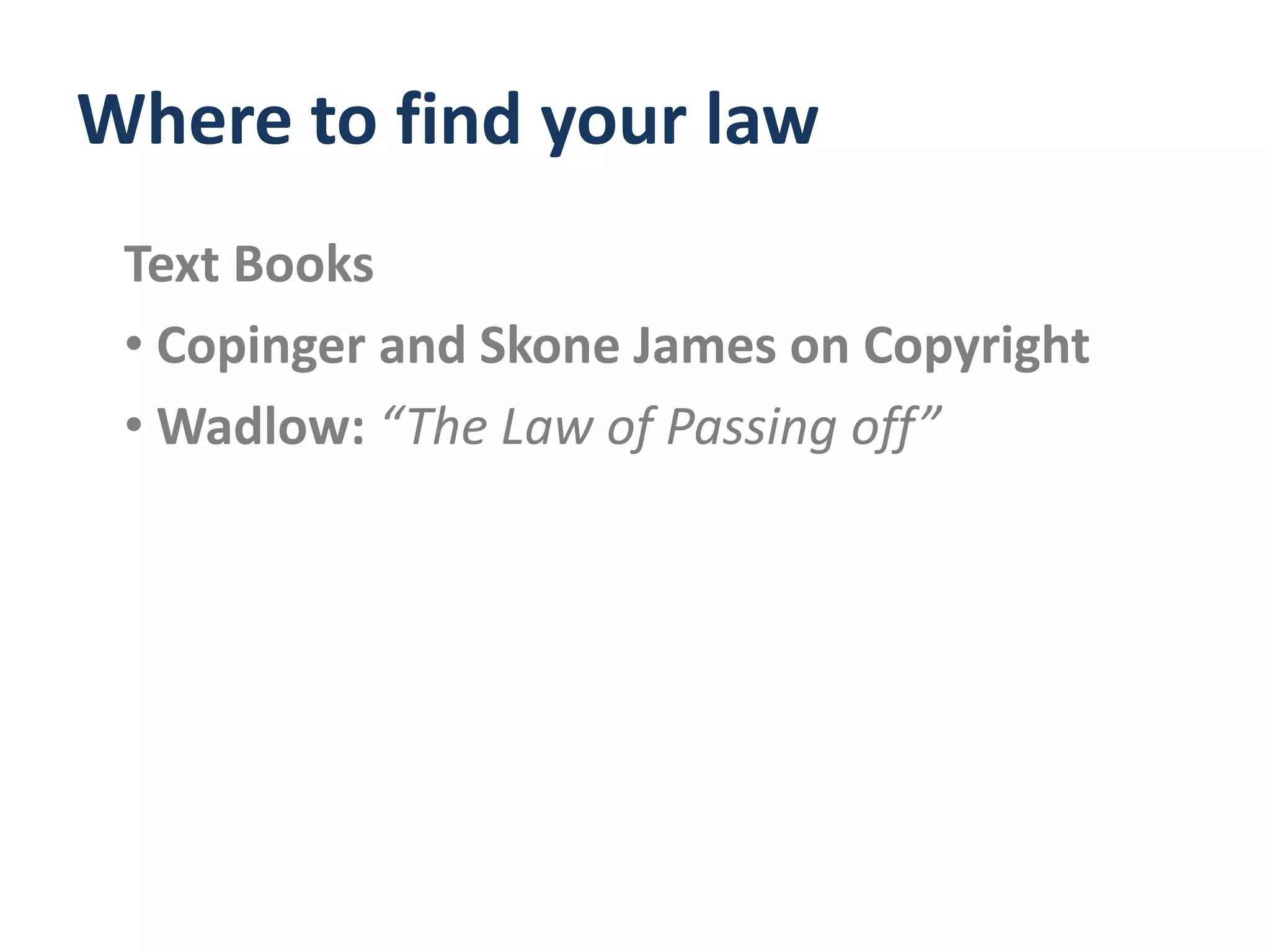
Where to find your law
Text Books
• Copinger and Skone James on Copyright
• Wadlow: “The Law of Passing off”
Any Questions
Jane Lambert
4-5 Gray’s Inn Square
Gray’s Inn
London
WC1R 5AH
jlambert@4-5.co.uk
http://www.4-5.co.uk

Introduction to Intellectual Property

  • 1.
    Introduction to IntellectualProperty Jane Lambert Thursday, 26 June 2013 16:00 – 18:00
  • 2.
    Contents • What isIntellectual Property? • Why do we have it? • The WTO Agreement and TRIPS • The Treaties • European Patent Convention • EU Directives and Regulations • Statutes and Case Law • Sources of IP Law
  • 3.
    What is IntellectualProperty? Intellectual property (“IP”) is the collective term for the bundle of laws that protect investment in intellectual assets (“IA”).
  • 4.
    What are IntellectualAssets? IA are the brands, designs, technology or the works of art and literature which give one business a competitive advantage over all others.
  • 5.
    What are Brands? Forthe purpose of this discussion, a brand means the sign that identifies a supplier or his goods or services in the market place.
  • 6.
    What are Designs? Ineveryday language “design” can mean the appearance of an article as in “designer handbag” or in a technical arrangement as in an “engine design”.
  • 7.
    What are Designs? Theformer are called “decorative” or “ornamental designs” and the latter “functional designs”. The law protects both in the UK and most other countries.
  • 8.
    What is Technology? Essentiallynew products and processes. English law is not very good at protecting new services or such as new methods of business or software.
  • 9.
    Works of Artand Literature Essentially these fall into two categories: • Permanent works like books, CDs, film, music or drawings; • Performances of actors, dancers, musicians or singers
  • 10.
    How does theLaw protect Brands? • Registered Trade Marks • Passing off • Geographical Indications • Registered Designs
  • 11.
    How does theLaw protect Designs? • Functional designs by unregistered design right • Decorative designs by registered designs, registered Community designs, unregistered Community designs and artistic copyright
  • 12.
    How does theLaw protect Technology? • Patents • Trade Secrets • Unregistered design rights • Plant breeders’ rights for new plant varieties • Literary copyright for computer programs and databases
  • 13.
    How does theLaw protect Works of Art and Literature? • Copyright protects original artistic, dramatic, literary and musical works, broadcasts, films, sound recordings and typographical arrangements of published editions. • Artists, dancers, musicians and other performers (and those with exclusive contracts to film or tape them) have the right to object to unauthorized filming or taping known as “rights in performances”.
  • 14.
    Competition and Freedomof Trade Monopolies and other exclusive rights conferred by IP laws restrict competition and freedom of trade just like any other monopoly or restraint of trade.
  • 15.
    Competition and Freedomof Trade To mitigate the effect of such restrictions the statutes and common law subject the subsistence and exercise of IP rights to conditions.
  • 16.
    Function of IPLaw To strike a balance between conflicting public interests: • Incentivizing creativity and innovation; while • Safeguarding competition and freedom to trade.
  • 17.
    Tension between conflictingpublic interests Illustrated by: • Statute of Monopolies 1623 which established patents; and • Statute of Anne 1710 which established copyright.
  • 18.
    Statute of Monopolies1623 Essentially a competition statute as it abolished monopolies but allowed an exception for inventions to incentivize innovation.
  • 19.
    Statute of Anne1710 Licensing system required to incentivize writers and publishers in a completely unregulated market.
  • 20.
    Tension between conflictingpublic interests The tension between those conflicting public imperatives resurfaces at international conferences, in national legislatures and the courts and its appreciation is fundamental to understanding IP.
  • 21.
    The WTO andTRIPs An instance where this tension arose was in the Uruguay round of negotiations to liberalize world trade in goods and services between 1986 and 1994.
  • 22.
    The WTO andTRIPs The Agreement establishing the World Trade Organization (“WTO”) in 1994 annexed an Agreement on Trade Related Aspects of Intellectual Property Rights (“TRIPS”).
  • 23.
    The WTO andTRIPs TRIPS requires WTO member states to protect the IA of its own citizens and residents and those of other member states
  • 24.
    The WTO andTRIPs Since 1994 providing minimum IP protection has been a condition of favourable access to the markets of the world’s leading industrial countries.
  • 25.
    The Treaties TRIPS refersto four core treaties: • Paris Convention 1883: patents, trade marks and industrial designs; • Berne Convention1886: copyrights; • Rome Convention 1961: rights in performances; and • Washington Convention 1989: semiconductor topographies.
  • 26.
    The Treaties Treaties canbe divided into four groups: • Protection Treaties: Paris, Berne, Rome etc.; • Prosecution Facilitation: PCT, Madrid Protocol and Hague; • Classification: Nice and Locarno; and • Regional: European Patent Convention (“EPC”).
  • 27.
    European Patent Convention •Establishes a European Patent office in Munich; • Grants European patents for new inventions on behalf of national governments which rank alongside national patents; and • Harmonizes the substantive laws of the contracting states.
  • 28.
    EU Directives andRegulations • From earliest days of the European project national IP rights were a barrier to trade between member states. • ECJ (now CJEU) developed doctrines that limited the exercise of those rights insofar as they restricted free movement of goods. • Solution was to harmonize national member states’ IP laws and create Community IP rights.
  • 29.
    EU Directives andRegulations • Extensive harmonization of copyright, registered design and trade mark law by a series of directives. • Community trade marks and design registration. • Less success with patents owing to disputes over language and enforcement. • But agreement has been reached on a unitary patent.
  • 30.
    Statutes • Registered DesignsAct 1949 • Patents Act 1977 • Copyright, Designs and Patents Act 1988 • Trade Marks Act 1994 The IPO has compiled useful unofficial consolidations of those statutes which can be downloaded from its website.
  • 31.
    Rules • Patents Rules2007 • Trade Marks 2008 • Registered Designs Rules 2006
  • 32.
    Law of Confidence “Inmy judgment, three elements are normally required if, apart from contract, a case of breach of confidence is to succeed. First, the information itself, in the words of Lord Greene, MR in the Saltman case on page 215, must ‘have the necessary quality of confidence about it.’ Secondly, the information must have been imparted in circumstances importing an obligation of confidence. Thirdly, there must be an unauthorized use of that information to the detriment of the party communicating it.” Megarry J in Coco v A N Clarke (Engineers) Ltd [1967] RPC 41, 47
  • 33.
    Passing off Lord Oliverset out the three basic requirements of an action for passing off in Reckitt and Colman Products Ltd v Borden Inc and Others RPC 341, 405.
  • 34.
    Passing off “Goodwill orreputation attached to the goods or services which he supplies in the mind of the purchasing public by association with an identifying ‘get-up’”.
  • 35.
    Passing off “Misrepresentation bythe defendant to the public (whether or not intentional) leading or likely to lead the public to believe that goods or services offered by him are the goods or services of the plaintiff.”
  • 36.
    Passing off “Damage byreason of the erroneous belief engendered by the defendant's misrepresentation that the source of the defendant's goods or services is the same as the source of those offered by the plaintiff.”
  • 37.
    IP Litigation All IPcases are allocated to the Chancery Division, the Patents County Court or a County Court attached to a Chancery District Registry (Birmingham, Bristol, Caernarfon, Cardiff, Leed s, Liverpool, Manchester, Mold, Newcastle, Pr eston)
  • 38.
    IP Litigation Patents, registereddesigns and registered Community designs, semiconductor topography and plant varieties cases are assigned to a special court within the Chancery Division known as the “Patents Court” or to the Patents County Court.
  • 39.
    IP Litigation Patents CountyCourt has a small claims track for IP cases other than patents, registered and registered Community designs, semiconductor topography and plant breeders rights.
  • 40.
    IP Litigation Practice isto be found in: • CPR Part 63 and PD Part 63 • Chancery Guide • Patents Court Guide • Patents County Court Guide • Small Claims Guide
  • 41.
    Where to findyour law Printed materials: • Reports of Patent Cases (“RPC”) • Fleet Street Reports (“FSR”) • European Intellectual Property Review (“EIPR”)
  • 42.
    Where to findyour law Online: •BAILII: (CJEU, General Court, Supreme Court, Court of Appeal, Chancery Division, Patents Court and Patents County Court) • IPO: Decisions of hearing officers and appointed persons, unofficial consolidations of core statutes, statutory instruments and rules, tribunal practice notes and Manual of Patent Practice)
  • 43.
    Where to findyour law Online: • EPO: EPC, Official Journal and decisions of boards of appeal •OHIM: Community trade mark and design regulations, trade mark and design directives and decisions of boards of appeal • WIPO: Treaties and conventions
  • 44.
    Where to findyour law Text Books • Terrell on Patents • Kerly on Trade Marks • Morcom and others: “Modern Law of Trade Marks” • Laddie, Prescott and Vitoria: “Modern Law of Copyright and Designs”
  • 45.
    Where to findyour law Text Books • Copinger and Skone James on Copyright • Wadlow: “The Law of Passing off”
  • 46.
    Any Questions Jane Lambert 4-5Gray’s Inn Square Gray’s Inn London WC1R 5AH jlambert@4-5.co.uk http://www.4-5.co.uk