• 1.- Introduction
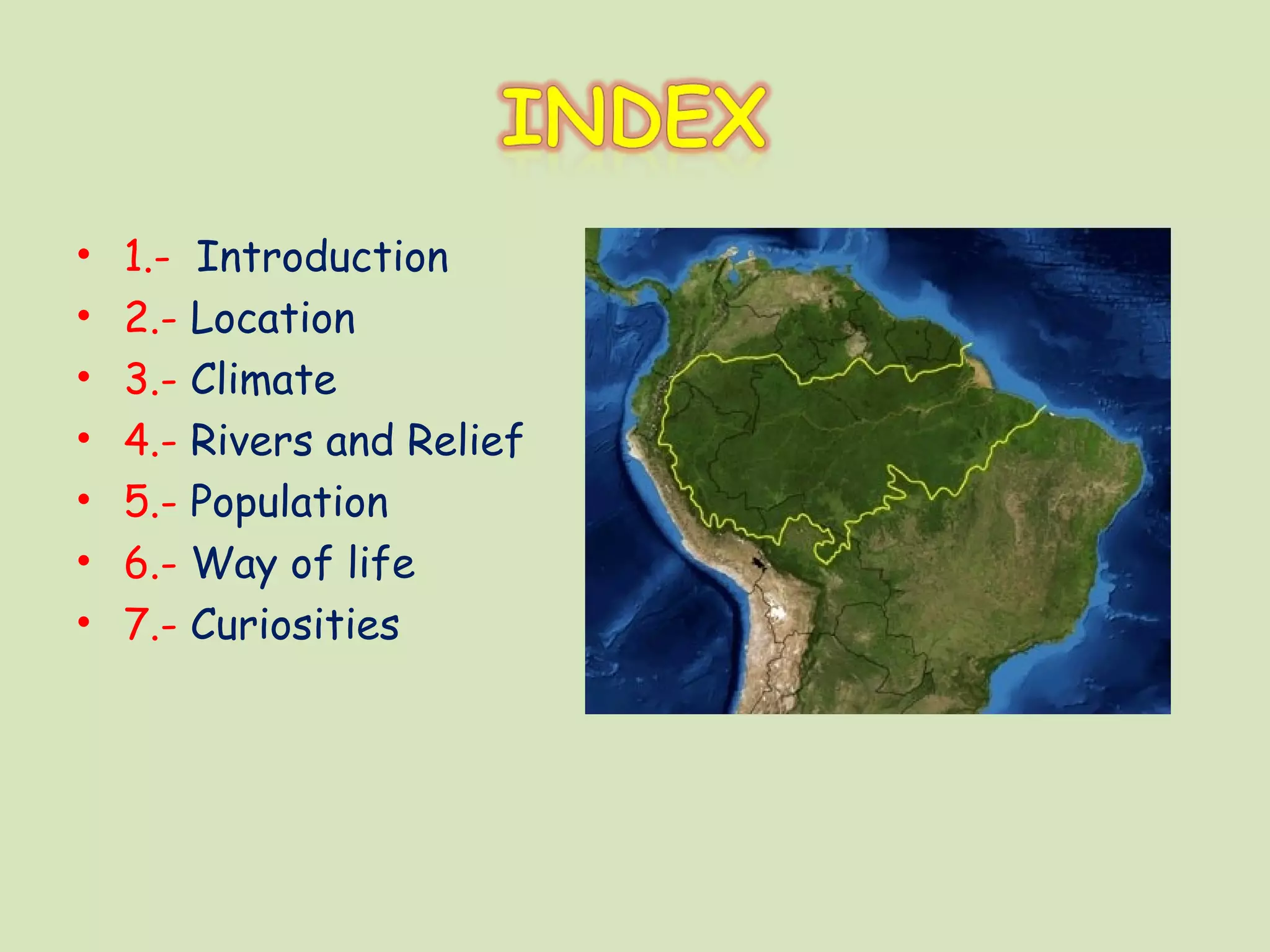
• 2.- Location
• 3.- Climate
• 4.- Rivers and Relief
• 5.- Population
• 6.- Way of life
• 7.- Curiosities
1.- Introduction
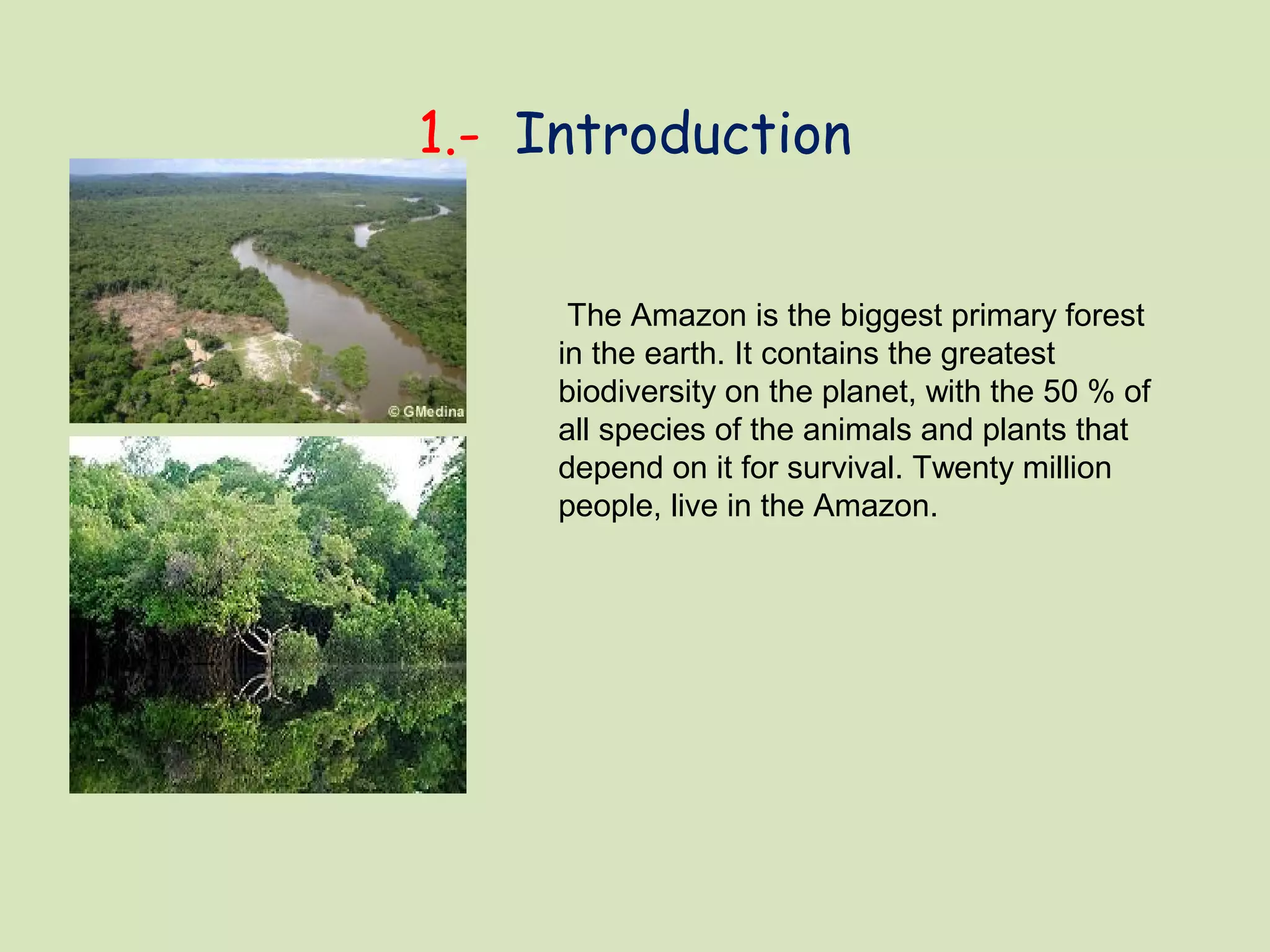
The Amazon is the biggest primary forest
in the earth. It contains the greatest
biodiversity on the planet, with the 50 % of
all species of the animals and plants that
depend on it for survival. Twenty million
people, live in the Amazon.
2.- Location
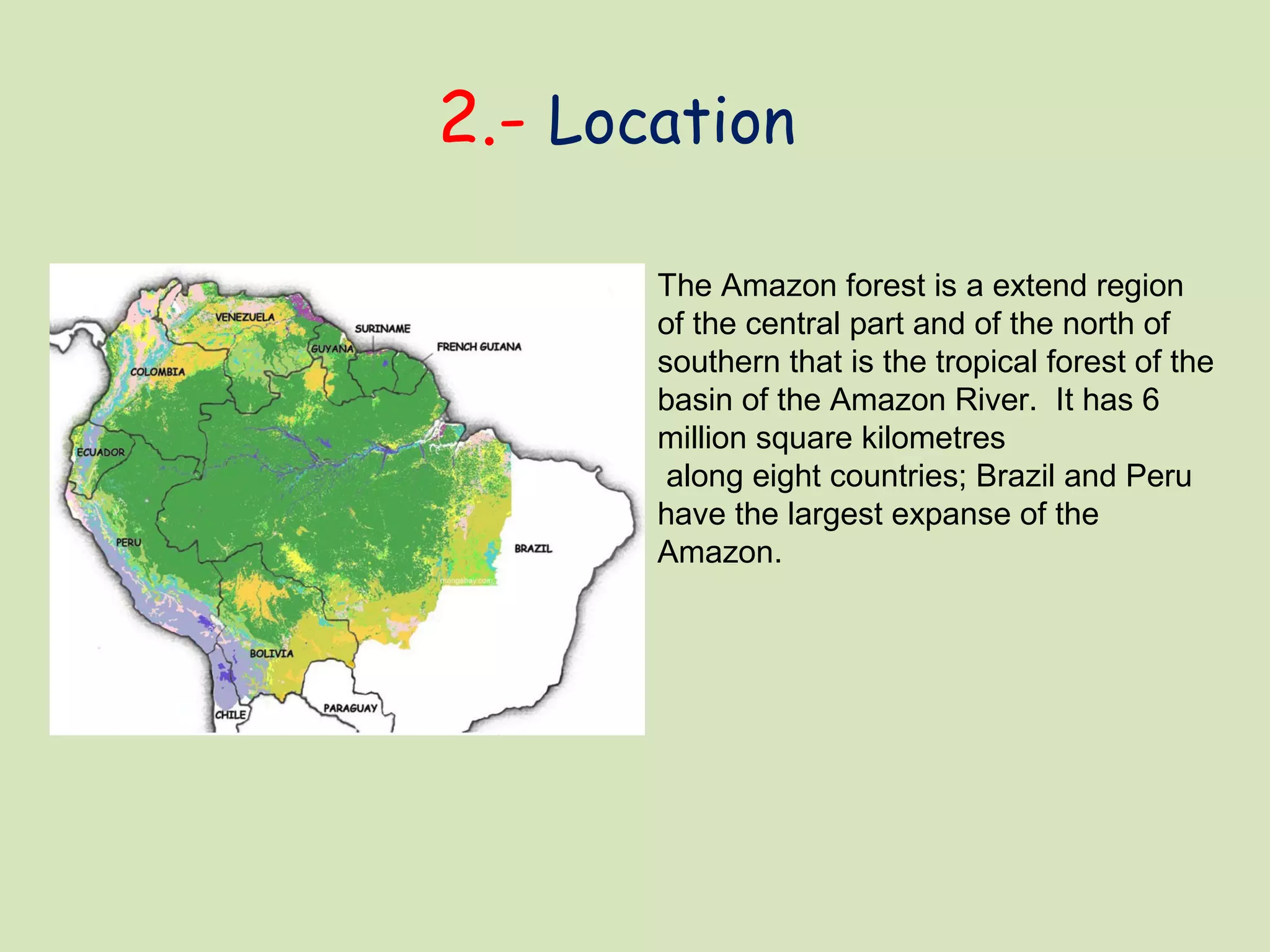
The Amazon forest is a extend region
of the central part and of the north of
southern that is the tropical forest of the
basin of the Amazon River. It has 6
million square kilometres
along eight countries; Brazil and Peru
have the largest expanse of the
Amazon.
3.- Climate
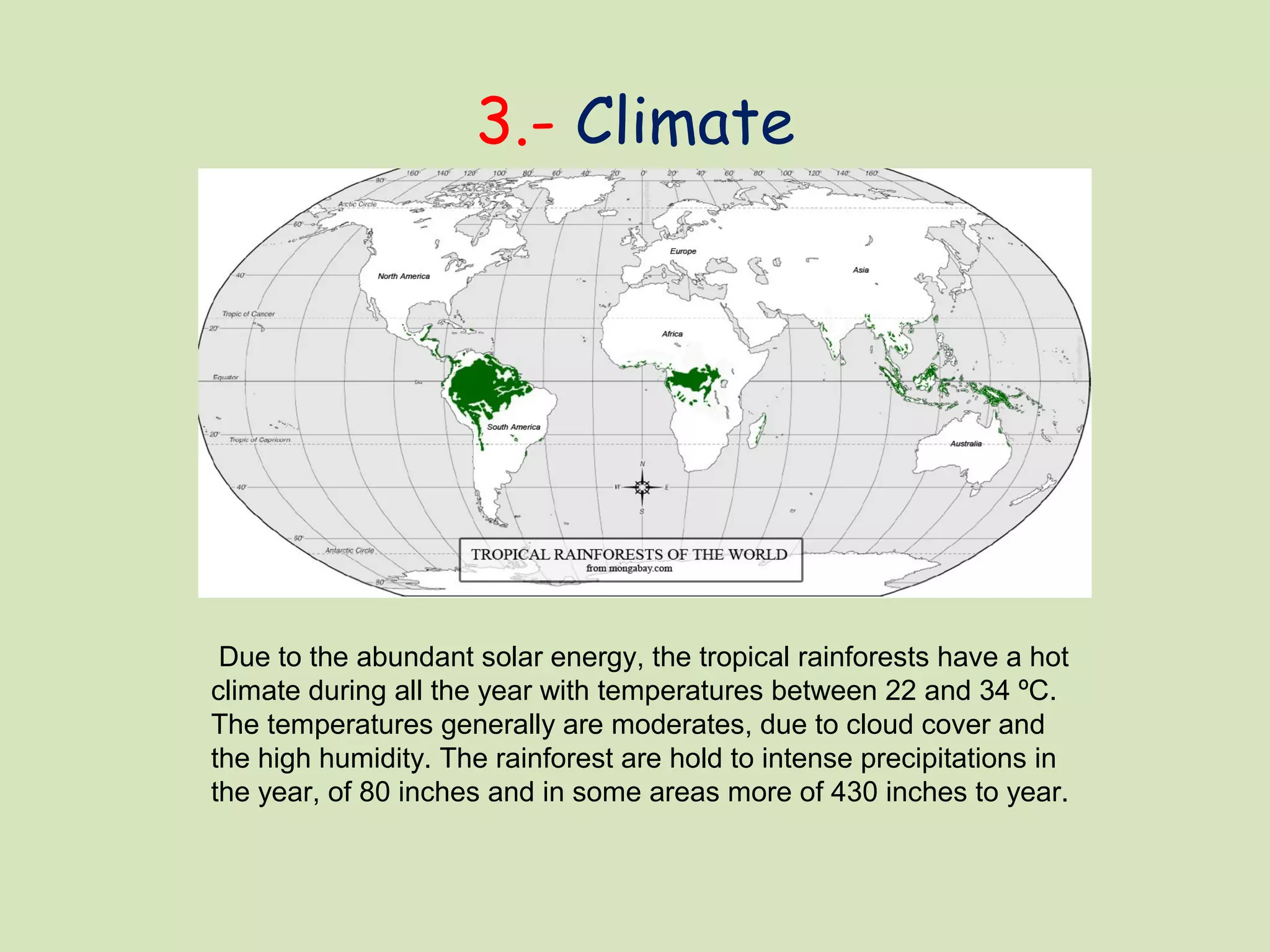
Due to the abundant solar energy, the tropical rainforests have a hot
climate during all the year with temperatures between 22 and 34 ºC.
The temperatures generally are moderates, due to cloud cover and
the high humidity. The rainforest are hold to intense precipitations in
the year, of 80 inches and in some areas more of 430 inches to year.
4.- Rivers and Relief
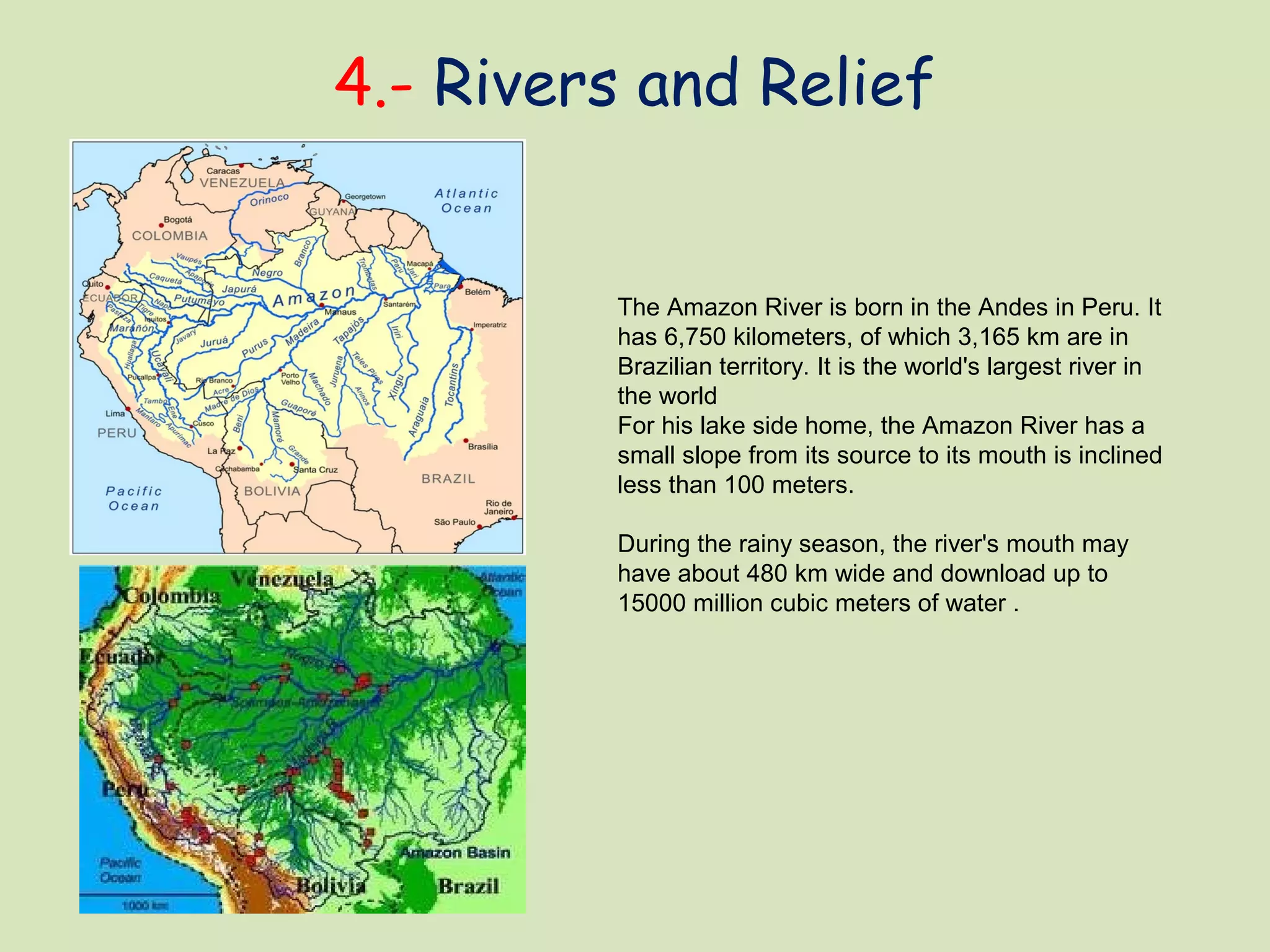
The Amazon River is born in the Andes in Peru. It
has 6,750 kilometers, of which 3,165 km are in
Brazilian territory. It is the world's largest river in
the world
For his lake side home, the Amazon River has a
small slope from its source to its mouth is inclined
less than 100 meters.
During the rainy season, the river's mouth may
have about 480 km wide and download up to
15000 million cubic meters of water .
5.- Population
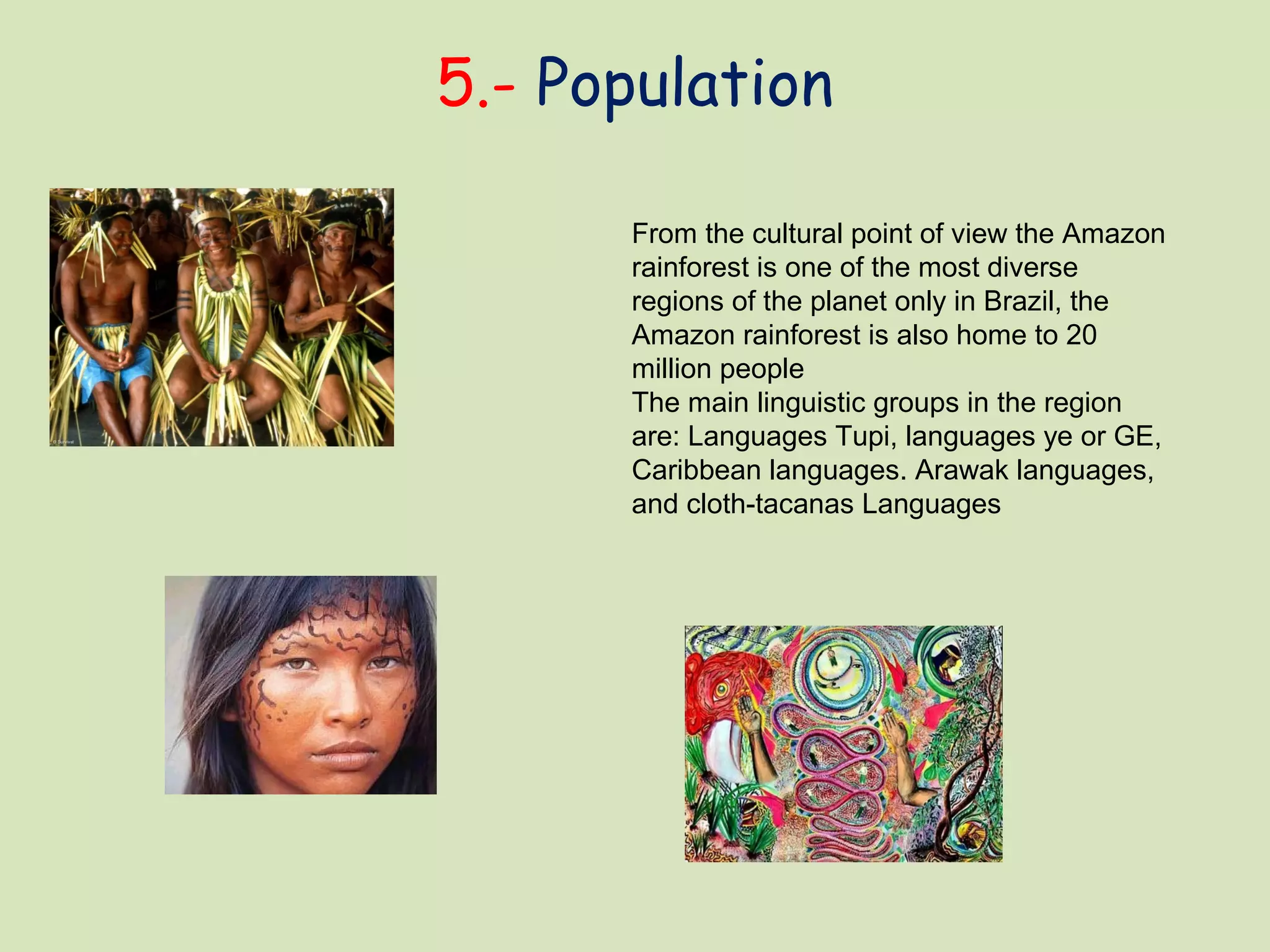
From the cultural point of view the Amazon
rainforest is one of the most diverse
regions of the planet only in Brazil, the
Amazon rainforest is also home to 20
million people
The main linguistic groups in the region
are: Languages Tupi, languages ye or GE,
Caribbean languages. Arawak languages,
and cloth-tacanas Languages
6.- Way of life
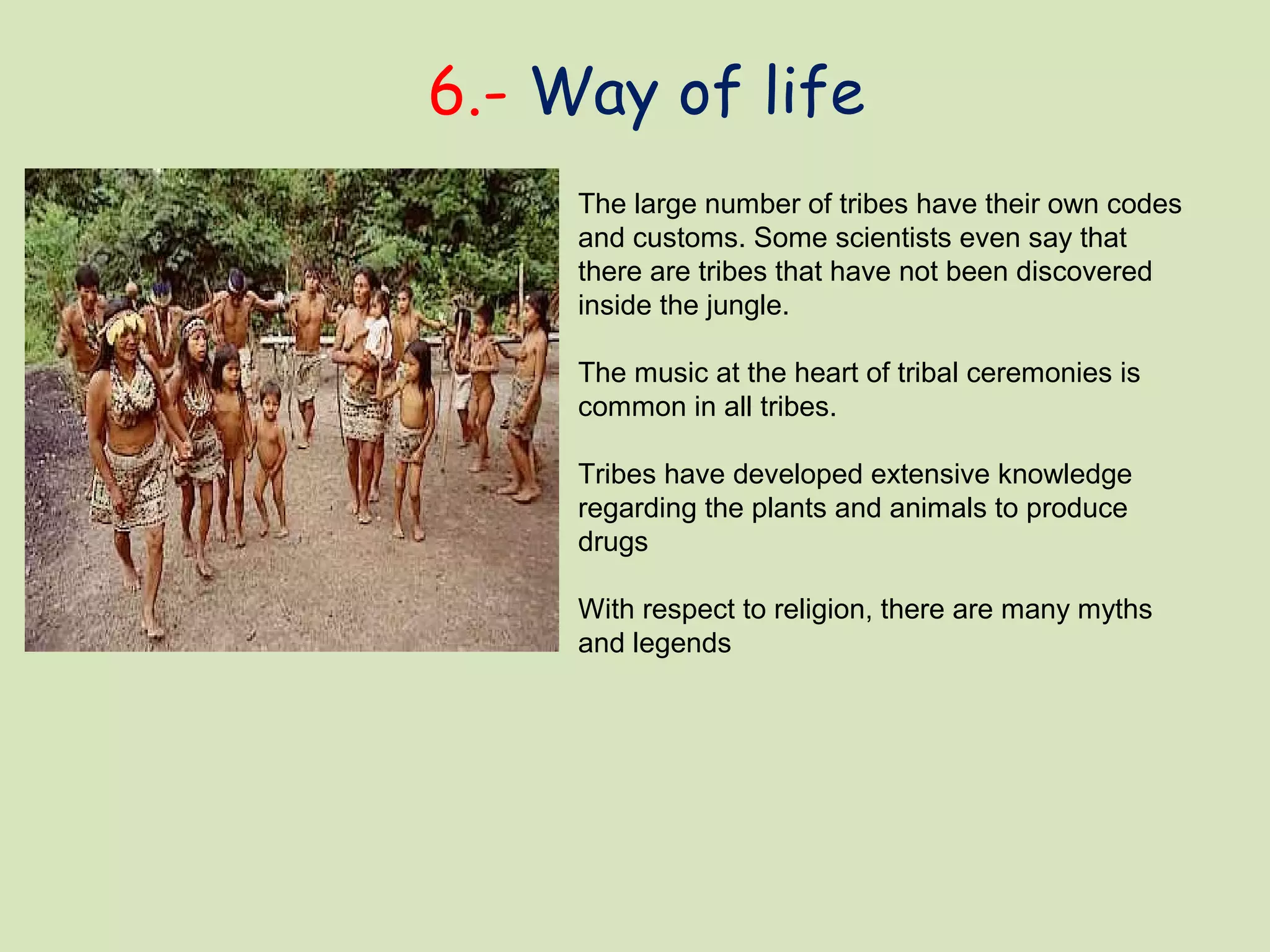
The large number of tribes have their own codes
and customs. Some scientists even say that
there are tribes that have not been discovered
inside the jungle.
The music at the heart of tribal ceremonies is
common in all tribes.
Tribes have developed extensive knowledge
regarding the plants and animals to produce
drugs
With respect to religion, there are many myths
and legends
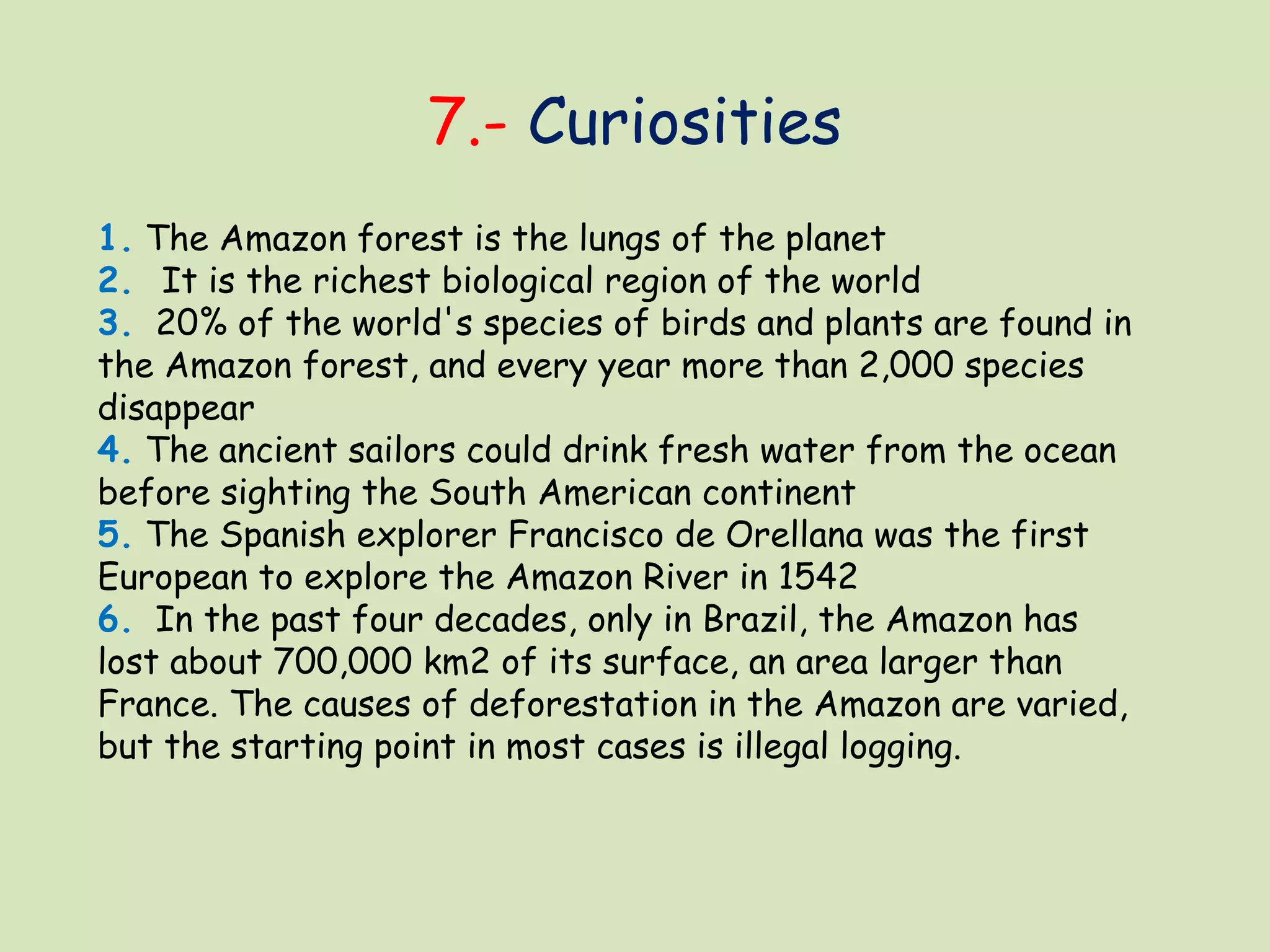
7.- Curiosities
1. The Amazon forest is the lungs of the planet
2.  It is the richest biological region of the world
3.  20% of the world's species of birds and plants are found in
the Amazon forest, and every year more than 2,000 species
disappear
4. The ancient sailors could drink fresh water from the ocean
before sighting the South American continent
5. The Spanish explorer Francisco de Orellana was the first
European to explore the Amazon River in 1542
6.  In the past four decades, only in Brazil, the Amazon has
lost about 700,000 km2 of its surface, an area larger than
France. The causes of deforestation in the Amazon are varied,
but the starting point in most cases is illegal logging.
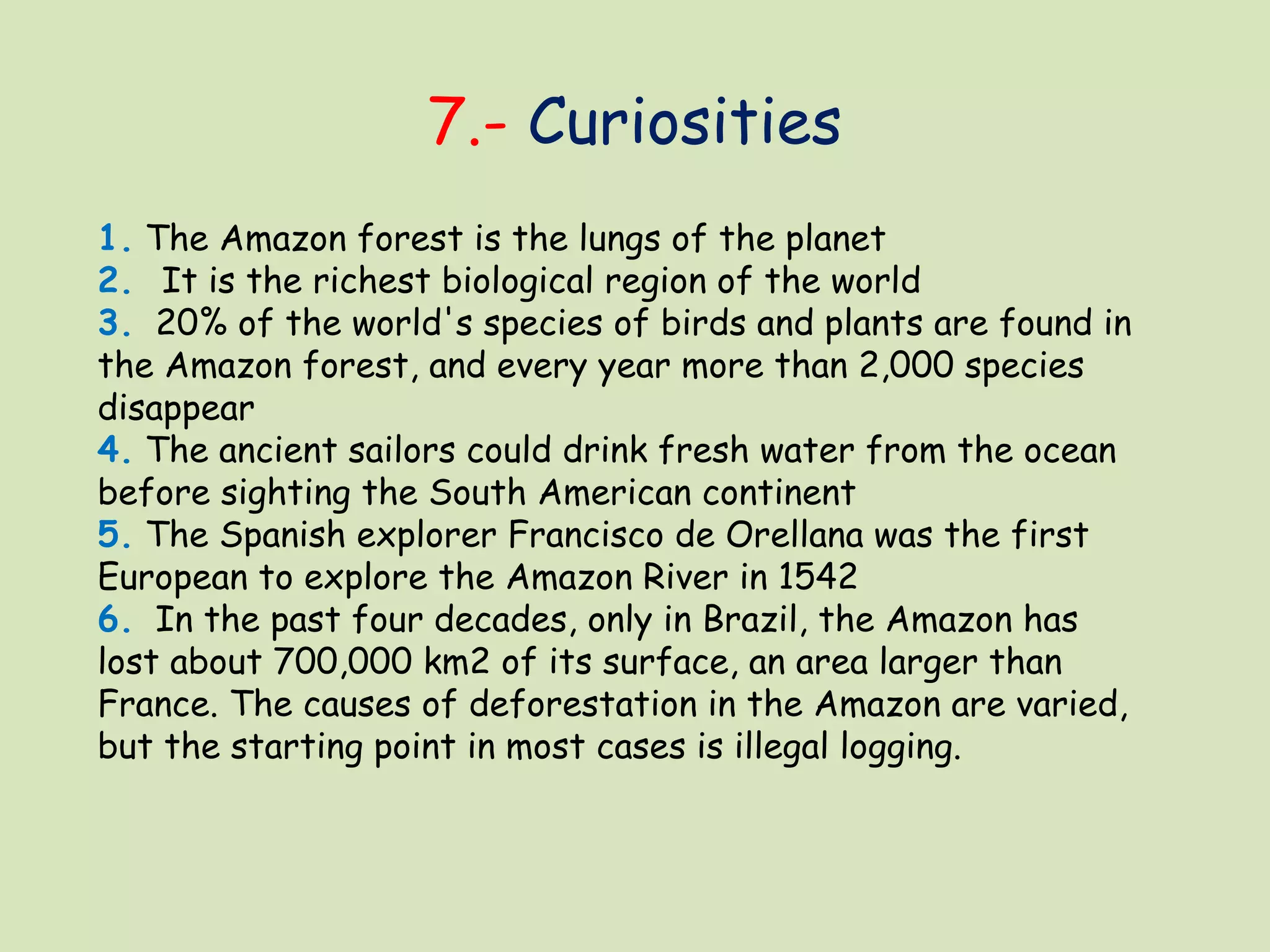
7.- Curiosities
1. The Amazon forest is the lungs of the planet
2.  It is the richest biological region of the world
3.  20% of the world's species of birds and plants are found in
the Amazon forest, and every year more than 2,000 species
disappear
4. The ancient sailors could drink fresh water from the ocean
before sighting the South American continent
5. The Spanish explorer Francisco de Orellana was the first
European to explore the Amazon River in 1542
6.  In the past four decades, only in Brazil, the Amazon has
lost about 700,000 km2 of its surface, an area larger than
France. The causes of deforestation in the Amazon are varied,
but the starting point in most cases is illegal logging.

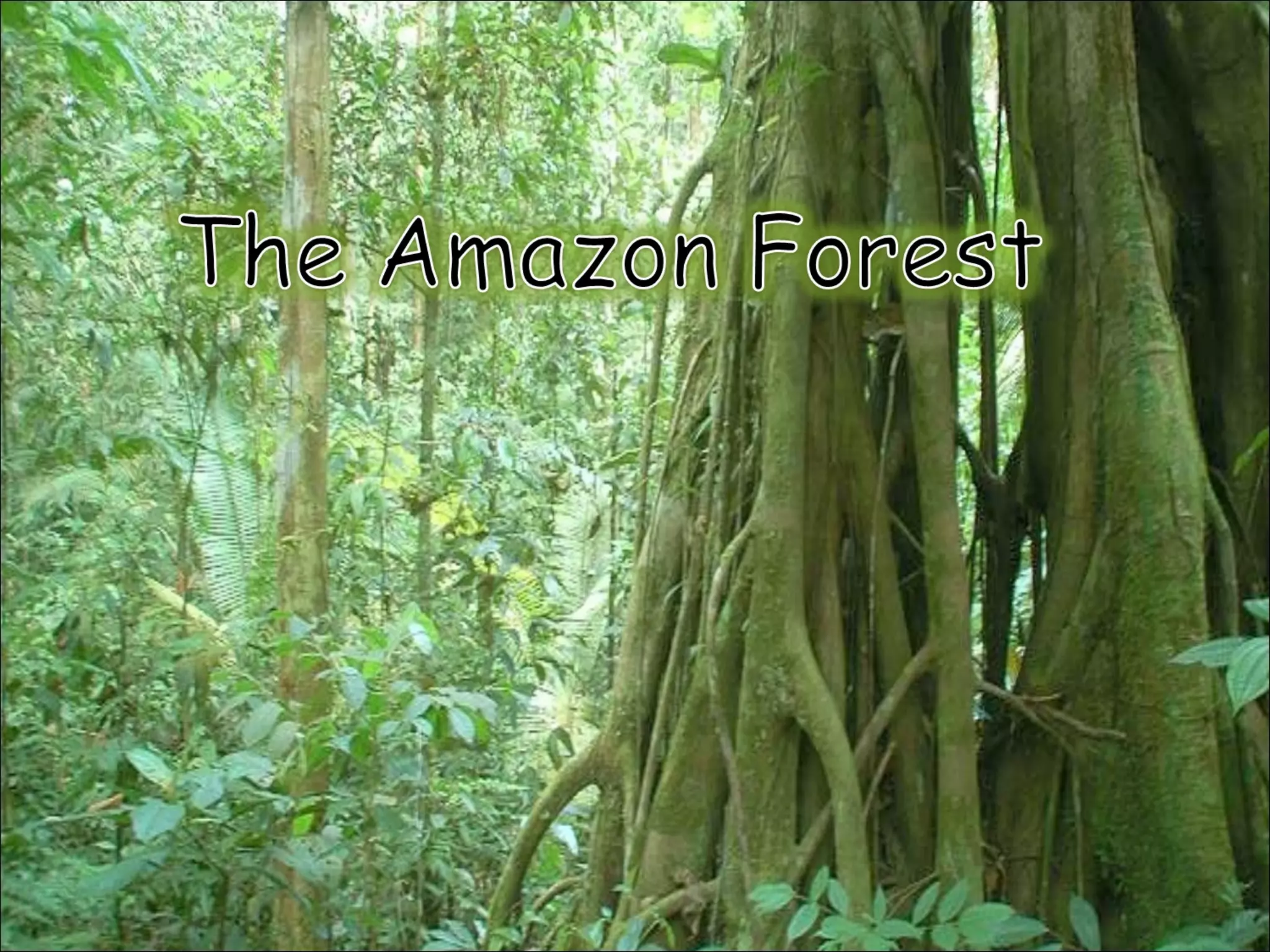
The amazon forest

  • 2.
    • 1.- Introduction •2.- Location • 3.- Climate • 4.- Rivers and Relief • 5.- Population • 6.- Way of life • 7.- Curiosities
  • 3.
    1.- Introduction The Amazonis the biggest primary forest in the earth. It contains the greatest biodiversity on the planet, with the 50 % of all species of the animals and plants that depend on it for survival. Twenty million people, live in the Amazon.
  • 4.
    2.- Location The Amazonforest is a extend region of the central part and of the north of southern that is the tropical forest of the basin of the Amazon River. It has 6 million square kilometres along eight countries; Brazil and Peru have the largest expanse of the Amazon.
  • 5.
    3.- Climate Due tothe abundant solar energy, the tropical rainforests have a hot climate during all the year with temperatures between 22 and 34 ºC. The temperatures generally are moderates, due to cloud cover and the high humidity. The rainforest are hold to intense precipitations in the year, of 80 inches and in some areas more of 430 inches to year.
  • 6.
    4.- Rivers andRelief The Amazon River is born in the Andes in Peru. It has 6,750 kilometers, of which 3,165 km are in Brazilian territory. It is the world's largest river in the world For his lake side home, the Amazon River has a small slope from its source to its mouth is inclined less than 100 meters. During the rainy season, the river's mouth may have about 480 km wide and download up to 15000 million cubic meters of water .
  • 7.
    5.- Population From thecultural point of view the Amazon rainforest is one of the most diverse regions of the planet only in Brazil, the Amazon rainforest is also home to 20 million people The main linguistic groups in the region are: Languages Tupi, languages ye or GE, Caribbean languages. Arawak languages, and cloth-tacanas Languages
  • 8.
    6.- Way oflife The large number of tribes have their own codes and customs. Some scientists even say that there are tribes that have not been discovered inside the jungle. The music at the heart of tribal ceremonies is common in all tribes. Tribes have developed extensive knowledge regarding the plants and animals to produce drugs With respect to religion, there are many myths and legends
  • 9.
    7.- Curiosities 1. The Amazonforest is the lungs of the planet 2.  It is the richest biological region of the world 3.  20% of the world's species of birds and plants are found in the Amazon forest, and every year more than 2,000 species disappear 4. The ancient sailors could drink fresh water from the ocean before sighting the South American continent 5. The Spanish explorer Francisco de Orellana was the first European to explore the Amazon River in 1542 6.  In the past four decades, only in Brazil, the Amazon has lost about 700,000 km2 of its surface, an area larger than France. The causes of deforestation in the Amazon are varied, but the starting point in most cases is illegal logging.
  • 10.
    7.- Curiosities 1. The Amazonforest is the lungs of the planet 2.  It is the richest biological region of the world 3.  20% of the world's species of birds and plants are found in the Amazon forest, and every year more than 2,000 species disappear 4. The ancient sailors could drink fresh water from the ocean before sighting the South American continent 5. The Spanish explorer Francisco de Orellana was the first European to explore the Amazon River in 1542 6.  In the past four decades, only in Brazil, the Amazon has lost about 700,000 km2 of its surface, an area larger than France. The causes of deforestation in the Amazon are varied, but the starting point in most cases is illegal logging.