Robert M. Guzzo
Math 32a
Parametric Equations
We’re used to expressing curves in terms
of functions of the form, f(x)=y.
What happens if the curve is too
complicated to do this?
Let’s look at an exampleLet’s look at an example.
Question: What is the path traced out by its
bloody splat?
Why would we ask such a question?
Mathematicians are sick bastards!!!
An ant is walking along... only to be crushed by a
rolling wheel.
Problem Posed Again
(in a less gruesome manner)
A wheel with a radius of r feet is marked at
its base with a piece of tape. Then we allow the
wheel to roll across a flat surface.
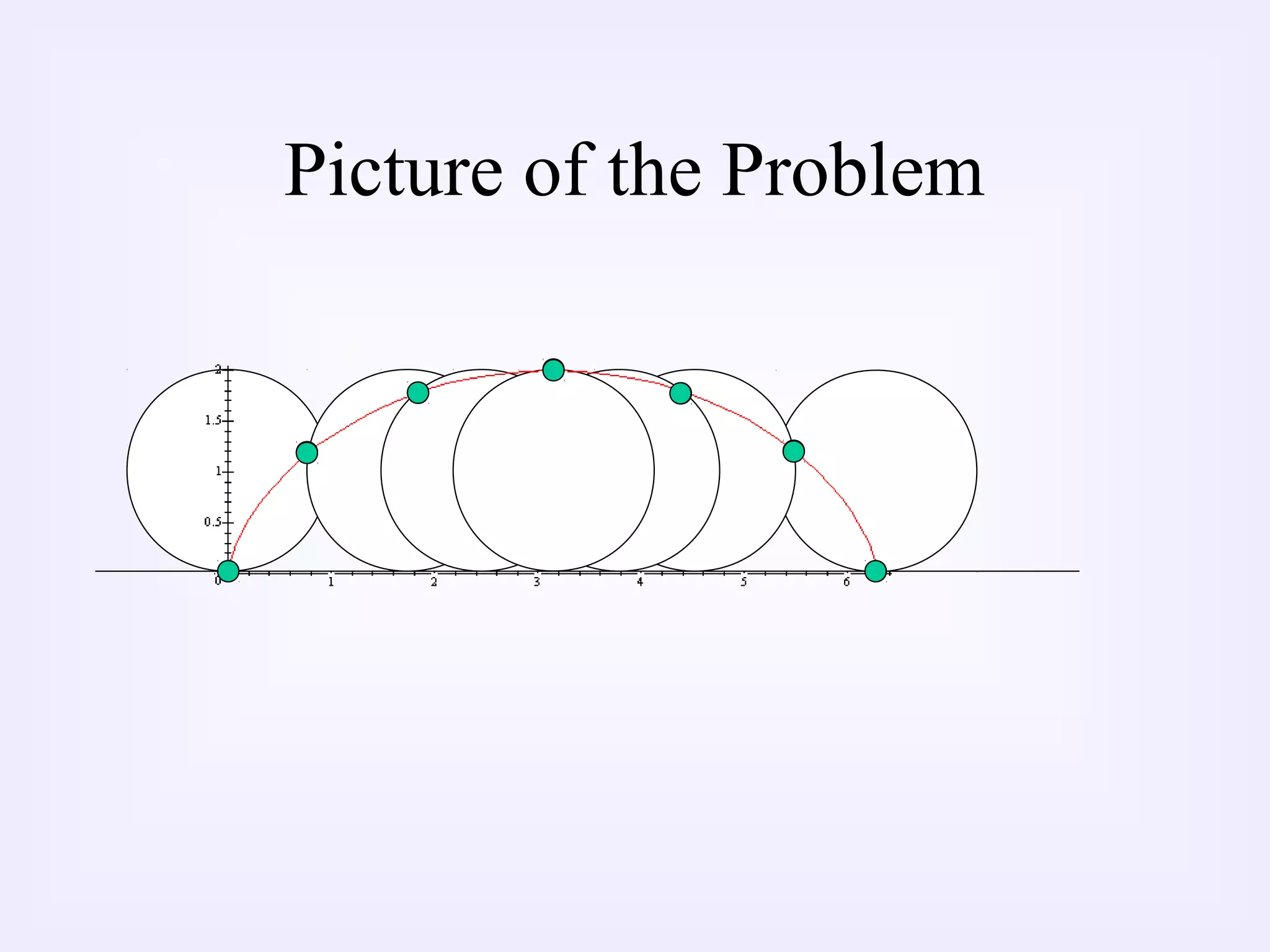
a) What is the path traced out by the tape
as the wheel rolls?
b) Can the location of the tape be determined at
any particular time?
Questions:
•What is your prediction for the shape
of the curve?
•Is the curve bounded?
•Does the curve repeat a pattern?
Picture of the Problem
Finding an Equation
•f(x) = y may not be good enough to express the
curve.
•Instead, try to express the location of a point, (x,y),
in terms of a third parameterparameter to get a pair of
parametric equationsparametric equations.
•Use the properties of the wheel to our advantage.
The wheel is a circle, and points on a circle can be
measured using angles.
WARNING: Trigonometry ahead!WARNING: Trigonometry ahead!WARNING: Trigonometry ahead!WARNING: Trigonometry ahead!WARNING: Trigonometry ahead!
Diagram of the Problem
2r
r
O
P
C
Q
θ
TX
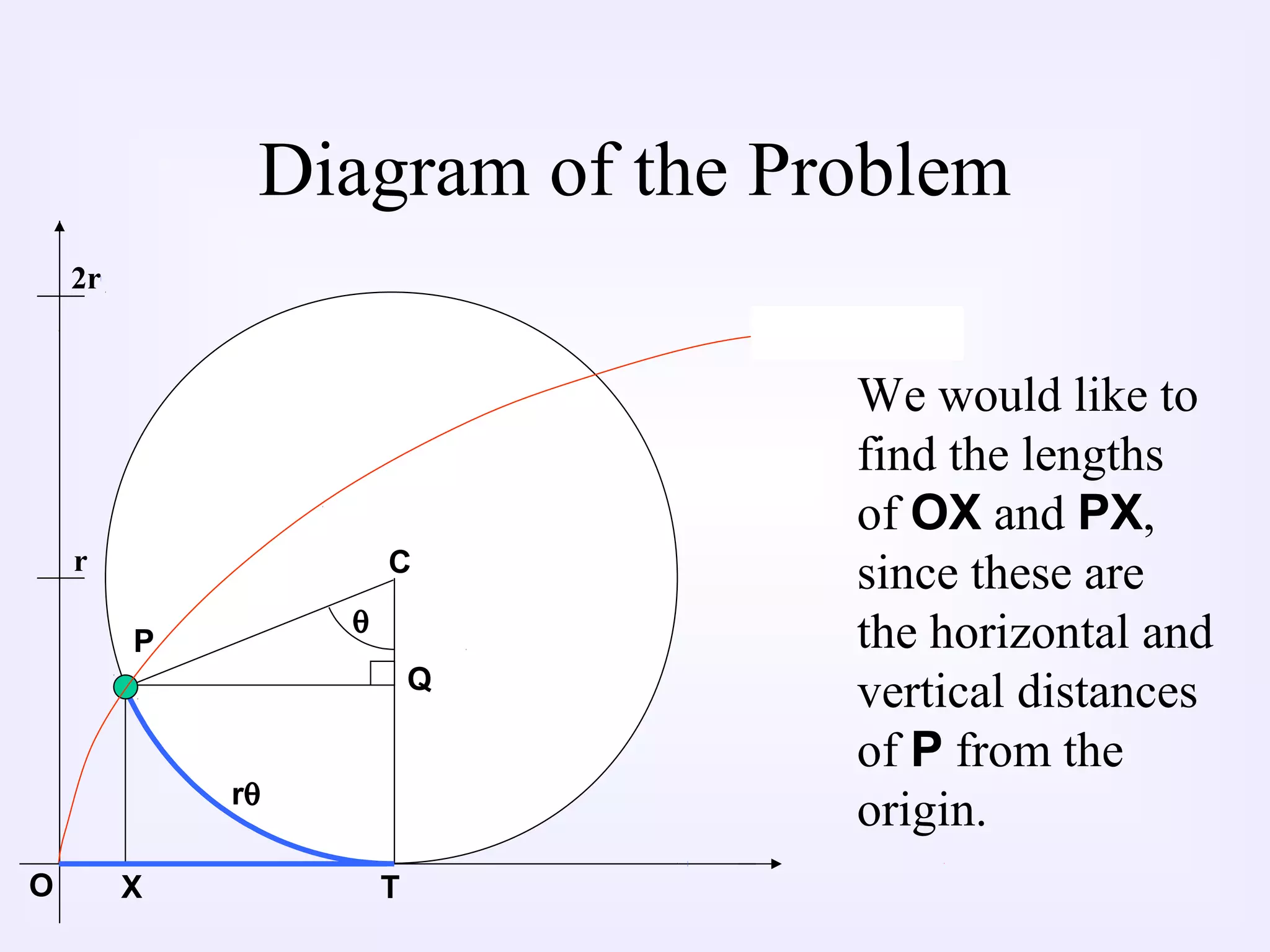
We would like to
find the lengths
of OX and PX,
since these are
the horizontal and
vertical distances
of P from the
origin.rθ
r
O
P
C
Q
θ
TX
The Parametric Equations
|OX| = |OT| - |XT|
rθ
rθ
r sinθ
r cosθ
r
|PX| = |CT| - |CQ|
= |OT| - |PQ|
x(θ) = rθ - r sinθ
y(θ) = r - r cosθ
Graph of the Function
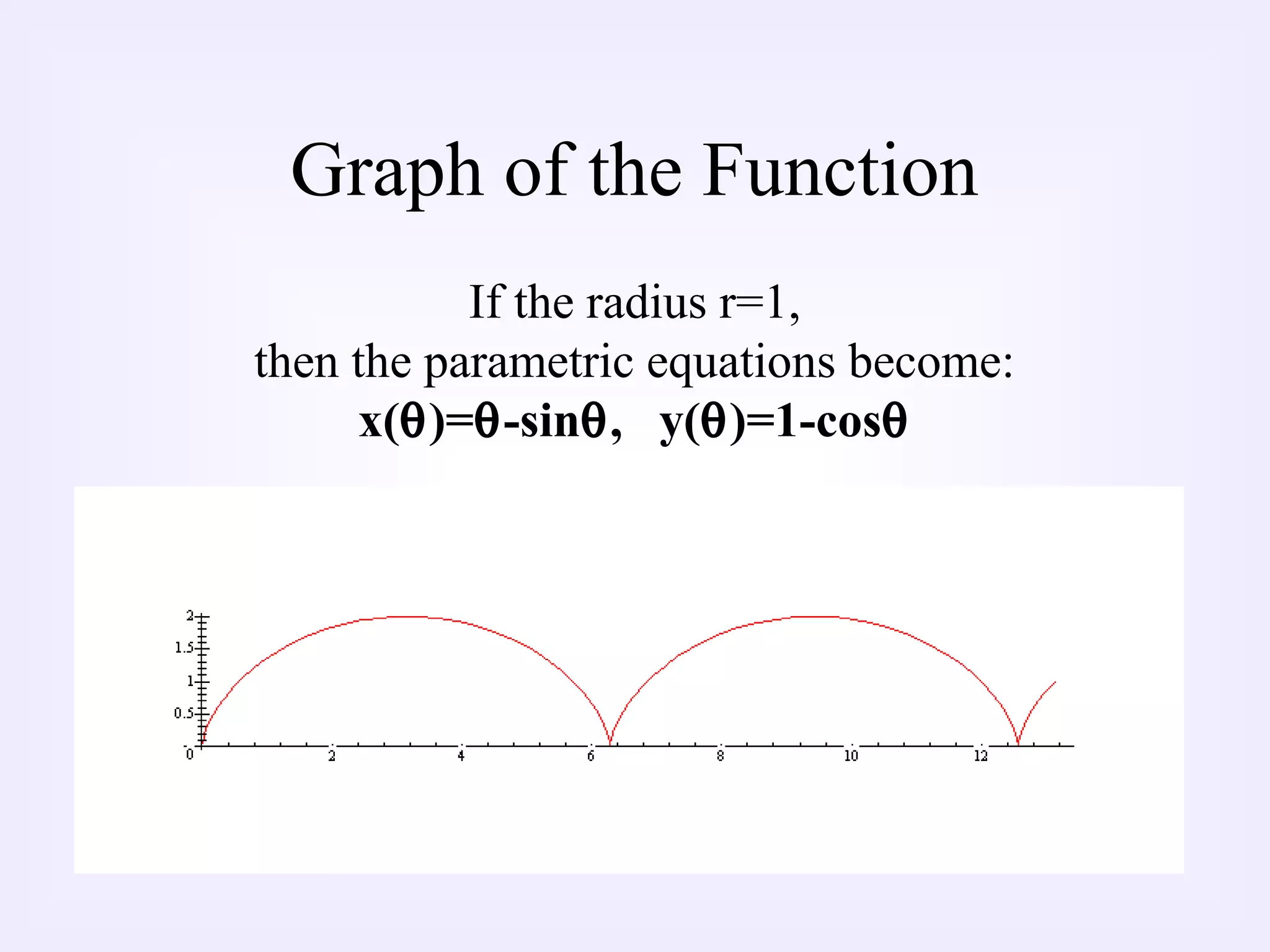
If the radius r=1,
then the parametric equations become:
x(θ)=θ-sinθ, y(θ)=1-cosθ
Real-World Example:
Gears
For Further Study
• Calculus, J. Stuart, Chapter 9, ex. 5, p. 592:
The basic problem. Stuart also looks at
more interesting examples:
• What happens if we move the point, P, inside the
wheel?
• What happens if we move P some distance outside
the wheel?
• What if we let the wheel roll around the edge of
another circle?
•History of the CycloidHistory of the Cycloid

Cycloid

  • 1.
    Robert M. Guzzo Math32a Parametric Equations
  • 2.
    We’re used toexpressing curves in terms of functions of the form, f(x)=y. What happens if the curve is too complicated to do this? Let’s look at an exampleLet’s look at an example.
  • 3.
    Question: What isthe path traced out by its bloody splat? Why would we ask such a question? Mathematicians are sick bastards!!! An ant is walking along... only to be crushed by a rolling wheel.
  • 4.
    Problem Posed Again (ina less gruesome manner) A wheel with a radius of r feet is marked at its base with a piece of tape. Then we allow the wheel to roll across a flat surface. a) What is the path traced out by the tape as the wheel rolls? b) Can the location of the tape be determined at any particular time?
  • 5.
    Questions: •What is yourprediction for the shape of the curve? •Is the curve bounded? •Does the curve repeat a pattern?
  • 6.
  • 7.
    Finding an Equation •f(x)= y may not be good enough to express the curve. •Instead, try to express the location of a point, (x,y), in terms of a third parameterparameter to get a pair of parametric equationsparametric equations. •Use the properties of the wheel to our advantage. The wheel is a circle, and points on a circle can be measured using angles. WARNING: Trigonometry ahead!WARNING: Trigonometry ahead!WARNING: Trigonometry ahead!WARNING: Trigonometry ahead!WARNING: Trigonometry ahead!
  • 8.
    Diagram of theProblem 2r r O P C Q θ TX We would like to find the lengths of OX and PX, since these are the horizontal and vertical distances of P from the origin.rθ
  • 9.
    r O P C Q θ TX The Parametric Equations |OX|= |OT| - |XT| rθ rθ r sinθ r cosθ r |PX| = |CT| - |CQ| = |OT| - |PQ| x(θ) = rθ - r sinθ y(θ) = r - r cosθ
  • 10.
    Graph of theFunction If the radius r=1, then the parametric equations become: x(θ)=θ-sinθ, y(θ)=1-cosθ
  • 11.
  • 12.
    For Further Study •Calculus, J. Stuart, Chapter 9, ex. 5, p. 592: The basic problem. Stuart also looks at more interesting examples: • What happens if we move the point, P, inside the wheel? • What happens if we move P some distance outside the wheel? • What if we let the wheel roll around the edge of another circle? •History of the CycloidHistory of the Cycloid