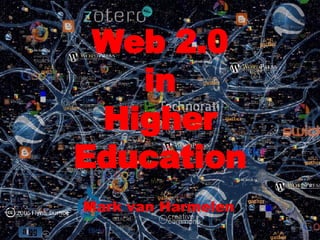
Web 2.0 in Higher Education

Loading...

Flash Player 9 (or above) is needed to view presentations.
We have detected that you do not have it on your computer. To install it, go here.

2 comments

Comments 1 - 2 of 2 previous next Post a comment

  • + alysaally Alysaally 2 years ago
    web 2.0 is an advanced techonology i like it. Here is some more information about higher education. Please reply for my article.
  • + markvanharmelen markvanharmelen 3 years ago
    Yes this guy looks like he;’s part of a 1960s Open University programme (UK TV based lectures). This is not a good example, I would rather have an example of student work showing, e.g., biodiversity in an urban environment, where that work is the product of several students working with each other, discussing, co-learning, and finally producing an artifact to be shown that demonstrates theri work.
Post a comment
Embed Video
Edit your comment Cancel

12 Favorites & 3 Groups

Web 2.0 in Higher Education - Presentation Transcript

  1. Web 2.0 in Higher Education Mark van Harmelen
  2. What’s it all about?
    • Sharing Content
    • create
    • save
    • find
    • use
    • re-use
    • mix
    • mash-up
    • repurpose
    • share
    • text, graphics, sound, video, slideshows, ….
    • What’s it all about?
    • Social software
    • helping people
    • interact
    • form groups
    • manage processes
    • pursue common interests and endeavours
    • learn
    • research
  3. Wikis, blogs
    • help people communicate
    source: http://www.modernlifeisrubbish.co.uk
  4. RSS, Atom
    • notification of changes
  5. Social bookmarking
    • collecting knowledge together
    del.icio.us home page
  6. Web start pages
    • organise your / your group’s web use
  7. Picture sharing
    • educational information, visual projects
  8. Video sharing
    • educational content – avoiding rescheduling lectures
  9. Podcasting, Vidcasting
    • audio, video with RSS for notification
    subscribe
  10. Mashups
    • superimpose data
    library availability user ratinng and ISBN, rating and reviews from Amazon
  11. Social networks
    • interact with learners, teachers and researchers
    • via social networks
  12. Common threads
    • tags
    • comments
    • ratings
    • RSS and notification
    • favorites
    • friends
    • network as platform for collaboration
    • user-generated content
    • mutually-added value
    • building community
  13. you need to try it to understand it
  14. Education Libraries Services
  15. Education and Web 2.0
  16. … applied scaffolding page structure content suggestions multi-way suggestion / feedback
  17. … learning together
  18. … communication / participation with Google Groups 168 messages 68 topics guess 75% me but significant effect feedback from one class member: felt involved in a course for the first time
  19. Library 2.0 / Repository 2.0
    • go where the user is
  20. Library 2.0 / Repository 2.0
    • enable the growth of
    • user generated content
    • ratings
    • recommendations
    • reviews
    • user tagging and tag exploitation
    • make it possible to meet
    • collaborate with
    • and help each other
    • thereby building communities
  21. Some service issues
    • Here or there?
    • What here?
    • Control and legal liability vs experimentation
    • Who as users and IPR
    • Services staff as advisors in a new field
    • What’s best?
    • What should our strategy be?
    • How should we learn about this?
  22. Examples
    • Edinburgh – Strategy first
    • Brighton – Elgg, anyone uses, 4.5% use
    • Leeds – Elgg, staff trained first, consequent use for teaching
    • Warwick – Own blog software, longest running scheme, highest use
  23. thanks
    • Mark van Harmelen
    • Independent consultant
    • and
    • School of Computer Science
    • University of Manchester
    • [email_address]
  24. Credits and licence
    • Credits
      • Web/neurone Flynn-Burhoe
      • Thumbs up by Sean Dreilinger
      • Community line drawing by the New School Masters in Media Studies Program and The Opportunity Agenda
      • Screendumps by Mark van Harmelen
    • License for this presentation http://creativecommons.org/licenses/by-nc-sa/3.0/

+ markvanharmelenmarkvanharmelen, 3 years ago

custom

4729 views, 12 favs, 5 embeds more stats

for MIMAS 2007 Conference

More info about this document

© All Rights Reserved

Go to text version

  • Total Views 4729
    • 4713 on SlideShare
    • 16 from embeds
  • Comments 2
  • Favorites 12
  • Downloads 204
Most viewed embeds
  • 9 views on http://markzspace.blogspot.com
  • 3 views on http://lorizelog.blogspot.com
  • 2 views on http://clausq.dk
  • 1 views on applewebdata://6068B040-32F5-4F20-A4D3-E94C901B1AC0
  • 1 views on http://www.blogger.com

more

All embeds
  • 9 views on http://markzspace.blogspot.com
  • 3 views on http://lorizelog.blogspot.com
  • 2 views on http://clausq.dk
  • 1 views on applewebdata://6068B040-32F5-4F20-A4D3-E94C901B1AC0
  • 1 views on http://www.blogger.com

less

Flagged as inappropriate Flag as inappropriate
Flag as inappropriate

Select your reason for flagging this presentation as inappropriate. If needed, use the feedback form to let us know more details.

Cancel
File a copyright complaint
Having problems? Go to our helpdesk?

Categories

Groups / Events