“ What if...?”
“ What if...?” A glimpse of insight that becomes a mission The engine of progress and innovation An opportunity to make a difference Two little words that can change the world
What if we could bring affordable Internet to remote villages of Africa? Could we bring doctors to remote health centers via the Internet? Could we expand the horizon and educational opportunities for children? Could we train entrepreneurs to build sustainable economic opportunities?
We Can Bring Good News
Sustainable Community-Operated Wireless Internet Services A Movement Across Africa Helping communities build their own high-speed wireless networks using common building materials and off-the-shelf electronics for less than $1,000 USD.
Malawi Malawi has one of the lowest internet penetration rates in the world.   Under 5% of Malawi’s 13 million citizens have access to the Internet
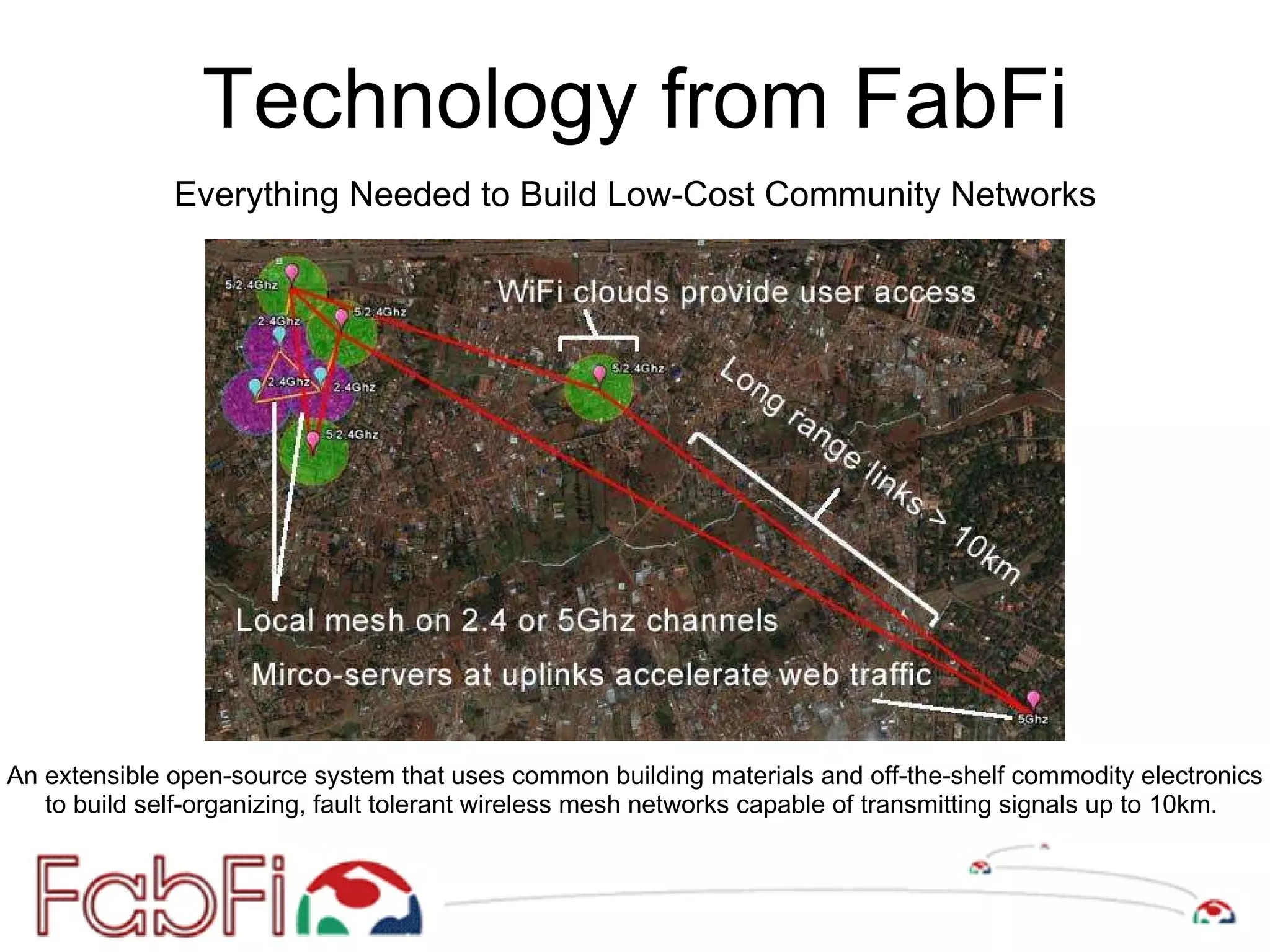
Technology from FabFi An extensible open-source system that uses common building materials and off-the-shelf commodity electronics to build self-organizing, fault tolerant wireless mesh networks capable of transmitting signals up to 10km.  Everything Needed to Build Low-Cost Community Networks
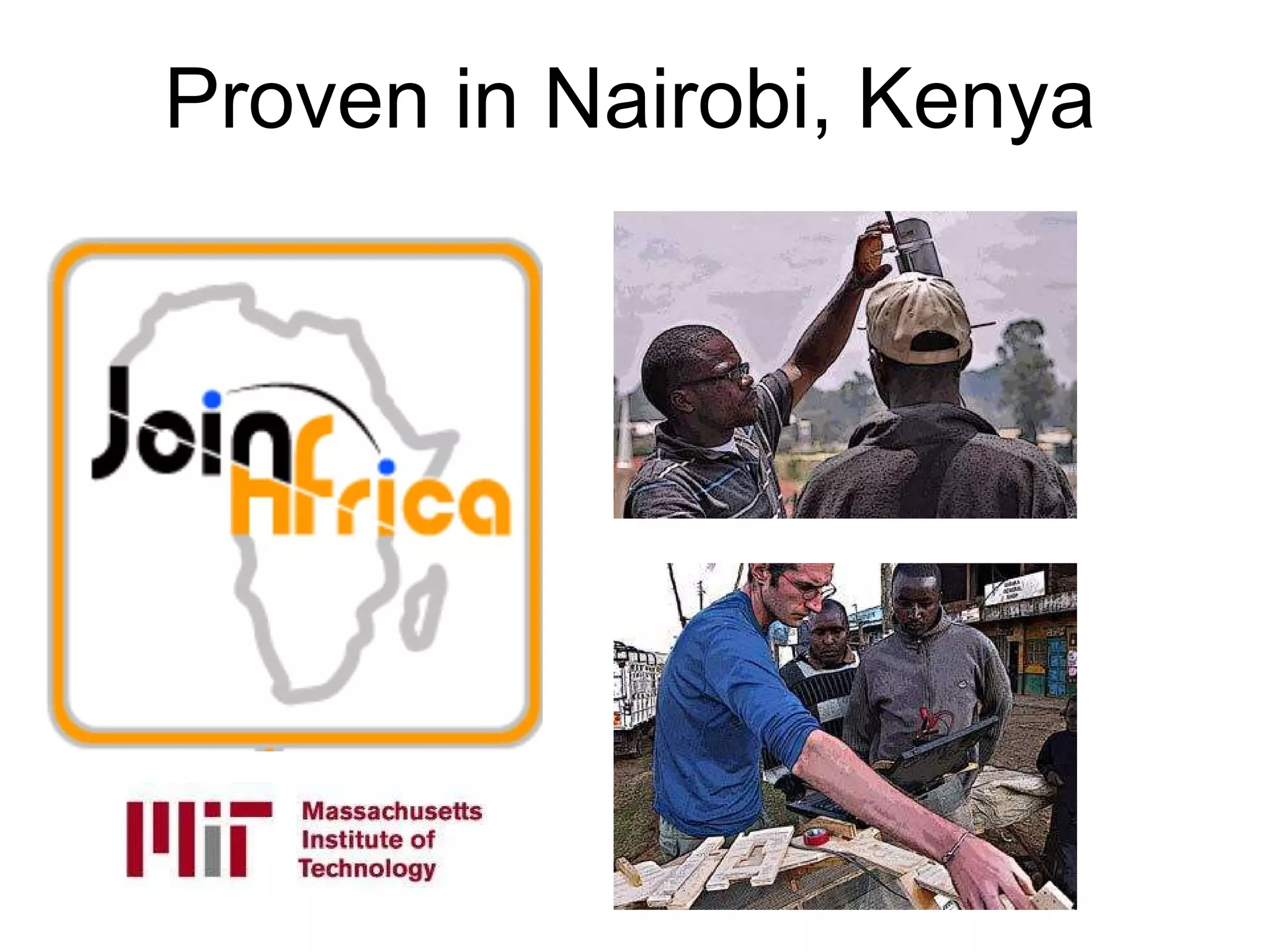
Proven in Nairobi, Kenya
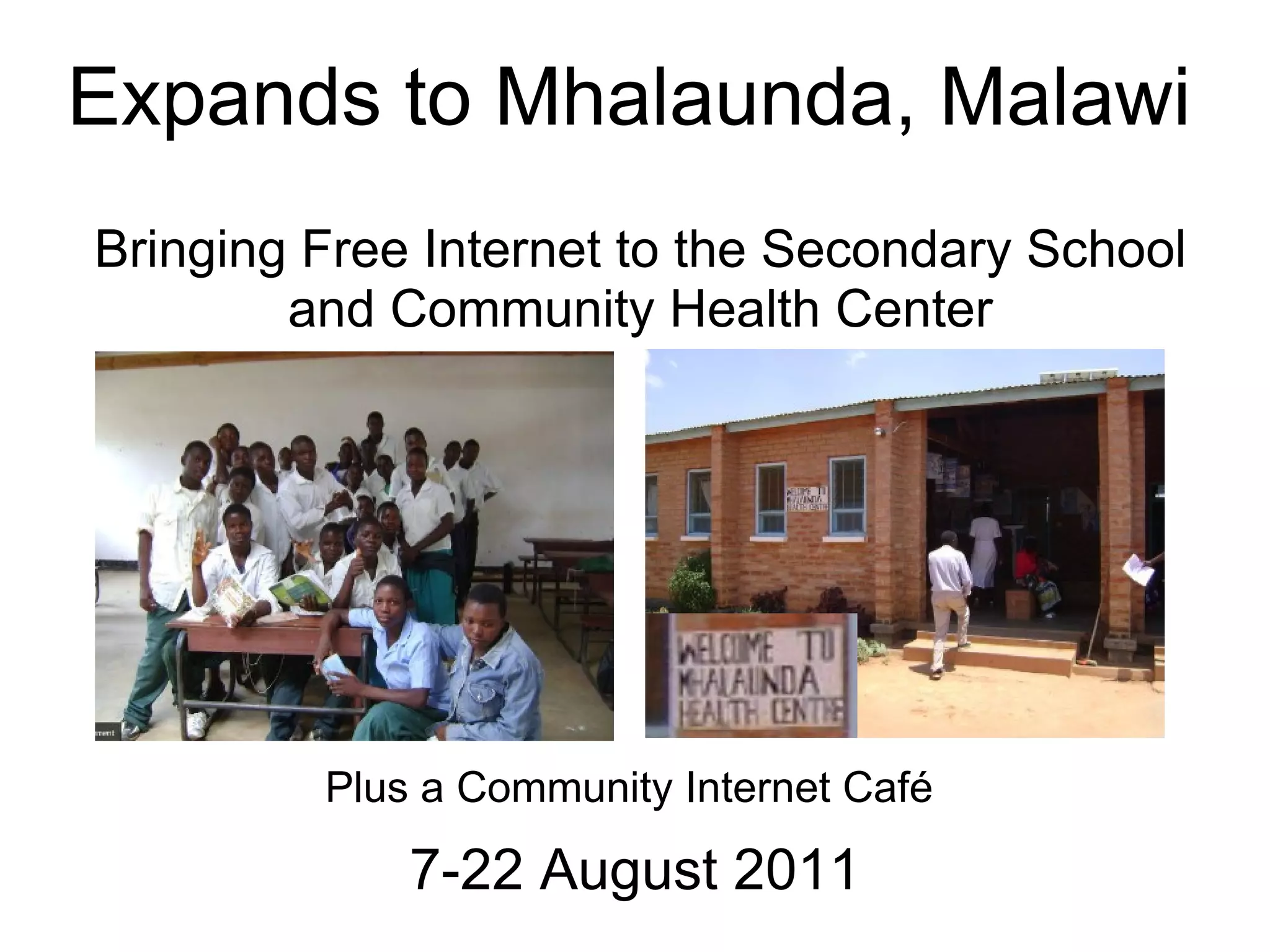
Expands to Mhalaunda, Malawi  Bringing Free Internet to the Secondary School and Community Health Center Plus a Community Internet Café  7-22 August 2011
Bringing Laptops for the School With Love from Olathe Medical Center
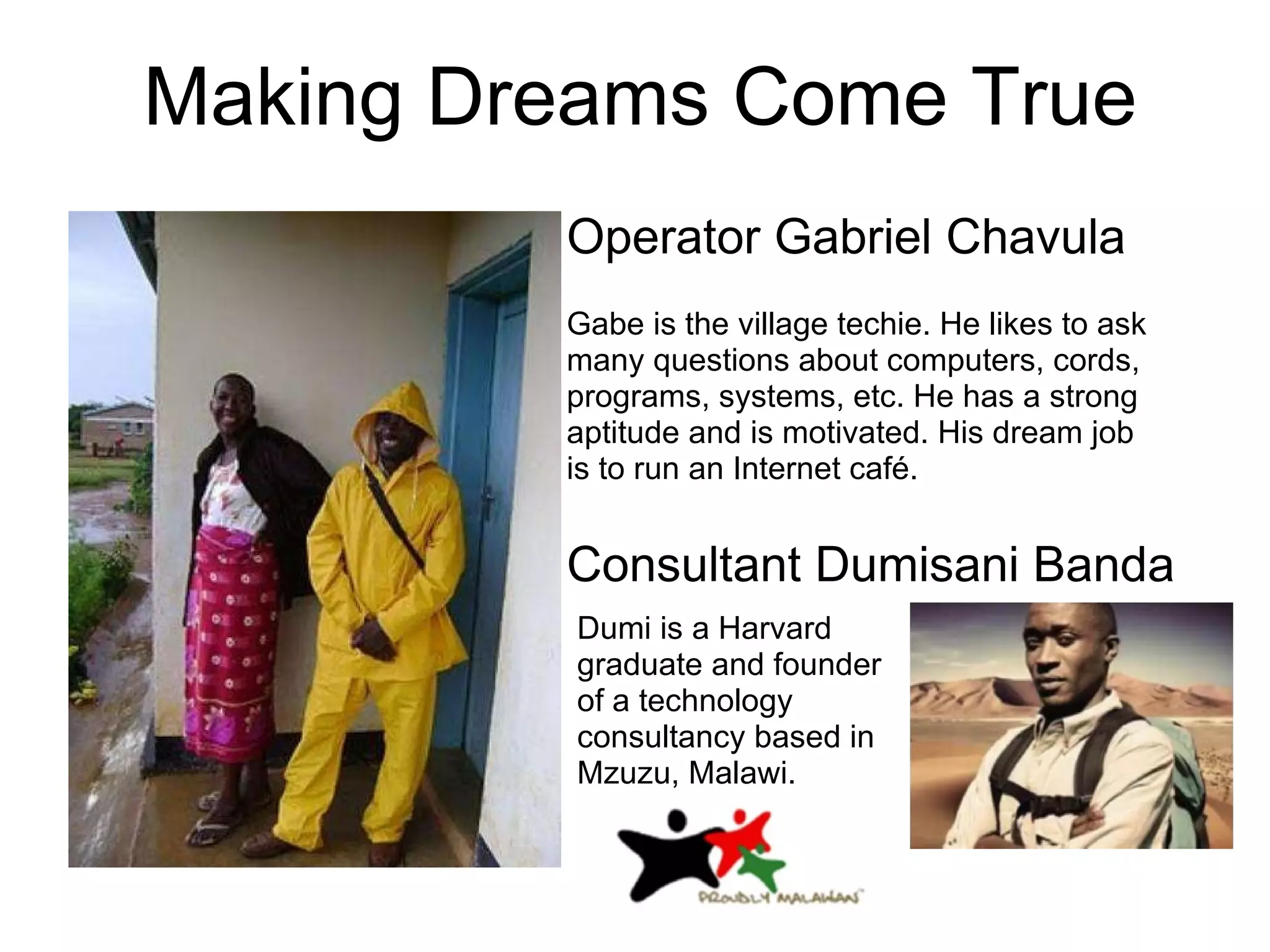
Gabe is the village techie. He likes to ask many questions about computers, cords, programs, systems, etc. He has a strong aptitude and is motivated. His dream job is to run an Internet café.  Making Dreams Come True Operator Gabriel Chavula Consultant Dumisani Banda Dumi is a Harvard graduate and founder of a technology consultancy based in Mzuzu, Malawi.
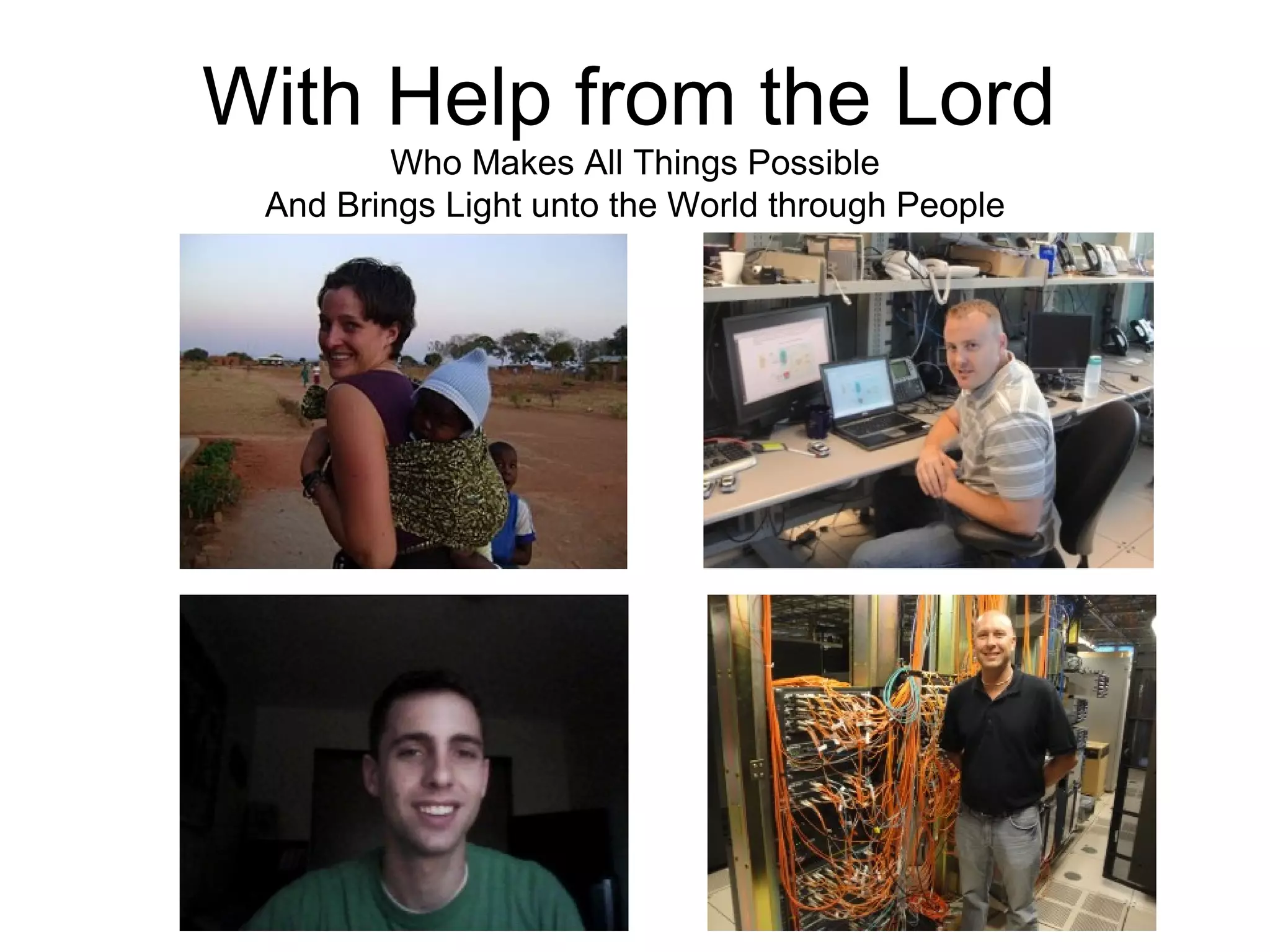
With Help from the Lord  Who Makes All Things Possible And Brings Light unto the World through People
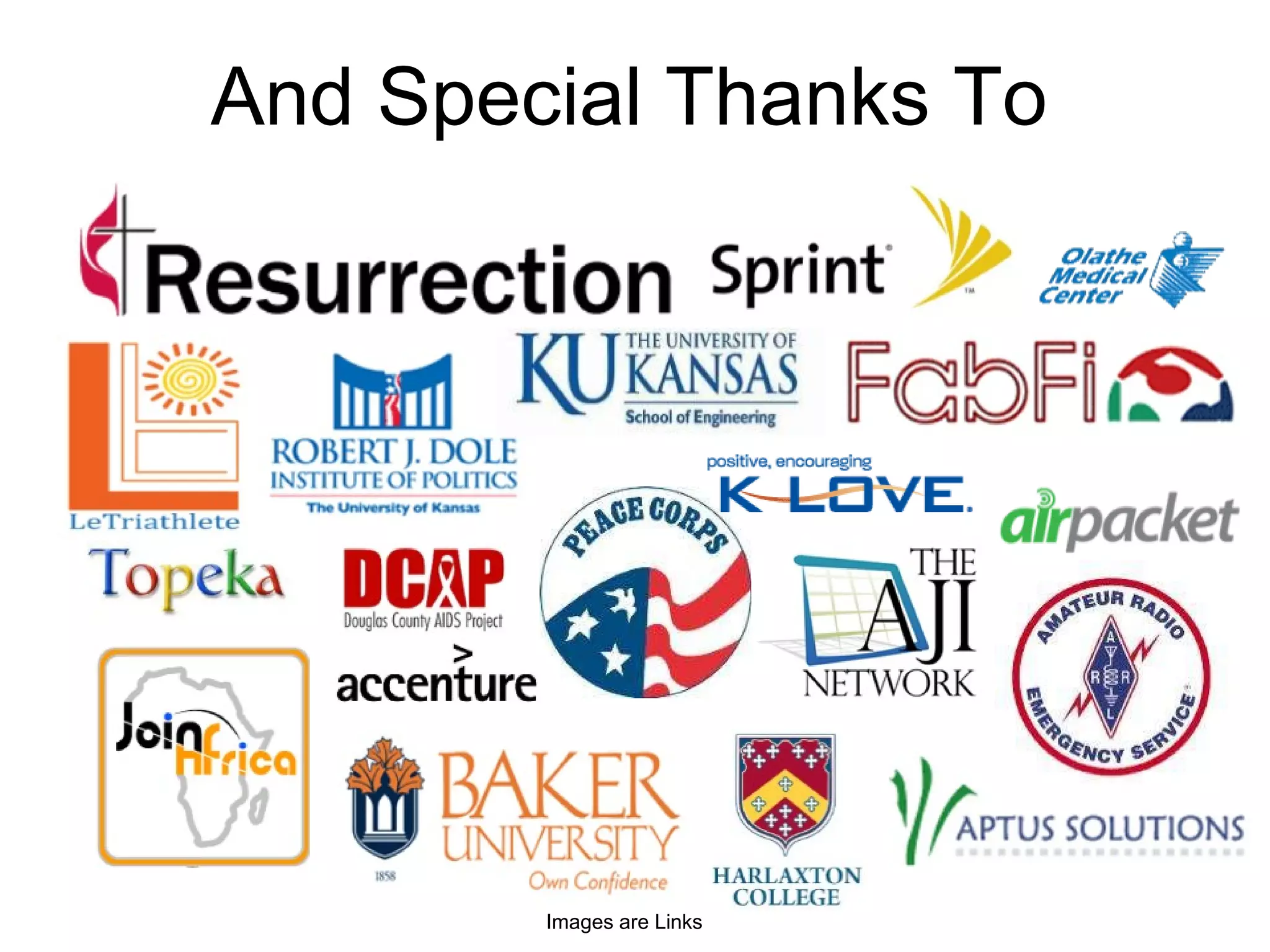
And Special Thanks To  Images are Links
Follow Our Progress
Donate Now  We Need $5000 Can We Count You for $100? All money donated will go towards realizing the goal of starting a JoinAfrica.org wireless network in Mhalaunda, Malawi. We need help with travel costs, equipment procurement, a pre-paid year of backbone internet.

What If... Malawi Wi Fi Project

  • 1.
  • 2.
    “ What if...?”A glimpse of insight that becomes a mission The engine of progress and innovation An opportunity to make a difference Two little words that can change the world
  • 3.
    What if wecould bring affordable Internet to remote villages of Africa? Could we bring doctors to remote health centers via the Internet? Could we expand the horizon and educational opportunities for children? Could we train entrepreneurs to build sustainable economic opportunities?
  • 4.
    We Can BringGood News
  • 5.
    Sustainable Community-Operated WirelessInternet Services A Movement Across Africa Helping communities build their own high-speed wireless networks using common building materials and off-the-shelf electronics for less than $1,000 USD.
  • 6.
    Malawi Malawi hasone of the lowest internet penetration rates in the world. Under 5% of Malawi’s 13 million citizens have access to the Internet
  • 7.
    Technology from FabFiAn extensible open-source system that uses common building materials and off-the-shelf commodity electronics to build self-organizing, fault tolerant wireless mesh networks capable of transmitting signals up to 10km. Everything Needed to Build Low-Cost Community Networks
  • 8.
  • 9.
    Expands to Mhalaunda,Malawi Bringing Free Internet to the Secondary School and Community Health Center Plus a Community Internet Café 7-22 August 2011
  • 10.
    Bringing Laptops forthe School With Love from Olathe Medical Center
  • 11.
    Gabe is thevillage techie. He likes to ask many questions about computers, cords, programs, systems, etc. He has a strong aptitude and is motivated. His dream job is to run an Internet café. Making Dreams Come True Operator Gabriel Chavula Consultant Dumisani Banda Dumi is a Harvard graduate and founder of a technology consultancy based in Mzuzu, Malawi.
  • 12.
    With Help fromthe Lord Who Makes All Things Possible And Brings Light unto the World through People
  • 13.
    And Special ThanksTo Images are Links
  • 14.
  • 15.
    Donate Now We Need $5000 Can We Count You for $100? All money donated will go towards realizing the goal of starting a JoinAfrica.org wireless network in Mhalaunda, Malawi. We need help with travel costs, equipment procurement, a pre-paid year of backbone internet.

Editor's Notes

  • #6 The growing demand for broadband voice, video, and data communications has driven the need for broadband networking worldwide. While wired networks have generally been successful in delivering such networks, in many areas of the world, the infrastructure for wired networking does not exist -- presenting a problem often referred to as connectivity to "the last mile." In the past few years, unlicensed wireless broadband networking has become an attractive and practical solution to deliver broadband access to the last mile.
  • #7 716,400 Internet Users in Malawi in 2009 according to the World Bank. Malawi has one of the lowest internet penetration rates in the world. According to the Malawi Communication Regulatory Authority, under 1% of Malawi’s 13 million citizens have access to the internet. Other research suggests internet penetration could be up to around 4%, but figures are still worryingly low.
  • #8 FabFi is an open-source, FabLab-grown system using common building materials and off-the-shelf electronics to transmit wireless ethernet signals across distances of up to several miles. With FabFi, communities can build their own wireless networks to gain high-speed internet connectivity---thus enabling them to access online educational, medical, and other resources. The cost of materials for a small 3-link system are typically less than $1,000 USD. Using technology from the FabFi Wireless Project, we would partner with local entrepreneurs to build self-organizing, fault tolerant wireless networks with a variety of 2.4 and 5Ghz wifi devices. We would train the local people how to install FabFi custom firmware on commodity hardware from manufacturers like Linksys, D-Link or Ubiquiti and augment the devices with Rapid-Fab antennas/reflectors as needed to increase range. With some minimal configration, JoinAfrica nodes associate with each other to form a wireless mesh that automatically identifies and routes web traffic to the closest gateway. By selecting the correct reflectors, the same WiFi electronics can perform any function from long-range point-to-point connections all the way to providing local user access. The device firmware automatically detects and manages all these links as a single system. For more details, please reference the FabFi Technical Summary .
  • #9 The JoinAfrica system is designed to make operating a large-scale WiFi network easy and sustainable for regular people. The system provides tools for constructing a wireless mesh network and a cloud-based server for billing and network management. JoinAfrica takes care of building relationships with ISPs and content providers, manages user accounts and lets operators associate with a common brand and offer the JoinAfrica "Freemium" service. The network operators form their own businesses and monetize the networks though both prepaid and postpaid options (prepaid through scratch cards and mobile payments “ mpesa ”). A “hosted” “cloud-based” micro-ISP management portal handles access control, billing, and operations management/monitoring. End users could then subscribe to the 512 Kbps internet service for around 3000 MWK or 1 Mbps for around 6000 MWK. A team from MIT, led by Keith Berkoben, a Masters student at MIT's Engineering Systems Division and a veteran developer of low-cost wireless network infrastructure, is the project manager for the JoinAfrica project in Kenya. There is a team of engineers on-the-ground in Nairobi Kenya proving out the business plan and advancing the philosophy of this project. To date, the results have been good. http://www.joinafrica.org/kenya/about/
  • #10 In my immediate village there is about 400-500. In my catchment area, the area in total that my Peace Corps post covers is 14,000. The only source of power in my area is solar. Individual houses own a solar panel which they charge a battery from and from which they invert and use for light, small electronics, etc. I should warn you, of those 14,000 people probably 50 or less have any sort of computer. Thats a high estimate too. And I mean any sort, I ran across the oldest laptop I've ever seen here. It belongs to the reverend here, he asked me to help him play videos on it. I had to explain that the computer is too old and doesn't have the capacity to even play videos, DVDs, or anything.
  • #11 Ubuntu |oǒ'boǒntoō| is an ancient African word meaning 'humanity to others'. It also means 'I am what I am because of who we all are'. The Ubuntu operating system brings the spirit of Ubuntu to the world of computers.
  • #13 The confluence of events that made this possible cannot be denied.
  • #14 The institutions that that helped shape the people behind this project and
  • #15 http://www.facebook.com/pages/Malawi-WiFi/178918215503395 http://twitter.com/#!/Malawi_WiFi http://www.youtube.com/watch?v=OUhV2KIMAwk
  • #16 https://www.paypal.com/cgi-bin/webscr?cmd=_s-xclick&hosted_button_id=S92NQ3FFY3W5G