PMSD proj design and evaluation, rev4

Loading...

Flash Player 9 (or above) is needed to view presentations.
We have detected that you do not have it on your computer. To install it, go here.

0 comments

Post a comment

    Post a comment
    Embed Video
    Edit your comment Cancel

    Notes on slide 1

    This presentation is a tool for the Markets and Livelihoods Programme’s (IA2’s) Team Leaders, Project Managers and Project Officers. It is intended to help them build the capacity of their peers and share ideas with community members about the ways in which we monitor and evaluate our initiatives. It uses a very basic language and is not intended to go very deep into the more complex nuances of M&E. This is work in progress. We need to make sure that the views, ideas and needs from the whole team are captured and distilled to improve this document until we feel comfortable with it as a standard capacity building guideline. The master copy of the document is available in Sharepoint so that TLs, PMs and POs can contribute with their views. PLEASE, USE THE NOTES SPACE UNDER EACH SLIDE TO WRITE YOUR THOUGHTS ABOUT THAT PARTICULAR SLIDE (for example, things you say when you present the slide, ways of presenting it, examples to illustrate, disagreements and missing information). YOUR THOUGHTS ABOUT THE TOOL IN GENERAL CAN BE WRITTEN HERE BELOW. Please identify your comment with your name and country.

    2 Favorites & 1 Event

    PMSD proj design and evaluation, rev4 - Presentation Transcript

    1. Markets and Livelihoods Programme Impact Assessment Framework Training material for practitioners (Working draft, Ver. 4, May 2008)
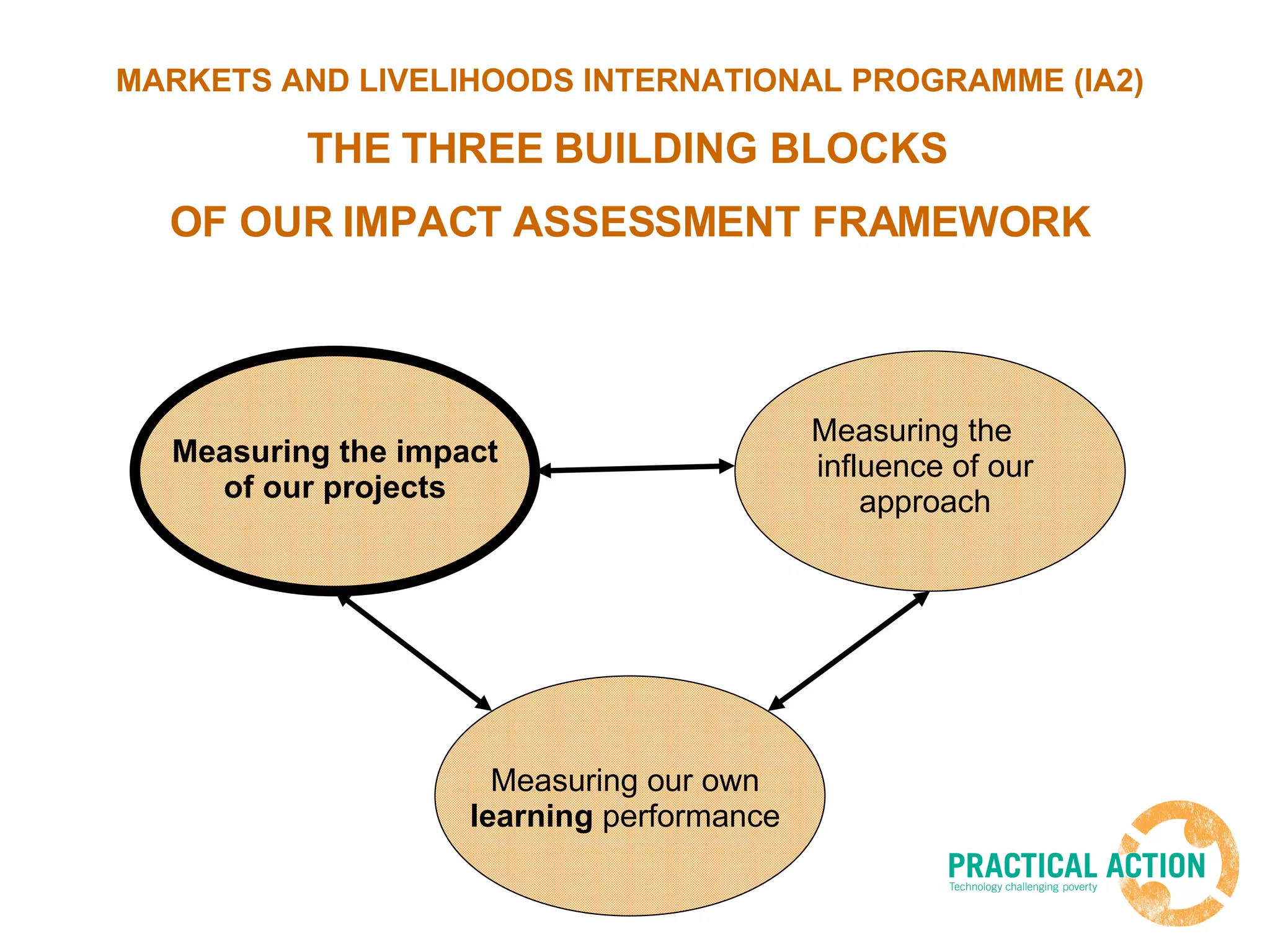
    2. MARKETS AND LIVELIHOODS INTERNATIONAL PROGRAMME (IA2) THE THREE BUILDING BLOCKS OF OUR IMPACT ASSESSMENT FRAMEWORK Measuring the impact of our projects Measuring the influence of our approach Measuring our own learning performance
    3. SECTION 1 Basic elements of a project
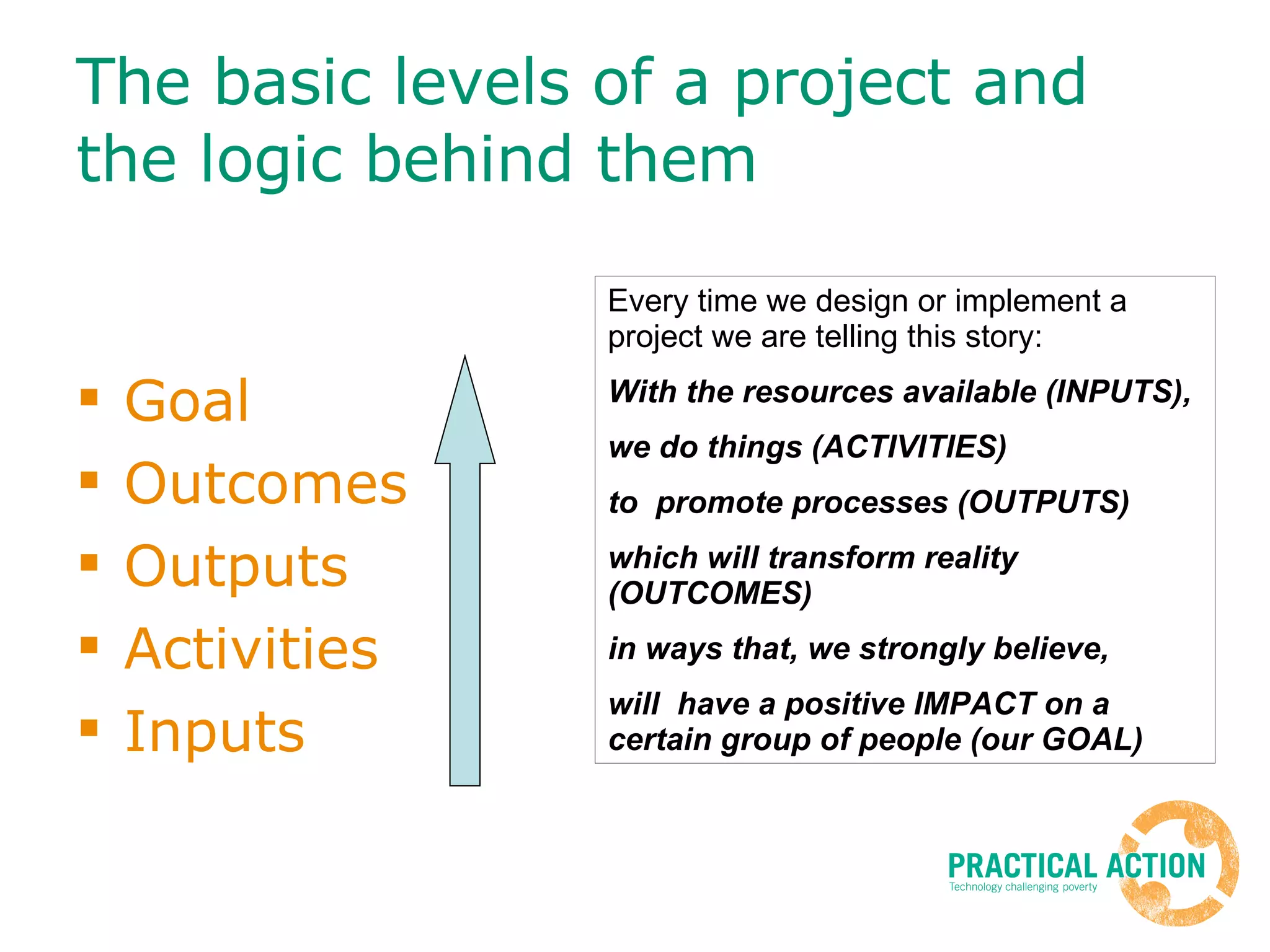
    4. The basic levels of a project and the logic behind them
      • Goal
      • Outcomes
      • Outputs
      • Activities
      • Inputs
      Every time we design or implement a project we are telling this story: With the resources available (INPUTS), we do things (ACTIVITIES) to promote processes (OUTPUTS) which will transform reality (OUTCOMES) in ways that, we strongly believe, will have a positive IMPACT on a certain group of people (our GOAL)
    5. INPUTS
      • They are the building blocks of any project (they define the budget):
        • Human resources
        • Time
        • Money
        • In-kind (normally from the community)
      • We have control over them
      • Are easy to measure and monitor
    6. ACTIVITIES
      • The things we do with the inputs we have available
      • Some examples are:
        • Organising meetings, workshops and fairs
        • Building infrastructure
        • Providing credit or subsidies
        • Producing leaflets and books
        • Creating a website
      • We begin to loose some control (but not much)
      • We know if they happened
      • We can quantify and qualify them well
    7. OUTPUTS
      • They are the processes we want to promote with the activities we do
      • They have three basic characteristics:
        • Are done by others (WHO)
        • With a purpose (WHAT FOR)
        • And in a particular way (HOW)
      • We can know if they are happening BUT…
      • the more they gain a life of their own, the more difficult it is for us to control them
    8. EXAMPLE OF AN OUTPUT
      • A group of influential, organised, and empowered farmers (WHO)
      • explore business opportunities with other actors and communicate those opportunities to their communities (WHAT FOR)
      • in a transparent, inspiring and effective way (HOW)
    9. OUTCOMES
      • They are the transformations we believe will occur in the world because of the processes we promote
      • In reality, they are partially caused by the people involved in our outputs
      • We can still know if they are happening but… we cannot control them directly and they are very difficult to control indirectly
      • We can only hope that we did things in ways that the transformations happen almost as we imagine
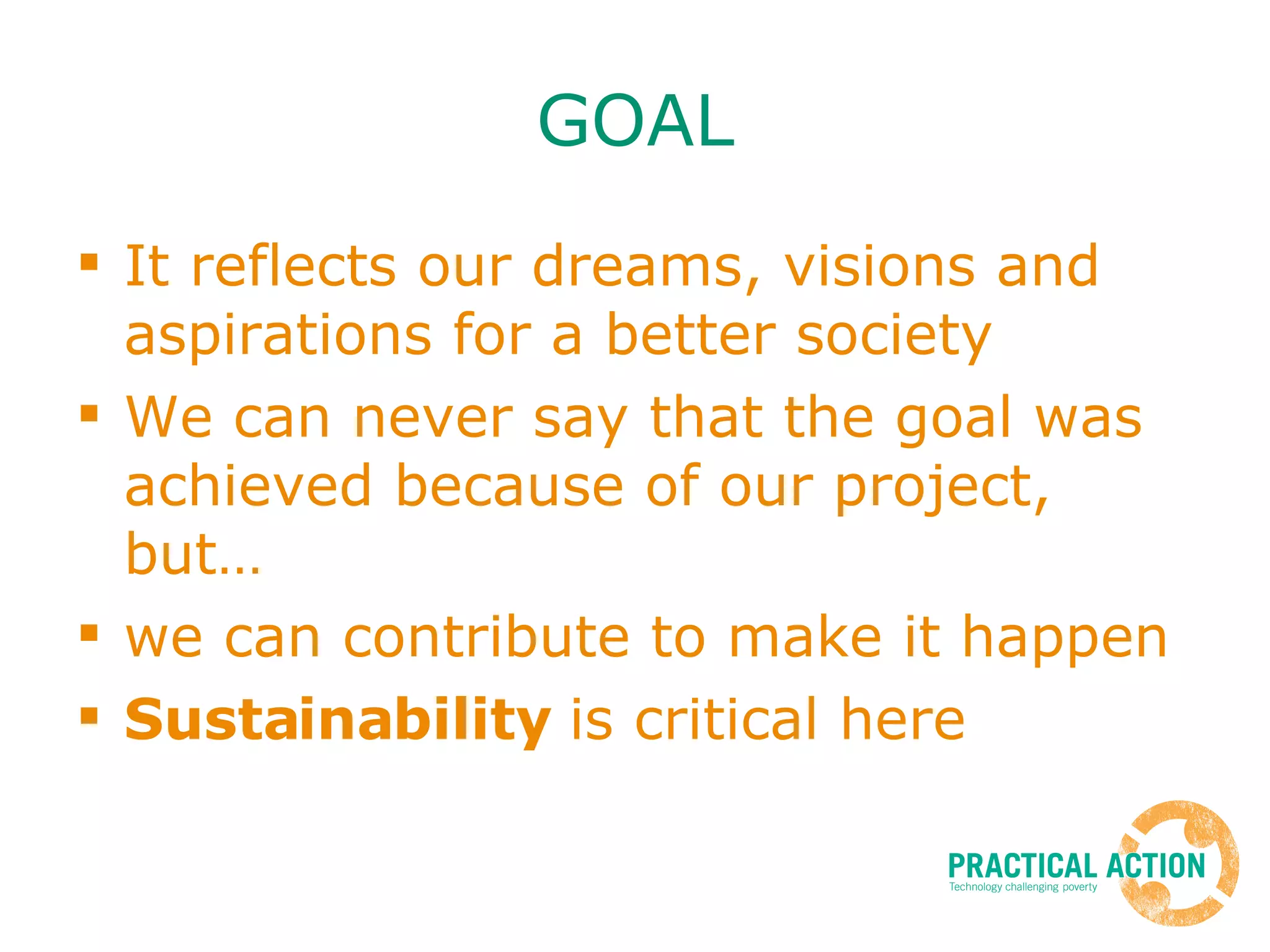
    10. GOAL
      • It reflects our dreams, visions and aspirations for a better society
      • We can never say that the goal was achieved because of our project, but…
      • we can contribute to make it happen
      • Sustainability is critical here
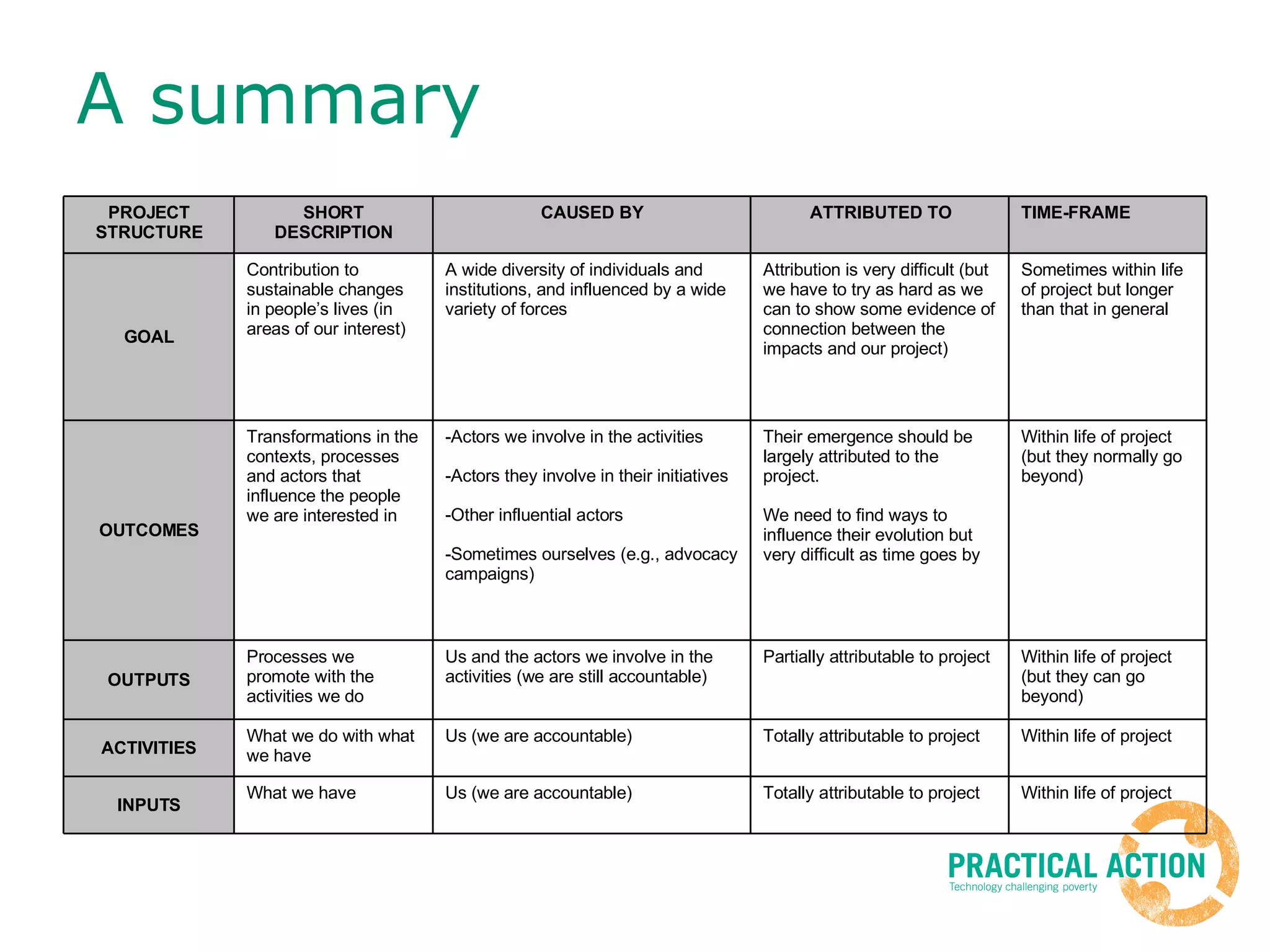
    11. A summary Within life of project Totally attributable to project Us (we are accountable) What we have INPUTS Within life of project Totally attributable to project Us (we are accountable) What we do with what we have ACTIVITIES Within life of project (but they can go beyond) Partially attributable to project Us and the actors we involve in the activities (we are still accountable) Processes we promote with the activities we do OUTPUTS Within life of project (but they normally go beyond) Their emergence should be largely attributed to the project. We need to find ways to influence their evolution but very difficult as time goes by
      • Actors we involve in the activities
      • Actors they involve in their initiatives
      • Other influential actors
      • Sometimes ourselves (e.g., advocacy campaigns)
      Transformations in the contexts, processes and actors that influence the people we are interested in OUTCOMES Sometimes within life of project but longer than that in general Attribution is very difficult (but we have to try as hard as we can to show some evidence of connection between the impacts and our project) A wide diversity of individuals and institutions, and influenced by a wide variety of forces Contribution to sustainable changes in people’s lives (in areas of our interest) GOAL TIME-FRAME ATTRIBUTED TO CAUSED BY SHORT DESCRIPTION PROJECT STRUCTURE
    12. SECTION 2 LOGICAL FRAMEWORK: Putting the project in one page
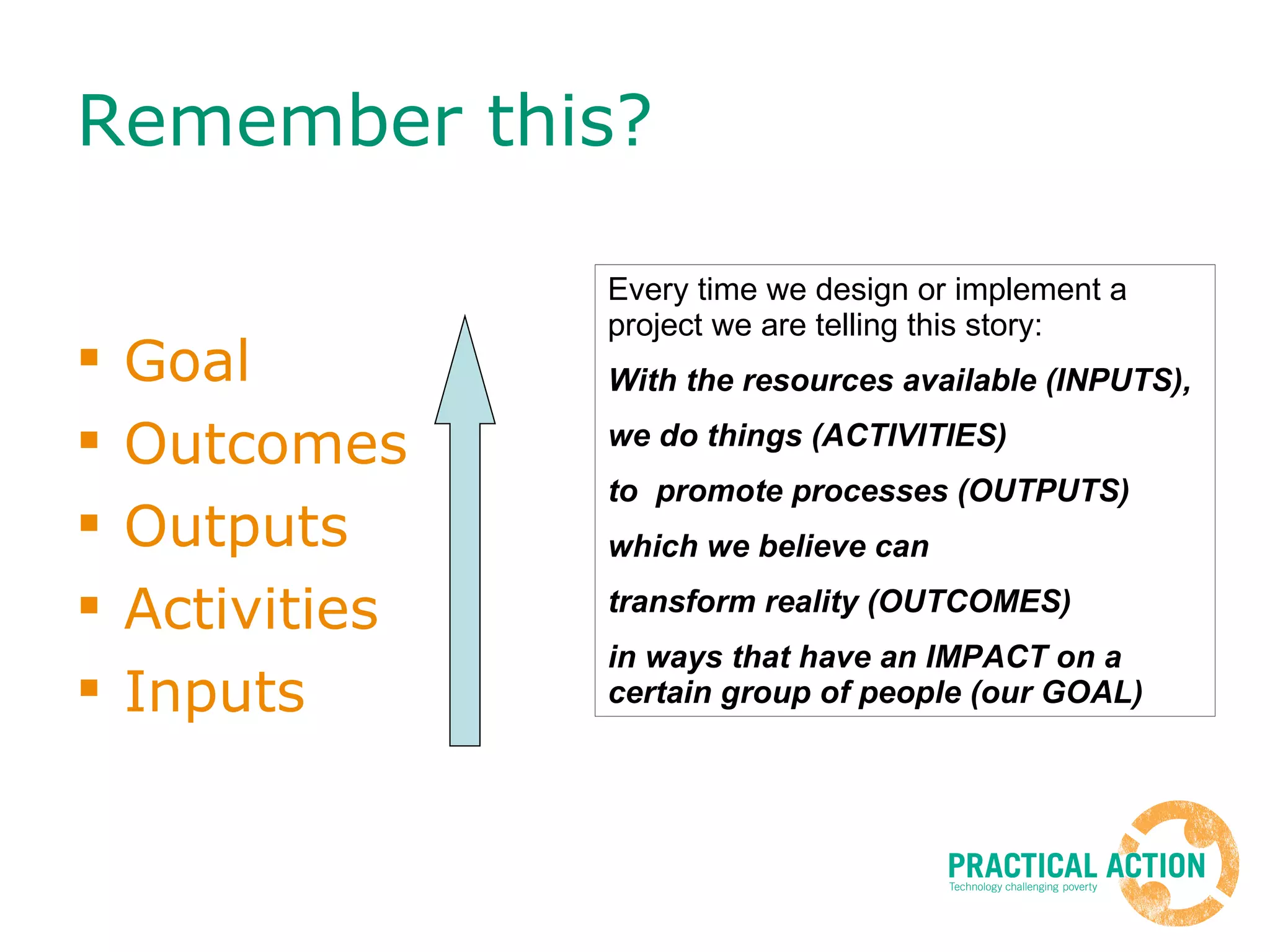
    13. Remember this?
      • Goal
      • Outcomes
      • Outputs
      • Activities
      • Inputs
      Every time we design or implement a project we are telling this story: With the resources available (INPUTS), we do things (ACTIVITIES) to promote processes (OUTPUTS) which we believe can transform reality (OUTCOMES) in ways that have an IMPACT on a certain group of people (our GOAL)
    14. Well…
      • A logframe is just a tool to tell the same story in a very simple, short and schematic way
      • It is not perfect (like any other tool) but we can use it to our advantage:
        • To help us filter out the ‘rubbish’ when we design a project (it promotes economic and simple design)
        • To help us communicate our ideas effectively and clearly to most donors
        • To monitor and evaluate the project
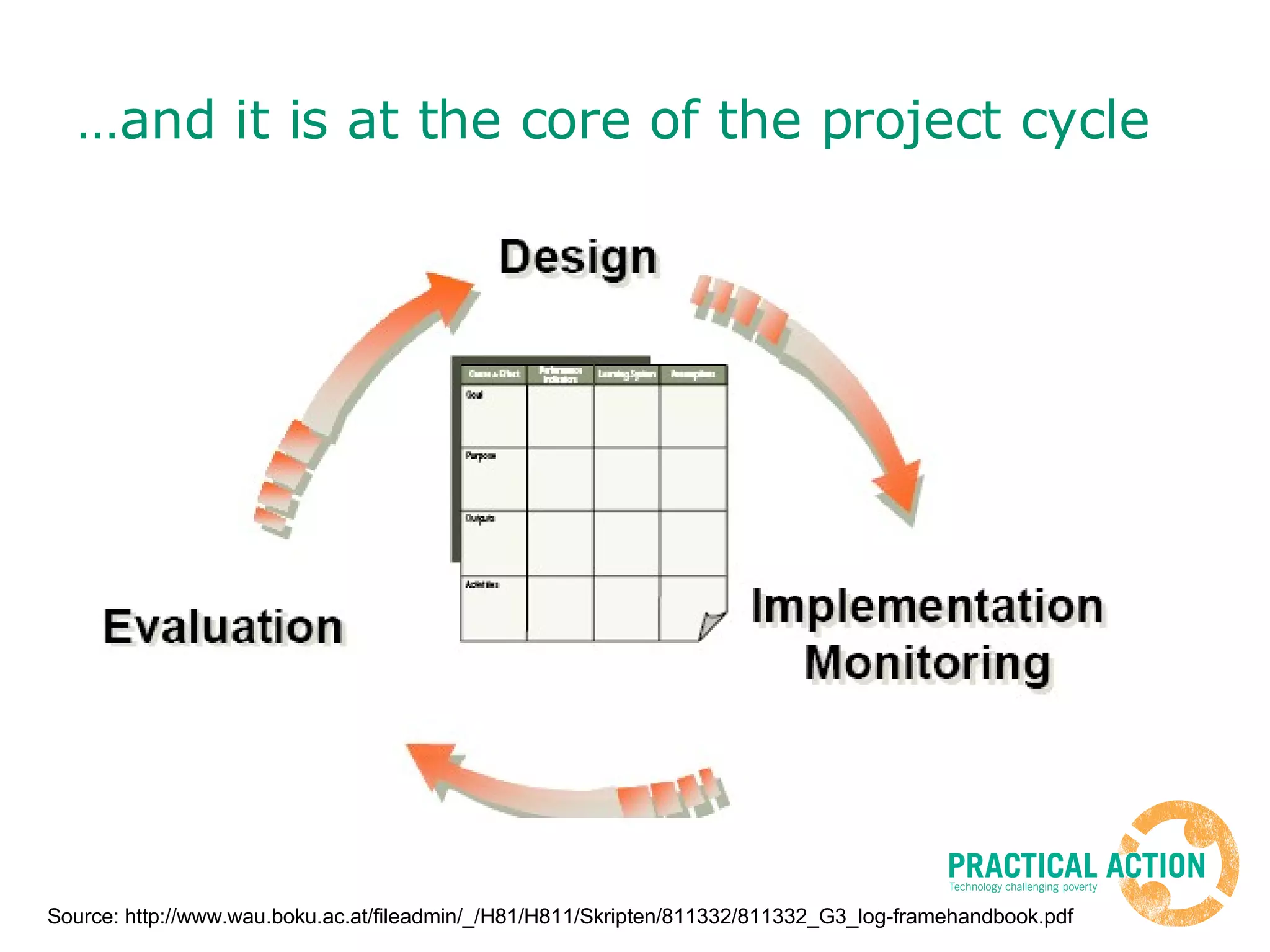
    15. … and it is at the core of the project cycle Source: http://www.wau.boku.ac.at/fileadmin/_/H81/H811/Skripten/811332/811332_G3_log-framehandbook.pdf
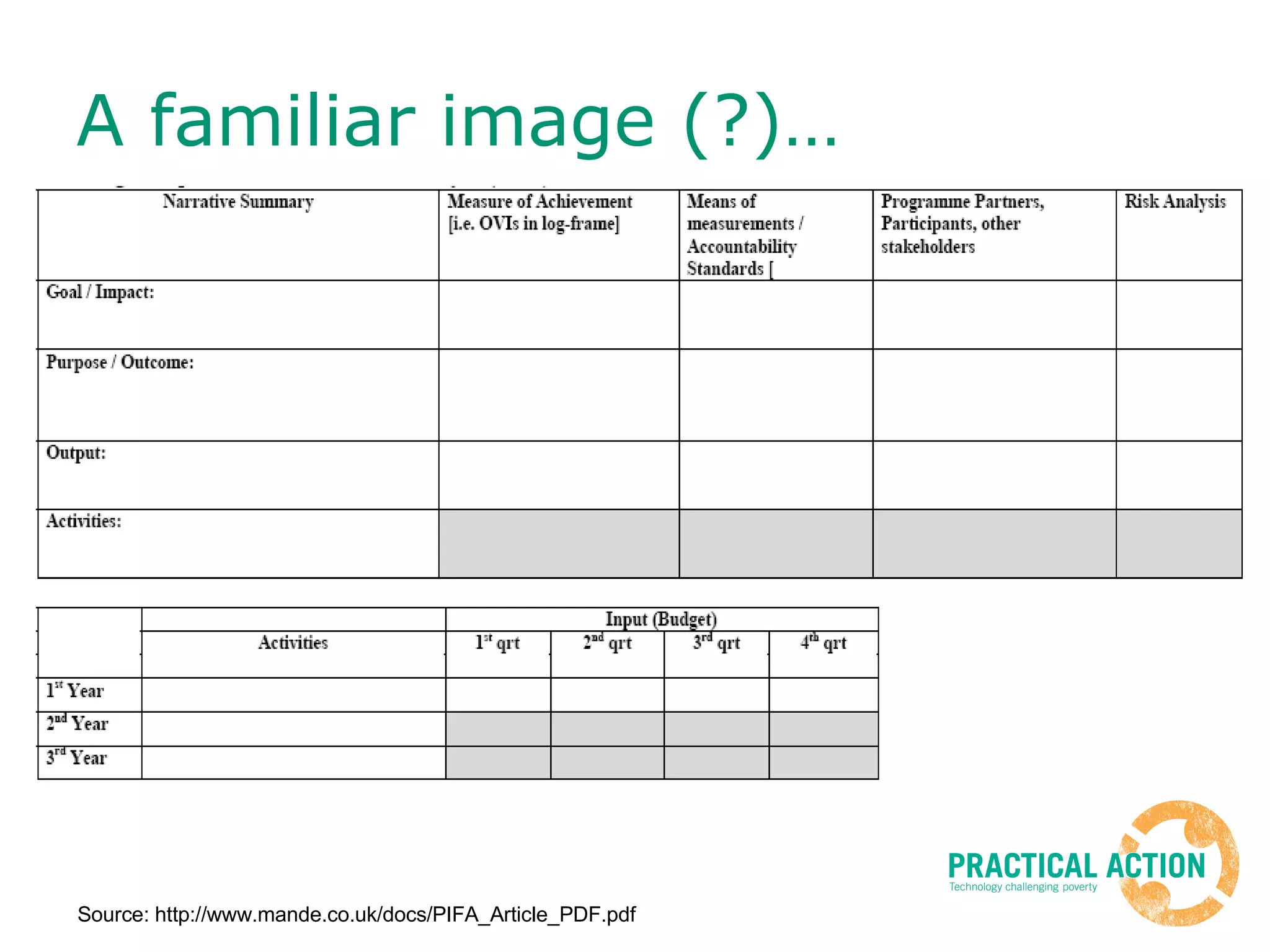
    16. A familiar image (?)… Source: http://www.mande.co.uk/docs/PIFA_Article_PDF.pdf
    17. SECTION 3 The Market Map: Backbone of the Impact Assessment Framework
    18. The Market Map model
      • A market is a complex and open system composed of market actors who are:
      • interacting through economic, social, political, and cultural relationships,
      • interested in a particular set of products or resources,
      • making the best they can with the skills, assets and resources they have available,
      • and influenced by contexts, issues and forces that affect their business decisions
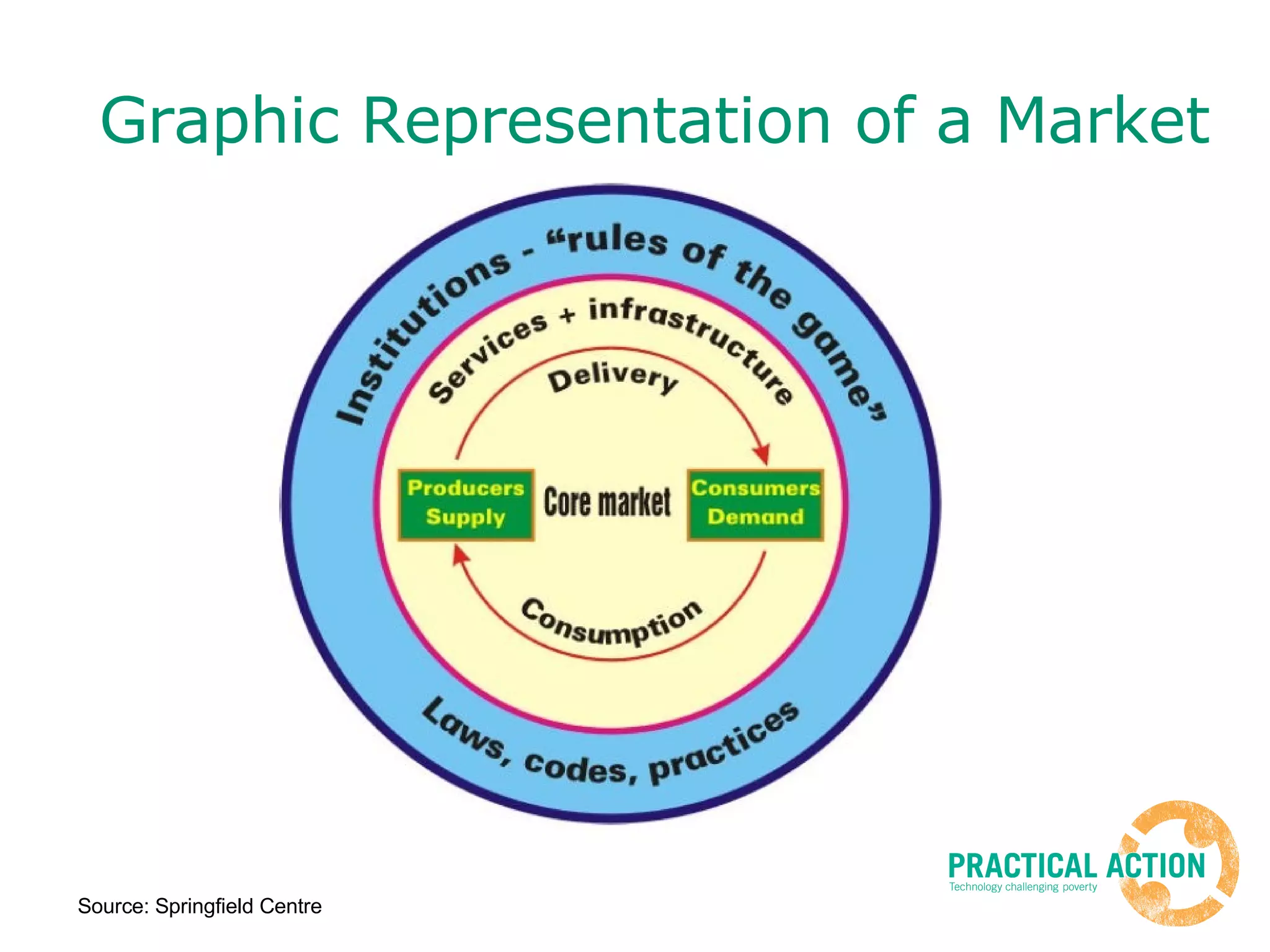
    19. Graphic Representation of a Market Source: Springfield Centre
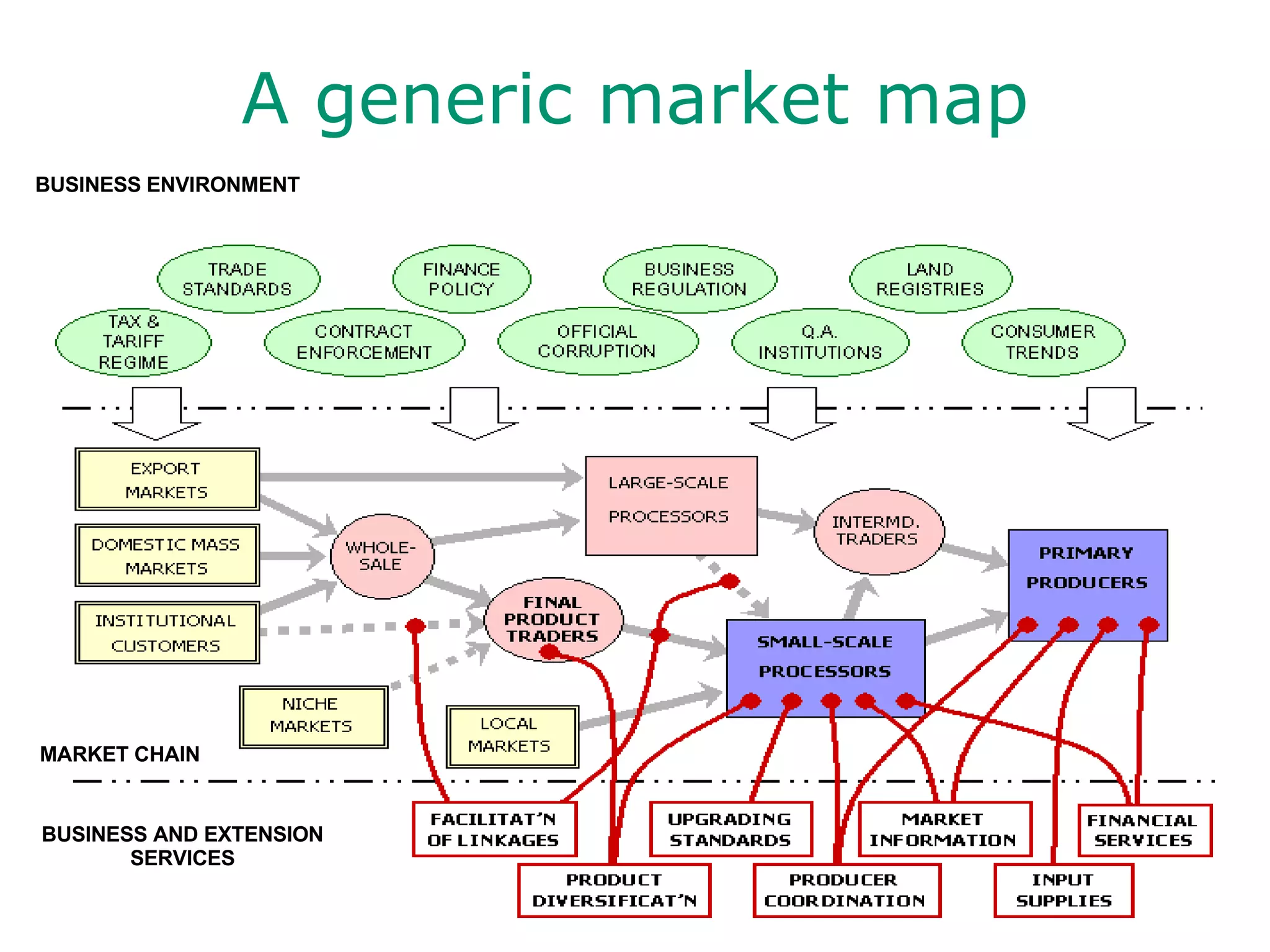
    20. A generic market map BUSINESS ENVIRONMENT MARKET CHAIN BUSINESS AND EXTENSION SERVICES
    21. SECTION 4 Our Intervention Approach: Participatory Market System Development -PMSD
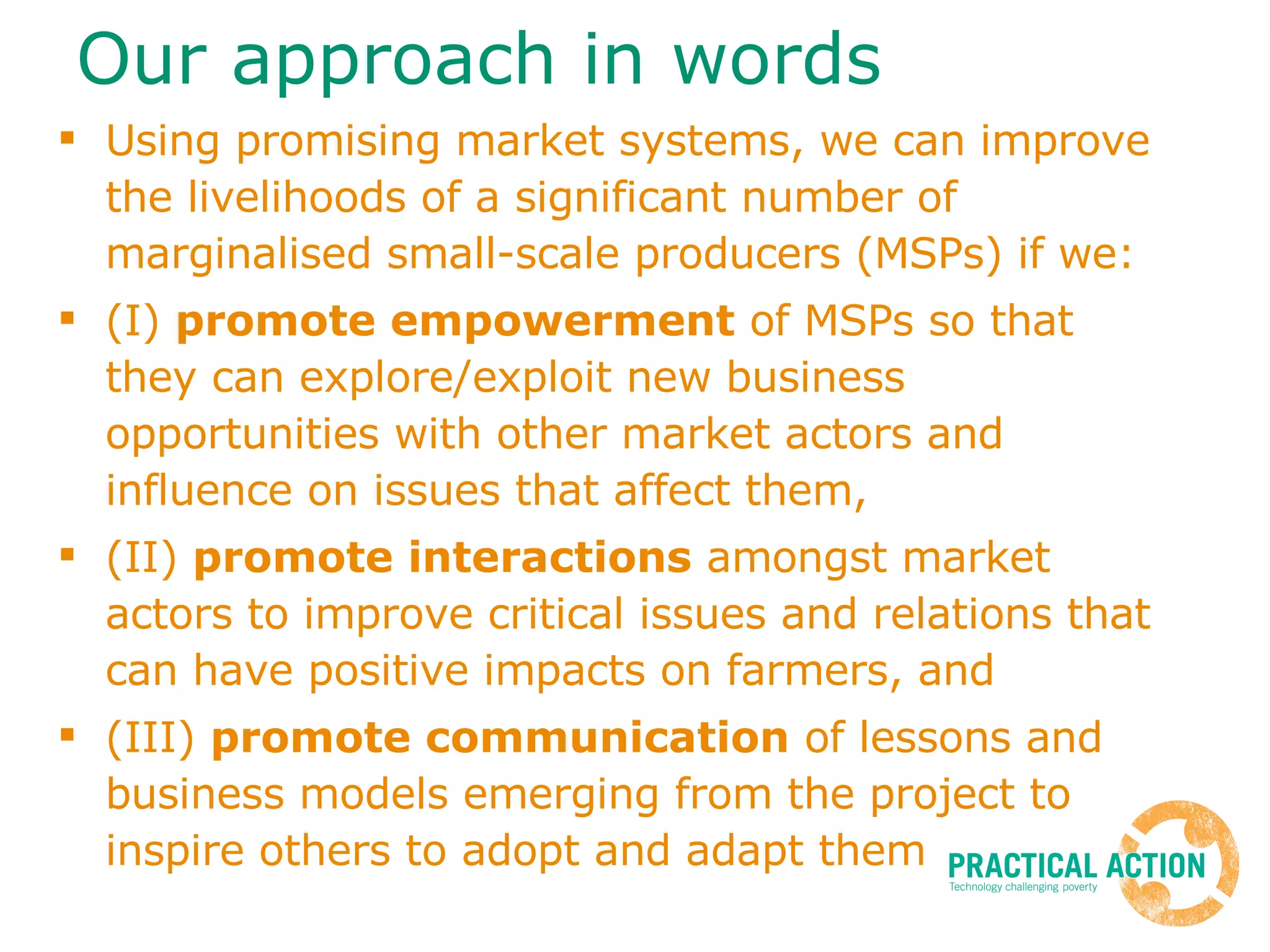
    22. Our approach in words
      • Using promising market systems, we can improve the livelihoods of a significant number of marginalised small-scale producers (MSPs) if we:
      • (I) promote empowerment of MSPs so that they can explore/exploit new business opportunities with other market actors and influence on issues that affect them,
      • (II) promote interactions amongst market actors to improve critical issues and relations that can have positive impacts on farmers, and
      • (III) promote communication of lessons and business models emerging from the project to inspire others to adopt and adapt them
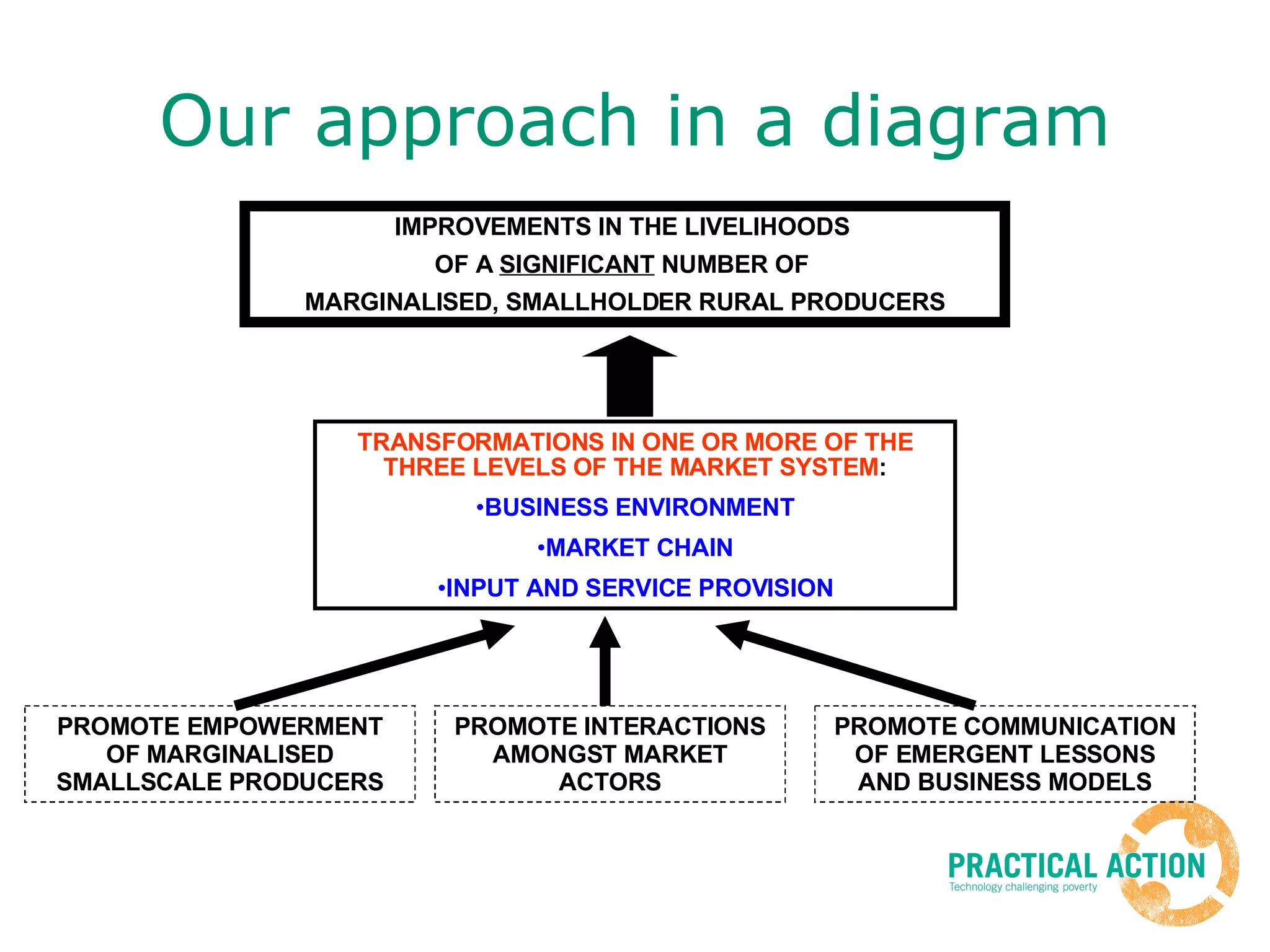
    23. Our approach in a diagram PROMOTE EMPOWERMENT OF MARGINALISED SMALLSCALE PRODUCERS PROMOTE INTERACTIONS AMONGST MARKET ACTORS PROMOTE COMMUNICATION OF EMERGENT LESSONS AND BUSINESS MODELS
      • TRANSFORMATIONS IN ONE OR MORE OF THE THREE LEVELS OF THE MARKET SYSTEM :
      • BUSINESS ENVIRONMENT
      • MARKET CHAIN
      • INPUT AND SERVICE PROVISION
      IMPROVEMENTS IN THE LIVELIHOODS OF A SIGNIFICANT NUMBER OF MARGINALISED, SMALLHOLDER RURAL PRODUCERS
    24. SECTION 5 Making sure our PMSD approach is effective -Monitoring and evaluating what we do-
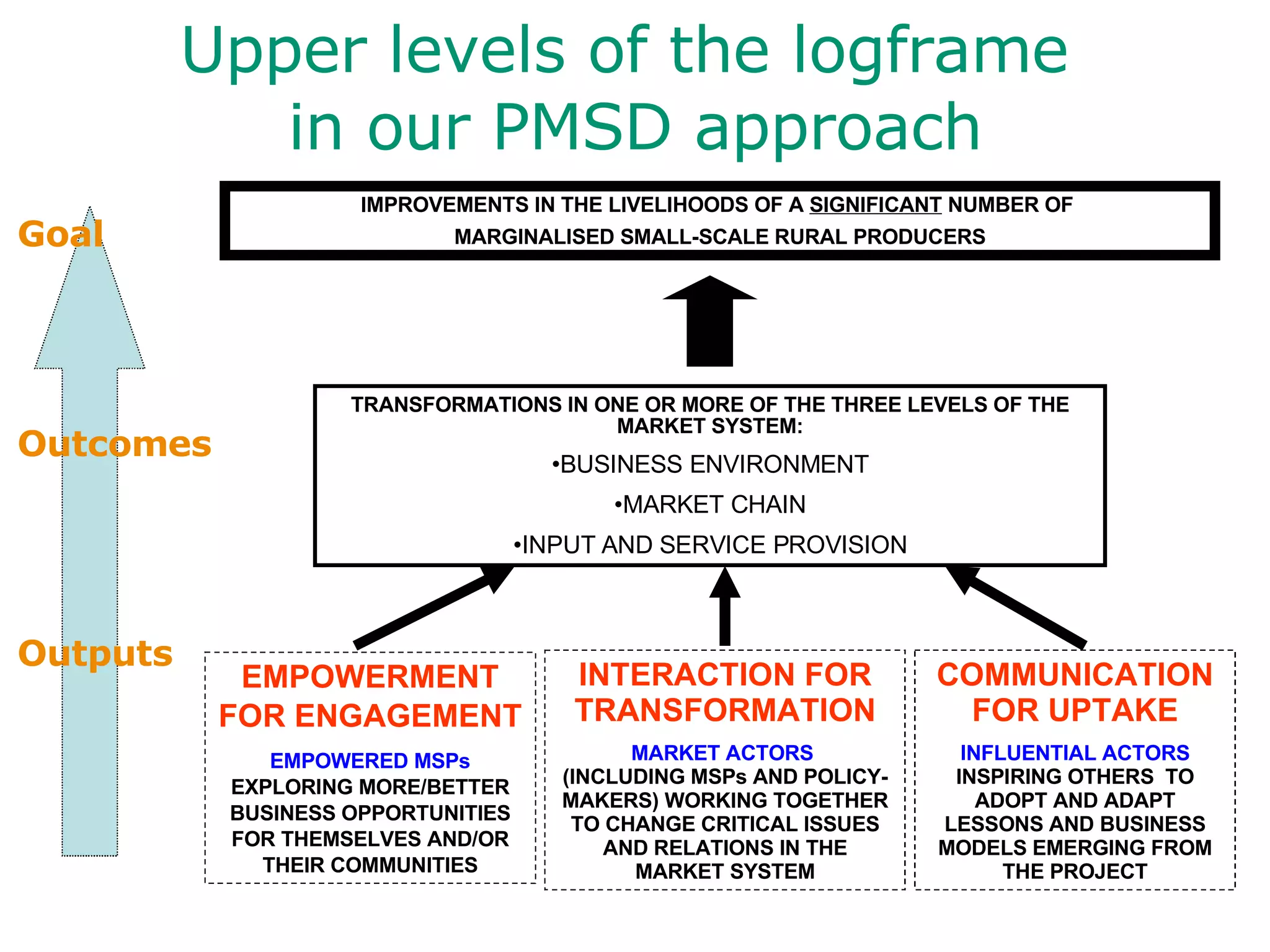
    25. Upper levels of the logframe in our PMSD approach
      • Goal
      • Outcomes
      • Outputs
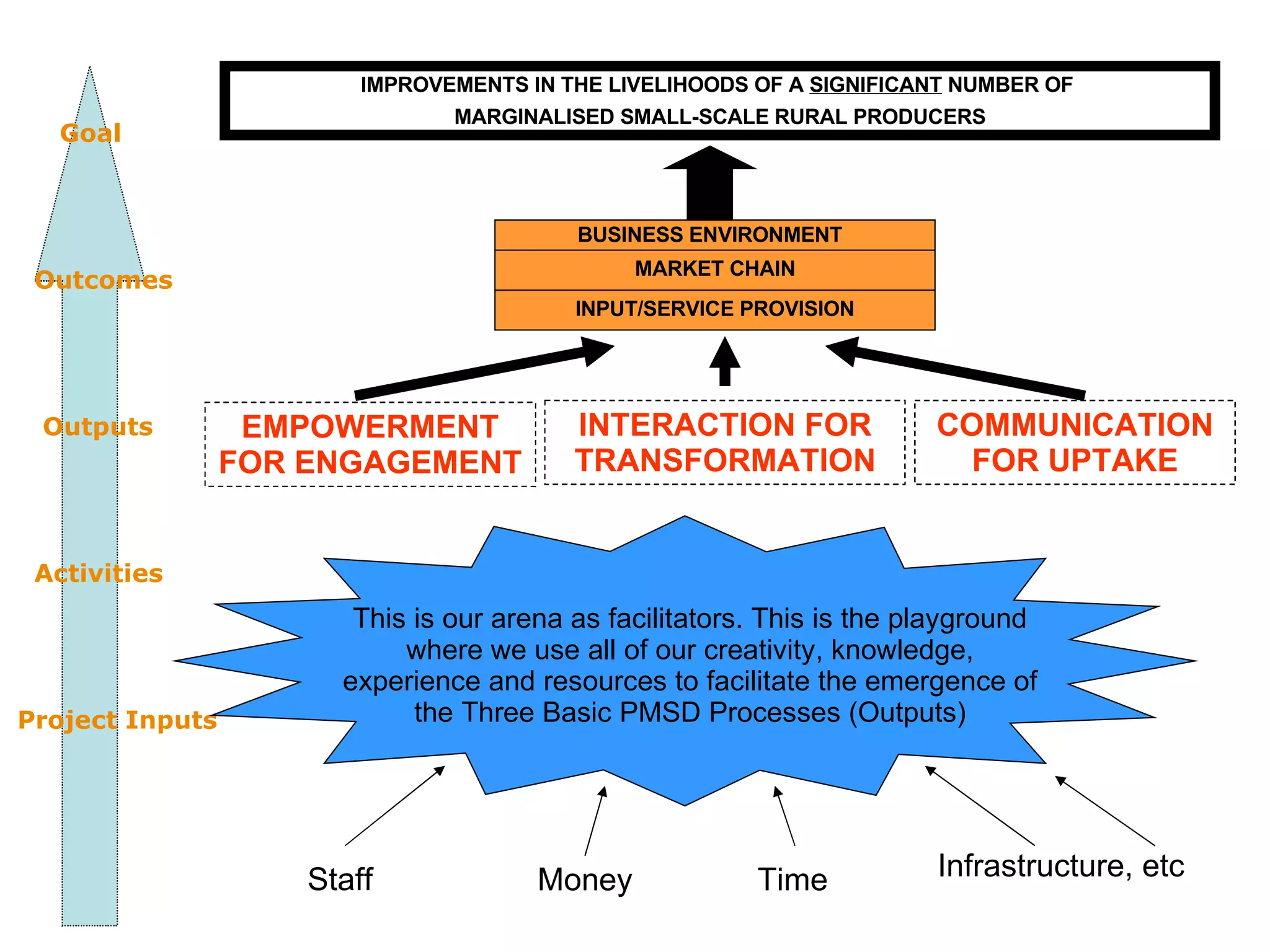
      EMPOWERMENT FOR ENGAGEMENT EMPOWERED MSPs EXPLORING MORE/BETTER BUSINESS OPPORTUNITIES FOR THEMSELVES AND/OR THEIR COMMUNITIES INTERACTION FOR TRANSFORMATION MARKET ACTORS (INCLUDING MSPs AND POLICY-MAKERS) WORKING TOGETHER TO CHANGE CRITICAL ISSUES AND RELATIONS IN THE MARKET SYSTEM
      • TRANSFORMATIONS IN ONE OR MORE OF THE THREE LEVELS OF THE MARKET SYSTEM:
      • BUSINESS ENVIRONMENT
      • MARKET CHAIN
      • INPUT AND SERVICE PROVISION
      IMPROVEMENTS IN THE LIVELIHOODS OF A SIGNIFICANT NUMBER OF MARGINALISED SMALL-SCALE RURAL PRODUCERS COMMUNICATION FOR UPTAKE INFLUENTIAL ACTORS INSPIRING OTHERS TO ADOPT AND ADAPT LESSONS AND BUSINESS MODELS EMERGING FROM THE PROJECT
      • Goal
      • Outcomes
      • Outputs
      • Activities
      • Project Inputs
      EMPOWERMENT FOR ENGAGEMENT INTERACTION FOR TRANSFORMATION IMPROVEMENTS IN THE LIVELIHOODS OF A SIGNIFICANT NUMBER OF MARGINALISED SMALL-SCALE RURAL PRODUCERS COMMUNICATION FOR UPTAKE BUSINESS ENVIRONMENT MARKET CHAIN INPUT/SERVICE PROVISION This is our arena as facilitators. This is the playground where we use all of our creativity, knowledge, experience and resources to facilitate the emergence of the Three Basic PMSD Processes (Outputs) Staff Money Time Infrastructure, etc
    26. Principles that guide our ACTIVITIES
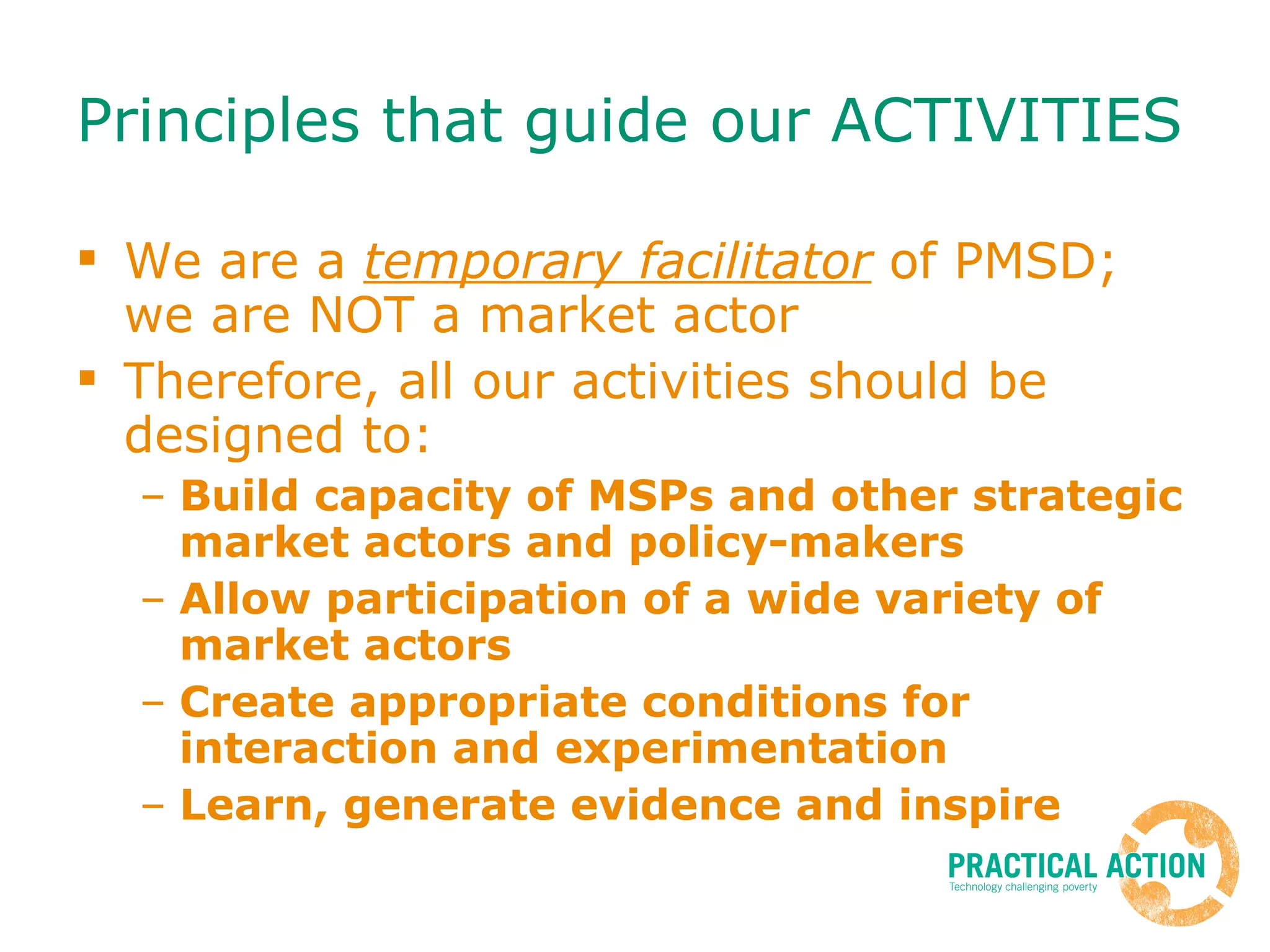
      • We are a temporary facilitator of PMSD; we are NOT a market actor
      • Therefore, all our activities should be designed to:
        • Build capacity of MSPs and other strategic market actors and policy-makers
        • Allow participation of a wide variety of market actors
        • Create appropriate conditions for interaction and experimentation
        • Learn, generate evidence and inspire
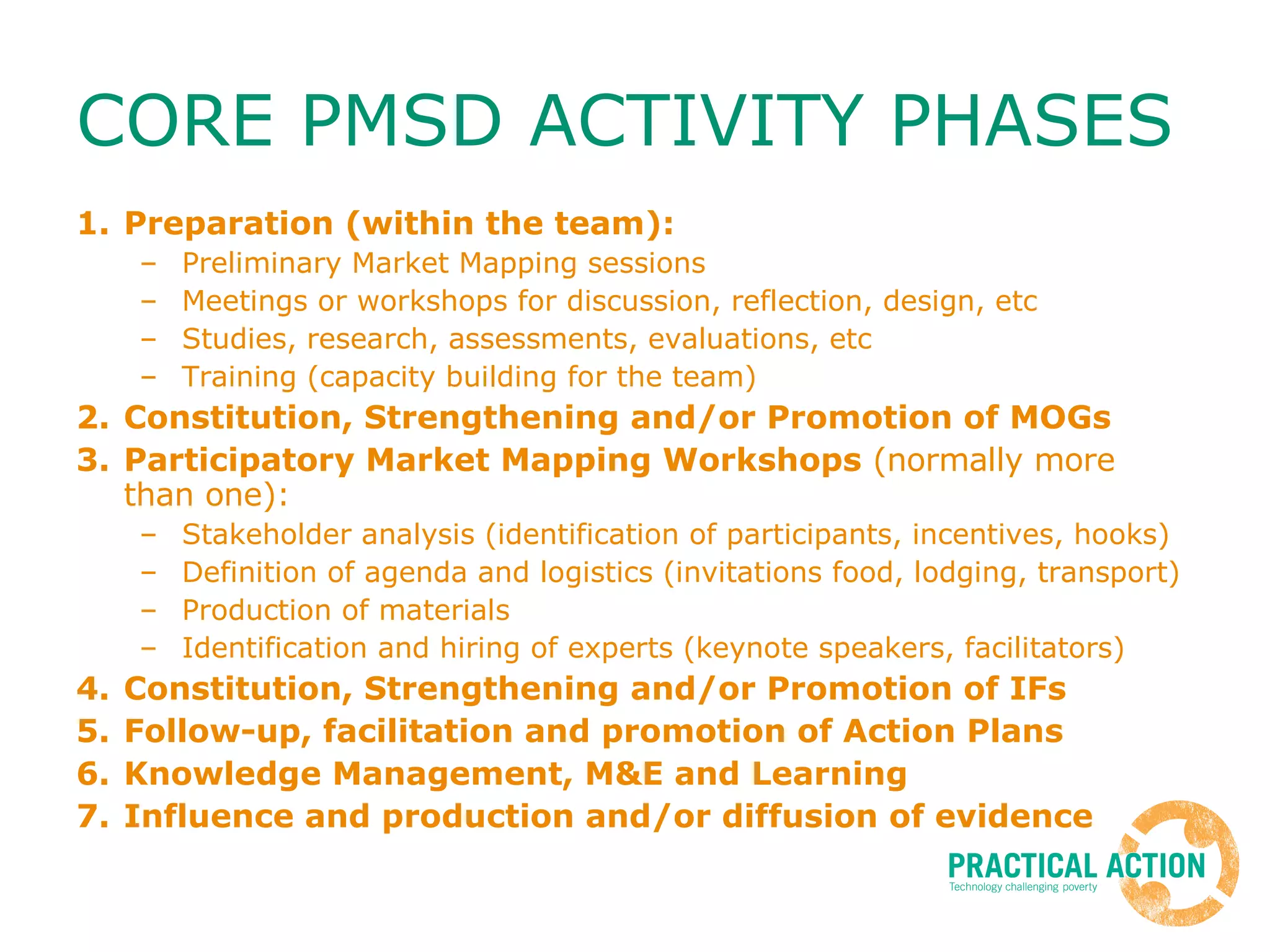
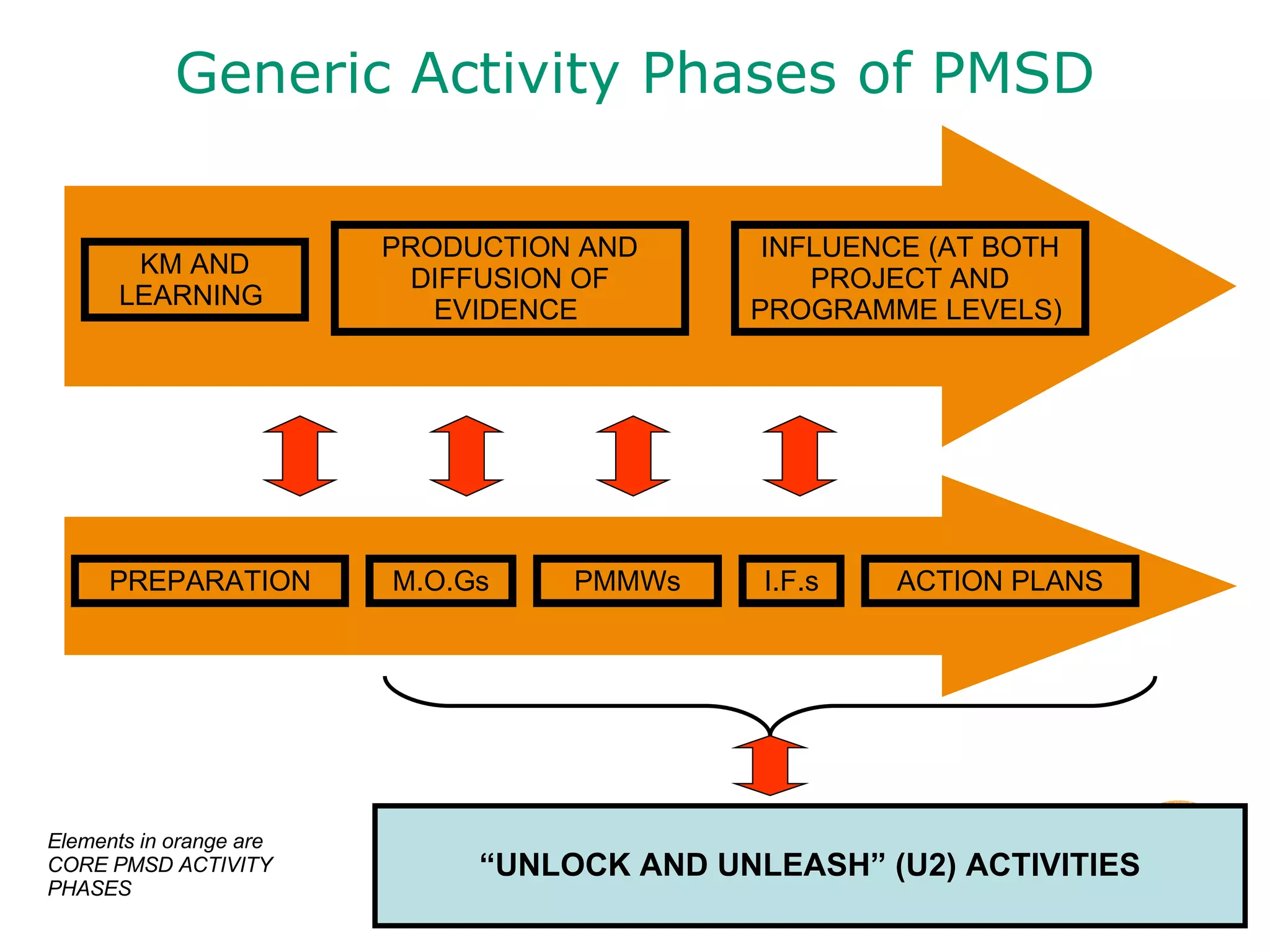
    27. CORE PMSD ACTIVITY PHASES
      • Preparation (within the team):
        • Preliminary Market Mapping sessions
        • Meetings or workshops for discussion, reflection, design, etc
        • Studies, research, assessments, evaluations, etc
        • Training (capacity building for the team)
      • Constitution, Strengthening and/or Promotion of MOGs
      • Participatory Market Mapping Workshops (normally more than one):
        • Stakeholder analysis (identification of participants, incentives, hooks)
        • Definition of agenda and logistics (invitations food, lodging, transport)
        • Production of materials
        • Identification and hiring of experts (keynote speakers, facilitators)
      • Constitution, Strengthening and/or Promotion of IFs
      • Follow-up, facilitation and promotion of Action Plans
      • Knowledge Management, M&E and Learning
      • Influence and production and/or diffusion of evidence
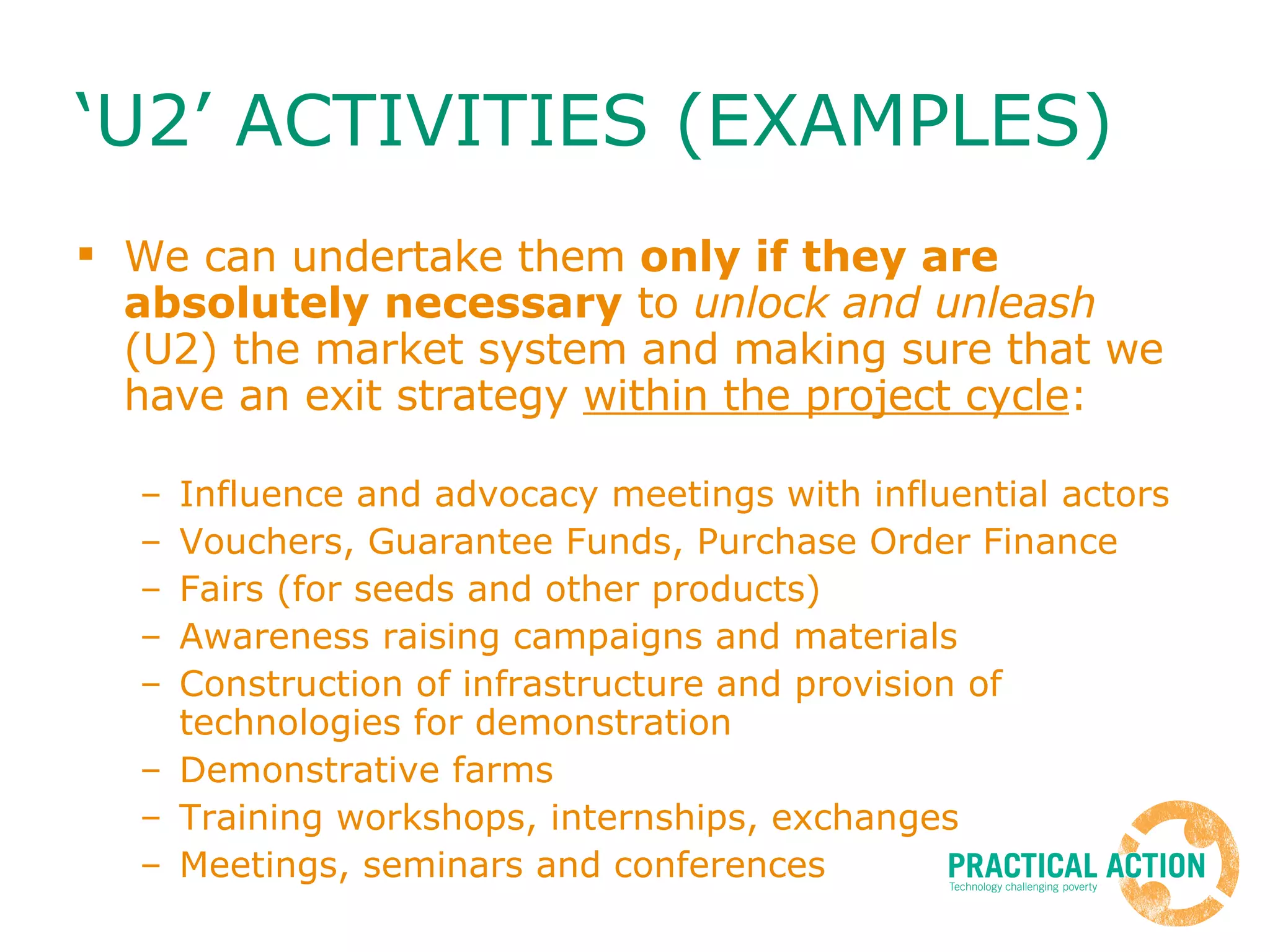
    28. ‘U2’ ACTIVITIES (EXAMPLES)
      • We can undertake them only if they are absolutely necessary to unlock and unleash (U2) the market system and making sure that we have an exit strategy within the project cycle :
        • Influence and advocacy meetings with influential actors
        • Vouchers, Guarantee Funds, Purchase Order Finance
        • Fairs (for seeds and other products)
        • Awareness raising campaigns and materials
        • Construction of infrastructure and provision of technologies for demonstration
        • Demonstrative farms
        • Training workshops, internships, exchanges
        • Meetings, seminars and conferences
    29. Generic Activity Phases of PMSD “ UNLOCK AND UNLEASH” (U2) ACTIVITIES KM AND LEARNING PRODUCTION AND DIFFUSION OF EVIDENCE INFLUENCE (AT BOTH PROJECT AND PROGRAMME LEVELS) Elements in orange are CORE PMSD ACTIVITY PHASES PREPARATION M.O.Gs PMMWs I.F.s ACTION PLANS
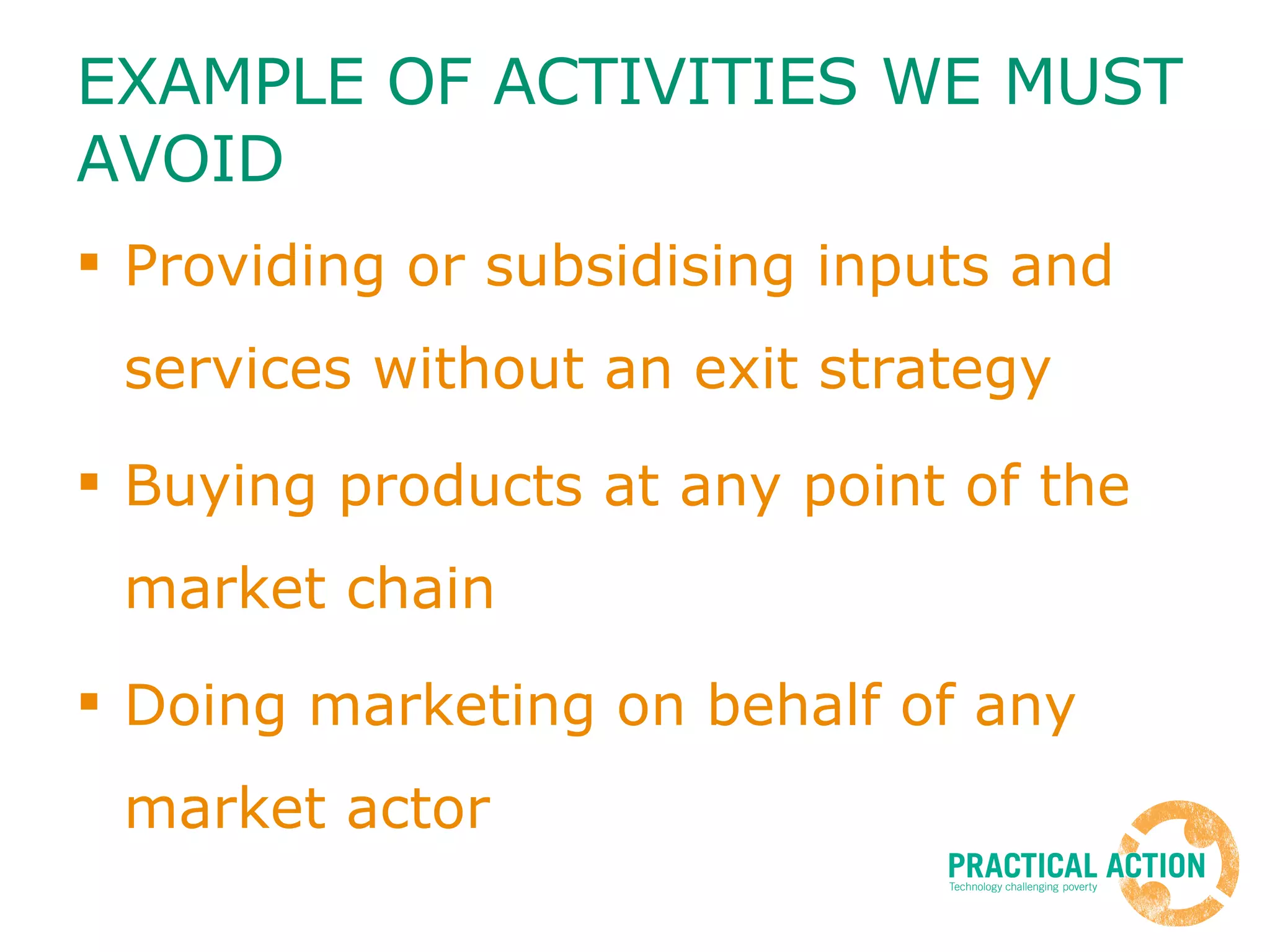
    30. EXAMPLE OF ACTIVITIES WE MUST AVOID
      • Providing or subsidising inputs and services without an exit strategy
      • Buying products at any point of the market chain
      • Doing marketing on behalf of any market actor
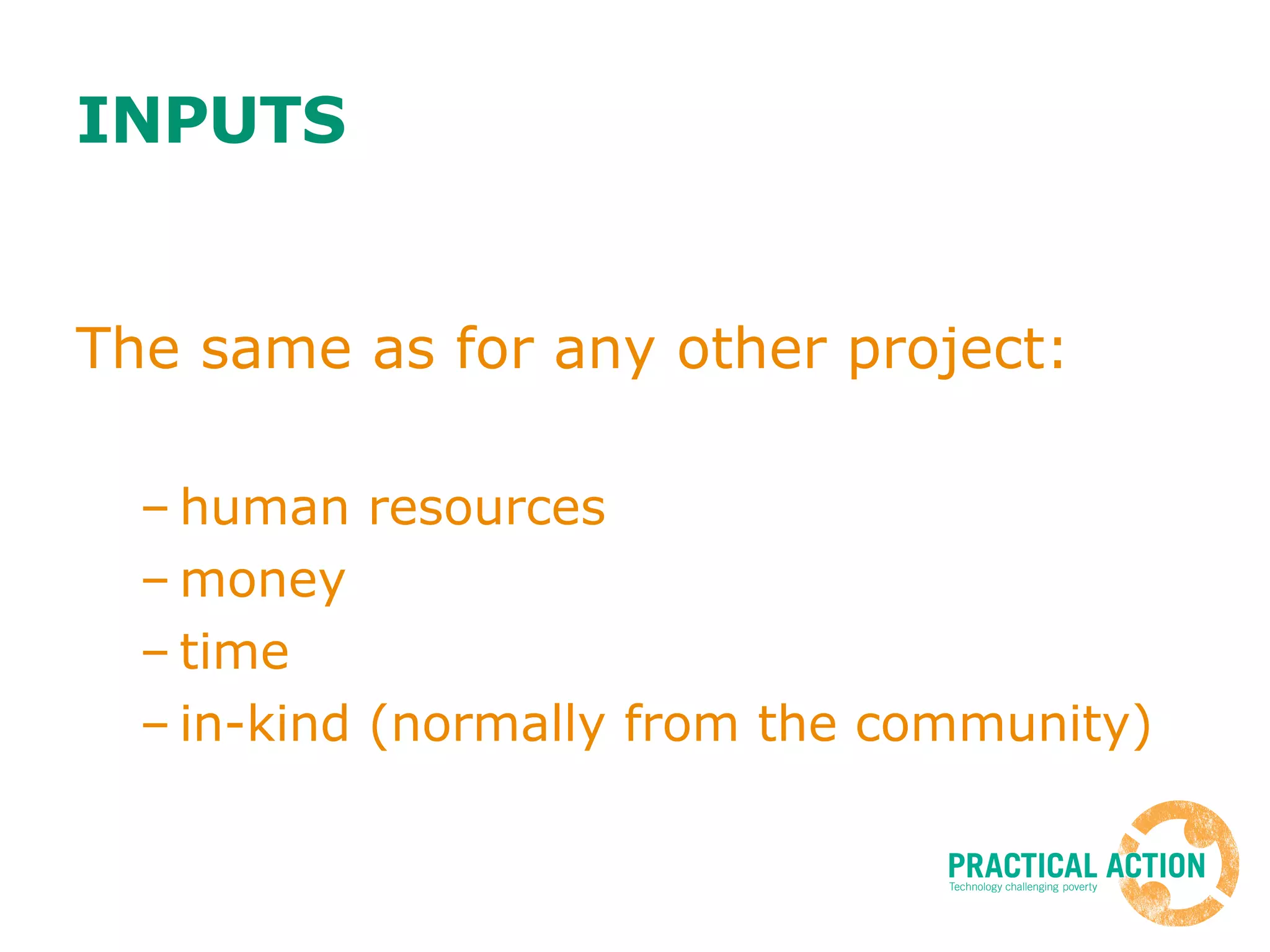
    31. INPUTS
      • The same as for any other project:
        • human resources
        • money
        • time
        • in-kind (normally from the community)
    32. SECTION 6 Indicators: telling a ‘good’ story
    33. WHAT ARE INDICATORS?
      • Indicators tell us whether things are happening in the project
      • Indicators are the main elements that allow us to share the project with others and convince them of its benefits
      • They also tell us when things are not going well or as expected
    34. DOING ‘SMART’ M&E
      • An M&E system (and the indicators it relies on) should be:
        • S pecific
        • M easurable
        • A chievable and Attributable
        • R elevant and Realistic
        • T ime-bound, Timely, Trackable, and Targeted
    35. SECTION 6 Case study: The livestock project in Kassala (Sudan) – Wellcome Trust
    36. Introduction
      • The Wellcome Trust is a very demanding donor: since 2003, in six different occasions, Practical Action applied to their funds without any success
      • This project was designed taking into account our most updated PMSD model and international experiences
      • The project was approved in 2005
    37. REMEMBER THIS?
      • The GOAL reflects our dreams, visions and aspirations for a better society
      • We can never say that the goal was achieved because of our project, but…
      • we can contribute to make it happen
      • Sustainability is critical here
    38. PROJECT GOAL
      • To contribute to
      • the long-term improvement
      • of the livelihoods and well-being
      • of 220,000 marginalised pastoralists
      • in the state of Kassala in Eastern Sudan
    39. REMEMBER THIS?
      • OUTCOMES are the transformations we believe will occur in the world because of the processes we promote
      • THE WORLD WE ARE INTERESTED IN IS THE MARKET SYSTEM (AROUND A SPECIFIC SUBSECTOR)
    40. PROJECT OUTCOME 1
      • BUSINESS ENVIRONMENT (influence and representation):
      • “To increase the organisation and political influence of the pastoralists around issues related to animal health and livestock markets at the local level, and improve their linkages with other stakeholders in the livestock subsector”
    41. PROJECT OUTCOME 2
      • MARKET CHAIN (livestock market chain productivity):
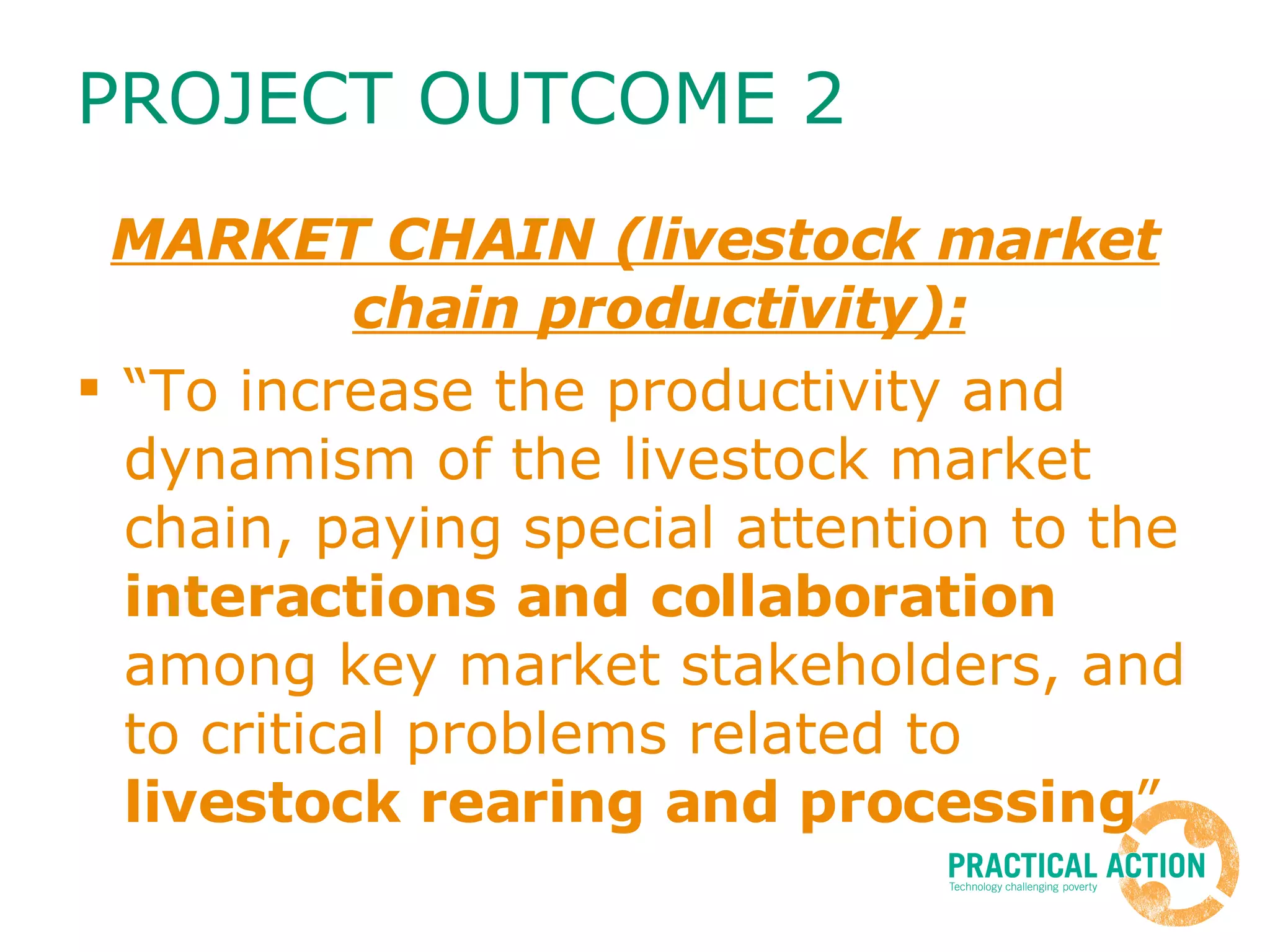
      • “To increase the productivity and dynamism of the livestock market chain, paying special attention to the interactions and collaboration among key market stakeholders, and to critical problems related to livestock rearing and processing ”
    42. PROJECT OUTCOME 3
      • SERVICE PROVISION:
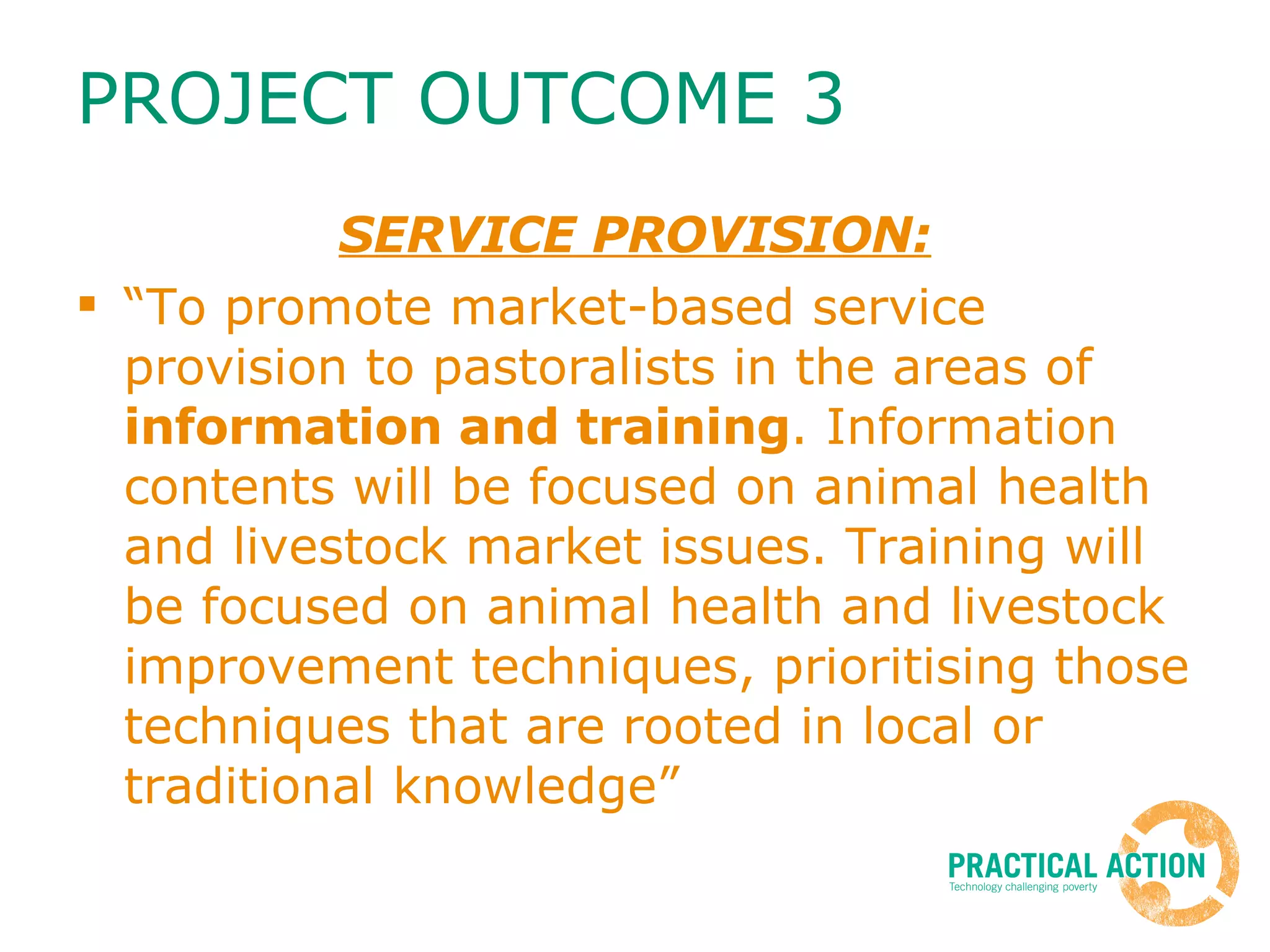
      • “ To promote market-based service provision to pastoralists in the areas of information and training . Information contents will be focused on animal health and livestock market issues. Training will be focused on animal health and livestock improvement techniques, prioritising those techniques that are rooted in local or traditional knowledge”
    43. REMEMBER THIS?
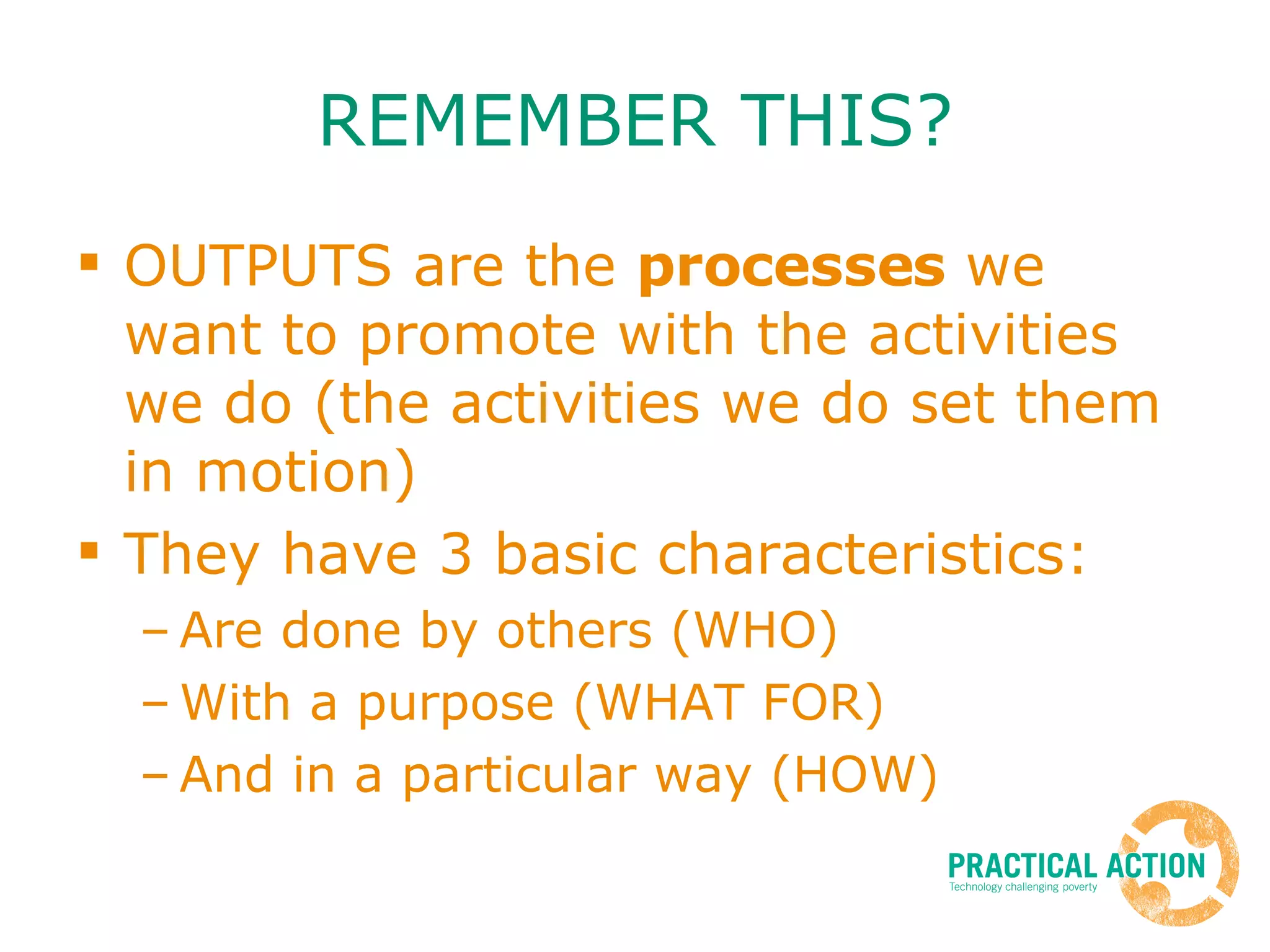
      • OUTPUTS are the processes we want to promote with the activities we do (the activities we do set them in motion)
      • They have 3 basic characteristics:
        • Are done by others (WHO)
        • With a purpose (WHAT FOR)
        • And in a particular way (HOW)
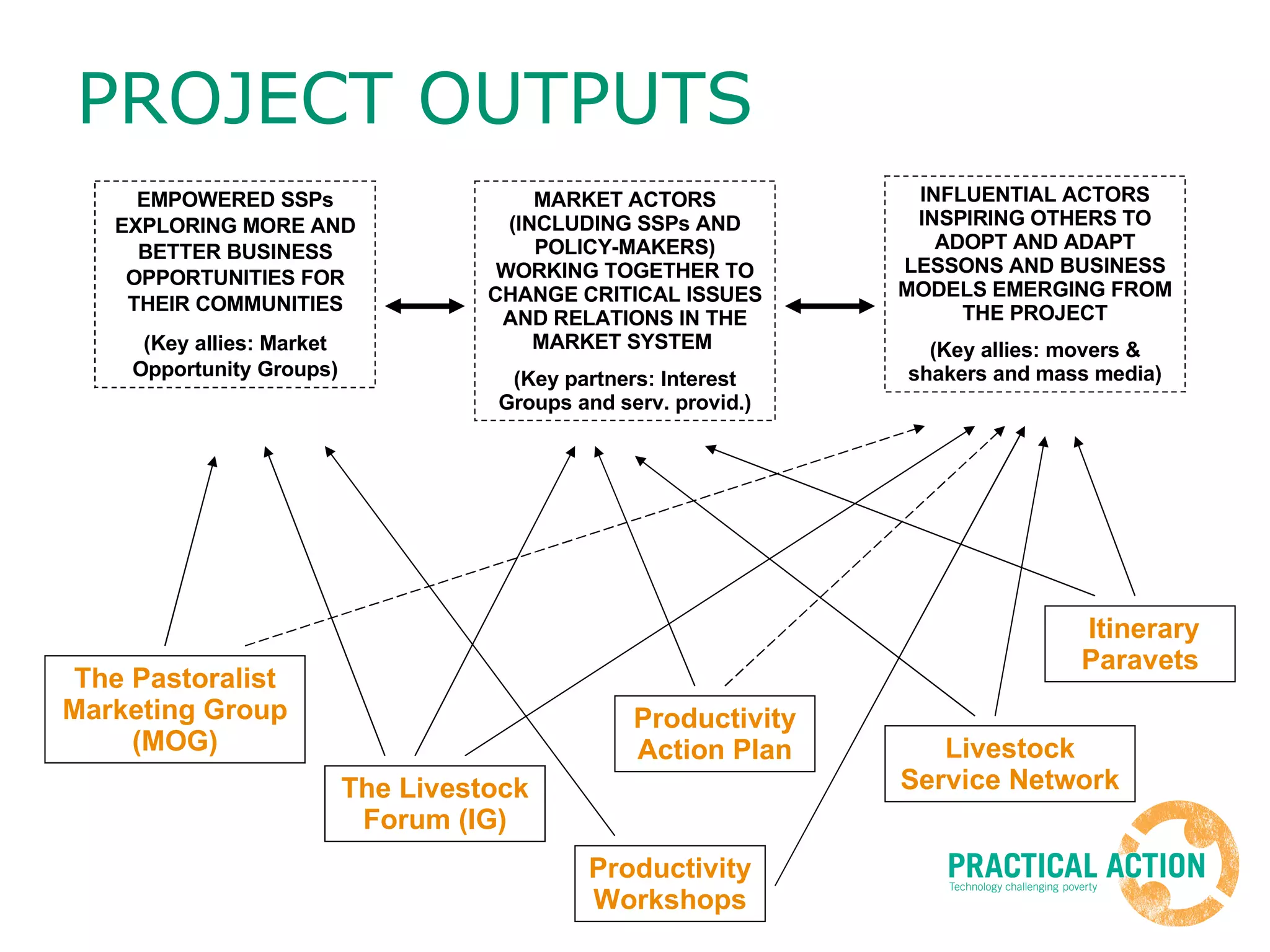
    44. PROJECT OUTPUTS EMPOWERED SSPs EXPLORING MORE AND BETTER BUSINESS OPPORTUNITIES FOR THEIR COMMUNITIES (Key allies: Market Opportunity Groups) MARKET ACTORS (INCLUDING SSPs AND POLICY-MAKERS) WORKING TOGETHER TO CHANGE CRITICAL ISSUES AND RELATIONS IN THE MARKET SYSTEM (Key partners: Interest Groups and serv. provid.) The Pastoralist Marketing Group (MOG) The Livestock Forum (IG) Productivity Action Plan Productivity Workshops Itinerary Paravets Livestock Service Network INFLUENTIAL ACTORS INSPIRING OTHERS TO ADOPT AND ADAPT LESSONS AND BUSINESS MODELS EMERGING FROM THE PROJECT (Key allies: movers & shakers and mass media)
    45. Productivity Workshops (example of OUTPUTS)
      • “ The project will create spaces for the pastoralists to discuss with their representatives in the Marketing Group about the early drafts and final version of the Productivity Action Plan. These workshops will be a communication mechanism that will increase the influence of the wider pastoralist communities in defining the Plan, which in turn is likely to become a mid-term navigation chart for a wide variety of stakeholders in the livestock subsector in Kassala”
    46. EXAMPLE OF A PROJECT ACTIVITY
      • These are the activities for the PRODUCTIVITY WORKSHOPS
        • Periodic workshops for pastoralists groups
        • Quarterly knowledge sharing visits of pastoralists to other peers
        • Periodic talks between pastoralists and researchers, practitioners and government officials
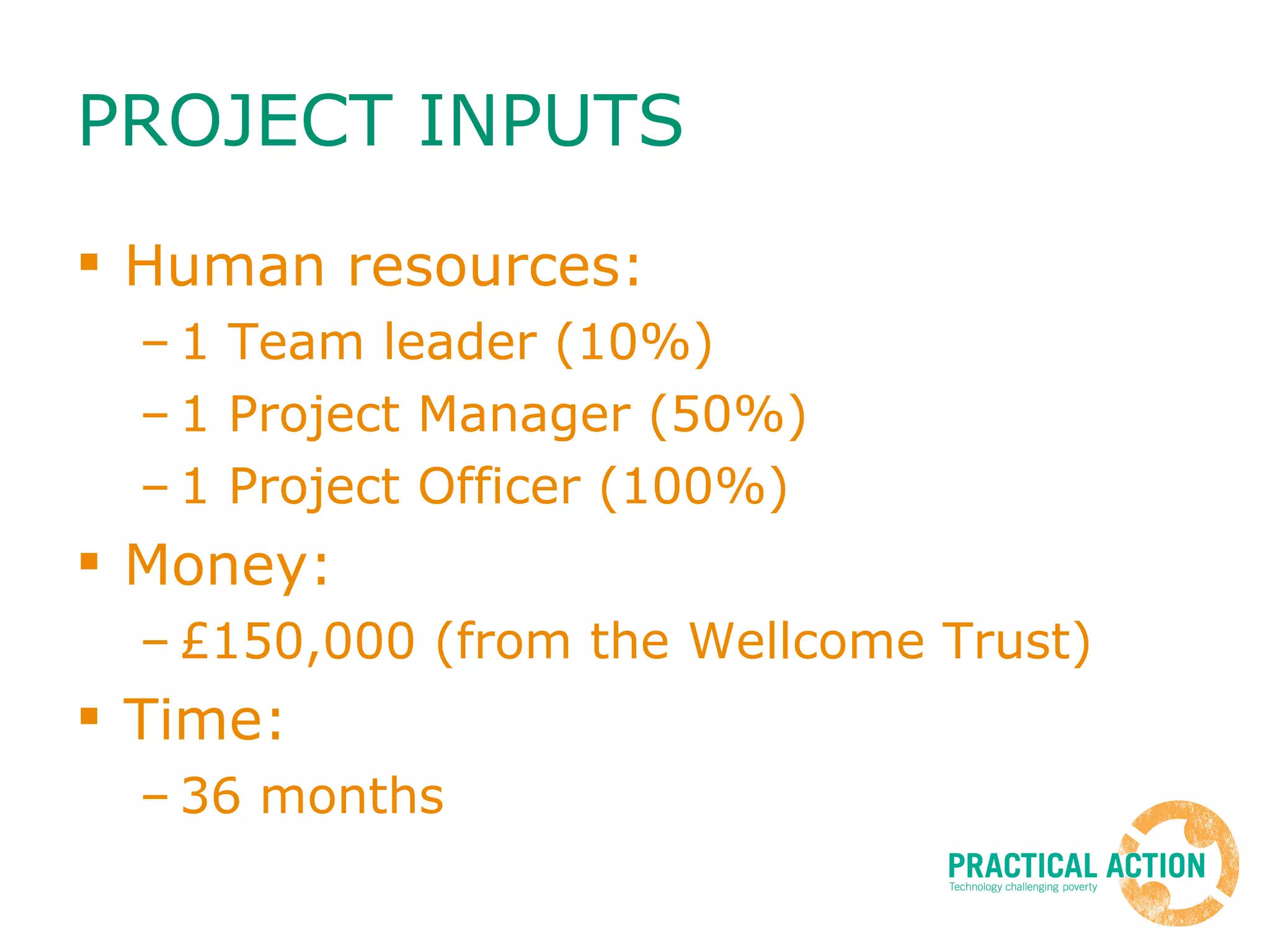
    47. PROJECT INPUTS
      • Human resources:
        • 1 Team leader (10%)
        • 1 Project Manager (50%)
        • 1 Project Officer (100%)
      • Money:
        • £150,000 (from the Wellcome Trust)
      • Time:
        • 36 months
    48. Thank you!
      • For comments and questions please contact Lucho Osorio (IA2 International Programme Coordinator) at:
      • [email_address]

    + luchokoolluchokool, 2 years ago

    custom

    1796 views, 2 favs, 2 embeds more stats

    More info about this document

    © All Rights Reserved

    Go to text version

    • Total Views 1796
      • 1780 on SlideShare
      • 16 from embeds
    • Comments 0
    • Favorites 2
    • Downloads 0
    Most viewed embeds
    • 14 views on http://portal-uk.itdg.org.uk
    • 2 views on http://pmsd.wikispaces.com

    more

    All embeds
    • 14 views on http://portal-uk.itdg.org.uk
    • 2 views on http://pmsd.wikispaces.com

    less

    Flagged as inappropriate Flag as inappropriate
    Flag as inappropriate

    Select your reason for flagging this presentation as inappropriate. If needed, use the feedback form to let us know more details.

    Cancel
    File a copyright complaint
    Having problems? Go to our helpdesk?

    Categories