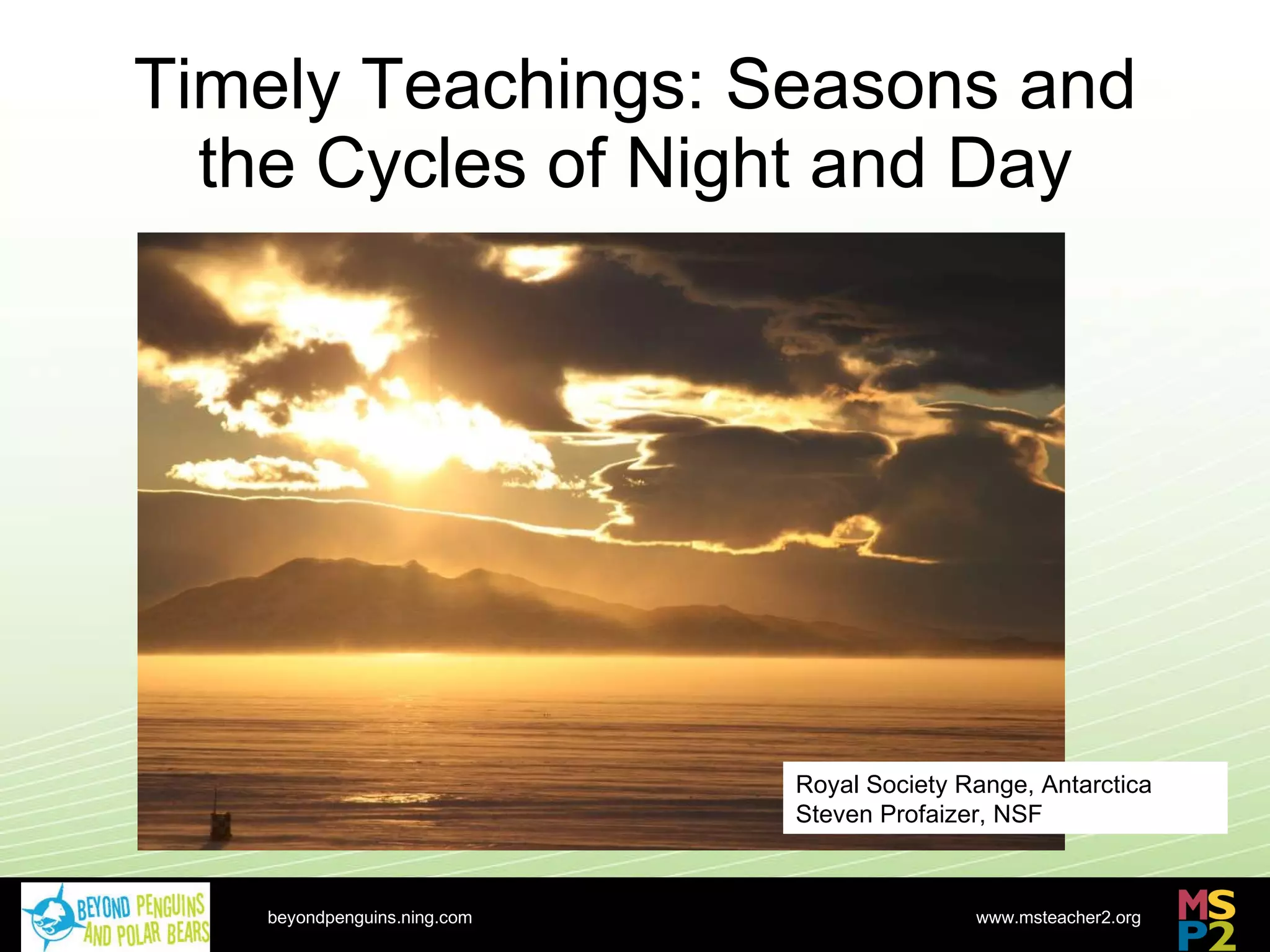
Timely Teachings: Seasons and the Cycles of Night and Day beyondpenguins.ning.com Royal Society Range, Antarctica Steven Profaizer, NSF
Jessica Fries-Gaither Project Director, Beyond Penguins and Polar Bears, and Education Resource Specialist with The Ohio State University beyondpenguins.ning.com About Us Kimberly Lightle Director, Digital Libraries The Ohio State University
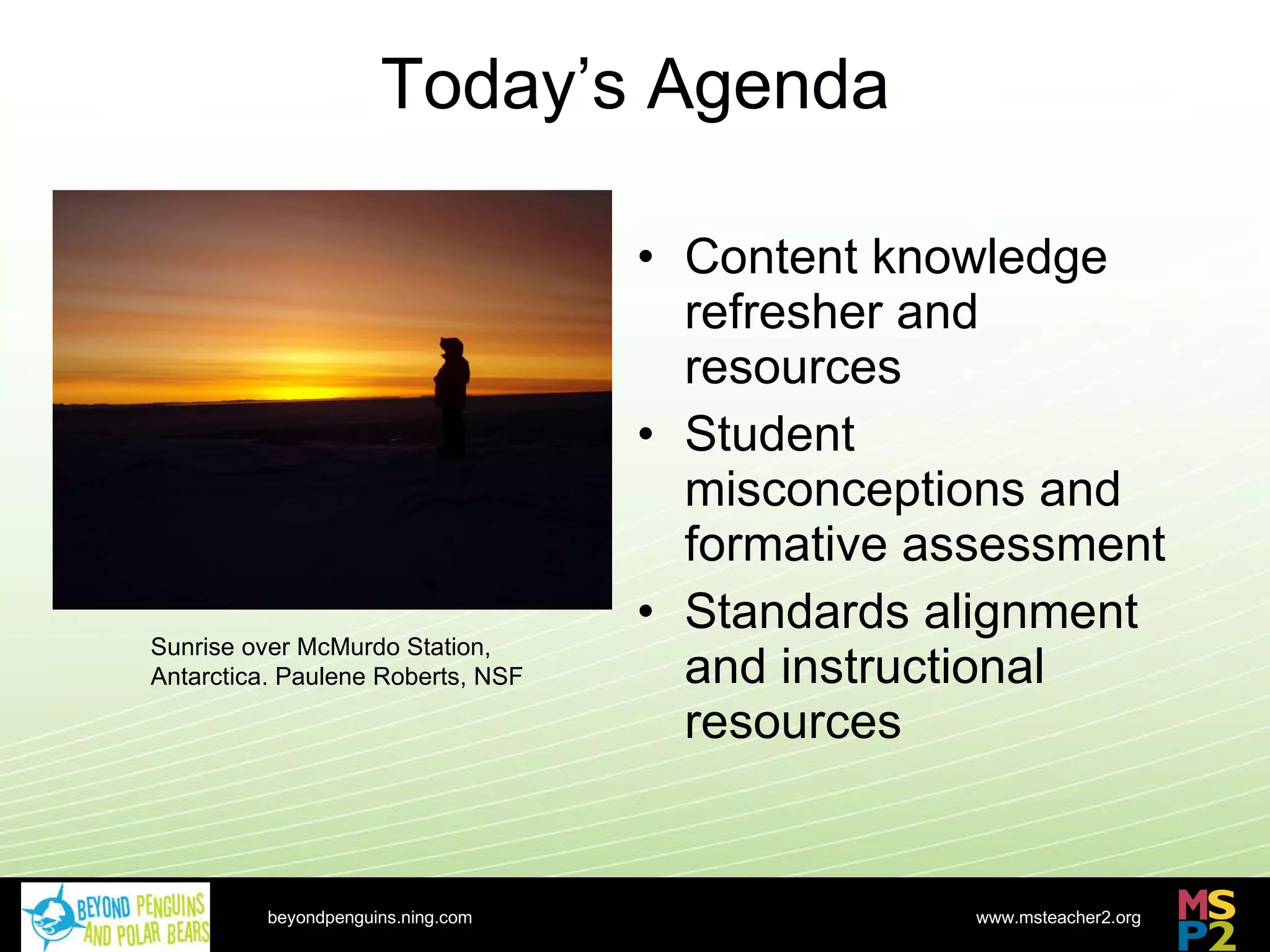
Today’s Agenda Content knowledge refresher and resources Student misconceptions and formative assessment Standards alignment and instructional resources beyondpenguins.ning.com Sunrise over McMurdo Station, Antarctica. Paulene Roberts, NSF
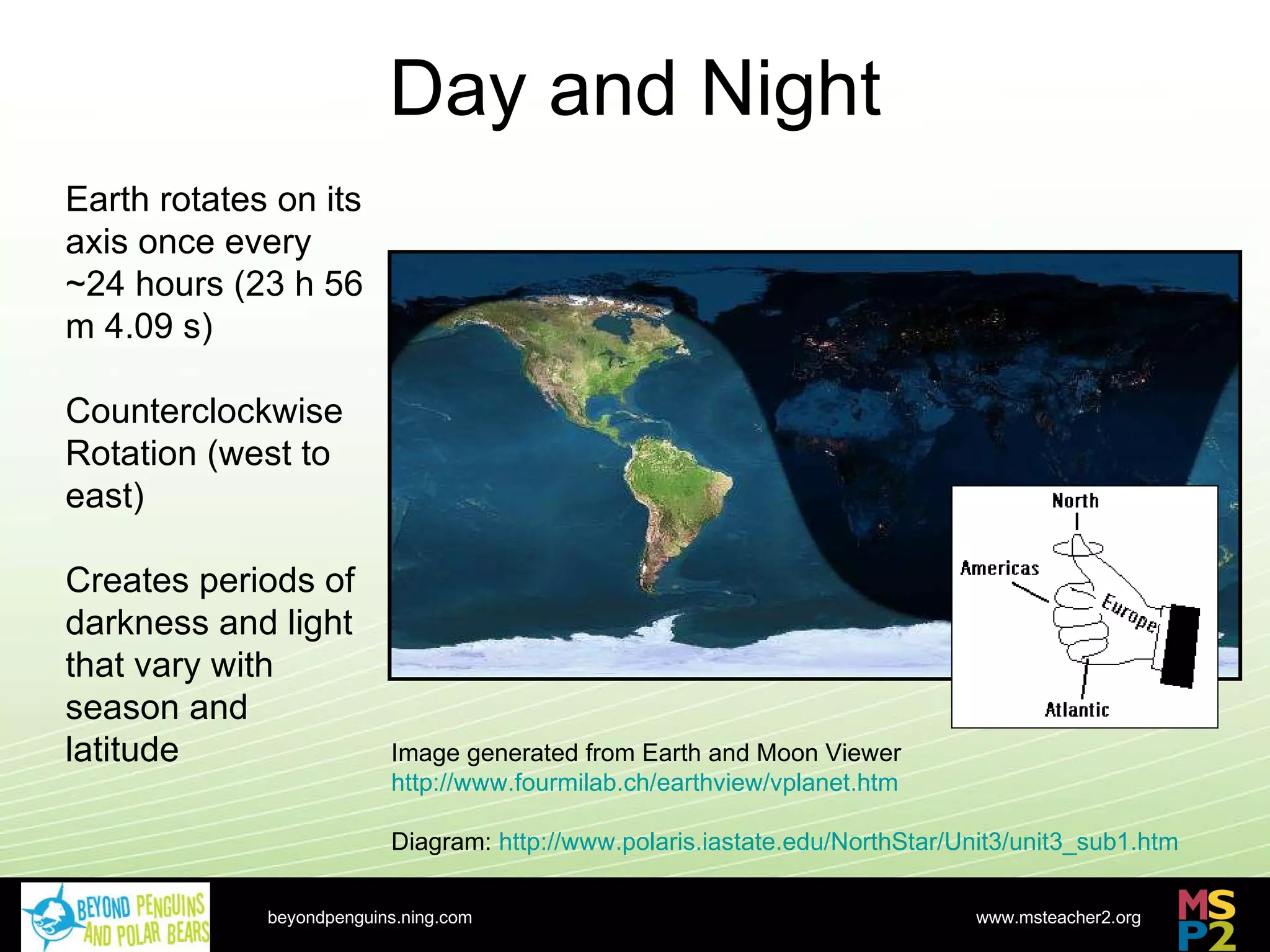
Day and Night beyondpenguins.ning.com Earth rotates on its axis once every ~24 hours (23 h 56 m 4.09 s) Counterclockwise  Rotation (west to east) Creates periods of darkness and light that vary with season and latitude Image generated from Earth and Moon Viewer http://www.fourmilab.ch/earthview/vplanet.htm Diagram:  http://www.polaris.iastate.edu/NorthStar/Unit3/unit3_sub1.htm
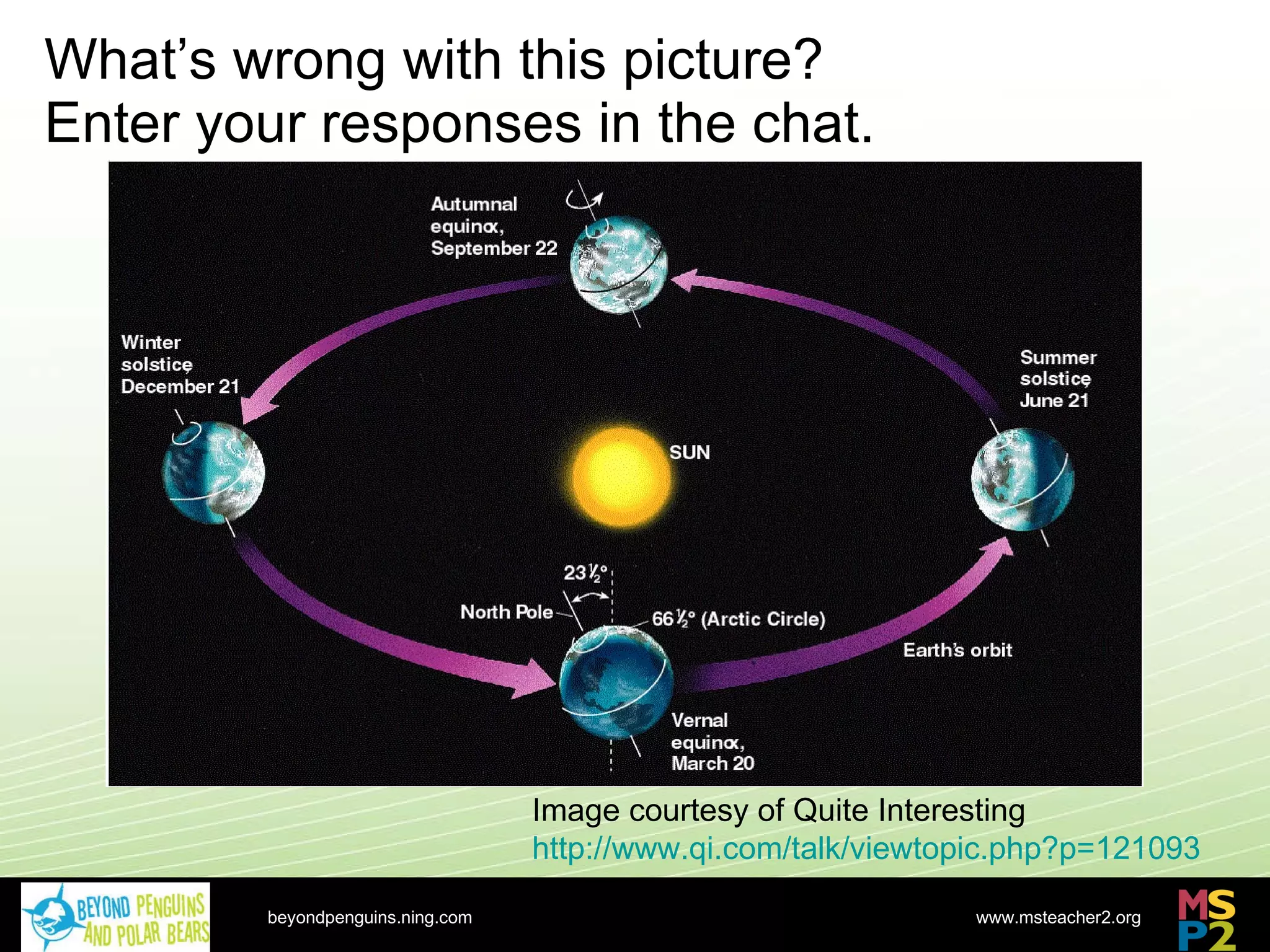
What’s wrong with this picture?  Enter your responses in the chat. beyondpenguins.ning.com Image courtesy of Quite Interesting http://www.qi.com/talk/viewtopic.php?p=121093
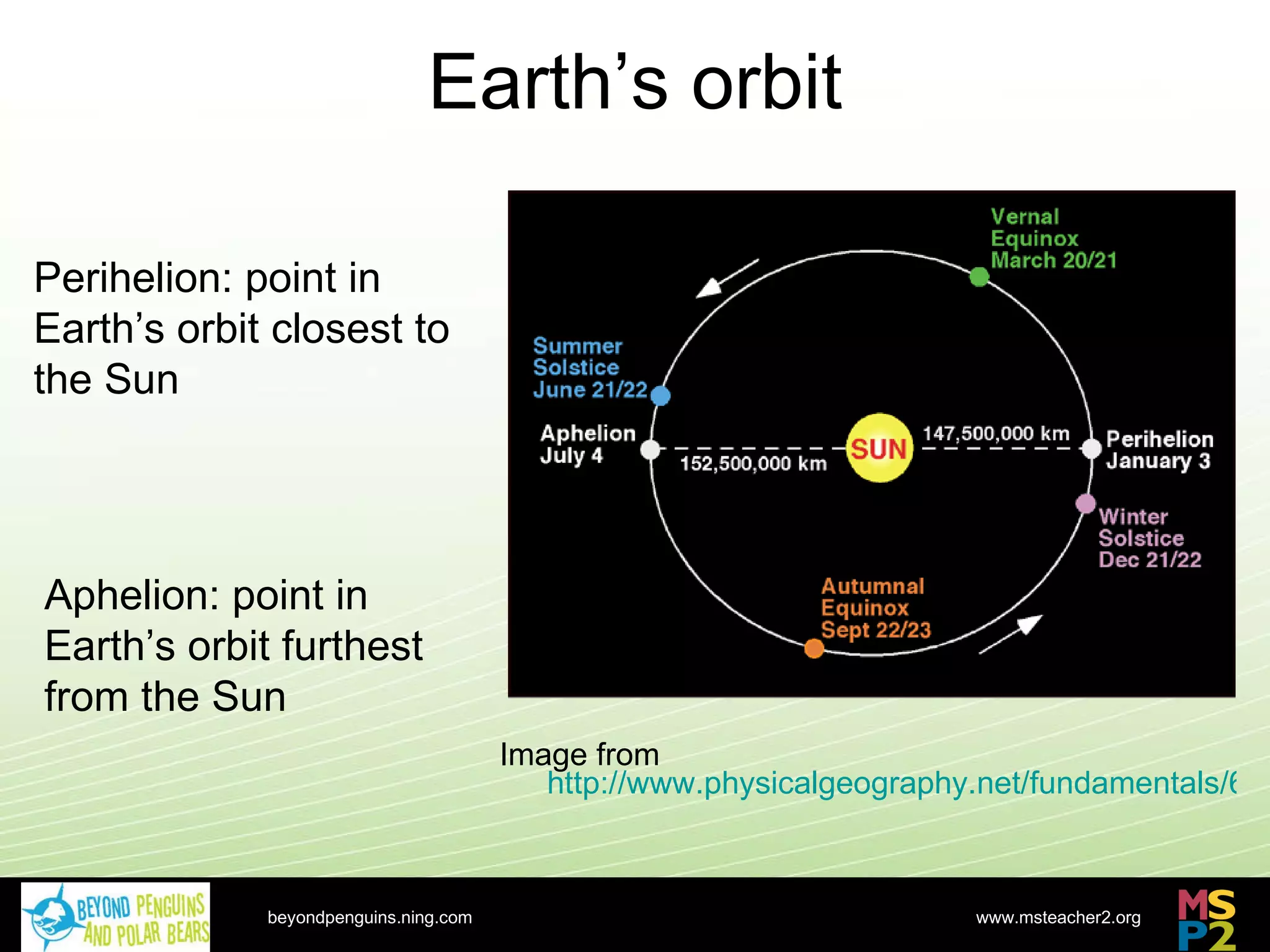
Earth’s orbit Image from  http://www.physicalgeography.net/fundamentals/6h.html beyondpenguins.ning.com Perihelion: point in Earth’s orbit closest to the Sun Aphelion: point in Earth’s orbit furthest from the Sun
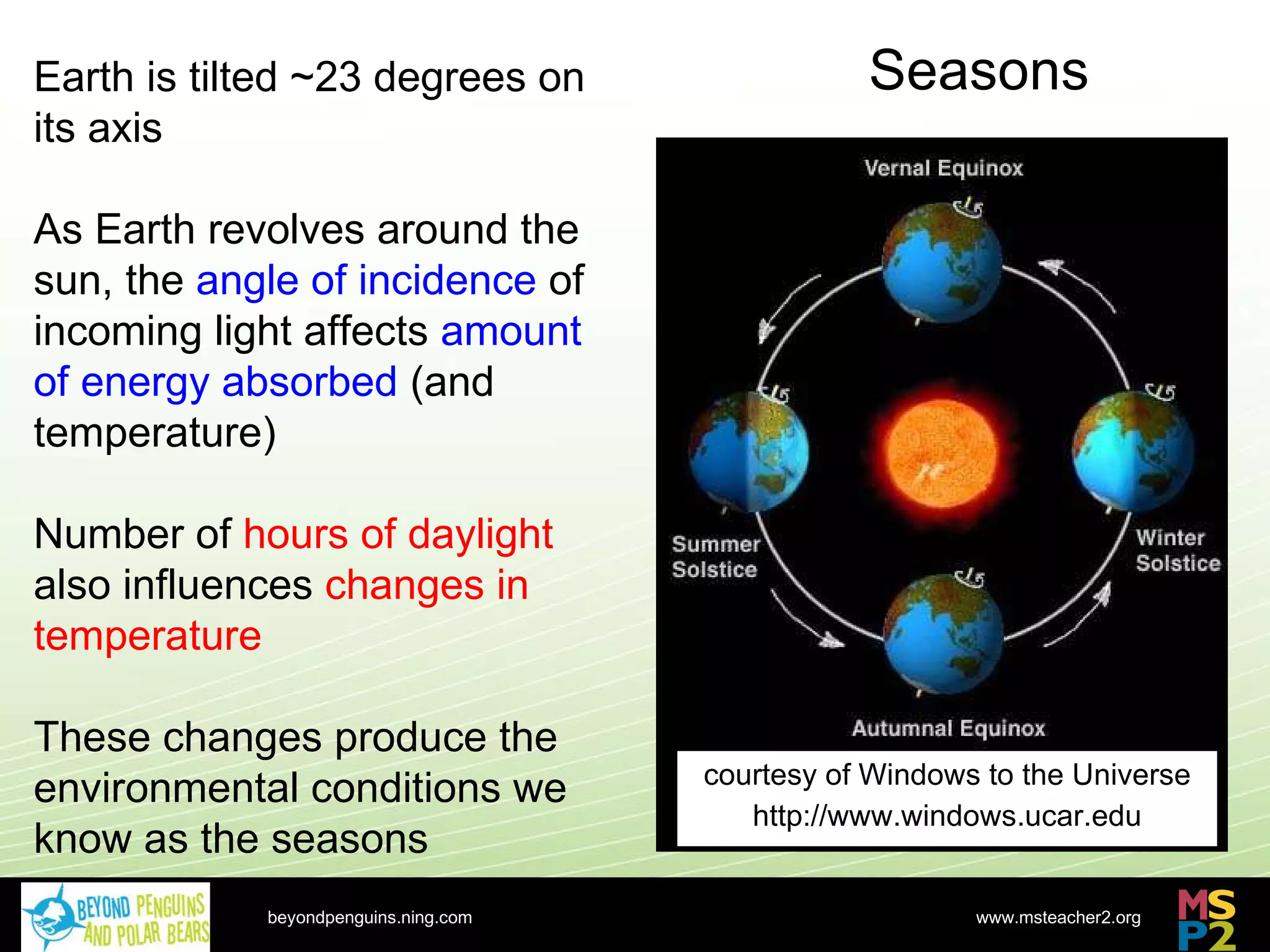
Seasons courtesy of Windows to the Universe http://www.windows.ucar.edu beyondpenguins.ning.com Earth is tilted ~23 degrees on its axis As Earth revolves around the sun, the  angle of incidence  of incoming light affects  amount of energy absorbed  (and temperature) Number of  hours of daylight  also influences  changes in temperature These changes produce the  environmental conditions we know as the seasons
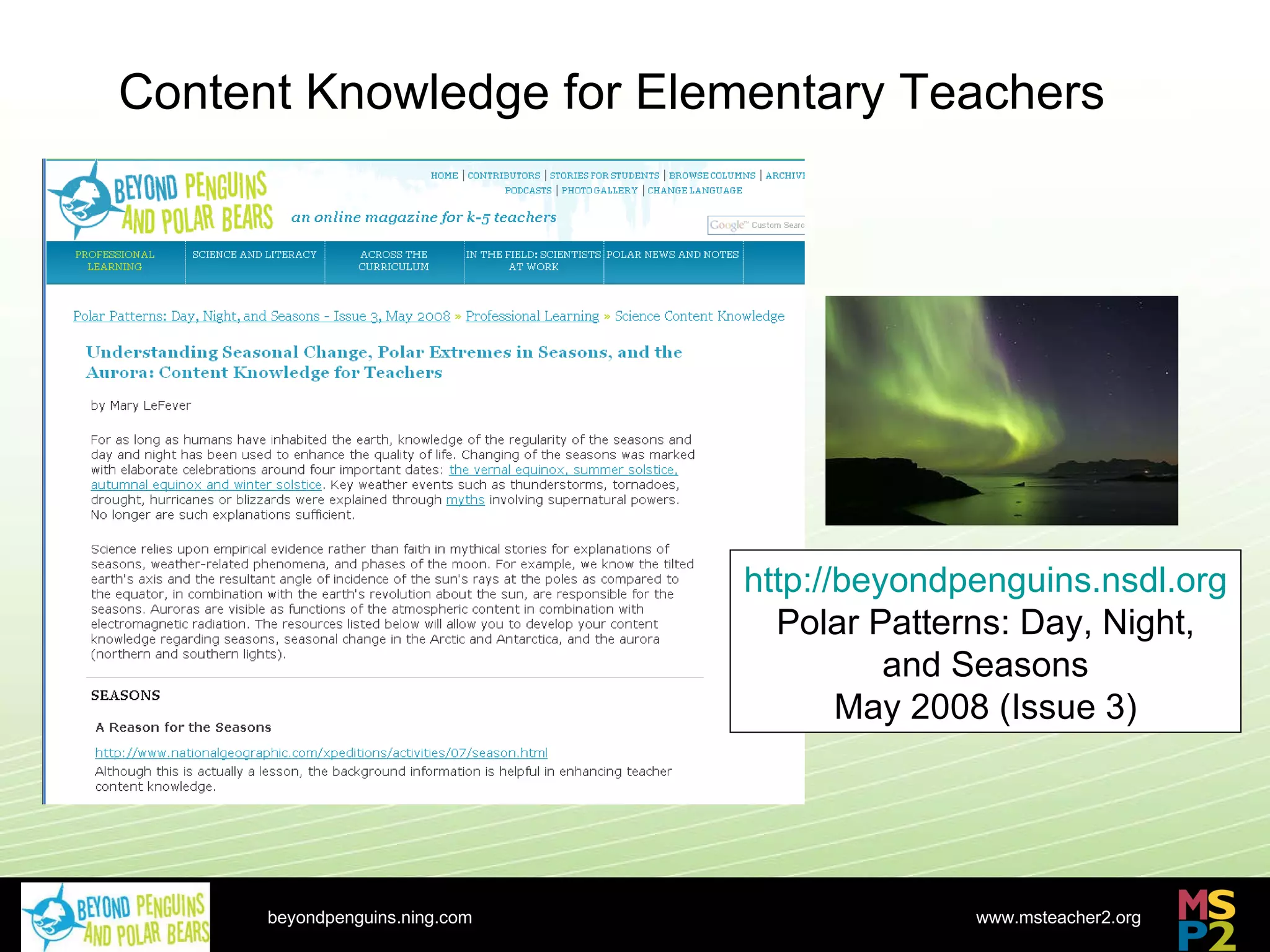
beyondpenguins.ning.com Content Knowledge for Elementary Teachers http://beyondpenguins.nsdl.org Polar Patterns: Day, Night, and Seasons May 2008 (Issue 3)
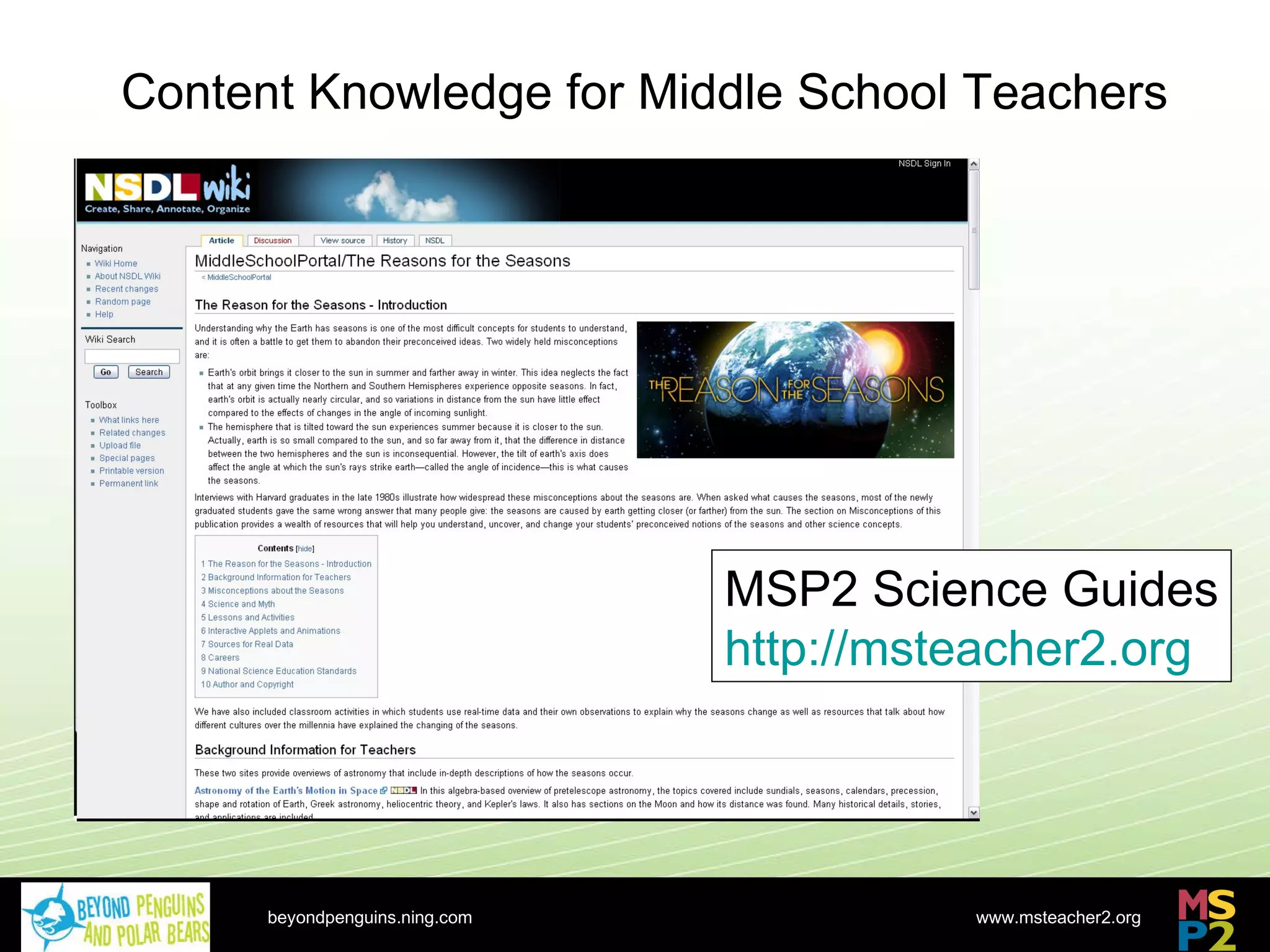
beyondpenguins.ning.com MSP2 Science Guides http://msteacher2.org Content Knowledge for Middle School Teachers
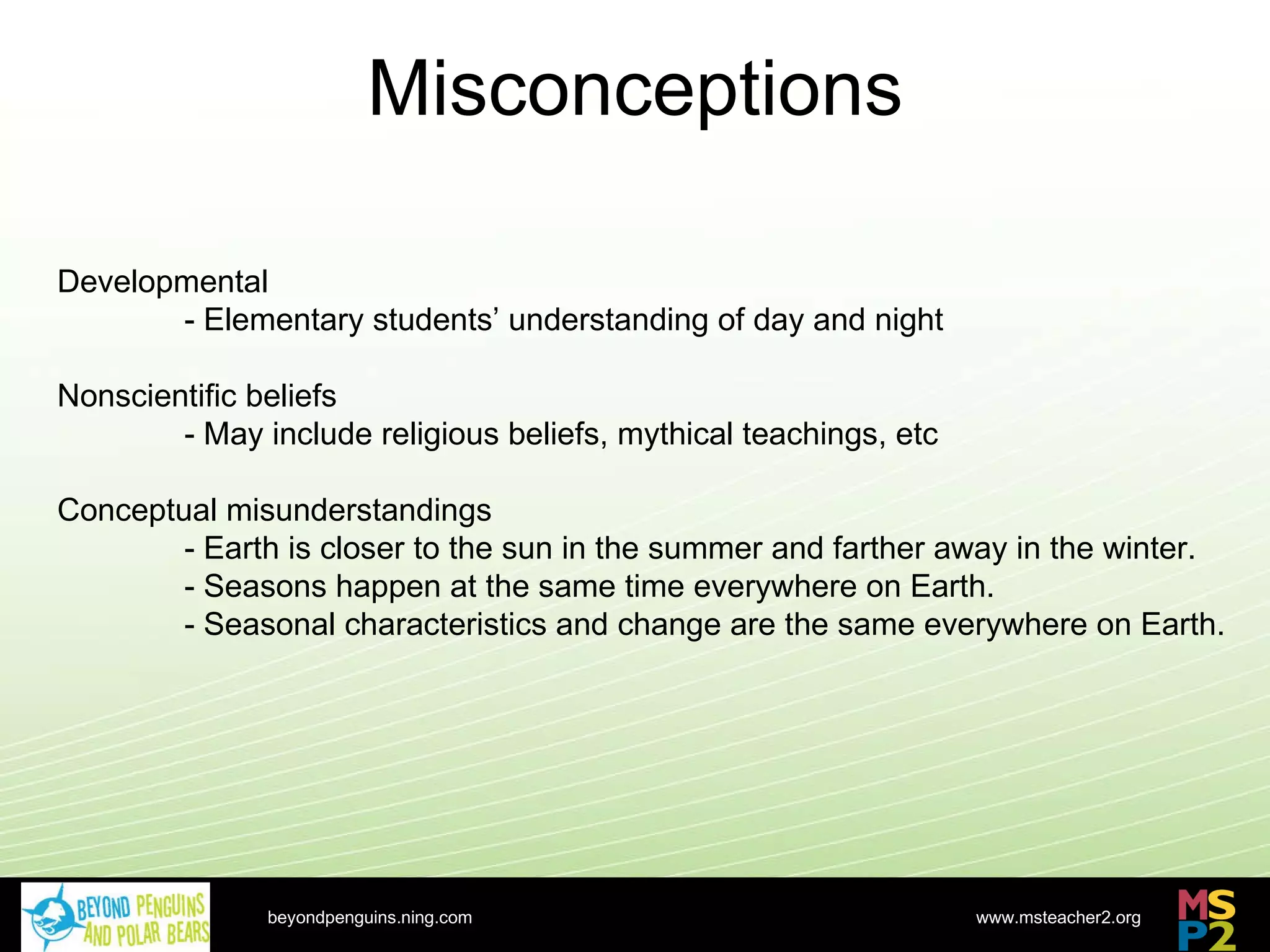
Misconceptions beyondpenguins.ning.com Developmental - Elementary students’ understanding of day and night Nonscientific beliefs - May include religious beliefs, mythical teachings, etc Conceptual misunderstandings - Earth is closer to the sun in the summer and farther away in the winter. - Seasons happen at the same time everywhere on Earth. - Seasonal characteristics and change are the same everywhere on Earth.
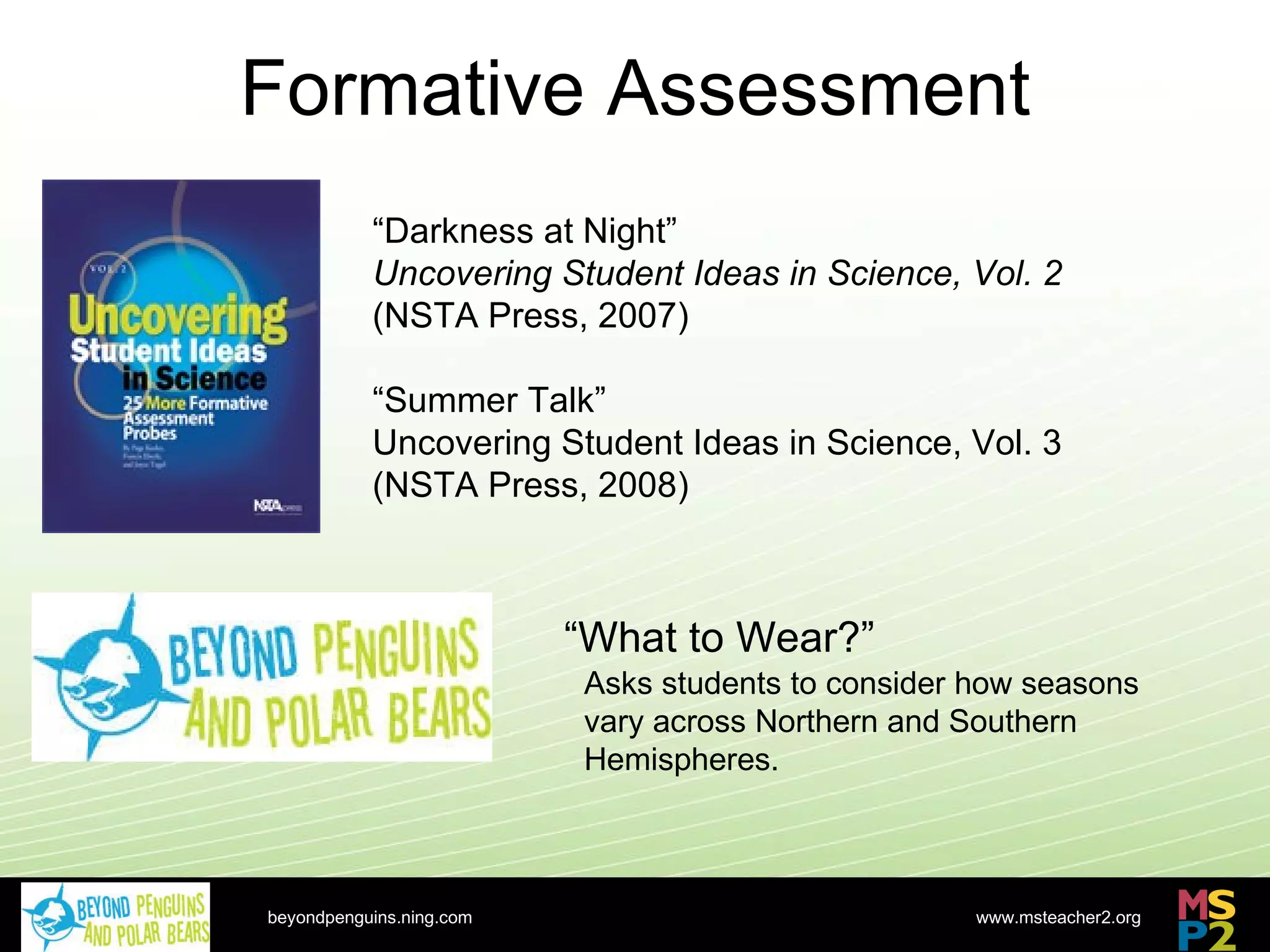
Formative Assessment beyondpenguins.ning.com “ Darkness at Night” Uncovering Student Ideas in Science, Vol. 2 (NSTA Press, 2007) “ Summer Talk” Uncovering Student Ideas in Science, Vol. 3 (NSTA Press, 2008) “ What to Wear?” Asks students to consider how seasons vary across Northern and Southern Hemispheres.
NSES: GRADES K-4 beyondpenguins.ning.com K-4 Earth and Space Science: Objects in the Sky The sun, moon, stars, clouds, birds, and airplanes all have properties, locations, and movements that can be  observed  and  described . K-4 Earth and Space Science: Changes in the Earth and Sky Objects in the sky have  patterns  of movement. The sun, for example, appears to move across the sky in the same way every day, but its path changes slowly over the seasons. Weather changes from day to day and over the seasons.
NSES: GRADES 5-8 beyondpenguins.ning.com 5-8 Earth and Space Science: Earth in the Solar System Most objects in the solar system are in regular and predictable motion. Those motions  explain  such phenomena as the day, the year, phases of the moon, and eclipses. Seasons results from variations in the amount of the sun’s energy hitting the surface, due to the tilt of the earth’s rotation on its axis and the length of the day.
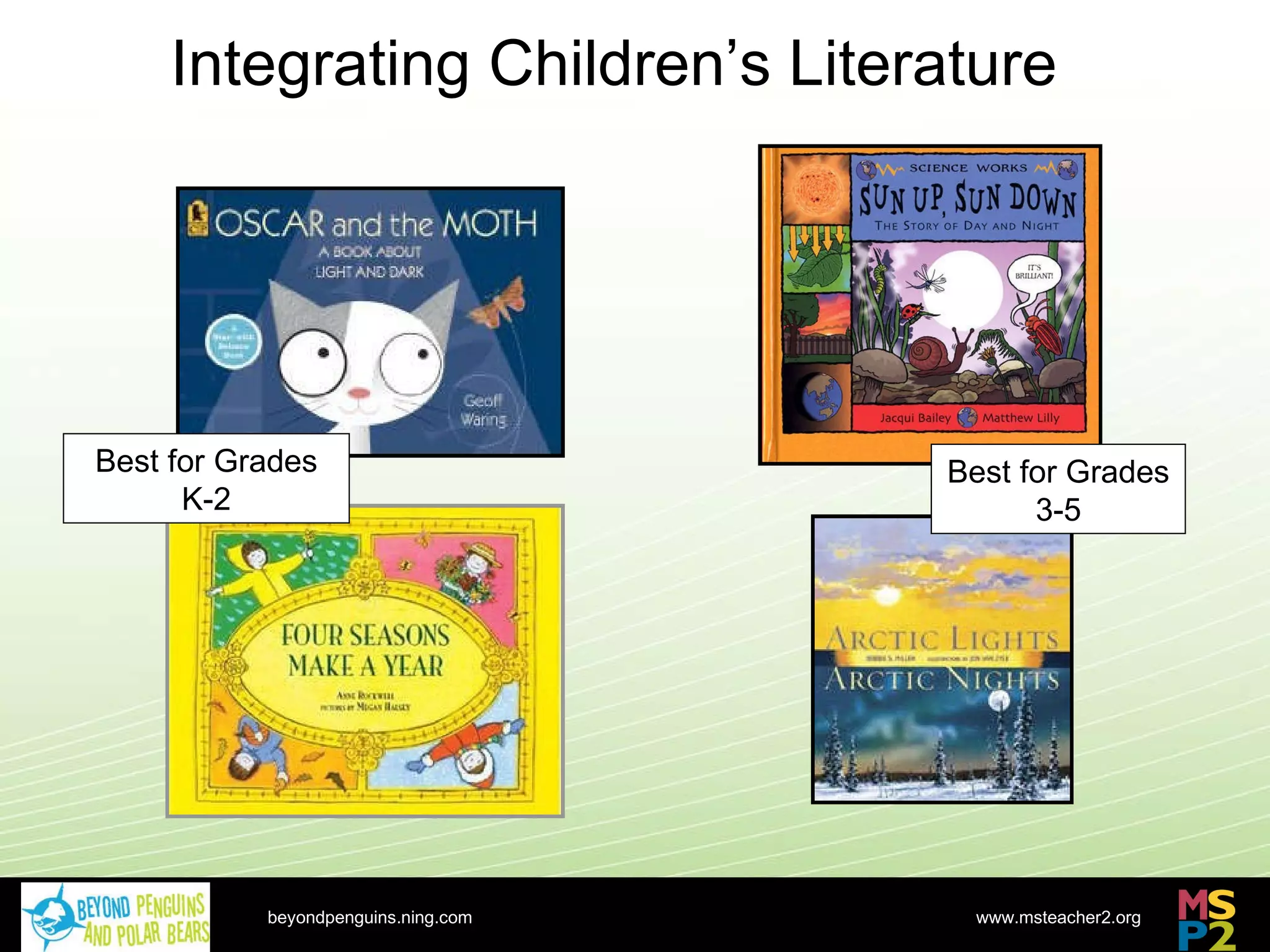
Integrating Children’s Literature http://nsdl.org Best for Grades K-2 Best for Grades 3-5 beyondpenguins.ning.com
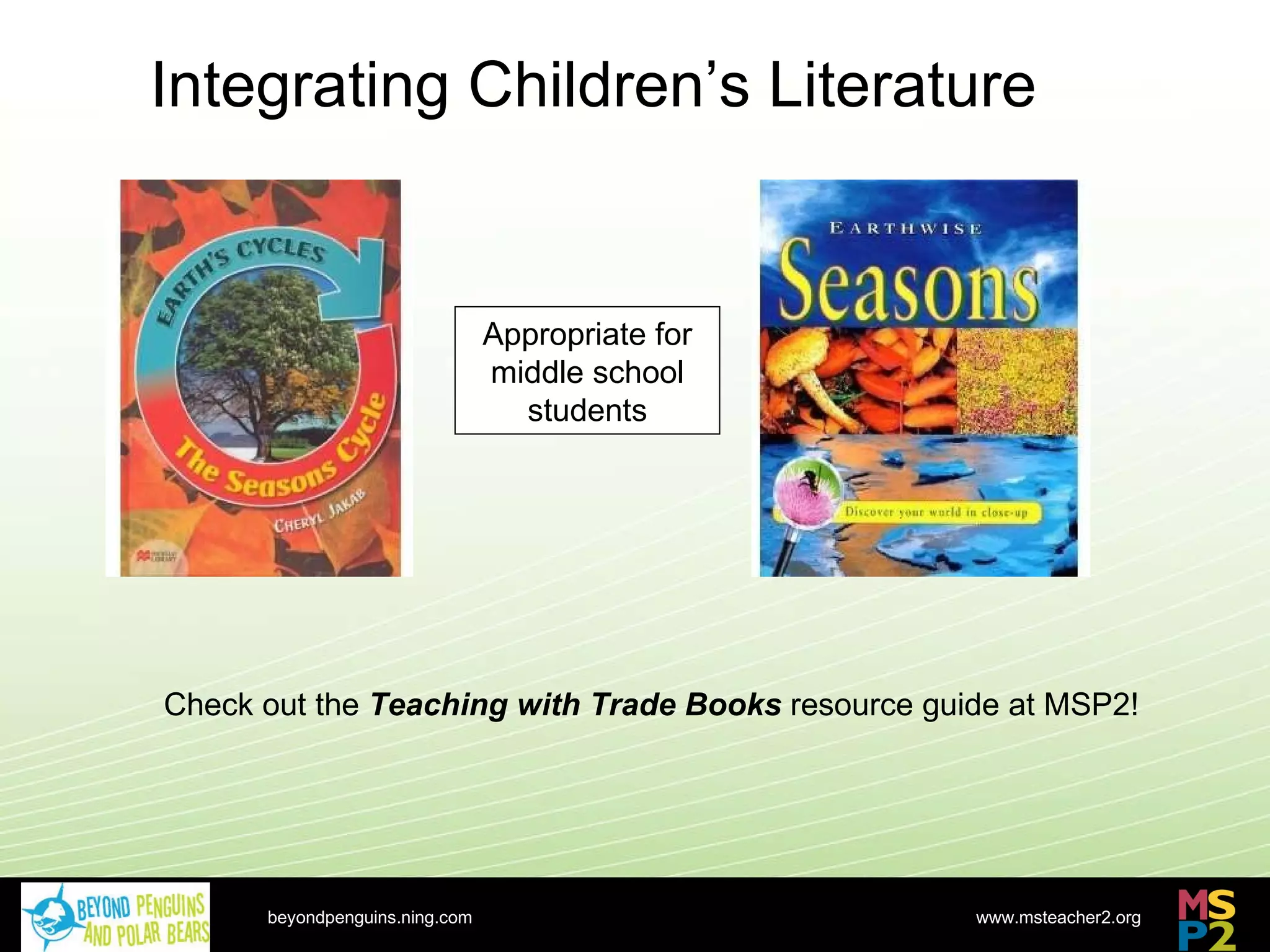
Integrating Children’s Literature beyondpenguins.ning.com Check out the  Teaching with Trade Books  resource guide at MSP2! Appropriate for middle school students
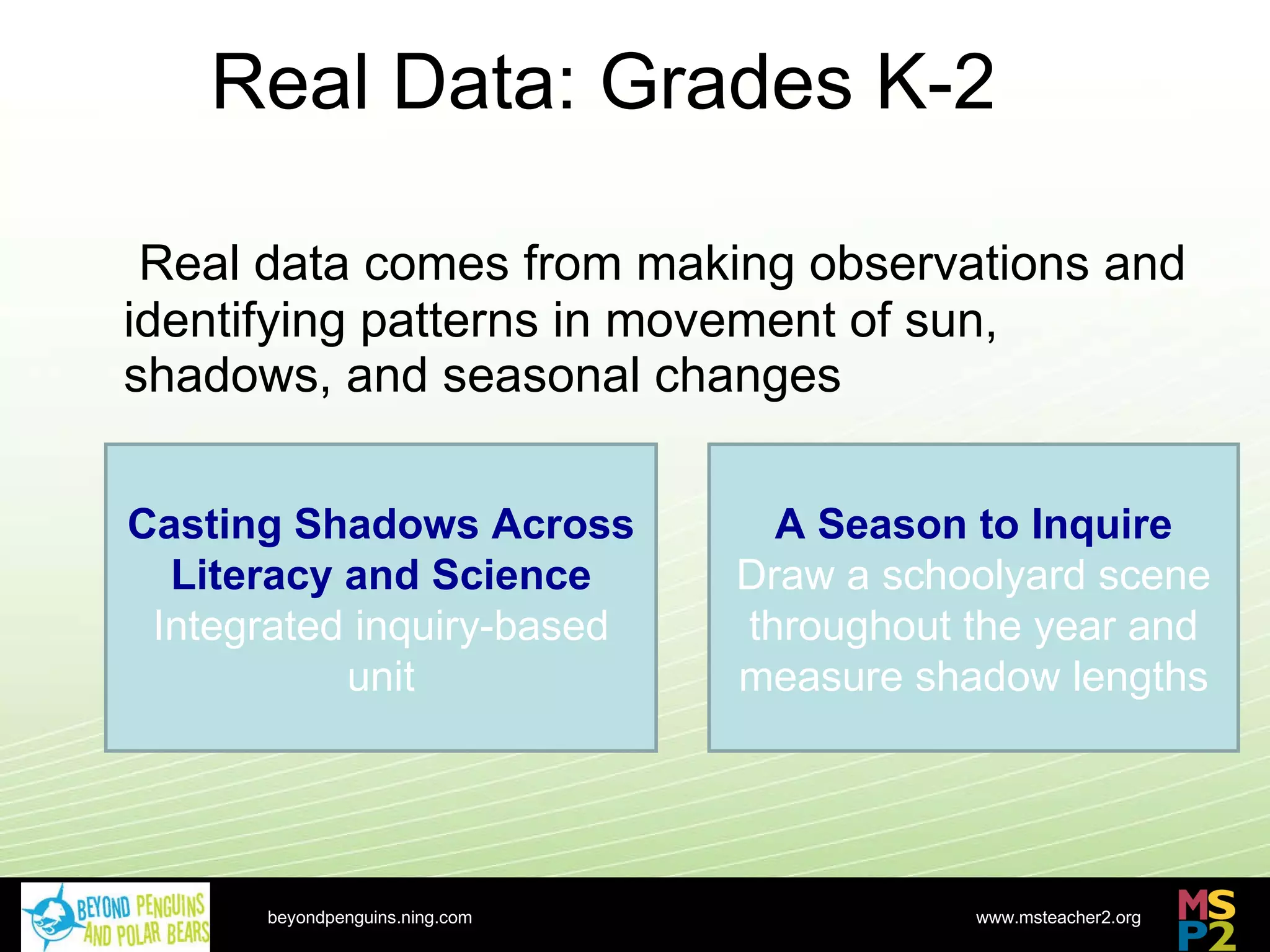
Real Data: Grades K-2 Real data comes from making observations and identifying patterns in movement of sun, shadows, and seasonal changes A Season to Inquire Draw a schoolyard scene throughout the year and measure shadow lengths Casting Shadows Across Literacy and Science Integrated inquiry-based unit http://nsdl.org beyondpenguins.ning.com
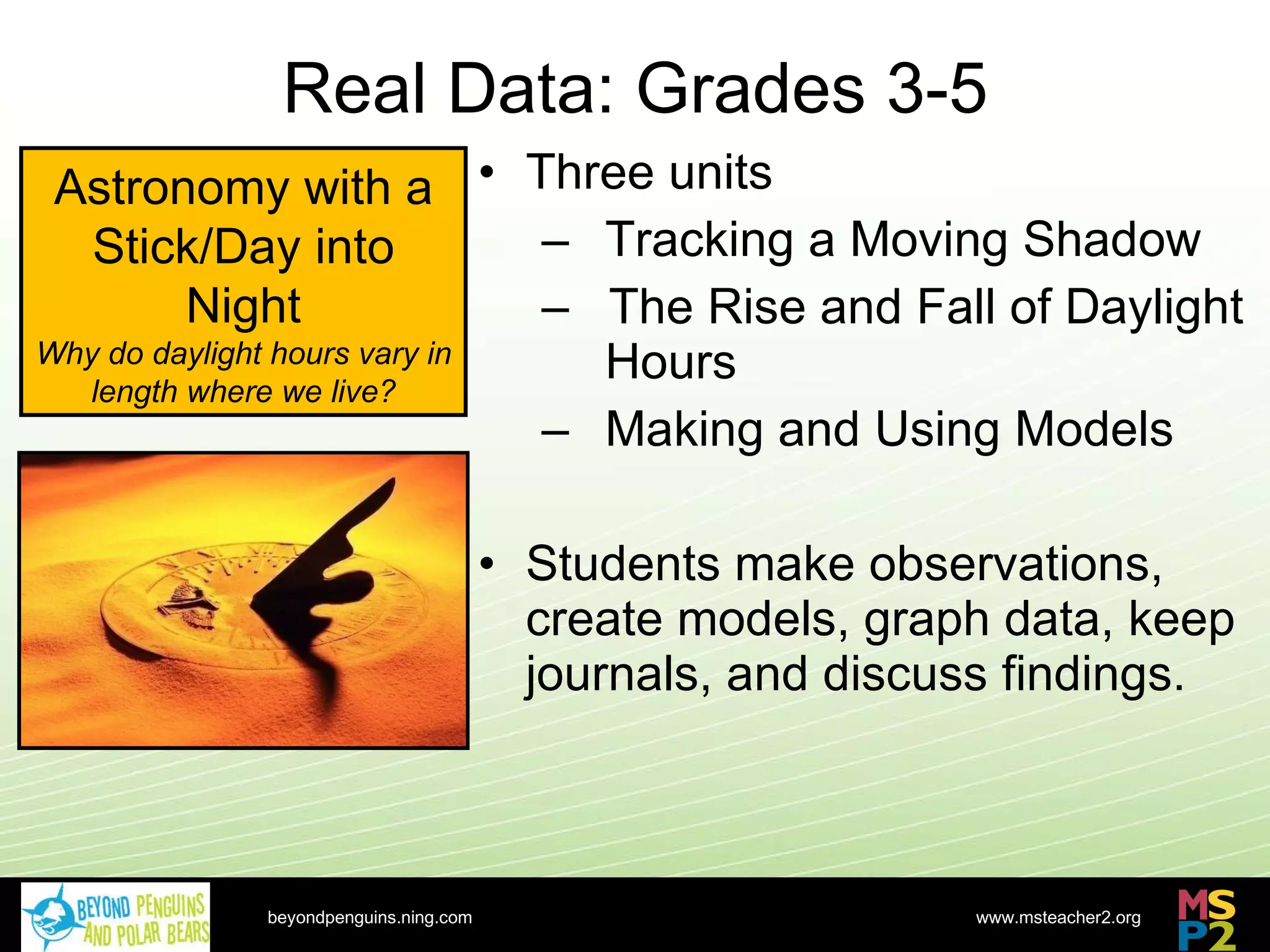
Real Data: Grades 3-5 Three units Tracking a Moving Shadow The Rise and Fall of Daylight  Hours Making and Using Models Students make observations, create models, graph data, keep journals, and discuss findings. Astronomy with a Stick/Day into Night Why do daylight hours vary in length where we live? http://nsdl.org beyondpenguins.ning.com
Real Data: Grades 4 and up 11-week online collaborative activity Students use clues (sunrise and sunset times) from 10 mystery locations and data from their hometown Goal: determine locations of mystery classes based on comparison of data Journey North: Mystery Class  http://www.learner.org/jnorth/mclass/index.html http://nsdl.org beyondpenguins.ning.com
Real Data: Grades 4 and up Online collaborative activity Students from around the world share data to determine how geographic location affects temperature and minutes of sunlight per day. Global Sun Temperature Project http://www.ciese.org/curriculum/tempproj3/en/ http://nsdl.org beyondpenguins.ning.com
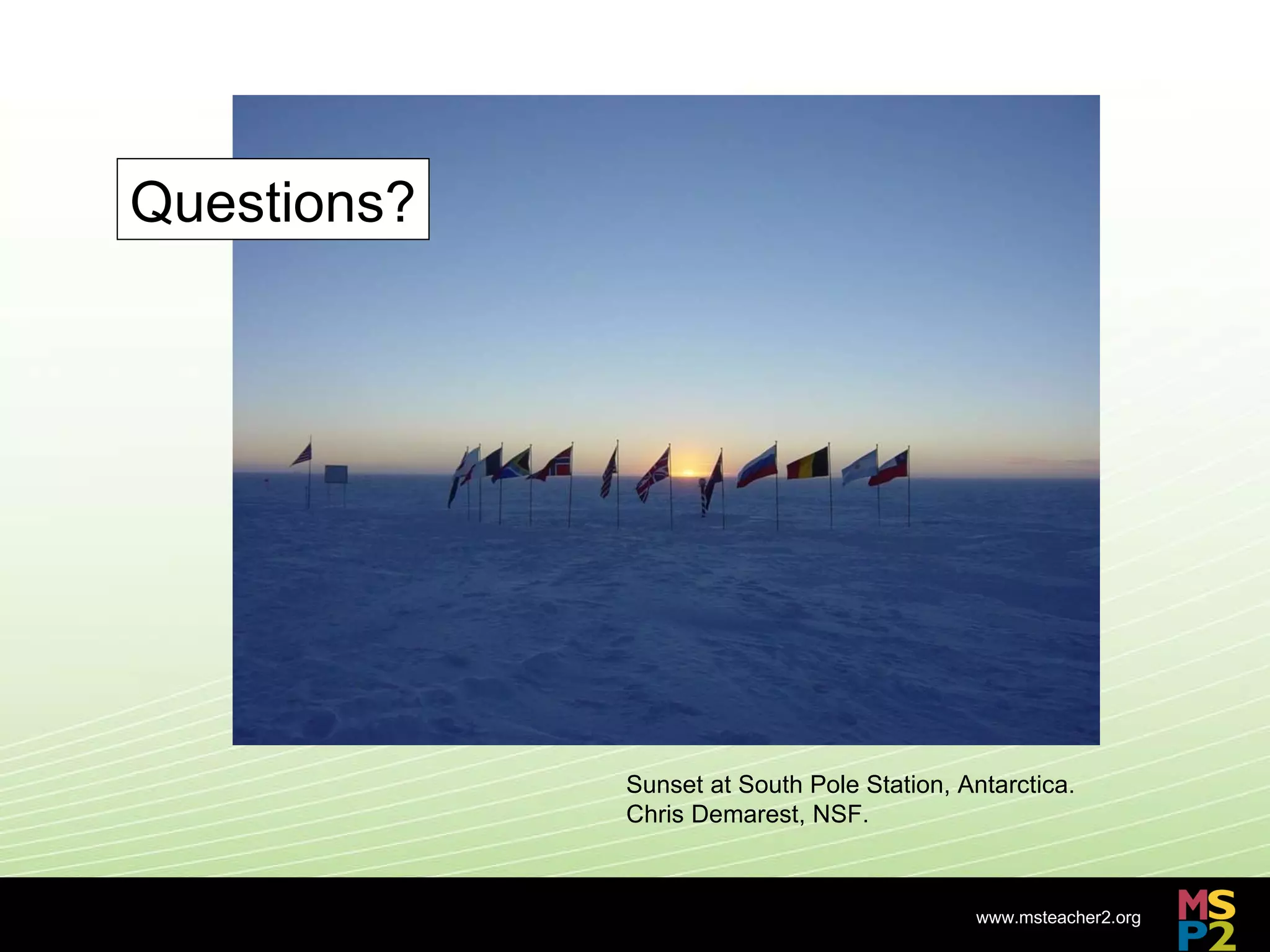
Sunset at South Pole Station, Antarctica. Chris Demarest, NSF.  Questions?

Timely Teachings: Seasons and the Cycles of Night and Day

  • 1.
    Timely Teachings: Seasonsand the Cycles of Night and Day beyondpenguins.ning.com Royal Society Range, Antarctica Steven Profaizer, NSF
  • 2.
    Jessica Fries-Gaither ProjectDirector, Beyond Penguins and Polar Bears, and Education Resource Specialist with The Ohio State University beyondpenguins.ning.com About Us Kimberly Lightle Director, Digital Libraries The Ohio State University
  • 3.
    Today’s Agenda Contentknowledge refresher and resources Student misconceptions and formative assessment Standards alignment and instructional resources beyondpenguins.ning.com Sunrise over McMurdo Station, Antarctica. Paulene Roberts, NSF
  • 4.
    Day and Nightbeyondpenguins.ning.com Earth rotates on its axis once every ~24 hours (23 h 56 m 4.09 s) Counterclockwise Rotation (west to east) Creates periods of darkness and light that vary with season and latitude Image generated from Earth and Moon Viewer http://www.fourmilab.ch/earthview/vplanet.htm Diagram: http://www.polaris.iastate.edu/NorthStar/Unit3/unit3_sub1.htm
  • 5.
    What’s wrong withthis picture? Enter your responses in the chat. beyondpenguins.ning.com Image courtesy of Quite Interesting http://www.qi.com/talk/viewtopic.php?p=121093
  • 6.
    Earth’s orbit Imagefrom http://www.physicalgeography.net/fundamentals/6h.html beyondpenguins.ning.com Perihelion: point in Earth’s orbit closest to the Sun Aphelion: point in Earth’s orbit furthest from the Sun
  • 7.
    Seasons courtesy ofWindows to the Universe http://www.windows.ucar.edu beyondpenguins.ning.com Earth is tilted ~23 degrees on its axis As Earth revolves around the sun, the angle of incidence of incoming light affects amount of energy absorbed (and temperature) Number of hours of daylight also influences changes in temperature These changes produce the environmental conditions we know as the seasons
  • 8.
    beyondpenguins.ning.com Content Knowledgefor Elementary Teachers http://beyondpenguins.nsdl.org Polar Patterns: Day, Night, and Seasons May 2008 (Issue 3)
  • 9.
    beyondpenguins.ning.com MSP2 ScienceGuides http://msteacher2.org Content Knowledge for Middle School Teachers
  • 10.
    Misconceptions beyondpenguins.ning.com Developmental- Elementary students’ understanding of day and night Nonscientific beliefs - May include religious beliefs, mythical teachings, etc Conceptual misunderstandings - Earth is closer to the sun in the summer and farther away in the winter. - Seasons happen at the same time everywhere on Earth. - Seasonal characteristics and change are the same everywhere on Earth.
  • 11.
    Formative Assessment beyondpenguins.ning.com“ Darkness at Night” Uncovering Student Ideas in Science, Vol. 2 (NSTA Press, 2007) “ Summer Talk” Uncovering Student Ideas in Science, Vol. 3 (NSTA Press, 2008) “ What to Wear?” Asks students to consider how seasons vary across Northern and Southern Hemispheres.
  • 12.
    NSES: GRADES K-4beyondpenguins.ning.com K-4 Earth and Space Science: Objects in the Sky The sun, moon, stars, clouds, birds, and airplanes all have properties, locations, and movements that can be observed and described . K-4 Earth and Space Science: Changes in the Earth and Sky Objects in the sky have patterns of movement. The sun, for example, appears to move across the sky in the same way every day, but its path changes slowly over the seasons. Weather changes from day to day and over the seasons.
  • 13.
    NSES: GRADES 5-8beyondpenguins.ning.com 5-8 Earth and Space Science: Earth in the Solar System Most objects in the solar system are in regular and predictable motion. Those motions explain such phenomena as the day, the year, phases of the moon, and eclipses. Seasons results from variations in the amount of the sun’s energy hitting the surface, due to the tilt of the earth’s rotation on its axis and the length of the day.
  • 14.
    Integrating Children’s Literaturehttp://nsdl.org Best for Grades K-2 Best for Grades 3-5 beyondpenguins.ning.com
  • 15.
    Integrating Children’s Literaturebeyondpenguins.ning.com Check out the Teaching with Trade Books resource guide at MSP2! Appropriate for middle school students
  • 16.
    Real Data: GradesK-2 Real data comes from making observations and identifying patterns in movement of sun, shadows, and seasonal changes A Season to Inquire Draw a schoolyard scene throughout the year and measure shadow lengths Casting Shadows Across Literacy and Science Integrated inquiry-based unit http://nsdl.org beyondpenguins.ning.com
  • 17.
    Real Data: Grades3-5 Three units Tracking a Moving Shadow The Rise and Fall of Daylight Hours Making and Using Models Students make observations, create models, graph data, keep journals, and discuss findings. Astronomy with a Stick/Day into Night Why do daylight hours vary in length where we live? http://nsdl.org beyondpenguins.ning.com
  • 18.
    Real Data: Grades4 and up 11-week online collaborative activity Students use clues (sunrise and sunset times) from 10 mystery locations and data from their hometown Goal: determine locations of mystery classes based on comparison of data Journey North: Mystery Class http://www.learner.org/jnorth/mclass/index.html http://nsdl.org beyondpenguins.ning.com
  • 19.
    Real Data: Grades4 and up Online collaborative activity Students from around the world share data to determine how geographic location affects temperature and minutes of sunlight per day. Global Sun Temperature Project http://www.ciese.org/curriculum/tempproj3/en/ http://nsdl.org beyondpenguins.ning.com
  • 20.
    Sunset at SouthPole Station, Antarctica. Chris Demarest, NSF. Questions?