Personal online reputation:
The development of an approach to investigate
how personal reputation is evaluated and
managed in online environments
by Frances VC Ryan
Presentation delivered at the
International Data and Information Management Conference
13th January 2016, Loughborough, England
Co-authors: Peter Cruickshank, Professor Hazel Hall, and Alistair Lawson
f.ryan@napier.ac.uk | @cleverfrances | www.JustAPhD.com
1
Overview of presentation
 Brief overview of the research themes
 Theoretical framework for empirical work
 Evaluation of potential methods
 Pilot testing chosen method
 Findings from pilot
 Conclusion and next steps
1 21 2
What’s the research about?
How online information contributes to the building, maintenance,
and evaluation of personal reputations
― Personal reputation: Private individuals, rather than corporate identity and brand
Two broad research themes:
(1) The means by which people evaluate or assess the personal
reputations of others from the online evidence available to them
(2) How people manage their own personal reputations through their use
of online information, and to what extent those behaviours are intentional
1 2 31 2 3
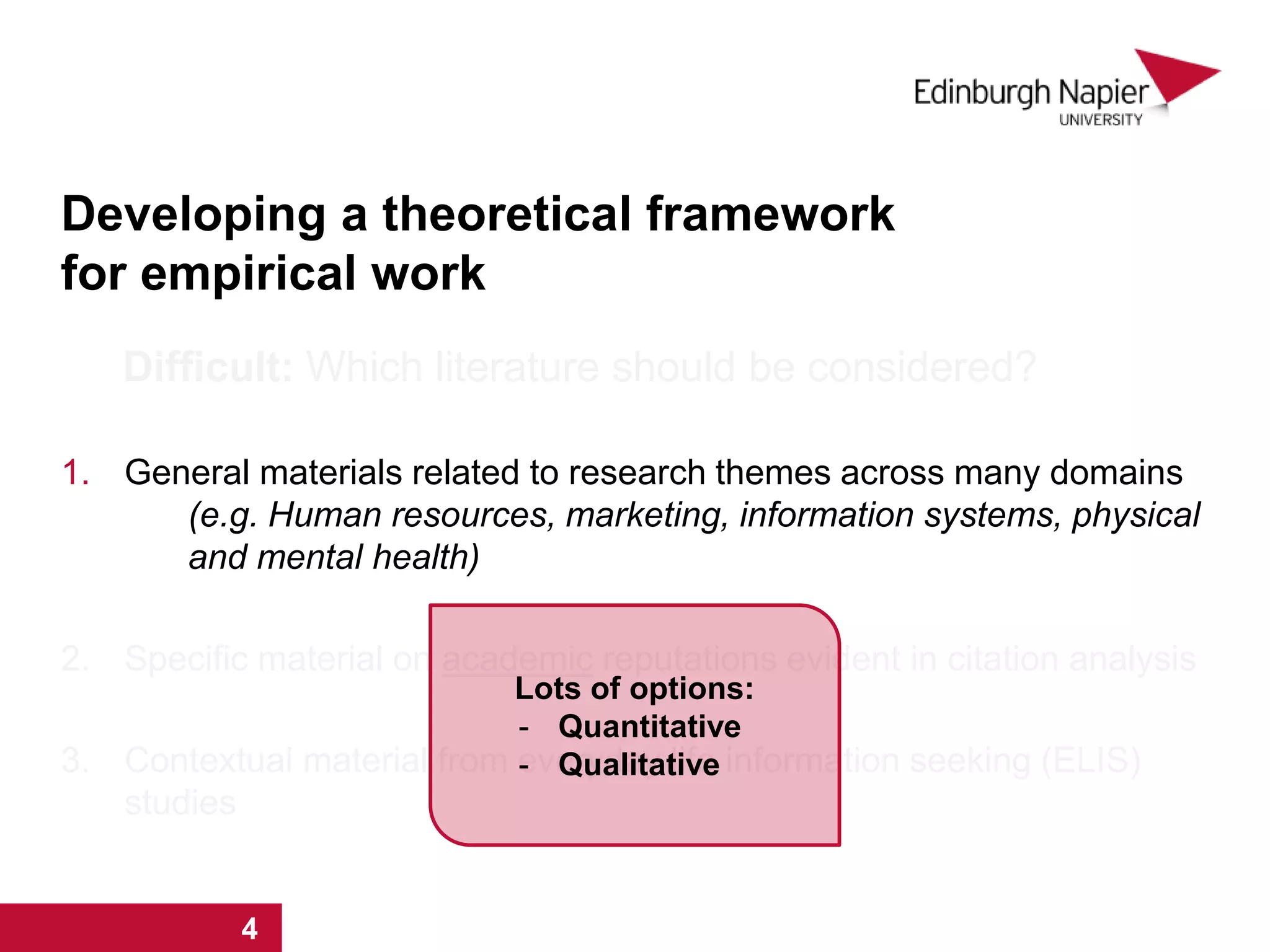
Developing a theoretical framework
for empirical work
Difficult: What literature should be considered?
1. General materials related to research themes across many domains
(e.g. Human resources, marketing, information systems, physical
and mental health)
2. Specific material on academic reputations evident in citation analysis
3. Contextual material from everyday life information seeking (ELIS)
studies
1 2 3 41 2 3 4
Developing a theoretical framework
for empirical work
Difficult: Which literature should be considered?
1. General materials related to research themes across many domains
(e.g. Human resources, marketing, information systems, physical
and mental health)
2. Specific material on academic reputations evident in citation analysis
3. Contextual material from everyday life information seeking (ELIS)
studies
1 2 3 4
Lots of options:
- Quantitative
- Qualitative
1 2 3 4
Developing a theoretical framework
for empirical work
Difficult: Which literature should be considered?
1. General materials related to research themes across many domains
(e.g. Human resources, marketing, information systems, physical
and mental health)
2. Specific material on academic reputations evident in citation analysis
3. Contextual material from everyday life information seeking (ELIS)
studies
1 2 3 4
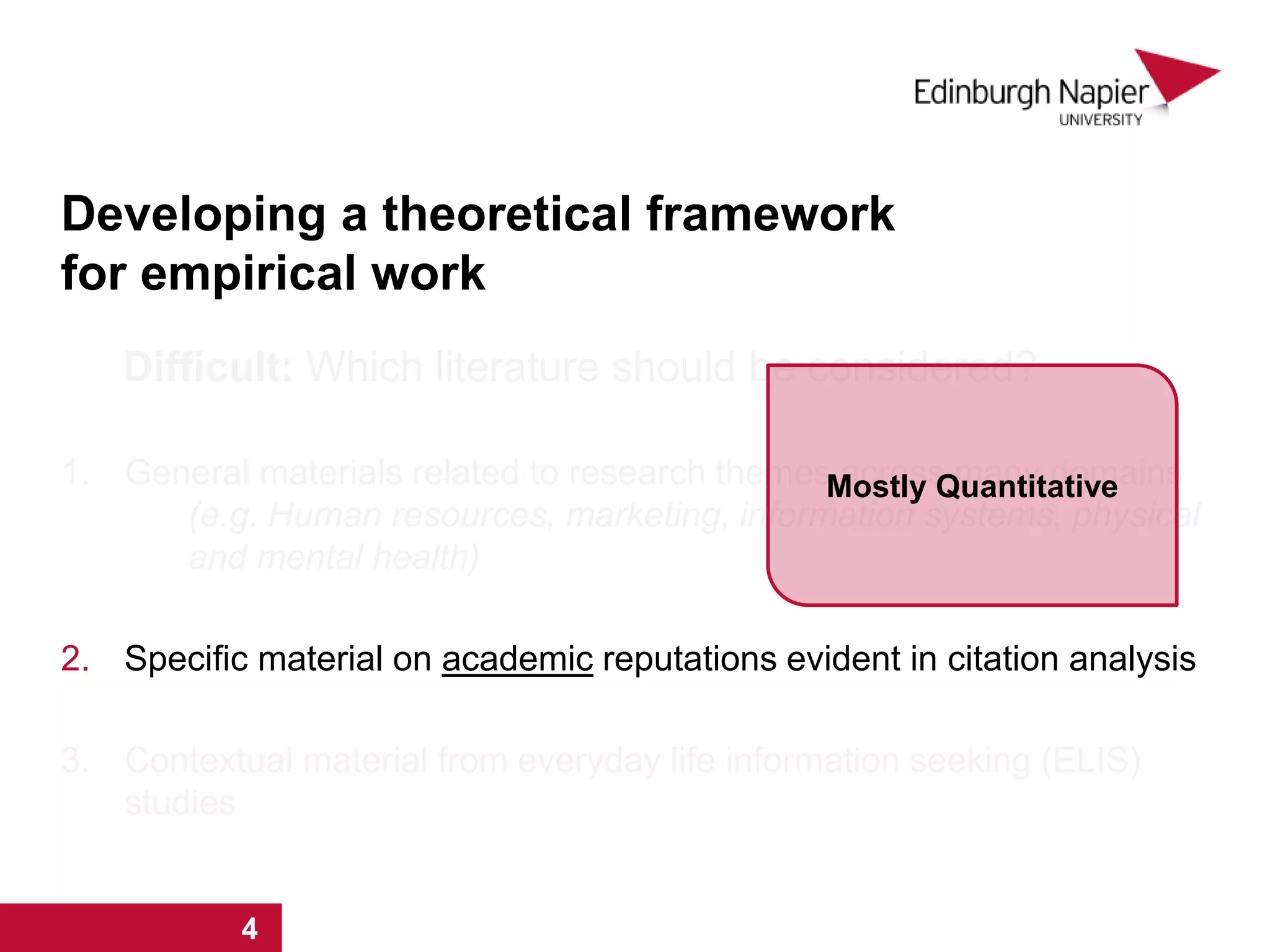
Mostly Quantitative
1 2 3 4
Developing a theoretical framework
for empirical work
Difficult: Which literature should be considered?
1. General materials related to research themes across many domains
(e.g. Human resources, marketing, information systems, physical
and mental health)
2. Specific material on academic reputations evident in citation analysis
3. Contextual material from everyday life information seeking (ELIS)
studies
1 2 3 4
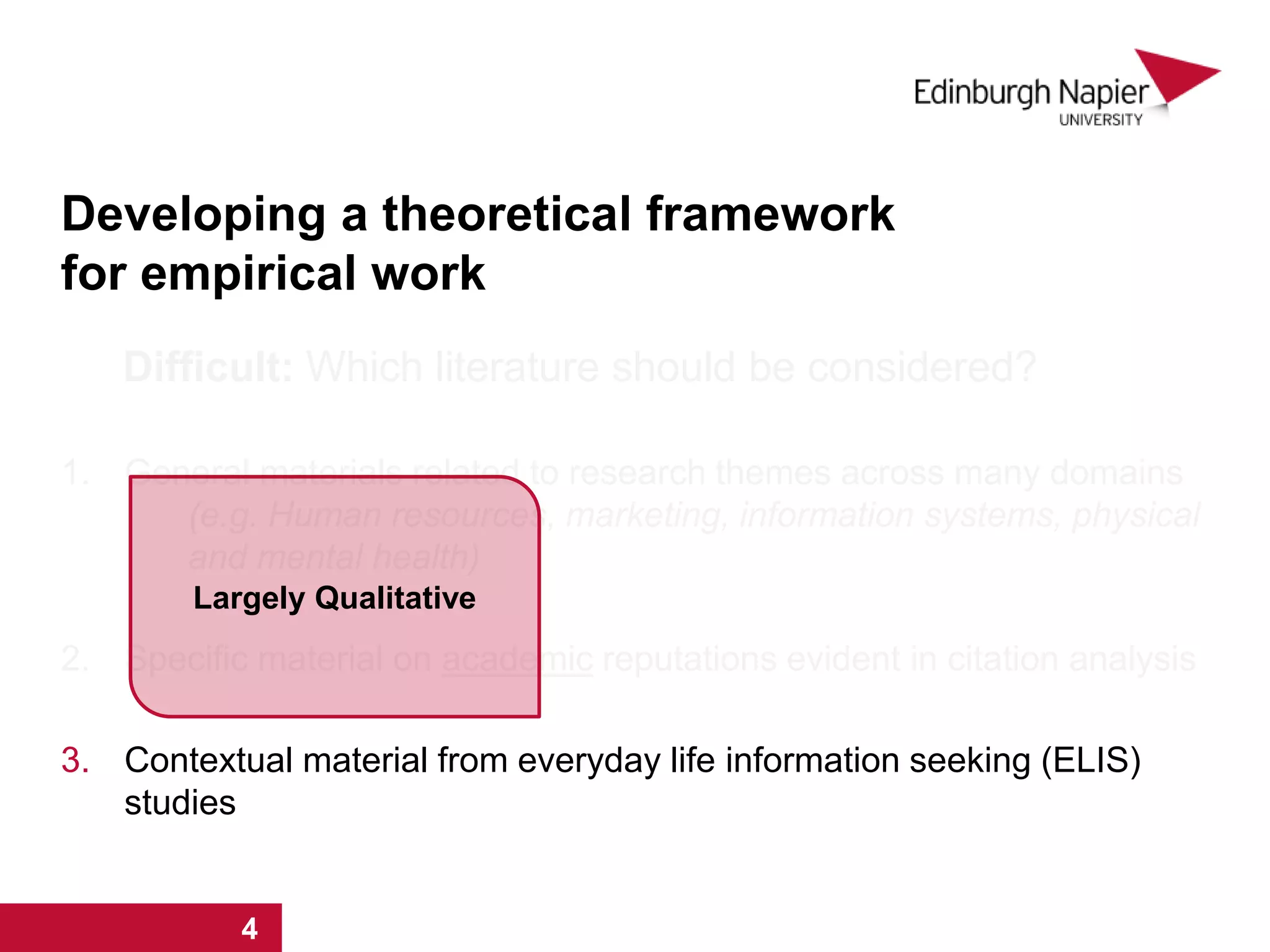
Largely Qualitative
1 2 3 4
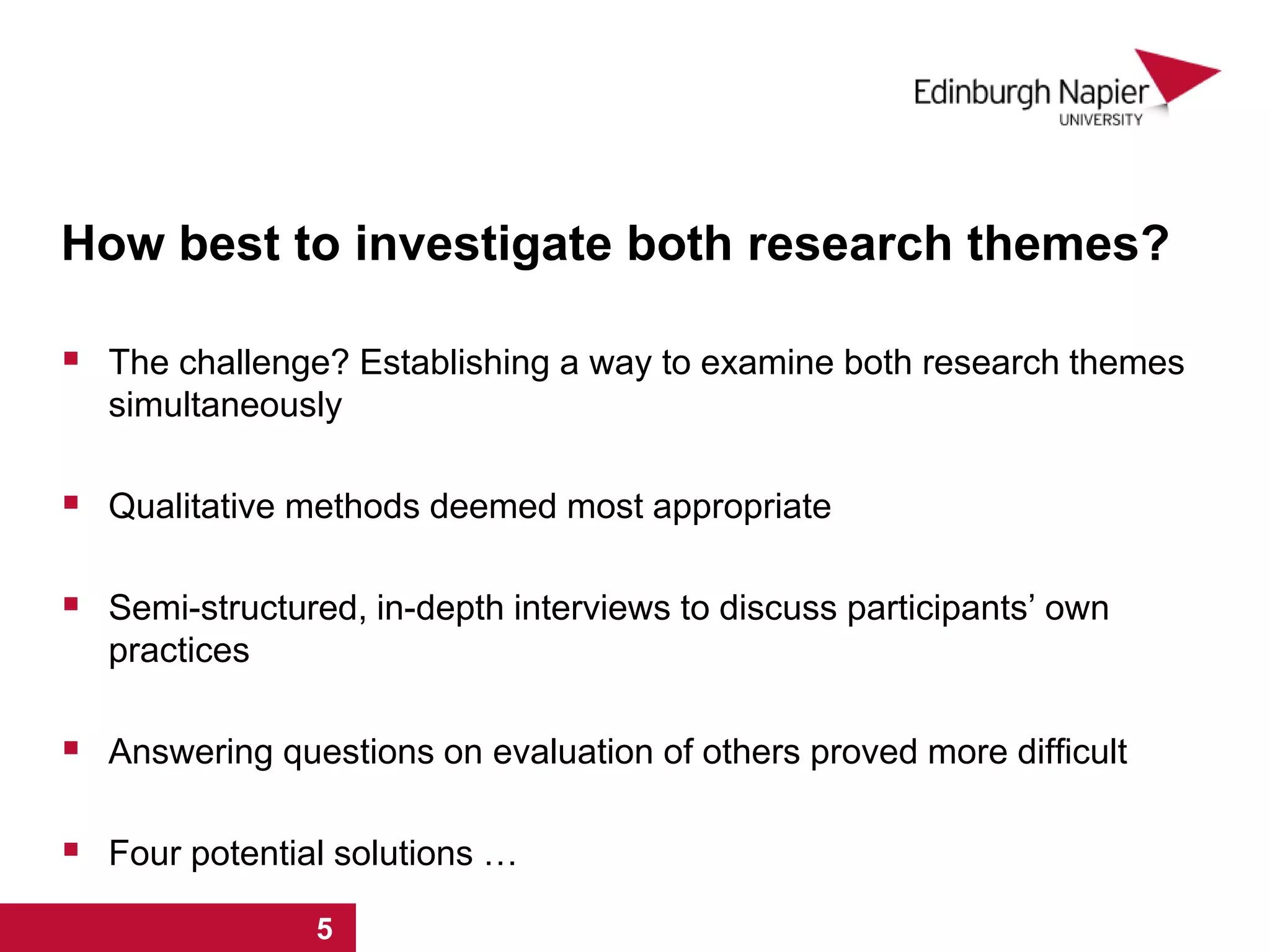
How best to investigate both research themes?
 The challenge? Establishing a way to examine both research themes
simultaneously
 Qualitative methods deemed most appropriate
 Semi-structured, in-depth interviews to discuss participants’ own
practices
 Answering questions on evaluation of others proved more difficult
 Four potential solutions …
1 2 3 4 5 6 71 2 3 4 5
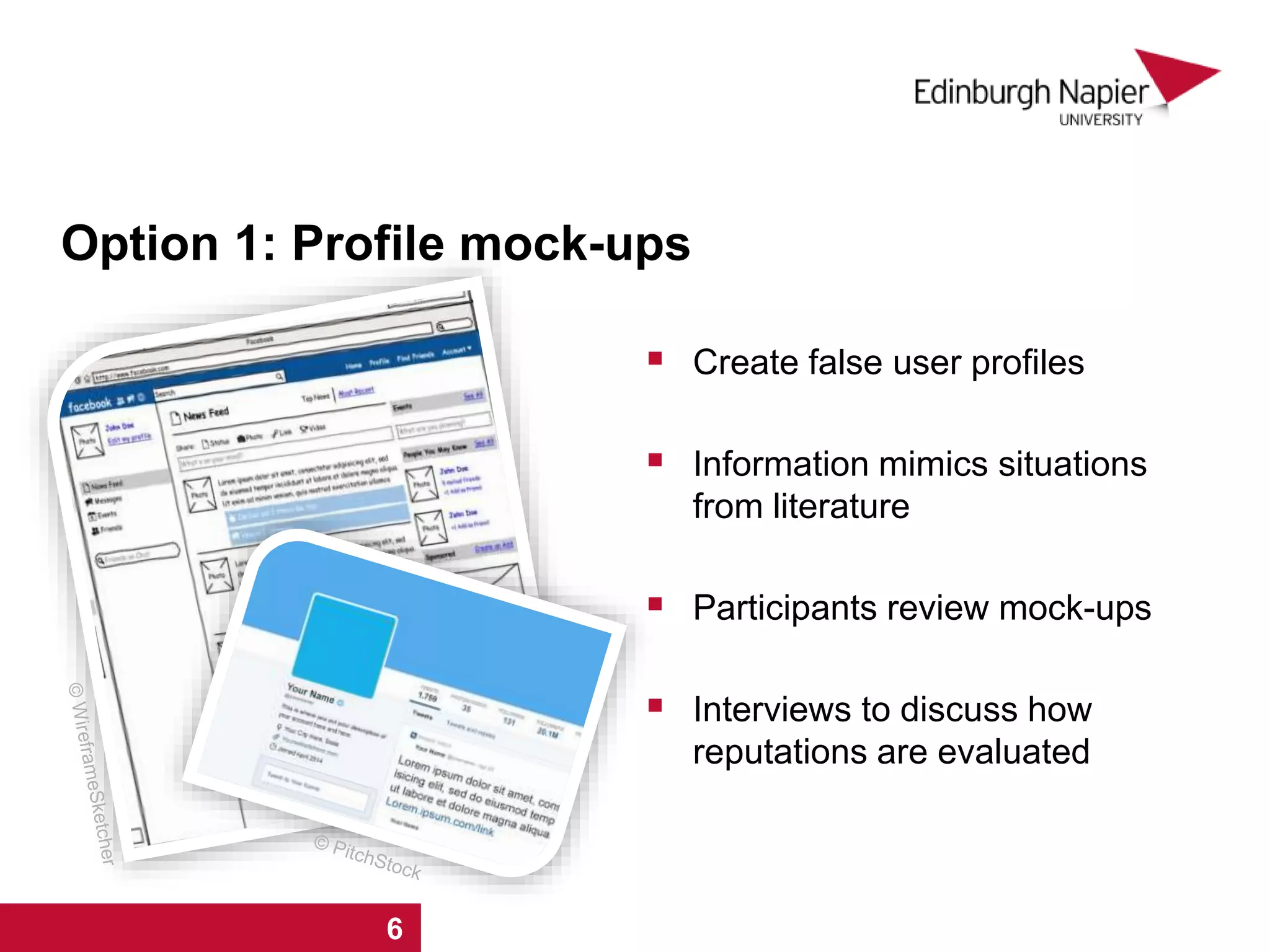
Option 1: Profile mock-ups
 Create false user profiles
 Information mimics situations
from literature
 Participants review mock-ups
 Interviews to discuss how
reputations are evaluated
1 2 3 4 5 6 7 81 2 3 4 5 6
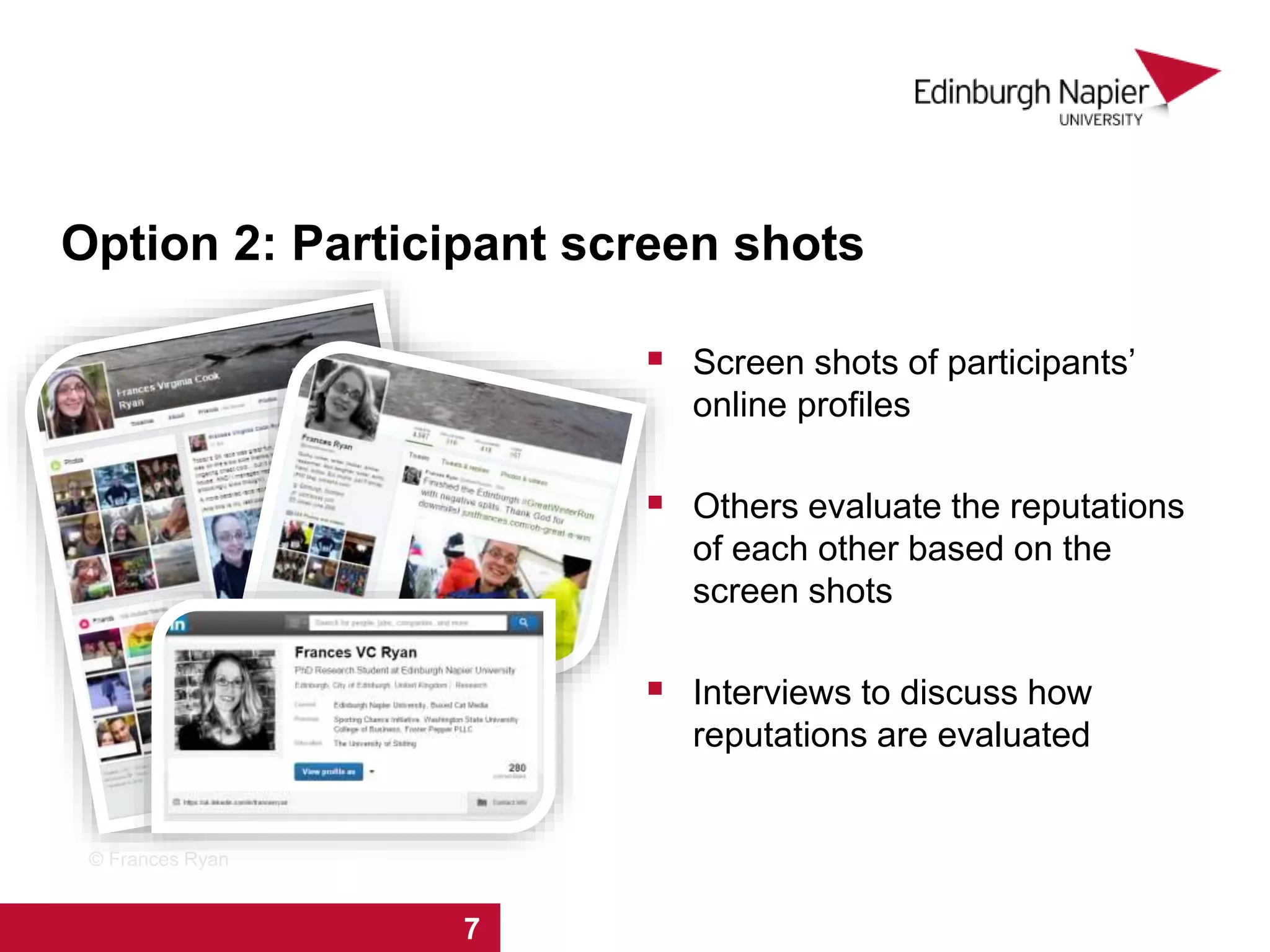
Option 2: Participant screen shots
 Screen shots of participants’
online profiles
 Others evaluate the reputations
of each other based on the
screen shots
 Interviews to discuss how
reputations are evaluated
1 2 3 4 5 6 7 8
© Frances Ryan
1 2 3 4 5 6 7
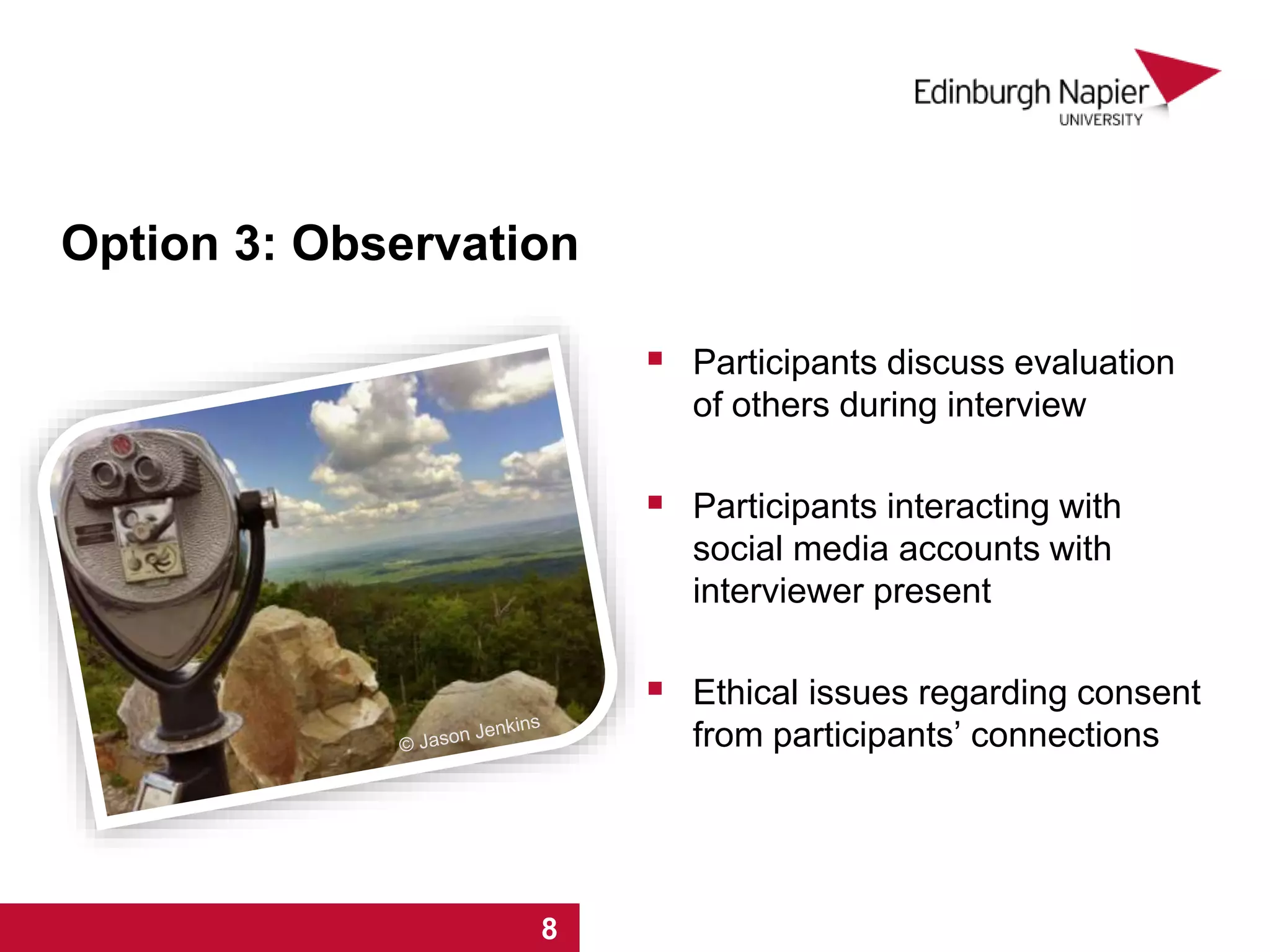
Option 3: Observation
 Participants discuss evaluation
of others during interview
 Participants interacting with
social media accounts with
interviewer present
 Ethical issues regarding consent
from participants’ connections
1 2 3 4 5 6 7 81 2 3 4 5 6 7 8
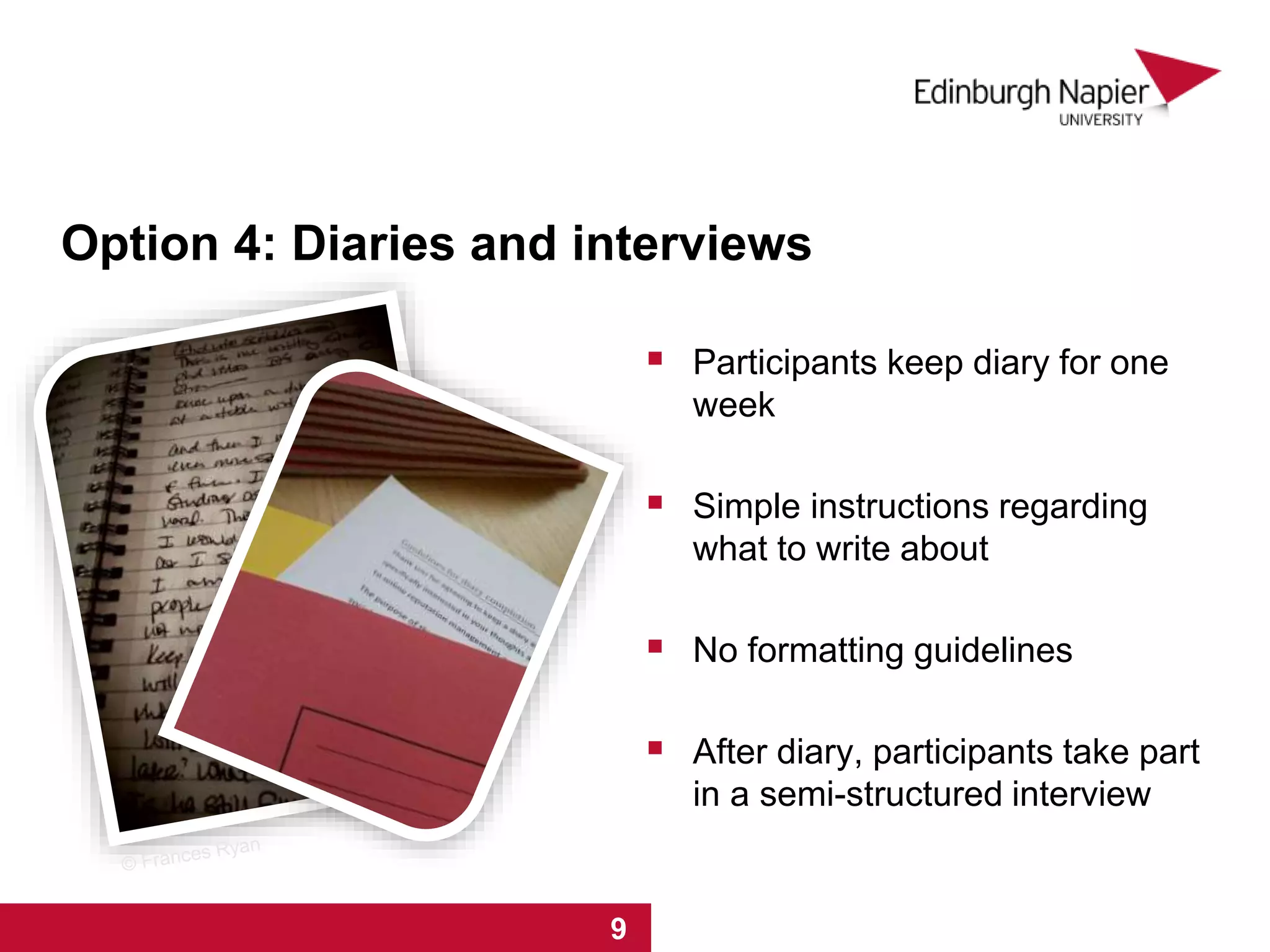
Option 4: Diaries and interviews
 Participants keep diary for one
week
 Simple instructions regarding
what to write about
 No formatting guidelines
 After diary, participants take part
in a semi-structured interview
1 2 3 4 5 6 7 81 2 3 4 5 6 7 8 9
Best option: Diaries and interviews
 Tradition in everyday life information seeking (ELIS) research
 Rich data are reliable sources of information and eliminate the
potential for inaccurate reporting
(Narayan, Case, & Edwards, 2011, p. 3)
 Several studies use a combination of diary-keeping and interviews
(Agosto & Hughes-Hassell, 2005; Dervin, 1983; McKenzie, 2003; Rieh, 2004)
 Although studies vary, they share a common theme: combining the
robustness of two forms of data
1 2 3 4 5 6 7 8 9 101 2 3 4 5 6 7 8 9 10
Testing the methods
 Pilot study to test methods and process
 Eight participants
 Popular social networking sites
 Participant diaries
 Participants kept diary for one week as they engaged with their social media accounts
 Interviews
 After completing diaries, participants took part in hour-long, semi-structured interviews
1 2 3 4 5 6 7 8 9 10 111 2 3 4 5 6 7 8 9 10 11
Findings
 Two-part data collection method was a success
 Participants were more aware of their actions and behaviours
 Not a burdensome amount of work for participants
 Produced a robust data set for analysis
 Helped to identify minor changes for main study
1 2 3 4 5 6 7 8 9 10 11 12 131 2 3 4 5 6 7 8 9 10 11 12
1 2 3 4 5 6 7 8 9 10 11 12 13 14 15
 Appropriateness of methods
confirmed
 Range of insights for main study
 Helped to re-format interview
guides and coding system
 Early indications show new
themes emerging
Pilot success!
1 2 3 4 5 6 7 8 9 10 11 12 13
Next steps
 Main empirical work
 Sample of 45+ participants
 Gen Y, Gen X, and Boomers
 Data analysis
 Thesis write-up
1 2 3 4 5 6 7 8 9 10 11 12 13 14 15 16 171 2 3 4 5 6 7 8 9 10 11 12 13 14
Slide 6: Creative commons copyright (1) WireframeSketcher
(wireframesketcher.com/mockups) (2) PitchStock (www.behance.net)
Slide 7: Copyright Frances VC Ryan
Slide 8: Creative commons copyright Jason Jenkins (www.flickr.com/jdub1980)
Slide 9: Copyright Frances VC Ryan
Slide 13: Creative commons copyright Sarah Reid (www.flickr.com/sarahreido)
Slide 14: Copyright Frances VC Ryan
1 2 3 4 5 6 7 8 9 10 11 12 13 14 15
Copyright attributions
Thank you!
f.ryan@napier.ac.uk
@cleverfrances
www.JustAPhD.com
+44(0)7530 696549
Slides available at: www.slideshare.net/justfrances

Personal online reputation: the development of an approach to investigate how personal reputation is evaluated and managed in online environments

  • 1.
    Personal online reputation: Thedevelopment of an approach to investigate how personal reputation is evaluated and managed in online environments by Frances VC Ryan Presentation delivered at the International Data and Information Management Conference 13th January 2016, Loughborough, England Co-authors: Peter Cruickshank, Professor Hazel Hall, and Alistair Lawson f.ryan@napier.ac.uk | @cleverfrances | www.JustAPhD.com 1
  • 2.
    Overview of presentation Brief overview of the research themes  Theoretical framework for empirical work  Evaluation of potential methods  Pilot testing chosen method  Findings from pilot  Conclusion and next steps 1 21 2
  • 3.
    What’s the researchabout? How online information contributes to the building, maintenance, and evaluation of personal reputations ― Personal reputation: Private individuals, rather than corporate identity and brand Two broad research themes: (1) The means by which people evaluate or assess the personal reputations of others from the online evidence available to them (2) How people manage their own personal reputations through their use of online information, and to what extent those behaviours are intentional 1 2 31 2 3
  • 4.
    Developing a theoreticalframework for empirical work Difficult: What literature should be considered? 1. General materials related to research themes across many domains (e.g. Human resources, marketing, information systems, physical and mental health) 2. Specific material on academic reputations evident in citation analysis 3. Contextual material from everyday life information seeking (ELIS) studies 1 2 3 41 2 3 4
  • 5.
    Developing a theoreticalframework for empirical work Difficult: Which literature should be considered? 1. General materials related to research themes across many domains (e.g. Human resources, marketing, information systems, physical and mental health) 2. Specific material on academic reputations evident in citation analysis 3. Contextual material from everyday life information seeking (ELIS) studies 1 2 3 4 Lots of options: - Quantitative - Qualitative 1 2 3 4
  • 6.
    Developing a theoreticalframework for empirical work Difficult: Which literature should be considered? 1. General materials related to research themes across many domains (e.g. Human resources, marketing, information systems, physical and mental health) 2. Specific material on academic reputations evident in citation analysis 3. Contextual material from everyday life information seeking (ELIS) studies 1 2 3 4 Mostly Quantitative 1 2 3 4
  • 7.
    Developing a theoreticalframework for empirical work Difficult: Which literature should be considered? 1. General materials related to research themes across many domains (e.g. Human resources, marketing, information systems, physical and mental health) 2. Specific material on academic reputations evident in citation analysis 3. Contextual material from everyday life information seeking (ELIS) studies 1 2 3 4 Largely Qualitative 1 2 3 4
  • 8.
    How best toinvestigate both research themes?  The challenge? Establishing a way to examine both research themes simultaneously  Qualitative methods deemed most appropriate  Semi-structured, in-depth interviews to discuss participants’ own practices  Answering questions on evaluation of others proved more difficult  Four potential solutions … 1 2 3 4 5 6 71 2 3 4 5
  • 9.
    Option 1: Profilemock-ups  Create false user profiles  Information mimics situations from literature  Participants review mock-ups  Interviews to discuss how reputations are evaluated 1 2 3 4 5 6 7 81 2 3 4 5 6
  • 10.
    Option 2: Participantscreen shots  Screen shots of participants’ online profiles  Others evaluate the reputations of each other based on the screen shots  Interviews to discuss how reputations are evaluated 1 2 3 4 5 6 7 8 © Frances Ryan 1 2 3 4 5 6 7
  • 11.
    Option 3: Observation Participants discuss evaluation of others during interview  Participants interacting with social media accounts with interviewer present  Ethical issues regarding consent from participants’ connections 1 2 3 4 5 6 7 81 2 3 4 5 6 7 8
  • 12.
    Option 4: Diariesand interviews  Participants keep diary for one week  Simple instructions regarding what to write about  No formatting guidelines  After diary, participants take part in a semi-structured interview 1 2 3 4 5 6 7 81 2 3 4 5 6 7 8 9
  • 13.
    Best option: Diariesand interviews  Tradition in everyday life information seeking (ELIS) research  Rich data are reliable sources of information and eliminate the potential for inaccurate reporting (Narayan, Case, & Edwards, 2011, p. 3)  Several studies use a combination of diary-keeping and interviews (Agosto & Hughes-Hassell, 2005; Dervin, 1983; McKenzie, 2003; Rieh, 2004)  Although studies vary, they share a common theme: combining the robustness of two forms of data 1 2 3 4 5 6 7 8 9 101 2 3 4 5 6 7 8 9 10
  • 14.
    Testing the methods Pilot study to test methods and process  Eight participants  Popular social networking sites  Participant diaries  Participants kept diary for one week as they engaged with their social media accounts  Interviews  After completing diaries, participants took part in hour-long, semi-structured interviews 1 2 3 4 5 6 7 8 9 10 111 2 3 4 5 6 7 8 9 10 11
  • 15.
    Findings  Two-part datacollection method was a success  Participants were more aware of their actions and behaviours  Not a burdensome amount of work for participants  Produced a robust data set for analysis  Helped to identify minor changes for main study 1 2 3 4 5 6 7 8 9 10 11 12 131 2 3 4 5 6 7 8 9 10 11 12
  • 16.
    1 2 34 5 6 7 8 9 10 11 12 13 14 15  Appropriateness of methods confirmed  Range of insights for main study  Helped to re-format interview guides and coding system  Early indications show new themes emerging Pilot success! 1 2 3 4 5 6 7 8 9 10 11 12 13
  • 17.
    Next steps  Mainempirical work  Sample of 45+ participants  Gen Y, Gen X, and Boomers  Data analysis  Thesis write-up 1 2 3 4 5 6 7 8 9 10 11 12 13 14 15 16 171 2 3 4 5 6 7 8 9 10 11 12 13 14
  • 18.
    Slide 6: Creativecommons copyright (1) WireframeSketcher (wireframesketcher.com/mockups) (2) PitchStock (www.behance.net) Slide 7: Copyright Frances VC Ryan Slide 8: Creative commons copyright Jason Jenkins (www.flickr.com/jdub1980) Slide 9: Copyright Frances VC Ryan Slide 13: Creative commons copyright Sarah Reid (www.flickr.com/sarahreido) Slide 14: Copyright Frances VC Ryan 1 2 3 4 5 6 7 8 9 10 11 12 13 14 15 Copyright attributions
  • 19.

Editor's Notes

  • #4 Two main themes: How people build and create their OWN identities and reputations How they evaluate or assess the reputations of others
  • #5 Information science – including citation analysis and everyday life information seeking However! Much of the literature is dispersed across a number of other domains
  • #6 Information science – including citation analysis and everyday life information seeking However! Much of the literature is dispersed across a number of other domains
  • #7 Information science – including citation analysis and everyday life information seeking However! Much of the literature is dispersed across a number of other domains
  • #8 Information science – including citation analysis and everyday life information seeking However! Much of the literature is dispersed across a number of other domains
  • #9 The idea that online and offline worlds have merged to create a “real world” is becoming an accepted concept But there is not a consensus on how or why the amalgamation happens. Hongladarom argues that the blurring between online and offline environments occurs as individuals project themselves onto social media and social networking sites. He also suggests that there is essentially no difference between individuals’ online and offline selves because of this, thus causing them to merge into one “real world”. Other studies have indicated that some individuals intentionally transfer their offline activities and interactions to online environments (Amichai-Hamburger & Vinitzky, 2010, p. 1294). However, Craig and Ludloff (2011) suggest that some of the blurring between online and offline worlds happens not because of individuals’ specific desires to share information about their offline worlds online, but rather the convenience of conducting some of their activities online. They argue that individuals trade personal information about themselves for the conveniences of services including ecommerce, instant messaging/communication, and connecting with others through networking sites (Craig & Ludloff, 2011, pp. 1-4). This is not necessarily due to an intentional desire to merge the two worlds. Anecdotal evidence asking about online/offline by HR managers and social media users alike.
  • #17 But we know that these gaps align with some of the “big questions” related to information science research. Specifically: How do people relate to, seek, and use information? (Bates, 1999, p. 6) How do we handle ideas and knowledge, both our own and other people’s? (Howkins, 2009, p. 1)