Power-related advantages of
    cloud computing
      Jonathan G. Koomey, Ph.D.
         http://www.koomey.com
 Project Scientist, LBNL and Consulting
     Professor, Stanford University
             May 17, 2010
                                          1
Your choice:
Current in-house IT
         or
cloud computing?


                      2
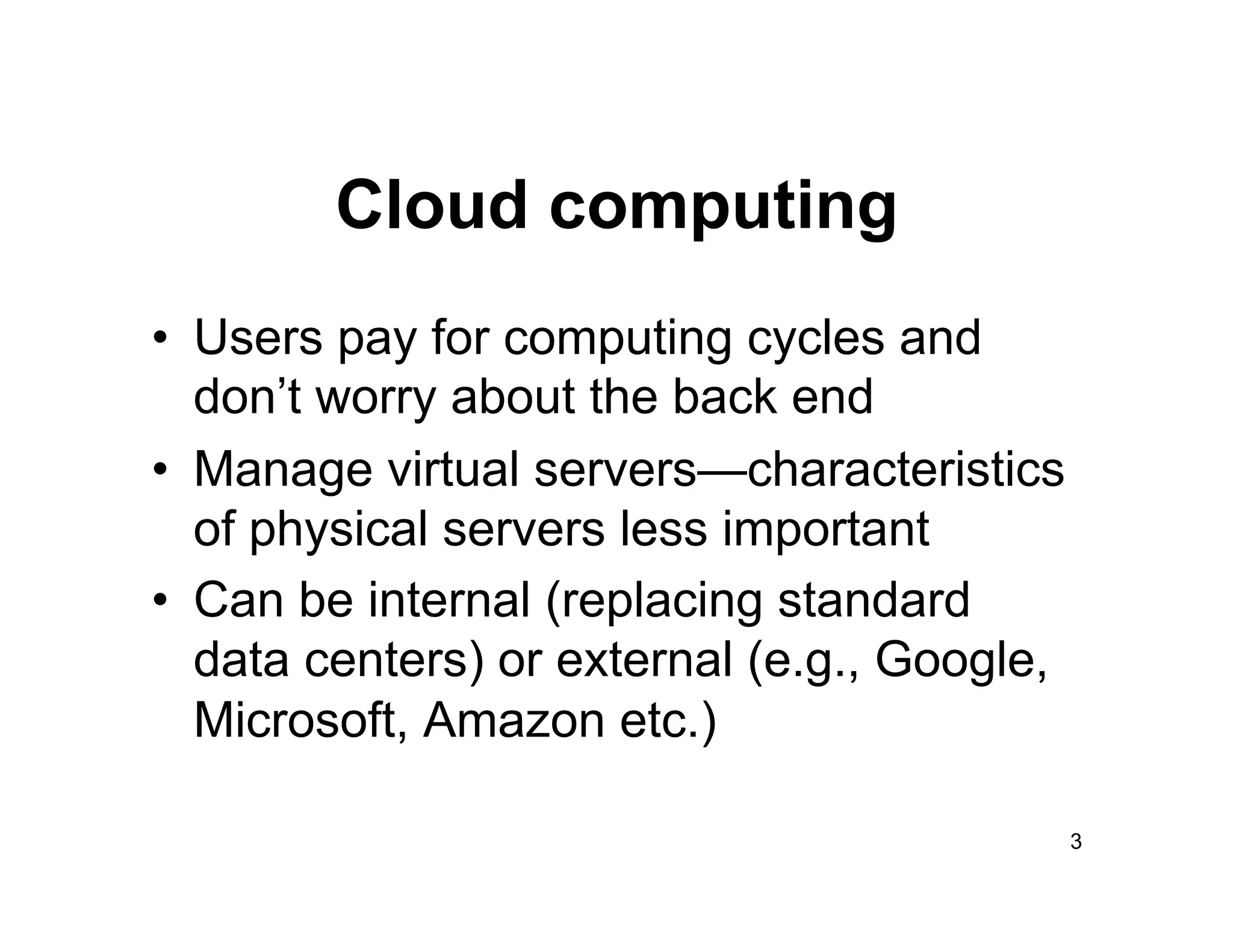
Cloud computing
•  Users pay for computing cycles and
   don’t worry about the back end
•  Manage virtual servers—characteristics
   of physical servers less important
•  Can be internal (replacing standard
   data centers) or external (e.g., Google,
   Microsoft, Amazon etc.)

                                              3
My claim:
Powerful economic trends will
 push users more and more
  towards cloud computing


                           4
One of the main drivers of
those trends is more efficient
    power use by cloud
    computing providers


                             5
Data center costs are strongly
  affected by IT power use,
  particularly server power


                            6
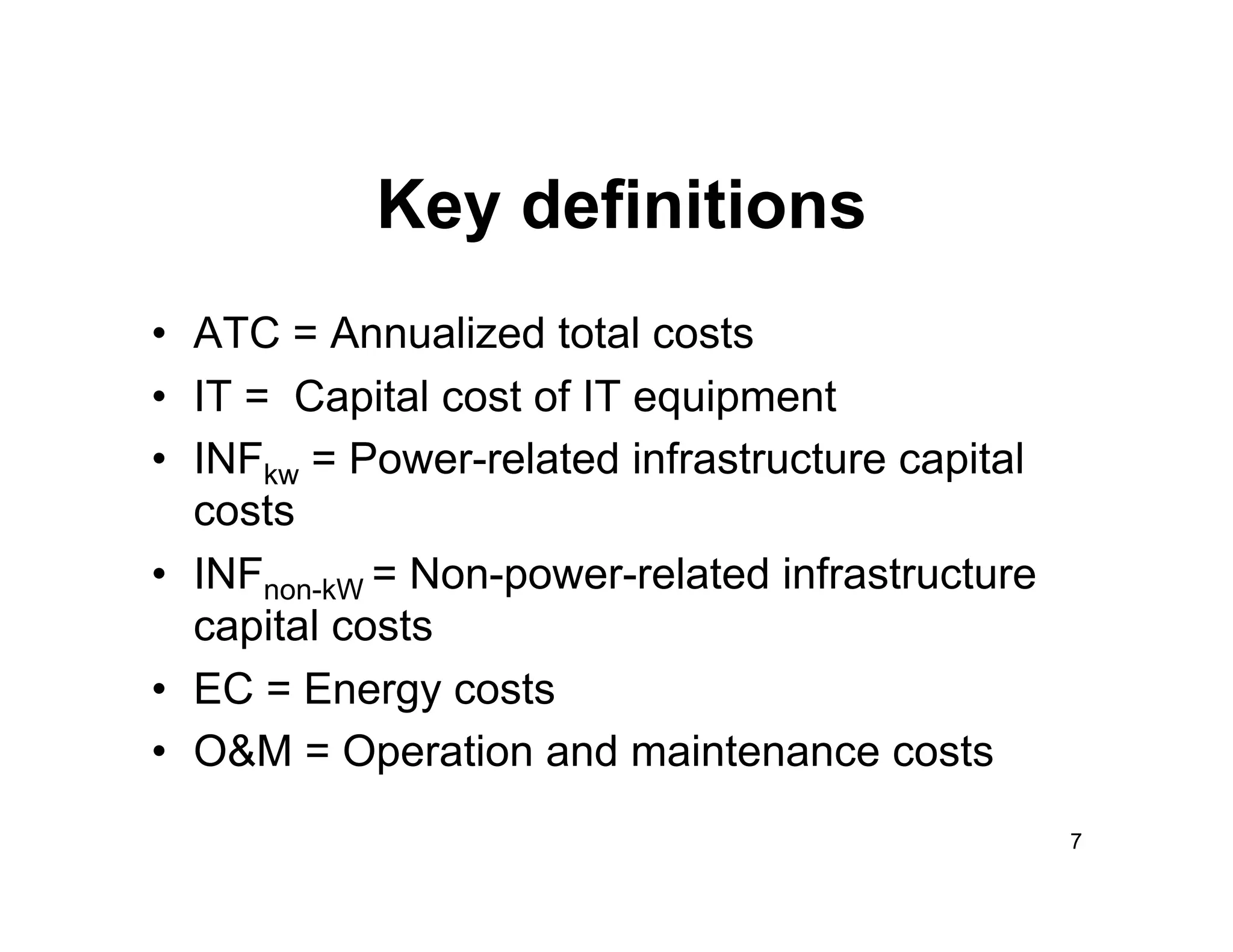
Key definitions
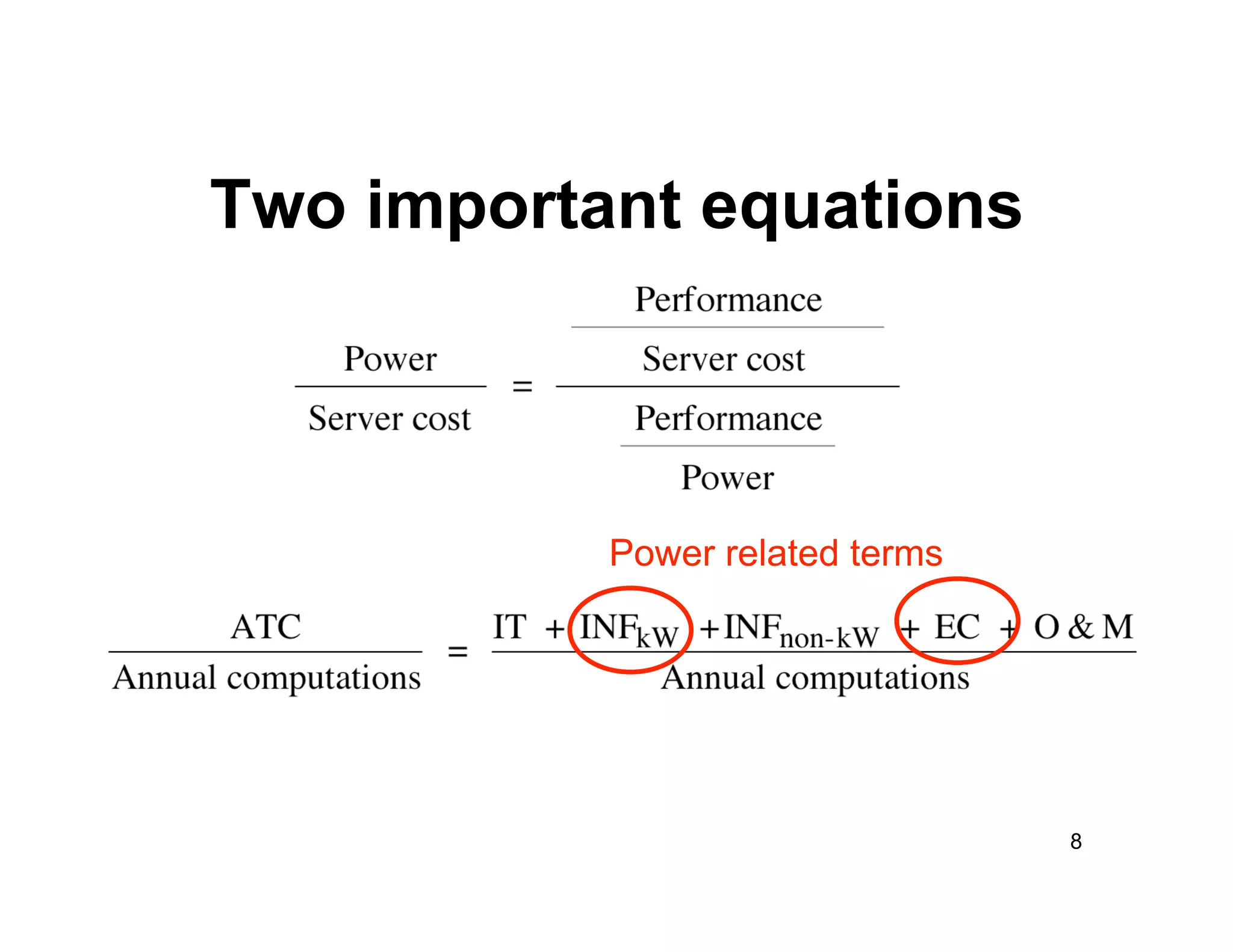
•  ATC = Annualized total costs
•  IT = Capital cost of IT equipment
•  INFkw = Power-related infrastructure capital
   costs
•  INFnon-kW = Non-power-related infrastructure
   capital costs
•  EC = Energy costs
•  O&M = Operation and maintenance costs
                                                  7
Two important equations


           Power related terms


                                 8
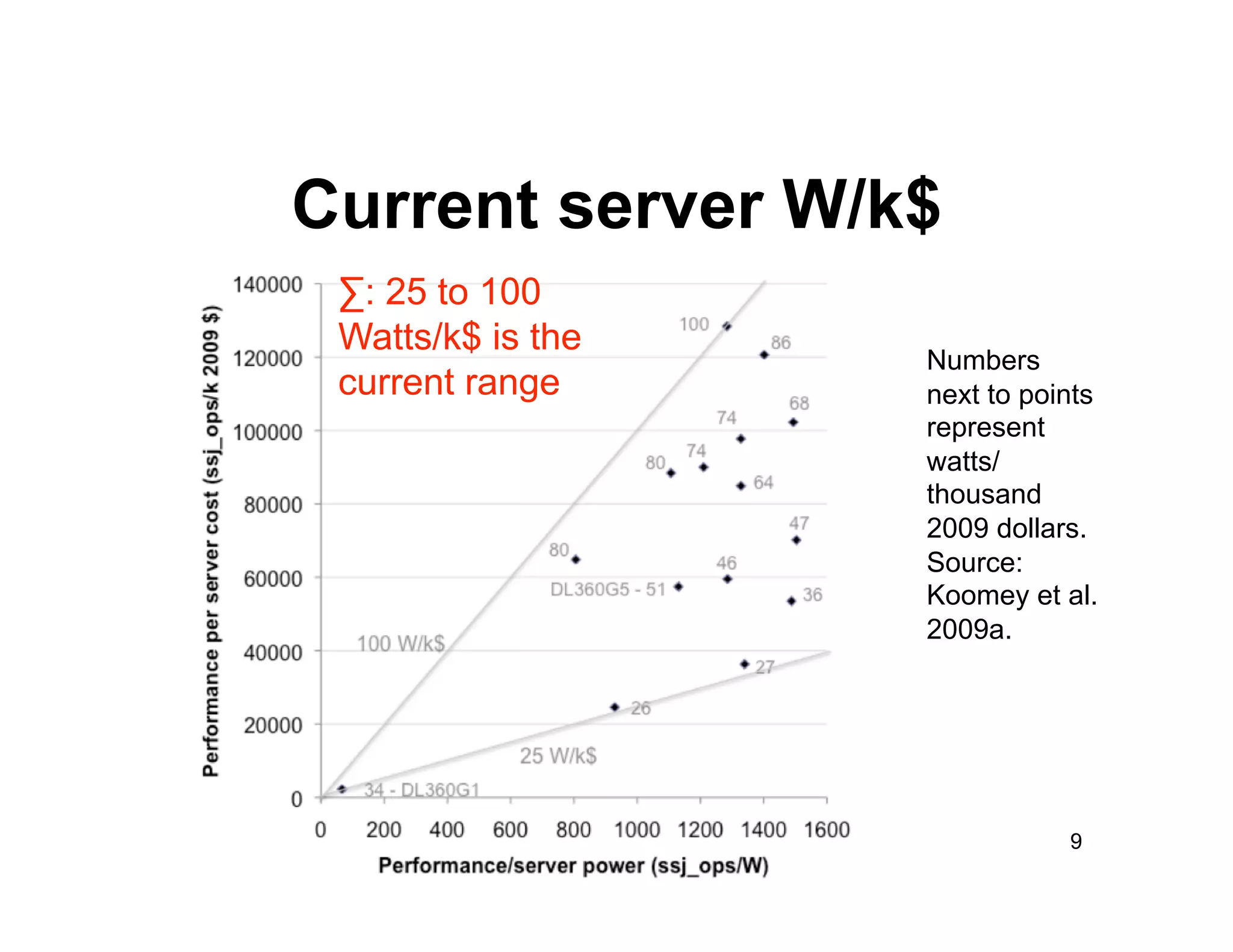
Current server W/k$
 ∑: 25 to 100
 Watts/k$ is the
                   Numbers
 current range     next to points
                   represent
                   watts/
                   thousand
                   2009 dollars.
                   Source:
                   Koomey et al.
                   2009a.


                              9
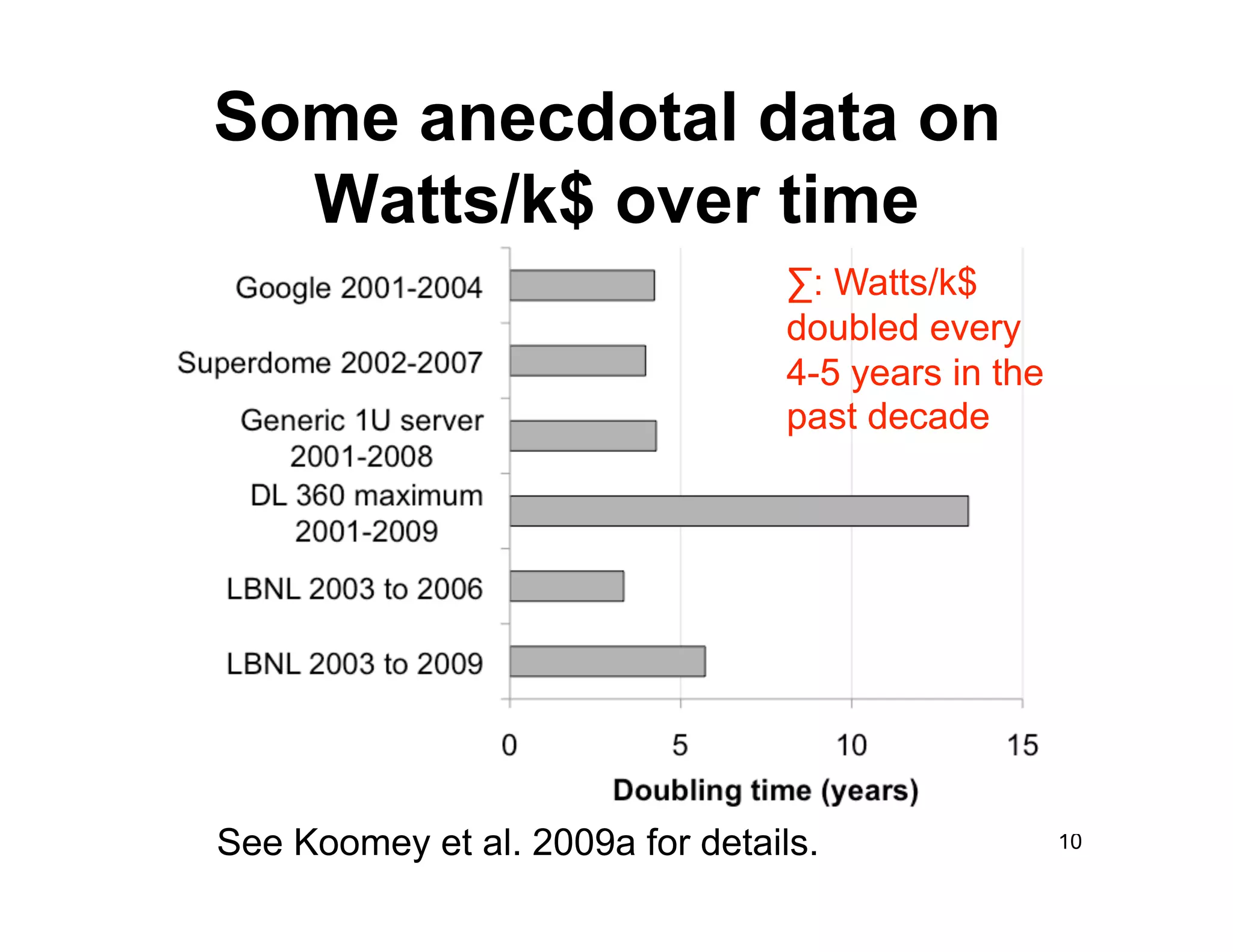
Some anecdotal data on
  Watts/k$ over time
                                  ∑: Watts/k$
                                  doubled every
                                  4-5 years in the
                                  past decade


See Koomey et al. 2009a for details.                 10
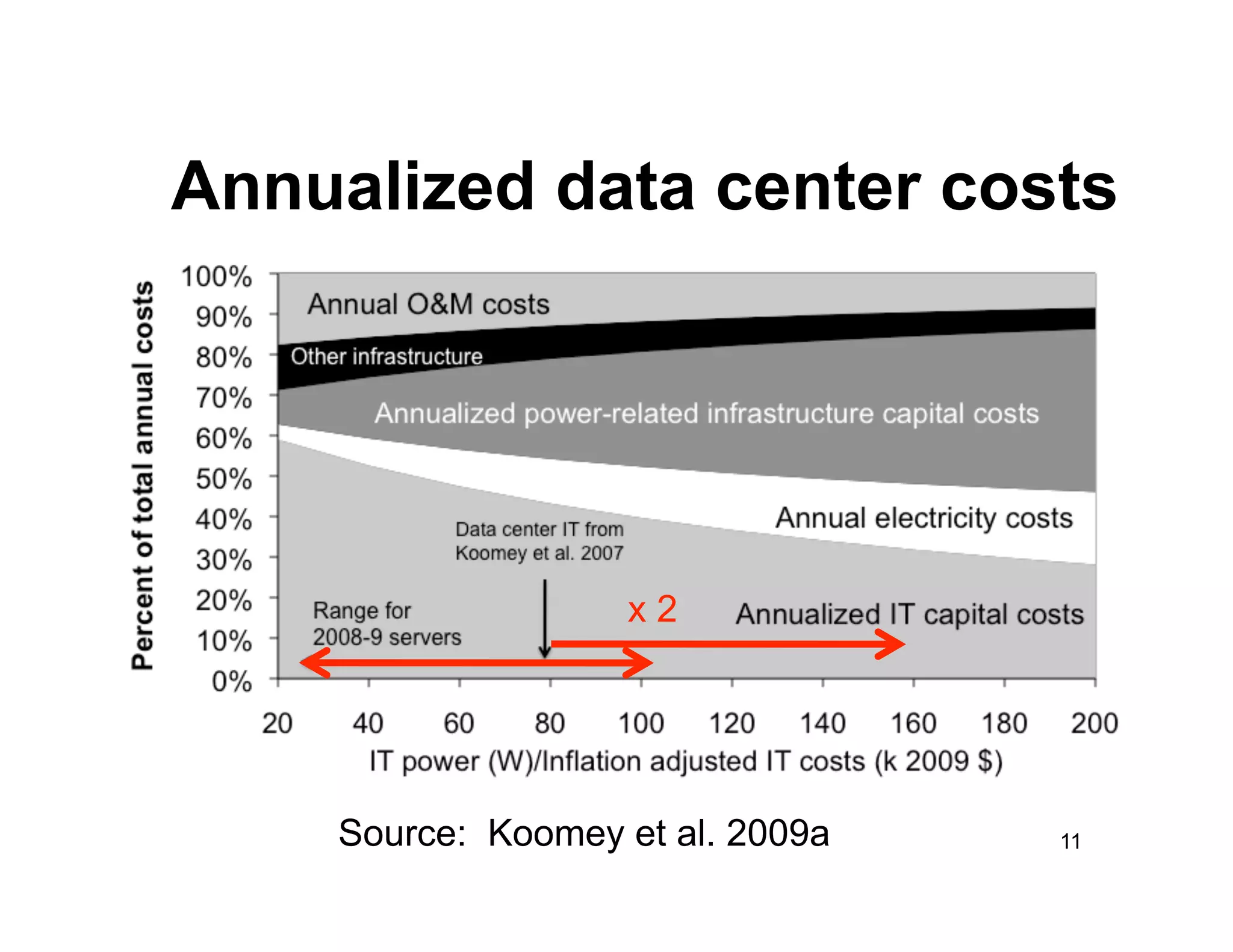
Annualized data center costs


                   x2


    Source: Koomey et al. 2009a   11
Improving the energy
efficiency of data centers is as
     much about people and
    institutions as it is about
            technology

                              12
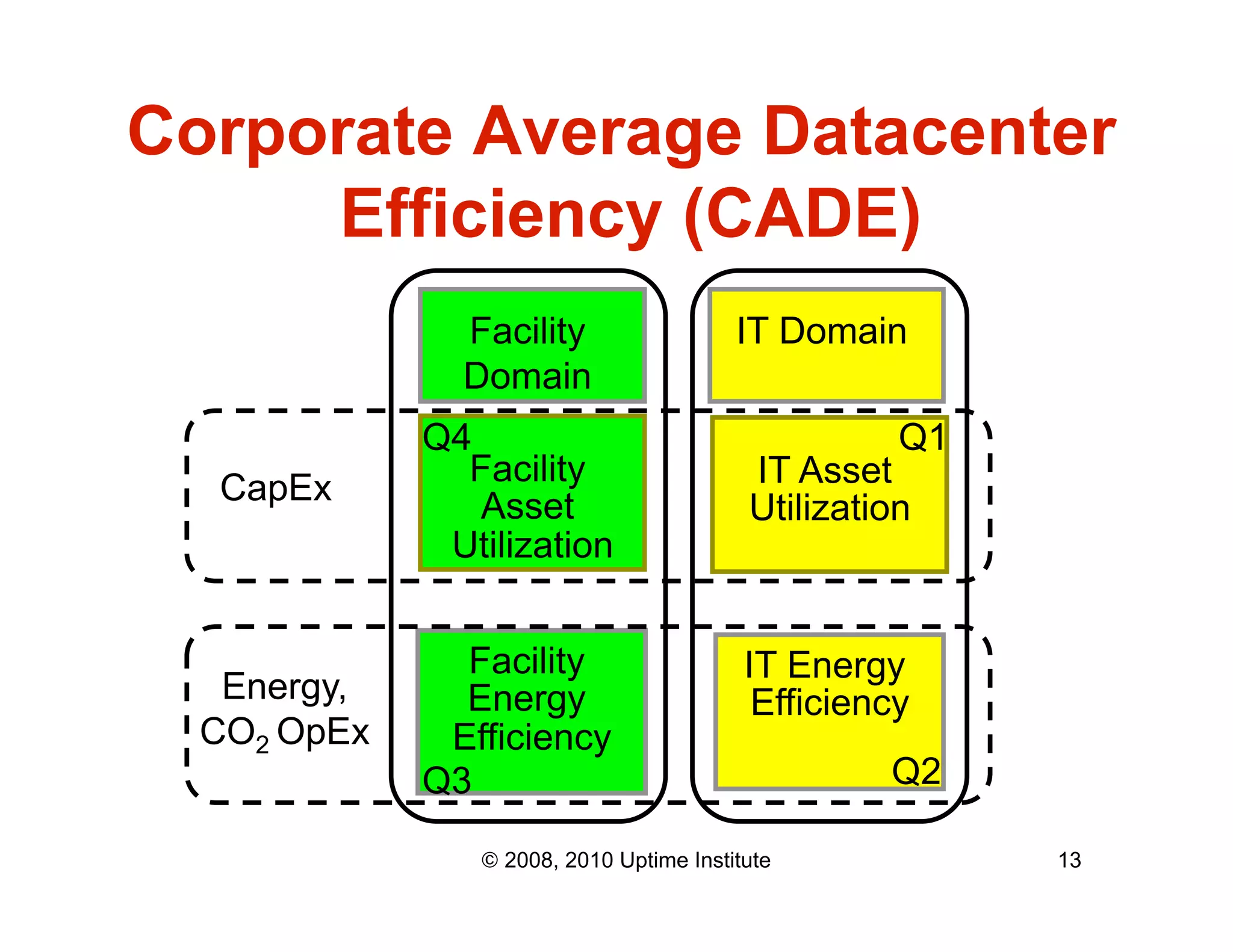
Corporate Average Datacenter
     Efficiency (CADE)
               Facility                  IT Domain
               Domain
             Q4                                     Q1
               Facility                   IT Asset
  CapEx         Asset                     Utilization
              Utilization


               Facility                   IT Energy
   Energy,     Energy                      Efficiency
  CO2 OpEx    Efficiency
             Q3                                    Q2

                © 2008, 2010 Uptime Institute            13
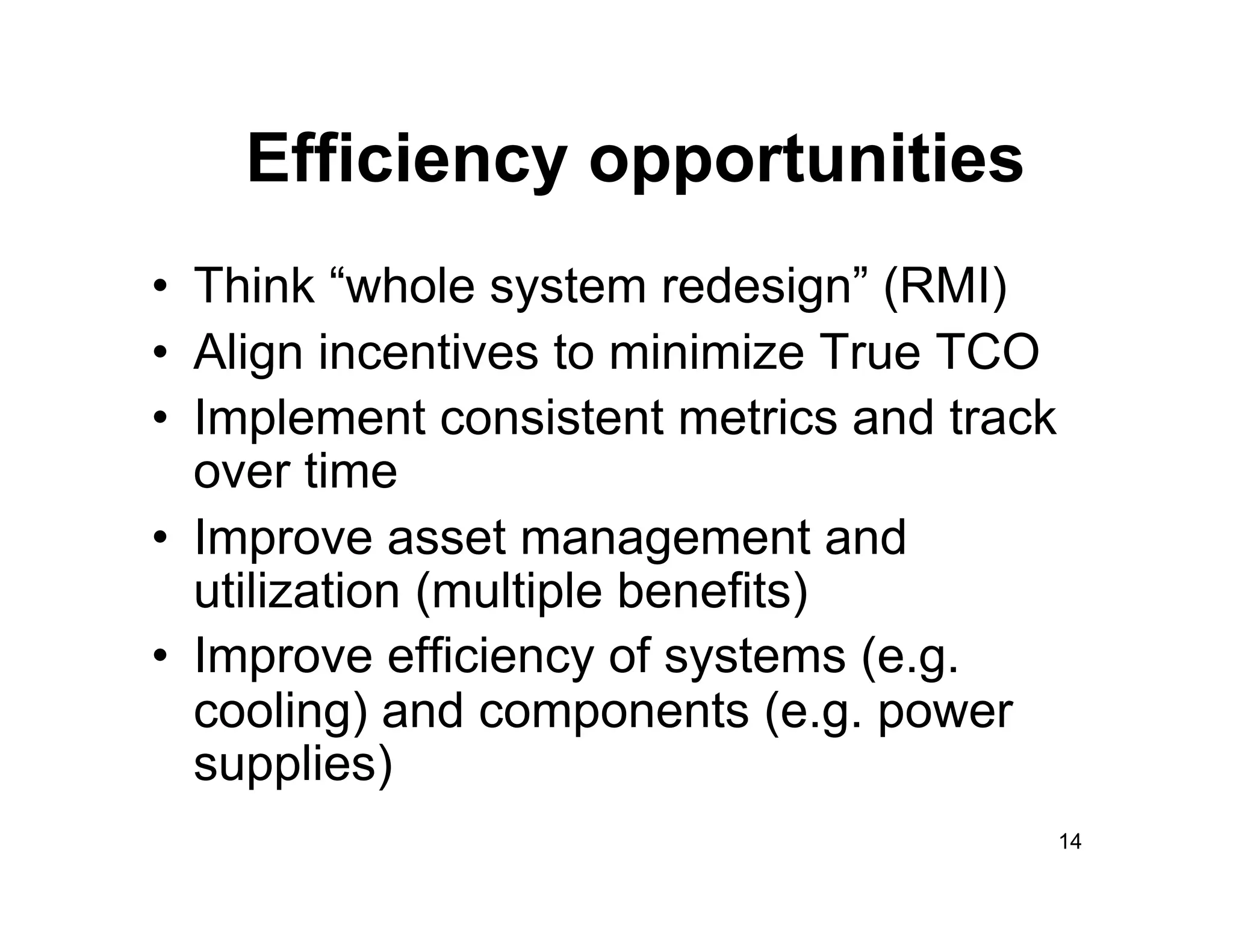
Efficiency opportunities
•  Think “whole system redesign” (RMI)
•  Align incentives to minimize True TCO
•  Implement consistent metrics and track
   over time
•  Improve asset management and
   utilization (multiple benefits)
•  Improve efficiency of systems (e.g.
   cooling) and components (e.g. power
   supplies)
                                            14
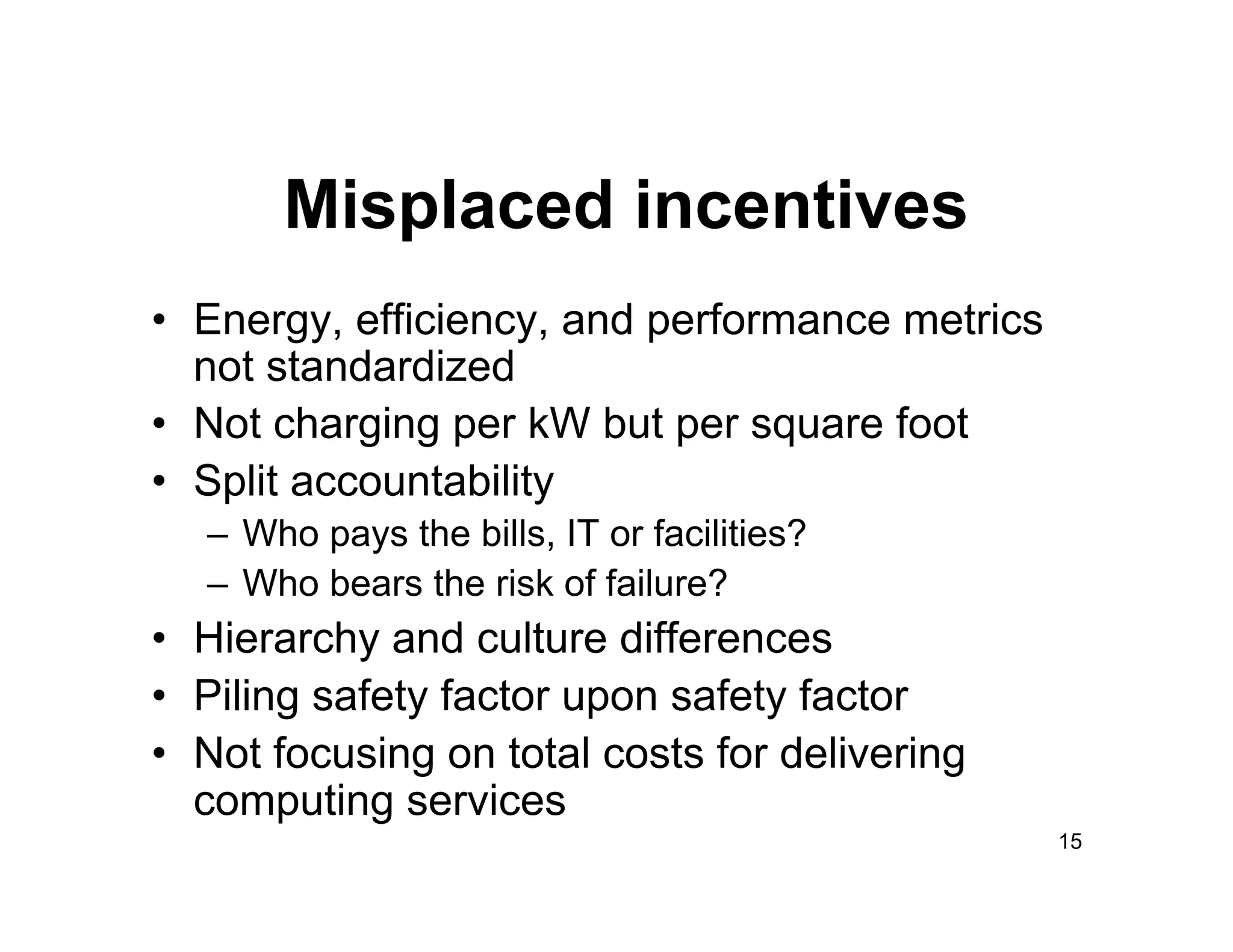
Misplaced incentives
•  Energy, efficiency, and performance metrics
   not standardized
•  Not charging per kW but per square foot
•  Split accountability
   –  Who pays the bills, IT or facilities?
   –  Who bears the risk of failure?
•  Hierarchy and culture differences
•  Piling safety factor upon safety factor
•  Not focusing on total costs for delivering
   computing services
                                                 15
Cloud computing suppliers
have at least four inherent
advantages on power and
 costs over “in-house” IT.


                              16
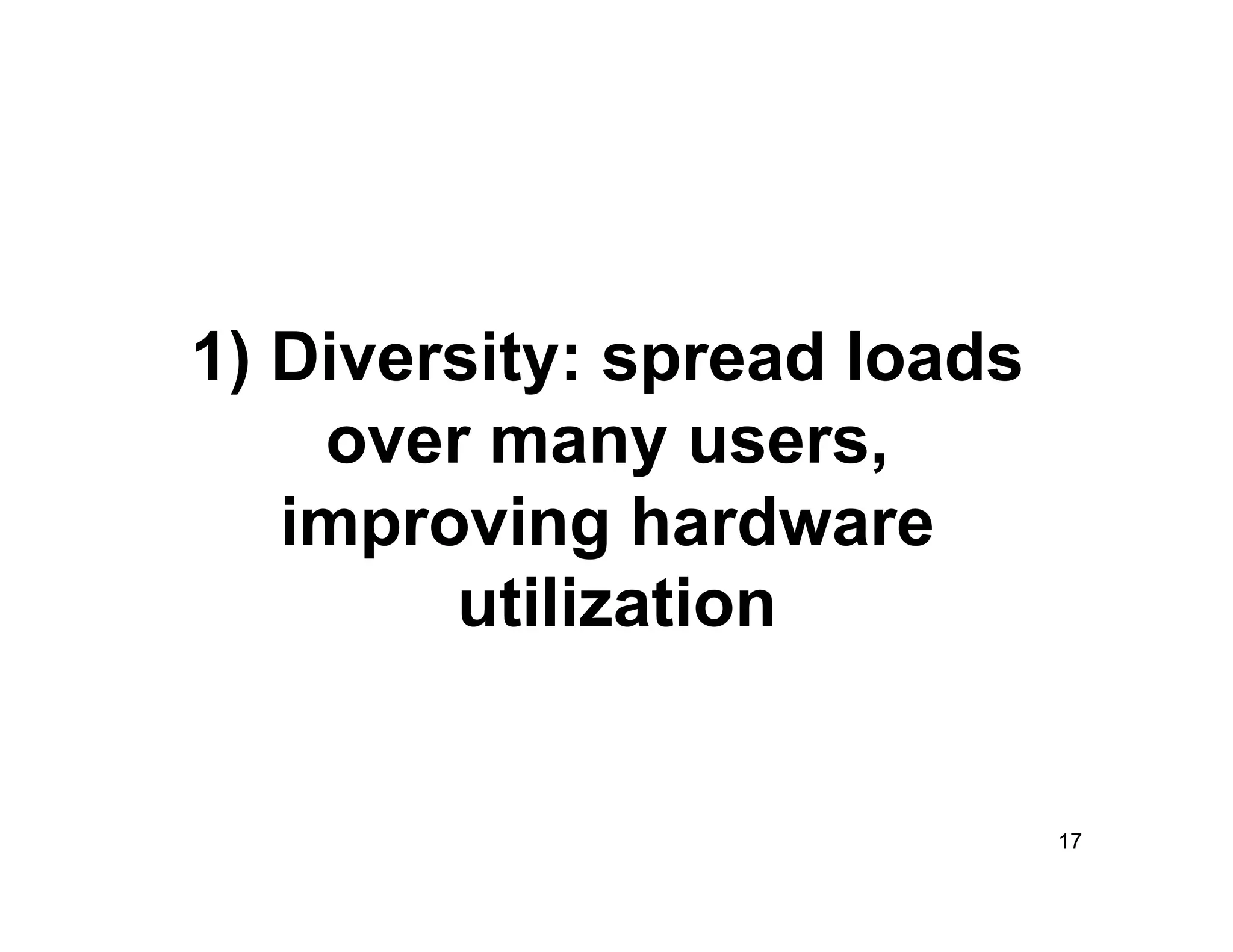
1) Diversity: spread loads
    over many users,
   improving hardware
        utilization


                             17
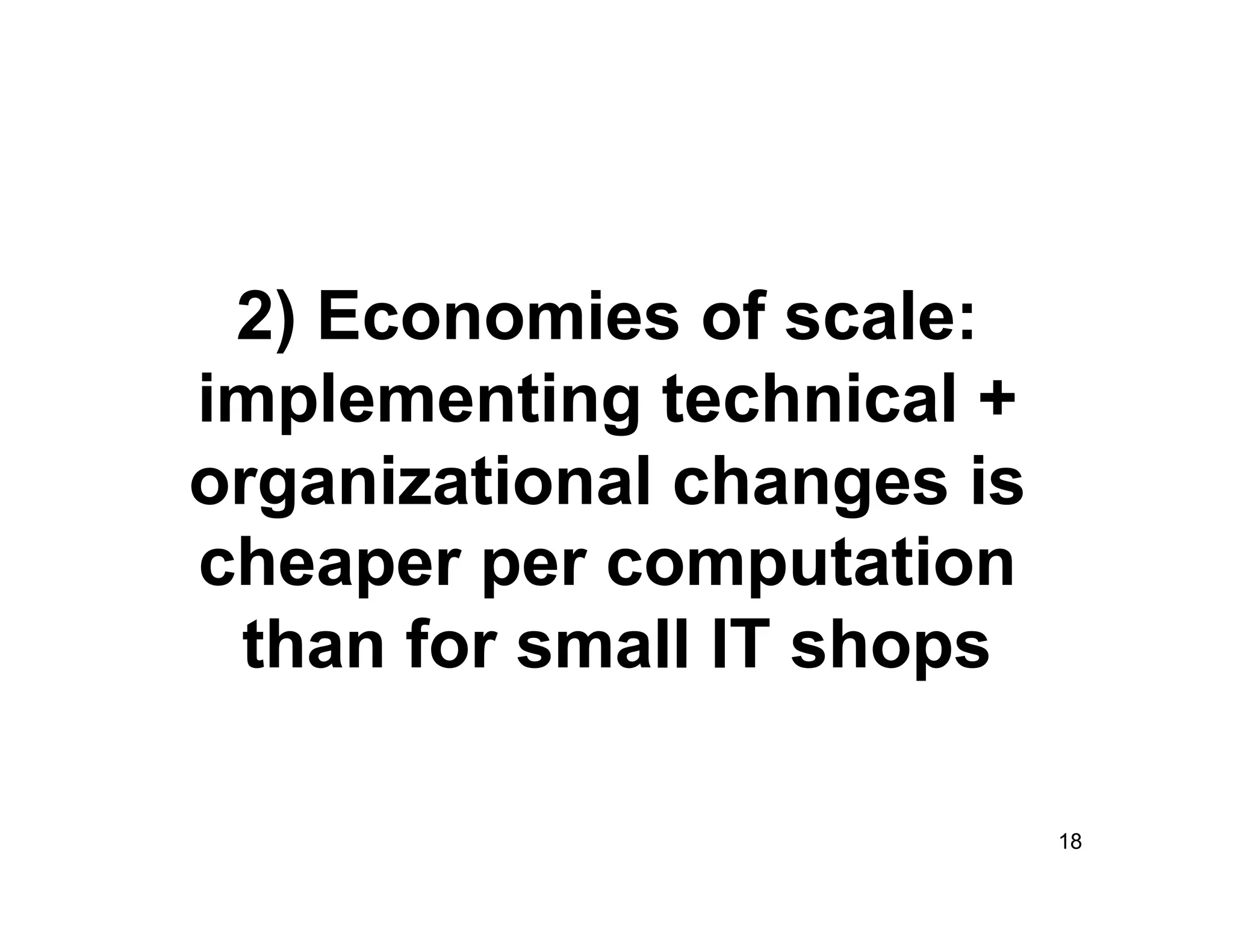
2) Economies of scale:
implementing technical +
organizational changes is
cheaper per computation
 than for small IT shops

                            18
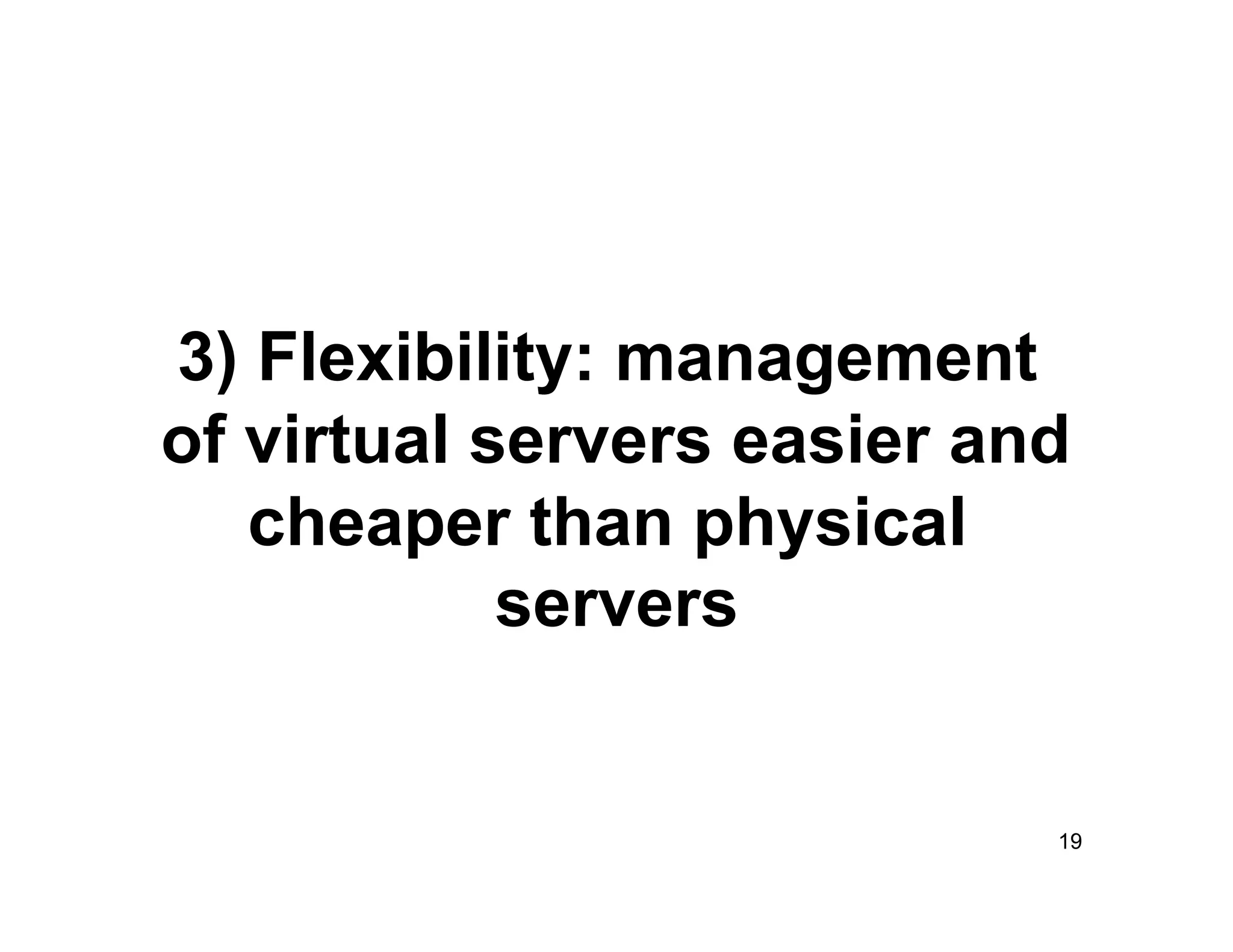
3) Flexibility: management
of virtual servers easier and
   cheaper than physical
            servers


                            19
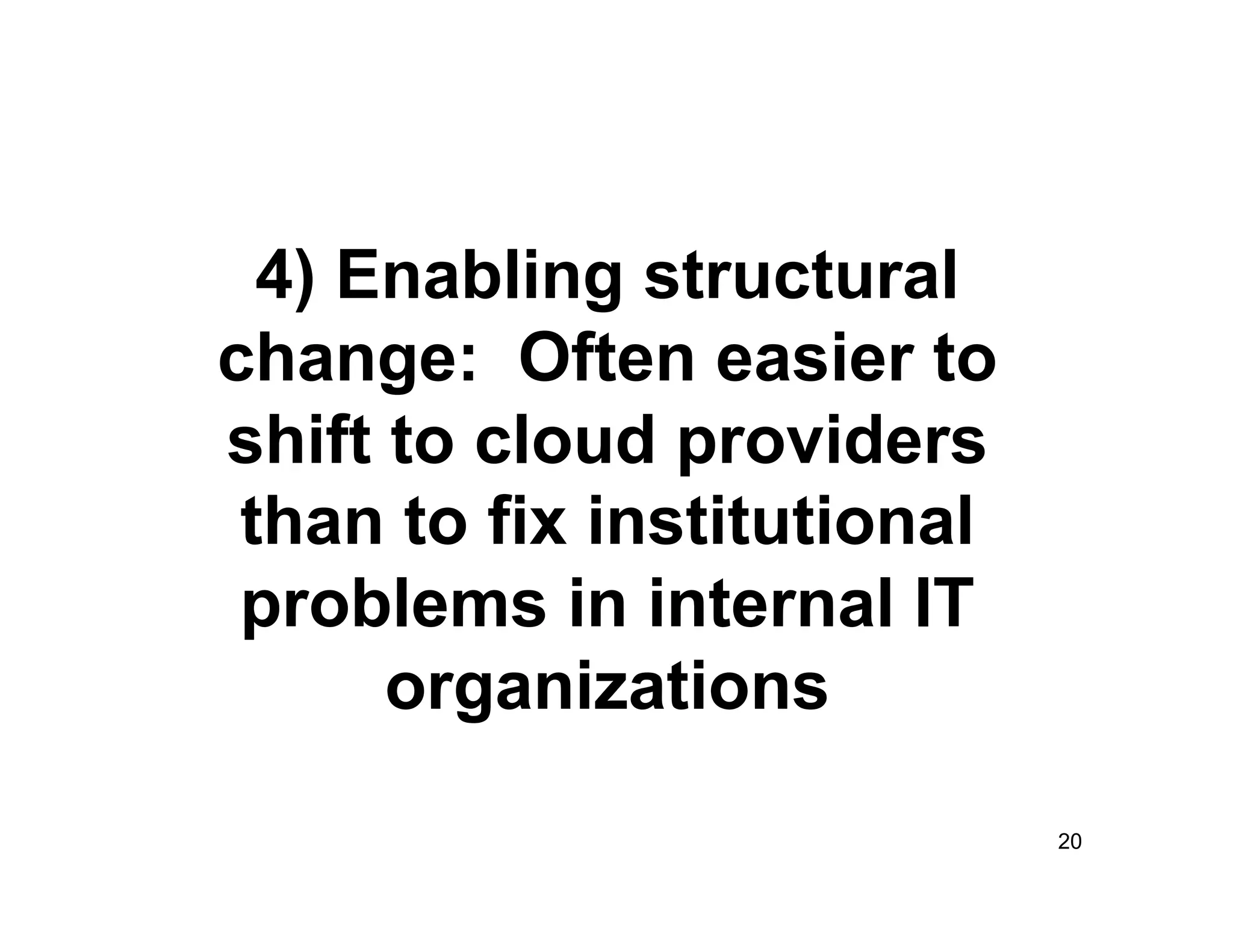
4) Enabling structural
change: Often easier to
shift to cloud providers
 than to fix institutional
 problems in internal IT
      organizations

                             20
Carbon taxes will accelerate
 these trends (and accentuate
regional differences in sources
     of power generation)


                            21
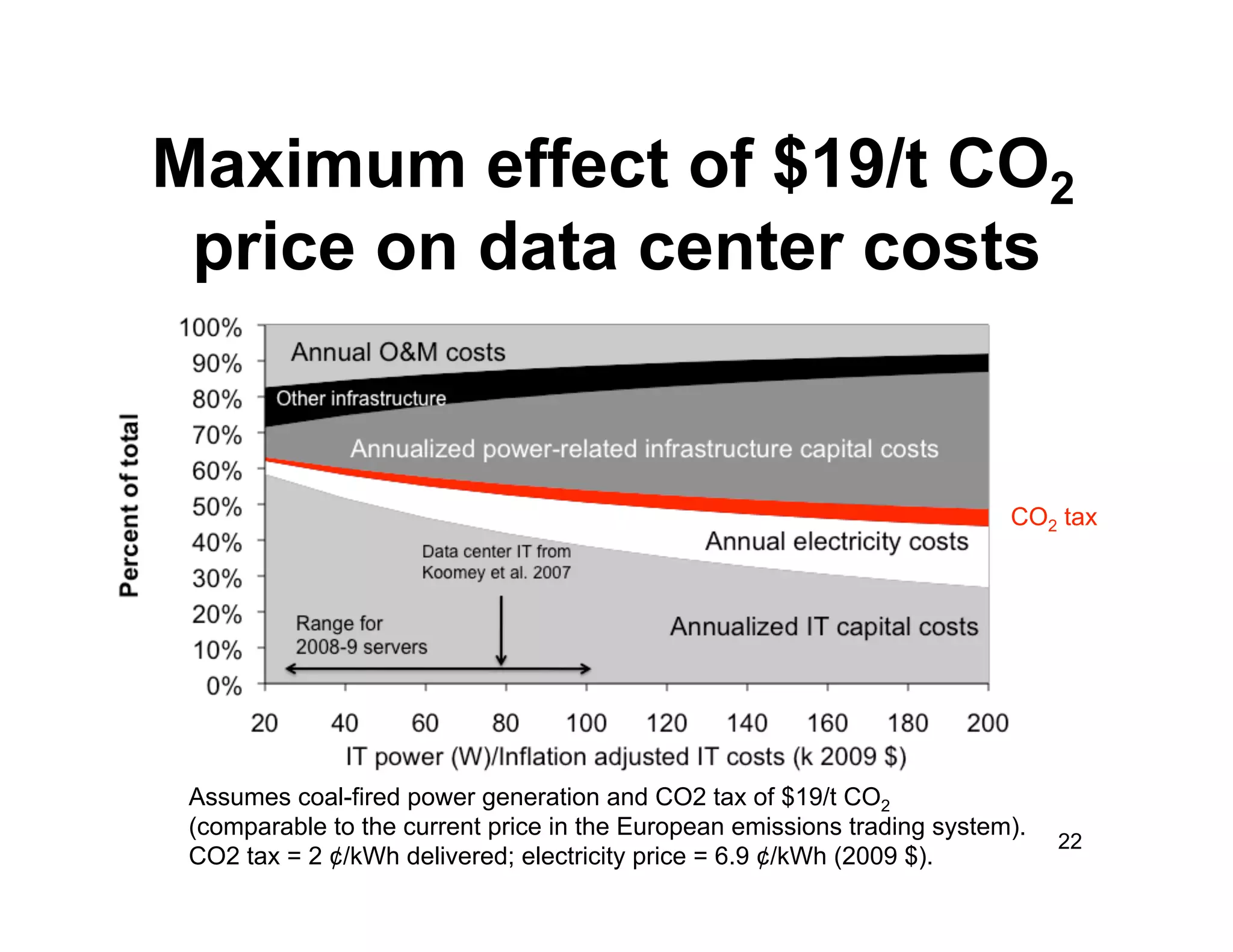
Maximum effect of $19/t CO2
 price on data center costs


                                                                          CO2 tax


 Assumes coal-fired power generation and CO2 tax of $19/t CO2
 (comparable to the current price in the European emissions trading system).
                                                                               22
 CO2 tax = 2 ¢/kWh delivered; electricity price = 6.9 ¢/kWh (2009 $).
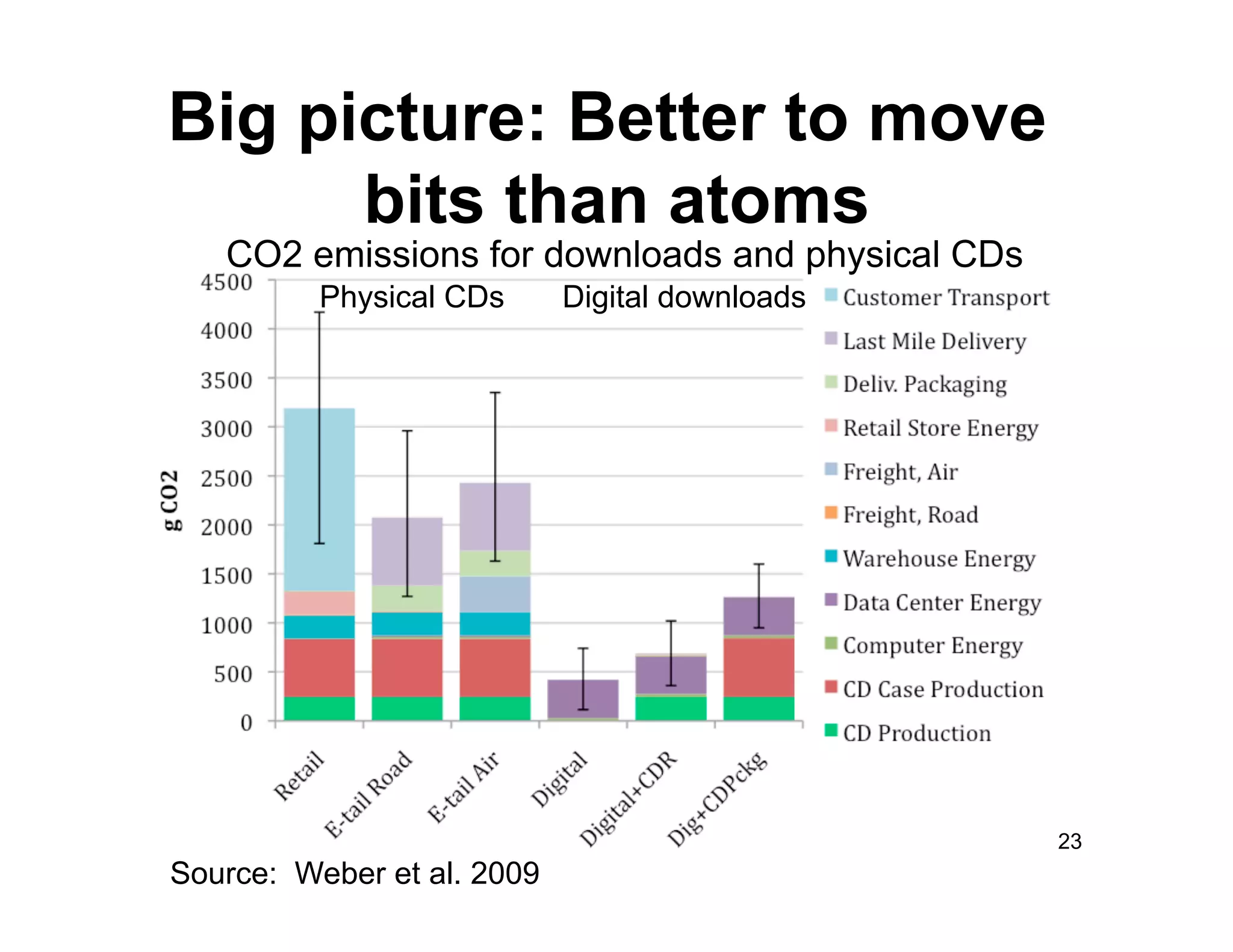
Big picture: Better to move
      bits than atoms
   CO2 emissions for downloads and physical CDs
          Physical CDs      Digital downloads


                                                  23
Source: Weber et al. 2009
Conclusions
•  Cloud computing’s inherent cost advantages
   will continue to drive customers to use it
•  Power efficiency is one of the main sources of
   these advantages (and pricing carbon will
   make the case more compelling)
•  Conventional internal data centers will still be
   important for certain kinds of applications, but
   will diminish in importance over time
•  Issues about liability, property rights, and
   security in the cloud will need to be sorted out,
   but the economic benefits will create pressure
   to do just that
                                                  24
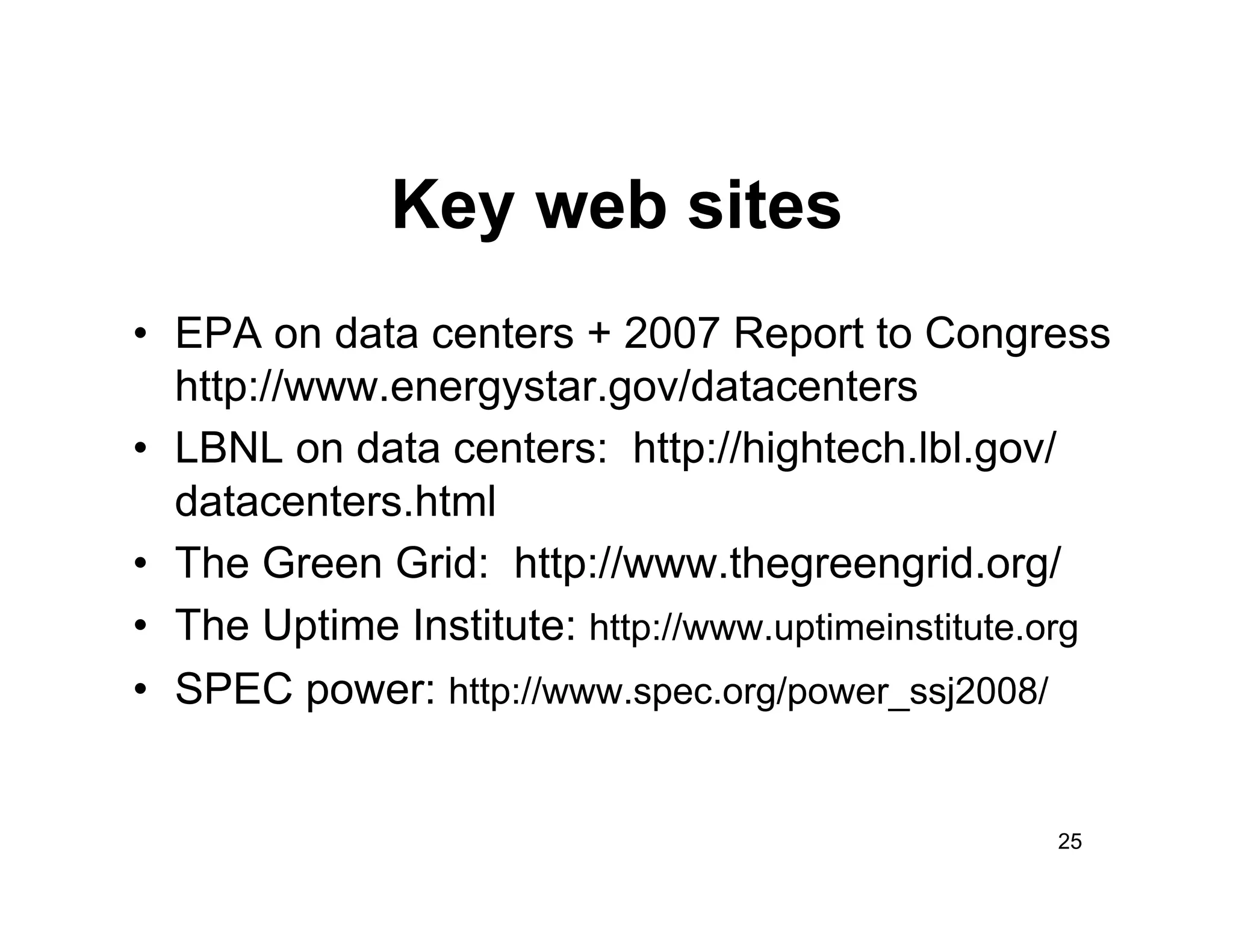
Key web sites
•  EPA on data centers + 2007 Report to Congress
   http://www.energystar.gov/datacenters
•  LBNL on data centers: http://hightech.lbl.gov/
   datacenters.html
•  The Green Grid: http://www.thegreengrid.org/
•  The Uptime Institute: http://www.uptimeinstitute.org
•  SPEC power: http://www.spec.org/power_ssj2008/


                                                    25
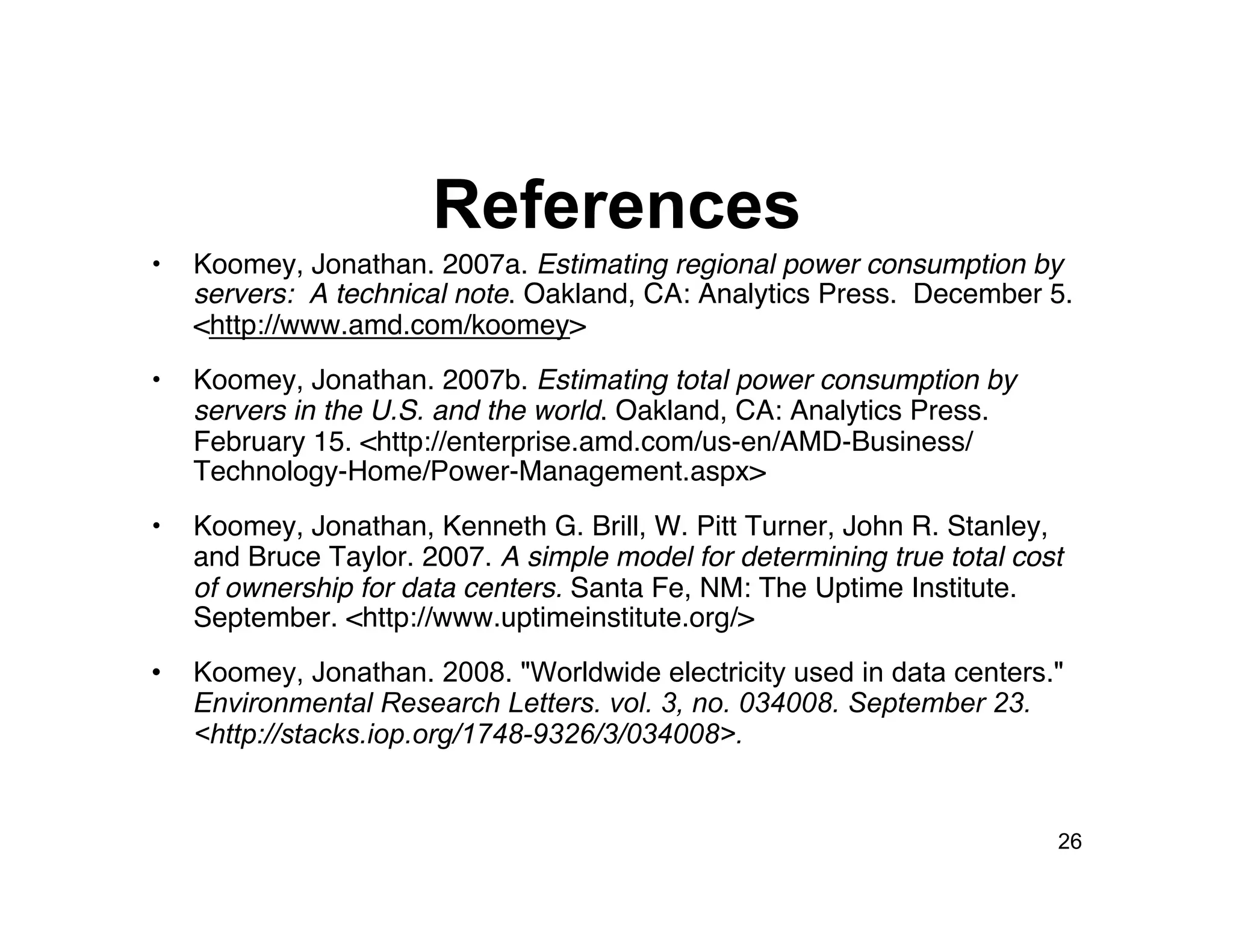
References
•    Koomey, Jonathan. 2007a. Estimating regional power consumption by
     servers: A technical note. Oakland, CA: Analytics Press. December 5.
     <http://www.amd.com/koomey>
•    Koomey, Jonathan. 2007b. Estimating total power consumption by
     servers in the U.S. and the world. Oakland, CA: Analytics Press.
     February 15. <http://enterprise.amd.com/us-en/AMD-Business/
     Technology-Home/Power-Management.aspx>
•    Koomey, Jonathan, Kenneth G. Brill, W. Pitt Turner, John R. Stanley,
     and Bruce Taylor. 2007. A simple model for determining true total cost
     of ownership for data centers. Santa Fe, NM: The Uptime Institute.
     September. <http://www.uptimeinstitute.org/>
•    Koomey, Jonathan. 2008. "Worldwide electricity used in data centers."
     Environmental Research Letters. vol. 3, no. 034008. September 23.
     <http://stacks.iop.org/1748-9326/3/034008>.


                                                                          26
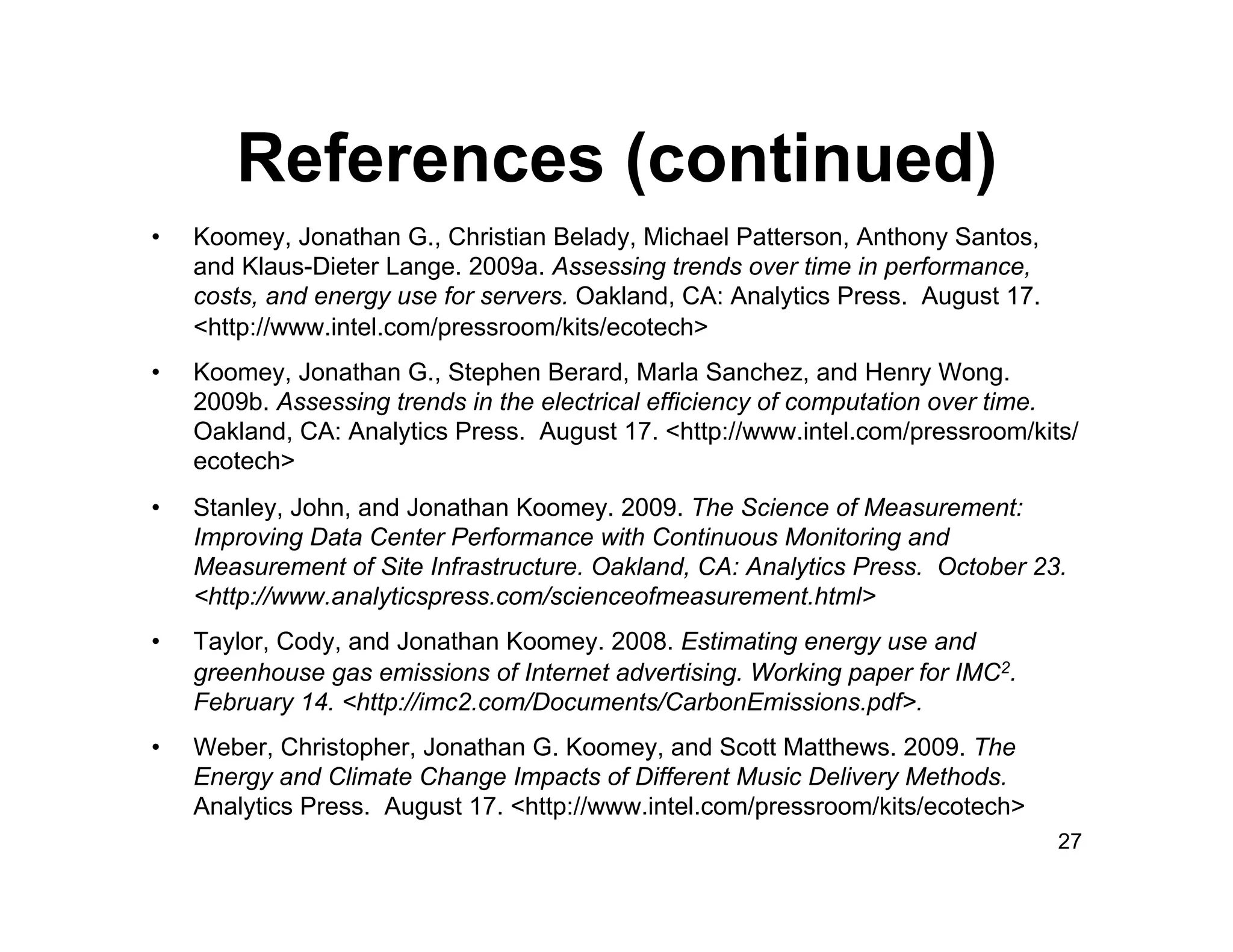
References (continued)
•    Koomey, Jonathan G., Christian Belady, Michael Patterson, Anthony Santos,
     and Klaus-Dieter Lange. 2009a. Assessing trends over time in performance,
     costs, and energy use for servers. Oakland, CA: Analytics Press. August 17.
     <http://www.intel.com/pressroom/kits/ecotech>
•    Koomey, Jonathan G., Stephen Berard, Marla Sanchez, and Henry Wong.
     2009b. Assessing trends in the electrical efficiency of computation over time.
     Oakland, CA: Analytics Press. August 17. <http://www.intel.com/pressroom/kits/
     ecotech>
•    Stanley, John, and Jonathan Koomey. 2009. The Science of Measurement:
     Improving Data Center Performance with Continuous Monitoring and
     Measurement of Site Infrastructure. Oakland, CA: Analytics Press. October 23.
     <http://www.analyticspress.com/scienceofmeasurement.html>
•    Taylor, Cody, and Jonathan Koomey. 2008. Estimating energy use and
     greenhouse gas emissions of Internet advertising. Working paper for IMC2.
     February 14. <http://imc2.com/Documents/CarbonEmissions.pdf>.
•    Weber, Christopher, Jonathan G. Koomey, and Scott Matthews. 2009. The
     Energy and Climate Change Impacts of Different Music Delivery Methods.
     Analytics Press. August 17. <http://www.intel.com/pressroom/kits/ecotech>
                                                                                   27

Koomeyoncloudcomputing V5

  • 1.
    Power-related advantages of cloud computing Jonathan G. Koomey, Ph.D. http://www.koomey.com Project Scientist, LBNL and Consulting Professor, Stanford University May 17, 2010 1
  • 2.
    Your choice: Current in-houseIT or cloud computing? 2
  • 3.
    Cloud computing •  Userspay for computing cycles and don’t worry about the back end •  Manage virtual servers—characteristics of physical servers less important •  Can be internal (replacing standard data centers) or external (e.g., Google, Microsoft, Amazon etc.) 3
  • 4.
    My claim: Powerful economictrends will push users more and more towards cloud computing 4
  • 5.
    One of themain drivers of those trends is more efficient power use by cloud computing providers 5
  • 6.
    Data center costsare strongly affected by IT power use, particularly server power 6
  • 7.
    Key definitions •  ATC= Annualized total costs •  IT = Capital cost of IT equipment •  INFkw = Power-related infrastructure capital costs •  INFnon-kW = Non-power-related infrastructure capital costs •  EC = Energy costs •  O&M = Operation and maintenance costs 7
  • 8.
    Two important equations Power related terms 8
  • 9.
    Current server W/k$ ∑: 25 to 100 Watts/k$ is the Numbers current range next to points represent watts/ thousand 2009 dollars. Source: Koomey et al. 2009a. 9
  • 10.
    Some anecdotal dataon Watts/k$ over time ∑: Watts/k$ doubled every 4-5 years in the past decade See Koomey et al. 2009a for details. 10
  • 11.
    Annualized data centercosts x2 Source: Koomey et al. 2009a 11
  • 12.
    Improving the energy efficiencyof data centers is as much about people and institutions as it is about technology 12
  • 13.
    Corporate Average Datacenter Efficiency (CADE) Facility IT Domain Domain Q4 Q1 Facility IT Asset CapEx Asset Utilization Utilization Facility IT Energy Energy, Energy Efficiency CO2 OpEx Efficiency Q3 Q2 © 2008, 2010 Uptime Institute 13
  • 14.
    Efficiency opportunities •  Think“whole system redesign” (RMI) •  Align incentives to minimize True TCO •  Implement consistent metrics and track over time •  Improve asset management and utilization (multiple benefits) •  Improve efficiency of systems (e.g. cooling) and components (e.g. power supplies) 14
  • 15.
    Misplaced incentives •  Energy,efficiency, and performance metrics not standardized •  Not charging per kW but per square foot •  Split accountability –  Who pays the bills, IT or facilities? –  Who bears the risk of failure? •  Hierarchy and culture differences •  Piling safety factor upon safety factor •  Not focusing on total costs for delivering computing services 15
  • 16.
    Cloud computing suppliers haveat least four inherent advantages on power and costs over “in-house” IT. 16
  • 17.
    1) Diversity: spreadloads over many users, improving hardware utilization 17
  • 18.
    2) Economies ofscale: implementing technical + organizational changes is cheaper per computation than for small IT shops 18
  • 19.
    3) Flexibility: management ofvirtual servers easier and cheaper than physical servers 19
  • 20.
    4) Enabling structural change:Often easier to shift to cloud providers than to fix institutional problems in internal IT organizations 20
  • 21.
    Carbon taxes willaccelerate these trends (and accentuate regional differences in sources of power generation) 21
  • 22.
    Maximum effect of$19/t CO2 price on data center costs CO2 tax Assumes coal-fired power generation and CO2 tax of $19/t CO2 (comparable to the current price in the European emissions trading system). 22 CO2 tax = 2 ¢/kWh delivered; electricity price = 6.9 ¢/kWh (2009 $).
  • 23.
    Big picture: Betterto move bits than atoms CO2 emissions for downloads and physical CDs Physical CDs Digital downloads 23 Source: Weber et al. 2009
  • 24.
    Conclusions •  Cloud computing’sinherent cost advantages will continue to drive customers to use it •  Power efficiency is one of the main sources of these advantages (and pricing carbon will make the case more compelling) •  Conventional internal data centers will still be important for certain kinds of applications, but will diminish in importance over time •  Issues about liability, property rights, and security in the cloud will need to be sorted out, but the economic benefits will create pressure to do just that 24
  • 25.
    Key web sites • EPA on data centers + 2007 Report to Congress http://www.energystar.gov/datacenters •  LBNL on data centers: http://hightech.lbl.gov/ datacenters.html •  The Green Grid: http://www.thegreengrid.org/ •  The Uptime Institute: http://www.uptimeinstitute.org •  SPEC power: http://www.spec.org/power_ssj2008/ 25
  • 26.
    References •  Koomey, Jonathan. 2007a. Estimating regional power consumption by servers: A technical note. Oakland, CA: Analytics Press. December 5. <http://www.amd.com/koomey> •  Koomey, Jonathan. 2007b. Estimating total power consumption by servers in the U.S. and the world. Oakland, CA: Analytics Press. February 15. <http://enterprise.amd.com/us-en/AMD-Business/ Technology-Home/Power-Management.aspx> •  Koomey, Jonathan, Kenneth G. Brill, W. Pitt Turner, John R. Stanley, and Bruce Taylor. 2007. A simple model for determining true total cost of ownership for data centers. Santa Fe, NM: The Uptime Institute. September. <http://www.uptimeinstitute.org/> •  Koomey, Jonathan. 2008. "Worldwide electricity used in data centers." Environmental Research Letters. vol. 3, no. 034008. September 23. <http://stacks.iop.org/1748-9326/3/034008>. 26
  • 27.
    References (continued) •  Koomey, Jonathan G., Christian Belady, Michael Patterson, Anthony Santos, and Klaus-Dieter Lange. 2009a. Assessing trends over time in performance, costs, and energy use for servers. Oakland, CA: Analytics Press. August 17. <http://www.intel.com/pressroom/kits/ecotech> •  Koomey, Jonathan G., Stephen Berard, Marla Sanchez, and Henry Wong. 2009b. Assessing trends in the electrical efficiency of computation over time. Oakland, CA: Analytics Press. August 17. <http://www.intel.com/pressroom/kits/ ecotech> •  Stanley, John, and Jonathan Koomey. 2009. The Science of Measurement: Improving Data Center Performance with Continuous Monitoring and Measurement of Site Infrastructure. Oakland, CA: Analytics Press. October 23. <http://www.analyticspress.com/scienceofmeasurement.html> •  Taylor, Cody, and Jonathan Koomey. 2008. Estimating energy use and greenhouse gas emissions of Internet advertising. Working paper for IMC2. February 14. <http://imc2.com/Documents/CarbonEmissions.pdf>. •  Weber, Christopher, Jonathan G. Koomey, and Scott Matthews. 2009. The Energy and Climate Change Impacts of Different Music Delivery Methods. Analytics Press. August 17. <http://www.intel.com/pressroom/kits/ecotech> 27