
Corundum
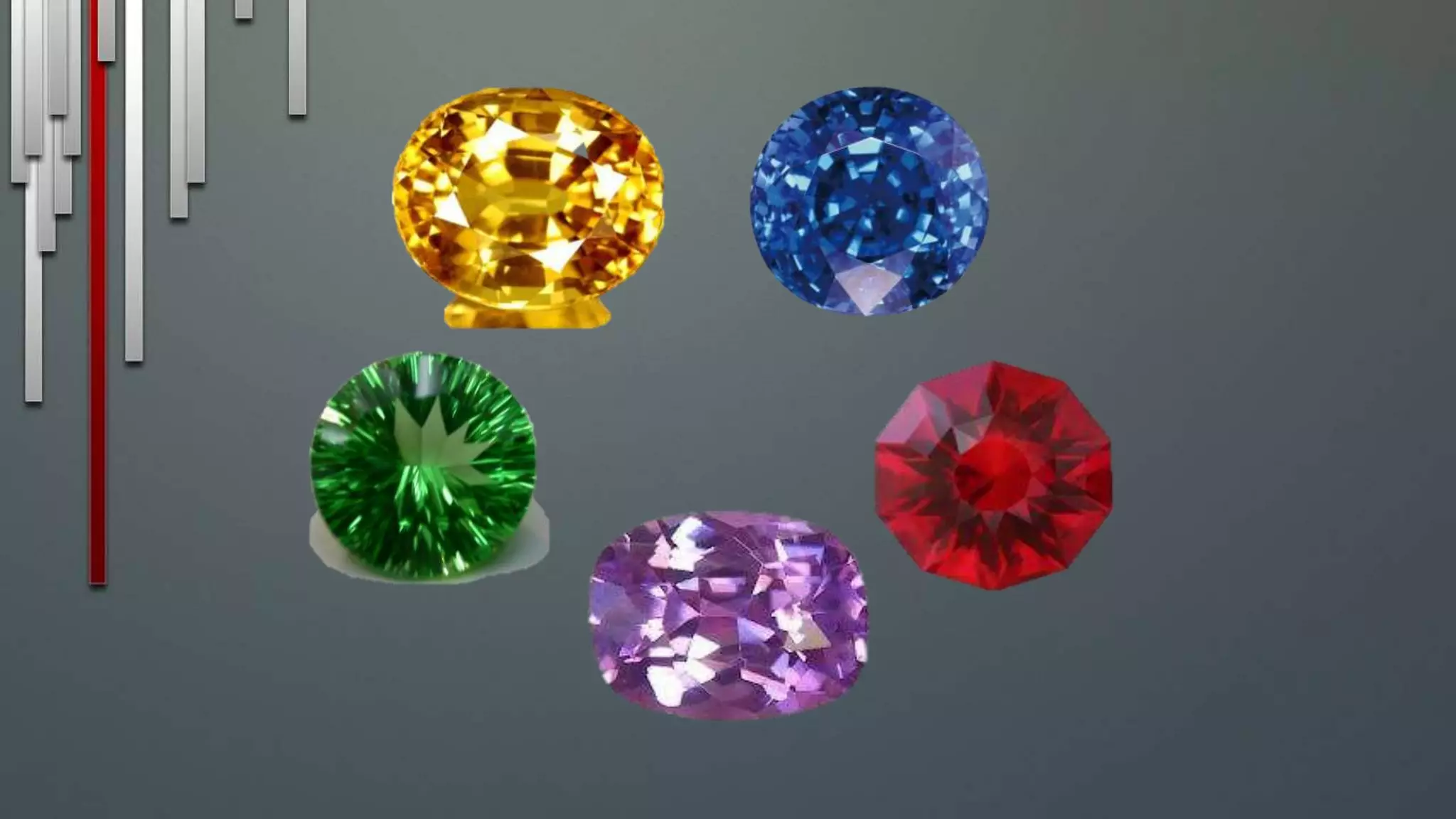
• Corundum is a crystalline form of aluminum
oxide (Al2O3) with traces of iron, titanium and
chromium.
• It is one of the naturally clear transparent
materials, but can have different colors when
impurities are present.
Cr+ =
Fe & Ti+ =
• The name "corundum" is derived from
the Tamil word kuruntam meaning "ruby“
• Corundum is a very hard, tough, and stable
mineral. It is the hardest mineral after
Diamond
Properties
Member of : Hematite Group
Crystal System: Hexagonal
Hardness: 9
Cleavage: None
Properties
Toughness: Excellent
Specific Gravity: 4.00 (3.99-4.02)
Transparency : Transparent, Translucent, Opaque
Colour: Colourless, blue, red, pink, yellow, grey,
golden-brown
Synthetic Corundum
• Corundum was the first gem mineral to be
synthesized in the lab by a process known
today as flame fusion ; producing synthetic
corundum from bauxite.
• The synthetic corundum is of high quality and
cost-competitive with corundum from natural
sources.
Applications
For Natural Corundum
• Ruby and Sapphire are the most famous
gemstones after Diamond for jewelries
• It is commonly used as an abrasive on
everything from sandpaper to large machines
used in machining metals.
Applications
For Synthetic Corundum
• Industrial applications today include use as
"jewel" bearings in instruments and fine watches.
• For windows in optical scanning devices
• Abrasive etc.
Mining Rubies and Sapphires
• They are rarely mined from the rocks in which
they form. Instead, they are usually mined from
stream sediments.
• Rubies and sapphires are very hard and resistant
to chemical weathering
Mining Rubies and Sapphires
• Their high specific gravity, relative to other
sediment particles, often causes currents to
concentrate them in small deposits.
• Most rubies and sapphires are produced by
washing the gravels of these stream deposits.
Geographical distribution1
Economics2
Known deposits of corundum in this
country are sufficient to supply only a
small fraction of the requirements of
American industries.
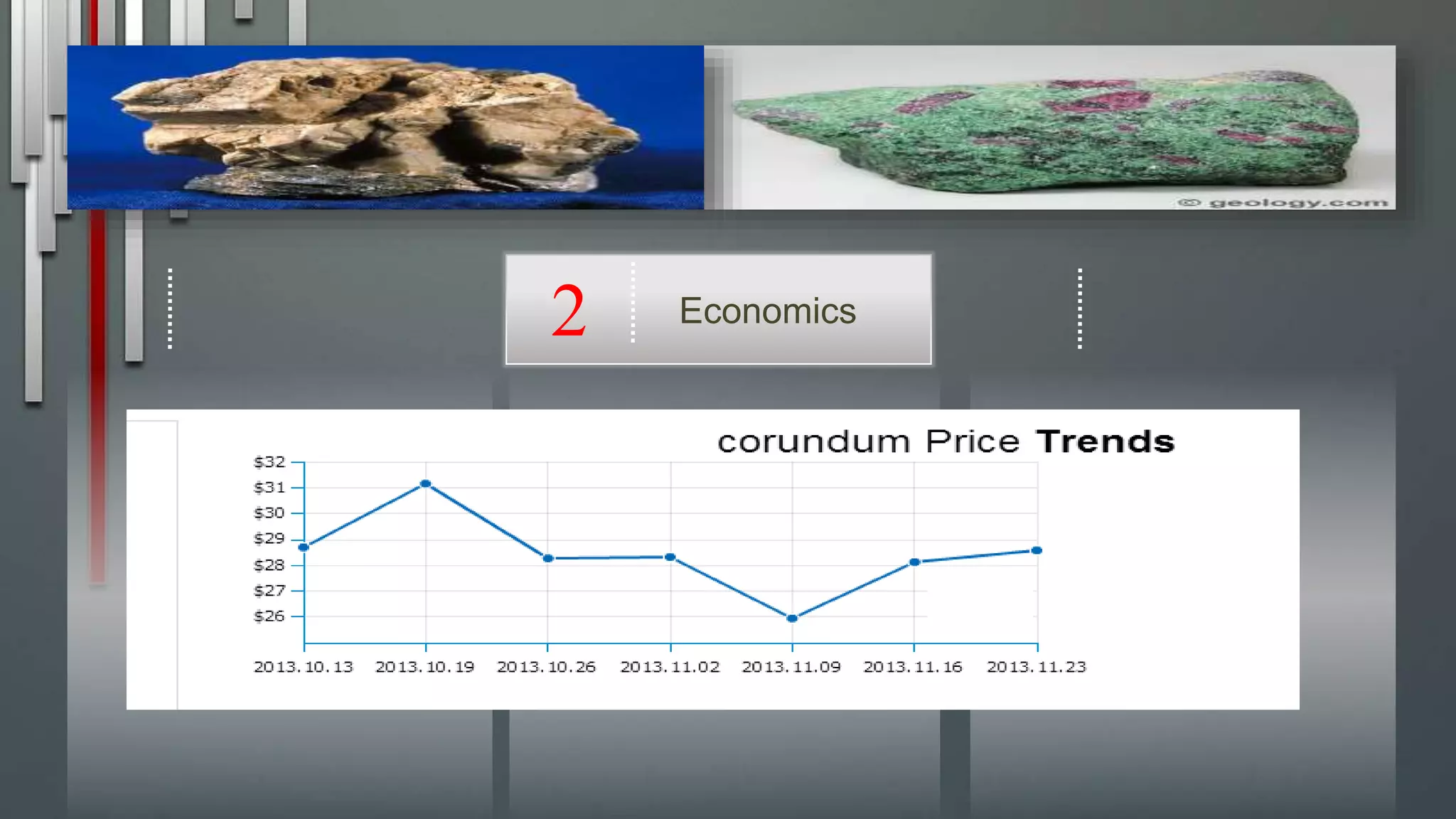
Between $3,000,000 and $5,000,000
worth of corundum has been produced in
Montana. Before mining was discontinued
in 1929, the Yogo deposit yielded
sapphires, chiefly gem material, value'd
at about
$2,500,000 in the rough.
Geographical distribution1 Economics2
This
price was presumably for 90
percent corundum and compares
with
prices from ~69 to ~107 for similar
grades from Africa in
1941-43.
From 1881 to 1895 inclusive,
the market price of domestic
corundum, as summarized in
Bureau of Mines Information
Circular
7295, ranged generally from
$150 to $200 per short ton.
Economics2Geographical distribution1
4 corundum axes dating back to
2500 B.C.E from the Liang Zhou
culture have been discovered in
China.
Emery grade corundum is found
on the Greek island
of Naxos and near Peekskill,
New York, USA. Abrasive
corundum is synthetically
manufactured from bauxite.
Corundum for abrasives is
mined in Zimbabwe, Russia, Sri
Lanka and India. Historically it
was mined from deposits
associated with dunites in
North Carolina, USA and from
a nepheline
syenite in Craigmont, Ontario.
Geographical distribution1
With a melting point at 2010°,
corundum makes for a great
material to withstand high
temperatures. Commonly used
in the lab, corundum crucibles
can stay stable for long periods
of time at 1600°.
Sometimes the mineral is even
carved into different shapes for
specialized jobs, such as
triangular shapes for the
manufacture of knives.
USES:
When corundum is found
opaque, its' physical properties
serves great industrial uses.
With a hardness of 9 on Moh's
scale, corundum grains of
various sizes are used as an
abrasive.
Economics2
Economics2

Corundum

  • 1.
  • 2.
    • Corundum isa crystalline form of aluminum oxide (Al2O3) with traces of iron, titanium and chromium. • It is one of the naturally clear transparent materials, but can have different colors when impurities are present.
  • 3.
  • 5.
    • The name"corundum" is derived from the Tamil word kuruntam meaning "ruby“ • Corundum is a very hard, tough, and stable mineral. It is the hardest mineral after Diamond
  • 6.
    Properties Member of :Hematite Group Crystal System: Hexagonal Hardness: 9 Cleavage: None
  • 7.
    Properties Toughness: Excellent Specific Gravity:4.00 (3.99-4.02) Transparency : Transparent, Translucent, Opaque Colour: Colourless, blue, red, pink, yellow, grey, golden-brown
  • 8.
    Synthetic Corundum • Corundumwas the first gem mineral to be synthesized in the lab by a process known today as flame fusion ; producing synthetic corundum from bauxite. • The synthetic corundum is of high quality and cost-competitive with corundum from natural sources.
  • 10.
    Applications For Natural Corundum •Ruby and Sapphire are the most famous gemstones after Diamond for jewelries • It is commonly used as an abrasive on everything from sandpaper to large machines used in machining metals.
  • 11.
    Applications For Synthetic Corundum •Industrial applications today include use as "jewel" bearings in instruments and fine watches. • For windows in optical scanning devices • Abrasive etc.
  • 12.
    Mining Rubies andSapphires • They are rarely mined from the rocks in which they form. Instead, they are usually mined from stream sediments. • Rubies and sapphires are very hard and resistant to chemical weathering
  • 13.
    Mining Rubies andSapphires • Their high specific gravity, relative to other sediment particles, often causes currents to concentrate them in small deposits. • Most rubies and sapphires are produced by washing the gravels of these stream deposits.
  • 15.
  • 16.
    Known deposits ofcorundum in this country are sufficient to supply only a small fraction of the requirements of American industries. Between $3,000,000 and $5,000,000 worth of corundum has been produced in Montana. Before mining was discontinued in 1929, the Yogo deposit yielded sapphires, chiefly gem material, value'd at about $2,500,000 in the rough. Geographical distribution1 Economics2
  • 17.
    This price was presumablyfor 90 percent corundum and compares with prices from ~69 to ~107 for similar grades from Africa in 1941-43. From 1881 to 1895 inclusive, the market price of domestic corundum, as summarized in Bureau of Mines Information Circular 7295, ranged generally from $150 to $200 per short ton. Economics2Geographical distribution1
  • 18.
    4 corundum axesdating back to 2500 B.C.E from the Liang Zhou culture have been discovered in China. Emery grade corundum is found on the Greek island of Naxos and near Peekskill, New York, USA. Abrasive corundum is synthetically manufactured from bauxite. Corundum for abrasives is mined in Zimbabwe, Russia, Sri Lanka and India. Historically it was mined from deposits associated with dunites in North Carolina, USA and from a nepheline syenite in Craigmont, Ontario. Geographical distribution1
  • 19.
    With a meltingpoint at 2010°, corundum makes for a great material to withstand high temperatures. Commonly used in the lab, corundum crucibles can stay stable for long periods of time at 1600°. Sometimes the mineral is even carved into different shapes for specialized jobs, such as triangular shapes for the manufacture of knives. USES: When corundum is found opaque, its' physical properties serves great industrial uses. With a hardness of 9 on Moh's scale, corundum grains of various sizes are used as an abrasive. Economics2
  • 20.