DATA TRANSMISSION AND 
TELEMETRY 
1
INTRODUCTION 
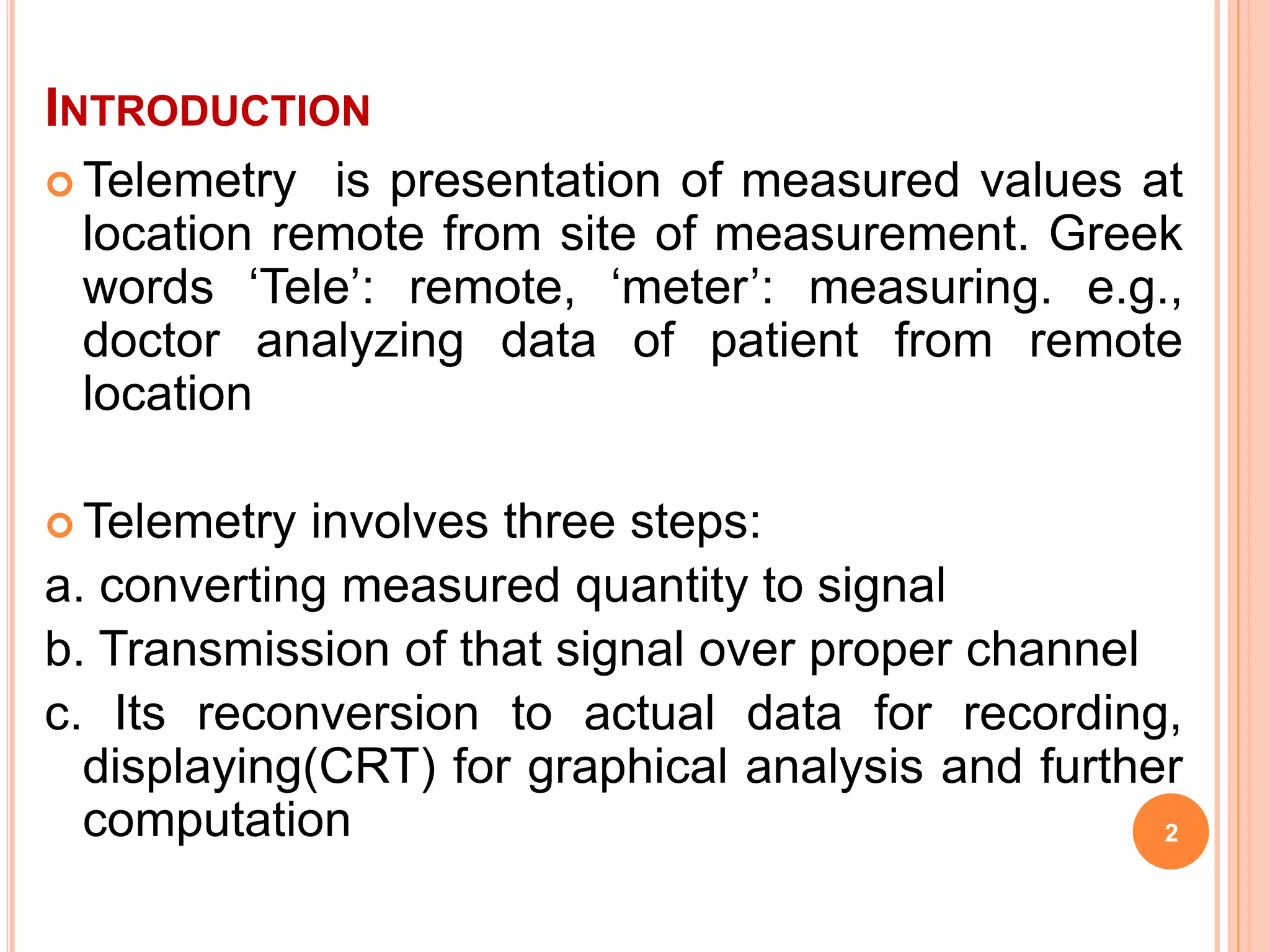
Telemetry is presentation of measured values at 
location remote from site of measurement. Greek 
words ‘Tele’: remote, ‘meter’: measuring. e.g., 
doctor analyzing data of patient from remote 
location 
Telemetry involves three steps: 
a. converting measured quantity to signal 
b. Transmission of that signal over proper channel 
c. Its reconversion to actual data for recording, 
displaying(CRT) for graphical analysis and further 
computation 2
3 
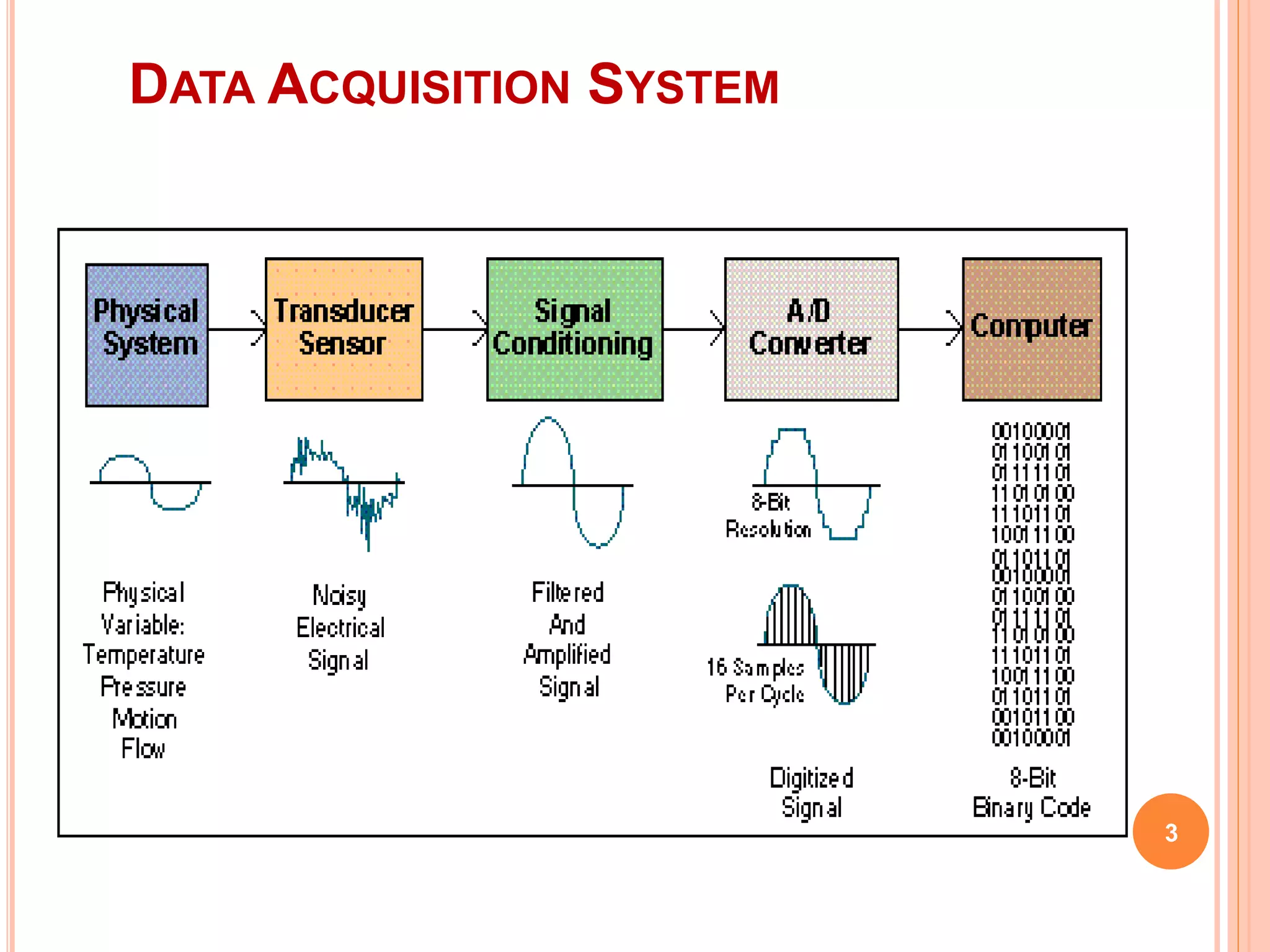
DATA ACQUISITION SYSTEM
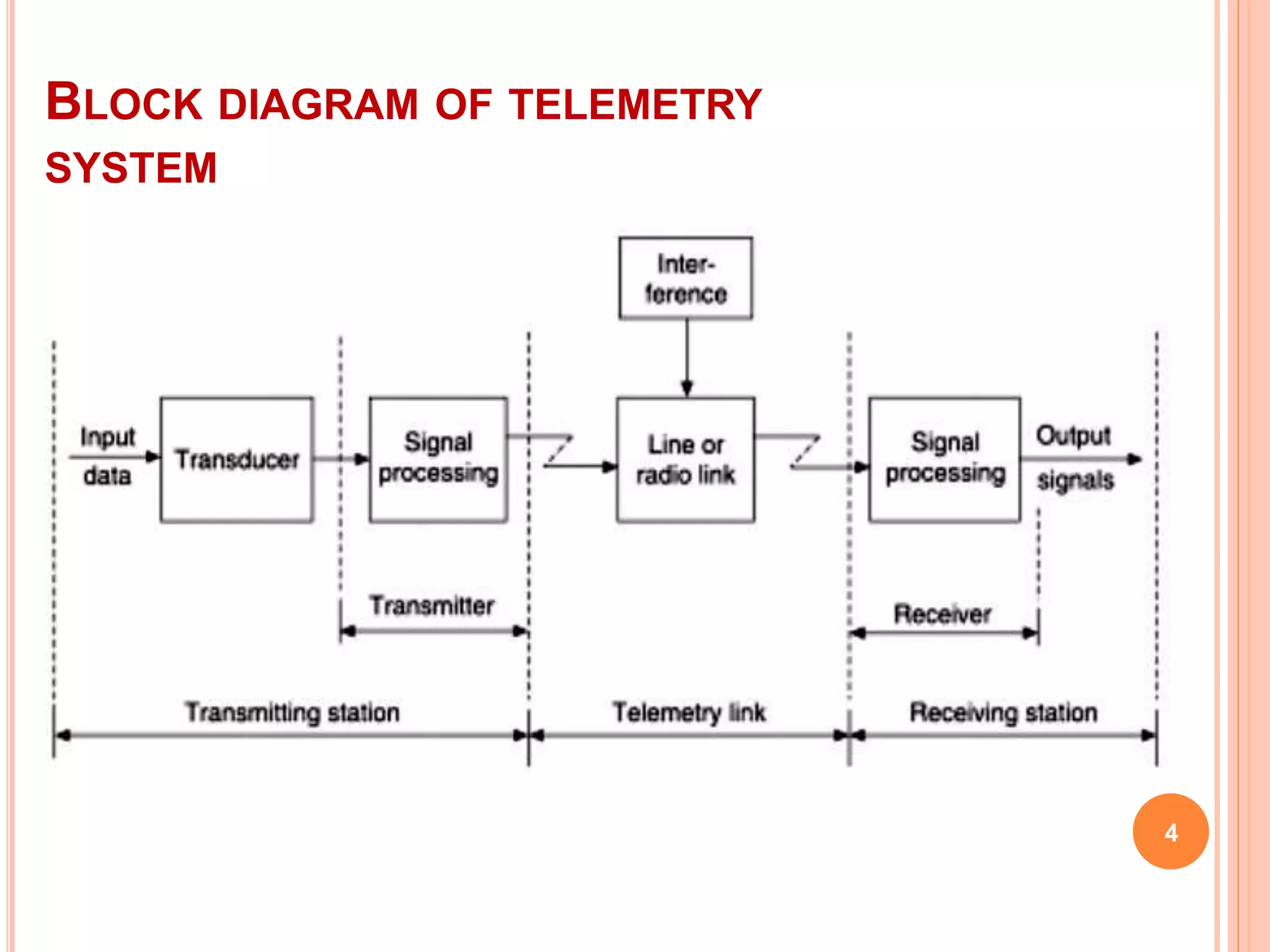
BLOCK DIAGRAM OF TELEMETRY 
SYSTEM 
4
FACTORS INFLUENCING TELEMETRY SYSTEM 
DESIGN 
 Primary criteria for choice and design is accuracy. 
 System is decided whether transmitted data is in 
Analog or Digital domain. 
 For digital data to be transmitted, error detection, 
recognition and correction capability make system 
accurate. 
 Selection of apt. bandwidth for data channel and data 
link to avoid crosstalk. 
 Power levels must be low to reduce noise generation. 
 S/N ratio of the system must be high. 
5
TYPES OF TELEMETRY SYSTEMS 
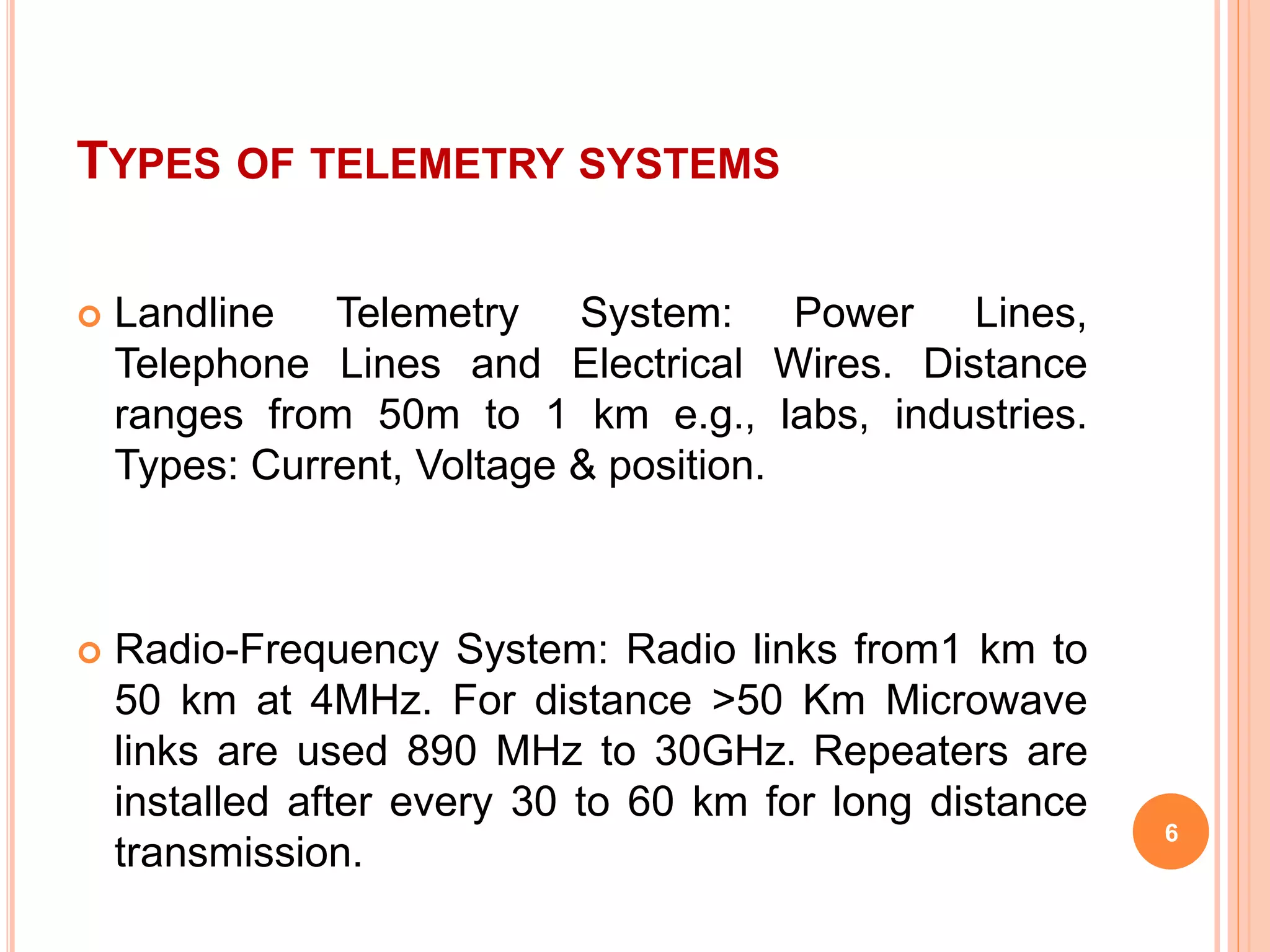
 Landline Telemetry System: Power Lines, 
Telephone Lines and Electrical Wires. Distance 
ranges from 50m to 1 km e.g., labs, industries. 
Types: Current, Voltage & position. 
 Radio-Frequency System: Radio links from1 km to 
50 km at 4MHz. For distance >50 Km Microwave 
links are used 890 MHz to 30GHz. Repeaters are 
installed after every 30 to 60 km for long distance 
transmission. 
6
LANDLINE 
TELEMETRY SYSTEM 
7
VOLTAGE TELEMETRY SYSTEM 
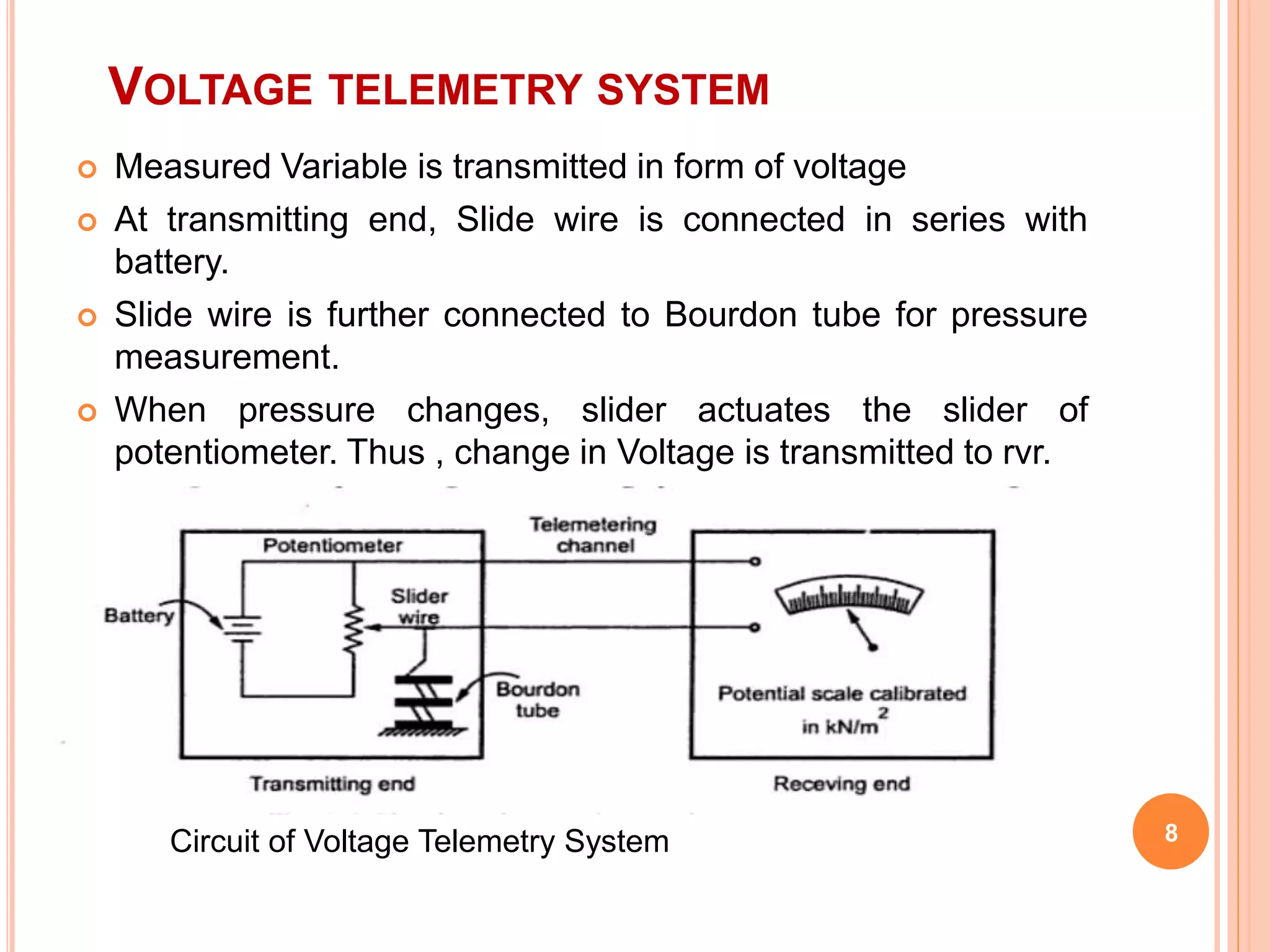
 Measured Variable is transmitted in form of voltage 
 At transmitting end, Slide wire is connected in series with 
battery. 
 Slide wire is further connected to Bourdon tube for pressure 
measurement. 
 When pressure changes, slider actuates the slider of 
potentiometer. Thus , change in Voltage is transmitted to rvr. 
 It is transmitted at the receiver end. 
Circuit of Voltage Telemetry System 8
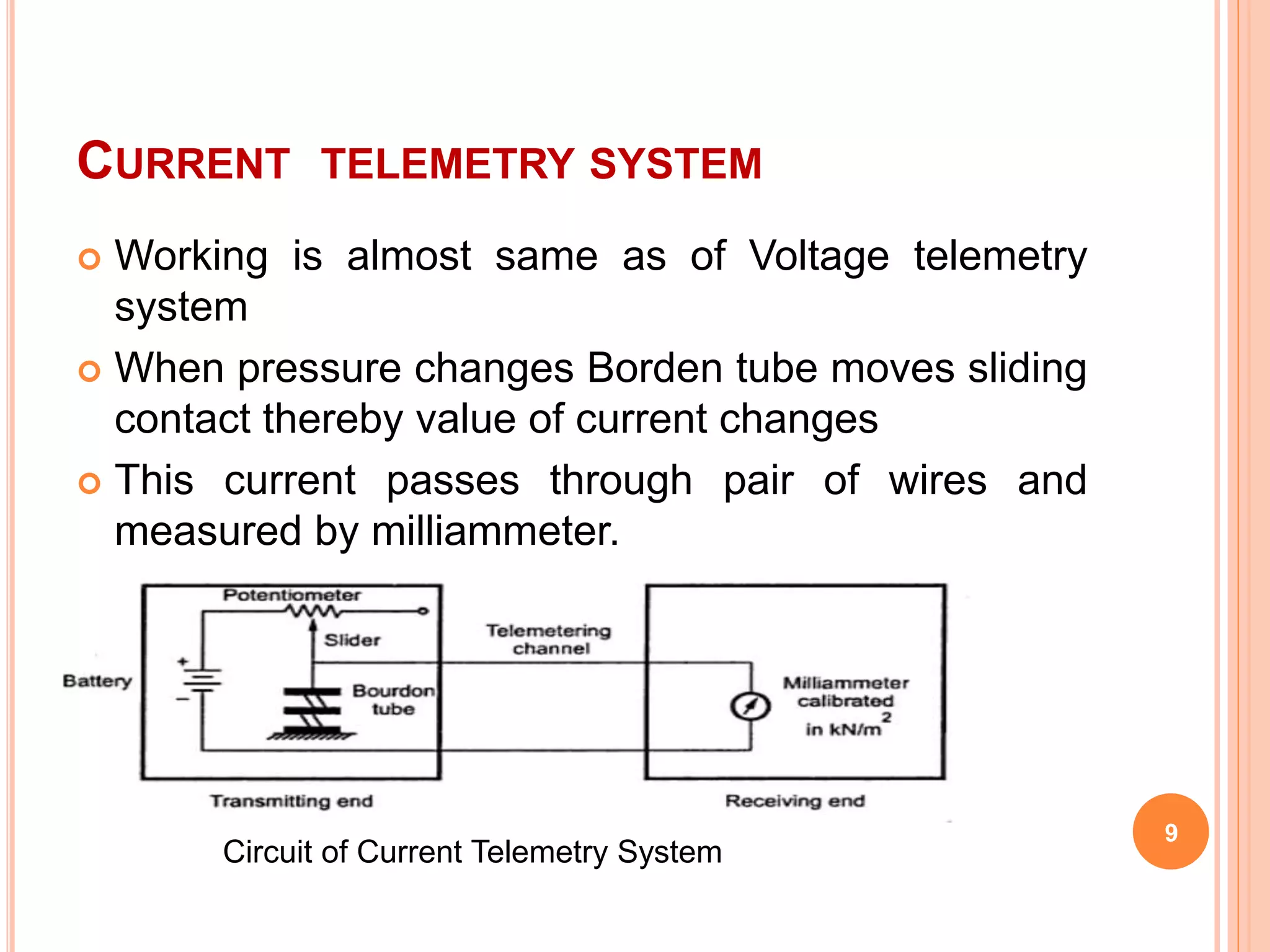
CURRENT TELEMETRY SYSTEM 
9 
 Working is almost same as of Voltage telemetry 
system 
 When pressure changes Borden tube moves sliding 
contact thereby value of current changes 
 This current passes through pair of wires and 
measured by milliammeter. 
Circuit of Current Telemetry System
DEMERITS AND MERITS 
Merits: 
 Effective for short distance measurement 
 V and I can be easily transmitted 
 Circuitry required is simple 
 Wide variety of primary sensing elements are available to 
measure reqd. variable. 
Demerits: 
 Demands high S/N ratio that is difficult to calibrate. 
 Need to be protected from EMI, noises and distortions in 
the channel. 
 Multiplexing is difficult 
 Limited frequency response 
10
R.F. TELEMETRY 
SYSTEM 
11
R.F. TELEMETRY SYSTEM 
 No physical link between telemeter transmitter and 
receiver. 
 Link is established through radio links. 
 Examples : in spacecrafts, rockets and missiles 
corrective actions can be taken from stations with 
help of R.F. Links 
 In instrumentation the o/p of transducer is 
considered as modulating signal. 12
R.F. TELEMETRY SYSTEM 
13 
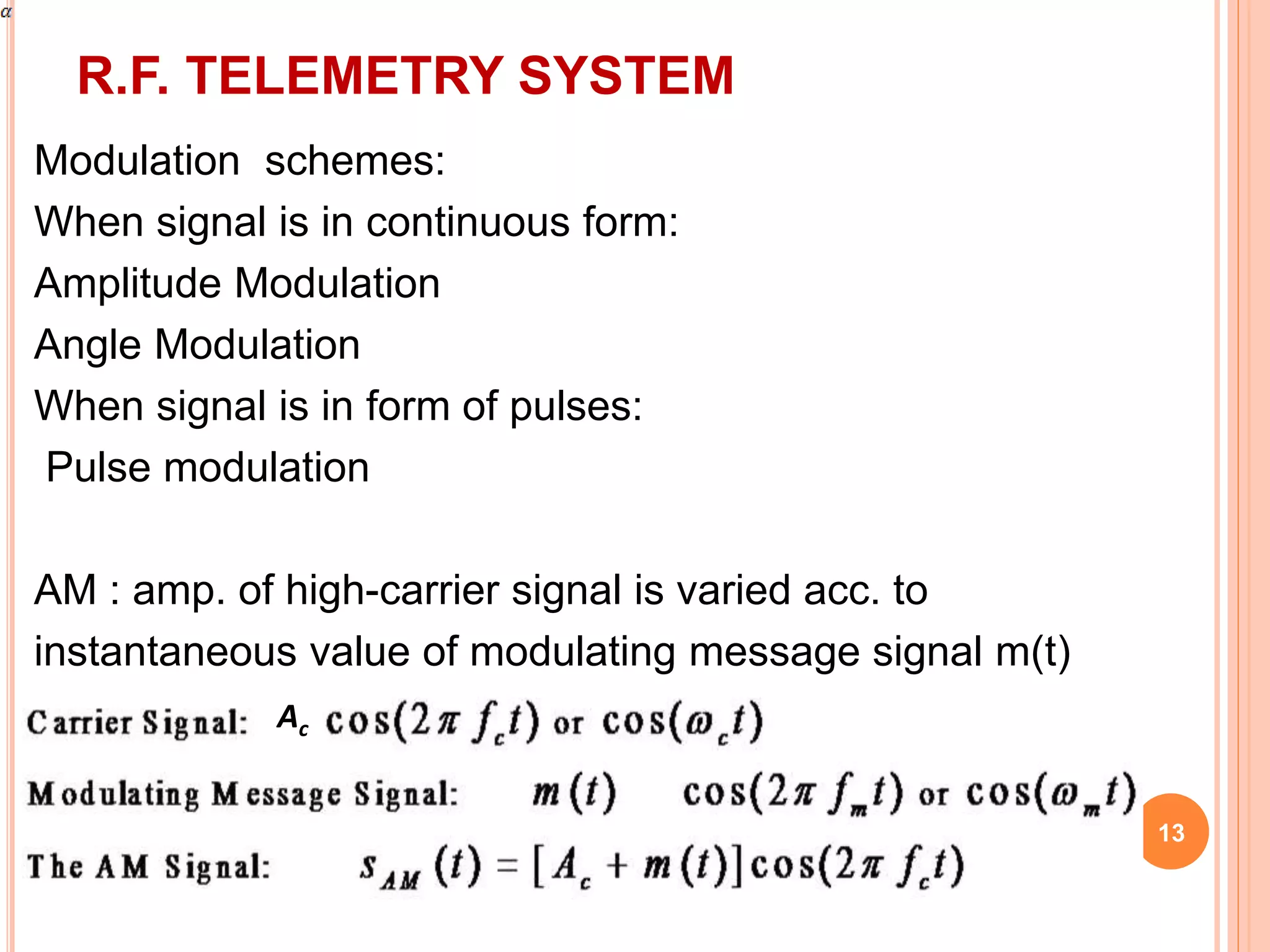
Modulation schemes: 
When signal is in continuous form: 
Amplitude Modulation 
Angle Modulation 
When signal is in form of pulses: 
Pulse modulation 
AM : amp. of high-carrier signal is varied acc. to 
instantaneous value of modulating message signal m(t) 
Ac
14 
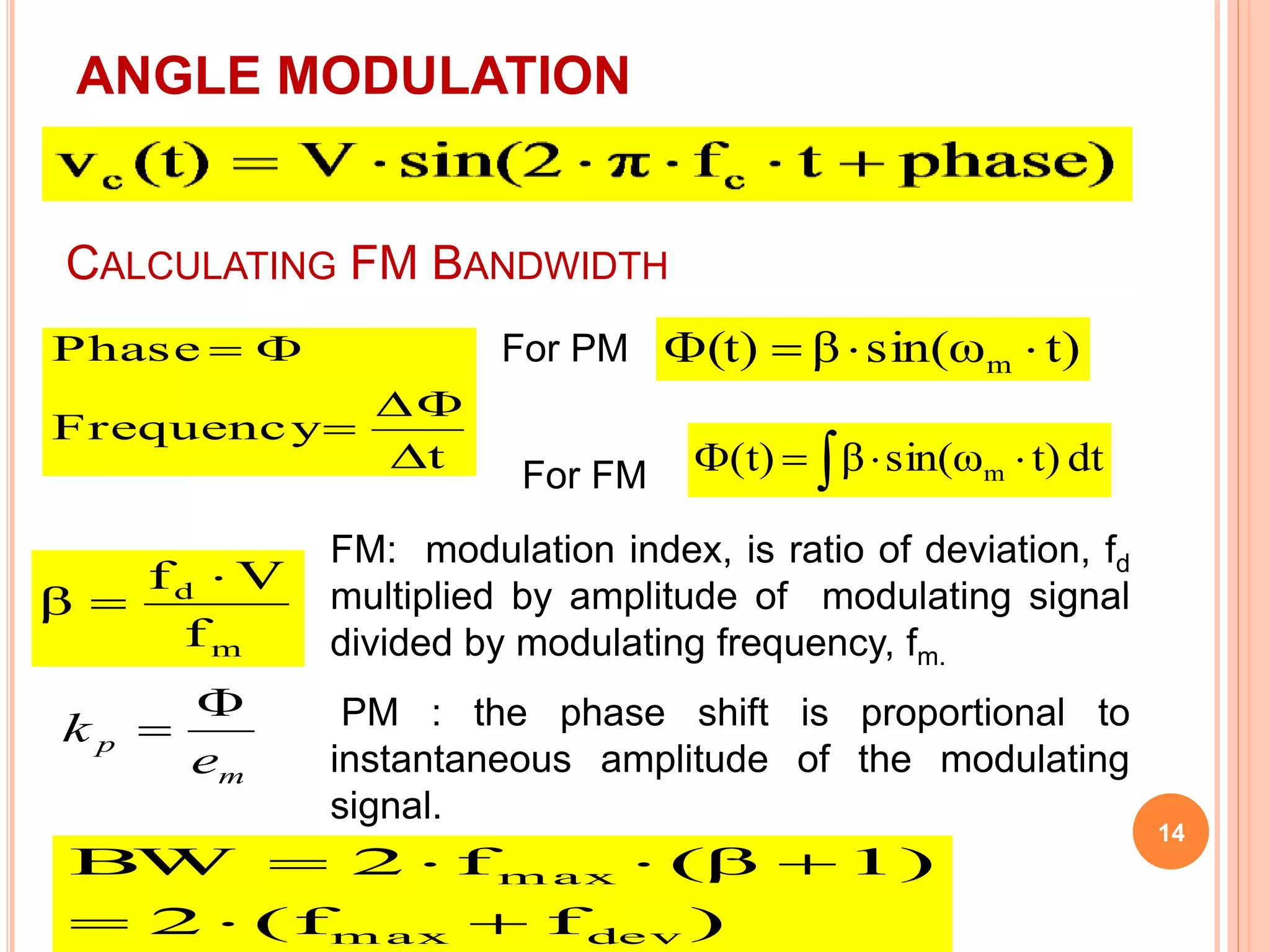
ANGLE MODULATION 
CALCULATING FM BANDWIDTH 
 
t 
Phase 
Frequency 
 
 
  
For PM 
For FM 
(t) β sin(ω t) m     
(t)  βsin(ω  t) dt m 
f V 
m 
d 
f 
β 
 
 
FM: modulation index, is ratio of deviation, fd 
multiplied by amplitude of modulating signal 
divided by modulating frequency, fm. 
PM : the phase shift is proportional to 
instantaneous amplitude of the modulating 
signal. 
p e 
m 
k 
 
 
BW  2  f  (β  
1) 
max 
   
2 (f f ) 
max dev
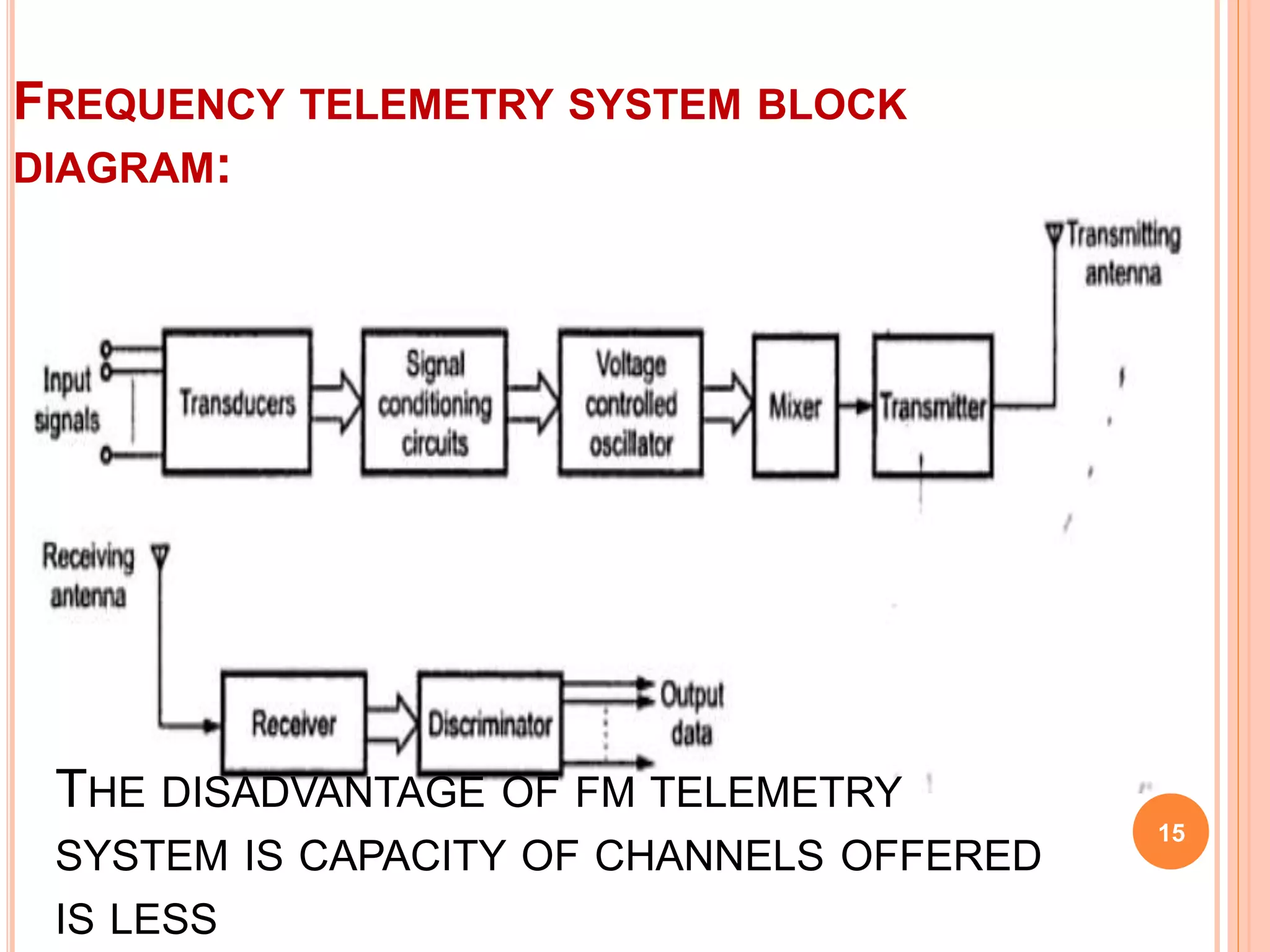
FREQUENCY TELEMETRY SYSTEM BLOCK 
DIAGRAM: 
15 
THE DISADVANTAGE OF FM TELEMETRY 
SYSTEM IS CAPACITY OF CHANNELS OFFERED 
IS LESS
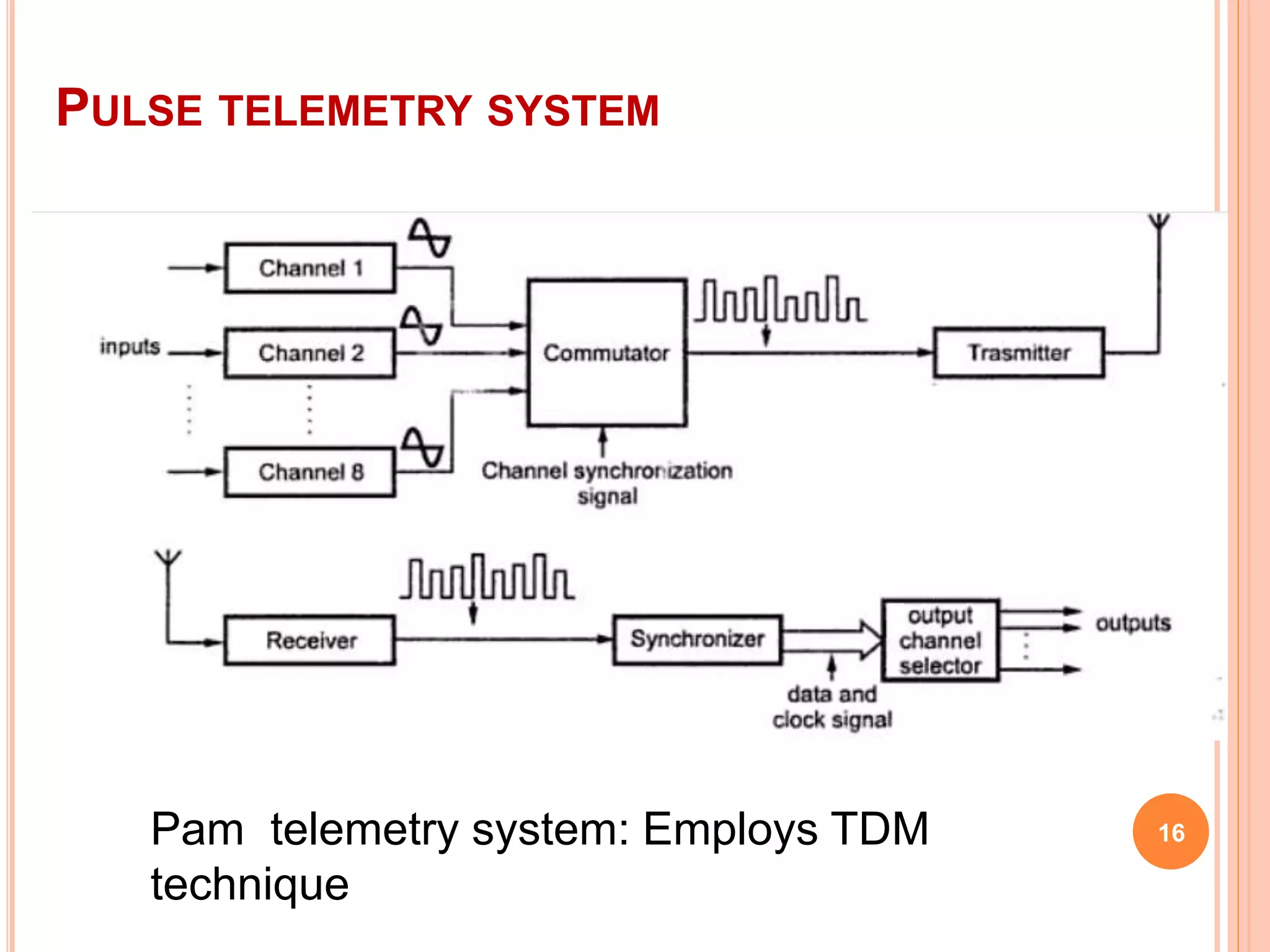
PULSE TELEMETRY SYSTEM 
Pam telemetry system: Employs TDM 16 
technique
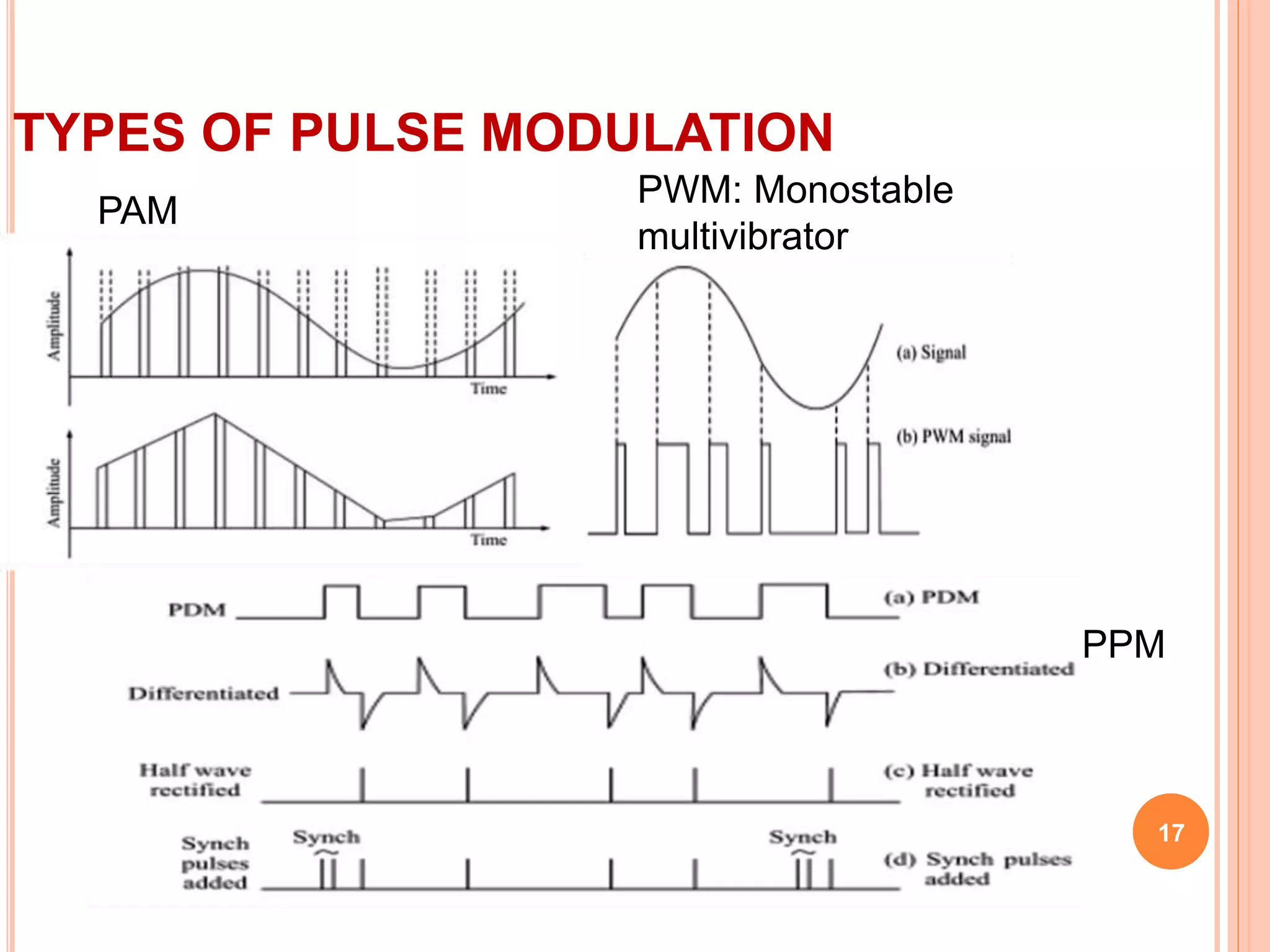
TYPES OF PULSE MODULATION 
PPM 
17 
PWM: Monostable 
multivibrator 
PAM
18

Data transmission and telemetry

  • 1.
  • 2.
    INTRODUCTION Telemetry ispresentation of measured values at location remote from site of measurement. Greek words ‘Tele’: remote, ‘meter’: measuring. e.g., doctor analyzing data of patient from remote location Telemetry involves three steps: a. converting measured quantity to signal b. Transmission of that signal over proper channel c. Its reconversion to actual data for recording, displaying(CRT) for graphical analysis and further computation 2
  • 3.
  • 4.
    BLOCK DIAGRAM OFTELEMETRY SYSTEM 4
  • 5.
    FACTORS INFLUENCING TELEMETRYSYSTEM DESIGN  Primary criteria for choice and design is accuracy.  System is decided whether transmitted data is in Analog or Digital domain.  For digital data to be transmitted, error detection, recognition and correction capability make system accurate.  Selection of apt. bandwidth for data channel and data link to avoid crosstalk.  Power levels must be low to reduce noise generation.  S/N ratio of the system must be high. 5
  • 6.
    TYPES OF TELEMETRYSYSTEMS  Landline Telemetry System: Power Lines, Telephone Lines and Electrical Wires. Distance ranges from 50m to 1 km e.g., labs, industries. Types: Current, Voltage & position.  Radio-Frequency System: Radio links from1 km to 50 km at 4MHz. For distance >50 Km Microwave links are used 890 MHz to 30GHz. Repeaters are installed after every 30 to 60 km for long distance transmission. 6
  • 7.
  • 8.
    VOLTAGE TELEMETRY SYSTEM  Measured Variable is transmitted in form of voltage  At transmitting end, Slide wire is connected in series with battery.  Slide wire is further connected to Bourdon tube for pressure measurement.  When pressure changes, slider actuates the slider of potentiometer. Thus , change in Voltage is transmitted to rvr.  It is transmitted at the receiver end. Circuit of Voltage Telemetry System 8
  • 9.
    CURRENT TELEMETRY SYSTEM 9  Working is almost same as of Voltage telemetry system  When pressure changes Borden tube moves sliding contact thereby value of current changes  This current passes through pair of wires and measured by milliammeter. Circuit of Current Telemetry System
  • 10.
    DEMERITS AND MERITS Merits:  Effective for short distance measurement  V and I can be easily transmitted  Circuitry required is simple  Wide variety of primary sensing elements are available to measure reqd. variable. Demerits:  Demands high S/N ratio that is difficult to calibrate.  Need to be protected from EMI, noises and distortions in the channel.  Multiplexing is difficult  Limited frequency response 10
  • 11.
  • 12.
    R.F. TELEMETRY SYSTEM  No physical link between telemeter transmitter and receiver.  Link is established through radio links.  Examples : in spacecrafts, rockets and missiles corrective actions can be taken from stations with help of R.F. Links  In instrumentation the o/p of transducer is considered as modulating signal. 12
  • 13.
    R.F. TELEMETRY SYSTEM 13 Modulation schemes: When signal is in continuous form: Amplitude Modulation Angle Modulation When signal is in form of pulses: Pulse modulation AM : amp. of high-carrier signal is varied acc. to instantaneous value of modulating message signal m(t) Ac
  • 14.
    14 ANGLE MODULATION CALCULATING FM BANDWIDTH  t Phase Frequency     For PM For FM (t) β sin(ω t) m     (t)  βsin(ω  t) dt m f V m d f β   FM: modulation index, is ratio of deviation, fd multiplied by amplitude of modulating signal divided by modulating frequency, fm. PM : the phase shift is proportional to instantaneous amplitude of the modulating signal. p e m k   BW  2  f  (β  1) max    2 (f f ) max dev
  • 15.
    FREQUENCY TELEMETRY SYSTEMBLOCK DIAGRAM: 15 THE DISADVANTAGE OF FM TELEMETRY SYSTEM IS CAPACITY OF CHANNELS OFFERED IS LESS
  • 16.
    PULSE TELEMETRY SYSTEM Pam telemetry system: Employs TDM 16 technique
  • 17.
    TYPES OF PULSEMODULATION PPM 17 PWM: Monostable multivibrator PAM
  • 18.