Partial Quotients

Loading...

Flash Player 9 (or above) is needed to view presentations.
We have detected that you do not have it on your computer. To install it, go here.

1 comments

Comments 1 - 1 of 1 previous next Post a comment

  • + guestce9f1 guestce9f1 9 months ago
    hey man, this vid really helped! i was struggling with partial quotients. i have to study for a division partial quotients test and this is where i came! thnxs man! yous a lifesaver!
Post a comment
Embed Video
Edit your comment Cancel

Favorites, Groups & Events

Partial Quotients - Presentation Transcript

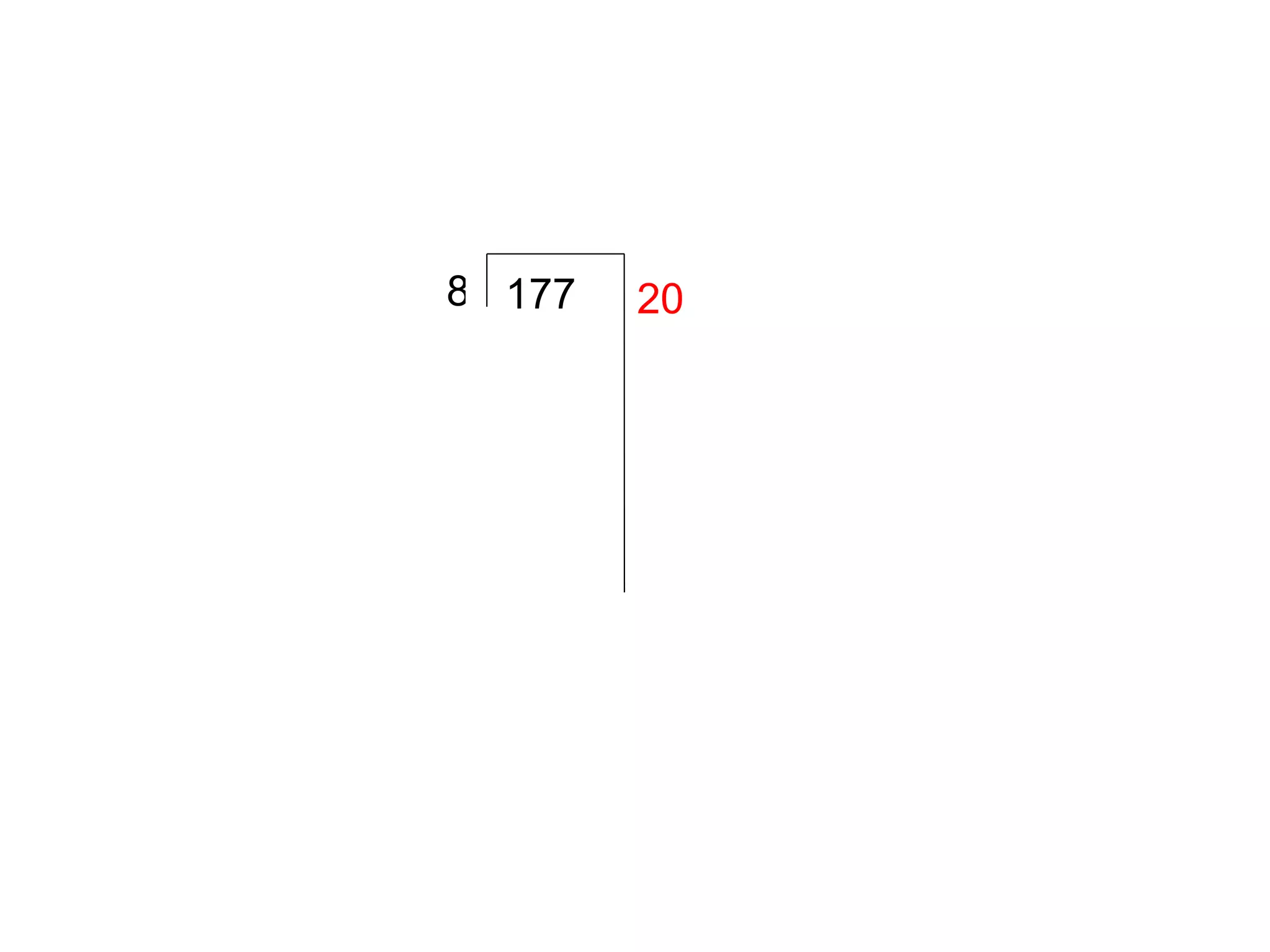
  1. 177 8 Start by setting up the problem like this. It looks just like the traditional long division method, except for the long line that is drawn to the right of the divisor.
  2. 177 8 Ask - How many [8s] are in 177? There are at least 10, so that will be the first partial quotient. Notice that you could pick other partial quotients here. You could have started with 20, or even a lower number like 5. A good tip is to start with easy multiples, like 10, 20, 50, or 100. 10
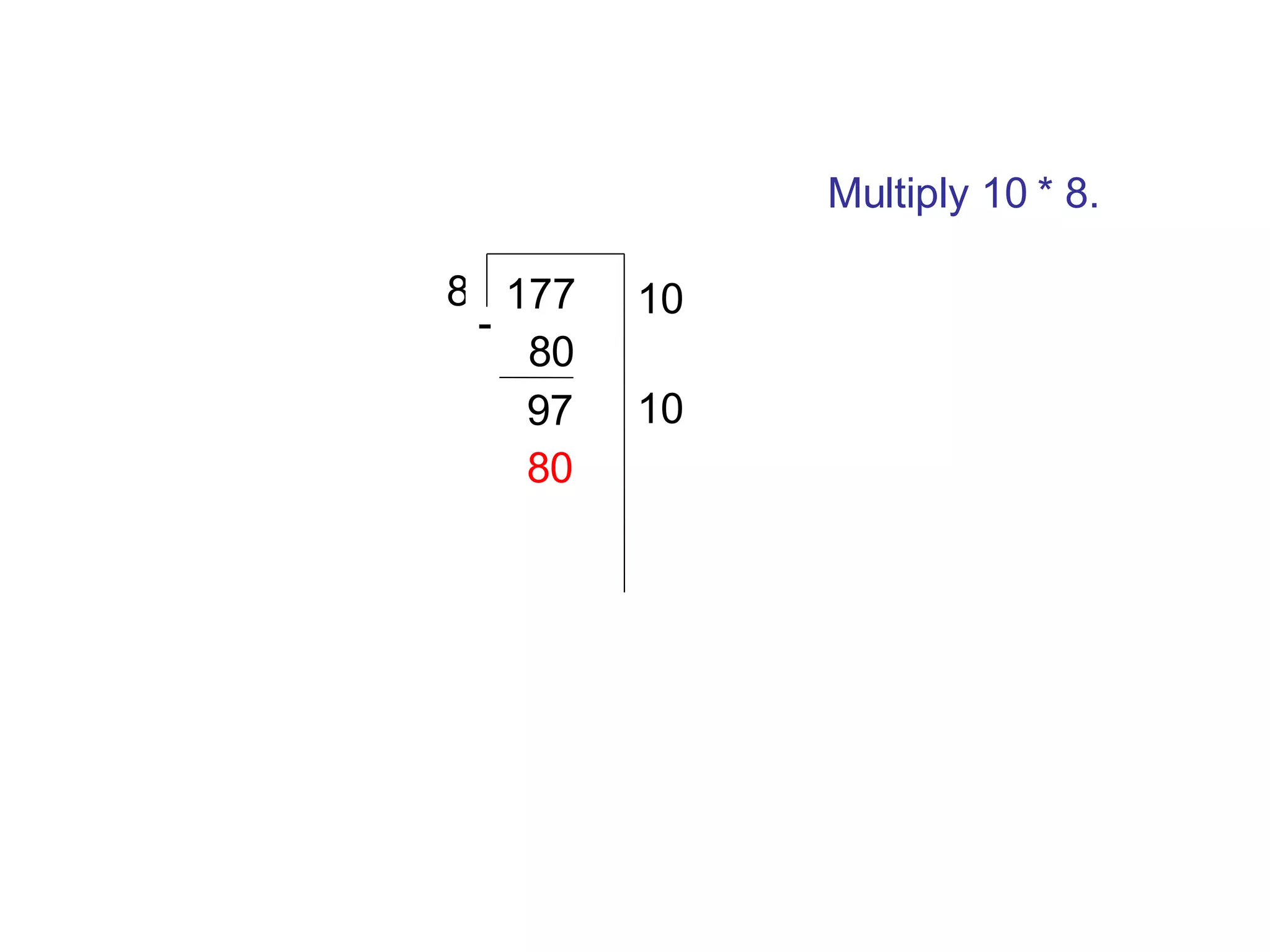
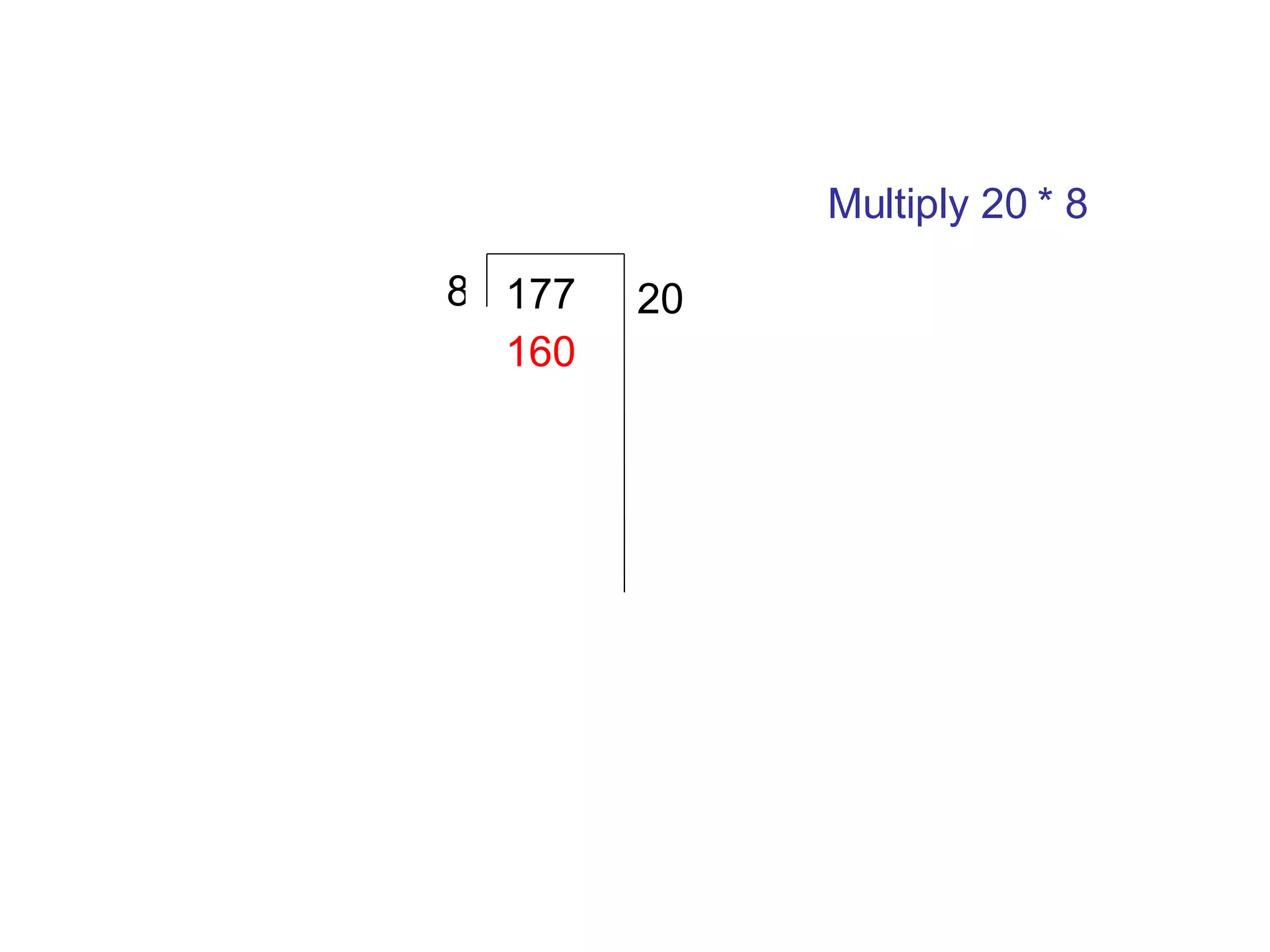
  3. 177 8 Multiply 10 * 8 10 80
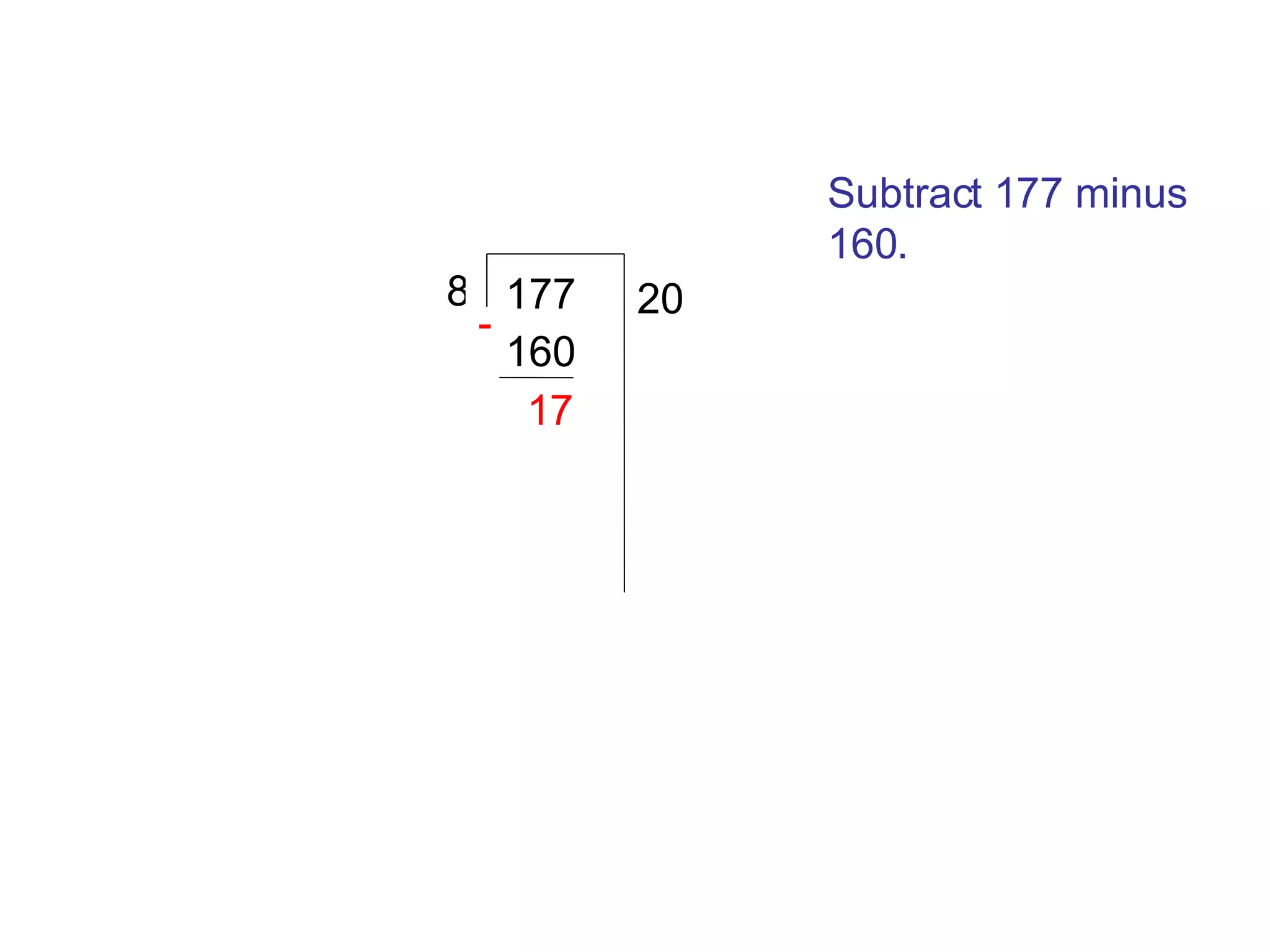
  4. 177 8 Subtract 177 minus 80. 10 80 97 -
  5. 177 8 Start the process over again. Ask - how many [8s] are in 97? Again, there are at least 10. 10 80 97 - 10
  6. 177 8 Multiply 10 * 8. 10 80 97 80 - 10
  7. 177 8 Subtract 97 minus 80. 10 80 97 80 17 - 10 -
  8. 177 8 Start the process again. Ask - how many [8s] are in 17. There are at least 2. 10 80 97 80 17 - 10 - 2
  9. 177 8 Multiply 2 * 8. 10 80 97 80 17 16 - 10 - 2
  10. 177 8 Subtract 17 minus 16. 10 80 97 80 17 16 1 - 10 - 2 -
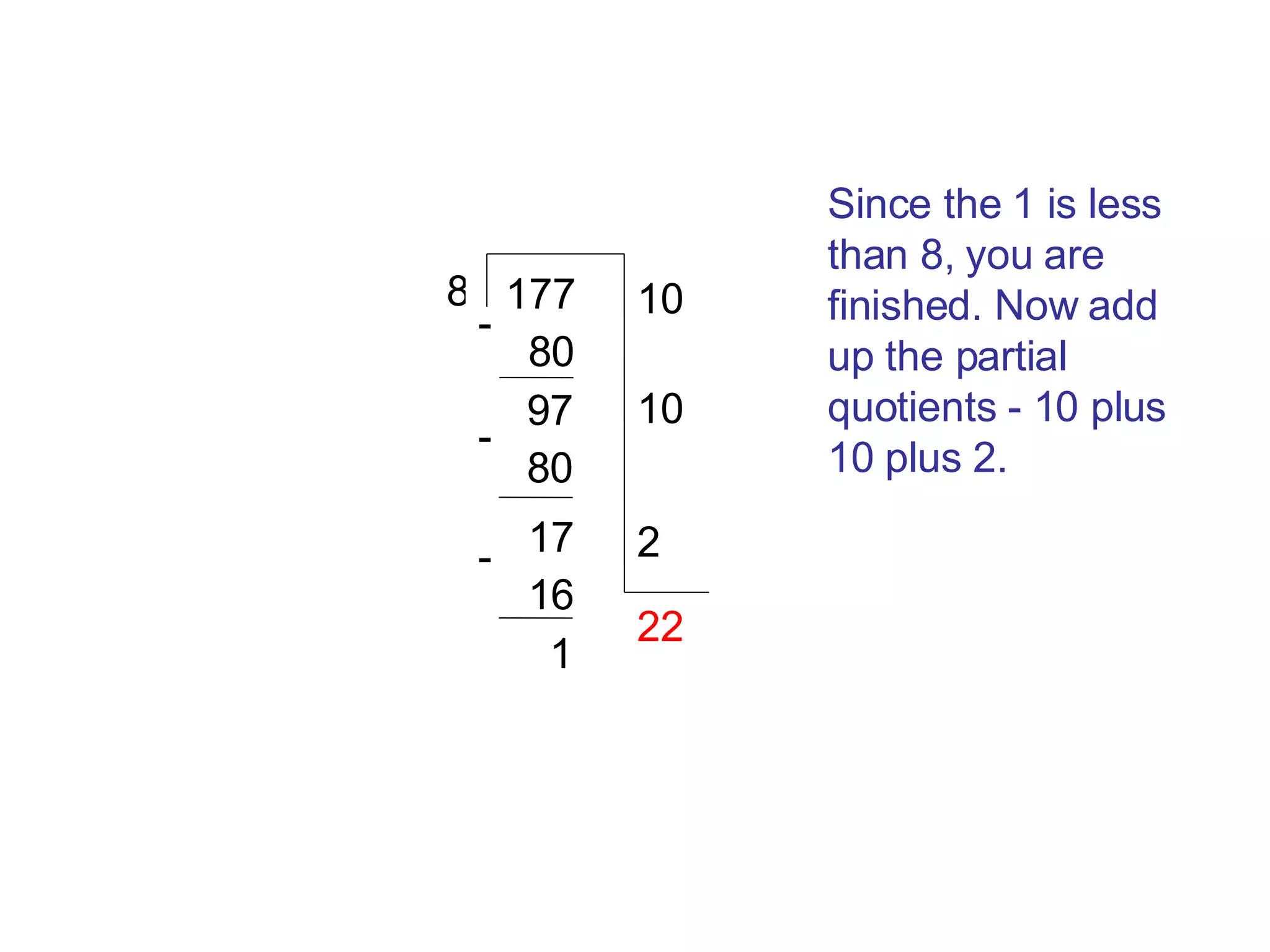
  11. 177 8 Since the 1 is less than 8, you are finished. Now add up the partial quotients - 10 plus 10 plus 2. 10 80 97 80 17 16 1 - 10 - 2 - 22
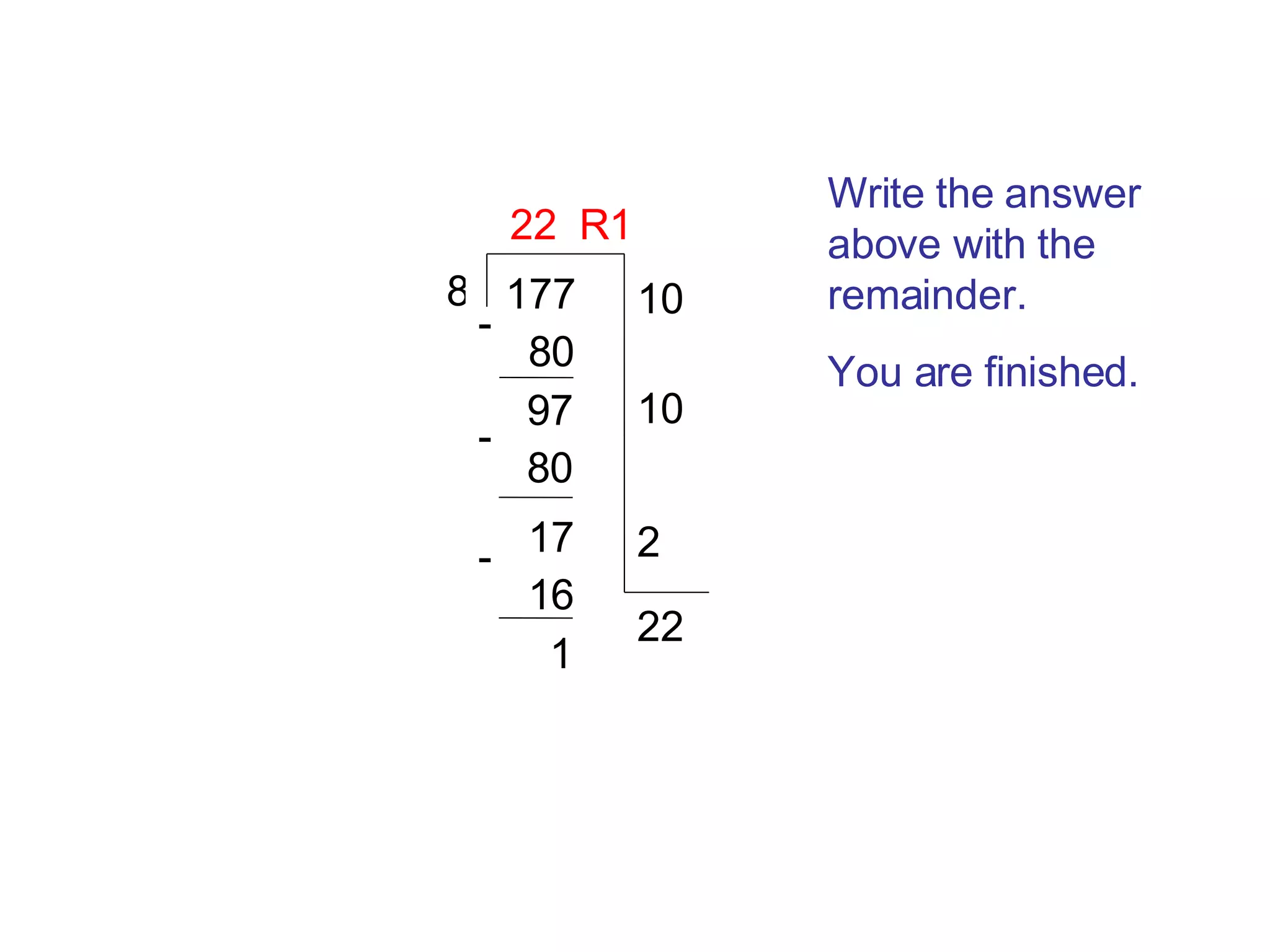
  12. 177 8 Write the answer above with the remainder. You are finished. 10 80 97 80 17 16 1 - 10 - 2 - 22 22 R1
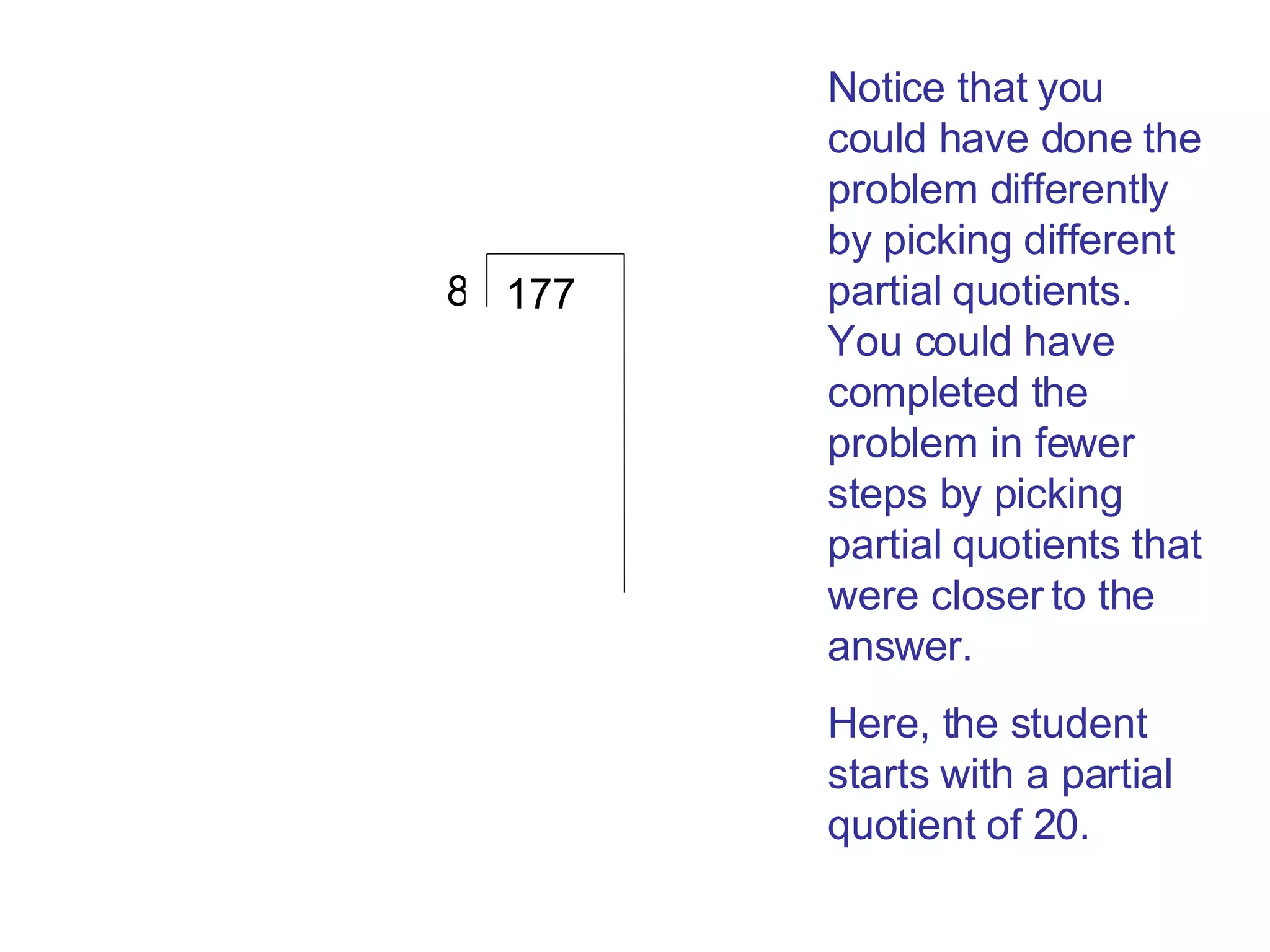
  13. 177 8 Notice that you could have done the problem differently by picking different partial quotients. You could have completed the problem in fewer steps by picking partial quotients that were closer to the answer. Here, the student starts with a partial quotient of 20.
  14. 177 8 20
  15. 177 8 Multiply 20 * 8 20 160
  16. 177 8 Subtract 177 minus 160. 20 160 17 -
  17. 177 8 Start the process over again. Ask - how many [8s] are in 17? There are at least 2. 20 160 17 - 2
  18. 177 8 Multiply 2 * 8. 20 160 17 - 2 16
  19. 177 8 Subtract 17 minus 16. 20 160 17 - 2 16 - 1
  20. 177 8 Since the 1 is less than 8, you are finished. Now add up the partial quotients - 20 plus 2. 20 160 17 - 2 16 - 1 22
  21. 177 8 Write the answer above with the remainder. You are finished. 20 160 17 - 2 16 - 1 22 22 R1

+ guestb30cd4guestb30cd4, 2 years ago

custom

3033 views, 0 favs, 7 embeds more stats

An example of the partial quotients division algori more

More info about this document

© All Rights Reserved

Go to text version

  • Total Views 3033
    • 3002 on SlideShare
    • 31 from embeds
  • Comments 1
  • Favorites 0
  • Downloads 40
Most viewed embeds
  • 12 views on http://www3.eboard.com
  • 6 views on http://www5.eboard.com
  • 4 views on http://www1.eboard.com
  • 3 views on http://www2.eboard.com
  • 3 views on http://ohiostateprincess.wordpress.com

more

All embeds
  • 12 views on http://www3.eboard.com
  • 6 views on http://www5.eboard.com
  • 4 views on http://www1.eboard.com
  • 3 views on http://www2.eboard.com
  • 3 views on http://ohiostateprincess.wordpress.com
  • 2 views on http://www4.eboard.com
  • 1 views on http://www.netvibes.com

less

Flagged as inappropriate Flag as inappropriate
Flag as inappropriate

Select your reason for flagging this presentation as inappropriate. If needed, use the feedback form to let us know more details.

Cancel
File a copyright complaint
Having problems? Go to our helpdesk?

Categories