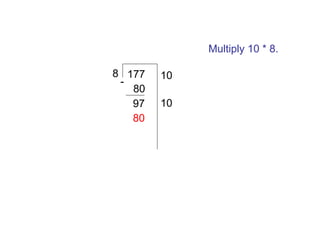
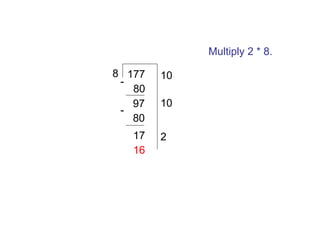
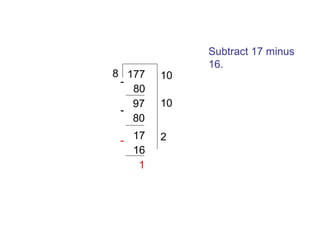
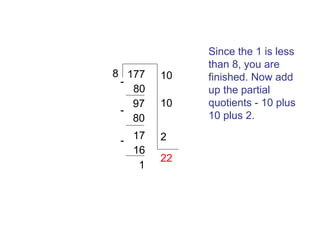
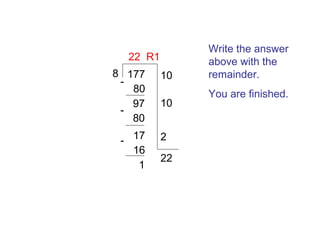
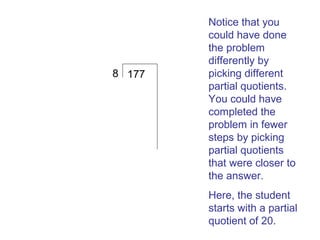
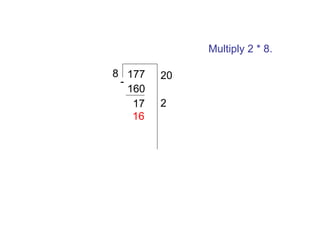
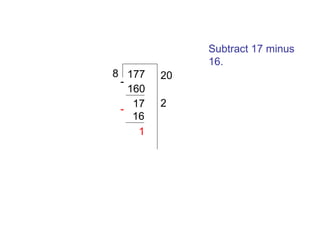
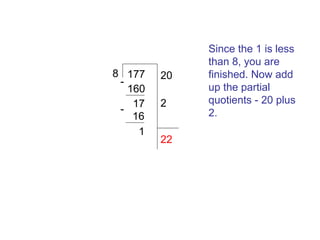
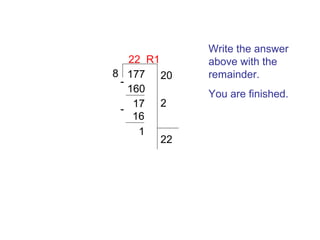
This document discusses the partial quotients method for long division of whole numbers. It provides an example of dividing 177 by 8 using partial quotients. The divisor (8) is broken into "partial quotients" of 10, 10, and 2, which are multiplied and subtracted until the remainder is reached. The summary explains that different partial quotients could have been chosen, and picking ones closer to the final answer would solve it in fewer steps. It also shows an alternate way to solve the same problem using an initial partial quotient of 20.
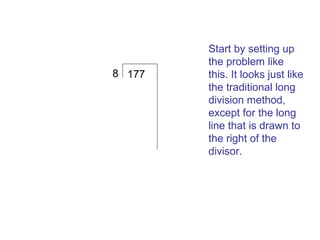
![8 177
10
Ask - How many
[8s] are in 177?
There are at least
10, so that will be
the first partial
quotient.
Notice that you
could pick other
partial quotients
here. You could
have started with
20, or even a lower
number like 5.
A good tip is to start
with easy multiples,
like 10, 20, 50, or
100.](https://image.slidesharecdn.com/paritialquotientsppt-131020100726-phpapp01/85/Paritial-quotients-ppt-4-320.jpg)
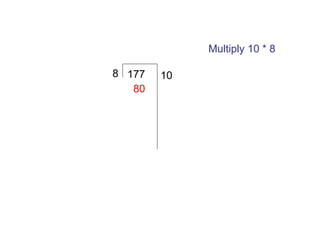
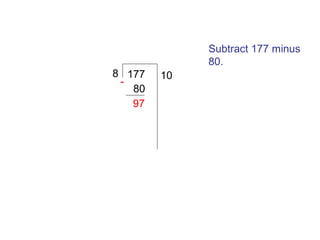
![8 177
80
97
10
10
Start the process
over again. Ask how many [8s] are
in 97?
Again, there are at
least 10.](https://image.slidesharecdn.com/paritialquotientsppt-131020100726-phpapp01/85/Paritial-quotients-ppt-7-320.jpg)
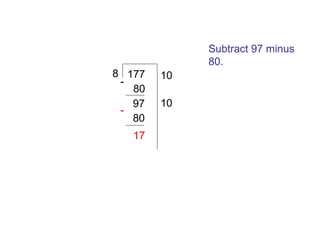
![8 177
80
97
80
17
10
10
2
Start the process
again. Ask - how
many [8s] are in 17.
There are at least
2.](https://image.slidesharecdn.com/paritialquotientsppt-131020100726-phpapp01/85/Paritial-quotients-ppt-10-320.jpg)
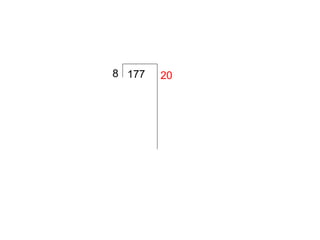
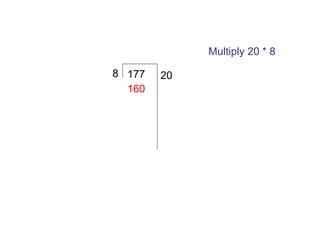
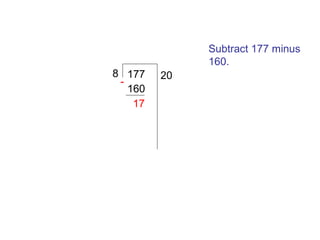
![8 177
160
17
20
2
Start the process
over again. Ask how many [8s] are
in 17?
There are at least
2.](https://image.slidesharecdn.com/paritialquotientsppt-131020100726-phpapp01/85/Paritial-quotients-ppt-19-320.jpg)


![5G Explained! A High Level Overview [Introduction]](https://cdn.slidesharecdn.com/ss_thumbnails/5gexplainedahighleveloverview-260119165306-cc137a3e-thumbnail.jpg?width=640&height=640&fit=bounds)


