Using Social Media to
communicate online
and share knowledge


    FAO Social Media
Senior Managers Workshop
          Rome
        July 2012
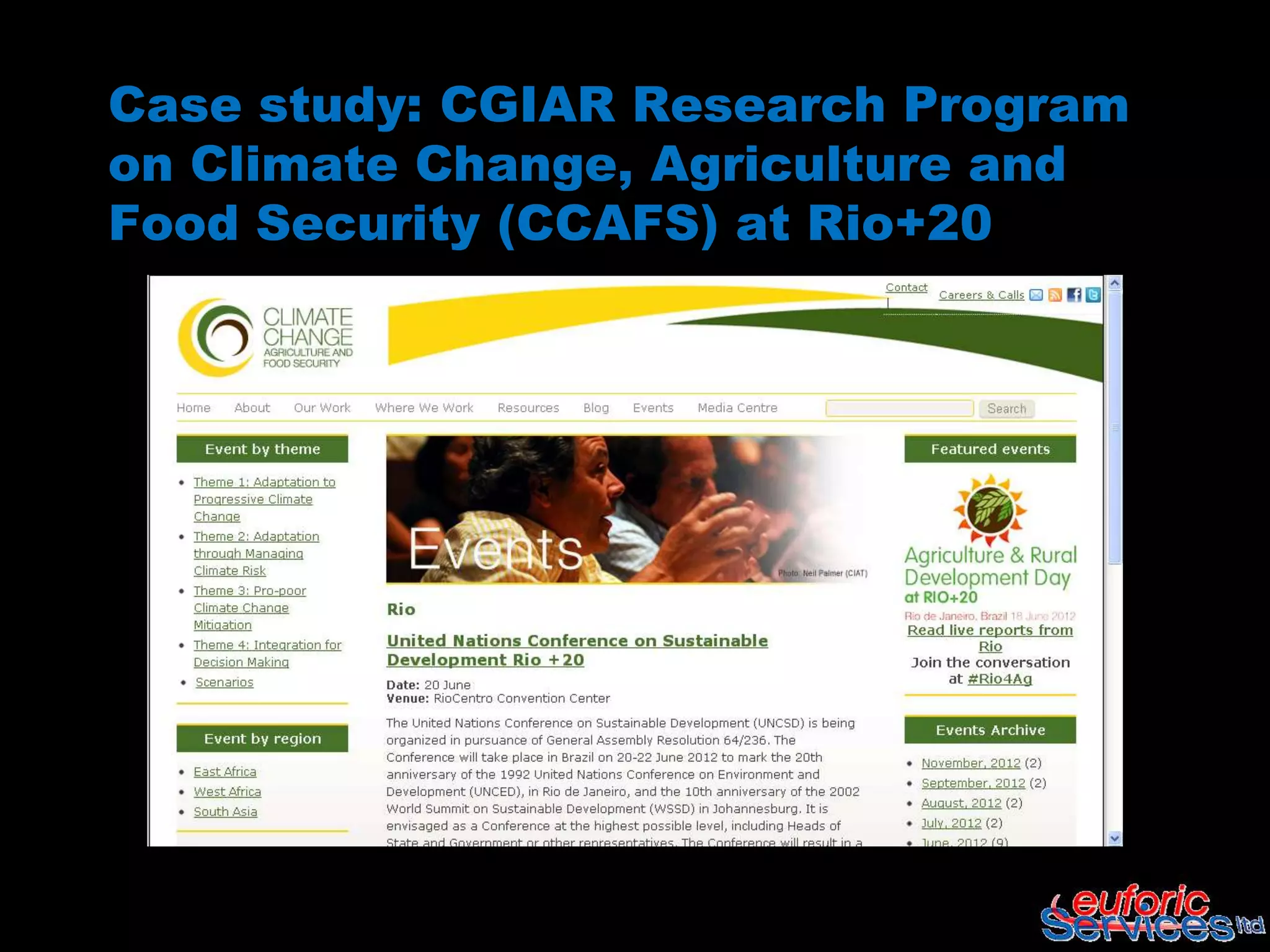
Case study: CGIAR Research Program
on Climate Change, Agriculture and
Food Security (CCAFS) at Rio+20
CCAFS at Rio+20: Social Media
Objectives

 Spread messages on sustainable
  agriculture for achieving food security in a
  changing climate
 Share CCAFS content that could inform
  Rio outcomes
 Engage in online debates about how to
  achieve a sustainable green economy
 Report live from key sessions
 Connect offsite participants to events in
  Rio
                   Developed with input from Peter Casier
How to achieve our goals

 Define our social media strategy:
  goals, messages, audiences
 Agree on roles and responsibilities:
  who does what?
 Define the tools and how to use them
 Produce, aggregate and share content
  widely: before, during and after the
  event
 Monitor and evaluate: what did we
  learn
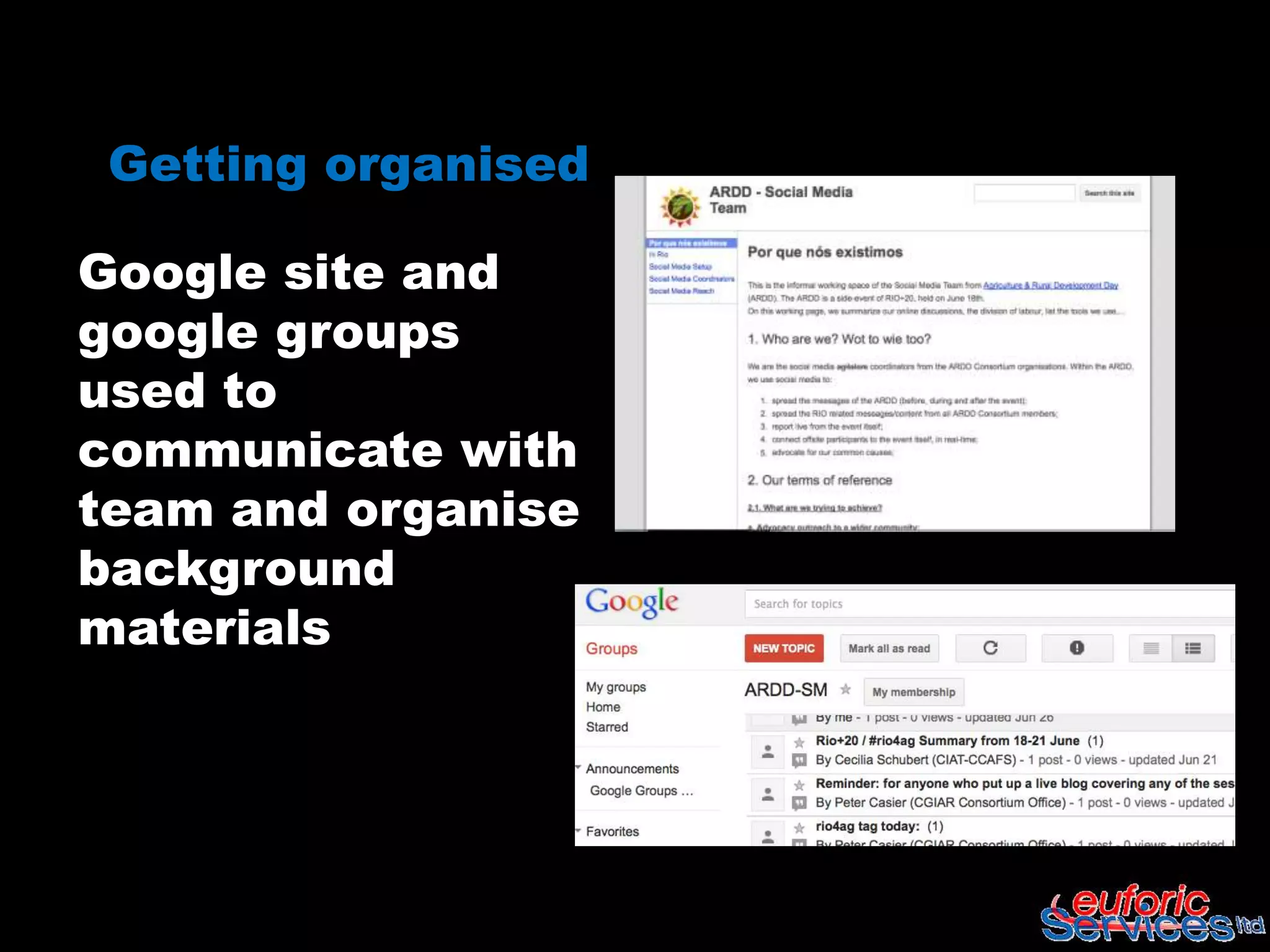
Getting organised

Google site and
google groups
used to
communicate with
team and organise
background
materials
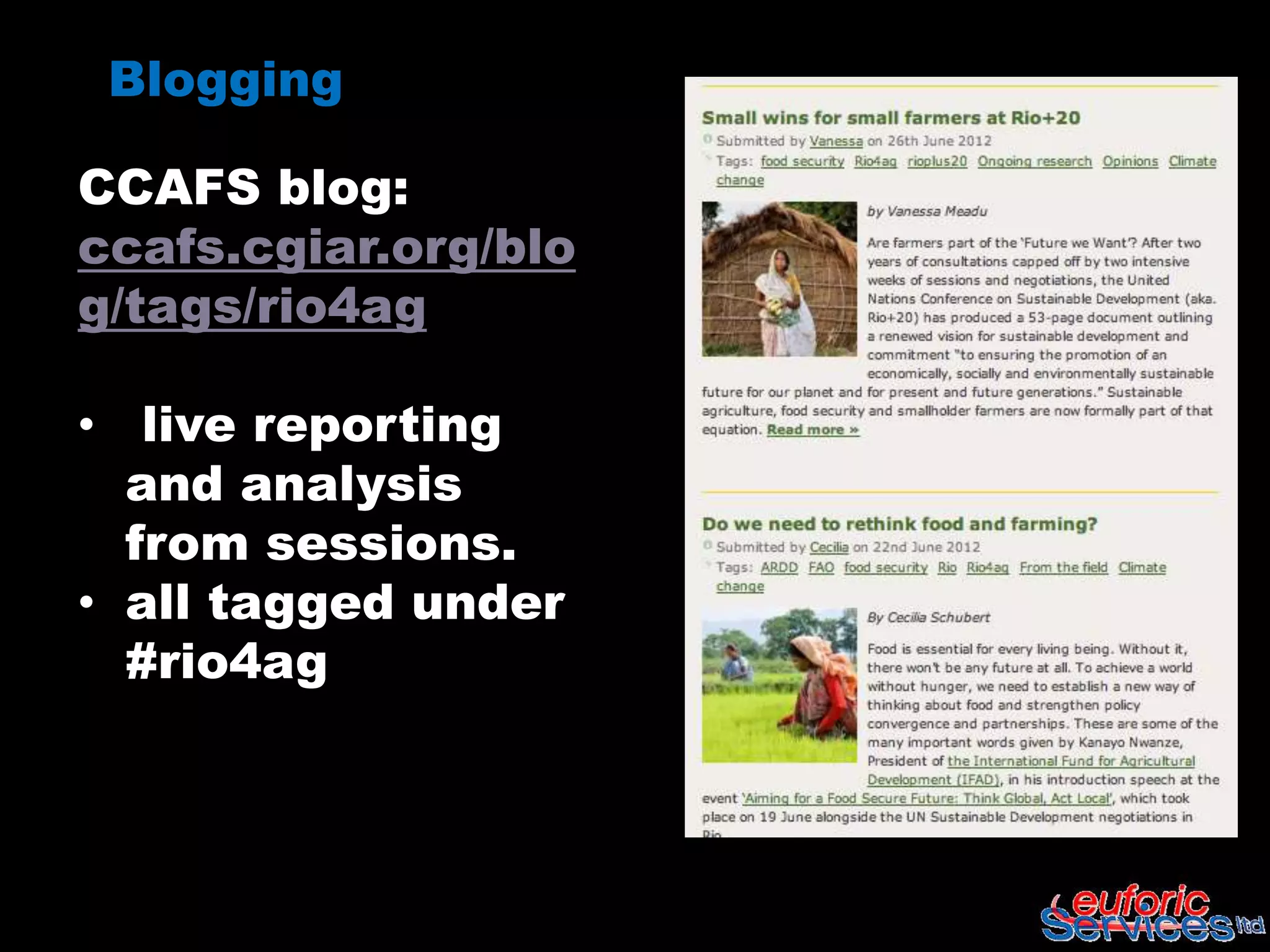
Blogging

CCAFS blog:
ccafs.cgiar.org/blo
g/tags/rio4ag

• live reporting
  and analysis
  from sessions.
• all tagged under
  #rio4ag
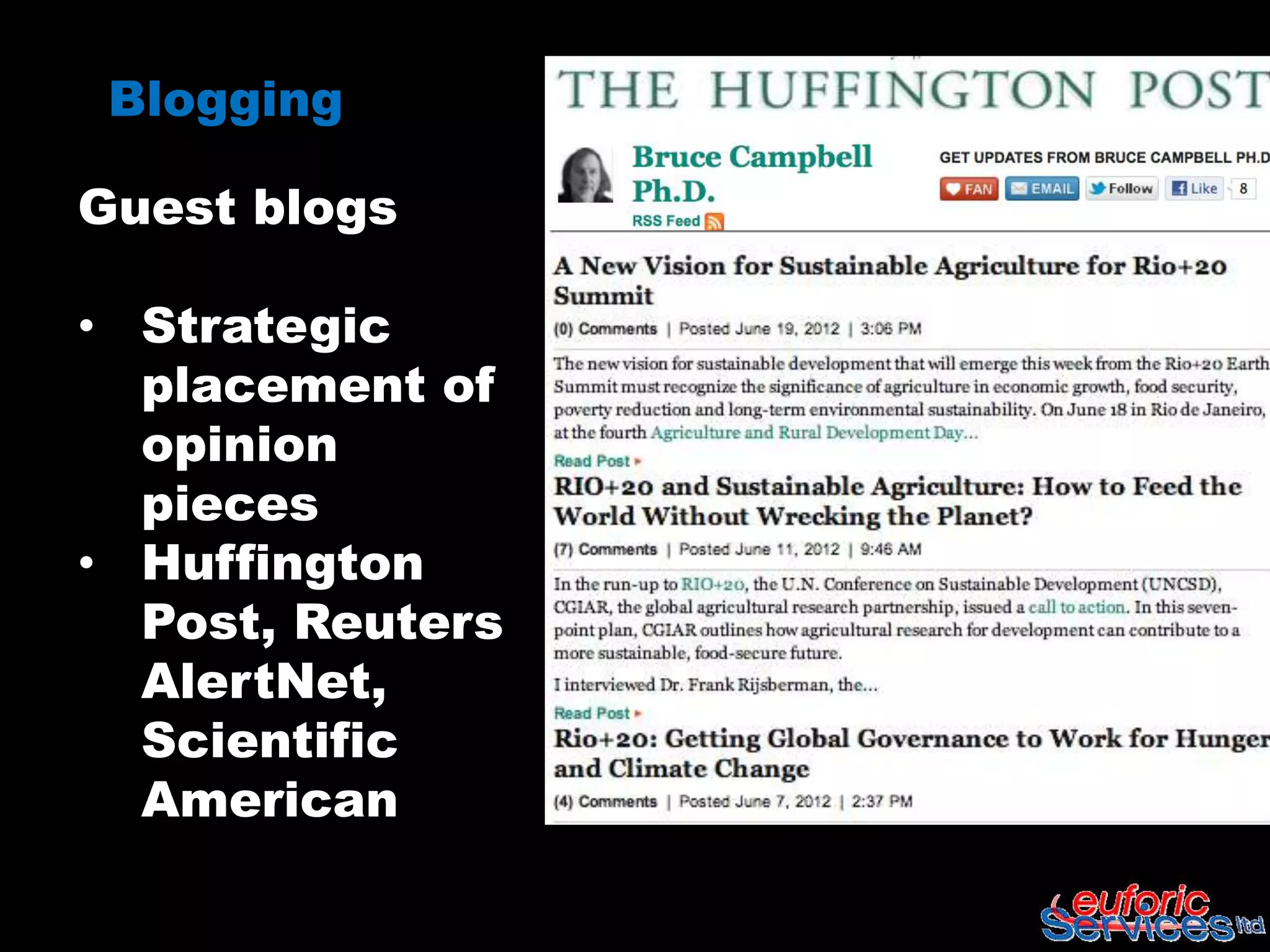
Blogging

Guest blogs

• Strategic
  placement of
  opinion
  pieces
• Huffington
  Post, Reuters
  AlertNet,
  Scientific
  American
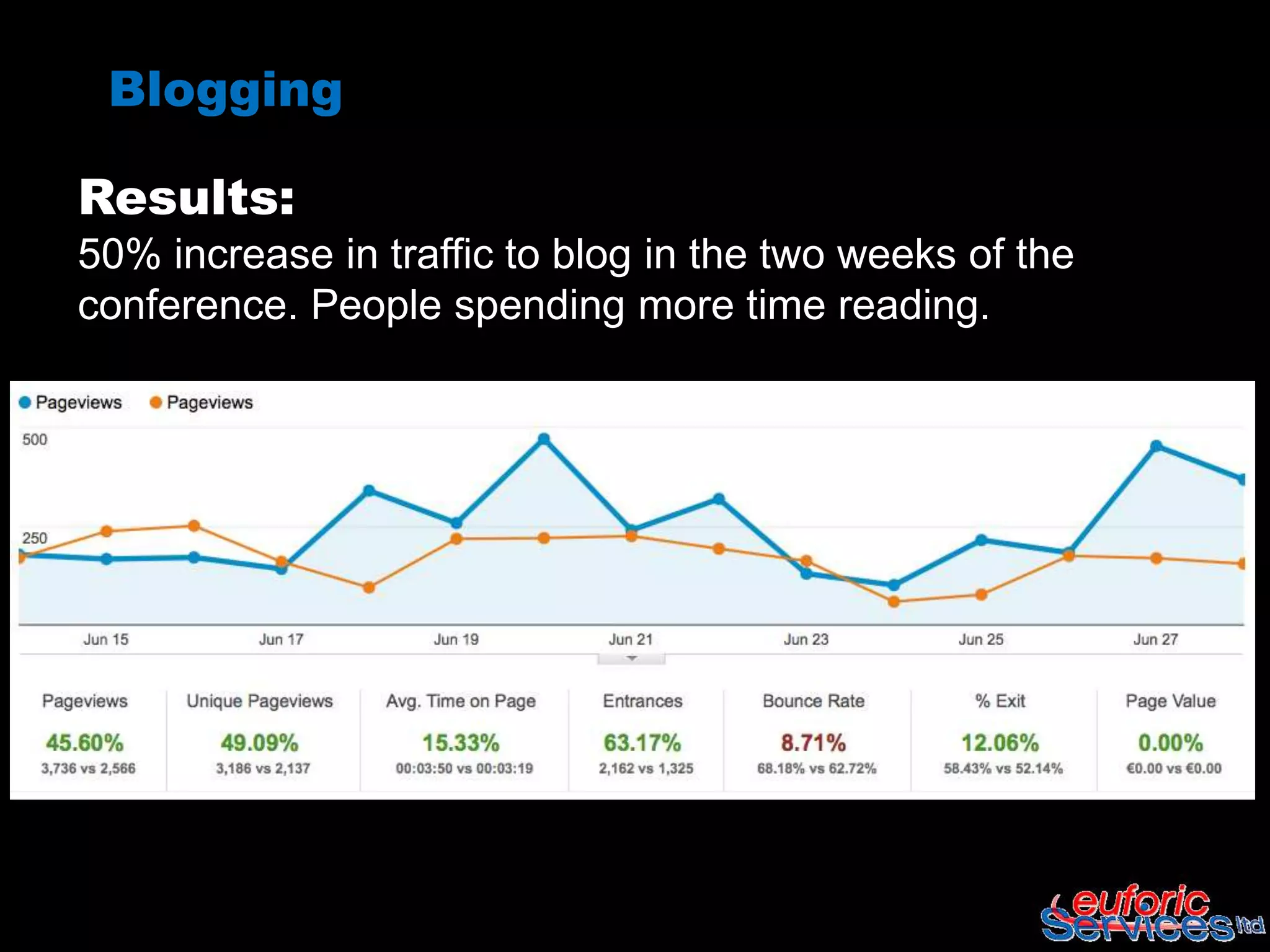
Blogging

Results:
50% increase in traffic to blog in the two weeks of the
conference. People spending more time reading.
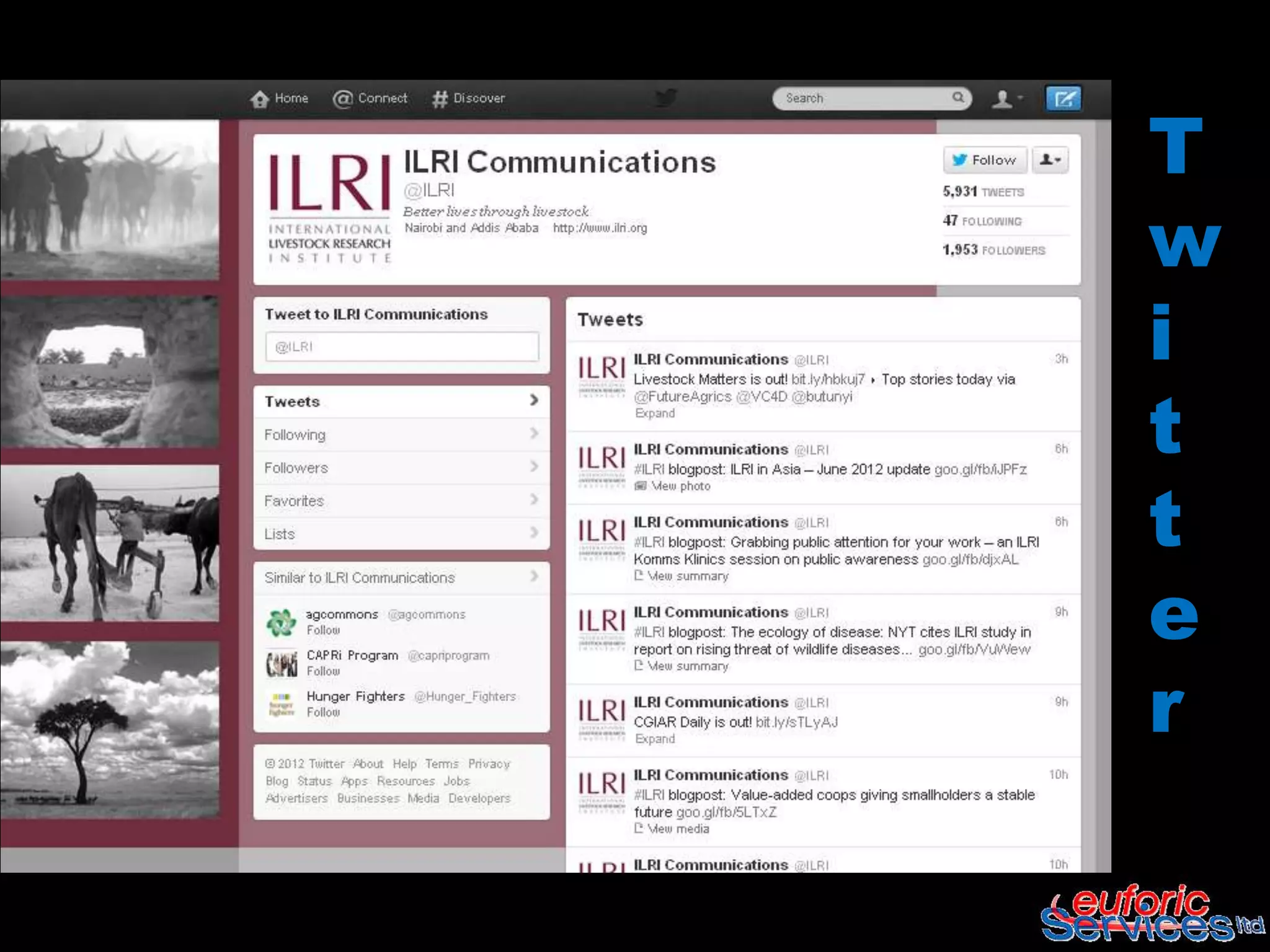
Microblogging

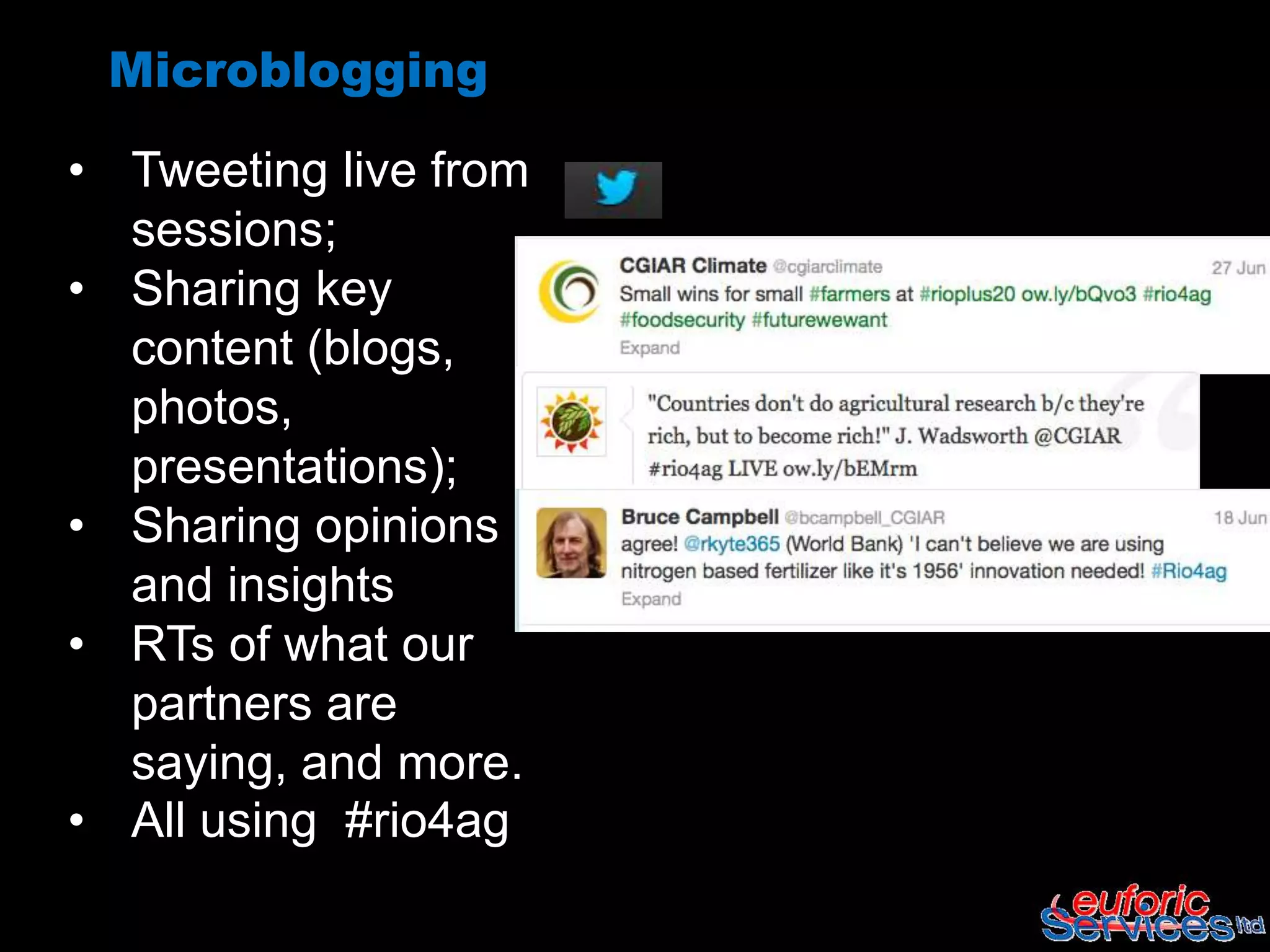
• Tweeting live from
  sessions;
• Sharing key
  content (blogs,
  photos,
  presentations);
• Sharing opinions
  and insights
• RTs of what our
  partners are
  saying, and more.
• All using #rio4ag
Microblogging
Results:
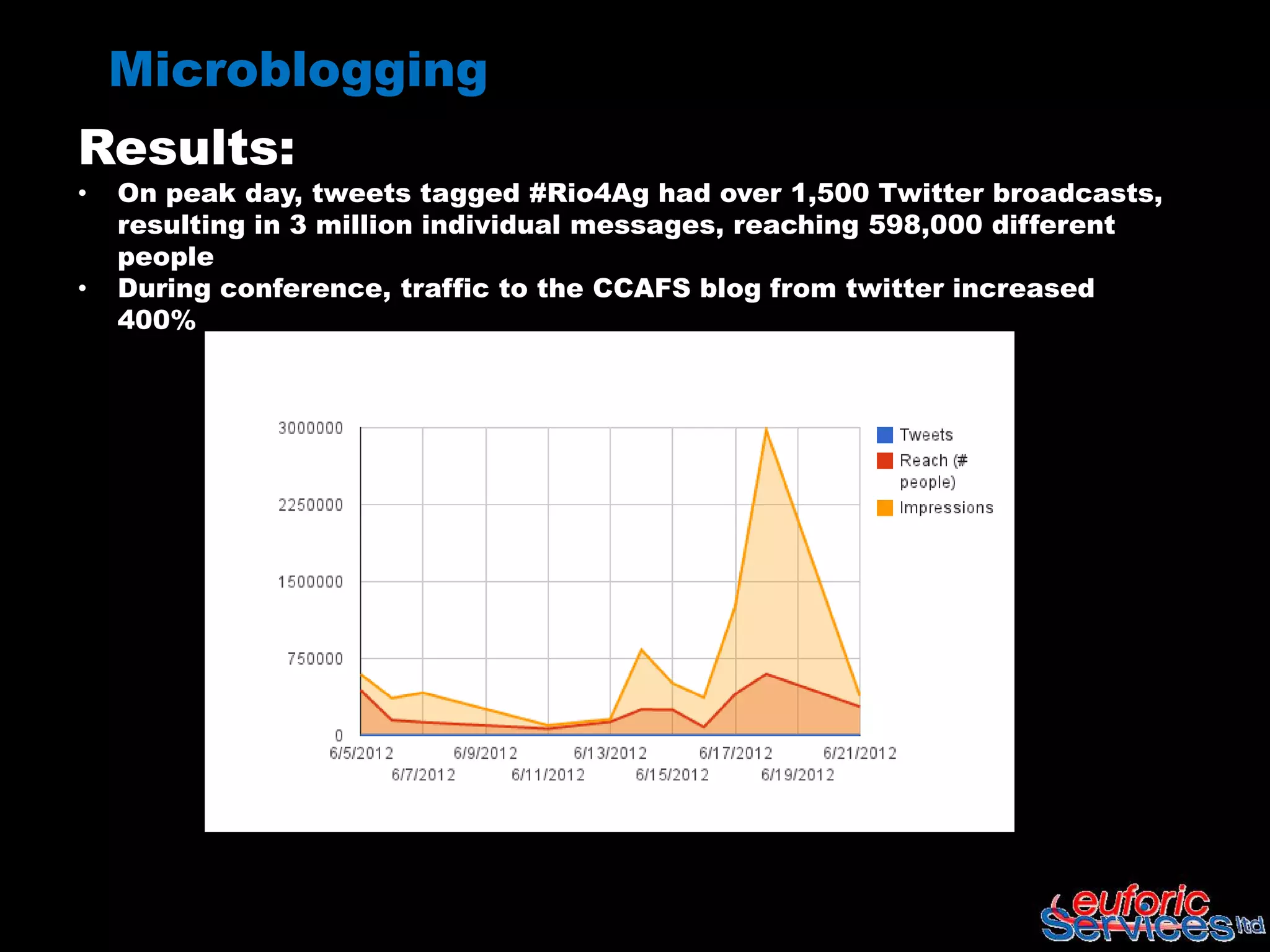
•   On peak day, tweets tagged #Rio4Ag had over 1,500 Twitter broadcasts,
    resulting in 3 million individual messages, reaching 598,000 different
    people
•   During conference, traffic to the CCAFS blog from twitter increased
    400%
Webcast

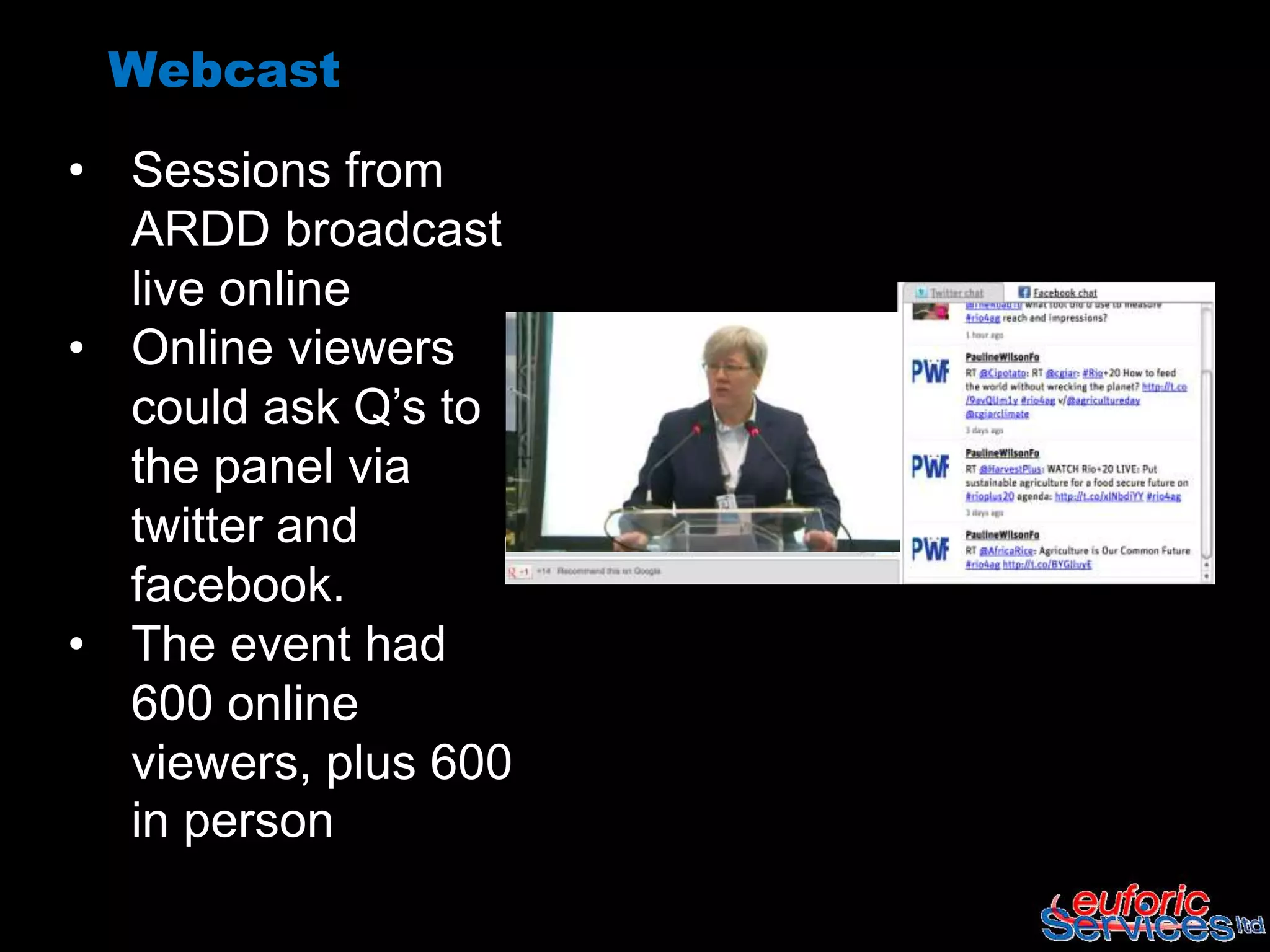
• Sessions from
  ARDD broadcast
  live online
• Online viewers
  could ask Q’s to
  the panel via
  twitter and
  facebook.
• The event had
  600 online
  viewers, plus 600
  in person
Video sharing

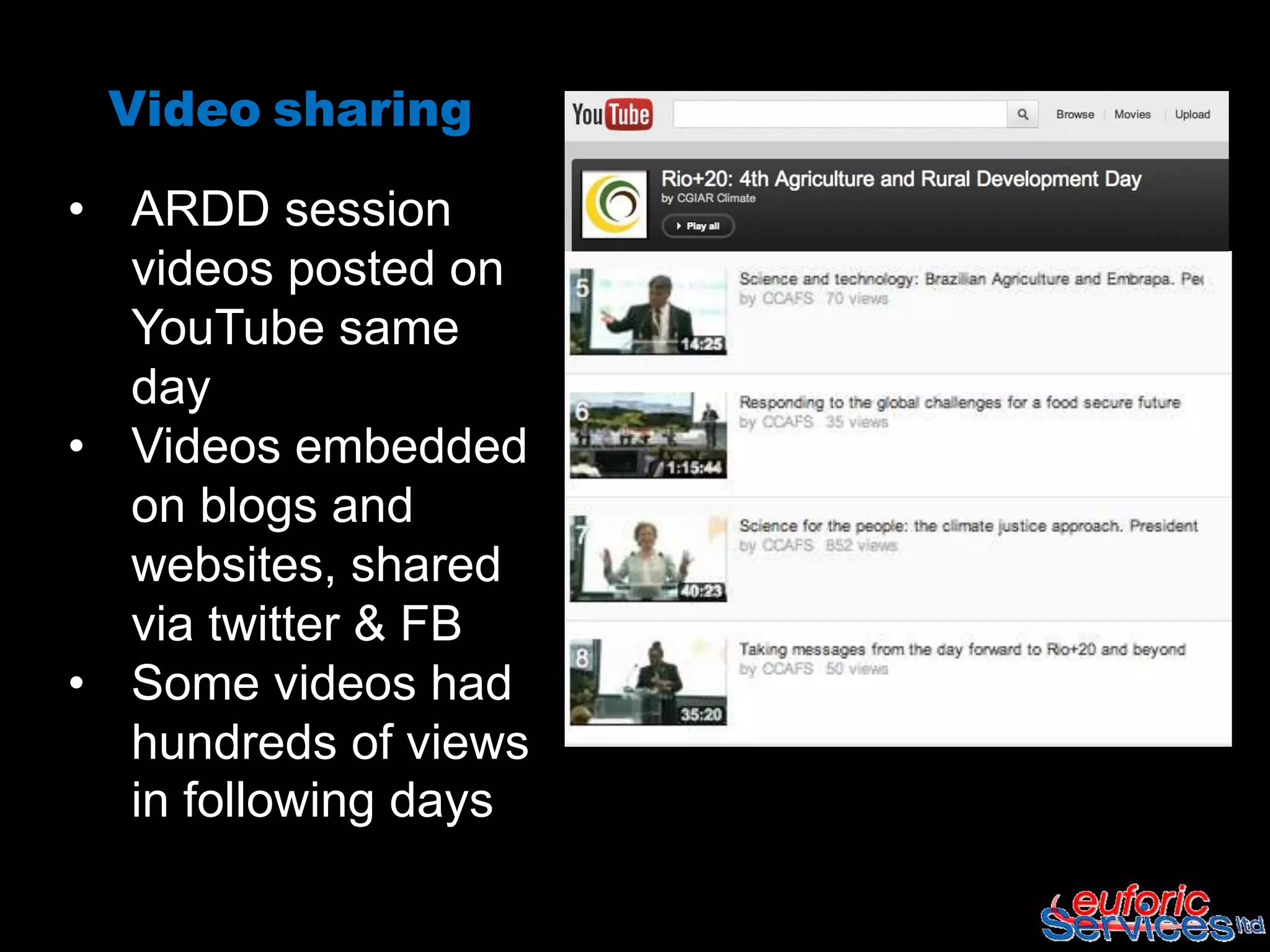
• ARDD session
  videos posted on
  YouTube same
  day
• Videos embedded
  on blogs and
  websites, shared
  via twitter & FB
• Some videos had
  hundreds of views
  in following days
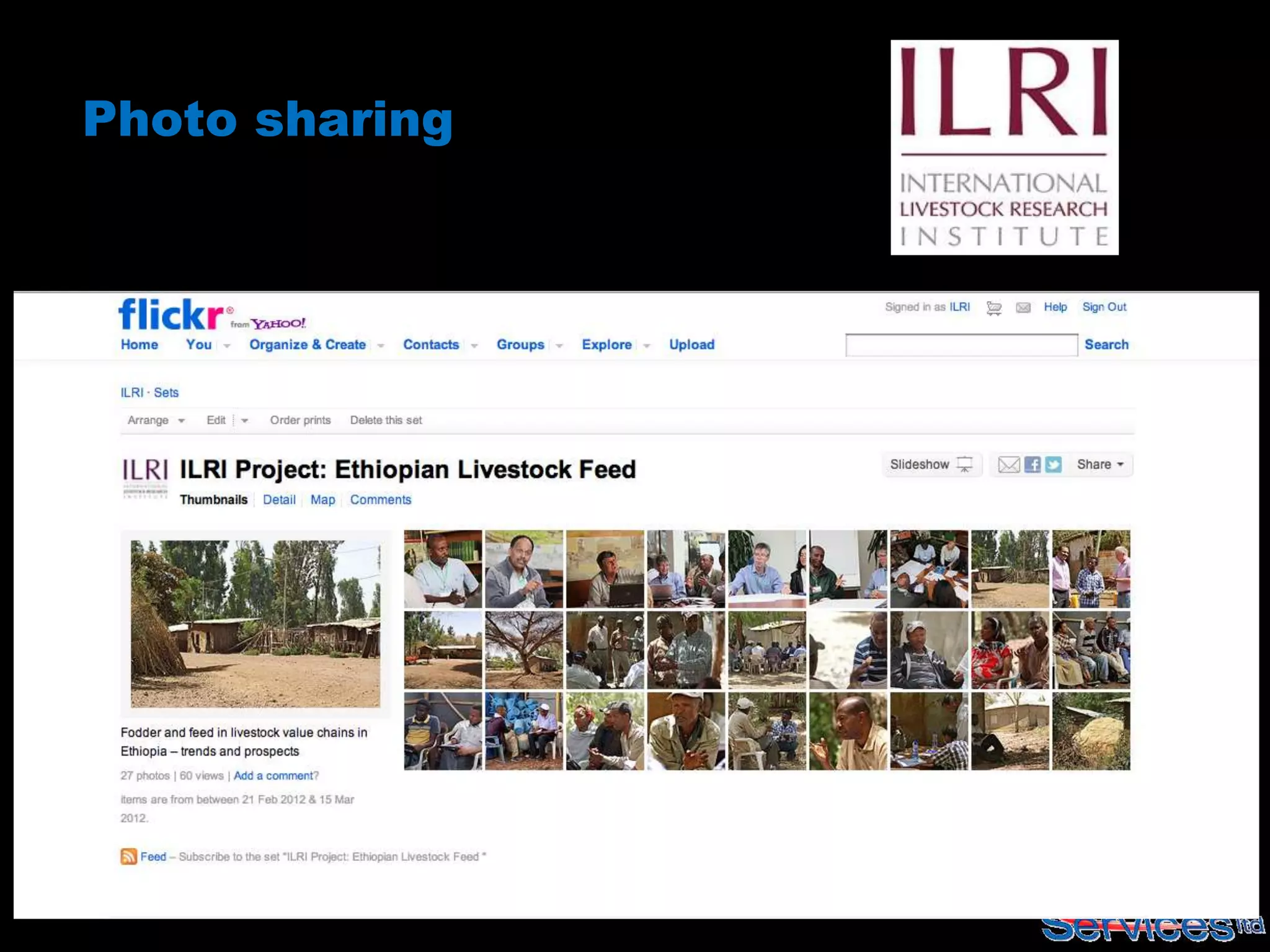
Photo sharing

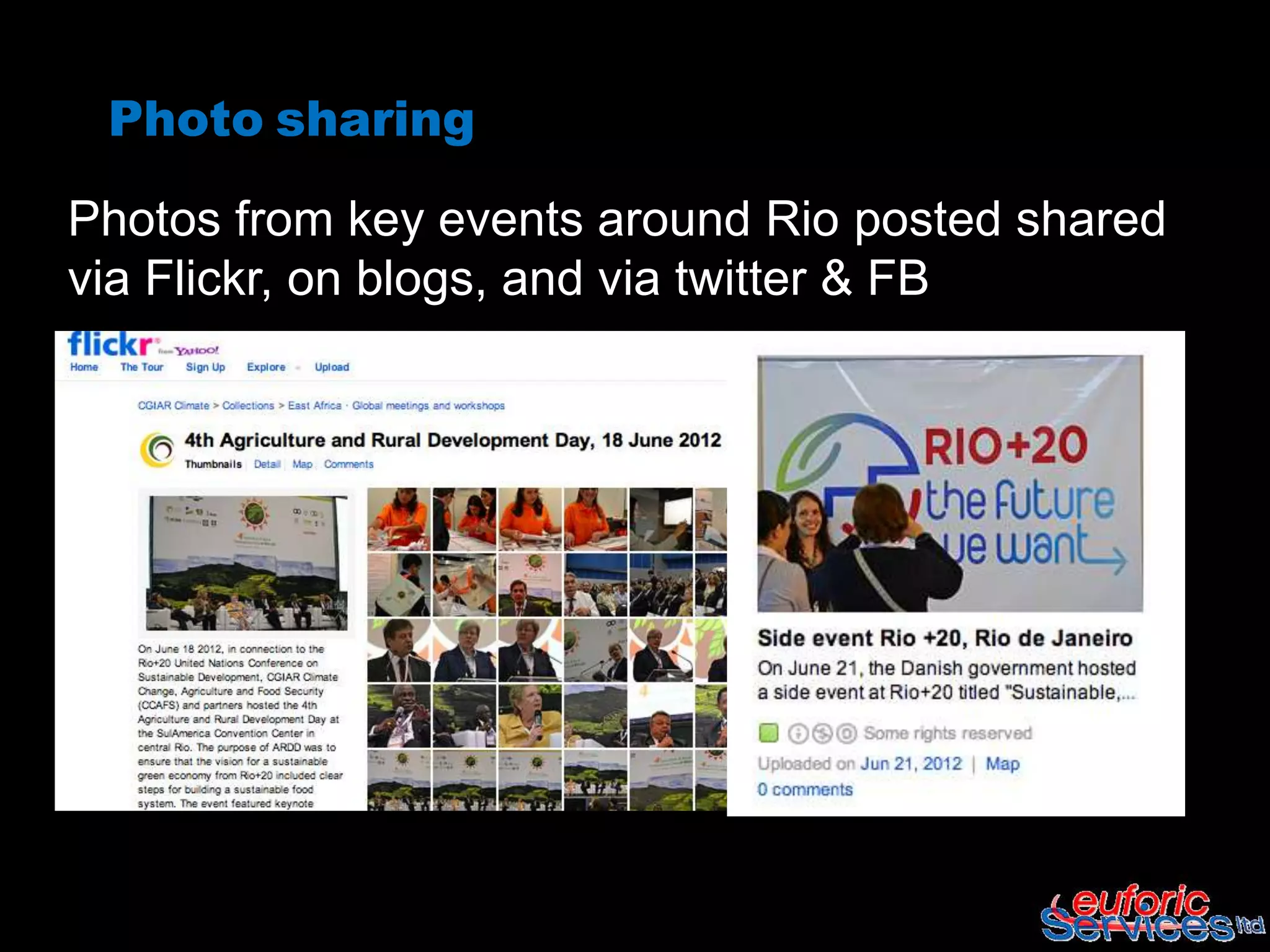
Photos from key events around Rio posted shared
via Flickr, on blogs, and via twitter & FB
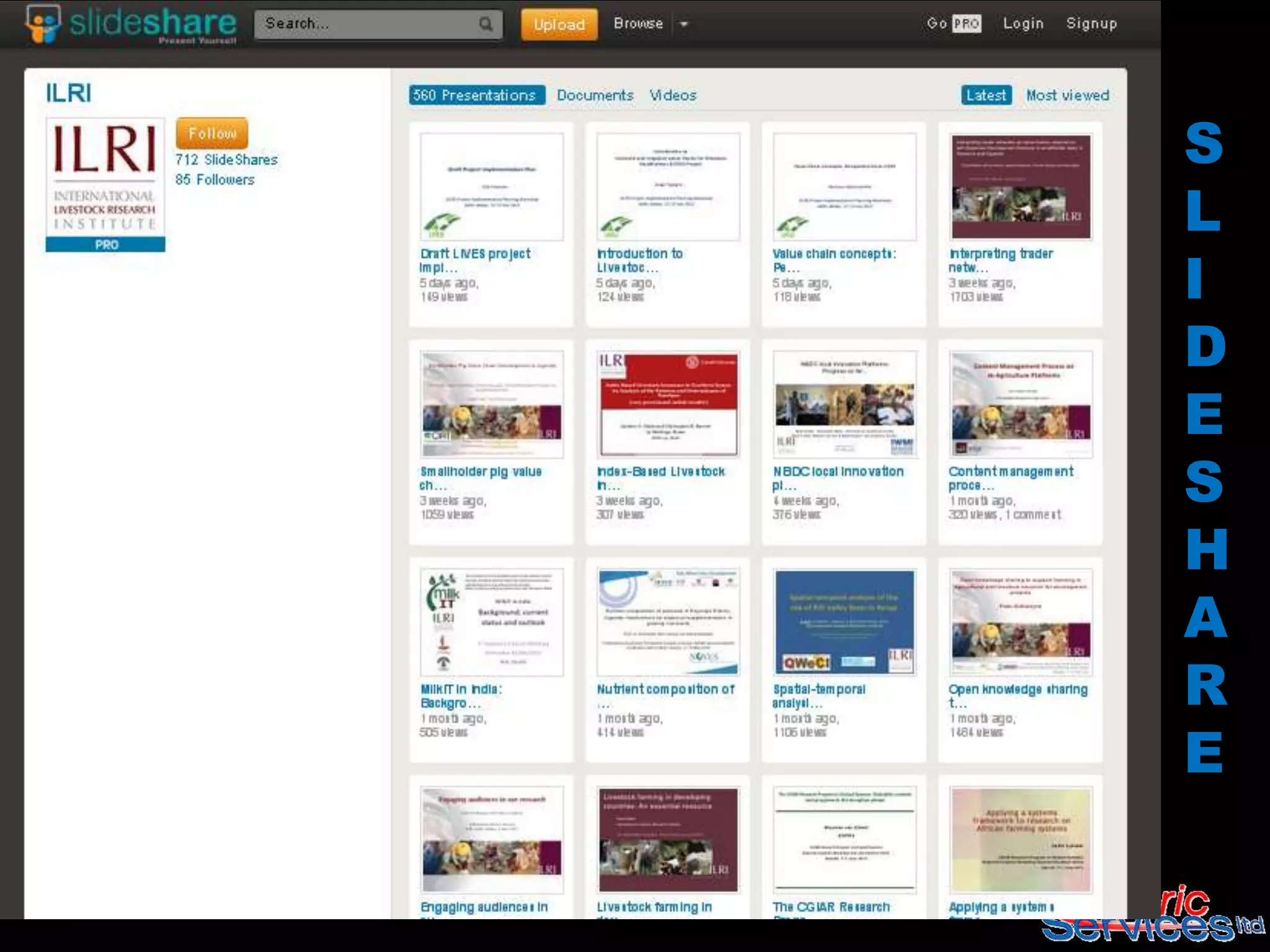
Presentation sharing
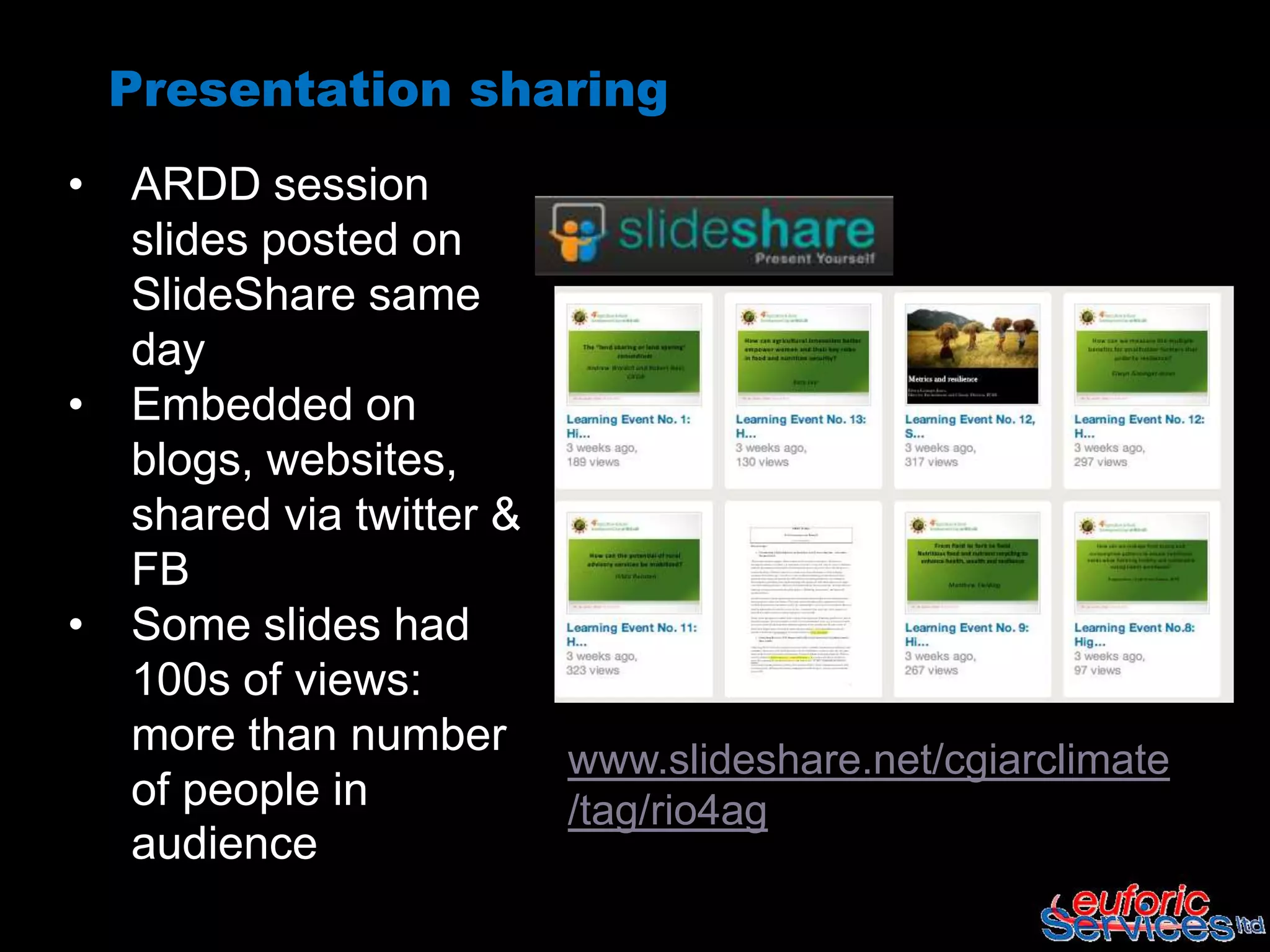
•   ARDD session
    slides posted on
    SlideShare same
    day
•   Embedded on
    blogs, websites,
    shared via twitter &
    FB
•   Some slides had
    100s of views:
    more than number
                           www.slideshare.net/cgiarclimate
    of people in           /tag/rio4ag
    audience
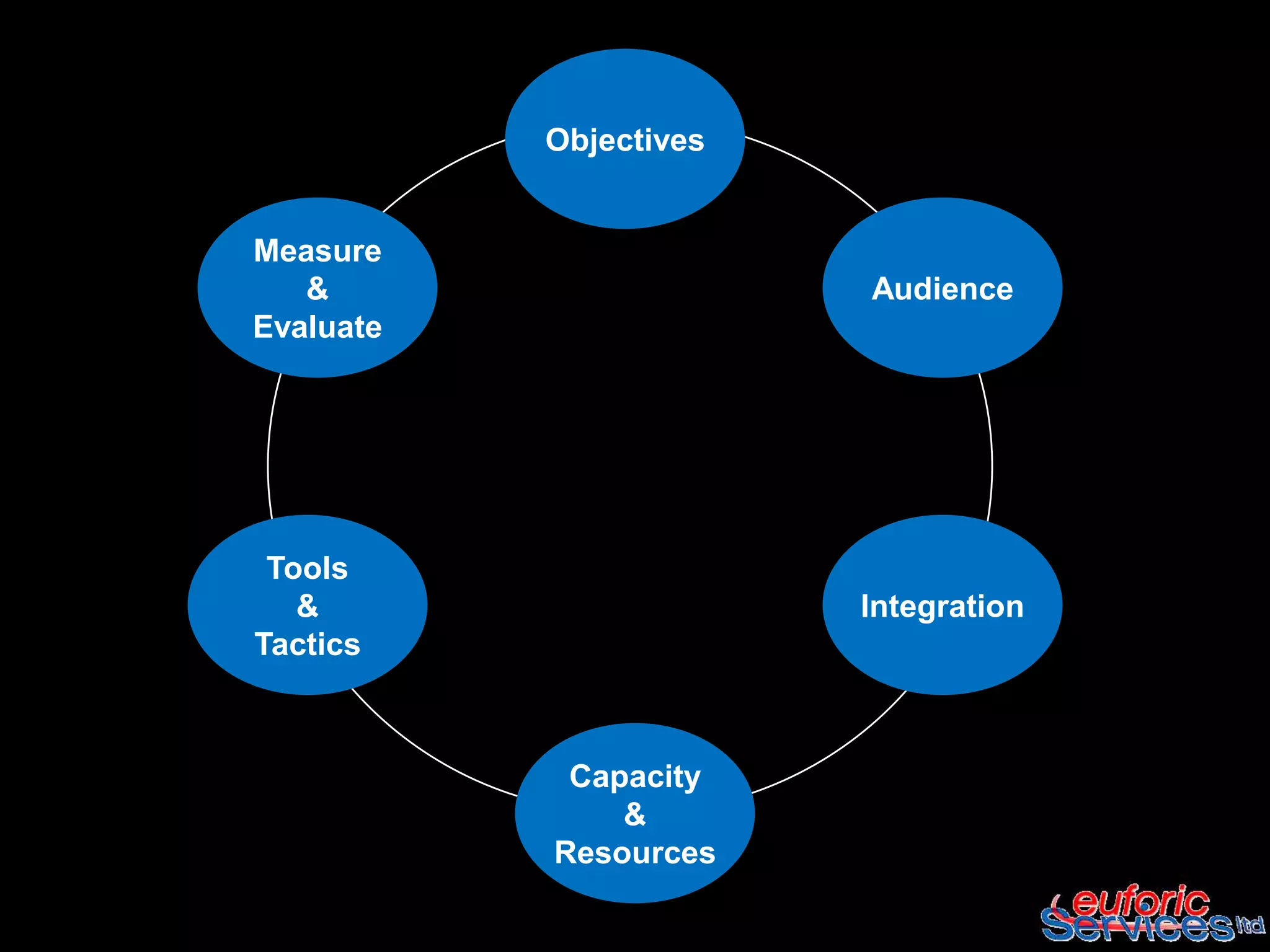
Objectives


Measure
   &                    Audience
Evaluate


 Tools
   &                    Integration
Tactics


            Capacity
               &
           Resources
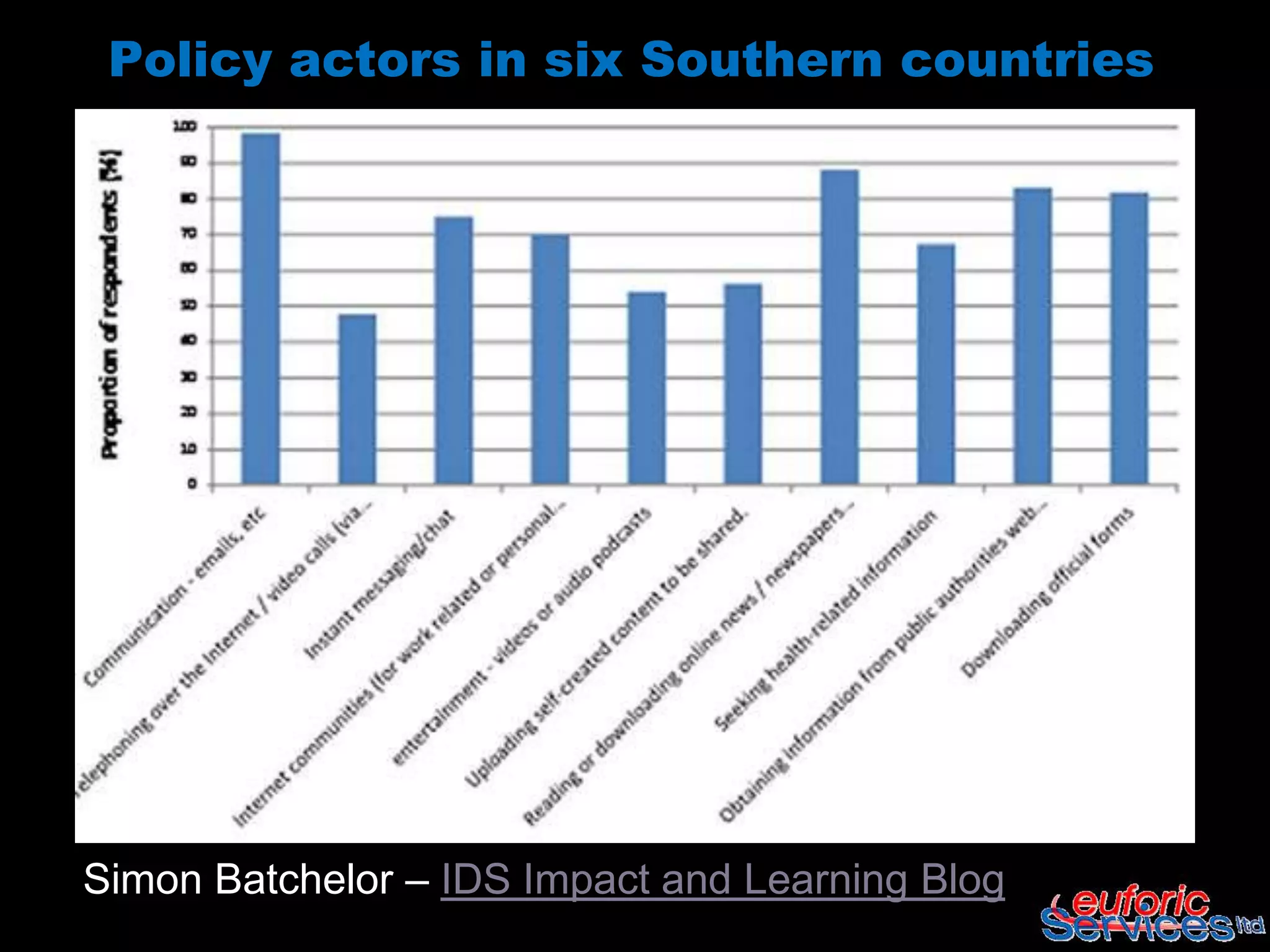
Policy actors in six Southern countries


Simon Batchelor – IDS Impact and Learning Blog
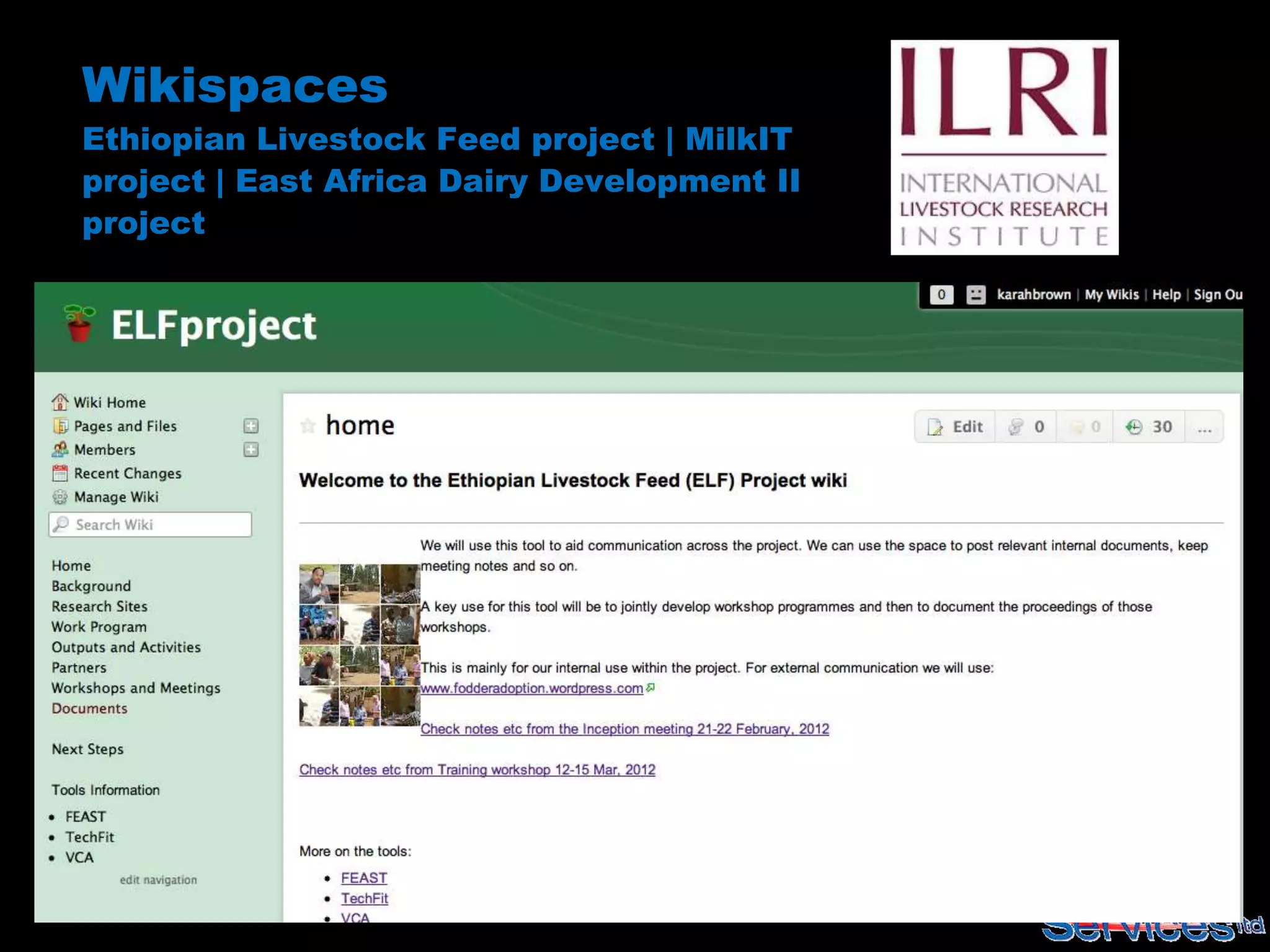
Wikispaces
Ethiopian Livestock Feed project | MilkIT
project | East Africa Dairy Development II
project
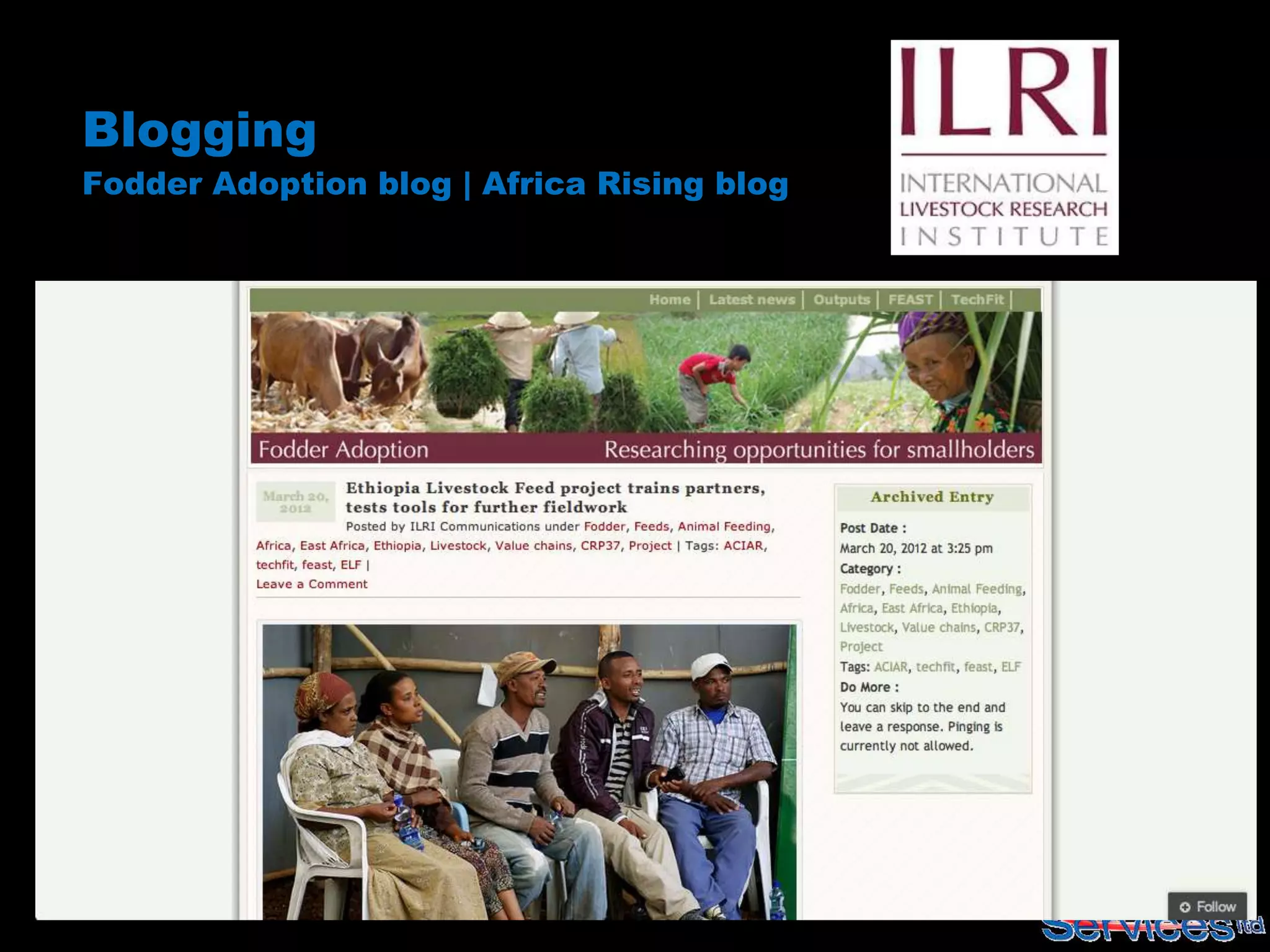
Blogging
Fodder Adoption blog | Africa Rising blog
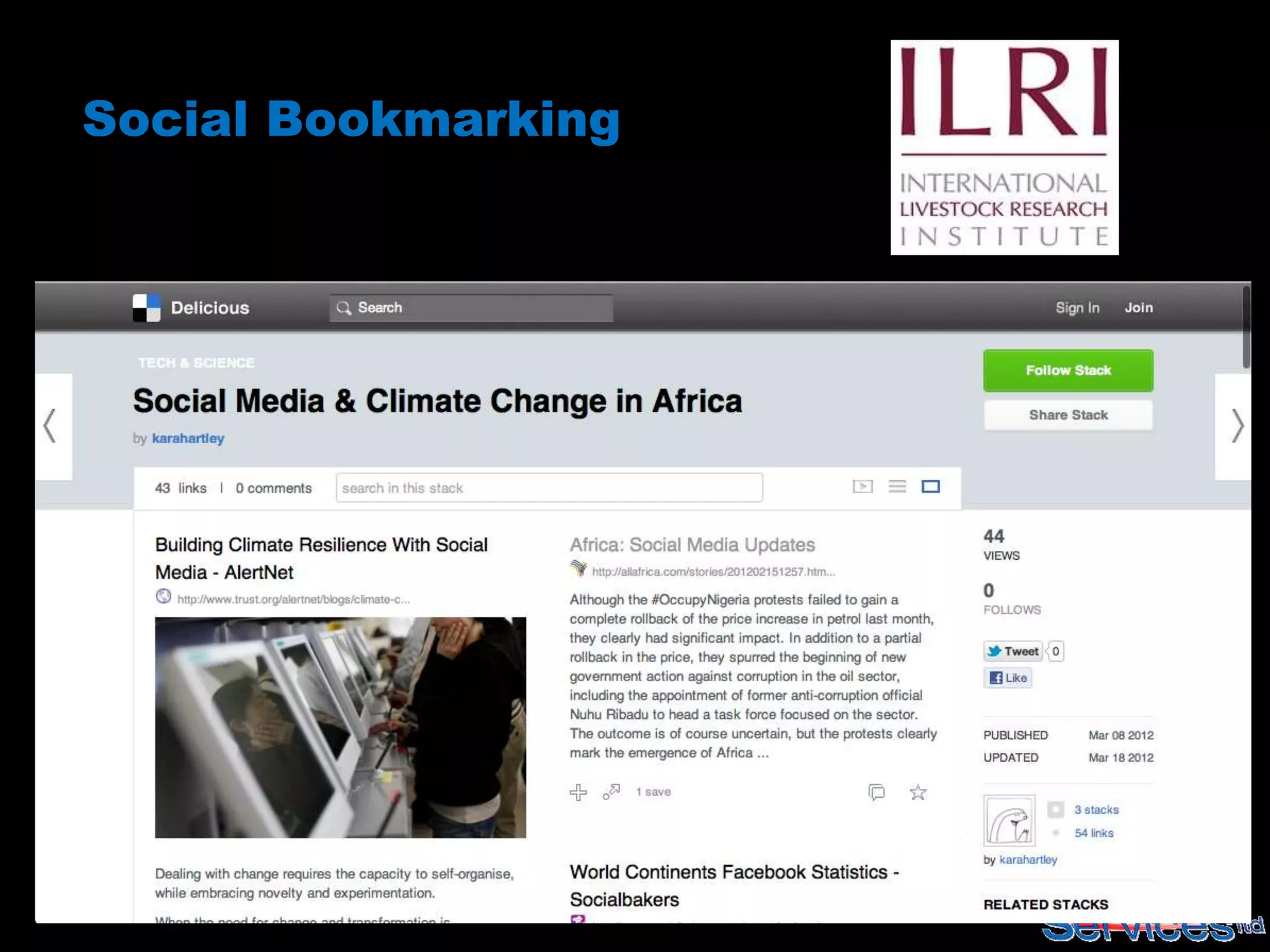
Social Bookmarking
Photo sharing
S
L
I
D
E
S
H
A
R
E
T
w
i
t
t
e
r
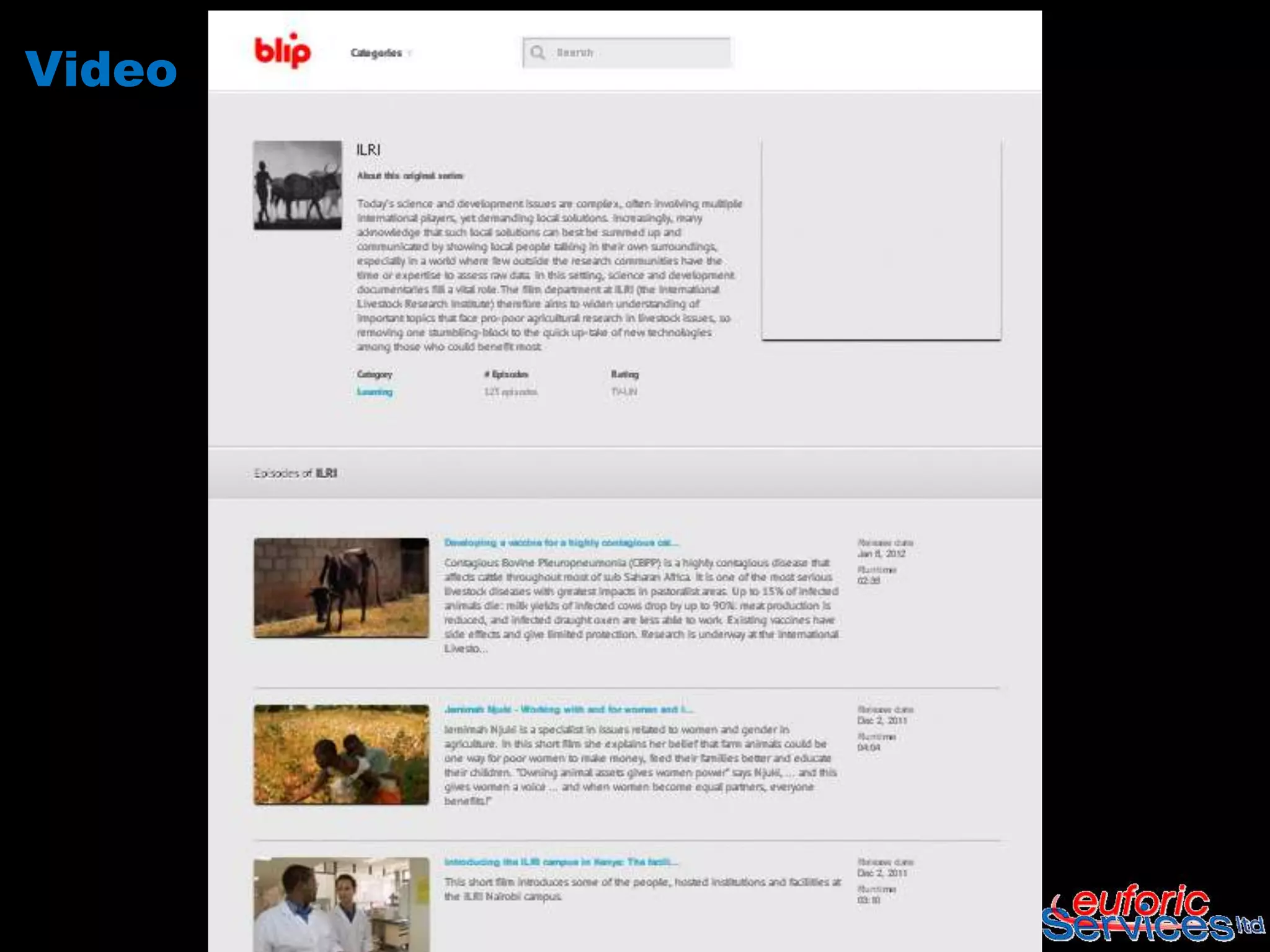
Video
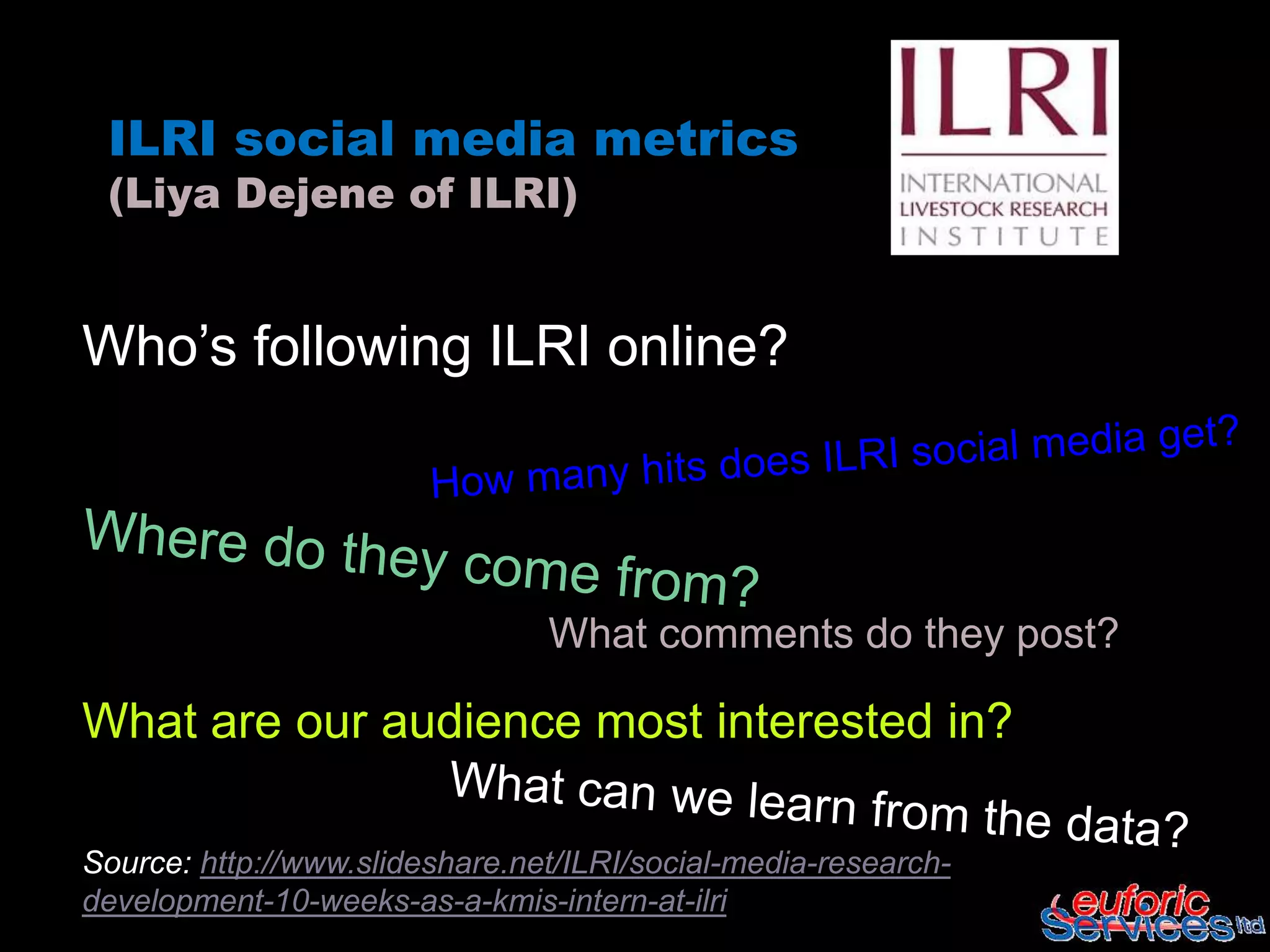
ILRI social media metrics
 (Liya Dejene of ILRI)


Who’s following ILRI online?


                                What comments do they post?

What are our audience most interested in?

Source: http://www.slideshare.net/ILRI/social-media-research-
development-10-weeks-as-a-kmis-intern-at-ilri
Social CGIAR: integrating tools to connect
people & enable content to travel
 Create
     –   Blogging
     –   Microblogging - Twitter
     –   Webcasts
     –   Video-sharing
     –   Photo sharing
     –   Presentation sharing
Social CGIAR: integrating tools to connect
people & enable content to travel
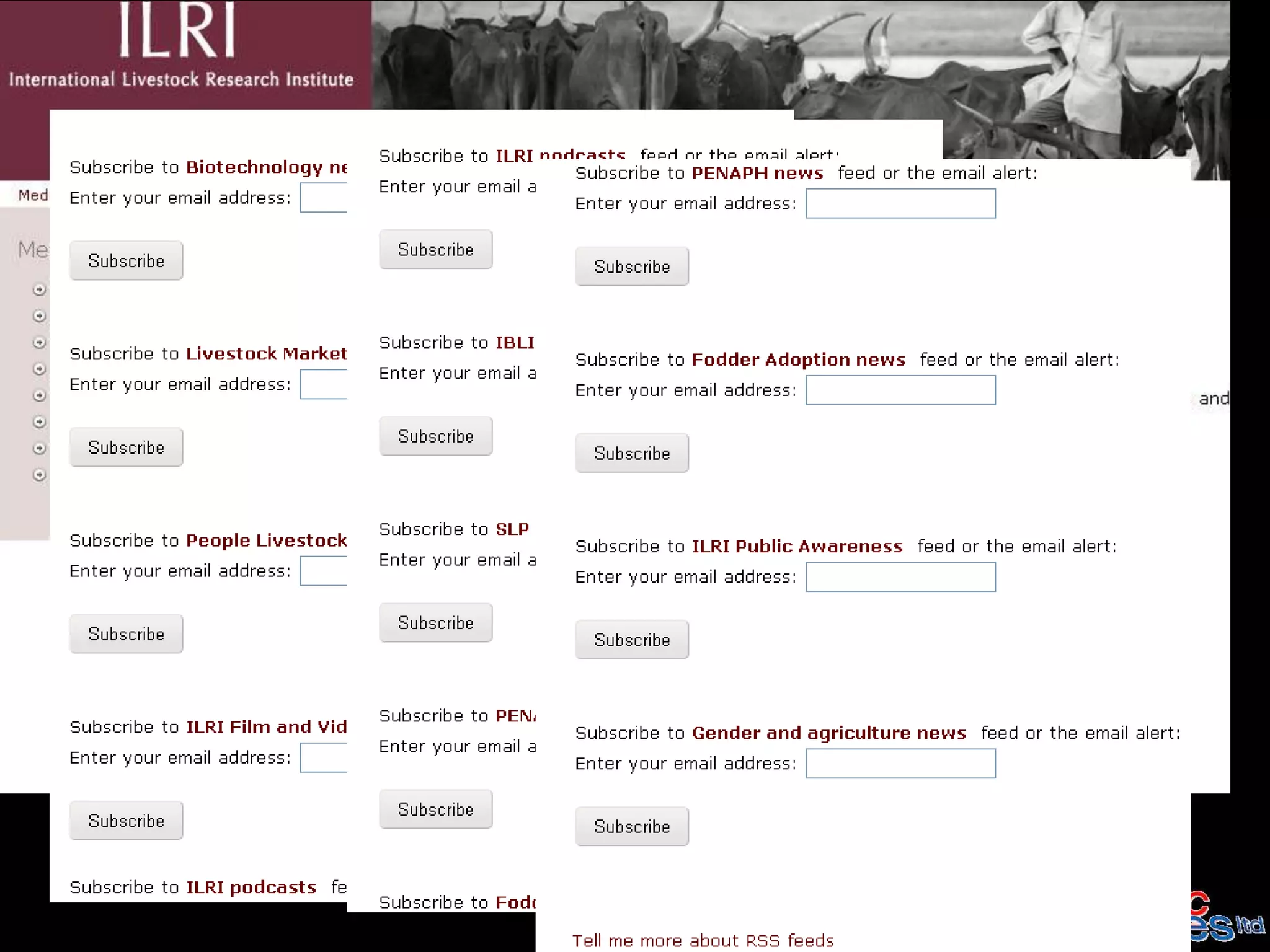
 Communicate, share and promote content
     – Feeds
     – Blogging and microblogging
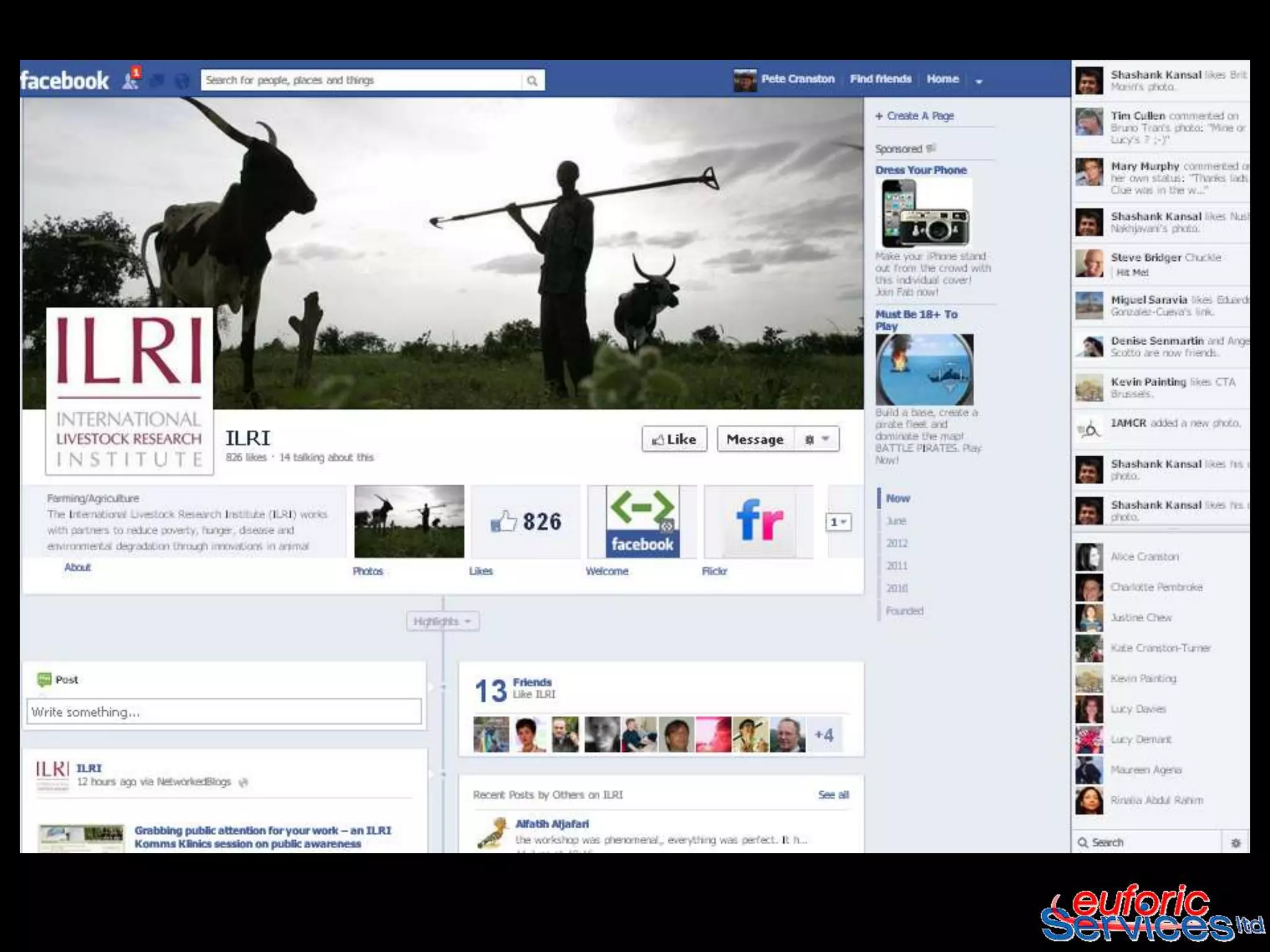
     – Facebook (social network sites)
 Collaborate and coordinate
     – Wikis, Google documents and sites for
       external partners; SharePoint for internal
     – Social Bookmarking
     – Email groups - Dgroups
Using Social Media to
communicate online
and share knowledge


    FAO Social Media
Senior Managers Workshop
          Rome
        July 2012

Using Social Media to communicate online and share knowledge

  • 1.
    Using Social Mediato communicate online and share knowledge FAO Social Media Senior Managers Workshop Rome July 2012
  • 2.
    Case study: CGIARResearch Program on Climate Change, Agriculture and Food Security (CCAFS) at Rio+20
  • 3.
    CCAFS at Rio+20:Social Media Objectives  Spread messages on sustainable agriculture for achieving food security in a changing climate  Share CCAFS content that could inform Rio outcomes  Engage in online debates about how to achieve a sustainable green economy  Report live from key sessions  Connect offsite participants to events in Rio Developed with input from Peter Casier
  • 4.
    How to achieveour goals  Define our social media strategy: goals, messages, audiences  Agree on roles and responsibilities: who does what?  Define the tools and how to use them  Produce, aggregate and share content widely: before, during and after the event  Monitor and evaluate: what did we learn
  • 5.
    Getting organised Google siteand google groups used to communicate with team and organise background materials
  • 6.
    Blogging CCAFS blog: ccafs.cgiar.org/blo g/tags/rio4ag • livereporting and analysis from sessions. • all tagged under #rio4ag
  • 7.
    Blogging Guest blogs • Strategic placement of opinion pieces • Huffington Post, Reuters AlertNet, Scientific American
  • 8.
    Blogging Results: 50% increase intraffic to blog in the two weeks of the conference. People spending more time reading.
  • 9.
    Microblogging • Tweeting livefrom sessions; • Sharing key content (blogs, photos, presentations); • Sharing opinions and insights • RTs of what our partners are saying, and more. • All using #rio4ag
  • 10.
    Microblogging Results: • On peak day, tweets tagged #Rio4Ag had over 1,500 Twitter broadcasts, resulting in 3 million individual messages, reaching 598,000 different people • During conference, traffic to the CCAFS blog from twitter increased 400%
  • 11.
    Webcast • Sessions from ARDD broadcast live online • Online viewers could ask Q’s to the panel via twitter and facebook. • The event had 600 online viewers, plus 600 in person
  • 12.
    Video sharing • ARDDsession videos posted on YouTube same day • Videos embedded on blogs and websites, shared via twitter & FB • Some videos had hundreds of views in following days
  • 13.
    Photo sharing Photos fromkey events around Rio posted shared via Flickr, on blogs, and via twitter & FB
  • 14.
    Presentation sharing • ARDD session slides posted on SlideShare same day • Embedded on blogs, websites, shared via twitter & FB • Some slides had 100s of views: more than number www.slideshare.net/cgiarclimate of people in /tag/rio4ag audience
  • 15.
    Objectives Measure & Audience Evaluate Tools & Integration Tactics Capacity & Resources
  • 17.
    Policy actors insix Southern countries Simon Batchelor – IDS Impact and Learning Blog
  • 19.
    Wikispaces Ethiopian Livestock Feedproject | MilkIT project | East Africa Dairy Development II project
  • 20.
    Blogging Fodder Adoption blog| Africa Rising blog
  • 21.
  • 22.
  • 23.
  • 24.
  • 25.
  • 28.
    ILRI social mediametrics (Liya Dejene of ILRI) Who’s following ILRI online? What comments do they post? What are our audience most interested in? Source: http://www.slideshare.net/ILRI/social-media-research- development-10-weeks-as-a-kmis-intern-at-ilri
  • 29.
    Social CGIAR: integratingtools to connect people & enable content to travel  Create – Blogging – Microblogging - Twitter – Webcasts – Video-sharing – Photo sharing – Presentation sharing
  • 30.
    Social CGIAR: integratingtools to connect people & enable content to travel  Communicate, share and promote content – Feeds – Blogging and microblogging – Facebook (social network sites)  Collaborate and coordinate – Wikis, Google documents and sites for external partners; SharePoint for internal – Social Bookmarking – Email groups - Dgroups
  • 31.
    Using Social Mediato communicate online and share knowledge FAO Social Media Senior Managers Workshop Rome July 2012

Editor's Notes

  • #4 Spread messages about the role of sustainable agriculture for achieving food security in a changing climate (before, during and after the conference and especially at Agriculture and Rural DevelopmentDay, a major event convened by agricultural agencies at Rio);spread RIO related messages/content from CCAFS (publications, tools, and more) report live from key agriculture and food security related events esp ARDD;connect offsite participants to what is going on in Rio, in real-time;engage with a global community of people, in Rio and online, who are debating the issues we work on.
  • #5 a. Define our social media strategy:- Clearly define and agree on the goals and targets of the social reporting efforts beforehand.- Define the link between "social" and "traditional" media - Define our key messages and the main target audienceb. Agree on roles and responsibilitiesWell before the event, assemble a small team of staff and partners who will be onsite and are willing to report from events, blog, tweet, take photos and more. Also connect with colleagues who are offsite who are willing to help spin and promote the content and help with essential tasks such as editing and uploading content. c. Define the toolsAgree on a standard set of tools and how they will be used. Also agree on conventions (e.g. using the #rio4agtag)d. Produce, aggregate and share content widelyDuring the event, work together to get content finalised and online quickly and invest as much time in promoting content once it's online.f. Monitor and evaluateA wrap-up report can summarize all content generated, and measure the actual reach of the social reporting and document the process as well as the lessons learnt.
  • #6 Mixed group, inside and outside the programme. SharePoint is a a key resource for FAO, tbd this afternoon
  • #8 Mixing blogging with traditional media outreach
  • #11 Reach is the total number of unique Twitter users who received tweets about the search term. Exposure is the total number of times tweets about the search term were received by users. We call each receipt of a tweet an impression. Both reach and impressions should be treated as directional metrics to give you an idea of the overall exposure the tracked term received. You should use these metrics to get a sense of the size of your potential audience, and use engagement metrics like retweets, clicks and replies to gain a more complete understanding of your impact. Source: http://tweetreach.com
  • #19 So that was an event: needs pre-event building, and this was a major effort for a one-off occasion. They use Social Media all the time but we want to change example. This is business as usual in ILRI, aiming to promote and share their content as widely and interactively as possible