
Ester Boldú
A COMPETENCE is defined as the ability to
put into practice the knowledge, skills and
attitudes acquired through the ESO stage in
a way which is appropriate to different
contexts and situations, and to do so in an
integrated way.

They are also labelled as KEY competences,
because we consider that these are the
essential competences to become citizens
and to solve problems in everyday situations.
1. Linguistic and Audiovisual
        Communicative
                             2. Artistic and Cultural
                                                                         Be and Act
                                                                         autonomously
                              3. Information Handling
                               and Digital Comp                          Think and
                                                                         Communicate
           Methodological     4. Mathematical
 Key                                                         To learn
                                                                         Discover and
Comp                          5. Learning to Learn            how to
                                                                         Have initiative
                              6. Autonomy,
                                                                        Coexist and Live
                              Initiative
          Personal                                                      in our world
                               and Decision Taking
                              7. Knowledge of & Interaction
                               with the Natural World

       living in the world
                              8. Social and Civic
KEY COMPETENCES are all considered
equally important, because each of them
can contribute to a successful life in a
knowledge society. Many of the competences
overlap and interlock: aspects essential to
one domain will support competence in
another.

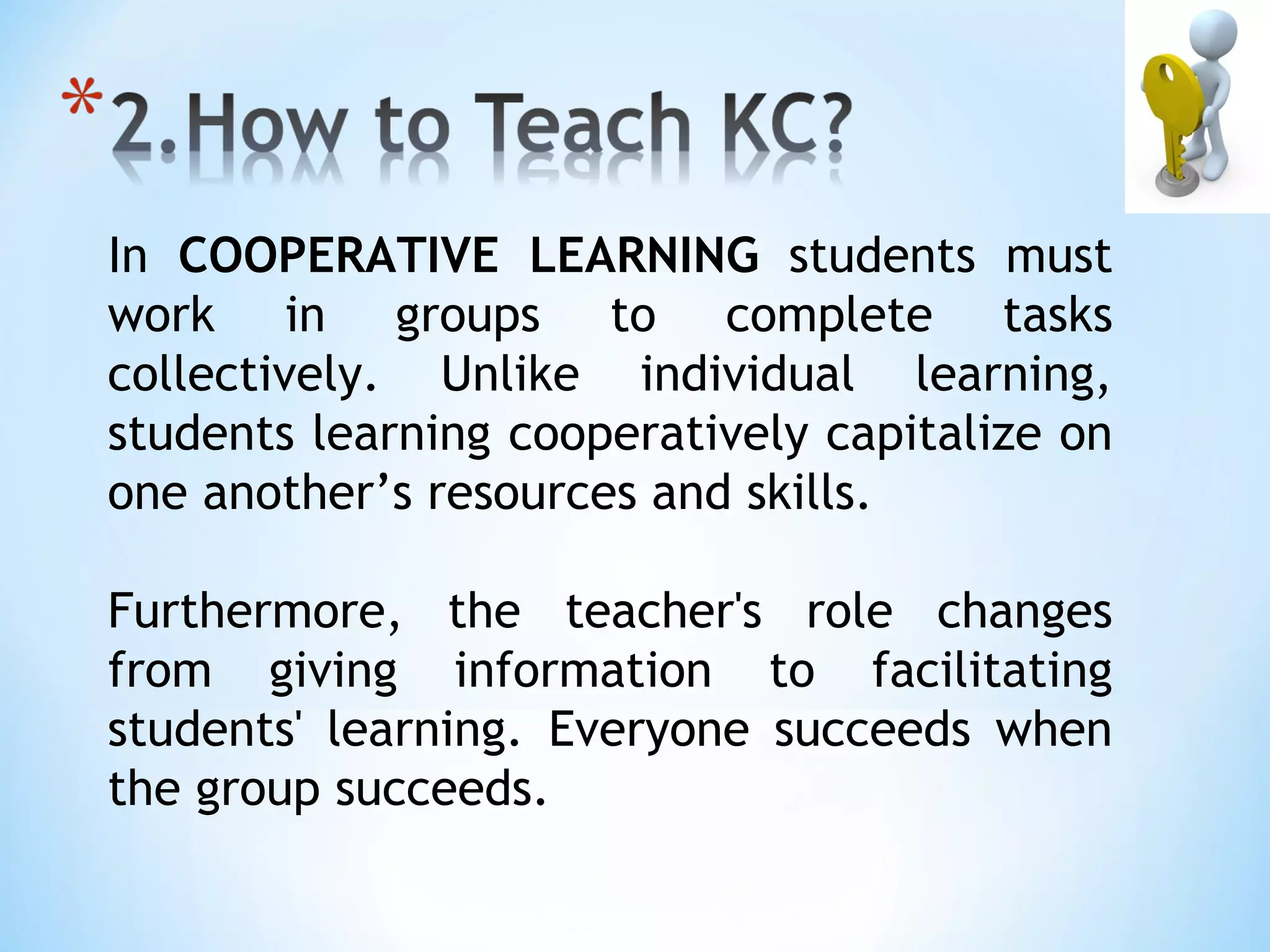
Therefore, COOPERATIVE LEARNING is a
perfect approach to implement KC.
In COOPERATIVE LEARNING students must
work in groups to complete tasks
collectively. Unlike individual learning,
students learning cooperatively capitalize on
one another’s resources and skills.

Furthermore, the teacher's role changes
from giving information to facilitating
students' learning. Everyone succeeds when
the group succeeds.
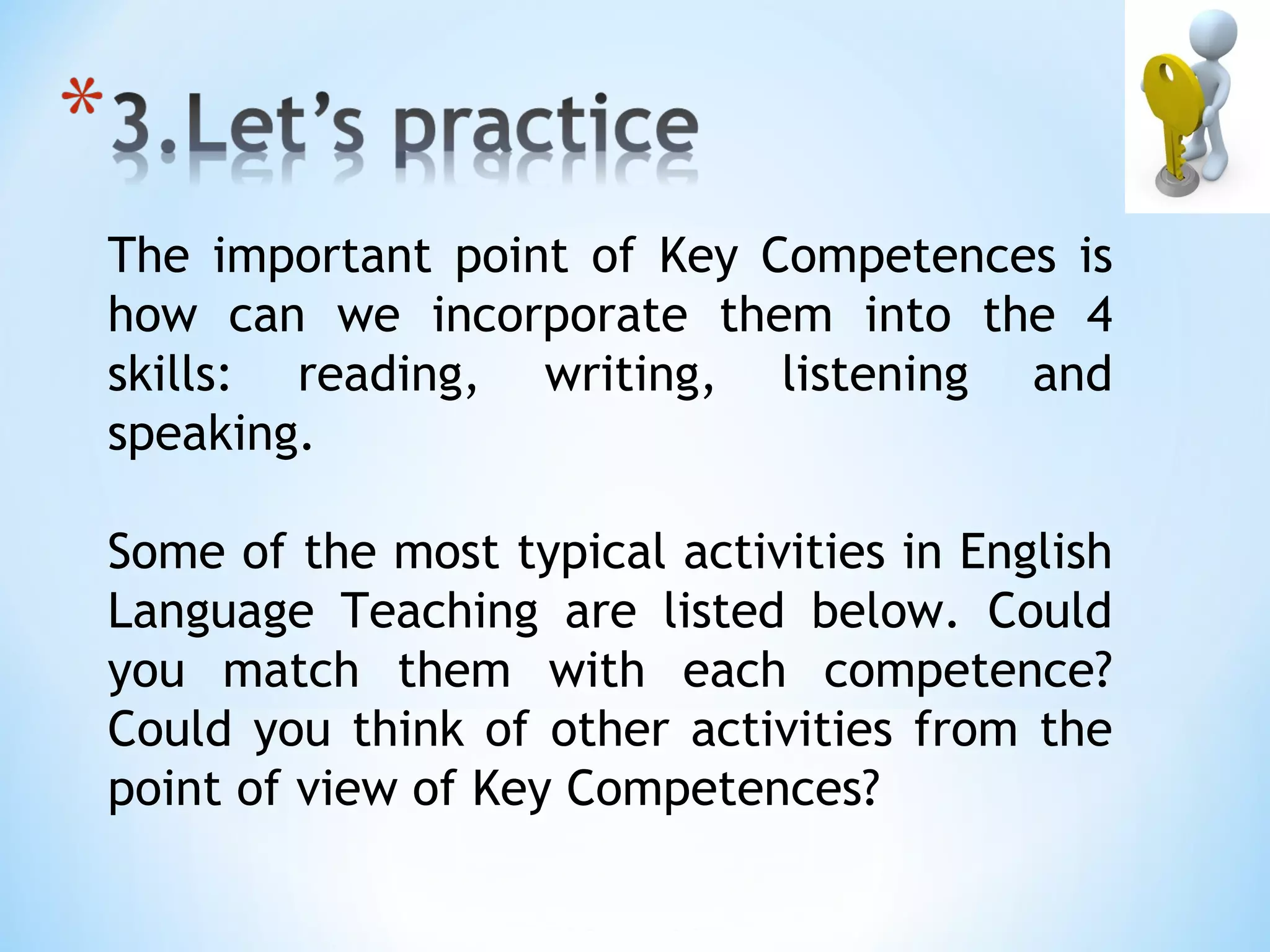
The important point of Key Competences is
how can we incorporate them into the 4
skills: reading, writing, listening and
speaking.

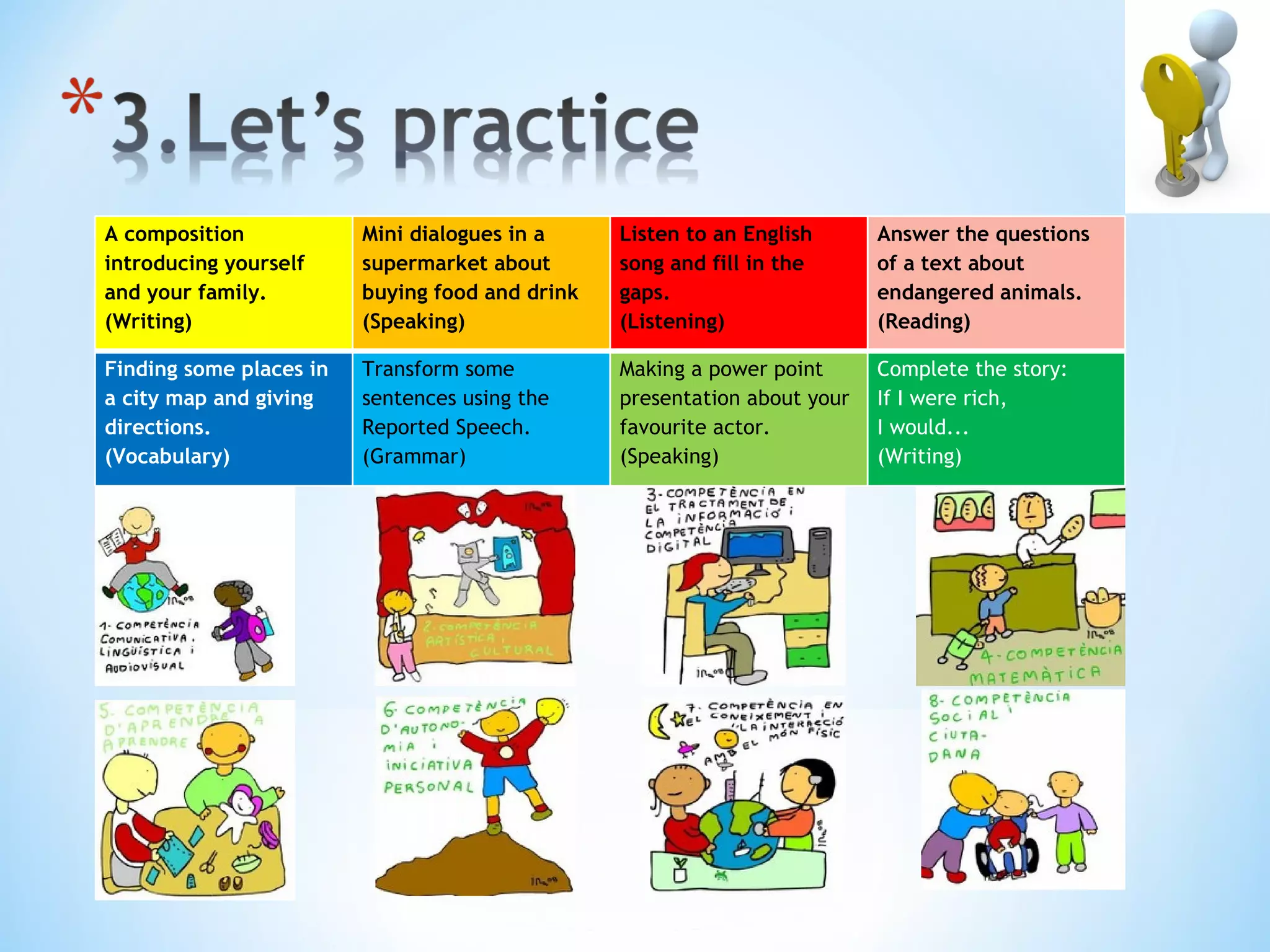
Some of the most typical activities in English
Language Teaching are listed below. Could
you match them with each competence?
Could you think of other activities from the
point of view of Key Competences?
A composition            Mini dialogues in a     Listen to an English      Answer the questions
introducing yourself     supermarket about       song and fill in the      of a text about
and your family.         buying food and drink   gaps.                     endangered animals.
(Writing)                (Speaking)              (Listening)               (Reading)

Finding some places in   Transform some          Making a power point      Complete the story:
a city map and giving    sentences using the     presentation about your   If I were rich,
directions.              Reported Speech.        favourite actor.          I would...
(Vocabulary)             (Grammar)               (Speaking)                (Writing)
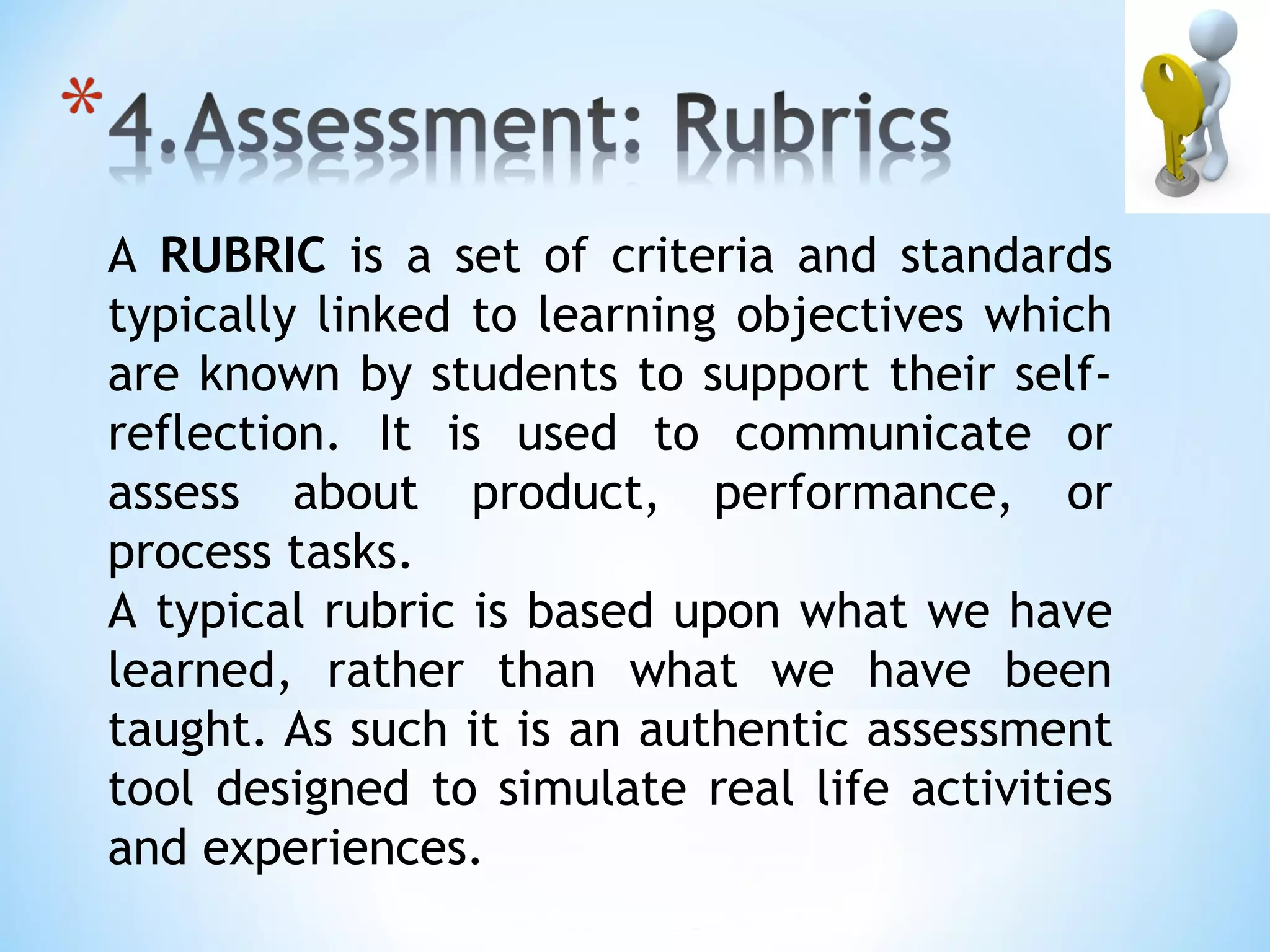
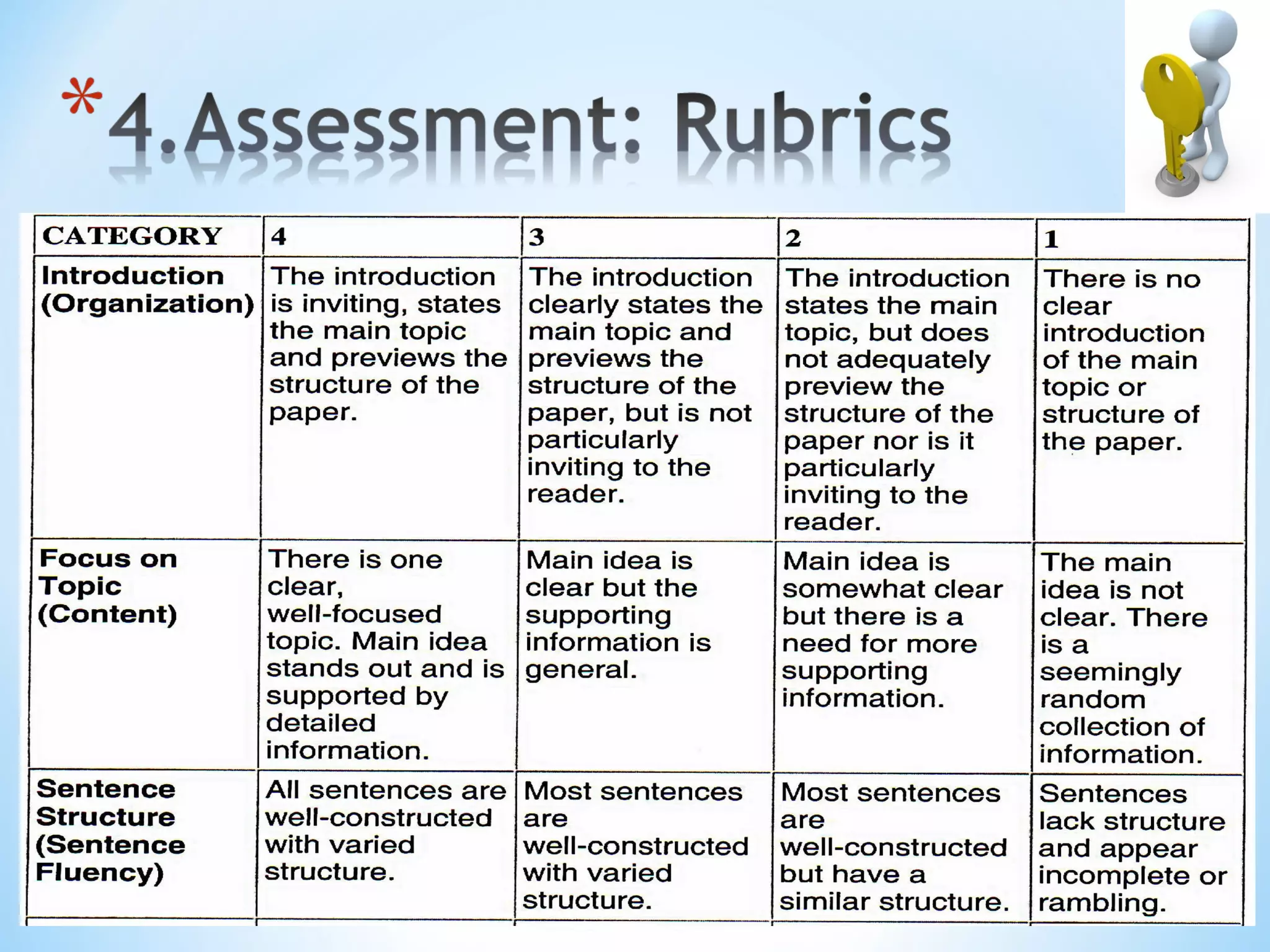
A RUBRIC is a set of criteria and standards
typically linked to learning objectives which
are known by students to support their self-
reflection. It is used to communicate or
assess about product, performance, or
process tasks.
A typical rubric is based upon what we have
learned, rather than what we have been
taught. As such it is an authentic assessment
tool designed to simulate real life activities
and experiences.
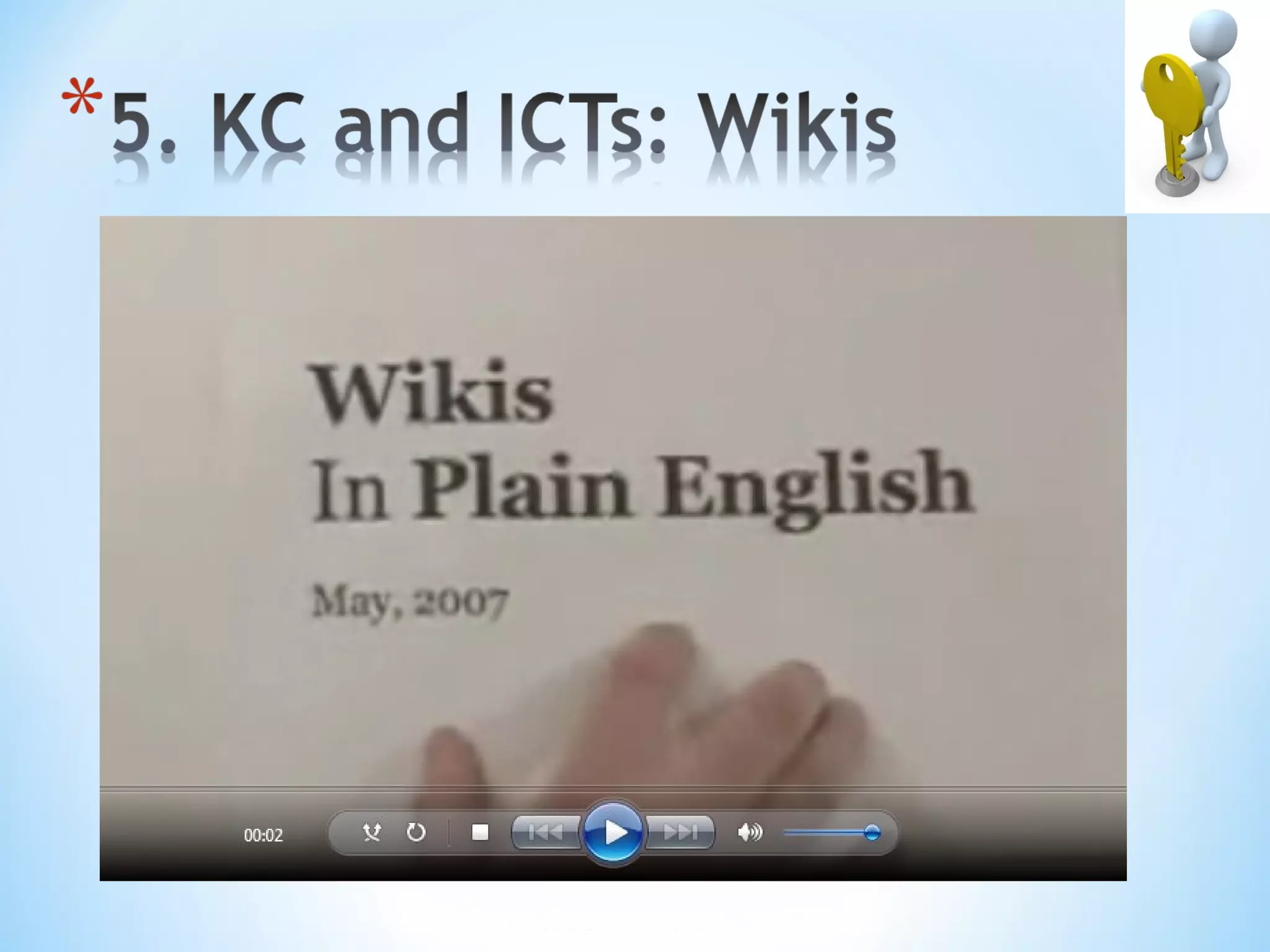
A WIKI is a website with multiple users who
can add, modify, or delete its content using
a simplified markup language or a rich-text
editor. 

Wikis may serve many different purposes:
community websites, corporate intranets
and notetaking. Some permit control over
different functions (levels of access). Other
rules may also be imposed for organizing
content.
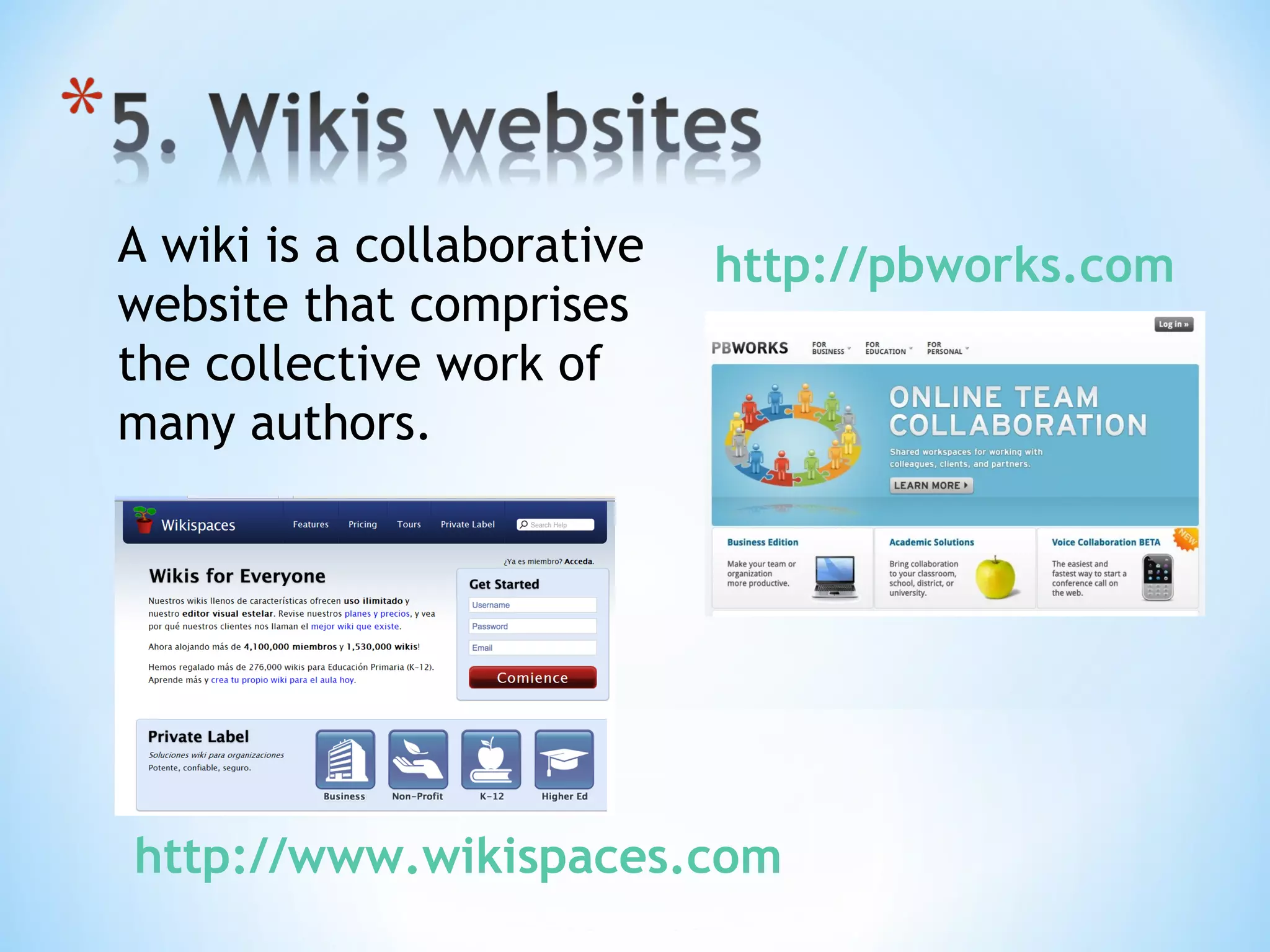
A wiki is a collaborative   http://pbworks.com
website that comprises
the collective work of
many authors.


http://www.wikispaces.com
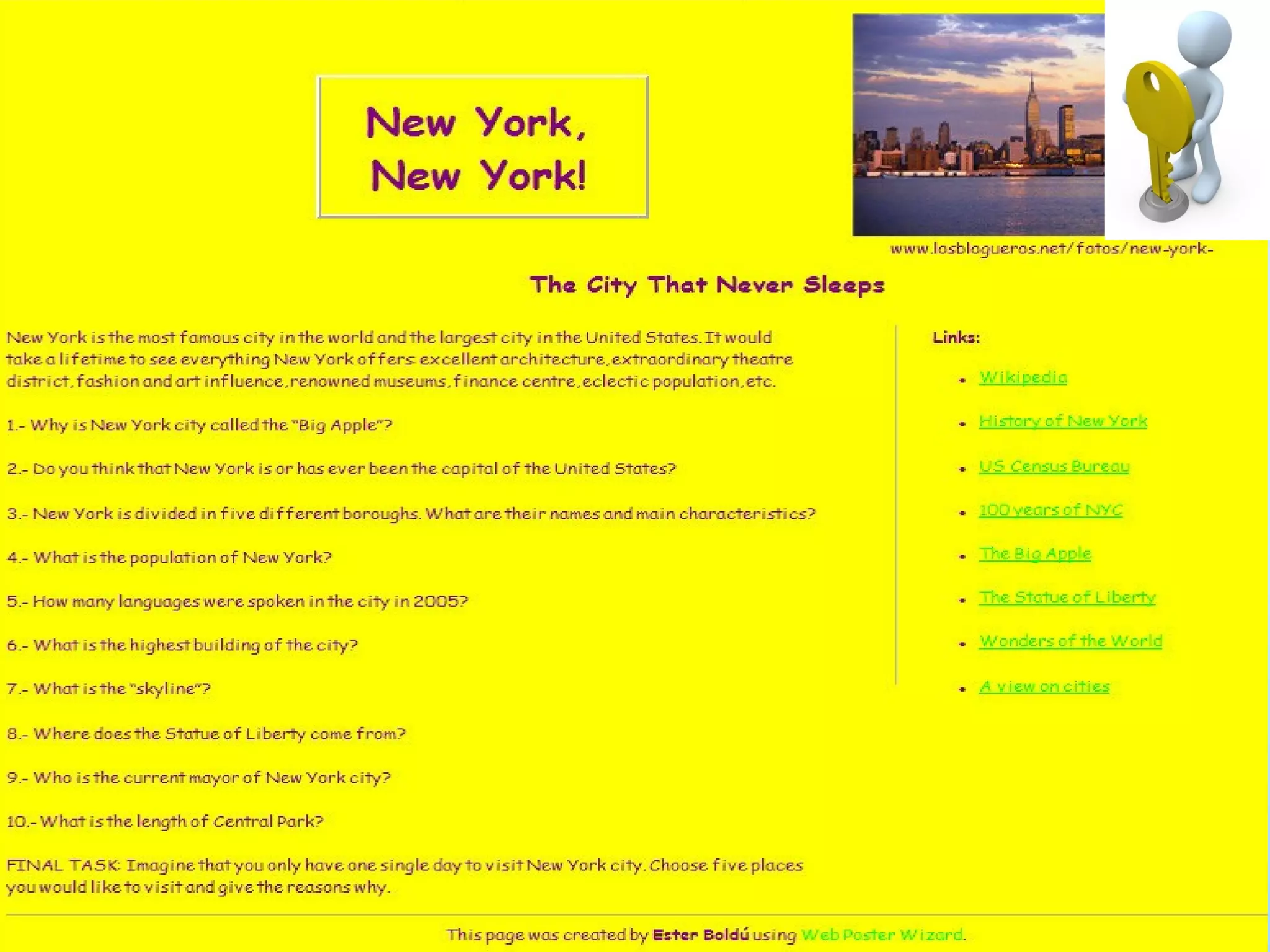
A Treasure Hunt, also known as a
Knowledge or Scavenger Hunt, sends
students to preselected sites to find the
answers to specific questions.

There are only 3 steps to create one:
*Identify 10-15 links (specific pages)
*Pose question for each link
*Include culminating question that requires
synthesis
Brainstorming of ICT resources:

Wikis, Blogs, Moodles, Podcasts, Videos
(teachertube, moviemaker), Twitter, Voki,
Translators, Bookmarks, Glogster, Text to
speech, writing tutor, lyricstraining, treasure
hunts, webquests, ppt presentations, chats
or eTwinning, ISSUU...
Visit my sites:
Blog: http://anglester.blogspot.com
Wiki: http://wikooperate.wikispaces.com
Webquest: https://sites.google.com/site/holidaysenglish/
Treasure:http://poster.4teachers.org/worksheet/view.php?id=109656
Moodle:http://phobos.xtec.cat/eboldu2/moodle/
INS Moodle:http://agora.xtec.cat/iespauvila/moodle/

Email me:
esterboldu@gmail.com
Key competences slideshare

Key competences slideshare

  • 1.
  • 2.
    A COMPETENCE isdefined as the ability to put into practice the knowledge, skills and attitudes acquired through the ESO stage in a way which is appropriate to different contexts and situations, and to do so in an integrated way. They are also labelled as KEY competences, because we consider that these are the essential competences to become citizens and to solve problems in everyday situations.
  • 3.
    1. Linguistic andAudiovisual Communicative 2. Artistic and Cultural Be and Act autonomously 3. Information Handling and Digital Comp Think and Communicate Methodological 4. Mathematical Key To learn Discover and Comp 5. Learning to Learn how to Have initiative 6. Autonomy, Coexist and Live Initiative Personal in our world and Decision Taking 7. Knowledge of & Interaction with the Natural World living in the world 8. Social and Civic
  • 4.
    KEY COMPETENCES areall considered equally important, because each of them can contribute to a successful life in a knowledge society. Many of the competences overlap and interlock: aspects essential to one domain will support competence in another. Therefore, COOPERATIVE LEARNING is a perfect approach to implement KC.
  • 5.
    In COOPERATIVE LEARNINGstudents must work in groups to complete tasks collectively. Unlike individual learning, students learning cooperatively capitalize on one another’s resources and skills. Furthermore, the teacher's role changes from giving information to facilitating students' learning. Everyone succeeds when the group succeeds.
  • 8.
    The important pointof Key Competences is how can we incorporate them into the 4 skills: reading, writing, listening and speaking. Some of the most typical activities in English Language Teaching are listed below. Could you match them with each competence? Could you think of other activities from the point of view of Key Competences?
  • 9.
    A composition Mini dialogues in a Listen to an English Answer the questions introducing yourself supermarket about song and fill in the of a text about and your family. buying food and drink gaps. endangered animals. (Writing) (Speaking) (Listening) (Reading) Finding some places in Transform some Making a power point Complete the story: a city map and giving sentences using the presentation about your If I were rich, directions. Reported Speech. favourite actor. I would... (Vocabulary) (Grammar) (Speaking) (Writing)
  • 10.
    A RUBRIC isa set of criteria and standards typically linked to learning objectives which are known by students to support their self- reflection. It is used to communicate or assess about product, performance, or process tasks. A typical rubric is based upon what we have learned, rather than what we have been taught. As such it is an authentic assessment tool designed to simulate real life activities and experiences.
  • 13.
    A WIKI is a website withmultiple users who can add, modify, or delete its content using a simplified markup language or a rich-text editor.  Wikis may serve many different purposes: community websites, corporate intranets and notetaking. Some permit control over different functions (levels of access). Other rules may also be imposed for organizing content.
  • 14.
    A wiki isa collaborative http://pbworks.com website that comprises the collective work of many authors. http://www.wikispaces.com
  • 15.
    A Treasure Hunt,also known as a Knowledge or Scavenger Hunt, sends students to preselected sites to find the answers to specific questions. There are only 3 steps to create one: *Identify 10-15 links (specific pages) *Pose question for each link *Include culminating question that requires synthesis
  • 17.
    Brainstorming of ICTresources: Wikis, Blogs, Moodles, Podcasts, Videos (teachertube, moviemaker), Twitter, Voki, Translators, Bookmarks, Glogster, Text to speech, writing tutor, lyricstraining, treasure hunts, webquests, ppt presentations, chats or eTwinning, ISSUU...
  • 18.
    Visit my sites: Blog:http://anglester.blogspot.com Wiki: http://wikooperate.wikispaces.com Webquest: https://sites.google.com/site/holidaysenglish/ Treasure:http://poster.4teachers.org/worksheet/view.php?id=109656 Moodle:http://phobos.xtec.cat/eboldu2/moodle/ INS Moodle:http://agora.xtec.cat/iespauvila/moodle/ Email me: esterboldu@gmail.com