TEACHING
TEACHING the Short Story
THE SHORT
Prof. Ma. Antoinette C. Montelagre
STORY
The short story as a genre
1.1 a brief, imaginative narrative unfolding a
single predominating incident and theme
1.2 it contains a plot, the details of which are so
compressed, and the whole treatment so
organized, as to produce a single impression

1.3 a narrative drama with a single effect
-What is a short story?
-Why use short stories
in class?
Some definitions:
A short story……..
- can be read in one sitting (Edgar
Allan Poe “The Philosophy of Composition” 1846)
- is 1,000 – 20,000 words long
- has a limited set of characters, a
single setting, and a simple plot
The characteristics of a short story
2.1 can be read in one sitting 2.6 there is usually a single
experience selected
2.2 has a single setting
2.7 it closes as soon as its
purpose is accomplished
2.3 with few characters
2.8 it shows great compression
2.4 not so many complications 2.9 told rapidly
in the plot
2.5 there is little or no change
of scene
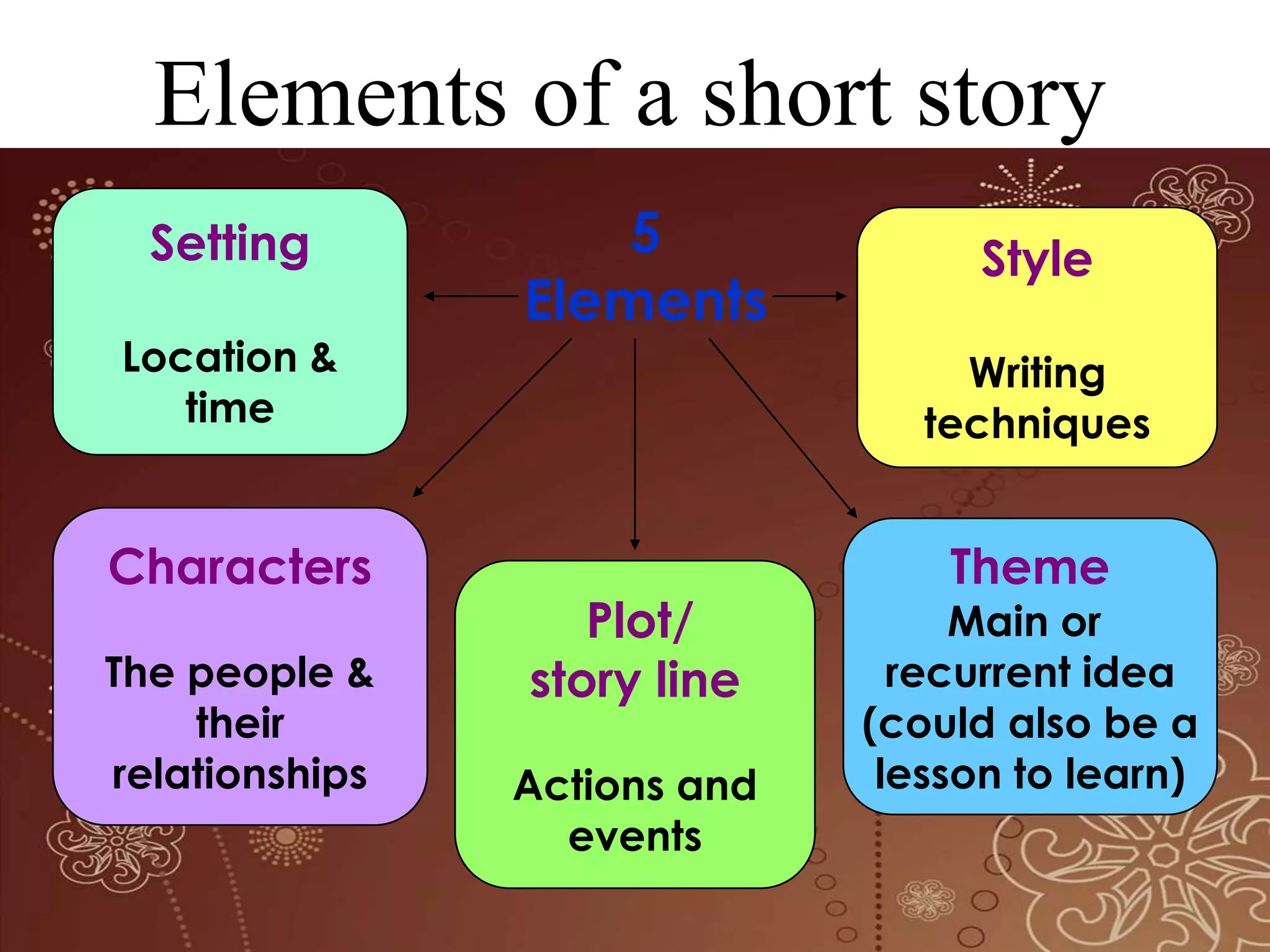
Elements of a short story
Setting
Location &
time

Characters
The people &
their
relationships

5
Elements

Style
Writing
techniques

Plot/
story line
Actions and
events

Theme

Main or
recurrent idea
(could also be a
lesson to learn)
The method of classifying stories
4.1 according to single effect produced
* stories of horror
* stories of the supernatural
* stories of local color
* stories of romantic adventure
* stories of humor
4.2 according to plot
4.5 according to theme
- adventure
- detective
- mystery

4.3 according to character
4.4 according to tone and atmosphere
The method of classifying stories

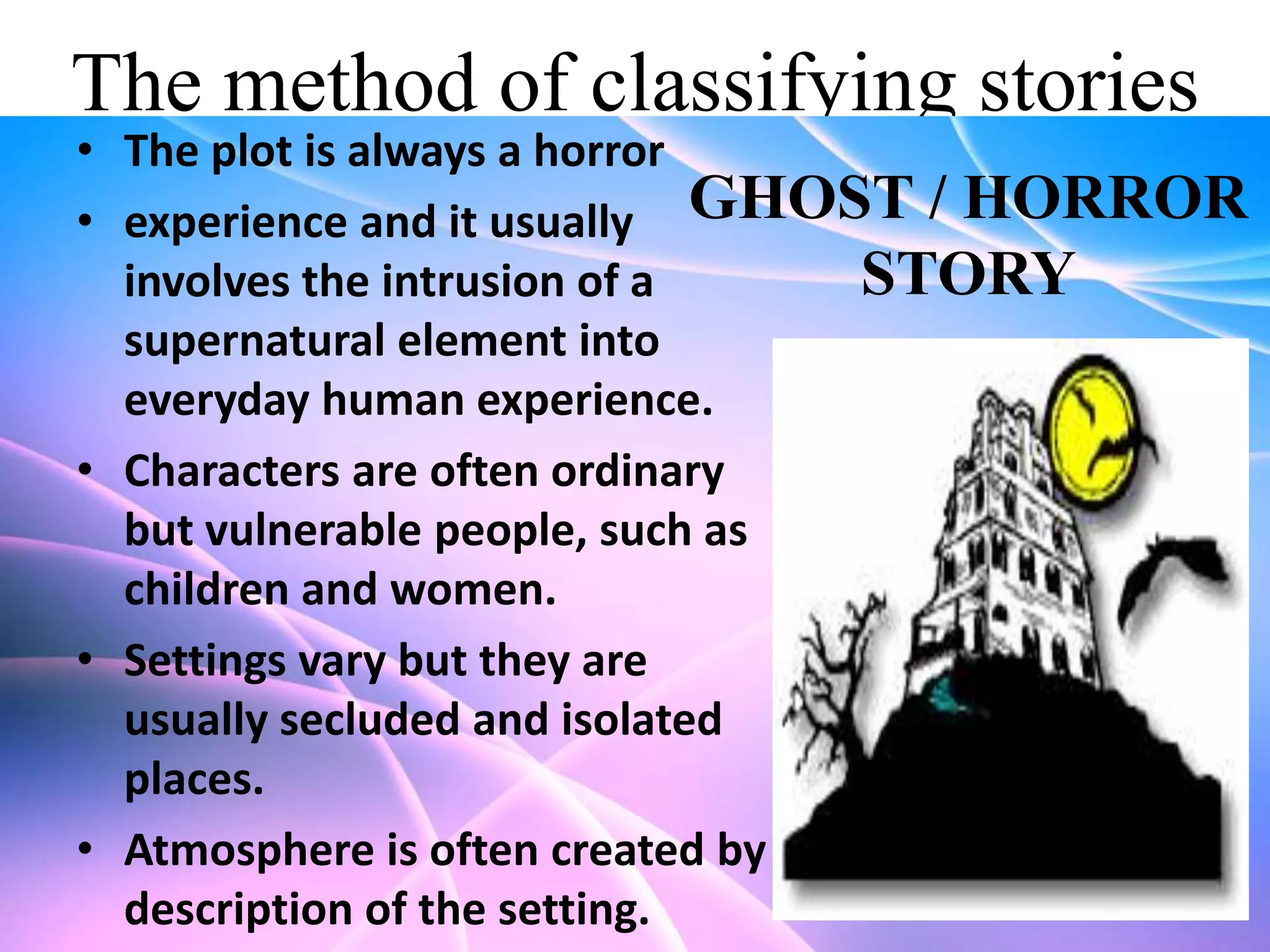
• The plot is always a horror
• experience and it usually GHOST / HORROR
STORY
involves the intrusion of a
supernatural element into
everyday human experience.
• Characters are often ordinary
but vulnerable people, such as
children and women.
• Settings vary but they are
usually secluded and isolated
places.
• Atmosphere is often created by
description of the setting.
The method of classifying stories
LOVE STORY (Romance)
- Plots of romance revolve around two people as
they develop romantic love for each other and
work to build a relationship together.
- Both the conflict and the climax of the story should be directly
related to that core theme of developing a romantic relationship.

- There is often a happy ending.
The method of classifying stories
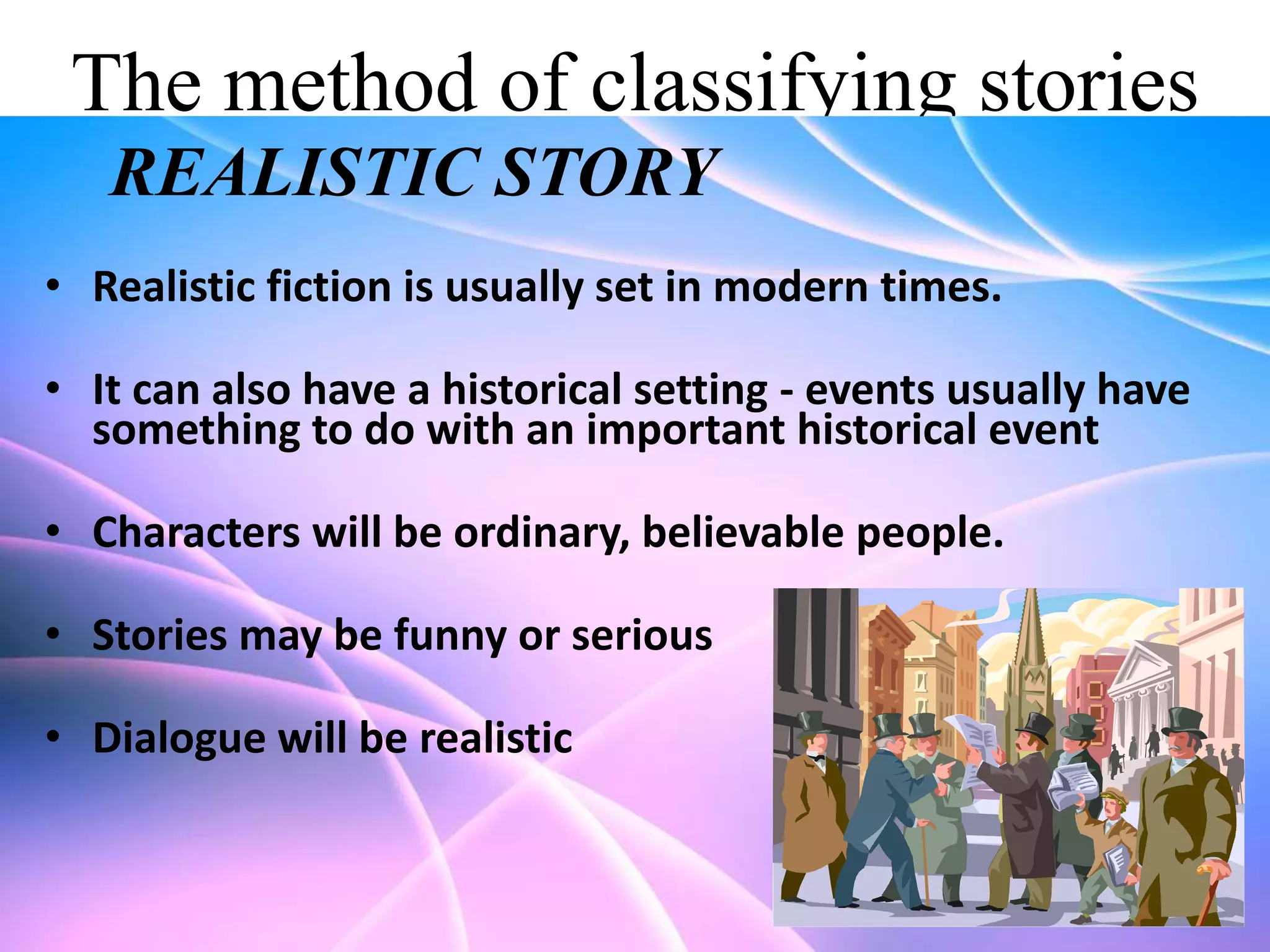
REALISTIC STORY
• Realistic fiction is usually set in modern times.
• It can also have a historical setting - events usually have
something to do with an important historical event

• Characters will be ordinary, believable people.
• Stories may be funny or serious

• Dialogue will be realistic
The method of classifying stories
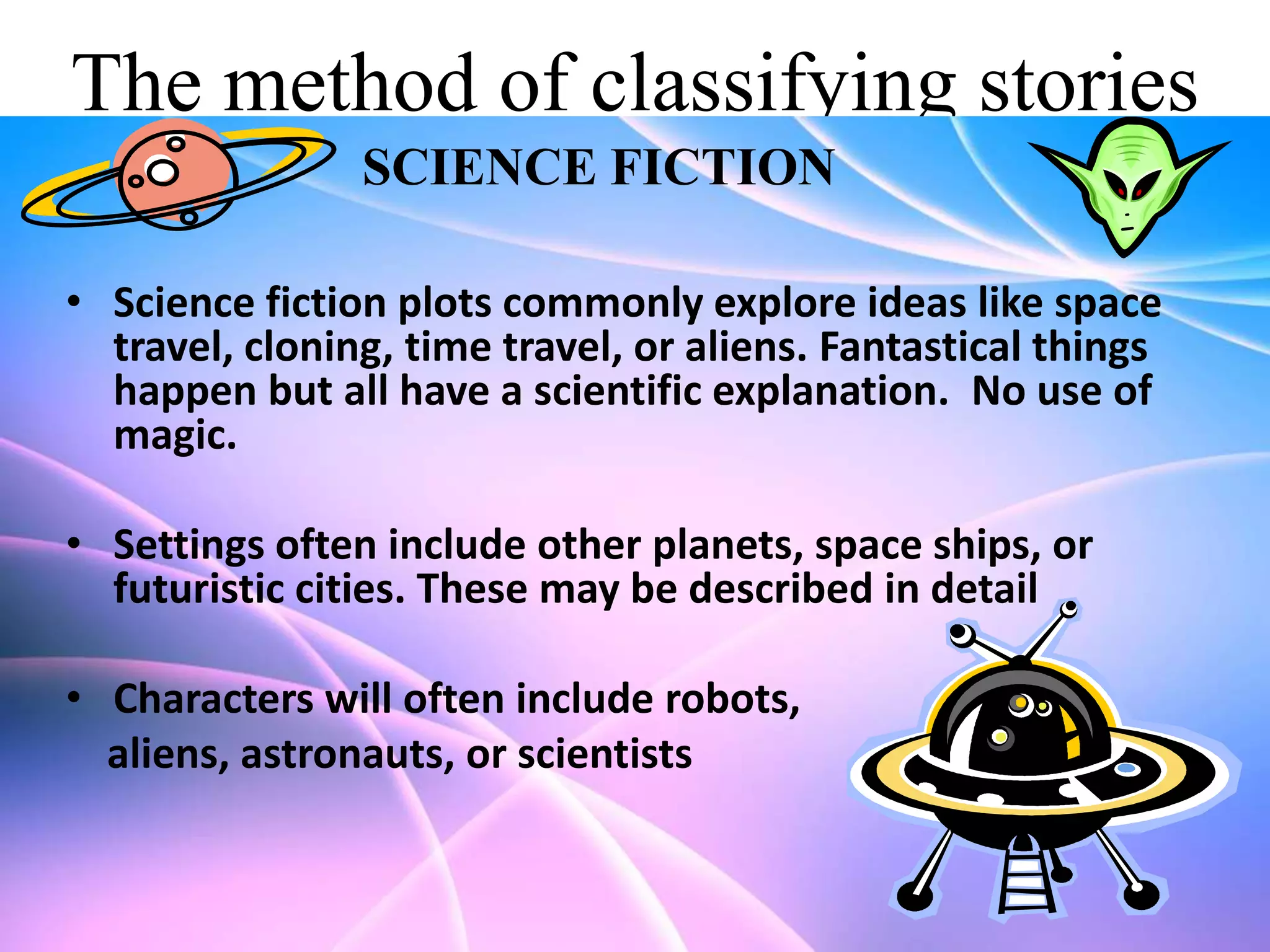
SCIENCE FICTION
• Science fiction plots commonly explore ideas like space
travel, cloning, time travel, or aliens. Fantastical things
happen but all have a scientific explanation. No use of
magic.

• Settings often include other planets, space ships, or
futuristic cities. These may be described in detail
• Characters will often include robots,
aliens, astronauts, or scientists
The method of classifying stories

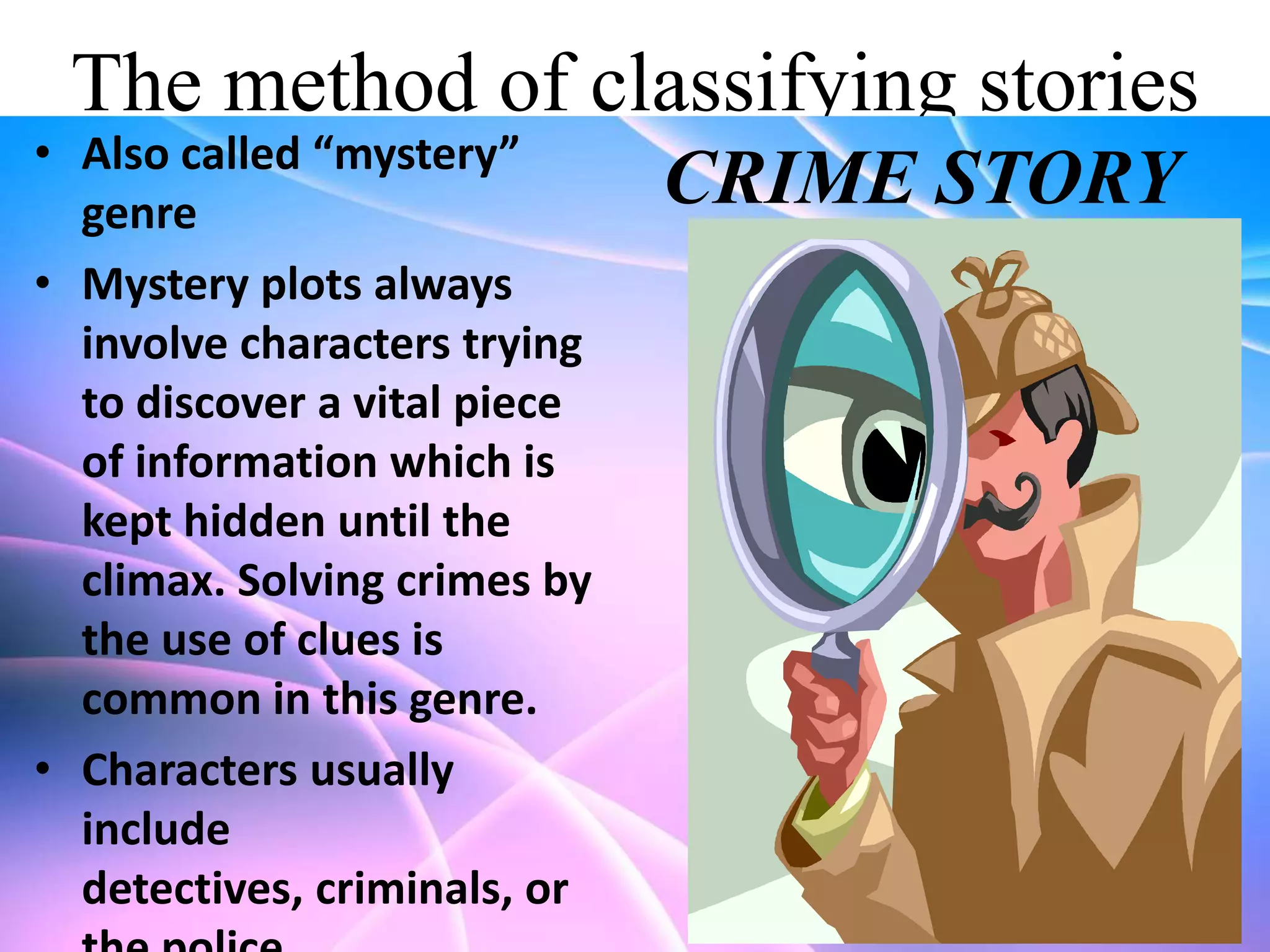
• Also called “mystery”
genre
• Mystery plots always
involve characters trying
to discover a vital piece
of information which is
kept hidden until the
climax. Solving crimes by
the use of clues is
common in this genre.
• Characters usually
include
detectives, criminals, or

CRIME STORY
The method of classifying stories
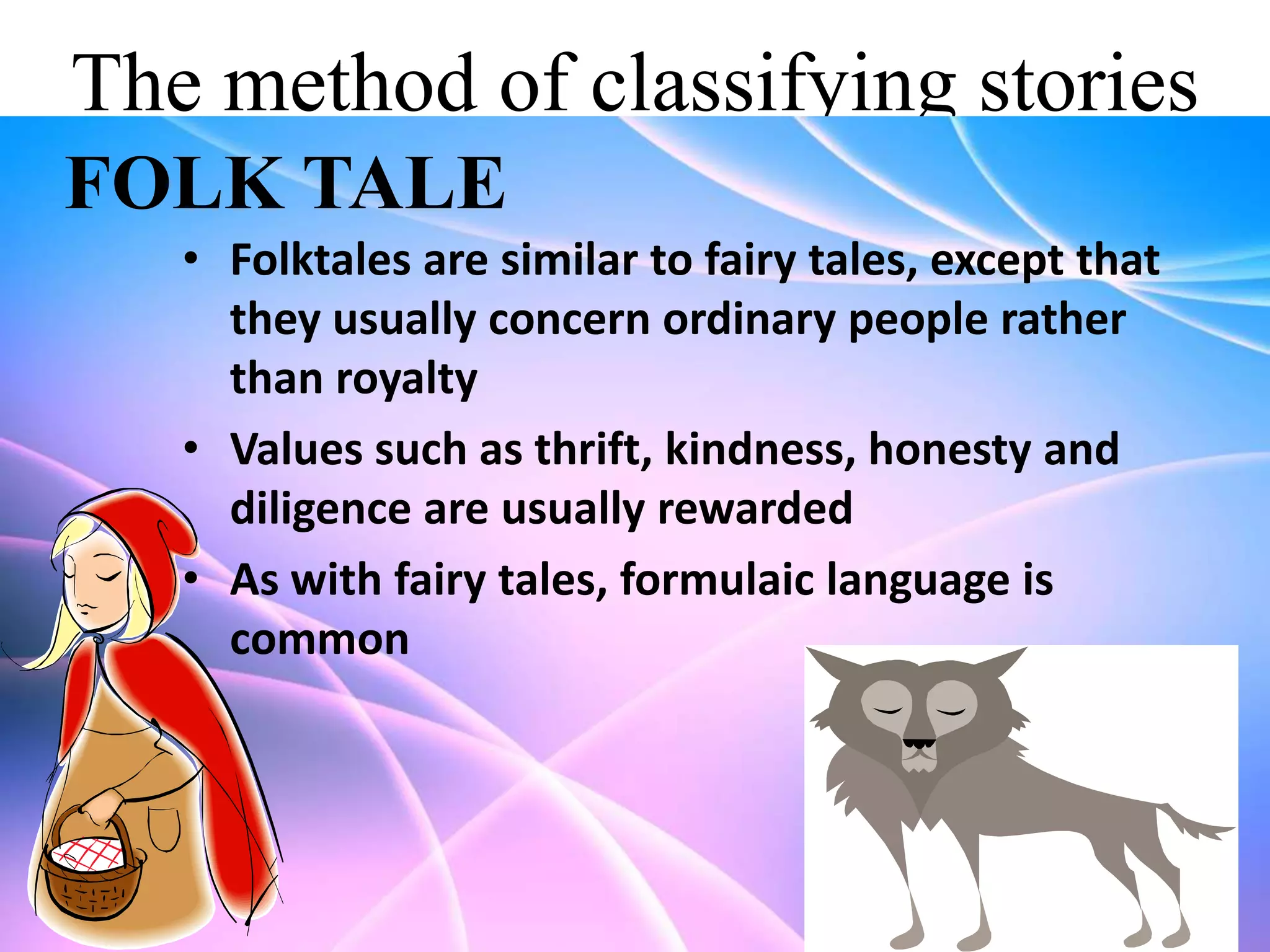
FOLK TALE
• Folktales are similar to fairy tales, except that
they usually concern ordinary people rather
than royalty
• Values such as thrift, kindness, honesty and
diligence are usually rewarded
• As with fairy tales, formulaic language is
common
The method of classifying stories
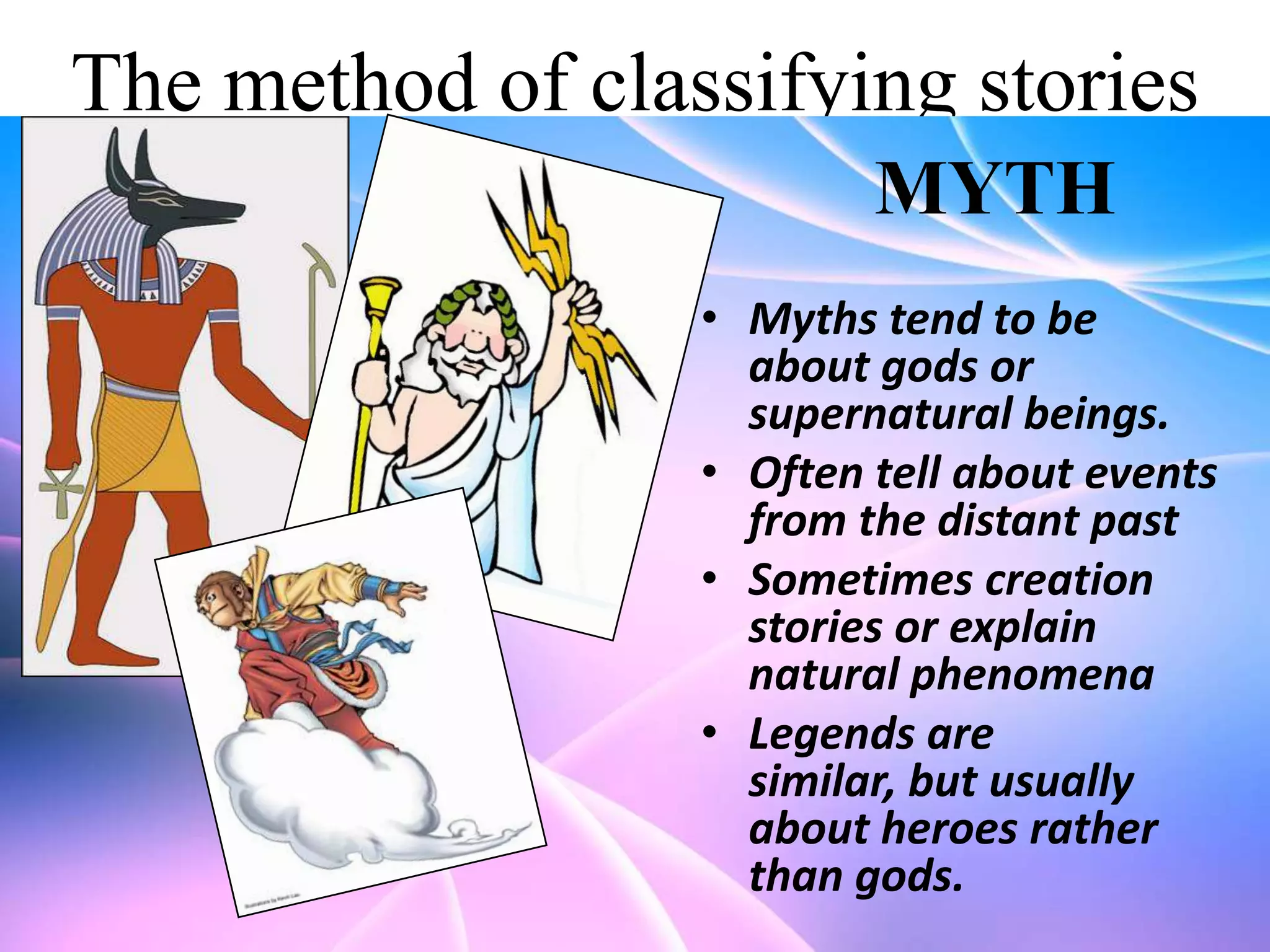
MYTH
• Myths tend to be
about gods or
supernatural beings.
• Often tell about events
from the distant past
• Sometimes creation
stories or explain
natural phenomena
• Legends are
similar, but usually
about heroes rather
than gods.
The method of classifying stories
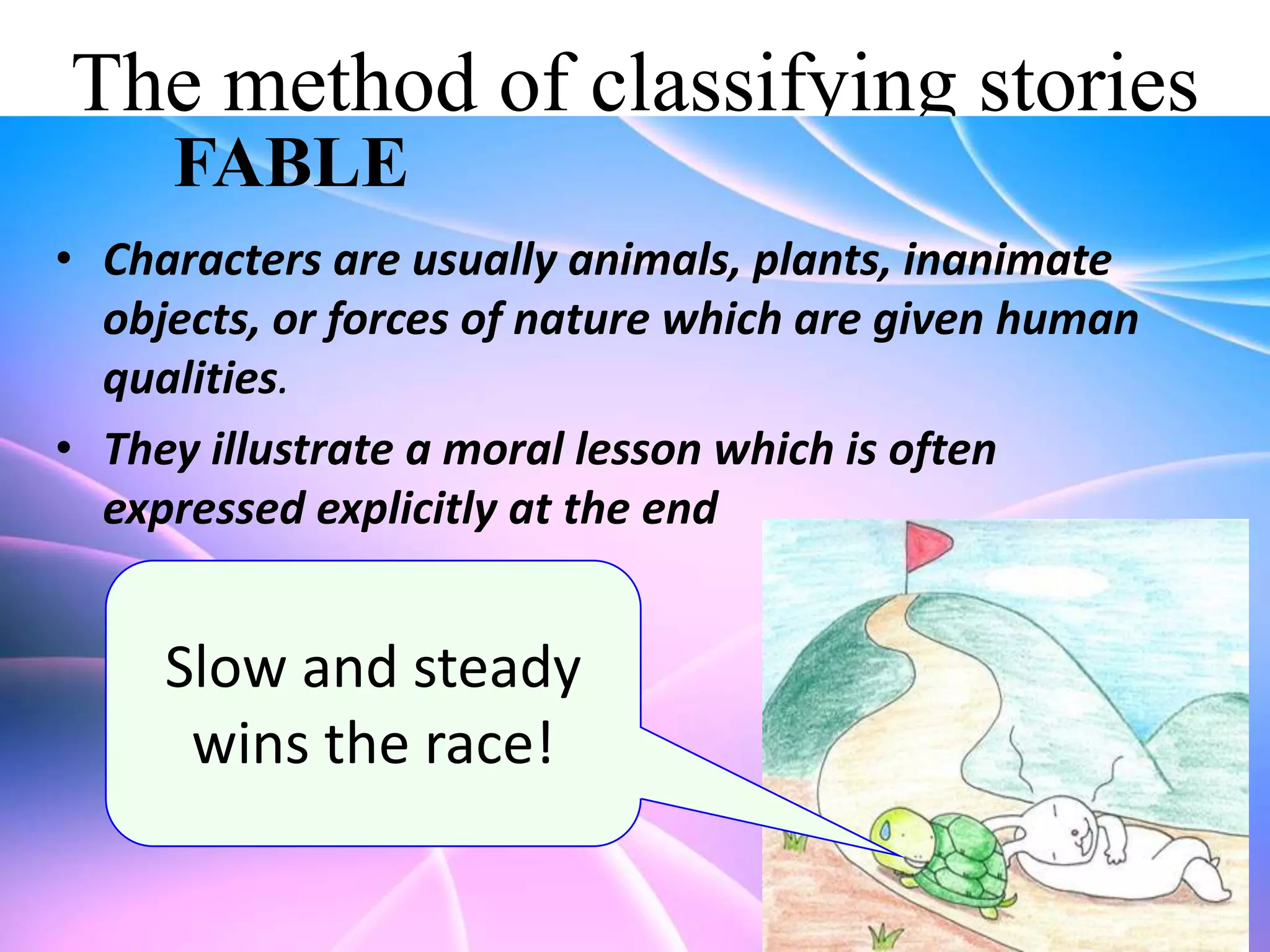
FABLE
• Characters are usually animals, plants, inanimate
objects, or forces of nature which are given human
qualities.
• They illustrate a moral lesson which is often
expressed explicitly at the end

Slow and steady
wins the race!
The method of classifying stories
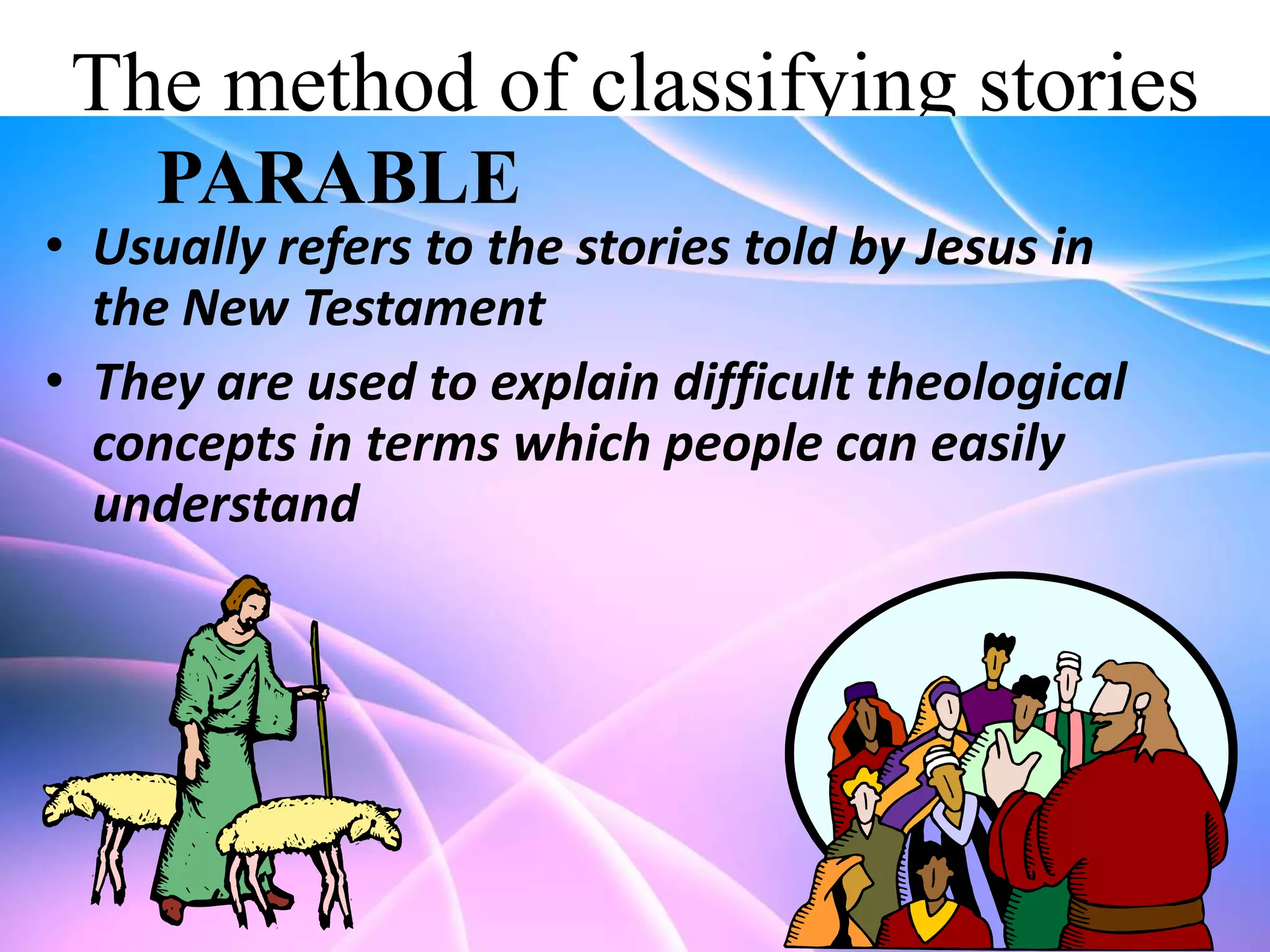
PARABLE

• Usually refers to the stories told by Jesus in
the New Testament
• They are used to explain difficult theological
concepts in terms which people can easily
understand
The method of classifying stories
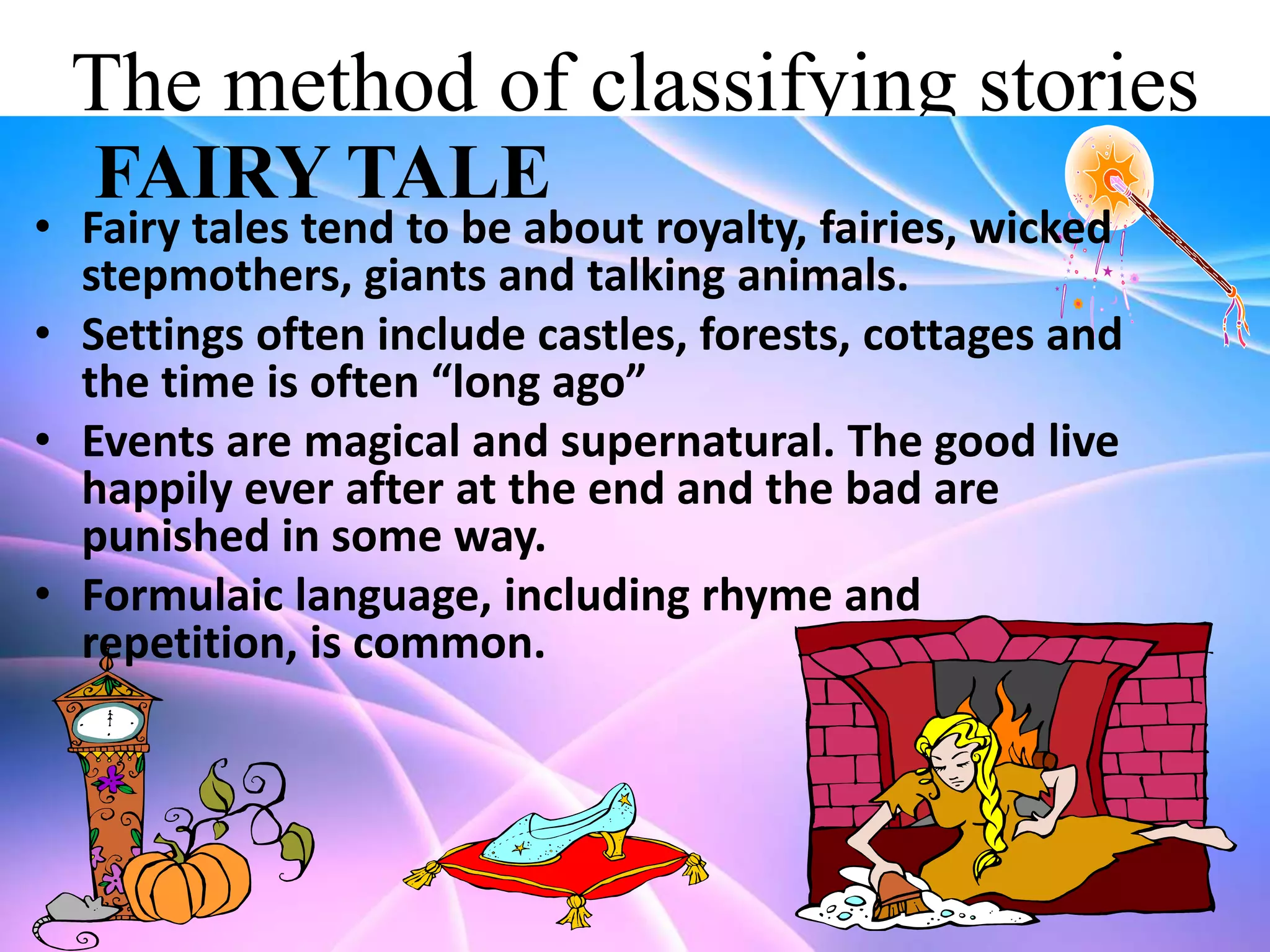
FAIRY TALE

• Fairy tales tend to be about royalty, fairies, wicked
stepmothers, giants and talking animals.
• Settings often include castles, forests, cottages and
the time is often “long ago”
• Events are magical and supernatural. The good live
happily ever after at the end and the bad are
punished in some way.
• Formulaic language, including rhyme and
repetition, is common.
Response strategies that would
understanding and appreciation of short stories
contribute to one’s
understanding and appreciation
of short stories
5.1 engaging; defining one’s emotional experience
5.2 connecting; relating similar experience

5.3 describing; describing the nature of a character’s acts

5.4 interpreting; inferring, explaining, or interpreting

5.5 judging; judging the character or the quality of the text
The process of literature- modes of
response
6.1 description

6.5 generalization

6.2 discrimination

6.6 evaluation

6.3 relation

6.7 valuing

6.4 interpretation

6.8 creation
Before reading
7.1 explore students’ background to see what personal experiences
they are approaching the selection with
7.2 build any background the students need to comprehend the
selection
While Reading
8.1 the teacher may want to guide the students with proposed
questions

8.2 he/ she can point to the difficult words and expressions and
unlock them
After Reading
9.1 the students are engaged in discussion and follow-up activities
that will extend their understanding of literature

9.2 they may be asked to list their own questions about the
selection
Modeling literature study
10.1 Don’t begin with a novel; using poems, essays, and short stories
10.2 Take time to teach students how to respond collaboratively
10.3 Teach students a repertoire of questions- both cognitive and
affective
10.4 Show students how to keep a reading journal as a way of
collecting their responses.
10.5 Allow class time for individual responses, group work, and
class sharing

Teaching the short story

  • 1.
    TEACHING TEACHING the ShortStory THE SHORT Prof. Ma. Antoinette C. Montelagre STORY
  • 2.
    The short storyas a genre 1.1 a brief, imaginative narrative unfolding a single predominating incident and theme 1.2 it contains a plot, the details of which are so compressed, and the whole treatment so organized, as to produce a single impression 1.3 a narrative drama with a single effect
  • 3.
    -What is ashort story? -Why use short stories in class?
  • 4.
    Some definitions: A shortstory…….. - can be read in one sitting (Edgar Allan Poe “The Philosophy of Composition” 1846) - is 1,000 – 20,000 words long - has a limited set of characters, a single setting, and a simple plot
  • 5.
    The characteristics ofa short story 2.1 can be read in one sitting 2.6 there is usually a single experience selected 2.2 has a single setting 2.7 it closes as soon as its purpose is accomplished 2.3 with few characters 2.8 it shows great compression 2.4 not so many complications 2.9 told rapidly in the plot 2.5 there is little or no change of scene
  • 6.
    Elements of ashort story Setting Location & time Characters The people & their relationships 5 Elements Style Writing techniques Plot/ story line Actions and events Theme Main or recurrent idea (could also be a lesson to learn)
  • 7.
    The method ofclassifying stories 4.1 according to single effect produced * stories of horror * stories of the supernatural * stories of local color * stories of romantic adventure * stories of humor 4.2 according to plot 4.5 according to theme - adventure - detective - mystery 4.3 according to character 4.4 according to tone and atmosphere
  • 8.
    The method ofclassifying stories • The plot is always a horror • experience and it usually GHOST / HORROR STORY involves the intrusion of a supernatural element into everyday human experience. • Characters are often ordinary but vulnerable people, such as children and women. • Settings vary but they are usually secluded and isolated places. • Atmosphere is often created by description of the setting.
  • 9.
    The method ofclassifying stories LOVE STORY (Romance) - Plots of romance revolve around two people as they develop romantic love for each other and work to build a relationship together. - Both the conflict and the climax of the story should be directly related to that core theme of developing a romantic relationship. - There is often a happy ending.
  • 10.
    The method ofclassifying stories REALISTIC STORY • Realistic fiction is usually set in modern times. • It can also have a historical setting - events usually have something to do with an important historical event • Characters will be ordinary, believable people. • Stories may be funny or serious • Dialogue will be realistic
  • 11.
    The method ofclassifying stories SCIENCE FICTION • Science fiction plots commonly explore ideas like space travel, cloning, time travel, or aliens. Fantastical things happen but all have a scientific explanation. No use of magic. • Settings often include other planets, space ships, or futuristic cities. These may be described in detail • Characters will often include robots, aliens, astronauts, or scientists
  • 12.
    The method ofclassifying stories • Also called “mystery” genre • Mystery plots always involve characters trying to discover a vital piece of information which is kept hidden until the climax. Solving crimes by the use of clues is common in this genre. • Characters usually include detectives, criminals, or CRIME STORY
  • 13.
    The method ofclassifying stories FOLK TALE • Folktales are similar to fairy tales, except that they usually concern ordinary people rather than royalty • Values such as thrift, kindness, honesty and diligence are usually rewarded • As with fairy tales, formulaic language is common
  • 14.
    The method ofclassifying stories MYTH • Myths tend to be about gods or supernatural beings. • Often tell about events from the distant past • Sometimes creation stories or explain natural phenomena • Legends are similar, but usually about heroes rather than gods.
  • 15.
    The method ofclassifying stories FABLE • Characters are usually animals, plants, inanimate objects, or forces of nature which are given human qualities. • They illustrate a moral lesson which is often expressed explicitly at the end Slow and steady wins the race!
  • 16.
    The method ofclassifying stories PARABLE • Usually refers to the stories told by Jesus in the New Testament • They are used to explain difficult theological concepts in terms which people can easily understand
  • 17.
    The method ofclassifying stories FAIRY TALE • Fairy tales tend to be about royalty, fairies, wicked stepmothers, giants and talking animals. • Settings often include castles, forests, cottages and the time is often “long ago” • Events are magical and supernatural. The good live happily ever after at the end and the bad are punished in some way. • Formulaic language, including rhyme and repetition, is common.
  • 18.
    Response strategies thatwould understanding and appreciation of short stories contribute to one’s understanding and appreciation of short stories 5.1 engaging; defining one’s emotional experience 5.2 connecting; relating similar experience 5.3 describing; describing the nature of a character’s acts 5.4 interpreting; inferring, explaining, or interpreting 5.5 judging; judging the character or the quality of the text
  • 19.
    The process ofliterature- modes of response 6.1 description 6.5 generalization 6.2 discrimination 6.6 evaluation 6.3 relation 6.7 valuing 6.4 interpretation 6.8 creation
  • 20.
    Before reading 7.1 explorestudents’ background to see what personal experiences they are approaching the selection with 7.2 build any background the students need to comprehend the selection
  • 21.
    While Reading 8.1 theteacher may want to guide the students with proposed questions 8.2 he/ she can point to the difficult words and expressions and unlock them
  • 22.
    After Reading 9.1 thestudents are engaged in discussion and follow-up activities that will extend their understanding of literature 9.2 they may be asked to list their own questions about the selection
  • 23.
    Modeling literature study 10.1Don’t begin with a novel; using poems, essays, and short stories 10.2 Take time to teach students how to respond collaboratively 10.3 Teach students a repertoire of questions- both cognitive and affective 10.4 Show students how to keep a reading journal as a way of collecting their responses. 10.5 Allow class time for individual responses, group work, and class sharing