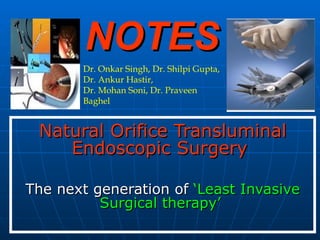
NOTES (Natural Orifice Transluminal Endoscopic Surgery)- By Dr. Onkar

Loading...

Flash Player 9 (or above) is needed to view presentations.
We have detected that you do not have it on your computer. To install it, go here.

0 comments

Post a comment

    Post a comment
    Embed Video
    Edit your comment Cancel

    2 Favorites

    NOTES (Natural Orifice Transluminal Endoscopic Surgery)- By Dr. Onkar - Presentation Transcript

    1. NOTES Natural Orifice Transluminal Endoscopic Surgery The next generation of ‘Least Invasive Surgical therapy’ Dr. Onkar Singh, Dr. Shilpi Gupta, Dr. Ankur Hastir, Dr. Mohan Soni, Dr. Praveen Baghel
    2. NOTES
      • PERFORMING SURGICAL PROCEDURES WITHOUT MAKING INCISIONS ON THE SURFACE OF THE BODY and LEAVING NO SCARS
    3. SURGEONS WITHOUT SCALPEL
    4. NOTES: DEFINITION
      • An experimental surgical technique - "scarless" abdominal operations performed with an multi-channel endoscope passed through a natural orifice ( mouth , urethra , anus , vagina etc.)
    5. NOTES: A STEP FORWARD
      • emerging surgical approach 
      • ‘ viewed as a step forward’
      • utilize the body’s natural openings.
    6. NOTES
      • Latest craze among todays
      • surgeons.
      • Highest level of minimal invasiveness.
      • Can be ‘Future of Surgery’
      • -Minimal invasive surgery
      • -Least invasive surgery
    7. NOTES: HISTORY
      • That endoscopy can be used to do procedures beyond the wall of the GIT was known since 1980 when the first transluminal feeding gastrostomy was described by Gauderer et al.
    8. NOTES: HISTORY
      • Kozarek et al. reported first of successful endoscopic drainage of pancreatic pseudocyst in 1985.
      • The first report of oral peritoneoscopy done in animals was published by Kalloo et al. in 2004.
    9. NOTES: HISTORY
      • In September 2007,
      • Novare announced
      • the successful
      • completion of the first
      • NOTES gallbladder removal (TV) procedures.
    10. NOTES: HISTORY
            • In March 2008, Dr Ricardo Zorron, of Brazil, performed the first series of NOTES cholecystectomy on four patients via transvaginal route.
    11. NOTES: IN INDIA
      • transgastric appendectomy in humans in India By Dr. G V Rao and Dr. N Reddy . ( Hyderabad, India)
    12. NOTES: IN INDIA
      • Famous bollywood actress ‘Shilpa Shetty’ and
      • south Indian actress ‘Khusboo’ have recently undergone transgastric appendicectomy.
    13. NOTES: HISTORY
      • Since then , multiple investigators have used transluminal endoscopy
      • in animal models to perform various intraperitoneal surgical procedures, ranging from tubal ligation to splenectomy.
    14. NOTES: THE IDEA
      • Idea of NOTES-developed in response to facts that patients would-
      • 1) realize the benefits of this least invasive technique of surgery.
      • 2) experience less physical discomfort than traditional procedures.
      • 3) have virtually no visible scarring following this type of surgery.
    15. NOTES: THE IDEA
      • When given an option - no scars - not only for cosmetic reasons, but because scars
      • indicate treatment
      • because of illness.
      • NOTES, with its general idea to minimizing the trauma .
    16. NOTES: THE CONCEPT
      • Gain access to surgical
      • field thro’ a natural
      • orifices—AVOIDINNG—
      • external incision…
      • Through the NOTES
      • many surgeries could
      • eventually become outpatient procedures, patients might even be able to return to a normal routine immediately.
    17. NOTES: THE CONCEPT
      • By avoiding incisions on the abdominal wall, risks of infection, pain and disability will be minimized and
      • recovery either
      • shortened or
      • eliminated .
    18. NOTES: THE CONCEPT
      • NOTES - safe and feasible
      • - same efficacy
      • as traditional laparoscopic procedures.
    19. NOTES: INSTRUMENTS
    20. NOTES: INSTRUMENTS
    21. NOTES: INSTRUMENTS
    22. NOTES: INSTRUMENTS
    23.  
    24. NOTES
      • Result of active cooperation between minimally invasive surgeons and interventional gastroenterologists.
    25.  
    26.  
    27. NOTES
      • Internal incision is over stomach , vagina , bladder or colon , thus completely avoiding any external incisions or scars.
    28. INTERNAL INCISION
    29.  
    30.  
    31. NOTES
      • Continued evolution of flexible endoscopy + Growing awareness about invasiveness of surgery having impact on patient outcomes
      • Lead to
      • Endoscopy and Surgery - working together as NOTES
    32. NOTES: ROUTES
      • NOTES has been
      • mostly practised
      • on animals, for diagnosis
      • and treatments, including
      • transgastric organ
      • removal.
    33. NOTES: ROUTES
      • DEMONSTRATING
      • TRANSGASTRIC ROUTE
    34.  
    35.  
    36.  
      • DEMONSTRATING
      • TRANSVAGINAL ROUTE
    37.  
    38.  
    39. NOTES: ROUTES
      • Acc. To some transvesical and transcolonic approaches- more suited to access upper abdominal structures, which are often more difficult to work with if using a transgastric approach.
    40. NOTES: ROUTES
      • Transvaginal access appears to be the safest and most feasible.
      • potentially less complications, but only possible in women.
    41. PROCEDURES DESCRIBED TILL NOW
      • Laboratory reports
      • Cholecystectomy, Splenectomy,
      • Tubal ligation, Gastrojejunostomy ,
      • Pyloroplasty,
      • Staging peritoneoscopy, Liver biopsy,
      • Distal pancreatectomy ,
      • Ventral hernia repair,
      • Gastric sleeve resection ,
      • Colectomy (right and left)
    42. PROCEDURES DESCRIBED TILL NOW
      • Human cases
      • TG- appendectomy,
      • TV- cholecystectomy,
      • TG- cholecystectomy,
      • TG- gastro-enterostomy,
      • Cancer staging.
    43.  
      • FIRST ‘NOTES’
      • (TRANS-VAGINAL)
      • CHOLECYSTECTOMY
    44.  
    45. NOTES: THE EASE
    46. NOTES: THE EASE
      • Improving surgical procedure outcomes .
      • Improving patient recovery time.
      • Improving the time frame in which hospitals discharge patients.
    47. NOTES: THE EASE
      • Reducing hospital bed occupancy rates.
      • Reducing patient trauma.
      • Many procedures may become OPD procedures.
    48. NOTES: ADVANTAGES
      • Wound infection- 2%-25% in laparoscopic S X - thus--> tremendous adverse impact on patient recovery and health care costs.
      • Eliminating all skin incisions would completely eliminate this risk.
    49. NOTES: ADVANTAGES
      • Incisional hernias - correlate with the size of incisions.
      • Incidence
      • 4%–18% with open surgery, and
      • 0.2%–3% with laparoscopic S X
      • will be eliminated with NOTES.
    50. NOTES: ADVANTAGES
      • Small-bowel obstruction-
      • Incidence due to P/O adhesions
      • 7.7%- open surgery
      • 3.3%- laparoscopic surgery
      • will perhaps be further ed with NOTES.
    51. NOTES: ADVANTAGES
      • Other potential benefits:
      • Decreased PO pain
      • -Less need for PO analgesia,
      • -Shorter hospital stay, and
      • -Faster recovery.
      • Thus a major cost savings.
    52. NOTES: ADVANTAGES
      • In specific sub-populations:
      • -Easy alternative access to the peritoneal cavity in morbidly obese patients, and
      • Could possibly reduce the lifetime risk of incision-related complications in children.
      • MODIFICATION OF NOTES
      • FOR OBESITY
    53.  
    54. NOTES: Current Challenge
      • Change is part of surgery but it is never easy to accept.
    55. NOTES: Current Challenge
      • At the dawn of surgery, excellence of a surgeon was associated with big incisions:
      • "Big scar, big surgeon” .
    56. NOTES: Current Challenge
      • 1882- open chole
      • 1985- first laparoscopic chole-- strongly criticized.
      • 1992- lap chole- declared t mt of choice for GB-stones.
    57. NOTES: Current Challenge
      • But now with NOTES moving one step further: philosophy of surgery will be dramatically changed, as surgical trauma & associated pain - physical barrier for surgery.
    58. NOTES: Current Challenge
      • NOTES will break
      • this barrier of surgical
      • trauma and pain, thus
      • representing an epical
      • evolution in surgery.
    59. NOTES: Current Status
      • Initially -lack of Training / Practice
      • -Not well versed with the equipment.
      • -Time consuming
      • -Need of multidisciplinary team, for possible complications
    60. NOTES
      • witnessing a true remarkable shift in their lifetime i.e. N atural O rifice T ransluminal E ndoscopic S urgery ( NOTES ).
    61. THANKYOU

    + dronkarsinghdronkarsingh, 4 months ago

    custom

    598 views, 2 favs, 2 embeds more stats

    NOTES- Next generation of minimal invasive surgery

    More info about this document

    © All Rights Reserved

    Go to text version

    • Total Views 598
      • 596 on SlideShare
      • 2 from embeds
    • Comments 0
    • Favorites 2
    • Downloads 32
    Most viewed embeds
    • 1 views on http://www.slideshare.net
    • 1 views on http://www.usmpvirtual.edu.pe

    more

    All embeds
    • 1 views on http://www.slideshare.net
    • 1 views on http://www.usmpvirtual.edu.pe

    less

    Flagged as inappropriate Flag as inappropriate
    Flag as inappropriate

    Select your reason for flagging this presentation as inappropriate. If needed, use the feedback form to let us know more details.

    Cancel
    File a copyright complaint
    Having problems? Go to our helpdesk?

    Categories