The Sacred, The
Profane, and the Pivot
     A Brief Case Study of Applied
CDM, AARRR Metrics, and Lean Principles


              (c) 2009 David Binetti
Definitions
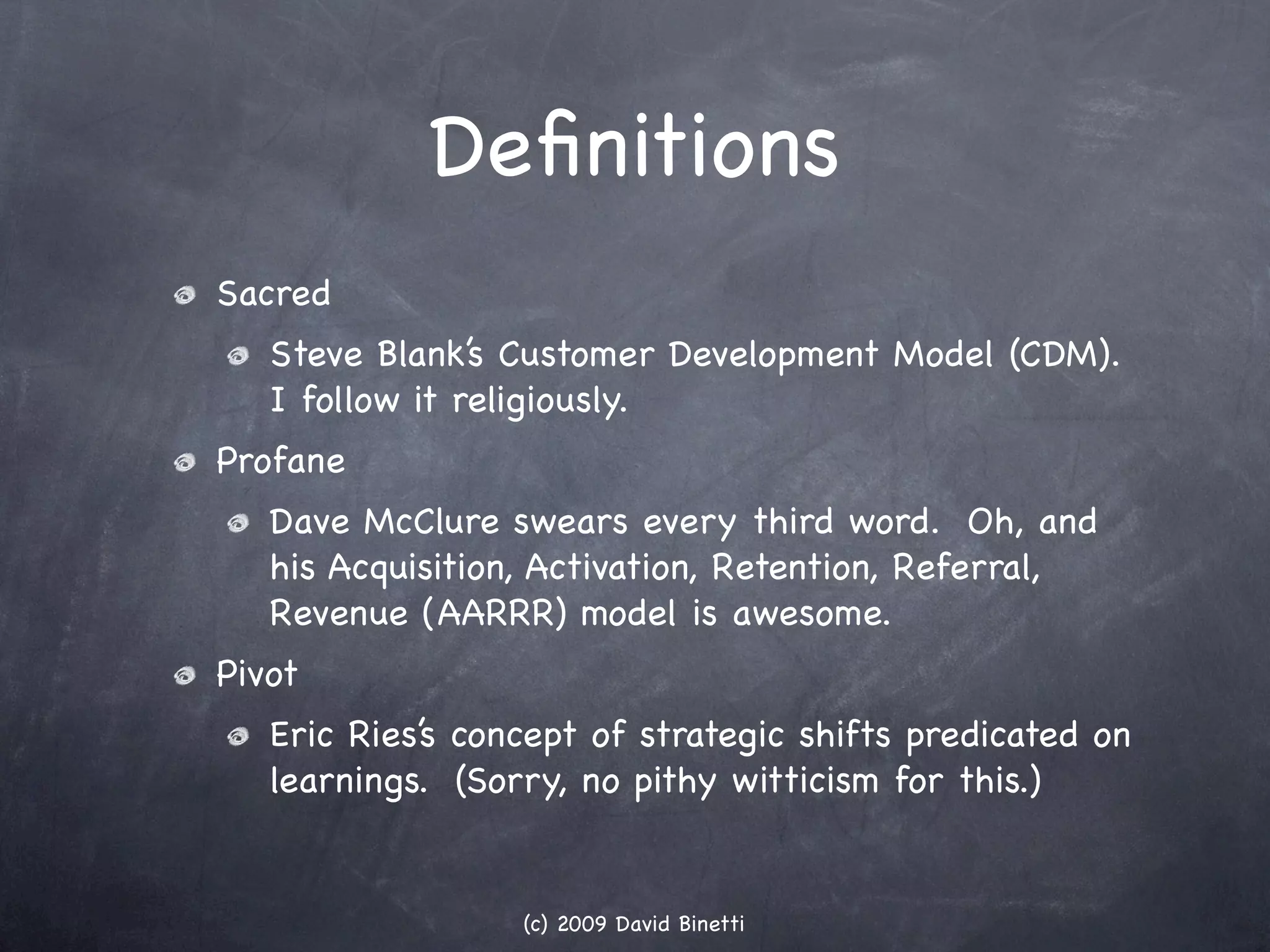
Sacred
   Steve Blank’s Customer Development Model (CDM).
   I follow it religiously.
Profane
   Dave McClure swears every third word. Oh, and
   his Acquisition, Activation, Retention, Referral,
   Revenue (AARRR) model is awesome.
Pivot
   Eric Ries’s concept of strategic shifts predicated on
   learnings. (Sorry, no pithy witticism for this.)


                  (c) 2009 David Binetti
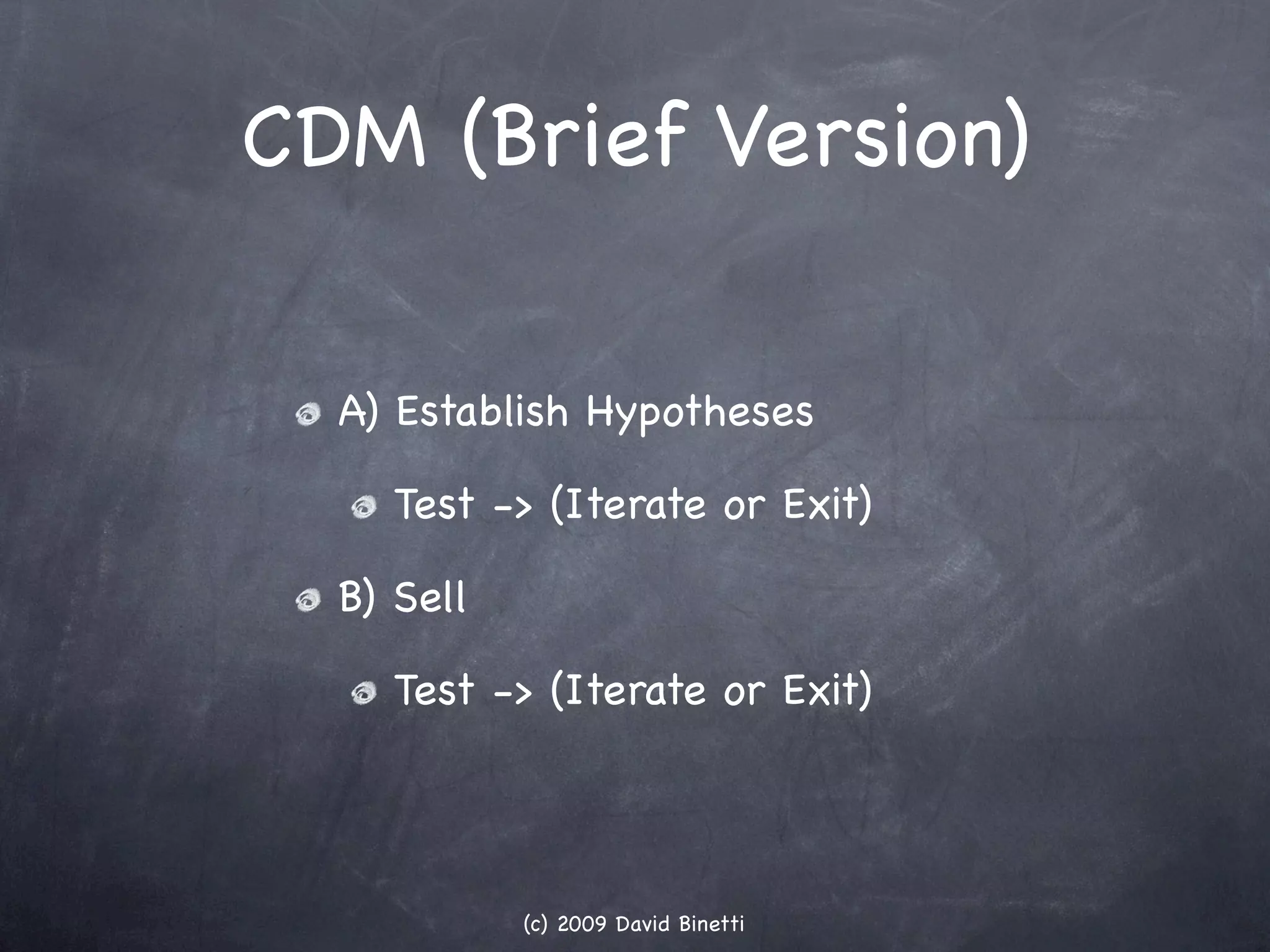
CDM (Brief Version)

  A) Establish Hypotheses

    Test -> (Iterate or Exit)

  B) Sell

    Test -> (Iterate or Exit)


            (c) 2009 David Binetti
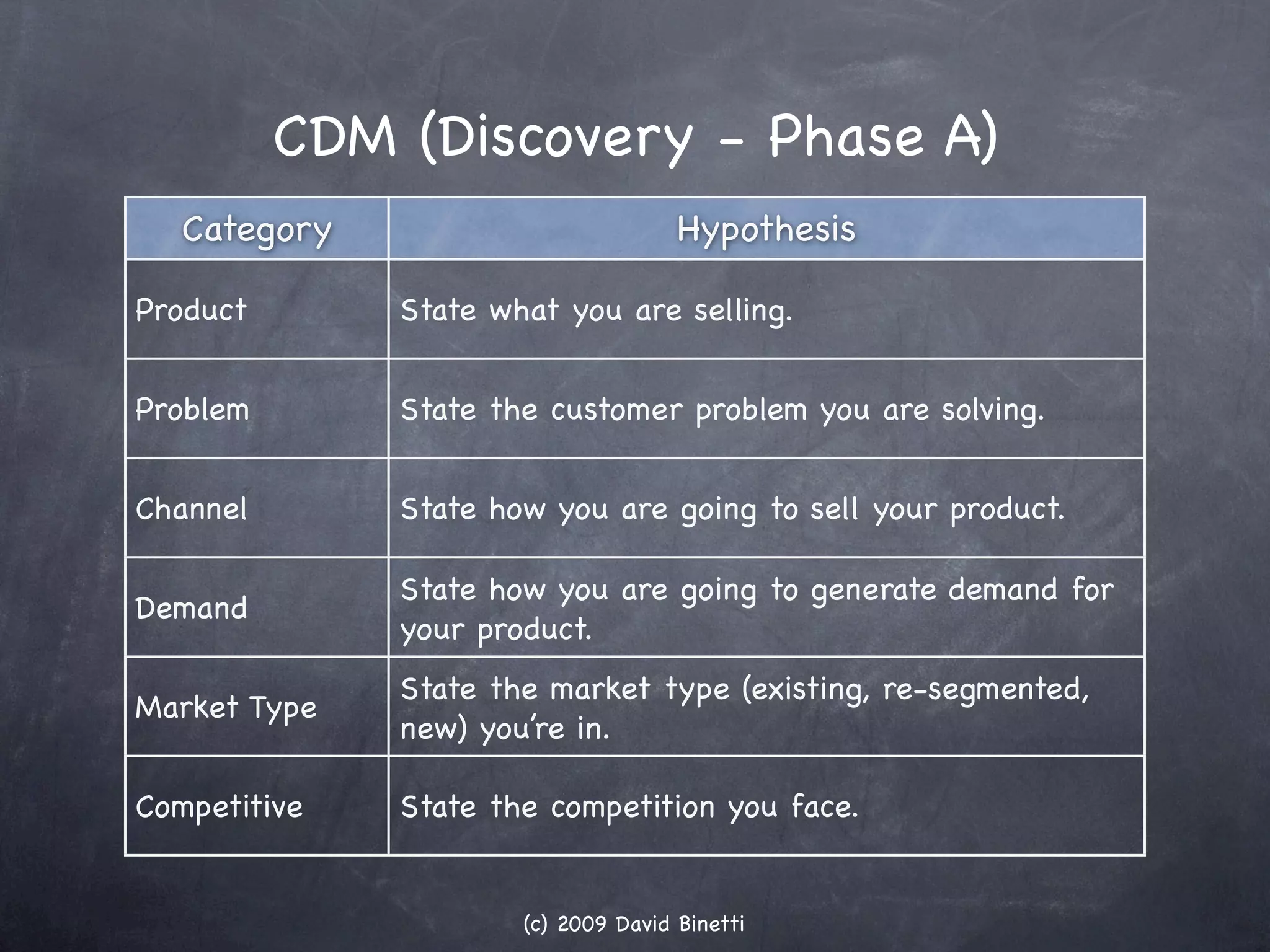
CDM (Discovery - Phase A)
   Category                          Hypothesis

Product       State what you are selling.


Problem       State the customer problem you are solving.


Channel       State how you are going to sell your product.

              State how you are going to generate demand for
Demand
              your product.
              State the market type (existing, re-segmented,
Market Type
              new) you’re in.

Competitive   State the competition you face.


                      (c) 2009 David Binetti
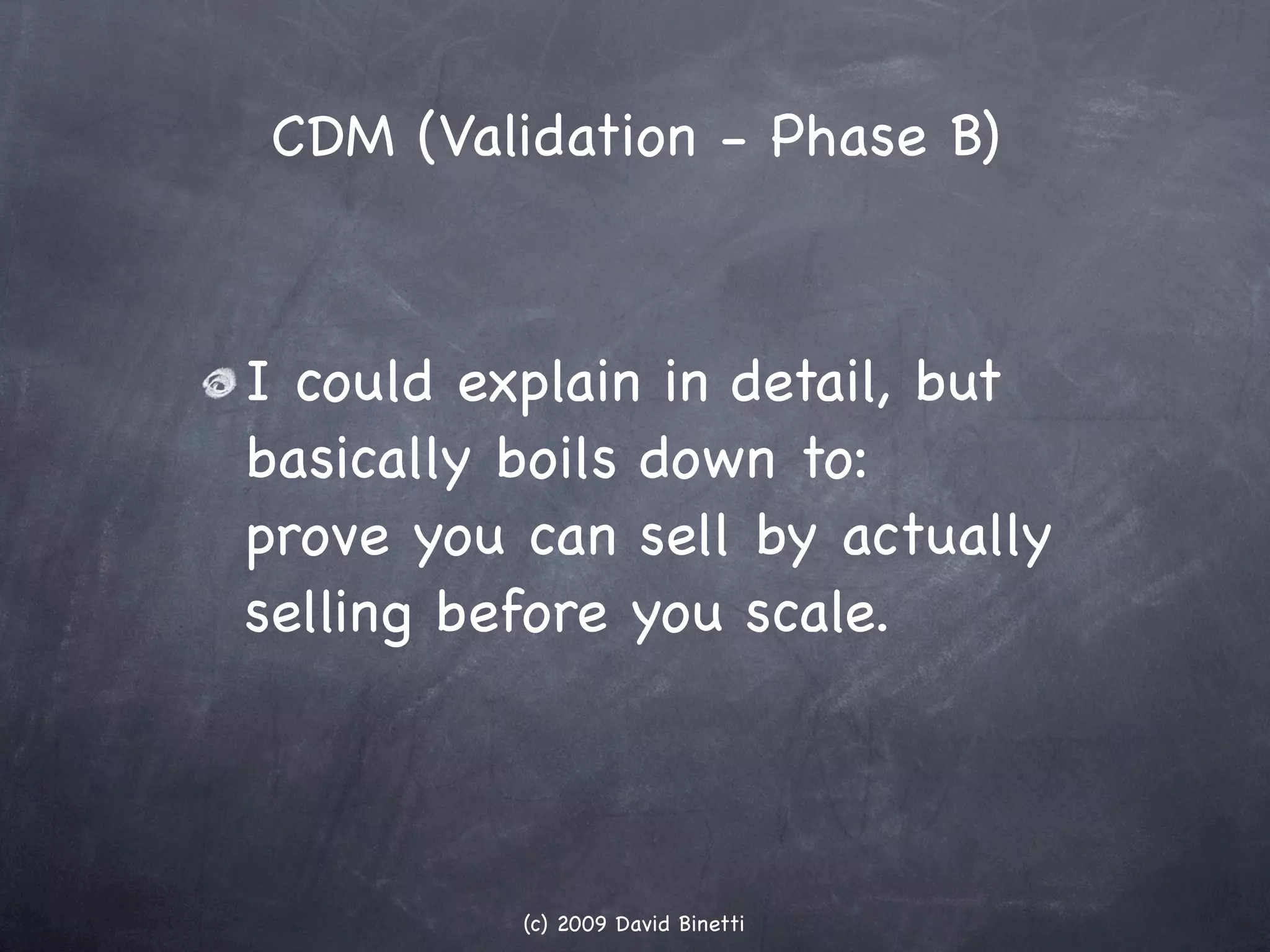
CDM (Validation - Phase B)


I could explain in detail, but
basically boils down to:
prove you can sell by actually
selling before you scale.


          (c) 2009 David Binetti
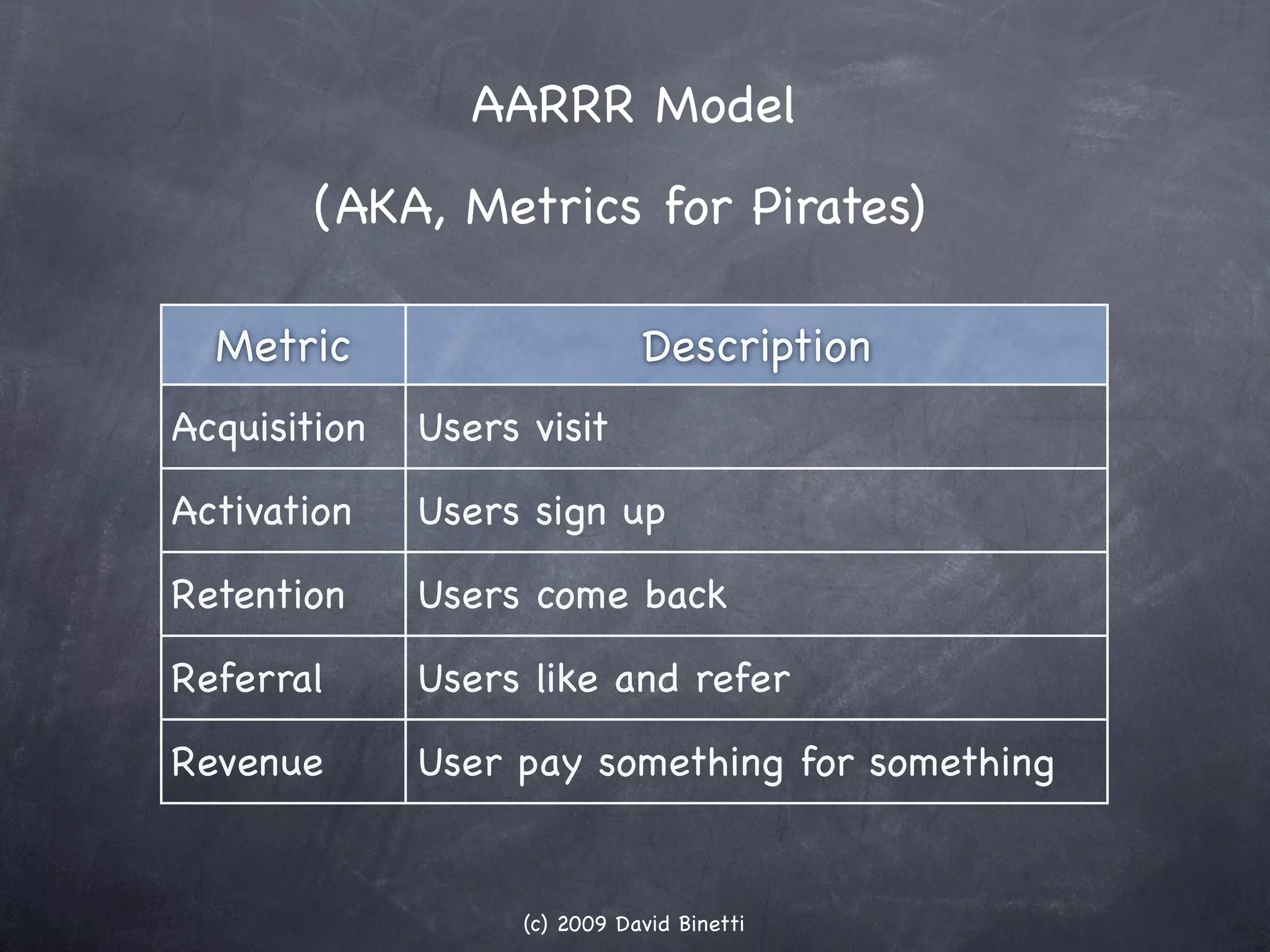
AARRR Model
        (AKA, Metrics for Pirates)

  Metric                       Description
Acquisition   Users visit

Activation    Users sign up

Retention     Users come back

Referral      Users like and refer

Revenue       User pay something for something


                    (c) 2009 David Binetti
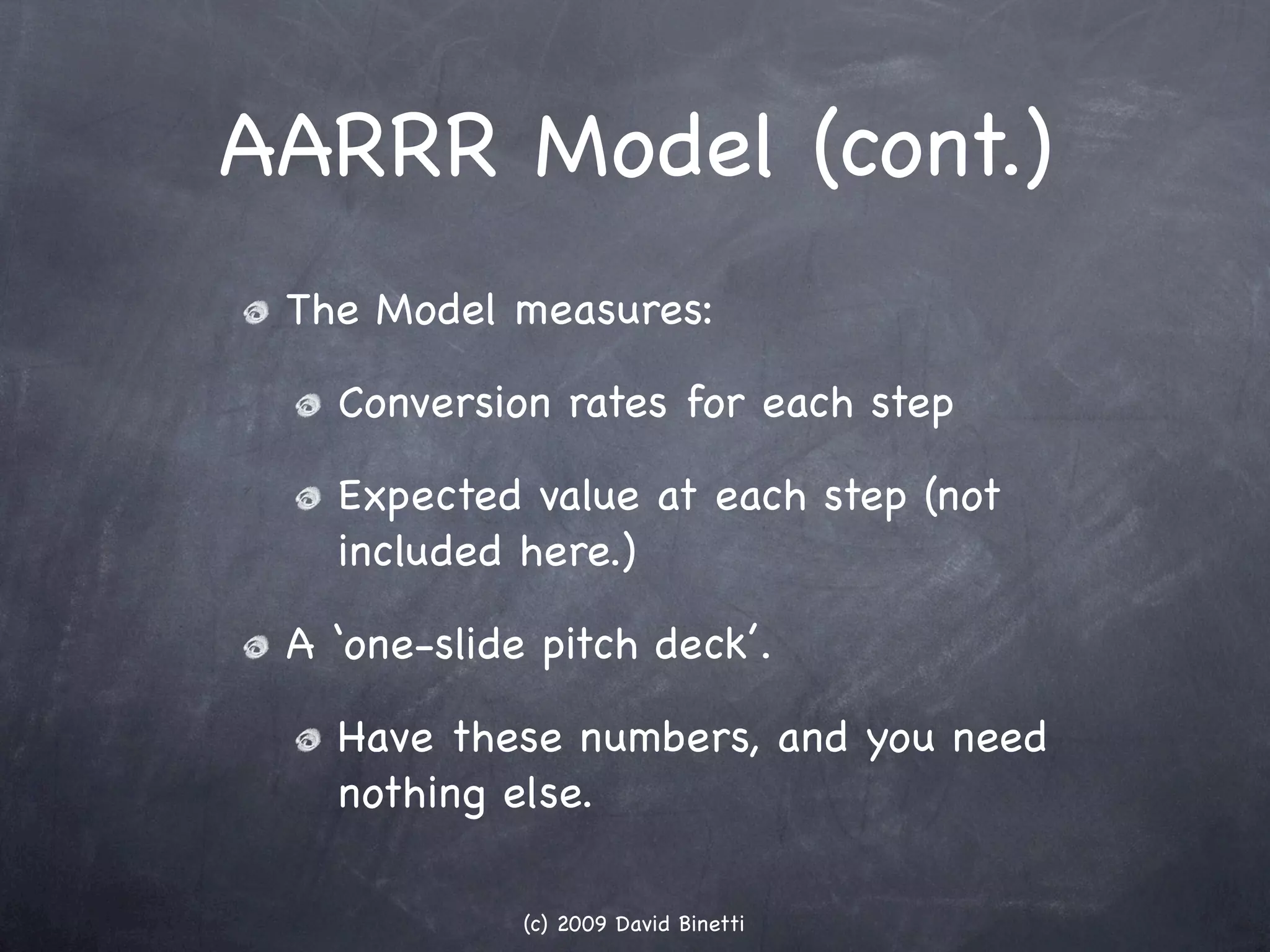
AARRR Model (cont.)
 The Model measures:

   Conversion rates for each step

   Expected value at each step (not
   included here.)

 A ‘one-slide pitch deck’.

   Have these numbers, and you need
   nothing else.

             (c) 2009 David Binetti
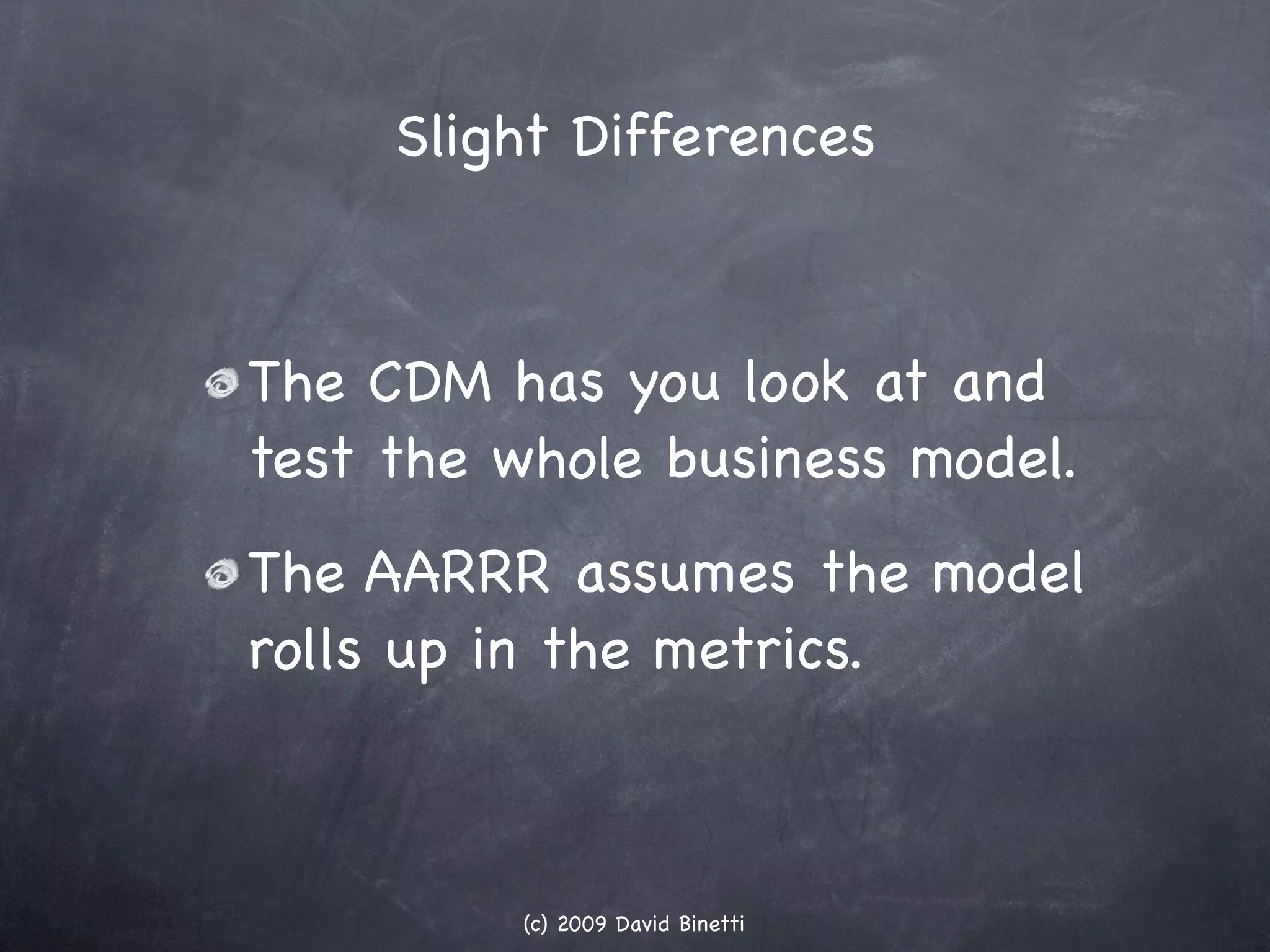
Slight Differences


The CDM has you look at and
test the whole business model.
The AARRR assumes the model
rolls up in the metrics.


         (c) 2009 David Binetti
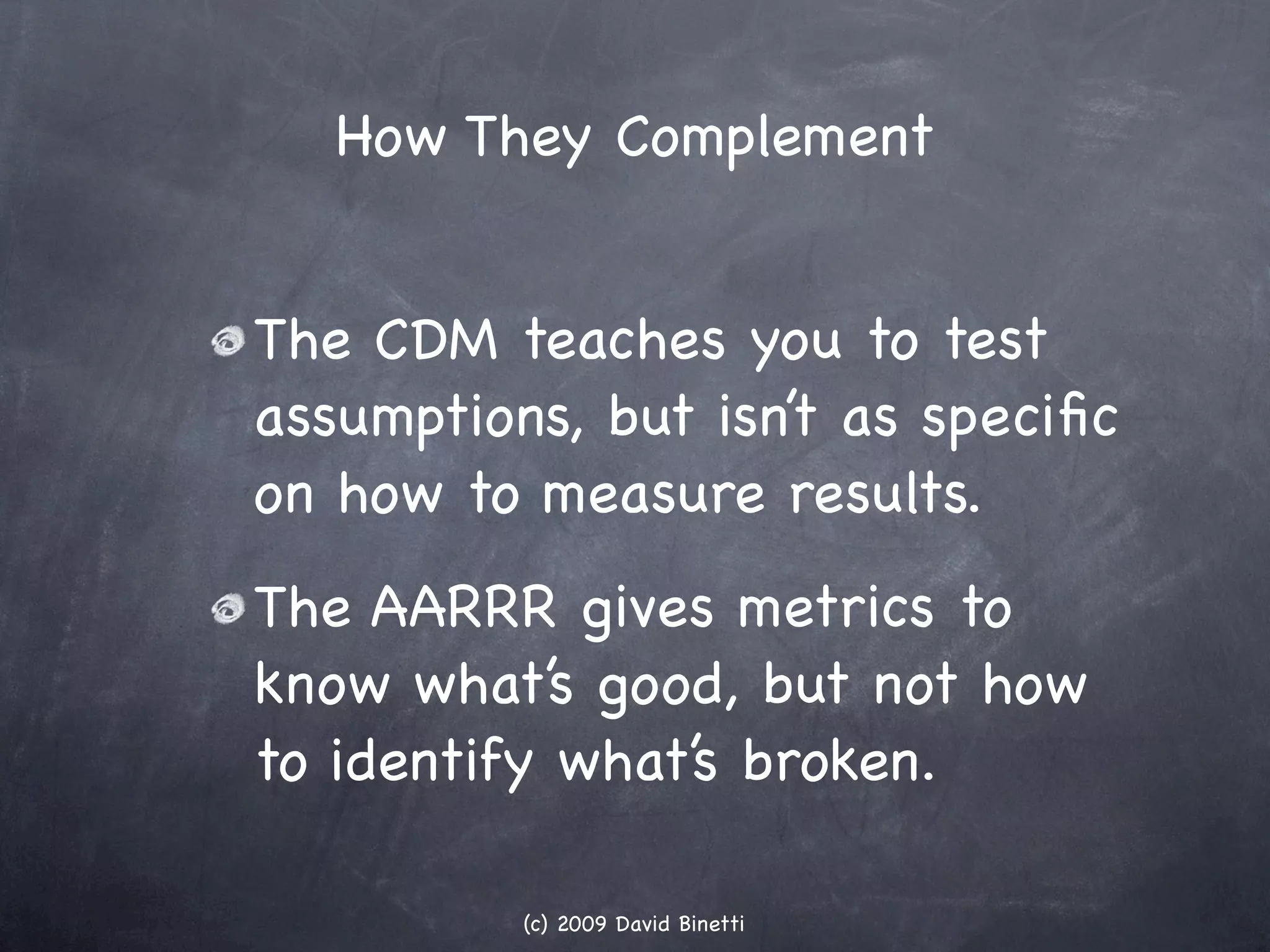
How They Complement


The CDM teaches you to test
assumptions, but isn’t as specific
on how to measure results.
The AARRR gives metrics to
know what’s good, but not how
to identify what’s broken.

          (c) 2009 David Binetti
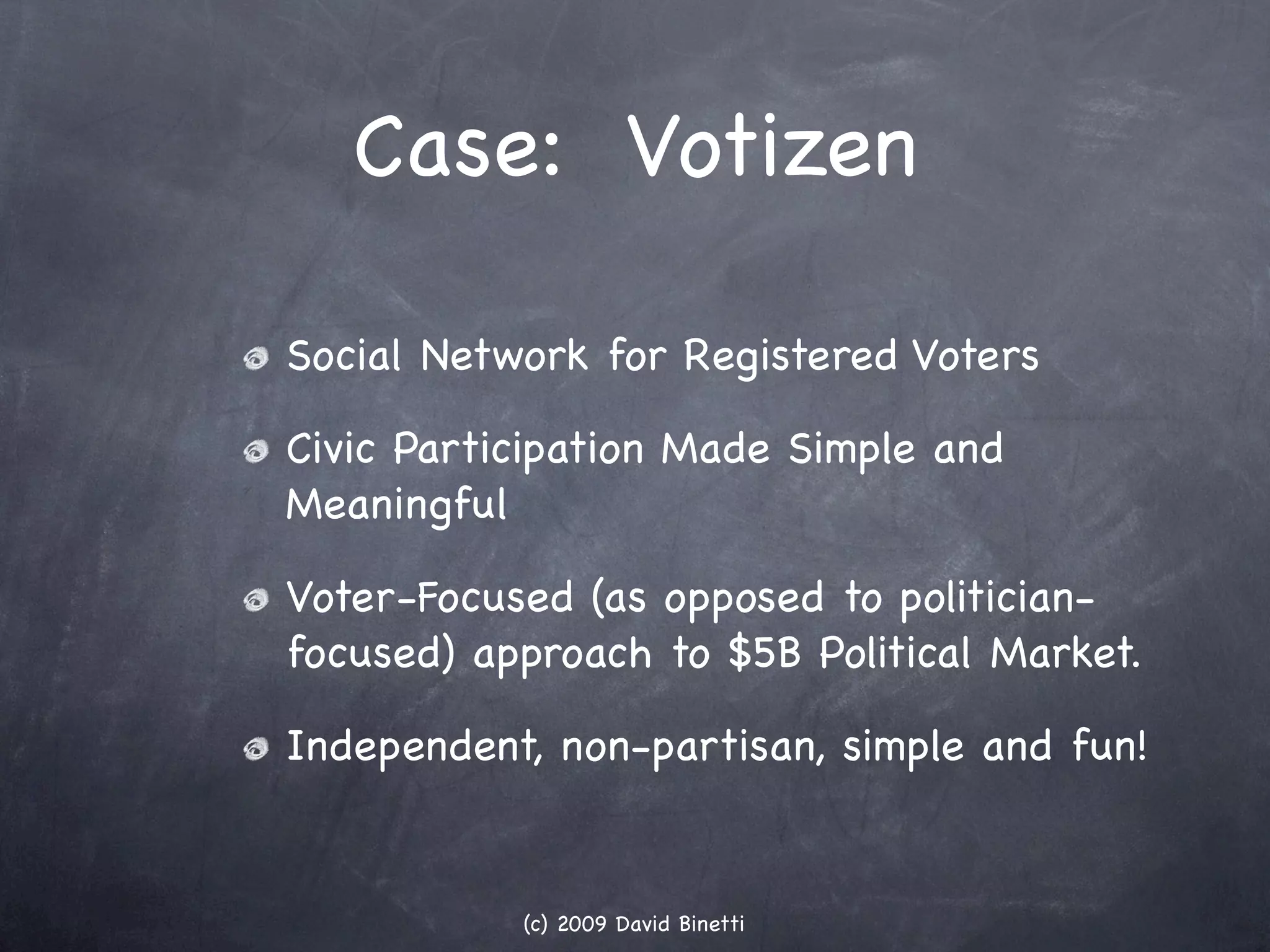
Case: Votizen

Social Network for Registered Voters

Civic Participation Made Simple and
Meaningful

Voter-Focused (as opposed to politician-
focused) approach to $5B Political Market.

Independent, non-partisan, simple and fun!


           (c) 2009 David Binetti
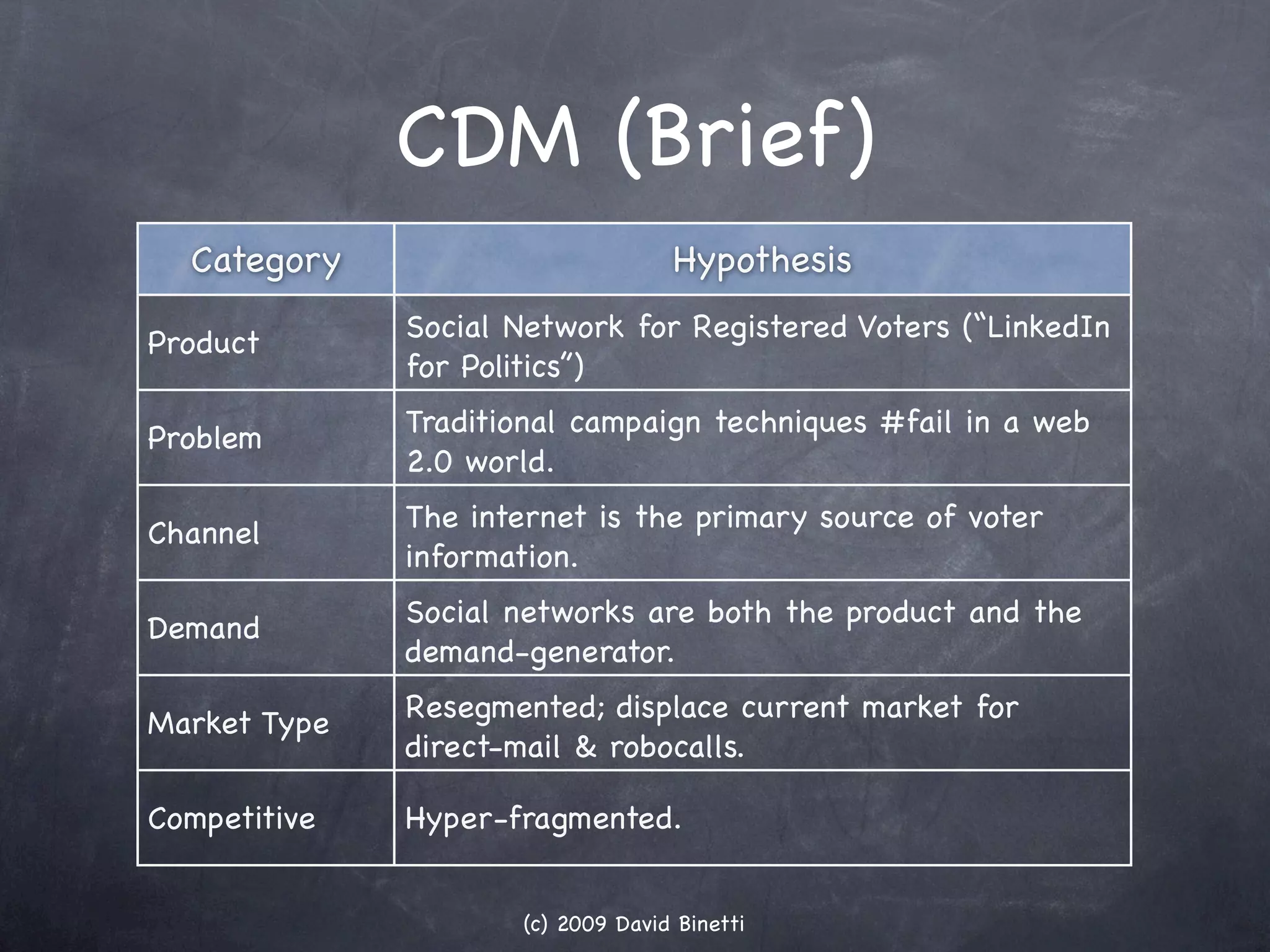
CDM (Brief)
  Category                         Hypothesis
              Social Network for Registered Voters (“LinkedIn
Product
              for Politics”)
              Traditional campaign techniques #fail in a web
Problem
              2.0 world.
              The internet is the primary source of voter
Channel
              information.

Demand        Social networks are both the product and the
              demand-generator.
              Resegmented; displace current market for
Market Type
              direct-mail & robocalls.

Competitive   Hyper-fragmented.


                     (c) 2009 David Binetti
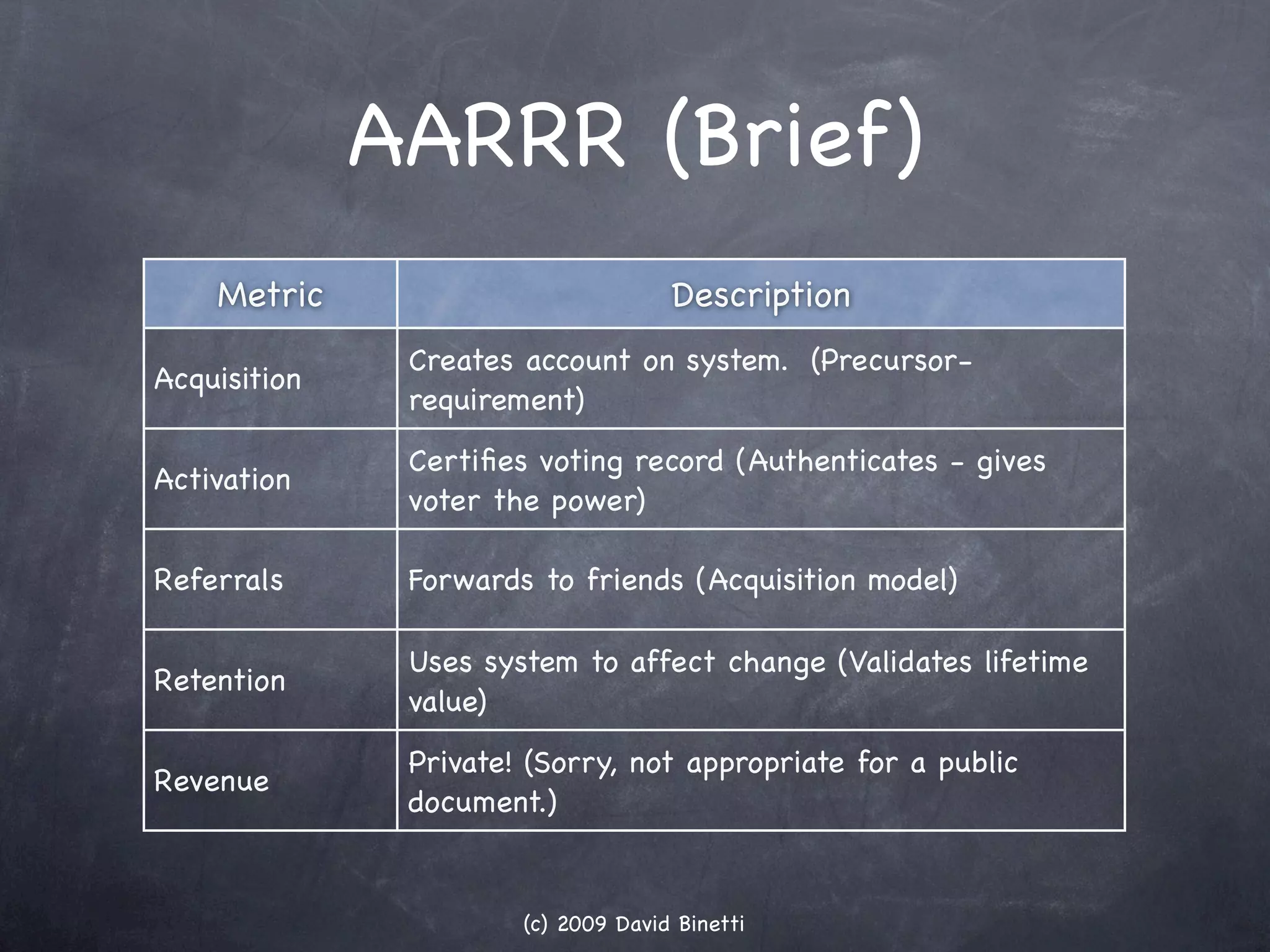
AARRR (Brief)
    Metric                           Description
               Creates account on system. (Precursor-
Acquisition
               requirement)
               Certifies voting record (Authenticates - gives
Activation
               voter the power)

Referrals      Forwards to friends (Acquisition model)

               Uses system to affect change (Validates lifetime
Retention
               value)
               Private! (Sorry, not appropriate for a public
Revenue
               document.)


                       (c) 2009 David Binetti
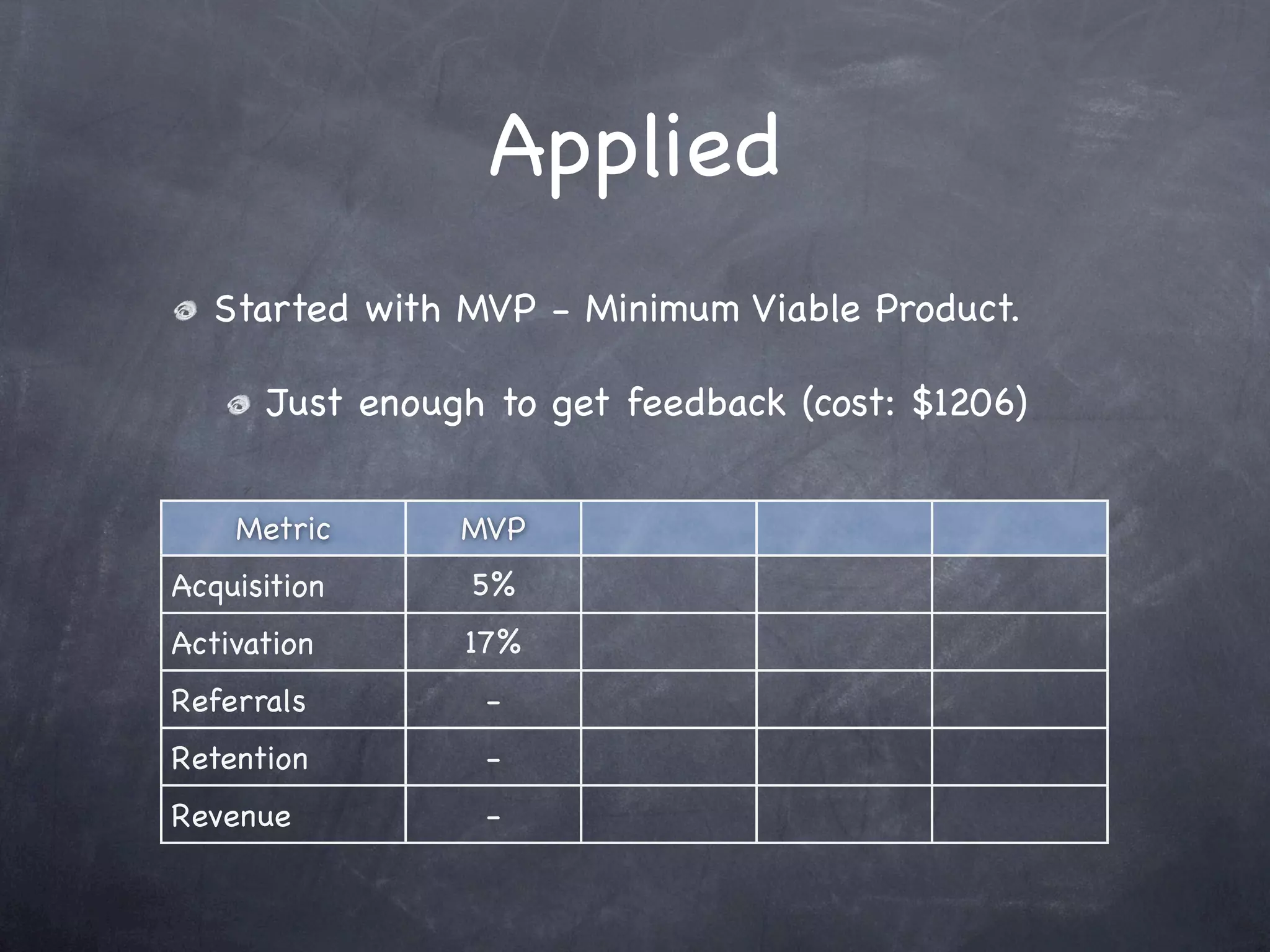
Applied
   Started with MVP - Minimum Viable Product.

      Just enough to get feedback (cost: $1206)


    Metric      MVP
Acquisition      5%
Activation      17%
Referrals        -
Retention        -
Revenue          -
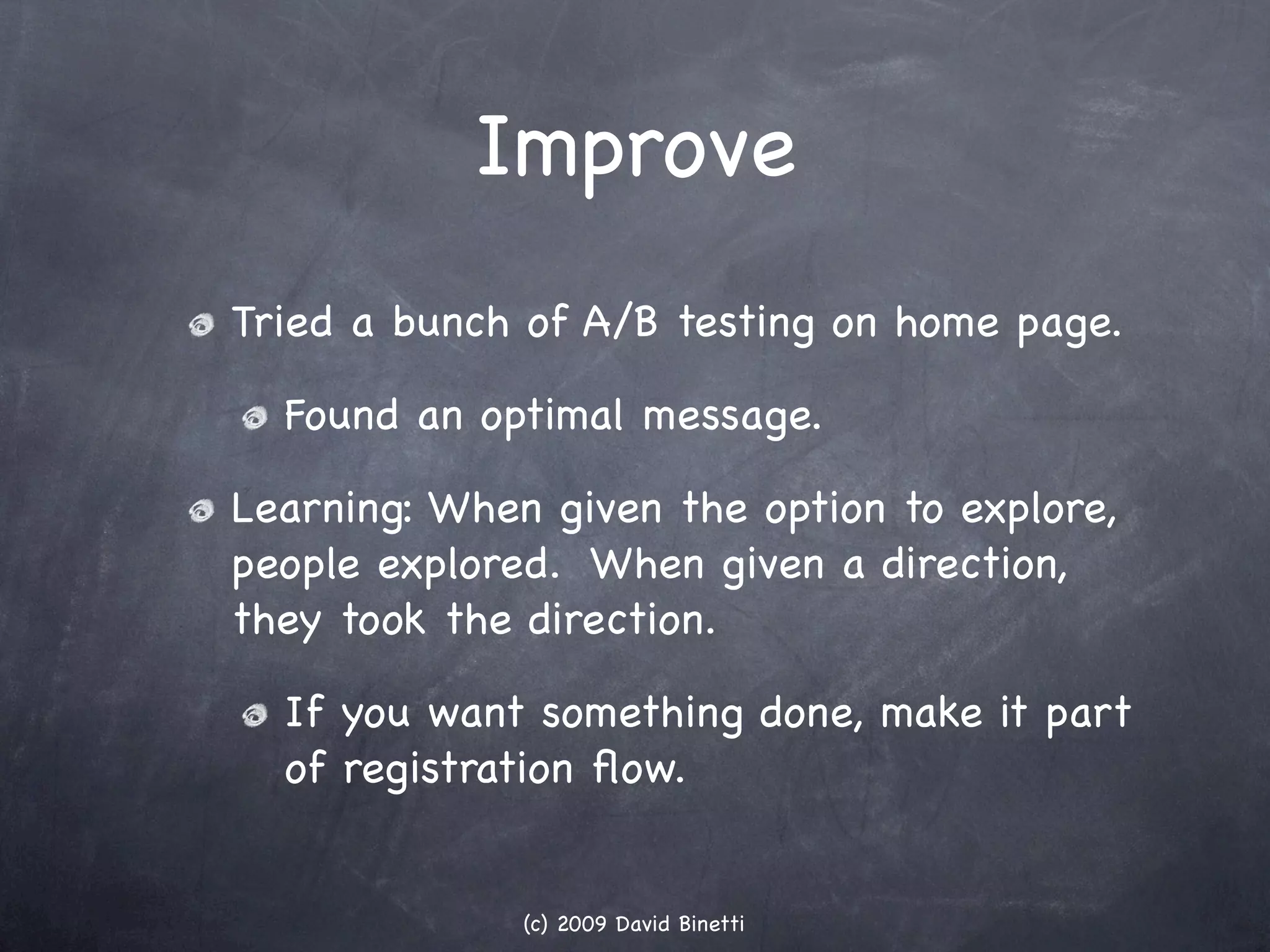
Improve
Tried a bunch of A/B testing on home page.

  Found an optimal message.

Learning: When given the option to explore,
people explored. When given a direction,
they took the direction.

  If you want something done, make it part
  of registration flow.


              (c) 2009 David Binetti
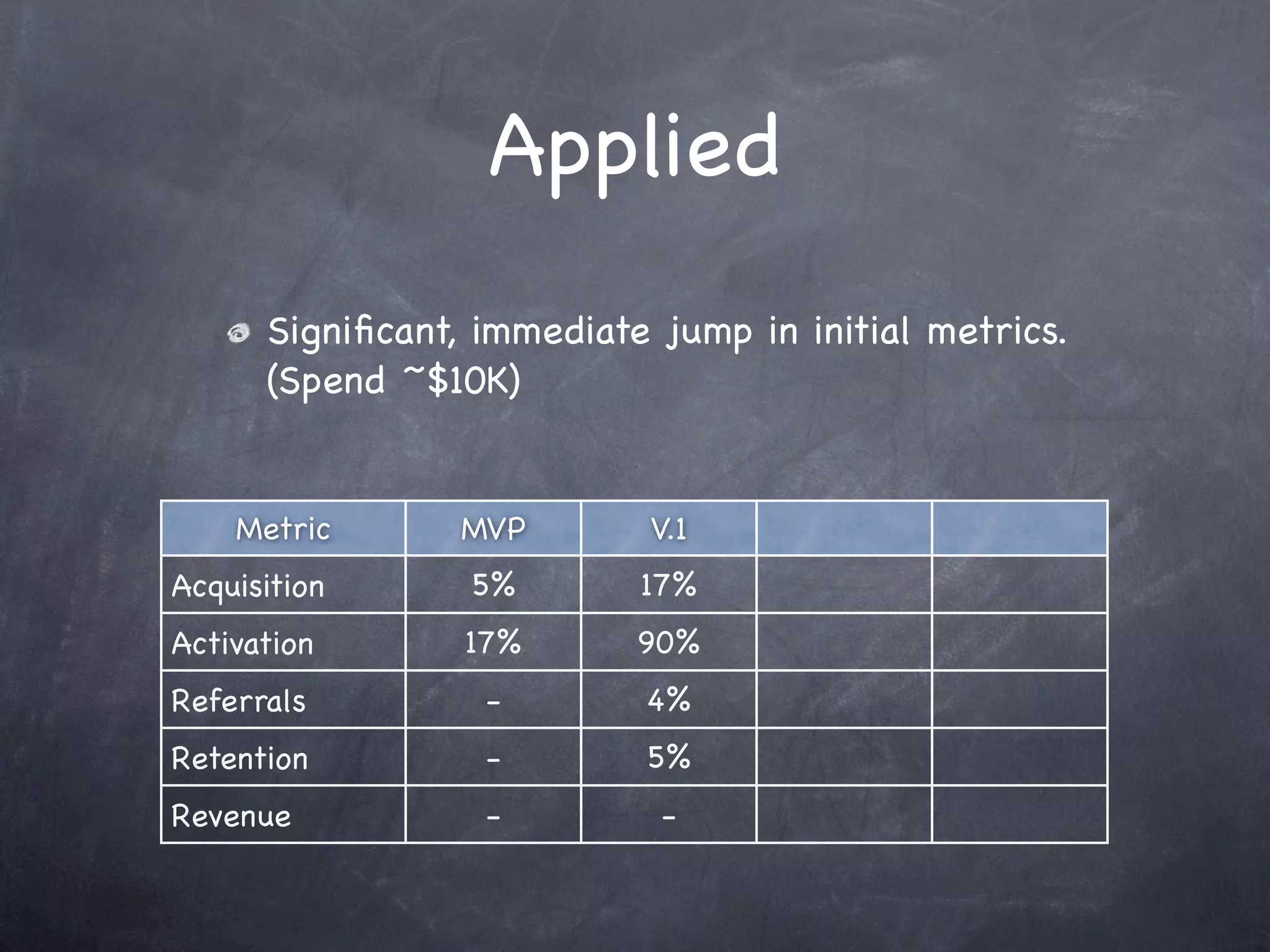
Applied
      Significant, immediate jump in initial metrics.
      (Spend ~$10K)


    Metric       MVP        V.1
Acquisition      5%        17%
Activation       17%       90%
Referrals         -        4%
Retention         -        5%
Revenue           -         -
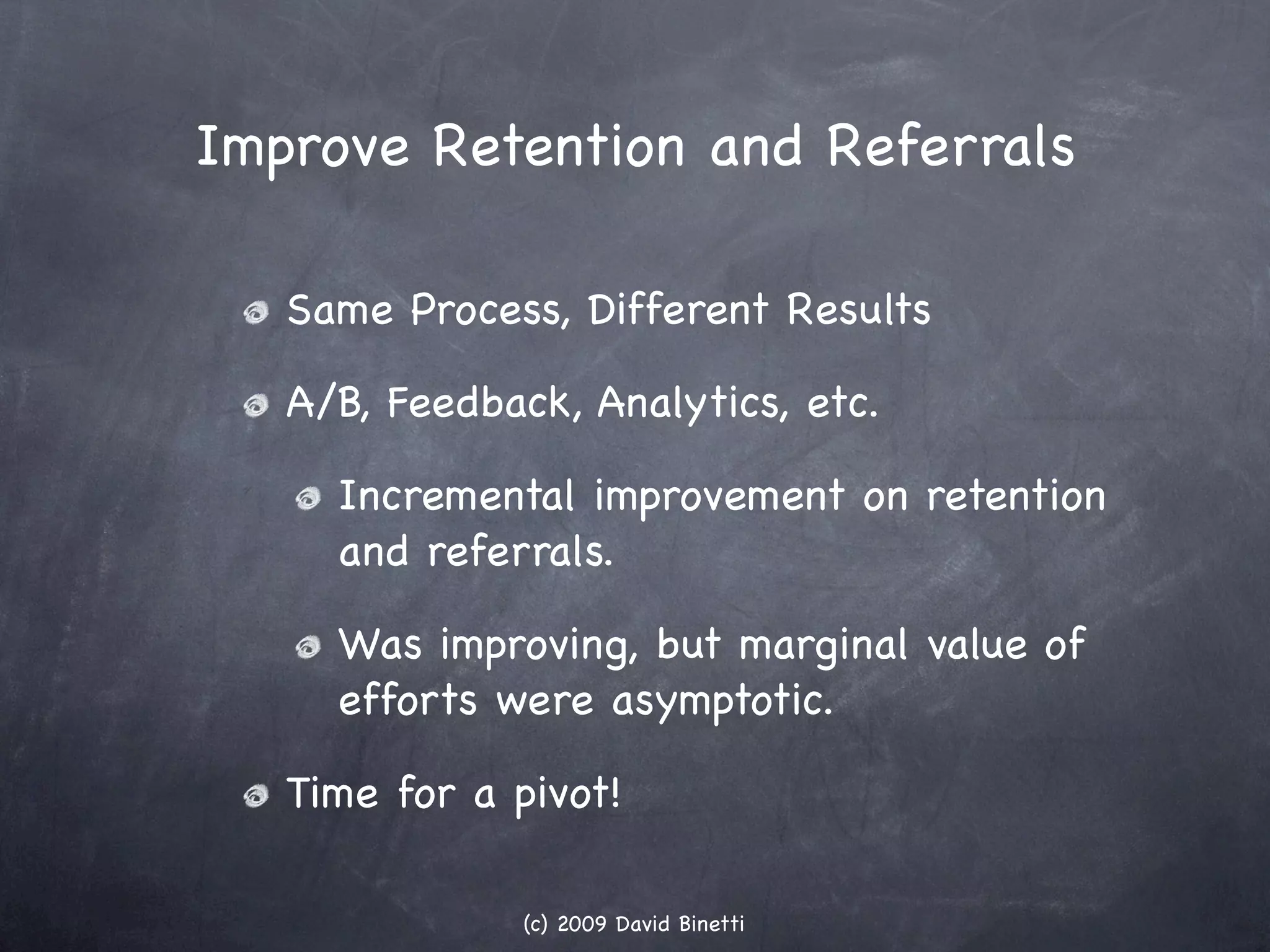
Improve Retention and Referrals

   Same Process, Different Results

   A/B, Feedback, Analytics, etc.

     Incremental improvement on retention
     and referrals.

     Was improving, but marginal value of
     efforts were asymptotic.

   Time for a pivot!

               (c) 2009 David Binetti
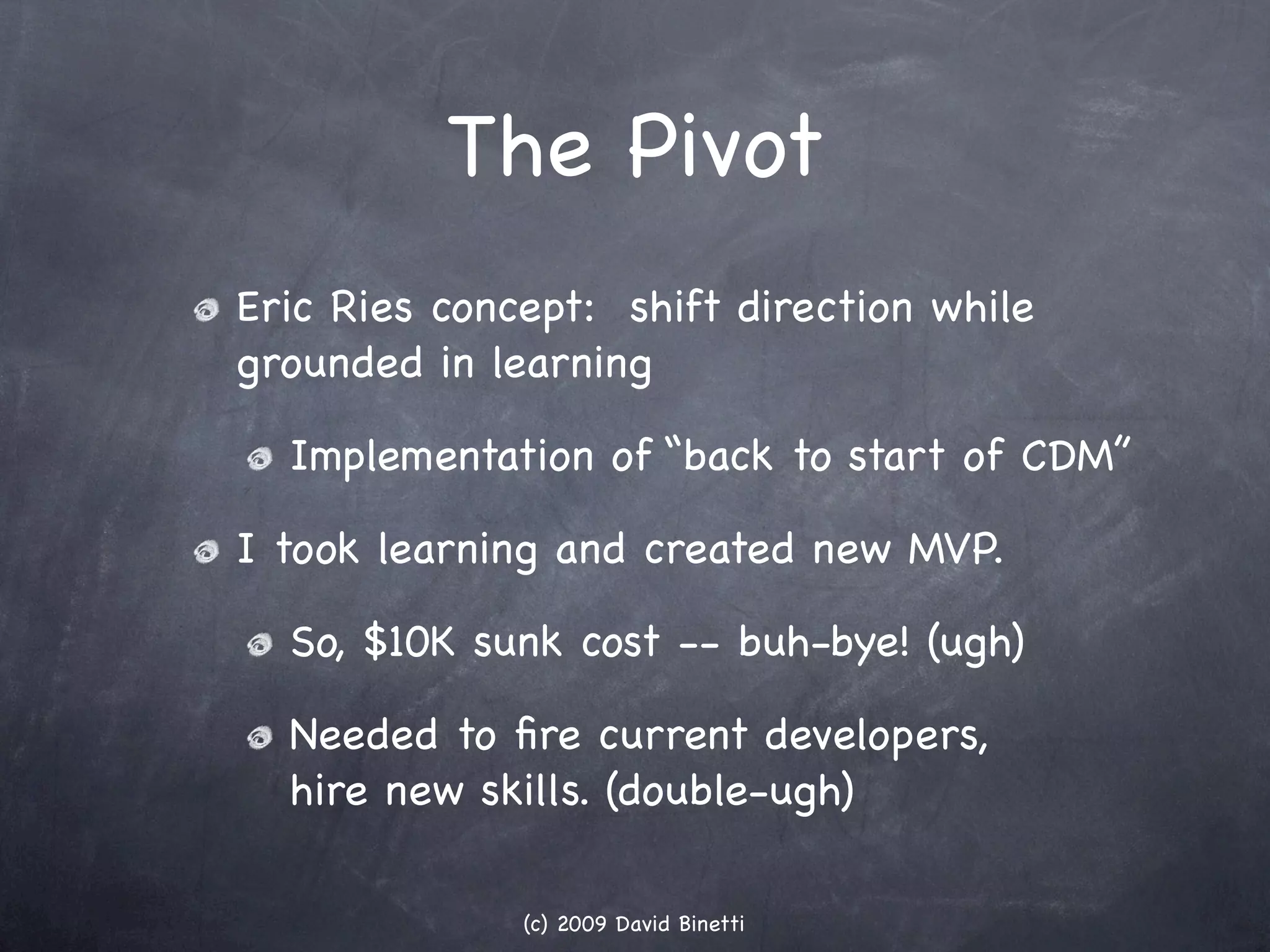
The Pivot
Eric Ries concept: shift direction while
grounded in learning

  Implementation of “back to start of CDM”

I took learning and created new MVP.

  So, $10K sunk cost -- buh-bye! (ugh)

  Needed to fire current developers,
  hire new skills. (double-ugh)

              (c) 2009 David Binetti
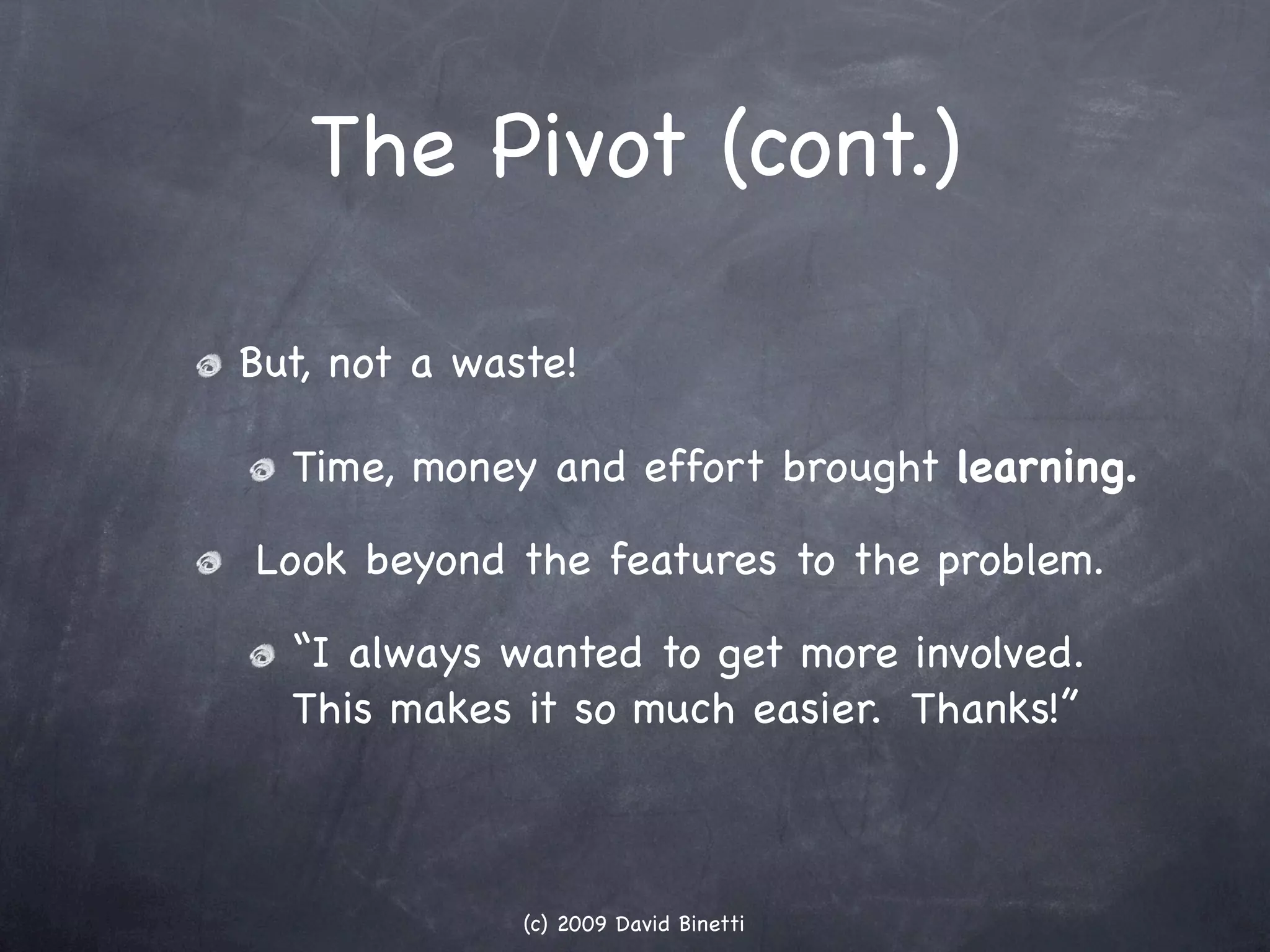
The Pivot (cont.)

But, not a waste!

  Time, money and effort brought learning.

Look beyond the features to the problem.

  “I always wanted to get more involved.
  This makes it so much easier. Thanks!”


              (c) 2009 David Binetti
Applied
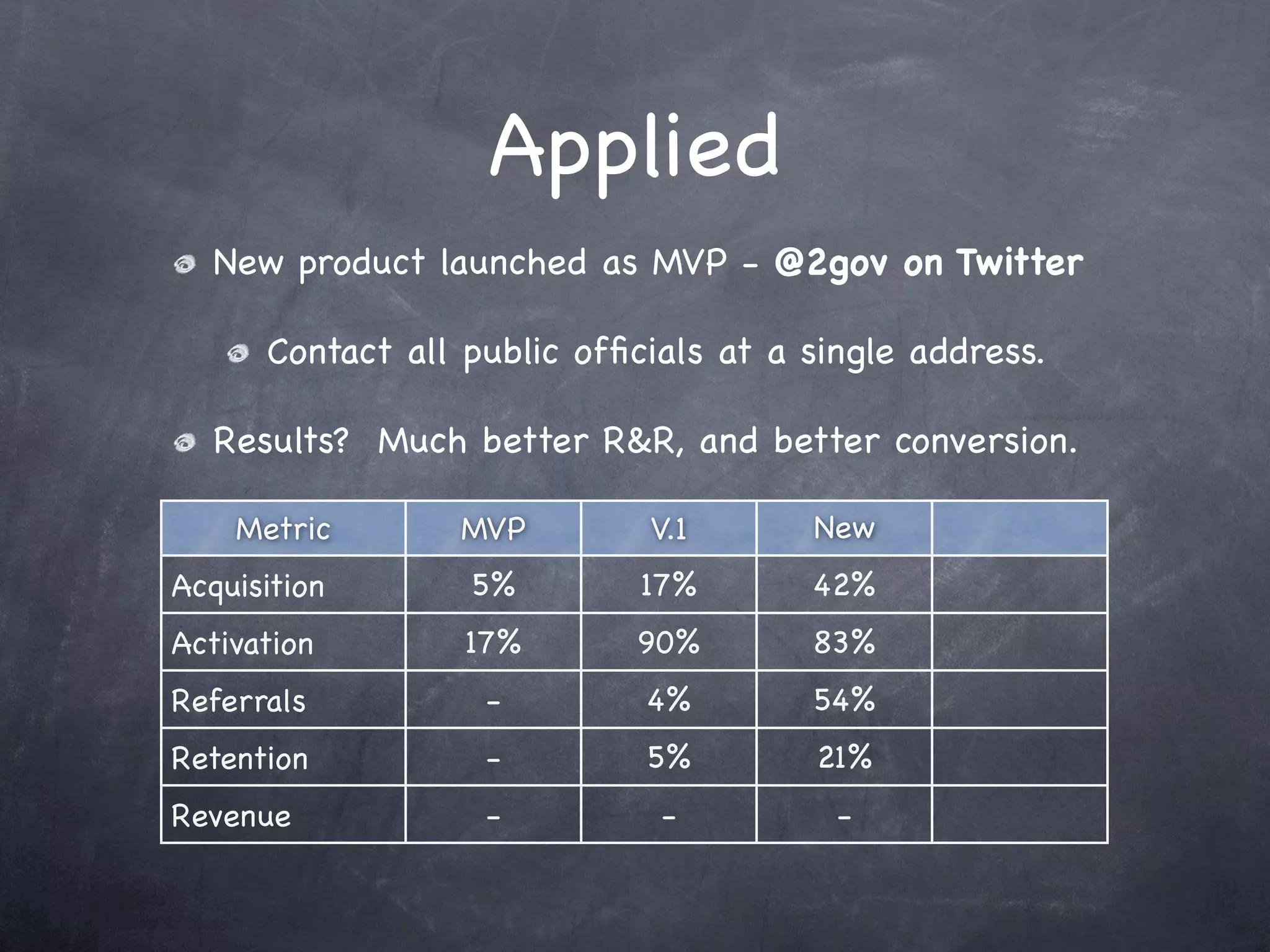
   New product launched as MVP - @2gov on Twitter

      Contact all public officials at a single address.

   Results? Much better R&R, and better conversion.

    Metric       MVP         V.1        New
                                      Product
Acquisition       5%         17%       42%
Activation        17%       90%        83%
Referrals          -         4%        54%
Retention          -         5%        21%
Revenue            -          -          -
Applied
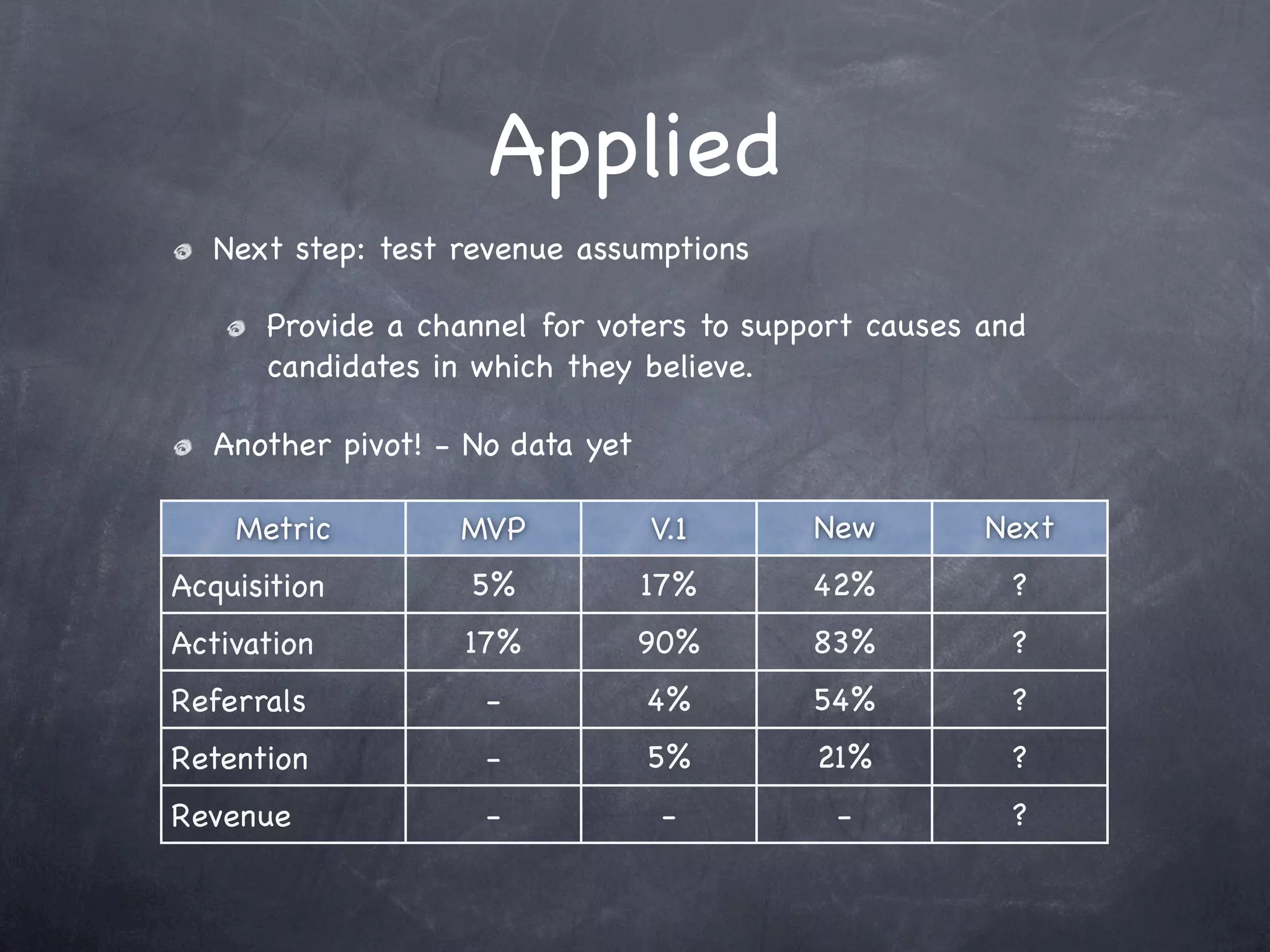
   Next step: test revenue assumptions

      Provide a channel for voters to support causes and
      candidates in which they believe.

   Another pivot! - No data yet

    Metric         MVP            V.1      New       Next
                                         Product   Iteration
Acquisition         5%            17%     42%          ?
Activation         17%            90%     83%          ?
Referrals            -            4%      54%          ?
Retention            -            5%      21%          ?
Revenue              -             -        -          ?
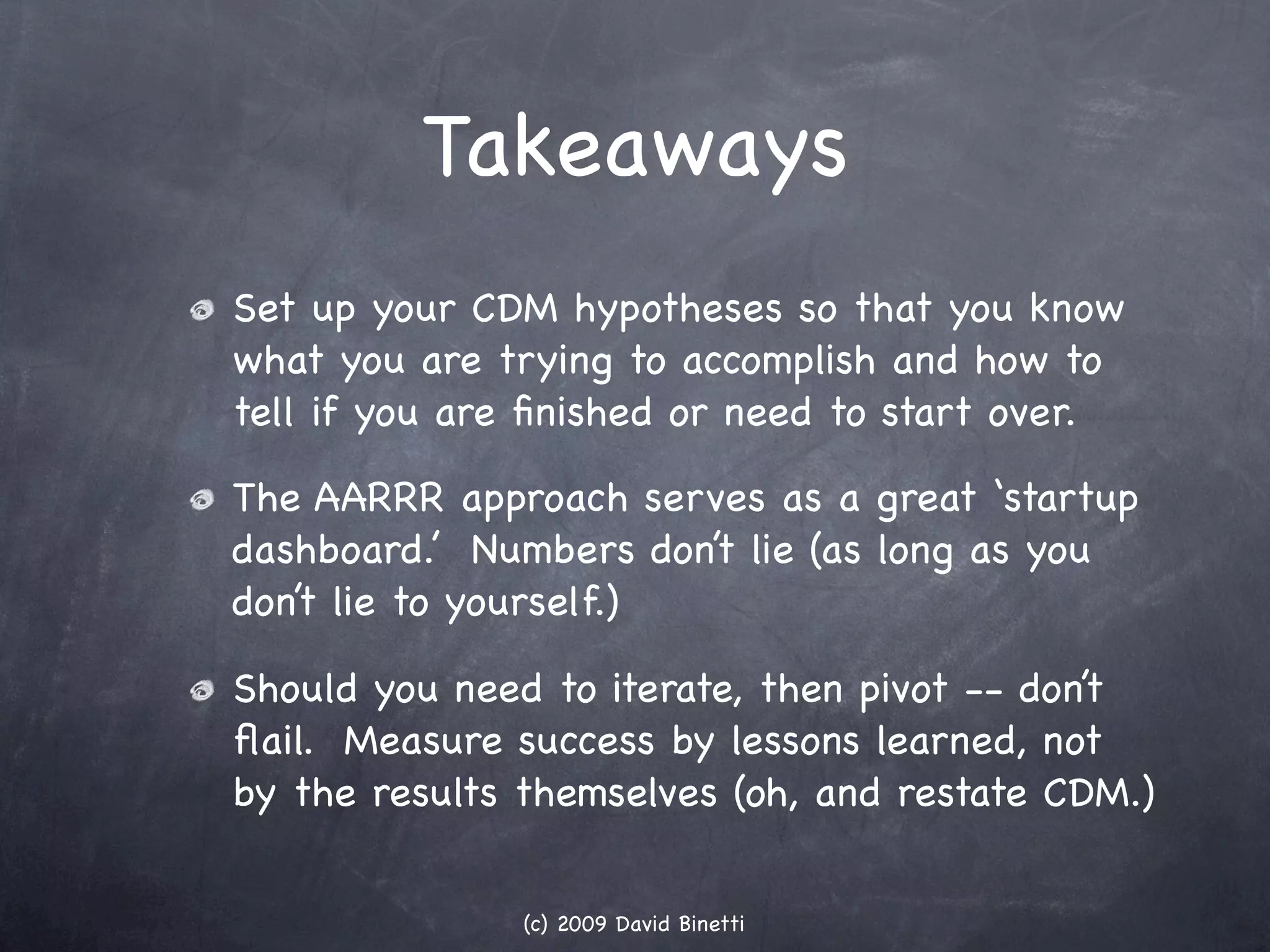
Takeaways
Set up your CDM hypotheses so that you know
what you are trying to accomplish and how to
tell if you are finished or need to start over.

The AARRR approach serves as a great ‘startup
dashboard.’ Numbers don’t lie (as long as you
don’t lie to yourself.)

Should you need to iterate, then pivot -- don’t
flail. Measure success by lessons learned, not
by the results themselves (oh, and restate CDM.)


               (c) 2009 David Binetti
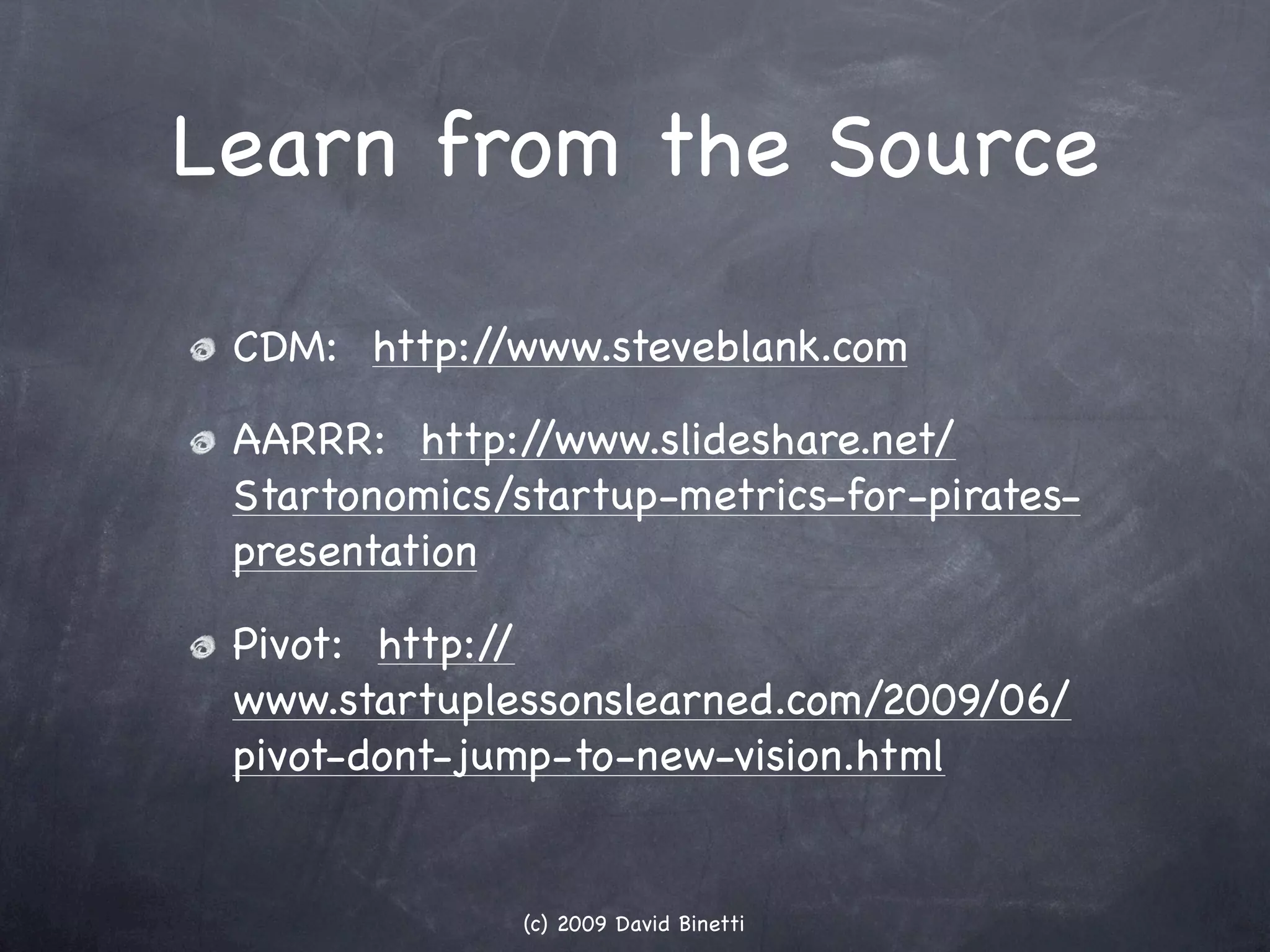
Learn from the Source

 CDM: http://www.steveblank.com

 AARRR: http:/ /www.slideshare.net/
 Startonomics/startup-metrics-for-pirates-
 presentation

 Pivot: http://
 www.startuplessonslearned.com/2009/06/
 pivot-dont-jump-to-new-vision.html


               (c) 2009 David Binetti
Feedback Wanted!

Would love feedback!

Want to get better, so criticism is preferred.

  “If you don’t have anything bad to say,
  then don’t say anything.”

dbinetti@gmail.com


              (c) 2009 David Binetti

Startup Case Study

  • 1.
    The Sacred, The Profane,and the Pivot A Brief Case Study of Applied CDM, AARRR Metrics, and Lean Principles (c) 2009 David Binetti
  • 2.
    Definitions Sacred Steve Blank’s Customer Development Model (CDM). I follow it religiously. Profane Dave McClure swears every third word. Oh, and his Acquisition, Activation, Retention, Referral, Revenue (AARRR) model is awesome. Pivot Eric Ries’s concept of strategic shifts predicated on learnings. (Sorry, no pithy witticism for this.) (c) 2009 David Binetti
  • 3.
    CDM (Brief Version) A) Establish Hypotheses Test -> (Iterate or Exit) B) Sell Test -> (Iterate or Exit) (c) 2009 David Binetti
  • 4.
    CDM (Discovery -Phase A) Category Hypothesis Product State what you are selling. Problem State the customer problem you are solving. Channel State how you are going to sell your product. State how you are going to generate demand for Demand your product. State the market type (existing, re-segmented, Market Type new) you’re in. Competitive State the competition you face. (c) 2009 David Binetti
  • 5.
    CDM (Validation -Phase B) I could explain in detail, but basically boils down to: prove you can sell by actually selling before you scale. (c) 2009 David Binetti
  • 6.
    AARRR Model (AKA, Metrics for Pirates) Metric Description Acquisition Users visit Activation Users sign up Retention Users come back Referral Users like and refer Revenue User pay something for something (c) 2009 David Binetti
  • 7.
    AARRR Model (cont.) The Model measures: Conversion rates for each step Expected value at each step (not included here.) A ‘one-slide pitch deck’. Have these numbers, and you need nothing else. (c) 2009 David Binetti
  • 8.
    Slight Differences The CDMhas you look at and test the whole business model. The AARRR assumes the model rolls up in the metrics. (c) 2009 David Binetti
  • 9.
    How They Complement TheCDM teaches you to test assumptions, but isn’t as specific on how to measure results. The AARRR gives metrics to know what’s good, but not how to identify what’s broken. (c) 2009 David Binetti
  • 10.
    Case: Votizen Social Networkfor Registered Voters Civic Participation Made Simple and Meaningful Voter-Focused (as opposed to politician- focused) approach to $5B Political Market. Independent, non-partisan, simple and fun! (c) 2009 David Binetti
  • 11.
    CDM (Brief) Category Hypothesis Social Network for Registered Voters (“LinkedIn Product for Politics”) Traditional campaign techniques #fail in a web Problem 2.0 world. The internet is the primary source of voter Channel information. Demand Social networks are both the product and the demand-generator. Resegmented; displace current market for Market Type direct-mail & robocalls. Competitive Hyper-fragmented. (c) 2009 David Binetti
  • 12.
    AARRR (Brief) Metric Description Creates account on system. (Precursor- Acquisition requirement) Certifies voting record (Authenticates - gives Activation voter the power) Referrals Forwards to friends (Acquisition model) Uses system to affect change (Validates lifetime Retention value) Private! (Sorry, not appropriate for a public Revenue document.) (c) 2009 David Binetti
  • 13.
    Applied Started with MVP - Minimum Viable Product. Just enough to get feedback (cost: $1206) Metric MVP Acquisition 5% Activation 17% Referrals - Retention - Revenue -
  • 14.
    Improve Tried a bunchof A/B testing on home page. Found an optimal message. Learning: When given the option to explore, people explored. When given a direction, they took the direction. If you want something done, make it part of registration flow. (c) 2009 David Binetti
  • 15.
    Applied Significant, immediate jump in initial metrics. (Spend ~$10K) Metric MVP V.1 Acquisition 5% 17% Activation 17% 90% Referrals - 4% Retention - 5% Revenue - -
  • 16.
    Improve Retention andReferrals Same Process, Different Results A/B, Feedback, Analytics, etc. Incremental improvement on retention and referrals. Was improving, but marginal value of efforts were asymptotic. Time for a pivot! (c) 2009 David Binetti
  • 17.
    The Pivot Eric Riesconcept: shift direction while grounded in learning Implementation of “back to start of CDM” I took learning and created new MVP. So, $10K sunk cost -- buh-bye! (ugh) Needed to fire current developers, hire new skills. (double-ugh) (c) 2009 David Binetti
  • 18.
    The Pivot (cont.) But,not a waste! Time, money and effort brought learning. Look beyond the features to the problem. “I always wanted to get more involved. This makes it so much easier. Thanks!” (c) 2009 David Binetti
  • 19.
    Applied New product launched as MVP - @2gov on Twitter Contact all public officials at a single address. Results? Much better R&R, and better conversion. Metric MVP V.1 New Product Acquisition 5% 17% 42% Activation 17% 90% 83% Referrals - 4% 54% Retention - 5% 21% Revenue - - -
  • 20.
    Applied Next step: test revenue assumptions Provide a channel for voters to support causes and candidates in which they believe. Another pivot! - No data yet Metric MVP V.1 New Next Product Iteration Acquisition 5% 17% 42% ? Activation 17% 90% 83% ? Referrals - 4% 54% ? Retention - 5% 21% ? Revenue - - - ?
  • 21.
    Takeaways Set up yourCDM hypotheses so that you know what you are trying to accomplish and how to tell if you are finished or need to start over. The AARRR approach serves as a great ‘startup dashboard.’ Numbers don’t lie (as long as you don’t lie to yourself.) Should you need to iterate, then pivot -- don’t flail. Measure success by lessons learned, not by the results themselves (oh, and restate CDM.) (c) 2009 David Binetti
  • 22.
    Learn from theSource CDM: http://www.steveblank.com AARRR: http:/ /www.slideshare.net/ Startonomics/startup-metrics-for-pirates- presentation Pivot: http:// www.startuplessonslearned.com/2009/06/ pivot-dont-jump-to-new-vision.html (c) 2009 David Binetti
  • 23.
    Feedback Wanted! Would lovefeedback! Want to get better, so criticism is preferred. “If you don’t have anything bad to say, then don’t say anything.” dbinetti@gmail.com (c) 2009 David Binetti